Where tomorrow’s scientists prefer to live − and where they’d rather not

Source: The Conversation – USA (2) – By Christopher P. Scheitle, Associate Professor of Sociology, West Virginia University
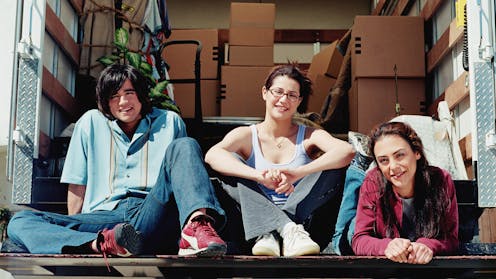
Many students have strong feelings about where they want to move after graduation. Tony Garcia/Stone via Getty Images

Graduate students interested in an academic career after graduation day have often been told they need to be open to moving somewhere they may not want to live. This advice is because of how hard it is to get a tenure-track professor position.

These days, this advice may be less relevant as graduate students are increasingly pursuing and ending up in careers outside of academia.

Where graduate students want to settle post-graduation has potential consequences for communities and states across the country that depend more and more on a steady stream of skilled workers to power their economies. Locations seen as undesirable may struggle to attract and retain the next generation of scientists, engineers, professors and other professions filled by today’s graduate students.

We are sociologists who are examining some of the factors that influence graduate students’ educational and career paths as part of a research project supported by the National Science Foundation. In March 2025 we distributed a survey to a sample of U.S.-based graduate students in five natural and social science disciplines: physics, chemistry, biology, psychology and sociology.

As part of our survey, we asked students to identify states they would prefer to live in and places where they would be unwilling to go. To some extent, our findings match some past anecdotes and evidence about the varying number of applications received for academic positions across different states or regions.

But little data has directly assessed students’ preferences, and our survey also provides some evidence that some states’ policies are having a negative impact on their ability to attract highly educated people.

Most preferred, most unwilling

For our study, we built our sample from the top 60 graduate programs for each of the five disciplines based on rankings from U.S. News and World Report. We received responses from nearly 2,000 students. Almost all of these students – 98%, specifically – are pursuing Ph.D.s in their respective fields.

As part of our survey, we asked students to identify locations where they would “prefer” to live and also those where they would be “unwilling” to live after finishing their graduate program. For each of these questions, we presented students with a list of all states along with the option of “outside of the United States.”

Just looking at the overall percentages, California tops the list of preferred places, with 49% of all survey-takers stating a preference to live there, followed by New York at 45% and Massachusetts with 41%.

On the other hand, Alabama was selected most often as a state students said they’d be unwilling to move to, with 58% declaring they wouldn’t want to live there. This was followed by Mississippi and Arkansas, both with just above 50% saying they’d be unwilling to move to either state.

Clusters of preference

While the two lists in many respects appear like inversions of one another, there are some exceptions to that. Looking beyond the overall percentages for each survey question, we used statistical analysis to identify underlying groups or clusters of states that are more similar to each other across both the “prefer” and “unwilling” questions.

One cluster, represented by California, New York and Massachusetts, is characterized by a very high level of preference and a low level of unwillingness. About 35% to 50% of students expressed a preference for living in these places, while only 5% to 10% said they would be unwilling to live in them. The response of “outside of the United States” is also in this category, which is noteworthy given recent concerns about the current generation of Ph.D. students looking to leave the country and efforts by other nations to recruit them.

A second cluster represents states where the preference levels are a bit lower, 20% to 30%, and the unwillingness levels are a bit higher, 7% to 15%. Still, these are states for which graduate students hold generally favorable opinions about living in after finishing their programs. This cluster includes states such as Colorado, Illinois, Pennsylvania, Maryland and New Jersey.

A third group of states represents locations for which the rate of preference is similar to the rate of unwillingness, in the range of 10% to 20%. This cluster includes states such as Minnesota, Delaware and Virginia.

The fourth and fifth clusters consist of states where the rate of unwillingness exceeds the rate of preference, with the size of the gap distinguishing the two clusters. In the fourth cluster, at least some students – 5% to 10% – express a preference for living in them, while around 30% to 40% say they are unwilling to live in them. This cluster includes Florida, Montana, South Carolina and Utah.

Almost no students express a preference for living in the states contained in the fifth cluster, while the highest percentages – 40% to 60% – express an unwillingness to live in them. This cluster includes Alabama, Kansas, Oklahoma and South Dakota.

Signs of current politics

Many factors influence our preferences for where we want to live, including family, weather and how urban, rural or suburban it is. The politics of a community can also influence our perceptions of a place’s desirability.

Indeed, political factors may be of particular concern to graduate students. In recent years, some states have taken a more hostile stance toward specific academic disciplines, institutions of higher education in general, or professions that are of interest to graduate students. While states such as Florida and Texas have been leading such efforts, many others have followed.

Interestingly, our statistical grouping of states finds that students’ unwillingness to live in states such as Texas, Florida, Georgia and Ohio is higher than we would expect given those states’ corresponding preference levels. For example, about 10% of students selected Texas as a place they would prefer to live in after graduation. Looking at other states with similar preference levels, we would expect about 10% to 20% of students to say they are unwilling to live in Texas. Instead, this percentage is actually 37%. Similarly, 5% of students say they would prefer to live in Florida. Other states with this preference rate have an unwillingness rate of around 35%, but Florida’s is 45%.

Although our data does not tell us for sure, these gaps could be a function of these states’ own policies or alignment with federal policies seen as hostile to graduate students and their future employers.

These findings suggest that communities and employers in some states might continue to face particularly steep hurdles in recruiting graduate students for employment once they finish their degrees.

The Conversation

Christopher P. Scheitle receives funding from the National Science Foundation and the John Templeton Foundation. This article is based on a study supported by the National Science Foundation (Award #2344563).

Katie Corcoran receives funding from the National Science Foundation, the John Templeton Foundation, and the Patient-Centered Outcomes Research Institute.

Taylor Remsburg receives funding from the National Science Foundation and the John Templeton Foundation as a research assistant. This article is based on a study supported by the National Science Foundation (Award #2344563).

ref. Where tomorrow’s scientists prefer to live − and where they’d rather not – https://theconversation.com/where-tomorrows-scientists-prefer-to-live-and-where-theyd-rather-not-254431

Taking intermittent quizzes reduces achievement gaps and enhances online learning, even in highly distracting environments

Source: The Conversation – USA (2) – By Jason C.K. Chan, Professor of Psychology, Iowa State University

More Americans are learning remotely. Drazen/E+ via Getty Images

Inserting brief quiz questions into an online lecture can boost learning and may reduce racial achievement gaps, even when students are tuning in remotely in a distracting environment.

That’s a main finding of our recent research published in Communications Psychology. With co-authors Dahwi Ahn, Hymnjyot Gill and Karl Szpunar, we present evidence that adding mini-quizzes into an online lecture in science, technology, engineering or mathematics – collectively known as STEM – can boost learning, especially for Black students.

In our study, we included over 700 students from two large public universities and five two-year community colleges across the U.S. and Canada. All the students watched a 20-minute video lecture on a STEM topic. Each lecture was divided into four 5-minute segments, and following each segment, the students either answered four brief quiz questions or viewed four slides reviewing the content they’d just seen.

This procedure was designed to mimic two kinds of instructions: those in which students must answer in-lecture questions and those in which the instructor regularly goes over recently covered content in class.

All students were tested on the lecture content both at the end of the lecture and a day later.

When Black students in our study watched a lecture without intermittent quizzes, they underperformed Asian, white and Latino students by about 17%. This achievement gap was reduced to a statistically nonsignificant 3% when students answered intermittent quiz questions. We believe this is because the intermittent quizzes help students stay engaged with the lecture.

To simulate the real-world environments that students face during online classes, we manipulated distractions by having some participants watch just the lecture; the rest watched the lecture with either distracting memes on the side or with TikTok videos playing next to it.

Surprisingly, the TikTok videos enhanced learning for students who received review slides. They performed about 8% better on the end-of-day tests than those who were not shown any memes or videos, and similar to the students who answered intermittent quiz questions. Our data further showed that this unexpected finding occurred because the TikTok videos encouraged participants to keep watching the lecture.

For educators interested in using these tactics, it is important to know that the intermittent quizzing intervention only works if students must answer the questions. This is different from asking questions in a class and waiting for a volunteer to answer. As many teachers know, most students never answer questions in class. If students’ minds are wandering, the requirement of answering questions at regular intervals brings students’ attention back to the lecture.

This intervention is also different from just giving students breaks during which they engage in other activities, such as doodling, answering brain teaser questions or playing a video game.

Why it matters

Online education has grown dramatically since the pandemic. Between 2004 and 2016, the percentage of college students enrolling in fully online degrees rose from 5% to 10%. But by 2022, that number nearly tripled to 27%.

Relative to in-person classes, online classes are often associated with lower student engagement and higher failure and withdrawal rates.

Research also finds that the racial achievement gaps documented in regular classroom learning are magnified in remote settings, likely due to unequal access to technology.

Our study therefore offers a scalable, cost-effective way for schools to increase the effectiveness of online education for all students.

What’s next?

We are now exploring how to further refine this intervention through experimental work among both university and community college students.

As opposed to observational studies, in which researchers track student behaviors and are subject to confounding and extraneous influences, our randomized-controlled study allows us to ascertain the effectiveness of the in-class intervention.

Our ongoing research examines the optimal timing and frequency of in-lecture quizzes. We want to ensure that very frequent quizzes will not hinder student engagement or learning.

The results of this study may help provide guidance to educators for optimal implementation of in-lecture quizzes.

The Research Brief is a short take on interesting academic work.

The Conversation

Jason C.K. Chan receives funding from the USA National Science Foundation.

Zohara Assadipour does not work for, consult, own shares in or receive funding from any company or organization that would benefit from this article, and has disclosed no relevant affiliations beyond their academic appointment.

ref. Taking intermittent quizzes reduces achievement gaps and enhances online learning, even in highly distracting environments – https://theconversation.com/taking-intermittent-quizzes-reduces-achievement-gaps-and-enhances-online-learning-even-in-highly-distracting-environments-254046

Trump’s battle with elite universities overlooks where most students actually go to college

Source: The Conversation – USA (2) – By Amy Li, Associate Professor of Higher Education, Florida International University

There are nearly 20 million undergraduate college students in the United States. Anadolu/Getty Images

Headlines often mention the ongoing power struggle between President Donald Trump’s administration and private colleges such as Columbia University and Harvard University.

But such elite universities educate only a small portion of America’s total undergraduate population, which stood at 20 million in fall 2024.

As an associate professor of higher education, I have published research on policies that affect college access, retention and graduation. My work has examined data across different types of higher education institutions.

The Ivies and other elites

Less than 1% of American college students attend elite private colleges.

A small group of colleges, consisting of Ivy League schools and other highly selective universities known as “Ivy-Plus,” fit in this category.

The Ivy League consists of eight private schools that formed an athletic conference in the 1950s. The member universities are known for their academic excellence.

The Ivy-Plus are highly prestigious colleges located across the country with similar reputations for outstanding academics such as Stanford University, Duke University and the Massachusetts Institute of Technology.

These colleges have extremely competitive admissions, often accepting less than 10% of applicants.

They enroll students from high-income backgrounds more than any other type of institution. Students from upper-income families represent 60% to 70% of attendees at elite privates.

Elite private universities confer undergraduate and graduate degrees and focus on research.

Elite public colleges

Elite public colleges, such as the University of California, Berkeley, and the University of Virginia, are near the top of the U.S. News & World Report’s rankings. They also are often the flagship university in their state, such as the University of Michigan.

These colleges have highly selective admissions processes as well and often accept about 10% to 20% of applicants.

The largest portion of revenue at public universities, roughly 40%, comes from government sources that include federal, state and local government grants, contracts and appropriations, according to the National Center for Education Statistics.

Students from upper-income families constitute 50% to 55% of attendees at elite public colleges.

Like elite private colleges, elite public colleges confer undergraduate and graduate degrees and focus on research.

Community colleges

There are 1,024 community colleges in the U.S., serving 39% of undergraduate students.

These public, two-year colleges grant associate degrees and occasionally bachelor’s degrees. They also offer certificates, workforce training and noncredit courses to prepare students for college-level courses.

Community colleges have a strong teaching focus and a mission to serve their communities. They tend to guarantee admission to anyone who wants to enroll and offer lower tuition and fees.

Community colleges are also critical entry points for students from lower-income households and those who identify as racial or ethnic minorities or who are the first in their family to attend college.

Like other public institutions, community colleges depend heavily on state funding, as well as local property taxes.

Regional universities

Students with backpacks walk on campus during warm weather.
Roughly 70% of undergraduate students who attend public, four-year institutions enroll at regional public universities.
Newsday RM via Getty Images

Of all undergraduates who attend public, four-year institutions, roughly 70% enroll in regional institutions.

They include colleges in state-run systems such as the State University of New York and California State University.

There is wide variation in acceptance rates among regional public universities, but they tend to be moderately selective, accepting between half and 70% of applicants.

Regional public universities offer a wide range of academic programs mostly at the bachelor’s and master’s levels. They also depend heavily on state funding.

Small private colleges

Small, less selective private colleges often have acceptance rates of 60% or higher and enroll 3,000 or fewer students.

Their budgets depend primarily on tuition and fees.

Some of these types of colleges have suffered from enrollment declines since the early 2000s, exacerbated by the COVID-19 pandemic.

Many of these institutions lacked the large endowments that allowed elite privates to weather the financial challenges brought on by the pandemic.

A number of small private colleges, such as Eastern Nazarene College in Massachusetts, have closed or merged with other universities due to financial difficulties.

These small private colleges often offer academic programs at the bachelor’s and master’s levels.

Private for-profit

About 5% of students attend private for-profit colleges.

These colleges offer courses in convenient formats that may be attractive to older adult students, including those with full-time jobs.

For-profit college students disproportionately identify as older, Black and female. Students who attend these colleges are also more likely to be single parents.

In recent years, the federal government has cracked down on false promises some for-profit institutions made about their graduates’ job and earnings prospects and other outcomes.

The enforcement led to the closure of some colleges, such as ITT Technical Institute and Corinthian Colleges.

Minority-serving institutions

Students dressed in graduation regalia stand in rows.
Minority-serving institutions, including historically Black colleges and universities, have a mission to serve certain populations.
Andrew Caballero-Reynolds/AFP via Getty Images

Minority-serving institutions have a mission to serve certain student populations.

Minority-serving institutions include historically Black colleges and universities, or HBCUs, such as Morehouse College; Hispanic-serving institutions, or HSIs, such as Florida International University; Asian American, Native American and Pacific Islander-serving institutions, or AANAPISIs, such as North Seattle College; and tribal colleges and universities, or TCUs, such as Blackfeet Community College, which serve Native American students.

The federal government determines which colleges fit the criteria.

These are primarily two- and four-year colleges, but some grant graduate degrees.

The Conversation

Amy Li does not work for, consult, own shares in or receive funding from any company or organization that would benefit from this article, and has disclosed no relevant affiliations beyond their academic appointment.

ref. Trump’s battle with elite universities overlooks where most students actually go to college – https://theconversation.com/trumps-battle-with-elite-universities-overlooks-where-most-students-actually-go-to-college-254680

Beyond the backlash: What evidence shows about the economic impact of DEI

Source: The Conversation – USA (2) – By Rodney Coates, Professor of Critical Race and Ethnic Studies, Miami University

DEI has a long history. Nora Carol Photography via Getty Images

Few issues in the U.S. today are as controversial as diversity, equity and inclusion – commonly referred to as DEI.

Although the term didn’t come into common usage until the 21st century, DEI is best understood as the latest stage in a long American project. Its egalitarian principles are seen in America’s founding documents, and its roots lie in landmark 20th-century efforts such as the 1964 Civil Rights Act and affirmative action policies, as well as movements for racial justice, gender equity, disability rights, veterans and immigrants.

These movements sought to expand who gets to participate in economic, educational and civic life. DEI programs, in many ways, are their legacy.

Critics argue that DEI is antidemocratic, that it fosters ideological conformity and that it leads to discriminatory initiatives, which they say disadvantage white people and undermine meritocracy. Those defending DEI argue just the opposite: that it encourages critical thinking and promotes democracy − and that attacks on DEI amount to a retreat from long-standing civil rights law.

Yet missing from much of the debate is a crucial question: What are the tangible costs and benefits of DEI? Who benefits, who doesn’t, and what are the broader effects on society and the economy?

As a sociologist, I believe any productive conversation about DEI should be rooted in evidence, not ideology. So let’s look at the research.

Who gains from DEI?

In the corporate world, DEI initiatives are intended to promote diversity, and research consistently shows that diversity is good for business. Companies with more diverse teams tend to perform better across several key metrics, including revenue, profitability and worker satisfaction.

Businesses with diverse workforces also have an edge in innovation, recruitment and competitiveness, research shows. The general trend holds for many types of diversity, including age, race and ethnicity, and gender.

A focus on diversity can also offer profit opportunities for businesses seeking new markets. Two-thirds of American consumers consider diversity when making their shopping choices, a 2021 survey found. So-called “inclusive consumers” tend to be female, younger and more ethnically and racially diverse. Ignoring their values can be costly: When Target backed away from its DEI efforts, the resulting backlash contributed to a sales decline.

But DEI goes beyond corporate policy. At its core, it’s about expanding access to opportunities for groups historically excluded from full participation in American life. From this broader perspective, many 20th-century reforms can be seen as part of the DEI arc.

Consider higher education. Many elite U.S. universities refused to admit women until well into the 1960s and 1970s. Columbia, the last Ivy League university to go co-ed, started admitting women in 1982. Since the advent of affirmative action, women haven’t just closed the gender gap in higher education – they outpace men in college completion across all racial groups. DEI policies have particularly benefited women, especially white women, by expanding workforce access.

Many Ivy League universities didn’t admit women until surprisingly recently.

Similarly, the push to desegregate American universities was followed by an explosion in the number of Black college students – a number that has increased by 125% since the 1970s, twice the national rate. With college gates open to more people than ever, overall enrollment at U.S. colleges has quadrupled since 1965. While there are many reasons for this, expanding opportunity no doubt plays a role. And a better-educated population has had significant implications for productivity and economic growth.

The 1965 Immigration Act also exemplifies DEI’s impact. It abolished racial and national quotas, enabling the immigration of more diverse populations, including from Asia, Africa, southern and eastern Europe and Latin America. Many of these immigrants were highly educated, and their presence has boosted U.S. productivity and innovation.

Ultimately, the U.S. economy is more profitable and productive as a result of immigrants.

What does DEI cost?

While DEI generates returns for many businesses and institutions, it does come with costs. In 2020, corporate America spent an estimated US$7.5 billion on DEI programs. And in 2023, the federal government spent more than $100 million on DEI, including $38.7 million by the Department of Health and Human Services and another $86.5 million by the Department of Defense.

The government will no doubt be spending less on DEI in 2025. One of President Donald Trump’s first acts in his second term was to sign an executive order banning DEI practices in federal agencies – one of several anti-DEI executive orders currently facing legal challenges. More than 30 states have also introduced or enacted bills to limit or entirely restrict DEI in recent years. Central to many of these policies is the belief that diversity lowers standards, replacing meritocracy with mediocrity.

But a large body of research disputes this claim. For example, a 2023 McKinsey & Company report found that companies with higher levels of gender and ethnic diversity will likely financially outperform those with the least diversity by at least 39%. Similarly, concerns that DEI in science and technology education leads to lowering standards aren’t backed up by scholarship. Instead, scholars are increasingly pointing out that disparities in performance are linked to built-in biases in courses themselves.

That said, legal concerns about DEI are rising. The Equal Employment Opportunity Commission and Department of Justice have recently warned employers that some DEI programs may violate Title VII of the Civil Rights Act of 1964. Anecdotal evidence suggests that reverse discrimination claims, particularly from white men, are increasing, and legal experts expect the Supreme Court to lower the burden of proof needed by complainants for such cases.

The issue remains legally unsettled. But while the cases work their way through the courts, women and people of color will continue to shoulder much of the unpaid volunteer work that powers corporate DEI initiatives. This pattern raises important equity concerns within DEI itself.

What lies ahead for DEI?

People’s fears of DEI are partly rooted in demographic anxiety. Since the U.S. Census Bureau projected in 2008 that non-Hispanic white people would become a minority in the U.S by the year 2042, nationwide news coverage has amplified white fears of displacement.

Research indicates many white men experience this change as a crisis of identity and masculinity, particularly amid economic shifts such as the decline of blue-collar work. This perception aligns with research showing that white Americans are more likely to believe DEI policies disadvantage white men than white women.

At the same time, in spite of DEI initiatives, women and people of color are most likely to be underemployed and living in poverty regardless of how much education they attain. The gender wage gap remains stark: In 2023, women working full time earned a median weekly salary of $1,005 compared with $1,202 for men − just 83.6% of what men earned. Over a 40-year career, that adds up to hundreds of thousands of dollars in lost earnings. For Black and Latina women, the disparities are even worse, with one source estimating lifetime losses at $976,800 and $1.2 million, respectively.

Racism, too, carries an economic toll. A 2020 analysis from Citi found that systemic racism has cost the U.S. economy $16 trillion since 2000. The same analysis found that addressing these disparities could have boosted Black wages by $2.7 trillion, added up to $113 billion in lifetime earnings through higher college enrollment, and generated $13 trillion in business revenue, creating 6.1 million jobs annually.

In a moment of backlash and uncertainty, I believe DEI remains a vital if imperfect tool in the American experiment of inclusion. Rather than abandon it, the challenge now, from my perspective, is how to refine it: grounding efforts not in slogans or fear, but in fairness and evidence.

The Conversation

Rodney Coates does not work for, consult, own shares in or receive funding from any company or organization that would benefit from this article, and has disclosed no relevant affiliations beyond their academic appointment.

ref. Beyond the backlash: What evidence shows about the economic impact of DEI – https://theconversation.com/beyond-the-backlash-what-evidence-shows-about-the-economic-impact-of-dei-252143

Extreme weather’s true damage cost is a mystery – that’s a problem for understanding storm risk

Source: The Conversation – USA (2) – By John Nielsen-Gammon, Regents Professor of Atmospheric Sciences, Texas A&M University

Hail can be destructive, yet the cost of the damage often isn’t publicly tracked. NOAA/NSSL

On Jan. 5, 2025, at about 2:35 in the afternoon, the first severe hailstorm of the season dropped quarter-size hail in Chatham, Mississippi. According to the federal storm events database, there were no injuries, but it caused $10,000 in property damage.

How do we know the storm caused $10,000 in damage? We don’t.

That estimate is probably a best guess from someone whose primary job is weather forecasting. Yet these guesses, and thousands like them, form the foundation for publicly available tallies of the costs of severe weather.

If the damage estimates from hailstorms are consistently lower in one county than the next, potential property buyers might think it’s because there’s less risk of hailstorms. Instead, it might just be because different people are making the estimates.

Hail can damage vehicles as well as roofs, agriculture and other property.
Hail damage in Dallas in June 2012.
Rondo Estrello/Flickr, CC BY-SA

We are atmospheric scientists at Texas A&M University who lead the Office of the Texas State Climatologist. Through our involvement in state-level planning for weather-related disasters, we have seen county-scale patterns of storm damage over the past 20 years that just didn’t make sense. So, we decided to dig deeper.

We looked at storm event reports for a mix of seven urban and rural counties in southeast Texas, with populations ranging from 50,000 to 5 million. We included all reported types of extreme weather. We also talked with people from the two National Weather Service offices that cover the area.

Storm damage investigations vary widely

Typically, two specific types of extreme weather receive special attention.

After a tornado, the National Weather Service conducts an on-site damage survey, examining its track and destruction. That survey forms the basis for the official estimate of a tornado’s strength on the enhanced Fujita scale. Weather Service staff are able to make decent damage cost estimates from knowledge of home values in the area.

They also investigate flash flood damage in detail, and loss information is available from the National Flood Insurance Program, the main source of flood insurance for U.S. homes.

Volunteers help clean up debris from storm damage in the Sunshine Hills neighborhood in London, Ky., Monday, May 19, 2025
Tornadoes in May 2025 destroyed homes in communities in several states, including London, Ky.
AP Photo/Timothy D. Easley

Most other losses from extreme weather are privately insured, if they’re insured at all.

Insured loss information is collected by reinsurance companies – the companies that insure the insurance companies – and gets tabulated for major events. Insurance companies use their own detailed information to try to make better decisions on rates than their competitors do, so event-based loss data by county from insurance companies isn’t readily available.

Losing billion-dollar disaster data

There’s one big window into how disaster damage has changed over the years in the U.S.

The National Oceanic and Atmospheric Administration, or NOAA, compiled information for major disasters, including insured losses by state. Bulk data won’t tell communities or counties about their specific risk, but it enabled NOAA to calculate overall damage estimates, which it released as its billion-dollar disasters list.

From that program, we know that the number and cost of billion-dollar disasters in the United States has increased dramatically in recent years. News articles and even scientific papers often point to climate change as the primary culprit, but a much larger driver has been the increasing number and value of buildings and other types of infrastructure, particularly along hurricane-prone coasts.

Critics in the past year called for more transparency and vetting of the procedures used to estimate billion-dollar disasters. But that’s not going to happen, because NOAA in May 2025 stopped making billion-dollar disaster estimates and retired its user interface.

Previous estimates can still be retrieved from NOAA’s online data archive, but by shutting down that program, the window into current and future disaster losses and insurance claims is now closed.

Emergency managers at the county level also make local damage estimates, but the resources they have available vary widely. They may estimate damages only when the total might be large enough to trigger a disaster declaration that makes relief funds available from the federal government.

Patching together very rough estimates

Without insurance data or county estimates, the local offices of the National Weather Service are on their own to estimate losses.

There is no standard operating procedure that every office must follow. One office might choose to simply not provide damage estimates for any hailstorms because the staff doesn’t see how it could come up with accurate values. Others may make estimates, but with varying methods.

The result is a patchwork of damage estimates. Accurate values are more likely for rare events that cause extensive damage. Loss estimates from more frequent events that don’t reach a high damage threshold are generally far less reliable.

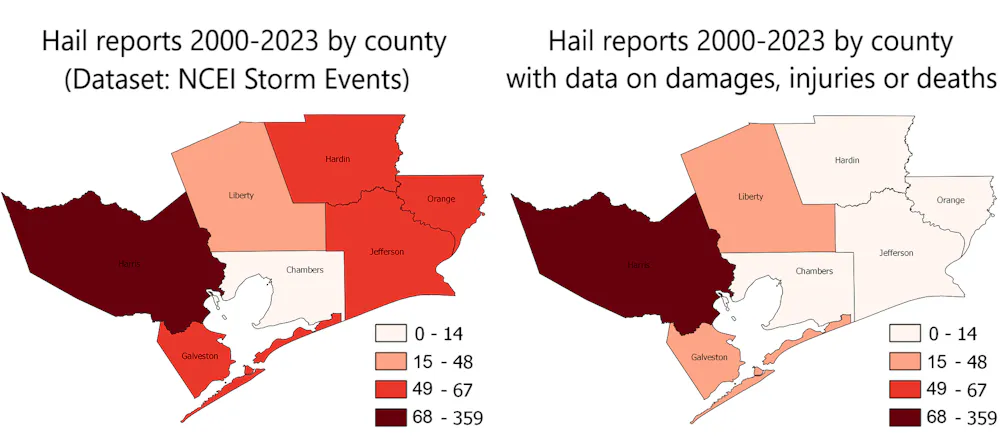
Two maps of the counties that are home to Houston and Galveston, along with five counties to their East, show major differences in storm damage reporting.
The number of severe hail reports in southeast Texas listed in the National Centers for Environmental Information’s storm events database is strongly correlated with population. The county with the most reports and greatest detail in those reports is home to Houston. Hailstorms in the three easternmost counties are rarely associated with damage estimates.
John Nielsen-Gammon and B.J. Baule

Do you want to look at local damage trends? Forget about it. For most extreme weather events, estimation methods vary over time and are not documented.

Do you want to direct funding to help communities improve resilience to natural disasters where the need is greatest? Forget about it. The places experiencing the largest per capita damages depend not just on actual damages but on the different practices of local National Weather Service offices.

Are you moving to a location that might be vulnerable to extreme weather? Companies are starting to provide localized risk estimates through real estate websites, but the algorithms tend to be proprietary, and there’s no independent validation.

4 steps to improve disaster data

We believe a few fixes could make NOAA’s storm events database and the corresponding values in the larger SHELDUS database, managed by Arizona State University, more reliable. Both databases include county-level disasters and loss estimates for some of those disasters.

First, the National Weather Service could develop standard procedures for local offices for estimating disaster damages.

Second, additional state support could encourage local emergency managers to make concrete damage estimates from individual events and share them with the National Weather Service. The local emergency manager generally knows the extent of damage much better than a forecaster sitting in an office a few counties away.

Third, state or federal governments and insurance companies can agree to make public the aggregate loss information at the county level or other scale that doesn’t jeopardize the privacy of their policyholders. If all companies provide this data, there is no competitive disadvantage for doing so.

Fourth, NOAA could create a small “tiger team” of damage specialists to make well-informed, consistent damage estimates of larger events and train local offices on how to handle the smaller stuff.

With these processes in place, the U.S. wouldn’t need a billion-dollar disasters program anymore. We’d have reliable information on all the disasters.

The Conversation

John Nielsen-Gammon receives funding from the National Oceanic and Atmospheric Administration and the State of Texas.

William Baule receives funding from NOAA, the State of Texas, & the Austin Community Foundation.

ref. Extreme weather’s true damage cost is a mystery – that’s a problem for understanding storm risk – https://theconversation.com/extreme-weathers-true-damage-cost-is-a-mystery-thats-a-problem-for-understanding-storm-risk-257105

AmeriCorps is on the chopping block – despite research showing that the national service agency is making a difference in local communities

Source: The Conversation – USA (2) – By Pamela Paxton, Professor of Sociology, The University of Texas at Austin

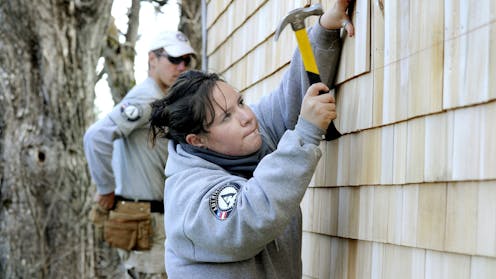
Many AmeriCorps crews, like this one seen at work in Maine in 2011, restore and renovate public parks. John Patriquin/Portland Press Herald via Getty Images

Hundreds of thousands of U.S. nonprofits provide vital services, such as running food banks and youth programs, supporting public health initiatives and helping unemployed people find new jobs. Although this work helps sustain local communities, obtaining the money and staff they require is a constant struggle for many of these groups.

That’s where AmeriCorps often comes in. The independent federal agency for national service and volunteerism has facilitated the work of approximately 200,000 people a year, placing them through partnerships with thousands of nonprofits that provide tutoring, disaster relief and many other important services.

But Americorps’ fate is now uncertain. In April 2025, the Trump administration canceled more than 1,000 grants, suddenly ending the stipends that were supporting more than 32,000 AmeriCorps volunteers. On June 5, a judge ordered that these grants be restored in Washington D.C. and 24 states in response to a lawsuit they had filed. The judge also ordered that all volunteers who had been deployed in those places be reinstated “if they are willing and able to return.”

The Trump administration has also put most of AmeriCorps administrative staff on leave and indicated that it wants to eliminate the independent agency, along with its US$1.2 billion annual budget. AmeriCorps doesn’t appear in a detailed 2026 budget request the administration released on May 30.

I’m a sociology and public affairs professor who has studied nonprofits and volunteering for decades. My research suggests that dismantling AmeriCorps would harm the organizations that rely on national service members and take a toll on the communities that benefit from their work.

AmeriCorps explains what the independent national service agency does.

What AmeriCorps does

AmeriCorps traces its roots to the mid-1960s, when Volunteers in Service to America, known as VISTA, was founded as a domestic counterpart to the Peace Corps. Several earlier service programs were consolidated when Congress passed the National and Community Service Trust Act in 1993. AmeriCorps was officially launched in 1994 – and VISTA became one of its programs.

Since then, AmeriCorps members have built housing and infrastructure, delivered disaster relief, tutored in low-income schools, provided health care and helped older adults age with dignity in both urban and rural communities across the nation.

AmeriCorps includes a variety of programs, each designed to address specific public needs. Some AmeriCorps volunteers provide direct services, such as tutoring, food delivery and in disaster response efforts. Others focus on building the long-term capacity of local nonprofits through volunteer recruitment, fundraising strategy and community outreach.

AmeriCorps volunteers, whom the agency calls “members,” are placed in thousands of nonprofits, schools and local agencies. Many of them are recent college graduates or early-career professionals. Some programs specifically ask people over 55 to serve. Those “senior” volunteers support children through the Foster Grandparents program, volunteer for organizations or assist other older people through the Senior Companions program.

Many AmeriCorps volunteers are paid a modest allowance for this work that runs about $500 per week. AmeriCorps senior volunteers receive smaller sums in hourly stipends to offset the costs of volunteering.

Fox40 News in Sacramento, Calif., covers the Trump administration’s reduction of AmeriCorps’ ranks in April 2025.

Helping nonprofits gain traction

AmeriCorps has long funded research that assesses its impact.

One such study found that every dollar invested in national service generates $11.80 in benefits for society, such as higher earnings, better mental and physical health, and economic growth. Additionally, every federal dollar spent on national service produces $17.30 in savings across other government programs through reductions in public assistance, health and criminal justice spending.

As part of AmeriCorps’ research grants program, I have received funding to study civic engagement and AmeriCorps programming.

In one of those studies, which I conducted with two former colleagues at the University of Texas at Austin in 2021, we found that VISTA volunteers were able to help nonprofits gain volunteers. After two years, an organization with that support had 71% more volunteers than those that didn’t participate in the VISTA program.

We also found that the longer a nonprofit had a staffer supported by the VISTA program, the more its overall pool of volunteers increased.

Nonprofits with VISTA volunteers also had three times as many donations two years later, compared with nonprofits without VISTA service members. But the total value of donations the nonprofit obtained didn’t always rise. That is, we found that VISTA builds people power, but not necessarily fundraising revenue.

Findings like these indicate that AmeriCorps hasn’t just helped the people it serves or the people who volunteer through the program. It also strengthens nonprofits and increases engagement within local communities, reinforcing the civic fabric that knits communities together.

As members of Congress and the White House decide whether to preserve AmeriCorps, I hope they consider the evidence that demonstrates this worthwhile program’s positive impact.

The Conversation

Pamela Paxton has received funding from the Office of Research and Evaluation at AmeriCorps.

ref. AmeriCorps is on the chopping block – despite research showing that the national service agency is making a difference in local communities – https://theconversation.com/americorps-is-on-the-chopping-block-despite-research-showing-that-the-national-service-agency-is-making-a-difference-in-local-communities-257430

When Elvis and Ella were pressed onto X-rays – the subversive legacy of Soviet ‘bone music’

Source: The Conversation – USA (2) – By Richard Gunderman, Chancellor’s Professor of Medicine, Liberal Arts, and Philanthropy, Indiana University

In the Soviet Union, some clever people realized that X-ray film was just soft enough to be etched by a sound recording device. Michelle Mengsu Chang/Toronto Star via Getty Images

When Western Electric invented electrical sound recording 100 years ago, it completely transformed the public’s relationship to music.

Before then, recording was done mechanically, scratching sound waves onto rolled paper or a cylinder. Such recordings suffered from low fidelity and captured only a small segment of the audible sound spectrum.

By using electrical microphones, amplifiers and electromechanical recorders, record companies could capture a far wider range of sound frequencies, with much higher fidelity. For the first time, recorded sound closely resembled what a live listener would hear. Over the ensuing years, sales of vinyl records and record players boomed.

The technology also allowed some enterprising music fans to make recordings in surprising and innovative ways. As a physician and scholar in the medical humanities, I am fascinated by the use of X-ray film to make recordings – what was known as “bone music,” or “ribs.”

This rather bizarre, homemade technology became a way to skirt censors in the Soviet Union – and even played an indirect role in its dissolution.

Skirting the Soviet censorship regime

At the end of World War II, Soviet censorship shifted into high gear in an effort to suppress a Western culture deemed threatening or decadent.

Many books and poems could circulate only through “samizdat,” a portmanteau of “self” and “publishing” that involved the use of copy machines to reproduce forbidden texts. Punishments inflicted on Soviet artists and citizens for producing or disseminating censored materials included loss of employment, imprisonment in gulags and even execution.

The phonographic analog of samizdat was often referred to as “roentgenizdat,” which was derived from the name of Wilhelm Roentgen, the German scientist who received the first Nobel Prize in physics in 1901 for his discovery of X-rays.

Roentgen’s work revolutionized medicine, making it possible to peer inside the living human body without cutting it open and enabling physicians to more easily and accurately diagnose skeletal fractures and diseases such as pneumonia.

Today, X-rays are produced and stored digitally. But for most of the 20th century they were created on photographic film and stored in large film libraries, which took up a great deal of space.

Because exposed X-ray films cannot be reused, hospitals often recycled them to recoup the silver they contained.

Making music from medicine

In the Soviet Union in the 1940s, some clever people realized that X-ray film was just soft enough to be etched by an electromechanical lathe, or sound recording device.

To make a “rib,” or “bone record,” they would use a compass to trace out a circle on an exposed X-ray film that might bear the image of a patient’s skull, spine or hands. They then used scissors to cut out the circle, before cutting a small hole in the middle so it would fit on a conventional record player.

Then they would use a recording device to cut either live sound or, more commonly, a bootleg record onto the X-ray film. Sound consists of vibrations that the lathe’s stylus etches into grooves on the disc. Such devices were not widely available, meaning that only a relatively small number of people could produce such recordings.

X-ray negative of hand bones cut into a circle, being pressed by a metal device.
A disc-cutting lathe demonstrates the production of an X-ray record at a 2021 exhibition in Berlin, Germany.
Adam Berry/Getty Images

The censors kept a close eye on record companies. But anyone who could obtain a recording device could record music on pieces of X-ray film, and these old films could be obtained after hospitals threw them out or purchased at a relatively low price from hospital employees.

Compared with professionally produced vinyl records, the sound quality was poor, with recordings marred by extraneous noises such as hisses and crackles. The records could be played only a limited number of times before the grooves would wear out.

Nonetheless, these resourceful recordings were shared, bought and sold entirely outside of official channels into the 1960s and 1970s.

A window into another life

Popular artists “on the bone” included Ella Fitzgerald and Elvis Presley, whose jazz and rock ’n’ roll recordings, to the ears of many Soviet citizens, represented freedom and self-expression.

In his book “Bone Music,” cultural historian Stephen Coates describes how Soviet authorities viewed performers such as The Beatles as toxic because they appeared to promote a brand of amoral hedonism and distracted citizens from Communist party priorities.

One Soviet critic of bone music recalled of its purveyors:

“It is true that from time to time they are caught, their equipment confiscated, and they may even be brought to court. But then they may be released and be free to go wherever they like. The judges decide that they are, of course, parasites, but they are not dangerous. They are getting suspended sentences! But these record producers are not just engaged in illegal operations. They corrupt young people diligently and methodically with a squeaky cacophony and spread explicit obscenities.”

Bone music was inherently subversive.

For one thing, it was against the law. Moreover, the music itself suggested that a different sort of life is possible, beyond the strictures of Communist officials. How could a political system that prohibited beautiful music, many asked, possibly merit the allegiance of its citizens?

The ability of citizens to get around the censors and spread Western thought, whether through books or bone music, helped chip away at the government’s legitimacy.

One Soviet-era listener Coates interviewed long after the USSR’s collapse described the joy of listening to these illicit recordings:

“I was lifted up off the ground, I started flying. Rock’n’roll showed me a new world, a world of music, words, and feelings, of life, of a different lifestyle. That’s why, when I got my first records, I became a happy man. I felt like a changed person, it was as if I was born again.”

The playing of a bootleg record from the Soviet Union, recorded on an X-ray negative.

The Conversation

Richard Gunderman does not work for, consult, own shares in or receive funding from any company or organization that would benefit from this article, and has disclosed no relevant affiliations beyond their academic appointment.

ref. When Elvis and Ella were pressed onto X-rays – the subversive legacy of Soviet ‘bone music’ – https://theconversation.com/when-elvis-and-ella-were-pressed-onto-x-rays-the-subversive-legacy-of-soviet-bone-music-251885

Like today’s selfie-takers, Walt Whitman used photography to curate his image – but ended up more lost than found

Source: The Conversation – USA (2) – By Trevin Corsiglia, PhD Candidate in Comparative Literature and Thought, Washington University in St. Louis

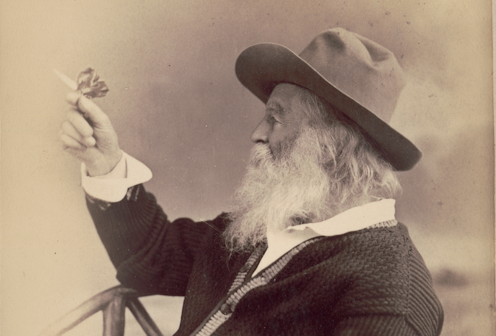
Though Walt Whitman insisted to friends that the moth was real – and landed on his finger spontaneously – it was a cardboard prop. Library of Congress

When I read and study Walt Whitman’s poetry, I often imagine what he would’ve done if he had a smartphone and an Instagram account.

Unlike many of his contemporaries, the poet collected an “abundance of photographs” of himself, as Whitman scholar Ed Folsom points out. And like many people today who snap and post thousands of selfies, Whitman, who lived during the birth of commercial photography, used portraits to craft a version of the self that wasn’t necessarily grounded in reality.

One of those portraits, taken by photographer Curtis Taylor, was commissioned by Whitman in the 1870s.

In it, the poet is seated nonchalantly, with a moth or butterfly appearing to have landed on his outstretched finger. According to at least two of his friends, Philadelphia attorney Thomas Donaldson and nurse Elizabeth Keller, this was Whitman’s favorite photograph.

Though he told his friends that the winged insect happened to land on his finger during the shoot, it turned out to be a cardboard prop.

Feigned spontaneity

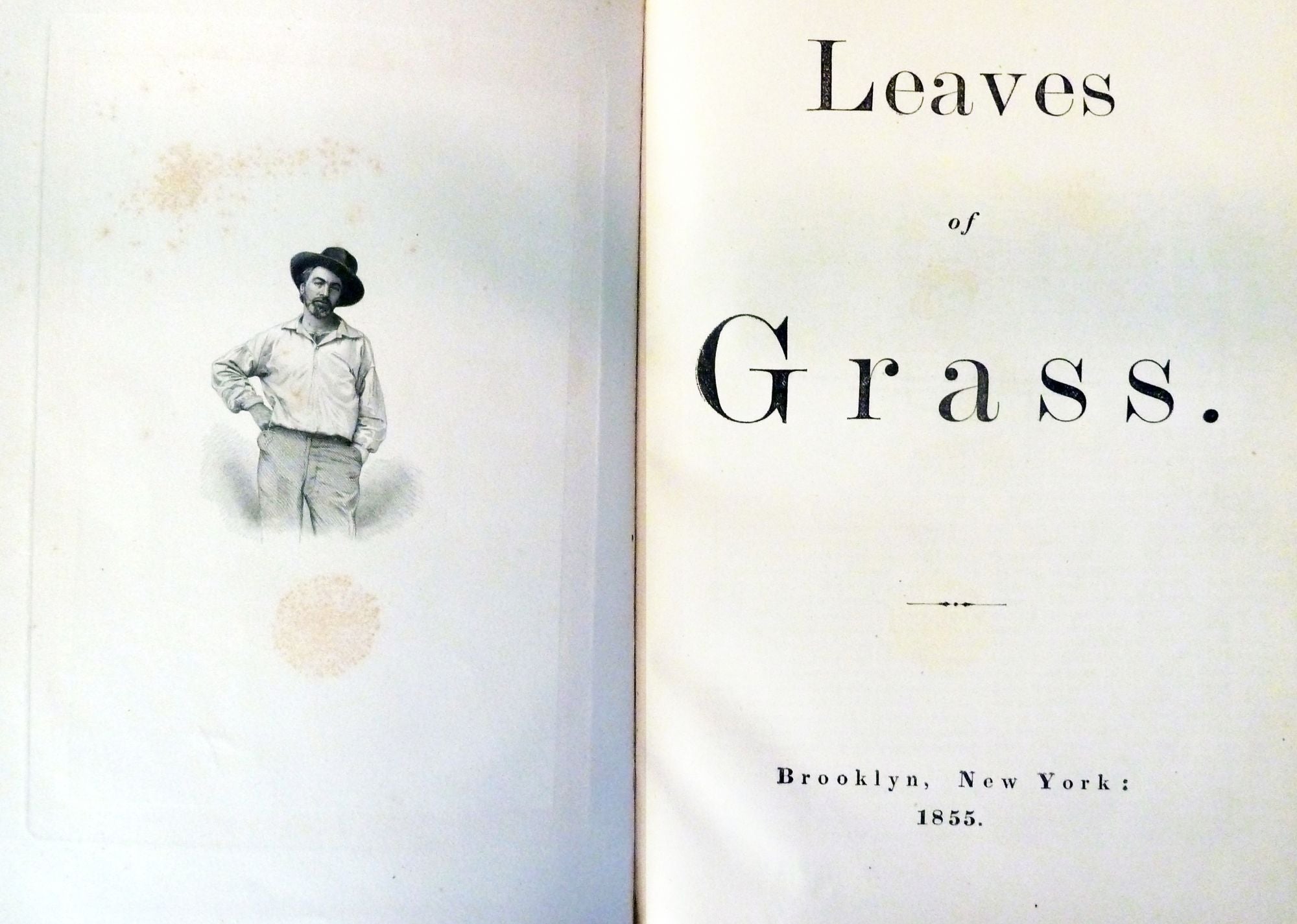
The scene with the butterfly reflects one of the main themes of Whitman’s “Leaves of Grass,” his best-known collection of poems: The universe is naturally drawn to the poet.

“To me the converging objects of the world perpetually flow,” he insists in “Song of Myself.”

“I have instant conductors all over me whether I pass or stop,” Whitman adds. “They seize every object and lead it harmlessly through me.”

Whitman told Horace Traubel, the poet’s close friend and earliest biographer, that “[y]es – that was an actual moth, the picture is substantially literal.” Likewise, he told historian William Roscoe Thayer: “I’ve always had the knack of attracting birds and butterflies and other wild critters.”

Of course, historians now know that the butterfly was, in fact, a cutout, which currently resides at the Library of Congress.

A red-and-white cardboard butterfly with text written on the wings.
The cardboard prop used by Walt Whitman in the portrait.
Library of Congress

So what was Whitman doing? Why would he lie? I can’t get inside his head, but I suspect he wanted to impress his audience, to verify that the protagonist of “Leaves of Grass,” the one with “instant conductors,” was not a fictional creation.

Today’s selfies often give the impression of having been taken on the spot. In reality, many of them are a carefully calculated creative act.

Media scholars James E. Katz and Elizabeth Thomas Crocker have argued that most selfie-takers strive for informality even as they carefully stage the images. In other words, the selfie weds the spontaneous to the intentional.

Whitman does exactly this, presenting a designed photo as if it were a happy accident.

Too much me

As Whitman biographer Justin Kaplan notes, no other writer at the time “was so systematically recorded or so concerned with the strategic uses of his pictures and their projective meanings for himself and the public.”

Black-and-white photographic portrait of bearded man.
Walt Whitman in an 1854 photograph likely taken by Gabriel Harrison.
Wikimedia Commons

The poet jumped at the opportunity to have his photo taken. There is, for instance, the famous portrait of the young, carefree poet that was used as the frontispiece for the first edition of “Leaves of Grass.” Or the 1854 photograph of a bearded and unkempt Whitman likely captured by Gabriel Harrison. Or the 1869 image of Whitman smiling lovingly at Peter Doyle, the poet’s intimate friend and probable lover.

Some social scientists have argued that today’s selfies can aid in the search for one’s “authentic self” – figuring out who you are and understanding what makes you tick.

Other researchers have taken a less rosy view of the selfie, warning that snapping too many can be a sign of low self-esteem and can, paradoxically, lead to identity confusion, particularly if they’re taken to seek external validation.

Whitman spent his life searching for what he termed the “Me myself” or the “real Me.” Photography provided him another medium, besides poetry, to carry on this search. But it seems to have ultimately failed him.

Having collected these images, he would then obsessively chew over what they all added up to, ultimately finding that he was far more lost than found in this sea of portraits.

I wonder if – to use today’s parlance – Whitman “scrolled” his way into a crisis of self-identity, overwhelmed by the sheer number of photos he possessed and the various, contradictory selves they represented.

“I meet new Walt Whitmans every day,” he once said. “There are a dozen of me afloat. I don’t know which Walt Whitman I am.”

The Conversation

Trevin Corsiglia does not work for, consult, own shares in or receive funding from any company or organization that would benefit from this article, and has disclosed no relevant affiliations beyond their academic appointment.

ref. Like today’s selfie-takers, Walt Whitman used photography to curate his image – but ended up more lost than found – https://theconversation.com/like-todays-selfie-takers-walt-whitman-used-photography-to-curate-his-image-but-ended-up-more-lost-than-found-256195

How does a person become famous when they’re just a kid?

Source: The Conversation – USA (2) – By Matthew Pittman, Associate Professor of Advertising and Public Relations, University of Tennessee

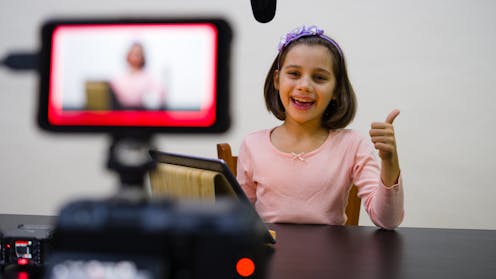
Some ‘kidfluencers’ have huge followings on social media, but the spotlight isn’t always a friendly place. ilkercelik/E+ via Getty images

Curious Kids is a series for children of all ages. If you have a question you’d like an expert to answer, send it to CuriousKidsUS@theconversation.com.


How does a person become famous when they’re just a kid? – Anushka, age 9, St. Augustine, Florida


First, consider what kind of fame you want. Some kids, such as Blue Ivy Carter or Suri Cruise, are known for having famous parents – in their cases, singer Beyoncé and actors Katie Holmes and Tom Cruise. That’s something you can’t really control.

Maybe you want to be a star athlete, like basketball player Caitlin Clark or skateboarder Sky Brown. If you’re good at a sport, practicing a lot will make you even better, and you might get famous.

Or maybe you want to be a famous musician. Singer LeAnn Rimes won her first Grammy Award at age 14. Justin Bieber was discovered on YouTube when he was 12. If you work hard at playing an instrument or singing, you increase your chances of getting noticed.

Skateboarder Sky Brown won her first Olympic medal, a bronze, at age 13 in 2020.

A newer way to become famous is to be a social media influencer – a person who gets paid, either with money or with stuff, to help sell things on social media. A 2023 survey of 1,000 Gen Zers – people in their early teens to mid-20s – found that 57% wanted to become influencers.

I study social media and teach a social media class at the University of Tennessee. I also have a side gig as an influencer. My posts have gone viral and been seen hundreds of millions of times all around the world. I post silly and serious things about my life on Instagram and TikTok.

Here are some things to know about fame at a young age.

There wasn’t always a youth culture

Before modern times, people didn’t pay much attention to children in the way that we do now. There were a few exceptions, such as composer Wolfgang Amadeus Mozart, who played music as a child for kings and queens in the 1700s, but they were rare.

Things changed a lot as the U.S. population boomed after World War II. Businesses realized that young people were a big market, and a new, youth-focused culture developed. Movies, TV shows and songs were increasingly made for young people, featuring young people.

Opening credits for seasons 3-4 of “The Partridge Family,” a TV situation comedy about a family that forms a pop music band. The show ran from 1970-1974 and turned David Cassidy, who played the oldest son, into a teen idol.

Now, thanks to social media and the internet, kids can get famous without being star athletes or actors. If you can make videos, sing songs, tell jokes or share art from your phone or computer and people like what you post, they might share it with others. Some kids become famous just by being really good at explaining things or showing their everyday lives.

For example, Anastasia Radzinskaya, an 11-year-old Russian American girl who shares content about children’s songs and games, has 1.5 million followers on Instagram. Ethan Gamer, a video game influencer, started appearing on YouTube in 2013 at age 7.

Pros and cons

Being a famous kid can offer a lot of benefits. You might get to appear on TV or in movies, wear cool clothes, or hang out with famous athletes or celebrities. You might also get to make money that you could use to support your family, pay for a high-quality education or fund causes that you care about, such as protecting nature or feeding hungry people.

But there also are downsides. Famous kids often have to work a lot and don’t have much time to hang out with friends. Also, people may say hurtful things about you on social media, which is something you can’t control.

Being famous can pressure people to act or dress in certain ways. Handling attention and criticism from strangers can be stressful for any young person, and fame makes the challenge much harder.

Should you try to be an influencer?

For me, influencing can be fun and creative. It’s cool to make a video and know that lots of people around the world are enjoying it.

Another plus is that the skills you need to be an influencer – communicating clearly, producing digital content and helping other people find cool new products – can be valuable as you grow up, no matter what job you have.

However, most influencers don’t make enough money to do it full time – they do it as a side gig while working a real job. If you are a kid, school should be your full-time job.

You also should expect to get rejected a lot before you start developing an audience. This can make you emotionally strong in the long run, but it still hurts when you share your work and no one seems to notice. Most influencers put in years of effort to learn the skills that help make them successful.

You’re likely to get negative responses that can hurt your feelings. You will need your parents’ help to manage online feedback and know how to react to all kinds of responses, positive and negative.

It’s definitely possible for kids to be famous today, but that doesn’t mean that every kid should try. What’s important is to do things that you enjoy, even if the whole world isn’t watching.


Hello, curious kids! Do you have a question you’d like an expert to answer? Ask an adult to send your question to CuriousKidsUS@theconversation.com. Please tell us your name, age and the city where you live.

And since curiosity has no age limit – adults, let us know what you’re wondering, too. We won’t be able to answer every question, but we will do our best.

The Conversation

Matthew Pittman’s influencer posts focus on his college teaching and family life. He occasionally receives products or payments in return for promoting toys, teaching tools and family games.

ref. How does a person become famous when they’re just a kid? – https://theconversation.com/how-does-a-person-become-famous-when-theyre-just-a-kid-255820

Queer country: LGBTQ+ musicians are outside the spotlight as Grand Ole Opry turns 100

Source: The Conversation – USA (2) – By Tanya Olson, Associate Teaching Professor, University of Maryland, Baltimore County

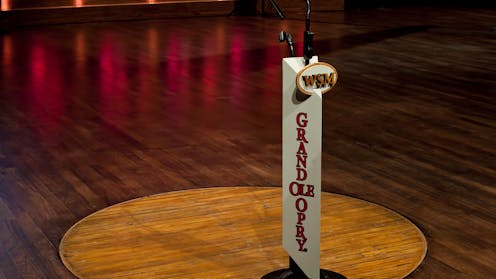
The iconic circle in the Grand Ole Opry stage. Who gets to stand in it? Timothy Wildey/Flickr, CC BY-NC

On March 15, 1974, the Grand Ole Opry country music radio show closed its run at the Ryman Auditorium in Nashville, Tennessee, with Johnny and June Carter Cash leading the song “Will the Circle Be Unbroken.” After that final show, a six-foot circle of wood was cut from the Ryman stage and moved to the new Grand Ole Opry House.

The next night, Roy Acuff opened the first show at the new venue. A video of Acuff singing in the 1940s played before the screen lifted to reveal Acuff himself, singing live in the same spot. The message was clear: Though the stage had changed, the story continued. The circle had not been broken.

The Opry began on WSM on Nov. 28, 1925, and is celebrating its centennial with a series of concerts and tributes under the name Opry 100. On March 19, 2025, Reba McEntire stepped onto the iconic circle on the Grand Ole Opry stage and kicked off NBC’s Opry 100 celebration with a verse of “Sweet Dreams.”

The final song of the night was “Will the Circle Be Unbroken,” performed by country legends like Bill Anderson and Jeannie Seely alongside newcomers like Lainey Wilson and Post Malone. It was a moment meant to celebrate 100 years of country music tradition and connection with a stage full of voices harmonizing across generations. A circle, unbroken.

But that night in March, one group of country performers was missing. Not a single openly gay, lesbian or bisexual artist appeared onstage during the anniversary celebration. In a moment designed to honor the full sweep of the genre’s past and future, a long line of country musicians was left standing outside the spotlight once again.

Wilma Burgess’ sexuality was common knowledge in music industry circles in the 1960s and ‘70s.

A slowly opening circle

Country music has never been without queer voices, but it regularly refuses to acknowledge them.

From 1962 to 1982, Wilma Burgess had 15 songs on Billboard’s Hot Country chart and two Grammy Award nominations. She recorded with legendary producer Owen Bradley and had Top 10 hits like “Misty Blue.” Despite this success, Burgess never played the Opry. Though Burgess was never publicly out, her sexuality was common knowledge in recording circles. In the 1980s, she left music and opened The Hitching Post, Nashville’s first lesbian bar. Like so many queer country artists, Burgess had to build her legacy outside the circle.

In the 1980s and 90s, k.d. lang and Sid Spencer expanded the presence of queer artists in country music. Lang won two Grammys and performed at the Opry, but she was labeled “cowpunk” and left the genre before coming out in 1992. Spencer released albums and toured widely within the gay rodeo circuit, but he was never recognized by mainstream country before his 1996 death from AIDS-related complications.

The 2000s offered small openings. Mary Gauthier became the first openly queer artist to perform on the Opry stage in 2005. Chely Wright had a No. 1 country single before coming out in 2010, but didn’t return to the Opry until 2019. Ty Herndon charted 17 singles before coming out in 2014. He wouldn’t appear at the Opry again until 2023.

These artists established themselves first and came out later, at great professional cost. The Opry hosts 5–6 shows a week, featuring 6–8 artists each night. In that context, a nine-year absence isn’t just a scheduling gap. In addition, the Grand Ole Opry currently has 76 members, a special designation indicating a level of success in country music. None of them identify as LGBTQ+.

Today, there are signs of change. Lily Rose, who has been openly queer since the beginning of her career, receives radio play, has songs on the charts and tours widely. But she remains the exception, not the rule. Other openly LGBTQ+ artists like Paisley Fields, Mya Byrne and Amythyst Kiah are recording, performing and building loyal audiences, but they are still rarely featured on country radio or invited onto the Opry stage. The circle may be widening, but for many queer artists, it’s still just out of reach.

The importance of the circle

In country music, visibility isn’t just symbolic. If you’re not on the radio, you don’t chart. If you don’t chart, you don’t tour. Without that platform, you can’t build a legacy.

Country radio and the Opry stage serve as gatekeepers of who counts. In 2015, a radio consultant infamously compared women artists to “tomatoes in the salad,” stating a few were fine, but they shouldn’t dominate. That same logic has long applied to queer artists; they can be tolerated at the edges but are rarely treated as essential.

Genre labeling becomes another barrier. Brandi Carlile and Brandy Clark both openly identify as lesbians and have been embraced by country audiences and critics alike, but they are routinely categorized as Americana artists. That rebranding often functions as a fence that keeps artists close enough to celebrate, but far enough to exclude.

Gina Venier is one of today’s many openly gay country artists.

Reimagining the circle

The Opry’s centennial celebrations are scheduled to continue through the end of 2025 with a concert at London’s Royal Albert Hall and a final anniversary show in Nashville on Nov. 28. Perhaps openly queer artists will take the stage at those events. If they do, it won’t just be symbolic; it will be a long overdue acknowledgment of artists who have always been here, even if they weren’t always seen.

Country music’s strength lies in how it braids together American traditions: gospel and blues, Black and white, rural and urban, old and new. It’s not a genre built on purity, but one that relies on the mix. That mix is what makes country music American – and what makes it endure.

If the circle on the Opry stage is meant to stand for country music itself, then I hope it will be like the music: honest and able to grow. If “Will the Circle Be Unbroken” is more of a promise than just a closing number, the future of country music depends on who’s allowed in the circle to sing it next.

The Conversation

Tanya Olson does not work for, consult, own shares in or receive funding from any company or organization that would benefit from this article, and has disclosed no relevant affiliations beyond their academic appointment.

ref. Queer country: LGBTQ+ musicians are outside the spotlight as Grand Ole Opry turns 100 – https://theconversation.com/queer-country-lgbtq-musicians-are-outside-the-spotlight-as-grand-ole-opry-turns-100-251892