The aftermath of floods, hurricanes and other disasters can be hardest on older rural Americans – here’s how families and neighbors can help

Source: The Conversation – USA (3) – By Lori Hunter, Professor of Sociology, Director of the Institute of Behavioral Science, University of Colorado Boulder
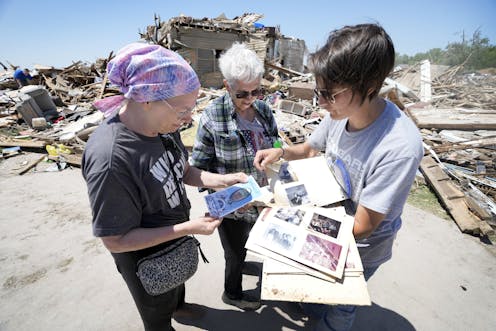
Edith Schaecher, center, and her daughter and granddaughter look at a photo album recovered from her tornado-damaged home in Greenfield, Iowa, in May 2024. AP Photo/Charlie Neibergall

Hurricanes, tornadoes and other extreme weather do not distinguish between urban and rural boundaries. But when a disaster strikes, there are big differences in how well people are able to respond and recover – and older adults in rural areas are especially vulnerable.

If a disaster causes injuries, getting health care can take longer in rural areas. Many rural hospitals have closed, leaving patients traveling longer distances for care.

At the same time, rural areas have higher percentages of older adults, a group that is more likely to have chronic health problems that make experiencing natural disasters especially dangerous. Medical treatments, such as dialysis, can be disrupted when power goes out or clinics are damaged, and injuries are more likely around property damaged by flooding or powerful winds.

As a sociologist who studies rural issues and directs the Institute of Behavioral Science at the University of Colorado Boulder, I believe that understanding the risks is essential for ensuring healthier lives for older adults. I see many different ways rural communities are helping reduce their vulnerability in disasters.

Disasters disrupt health care, especially in isolated rural regions

According to the U.S. Census Bureau, about 20% of the country’s rural population is age 65 and over, compared with only 16% of urban residents. That’s about 10 million older adults living in rural areas.

There are three primary reasons rural America has been aging faster than the rest of the country: Young people have been leaving for college and job opportunities, meaning fewer residents are starting new families. Many older rural residents are choosing to “age in place” where they have strong social ties. And some rural areas are gaining older adults who choose to retire there.

An aging population means rural areas tend to have a larger percentage of residents with chronic disease, such as dementia, heart disease, respiratory illness and diabetes.

According to research from the National Council on Aging, nearly 95% of adults age 60 and older have at least one chronic condition, while more than 78% have two or more. Rural areas also have higher rates of death from chronic diseases, particularly heart disease.

At the same time, health care access in rural areas is rapidly declining.

Nearly 200 rural hospitals have closed or stopped providing in-patient care since 2005. Over 700 more — one-third of the nation’s remaining rural hospitals — were considered to be at risk of closing even before the cuts to Medicaid that the president signed in July 2025.

Hospital closures have left rural residents traveling about 20 miles farther for common in-patient health care services than they did two decades ago, and even farther for specialist care.

Those miles might seem trivial, but in emergencies when roads are damaged or flooded, they can mean losing access to care and treatment.

After Hurricane Katrina struck New Orleans in 2005, 44% of patients on dialysis missed at least one treatment session, and almost 17% missed three or more.

When Hurricanes Matthew and Florence hit rural Robeson County, North Carolina, in 2016 and 2018, some patients who relied on insulin to manage their blood sugar levels went without insulin for weeks. The county had high rates of poverty and poor health already, and the healthy foods people needed to manage the disease were also hard to find after the storm.

Insulin is important for treating diabetes – a chronic disease estimated to affect nearly one-third of adults age 65 and older. But a sufficient supply can be harder to maintain when a disaster knocks out power, because insulin should be kept cool, and medical facilities and drugstores may be harder for patients to reach.

Rural residents also often live farther from community centers, schools or other facilities that can serve as cooling centers during heat waves or evacuation centers in times of crisis.

Alzheimer’s disease can make evacuation difficult

Cognitive decline also affects older adults’ ability to manage disasters.

Over 11% of Americans age 65 and older – more than 7 million people – have Alzheimer’s disease or related dementia, and the prevalence is higher in rural areas’ older populations compared with urban areas.

Caregivers for family members living with dementia may struggle to find time to prepare for disasters. And when disaster strikes, they face unique challenges. Disasters disrupt routines, which can cause agitation for people with Alzheimer’s, and patients may resist evacuation.

Living through a disaster can also worsen brain health over the long run. Older adults who lived through the 2011 Great East Japan earthquake and tsunami were found to have greater cognitive decline over the following decade, especially those who lost their homes or jobs, or whose health care routines were disrupted.

Social safety nets are essential

One thing that many rural communities have that helps is a strong social fabric. Those social connections can help reduce older adults’ vulnerability when disasters strike.

Following severe flooding in Colorado in 2013, social connections helped older adults navigate the maze of paperwork required for disaster aid, and some even provided personal loans.
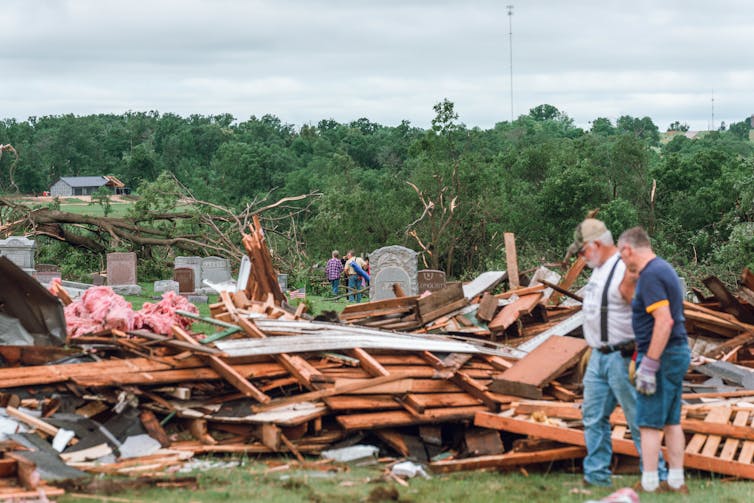
Two older men stand by debris form a storm-damaged church. Another group of people walks in the background.
Community support through churches, like this one whose building was hit by a tornado in rural Argyle, Wis., in 2024, and other groups can help older adults recover from disasters.
Ross Harried/NurPhoto via Getty Images

Friends, family and neighbors in rural areas often check in on seniors, particularly those living alone. They can help them develop disaster response plans to ensure older residents have access to medications and medical treatment, and that they have an evacuation plan.

Rural communities and local groups can also help build up older adults’ mental and physical health before and after storms by developing educational, social and exercise programs. Better health and social connections can improve resilience, including older adults’ ability to respond to alerts and recover after disasters.

Ensuring that everyone in the community has that kind of support is important in rural areas and cities alike as storm and flood risks worsen, particularly for older adults.

The Conversation

Lori Hunter receives funding from the National Institutes of Health and the National Science Foundation.

ref. The aftermath of floods, hurricanes and other disasters can be hardest on older rural Americans – here’s how families and neighbors can help – https://theconversation.com/the-aftermath-of-floods-hurricanes-and-other-disasters-can-be-hardest-on-older-rural-americans-heres-how-families-and-neighbors-can-help-247691
What is the ‘Seven Mountains Mandate’ and how is it linked to political extremism in the US?

Source: The Conversation – USA (3) – By Art Jipson, Associate Professor of Sociology, University of Dayton

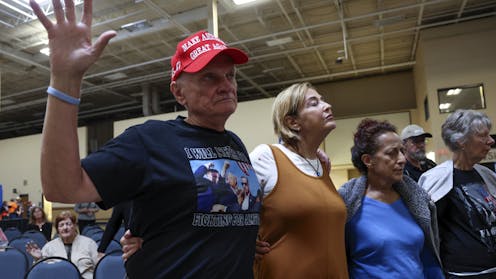
People pray before Republican vice presidential nominee J.D. Vance at a town hall hosted by Lance Wallnau on Sept. 28, 2024, in Monroeville, Pa. AP Photo/Rebecca Droke

Vance Boelter, who allegedly shot Melissa Hortman, a Democratic Minnesota state representative, and her husband, Mark Hortman, on June 14, 2025, studied at Christ for the Nations Institute in Dallas. The group is a Bible school linked to the New Apostolic Reformation, or NAR.

The NAR is a loosely organized but influential charismatic Christian movement that shares similarities with Pentecostalism, especially in its belief that God actively communicates with believers through the Holy Spirit. Unlike traditional Pentecostalism, however, the organization emphasizes modern-day apostles and prophets as authoritative leaders tasked with transforming society and ushering in God’s kingdom on Earth. Prayer, prophecy and worship are defined not only as acts of devotion but as strategic tools for advancing believers’ vision of government and society.

After the shooting, the Christ for the Nations Institute issued a statement “unequivocally” denouncing “any and all forms of violence and extremism.” It stated: “Our organization’s mission is to educate and equip students to spread the Gospel of Jesus Christ through compassion, love, prayer, service, worship, and value for human life.”

But the shooting has drawn attention to the school and the larger Christian movement it belongs to. One of the most important aspects of NAR teachings today is what is called “the Seven Mountain Mandate.”

The Seven Mountain Mandate calls on Christians to gain influence, or “take dominion,” over seven key areas of culture: religion, family, education, government, media, business and the arts.

With over three decades of experience studying extremism, I offer a brief overview of the history and core beliefs of the Seven Mountains Mandate.

‘Dominion of Christians’

The Seven Mountains concept was originally proposed in 1975 by evangelical leader Bill Bright, the founder of Campus Crusade for Christ. Now known as “Cru,” the Campus Crusade for Christ was founded as a global ministry in 1951 to promote Christian evangelism, especially on college campuses.

United by a shared vision to influence society through Christian values, Bright partnered with Loren Cunningham, the founder of Youth With A Mission, a major international missionary training and outreach organization, in the 1970s.

The Seven Mountains Mandate was popularized by theologian Francis Schaeffer, who linked it to a larger critique of secularism and liberal culture. Over time, it evolved.

C. Peter Wagner, a former seminary professor who helped organize and name the New Apostolic Reformation, is often regarded as the theological architect of the group. He developed it into a call for dominion. In his 2008 book “Dominion! How Kingdom Action Can Change the World,” he urged Christians to take authoritative control of cultural institutions.

For Wagner, “dominion theology” – the idea that Christians should have control over all aspects of society – was a call to spiritual warfare, so that God’s kingdom would be “manifested here on earth as it is in heaven.”

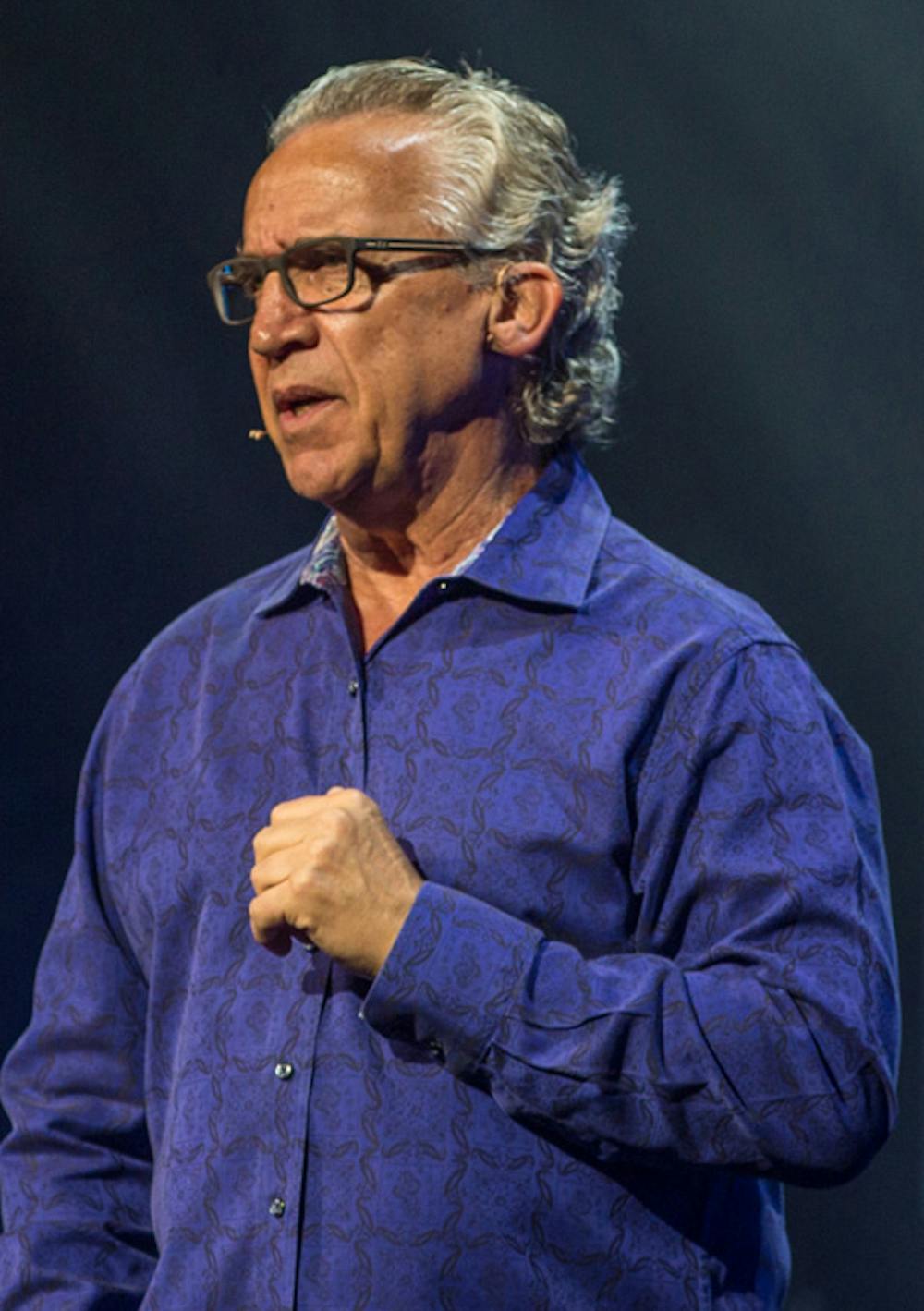
A gray-haired man wearing glasses and a blue shirt.
Bill Johnson.
Doctorg via Wikimedia Commons

Since 1996, Bill Johnson, a senior leader of Bethel Church, and Johnny Enlow, a self-described prophet and Seven Mountains advocate, among others, have taken the original idea of the Seven Mountains Mandate and reshaped it into a more aggressive, political and spiritually militant approach. Spiritual militancy reflects an aggressive, us-vs.-them mindset that blurs the line between faith and authoritarianism, promoting dominion over society in the name of spiritual warfare.

Their version doesn’t just aim to influence culture; it frames the effort as a spiritual battle to reclaim and reshape the nation according to their vision of God’s will.

Lance Wallnau, another Christian evangelical preacher, televangelist, speaker and author, has promoted dominion theology since the early 2000s. During the 2020 U.S. presidential election, Wallnau, along with several prominent NAR figures, described Donald Trump as anointed by God to reclaim the “mountain” of government from demonic control.

In their book “Invading Babylon: The 7 Mountains Mandate,” Wallnau and Johnson explicitly call for Christian leadership as the only antidote to perceived moral decay and spiritual darkness.

The beliefs

Sometimes referred to as Seven Mountains of Influence or Seven Mountains of Culture, the seven mountains are not neutral domains but seen as battlegrounds between divine truth and demonic deception.

Adherents believe that Christians are called to reclaim these areas through influence, leadership and even, if necessary, the use of force and to confront demonic political forces, as religion scholar Matthew Taylor demonstrates in his book “The Violent Take It By Force.”

Diverse perspectives and interpretations surround the rhetoric and actions associated with the New Apostolic Reformation. Some analysts have pointed out how the NAR is training its followers for an active confrontation. Other commentators have said that the rhetoric calling for physical violence is anti-biblical and should be denounced.

NAR-aligned leaders have framed electoral contests as struggles between “godly” candidates and those under the sway of “satanic” influence.

Similarly, NAR prophet Cindy Jacobs has repeatedly emphasized the need for “spiritual warfare” in schools to combat what she characterizes as “demonic ideologies” such as sex education, LGBTQ+ inclusion or discussions of systemic racism.

In the NAR worldview, cultural change is not merely political or social but considered a supernatural mission; opponents are not simply wrong but possibly under the sway of demonic influence. Elections become spiritual battles.

This belief system views pluralism as weakness, compromise as betrayal, and coexistence as capitulation. Frederick Clarkson, a senior research analyst at Political Research Associates, a progressive think tank based in Somerville, Massachusetts, defines the Seven Mountains Mandate as “the theocratic idea that Christians are called by God to exercise dominion over every aspect of society by taking control of political and cultural institutions.”

The call to “take back” the culture is not metaphorical but literal, and believers are encouraged to see themselves as soldiers in a holy war to dominate society. Some critics argue that NAR’s call to “take back” culture is about literal domination, but this interpretation is contested.

Many within the movement see the language of warfare as spiritually focused on prayer, evangelism and influencing hearts and minds. Still, the line between metaphor and mandate can blur, especially when rhetoric about “dominion” intersects with political and cultural action. That tension is part of an ongoing debate both within and outside the movement.

Networks that spread the beliefs

This belief system is no longer confined to the margins. It is spread widely through evangelical churches, podcasts, YouTube videos and political networks.

It’s hard to know exactly how many churches are part of the New Apostolic Reformation, but estimates suggest that about 3 million people in the U.S. attend churches that openly follow NAR leaders.

At the same time, the Seven Mountains Mandate doesn’t depend on centralized leadership or formal institutions. It spreads organically through social networks, social media – notably podcasts and livestreams – and revivalist meetings and workshops.

André Gagné, a theologian and author of “American Evangelicals for Trump: Dominion, Spiritual Warfare, and the End Times,” writes about the ways in which the mandate spreads by empowering local leaders and believers. Individuals are authorized – often through teachings on spiritual warfare, prophetic gifting, and apostolic leadership – to see themselves as agents of divine transformation in society, called to reclaim the “mountains,” such as government, media and education, for God’s kingdom.

This approach, Gagné explains, allows different communities to adapt the action mandate to their unique cultural, political and social contexts. It encourages individuals to see themselves as spiritual warriors and leaders in their domains – whether in business, education, government, media or the arts.

Small groups or even individuals can start movements or initiatives without waiting for top-down directives. The only recognized authorities are the apostles and prophets running the church or church network the believers attend.

The framing of the Seven Mountains Mandate as a divinely inspired mission, combined with the movement’s emphasis on direct spiritual experiences and a specific interpretation of scripture, can create an environment where questioning the mandate is perceived as challenging God’s authority.

Slippery slope

These beliefs have increasingly fused with nationalist rhetoric and conspiracy theories.

A white flag bearing the words 'An Appeal to Heaven,' featuring a green pine tree, with the American flag displayed beneath it.
The ‘Appeal to Heaven’ flags symbolize the belief that people have the right to appeal directly to God’s authority when they think the government has failed.
Paul Becker/Becker1999 via Flickr, CC BY

A powerful example of NAR political rhetoric in action is the rise and influence of the “Appeal to Heaven” flags. For those in the New Apostolic Reformation, these flags symbolize the belief that when all earthly authority fails, people have the right to appeal directly to God’s authority to justify resistance.

This was evident during the Jan. 6, 2021, Capitol insurrection, when these flags were prominently displayed.

To be clear, its leaders are not calling for violence but rather for direct political engagement and protest. For some believers, however, the calls for “spiritual warfare” may become a slippery slope into justification for violence, as in the case of the alleged Minnesota shooter.

Understanding the Seven Mountains Mandate is essential for grasping the dynamics of contemporary efforts to align government and culture with a particular vision of Christian authority and influence.

The Conversation

Art Jipson does not work for, consult, own shares in or receive funding from any company or organization that would benefit from this article, and has disclosed no relevant affiliations beyond their academic appointment.

ref. What is the ‘Seven Mountains Mandate’ and how is it linked to political extremism in the US? – https://theconversation.com/what-is-the-seven-mountains-mandate-and-how-is-it-linked-to-political-extremism-in-the-us-260034

Here’s a way to save lives, curb traffic jams and make commutes faster and easier − ban left turns at intersections

Source: The Conversation – USA – By Vikash V. Gayah, Associate Professor of Civil Engineering, Penn State

Research shows left turns at intersections are dangerous and slow traffic. Benjamin Rondel/The Image Bank via Getty Images

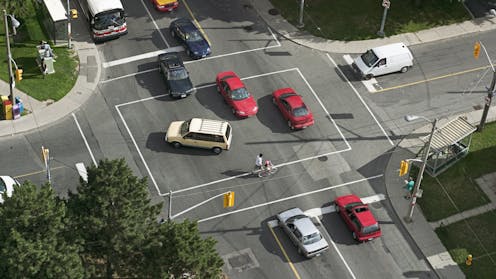
More than 60% of traffic collisions at intersections involve left turns. Some U.S. cities – including San Francisco, Salt Lake City and Birmingham, Alabama – are restricting left turns.

Dr. Vikash Gayah, a professor of civil engineering at Penn State University and the interim director of the Larson Transportation Institute, discusses how left turns at intersections cause accidents, make traffic worse and use more gas.

Dr. Vikash Gayah discusses why left turns should be banned at some intersections.

The Conversation has collaborated with SciLine to bring you highlights from the discussion, edited for brevity and clarity.

How dangerous are left turns at intersections?

Vikash Gayah: When you make a left turn, you have to cross oncoming traffic. When you have a green light, you need to wait for a gap in the oncoming traffic before turning left. If you misjudge when you decide to turn, you could hit the oncoming traffic, or be hit by it. That’s an angle crash, one of the most dangerous types of crashes.

Also, the driver of the left-turning vehicle is typically looking at oncoming traffic. But pedestrians may be crossing the street they’re turning on to. Often the driver doesn’t see the pedestrians, and that too can cause a serious accident.

On the other hand, right turns require merging into traffic, but they’re not conflicting directly with traffic. So right turns are much, much safer than left turns.

What are the statistics on the unique dangers of left turns?

Gayah: Approximately 40% of all crashes occur at intersections − 50% of those crashes involve a serious injury, and 20% involve a fatality.

About 61% of the crashes at intersections involve a left turn. Left-hand turns are generally the least frequent movement at an intersection, so that 61% is a lot.

Why are left turns inefficient for traffic flow?

Gayah: When left-turning vehicles are waiting for the gap, they can block other lanes from moving, particularly when several vehicles are waiting to turn left.

Instead of the solid green light, many intersections use the green arrow to let left-turning vehicles move. But to do that, all other movements at the intersection have to stop. Stopping all other traffic just to serve a few left turns makes the intersection less efficient.

Also, every time you move to another “phase” of traffic – like the green arrow – the intersection has a brief period of time when all the lights are red. Traffic engineers call that an all-red time, and that’s when the intersection is not serving any vehicles. All-red time is two to three seconds per phase change, and that wasted time adds up quickly to further make the intersection less efficient.

An aerial view of a cars traveling around a roundabout.
Roundabouts reduce the need for left turns, but they don’t work everywhere.
Pete Ark/Moment via Getty Images

What restrictions have been tried in different cities?

Gayah: When a downtown is not very busy – in the off-peak periods – allowing left turns is fine because you don’t need that additional ability to move vehicles at each intersection.

Some cities are implementing signs that say no left turns at intersections from 7 to 9, which is the morning peak period, or 4 to 6, which is the afternoon peak period. In San Francisco, for example, Van Ness Avenue restricts left turns during peak periods.

But cities aren’t implementing these restrictions on a larger scale. Restrictions are more along individual corridors or isolated intersections instead of essentially the entire downtown, where possible. That would make the downtown street network more efficient.

Roundabouts are one approach to avoiding left turns.

Gayah: Roundabouts are safe because there’s no longer a need to cross opposing traffic. Everyone circulates in the same direction. You find where you need to go and then exit.

But restricting left turns, in general, is more efficient. Roundabouts aren’t as efficient when it’s busier. The roundabout gets full, which can cause a gridlock, and no vehicle can move. Traditional intersections are less prone to gridlock.

Roundabouts also take up more space. Installing a roundabout might mean expanding the intersection. In some downtowns, that means tearing down buildings or removing sidewalks. Restricting left turns only requires a sign that says “no left turns” or “no left turns during peak periods.” That’s it.

What are the benefits to banning left turns in urban areas?

Gayah: Any way you cut it, eliminating left turns will result in longer travel distances. I’ll have to travel a longer distance to get to where I need to go. The worst case is having to circle the block. I’m actually traveling four extra block lengths to get to where I need to go.

But not all trips require circling the block. In a typical downtown, each trip will be about one block length longer on average. That’s not a lot of extra distance. And that extra driving is more than offset by the fact that each intersection with banned left turns is now moving more vehicles. Which means every time you’re at an intersection, you wait less time, on average. So you travel a slightly longer distance but get to where you’re going more quickly.

Does avoiding left turns improve fuel efficiency?

Gayah: Our research found that even though vehicles travel longer distances on average with the restricted left turns, they spend less fuel – about 10% to 15% less per trip – because they don’t stop as much at intersections.

This is why UPS and other fleets route their vehicles to avoid left turns. There’s less idling and fewer stops.

Do you think banning left turns could become widely accepted?

Gayah: It’s a new strategy, so it’s uncomfortable for some people. But when they get to their destination faster, I think people will latch onto it.

Watch the full interview to hear more.

SciLine is a free service based at the American Association for the Advancement of Science, a nonprofit that helps journalists include scientific evidence and experts in their news stories.

The Conversation

Vikash V. Gayah’s research has been funded by various State Departments of Transportation (including Pennsylvania, Wisconsin, Washington State, Montana, South Dakota and North Carolina), US Department of Transportation (via the Mineta National Transit Research Consortium, the Mid-Atlantic Universities Transportation Center, and the Center for Integrated Asset Management for Multimodal Transportation Infrastructure Systems), Federal Highway Administration, National Cooperative Highway Research Program, and National Science Foundation..

ref. Here’s a way to save lives, curb traffic jams and make commutes faster and easier − ban left turns at intersections – https://theconversation.com/heres-a-way-to-save-lives-curb-traffic-jams-and-make-commutes-faster-and-easier-ban-left-turns-at-intersections-257877

How can the James Webb Space Telescope see so far?

Source: The Conversation – USA – By Adi Foord, Assistant Professor of Astronomy and Astrophysics, University of Maryland, Baltimore County

This is a James Webb Space Telescope image of NGC 604, a star-forming region about 2.7 million light-years from Earth. NASA/ESA/CSA/STScI

Curious Kids is a series for children of all ages. If you have a question you’d like an expert to answer, send it to CuriousKidsUS@theconversation.com.


How does the camera on the James Webb Space Telescope work and see so far out? – Kieran G., age 12, Minnesota


Imagine a camera so powerful it can see light from galaxies that formed more than 13 billion years ago. That’s exactly what NASA’s James Webb Space Telescope is built to do.

Since it launched in December 2021, Webb has been orbiting more than a million miles from Earth, capturing breathtaking images of deep space. But how does it actually work? And how can it see so far? The secret lies in its powerful cameras – especially ones that don’t see light the way our eyes do.

I’m an astrophysicist who studies galaxies and supermassive black holes, and the Webb telescope is an incredible tool for observing some of the earliest galaxies and black holes in the universe.

When Webb takes a picture of a distant galaxy, astronomers like me are actually seeing what that galaxy looked like billions of years ago. The light from that galaxy has been traveling across space for the billions of years it takes to reach the telescope’s mirror. It’s like having a time machine that takes snapshots of the early universe.

By using a giant mirror to collect ancient light, Webb has been discovering new secrets about the universe.

A telescope that sees heat

Unlike regular cameras or even the Hubble Space Telescope, which take images of visible light, Webb is designed to see a kind of light that’s invisible to your eyes: infrared light. Infrared light has longer wavelengths than visible light, which is why our eyes can’t detect it. But with the right instruments, Webb can capture infrared light to study some of the earliest and most distant objects in the universe.

A dog, shown normally, then through thermal imaging, with the eyes, mouth and ears brighter than the rest of the dog.
Infrared cameras, like night-vision goggles, allow you to ‘see’ the infrared waves emitting from warm objects such as humans and animals. The temperatures for the images are in degrees Fahrenheit.
NASA/JPL-Caltech

Although the human eye cannot see it, people can detect infrared light as a form of heat using specialized technology, such as infrared cameras or thermal sensors. For example, night-vision goggles use infrared light to detect warm objects in the dark. Webb uses the same idea to study stars, galaxies and planets.

Why infrared? When visible light from faraway galaxies travels across the universe, it stretches out. This is because the universe is expanding. That stretching turns visible light into infrared light. So, the most distant galaxies in space don’t shine in visible light anymore – they glow in faint infrared. That’s the light Webb is built to detect.

A diagram of the electromagnetic spectrum, with radio, micro and infrared waves having a longer wavelength than visible light, while UV, X-ray and gamma rays have shorter wavelengths than visible light.
The rainbow of visible light that you can see is only a small slice of all the kinds of light. Some telescopes can detect light with a longer wavelength, such as infrared light, or light with a shorter wavelength, such as ultraviolet light. Others can detect X-rays or radio waves.
Inductiveload, NASA/Wikimedia Commons, CC BY-SA

A golden mirror to gather the faintest glow

Before the light reaches the cameras, it first has to be collected by the Webb telescope’s enormous golden mirror. This mirror is over 21 feet (6.5 meters) wide and made of 18 smaller mirror pieces that fit together like a honeycomb. It’s coated in a thin layer of real gold – not just to look fancy, but because gold reflects infrared light extremely well.

The mirror gathers light from deep space and reflects it into the telescope’s instruments. The bigger the mirror, the more light it can collect – and the farther it can see. Webb’s mirror is the largest ever launched into space.

The JWST's mirror, which looks like a large, roughly hexagonal shiny surface made up of 18 smaller hexagons put together, sitting in a facility. The mirror is reflecting the NASA meatball logo.
Webb’s 21-foot primary mirror, made of 18 hexagonal mirrors, is coated with a plating of gold.
NASA

Inside the cameras: NIRCam and MIRI

The most important “eyes” of the telescope are two science instruments that act like cameras: NIRCam and MIRI.

NIRCam stands for near-infrared camera. It’s the primary camera on Webb and takes stunning images of galaxies and stars. It also has a coronagraph – a device that blocks out starlight so it can photograph very faint objects near bright sources, such as planets orbiting bright stars.

NIRCam works by imaging near-infrared light, the type closest to what human eyes can almost see, and splitting it into different wavelengths. This helps scientists learn not just what something looks like but what it’s made of. Different materials in space absorb and emit infrared light at specific wavelengths, creating a kind of unique chemical fingerprint. By studying these fingerprints, scientists can uncover the properties of distant stars and galaxies.

MIRI, or the mid-infrared instrument, detects longer infrared wavelengths, which are especially useful for spotting cooler and dustier objects, such as stars that are still forming inside clouds of gas. MIRI can even help find clues about the types of molecules in the atmospheres of planets that might support life.

Both cameras are far more sensitive than the standard cameras used on Earth. NIRCam and MIRI can detect the tiniest amounts of heat from billions of light-years away. If you had Webb’s NIRCam as your eyes, you could see the heat from a bumblebee on the Moon. That’s how sensitive it is.

Two photos of space, with lots of stars and galaxies shown as little dots. The right image shows more, brighter dots than the left.
Webb’s first deep-field image: The MIRI image is on the left and the NIRCam image is on the right.
NASA

Because Webb is trying to detect faint heat from faraway objects, it needs to keep itself as cold as possible. That’s why it carries a giant sun shield about the size of a tennis court. This five-layer sun shield blocks heat from the Sun, Earth and even the Moon, helping Webb stay incredibly cold: around -370 degrees F (-223 degrees C).

MIRI needs to be even colder. It has its own special refrigerator, called a cryocooler, to keep it chilled to nearly -447 degrees F (-266 degrees C). If Webb were even a little warm, its own heat would drown out the distant signals it’s trying to detect.

Turning space light into pictures

Once light reaches the Webb telescope’s cameras, it hits sensors called detectors. These detectors don’t capture regular photos like a phone camera. Instead, they convert the incoming infrared light into digital data. That data is then sent back to Earth, where scientists process it into full-color images.

The colors we see in Webb’s pictures aren’t what the camera “sees” directly. Because infrared light is invisible, scientists assign colors to different wavelengths to help us understand what’s in the image. These processed images help show the structure, age and composition of galaxies, stars and more.

By using a giant mirror to collect invisible infrared light and sending it to super-cold cameras, Webb lets us see galaxies that formed just after the universe began.


Hello, curious kids! Do you have a question you’d like an expert to answer? Ask an adult to send your question to CuriousKidsUS@theconversation.com. Please tell us your name, age and the city where you live.

And since curiosity has no age limit – adults, let us know what you’re wondering, too. We won’t be able to answer every question, but we will do our best.

The Conversation

Adi Foord does not work for, consult, own shares in or receive funding from any company or organization that would benefit from this article, and has disclosed no relevant affiliations beyond their academic appointment.

ref. How can the James Webb Space Telescope see so far? – https://theconversation.com/how-can-the-james-webb-space-telescope-see-so-far-257421

Turbulent research landscape imperils US brain gain − and ultimately American prosperity

Source: The Conversation – USA – By Marc Zimmer, Professor of Chemistry, Connecticut College

International students have been a big part of American STEM. Rick Friedman/AFP via Getty Images

Despite representing only 4% of the world’s population, the United States accounts for over half of science Nobel Prizes awarded since 2000, hosts seven of The Times Higher Education Top 10 science universities, and incubates firms such as Alphabet (Google), Meta and Pfizer that turn federally funded discoveries into billion-dollar markets.

The domestic STEM talent pool alone cannot sustain this research output. The U.S. is reliant on a steady and strong influx of foreign scientists – a brain gain. In 2021, foreign-born people constituted 43% of doctorate-level scientists and engineers in the U.S. They make up a significant share of America’s elite researchers: Since 2000, 37 of the 104 U.S. Nobel laureates in the hard sciences, more than a third, were born outside the country.

China, the U.S.’s largest competitor in science, technology, engineering and math endeavors, has a population that is 4.1 times larger than that of the U.S. and so has a larger pool of homegrown talent. Each year, three times as many Chinese citizens (77,000) are awarded STEM Ph.D.s as American citizens (23,000).

To remain preeminent, the U.S. will need to keep attracting exceptional foreign graduate students, budding entrepreneurs and established scientific leaders.

Funding and visa policies could flip gain to drain

This scientific brain gain is being threatened by the Trump administration, which is using federal research funding, scholarships and fellowships as leverage against universities, freezing billions of dollars in grants and contracts to force compliance with its ideological agenda. Its ad hoc approach has been described by higher education leaders as “unprecedented and deeply disturbing,” and a Reagan-appointed judge ruled that 400 National Institutes of Health grants be reinstated because their terminations were “bereft of reasoning, virtually in their entirety.”

Experts caution that these moves not only risk immediate harm to scientific progress and academic freedom but also erode the public’s trust in science and education, with long-term implications for the nation’s prosperity and security.

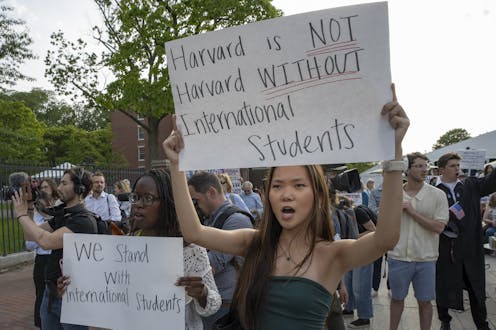
Citing national security concerns, the White House has also targeted visas for Harvard University’s international students and instructed embassies worldwide to halt visa interviews for all international students, citing national security and alleged institutional misconduct. Against a backdrop of court injunctions and legal appeals, the government continues its heightened “national-security” vetting, so thousands of international scholars remain in limbo.

These measures, combined with travel bans, intensified scrutiny and revocations of existing visas, have disrupted research collaborations and threaten the nation’s continued status as a global leader in science and innovation.

What US misses with fewer foreign scientists

The U.S. research brain gain starts with the 281,000 foreign STEM graduate students and 38,000 foreign STEM postdoctoral scholars who annually come to the U.S. I am one of them. After earning my bachelor’s and master’s degrees in South Africa, I left in 1986 to avoid the apartheid‑era military service, completed my chemistry doctorate and postdoc in the U.S., and joined the United States’ brain gain. It’s an opportunity today’s visa climate might have denied me.

poster announcing 'Safe Place For Science'
Some other countries are eager to scoop up STEM talent that is unwelcome or unfunded in the U.S.
Clement Mahoudeau/AFP via Getty Images

Incentives for the best and brightest foreign science students to come to the U.S. are diminishing at the same time its competitors are increasing their efforts to attract the strongest STEM researchers. For instance, the University of Hong Kong is courting stranded Harvard students with dedicated scholarships, housing and credit-transfer help. A French university program, Safe Place for Science, drew so many American job applicants that it had to shut the portal early. And a Portuguese institute reports a tenfold surge in inquiries from U.S.-based junior faculty.

Immigrants import new ways of thinking to their research labs. They come from other cultures and have learned their science in different educational systems, which place different emphases on rote learning, historical understanding and interdisciplinary research. They often bring an alternative perspective that a homogeneous scientific community cannot match.

Immigrants also help move discoveries from the lab to the marketplace. Foreign-born inventors file patents at a higher per‑capita rate than their domestic peers and are 80% more likely to launch a company. Such firms create roughly 50% more jobs than enterprises founded by native-born entrepreneurs and pay wages that are, on average, one percentage point higher.

The economic stakes are high. Growth models suggest that scientific advances now account for a majority of productivity gains in high‑income countries.

L. Rafael Reif, the former president of MIT, called international talent the “oxygen” of U.S. innovation; restricting visas chokes that supply. Ongoing cuts and uncertainties in federal funding and visa policy now jeopardize America’s scientific leadership and with it the nation’s long‑term economic growth.

The Conversation

Marc Zimmer received funding from NIH and NSF.

ref. Turbulent research landscape imperils US brain gain − and ultimately American prosperity – https://theconversation.com/turbulent-research-landscape-imperils-us-brain-gain-and-ultimately-american-prosperity-258537

Social media can support or undermine democracy – it comes down to how it’s designed

Source: The Conversation – USA – By Lisa Schirch, Professor of the Practice of Peace Studies, University of Notre Dame

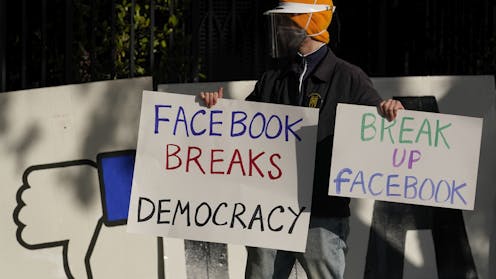
A protester calls out Facebook for facilitating the spread of disinformation. AP Photo/Jeff Chiu

Every design choice that social media platforms make nudges users toward certain actions, values and emotional states.

It is a design choice to offer a news feed that combines verified news sources with conspiracy blogs – interspersed with photos of a family picnic – with no distinction between these very different types of information. It is a design choice to use algorithms that find the most emotional or outrageous content to show users, hoping it keeps them online. And it is a design choice to send bright red notifications, keeping people in a state of expectation for the next photo or juicy piece of gossip.

Platform design is a silent pilot steering human behavior.

Social media platforms are bringing massive changes to how people get their news and how they communicate and behave. For example, the “endless scroll” is a design feature that aims to keep users scrolling and never reaching the bottom of a page where they might decide to pause.

I’m a political scientist who researches aspects of technology that support democracy and social cohesion, and I’ve observed how the design of social media platforms affects them.

Democracy is in crisis globally, and technology is playing a role. Most large platforms optimize their designs for profit, not community or democracy. Increasingly, Big Tech is siding with autocrats, and the platforms’ designs help keep society under control.

There are alternatives, however. Some companies design online platforms to defend democratic values.

Optimized for profit

A handful of tech billionaires dominate the global information ecosystem. Without public accountability or oversight, they determine what news shows up on your feed and what data they collect and share.

Social media companies say they are in the business of connecting people, but they make most of their money as data brokers and advertising firms. Time spent on platforms translates to profit. The more time you spend online, the more ads you see and the more data they can collect from you.

This ad-based business model demands designs that encourage endless scrolling, social comparison and emotional engagement. Platforms routinely claim they merely reflect user behavior, yet internal documents and whistleblower accounts have shown that toxic content often gets a boost because it captures people’s attention.

Tech companies design platforms based on extensive psychological research. Examples include flashing notifications that make your phone jump and squeak, colorful rewards when others like your posts, and algorithms that push out the most emotional content to stimulate your most base emotions of anger, shame or glee.

How social media algorithms work, explained.

Optimizing designs for user engagement undermines mental health and society. Social media sites favor hype and scandal over factual accuracy, and public manipulation over designing for safety, privacy and user agency. The resulting prevalence of polarizing false and deceptive information is corrosive to democracy.

Many analysts identified these problems nearly a decade ago. But now there is a new threat: Some tech executives are looking to capture political power to advance a new era of techno-autocracy.

Optimized for political power

A techno-autocracy is a political system where an authoritarian government uses technology to control its population. Techno-autocrats spread disinformation and propaganda, using fear tactics to demonize others and distract from corruption. They leverage massive amounts of data, artificial intelligence and surveillance to censor opponents.

For example, China uses technology to monitor and surveil its population with public cameras. Chinese platforms like WeChat and Weibo automatically scan, block or delete messages and posts for sensitive words like “freedom of speech.” Russia promotes domestic platforms like VK that are closely monitored and partly owned by state-linked entities that use it to promote political propaganda.

Over a decade ago, tech billionaires like Elon Musk and Peter Thiel, and now Vice President JD Vance, began aligning with far-right political philosophers like Curtis Yarvin. They argue that democracy impedes innovation, favoring concentrated decision-making in corporate-controlled mini-states governed through surveillance. Embracing this philosophy of techno-autocracy, they moved from funding and designing the internet to reshaping government.

Techno-autocrats weaponize social media platforms as part of their plan to dismantle democratic institutions.

The political capture of both X and Meta also have consequences for global security. At Meta, Mark Zuckerberg removed barriers to right-wing propaganda and openly endorsed President Donald Trump’s agenda. Musk changed X’s algorithm to highlight right-wing content, including Russian propaganda.

Designing tech for democracy

Recognizing the power that platform design has on society, some companies are designing new civic participation platforms that support rather than undermine society’s access to verified information and places for public deliberation. These platforms offer design features that big tech companies could adopt for improving democratic engagement that can help counter techno-autocracy.

In 2014, a group of technologists founded Pol.is, an open-source technology for hosting public deliberation that leverages data science. Pol.is enables participants to propose and vote on policy ideas using what they call “computational democracy.” The Pol.is design avoids personal attacks by having no “reply” button. It offers no flashy newsfeed, and it uses algorithms that identify areas of agreement and disagreement to help people make sense of a diversity of opinions. A prompt question asks for people to offer ideas and vote up or down on other ideas. People participate anonymously, helping to keep the focus on the issues and not the people.

The civic participation platform Pol.is helps large numbers of people share their views without distractions or personal attacks.

Taiwan used the Pol.is platform to enable mass civic engagement in the 2014 democracy movement. The U.K. government’s Collective Intelligence Lab used the platform to generate public discussion and generate new policy proposals on climate and health care policies. In Finland, a public foundation called Sitra uses Pol.is in its “What do you think, Finland?” public dialogues.

Barcelona, Spain, designed a new participatory democracy platform called Decidim in 2017. Now used throughout Spain and Europe, Decidim enables citizens to collaboratively propose, debate and decide on public policies and budgets through transparent digital processes.

Nobel Peace Laureate Maria Ressa founded Rappler Communities in 2023, a social network in the Philippines that combines journalism, community and technology. It aims to restore trust in institutions by providing safe spaces for exchanging ideas and connecting with neighbors, journalists and civil society groups. Rappler Communities offers the public data privacy and portability, meaning you can take your information – like photos, contacts or messages – from one app or platform and transfer it to another. These design features are not available on the major social media platforms.

screenshot of a website with two rows of four icons
Rappler Communities is a social network in the Philippines that combines journalism, community and technology.
Screenshot of Rappler Communities

Tech designed for improving public dialogue is possible – and can even work in the middle of a war zone. In 2024, the Alliance for Middle East Peace began using Remesh.ai, an AI-based platform, to find areas of common ground between Israelis and Palestinians in order to advance the idea of a public peace process and identify elements of a ceasefire agreement.

Platform designs are a form of social engineering to achieve some sort of goal – because they shape how people behave, think and interact – often invisibly. Designing more and better platforms to support democracy can be an antidote to the wave of global autocracy that is increasingly bolstered by tech platforms that tighten public control.

The Conversation

Lisa Schirch receives funding from the Ford Foundation. I know the founder of Pol.is and Remesh platforms, mentioned in this article, as well as Maria Ressa of Rappler Communities.

I will not benefit in any way from describing their work.

ref. Social media can support or undermine democracy – it comes down to how it’s designed – https://theconversation.com/social-media-can-support-or-undermine-democracy-it-comes-down-to-how-its-designed-257103

From Seattle to Atlanta, new social housing programs seek to make homes permanently affordable for a range of incomes

Source: The Conversation – USA (2) – By Susanne Schindler, Research Fellow at the Joint Center for Housing Studies, Harvard Kennedy School

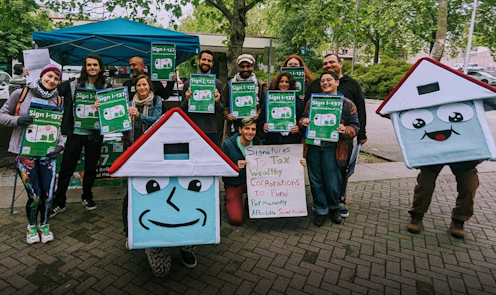
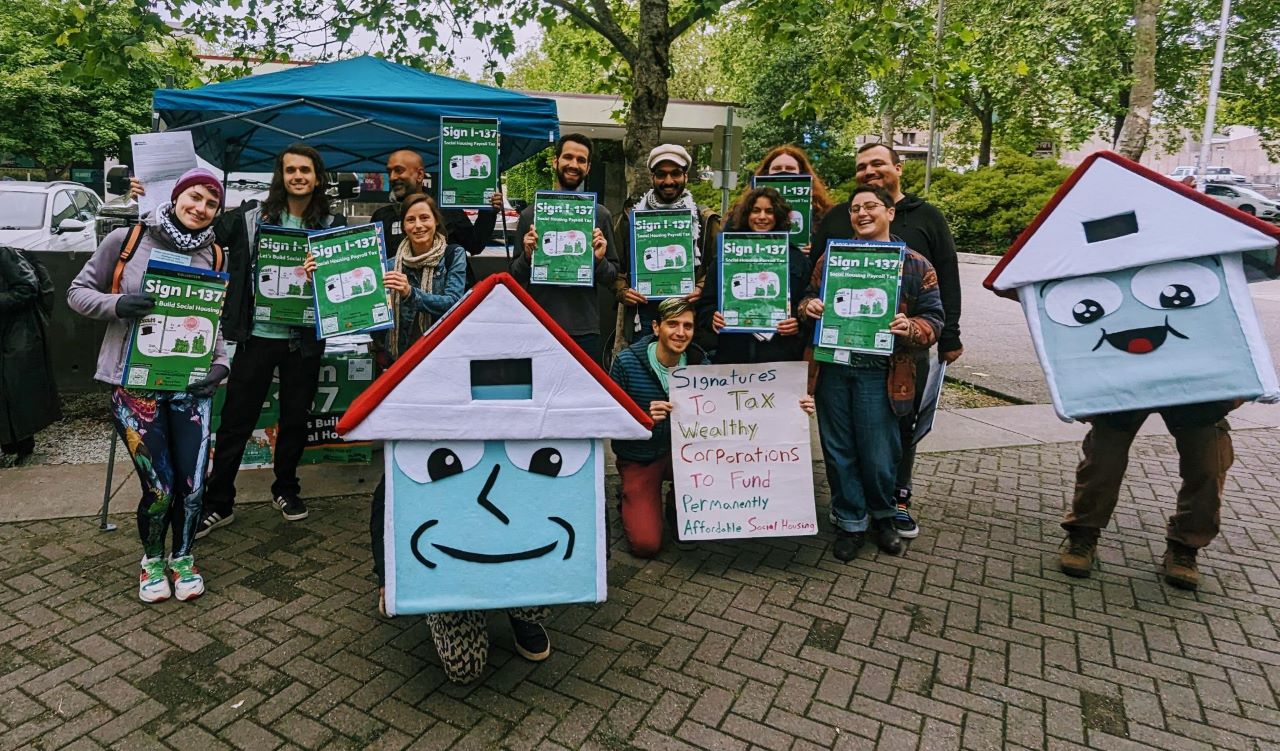
Activists in Seattle gather signatures to put a social housing initiative on the ballot. In early 2025, voters passed the measure, which implements a payroll tax on high incomes to fund the program. House Our Neighbors, CC BY-SA

Seattle astounded housing advocates around the country in February 2025, when roughly two-thirds of voters approved a ballot initiative proposing a new 5% payroll tax on salaries in excess of US$1 million.

The expected revenue – estimated to amount to $52 million dollars annually – would go toward funding a public development authority named Seattle Social Housing, which would then build and maintain permanently affordable homes.

The city has experienced record high rents and home prices over the past two decades, attributed in part to the high incomes and relatively low taxes paid by tech firms like Amazon. Prior attempts to make these companies do their part to keep the city affordable have had mixed results.

So despite nationwide, bipartisan skepticism of government and tax increases, Seattle’s voters showed that in light of a severe affordability crisis, a new role for the public sector and a new, dedicated fiscal revenue stream for housing were not only necessary, but possible.

As a trained architect and urban historian, I study how capitalist societies have embraced – or rejected – housing that’s permanently shielded from market forces and what that means for architecture and urban design.

To me, Seattle’s social housing initiative shows that the country’s traditional, “either-or” housing model – of unregulated, market-rate housing versus tightly regulated, income-restricted affordable housing – has reached its limits.

Social housing promises a different path forward.

The rise of the ‘two-tiered’ system

After World War I, amid a similarly dire housing crisis, journalist Catherine Bauer traveled to Europe and learned about the continent’s social housing programs.

She publicized her findings in the 1934 book “Modern Housing,” in which she advocated for housing that would be permanently shielded from the private real estate market. High-quality design was central to her argument. (The book was reissued in 2020, reflecting a renewed hunger for her ideas.)

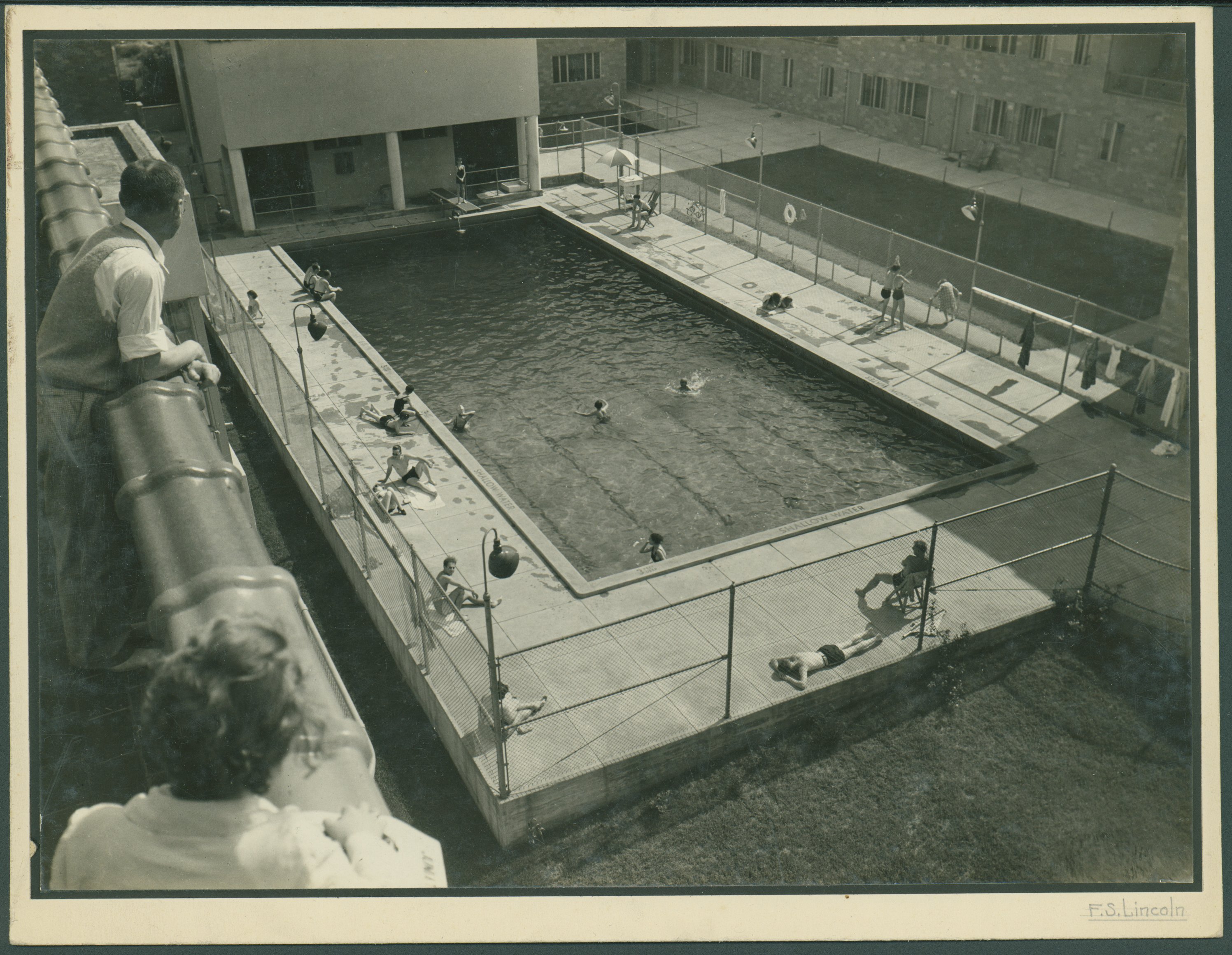
Early New Deal programs supported “limited-dividend,” or nonprofit, housing sponsored by civic organizations such as labor unions. The Carl Mackley Houses in Philadelphia exemplified this approach: The government provided low-interest loans to the American Federation of Full-Fashioned Hosiery Workers, which then constructed housing for its workers with rents set at affordable rates. The complex was built with community rooms and a swimming pool for its residents.

Black and white photo of a swimming pool surrounded by an apartment complex.
Financed by $1.2 million in federal funds, the Carl Mackley Houses, completed in 1935, provided homes for union workers.
Alfred Kastner papers, Collection No. 7350, Box 45, Record 12, American Heritage Center, University of Wyoming

However, the 1937 U.S. Housing Act omitted this form of middle-income housing. Instead, the federal government chose to support public rental housing for low-income Americans and private homeownership, with little in between.

Historian Gail Radford has aptly termed this a “two-tiered system,” and it was problematic from the start.

Funding for public housing in the U.S. – as well as for its successor, private-sector-built affordable housing – has always been capped in ways that fall far short of demand, with access to the homes largely restricted to households with the lowest incomes. Private-sector-built affordable housing depends on dangling tax credits for private investors, and rent restrictions can expire.

While the U.S. promoted this two-tiered system, cities like Vienna pursued a different path.

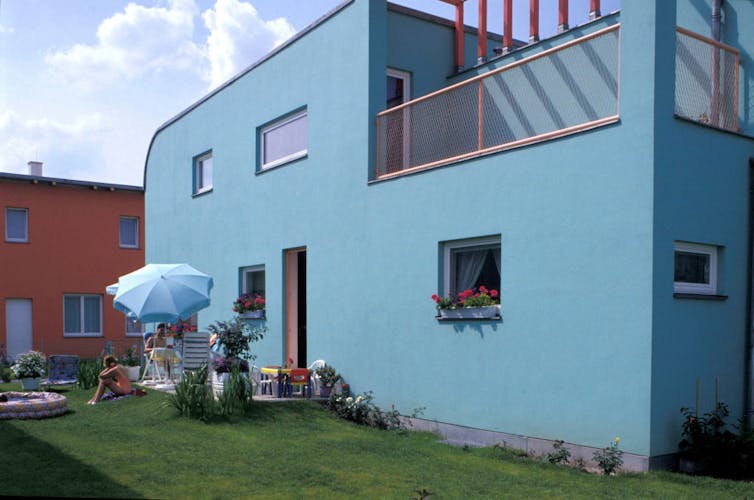
In Austria’s culturally vibrant capital, today half of all dwellings are permanently removed from the private market. Roughly 80% of households qualify to live in them. The buildings take a range of forms, are located in all neighborhoods, and are built and operated as rental or cooperative housing either by the city or by nonprofit developers.

Rents do not rise and fall according to household income, but are instead set to cover capital and operation expenses. These are kept low thanks to long-term, low-interest loans. These loans are funded through a nationwide 1% payroll tax, split evenly between employers and employees. Renters also make a down payment, priced in relation to the size and age of the apartment, which keeps monthly rents down. To guarantee access to low-cost land, the municipality has pursued an active land acquisition policy since the 1980s.

A blue, modern-looking, two-story dwelling with red flowers in the windows.
Vienna’s Pilotengasse Housing Estate, a social housing development featuring low-rise buildings with abundant greenery, was completed in 1992 and serves a range of income groups.
Viennaslide/Construction Photography/Avalon/Getty Images

Housing shielded from the private market

The inequities created by the two-tiered system – along with the absence of viable options for moderate- and middle-income households – are what social housing advocates in the U.S. are trying to address today.

In 2018, the think tank People’s Policy Project published what was likely the first 21st-century report advocating for social housing in the U.S., citing Vienna as a model.

Across the U.S., social housing is being used to describe a range of programs, from limited equity cooperatives and community land trusts to public housing.

They all share a few underlying principles, however.

First and foremost, social housing calls for permanently shielding homes from the private real estate market, often referred to as “permanent affordability.” This usually means public investment in housing and public ownership of it. Second, unlike the ways in which public housing has traditionally operated in the U.S., most social housing programs aim to serve households across a broader range of incomes. The goal is to create housing that is both financially sustainable and appealing to broad swaths of the electorate. Third, social housing aspires to give residents more control over the governance of their homes.

Social housing doesn’t all look the same. But thoughtful design is key to its success. It’s built to be owned and operated in the long-term, not for short-term financial gain. Construction quality matters, and developers realize it needs to be appealing to a range of tenants with different needs.

Early successes

In recent years, there have been significant wins for the social housing movement at the state and local levels.

In 2023, Atlanta created a new quasi-public entity to co-develop mixed-income housing on city-owned land. In 2024, Rhode Island voters and the Massachusetts legislature funded pilot projects to test public investment in social housing. And 2025 has seen the the passage of Chicago’s Green Social Housing ordinance.

Many of these programs were directly inspired by affordable housing initiatives in Montgomery County, Maryland.

Since 2021, the county’s housing authority has used a $100 million housing fund to invest in new mixed-income developments. Through these investments, the county retains co-ownership and has been able to bring down the cost of development enough to offer 30% of homes at significantly below market rents, in perpetuity. If Vienna is the global paragon for social housing, Montgomery County has become its domestic counterpart.

In Seattle, social housing will mean homes delivered and permanently owned by Seattle Social Housing, which is funded through the payroll tax on high incomes. The initiative envisions developments featuring a range of apartment sizes to meet the needs of different family sizes, built to high energy-efficiency standards. Homes will be available to households earning up to 120% of area median income, with residents paying no more than 30% of their income on rent. In Seattle, that means that a single-person household making up to $120,000 will qualify.

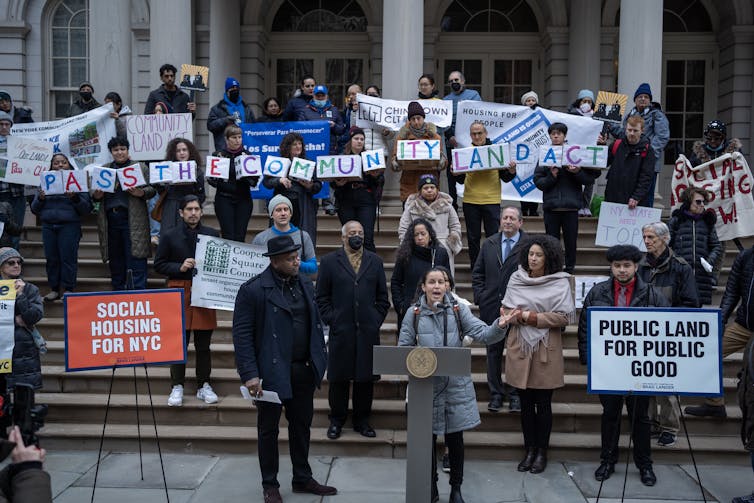
Activists stand on steps holding colorful signs while a woman stands in front of them speaking from a lectern.
Members of the New York City Council hold a rally with housing activists to promote social housing legislation in March 2023.
William Alatriste/NYC Council Media Unit, CC BY-SA

Ongoing debates

Despite these successes, many Americans remain skeptical of social housing.

Sign up for a webinar on the topic, and you’ll hear participants question the term itself. Isn’t it far too “socialist” to be broadly adopted in the U.S.? And isn’t this just “old wine in new bottles”?

Join a housing task force, and established nonprofits will be the ones to push back, arguing that they already know how to build and manage housing, and that all they need is money.

Some housing activists also question whether using scarce public dollars to pay for mixed-income housing will yet again shortchange those who most need governmental assistance – namely, the poor. Others point to the need to provide more ways to build intergenerational wealth, especially for racial minorities, who have historically faced barriers to homeownership.

Urban planner Jonathan Tarleton has highlighted another important issue: the danger of social housing reverting over time to private ownership, as has been the case with some cooperatives in New York City. Tarleton stresses the need for “social maintenance” – the importance of telling and retelling the story of whom social housing is meant to serve.

These debates raise important questions. Social housing may be a confusing term and an aspirational concept. But it is here to stay: It has galvanized organizers and policymakers around a new approach to the design, development and maintenance of housing.

Social housing keeps prices down through long-term public investment, ensuring that future generations will still benefit. Developers can design and provide homes that respond to how people want to live. And in an increasingly polarized country, social housing will allow people of various backgrounds, incomes and ideological persuasions to live together again, rather than apart.

Whether it’s the kind found in Seattle, in Maryland or somewhere in between, I believe social housing is needed more than ever before to address the country’s twin problems of affordability and a lack of political imagination.

This article is part of a series centered on envisioning ways to deal with the housing crisis.

The Conversation

Susanne Schindler receives funding from Harvard’s Joint Center for Housing Studies.

ref. From Seattle to Atlanta, new social housing programs seek to make homes permanently affordable for a range of incomes – https://theconversation.com/from-seattle-to-atlanta-new-social-housing-programs-seek-to-make-homes-permanently-affordable-for-a-range-of-incomes-255097

Misinformation lends itself to social contagion – here’s how to recognize and combat it

Source: The Conversation – USA (3) – By Shaon Lahiri, Assistant Professor of Public Health, College of Charleston

Misinformation on social media has the potential to manipulate millions of people. Pict Rider/iStock via Getty Images Plus

In 2019, a rare and shocking event in the Malaysian peninsula town of Ketereh grabbed international headlines. Nearly 40 girls age 12 to 18 from a religious school had been screaming inconsolably, claiming to have seen a “face of pure evil,” complete with images of blood and gore.

Experts believe that the girls suffered what is known as a mass psychogenic illness, a psychological condition that results in physical symptoms and spreads socially – much like a virus.

I’m a social and behavioral scientist within the field of public health. I study the ways in which individual behavior is influenced by prevailing social norms and social network processes, across a wide range of behaviors and contexts. Part of my work involves figuring out how to combat the spread of harmful content that can shape our behavior for the worse, such as misinformation.

Mass psychogenic illness is not misinformation, but it gives researchers like me some idea about how misinformation spreads. Social connections establish pathways of influence that can facilitate the spread of germs, mental illness and even behaviors. We can be profoundly influenced by others within our social networks, for better or for worse.

The spreading of social norms

Researchers in my field think of social norms as perceptions of how common and how approved a specific behavior is within a specific network of people who matter to us.

These perceptions may not always reflect reality, such as when people overestimate or underestimate how common their viewpoint is within a group. But they can influence our behavior nonetheless. For many, perception is reality.

Social norms and related behaviors can spread through social networks like a virus can, but with one crucial caveat. Viruses often require just one contact with a potential host to spread, whereas behaviors often require multiple contacts to spread. This phenomenon, known as complex contagion, highlights how socially learned behaviors take time to embed.

Watch the people in this video and see how you react.

Fiction spreads faster than fact

Consider a familiar scenario: the return of baggy jeans to the fashion zeitgeist.

For many millennials like me, you may react to a friend engaging in this resurrected trend by cringing and lightly teasing them. Yet, after seeing them don those denim parachutes on multiple occasions, a brazen thought may emerge: “Hmm, maybe they don’t look that bad. I could probably pull those off.” That’s complex contagion at work.

This dynamic is even more evident on social media. One of my former students expressed this succinctly. She was looking at an Instagram post about Astro Boy Boots – red, oversize boots based on those worn by a 1952 Japanese cartoon character. Her initial skepticism quickly faded upon reading the comments. As she put it, “I thought they were ugly at first, but after reading the comments, I guess they’re kind of fire.”

Moving from innocuous examples, consider the spread of misinformation on social media. Misinformation is false information that is spread unintentionally, while disinformation is false information that is intentionally disseminated to deceive or do serious harm.

Research shows that both misinformation and disinformation spread faster and farther than truth online. This means that before people can muster the resources to debunk the false information that has seeped into their social networks, they may have already lost the race. Complex contagion may have taken hold, in a malicious way, and begun spreading falsehood throughout the network at a rapid pace.

People spread false information for various reasons, such as to advance their personal agenda or narrative, which can lead to echo chambers that filter out accurate information contrary to one’s own views. Even when people do not intend to spread false information online, doing so tends to happen because of a lack of attention paid to accuracy or lower levels of digital media literacy.

Inoculation against social contagion

So how much can people do about this?

One way to combat harmful contagion is to draw on an idea first used in the 1960s called pre-bunking. The idea is to train people to practice skills to spot and resist misinformation and disinformation on a smaller scale before they’re exposed to the real thing.

The idea is akin to vaccines that build immunity through exposure to a weakened form of the disease-causing germ. The idea is for someone to be exposed to a limited amount of false information, say through the pre-bunking with Google quiz. They then learn to spot common manipulation tactics used in false information and learn how to resist their influence with evidence-based strategies to counter the falsehoods. This could also be done using a trained facilitator within classrooms, workplaces or other groups, including virtual communities.

Then, the idea is to gradually repeat the process with larger doses of false information and further counterarguments. By role-playing and practicing the counterarguments, this resistance skills training provides a sort of psychological innoculation against misinformation and disinformation, at least temporarily.

Importantly, this approach is intended for someone who has not yet been exposed to false information – hence, pre-bunking rather than debunking. If we want to engage with someone who firmly believes in their stance, particularly when it runs contrary to our own, behavioral scientists recommend leading with empathy and nonjudgmentally exchanging narratives.

Debunking is difficult work, however, and even strong debunking messages can result in the persistence of misinformation. You may not change the other person’s mind, but you may be able to engage in a civil discussion and avoid pushing them further away from your position.

Spreading facts, not fiction

When everyday people apply this with their friends and loved ones, they can train people to recognize the telltale signs of false information. This might be recognizing what’s known as a false dichotomy – for instance, “either you support this bill or you HATE our country.”

Another signal of false information is the common tactic of scapegoating: “Oil industry faces collapse due to rise in electric car ownership.” And another is the slippery slope of logical fallacy. An example is “legalization of marijuana will lead to everyone using heroin.”

All of these are examples of common tactics that spread misinformation and come from a Practical Guide to Pre-Bunking Misinformation, created by a collaborative team from the University of Cambridge, BBC Media Action and Jigsaw, an interdisciplinary think tank within Google.

This approach is not only effective in combating misinformation and disinformation, but also in delaying or preventing the onset of harmful behaviors. My own research suggests that pre-bunking can be used effectively to delay the initiation of tobacco use among adolescents. But it only works with regular “booster shots” of training, or the effect fades away in a matter of months or less.

Many researchers like me who study these social contagion dynamics don’t yet know the best way to keep these “booster shots” going in people’s lives. But there are recent studies showing that it can be done. A promising line of research also suggests that a group-based approach can be effective in maintaining the pre-bunking effects to achieve psychological herd immunity. Personally, I would bet my money on group-based approaches where you, your friends or your family can mutually reinforce each other’s capacity to resist harmful social norms entering your network.

Simply put, if multiple members of your social network have strong resistance skills, then your group has a better chance of resisting the incursion of harmful norms and behaviors into your network than if it’s just you resisting alone. Other people matter.

In the end, whether we’re empowering people to resist the insidious creep of online falsehoods or equipping adolescents to stand firm against peer pressure to smoke or use other substances, the research is clear: Resistance skills training can provide an essential weapon for safeguarding ourselves and young people from harmful behaviors.

The Conversation

Shaon Lahiri does not work for, consult, own shares in or receive funding from any company or organization that would benefit from this article, and has disclosed no relevant affiliations beyond their academic appointment.

ref. Misinformation lends itself to social contagion – here’s how to recognize and combat it – https://theconversation.com/misinformation-lends-itself-to-social-contagion-heres-how-to-recognize-and-combat-it-254298

Are people at the South Pole upside down?

Source: The Conversation – USA (2) – By Abigail Bishop, Ph.D. Student in Physics, University of Wisconsin-Madison

At the South Pole, which way is up? Abigail Bishop

Curious Kids is a series for children of all ages. If you have a question you’d like an expert to answer, send it to CuriousKidsUS@theconversation.com.


Are people on the South Pole walking upside down from the rest of the world? – Ralph P., U.S.


When I was standing at the South Pole, I felt the same way I feel anywhere on Earth because my feet were still on the ground and the sky was still overhead.

I’m an astrophysicist from Wisconsin who lived at the South Pole for seven weeks from December 2024 to January 2025 to work on an array of detectors looking for extremely high energy particles from outer space.

I didn’t feel upside down, but there were some differences that still made the South Pole feel flipped over from what I was used to.

As someone who loves looking for the Moon, I noticed that the face of the man on the Moon was flipped over, like he went from 🙂 to 🙃. All the craters that I was used to seeing on the top of the Moon from Wisconsin were now on the bottom – because I was looking at the Moon from the Southern Hemisphere instead of the Northern Hemisphere.

An image showing the Moon and the Earth, and how the Moon looks different from one end of the Earth than the other.
How the Moon looks depends on your point of view.
The Planetary Society, CC BY-SA

After noticing this difference, I remembered something similar in the night skies of New Zealand, a country near Antarctica where my fellow travelers and I got our big red coats that kept us warm at the South Pole. I had looked for Orion, a constellation that in the Northern Hemisphere is viewed as a hunter holding a bow and drawing an arrow from his quiver. In the night sky of New Zealand, Orion looked like he was doing a handstand.

Everything in the sky felt upside down and opposite, compared with what I was used to. A person who lives in the Southern Hemisphere might feel the same about visiting the Arctic or the North Pole.

A view of Earth from space.
‘The Big Blue Marble’ photo, taken in 1972 by the crew of Apollo 17.
NASA

An out-of-this-world perspective

To understand what’s happening, and why things are really different but also feel very much the same, it might be useful to back up a bit from Earth’s surface. Like into outer space. On space missions to the Moon, astronauts could see one side of the Earth’s sphere at once.

If they had superhero vision, an astronaut would see the people at the South Pole and North Pole standing upside down from each other. And a person at the equator would look like they were sticking straight out the side of the planet. In fact, even though they might be standing on the equator, people in Colombia and Indonesia would also look like they were upside down from each other, because they would be sticking out from opposite sides of the Earth.

Of course, if you asked each person, they would say, “My feet are on the ground, and the sky is up.”

That’s because Earth is essentially a really big ball whose gravitational pull on every one of us points to the center of the planet. The direction that Earth pulls us in is what people call “down” all over the planet. Think about holding a baseball between your pointer fingers. From the perspective of your fingertips on the ball’s surface, both are pointing “down.” But from the perspective of a friend nearby, your fingers are pointing in different directions – though always toward the center of the ball.

These relationships between people on the Earth’s surface are good for a little bit of fun, though. While I was at the South Pole, I pointed my body in the same direction as my friends in Wisconsin – by doing a handstand. But if you look at the picture the other way around, it looks like I’m holding up the entire planet, like Superman.

A person does a handstand on a white surface near a red-and-white striped pole surrounded by flags of various nations.
This is the right way up: Abigail Bishop does a handstand at the ceremonial South Pole.
Abigail Bishop

Hello, curious kids! Do you have a question you’d like an expert to answer? Ask an adult to send your question to CuriousKidsUS@theconversation.com. Please tell us your name, age and the city where you live.

And since curiosity has no age limit – adults, let us know what you’re wondering, too. We won’t be able to answer every question, but we will do our best.

The Conversation

Abigail Bishop receives funding from National Science Foundation Award 2013134 and has received funding from the Belgian American Education Foundation.

ref. Are people at the South Pole upside down? – https://theconversation.com/are-people-at-the-south-pole-upside-down-256754

Rural hospitals will be hit hard by Trump’s signature spending package

Source: The Conversation – USA (3) – By Lauren S. Hughes, State Policy Director, Farley Health Policy Center; Associate Professor of Family Medicine, University of Colorado Anschutz Medical Campus

Health policy experts predict that cuts to Medicaid will push more rural hospitals to close. sneakpeekpic via iStock / Getty Images Plus

The public health provisions in the massive spending package that President Donald Trump signed into law on July 4, 2025, will reduce Medicaid spending by more than US$1 trillion over a decade and result in an estimated 11.8 million people losing health insurance coverage.

As researchers studying rural health and health policy, we anticipate that these reductions in Medicaid spending, along with changes to the Affordable Care Act, will disproportionately affect the 66 million people living in rural America – nearly 1 in 5 Americans.

People who live in rural areas are more likely to have health insurance through Medicaid and are at greater risk of losing that coverage. We expect that the changes brought about by this new law will lead to a rise in unpaid care that hospitals will have to provide. As a result, small, local hospitals will have to make tough decisions that include changing or eliminating services, laying off staff and delaying the purchase of new equipment. Many rural hospitals will have to reduce their services or possibly close their doors altogether.

Hits to rural health

The budget legislation’s biggest effect on rural America comes from changes to the Medicaid program, which represent the largest federal rollback of health insurance coverage in the U.S. to date.

First, the legislation changes how states can finance their share of the Medicaid program by restricting where funds states use to support their Medicaid programs can come from. This bill limits how states can tax and charge fees to hospitals, managed care organizations and other health care providers, and how they can use such taxes and fees in the future to pay higher rates to providers under Medicaid. These limitations will reduce payments to rural hospitals that depend upon Medicaid to keep their doors open.

Rural hospitals play a crucial role in health care access.

Second, by 2027, states must institute work requirements that demand most Medicaid enrollees work 80 hours per month or be in school at least half time. Arkansas’ brief experiment with work requirements in 2018 demonstrates that rather than boost employment, the policy increases bureaucracy, hindering access to health care benefits for eligible people. States will also now be required to verify Medicaid eligibility every six months versus annually. That change also increases the risk people will lose coverage due to extra red tape.

The Congressional Budget Office estimates that work requirements instituted through this legislative package will result in nearly 5 million people losing Medicaid coverage. This will decrease the number of paying patients at rural hospitals and increase the unpaid care hospitals must provide, further damaging their ability to stay open.

Additionally, the bill changes how people qualify for the premium tax credits within the Affordable Care Act Marketplace. The Congressional Budget Office estimates that this change, along with other changes to the ACA such as fewer and shorter enrollment periods and additional requirements for documenting income, will reduce the number of people insured through the ACA Marketplace by about 3 million by 2034. Premium tax credits were expanded during the COVID-19 pandemic, helping millions of Americans obtain coverage who previously struggled to do so. This bill lets these expanded tax credits expire, which with may result in an additional 4.2 million people becoming uninsured.

An insufficient stop-gap

Senators from both sides of the aisle have voiced concerns about the legislative package’s potential effects on the financial stability of rural hospitals and frontier hospitals, which are facilities located in remote areas with fewer than six people per square mile. As a result, the Senate voted to set aside $50 billion over the next five years for a newly created Rural Health Transformation Program.

These funds are to be allocated in two ways. Half will be directly distributed equally to states that submit an application that includes a rural health transformation plan detailing how rural hospitals will improve the delivery and quality of health care. The remainder will be distributed to states in varying amounts through a process that is currently unknown.

While additional funding to support rural health facilities is welcome, how it is distributed and how much is available will be critical. Estimates suggest that rural areas will see a reduction of $155 billion in federal spending over 10 years, with much of that concentrated in 12 states that expanded Medicaid under the Affordable Care Act and have large proportions of rural residents.

That means $50 billion is not enough to offset cuts to Medicaid and other programs that will reduce funds flowing to rural health facilities.

An older bearded white man in a yellow shirt sits on a hospital bed in an exam room
Americans living in rural areas are more likely to be insured through Medicaid than their urban counterparts.
Halfpoint Images/Moment via Getty Images

Accelerating hospital closures

Rural and frontier hospitals have long faced hardship because of their aging infrastructure, older and sicker patient populations, geographic isolation and greater financial and regulatory burdens. Since 2010, 153 rural hospitals have closed their doors permanently or ceased providing inpatient services. This trend is particularly acute in states that have chosen not to expand Medicaid via the Affordable Care Act, many of which have larger percentages of their residents living in rural areas.

According to an analysis by University of North Carolina researchers, as of June 2025 338 hospitals are at risk of reducing vital services, such as skilled nursing facilities; converting to an alternative type of health care facility, such as a rural emergency hospital; or closing altogether.

Maternity care is especially at risk.

Currently more than half of rural hospitals no longer deliver babies. Rural facilities serve fewer patients than those in more densely populated areas. They also have high fixed costs, and because they serve a high percentage of Medicaid patients, they rely on payments from Medicaid, which tends to pay lower rates than commercial insurance. Because of these pressures, these units will continue to close, forcing women to travel farther to give birth, to deliver before going full term and to deliver outside of traditional hospital settings.

And because hospitals in rural areas serve relatively small populations, they lack negotiating power to obtain fair and adequate payment from private health insurers and affordable equipment and supplies from medical companies. Recruiting and retaining needed physicians and other health care workers is expensive, and acquiring capital to renovate, expand or build new facilities is increasingly out of reach.

Finally, given that rural residents are more likely to have Medicaid than their urban counterparts, the legislation’s cuts to Medicaid will disproportionately reduce the rate at which rural providers and health facilities are paid by Medicaid for services they offer. With many rural hospitals already teetering on closure, this will place already financially fragile hospitals on an accelerated path toward demise.

Far-reaching effects

Rural hospitals are not just sources of local health care. They are also vital economic engines.

Hospital closures result in the loss of local access to health care, causing residents to choose between traveling longer distances to see a doctor or forgoing the services they need.

But hospitals in these regions are also major employers that often pay some of the highest wages in their communities. Their closure can drive a decline in the local tax base, limiting funding available for services such as roads and public schools and making it more difficult to attract and retain businesses that small towns depend on. Declines in rural health care undermine local economies.

Furthermore, the country as a whole relies on rural America for the production of food, fuel and other natural resources. In our view, further weakening rural hospitals may affect not just local economies but the health of the whole U.S. economy.

The Conversation

Lauren S. Hughes has received funding for rural health projects from the Sunflower Foundation, The Colorado Health Foundation, the University of Colorado School of Medicine Rural Program Office, the Caring for Colorado Foundation, and the Zoma Foundation. She currently serves as chair of the Rural Health Redesign Center Organization Board of Directors and is a member of the Rural Primary Care Advisory Council with the Weitzman Institute.

Kevin J. Bennett receives funding from the National Institutes of Health, the Centers for Disease Control & Prevention, the Health Resources and Services Administration and the state of South Carolina. He is currently on the Board of Trustees of the National Rural Health Association as immediate past president.

ref. Rural hospitals will be hit hard by Trump’s signature spending package – https://theconversation.com/rural-hospitals-will-be-hit-hard-by-trumps-signature-spending-package-260164