Dogs are helping people regulate stress even more than expected, research shows

Source: The Conversation – USA (3) – By Kevin Morris, Research Professor of Social Work, University of Denver

Studies show that dogs help humans cope with stress. marcoventuriniautieri/E+ via Getty Immages

In a 2022 survey of 3,000 U.S. adults, more than one-third of respondents reported that on most days, they feel “completely overwhelmed” by stress. At the same time, a growing body of research is documenting the negative health consequences of higher stress levels, which include increased rates of cancer, heart disease, autoimmune conditions and even dementia.

Assuming people’s daily lives are unlikely to get less stressful anytime soon, simple and effective ways to mitigate these effects are needed.

This is where dogs can help.

As researchers at the University of Denver’s Institute for Human-Animal Connection, we study the effects animal companions have on their humans.

Dozens of studies over the last 40 years have confirmed that pet dogs help humans feel more relaxed. This would explain the growing phenomenon of people relying on emotional support dogs to assist them in navigating everyday life. Dog owners have also been shown to have a 24% lower risk of death and a four times greater chance of surviving for at least a year after a heart attack.

Now, a new study that we conducted with a team of colleagues suggests that dogs might have a deeper and more biologically complex effect on humans than scientists previously believed. And this complexity may have profound implications for human health.

How stress works

The human response to stress is a finely tuned and coordinated set of various physiological pathways. Previous studies of the effects of dogs on human stress focused on just one pathway at a time. For our study, we zoomed out a bit and measured multiple biological indicators of the body’s state, or biomarkers, from both of the body’s major stress pathways. This allowed us to get a more complete picture of how a dog’s presence affects stress in the human body.

The stress pathways we measured are the hypothalamic-pituitary-adrenal, or HPA, axis and the sympathoadrenal medullary, or SAM, axis.

When a person experiences a stressful event, the SAM axis acts quickly, triggering a “fight or flight” response that includes a surge of adrenaline, leading to a burst of energy that helps us meet threats. This response can be measured through an enzyme called alpha-amylase.

At the same time, but a little more slowly, the HPA axis activates the adrenal glands to produce the hormone cortisol. This can help a person meet threats that might last for hours or even days. If everything goes well, when the danger ends, both axes settle down, and the body goes back to its calm state.

While stress can be an uncomfortable feeling, it has been important to human survival. Our hunter-gatherer ancestors had to respond effectively to acute stress events like an animal attack. In such instances, over-responding could be as ineffective as under-responding. Staying in an optimal stress response zone maximized humans’ chances of survival.

An man pets a dog in a gym.
Dogs can be more helpful than human friends in coping with stressful situations.
FG Trade/E+ via Getty Images

More to the story

After cortisol is released by the adrenal glands, it eventually makes its way into your saliva, making it an easily accessible biomarker to track responses. Because of this, most research on dogs and stress has focused on salivary cortisol alone.

For example, several studies have found that people exposed to a stressful situation have a lower cortisol response if they’re with a dog than if they’re aloneeven lower than if they’re with a friend.

While these studies have shown that having a dog nearby can lower cortisol levels during a stressful event, suggesting the person is calmer, we suspected that was just part of the story.

What our study measured

For our study, we recruited about 40 dog owners to participate in a 15-minute gold standard laboratory stress test. This involves public speaking and oral math in front of a panel of expressionless people posing as behavioral specialists.

The participants were randomly assigned to bring their dogs to the lab with them or to leave their dogs at home. We measured cortisol in blood samples taken before, immediately after and about 45 minutes following the test as a biomarker of HPA axis activity. And unlike previous studies, we also measured the enzyme alpha-amylase in the same blood samples as a biomarker of the SAM axis.

As expected based on previous studies, the people who had their dog with them showed lower cortisol spikes. But we also found that people with their dog experienced a clear spike of alpha-amylase, while those without their dog showed almost no response.

No response may sound like a good thing, but in fact, a flat alpha-amylase response can be a sign of a dysregulated response to stress, often seen in people experiencing high stress responses, chronic stress or even PTSD. This lack of response is caused by chronic or overwhelming stress that can change how our nervous system responds to stressors.

In contrast, the participants with their dogs had a more balanced response: Their cortisol didn’t spike too high, but their alpha-amylase still activated. This shows that they were alert and engaged throughout the test, then able to return to normal within 45 minutes. That’s the sweet spot for handling stress effectively. Our research suggests that our canine companions keep us in a healthy zone of stress response.

Having a dog benefits humans’ physical and psychological health.

Dogs and human health

This more nuanced understanding of the biological effects of dogs on the human stress response opens up exciting possibilities. Based on the results of our study, our team has begun a new study using thousands of biomarkers to delve deeper into the biology of how psychiatric service dogs reduce PTSD in military veterans.

But one thing is already clear: Dogs aren’t just good company. They might just be one of the most accessible and effective tools for staying healthy in a stressful world.

The Conversation

Kevin Morris receives funding for this research from the Morris Animal Foundation, the Human-Animal Bond Research Institute, and the University of Denver.

Jaci Gandenberger receives funding from the University of Denver to support this research.

ref. Dogs are helping people regulate stress even more than expected, research shows – https://theconversation.com/dogs-are-helping-people-regulate-stress-even-more-than-expected-research-shows-254563

Amid fragile ceasefire, violence in southern Syria brings Druze communities’ complex cross-border ties to the fore

Source: The Conversation – USA (3) – By Asher Kaufman, Professor of History and Peace Studies, University of Notre Dame

Druze from Syria hug relatives from the Israeli Druze community before crossing the border in the Israeli-controlled Golan Heights on July 17, 2025. AP Photo/Leo Correa

A fragile ceasefire was put in place in southern Syria on July 19, 2025, after days of violence between Druze militias and Bedouin tribes that drew in government forces and prompted Israeli strikes on the capital, Damascus, as a warning to pull back from Druze areas. The United States helped broker the latest agreement, fearing a spillover of violence to other parts of Syria.

The conflict’s quick escalation brings to the fore multiple layers of politics and identity in the region – particularly among the Druze, who form an important minority in several countries and make up about 2% of Israel’s population. As a historian of the Middle East, I have researched Druze cross-border communal ties and followed closely their predicaments since the start of the Syrian civil war in March 2011.

A wide road seen from above, with damaged buildings alongside it and smoke rising against a blue sky.
Bedouin fighters deploy in Mazraa village on the outskirts of Sweida, as smoke rises from clashes with Druze militias, on July 18, 2025.
AP Photo/Ghaith Alsayed

Cross-border brotherhood

The Druze are a monotheistic religious community that split from a branch of Shiite Islam in the 11th century. Today, they live mainly in three countries: Lebanon, Syria and Israel, with a small presence in northern Jordan.

Despite their geographical dispersion, they have managed to retain a strong sense of communal identity. One of the most important creeds of their faith is “protection of brothers of the faith.”

Another article of faith that helps to buttress shared communal solidarity is belief in reincarnation: that with physical death, the soul is transferred to the body of a newly born Druze.

Although Druze history shows that the community is not always united, the belief in and practice of cross-border solidarity is very strong. According to their popular saying, “the Druze are like a copper tray. Wherever you hit it, the whole tray reverberates.”

National identity

After World War I, the creation of the modern states in the Middle East divided the Druze community between Syria, Lebanon and the British mandate of Palestine, which is now Israel.

A person holding a brightly colored flag waves as night falls in a hilly area.
A young member of the Druze community in the Golan Heights waves to Syrian Druze clerics while they cross the border back to Syria on March 15, 2025.
AP Photo/Leo Correa

In Israel, they have largely integrated into the Jewish state. Like Jewish citizens, Druze men are required to serve in the military, and many have attained leadership positions in the security sector and politics.

A popular cliché has developed about their “blood oath” with the Jewish state. In a July 15 statement, Prime Minister Benjamin Netanyahu and Defense Minister Israel Katz cited Israel’s “deep covenant of blood with our Druze citizens” and their connections to Druze in Syria.

Their integration has been marred by discrimination, a prime example of which is the 2018 law that defines Israel as the nation-state for Jews. Still, many retain a strong sense of Israeli identity that sets them apart from Arab Palestinian citizens of Israel.

An additional Druze community lives in the Golan Heights, territory that Israel seized from Syria in 1967 and has occupied since. Most Druze there declined to receive Israeli citizenship, and remained loyal to Syria until the outbreak of the civil war there. Since then, there has been a notable change in their relationship with Israel, marked by increased numbers who have acquired Israeli citizenship.

Druze communities elsewhere in the region have also adopted aspects of their countries’ culture, including Arab nationalism and Syrian or Lebanese national sentiments. Still, cross-border solidarity among Druze has remained strong – and often resurfaced in times of crisis.

War in Syria

When the Syrian civil war erupted in March 2011, Syrian Druze were targeted at times by both the Assad regime, which pressured them to support it, and by Islamist rebel groups that regarded them as infidels. The Druze straddled a fine line throughout the war, seeking, not always successfully, to be left on their own.

In 2015, that tension came to a boiling point. Druze regions throughout Syria became sites of military confrontations, involving Druze militias, the Syrian army and opposition fighters.

Israeli Druze organized mass rallies in support of their brothers in Syria and called on the Israeli government to intervene. Israel, in turn, protected Syrian Druze villages close to its border with Syria in the Golan Heights. The Israeli government covertly supported Druze areas deeper in Syria, and sent clear messages to combatants on all sides not to harm the Druze.

Since the fall of the Assad regime in Damascus in December 2024, Ahmad al-Sharaa, the new Syrian leader, has attempted to bring divided and ruined Syria together under his authority.

However, religious and ethnic minorities have been highly suspicious of the new government. Many of its members hail from al-Sharaa’s own militia during the civil war, Hayat Tahrir al Sham, which targeted religious minorities and enforced its own interpretation of Islam on the population under its control.

Spiraling crisis

The most recent violence took place in Mount Druze, a region in Sweida province that is home to most of the community in Syria. It was sparked by an incident where a local Bedouin band robbed and killed a Druze man. The incident quickly became a catalyst for major fighting between Druze, Bedouins and dispatched units of the Syrian army.

A man in camo walks down a road as two men up ahead on a bicycle look at a covered body on the ground.
Syrian government forces in Mazraa village, on the outskirts of Sweida, pass by a dead Druze militia fighter on July 14, 2025.
AP Photo/Ghaith Alsayed

State security forces tried to impose their authority, but in the process killed scores of Druze. They also violated Druze cultural norms by filming the forced shaving of Druze men’s mustaches, including respected religious men, and posting the clips on social media. According to the Syrian Observatory for Human Rights, more than 1,100 people have been killed in the fighting.

The fragile agreement that the Sweida Druze signed with the new government in May, as part of the government’s efforts to solidify authority over the divided country, collapsed following these incidents.

Befitting the saying about the reverberation of the copper tray, Israeli Druze immediately mobilized, joined by Druze in the Golan Heights. Hundreds crossed the border to Syria. Many called on the government in Jerusalem to intervene, though others were opposed.

On July 16, the Israeli military targeted the Syrian army by striking Damascus – sending a clear threat to al-Sharaa. Israel also struck military targets in southern Syria.

Later that day, the Syrian government reached a ceasefire agreement with the Druze in Sweida, which collapsed soon after. On July 19, following more fighting and violence – and mediation by the United States, Turkey and Jordan – a new ceasefire was put in place, though new fighting has been reported.

A changing Middle East

Even before these recent incidents, Israel became a key player in post-Assad Syria by occupying areas close to their shared border. Now, Israel has deepened its involvement by defending the Druze population in the country – as many Israeli Druze had hoped it would since the start of the civil war in 2011.

Apart from supporting the Druze, Israel’s military actions are also tied to its efforts to project power amid the tectonic shifts in the Middle East since the Hamas attacks on Oct. 7, 2023. In Syria, it seeks to guarantee its influence on the reshaping of the country after civil war. Domestically, Netanyahu is interested in prolonging Israel’s state of emergency, as it extends the survival of his far-right and unpopular government. Syria provides him with another front to maintain this state of emergency.

For many Israeli Druze, meanwhile, this still-unfolding episode constitutes another example in their history of seeking to protect their brothers in faith. Among Druze in the Middle East, they are uniquely positioned, with many serving in the region’s most powerful military.

On July 19, Israel’s public broadcaster, Kan news, reported that 2,000 Israeli Druze, including reserve soldiers, signed a petition that said: “we are getting ready to volunteer to fight alongside our brothers in Sweida. It is our time to defend our brothers, our land and our religion.”

The Conversation

Asher Kaufman does not work for, consult, own shares in or receive funding from any company or organization that would benefit from this article, and has disclosed no relevant affiliations beyond their academic appointment.

ref. Amid fragile ceasefire, violence in southern Syria brings Druze communities’ complex cross-border ties to the fore – https://theconversation.com/amid-fragile-ceasefire-violence-in-southern-syria-brings-druze-communities-complex-cross-border-ties-to-the-fore-261337

Comparing ICE to the Gestapo reveals people’s fears for the US – a Holocaust scholar explains why Nazi analogies remain common, yet risky

Source: The Conversation – USA – By Daniel H. Magilow, Professor of German, University of Tennessee

U.S. Immigration and Customs Enforcement officers gather for a briefing before an enforcement operation on Jan. 27, 2025, in Silver Spring, Md. Associated Press

Minnesota Gov. Tim Walz recently sparked controversy by comparing U.S. Immigration and Customs Enforcement to Nazi Germany’s notorious secret police, the Gestapo.

“Donald Trump’s modern-day Gestapo is scooping folks up off the streets,” Walz said during a May 2025 speech at the University of Minnesota Law School’s commencement ceremony.

“They’re in unmarked vans, wearing masks, being shipped off to foreign torture dungeons, no chance to mount a defense, not even a chance to kiss a loved one goodbye, just grabbed up by masked agents, shoved into those vans, and disappeared,” Walz added.

ICE, tasked with enforcing immigration policies, has dramatically increased the number of nationwide arrests of immigrants since President Donald Trump returned to office in January 2025. ICE’s arrests of immigrants have more than doubled in 38 states since then.

In recent months, other Democratic politicians, including U.S Rep. Dan Goldman of New York, have also compared ICE to the Gestapo, or Adolf Hitler’s “secret police,” as Rep. Seth Moulton of Massachusetts said in April.

But do ICE’s tactics actually resemble those of the Gestapo?

Because I am a scholar of modern Germany and the Holocaust, people regularly ask me if this analogy is accurate. The answer is complicated.

Men are seen looking afraid and with their hands up, looking toward two men with uniforms and helmets, in a faded black-and-white photo.
The Gestapo arrests a group of Jewish men hiding in a cellar in Poland in 1939, in what was possibly a staged German propaganda photo.
Keystone/Hulton Archive/Getty Images

Understanding the Gestapo

The Nazi regime established the Gestapo, short for the German phrase Geheime Staatspolizei, meaning secret state police, soon after Hitler became chancellor of Germany in January 1933. Among other responsibilities, the Gestapo was tasked with investigating political crimes and monitoring opposition activity. It later enforced racial laws in Germany and across occupied Europe.

As part of its daily work, the Gestapo identified and monitored the regime’s political enemies. It arrested, interrogated, detained and tortured suspects and sent others to concentration camps. To identify suspects, it often relied on anonymous denunciations that came not only from zealous Nazis, but also from disgruntled neighbors or business competitors who tipped off the Gestapo to Jews and other people.

While the Gestapo was relatively small in terms of personnel, it projected an image of being, as one scholar wrote, “omniscient, omnipotent, and omnipresent.”

It enforced the regime’s will and suppressed dissent not through sheer manpower but by creating a pervasive sense of fear. This aura of menace and terror has long outlived the Nazi regime itself.

ICE’s operations

ICE, with around 21,000 officers and staff operating in a country of more than 340 million, is smaller both in absolute terms and on a per capita basis. At its height between 1943 and 1945, the Gestapo had between 40,000 and 50,000 personnel in a country of 79 million.

ICE is set to expand its work in the next few years with an additional US$75 billion in funding that Congress appropriated in July as part of Trump’s tax and spending bill.

And while ICE focuses on immigration, the Gestapo had a more expansive role. It was responsible for suppressing all forms of political dissent, not just violations of immigration law.

ICE operates with vastly more advanced technologies that did not exist in the 1940s, including facial recognition and social media monitoring.

There is technically more transparency around ICE’s work than the Gestapo’s, since ICE is a federal agency that is subject to its work and information being reviewed by politicians and the public alike. But in June 2020, the first Trump administration reclassified ICE, which is part of the Department of Homeland Security, as a “security/sensitive agency.” This designation makes it harder for people to request and receive information about ICE’s work through Freedom of Information Act records requests.

Like the Gestapo, ICE can seem performative in its work, like when it carried out a dramatic July raid of a cannabis farm in California in which balaclava-wearing officers used tear gas against protesters.

The Gestapo in today’s world

Since World War II and the fall of the Nazi regime, the term Gestapo has become shorthand in the United States to describe police repression.

Using the word Gestapo to describe the worst possible authoritarian oppression has been popularized in popular movies in everything from the 1943 film “Casablanca” and “The Black Gestapo” in 1975 to “Inglourious Basterds” in 2009 and “Jojo Rabbit” in 2019.

Walz’s remarks in May, though provocative, were also far from isolated in politics. Politicians from both sides of the aisle, as well as political observers, regularly use Gestapo and Nazi metaphors to attack their opponents.

In 2022, Rep. Marjorie Taylor Greene of Georgia famously confused the term Gestapo with gazpacho soup in a gaffe that went viral. “Now we have Nancy Pelosi’s gazpacho police spying on members of Congress,” she said.

In 2024, Trump accused President Joe Biden of running a “Gestapo administration” as the Justice Department prosecuted Trump for attempting to overturn the 2020 election.

Overall, mentions of the word Gestapo in social media increased by 184% between 2017 and 2024, according to the nonprofit group Foundation to Combat Antisemitism.

The U.S. Holocaust Memorial Museum is among the organizations that have condemned making comparisons to the Holocaust and the Nazis for many reasons, including their historical inaccuracy and because they are insulting to people whose families remain scarred by the Holocaust.

A woman wearing a blue shirt grimaces as she is held back by a man wearing a black shirt that says 'police.' Other people appear to fight alongside them.
A Paraguayan woman whose relative was detained by ICE agents scuffles with officers in the halls of an immigration court in New York City on July 16, 2025.
Spencer Platt/Getty Images

What historical comparisons really say

Analogies can be useful for clarifying complex ideas. But especially when they stretch across decades and vastly different political contexts, they risk oversimplifying and trivializing history.

I believe that comparing ICE to the Gestapo is less a historical judgment than a reflection of modern anxiety – a fear that the U.S. is veering toward authoritarianism reminiscent of 1930s Germany.

If politicians and other public figures are looking for historical comparisons to modern law enforcement agencies that use severe tactics, there is, unfortunately, no shortage of options: the Soviet Union’s secret police agencies NKVD and KGB, Iran’s former secret police and intelligence agency SAVAK or East Germany’s Stasi, to name just a few.
All of those organizations denied suspects due process and grossly violated human rights in order to protect political regimes – but they don’t necessarily easily compare to ICE, either.

Still, politicians and political observers alike most often turn to the Gestapo and other Nazi references instead.

Ultimately, the Gestapo, Nazi Germany and the Holocaust serve as a powerful, shared cultural reference point. The catastrophes of World War II epitomize the worst possible outcomes of evil left unchecked.

They have become the master moral paradigm and an ethical compass for the world today. In an age of polarization, World War II and the Holocaust remain the mirror in which Americans examine their present.

The Conversation

Daniel H. Magilow received funding from the National Endowment for the Humanities (although DOGE cancelled the grant in April 2025).

He serves as Co-Editor-in-Chief of Holocaust and Genocide Studies, the journal of the United States Holocaust Memorial Museum’s Jack, Joseph and Morton Mandel Center for Advanced Holocaust Studies

ref. Comparing ICE to the Gestapo reveals people’s fears for the US – a Holocaust scholar explains why Nazi analogies remain common, yet risky – https://theconversation.com/comparing-ice-to-the-gestapo-reveals-peoples-fears-for-the-us-a-holocaust-scholar-explains-why-nazi-analogies-remain-common-yet-risky-260767

How the world’s nuclear watchdog monitors facilities around the world – and what it means that Iran kicked it out

Source: The Conversation – USA – By Anna Erickson, Professor of Nuclear and Radiological Engineering, Georgia Institute of Technology

This travel case holds a toolkit containing equipment for inspecting nuclear facilities. Dean Calma/IAEA, CC BY

What happens when a country seeks to develop a peaceful nuclear energy program? Every peaceful program starts with a promise not to build a nuclear weapon. Then, the global community verifies that stated intent via the Treaty on the Non-Proliferation of Nuclear Weapons.

Once a country signs the treaty, the world’s nuclear watchdog, the International Atomic Energy Agency, provides continuous and technical proof that the country’s nuclear program is peaceful.

The IAEA ensures that countries operate their programs within the limits of nonproliferation agreements: low enrichment and no reactor misuse. Part of the agreement allows the IAEA to inspect nuclear-related sites, including unannounced surprise visits.

These are not just log reviews. Inspectors know what should and should not be there. When the IAEA is not on site, cameras, tamper-revealing seals on equipment and real-time radiation monitors are working full-time to gather or verify inside information about the program’s activities.

Safeguards toolkit

The IAEA safeguards toolkit is designed to detect proliferation activities early. Much of the work is fairly technical. The safeguards toolkit combines physical surveillance, material tracking, data analytics and scientific sampling. Inspectors are chemists, physicists and nuclear engineers. They count spent fuel rods in a cooling pond. They check tamper seals on centrifuges. Often, the inspectors walk miles through hallways and corridors carrying heavy equipment.

That’s how the world learned in April 2021 about Iran pushing uranium enrichment from reactor-fuel-grade to near-weapons-grade levels. IAEA inspectors were able to verify that Iran was feeding uranium into a series of centrifuges designed to enrich the uranium from 5%, used for energy programs, to 60%, which is a step toward the 90% level used in nuclear weapons.

Around the facilities, whether for uranium enrichment or plutonium processing, closed-circuit surveillance cameras monitor for undeclared materials or post-work activities. Seals around the facilities provide evidence that uranium gas cylinders have not been tampered with or that centrifuges operate at the declared levels. Beyond seals, online enrichment monitors allow inspectors to look inside of centrifuges for any changes in the declared enrichment process.

Seals verify whether nuclear equipment or materials have been used between onsite inspections.

When the inspectors are on-site, they collect environmental swipes: samples of nuclear materials on surfaces, in dust or in the air. These can reveal if uranium has been enriched to levels beyond those allowed by the agreement. Or if plutonium, which is not used in nuclear power plants, is being produced in a reactor. Swipes are precise. They can identify enrichment levels from a particle smaller than a speck of dust. But they take time, days or weeks. Inspectors analyze the samples at the IAEA’s laboratories using sophisticated equipment called mass spectrometers.

In addition to physical samples, IAEA inspectors look at the logs of material inventories. They look for diversion of uranium or plutonium from normal process lines, just like accountants trace the flow of finances, except that their verification is supported by the ever-watching online monitors and radiation sensors. They also count items of interest and weigh them for additional verification of the logs.

Beyond accounting for materials, IAEA inspectors verify that the facility matches the declared design. For example, if a country is expanding centrifuge halls to increase its enrichment capabilities, that’s a red flag. Changes to the layout of material processing laboratories near nuclear reactors could be a sign that the program is preparing to produce unauthorized plutonium.

Losing access

Iran announced on June 28, 2025, that it has ended its cooperation with the IAEA. It removed the monitoring devices, including surveillance cameras, from centrifuge halls. This move followed the news by the IAEA that Iran’s enrichment activities are well outside of allowed levels. Iran now operates sophisticated uranium centrifuges, like models IR-6 and IR-9.

Removing IAEA access means that the international community loses insight into how quickly Iran’s program can accumulate weapon-grade uranium, or how much it has produced. Also lost is information about whether the facility is undergoing changes for proliferation purposes. These processes are difficult to detect with external surveillance, like satellites, alone.

a satellite view of a complex of buidlings on a desert landscape
A satellite view of Iran’s Arak Nuclear Complex, which has a reactor capable of producing plutonium.
Satellite image (c) 2025 Maxar Technologies via Getty Images

An alternative to the uranium enrichment path for producing nuclear weapons material is plutonium. Plutonium can’t be mined, it has to be produced in a nuclear reactor. Iran built a reactor capable of producing plutonium, the IR-40 Heavy Water Research Reactor at the Arak Nuclear Complex.

Iran modified the Arak reactor under the now-defunct Joint Comprehensive Plan of Action to make plutonium production less likely. During the June 2025 missile attacks, Israel targeted Arak’s facilities with the aim of eliminating the possibility of plutonium production.

With IAEA access suspended, it won’t be possible to see what happens inside the facility. Can the reactor be used for plutonium production? Although a lengthier process than the uranium enrichment path, plutonium provides a parallel path to uranium enrichment for developing nuclear weapons.

Continuity of knowledge

North Korea expelled IAEA inspectors in 2009. Within a few years, they restarted activities related to uranium enrichment and plutonium production in the Yongbyon reactor. The international community’s information about North Korea’s weapons program now relies solely on external methods: satellite images, radioactive particles like xenon – airborne fingerprints of nuclear activities – and seismic data.

What is lost is the continuity of the knowledge, a chain of verification over time. Once the seals are broken or cameras are removed, that chain is lost, and so is confidence about what is happening at the facilities.

When it comes to IAEA inspections, there is no single tool that paints the whole picture. Surveillance plus sampling plus accounting provide validation and confidence. Losing even one weakens the system in the long term.

The existing safeguards regime is meant to detect violations. The countries that sign the nonproliferation treaty know that they are always watched, and that plays a deterrence role. The inspectors can’t just resume the verification activities after some time if access is lost. Future access won’t necessarily enable inspectors to clarify what happened during the gap.

The Conversation

Anna Erickson receives funding from DOE National Nuclear Security Administration.

ref. How the world’s nuclear watchdog monitors facilities around the world – and what it means that Iran kicked it out – https://theconversation.com/how-the-worlds-nuclear-watchdog-monitors-facilities-around-the-world-and-what-it-means-that-iran-kicked-it-out-260689

How the QAnon movement entered mainstream politics – and why the silence on Epstein files matters

Source: The Conversation – USA (3) – By Art Jipson, Associate Professor of Sociology, University of Dayton

QAnon supporters wait for Donald Trump to speak at a campaign rally at Atlantic Aviation on September 22, 2020, in Moon Township, Pennsylvania. eff Swensen/Getty Images

The Justice Department asked a federal court on July 18, 2025, to unseal grand jury transcripts in Jeffrey Epstein’s case. The direction from President Donald Trump came after weeks of frustration among some far-right groups over his administration’s refusal to release the complete and unredacted “Epstein files.”

Epstein, a wealthy financier with high-profile connections, was arrested in 2019 on sex trafficking charges and later died by suicide in a Manhattan jail awaiting trial.

In early 2025, a federal court unsealed portions of the court documents. While names of some of the alleged clients and victims were released, many were redacted or withheld.

Epstein’s arrest and death became a central focus for QAnon followers, who saw them as proof of a hidden global elite engaged in child trafficking and protected by powerful institutions. The release – or withholding – of the Epstein files is often cited within QAnon movement circles as evidence of a broader cover-up by the so-called “deep state.”

Some followers of the MAGA – Make America Great Again – movement and the Republican Party believe in the false claim that the United States is secretly controlled by a cabal of elites who are pedophiles, sex traffickers and satanists.

Over time, what started as a baseless conspiracy on obscure platforms has migrated into the mainstream. It has influenced rhetoric and policy debates, and even reshaped the American political landscape. The foundational belief of many of the QAnon followers is that Trump is a heroic figure fighting the elite pedophile ring.

Trump’s attempts at downplaying or obstructing the very disclosures they believe would validate their worldview has led to confusion. To some, the delay in the release of the files feels like a betrayal, or even the possibility of his wrongdoing. Others are trying to reinterpret Trump’s actions through increasingly baseless conspiracy logic.

Trump has publicly dismissed demands for the full release of the Epstein Files as a “hoax.” He has also made false claims. On July 15, 2025, Trump said: “And I would say that, you know, these files were made up by Comey. They were made up by Obama.”

As a scholar who studies extremism, I know that the movement views Trump as a mythological figure and it interprets Trump’s actions to fit this overarching narrative – an elasticity which makes the movement both durable and dangerous.

From Pizzagate to QAnon

The QAnon movement began with the Pizzagate conspiracy theory in 2016, which falsely claimed that high-ranking Democrats were operating a child sex trafficking ring out of a Washington, D.C., pizzeria. The baseless theory gained enough online momentum that a man armed with an assault rifle stormed the restaurant, seeking to “free the children.”

In 2017, an anonymous figure called “Q” began posting cryptic messages on message boards like 4chan and 8kun. The baseless accusations of a global network of elites involved in controlling global institutions, including governments, businesses, and the media, as well as operating a child trafficking and ritual abuse, were central to the QAnon movement’s narrative.

Two people holding up cellphones with messages 'Ask the Q' and 'We are the Q.'
Supporters of President Donald Trump with messages referring to the QAnon conspiracy theory at a campaign rally at Las Vegas Convention Center on February 21, 2020.
Mario Tama/Getty Images

The movement has recruited followers through language like “Save the Children,” to mobilize around issues of child trafficking.

A poster with the slogan 'Stop Child Trafficking' in big letters, with smaller ones saying 'pizzagate' and other phrases.
The QAnon movement recruits new followers through appeals to stop child trafficking.
Hollie Adams/Getty Images

Many QAnon adherents, particularly women, were drawn to the movement through such appeals to child protection. According to psychologists Sophia Moskalenko and Mia Bloom, this type of appeal taps into powerful emotional instincts, making conspiracy theories like QAnon more persuasive and harder to dislodge, even in the face of contradictory evidence.

QAnon movement’s rise

QAnon followers perceived Trump as a messianic figure working to expose this cabal in a climactic reckoning known as “The Storm” – a moment when mass arrests would finally bring justice.

They claimed that this moment would eventually bring about a “Great Awakening,” a reference to the religious revivalist movements of the 18th and 19th centuries. In this context the phrase described the supposed political and spiritual enlightenment that would follow “The Storm” – a moment of mass realization when people would “wake up” to the truth about the “deep state.”

A mobile device with an image of Donald Trump alongside a QAnon sticker using an American flag.
Trump reposted an image of himself wearing a Q lapel pin overlaid with the words ‘The Storm is Coming.’
Olivier Douliery/AFP via Getty Images

In 2019, the FBI identified QAnon as a domestic terrorism threat, and major social media platforms began banning related content, but by then, QAnon had bled into mainstream conservative politics. Q-endorsing candidates, such as Marjorie Taylor Greene, ran for and won elected office a year later.

Trump and QAnon

During Trump’s first administration – from 2017 to 2021 – the QAnon movement flourished. The posts from Q claimed to reveal insider knowledge of a secret war being waged by the president, often in coordination with the military, against the powerful elite.

Trump never explicitly endorsed the movement, but he did little to distance himself from it.

His administration also included figures, like former National Security Adviser Michael Flynn, who openly interacted with Q content online.

Trump’s rhetoric, especially during the COVID-19 pandemic and the 2020 election, gave new life to QAnon narratives. When he questioned the integrity of the electoral process, QAnon followers interpreted it as confirmation of the deep state’s meddling.

However, after Trump’s loss to Joe Biden in the 2020 presidential race, QAnon followers revised their original prophecy to maintain belief in “The Storm” and “The Great Awakening.” Some claimed the defeat was part of a larger secret plan, with Biden’s presidency serving as a cover for exposing the deep state. Some believed Trump remained the true president behind the scenes, while others reframed the awakening as a spiritual rather than political event.

Indeed, by 2020, several congressional candidates openly embraced or showed sympathy for the QAnon movement.

At various campaign rallies in 2022 and after Trump used the movement’s symbolism. On Truth Social, his social media platform, he retweeted Q-affiliated accounts, and praised QAnon supporters as “people who love our country.” That same year he reposted an image of himself wearing a Q lapel pin overlaid with the words “The Storm is Coming.”

After the 2020 elections

Trump’s departure from the White House in January 2021 created an existential crisis for the QAnon movement. Predictions that he would declare martial law or arrest Joe Biden and other Democrats on Inauguration Day failed to materialize. Q’s posts also stopped, leaving many followers adrift.

Some abandoned the theory. Others rationalized the failed predictions or embraced new conspiracy narratives, such as the belief that Trump was still secretly in charge or that the military would soon act to reinstate him.

Some QAnon communities merged with or were absorbed into broader anti-vaccine, anti-globalist, and Christian nationalist movements.

How big is the movement?

Estimating the number of QAnon believers is difficult because many individuals do not openly identify with the movement, and those who do often hold a range of loosely connected or partial beliefs rather than adhering to a consistent or uniform ideology. Not everyone who shares a Q meme or echoes a Q talking point identifies as being part of the movement.

That said, surveys by groups like the 2024 Public Religion Research Institute and the Associated Press have found that 15–20% of Americans believe in some of QAnon’s core claims, such as the existence of a secret group of Satan-worshipping elites controlling the government.

Among Republican voters, the number is often higher.

This does not mean all these people are hardcore QAnon adherents, but it does show how far the narrative, or parts of it, has seeped into mainstream thinking.

Epstein as evidence of ‘the cabal’

The Trump administration’s failure to disclose the information in Epstein files has fueled internal confusion, disillusionment and even radicalization within the movement.

For some QAnon believers, this failure was a turning point: if Trump – once seen as the hero in the conspiracy narrative – would not or could not reveal the truth, then the “deep state” must be more entrenched than imagined.

At the same time, frustrations have grown within MAGA and the QAnon movement’s spaces. Some see it as a failure to fulfill one of his most important promises: exposing elite pedophiles. Others believe the delay is strategic, another example of “the plan” requiring more patience.

The QAnon movement continues to evolve, even as its central figure hedges and hesitates, showing how potent myths can be in times of uncertainty. In my view, understanding why this belief continues to gain traction is essential for understanding the current state of American democracy.

The Conversation

Art Jipson does not work for, consult, own shares in or receive funding from any company or organization that would benefit from this article, and has disclosed no relevant affiliations beyond their academic appointment.

ref. How the QAnon movement entered mainstream politics – and why the silence on Epstein files matters – https://theconversation.com/how-the-qanon-movement-entered-mainstream-politics-and-why-the-silence-on-epstein-files-matters-261316

How the ‘big, beautiful bill’ will deepen the racial wealth gap – a law scholar explains how it reduces poor families’ ability to afford food and health care

Source: The Conversation – USA – By Beverly Moran, Professor Emerita of Law, Vanderbilt University

President Donald Trump and Secretary of State Marco Rubio watch Speaker of the House Mike Johnson on television after the House passed the bill on July 3, 2025. Joyce N. Boghosian/White House via AP

President Donald Trump has said the “big, beautiful bill” he signed into law on July 4, 2025, will stimulate the economy and foster financial security.

But a close look at the legislation reveals a different story, particularly for low-income people and racial and ethnic minorities.

As a legal scholar who studies how taxes increase the gap in wealth and income between Black and white Americans, I believe the law’s provisions make existing wealth inequalities worse through broad tax cuts that disproportionately favor wealthy families while forcing its costs on low- and middle-income Americans.

The widening chasm

The U.S. racial wealth gap is stark. White families’ median wealth between 2019 and 2022 grew to more than $250,000 higher than Black families’ median wealth.

This disparity is the result of decades of discriminatory policies in housing, banking, health care, taxes, education and employment.

The new legislation will widen these chasms through its permanent extension of individual tax cuts in Trump’s 2017 tax reform package. Americans have eight years of experience with those changes and how they hurt low-income families.

The nonpartisan Congressional Budget Office, for example, predicted that low-income taxpayers would gain US$70 a year from the 2017 tax cuts. But that figure did not include the results of eliminating the individual mandate that encouraged uninsured people to get health insurance through the federal marketplace. That insurance was heavily subsidized by the federal government.

The Republican majority in Congress predicted that the loss of the mandate would decrease federal spending on health care subsidies. That decrease cost low-income taxpayers over $4,000 per person in lost subsidies.

The Congressional Budget Office examined the net effect of the 2025 bill by combining the tax changes with cuts to programs like Medicaid and food assistance. It found that the bill will reduce poor families’ ability to obtain food and health care.

A woman speaks outdoors in front of a microphone as several peopple holding a banner stand behind her.
Rep. Melanie Stansbury of New Mexico speaks during a news conference at the Capitol focused on the One Big Beautiful Bill Act, on June 3, 2025.
AP Photo/Rod Lamkey Jr.

Wealth-building for whom?

Perhaps the most revealing part of the bill is how it turns ideas for helping low-income families on their head. They are touted as helping the poor – but they help the wealthy instead.

A much publicized feature of the bill is the creation of “Trump Accounts,” a pilot program providing a one-time $1,000 government contribution to a tax-advantaged investment account for children born between 2025 and 2028.

While framed as a “baby bonus” to build wealth, the program’s structure is deeply flawed and regressive. Although the first $1,000 into the accounts comes from the federal government, the real tax benefits go to wealthy families who can avoid paying taxes by contributing up to $5,000 per year to their children’s accounts.

As analysts from the Roosevelt Institute, a progressive economic and social policy think tank, have pointed out, this design primarily benefits affluent families who already have the disposable income to save and can take full advantage of the tax benefits.

For low-income families struggling with daily expenses, making additional contributions is not a realistic option. These accounts do not address the fundamental barrier to saving for low-income families – a lack of income – and are more likely to widen the wealth gap than to close it.

This regressive approach – regressive because the wealthy get larger benefits – to wealth-building is mirrored in the bill’s renewal and enhancement of the New Markets Tax Credit program. Although extended by the “big, beautiful bill” to drive investment into low-income communities by offering capital gains tax breaks to investors, the program subsidizes luxury real estate projects that do little to benefit existing low-income residents and accelerate gentrification and displacement. Studies show that there is very little increase in salaries or education in areas with these benefits.

A harsh new rule

The child tax credit is another part of the bill that purports to help the poor and working classes while, in fact, giving the wealthy more money.

A family can earn up to $400,000 and still get the full $2,200 tax credit per child, which reduces their tax liability dollar for dollar. In contrast, a family making $31,500 or less cannot receive a tax credit of more than $1,750 per child. And approximately 17 million children – disproportionately Black and Latino – will not receive anything at all.

More significantly, the law tightens eligibility by requiring not only the child but also the taxpayer claiming the credit to have a Social Security number. This requirement will strip the credit from approximately 4.5 million U.S. citizen children in mixed-status families – families where some people are citizens, legal residents and people living in the country without legal permission – where parents may file taxes with an Individual Taxpayer Identification Number but lack a Social Security number, according to an April 2025 study.

A man in suit and tie sits outdoor at a table holding a gavel as dozens of people stand behind him and clap.
President Donald Trump, joined by Republican lawmakers, holds a gavel after signing the One, Big Beautiful Bill Act into law, on July 4, 2025 in Washington, DC.
Eric Lee/Getty Images

A burden on the poor

Perhaps most striking is the law’s “pay-fors” – the provisions designed to offset the cost of the tax cuts.

The legislation makes significant changes to Medicaid and the Supplemental Nutrition Assistance Program, lifelines for millions of low-income families.

The law imposes new monthly “community engagement” requirements, a form of work requirement, for able-bodied adults to maintain Medicaid coverage. The majority of such adults enrolled in Medicaid already work. And many people who do not work are caring full time for young children or are too disabled to work. The law also requires states to conduct eligibility redeterminations twice a year.

Redeterminations and work requirements have historically led to eligible people losing coverage. For SNAP, the bill expands work requirements to some Americans who are up to 64 years old and the parents of older children and revises benefit calculations in ways that will reduce benefits.

By funding tax cuts for the wealthy while making cuts to essential services for the poor, the bill codifies a transfer of resources up the economic ladder.

In my view, the “big, beautiful bill” represents a missed opportunity to leverage fiscal policy to address the American wealth and income gap. Instead of investing in programs to lift up low- and middle-income Americans, the bill emphasizes a regressive approach that will further enrich the wealthy and deepen existing inequalities.

The Conversation

Beverly Moran does not work for, consult, own shares in or receive funding from any company or organization that would benefit from this article, and has disclosed no relevant affiliations beyond their academic appointment.

ref. How the ‘big, beautiful bill’ will deepen the racial wealth gap – a law scholar explains how it reduces poor families’ ability to afford food and health care – https://theconversation.com/how-the-big-beautiful-bill-will-deepen-the-racial-wealth-gap-a-law-scholar-explains-how-it-reduces-poor-families-ability-to-afford-food-and-health-care-260680

Florida plan to deputize National Guard officers as immigration judges at Alligator Alcatraz would likely violate constitutional rights

Source: The Conversation – USA – By Raquel Aldana, Professor of Law, University of California, Davis

President Donald Trump visits Alligator Alcatraz in Ochopee, Florida on July 1, 2025. Andrew Caballero-Reynolds/AFP via Getty Images

Seeking to expand Florida’s role in federal immigration enforcement, Florida Gov. Ron DeSantis in May 2025 submitted the state’s Immigration Enforcement Operations Plan to the Trump administration.

The plan, endorsed by President Donald Trump, says all of Florida’s roughly 47,000 law enforcement officers have received, or soon will receive, training to act as immigration officers. It’s part of an effort to, as the plan notes, “maintain state-led border security operations in the absence of federal support.”

The DeSantis plan includes a proposal to deputize Florida’s nine National Guard Judge Advocate General’s Corps officers to serve as immigration judges. JAG officers are attorneys who serve as legal advisers, prosecutors, defense counsel and military judges in a wide range of matters specific to the armed forces. That includes courts-martial and civil matters involving the military.

DeSantis has said the move is necessary to create a fast-track deportation system at Florida’s new immigration detention facility in the Everglades, Alligator Alcatraz.

He has dismissed due process concerns – such as a lack of training and independence – from legal experts, pointing to the backlog in immigration courts. Immigration judges in Florida’s immigration courts have one of the largest backlogs in the country, with over half a million cases.

Congress establishes immigration policy

The Constitution grants Congress, not the president or state governments, the power to establish immigration laws.

Under the Immigration and Nationality Act of 1952, also known as the McCarran-Walter Act, Congress created a clear process for immigration removal cases.

In general, a U.S. noncitizen may face removal from the country based on violations to the immigration laws. Those range from unauthorized entry to committing or being convicted of certain crimes.

Congress designated the Executive Office for Immigration Review, an agency within the Department of Justice that houses the immigration courts and the Board of Immigration Appeals, as the body exclusively responsible for deciding immigration removal cases. The office also details the authority and standards for how immigration judges conduct deportation hearings.

Immigration judges undergo rigorous vetting and training. And their decisions are subject to appeal to the Board of Immigration Appeals, the administrative appellate body for decisions made by immigration judges.

The McCarran-Walter Act also contains several provisions that subject most immigration court decisions such as removal or asylum to judicial review in federal courts. That can happen on direct appeal or as part of habeas corpus petitions that challenge the legality of detention or removal.

The system is far from perfect. But Congress designed it to ensure legal expertise and due process guarantees.

As an immigration scholar, I believe that allowing Florida JAG officers to serve as immigration judges bypasses this framework that is set in law, and violates the constitutionally mandated separation of powers.

JAG officers, including those in Florida’s National Guard, are not governed by the McCarran-Walter Act. They are military lawyers in an entirely separate system, overseen by the Uniform Code of Military Justice, which defines the role of military judges. The code retains a unique military character that is substantially different from the judicial appellate system that governs immigration administrative rulings.

Simply put, neither Trump nor DeSantis can create an entirely new system of immigration judges outside of the one already established by Congress.

Federal agencies cannot deputize JAGs

A current immigration provision, known as the 287(g) program, authorizes U.S. Immigration and Customs Enforcement to collaborate with local law enforcement to enforce federal immigration laws.

But this provision only authorizes deputizing local law enforcement to assist “in relation to the investigation, apprehension, or detention” of immigrants – not the arbitration of deportation cases.

In the nearly three decades since 287(g) was enacted, no state or local officials – let alone military officers – have been permitted to act as immigration judges.

DeSantis’ plan seeks to convert Florida’s JAG officers from state to federal officials to function as immigration judges. Trump’s approval of this plan would also exceed the scope of his statutory authority.

Federal statutes allow the president to federalize the National Guard in limited instances: during times of war or national emergency.

But neither DeSantis’ rhetoric nor Trump’s framing of undocumented immigration as an “invasion” meet these legal thresholds.

A detention center is seen from a helicopter.
An aerial view of the migrant detention center in Ochopee, Florida on July 4, 2025.
Alon Skuy/Getty Images

JAGs cannot engage in domestic law enforcement

Even if Florida’s National Guard were federalized, JAG officers still could not legally serve as immigration judges.

The Posse Comitatus Act, enacted in 1878, restricts the use of federal military personal in civilian law enforcement. It reflects a longstanding American principle: The military should not police civilians.

Immigration enforcement – including deciding whether someone is deported – is fundamentally a civilian enforcement function.

The only narrow exceptions to the Posse Comitatus Act’s restrictions require a clear statutory basis, such as Trump invoking the Insurrection Act of 1807, a law that would allow the president to rely on the military for domestic enforcement to quell a rebellion or widespread violence.

Due process concerns

The DeSantis plan also compromises constitutionally guaranteed rights to a fair process for immigrants facing removal.

Immigration law is notoriously complex. Even experienced immigration lawyers struggle to keep up with its constant changes.

JAG officers, trained primarily in military law, would face immense challenges interpreting and applying immigration statutes. That’s especially true with only weeks of preparation, as DeSantis proposes.

But due process isn’t only about knowledge of legal technicalities. The Fifth Amendment guarantees due process rights to all persons on U.S. soil, regardless of immigration status.

For decades, courts have interpreted these protections to include fair hearings before qualified immigration judges – and, in most instances, judicial review.

By circumventing established procedures, DeSantis’ plan risks creating a system where expedited deportations come at the expense of accuracy and constitutional rights.

The Conversation

Raquel Aldana does not work for, consult, own shares in or receive funding from any company or organization that would benefit from this article, and has disclosed no relevant affiliations beyond their academic appointment.

ref. Florida plan to deputize National Guard officers as immigration judges at Alligator Alcatraz would likely violate constitutional rights – https://theconversation.com/florida-plan-to-deputize-national-guard-officers-as-immigration-judges-at-alligator-alcatraz-would-likely-violate-constitutional-rights-260677

Leaders in India, Hungary and the US are using appeals to nostalgia and nationalism to attack higher education

Source: The Conversation – USA (2) – By Riyad A. Shahjahan, Professor of Higher, Adult and Life Long Education, Michigan State University

Two scholars argue that nostalgia and resentment fuel government attacks on universities. Rick Friedman/AFP

Harvard University is under siege by the Trump administration – and the world is watching. But this case isn’t just an American issue.

It’s part of a global trend: universities cast as enemies and institutions in need of reform. Populist, right-wing governments are blaming universities for tearing at the fabric of nations.

These attacks are part of a broader strategy known as affective nationalism. It occurs when leaders use emotions, not just ideas, to build national identity. Feelings such as fear, pride, nostalgia and resentment are deployed to create a story about who belongs, who doesn’t and who’s to blame.

As scholars who study nationalism, emotion and higher education, we explore the emotional politics behind these attacks.

Prime Minister of Hungary Viktor Orbán addresses a crowd.
Prime Minister Viktor Orbán of Hungary has been hostile to academic freedom.
Pierre Crom/Getty Images News

Global backlash

Much of President Donald Trump’s vision and rhetoric is inspired by Hungary, where Prime Minister Viktor Orbán has waged a culture war on higher education for over a decade, banning gender studies and reshaping university governance. Orbán’s attacks on Central European University expose his hostility to academic freedom, critical thinking and diversity. All are viewed as threats to his nationalist “illiberal democracy.”

Trump followed Orbán’s playbook. On May 22, 2025, his administration declared that Harvard could no longer enroll foreign students. A U.S. Department of Homeland Security statement claimed that university leaders “created an unsafe campus environment by permitting anti-American, pro-terrorist agitators.” The statement suggested that many of the so-called agitators were foreign students.

Similarly, in India, students at Jawaharlal Nehru University were labeled “anti-national” for protesting the Citizenship Amendment Act, which provides fast-track citizenship to non-Muslim refugees. The students argued that it marginalizes Muslims. Since 2016, the Modi government has increasingly used “anti-national” and sedition charges to silence student and academic dissent.

These labels – “elite,” “foreign” or “anti-national” – are not neutral. They fuel fear, resentment and powerful narratives that frame universities as threats. Harvard, Central European University and Jawaharlal Nehru University have become symbols of broader national anxieties around identity and belonging.

British-Australian feminist scholar Sara Ahmed’s work on the sticky nature of emotions helps reveal the two emotions that often appear in attacks on universities: nostalgia and resentment.

U.S. President Donald Trump signs an executive order with a 'Make America Great Again' hat near the document.
The Trump administration has used nostalgia as a tool in its attacks on Harvard University.
Chip Somodevilla/Getty Images News

Glorifying the nation’s past

Nostalgia is a longing for a better past.

Consider Trump’s “Make American Great Again” slogan. It implies the nation was once great, has declined and must reclaim its former glory. That’s a powerful emotional story. Nationalism often works this way – by telling a tale of a lost golden age and a future that must be saved.

For that reason, nostalgia is central to populist attacks on universities and institutional reform. U.S. Secretary of Education Linda McMahon, for example, evoked Harvard’s symbolic past as part of the American Dream, arguing it has lost its way and “put its reputation in serious jeopardy.”

In India, Modi’s government rejects Western influence, while using nostalgia to revive a Hindu past in higher education. The Modi government promotes national pride on campuses by glorifying military heroes and installing symbolic figures – such as the statue of Swami Vivekananda, a Hindu monk and philosopher, at Jawaharlal Nehru University – to shape student identity and loyalty.

In Hungary, Orbán mobilizes a glorified Christian past to challenge discourses on diversity, inclusion, critical inquiry and academic freedom in higher education. A 2021 bill tasks universities with defending the nation and preserving its intellectual and cultural heritage.

Prime Minister of India Narendra Modi arrives at an event.
In India, the Modi government has increasingly framed public universities as institutions corrupted by Western ideas.
Tomas Cuesta/Getty Images News

Enemies of the nation

Resentment is a powerful emotion often used by states that see themselves as defenders of national unity and values. When Harvard resisted Trump’s reforms, the president framed the university’s stance in a Truth Social post as a betrayal to the nation, denouncing it as “terrorist inspired/supporting ‘sickness.’” Meanwhile, the Department of Education issued a statement that accused the university of a “troubling entitlement mindset.”

Similarly, in India, the Modi government has increasingly framed public universities – especially those with critical voices – as “anti-national” spaces. By casting critical voices as enemies within, the state turns resentment into a political weapon to justify the erosion of academic freedom.

In Hungary, the Orbán government mobilized resentment to portray universities and academics as disloyal elites working against the nation. One example of Hungary’s war on universities is the 2018 ban on gender studies, justified by the Orbán government as rejecting “socially constructed genders” in favor of “biological sexes.” This move reflects how the government uses resentment to assert ideological control over academic institutions.

Jawaharlal Nehru University students show their degrees during a convocation ceremony
Universities are under attack for what they represent.
Hindustan Times

Emotional battlegrounds?

Universities, especially elite ones such as Harvard and Jawaharlal Nehru University, carry deep symbolic weight. People care because of what the institutions represent.

Harvard, with its elite status, has long been a symbol of academic authority. But more recently, it has been cast as a defender of liberal higher education – making it a Trump administration target.

Jawaharlal Nehru University in India holds similar symbolic weight. It’s historically associated with producing the country’s social elites and is seen, especially in mainstream media, as left-leaning, making it a lightning rod in India’s polarized political landscape.

In Hungary, the Orbán government viewed Central European University as a danger because it threatened the government’s Christian-nationalist vision of the nation-state.

Universities are under attack not just for what they teach and research, but for what – and who – they represent. These are not just ideological disputes; they are emotional struggles over identity, belonging and public trust.

The Conversation

The authors do not work for, consult, own shares in or receive funding from any company or organization that would benefit from this article, and have disclosed no relevant affiliations beyond their academic appointment.

ref. Leaders in India, Hungary and the US are using appeals to nostalgia and nationalism to attack higher education – https://theconversation.com/leaders-in-india-hungary-and-the-us-are-using-appeals-to-nostalgia-and-nationalism-to-attack-higher-education-258975

About a third of pregnant women in the US lack sufficient vitamin D to support healthy pregnancies − new research

Source: The Conversation – USA (3) – By Melissa Melough, Assistant Professor of Nutrition Science, University of Delaware

Higher vitamin D levels in a mother’s blood during pregnancy have been linked to higher IQ scores in early childhood and reduced behavioral problems.
gpointstudio/iStock via Getty Images

Children whose mothers had higher vitamin D levels during pregnancy scored better on tests of memory, attention and problem-solving skills at ages 7 to 12 compared with those whose mothers had lower levels. That is a key finding of a new peer-reviewed study that my colleagues and I published in The American Journal of Clinical Nutrition.

While vitamin D has long been known for its role in maintaining bone health, scientists have since uncovered its importance in regulating immune function, reducing inflammation and protecting the nervous system. Now, growing evidence – including our new findings – suggest it may also support brain development beginning in the womb.

My team and I found that the link between prenatal vitamin D levels and childhood cognition was strongest among Black families, who also face higher rates of vitamin D deficiency.

This suggests that vitamin D supplementation may be a promising, low-cost strategy to support brain development while reducing racial disparities. Our study also suggested that vitamin D levels early in pregnancy may be most important for childhood cognitive development, highlighting the importance of early action by health care providers.

We analyzed more than 900 mother-child pairs across the U.S. who participated in a large national study called ECHO, short for Environmental influences on Child Health Outcomes. We measured vitamin D in the mothers’ blood during pregnancy and assessed children’s cognitive abilities using a standardized test battery. We also accounted for other important factors that shape childhood development such as the mother’s education, neighborhood conditions and the child’s age and sex.

This new study builds on our earlier findings that higher vitamin D levels during pregnancy are linked to higher IQ in early childhood and with reduced behavioral problems in middle childhood.

Collectively, these studies suggest that vitamin D plays a crucial role in brain development during pregnancy, with lasting benefits for children’s cognitive and behavioral outcomes.

A female doctor holding a clipboard and pen watches a young child play with blocks.
The children of mothers who had higher vitamin D levels during pregnancy scored better on tests of memory, attention and problem-solving skills at ages 7 to 12.
Prostock-Studio/iStock via Getty Images Plus

Why it matters

Vitamin D deficiency is a common global problem.

In the U.S., about 42% of adults have vitamin D levels below 20 nanograms per milliliter, or ng/ml, a commonly used cutoff for deficiency. About a third of U.S. pregnant women are deficient, and the rates are even higher among Black pregnant women, with 80% found to be deficient. This racial difference is partly due to differences in skin pigmentation, as melanin pigment reduces the skin’s ability to produce vitamin D from sunlight.

Although we can get vitamin D both from sun exposure and our diets, deficiency is common because these sources don’t meet everyone’s needs. Sunlight isn’t always a reliable source, especially for people with darker skin, those living in northern climates or those who often wear sunscreen or sun-protective clothing. Natural food sources such as fatty fish, egg yolks and certain mushrooms contain some vitamin D, and fortified products such as milk and breakfast cereals help, but not everyone eats enough of these foods to maintain healthy vitamin D levels.

That’s why supplements are often necessary and are recommended in many cases by the Dietary Guidelines for Americans.

Although current guidelines recommend that pregnant women consume 600 international units, or IUs, of vitamin D daily, higher doses of at least 1,000 to 2,000 IU are often needed to correct deficiency. On average, U.S. women consume only 168 IU from food and beverages, and many prenatal vitamins provide just 400 IU. This highlights an important opportunity for clinicians to improve screening and support around vitamin D supplementation both before and during pregnancy.

If a simple, low-cost strategy such as prenatal vitamin D supplementation can help support brain development, it may yield lasting benefits for children. Long-term studies have shown that higher cognitive scores in childhood are linked to better memory and reasoning in older age, as well as longer lifespan.

What still isn’t known

While our studies have linked higher vitamin D levels in pregnancy to improved cognitive and behavioral development in children, we cannot yet prove that vitamin D is the direct cause.

Therefore, studies called randomized controlled trials – the gold standard of research – are needed to confirm these findings and determine how best to translate them into clinical practice. These studies will be essential for determining the optimal target levels for vitamin D to support brain development in pregnancy.

The Research Brief is a short take on interesting academic work.

The Conversation

Melissa Melough receives funding from the National Institutes of Health (NIH).

ref. About a third of pregnant women in the US lack sufficient vitamin D to support healthy pregnancies − new research – https://theconversation.com/about-a-third-of-pregnant-women-in-the-us-lack-sufficient-vitamin-d-to-support-healthy-pregnancies-new-research-259433

‘I just couldn’t stop crying’: How prison affects Black men’s mental health long after they’ve been released

Source: The Conversation – USA (3) – By Helena Addison, Postdoctoral fellow, Yale University

Black men who have been incarcerated have elevated rates of PTSD, depression and psychological distress. da-kuk/E+ Collection via Getty Images

Mike returned home to Philadelphia after a 15-year prison sentence and suffered an emotional breakdown.

“I just couldn’t stop crying … I don’t know. It was the anxiety. It was just a lot,” he said. “I was under a lot of pressure and it just came crashing down.”

Mike, who was in his late 40s when we spoke, told me about his childhood filled with abuse, his first arrest at age 14, and the over 20 years of his life that he spent behind bars.

As a registered nurse and nurse scientist who studies how incarceration affects mental health, I know Mike’s experience after release from prison is not uncommon. Studies show that Black men who have experienced incarceration have higher rates of PTSD, depression and psychological distress compared with Black men who have never been incarcerated.

Working in psychiatric hospitals in Philadelphia, I met many patients in crisis who had been incarcerated at some point in their lives. As a part of my doctoral research, funded by the National Institute of Nursing Research, I interviewed 29 formerly incarcerated Black men to understand how incarceration has affected their mental health.

My peer-reviewed findings were published in the journal Social Science & Medicine. All quotes shared here use pseudonyms to protect the men’s privacy.

Trauma of incarceration

Mass incarceration in the U.S. has serious health consequences for individuals, families and communities. In Philadelphia alone, over 20,000 people return home from incarceration each year.

While incarceration rates are declining in Philadelphia, the needs of those coming home remain significant.

Many formerly incarcerated men described experiencing or witnessing violence, including being beaten by correctional officers and witnessing close friends get assaulted or killed.

“You know you are not regular because you come from a traumatic situation, right?” said Thomas, 44, who spent 18 years incarcerated.

The participants expressed that racism was common, especially while incarcerated in facilities located in the rural central and northern regions of Pennsylvania.

“I ain’t gonna sugar coat it – Black people going up into them white people mountains, they call you [n-word] all day long and you basically there to accept it,” Antonio told me.

Incarceration was especially difficult for those who were held for months pretrial without ever being convicted and those incarcerated during COVID restrictions who spent more than 23 hours a day in their cells.

‘Even though I’m free, I ain’t free’

Participants described life on parole or probation, or in transitional housing, as another form of confinement.

Ken, 56, has been out of prison for over a decade but said, “I’m still locked up, even though I’m free, I ain’t free. You just get a whole new set of rules and regulations.”

Men described significant anxiety related to community supervision requirements, including difficulty sleeping the night before a probation appointment.

Participants also described distress caused by “no association” restrictions. These are common parole and probation requirements that prohibit people under supervision from interacting with others who have criminal records, are also under supervision or are currently incarcerated. Violating this requirement can lead to a technical violation and reincarceration.

While these requirements are meant to reduce the risk of reoffending, they often isolate people from supportive relationships and resources, including housing and employment.

“[There are] a lot of smart brothers in there. And it hurts my heart. And that’s where the depression coming in too,” said Reese, who spent six years incarcerated. “I can’t contact them in jail. … That’s just how it is in the system.”

Philadelphia has the highest rate of community supervision – including probation and parole – among the largest U.S. cities, according to a 2019 analysis by The Philadelphia Inquirer.

At that time, the Inquirer reports, 1 in 23 adults in Philadelphia were under community supervision – and 1 in 14 Black adults in Philadelphia.

The men I interviewed said they felt like parts of them never left jail or prison, while others felt that they brought prison or jail home with them.

Tyrese, 34, said he stays home as often as he can.

“I’ve been out of the joint for seven years now and feel like I’m still institutionalized, I guess,” he said. “I know people that don’t even come outside,” referring to other formerly incarcerated men.

Others had dreams that they were back in a cell, or at home still wearing jail clothing. Long after release, many described constant hypervigilance and anxiety.

“I can be walking to the bus station and there be people walking around me, I’m constantly watching them,” said Anthony, who was first incarcerated at age 18 and served 16 years. “I’m watching every movement they’re doing. That’s a habit I had from jail.”

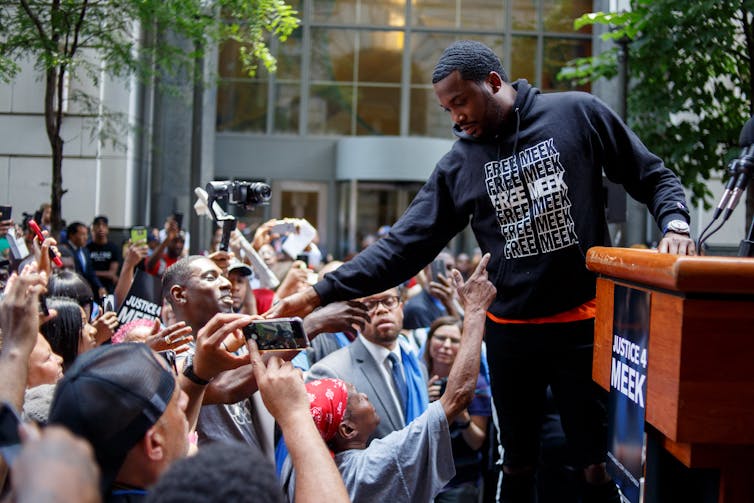
Man in black hoodie that says 'Free Meek' interacts with crowd of supporters in street
Philly rapper Meek Mill, shown here at a 2018 rally outside a Center City courthouse, was sentenced to probation for 10 years after a conviction on drug and gun charges. He became an advocate of criminal justice reform.
Michael Candelori/Pacific Press/LightRocket via Getty Images

Finding work

People who have been incarcerated often struggle to find employment after release, as many employers are unwilling to hire a person with a criminal record.

This leaves about 35% of formerly incarcerated Black men unemployed.

At the time of our interview, Tay, 31, was working part-time in carpentry. “Because I had felonies on my record a lot of places won’t hire me,” he said. “And a couple of places that I was working with, they ended up firing me once they did the background check.”

These frustrations can easily spill over into family life.

Mark, 30, also works part-time and said he found himself frequently becoming agitated and snapping at his kids, other family members and his girlfriend. “I can’t get the job I want or the job that I need to do what I need to do for my family and I’ll be frustrated,” he shared.

Participants struggled with having to depend on others for basic needs upon release. Kenny, who is now self-employed as a caterer, recalled his experience a few years earlier. “I was crying. I was a grown man, almost 40 years old, and my mother had to buy me underwear, socks,” he said.

The importance of fatherhood

Despite their many hardships, some of the men spoke with joy about reconnecting with their children.

“I think the most positive thing that happened since I’ve been out of prison is I got custody of my sons,” said Ken, a father of two. “Them kids saved me.”

Like many of the other participants with children, however, he was frustrated about being unable to provide for them and worried about repeating harmful cycles.

“You want to do good, but it makes you think bad stuff when you don’t have the right resources,” he continued. “You don’t want [your kids] to do the same things you did.”

Others struggled to bond with their children after years of separation.

John, 29, explained, “The bonding is kind of awkward, because you wasn’t there, especially during the pandemic when there was no visits allowed.”

Returning to disadvantaged neighborhoods

Most people released from incarceration return to neighborhoods with high rates of poverty, violence and other disadvantages.

Shawn, who lives in pubic housing, showed me abandoned buildings and boarded storefronts in his neighborhood and described how the environment made rebuilding his life harder.

For many participants, returning to divested communities brought stress. They experienced frequent exposure to substance use, violence and negative police encounters, and they had limited access to basic resources and job opportunities needed to support recovery and stability.

“This is my real life. It’s not fake. It’s not no, ‘Well, why did he go back and do this or that?’” he said. “I live in an underserved, impoverished, danger zone – period.”

Moving forward

The experiences these men shared with me demonstrate how traumatic incarceration is, even many years after release.

Supporting the mental health of formerly incarcerated Black men requires trauma-informed services, such as culturally responsive counseling, peer support and care that acknowledges the lasting effects of incarceration.

It also means helping them build or rebuild their financial resources, reconnect with their children and loved ones, and supporting the broader communities they return to through investment in housing, employment and accessible health and social services.

The Conversation

Helena Addison received funding from National Institute of Nursing Research of the National Institutes of Health under Award Number F31NR020434, the Substance Abuse and Mental Health Administration and American Nurses Association Minority Fellowship Program, the University of Pennsylvania’s Presidential PhD Fellowship, and Jonas Philanthropies to support this study and/or her PhD training. The content is solely the responsibility of the authors and does not necessarily represent the official views of the National Institutes of Health, or any other funding organizations or institutions. The views expressed in written training materials or publications and by speakers and moderators do not necessarily reflect the official policies of the Department and Human Services; nor does mention of trade names, commercial practices, or organizations imply endorsement by the U.S. Government.

ref. ‘I just couldn’t stop crying’: How prison affects Black men’s mental health long after they’ve been released – https://theconversation.com/i-just-couldnt-stop-crying-how-prison-affects-black-mens-mental-health-long-after-theyve-been-released-259975