Satellite images show how Antarctica’s vanishing sea ice is changing the food chain

Source: The Conversation – UK – By Angus Atkinson, Professor of Marine Ecology, Plymouth Marine Laboratory

Melting ice is an emblem of climate change. For sea ice, the Arctic has been grabbing most of the headlines for its truly alarming rate of decline. But recently Antarctica has followed suit.

Around ten years ago everything changed. After decades of stability and within just a few years, an ocean area nearly the size of Greenland suddenly became sea-ice free. At first, scientists thought this could be a blip, but now it is described as a step change, with large ocean areas remaining ice free ever since.

This has dramatic consequences for the marine life of Antarctica. The ice decline was so sudden it challenged most existing computer models of the Southern Ocean and its ecosystems. Models tend not to predict step changes very well. Likewise, due to the sheer seismic suddenness of ice loss, the boots-on-the-ground fieldworkers could not scramble fast enough to document how the loss of sea ice was affecting the plants and animals living here.

Our 2025 study looked at ice loss from a different perspective. We used satellite imagery to pinpoint the exact wavelengths of light that are reflected from the upper ocean back into space.

Just like landscapes can be classified, we divided the ocean into distinct “seascapes”, based on the wavelengths of light that they reflect. This tells us about the phytoplankton – the tiny drifting planktonic algae that support the rest of the food web. Changes in light reflections indicate how much phytoplankton is present and also which types of species are present.

Surprisingly, we found that large and remote expanses of the Southern Ocean actually increased from very low concentrations of phytoplankton to more moderate levels. Nearly 70% of the Southern Ocean now has, on average, more phytoplankton since the ice declined around ten years ago.

This increase in food supply might sound good. But sea ice supports unique marine ecosystems, and in many ways. For example, it provides nooks and crannies for shelter and nursery. Sea ice also nurtures hotspots of food, supporting large algae called diatoms that are easily eaten and passed up Antarctic food chains.

Diatoms are a key food source for Antarctic krill, shrimp-like crustaceans which also need sea ice as a nursery habitat. Krill in turn are the food source for penguins, whales and other marine species, as well as being the target species for an important fishery valued in hundreds of millions of dollars.

Winners and losers

Krill do not seem to be benefiting from the increases in phytoplankton after the dramatic loss of sea ice. Instead, gelatinous filter feeders known as “salps” associate with the ice-free seascapes that have increased in size.

Salps are a colonial, barrel-shaped group of species that pump water through their transparent bodies, filtering out even the smallest phytoplankton. They are more nutritious than most jellyfish, but much less carbon rich than crustaceans such as krill, who help in the storage of carbon at depth.

A study by another team sheds more light on what was happening. They showed that the step-change in sea ice marked a sudden shift in phytoplankton composition. Suddenly, a group of tiny phytoplankton called cryptophytes started increasing.

Salps act like marine vacuum cleaners that can rapidly and efficiently remove even these small cryptophytes from the water. It looks like the recent low ice era has changed large expanses of ocean from having too little food even for salps into that sweet spot – not super-rich but just good enough for these vacuum cleaners to thrive.

These studies are just starting to map how the “new-normal” low-ice era is reshaping Antarctic ecosystems. Salps are not fished commercially, do not appear so important in storing carbon, and support different types of food chain. Any long-term shift in the relative dominance of krill and salps will have far-reaching ramifications for Southern Ocean ecosystems and their role in nutrient cycling.


Don’t have time to read about climate change as much as you’d like?

Get a weekly roundup in your inbox instead. Every Wednesday, The Conversation’s environment editor writes Imagine, a short email that goes a little deeper into just one climate issue. Join the 47,000+ readers who’ve subscribed so far.


The Conversation

Angus Atkinson receives funding from the European Space Agency (ESA). His contribution to this work was supported by ESA Cluster OCEAN HEALTH THEME 3: Open Ocean Biodiversity, grant number 4000137125/22/I-DT project Biodiversity in the Open Ocean: Mapping, Monitoring and Modelling (BOOMS). He was also supported by the World Wide Fund for
Nature and the Natural Environment Research Council (NERC) National Capability (NC) International FOCUS Programme (grant no. NE/X006271/1)

Bob Brewin receives funding from a UK Research and Innovation Future Leader Fellowship (MR/V022792/1).

Victor Martinez Vicente receives funding from the European Space Agency (ESA). His contribution to this work was supported by ESA Cluster OCEAN HEALTH THEME 3: Open Ocean Biodiversity, grant number 4000137125/22/I-DT project Biodiversity in the Open Ocean: Mapping, Monitoring and Modelling (BOOMS)

ref. Satellite images show how Antarctica’s vanishing sea ice is changing the food chain – https://theconversation.com/satellite-images-show-how-antarcticas-vanishing-sea-ice-is-changing-the-food-chain-275847
Trump’s approach to Iran is a departure from containment policy of his predecessors

Source: The Conversation – UK – By Darius Wainwright, Lecturer in Modern History, University of Bristol

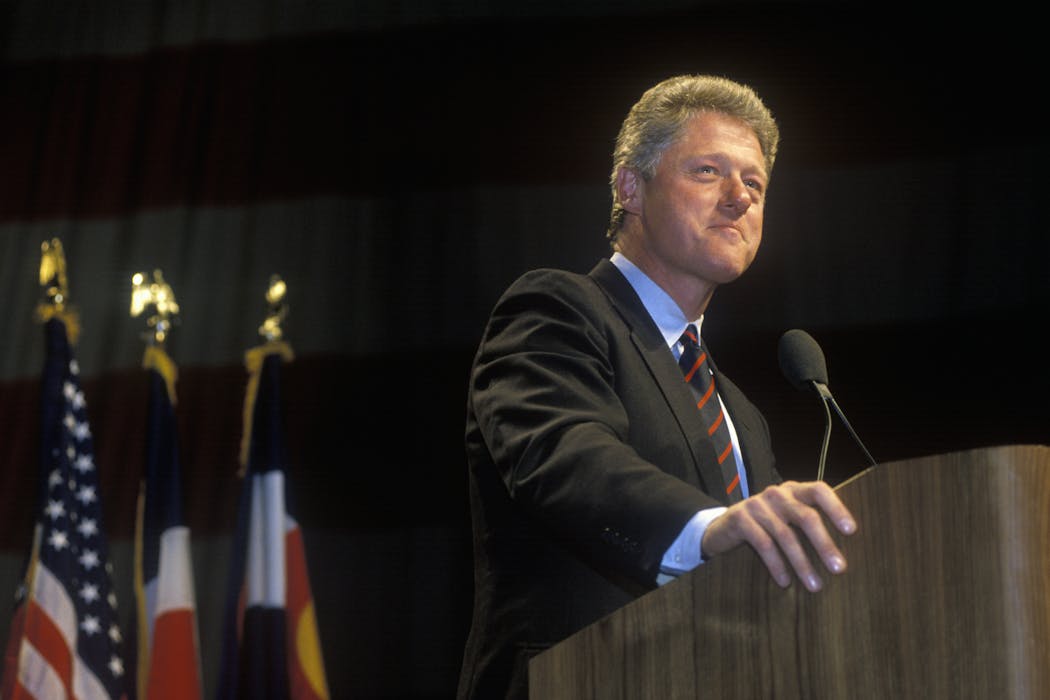
Bill Clinton developed a strategy of containing Iran that was followed by successive US presidents. Joseph Sohm / Shutterstock

The joint US-Israeli combat operation against Iran, and the killing of its supreme leader, Ayatollah Ali Khamenei, is a watershed moment in the US-Iran relationship. Bilateral interactions have been tense since 1979 when a revolution ousted Iran’s pro-American Shah, Muhammad Reza Pahlavi, and replaced him with an Islamic theocracy opposed to the US.

However, these tensions have now bubbled over into direct conflict. The US and Israel have bombed Iranian cities, which Tehran has responded to by launching strikes across the region. Hostilities have now spread to Lebanon, with the Iran-backed Hezbollah group launching missiles and drones towards Israel in retaliation for Khamenei’s killing.

In a video statement posted on social media shortly after the US-Israeli intervention began, Trump appeared to justify his approach by saying the Iranian government’s activities “directly endanger the US, our troops, our bases overseas and our allies”. His actions signal a departure from a stated American foreign policy approach to Iran that has stood since the 1990s.

Consecutive US presidential administrations had developed a strategy of containing Iran, focused on trying to prevent its government from expanding its reach and influence across the Middle East. This has taken two forms. Presidents have either sought to isolate the country on the world stage or negotiate with its leadership to temper Iran’s expansionist tendencies.

Bill Clinton coined the approach and applied its two facets. His White House appropriated the idea from the stated US stance towards the Soviet Union and its allies during the cold war. Officials in his administration initially referred to Iran as a “rouge state” that was opposed to American interests and global stability.

In 1995, Clinton signed two orders strengthening the economic sanctions on Iran that had been in place since the 1979 revolution. The first forbade American companies from investing in the Iranian oil industry. And the second banned all US firms from conducting business in Iran. Clinton also pledged to impose sanctions on any firm or organisation outside the US that traded with the country.

But after the 1997 election of a reformist Iranian president in Mohammad Khatami, Clinton offered to negotiate with Tehran. To pave the way for diplomatic dialogue, his secretary of state, Madeline Albright, even publicly admitted to the CIA’s involvement in steering a coup in 1953 that resulted in the removal of the Iranian prime minister, Mohammad Mosaddegh.

Clinton’s apparent u-turn, which also saw US economic sanctions relaxed to pre-1995 levels, yielded next-to-no tangible results. As supreme leader, Khamenei overruled Khatami’s attempts to engage with the US diplomatically.

George W. Bush emulated his predecessor’s initial approach to Iran. Whereas Clinton regarded Iran as a rouge state, Bush took this framework one step further in his 2002 State of the Union address. Due to the Iranian government’s supposed links to and support for terrorist groups, he referred to Iran as a member of the “axis of evil” – a nation that needed to be challenged and contained.

However, despite Bush’s tough rhetoric, his other foreign policy actions while in office benefited Iranian regional interests. In removing the Taliban from power in Afghanistan and Saddam Hussein from Iraq, the Bush administration eliminated two of Iran’s key rivals. The next decade saw Iranian-backed proxy groups grow in prominence across Iraq, Syria and Lebanon.

Barack Obama adopted Clinton’s latter approach towards the country. His administration negotiated with the Iranian government over its nuclear programme, which resulted in the 2015 Joint Comprehensive Plan of Action. Iran pledged to limit its uranium enrichment and agreed to intensive monitoring.

The Obama administration sought to use the prospect of global inclusion and the lifting of economic sanctions to persuade Iran to check its regional expansionist aspirations. Joe Biden, who was US president between 2021 and 2024, sought to resurrect the Joint Comprehensive Plan of Action after Trump’s abandoning of the treaty in his first term.

Containment to confrontation

In targeting Iran’s leadership and military infrastructure, the Trump administration has departed from this well-established strategy. Trump has shifted American policy towards Iran from one of containment to confrontation. This is an approach the White House has worked towards for the past year, despite also engaging Iranian officials in talks.

Trump’s backing of Israel in its victories over Iranian-backed paramilitary groups like Hamas and Hezbollah tempered Tehran’s regional reach. His support for Israeli strikes on Iran during the 12-day war in 2025 culminated in the shattering of Iran’s air defences and intelligence infrastructure. Subsequent US air strikes on Iranian nuclear facilities also halted the country’s enrichment programme.

Whether the killing of Iran’s political and religious leadership will result in a less belligerent Iran remains to be seen. While the Islamic Republic’s figurehead has been removed, the power structures that maintained Khamenei’s power remain intact. All indicators are that the Islamic Republic will implement a succession plan and double down against US-led incursions and encroachment.

Trump is pushing for regime change. In his statement announcing the strikes, the president urged Iranians opposed to the Islamic Republic to take to the streets. Yet he did not go as far as endorsing the installation of the exiled crown prince, Reza Pahlavi, who enjoys considerable support among the Iranian diaspora.

The Trump administration is clearly on a path that has pushed the US towards direct confrontation with Iran. Whether or not this approach ultimately leads to an Iran that is more amenable to Israel and less antagonistic towards the US’s Gulf allies, it has brought decades of containment to an abrupt end.

The Conversation

Darius Wainwright does not work for, consult, own shares in or receive funding from any company or organisation that would benefit from this article, and has disclosed no relevant affiliations beyond their academic appointment.

ref. Trump’s approach to Iran is a departure from containment policy of his predecessors – https://theconversation.com/trumps-approach-to-iran-is-a-departure-from-containment-policy-of-his-predecessors-277174

Strait of Hormuz: if the Iran conflict shuts world’s most important oil chokepoint, global economic chaos could follow

Source: The Conversation – UK – By Sarah Schiffling, Deputy Director of the HUMLOG (Humanitarian Logistics and Supply Chain Management Research) Institute, Hanken School of Economics

The reported sinking of several Iranian warships by US missiles in the Gulf of Oman serves as a reminder of the maritime aspect of the conflict which began February 28 with a barrage of Israeli and American missiles targeting Iran. Two other vessels, believed to be tankers, have also been reported as having been hit by missiles, of an as yet undetermined source, in the vicinity of the Strait of Hormuz, underlining the importance of this vital shipping lane – which is likely to play an key part in all sides’ calculations.

Full details have yet to emerge of the incidents. But there are already signs that the strait will become a major focus of concern because of the huge implications should the conflict disrupt maritime traffic through this the narrow outlet of the Persian Gulf. Ships crossing the Strait of Hormuz carry around one-fifth of global oil supplies. That’s about 20 million barrels per day. This makes the strait the most critical energy chokepoint.

There are a small number of strategic passageways, or chokepoints on which global trade depends and which are vulnerable to disruption. Any disruption reverberates instantly through global markets and supply chains. With conflict raging in Iran and attacks across the Middle East, traders, governments and businesses will be watching oil prices closely as the markets open.

After Israel and the US launched attacks on Iran on February 28, prompting retaliatory strikes across the region from Iran, Tehran broadcast to vessels in the region claiming that the Strait of Hormuz was closed.

Although the shipping lanes are only about two miles wide, actually physically closing them would be difficult to achieve. The most decisive action Tehran could take would be to mine the shipping lanes. With the large US naval presence in the area, this would be very difficult for Iran to achieve.

But a formal blockade is not necessary to stop traffic. When perceived threat levels rise, ships stay away. Big shipping companies such as Hapag Lloyd and CMA CGA have already suspended transit through the strait and advised their ships to proceed to shelter.

Vessel tracking already shows reduced movements in the Strait of Hormuz. Ships are waiting to enter or exit the Persian Gulf or diverting away from the region. An advisory from the United Kingdom Maritime Trade Operations (UKMTO) Centre has warned of the “increased risk of miscalculation or misidentification, particularly in proximity to military units”.

Several ports have suspended operations after debris from an intercepted missile sparked a fire at Dubai’s Jebel Ali Port. While other ports continue to operate, the risk and uncertainty are disrupting shipping in the region.

Supply chain disruption

Hormuz is dominated by oil tankers and liquid natural gas carriers, so disruption directly hits global energy supplies. In addition, a lesser-known dependency is that one-third of the world’s fertiliser trade passes through the strait. Both energy and agricultural supply chains have already been destabilised by the Ukraine war. Further price rises could have far-reaching consequences.

Map of Straits of Hormuz
The Strait of Hormuz is one of the world’s most important waterways, with 20% of the global trade in oil flowing through a narrow maritime channel.
Wikimedia Commons

The main destinations for oil and gas flowing through Hormuz are China, India, Japan, and South Korea. India, which imports about half of its crude oil through the strait, has activated contingency plans to safeguard energy supplies.

But apart from amassing strategic national stockpiles to weather immediate disruptions, there may be limited alternatives for countries dependent on getting their energy supplies through the strait. Saudi Arabia and the UAE have some pipelines for both oil and gas that can bypass the Hormuz. There is an estimated spare capacity of 2.6 million barrels per day for these pipelines. But that’s a fraction of what is normally shipped through the strait.

Oil and gas are traded globally. So even countries whose energy needs are not met by imports from the Persian Gulf will be affected by price increases. Oil prices are expected to increase to up to US$100 (£74) per barrel when markets open on Monday. Opec has agreed to modestly boost oil output in a bid to stabilise markets. But the group of oil producing countries has limited options as key members are affected by the fallout of the attacks on Iran.

Energy price increases will hit consumers directly when filling up their cars or heating their homes. They also affect companies across a wide range of industries. This has the potential to cause further supply chain disruptions.

Supply chains rely on predictability. The persistent geopolitical uncertainty has complicated operations worldwide. Limited alternatives make the de facto closure of the Strait of Hormuz all the more impactful. The longer the disruption persists, the more significant and structural the economic damage will become.

Potential for escalation

There is still a potential for a catastrophic escalation in the Strait of Hormuz. The sinking of a tanker would have dramatic consequences for the environment and would likely halt navigation for an extended period of time.

But prolonged instability may also prove destructive for the global economy.
Previously, Iran closing the strait was seen as unlikely considering the global backlash and economic harm to Iran itself. But with regime change now the stated goal of the US-Israeli attacks, the cost of holding the world economy hostage might seem justified to the rulers in Tehran.

The Conversation

Sarah Schiffling does not work for, consult, own shares in or receive funding from any company or organisation that would benefit from this article, and has disclosed no relevant affiliations beyond their academic appointment.

ref. Strait of Hormuz: if the Iran conflict shuts world’s most important oil chokepoint, global economic chaos could follow – https://theconversation.com/strait-of-hormuz-if-the-iran-conflict-shuts-worlds-most-important-oil-chokepoint-global-economic-chaos-could-follow-277199

US-Israeli attack on Iran risks plunging the world into turmoil

Source: The Conversation – UK – By Arshin Adib-Moghaddam, Professor in Global Thought and Comparative Philosophies, Inaugural Co-Director of Centre for AI Futures, SOAS, University of London

The US and Israel have launched extensive, coordinated attacks on numerous targets across Iran, prompting retaliatory strikes in the region. Donald Trump neither tried to obtain Congressional approval, nor did he pursue a United Nations security council resolution ahead of these actions. And the attack has come in the middle of talks between Tehran and Washington.The facts are clear. This is an illegal war, both in terms of US law and international statutes.

The US president has repeatedly said that Iran can’t be allowed to develop a nuclear weapon. But the IAEA has stated that there is no evidence that Iran is pursuing a nuclear weapon. Iran’s foreign minister, Abbas Araghchi, said after the latest round of talks that “good progress” was being made on a deal to limit Iran’s nuclear programme in return for sanctions relief.

Now, from everything that the US president is saying, the goalposts have shifted from a nuclear deal to an attempt to force regime change.

So bombs are falling on various cities in Iran, family members are hiding, tragedies will inevitably happen and the innocent will suffer. This is the endpoint of a longstanding campaign by the US and Israeli right-wing to reshape the Middle East and the wider Muslim world at the barrel of a gun. This is yet another intervention in a long history of disastrous foreign moves that have destabilised the country since Britain and the Soviet Union deposed Reza Shah Pahlavi in 1941 and the CIA and MI6 orchestrated a coup to depose Iran’s democratically elected prime minister, Mohammad Mossadegh, in 1953.

The consequences of this attack are likely to be dire for the region and the world. Already, Iran has retaliated by targeting US bases in Kuwait, Qatar, the United Arab Emirates and Bahrain and the first reports of casualties are emerging. Iran is unlikely to hold back. It’s clear that the Islamic Republic is viewing this as an existential threat.

Tehran will call on its allies in the region, the Houthis in Yemen, the Popular Mobilisation Forces in Iraq and Hezbollah in Lebanon which – despite being weakened over two years of attacks by Israel aided and abetted by the United States – have the capacity to expand the conflict throughout the region.

Iran has already indicated in recent drills with the Russian Navy that it may be capable of closing off the Strait of Hormuz, through which around one-quarter of the world’s oil and one-third of its liquefied natural gas travel. As a consequence, oil prices will explode and the world economy will suffer.

Clash of civilisations

There is a cultural component to this war, too. Israel and the US are conducting this war during the month of Ramadan. Muslims all over the world are fasting. For billions of them, this is the month of spirituality, peace and solidarity. Images of Iranian Muslims being killed by Israeli and US bombs threaten to further a clash of civilisations narrative which pits the Judeo-Christian world against Islam.

Muslims in European capitals, together with anti-war activists, will see this war as a clear aggression on the part of the US and Israel. Global public opinion will not be easily swayed into the direction Trump and Netanyahu would like.

And it must be asked, what will the leaders in Moscow and Beijing be thinking as they watch this illegal war and what might this mean for Ukraine and Taiwan? Vladimir Putin and Xi Jinping are close to the government of Iran and will condemn this war. At the same time, they must feel emboldened to pursue their own agendas with military might.

So Trump and Netanyahu’s attack on Iran has the potential to plunge the world into deep crisis. Expect more refugees, more economic turmoil, more trauma, death and destruction. The only hope now is that cooler heads among world leaders can prevail to contain this conflict and to limit the actions of Trump and Netanyahu.

Diplomacy has to be prioritised. Attempting to force regime change by launching an illegal war is foolhardy. If Iran is further destabilised, the entire Middle East and beyond will be plunged into utter turmoil. From there the outcome for the whole world is dangerously uncertain.

The Conversation

Arshin Adib-Moghaddam does not work for, consult, own shares in or receive funding from any company or organisation that would benefit from this article, and has disclosed no relevant affiliations beyond their academic appointment.

ref. US-Israeli attack on Iran risks plunging the world into turmoil – https://theconversation.com/us-israeli-attack-on-iran-risks-plunging-the-world-into-turmoil-276818

Why isn’t the Greens’ growing success reflected in media coverage?

Source: The Conversation – UK – By Maxwell Modell, Research associate, Cardiff University

wellphoto/Shutterstock

The victory of the Greens in the Gorton and Denton parliamentary byelection is a landmark for the party. But our new research reveals the Greens have received limited airtime over the last year despite almost doubling their support in the polls and in party membership.

While Reform UK has seen a spike in media coverage since it took a commanding lead in the polls, our research shows the Greens have not received more airtime in recognition of their growing popularity.

Broadcasters have to abide by due impartiality rules, but they have the editorial freedom to balance the airtime of political parties. They consider factors such as a party’s vote share at the last UK general election or a party’s electoral performance at the most recent devolved, regional and local election. Other factors to consider include the latest trends in opinion polls tracking voting intention, and whether what a party is saying the news organisation considers significant or, as the BBC says, whether they are “making the political weather” by setting the agenda.

After winning the byelection, this raises the question: should the Greens now be given more airtime?

Limited coverage of Greens

Our Impartiality project team has been tracking coverage of UK opposition parties on BBC News at Ten and ITV News at Ten, the UK’s most-watched nightly TV news bulletins.

In 2025, we found the Greens were the sixth most covered opposition party, being referenced in just 32 items, behind the Conservatives (375), Reform UK (213), the Liberal Democrats (116), the Scottish National Party or SNP (46) and ahead of Plaid Cymru (10).

Number of items led by an opposition party on BBC News at Ten and ITV News at Ten.
Cardiff University, CC BY-NC-ND

We also tracked how often a party was the leading focus of a broadcaster’s report. The Greens led four items – three on BBC and one on ITV. These stories related to the Greens’ May local election campaign, Zack Polanski winning the party leadership in September and the party conference in October. But neither BBC News at Ten and ITV News at Ten covered the announcement or build-up to the leadership contest.

In contrast, Reform UK led 69 items, Conservatives led 45 items, the Liberal Democrats led 14 items and the SNP led 13 items.

vote green sign, outside blue sky
Growing success of the Green party doesn’t mean more press appearances.
Peter_Fleming

The Greens also appeared on only four episodes of BBC Question Time during 2025. That was about a third as often as the Liberal Democrats and Reform UK.
Despite the leadership change, the subsequent surge in membership and the sustained rise in poll ratings (from 11% in August 2025 to 17% in December 2025), broadcast coverage of Greens did not increase at the end of 2025.

This shows a potential inequality in the treatment of the rising left and right parties. The BBC cited improvements in opinion polling as one of the factors behind the increased coverage of Reform UK, but the Green party’s popularity has not received anywhere near the same recognition.


Read more:
What Hannah Spencer’s historic win means for the Green party’s future


In May 2025, news coverage of Reform UK increased substantially following its victories in local and mayoral elections, which broadcasters considered a sign that the party was now a major player in UK electoral politics. Our research even showed in September 2025 Reform UK was referenced on TV news more than the Conservatives, the party that is supposed to be the UK’s parliamentary official opposition.

The question now is whether broadcasters will take the Green party’s victory in Gorton and Denton as a similar sign of its electoral significance and increase media coverage of the party.

While broadcasters have not broken any of the UK’s rules on due impartiality, our new research raises questions about how they have been interpreting impartiality in a new multi-party system.

Traditionally they have relied on allocating airtime according to parties with the largest number of MPs and total vote at the last general election. They have also factored in performances at the latest local, regional or devolved elections. But they now appear to making more subjective judgements about allocating airtime according to the opinion polls or the newsworthiness of parties.

Given the Greens’ growing popularity, their distinctive set of policies, charismatic leader and byelection victory, they might now look set to receive more media attention and scrutiny over the coming months.

The Conversation

Maxwell Modell receives funding from the AHRC for research into broadcasters’ impartiality.

Matt Walsh receives funding from the AHRC for research into broadcasters’ impartiality.

Stephen Cushion has received funding from the BBC Trust, Ofcom, AHRC, BA and ESRC.

ref. Why isn’t the Greens’ growing success reflected in media coverage? – https://theconversation.com/why-isnt-the-greens-growing-success-reflected-in-media-coverage-277137

Twenty-year sentence for Hong Kong media mogul Jimmy Lai is a further blow for journalists feeling the heat of Beijing’s crackdown on press freedom

Source: The Conversation – UK – By Yuen Chan, Senior Lecturer, School of Arts and Social Sciences, Department of Journalism, City St George’s, University of London

The sentencing of Hong Kong media mogul Jimmy Lai to 20 years in prison on February 8 on charges of sedition and collusion with foreign forces prompted international outrage.

Lai founded the now shuttered pro-democracy Apple Daily newspaper – and supporters of press freedom around the world pointed to the chilling effect the sentence would have on the media, in a city once vaunted as a beacon for press freedom in Asia.

The reaction was more muted in Hong Kong, where dissent has been stifled since Beijing imposed the draconian National Security Law in 2020, following months of protests in 2019. A local security law enacted in 2024 further expanded the scope of the city’s national security legislation.

Privately, some local journalists say Lai’s conviction will have limited impact on their work. They have already felt heavily constrained by the security laws and what they’re calling the “new normal” – an overarching national security apparatus and culture. Although saddened, they were not altogether surprised at the severity of Lai’s sentence.

One journalist told me they were more shaken by the sentences of up to ten years that were meted out to six senior Apple Daily editors and writers for “just doing their jobs”.

Since the national security law, Hong Kong journalists’ jobs have involved a great deal of dancing around shifting boundaries as to what can and can’t be reported. Inevitably, this has meant exercising greater self-censorship.

In an editorial on the sentencing, the Ming Pao newspaper, which has long positioned itself as a neutral paper of record, suggested the Lai ruling has brought these boundaries into sharper focus, concluding: “Collusion with foreign forces cannot readily be dressed up as journalism.”

The newspaper said that as Hong Kong now operates within the framework of the national security legislation: “The media must operate within this legal framework while continuing to report facts and hold power to account, a balance essential to preserving the city’s pluralism and openness.”

But it hoped “the Lai case will prove a watershed, allowing space for press freedom to widen step by step, so the media can fulfil its responsibilities more effectively”.

However, local journalists I spoke to described this position as naïve and wishful thinking, and said the red lines are no clearer now than before. Selina Cheng, chair of the Hong Kong Journalists Association (HKJA), believes the constraints on free expression in Hong Kong go far beyond a legal framework.

“If we call it a legal framework, it’s giving the system some kind of legitimacy,” Cheng told me. “In reality, the way it operates is there is a lot of destruction of due process, creating an atmosphere of fear and anxiety in those working in industries of expression.”

Apart from being arrested and jailed, Cheng says journalists and their family members have been doxed, with their personal details posted online, and harassed. Both individual journalists and news outlets have been targeted by unusual tax audits.

Tai Po tragedy

Cheng was one of several journalists I spoke to who pointed to the November 2025 fire which killed 168 people in Tai Po’s Wang Fuk Court Estate as a potent symbol of the current state of press freedom and freedom of speech in Hong Kong.

In the immediate aftermath, local and international journalists interviewed victims and reported extensively on suspected corruption and lack of oversight of building works on the site. But residents and other potential interviewees soon became reluctant to speak to reporters following the arrests of people who had posted comments online.

A student who started a petition for an independent inquiry was arrested – and then recently expelled from his university just weeks from graduation, even though he hasn’t been charged.

For one veteran journalist, who asked to remain anonymous for fear of bringing trouble to their organisation, what led to the Tai Po tragedy highlights a “media failure”. The news outlets which had most doggedly pursued stories about building maintenance, bid-rigging and corruption were the investigative site Factwire and Apple Daily, so “when these outlets disappeared, a lot of the reports also petered out”.

“In the past, you’d have lots of commentary in the media after an incident like this,” they explained. “There’d be legal scholars, experts, people from all different sectors. But now, the universities don’t allow people to comment and articles are spiked or censored, so it’s hard to raise and maintain public concern.”

Snitch culture

The journalist spoke of a system that extends beyond the legal framework of the national security law that restricts speech, through the control of public opinion and a “snitch culture” that weaponises complaints.

A Hong Kong police national security hotline was launched in November 2020; by June 2025, the city’s security chief said it had received more than 920,000 reports. Public bodies and funding organisations also regularly receive complaints about platforming of funding groups or individuals perceived to be pro-democracy or supportive of the 2019 protests.

Last October, a public venue cancelled a play written by Candace Chong, a leading playwright who was been vocal about censorship. The body that manages the Xiqu Centre, part of the West Kowloon Cultural District, said it had received complaints that the show – which depicts a love triangle between three men – defamed Hong Kong.

There are signs the “media failure” is already affecting governance. In January, the government introduced a controversial seat belt law requiring all bus passengers to buckle up while seated, only to shelve it five days later. The bill had received little scrutiny in Hong Kong’s now opposition-free legislature.

“It’s really unthinkable for a government to push out a bill, get it rubber-stamped by the legislature, and then withdraw it because they suddenly realise people are unhappy or the legislative details haven’t been thought through,” the HKJA’s Cheng told me. “It shows how the government misjudged public sentiment. This can be attributed to how the media isn’t free any more.”

The Conversation

Yuen Chan does not work for, consult, own shares in or receive funding from any company or organisation that would benefit from this article, and has disclosed no relevant affiliations beyond their academic appointment.

ref. Twenty-year sentence for Hong Kong media mogul Jimmy Lai is a further blow for journalists feeling the heat of Beijing’s crackdown on press freedom – https://theconversation.com/twenty-year-sentence-for-hong-kong-media-mogul-jimmy-lai-is-a-further-blow-for-journalists-feeling-the-heat-of-beijings-crackdown-on-press-freedom-276992

‘Working hard used to get you something’: what Hannah Spencer’s speech tells us about her, and the state of British politics

Source: The Conversation – UK – By Alex Prior, Lecturer in Politics with International Relations, London South Bank University

Hannah Spencer’s parliamentary story – as the new Green MP for Gorton and Denton – has just begun.

Nevertheless, the life story that she presented in her victory speech was that of a plumber, not a politician. She identified herself – in present tense – by that trade; she had not grown up wanting to be a politician. She also celebrated qualifying as a plasterer during the “chaos” and “pressure” of the election campaign. She described campaigning jovially as “all this”, as if it were just a challenge in the broader adventure, not the adventure itself.

Despite, or perhaps because of, accusations that the Greens used “sectarian politics” to secure victory, the speech was one of solidarity, of aligning herself with the struggles and achievements of “the community that I am from”. Spencer said that she had lived there in one of the hardest times of her life, and presented the strength of the community “at holding things together” as an inspiration.

She aligned herself and her personal characteristics with those of the constituency, stressing that “I am no different to every single person here in this constituency. I work hard. That is what we do.”

Alongside all the talk of “we”, of common interests and lack of difference, Spencer singled out several audiences for her story. One such audience? Her now-plumberless “customers”, to whom she duly apologised: “I’m sorry, but I think I might have to cancel the work that you had booked in, because I’m heading to parliament”.

Spencer also addressed those who voted for her, and those who didn’t. She spoke of “my Muslim friends and neighbours”, who “are just like me: human”. She discussed the “left-behind” (“I see you, and I will fight for you”), and people doing jobs like hers: “We will finally get a seat at the table”. And she addressed “our white working class communities, the background that I have become so glad to be from”.

A personal and political journey

My research focuses on political narratives and storytelling as a means of communication: the stories that parliaments contain and project, the stories we tell about the places we’re in and the stories that politicians use to communicate themselves to voters. Spencer’s speech is an attempt to portray a compelling story to her new constituency.

She spoke about how moving away from the constituency to nearby Trafford made the qualities of Gorton and Denton’s community “even clearer”. Only realising your love for a place and the people in it when you’ve moved away is a familiar narrative device. As Joni Mitchell once sang, “You don’t know what you’ve got ‘til it’s gone”.

In Spencer’s speech, this tactic carried a sharper political edge. This is a constituency that people move away from to get the “nice life” that Spencer described: “good schools, a thriving high street and clean air”.

This part of the story carried a rebuke to an audience that Spencer was addressing, but not by name: the Labour Party, for whom this was a traditionally safe seat. Spencer observed that “working hard used to get you something”.

I would argue that “you”, in this context, is a reference to traditional Labour voters. The implication here is that it is voting Labour that “used to get you something”.

Being a politician now isn’t an aspect of Spencer’s story that she’s keen to claim. She may now sit at Westminster, but she appears to frame this as an extension of who she already is — a worker, a neighbour, a constituent — in a new arena.

In doing so, she attempts to recast political representation itself as continuity of identity. The challenge, of course, will be whether she can sustain that claim. It is easier to say “I am no different” on a victory stage following a byelection win than from the House of Commons. The durability of her narrative – and perhaps her political appeal – will rest on whether she can remain recognisably “from” the constituency while operating within the institution of parliament.

The Conversation

Alex Prior does not work for, consult, own shares in or receive funding from any company or organisation that would benefit from this article, and has disclosed no relevant affiliations beyond their academic appointment.

ref. ‘Working hard used to get you something’: what Hannah Spencer’s speech tells us about her, and the state of British politics – https://theconversation.com/working-hard-used-to-get-you-something-what-hannah-spencers-speech-tells-us-about-her-and-the-state-of-british-politics-277121

Why the Legend of Zelda games still resonate with players after 40 years

Source: The Conversation – UK – By Annayah Prosser, Assistant Professor in Marketing, Business and Society, University of Bath

A large model of Link from the Zelda games, in Tokyo. yu_photo/Shutterstock

Nintendo’s Legend of Zelda video game series celebrated its 40th anniversary in February 2026. Millions of players across the world have grown up alongside the 21-title series, from the release of the original game on the Famicom gaming system in 1986, to the most recent game, Echoes of Wisdom, published for the Switch in 2024.

The Zelda games were inspired by series creator Shigeru Miyamoto’s childhood in the Japanese countryside. They frequently involve complex environmental exploration and problem solving.

Over time, the series has moved from pixelated forests into high resolution, awe-inspiring landscapes. In that time, Zelda has become an intergenerational success, released in new forms for new generations with each Nintendo console.

Many Zelda games serve as flagships for these new consoles, tying the game experience into new technological capacities – showcasing the motion control of the Wii, the dual screens of the DS, and the joystick first introduced on the the N64. Just as the console technology has evolved, so has the Zelda series.

The series is one of Nintendo’s biggest commercial successes, with an estimated 150 million copies of the games sold worldwide. The most popular game within the series, Breath of the Wild (released on the Switch in 2018), has sold more than 34 million copies to date.


Read more:
The Legend of Zelda: Tears of the Kingdom review – a masterclass in rewarding curiosity


Beyond the game

As well as fun past times, video games can be important vehicles for social connection and personal development. The Zelda series grapples with age-old struggles of good versus evil and destruction versus creation.

I’m the editor of the Psychgeist of Pop Culture: The Legend of Zelda – an open-access book which explores the social and psychological impact of the series across a variety of domains. In the book, researchers like myself show how engaging with virtual stories and problems can help us to better understand our own day-to-day lives. For example, recent research from social scientist George Farmer shows that playing video games can be a helpful form of stress relief during times of crisis.

The moral dilemmas presented in the Zelda games also help to train players for real-world social action. Experimental psychologist Kathryn Francis argues in her chapter that the games provide players with an immersive virtual space for moral reflection and development.

In my own chapter, I analysed the environmental narratives of the games Breath of the Wild and Tears of the Kingdom to assess their potential impact on players. I argued that experiencing the environmental devastation wrought by villains in the games, and having the power to save the world in this setting might also equip players with the tools and motivation to address the climate crisis in real life.

The Zelda series can also help players to understand and interrogate their identities, and the roles we play within our own lives. The games allow players to explore what it means to be a hero, villain, or a princess with increasing freedom of expression and action.

They can choose to save the world as quickly as possible (by doing a “speedrun”) or they can take their time to get to know the community and environment. This freedom of play allows for different experiences which appeal to different types of players, making the series particularly versatile. In the games players get to experiment with different quests and narrative paths, and learn more about themselves, their values and preferences in the process.

Forty years on, the Zelda franchise shouldn’t just be seen as a purely economic success. Rather, it should be understood as a cultural powerhouse which has had a very real impact on the lives of millions around the world.

Given the generational staying power of these games, many Zelda fans across the world will be eagerly awaiting the next step for the series. What might the 40th anniversary celebrations bring? Will a new title be revealed? What will the first Switch 2 Zelda game be? Will the virtual world translate well to the upcoming live-action film?

Regardless of the answers to these questions, the series likely will likely to have a significant impact on its players around the world for decades to come.


Looking for something good? Cut through the noise with a carefully curated selection of the latest releases, live events and exhibitions, straight to your inbox every fortnight, on Fridays. Sign up here.


The Conversation

Annayah Prosser does not work for, consult, own shares in or receive funding from any company or organisation that would benefit from this article, and has disclosed no relevant affiliations beyond their academic appointment.

ref. Why the Legend of Zelda games still resonate with players after 40 years – https://theconversation.com/why-the-legend-of-zelda-games-still-resonate-with-players-after-40-years-276456

No, autistic people are not ‘mind blind’ – here’s why

Source: The Conversation – UK – By Travis LaCroix, Assistant Professor of Philosophy, Durham University

maxim ibragimov/Shutterstock.com

For four decades, a controversial idea has shaped how autism is understood by researchers, healthcare professionals and the public: the claim that autistic people are “mind blind”. The phrase suggests an inability to grasp what others think or feel. It is simple, memorable – and wrong.

The claim rests on a concept called “theory of mind”. In everyday terms, theory of mind is the ability to recognise that other people’s thoughts, beliefs and emotions may differ from your own. This idea explains why someone understands that a joke can fall flat, that a promise can be broken, or that a friend can be mistaken without lying. It is often presented as the key to how people make sense of one another.

The idea entered psychology in the late 1970s, when researchers began asking how children learn to reason about other minds. Simple stories were designed to test this ability, often involving a character who holds a false belief. If a child could predict that the character would act on that belief, they were taken to have a theory of mind. These tasks quickly became a standard tool in developmental research.

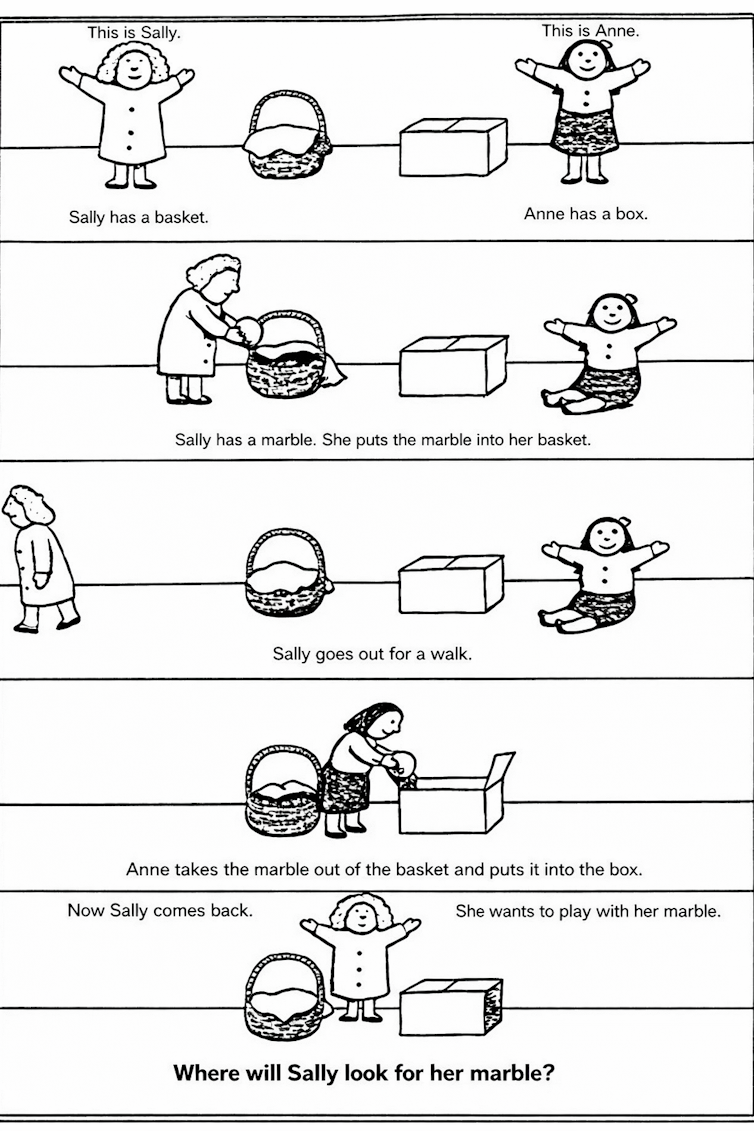
In 1985, one such test was used in a study of autistic children. In the “Sally-Anne” task, a doll (Sally) hides a marble, leaves the room, and returns after another doll (Anne) has moved it. Asked where Sally will look, many autistic children in that study gave the “wrong” answer. This finding was interpreted as evidence that autistic children lacked theory of mind.

The Sally-Anne test

A cartoon of the Sally-Anne test.
Does the autistic child really not have a ‘theory of mind’?
Simon Baron-Cohen, Alan M. Leslie, and Uta Frith

From this experiment, a vast research programme followed. New tasks multiplied: reading emotions from photos of eyes, interpreting short stories, judging intentions from animated shapes.

Across the late 1980s and 1990s, scientific papers and popular media represented autism as defined by a core failure to understand minds. The theory stuck, appearing in academic articles, textbooks, court rulings and popular science writing.

The problem is that the evidence never supported the claim. Even in the original study, one in five autistic children passed the task. Later research found huge variation. Some studies showed most autistic participants passing theory-of-mind tests; others found little or no difference between autistic and non-autistic groups. A theory meant to describe a key deficit kept running into exceptions.

More troubling is the tests themselves. Many rely heavily on language. Performance is often better predicted by vocabulary level than whether someone is autistic.

Different theory-of-mind tasks also fail to line up with one another, suggesting they are not measuring a single underlying ability at all. If an ability cannot be measured consistently, claims about its absence become doubtful.

At this point, a straightforward scientific response would have been to reconsider the theory. Instead, it was repeatedly patched.

When autistic people passed a task, researchers argued that the task was too simple. New, more complex tasks were introduced, which produced the same mixed results. When findings contradicted the core idea, the definition of “theory of mind” quietly expanded to include eye contact, joint attention, or social motivation.

When science stops testing

This pattern matters because of what it says about how science works. Drawing on the philosophy of science, my recent analysis argues that theory-of-mind research in autism has become “degenerating”. Rather than generating new, risky predictions, the theory survives by shifting definitions and goalposts to avoid being disproved. When no possible result counts against a theory, it stops being scientific. In a subsequent response to commentators, I explore why the theory-of-mind paradigm has persisted despite its deep empirical and conceptual difficulties.

Questioning this idea did not come from a single paper or field. Psychologists, linguists, and philosophers all raised concerns. So did autistic people, whose everyday experiences often flatly contradicted the idea that they lacked insights into others.

Studies began to show that non-autistic people are just as poor at interpreting autistic expressions as the reverse. Social misunderstanding, it turns out, goes both ways.

That insight helped fuel alternative approaches. One approach frames communication breakdowns as mutual mismatches between different styles of thinking and communicating, rather than deficits located in autistic people.

Another focuses on differences in attention and interest, offering an explanation of perception, motivation and learning. These approaches generate new, testable questions and align more closely with people’s actual experiences.

Today, the field is at a crossroads. The idea that autistic people are mind blind lacks a secure foundation. Its empirical support has weakened, and its assumptions are increasingly questioned. What remains is its influence. When educators or healthcare professionals assume a lack of empathy, they are less likely to trust autistic people’s own accounts or involve them in decisions that affect their lives.

Abandoning this myth does not weaken autism science. It strengthens it. Social understanding is not absent in autism; it is shaped differently, expressed in different contexts, and often overlooked when the wrong tools are used. Autistic people are not mind blind. They think and understand differently, and the evidence has pointed that way for some time. It’s time science reflected that.

The Conversation

Travis LaCroix received funding from the Social Science and Humanities Research Council (Canada).

ref. No, autistic people are not ‘mind blind’ – here’s why – https://theconversation.com/no-autistic-people-are-not-mind-blind-heres-why-272848

Wallace & Gromit, Biba style and the irrepressible Tracey Emin: what to visit and see this week

Source: The Conversation – UK – By Jane Wright, Commissioning Editor, Arts & Culture, The Conversation

When I was growing up there were three channels on the telly, which seems quaint now. You watched what was on, like it or lump it. But I have only good memories of children’s TV in the 1970s. Hiding behind a cushion as we watched Dr Who, singing along to Sesame Street, lots of excellent dramas, and a surprising array of weird trippy stop-motion animation that featured stoned rabbits and talking TVs.

But my favourite was a wonderful art show aimed primarily at deaf children called Vision On. (For anyone who’d like a walk down memory lane, listen to the groovy theme tune below and transport yourself back to your 1970s living room.)

Vision On.

A lovely man called Tony Hart shared simple art techniques, and later got his own spin-off show called Take Hart. It was here in 1977 that I first encountered a charming little Plasticine character called Morph who persisted in interrupting Tony has he tried to make art, generally making a mess and causing chaos. But always in the most endearing way.

It was groundbreaking stuff in those days, watching a ball of plasticine unfurl into this funny little figure with big eyes and a bigger heart. Who would have guessed Morph was the beginning of Aardman, one of the most successful stop-motion animation studios in the world? One that would go on to create beloved characters like Wallace & Gromit and even win Oscars?

That success is surely down to a very British sensibility that celebrates quirk and eccentricity, chewy regional accents, DIY and a heroic sweetness that remains untainted by cynicism. I still marvel at the genius of the long-suffering Gromit’s scowl, conveyed only by two indented thumbprints for eyebrows.

Aardman’s work is now rightly being celebrated in an exhibition at the Young V&A in London. We sent along animation expert Christopher Holliday to give us his take as the studio celebrates almost half a century of hi-octane slapstick, unlikely heroes and comical villains.

Two national treasures

It’s a great week for celebrating quintessential Britishness in film, art and fashion. In Edinburgh The Biba Story has just begun at the wonderful Dovecot tapestry studio. The show is a warm, inclusive and affectionate look at the impact of Barbara Hulanicki’s groundbreaking Biba fashion and lifestyle label that brought a splash of excitement to drab postwar Britain in the mid-1960s. Best of all are the vivid memories of women now in their eighties describing the thrill of high fashion at low prices in their teens.

At the Tate Modern in London, the irrepressible Tracey Emin is back with a restrospective called, appropriately, Tracey Emin: A Second Life after she rose like a phoenix from the ashes of her grim encounter with cancer and the life-changing surgery that followed. I adore Emin (even though I don’t always like her work) because she makes art utterly on her own terms. Complicated, contradictory, uncompromising and fearless, many people find that altogether too much in one woman. But Emin mines her life and experience in ways that make her vulnerable which I find brave, honest and admirable.

Films heading for the Oscars

Wagner Moura and Rose Byrne are each nominated for best actor/actress gongs at this year’s Oscars, and both, according to our reviewers, would be worthy winners.

Set in 1977 during Brazil’s two-decade dictatorship, The Secret Agent is a gripping thriller that features an outstanding performance from Moura. The Brazilian actor plays Armando, an academic forced into hiding after clashing with big business interests aligned with the regime who want to get their hands on his research. Kleber Mendonça Filho’s film makes clear that authoritarianism attacks society not only through violence and repression of civilians, but through the silencing of knowledge and learning. This timely and important film reminds us why academic freedom must be protected.

Rose Byrne gives a relentless performance as Linda, an exhausted resentful mother quickly unravelling in If I Had Legs I’d Kick You. Her husband who works away is unconcerned that she is looking after their seriously ill daughter solo. Her unfulfilling but demanding work as a therapist piles on more pressure and her own therapist is deeply unsympathetic. Unsupported and drowning in despair, she is unable to find respite. This dark and unsettling film, says our reviewer Laura O’Flanagan, “is an example of how cinema has become less interested in saccharine, idealised depictions of mothers and more concerned with their inner lives, however messy”.

The Conversation

ref. Wallace & Gromit, Biba style and the irrepressible Tracey Emin: what to visit and see this week – https://theconversation.com/wallace-and-gromit-biba-style-and-the-irrepressible-tracey-emin-what-to-visit-and-see-this-week-274175