Netflix and Paramount bidding for a potentially lucrative back catalogue mirrors 18th-century publishing deals

Source: The Conversation – UK – By Marrisa Joseph, Associate Professor of Organisation Studies & Business History, University of Reading

miss.cabul/Shutterstock

Netflix’s plan to buy the Hollywood studio Warner Bros Discovery is over. The streaming giant was eventually outbid by rival company Paramount Skydance, which is willing to pay around US$111 billion (£82.2 billion) for the company.

It’s not a done deal yet. There will be regulatory hoops that Paramount needs to get through.

But after a tense few months of negotiations, Warner Bros, which put itself up for sale last year, said Paramount’s latest bid was “superior” to the one from Netflix, which then refused to raise its offer.

And if things go according to Paramount’s plan, the company will soon become the new owners of a vast library of content. It will own the likes of Casablanca, Friends, Superman, Harry Potter and Game of Thrones. Plus it will have the Sopranos, Sex and the City and Succession.

Media companies like Paramount and Netflix appear to see high quality back catalogues as valuable strategic assets. The theory is that control over legacy content can provide financial stability and a durable competitive advantage.

And it’s a strategy with a long history. Back in the 18th century for example, Longman, the UK’s oldest commercial publishing house, built up its business by acquiring the catalogues of other firms.

Founded by Thomas Longman in 1724, the company steadily and deliberately expanded its portfolio of titles. One of the most famous and lucrative of these was Robinson Crusoe by Daniel Defoe.

In addition to acquiring catalogues from publishers (who were often retiring or leaving the trade) Longman was also a keen trader of shares in consortiums known as “congers”. This was where publishers collaborated to finance new literary works as a way of spreading the risk of potentially costly publishing ventures. In 1755, for example, Longman joined a consortium with five other publishers to produce and publish Samuel Johnson’s Dictionary of the English Language.

By the time Longman reached its centenary in 1824, the firm was regarded as one of the most distinguished publishing houses of the age. Its fortunes were built on the substantial capital generated through the acquisition of lucrative copyrights, a strategy that successive generations continued.

It was the third generation of Longman publishers for example, who, in 1863, acquired the business of John William Parker & Son, publishers of Gray’s Anatomy. First issued in 1858, the work had already become pivotal to medical education, making it a highly valuable addition to Longman’s catalogue. It has never been out of print, and still sells well to medical students and doctors around the world today.

Longman continued to grow, and was considered one of the major players in British publishing in the 19th century. A steady commitment to purchasing reference and instructional works helped cement the firm’s reputation as a leading educational publisher, a position strengthened by its overseas trade and broad catalogue of school textbooks.

Content is always king

This would become their enduring legacy well into the 20th century, as Longman’s reference works came to define standards in English language educational publishing.

Copy of Gray's Anatomy on a desk.
Still a bestseller.
Tom Quisenaerts/Shutterstock

As successive generations of Longman had pursued this strategy of acquiring established firms with profitable lists, new media companies entered the market seeking to expand their portfolios. Longman’s reputation and extensive back catalogue eventually made the firm an attractive target for a take over.

In 1968 Longman was acquired by Pearson, bringing an end to a publishing dynasty that had lasted for centuries. And although no longer family-owned, the Longman imprint has endured as a strong brand in educational publishing.

Similarly, by absorbing Warner Bros. Discovery’s extensive archive, Paramount will gain control over a vast catalogue of cultural content, influencing which stories persist and how future entertainment landscapes may be shaped.

The deal, if it happens, demonstrates how legacy assets remain powerful tools for shaping markets and culture. It will also show that for media companies in the 21st century, as with publishing companies 300 years ago, ownership of a profitable back catalogue continues to be a cornerstone of growth and innovation.

The Conversation

Marrisa Joseph works for the University of Reading.

ref. Netflix and Paramount bidding for a potentially lucrative back catalogue mirrors 18th-century publishing deals – https://theconversation.com/netflix-and-paramount-bidding-for-a-potentially-lucrative-back-catalogue-mirrors-18th-century-publishing-deals-275955

How the Greeks mapped the mythical places of their heroes and legends

Source: The Conversation – UK – By Lisa Doyle, Postdoctoral Research Fellow, Trinity College Dublin

From the third century BC, Alexandria in Egypt was the intellectual hub of the Greek world, as the literature of classical antiquity was collected, edited and canonised at the Mouseion (Shrine of the Muses) and the Library of Alexandria.

To the ancient Greeks, myths were more than just stories, and to the scholars working at the library, mythical tales presented an opportunity to understand the inhabited world. We are able to uncover how scholars attempted to bridge the gap between myths and the real world through a particular type of source material, one that is preserved in the margins of manuscripts.

We are fortunate that the commentaries and scholarly works of Alexandrian critics have been passed down to us – copied and transmitted across the centuries as comments, notes and annotations in the margins of papyri and manuscripts.

These comments are known as scholia, and they are a window into the workings of ancient scholars. Scholia reveal a range of concerns and ideas, from analysis of poetic techniques to criticisms of grammar. They are also testament to the endeavour of ancient scholars to map the mythical places traversed on heroic voyages onto locations in the known world.

Mapping myths and monsters

One of the most significant scholarly disputes in antiquity, even predating the establishment of the Alexandrian library, was the route taken by the hero Odysseus on his perilous homeward journey after the Trojan War. The final stages of the Greco-Trojan conflict and the subsequent homecoming of Odysseus were the subjects of the ancient epic poems attributed to Homer: the Iliad and the Odyssey.

Homer’s epics were the focal point of scholarly activity in Alexandria. Indeed, one of the chief librarians there, Apollonius of Rhodes, composed his own epic, the Argonautica, which recounts the quest of Jason and the Argonauts to obtain the golden fleece and was modelled on the Homeric poems of a few centuries before.

Like Odysseus, the route taken by Jason was disputed, and Apollonius, as a scholar-poet, was familiar with debates on the exact routes taken by these heroes. Across several annotations, the scholia tell us about the versions of the Argo’s journey that differ from Apollonius’, including that of his contemporary, the poet Callimachus.

The attempt to map mythical locations is most notably characterised by the wanderings of Odysseus (as recounted in Books 9-12 of the Odyssey), which were located in Sicily and Italy. Significantly, the sea monsters Scylla and Charybdis were thought to dwell in the treacherous strait of Messina, the strip of water between the north-east of Sicily and the toe of Italy’s boot.

A strict opponent of this approach, however, was Eratosthenes – the Alexandrian scholar who calculated the circumference of the earth, to a remarkable degree of accuracy. He preferred to locate the wanderings of Odysseus and the travels of the Argo at a remove from the Mediterranean, dispelling them to the remote regions of the ocean.

Professor Helen Lovatt of the University of Nottingham shares insights about Jason and the Argonauts.

How to spot a myth

While the route of Apollonius’ Argonauts contained fantastical elements (like the Sirens and the Clashing Rocks), scholars were also interested in mapping known locations along the route.

As the Argonauts navigate places like the Black Sea in Book II of the Argonautica, the evidence in the scholia demonstrates that scholars had a desire to record the geographical landmarks visited by the heroes, as well as any myths associated with those locations.

In his own epic, Apollonius ensures that the Argonauts leave markers of their journey, often in the form of an altar that is still visible in the landscape. The scholia show us scholars discussing the exact location of these markers – whether the altar to the 12 gods on the Bosporus strait was found on the European side or Asian side, for instance.

In addition to the markers mentioned by Apollonius, the scholia document a vast array of location-based stories which explain the origin of a place’s name – the aition. By using the mythical past to explain a phenomenon in the present, aetiology is a way for the contemporary reader to orient themselves in a text.

It is clear that critics had a “checklist” of sorts for talking about physical landmarks such as rivers or mountains: they note their location, the origin of their name and any connected myths or mythical markers. A standard entry in the scholia reads like this:

The Callichorus is a river sacred to Dionysus in the region of Heraclea. The river is called this because Dionysus organised a chorus there.

The consistency with which these physical landmarks are documented resembles the catalogues which we also find on papyri from the Hellenistic period – the era after the death of Alexander the Great which saw the expansion and transformation of Greek language and culture. Papyri of this type list the names of rivers and associate them with renowned peoples and places (such as those on the Argonautic voyage).

This shows us that these locations, even if they are known from poetry or a fictional voyage, could be situated in the landscape and understood through an origin myth. The cataloguing of mythical landmarks ensures they become enshrined in cultural memory and, through the process of copying them in the margins, ingrained in Greek identity.

The Conversation

Lisa Doyle receives funding from Taighde Éireann / Research Ireland.

ref. How the Greeks mapped the mythical places of their heroes and legends – https://theconversation.com/how-the-greeks-mapped-the-mythical-places-of-their-heroes-and-legends-275035

Menopause makes teachers’ work lives harder – and may push them out of the profession

Source: The Conversation – UK – By Hannah Ainsworth, Senior Lecturer in Primary and Childhood Education, Edge Hill University

Frame Stock Footage/Shutterstock

Secondary teaching in England currently faces a recruitment and retention crisis. Over 90% of teachers leave before retirement.

Although the government have made efforts to improve recruitment and retention, interventions tend to focus on initial teacher trainees and early career teachers – ignoring the experiences of midlife teachers, including menopause.

Research suggests that menopause can increase the risk of burnout at work. However, there has been limited exploration of how menopause affects secondary teachers’ intentions to remain in the profession.

My PhD research explored this. I surveyed 258 peri- and post-menopausal secondary teachers between the ages of 40 and 65 across England, carrying out interviews with 12. I found that teachers are statistically more likely to intend to leave teaching if they are menopausal than if they are pre-menopausal.

When interviewed, menopausal teachers explained they felt they had no option but to leave or reduce their hours and responsibilities as they were unable to manage their menopause symptoms at work. Teachers experiencing menopause symptoms felt that they were less able to do their jobs. “I am planning my exit as we speak now,” Rachel said. “It’s not a job you can sustain.”

Menopause can cause a range of symptoms, with teachers finding menopause-related bladder problems, heavy bleeding and fatigue to be most problematic. Teachers often had limited access to bathrooms during the school day. Jane explained how she was often unable to access a bathroom for up to four hours, and Maddie said she was having “stress dreams about not being able to go the toilet”.

Alongside bathroom access, women found the lack of flexibility and the performance element of the job difficult to manage while experiencing menopause-related fatigue. Paige, who retrained as a teacher in her forties, recounted how she had “never actually come across a profession which is so rigid”. “It is relentless and there is no let up,” Jane explained.

This rigidity also meant many menopausal teachers could not access health appointments, meaning they lacked menopause support inside or outside of school. This further affected their health and wellbeing, as well as their intentions to leave the profession.

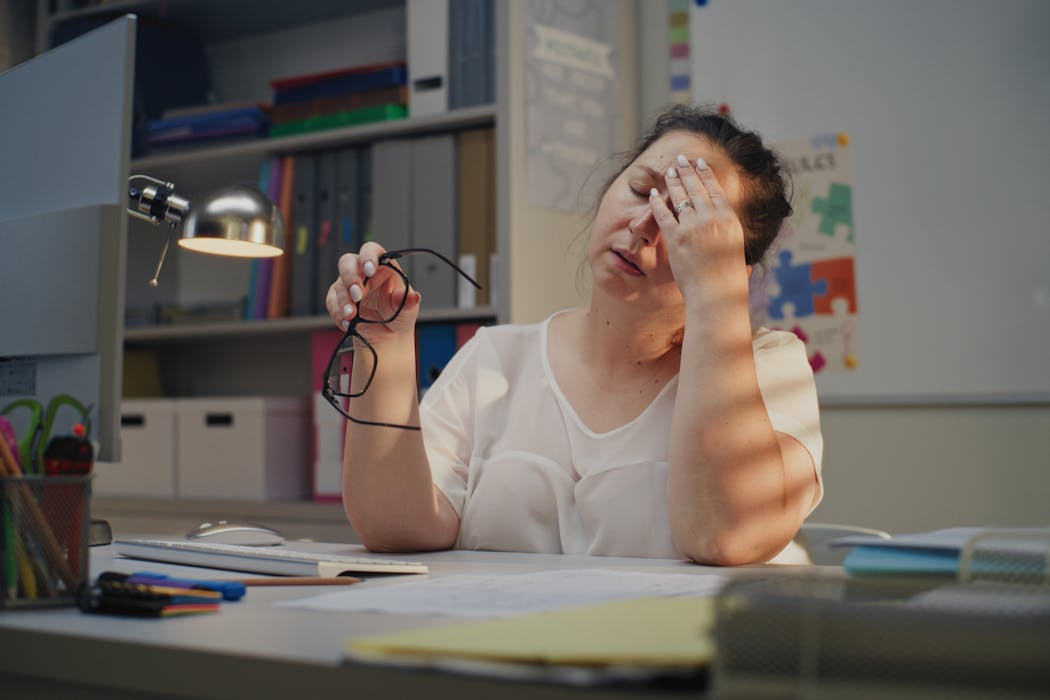
Woman in meeting
Women felt they didn’t receive the right support.
AYA images/Shutterstock

Only 7% of menopausal secondary teachers in my survey felt supported by their school; 80% reported struggling to manage workload and to access accommodations, such as flexible working, cooling down methods and regular breaks. Most teachers felt as though their line manager would not know how to help them or how challenging menopause can be. Caroline, a head of department, thought her current headteacher “would find it almost laughable” if she was to ask for support around menopause.

No sympathy

Those who do try to ask for support are often penalised or ignored. Maria raised her heavy bleeding with her line manager and was told discussing the issue was “inappropriate”. Rachel explained that “they had no sympathy” for her symptoms. Maddie asked for more access to toilets: “Of course, it’s been completely ignored.”

Discriminatory practices are having a detrimental impact on women secondary school teachers, psychologically and financially. Rachel felt forced to give up her role as head of department and “took a huge hit financially”. Susan “felt anxious and ashamed”. The teachers highlighted a systemic failure for midlife women in secondary teaching, noting “a cull of older ladies” in the profession. Only 34% of teachers surveyed identified a menopause policy, with those I interviewed noting how the menopause policies in place were tokenistic and ineffective. Maria explained that her school’s policy was “very much box ticking”.

Despite being a female dominated sector, the “career stifling” described in the interviews is represented in the persistent gender pay gap. Women are less likely to be in leadership positions in schools than men.

These findings raise questions around the inclusivity of secondary teaching, particularly for women and for those who have health-related needs. Supporting menopausal teachers is imperative for retaining experienced and talented teachers.

Changes such as accessing bathrooms, reducing workload and the consideration of flexible working opportunities would make a real difference for women in teaching. Training for line managers and HR would help them effectively support menopausal teachers – and wider scrutiny needs to occur around the potential gendered and ableist discriminatory practices occurring in the teaching profession.

All names have been changed for anonymity

The Conversation

Hannah Ainsworth received funding from the ESRC for the research project informing this article.

ref. Menopause makes teachers’ work lives harder – and may push them out of the profession – https://theconversation.com/menopause-makes-teachers-work-lives-harder-and-may-push-them-out-of-the-profession-276307

How dangerous has the conflict in Iran become? Expert Q&A

Source: The Conversation – UK – By Scott Lucas, Professor of International Politics, Clinton Institute, University College Dublin

The conflict in the Middle East is now in its sixth day and is showing no sign of letting up. Israeli and US warplanes have continued to strike targets inside Iran, which has prompted retaliatory attacks throughout the region. An American submarine has also sunk an Iranian navy ship off the coast of Sri Lanka, killing at least 80 people, while Nato defences intercepted a missile heading towards Turkey.

US officials, who initially envisioned the conflict in Iran lasting four to five weeks, are now warning it may go on far longer. “We are accelerating, not decelerating,” Defence Secretary Pete Hegseth told reporters on March 4, adding that “more bombers and more fighters are arriving just today”. We asked Middle East expert Scott Lucas how dangerous the situation has become.

You’ve called this ‘uncontained war’. What do you mean by that?

Once the Iranian regime retaliated, hours after initial US-Israel airstrikes that it was later revealed killed Iranian supreme leader Ayatollah Ali Khamenei, this was no longer just an American-Israeli war on Iran. Tehran, which had refrained from retaliation beyond Israel in the 12-day war in 2025, was taking this across the region.

This was a war in the Gulf states, where Iran fired not only on American bases but also industrial areas, ports and tankers. This was a war in Lebanon, where Israel responded to Hezbollah rocket fire with airstrikes and an expansion of its occupation in the south of the country. This was the possibility of war spreading to Iraq, where the US military and CIA may be supporting Iranian Kurds for a cross-border incursion.

It is now possibly also a war beyond the Middle East. A drone attacked the UK’s RAF Akrotiri base in Cyprus and an Iranian missile has been intercepted flying towards Turkey. Drones have struck an airport and school in Azerbaijan. Iran has denied responsibility but the Azerbaijani president, Ilham Aliyev, has put his armed forces on high readiness.

How dangerous a moment is this?

War is always dangerous, of course, but this conflict is compounded by the shattering of any international “rules of the game”. The US and Israel have blatantly violated international law. They have assassinated the head of another country and his senior officials.

The UN can condemn the strikes, but this will be easily disregarded by Israel and the US. Donald Trump has historically taken little notice of UN criticism, and said in January that his power is limited only by his “own morality”. European countries can call for deescalation, but almost all have now prioritised working with the US on the defence of positions threatened by the Iranians.

China is maintaining a cautious position and Russia will be grateful that attention is being taken away from its invasion of Ukraine. If the Iranian regime does not surrender, there does not appear to be anyone or anything capable of checking the US and Israeli attacks – and thus the retaliatory shocks across the region and beyond.

Is there a risk that Nato will be drawn in?

Nato is already drawn in. Once Iran went beyond the Middle East to threaten Cyprus and Turkey, then the bloc had to take action. However, while Nato forces downed the missile heading towards Turkish airspace, the alliance is not yet discussing invoking Article 5 (the agreement that an attack on one Nato member is considered an attack on all).

The alliance has also become involved in the conflict verbally to ensure the Trump camp does not abandon Ukrainian and European security at a sensitive point in talks to end Russia’s invasion of Ukraine. Nato secretary-general Mark Rutte, already known for calling Trump “daddy”, has given fulsome praise to the war even as some Nato members like Spain condemn it.

In a recent interview with a German television channel, Rutte said: “It’s really important what the US is doing here, together with Israel, because it is taking out, degrading the capacity of Iran to get its hands on nuclear capability.”

Where are the Gulf states in this? What happened to Qatar’s attempts to mediate?

The Gulf states are likely to be happy that Iran’s supreme leader and others in his circle have been assassinated. For decades, Khamenei had pursued a strategy of expanding Iran’s influence across the Middle East – directly threatening Gulf monarchies. However, they are loathe to see regime change, fearing the disorder and instability that marked Iraq after the 2003 US invasion.

They have been trying to pull back the Trump administration – an initiative by Qatar to persaude Trump into finding an off-ramp is notable – but they have to do so quietly. Open opposition to the US president risks even more serious disruption of the political and economic situation, with no guarantee that a triggered Trump will listen.

There is a further complication because of division among the Gulf states. Saudi Arabia, Qatar and Kuwait put some of the blame for the rising hostilities in the Middle East on the United Arab Emirates and Bahrain for their policy of normalising relations with Israel. They claim this has emboldened the Israeli government of Benjamin Netanyahu.

So far, the quiet push for deescalation does not appear to have succeeded. Without naming Qatar or another Gulf partner, Trump said on March 3 that there will be no talks with Tehran.

The US and Israel are reportedly arming Kurdish groups. How could that change things?

With Plan A for regime surrender not succeeding so far, the Trump camp has had to consider what to do next. More bombing and an incursion by ground forces are two options, as is supporting an insurrection by Iranian Kurds.

It appears the US president and his senior advisers (along with their Israeli allies) may opt for the Kurdish option. According to reports, Trump has in recent days called Kurdish minority leaders to offer them “extensive US aircover” and other backing if they enter the conflict.

But the Iranian regime will undoubtedly unleash its military against the insurgents, throwing the west of the country into further turmoil. And it will have a justification to rally Iranians around the nation, despite the mass protests that were crushed in January.

Even if the US can support the insurgency in splitting off part of Iran, what happens to the rest of the country? What does Plan B offer other than instability and fragmentation that could parallel post-2003 Iraq?

This does not bring an assurance that the regime’s retaliation will be halted soon. Meanwhile, the US military is facing a shortage of interceptors which – if Iran’s firepower has not been expended – maintains the threat facing the Gulf states.

The Conversation

Scott Lucas does not work for, consult, own shares in or receive funding from any company or organisation that would benefit from this article, and has disclosed no relevant affiliations beyond their academic appointment.

ref. How dangerous has the conflict in Iran become? Expert Q&A – https://theconversation.com/how-dangerous-has-the-conflict-in-iran-become-expert-qanda-277632

The Gulf’s delicate balancing act between the US and Iran is now in flames

Source: The Conversation – UK – By Gemma Ware, Host, The Conversation Weekly Podcast, The Conversation

As Israel and the US continued to bomb Iran after killing the country’s supreme leader Ali Khamenei, Iran lashed out at its neighbours. Among the targets of Iranian drone strikes were a hotel in Dubai, a port in Oman, gas facilities in Qatar, and multiple US bases and embassies in the region, including in the Saudi Arabian capital, Riyadh.

Saudi Arabia and Iran have a long and bitter rivalry. Yet, in recent years, the Saudis had begun building new diplomatic relationship with Iran, even as they and other Gulf states continued to host American military bases, and court American investment.

Now the Gulf states find themselves in the middle of the very regional conflict many of its leaders hoped to avoid. It’s one which threatens longstanding efforts to cement the Gulf as a hub for finance, travel and tourism, and as an oasis of security.

In today’s episode of The Conversation Weekly podcast, we speak to Simon Mabon, a professor of international relations at Lancaster University in the UK and expert in Saudi-Iran relations, about how the Gulf’s delicate balancing act between the US and Iran came toppling down.

Mabon says that in recent years, Gulf states realised they had to live alongside Iran. “You can’t do that without having regional stability. And the only way you could get regional stability is to integrate Iran in some way, shape, or form,” says Mabon.

But after the US-Israeli war on Iran, and Iran’s retaliation against its neighbours, Mabon thinks it will be very difficult “to rebuild the sort of trust that had been cultivated over years between the Gulf Arab states and Iran”. That leaves big questions about how Gulf states, which may have advanced military hardware, but only small armies, ensure the security of their populations and their economies.

Listen to the interview with Simon Mabon on The Conversation Weekly podcast. This episode was written and produced by Mend Mariwany and Katie Flood. Mixing by Eleanor Brezzi and theme music by Neeta Sarl. Gemma Ware was the executive producer.

Newsclips in this episode from CNN, 60 minutes, euronews, BBC News, PBS NewsHour and WION.

Listen to The Conversation Weekly via any of the apps listed above, download it directly via our RSS feed or find out how else to listen here. A transcript of this episode is available via the Apple Podcasts or Spotify apps.

The Conversation

Simon Mabon receives funding from Carnegie Corporation of New York and the Henry Luce Foundation. He is affiliated with the Foreign Policy Centre.

ref. The Gulf’s delicate balancing act between the US and Iran is now in flames – https://theconversation.com/the-gulfs-delicate-balancing-act-between-the-us-and-iran-is-now-in-flames-277449

The Black Death’s counterintuitive effect: as human numbers fell, so did plant diversity

Source: The Conversation – UK – By Christopher Lyon, Visiting Research Fellow, Centre for Death and Society, University of Bath

Paul Nash/Shutterstock

Between 1347 and 1353, Europe was gripped by the most catastrophic pandemic in its history: the Black Death. Killing many millions, the plague wiped out between one-third and a half of Europe’s population.

In some cities, mortality rates were as high as 80%. In rural areas, Black Death mortality caused intense labour shortages. Entire villages were left empty as rural economies collapsed. In many places, cultivated fields were abandoned and reclaimed by woodland, scrub and deer.

Given the widely reported negative effects that people have had on nature over recent decades and centuries, we might expect this continental-scale “rewilding” to have enabled biodiversity to flourish. However, our new study in the journal Ecology Letters uncovers a potentially counterintuitive result: when Europe’s human population crashed, plant biodiversity also plummeted.

Fossilised pollen grains in sediment cores extracted from lakes and bogs contain information about plant communities that existed thousands of years ago. We used data from over 100 fossil pollen records from across Europe to explore how plant diversity changed before, during and after the Black Death.

The pollen data show that between 0BC and 1300, plant diversity in Europe increased. It grew through the rise and fall of the Western Roman Empire and continued through the early Middle Ages. By the High Middle Ages, biodiversity levels were at their peak.

However, in 1348, Europe was hit by plague and for about 150 years, plant biodiversity plummeted. It was only after a century and a half – as human populations recovered and farming resumed – that plant diversity began to rise again.

black and white etch of people dying from black death
The plague of Florence in 1348, as described in Boccaccio’s Decameron. Etching by L. Sabatelli. Iconographic Collections.
Wellcome Collection gallery (2018-04-05), CC BY-NC-ND

We found that the biggest losses of plant diversity occurred in areas most affected by land abandonment. By plotting patterns of biodiversity changes from sites with different Black Death land use histories, we discovered that biodiversity collapsed in landscapes where crop (arable) production was abandoned, whereas landscapes with growing or stable arable farming became more biodiverse.

Our work suggests that over 2,000 years of increasing European biodiversity was generated because of – not in spite of – humans. But why? And what lessons can we learn from this for managing biodiversity now, when land being converted into farmland is driving biodiversity losses?

Population growth and technological innovations pushed agricultural activities into previously unused lands over the first 1,300 years of the common era. Unlike today – where crop monocultures are dominant – mixed agricultural systems were the norm over the majority of the last 2,000 years. Across Europe, a diverse lattice of farmlands and farming practices were typically separated by woods, rough grazing lands and uncultivated plots, often enclosed by hedgerows or trees.

wooded landscape with crops on farmland
A patchy landscape of woodland, farmland, grazing lands and unused areas creates a mixture of habitats for plants that raises biodiveristy.
Yuri Dondish/Shutterstock

The result was a patchy landscape where there were lots of opportunities for different plant species to survive, and biodiversity was high.

The Black Death disrupted this by reducing human disturbance. The result was a less patchy landscape and an overall loss in plant diversity. Diversity only recovered when extensive farming returned.

People can boost nature

These findings call into question conservation policies that advocate for removing or reducing human influence from Europe’s landscapes to protect biodiversity.

One such policy initiative is rewilding, which is seen by many as a route to achieving a biodiverse future where nature is given space to flourish. Yet, many of the most biodiverse locations in Europe are those with a long history of low-intensity, mixed agriculture. To rewild these human-formed landscapes may, paradoxically, risk eroding the biodiversity that conservationists seek to protect.

Our findings of long-term positive human–biodiversity relationships is not solely a European phenomenon. Multimillennial interactions between humans and the natural world have resulted in elevated biodiversity levels across planet. Examples of diverse, cultural ecosystems include the forest gardens of the Pacific North West (forests cultivated by Indigenous peoples), the satoyama of Japan (low intensity mixed systems of rice paddies and woodlands in mountainous foothills) and the ahupua’a of Hawaii (segments of diverse hillsides used to cultivate multiple crops).

Modern, intensive farming practices have caused substantial biodiversity losses across the globe. Yet, our Black Death findings, in combination with numerous other examples, show us that humans and nature do not always have to be kept separate to conserve and promote biodiversity. Indeed, recognising landscapes as cultural ecosystems may help us imagine futures where both nature and people can live together and thrive.

Traditional, low-intensity land management practices have generated diverse ecosystems for millennia. Today, where locally appropriate, they should be encouraged for the conservation of both biological and cultural diversity.

The Conversation

Christopher Lyon receives funding from a Leverhulme Trust Research Centre—The Leverhulme Centre for Anthropocene Biodiversity, grant no. RC-2018-021 and the Biotechnology and Biological Sciences Research Council, grant number BB/Z516697/1. He has previously received funding from the York Environmental Sustainability Institute; the White Rose University Consortium; the Biotechnology and Biological Science Research Council, Economic and Social Research Council, Natural Environment Research Council, and the Scottish Government, grant no. BB/R005842/1; and the Social Sciences and Humanities Research Council of Canada, grant no. 132726.

Jonathan D. Gordon receives funding from a Leverhulme Trust Research Centre—The Leverhulme Centre for Anthropocene Biodiversity, grant no. RC-2018-021

ref. The Black Death’s counterintuitive effect: as human numbers fell, so did plant diversity – https://theconversation.com/the-black-deaths-counterintuitive-effect-as-human-numbers-fell-so-did-plant-diversity-277386

Female writers and readers have been challenging the patriarchy for more than 200 years

Source: The Conversation – UK – By Roberta Garrett, Senior Lecturer in Literature and Cultural Studies, University of East London

Emerald Fennell’s film adaptation of Wuthering Heights has been pulling in the crowds recently, which is quite a feat in troubled times for cinema. Published in 1847, Emily Brontë’s tale of psycho-sexual power dynamics is just one of many enduring female-authored 19th century novels exploring female sexuality and desire for autonomy. These characters existed within a system that allowed women few education or career opportunities.

The ever-popular work of canonical British female writers such as Jane Austen, the (other) Brontë sisters and George Eliot were very different in style and tone. But they also draw attention to various forms of gender inequality.

Their novels focused on issues such as inheritance and property laws, the pressure on young women to marry for financial security, the sexual double standard and the lack of career prospects for women. In doing so, they gave voice to the frustrations of an expanding female readership in the 19th century.

The work of these and lesser-known female authors was crucial in shaping and fuelling public debates on what was referred to in the mid-Victorian period as “the woman question” (women’s right to vote). It later became the first-wave feminist movement in the late 19th and early 20th century.

The emergence of two inventive new literary forms in the early 20th century were key. One was modernism and the other the new printed paperback; both were intertwined with the expansion of women’s concerns and desires in the social and cultural sphere.

Modernism saw the burgeoning of experimental female writers such as Virginia Woolf and Jean Rhys in the 1920s. Then came popular genres such as mass market romance and what is now described as “cosy” crime fiction in the 1930s. Women writers and readers were creating spaces in high art and mass culture that centred female experience and domestic and personal life from the beginning of the 20th century.

The second wave

Given the importance of novels and reading to the history of feminist struggle, it is not surprising that second-wave feminism drew heavily on women’s literary heritage. This saw the publication of landmark academic studies of women’s writing such as Elaine Showalter’s A Literature of Their Own (1977), and Sandra Gilbert and Susan Guber’s The Madwoman in the Attic (1979). And with them came the proliferation of university courses on women’s writing.

The 1960s and 1970s also witnessed the birth of polemical feminist bestsellers. This included Germaine Greer’s The Female Eunuch (1970) and “consciousness raising” popular novels, such as The Woman’s Room (1977) by Marilyn French.

In the 1970s and 1980s, a more diverse group of feminist writers came on the scene. Writers like Margaret Atwood, Angela Carter, Alice Walker, Audre Lorde, Toni Morrison, Octavia Butler and Rita Mae Brown, continued to shape and expand the political and cultural scope and influence of women’s writing into queer, black and postmodernist forms.

Bookgroups, BookTok and the feminist novel

In our own era, while men are reading fewer and fewer novels, female writers and readers are keeping the world of fiction alive. Aside from being the major purchasers of fiction, women are far more likely to enhance and socialise their literary interests. Local book groups and online review and recommendation communities such as Booktok are popular spaces for exploring new literature.

They are also the driving force in the creation and consumption of successful new literary cycles. For example, one of the publishing success stories of the last ten years in English language fiction was the female-centred psychological thriller/domestic noir crime novel. This included the likes of Gone Girl (2014), The Girl on the Train (2016), Big Little Lies (2017) and The Housemaid.

As feminist literary critics have pointed out, not only are these novels predominantly written and narrated by women. Through widespread circulation and screen adaptations, they have also continued to bring to light key gender and power issues such as coercive control, domestic violence and the murder of women. At the lighter end of the spectrum, the recent explosion of “romantasy” fiction (a romance-fantasy hybrid) focuses on female desire and pleasure.

The boundary between literary and genre fiction is becoming increasingly blurred. But contemporary female writers such as Rachel Cusk, Bernadine Evaristo, Anna Burns and Eimear McBride continue to produce innovations in style and form. And younger female writers of “rage” and “sad girl” novels like Ottessa Moshfegh, Oyinkan Braithwaite, Rachel Yoder, Raven Leilani and Aria Aber are not afraid to explore edgy and unsettling accounts of women’s experience.

In life-writing, creative non-fiction and autofiction, women’s stories have also proliferated. Post #MeToo bestsellers such as Acts of Desperation (2022) by Meghan Nolan, and Three Women (2020) by Lisa Taddeo, tearing down comfortable myths of equality and exposing the persisting inequalities in women’s personal relationships.

For more than two centuries, women’s writing has not only reflected the constraints of patriarchy but actively challenged and reshaped them. As long as women continue to write, read and reimagine the world through fiction, novel reading will remain a vital site of feminist resistance and possibility.

This article features references to books that have been included for editorial reasons, and may contain links to bookshop.org; if you click on one of the links and go on to buy something, The Conversation UK may earn a commission.

The Conversation

Roberta Garrett does not work for, consult, own shares in or receive funding from any company or organisation that would benefit from this article, and has disclosed no relevant affiliations beyond their academic appointment.

ref. Female writers and readers have been challenging the patriarchy for more than 200 years – https://theconversation.com/female-writers-and-readers-have-been-challenging-the-patriarchy-for-more-than-200-years-276231

What Americans think of the war in Iran

Source: The Conversation – UK – By Paul Whiteley, Professor, Department of Government, University of Essex

The American people are bitterly divided over the conflict in Iran. The US president, Donald Trump, won office in 2024 after campaigning on a message of “no new wars”. So the conflict that began with airstrikes conducted with the Israeli military in the early hours of February 28, and which has quickly spread into the rest of the region, has polarised opinion across the country.

An Economist/YouGov poll completed on March 2 provides early information about what Americans think of the war so far. The poll asked the following question: “Would you support or oppose the US using military force to overthrow the government of Iran?”

There is a great deal of confusion about what the objectives of the war are, since the messaging from Trump, and his senior officials, has veered from preventing Iran from developing nuclear weapons, to destroying the country’s ballistic missile capability, to regime change.

But, from the point of view of polling, this is as good a question as any for finding out what Americans think. Altogether 32% of them support the war and 45% oppose it.

A divided society

The responses to this question analysed by gender, race, age and education appear in the graph. Those who were uncertain are not included in the totals.
The graph shows that large variations exist among the different groups in relation to their attitudes to the war.

The relationship between attitudes to the war and the
social backgrounds of respondents

The largest differences are in relation to race. Some 37% of white respondents support the war and 44% oppose it. In contrast 7% of black people support it and 60% oppose. Hispanics were in between these two, but rather closer to whites than to blacks.

The was a large gender difference in the responses as well with 37% of men in support but only 26% of women. A marked age difference existed too with only 21% of 18-to-29 year olds supporting and 50% opposed. At the same time some 40% of those over the age of 65 supported the war with 49% opposed. Finally, 34% of those without a college degree were in support compared with 27% with a college degree. Overall, young black women with a college degree were most likely to oppose the war, whereas older white men without a college degree were most in support.

A question of politics

The social backgrounds and attitudes to the war of respondents are interesting, but they are overshadowed by the polarisation of opinion among supporters of the political parties and ideological factions. These appear in the second chart.

The relationship between attitudes to the war and the
political affiliations of respondents

The striking feature of this chart is the difference between respondents who identify with the Democrats and those who identify with the Republicans. Only 8% of Democrats support the war compared with 64% of Republicans. The highest level of support comes from respondents who are Maga (Make American Great Again) supporters. No less that 75% of them support the war and only 10% oppose it.

There is similar polarisation among liberals, which refers to anyone on the left of the ideological spectrum in the US, and conservatives. Only 8% of liberals support the war compared with 66% of conservatives. Moderates are in between the two with 25% of them supporting and 50% opposing the war.

What it could mean for November’s mid-term elections

One theory of elections argues that individuals have a set of well-defined preferences over policies and so they support the party which is closest to them in relation to these policies. In this analysis, policy preferences are summarised by the left-right ideological dimension, or alternatively by the liberal-conservative dimension in politics.

In fact, it appears that in reality the reverse is true with voters choosing a party or leader and then changing their views to fit in with those of their newly adopted party. The 47th US president is an extreme case of this, because he constantly changes his mind. Before he was elected, he promised that the US would not get involved in any more wars in the middle east. It appears that most Republicans and nearly all the Maga supporters are quite willing to go along with the U-turn and agree with anything he does.

This is a big advantage for a president who is so polarising, since it means that he can rely on a body of loyal supporters even when they don’t know the latest policy changes. However, it is a weakness when it comes to elections because the Democrats and Independents together easily outnumber the Republicans and Maga supporters in the electorate.

The Cooperative Election Study, a large-scale survey conducted at the time of the presidential election in 2024 showed that 32% of respondents in their national survey identified with the Democrats, 27% with the Independents and 30% with the Republicans. In short, the Republicans are up against a coalition of Democrats and Independents who make up just under 60% of the voters. Add the factor that many Americans are outraged by the president’s behaviour and you have a winning coalition for the opposition in the mid-term elections.

Whatever happens in the war, Trump is unlikely to recover his popularity for the Republicans not to lose control of the House of Representatives – and possibly the Senate – in the mid-term elections in November.

The Conversation

Paul Whiteley has received funding from the British Academy and the ESRC.

ref. What Americans think of the war in Iran – https://theconversation.com/what-americans-think-of-the-war-in-iran-277627

Choosing to buy organic food depends more on trust than taste – what our new study in the UK and Japan shows

Source: The Conversation – UK – By Steven David Pickering, Honorary Professor, International Relations, Brunel University of London

Akarawut/Shutterstock

Organic food is often presented as a healthier, greener or more ethical choice. But when people decide whether to pay extra for organic milk, eggs or vegetables, something else is going on.

Organic food belongs to a curious category that economists call “credence goods”. These are the products whose key qualities can’t be verified even after you’ve bought them. There’s no way that you can tell by looking at, tasting or cooking a food item whether it was genuinely produced to organic standards. Instead, you have to take it on trust.

That makes buying organic less about what’s on the plate and more about what’s going on in people’s heads.

When people pay more for organic food, they are effectively buying a promise: that production followed certain rules, that certification means something and that the system policing those rules is credible. Whether people are willing to pay that premium depends not just on how much the food costs or how much money they earn. It also depends on how much trust they place in the certification and regulatory system behind the label, and how comfortable they are paying more for something they cannot personally verify.

As part of our ongoing research into trust, we conducted two large surveys with around 1,300 respondents in Britain and 1,500 in Japan. We asked people whether they would be willing to pay more for organic versions of everyday foods such as dairy products, meat, eggs and vegetables.

We also asked a few simple questions about trust (both trust in government and trust in other people) as well as how willing respondents were, in general, to take risks.

radishes, jute bag of veg, handwritten chalkboard sign says 100% organic
People who trust the government are more willing to pay extra for organic food.
New Africa/Shutterstock

We got the same message back from both countries. In both the UK and Japan, people who trusted the government were more willing to pay extra for organic food. This was true regardless of whether the product was milk, eggs or vegetables, and regardless of age, gender, education or political views.

Willingness to take risks mattered too. People who described themselves as more comfortable taking risks were more willing to pay a premium for organic food. Paying more for something you can’t directly verify is, after all, a form of everyday risk taking.

Trust in other people (what social scientists call “generalised trust”) played a slightly different role. It mattered most when organic food was seen as reflecting personal values, such as environmental responsibility or ethical production, rather than having guaranteed quality.

Where Japan and the UK differ

Comparing results from the UK and Japan helps explain why trust plays such a pivotal role in these shopping decisions.

Japan’s organic certification system is centralised and state-led. Organic food is less common, but public trust in the government remains relatively high. In this context, institutional credibility is crucial. If consumers trust the state, they are more likely to trust the organic label it oversees.

In the UK, organic food is more widely available than in Japan, but certification is fragmented across government bodies and private organisations. Here, trust spreads outwards: confidence in other people, social norms and shared values plays a bigger role alongside institutional trust.

In both cases, however, the basic logic is the same. Organic labels work only when the system behind them is trusted. This has important implications at a time when food prices are rising and trust in public institutions is under pressure in many countries.

Promoting organic food is often framed as a matter of better information or clearer labelling. But our findings suggest that even perfect labels won’t persuade consumers if confidence in institutions is weak, or if paying more feels like too much of a gamble.

When trust erodes, ethical consumption becomes harder. This isn’t because people stop caring about sustainability or animal welfare, but because they stop believing the promises attached to higher prices.

Organic food, then, depends on trust. And without that trust, even the most well-intentioned labels will struggle to sell.

The Conversation

Steven David Pickering received funding from the UKRI’s ESRC (grant reference ES/W011913/1).

Yosuke Sunahara receives funding from the Japan Society for the Promotion of Science (JSPS, grant reference JPJSJRP 20211704).

Martin Ejnar Hansen does not work for, consult, own shares in or receive funding from any company or organisation that would benefit from this article, and has disclosed no relevant affiliations beyond their academic appointment.

ref. Choosing to buy organic food depends more on trust than taste – what our new study in the UK and Japan shows – https://theconversation.com/choosing-to-buy-organic-food-depends-more-on-trust-than-taste-what-our-new-study-in-the-uk-and-japan-shows-275163

Iran conflict: air campaigns rarely work as intended – they often make matters worse

Source: The Conversation – UK – By Matthew Powell, Teaching Fellow in Strategic and Air Power Studies, University of Portsmouth

The US and Israel have launched a coordinated air campaign in recent days to destroy Iran’s missile capabilities and navy, curb its ability to develop nuclear weapons and eliminate its leadership. The strikes have been accompanied by calls from Donald Trump for the Iranian people to rise up and overthrow their government.

In his statement announcing the start of the operation on February 28, Trump said: “When we are finished, take over your government. It will be yours to take. This will be probably your only chance for generations.” It is clear that Trump is hoping US and Israeli air power can weaken the regime in Tehran sufficiently for the Iranian people to finish the job themselves.

This approach has been criticised by some world leaders. British prime minister Keir Starmer, for instance, told MPs on March 2 that his government “does not believe in regime change from the skies”. And, in any case, history offers few examples in which an aerial bombing campaign aimed at enabling regime change has produced positive outcomes.

There are strategic benefits to using air power. It is inherently flexible in how it can be deployed, which allows for the escalation and deescalation of violence with greater ease than is possible with land or naval power. The speed and reach of air power also broadens the range of available military targets, while simultaneously reducing the need to expose troops to risk.

But air power has several limitations. Perhaps the main limitation is that, unlike ground forces, air power is unable to hold and secure territory that would allow for the consolidation of control. This was evident following the Libyan revolution in 2011, where a Nato air campaign supported a rebellion that overthrew the country’s ruler, Colonel Muammar Gaddafi.

Despite the initial success of the rebellion, Libya soon fell into chaos. Two main competing governments, supported by complex networks of militias, have spent the past decade or so vying for control. This has created a deeply divided, highly fragile state.

This is not to say putting western boots on the ground to help manage a transition would have led to a different outcome. Several years earlier, ground forces were unable to prevent Iraq from descending into civil war after the toppling of Saddam Hussein. But what is clear is that the deployment of air power alone was not sufficient to influence the political direction of Libya once Gaddafi had been removed.

Situation in Iran

The lesson from Libya is that fomenting a revolution when you have little ability to control how events play out on the ground can lead to unfavourable outcomes. This can be applied directly to the current situation in Iran.

As was the case in Libya, it is far from clear what will replace the government in Tehran should it fall. Iran’s opposition is fragmented and disorganised. Reza Pahlavi, the exiled son of Iran’s last shah, has positioned himself as a possible successor to the current leadership.

But the level of support for him within Iran is unclear. Surveys by the Gamaan group, an organisation that attempts to gauge political sentiment in Iran, suggest roughly one-third of people are strong supporters of Pahlavi and another third strongly oppose him.

With no unified opposition ready and able to enact a provisional government if the regime falls, the result is likely to be a power vacuum. This could possibly result in a civil war that further destabilises the region.

At the same time, there is no guarantee that the US-Israeli air campaign will encourage the Iranian people to topple their country’s leadership. Rounds of protests in recent years have been met with brutal repression by the authorities, with estimates suggesting tens of thousands of protestors were killed during the latest crackdown in January 2025.

It will remain a significant risk to protest against the Iranian regime, regardless of the damage that has been inflicted on the country’s leadership. Karoline Leavitt, the White House press secretary, said that “49 of the most senior Iranian regime leaders” had been “wiped off the face of the Earth” in the opening US-Israeli strikes.

The Iranian Revolutionary Guard Corps (IRGC), which operates parallel to Iran’s regular armed forces, exists solely to support the regime and answers directly to the supreme leader. It has upward of 190,000 troops under its command and is supported by the Basij paramilitary force, which claims it can mobilise around 600,000 volunteers.

Trump has threatened the IRGC and the Basij with certain death unless they lay down their arms. They are unlikely to take notice of these threats. However, if they do, there is effectively no one to accept their surrender – it is impossible to surrender to an aircraft tens of thousands of feet in the sky.

The removal of the regime in Tehran will be wished for by many across the globe. But there is no guarantee an air campaign will lead to its demise, nor is it clear that what follows will be any better. As Libya shows, what could follow the overthrow of the Islamic Republic is instability and chaos – a situation that could create more problems than it solves.

The Conversation

Matthew Powell does not work for, consult, own shares in or receive funding from any company or organisation that would benefit from this article, and has disclosed no relevant affiliations beyond their academic appointment.

ref. Iran conflict: air campaigns rarely work as intended – they often make matters worse – https://theconversation.com/iran-conflict-air-campaigns-rarely-work-as-intended-they-often-make-matters-worse-277319