Four ways to tackle health and climate together – and lift millions of people out of poverty

Source: The Conversation – UK – By Mark Maslin, UCL Professor of Earth System Science and UNU Lead for Climate, Health and Security, UCL

24Novembers/Shutterstock

Our health is shaped long before we get to see a doctor. It is shaped by the health of our parents, the air we breathe, the homes we live in, the work we do, the food we can afford and the strength of our communities. For millions, these conditions are defined by poverty, inequality and pollution.

Climate change compounds these issues in unfair and unpredictable ways. The poorer a country, nation or community, the greater the risk of exposure to extreme weather, food and water insecurity, disease and forced displacement. Yet, people in the least developed countries have contributed almost nothing to global heating.

Climate change affects health, shortens lives and makes daily life more difficult for millions of families around the world. But so often, these issues are tackled separately by different government departments and funders.

A new report from the Climate Crisis Advisory Group, a diverse collection of the world’s most influential and interdisciplinary climate experts, highlights the urgent need for health and climate action to be designed together and work in tandem.

While reviewing this report as a member of this group and writing the foreword, I was struck by four clear win-win areas for climate and health.

1. Transitioning away from fossil fuels

As soon as sectors, such as transport or heating, are electrified, pollution and associated health risks are reduced. “Electrifying everything” brings major health benefits: immediately tackling the 8 million premature deaths around the world currently caused by fossil fuel pollution.

Switching to electric transport means cleaner air and reduced toxic exposure. It also creates cooler, less polluted and quieter cities. This reduces respiratory and cardiovascular disease, reduces heat-related injuries and deaths. In turn, this lowers the strain on health and emergency services.

As “everything” is becoming electrified, production of electric power can also transition to renewable energy – thereby consolidating low emissions, energy security and cheaper energy infrastructure and production costs.

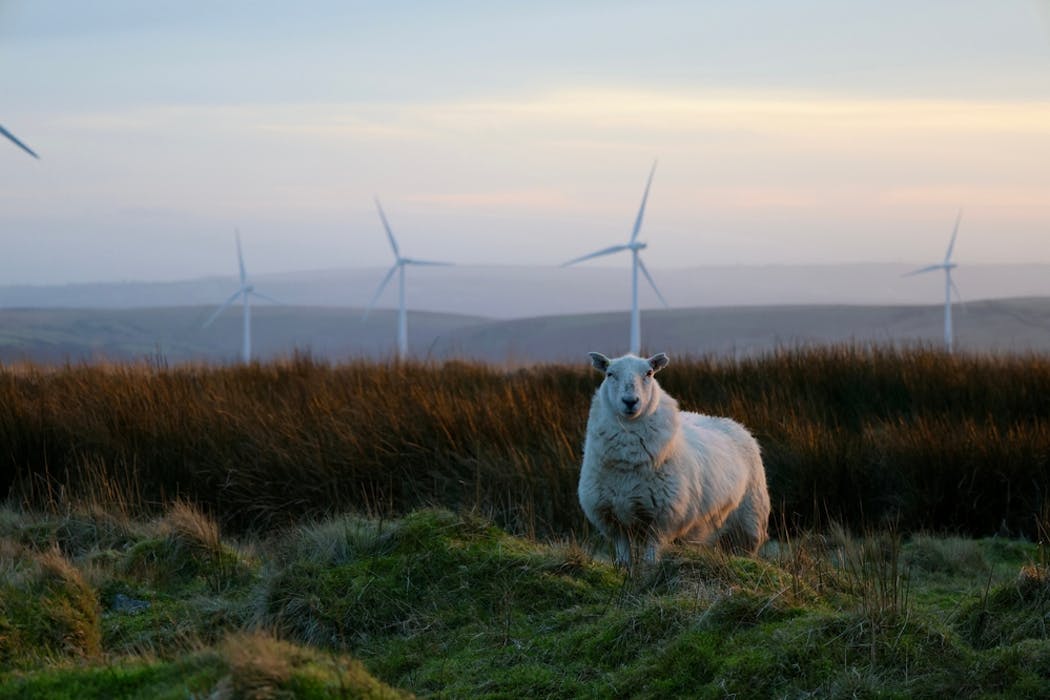
Transitioning away from fossil fuels will benefit nature and human health.
GUNMANPHOTO/Shutterstock

2. Stewarding nature

Looking after the natural world has many health and climate benefits. Greening our cities reduces the urban heat island effect that means large city centres can be up to 10˚C warmer than surrounding countryside. Greening urban areas also helps reduce the risk of flash floods as vegetation soaks up and stores a lot of the heavy rainfall.

More access to nature and healthy environments improves people’s mental health. By managing and enhancing our natural ecosystems, we protect water quality and build resilience from extreme weather. Stewardship of our natural environment reduces exposure to disease, toxic pollutants and contaminants. This results in fewer injuries and deaths from extreme weather and better mental wellbeing.

3. Transforming food systems

There are 2.3 billion people that regularly do not have enough to eat. Food systems that provide affordable access to nutritious and sustainable diets for all means building resilient, low-emission food production and supply chains. It also involves moving away from a meat-based diet.

This will have two major health outcomes. It will lower rates of undernutrition and early mortality. It will also reduce obesity, diabetes and cardiovascular disease. This leads to a healthier, more prosperous population with a more productive workforce.

4. Building resilient infrastructure

Two billion people do not have access to safe drinking water, while 1.5 billion people lack basic sanitation. By 2050, up to 5 billion people could face water shortages due to climate change, increased demand (especially in rapidly expanding cities) and pollution.

Mismanagement of water resources creates huge environmental damage and contributes to greenhouse gas emissions. Governments need to build resilient and safe water infrastructure, reducing exposure to waterborne and respiratory diseases.

Other infrastructure – especially schools and hospitals – requires strengthening with an understanding of the increased pressures arising from climate change.

Improving these critical resources for the most vulnerable citizens, securing an education and health services, improves physical and mental health security. Infrastructure systems can increase local and regional cooling, while offering protection from extreme weather and maintaining education and other essential services.

Developing policy

These all seem perfectly logical things to do – but with so many competing demands on policymakers around the world, how is it possible to provide this essential focus on health and climate together?

The new report suggests using nationally determined contributions (NDCs).

Nationally determined contributions, explained by an expert.

These national documents originated as climate pledges, but in practice, they function as strategic economic roadmaps. NDCs are a public declaration of intent that help align priorities across government and society, creating a focal point for participation, coordination and accountability.

Countries must update their NDCs every five years. Each update is meant to reflect new evidence and lessons learned, and to raise ambition over time so plans don’t stagnate while risks and solutions change.

People support climate action more when they can feel the benefits in their daily life. Using health as a lens helps focus NDCs on outcomes such as cleaner air, safer homes, robust education provision, cooler cities and fewer illnesses and deaths during extreme weather.

These near-term, visible wins can build public backing and bring more ministries on board (not just from environmental departments). This means that climate plans will be more likely to be delivered, because a win for climate change action is always a win for health.

The Conversation

Mark Maslin is Pro-Vice Provost of the UCL Climate Crisis Grand Challenge and the Lead for Climate, Health and Security at the UNU. He was co-director of the London NERC Doctoral Training Partnership and is a member of the Climate Crisis Advisory Group. He is an advisor to Sheep Included Ltd, Lansons, NetZeroNow and has advised the UK Parliament. He has received grant funding from the NERC, EPSRC, ESRC, DFG, Royal Society, DIFD, BEIS, DECC, FCO, Innovate UK, Carbon Trust, UK Space Agency, European Space Agency, Research England, Wellcome Trust, Leverhulme Trust, CIFF, Sprint2020, and British Council. He has received funding from the BBC, Lancet, Laithwaites, Seventh Generation, Channel 4, JLT Re, WWF, Hermes, CAFOD, HP, Royal Institute of Chartered Surveyors, John Templeton Foundation, The Nand & Jeet Khemka Foundation, Quadrature Climate Foundation.

ref. Four ways to tackle health and climate together – and lift millions of people out of poverty – https://theconversation.com/four-ways-to-tackle-health-and-climate-together-and-lift-millions-of-people-out-of-poverty-276696

The story of the first telephone call – nine words that changed the world

Source: The Conversation – UK – By Iwan Rhys Morus, Professor of History, Department of History & Welsh History, Aberystwyth University

“Mr Watson, come here. I want to see you.” Hardly momentous words, but their implications were enormous.

Spoken by Scottish-born Alexander Graham Bell in his Boston laboratory on March 10 1876, they were the first intelligible words to be transmitted electrically through a wire from one place to another. With that, the telephone age began.

Thomas Watson, Bell’s assistant, received that call only in the next room – but Bell’s ambitions ran much further. The 29-year-old professor of vocal physiology at Boston University was sure he had invented a technology that would change history. Now he just needed to convince the rest of the world.

An 1876 sketch by Alexander Graham Bell showing his telephone technology.
Library of Congress

Bell had been working on the design of a “harmonic telegraph”, as he called it, for several years. Originally, it was meant as a way of sending numerous telegraph messages simultaneously down the same cable.

But Bell was not the only one to have the idea. The American electrical engineer Elisha Grey was working along similar lines, and both men submitted patent caveats – a notice of their intention to submit a full application – within an hour of each other on February 14 1876. There followed some frantic communication between Bell in Boston and his agent in Washington DC to make sure the applications did not overlap.

Bell’s patent (US174465A) was finally issued on March 7. Three days later, he made history when he spoke those nine simple words. Grey abandoned his patent caveat, and his future attempts to contest Bell’s patent failed in court.

How Bell’s telephone worked

The key to this new telephone technology was developing a way of turning the acoustic oscillations generated by the human voice into electrical oscillations that could be transmitted through a telegraph cable. (By this time, undersea cables connected Ireland with North America, and England with mainland Europe.)

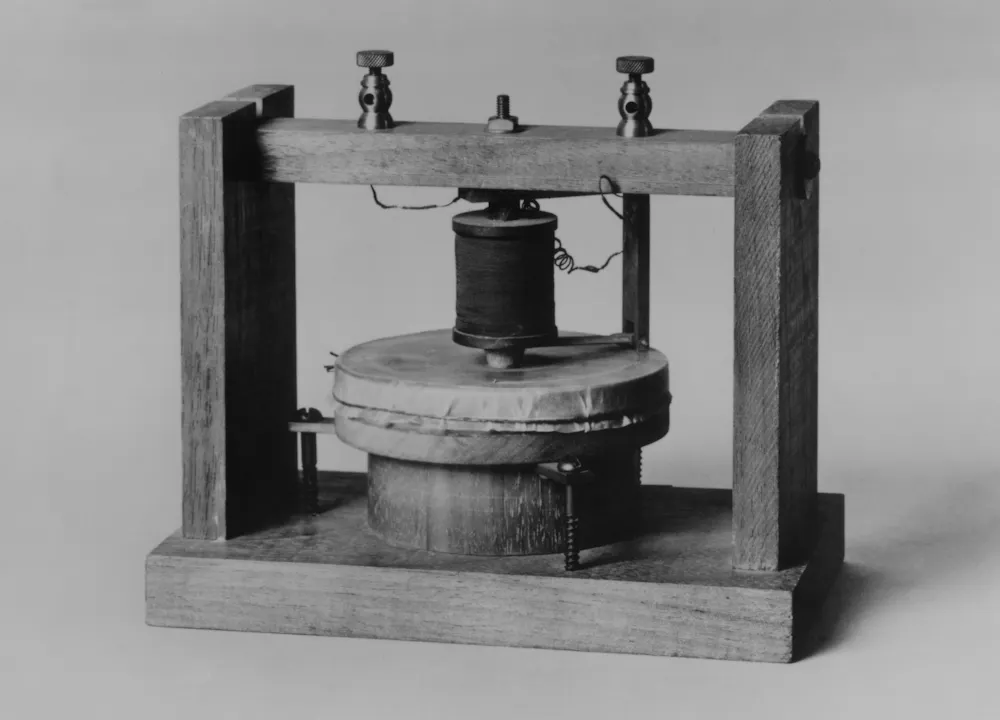
Bell and his assistant Watson had already shown that quite complex sounds such as musical notes could be transmitted electrically. In 1875, they built a transmitter made of parchment stretched tight like a drum, with a piece of magnetised iron attached that could move between the poles of an electromagnet.

Sound caused the parchment to vibrate. This in turn made the piece of iron move back and forth between the electromagnet’s poles, creating an oscillating current which could be turned back into sound with similar apparatus at the other end.

Alexander Graham Bell's telephone design featured a transmitter made of parchment stretched tight like a drum.
Alexander Graham Bell’s telephone design featured a transmitter made of parchment stretched tight like a drum.
Everett Collection/Shutterstock

This was the technology that Bell patented on March 7 1876. But it was not the technology he used in his first demonstration three days later. In fact, his words were transmitted using a liquid transmitter filled with acidified water that conducted electricity.

This device was similar to ones Grey had been using. This fact caused some controversy when it later became known, forming part of Grey’s attempts to contest Bell’s patent. It is still sometimes claimed that Grey, rather than Bell, was the telephone’s true inventor.

Bell did not use the liquid transmitter again in his experiments – it was difficult to see how it could be turned into a commercial instrument. And for the first few months following the demonstration, the telephone seemed to be going precisely nowhere.

Everyone agreed it was a marvellous and ingenious device – but what was it for, exactly? It was no competition to the telegraph. After all, who were you going to call?

Salesman and showman

When Bell’s new device on show at the Centennial Exposition in Philadelphia in 1876, it was largely lost in the crowd of exhibits – although the emperor of Brazil is reported to have exclaimed: “My God, it talks!”

However, two of the judges, eminent scientists Joseph Henry and William Thomson, awarded Bell one of the exhibition’s coveted medals. Irish-born Thomson – the first scientist to be elevated to the British Parliament’s upper house as Lord Kelvin – would later tell scientists back home about “the most wonderful thing in America … the greatest by far of all the marvels of the electric telegraph is due to a young countryman of our own, Mr Graham Bell.”

Bell, meanwhile, was working hard at selling his invention. Like all Victorian inventors, he had to be a showman, too. At a performance in Salem, Massachusetts, in February 1877, he used the telephone to communicate with his assistant Watson far away in Boston.

First they played Morse code down the line in musical notes, and “the audience burst into wild applause”, according to reports. Then a “telephonic organ” in Boston played Auld Lang Syne and Yankee Doodle to the rapt Salem audience.

In London, wires were laid between theatres to enable a “telephonic concert, in which the audience in one house will hear the music played at the other”.

All of this took money, of course, and Bell had the investors to back him – including his soon-to-be father-in-law Gardiner Greene Hubbard, a wealthy American lawyer, financier and the founder of the National Geographic Society. In 1877, they formalised the Bell Patent Association into the joint stock company, the Bell Telephone Company, to develop the commercial possibilities of Bell’s invention.

They were soon manufacturing telephone equipment to Bell’s design, and two years later established the International Bell Telephone Company to market the equipment in Europe. In 1885, this would become the American Telephone and Telegraph Company, better known today as AT&T.

On a more individual level, Bell made a fortune while his rival Grey has largely been relegated to a footnote in the history of electrical technologies.

By the turn of the 20th century, the telephone had found its place as an essential accessory for prosperous middle-class households in the US and Europe, and an important tool for businessmen.

It had also become a vital ingredient in the exciting mix of ideas and inventions that Victorians on both sides of the Atlantic used to imagine their technological future.

This article contains references to a book that has been included for editorial reasons, with links to bookshop.org. If you click on one of these links and go on to buy something from bookshop.org, The Conversation UK may earn a commission.

The Conversation

Iwan Rhys Morus does not work for, consult, own shares in or receive funding from any company or organisation that would benefit from this article, and has disclosed no relevant affiliations beyond their academic appointment. He is the author of How the Victorians Took Us to the Moon (Icon Books).

ref. The story of the first telephone call – nine words that changed the world – https://theconversation.com/the-story-of-the-first-telephone-call-nine-words-that-changed-the-world-277694

A brief cinematic history of Frankenstein’s Bride as a feminist icon

Source: The Conversation – UK – By Polina Zelmanova, PhD Candidate in Film and Television Studies, University of Warwick

Frankenstein’s female creature, also known as “the Bride”, was the first female monster to appear on screen, in the 1935 Frankenstein sequel: The Bride of Frankenstein. An unruly and rebellious figure, she has inspired dozens of adaptations since.

Most recently, the Bride, as a dramatic character, has been part of a series of creative reimaginings through an explicitly feminist lens. For instance, the dark coming of age comedy, Lisa Frankenstein (2024). It imagined the Bride (Kathryn Newton) in the role of the scientist, who accidentally brings to life a young Victorian man (Cole Sprouse).

Released just a year earlier, Poor Things (2023) brought an even more complex exploration of power, agency and consent, set in a retro-futuristic Victorian era. In it, the female creature Bella (Emma Stone) negotiates what it means to be both a scientific object and creator (being created out of the pregnant body of a woman and the brain of the mother’s unborn baby). Bella does not abide by the rules and conventions of polite society, using her body against the purpose of her creator and causing several mental breakdowns for the male characters in the process.

The trailer for The Bride!

Now, a new movie directed by Maggie Gyllenhaal, The Bride!, brings the character to life in moody 1930s Chicago. Jessie Buckley plays the female creature brought back from the dead to be Frankenstein’s mate. But she is not the sort of creature that is inclined to serve someone else’s purpose. When Frankenstein (now the monster, not the scientist, and played by Christian Bale) calls her “the Bride of Frankenstein”, she replies: “No, just the Bride.”

Although the film promises a “Bonnie and Clyde” story – two lovers and rebels on the run from the law – this Bride refuses to belong to any man. Instead, gun in hand, she demands to be seen and heard on her own terms.

Reanimating the Bride from novel to screen

Since her inception, the Bride’s struggle has been for autonomy. She first appeared in Mary Shelley’s novel Frankenstein (1818), named after an egomaniac scientist who creates a creature from cadavers. In the novel, Dr Frankenstein begrudgingly agrees to make his male creature a companion, but destroys her before she can live. He is afraid she might reproduce or become even more powerful than the male creature.

Her destruction is the most violent episode in the novel and makes apparent the anxiety that her unruly female body causes to the mad scientist. The erasure of Shelley’s original female creation set the scene for the way she continues to be written out of most adaptations of the novel. This includes, most recently, Guillermo del Toro’s Frankenstein (2025).


Read more:
Guillermo de Toro’s Frankenstein: beguiling adaptation stays true to heart of Mary Shelley’s story


One hundred years on from Shelley’s novel, the Bride was finally brought to life in James Whales’ The Bride of Frankenstein and played by Elsa Lanchester. Although central to the film’s title, she appears only in the final five minutes. But that was more than enough time to establish her cinematic legacy.

The monster meets his bride in The Bride of Frankenstein (1935).

She stands tall, dressed in a white gown, her dark, voluminous hair streaked with lightning. Scars and stitches run around her face. She is both alive and dead, a bride and child, beautiful and monstrous, futuristic and otherworldly. Her appearance defies categorisation, not quite the demure wife she is meant to be.

Even more memorable is the Bride’s defiant scream when she rejects the male creature and the role assigned to her by the film’s title and her creator. Feminist scholars have read this as an assertion of sexual autonomy and agency, a rejection of patriarchal control and a refusal of the role of wife and mother. She is a powerful symbol of defiance, and both costume and voice become tools for future Brides to say no to their fate. Lanchester’s Bride, however, is not able to invent alternative possibilities for herself and is ultimately destroyed by the male creature, punished for her rebellion.

The limitations of patriarchy are made even clearer in later adaptations in which Brides who choose to end their lives, such as Frankenstein Created Woman (1967). Her limited options also show the constraints of a narrative in which she is made a mere character in someone else’s story.

The creature Lily (Billie Piper) in the television series Penny Dreadful (2014-2016) is another Bride who attempts to make her own path. But the memories of her body’s previous life as a sex worker have shown her that the world is rotten to the core – her only solution is to destroy it. Lily chooses destruction over radical change, and while she rejects both Frankenstein and the male creature, the man she does willingly choose ultimately betrays her.

The trailer for Poor Things.

For some Brides, power comes from reclaiming the role of creator. This can be seen in Lisa Frankenstein and Poor Things, but also in an earlier adaptation – the exploitation comedy Frankenhooker (1990). The film ends with the Bride taking revenge on her creator by attaching his head to female body parts.

Poor Things is one of the only films where the Bride is not only invested in radical social change, but also escapes the expectations put onto her body as a scientific and sexual object. Bella actively subverts these expectations by repurposing her body as one of personal scientific enquiry. This extends to the way she uses sex. It puts her in a complicated position in relation to exploitation and empowerment, where she is simultaneously both and neither. Instead, her actions sit somewhere on the outside of our current perceptions of both.

As Jessie Buckley’s new Bride graces our screens, she promises to follow in the footsteps of her rebellious predecessors – and a long horror tradition.

This article features references to books that have been included for editorial reasons, and may contain links to bookshop.org. If you click on one of the links and go on to buy something from bookshop.org The Conversation UK may earn a commission.

The Conversation

Polina Zelmanova receives funding from the Arts and Humanities Research Council to support the research undertaken as part of her PhD..

ref. A brief cinematic history of Frankenstein’s Bride as a feminist icon – https://theconversation.com/a-brief-cinematic-history-of-frankensteins-bride-as-a-feminist-icon-277294

How AI could unlock deep-sea secrets of marine life

Source: The Conversation – UK – By Kerry Howell, Professor of Deep Sea Ecology, Plymouth Marine Laboratory

Wirestock Creators/Shutterstock

Somewhere in the North Atlantic, more than a kilometre beneath its surface, a cold-water coral reef stretches across an unnamed seamount. Despite never appearing on a chart, this underwater forest has existed for centuries, growing a centimetre or two each year.

The reef is a home and feeding ground for dozens of species that depend on it the way a woodland creature depends on trees. It has survived ice ages – but whether it will survive increasing pressures from industrial fishing, deep-sea mining and climate change is, in part, a question about data. If we don’t know it exists, how can we protect it?

A new project called Deep Vision could fundamentally transform our understanding of the deep ocean by digging into pictures and videos sat largely unexamined in research archives around the world. By using AI, thousands of hours of seafloor footage can be analysed to produce the first comprehensive maps of vulnerable marine ecosystems across the entire Atlantic basin.

Over the past two decades, robotic and autonomous underwater vehicles have collected vast quantities of footage from the deep sea. This represents an extraordinary resource – a record of ecosystems that most humans will never see.

The difficulty is that less than half of this imagery has ever been analysed. A single dive can take a trained human analyst two months to process. Multiply that by thousands of dives and you begin to appreciate why this treasure trove of information has remained largely locked away.

The solution, I am convinced, is artificial intelligence.

dark seabed, torch lighting up
AI could fundamentally change how quickly discoveries about the deep sea are made.
Yetugraphic/Shutterstock

In research published in 2022, my colleagues and I showed that AI could be trained to successfully analyse over 58,000 deep-sea images in under ten days. The AI model helped us map the distribution of a fragile xenophyophore – a giant single-celled organism that is a recognised indicator of vulnerable marine ecosystems – at a depth of 1,200 metres in the north-east Atlantic. What would have taken a human analyst many months was accomplished in days.

AI also provides consistency. Human analysts, however expert, do not always agree with one another. Indeed, they do not always agree with themselves: a researcher identifying marine species may classify specimens differently at different times. A machine makes errors but it makes them consistently, which means these errors can be identified, corrected and accounted for.

Forests of the deep

Deep Vision is focusing specifically on what we call vulnerable marine ecosystem indicator taxa, such as deep-sea corals and sponges.

These are the organisms I think of as the forests of the deep. In an environment where there are no plants to provide habitats, these animals fulfil this role. They are keystone organisms in the most literal sense: remove them and the ecosystem collapses.

Once AI has extracted biodiversity observations from the imagery, the next stage is to build habitat-suitability models – predictive maps that extend our understanding beyond the specific locations where cameras have surveyed.

Our research shows that high-resolution habitat suitability models are a useful tool in spatial management, capable of informing decisions about where marine-protected areas should be located. However, the quality of the underlying seafloor data remains critical to how well they perform.

As a marine biologist, I sometimes get asked why people should care about a sponge living two kilometres beneath the surface of the Atlantic. It is a fair question, and the answer is more immediate than most people expect. These animals recycle essential nutrients and play a key role in the carbon cycle, and that effects us all.

The ocean is the engine room of a planetary life-support system, and effective management of it relies on having the best possible understanding of the species and ecosystems within it.

If this project succeeds in the Atlantic, the methods could be replicated in other ocean basins. The Pacific, the Indian Ocean and the Southern Ocean all present the same challenges of insufficient data and vast unexplored territory.

The Conversation

Kerry Howell receives funding from the Bezos Earth Fund’s AI for Climate and Nature Grand Challenge.

ref. How AI could unlock deep-sea secrets of marine life – https://theconversation.com/how-ai-could-unlock-deep-sea-secrets-of-marine-life-276717

Plaid Cymru plans to share wind farm profits with local people – here’s how that idea has been tried elsewhere

Source: The Conversation – UK – By Udisha Saklani, Lecturer, King’s College London

Ellie Ford/Shutterstock

When wind turbines rise above a Welsh hillside, who should benefit financially? Plaid Cymru’s Rhun ap Iorwerth believes it should be local communities.

In a recent speech, the leader of the party that is currently heading the polls for the upcoming Welsh election said he would require renewable energy projects over 10 megawatts to offer communities 15%-to-25% ownership stakes, or other benefits.

Ap Iorwerth also said if his party won the upcoming election, they would create a national energy body to develop renewables at scale, with the aim of keeping more profits in Wales and advancing a “just green transition”.

The proposal responds to a familiar grievance: that Welsh natural resources generate wealth which leaves the region, while local communities live with the infrastructure and gain little in return.

Yet the details of how this would work remain unclear. Who buys the shares? Who can afford them? And how do financial returns translate into wider community benefit?

There are lessons for Plaid from how similar initiative work elsewhere. Several countries already use financial participation schemes that allow communities to invest in local renewable energy projects. In Denmark, for instance, developers must offer at least 20% ownership of new wind projects to nearby residents.

Nepal has adopted a related model for hydropower projects. People living in nearby areas are typically offered shares in a new project. Like any equity investment, these shares can generate dividends once the power plant becomes operational and profitable. In practice, payouts often arrive several years after construction begins and returns vary widely across projects.

In my recent research on the huge Arun III hydropower project in Nepal, I explored how opening up shares to local people contributed to shifting local debates around a once highly contested scheme.

From protest to negotiation

The project to build a 70m high, 466m wide concrete gravity dam across the Arun river stalled in the 1990s after intense opposition to what critics saw as externally imposed, foreign-led development. Decades later, developers offered around 1.6 billion Nepalese rupees (£9 million) in shares to local communities.

Based on interviews with civil servants, project developers and residents, I found this changed the political conversation. Opposition did not disappear, but debates shifted from outright rejection to negotiation over how water, land and energy should generate long-term local benefit.

Shareholding changed how communities engaged with the project. Residents invoked their status as shareholders when seeking roads, schools and improved compensation. Ownership did not eliminate disputes, but it shifted expectations about accountability.

Opposition to wind farms could be overcome by shareholding.

Wales faces lower stakes. Resistance to onshore renewables often centres on fairness and profits not being shared. Community ownership can help address this – if it is meaningful rather than symbolic.

The percentage is less important than the design, according to my research. Nepal mandates around 8%-to-10% local shareholding in large hydropower projects, and the policy has proven immensely popular. Across 17 listed schemes, it raised more than US$10 million (£7.4 million) and was oversubscribed many times over.

Yet strong demand masked deeper inequalities. In 2019, a review by the International Finance Corporation, a global development institution that is part of the World Bank Group, found some households borrowed at interest rates of 18%-to-20% from microfinance institutions (and even higher from informal lenders), or sold livestock and jewellery to buy shares.

Dividends typically arrived three-to-five years after construction began. So, share ownership came down to who could afford to participate and wait for dividends.

For Wales, the key question is how participation is structured. Will shares be affordable? Will returns flow to individuals, collective funds or both? Will vulnerable households be protected from financial risk?

Wales starts from a stronger position than Nepal did. Nearly 60 community energy groups already operate successfully through the not-for-profit Community Energy Wales, with elected boards, annual general meetings and transparent reporting as standard practice. Platforms such as Ethex, an ethical investment platform that lists share offers, allow relatively low-cost entry.

Plaid’s proposal would extend these principles beyond small, voluntary schemes into commercially developed renewable energy projects, embedding community ownership within more formal policy.

Ownership changes expectations

The most important lesson from Nepal is not that local shareholding gives communities control over infrastructure projects – it usually does not. Rather, it can reshape expectations about how communities relate to these projects.

In interviews for my research on Arun III, residents described how share offers changed the tone of the debate. Some referred to their status as shareholders when raising concerns about project benefits, timelines or local infrastructure.

Individual holdings were small and did not confer formal decision-making power. But they changed how residents justified requests for local benefits and accountability.

Debate over renewable energy projects often peaks during the planning stage, when communities can object before decisions are finalised. Once approval is granted, local influence typically narrows to compensation or community benefit arrangements.

Financial participation schemes aim to extend engagement by linking communities to a project’s economic outcomes. Research shows that public acceptance of renewable energy projects depends strongly on how they are designed – and in particular, whether communities have influence over decisions and share in the financial benefits.

But expectations must be managed, and local trust is important. In Nepal, dividend payments were often delayed for several years. Early enthusiasm faded when returns did not materialise as expected. Ownership works only when expectations are realistic and governance is clear.

Why look to Nepal from Wales?

These projects differ in scale, governance and impact. Yet all involve resource-rich regions grappling with energy security, economic transition and questions of distributive justice.

Infrastructure projects are rarely simply accepted or rejected. In practice, they are worked through and contested over time. Community ownership can move debates beyond simple for-or-against positions – but only when schemes are carefully designed and inclusive.

The challenge for Plaid is not only to set a bold ownership plan, but to define how it will work. If done well, community ownership could anchor renewable expansion in local belief and acceptance. If done poorly, it risks undermining public trust.

The Conversation

Udisha Saklani received funding from the UK Research and Innovation Economic and Social Research Council (ESRC) under grant number ES/P011373/1, as part of the Global Challenges Research Fund. She also acknowledges support from the Margaret Anstee Studentship awarded by Newnham College, University of Cambridge.

ref. Plaid Cymru plans to share wind farm profits with local people – here’s how that idea has been tried elsewhere – https://theconversation.com/plaid-cymru-plans-to-share-wind-farm-profits-with-local-people-heres-how-that-idea-has-been-tried-elsewhere-277546

Most Saharan dust is generated by ‘hidden thunderstorms’ high above the desert

Source: The Conversation – UK – By Richard Washington, Professor of Climate Science, University of Oxford

muratart / shutterstock

When Saharan dust reaches the UK and Europe, as a huge country-sized cloud did over the past few days, it can transform the sky. Tiny particles drifting in the atmosphere scatter blue light while allowing reds and oranges to reach us intact, producing beautiful sunsets.

But these striking displays are also a reminder of how connected the Earth is. Dust drifting over my head in England may have rested on the dry surface of the Sahara for thousands of years, before a burst of wind lifted it into the atmosphere and carried it thousands of kilometres north.

In spring, the massive temperature difference between the already-hot Sahara and still-snow-covered mountains in Europe can generate powerful low-pressure systems that sweep dust northwards.

But these familiar weather systems are not actually responsible for most Saharan dust. Instead, much of it is produced by a special kind of desert thunderstorm – a process that climate models struggle to simulate.

When faced with the question of how dust outbreaks will change as the climate warms, simulations from the latest generation of climate models suggest Saharan dust emissions could increase by up to 13% by the end of the century. If winds blow in the right direction, that could mean more dust reaching Europe.

However, the real story of how Saharan dust is generated is more complicated – and much more interesting.

Hunting the world’s biggest dust source

Some 20 years ago, colleagues and I travelled to one of the most remote places in the Sahara: the Bodélé Depression in Chad. A satellite that was intended to measure ozone also, by accident, seemed capable of measuring dust – and suggested this basin might be the world’s single biggest source of airborne dust.

At that time, there were no direct meteorological measurements – so we installed instruments across the desert to measure winds and atmospheric conditions. We discovered an astonishing wind concentrated between the Tibesti and Ennedi mountains, which we called the Bodélé low-level jet.

Near the Earth’s surface, the wind there regularly exceeded 16 metres per second – a “moderate gale” in the Beaufort wind scale, easily strong enough to lift vast quantities of fine sediment into the atmosphere.

These winds explain why Bodélé is such a big dust source. There are many such low-level jets across the Sahara, but none as grand as this one.

Nowadays, climate models can simulate these jets. While they typically underestimate their strength, these are tolerable errors – the model at least simulates the mechanism that makes the dust.

However, in the early 2010s, when we turned our attention to summer dust storms elsewhere in the Sahara, the story became far more surprising.

The hidden storms that raise most Saharan dust

During summer, the largest sources of dust shift westwards to countries like Algeria, Mali, Niger and Mauritania. To understand what drives these emissions, we deployed around 30 tonnes of meteorological equipment across the region, with the assistance of the Algerian meteorological service.

This produced some enthralling results – most notably: around 80% of Saharan dust emissions in summer are produced by thunderstorms.

These are special thunderstorms. Because the Saharan air is so dry, clouds often sit more than five kilometres above the surface. Rain falling from these storms usually evaporates long before it reaches the ground.

The evaporation cools the surrounding air, which becomes dense and plunges downwards, spreading out rapidly when it hits the surface. As it spreads across the desert floor, this wall of wind scrapes up huge quantities of dust.

Diagram of Saharan dust-generating thunderstorms
These so-called ‘cold pool outflows’ are tricky to simulate in climate models.
Richard Washington

Using satellites, we tracked more than 1,500 of these events. Many travel hundreds of kilometres across the desert, mostly at night, raising huge plumes of dust. In fact, these “dry thunderstorms” appear to be responsible for the vast majority of Saharan dust produced during summer.

The modelling problem

This discovery creates a problem for climate predictions.

The global climate models used to estimate future dust levels are very powerful. But they do not zoom in enough to simulate individual thunderstorms, or the pools of cold air they produce. In other words, the models that suggest Saharan dust emissions could increase by 13% do not simulate the processes that are responsible for most Saharan dust in the first place.

Instead, they are typically tuned to match dust concentrations measured by sparse monitoring networks far from the sources of the dust. This means we cannot rely on these particular tools.

There is hope, though. A new generation of very high resolution “convection-permitting” climate models do simulate thunderstorms and will, given time, provide us with better estimates of the future.

Climate change could also influence the storms themselves. A warming Mediterranean may pull the West African Monsoon further north into the Sahara, for instance, potentially creating more favourable conditions for dust-producing thunderstorms.

Exactly how this will play out remains an open question. For now, Saharan sunsets in Europe are a reminder that the atmosphere around us is linked to distant deserts – and that some of the most important processes linking the two are still being uncovered.

The Conversation

Richard Washington receives funding from NERC and FCDO.

ref. Most Saharan dust is generated by ‘hidden thunderstorms’ high above the desert – https://theconversation.com/most-saharan-dust-is-generated-by-hidden-thunderstorms-high-above-the-desert-277778

Why you can remember every word of a song from 25 years ago – but not why you walked into the room

Source: The Conversation – UK – By Michelle Spear, Professor of Anatomy, University of Bristol

New Africa/Shutterstock.com

While driving recently, a long-forgotten song came on the radio. I found myself singing along; not only did I know all the lyrics to a song I hadn’t heard in 25 years or more, but I also managed to rap along. How is it that I could give this rendition, but often cannot remember what I came into the room for?

It is tempting to treat these moments as evidence of cognitive decline. A quiet, creeping sense that something is slipping. But the contrast between flawlessly (it was) performing a decades-old song and forgetting a just-formed intention is not a sign that memory is failing. It is a demonstration of how memory works.

We tend to talk about “memory” as if it were a single thing. It isn’t.

Remembering song lyrics relies on long-term memory – networks distributed across the brain that store information consolidated over years. These include language areas in the temporal lobes, auditory cortex, motor regions involved in speech production, and emotional circuits of the brain that help tag experiences as meaningful.

Music is neurologically extravagant: it recruits multiple systems at once – rhythm, language, movement and emotion. That multiplicity strengthens encoding.

Each time you repeated those lyrics – in your bedroom, in a car, at a party – you reinforced the synaptic connections involved. Over time, the pathway becomes efficient and stable. Retrieval becomes almost automatic.

By contrast, remembering why you walked into the kitchen relies on working memory – the brain’s temporary holding space. Working memory is fragile. It can hold only a small amount of information for a short period, and it is highly sensitive to distraction. A single competing thought is enough to overwrite it.

Psychologists have described what is sometimes called the “doorway effect”. When you move from one physical space to another, the brain updates context. It segments experience into discrete episodes.

The intention formed in the previous room – “get my glasses”, “find my charger” – was encoded in that earlier context. Crossing a threshold can weaken the retrieval cue. The task disappears.

This isn’t inefficiency, it’s organisational strategy. Our brains evolved to structure experience into meaningful chunks. That segmentation supports long-term memory formation – even if it occasionally leaves us standing in the hallway, perplexed.

The doorway effect.

Why music survives

Music benefits from structure. Rhyme and rhythm create predictable patterns. Predictability supports recall because the brain is constantly anticipating what comes next.

Brain imaging studies show that musical memory activates widespread cortical and subcortical regions. Strikingly, even in neurodegenerative conditions such as Alzheimer’s disease, musical memory can remain relatively preserved long after other forms of recall deteriorate.

The fact that you can still deliver a flawless rap verse decades later tells us something important: memory strength is less about age and more about depth of encoding. A lyric repeated hundreds of times in adolescence may be neurologically “stronger” than a single fleeting intention formed five seconds ago.

Processing speed does tend to slow modestly with age. Working memory becomes more vulnerable to interference. Multitasking grows harder. But long-term knowledge – vocabulary, expertise, well-rehearsed information – is often maintained or even enhanced.

What feels like memory loss is frequently attentional overload. Modern environments are saturated with interruptions: notifications, internal thoughts, competing demands. Working memory was never designed to withstand this level of interference.

How to reduce ‘roomnesia’

The issue is not that your brain can no longer store information, it’s that it is selective about what it stabilises. Small adjustments can reduce those frustrating “roomnesia” moments.

One of the simplest is to say the task out loud before you move. Verbalising an intention – “I’m going upstairs to get my charger” – strengthens its encoding by engaging additional language networks.

Another approach is brief visualisation. Taking a second to picture the object you are about to retrieve creates a richer mental trace than a vague intention alone.

Even carrying a physical cue can help: picking up an empty mug before heading to the kitchen anchors the purpose of the journey in something tangible. These strategies work because they reinforce the intention before a change in context disrupts it, making the memory less vulnerable to interference.

If you can still perform a 1990s rap in full but occasionally forget why you walked upstairs, your brain is not betraying you. It is prioritising deeply rehearsed, emotionally tagged information over transient intentions. In other words, it is doing exactly what it was built to do.

The Conversation

Michelle Spear does not work for, consult, own shares in or receive funding from any company or organisation that would benefit from this article, and has disclosed no relevant affiliations beyond their academic appointment.

ref. Why you can remember every word of a song from 25 years ago – but not why you walked into the room – https://theconversation.com/why-you-can-remember-every-word-of-a-song-from-25-years-ago-but-not-why-you-walked-into-the-room-277330

Shabana Mahmood is wrong: refugee status was never ‘permanent from day one’

Source: The Conversation – UK – By Georgia Cole, Senior Lecturer, University of Edinburgh

The UK’s asylum system is being overhauled. The home secretary, Shabana Mahmood, has laid out a series of reforms that will affect refugees seeking safety in Britain. Mahmood argues that these changes – which include removing financial and housing support for asylum seekers who break the law, and offering incentive payments for asylum seekers whose claims have been rejected to return home – will remove “incentives” drawing people to Britain. She says they are necessary as part of a “firm but fair approach” to asylum.

One of the headline announcements is to make refugee status temporary, subject to review every 30 months. “Those whose country has now become safe, and therefore no longer require protection, will be expected to return home,” according to the home secretary.

Under the current rules, asylum seekers who have been granted refugee status are permitted to stay for five years, after which they can apply for indefinite leave to remain in the UK. Mahmood claims that “this means refugee status is, in effect, permanent from day one”.

But this is not true. Refugee status was always intended to be temporary. Most refugees have never wanted to be refugees forever, and states have never been expected to host them indefinitely.

Since the creation of the UN refugee convention, states have had the right to end refugee status. The convention itself, as the home secretary even noted, says that its protections no longer apply if “the circumstances in [connection] with which [someone] has been recognised as a refugee have ceased to exist”.

If someone is no longer in need of international protection, they must either return to their country of origin or find another legal way to stay where they are. The UN refugee agency has always been clear though that the onus of proving this falls on states. Refugees should neither be required to continuously justify their right to international protection nor “be subject to constant review in the light of temporary changes” in the country that they came from. This puts the UK government’s position at odds with a key principle designed to protect refugees, by requiring them to apply for further permission to stay.


Read more:
What Labour’s migration reforms mean for LGBTQ+ asylum seekers


Technically, the UK government already had the right to remove refugee status and, if individuals had no other legal claim to stay in the UK, send people back to countries it deemed “safe”. For several reasons, however, this has been difficult to implement in practice.

To end a person’s refugee status, states must prove that a refugee is no longer at risk of persecution, and that if they must return to their country of origin, they will not face a threat to their life and fundamental liberties. States must hence demonstrate that there has been a “fundamental, stable and durable” change in the country of origin. This should be related to the specific reason for the refugee’s asylum claim.

Looking at major recent refugee-producing countries, such as Syria, Ukraine and Afghanistan, conflict and violence still rage. It seems implausible that any government would be able to prove that significant numbers of citizens from these countries no longer have valid claims to protection.

Denmark – the country whose asylum system has inspired Mahmood – has been attempting to reject Syrians’ applications to renew their refugee status, on the grounds that parts of Syria are safe for them to return to. These efforts have been criticised by international groups including the UN refugee agency, and are so far only applicable to a small number of people.

A border force boat carrying people thought to be refugees arrives at a dock in Dover
The home secretary says changes to the asylum system will remove the ‘incentives’ that draw people to seek safety in the UK.
Sean Aidan Calderbank/Shutterstock

Determining safety

Refugees can become pawns in domestic and international politics, regardless of their ongoing need for protection.

Who, for example, gets to decide what is an acceptable standard of human rights? Or whether a change is actually “fundamental, stable and durable”? Countries of asylum have pushed to end refugees’ statuses to reduce their responsibilities to host them. This appears to be Mahmood’s plan.

Countries of origin can also manipulate this process. They have pushed for refugees to be returned to them, in order to silence legitimate political opposition in exile, and in the hope of restoring their images as peaceful countries. This happened during the protracted application of the cessation clause to Rwandan refugees, leaving many in a vulnerable position.

Practically too, in stating that the status of refugees will be reviewed every 30 months, Mahmood is introducing another costly and time-intensive bureaucratic process when the asylum system is already chronically backlogged. The government has already trialled using artificial intelligence in asylum decision making, so it’s possible that this is on the horizon here. But this comes with its own risks to due process, fairness and privacy.

I would argue that the government is dressing up a legal option that they have always had as a “new policy”, while downplaying the safeguards that have prevented them from turning this option into reality.

It is unlikely that this reform will make the asylum process either more efficient or humane, or that it was ever intended to do so. Mahmood insists that it will make the system “fair … to those seeking a new and better future in this country” – but requiring refugees to relive and defend their trauma every two and a half years will only heighten the suspicious, hostile and punitive nature of the asylum system.

The Conversation

Georgia Cole does not work for, consult, own shares in or receive funding from any company or organisation that would benefit from this article, and has disclosed no relevant affiliations beyond their academic appointment.

ref. Shabana Mahmood is wrong: refugee status was never ‘permanent from day one’ – https://theconversation.com/shabana-mahmood-is-wrong-refugee-status-was-never-permanent-from-day-one-277662

How do we know what asteroids are made out of?

Source: The Conversation – UK – By Ben Rider-Stokes, Post Doctoral Researcher in Achondrite Meteorites, The Open University

Asteroids are some of the oldest objects in the Solar System: leftovers from the chaotic time when planets were assembling from dust and rock. They’re time capsules, preserving clues about what the early Solar System was like, and, ultimately, what the building blocks of planets are.

Knowing what an asteroid is made of also matters for very practical reasons. If an asteroid were ever on a collision course with Earth, its composition would affect how dangerous it is, how it breaks up in the atmosphere, and how we might successfully nudge it away. This area of research is called planetary defence.

Understanding the make-up of asteroids also matters for the future of exploration: some asteroids may contain metals, minerals, and even water – potentially useful resources. But how can we tell what asteroids are made of when most of them are millions of kilometres away?

Asteroid ‘fingerprints’

One of the most powerful techniques is spectroscopy, the science of splitting light into components and measuring what wavelengths are absorbed or reflected. Minerals interact with light in characteristic ways, leaving subtle dips and slopes in a spectrum. In effect, an asteroid’s surface leaves behind a chemical fingerprint in sunlight.

These fingerprints let us place asteroids into broad families. One of the most common groups near Earth is the S-complex, a class of relatively reflective asteroids often associated with silicate minerals such as olivine and pyroxene. For decades, researchers suspected that S-complex asteroids were linked to a particular category of meteorites that frequently fall to Earth: the ordinary chondrites.

A phenomenal example of how well this can work came from Japan’s sample-return mission Hayabusa, which visited the near-Earth asteroid (25143) Itokawa. Hayabusa reached the asteroid in September 2005. From its reflected light, Itokawa was inferred to be an S-complex asteroid, and spectroscopic comparisons suggested it should resemble ordinary chondrites, particularly the LL subgroup.

Hayabusa returned tiny grains of asteroid regolith to Earth, and laboratory analyses showed the mineralogy and mineral chemistry were identical to LL chondrites. In other words, the remote spectral prediction matched the physical reality of the samples.

Dart
Artist’s concept: The Dart mission collided with, and moved, the asteroid Dimorphos.
Nasa

Then Dart arrived — and raised the stakes. In September 2022, Nasa deliberately slammed a spacecraft into the small moonlet Dimorphos, which orbits the larger asteroid Didymos, in the Dart (Double Asteroid Redirection Test) mission.

The goal wasn’t to destroy the asteroid; it was to test whether a kinetic impact could measurably change its orbit. Didymos has been observed extensively with spectroscopy and is classified as an S-complex and inferred to have a LL chondrite composition.

But is there a possibility we could we be misreading the make up of some space rocks? A 2026 paper argues that another meteorite group, brachinites, can show spectral properties that overlap with S-complex asteroids. One sample (NWA 14635) even shows spectroscopic band parameters similar to Didymos.

This is a big deal, because it means there may not be a neat one-to-one mapping between asteroid types and meteorite types. Asteroids are the left over building blocks of planets in our Solar System, often termed “space rocks”. Meteorites are space rocks that have survived the journey through a planet’s atmosphere, reaching the surface.

For planetary defence, this distinction matters. A chondritic “rubble pile”, composed of loosely bound rocks, and a more strongly processed, coherent igneous body (which would cover the brachinites) might respond differently when hit.

An ordinary chondrite-like surface might absorb energy like a “cosmic beanbag”, while a more magmatic surface might behave more like brittle rock. If we want to predict what happens when we try to deflect an asteroid, we need to know what its surface resembles.

This is exactly why the European Space Agency’s Hera mission is so exciting. Hera isn’t repeating Dart; it’s doing the follow-up crime scene investigation. Hera launched in October 2024 and is now on its way to the Didymos system, with arrival planned for late 2026. Once there, it will map both asteroids in detail.

Hera also comes with two small satellites known as cubesats: Juventas and Milani. Milani will help study the surface composition. This will give insights into not just what Dimorphos looks like from a distance, but what it’s made of, how it’s structured, and how it responded to Dart’s impact.

In the context of the new brachinite result, Hera’s role becomes even more important. If Didymos and Dimorphos turn out to be less “ordinary chondrite-like” than we assumed, or if their surfaces disguise a more complex origin, Hera is the mission that can test that assumption directly. It’s a reminder that asteroids still have the power to surprise us.

The Conversation

Ben Rider-Stokes does not work for, consult, own shares in or receive funding from any company or organisation that would benefit from this article, and has disclosed no relevant affiliations beyond their academic appointment.

ref. How do we know what asteroids are made out of? – https://theconversation.com/how-do-we-know-what-asteroids-are-made-out-of-275244

What Keir Starmer can learn from ‘little creep’ Harold Wilson in dealing with an angry US president

Source: The Conversation – UK – By Benjamin Quail, Lecturer in US Cultural and Social History, Queen’s University Belfast

Starmer speaks to French president Emmanuel Macron and German chancellor Fredrich Merz about the situation in the Middle East. Number 10/Flickr, CC BY

The Anglo-American “special relationship” has hit a low ebb following American strikes on Iran. US president Donald Trump disparaged British prime minister Keir Starmer with a negative comparison to Winston Churchill, making clear his “disappointment” over British reticence to offer logistical support to the American military.

This is the latest in a series of comments Trump has made about Starmer’s authority on foreign policy concerns – particularly the British return of Diego Garcia to Mauritius.

For his part, Starmer has publicly broken from the president on the matter of Greenland, offering “strong support” to Denmark in response to US threats to take over the territory. In January, when Trump disparaged British troops in Iraq and Afghanistan, Starmer called the remarks “appalling.”. Despite Trump’s attempts on Truth Social to smooth the matter over following a “stern” call from Starmer, one controversial exchange has bled into the next. Trump is understood to be very unhappy that the UK won’t join strikes on Iran. Starmer has stood by his decision and insists it is his duty to decide what action is in “Britain’s national interest,”.

This breakdown in relations between the two heads of state is remarkable – but it is not unprecedented. Britain’s refusal to follow America into a foreign conflict has inflamed tensions before. President Lyndon B Johnson and prime minister Harold Wilson endured a breakdown in the 1960s over Vietnam. The way Wilson handled this situation should be Starmer’s guiding light has he charts his own course on Iran.

Vietnam

The UK did not publicly participate in the Vietnam war. At the time it was searching for a way to join the European single market against French wishes and extricate itself from its military bases in the Arabian Peninsula and Southeast Asia. Wilson was seeking to move away from costly military commitments abroad.

Publicly, Wilson pushed for an end to the war, meeting with the Soviet Union’s Alexei Kosygin to try and move negotiations forward. He backed Johnson when the US agreed to what Wilson called “unconditional negotiations” with North Vietnam in 1966. Behind closed doors, Wilson reiterated his private support for Johnson regularly. He also met with the president to justify British reticence to join the war on several occasions, using trips to Washington as a way of trying to bolster the public image of a strong affiliation.

Lyndon B. Johnson with Harold Wilson in a garden at the White House.
No love lost: Lyndon B. Johnson with Harold Wilson at the White House in 1967.
Library of Congress

However, the Wilson and Johnson governments clashed over a number of concerns. Johnson faced criticism in Britain for failing to attend the funeral of Winston Churchill in 1965. LBJ was allegedly so infuriated by the lack of British troop commitment to the war that he called Wilson a “little creep” behind closed doors. The Americans also lamented the weakness of the British pound, as Wilson had it devalued by 14.3% in 1967. This threatened the stability of the US dollar and other western currencies.

The White House began to see Britain as a much less valuable – or stable – ally in the ongoing cold war. The British in return felt pushed to acquiesce to American pressure, while also relying on American support on issues such as Rhodesia, which unilaterally declared independence from the UK in 1965.

With this change in attitude, Johnson turned to other allies for public support. The then Australian prime minister, Harold Holt, went “all the way with LBJ,” joining other Pacific allies in sending troops to fight alongside Americans. Johnson lavished support on them, granting Australia its first state visit by a sitting US president in late 1966.

Conversely, he never visited Britain once. Johnson’s antipathy towards the UK is perhaps best summed up by an act of political disrespect towards Wilson in 1965, when he had the White House band play “Plenty of Nuttin’” at a diplomatic dinner following economic talks – a sarcastic rejoinder for Wilson’s lack of what he deemed proper support.

A third way

Ultimately, the “special relationship” cooled significantly during the Johnson-Wilson era. But despite the sometimes-wretched relations between the two leaders, the connection between the two countries in terms of intelligence sharing, training and support on other matters remained intact. Wilson saw the value of American support, travelling to the United States several times during the 1960s despite criticism from anti-war campaigners and from some in parliament. Wilson’s conciliatory approach is mirrored by Starmer’s attempts to carve a third way over the first year of Trump’s government. Starmer was heavily criticised for inviting Trump to carry out a second state visit – the first US president to receive a return invite.

The situation has changed since then, and the Iran strikes have indeed put pressure on the US-UK relationship. But there is precedent for resistance to American pressure in the Wilson-Johnson relationship. The effects were stark – it was not until Margaret Thatcher and Ronald Reagan were in charge that the relationship truly felt “special” once again – but it endured and thrived again despite what had been a severe clash in personalities.

Trump’s climbdown over the criticisms he made of Nato troops in January shows that the United States still values its British ally to some extent. The prime minister should remember that the relationship will endure long after the current occupants of both the White House and 10 Downing Street leave their respective offices.

The Conversation

Benjamin Quail has received funding from the US-UK Fulbright Commission.

ref. What Keir Starmer can learn from ‘little creep’ Harold Wilson in dealing with an angry US president – https://theconversation.com/what-keir-starmer-can-learn-from-little-creep-harold-wilson-in-dealing-with-an-angry-us-president-277695