How commercial sand dredging is reshaping the largest lake in the UK – new study

Source: The Conversation – UK – By Neil Reid, Reader (Associate Professor) in Conservation Biology, Queen’s University Belfast

Algal blooms on Lough Neagh have harmful effects on wildlife and water quality. Studio 70SN/Shutterstock

At Lough Neagh in Northern Ireland, sand has been dredged commercially for decades. Large vessels remove sand from the lakebed and transport it to the shore. Because this happens underwater, the scale of the activity is largely invisible. Regulation has focused on where dredging is allowed and how much sand is removed.

Sand is used by the construction industry to make concrete. Demand for sand as a raw material is rising globally. Much of it taken from rivers, coasts and lakes.

But my team’s new research shows that this sand dredging is not just disturbing specific parts of the lakebed. That disruption is much more widespread and may be affecting the entire ecosystem.

Lough Neagh, the largest lake in the UK, supplies drinking water to 41% of the population of Northern Ireland and supports fisheries, wildlife and local livelihoods. Yet it is now at the centre of an environmental crisis. Toxic blue-green algal blooms caused by an overgrowth of the cyanobacteria Microcystis aeruginosa clog up the entire ecosystem.

Lough Neagh has experienced severe blue-green algal blooms each year since 2023, which can damage both environmental and public health. These blooms are mainly driven by nutrient pollution, warming waters and invasive species. Cumulative release of phosphorus and sustained sediment disturbance by dredging probably frees up nutrients in the system that could contribute to thresholds necessary for algal blooms to occur.

The current management by the Lough Neagh Action Plan focuses on reducing nutrient pollution and doesn’t yet consider sand dredging as a contributing factor.

To understand what is happening below the surface, my team worked with researchers at Newcastle University using sonar mapping to examine parts of the lakebed. Our findings revealed major physical changes. In some areas, dredging had carved deep depressions into the sediment, lowering the lakebed by up to 17 metres. These are not small disturbances. They reshape the lake’s structure.

The lakebed is a living habitat. It supports organisms such as the larvae of Lough Neagh flies, which form the base of the food web as prey for fish and other animals. It is also where commercially important fish like pollan and eel spawn. When this habitat is removed or repeatedly disturbed, ecosystem recovery can be slow or stall.

Our most striking finding was how far disturbance from dredging spreads. Satellite images showed plumes of sediment trailing behind dredging vessels, sometimes stretching more than a mile at the surface.

Such plumes are not created only during dredging itself, but also when boats move between sites, stirring up sediment in this unusually shallow lake with their powerful propellers. So-called “turbidity corridors” at times cover half of the lake’s surface. Sediment was also seen running off shoreline unloading yards, extending up to more than a mile offshore.

Dredging does not stay where it happens. Its footprint moves with the boats and spreads across the lake.

When sediment is stirred up, the effects ripple through the ecosystem. Cloudy water makes it harder for fish and birds to feed. More importantly, sediments store nutrients, especially phosphorus that may be released back into the water if disturbed.

Lough Neagh holds large amounts of what is known as legacy phosphorus. This has built up as a result of natural processes as well as decades of farm runoff, human wastewater treatment overflows and leaky septic tanks among other sources. When sediments are disturbed, stored pollution could potentially be released back into the water. Because the lake is shallow, that release can quickly affect the whole system.

The consequences for wildlife are significant. Disturbing the lakebed may damage fish spawning grounds and disrupt invertebrates that support the food web. Increased cloudiness can reduce feeding success for fish and birds. Powerful boat wakes could erode shorelines and disturb protected nesting birds. There is also concern for the eel fishery that recently collapsed.

While many factors are involved, widespread disturbance adds further pressure on an ecosystem already at the point of collapse.

Rethinking regulation

Current rules focus on the licensed dredging area and how much sand is removed. Our research suggests that approach is too narrow.

The wider effects including lakebed disturbance, sediment plumes, boat movement, propeller disturbance and runoff from the shore also need to be considered. If efforts to restore the lake focus only on reducing nutrient runoff from the land, other important drivers of decline may be overlooked.

There are practical ways to reduce the environmental footprint of dredging. Adjusting the force of suction used to collect sediment could reduce disturbance. Limiting overflow from the hopper – the part of the flat-bottomed barge used to collect dredged sand and water after suction – could reduce water containing sediment discharging back into the lake. Slower vessel speeds and fixed shipping lanes could confine disturbance.

In shallow waters, boats moving less forcefully – or protecting the lakebed – could stop sediment being churned up. On land, covering sand piles and using ponds or vegetation can help trap runoff before it flows into the lake.

Lough Neagh reflects a global issue. Demand for sand is increasing rapidly, putting pressure on aquatic environments worldwide. This research is the first attempt to measure how far the consequences of sand dredging extend across the UK and Ireland’s largest lake. The effects go well beyond the point of extraction.

If Lough Neagh is to recover, management will need to reflect the true scale of disturbances, including those unseen beneath the surface.

The Conversation

Neil Reid does not work for, consult, own shares in or receive funding from any company or organisation that would benefit from this article, and has disclosed no relevant affiliations beyond their academic appointment.

ref. How commercial sand dredging is reshaping the largest lake in the UK – new study – https://theconversation.com/how-commercial-sand-dredging-is-reshaping-the-largest-lake-in-the-uk-new-study-279732

Why the US and Israel’s alliance endures – even when it strains

Source: The Conversation – UK – By Bamo Nouri, Honorary Research Fellow, Department of International Politics, City St George’s, University of London

Israel and the US have maintained a close alliance for decades. Their recent joint air campaign in Iran has once again underscored the depth of this partnership. Yet while the strength of their relationship is widely acknowledged, the reasons behind it remain contested.

At the centre of this debate lies the question of whether US support for Israel is driven primarily by domestic political forces, particularly lobbying organisations such as the American Israel Public Affairs Committee (Aipac), or whether it reflects broader strategic imperatives within US foreign policy.

Aipac’s historical influence is well documented. It emerged in the 1950s from the American Zionist Committee for Public Affairs and developed into a powerful lobbying organisation. By the 1970s it had become instrumental in securing substantial US military and economic aid, as well as favourable legislative outcomes, for Israel.

US aid to Israel now includes approximately US$3.3 billion (£2.4 billion) annually in military financing and an additional US$500 million for missile defence. Aipac, which has embedded itself across Democratic and Republican political networks, has played a central role in maintaining this flow of support.

But the claim that Aipac drives US policy, which former US counterterrorism official Joe Kent suggested in March when resigning from the Trump administration in opposition to the Iran war, misreads how power operates in Washington.

As scholars of American power, we argue that the US-Israeli alliance has been driven primarily by Israel’s demonstrated value as a strategic asset for the US, rather than solely by the influence of lobbying. Aipac has become effective because it aligns with this existing strategic consensus, not because it created it.

Strategic US asset

This strategic consensus can be traced to the cold war. Israel’s decisive victory in the 1967 six-day war over a coalition of Arab states supported by and aligned with the Soviet Union revealed its utility as a regional proxy capable of advancing US interests in the Middle East.

From that point onward, US policymakers framed Israel as a pillar of their Middle East strategy – part of a broader effort to contain the influence of rival powers, project US power overseas and stabilise a region that is central to global energy supplies.

This framing became institutionalised in US policy in the late 1960s. Washington sharply increased arms transfers, supplying Israel with advanced aircraft such as F-4 Phantoms under President Lyndon B. Johnson. Intelligence-sharing arrangements were also expanded between the two countries.

The US perception of Israel as a strategic regional asset grew further in 1970. That year, the US requested that Israel prepare to intervene in Jordan on behalf of the government in its conflict with the Palestine Liberation Organization. Israel responded by moving troops to the border, with the presence of Israeli planes overhead often credited as having deterred invasion by Syrian forces.

Then, during the 1973 Yom Kippur war (again fought between Israel and Soviet-aligned Arab states), the US launched a large-scale airlift of military supplies into Israel. The operation signalled that Israel’s security was now directly tied to American strategy.

From the late 1970s, Israel was incorporated into a wider US-led regional security architecture alongside countries such as Egypt and Jordan. This followed the 1978 Camp David accords and 1979 Egypt-Israel peace treaty, which brought Egypt into a US-backed regional order. The US subsequently expanded joint military exercises, positioned military equipment in Israel and deepened defence coordination across these states.

Further evidence underscores the primacy of strategy in the US-Israeli relationship. President Ronald Reagan’s 1981 decision to sell surveillance aircraft to Saudi Arabia, for example, proceeded despite intense opposition from pro-Israel lobby groups. When core US strategic interests have been at stake, US policy has overridden lobbying pressure.

Formal agreements have reinforced the depth of the US-Israeli alliance. A 2016 memorandum of understanding committed US$38 billion in military aid over a decade. The US is also Israel’s largest trading partner, with bilateral trade approaching US$50 billion annually.

Cooperation extends across scientific, technological and industrial sectors, while both states are deeply integrated within international organisations. This dense web of ties cannot be reduced to lobbying influence alone.

Israel has played a significant role in destabilising the Middle East in recent years through its actions in Gaza, Lebanon and Iran. It has also effectively undermined the current ceasefire between the US and Iran by continuing to bomb Hezbollah targets in Lebanon.

In light of these developments, does the core premise of the US-Israeli alliance – that Israel helps underpin regional stability in line with US interests – still hold? Or are the foundations of US support for Israel beginning to strain under the pressures of a more volatile Middle East?

We argue that, instead of undermining the alliance, Israel’s continued attacks on Lebanon expose the underlying structure of the US-Israeli relationship. Israel said Lebanon was not included in the ceasefire, a stance that was reinforced by US officials including President Donald Trump and Vice-President J.D. Vance.

They backed Israel’s right to act against Hezbollah, with Trump calling the conflict in Lebanon a “separate skirmish”. This alignment suggests not divergence, but coordination within an asymmetric relationship in which the US provides the overarching strategic framework and Israel executes within it.

Rather than adding strain to the alliance, these developments illustrate its durability. Even where Israeli actions risk escalation or complicate diplomacy, US support remains intact – rooted in a broader convergence of interests centred on maintaining regional dominance.

The Conversation

The authors do not work for, consult, own shares in or receive funding from any company or organisation that would benefit from this article, and have disclosed no relevant affiliations beyond their academic appointment.

ref. Why the US and Israel’s alliance endures – even when it strains – https://theconversation.com/why-the-us-and-israels-alliance-endures-even-when-it-strains-278517

National Car Parks is in administration – some big companies are so dependent on debt that they can’t adjust to change

Source: The Conversation – UK – By Erwei (David) Xiang, Senior Lecturer (Associate Professor) in Accounting, Newcastle University

chrisdorney/Shutterstock

When the UK’s biggest private car park company went into administration last month, some motorists might have been surprised. How could National Car Parks (NCP), a company that charged so much for parking, at so many prime sites across the country, run out of road?

Maybe it was down to a drop in commuters and high street shoppers after COVID? Or perhaps the firm suffered from too many long leases and the rise of new parking apps?

All of these reasons will have featured, but the deeper cause of NCP’s demise lies in the way it was financed. This was not simply a business undone by shifting travel habits – it was a business made dangerously fragile by debt.

Any company can suffer when demand falls. But a company carrying a heavy debt burden suffers differently, because the bill for past borrowing does not shrink when customers disappear. Interest still has to be paid and creditors rarely wait patiently for a market to recover.

NCP now looks like a textbook example of just how exposed firms can become when high borrowing meets rising costs and weaker cash flow.

By the time administrators were called in, NCP’s finances were already deeply impaired. Park24, its Japanese parent company, said that last September the company’s debts exceeded the value of its assets by around £305 million.

It later emerged that NCP had faced years of difficult trading and that parking demand had failed to return to pre-pandemic levels, especially in city centre and commuter locations.

In those circumstances, a business with a stronger balance sheet might have had time to close sites, renegotiate leases or absorb a few years of disappointing demand. But with huge debts, NCP no longer had those options. And once a company reaches the point where liabilities tower over assets, strategic choices become financial emergencies.

The roots of the problem go back further than COVID. NCP was bought and sold several times over the past two decades, passing through private equity firms, and gathering debt along the way, before it was sold in 2017 to Park24 and the Development Bank of Japan. So the debt burden of 2026 was not simply the product of recent trading weaknesses. It was, at least in part, an inheritance from an earlier ownership model.

This is the logic of what’s known as a “leveraged buyout”, where a company is bought largely with borrowed money, and the acquired company’s future cash flow is expected to service the debt.

A car park operator may once have looked well suited to that structure. It had assets, was geographically diverse and was supported by predictable demand. And debt is most manageable in businesses with stable and dependable cash flows. In principle, parking should have fitted the bill.

But the model depends on one crucial assumption – that the underlying business will keep generating sufficiently stable cash flow. If that assumption fails, debt can become a trap. And NCP’s stability turned out to be much more fragile than its financiers appear to have assumed.

From leverage to liability

The post-pandemic shift in commuting did not create NCP’s debt problem then, but it exposed it. Fewer people now travel into city centres five days a week, and online shopping has weakened some of the retail footfall that once helped sustain town-centre parking.

What made this fatal was that NCP’s revenues fell while many of its costs did not. The company had a high concentration of long-term, inflexible leases, meaning it could not simply walk away from loss-making sites or bring costs down in line with lower occupancy. Meanwhile, utilities, maintenance, staffing, business rates and structural upkeep all continued to cost more.

High energy costs, as well as high inflation left the business squeezed from both sides: less money coming in and stubbornly high costs going out.

Empty motorway lanes.
COVID meant no cars, so no parking.
Ink Drop/Shutterstock

Research shows that once a heavily indebted company begins to look shaky, debt becomes harder to refinance and more punishing to carry. And it’s not just NCP. Thames Water is another example of a company providing an everyday service which is weakened by huge debt.

At NCP, administrators will try to keep things going while they explore options. But whatever happens to that brand, it will not be the last British business pushed to the edge by debt.

The British Chambers of Commerce has already warned that the current conflict in the Middle East could push inflation up, while businesses in energy-intensive sectors are sufferering new cost pressures. For heavily indebted firms, that is exactly the kind of environment that turns vulnerability into collapse.

NCP’s failure, then, should not be dismissed as a quirky casualty of hybrid work or a changing market. It is also a warning about what happens when a business is so heavily loaded with debt that it loses the flexibility to respond when the world changes.

The Conversation

Erwei (David) Xiang does not work for, consult, own shares in or receive funding from any company or organisation that would benefit from this article, and has disclosed no relevant affiliations beyond their academic appointment.

ref. National Car Parks is in administration – some big companies are so dependent on debt that they can’t adjust to change – https://theconversation.com/national-car-parks-is-in-administration-some-big-companies-are-so-dependent-on-debt-that-they-cant-adjust-to-change-280092

Taskmaster returns: five lessons in creativity from TV’s most absurd challenges

Source: The Conversation – UK – By Tamara Friedrich, Associate Professor of Entrepreneurship and Innovation, Warwick Business School, University of Warwick

The Bafta-winning comedy game show, Taskmaster, has returned to Channel 4 for its 21st series. Part of the show’s long-running appeal is its lighthearted exhibition of human creativity.

Recently, I was part of the Warwick Business School Lead out Loud podcast with Alex Horne, the show’s creative mastermind and star, to talk about Taskmaster’s lessons for leadership. His creativity is an inspiration. The show is ripe with insights on how to be more creative in our daily tasks – even if they are more subdued than the ones the contestants must solve in the Taskmaster house.

Below are five lessons in creativity we can all take from the Taskmaster playbook.

1. Thinking inside the box

One of the biggest myths of creativity is that constraints limit our imagination. But decades of research have shown this is not true – constraints actually spur creativity, often through associational thinking where the constraint triggers other related thoughts or ideas.

In the last series of Taskmaster, one task was to bring “a very soft thing that would be most beneficial for Greg [the Taskmaster]”. The constraint of “soft” led to very different mental associations for each contestant, resulting in a hilarious assortment of solutions – a cushion made of cat hair, a bonnet with a manly design, a bird that tells fortunes, a blanket that can be worn and “the hands and voices of the elderly”.

Constraints have also served as inspiration for Horne when developing the tasks. In the Lead out Loud podcast, he described the COVID constraint of keeping contestants two metres apart. “It was a really fun constraint to work with,” he explained. “It gave us something to play with. The whole show is about constraints.”

2. Reframing the problem

When we face a problem, most of us jump immediately into idea generation. However, there is great power in pausing to fully explore the problem and consider how it can be framed and reframed.

This may involve asking the question differently, exploring alternative perspectives, or considering all of the factors associated with the problem. Even more challenging is rethinking assumptions about the problem itself. The most creative contestants often turn the challenge on its head, breaking assumptions about the task’s rules.

The series two challenge involving placing exercise balls on a yoga mat.

In a series two task where contestants were instructed to place three exercise balls on a yoga mat on top of a hill, four contestants assumed this meant the balls must be moved up the hill and placed on the mat. Richard Osman, however, brought the mat down to the balls instead and won the round. Unlike the others, he paused to reread the instructions and reframed how they could be interpreted, capitalising on the ambiguity.

3. Embracing experimentation and failure

The joy and humour of Taskmaster is primarily in the meandering, hilarious journey the contestants take to their final solution. We have a window into how five very different people think through a problem from their unique perspectives.

It also highlights that there is no one right way to solve most problems, whether they are an absurd task on a game show, developing a new sales strategy, or figuring out how to entertain your toddler.

In embracing uncertainty and improvisation, the show also implicitly (and sometimes explicitly) makes failure okay. The key to this is the psychological safety we see on the show – a key component of innovative teams and an intentional part of the show’s design. Psychological safety means, among other things, that you feel it is safe to take risks and make mistakes, you can ask for help and those around you won’t ridicule or reject you.

The trailer for the latest season of Taskmaster.

When asked how contestants respond to moments of failure, Horne said: “The comedians have to feel safe. Because I’m a comedian and a producer on it as well … they feel a bit more in safe hands that they can take risks and if it doesn’t work, it doesn’t matter. So from the beginning we’ve tried to create this place where you can muck about, and we’re not going to show you in a bad light.”

Allowing for experimentation and tolerance of what professor of leadership Amy Edmondson calls “intelligent failure” is essential to innovation.

4. Creativity breeds creativity

After coming up with so many tasks, Horne was asked on the Winging It podcast if he feels his well of ideas is drying up. He responded that he often thinks of new tasks when he’s creating other tasks. “That’s when you’re most fertile. Wells don’t dry up. Wells are built near natural springs.”

When generating ideas, it can often feel like we are “running out” of ideas because the pace of idea generation slows down. This is an artefact of the rapid production of the more obvious solutions at the start. However, as the pace of idea generation slows down, the originality of ideas goes up. When the pace slows, we must shift into strategies that require more effort, but ultimately result in more creative solutions.

Generating ideas in teams can help this because it enables cross-fertilisation, where one team member’s ideas spark ideas in someone else, causing the well to fill up again. Team challenges on the show provide many examples of this.

5. It’s all fun and games

At the end of the day, Taskmaster is a game show. Our lives of crafting AI prompts, inbox management and Teams meetings may seem a far cry from the hijinks in the Taskmaster house. You may therefore think that our real work lives are not a fair comparison for lessons on creativity from Taskmaster. But the research on playfulness and creativity in organisations would say otherwise.

Creating a sense of playfulness in teams and organisations can foster creativity, as can humour. Perhaps the key to facilitating your own team or organisation’s creativity could be hosting your own round of Taskmaster!

The Conversation

Tamara Friedrich works for Warwick Business School at the University of Warwick.

ref. Taskmaster returns: five lessons in creativity from TV’s most absurd challenges – https://theconversation.com/taskmaster-returns-five-lessons-in-creativity-from-tvs-most-absurd-challenges-280383

What secret report reveals about British nuclear weapons tests – veterans claimed they were harmed by the fallout

Source: The Conversation – UK – By Christopher R. Hill, Professor of History, Faculty of Business and Creative Industries, University of South Wales

“The Ministry of Defence has always maintained that it never rained,” said Ken McGinley, founder of the British Nuclear Test Veterans Association (BNTVA). “I’m sorry, you’re liars … I was there!”

McGinley, who was a royal engineer, gave this interview in January 2024, shortly before his death, as part of our Oral History of British Nuclear Test Veterans project.

McGinley was present during the Grapple nuclear weapons test series, conducted by the UK on the central Pacific island of Kiritimati (also known as Christmas Island) in the late 1950s. At the time, this remote atoll was inhabited by 250 villagers as well as thousands of British servicemen.

For decades, many of those present during this and other above-ground British nuclear weapons tests have argued they were harmed by radioactive fallout. McGinley founded the BNTVA in 1983 to “gain recognition and restitution” for the veterans who took part in British and American nuclear tests and clean-ups between 1952 and 1965.

British royal engineers build a runway during construction of the British military base on Kiritimati.
British royal engineers build a runway during construction of the British military base on Kiritimati, November 1956.
Imperial War Museums via Wikimedia

Rain became a key symbol in their argument as one of the only tangible signs of fallout taking place. The nuclear physicist Sir Joseph Rotblat described these alleged post-blast showers as “rainout”, a phenomenon whereby rain and mushroom clouds interact, leading to the contamination of rain droplets by harmful radionuclides.

In almost all cases, any link to subsequent health issues has been denied by the UK government because of lack of evidence of widespread radioactive contamination. However, a review of the evidence – written in 2014 by anonymous government scientists in response to freedom of information requests – was recently leaked by whistleblowers.

It reveals that post-blast radiation readings increased by a factor of up to seven on the island, compared with the normal background level. In our view, this would be more than enough to satisfy the “reasonable doubt” that tribunals require for veterans to receive a war pension due to illness or injury related to their service, as stated in the Naval, Military and Air Forces (Disablement and Death) Services Pension Order.

The top secret review, first revealed publicly by the Mirror newspaper on March 14 2026, also contains new evidence of radioactive contamination of fish in the island’s waters.

The repeated dismissal of veterans’ testimony in court cases and pension appeals caused stress and trauma for many. The majority died insisting they were not deceitful or forgetful – and that it did indeed rain while they were living on Kiritimati.

‘Factually inaccurate’

Kiritimati was monitored for fallout by the Ministry of Defence (MoD) after each detonation over the island – the largest of which, Grapple Y, was 200 times more powerful than the bomb dropped on Hiroshima.

In 1993, environmental monitoring data was collated into a report by a team at the MoD’s Atomic Weapons Establishment (AWE). Known as the Clare report, this informed the UK’s official position on fallout: namely, that none occurred over populated areas and that veterans would need to prove otherwise to secure redress.

However, the 2014 review of fallout data concluded the Clare report was “incomplete and, in some cases, factually inaccurate”.

Despite this review being passed on to the MoD, however, it was kept secret for more than a decade. Following its release, the legal implications could be gamechanging. According to the 2014 review: “The instrument readings could potentially be used to challenge the validity of statements made by MoD and UK government regarding … fallout on Christmas Island.”


Read more:
‘Our nuclear childhood’: the sisters who witnessed H-bomb tests on their Pacific island and are still coming to terms with the fallout


In a recent House of Commons debate on the issue, the UK minister for veterans and people, Louise Sandher-Jones, confirmed her commitment “to the nuclear test veterans and their fight for transparency … They have had a very long fight, and I really recognise how difficult it has been for them, and I want them to understand that I am committed to them.”

Video: BFBS Forces News.

What Merlin reveals

Behind the scenes, the release of newly declassified archival material in the publicly accessible Merlin database has added to calls for government accountability about the nuclear tests.

Compiled by the treasury solicitor during a class action against the MoD between 2009 and 2012, the database was stored at AWE until the journalist and author Susie Boniface discovered it held information about the medical monitoring of servicemen and Indigenous people. Her work led to its release in 2025.

Holding over 28,000 files, Merlin was commissioned by the MoD in response to the compensation claims made by almost 1,000 veterans from 2009. Its contents include official reports and communications, photographs, maps, safety guidelines and health monitoring information. Video footage includes the Grapple X test in November 1957.

Video: atomcentral.

A University of Liverpool team based in The Centre for People’s Justice and the Department of History is working with Boniface and campaign group Labrats International to catalogue and analyse the contents of Merlin – combining it with other sources, including personal testimony. Recently released files indicate nuclear fallout in the island’s ground sediment and rainwater, and heightened radioactivity in its clams.

Evidence has also emerged of radioactive waste being dropped from aeroplanes into the sea off Queensland in 1958 and 1959. Although dumping radioactive waste was surprisingly common during the cold war, this revelation raises questions about how risk and danger was understood and managed during Britain’s nuclear test programme.

The files also show workers without protective clothing around a plutonium pit at Maralinga in South Australia, site of seven British atmospheric nuclear tests in 1956-57.

Official notes reporting atomic waste dumping off the Queensland coast of Australia.
Previously classified reports of atomic waste dumping off the Queensland coast of Australia.
The National Archives (Merlin files)

The Merlin releases have galvanised claims that not so long ago may have been interpreted as conjecture. The recent releases suggest that servicemen and islanders were exposed to radioactive fallout – not just from rain showers, but from the fish they ate and the water they drank.

While a causal link with subsequent health conditions would be hard to prove, we believe it is time for the UK government to get behind a public inquiry into the full impact of Britain’s nuclear weapons testing programme.

The Conversation

Christopher Hill was Principal Investigator of ‘An Oral History of British Nuclear Test Veterans’, a two-year project funded by the UK Office for Veterans’ Affairs.

Jonathan Hogg receives funding from Research England’s Policy Support Fund to support research into the Merlin database. He was Co-Investigator on ‘An Oral History of British Nuclear Test Veterans’, a two-year project funded by the UK Office for Veterans’ Affairs. The final report can be viewed here: https://www.liverpool.ac.uk/humanities-and-social-sciences/research/projects/nuclear-test-veterans/

ref. What secret report reveals about British nuclear weapons tests – veterans claimed they were harmed by the fallout – https://theconversation.com/what-secret-report-reveals-about-british-nuclear-weapons-tests-veterans-claimed-they-were-harmed-by-the-fallout-280189

All The President’s Men at 50: how a trusted US media covered politics in the 1970s

Source: The Conversation – UK – By Matthew Mokhefi-Ashton, Lecturer in Politics and International Relations, Nottingham Trent University

This month marks the 50th anniversary of a much-revered classic of American cinema, All The President’s Men.

The 1976 movie starring Robert Redford and Dustin Hoffman was an adaptation of Bob Woodward and Carl Bernstein’s 1974 book of investigative journalism detailing their two-year unravelling of the Watergate conspiracy. The shocking scandal brought down a president and profoundly shook Americans’ trust in government.

On June 17 1972, operatives working for President Richard Nixon’s Committee for the Re-election of the President (often satirically referred to as CREEP) were caught breaking into the Democrat party’s national headquarters at the Watergate complex in Washington. The subsequent attempted cover-up eventually led to the resignation of Nixon and many in his administration going to jail.

The book and film led to several words and phrases entering the popular lexicon, including “deep throat” as shorthand for informants, the expression “follow the money” and of course the use of the word “gate” tacked on at the end of a word to denote a scandal. The film is probably the most famous movie about journalism ever made and helped shape the public’s view of who journalists were and how they functioned.

In many ways it’s strange to see an America where the media were so trusted. At the time a significant majority of Americans held the view that if the Washington Post or New York Times printed something, then it must be true. This is in contrast to today where trust in the US media is at an all-time low.

Woodward and Bernstein’s success was partly helped by the fact that the news cycle was a lot slower. Newspapers only went to print once or twice a day, so journalists had valuable time to check sources, look at records and discuss what they were doing with colleagues and editors.

Crucially, if they weren’t sure of the merits of a story, it was easier to shelve it for the next day. The current 24-hour news cycle makes this much more difficult. Journalists are under constant pressure to publish as soon as possible, leaving far less time for verification and reflection. Speed is rewarded over accuracy and the competitive scramble to be first can mean stories go out before they are fully formed.

The funding model is also fundamentally different. Many local newspapers were owned by families who lived in the cities where they were based and had been there for generations (in the case of the Washington Post with Katherine Graham). They often had a personal stake in the community.

There were still press barons, for instance William Randolph Hearst. The Orson Welles film Citizen Kane was based on his life story. But even at their most powerful, these proprietors operated within a media ecosystem where credibility was the currency that kept readers buying.

The media was funded by sales and advertising, giving journalists the freedom to work on a story. Today, by contrast, there is a focus on chasing clicks with articles either made up of lists or with clickbait headlines designed to be shared across social media.

How the press shaped the national agenda

The early 1970s was a world where the press were just as important – if not more so – than TV in shaping the national agenda. While commentators and columnists such as Walter Winchell had always been celebrities, the film established the idea of journalists as household names in their own right.

This has arguably been problematic in some ways as it could be claimed that it encouraged a more ego-driven approach to reporting, where the journalist-as-hero narrative risks making the story about the person covering it rather than the subject itself.

It was also an environment where the media still focused on the idea of reporting the news rather than making it. Today many media platforms explicitly market themselves as investigative journalism and see their role as setting the agenda. More traditional outlets see this as the media becoming too activist and ideological. There are proponents on both sides of the debate; All The President’s Men seems to take the view that the media report the news and the public decide how to interpret it.

However, the film’s very existence complicates that position. Woodward and Bernstein did not merely report events – they led the debate. The question of whether the press should be a mirror held up to power or a force that actively shapes political outcomes is still ongoing.

It’s worth noting that 1976 also saw the release of Network. This movie was entirely fictional and told the story of a broadcaster, played by Peter Finch, who has a mental breakdown live on air. He becomes “the mad prophet of the airwaves”, telling his audience to shout out of the window: “I’m mad as hell and I’m not going to take it any more!”

While All The President’s Men served as a monument to what the press had achieved and what it could and should be, Network, though billed as outrageous satire at the time, has proven a significantly more accurate prediction of the future.

In the film the TV network is owned by a vast corporation with financial interests in several other areas. While Woodward and Bernstein are professionals doing their job, they do it largely without animosity. Their goal is to uncover the truth of the Watergate conspiracy, not to bring down the president. Network predicted a world where profit is everything and media and politics are fundamentally adversarial, with reporters aiming to make their audience as angry as possible.

Fifty years on, the question is not which film got it right (all the evidence suggests Network). It is whether the world All The President’s Men celebrated was already vanishing, even as audiences and critics were praising it.

The Conversation

Matthew Mokhefi-Ashton does not work for, consult, own shares in or receive funding from any company or organisation that would benefit from this article, and has disclosed no relevant affiliations beyond their academic appointment.

ref. All The President’s Men at 50: how a trusted US media covered politics in the 1970s – https://theconversation.com/all-the-presidents-men-at-50-how-a-trusted-us-media-covered-politics-in-the-1970s-280613

US blockade of Strait of Hormuz ratchets up tensions with China ahead of Trump visit to Beijing

Source: The Conversation – UK – By Tom Harper, Lecturer in International Relations, University of East London

The Trump administration’s decision to carry out a naval blockade of the Strait of Hormuz has raised tensions in the Persian Gulf to new and more perilous levels. The move was announced by the US president, Donald Trump, after negotiations over a ceasefire with Iran broke down on April 11, partly due to Iran wanting to retain control of the vital Strait of Hormuz, through which one-fifth of the world’s oil transits.

The blockade is designed to neutralise Iran’s efforts to close the strait to shipping it deems unfriendly to Tehran and implement a toll system for other vessels transiting the strait.

The US blockade can be seen as the latest attempt by the Trump administration to project strength. But it also throws down a challenge to Beijing. China has been the main purchaser of Iranian oil in recent years and is one of the few nations whose shipping can enter the strait unchallenged.

It appeared very likely that this status would be tested on April 14 when the Rich Starry, a Chinese owned and operated tanker under US sanction for transporting Iranian oil, transited the strait unchallenged by the US warships in the region.

But it has since been reported that the vessel turned back in the Gulf of Oman and headed back to the Strait of Hormuz. The US now claims that six vessels that attempted to transit the strait were turned around.

The Rich Starry’s willingness to avert a potential Sino-American clash, suggests that Beijing is still unwilling to challenge Washington’s red lines, particularly so close to a state visit by the US president next month, a trip postponed from March 31 as a result of the conflict in Iran. China has called the US blockade a “dangerous and irresponsible act”.

But what appears to be a deliberate decision not to challenge the blockade may be interpreted as another instance of Chinese weakness, which will probably embolden Washington to take more active measures against China’s tanker fleets.

However, the US seizure of any Chinese shipping could certainly provoke a more dangerous outcome, with the prospect of increased tensions or even conflict with Beijing. Should the US seize a Chinese vessel, Beijing could see this as an act of war on Washington’s part, if it chooses to interpret such an incident as an American effort to strangle the Chinese economy.

While an armed clash between the US and China in the Persian Gulf is unlikely, it is possible that Beijing may deploy its fleet stationed in Djibouti to the region. China’s base in Djibouti is home to its 48th escort group which has previously performed anti-piracy operations in the region as well as escort duties for Chinese-owned ships in the region. This which raises the question over whether Washington would be willing to fire on Chinese warships to enforce its blockade.

China’s challenge to the US

China’s response to an American blockade may be more indirect in nature. One form this could take is the provision of Chinese weapons systems to Iran.

China’s Beidou satellite navigation system has already played a significant role in guiding Iran’s existing stockpile of missiles against American and Israeli targets. Further Chinese military assistance, especially in the form of missiles and drones, can help Beijing retaliate indirectly through Iran.

The New York Times recently reported intelligence sources alleging that China may have shipped shoulder-launched missiles to Iran – but this was strenuously denied by Beijing.

On the other hand, a potential Chinese retaliation may not even take place in the Middle East. Instead, it is possible that Beijing may target American assets and interests in the Asia Pacific.

This comes at a time where several American allies in the region have become increasingly vulnerable, with some missiles system being deployed to the Middle East from South Korea. Coupled with fuel shortages as a result of the closure of the Strait of Hormuz, the region is potentially even more exposed to China’s moves should Beijing choose to act.

Full Map of the Strait of Hormuz
The US is reportedly turning vessels around in the Golf Oman, where they emerge from the Strait of Hormuz.
Wikimedia Commons

While Beijing prefers a more stable Middle East and global economy, having been one of the key beneficiaries of globalisation, there are several opportunities for China’s wider goals. One of the biggest is the status of the Renminbi. It has become prominent in the oil trade in the Persian Gulf, with Iran primarily dealing with transactions in the currency. This is in line with the emergence of the petroyuan in the 21 century to challenge the dominance of the petrodollar.

Alongside China’s position as a supplier of aviation fuel in the Asia Pacific, the conflict has entrenched and strengthened China’s role in the global economy.

In addition, the potential shortage of petroleum can open the door for wide-scale adoption of electric vehicles (EVs), with Chinese firms such as BYD being potential beneficiaries of a future EV boom. This echoes the popularity of Japanese cars during the Opec crisis of the 1970s, due to their comparatively high fuel efficiency in contrast to American and European models.

As a result, a prolonged Middle East oil crisis may see firms such as BYD become household names, furthering the influence of “Brand China”.

Alongside these, the crisis may further China’s push to present itself as a more stable partner in contrast to Washington’s more chaotic approach. This has gained traction due to the perceived unpredictability of the Trump administration over the past 15 months.

China already has a comparatively favourable global image when compared to the US. A wider conflict with Iran will probably take this further. As a result, the path of the Rich Starry may chart the course of the Sino-American competition and the world that this competition will shape.

The Conversation

Tom Harper does not work for, consult, own shares in or receive funding from any company or organisation that would benefit from this article, and has disclosed no relevant affiliations beyond their academic appointment.

ref. US blockade of Strait of Hormuz ratchets up tensions with China ahead of Trump visit to Beijing – https://theconversation.com/us-blockade-of-strait-of-hormuz-ratchets-up-tensions-with-china-ahead-of-trump-visit-to-beijing-280674

Waking at 3am every night? Here’s what may be going on

Source: The Conversation – UK – By Talar Moukhtarian, Assistant Professor in Mental Health, Warwick Medical School, University of Warwick

tigercat_lpg/Shutterstock

It’s 3am. The room is dark, the house is silent, but your brain is suddenly wide awake.

Many people find themselves waking at roughly the same time each night and start to wonder whether something is wrong with their sleep.

Waking during the night is actually a normal part of sleep. Most people wake briefly several times, but usually fall back asleep so quickly they do not remember it the next morning. It becomes more of a problem when those awakenings last longer, or start happening at the same time every night, leaving you less refreshed the next day.

Sleep does not unfold in one long, uninterrupted stretch. Throughout the night, the brain moves through repeating sleep cycles that last around 90 to 110 minutes. Each cycle includes several stages: light sleep, deep sleep and rapid eye movement (REM) sleep, when most dreaming occurs. Most adults go through four to six of these cycles each night.

Towards the end of each cycle, sleep becomes lighter, making brief awakenings more likely. Deep sleep also occurs mostly in the earlier part of the night and becomes less frequent as morning approaches. That means waking in the early hours is not unusual.

Stress can make these awakenings feel much more noticeable. In the early morning, the body begins preparing to wake up and levels of cortisol, a hormone involved in alertness, start to rise. This increase is part of the body’s normal daily rhythm and helps us feel more awake as morning gets closer.

Woman lies awake with stress at 3am
Stress is strongly linked to insomnia.
chayapat karnnet/Shutterstock

But if your mind is already crowded with worries about work, relationships or everyday pressures, a brief awakening can quickly turn into a full spell of overthinking. At night there are fewer distractions, so thoughts that might seem manageable during the day can feel louder and harder to escape. Unsurprisingly, stress and rumination are strongly linked to insomnia symptoms, and can make it much harder to fall back asleep after waking.

Daily habits can also shape when and how often people wake during the night. Alcohol, for example, may help people fall asleep faster, but it often fragments sleep later on and increases awakenings in the second half of the night. Caffeine can have a similar effect. Even when consumed in the afternoon, it can linger in the body for hours, making sleep lighter and increasing the likelihood of waking. Caffeine taken up to six hours before bedtime can still interfere with sleep.

Other factors matter too. Irregular sleep schedules, going to bed much earlier than usual to catch up on rest, late-evening light or screen exposure, or a bedroom that is too warm or too cold can all reduce sleep quality and make waking during the night more likely.

For some people, repeated awakenings can become part of a vicious cycle and, if they persist, develop into insomnia. After enough nights spent lying awake and worrying about sleep, the brain can start to associate nighttime with stress and alertness rather than rest. The more someone worries about being awake, the harder it can become to drift off again.

Small habits can strengthen this pattern. Checking the clock during the night, for example, can increase frustration and make the mind more alert. Treatments such as cognitive behavioural therapy for insomnia aim to break this cycle by changing the thoughts and behaviours that keep the brain switched on at night.

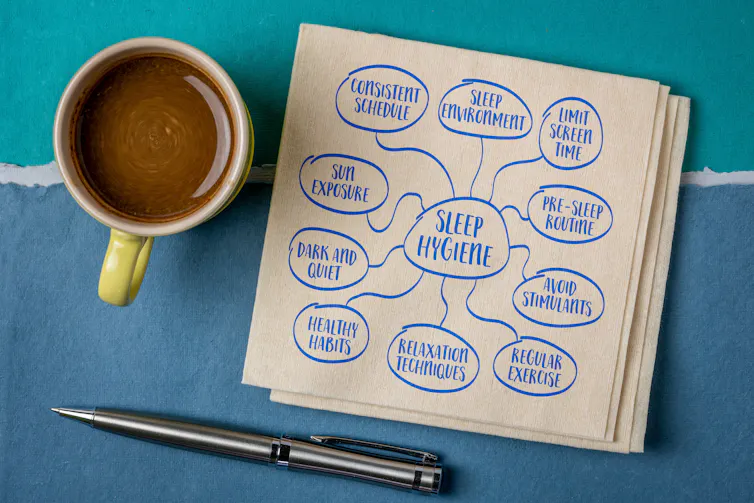
Small changes in routine can help the body settle into a steadier rhythm. These are often referred to as good sleep hygiene: habits that support healthy sleep. Keeping a consistent wake-up time, even after a poor night, helps anchor the body clock and stabilise sleep patterns.

Sleep hygiene mind map written on a napkin next to cup of coffee and pen
Sleep hygiene refers to healthy daily habits that can help promote high-quality sleep.
marekuliasz/Shutterstock

Allowing time to unwind before bed, limiting caffeine and alcohol later in the day, and creating a calm sleep environment can also reduce night awakenings. If you lie awake for a long time, it can help to get out of bed briefly and do something relaxing until you feel sleepy again. That helps break the link between bed and wakefulness.

Managing stress during the day can also make a difference, reducing the chance of going to bed already tense and alert. Journaling, yoga, meditation, breathing exercises and mindfulness can all help calm the mind before sleep.

So while waking at 3am can feel unsettling, occasional nighttime awakening is part of how sleep works. Understanding what is happening in the body, and how stress and daily habits can shape sleep, can make those middle-of-the-night moments feel a little less alarming.

The Conversation

Talar Moukhtarian has received funding from the Medical Research Council.

ref. Waking at 3am every night? Here’s what may be going on – https://theconversation.com/waking-at-3am-every-night-heres-what-may-be-going-on-278264

The UK is spending more on defence – but is raiding the aid budget the best way to pay for it?

Source: The Conversation – UK – By Matt Barlow, Lecturer International Political Economy, University of Glasgow

In March, the UK foreign secretary Yvette Cooper made a statement to parliament setting out the government’s international aid priorities. With an aid budget significantly smaller than it was five years ago, Cooper proposed which countries and programmes would receive support.

This was the first time MPs and the public heard any spending detail after the latest round of cuts to aid.

To allow more money for defence in an increasingly volatile world, in 2025 the UK cut its aid budget from 0.5% to 0.3% of gross national income (GNI). The cut now leaves international aid spending at £9.2 billion per year. It followed a similar reduction in 2021, when the government cited post-COVID financial pressures.

Conflict is a central theme in the government’s priorities, with support maintained for fragile and war-torn states: Palestine, Sudan, Ukraine and Lebanon (albeit only for this year for Lebanon due to the Israeli bombardment). It means that by 2028-29, 70% of UK aid spending will be spent in conflict zones.

So inevitably there were regions that were de-prioritised. Support for many African states has been reduced. Bilateral aid to the region is set to reduce by more than £800 million, or 56% by 2028-29.

And with 20% of the aid budget already designated for domestic refugee spending and housing – £2.8 billion was spent on this in 2024 – the amount of aid available to some of the world’s poorest countries is coming under increasing pressure. Unfortunately, this reflects a global trend.

Cooper argued that countries receiving aid do not want to be in a dependent relationship with the UK. Instead, she said the situation could be reimagined as “partnership not paternalism”. This is certainly an idea that responds to criticisms of aid as neocolonial, fragmented and of little use in addressing the root causes of poverty.

And with challenges remaining across developing economies even after decades of aid, this argument should not be discounted – even if evidence shows aid saves millions of lives every year.

Who should pay?

But across the world, talk has turned to the alternatives for developing countries to finance the processes of development. While the options are limited, there is some consensus.

Discussions have focused on how to plug the aid gap by supporting governments in recipient states to collect more tax domestically, while increasing private finance.

Raising taxation sustainably was already a central pillar of the UN’s Sustainable Development Goals. But the need to do so has gained momentum as development organisations push finance ministries to adopt more resilient “fiscal roadmaps”. Yet raising revenue through taxation is especially difficult for governments in poorer nations.

A major issue is the disconnect between policy and politics. Taxation is often seen as a technical challenge, when the reality is that it is deeply political. While wealth redistribution through taxation has reduced poverty and inequality in regions of the developing world, progressive taxation can be hampered by a lack of political will to implement it.

The ability of governments to tax is also undermined when those with the means to do so move their wealth across borders to pay less tax.

Negotiations are under way within the UN to create a more effective global system for taxation that will be fairer and reduce inequality across developing countries. Inevitably, these proposals face resistance from wealthy nations with large corporate bases.

Aside from tax reform, the need to attract private investment is high on the agenda. With this in mind, governments and development organisations have adopted increasingly creative means to make this attractive. It came as no surprise that Cooper referred to the UK government’s global role as an “investor” rather than just a donor, when wealthy and emerging economies have been moving in this direction for some time.

The moral case

But it is a shift that is not without social and political risks. First, the projects that are attractive to financiers rely on significant public subsidy, referred to as “blended finance”. This diverts public resources from other causes that may create greater social value but are considered less profitable for investors. There has been criticism of the impact on poverty and inequality from these developments in the spheres of education and health.

Second, there are few public scrutiny mechanisms for private investment. Financial information is treated as commercially sensitive, posing a severe challenge to effective governance and accountability.

And crucially, neither of these modes of financing offers a quick-fix solution to the aid cuts. Ultimately, what is key is rebuilding a moral case for aid that has been lost in recent years.

The UK government has made the case that rather than bilateral direct aid, international cooperation through institutions and joint initiatives such as Gavi, The Vaccine Alliance are critical to multiply the impact of the support. And there are many who would agree that aid in its current iteration is unsustainable. So a shift away from a traditional framework has support.

But there remains a moral case for aid – and the pace and scale of the cuts has caused concern. In fact, the UK foreign secretary acknowledged this in a newspaper column that accompanied the statement. In it, she argued that reducing aid to fund defence was not walking away from the Labour party’s values and responsibilities.

But this is a difficult sell when the alternatives take time to implement and there are questions about why increased funding of defence should come at the expense of the aid budget. Taxing those with the broadest shoulders more could better exemplify the values Cooper argued for. It could be said there is a moral case for that.

The Conversation

Matt Barlow and Benjamin Hunter are project leads for The State of Development Aid and What Comes Next, which received funding from the Scottish Council on Global Affairs.

ref. The UK is spending more on defence – but is raiding the aid budget the best way to pay for it? – https://theconversation.com/the-uk-is-spending-more-on-defence-but-is-raiding-the-aid-budget-the-best-way-to-pay-for-it-280220

From ‘market value’ to levelling up, the manosphere is shaped by a financial mindset

Source: The Conversation – UK – By Robert Lawson, Associate Professor in Sociolinguistics, Birmingham City University

oneinchpunch/Shutterstock

Louis Theroux’s recent Netflix documentary Inside the Manosphere shines a spotlight on masculinity influencers and the dangers of online misogyny, conspiracy theories and anti-feminist ideologies. Responses to the documentary have ranged from outrage to disbelief, criticising how the manfluencers treat the women in their lives and discussing the importance of role models in countering manosphere influences.

But what has been less talked about is how it reveals the relentless pursuit of financial gain driving these “manfluencers” and the language they use to normalise their views.

Amid a cost of living crisis and a declining job market, Theroux shows why “manfluencers” resonate so strongly with their target audience of boys and young men. Theroux meets four key figures in the manosphere, all of whom sell a carefully curated lifestyle based on conspicuous consumption, hypersexuality and an “alpha masculinity” mindset to their millions of followers.

Although this may seem like a tempting lifestyle to some, the main effect is to reinforce a sense of inadequacy and failure among their audiences. Do this enough times, then you can sell the solution to become a “real man”.


Read more:
How boys get sucked into the manosphere


In Theroux’s documentary, two fans of a manosphere influencer suggest that “life as a man, you’re born without value. We have to build that value. You have to work for every penny”.

The language used in the manosphere is the language of financial markets, with discussion of optimisation, levelling up and marginal gains. Phrases like “sexual market value”, “high/low value man” and “maxxing” convert intimacy into a market and the body into an asset class. Manosphere guidance encourages young men to inspect themselves from the outside, as if conducting a performance review. Men’s bodies are seen as measurable assets and an index of “masculinity”.


Read more:
The pseudoscientific attractiveness scale that grew out of incel forums and is now making money for looksmaxxing influencers


Glow-ups, routines, hacks, looksmaxxing, courses, tips and videos on “ways to increase your value” are deployed as strategies to help fans unlock the secret of being a “real man”. In these spaces, the broader system that turns masculinity and relationships into metrics is never the problem. Instead, men are told that failure lies in their inability to increase their own “market value”. These discourses of “self-improvement” are, in reality, damaging forms of self-surveillance.

Manosphere adherents end up caught in a loop of aspiration and self-loathing: improve, compare, fail, repeat. In this context, the language of “levelling up” becomes especially insidious. Although it sounds playful and empowering, this mindset traps fans in a permanently unwinnable game. There is always another goal to strive for, another skill to master, another level to unlock.

‘Manosphere’ influencers place high value on physical fitness and attractiveness in both men and women.
MDV Edwards/Shutterstock

The dating market

The consequences of this mindset for both men and women is most evident in the language around dating and the idea of the “sexual market”. Attraction is viewed as quantifiable (“high/low value”), competitive (“winners/losers”) and impersonal (“it’s just sex”). Women and men are both consumers and products competing for scarce demand. Rejection is “market feedback”.

These metaphors reduce a deeply social and emotional sphere of life down to a superficial economic reality. By treating people and relationships as metrics, it becomes easier to view them only in instrumental terms. Framing relationships as one-dimensional, transactional and based on hierarchy has negative effects for both men and women.

In Inside the Manosphere, one influencer reveals that he filmed a woman performing a sex act on him for “clout”. Theroux shows a clip from one influencer’s social media arguing that women are “subordinate” to men and should always make themselves sexually available. In one of the most discussed scenes from the documentary, one man advocates for “one-sided monogamy”, where he sleeps with other women while his wife stays at home as the main caregiver.

This man reduces women to an “attractiveness score”, saying that if a man isn’t tall but is physically fit, muscular and makes money, “Maybe [he doesn’t] come to Miami and pull Miami 10s, but I’ll be damned if [he] can’t pull a couple of 8s or 9s in a small town in America”.

Some of this corporate language is used to make misogynistic ideas sound neutral, data-driven and common sense. While recording a podcast, one man uses his “female delusion calculator” to draw attention to the unrealistic expectations a female guest has of a prospective partner. Although presented as a mathematical model based on demographic data, its primary function is to highlight what he claims is the “irrational” nature of women in the contemporary dating scene, and conclude that women “overinflate [their] own sense of self-worth”.

By framing this commentary as a form of objective analysis, it makes hierarchy seem an everyday and commonplace part of life and hides its misogynistic underpinnings.

Influencers in the manosphere often pronounce that they are seeking to elevate the position of men through the language of empowerment. The self-improvement narratives are compelling, but they don’t stand up against the evidence that these men are very much in it for themselves.

The documentary highlights how the manfluencers’ central goal is ultimately self-enrichment, often at the expense of their followers. Theroux “invests” £500 into an interviewee’s trading platform, only to see it whittled away over the course of a few weeks, with the influencer taking his cut. Fans of one influencer pay to have their comments read out live on air. Another influencer courts conspiracy theories to create viral content, describing those in the manosphere as “trying to make a buck” by selling ideologies.

There is a sense that compromising the social contract doesn’t matter, so long as you have a Rolex on your wrist, a Lamborghini to drive and a fancy apartment to hide away in. The ideologies promoted by the manfluencers in the documentary are rooted in misogyny, sexism, violence and exploitation – and there is clearly a market ready and willing to buy them.

The Conversation

Robert Lawson is a Research Fellow in the Institute for Research on Male Supremacism.

ref. From ‘market value’ to levelling up, the manosphere is shaped by a financial mindset – https://theconversation.com/from-market-value-to-levelling-up-the-manosphere-is-shaped-by-a-financial-mindset-278565