The first Welsh settlers landed on the shores of what is today the Province of Chubut, in Argentinean Patagonia, on 28 July 1865. Carried on the ship Mimosa, this was the first of a series of immigrant contingents to create the Welsh settlement known as Y Wladfa.
The many chronicles and accounts about it have imbued the settlement with a mythical sheen. Today, Y Wladfa is home to the most famous Welsh-speaking community outside Wales. It is often touted in Britain as a little Wales across the sea. In fact, “Welsh Patagonia”, as it’s also known, was established precisely with the aim of preserving the language and culture.
A major aspect of the settlement that is celebrated is the unique friendship with the Indigenous Tehuelche that the Welsh immigrants would have struck up. However, with the commemoration of 160 years of that first group of settlers, the story about this connection is being challenged in a recently launched digital exhibition: Problematising History: Indigenous perspectives on Welsh settlement in Patagonia.
Looking for something good? Cut through the noise with a carefully curated selection of the latest releases, live events and exhibitions, straight to your inbox every fortnight, on Fridays. Sign up here.
Rather than attempting to undo the past, the project aims to address a glaring omission in historical accounts which results in an incomplete understanding of the impacts of the settlement – the lack of indigenous perspectives.
The new trilingual (Spanish, Welsh and English) exhibition challenges romanticised views about the myth of friendship between the Welsh settlers and the Indigenous Tehuelche in Patagonia. Bringing together four Mapuche Tehuelche creative projects, it reflects critically on how the story of Welsh colonisation in Chubut is told by providing a platform for voices previously unheard in Britain.
Little Wales across the sea
In Welsh Patagonia you can see quaint casas de té gales (Welsh tea houses), the ever-present dragons and strangely familiar Welsh street names. You will also see the Welsh language in towns like Gaiman, Trevelin or Trelew. To find a language that is only spoken by less than 20% in Wales itself be so present in this corner of Latin America can make for an odd experience.
The stories of how this place came to be are typical of settler colonial settings. These rose-tinted tales describe the encounter between the Welsh and the Indigenous Tehuelche as a harmonious meeting of cultures that led to a lasting friendship. The assumption is that the largely peaceful coexistence was due to the inherent Welsh benevolence rather than the result of negotiation and relationship building on both sides.
The overlooking of Indigenous agency and resistance is partly due to virtually all of the historical records available in Welsh or English being created by Welsh or European people. Even those appearing to foreground indigenous voices were recorded by non-Indigenous rapporteurs and often include at least one layer of translation.
As voices in the project Puel Willi Mapu Mew: Taiñ Zungun have said about the “Welsh rifleros” (the first Welsh explorers to “go West”):
“Their arrival is commemorated as an epic legend and they are inscribed as heroes who ‘discovered’ our land, silencing our pre-existence as Tehuelche Mapuche people, and leading to the violence of the successive evictions and removals of our lof (community).”
The incorporation of indigenous perspectives on Welsh settlement to the collections of the National Library of Wales represents a groundbreaking development. It is about time that space has been made for Mapuche Tehuelche memories about forced displacement, territorial dispossession and heritage appropriations.
Changing perceptions
The early pioneers were invited by the Argentinean government to settle in the area around the Chubut river. They were then pretty much left to their own devices to endure in the unforgiving and harsh terrain. The Indigenous Tehuelche would have not only provided them with meat but taught them to hunt and survive in their new environment.
An aspect of that good will can be traced to the Chegüelcho agreement, which the Argentine government drew up with the leaders of local Indigenous communities. The agreement stipulated that, provided the Welsh settlement was left to develop on the lands in question, the central government would send regular rations to the communities and provide animals and clothing.
However, the nuances of the coexistence have been removed, leaving a flattened historical narrative. In reality, the relationship was the result of continuous renegotiation of practical necessities and pursuit of reciprocal benefit – but was also fraught.
The Welsh outpost was beneficial to Patagonian indigenous populations in providing a convenient outlet for trading their animal skins and ostrich feathers. However, Y Wladfa was the first step of a broader Argentine project that actively sought to dispossess indigenous peoples and assert state sovereignty over Patagonia.
“The official history of Chubut silences the stories of the Mapuche and allows words like ‘progress’ and ‘Welsh settlers’ to resonate,” contributor Agustín Pichiñan explains.
“With the support of the State, fences were extended all over our territory bringing us subjugation, harassment and discrimination. Yet, we keep on resisting and fighting to recover our history, using the knowledge of our ancestors and the memories of our lof (community).”
Sustaining a simplified historical narrative and ignoring indigenous perspectives allows convenient stories which simply celebrate Y Wladfa. It prevents us from sitting with uncomfortable truths and learning.
Chief among these truths is that as a colonised people themselves the Welsh were agents of colonialism elsewhere. This is part of the wider history of Patagonian settlement and is key to striving for a better present and future for all involved.
Get your news from actual experts, straight to your inbox.Sign up to our daily newsletter to receive all The Conversation UK’s latest coverage of news and research, from politics and business to the arts and sciences.
Geraldine Lublin has received funding for the “Problematising History: Indigenous perspectives on Welsh settlement in Patagonia”.project from the Arts & Humanities Research Council Impact Acceleration Account at Swansea University.
Source: The Conversation – UK – By Natasha Lindstaedt, Professor in the Department of Government, University of Essex
As climate change drives rising temperatures and changes in rainfall, Mexico and the US are in the middle of a conflict over water, putting an additional strain on their relationship.
Partly due to constant droughts, Mexico has struggled to maintain its water deliveries for much of the last 25 years, in keeping with a water-sharing agreement between the two countries that has been in place since 1944 (agreements between the two regulating water sharing have existed since the 19th century).
As part of this 1944 treaty, set up when water was not as scarce as it is now, the two nations divide and share the flows from three rivers (the Rio Grande, the Colorado and the Tijuana) that range along their 2,000-mile border. The process is overseen by the International Boundary and Water Commission.
Mexico must send 430 million cubic metres of water per year from the Rio Grande to the US, while the US must send nearly 1.85 billion cubic metres of water from the Colorado River to support the Mexican border cities of Tijuana and Mexicali.
Water deliveries are measured over a five-year cycle, and the current one ends in October. Mexico struggled to deliver its water “debt” in the last cycle which ended in 2020, using waters from reservoirs at the last minute to fulfil its obligations. This left northern Mexico with severely depleted water levels.
Due to growing tensions over water, the Biden administration tried to negotiate and work with the Mexican government to improve the speed with which Mexico’s water deliveries were taking place in 2024.
But with Donald Trump’s return to office, the US has taken a more aggressive stance with Mexico to address its water debts to the US. For the first time in over 50 years, in March of 2025, the US refused to send water from the Colorado River to Tijuana – a city of nearly 2 million people – in order to force Mexico to send more water to Texas.
Mexico has since responded by transferring 75 million cubic metres of water, but this is just a drop in the bucket, as Mexico remains 1.5 billion cubic metres in debt. And this did little to satisfy the Trump administration, which threatened to withhold more water from Mexico. It also demanded the resignation of Maria-Elena Giner, who led the International Boundary and Water Commission, in April.
Rather than looking at diplomatic solutions, Trump has accused Mexico of stealing Texans’ water and has promised to keep escalating consequences if it doesn’t deliver on the treaty terms.
For farmers in Texas, the water shortage has left them unable to plant their crops as they don’t have enough irrigated water to do so. A year ago, the last sugar mill in southern Texas shut down due to the lack of water being delivered by Mexico.
But Mexican farmers believe that the agreement is binding only when Mexico has enough water to satisfy its own needs – and with drought conditions, this means that no excess available water can be sent. Continuing drought conditions in Mexico have plagued farmers in the north, who also rely on water for their crops. Reductions in rainfall in recent years have also left Mexico struggling with water supplies for its own citizens in urban areas.
In recent years, drought has particularly affected the city of Monterrey in northern Mexico. In 2022, taps ran dry with many of its five million residents without running water for months. Flushing toilets, laundering clothing, washing dishes, bathing all required hauling water by hand from wells.
Locals protested the fact that the best water infrastructure went to factories, not residents. One factor is that water demand has skyrocketed due to more manufacturing in border cities in Mexico.
While increased manufacturing poses one problem, an even bigger problem lies with agriculture, and the types of plants being planted, as well as the way they have traditionally been watered. For example, avocados require 91 litres a day – four times more water than the production of oranges, and ten times more than the production of tomatoes.
Alfalfa is another thirsty crop being mass produced in drought-prone states, such as Texas, California and even Arizona.
Citizens in Mexico City sometimes faced weeks of water shortages in recent years.
As much as 80% of the Colorado River basin’s water is used for agriculture and about half of that goes towards the production of alfalfa. Even more concerning is that most of the water is going to feed these thirsty crops. And in the dry south-west states of the US half of its water goes to towards the production of beef and dairy cattle.
This has an impact on cities who are completely dependent on the Colorado River. In the case of Tijuana in Mexico, the Colorado River supplies 90% of its water, while US cities such as Los Angeles and Las Vegas receive 50% and 90% of their water supplies from the Colorado River and basin, respectively.
This is a major concern as both the Colorado River and the Rio Grande are experiencing record low levels of water. And getting more water from Mexico is not a long-term solution.
Though the Biden administration was criticised by farmers for not threatening Mexico, by withholding water, its approach largely focused more on the long-term challenges.
For the previous US administration the solution was to invest more in the Colorado River basin, incentivising California, Arizona and Colorado to conserve three million acre-feet of water through 2026 in return for US$1 billion (£741,000,000) in federal funding.
What drives this conflict?
But under Trump, federal funding for tackling climate change is being slashed. Increased polarisation in US domestic politics and growing tensions between the US and Mexico will make resolving this crisis all the more difficult.
This is a missed opportunity. Even though conflicts over water are becoming more frequent, water scarcity can also be a potential driver of cooperation.
Meanwhile, the US’s relationship with Mexico continues to be rocky. Trump has threatened to put new 30% tariffs on Mexico from August 1, after he claimed it hadn’t done enough to tackle drug cartels.
Mexico’s president, Claudia Sheinbaum, has said her government was destroying drug laboratories every day, and that the US must control weapons travelling over its border into Mexico which were being used for criminal purposes. Meanwhile, high tariffs on Mexican goods are likely to affect US consumers as Mexico is currently the US’s biggest trading partner.
Cooperation, and acknowledging the role played by climate change, and unsustainable forms of development in both agriculture and manufacturing are key to resolving this cross-border water crisis – but these are things that the Trump administration is unlikely to acknowledge, or address.
Get your news from actual experts, straight to your inbox.Sign up to our daily newsletter to receive all The Conversation UK’s latest coverage of news and research, from politics and business to the arts and sciences.
Natasha Lindstaedt does not work for, consult, own shares in or receive funding from any company or organisation that would benefit from this article, and has disclosed no relevant affiliations beyond their academic appointment.
The feelings that surged through the pub that I watched the women’s Euro 2022 cup final in were electric. England had won. My friends were in tears. Strangers were shaking hands, patting each other on the back, smiling goofily at anyone who would catch their eye. It was wonderful. I’m hoping for repeat scenes this Sunday when the Lionesses face Spain in the 2025 Uefa European Women’s Championship.
Whether they win or not, the journey has been a joy. I watched the quarter-final between England and Sweden at a pub hosting an Irish trad folk night. With every England goal, the fiddlers celebrated with a rowdy song. The street I was watching the semi-final on erupted as different pockets of fans celebrated as Chloe Kelly scored the goal that would send the Lionesses into the final.
Women’s football has gone from strength to strength since that monumental win in 2022. Many of the Lionesses are now household names (Kelly, Lucy Bronze, Ella Toone and Beth Mead to name a few). As someone who attends women’s games, I’ve never seen the stands so full. You’ve also never been able to see so many games broadcast.
The situation for players has also massively improved with female footballers earning more than ever. In this piece, sports financing expert Christina Philippou, celebrates these many wins but also highlights where there is room for improvement.
A lot of the gains made in women’s football in England can be attributed to that win in 2022. Here’s hoping that on Sunday we see another win, which leads to many more strides for women’s football.
The 2025 Uefa European Women’s Championship final will be available to watch on the BBC at 5pm, July 27.
On Sunday, the Lionesses will march onto the pitch wearing their all-white home kit. The purpose of such clothing is to unite the players, to show they are a team and representatives of a country. In this, we can see how, as the philosopher Kate Moran writes in her new book, clothes are much more than just what we put on.
In A Philosopher Looks at Clothes, Moran shows that what we choose to wear is a worthy topic of deep philosophical inquiry.
Our reviewer, Sarah Richmond, a philosophy expert, found the book an engaging and unpretentious exploration of an ubiquitous aspect of daily life. Clothing provides Moran with fertile ground for ethical, political, aesthetic and identity-related reflections.
Also challenging how we have historically seen things is the new book by writer and curator Alayo Akinkugbe. In Reframing Blackness, Akinkugbe invites the reader to challenge art history and its approach to blackness.
How has the teaching of art history excluded blackness? How does such teaching then affect the creation and curation of art in relation to blackness.
Wanja Kimani, a curator herself, found the book engaged with many of the issues that black artists and those teaching and working in the arts have been grappling with since at least the 1960s in a clear-eyed and refreshingly optimistic manner.
For at least the last ten years there has been a growing trend for exhibitions that tackle climate change and the collapse of nature. Pandora Syperek, an expert in design, and Sarah Wade, an expert in museums, have been great supporters of the ability of such curation to communicate the urgency of such issues.
Putting their research into practice, the pair have put on their first exhibition entitled Sea Inside. Asking the question “can the sea survive us?” the show features art works that show how connected humanity is to the ocean.
These works are, as they write, emotive, imaginative and often very funny. From an aquarium full of tears to videos of jelly fish having sex in a lab, these works hope to move us closer to a care and understanding for fragile sea ecosystems.
Sea Inside is on at Sainsbury Centre in Norwich until 26 October, 2025
At The King’s Gallery, Buckingham Palace you can explore the glamour of the Edwardian age through some of Britain’s most fashionable royal couples – King Edward VII and Queen Alexandra, their son George V and his wife Mary of Teck.
As our reviewer, professor of modern British history Jane Hamlett notes, one of the most interesting things about The Edwardians: Age of Elegance is what it reveals about the personal taste of the royals. Featuring more than 300 objects from the Royal Collection – almost half for the first time – it is fascinating to see what they chose to collect. You’ll get the chance to see work by recognisable artists of the period, including Carl Fabergé, John Singer Sargent and William Morris.
This article features references to books that have been included for editorial reasons, and may contain links to bookshop.org. If you click on one of the links and go on to buy something from bookshop.org The Conversation UK may earn a commission.
I’m not sure if it was the effect of the atomic bomb, but I have always had a weak body, and when I was born, the doctor said I wouldn’t last more than three days.
These are the words of Kazumi Kuwahara, a third-generation hibakusha – a survivor of the atomic bombing of Hiroshima and Nagasaki in Japan 80 years ago.
Kuwahara, who still lives in Hiroshima, was in London on May 6 this year to give a speech at a Victory Over Japan Day conference organised and hosted by the University of Westminster. Now 29, she told the conference that she felt she had been “fighting illness” throughout her 20s. When she was 25, she needed abdominal surgery to remove a tumour which post-surgery tests showed was benign.
When she found out about the operation, her grandmother, Emiko Yamanaka – now aged 91 and a direct survivor of the atomic bombing of Hiroshima – told her: “I’m sorry, it’s my fault.” Kuwahara explained:
Ever since I was young, whenever I became seriously ill, my grandmother would repeatedly say: ‘I’m sorry.’ The atomic bombing didn’t end on that day and the survivors – we hibakusha – continue to live within its shadow.
Kazumi Kuwahara with her grandmother, Emiko Yamanaka, outside Hiroshima Peace Dome in 2025. Kazumi Kuwahara, CC BY-NC-ND
Kuwahara came to stay with me ten years ago during a study abroad break after I had interviewed her grandmother for my doctoral research. When I’d made a film about Yamanaka in 2012, I immediately noticed her reluctance to share her harrowing experience. But she then invited me to interview her in Hiroshima – the first of ten trips I made there for research which would become an interview archive.
I wanted to research hibakusha like Kuwahara and her grandmother as they continue to confront the physical, social and psychological effects of the atomic bombs dropped on August 6 and August 9 1945, on Hiroshima and Nagasaki respectively.
The 16-kiloton bomb dropped on Hiroshima at 8.15am by a US B-29 bomber was codenamed “Little Boy” by the Americans. It exploded about 600 metres above the Shima Hospital in the downtown area of Nakajima – a mix of residential, commercial, sacred and military sites. The bomb emitted a radioactive flash as well as a sonic boom. A gigantic fireball formed (about 3,000–4,000°C), as well as an atomic mushroom cloud which climbed up to 16km in the air.
In Japan in the immediate aftermath of the bombing, people couldn’t even utter the phrase “atomic bomb” due to censorship rules initially enforced by the Japanese military authorities, up until the day of surrender on August 15. The censorship was reinstated and expanded by the US during its occupation of the Japanese islands from September 2 1945.
The Insights section is committed to high-quality longform journalism. Our editors work with academics from many different backgrounds who are tackling a wide range of societal and scientific challenges.
For decades, the hibakusha have faced discrimination and difficulty in obtaining work and finding marriage partners due to a complex combination of suppression, stigma, ignorance and fear around the dropping of the atomic bombs and their aftereffects.
Wartime propaganda in Imperial Japan precluded free speech while also imposing bans on luxury goods, western language and customs (including clothes) and public displays of emotion.
However, the US occupation – which lasted until the San Francisco treaty was signed on April 28 1952 – went further, establishing an extensive Civil Censorship Department (the CCD) which monitored not only all newspapers, magazines, pamphlets, books, films and plays but also radio broadcasts, personal mail, as well as telephone and telegraph communications. Little wonder the scars of the bomb remained untreated, for generations.
Emiko Yamanaka’s story
Yamanaka was 11 years old when she was exposed to the atomic bombing, just 1.4km from ground zero.
Emiko Yamanaka (far left) with her four brothers and parents during wartime before the atomic bombing in 1945. Emiko Yamanaka
She told me about her experiences of surviving on the bank of the River Ota, which divides into seven rivers in the estuary of Hiroshima. Yamanaka was the oldest of five siblings in 1945. Although the family had been evacuated to an island near Kure 25km away, she returned to their home on the outskirts of the city with her mother and nine-year-old brother early on the morning of August 6, so she could attend an appointment with an eye-doctor for a case of conjunctivitis.
Making her way into the city by herself, the tram she was travelling on needed to stop due to an air-raid warning. It was a “light” warning as just two B-29s had been spotted approaching the mainland (a third photography plane was not yet visible on the horizon), so Yamanaka needed to continue her journey on foot. She recalled:
When I got to Sumiyoshi shrine, the strap of one of my wooden geta [Japanese clogs] had snapped off. I tried to fix it with a torn piece of my handkerchief in the shade of a nearby factory building. Then a man came out of the factory and gave me a string of hemp. He advised me to enter the doorway because the sun was very hot already.
When I was repairing my strap, there was a flash. I was blinded for a moment because the light was so strong, as if the sun or a fireball had fallen down over my head. I couldn’t tell where it came from – side, front or behind. I didn’t know what had happened to me. It felt like I was mowed down, pinned or veiled in by something very strong. I couldn’t exhale.
I cried out: “I can’t breathe! I’m choking! Help me!” I fainted. It all happened in a matter of seconds. I heard something rustling nearby and suddenly recovered my senses. “Help me. Help me,” I cried.
A man wearing what seemed like an apron, tattered gaiters and ammo boots came towards her and called out: “Where are you? Where are you?” He pushed aside the debris and extended his arm to Yamanaka:
When I caught his hand, the skin of his hand stripped off and our hands slipped. He adjusted his hand and dragged me out of the debris, grabbing my fingers … I felt a sense of relief, but I forgot to say thank you to him. Everything happened in a moment.
Yamanaka started to run back the way she had come along the river, as “the city was not yet burning”. She saw the shrine just beyond Sumiyoshi bridge, not far from the river. But the bridge had been damaged by the bomb, so she couldn’t cross it.
Yamanaka’s family home was at Eba across the river. In those days, the River Ota was used for river transport and business, and there were huge stone steps going down to the river for loading. She said:
I wanted to get across to the other side. Then the city started to burn: the fires were chasing me and I had to run along the riverbank. I had to keep running as fast as possible until I finally reached Yoshijima jail. I was so scared but the area was not burning yet. I felt so relieved, I lost my consciousness.
She awoke hearing shouts of “is there anyone who is going back to Eba from Funairi?” and recognised a neighbour. She asked him to take her across, but he couldn’t recognise her. “I shed big tears when I heard his voice,” she told me. There were about ten people in a small wooden boat, all with “big swollen grotesque faces and frizzy hair. I thought they were old people. Maybe I also looked like an old woman,” she added.
After crossing the river in the small boat, Yamanaka ran to her Eba home which, even though it was 3km from ground zero, had collapsed. She couldn’t find her mother. Someone told her to go to the air-raid shelter nearby, but there were too many people to fit inside.
When she finally found her mother, she was barely recognisable, wrapped in bandages from her injuries. Yamanaka herself had to go to hospital as tiny pieces of glass from the factory windows where she had been exposed were lodged in her body.
She told me how some shards of glass still emerge from her body occasionally, secreting a chocolate-coloured pus. The family – Yamanaka, her mother and her younger brother (her father, grandparents and the other siblings had remained evacuated) – stayed up all night in a shelter on Eba hill, listening to the sounds of the burning city, the cries for mothers, the sounds of carts filled with refugees.
“All those sounds horrified me,” Yamanaka recalled – decades on from the day that changed everything.
The aftermath of the atomic bomb showing the former Hiroshima Industrial Promotion hall. The Peace Memorial Park, dedicated to the victims, would later be built here. Shutterstock/CG Photographer
The day the world changed
The immediate effects of the bomb, including heat, blast and radiation, extended to a 4km radius – although recent studies show the radioactive fallout from “black rain” extended much further, due to the winds blowing the mushroom cloud. And some survivors told me they witnessed the blast effects of the bomb, including windows blown out or structures disturbed, in outlying towns and villages up to 30km away.
But the closer you were to ground zero, the more likely you were to suffer severe effects. At 0.36km from ground zero, there was almost nothing left; about 4km away, 50% of the inhabitants died. Even 11km away, people suffered from third-degree burns due to the effects of radiation. The neutron rays also penetrated the surface of the earth, causing it to become radioactive.
The mushroom cloud was visible from the hills of neighbouring prefectures. Those who were beyond the immediate blast radius may not have shown any external injuries immediately – but they commonly became sick and died in the days, weeks, months and years that followed.
And those outside the city were exposed to radiation when they tried to enter to help the injured.
Radiation also affected children who were in the womb at the time. Common radiation-related diseases were hair loss, bleeding gums, loss of energy (“no more will” in Japanese) and pain, as well as life-threatening high fever.
About 650,000 people were recognised by the Japanese government as having been affected by the atomic bombings of Hiroshima and Nagasaki. While most have now passed away, figures held by the Ministry of Labour, Health and Welfare from March 31 2025 show there are an estimated 99,130 still alive, whose average age is now 86.
In a radio broadcast following the atomic bombings, Emperor Hirohito announced Japan’s surrender and called on the Japanese people to “bear the unbearable”, referring to the “most cruel weapons” that had been used by the Allied forces without directly identifying the nuclear attack. Due to ill-feeling about the defeat, shame over Japan’s imperial past and role in the war, plus censorship and ignorance about the reality of nuclear weapons, the idea grew that the dead and injured hibakusha were simply “sacrifices” (‘生贄 になる’) for world peace.
Generations affected
It took Yamanaka around seven years to recover her strength enough to lead a relatively normal life, so she barely graduated from high school. She has subsequently been diagnosed with various blood, heart, eye and thyroid diseases as well as low immunity – symptoms that can be related to radiation exposure.
Her daughters also suffered. In 1977, when her eldest daughter was 19, she had three operations for skin cancer. In 1978, when her second daughter was 14, she developed leukaemia. In 1987, her third daughter suffered from a unilateral oophorectomy (a surgical procedure to remove one ovary).
I interviewed Yamanaka’s daughters, granddaughter and several other survivors repeatedly, beginning with experiences prior to the atomic bombing and then continuing up to the present day.
While these interviews generally started in the official location of the Hiroshima Peace Memorial Museum, I also conducted walking interviews and went to sites of special importance to their personal memories. I shared car journeys, coffees and meals with them and their helpers, because I wanted to see their lives in context, as part of a community.
Their trauma and suffering are dealt with socially. For the relatively few survivors who tell their stories in public, it is through the help of strong local networks. While I was at first told I would not find survivors who wanted to share their stories, gradually more came forward through a snowball effect.
Returning to interview Yamanaka in August 2013, we travelled by car to her former home of Eba, pausing at the site where she had alighted after her journey across the river. There, Yamanaka struck up conversation with a fellow survivor who was passing on his bicycle. His name was Maruto-San. They had attended the same temple-based elementary school.
Emiko Yamanaka meets a fellow hibakusha, Maruto San, on a visit to her hometown in Eba with the author in August 2013. Elizabeth Chappell
The two hibakusha, who had both been exposed when young (part of a category known as jakunen hibakusha) exchanged stories about their experiences after “that day” (ano hi) – as August 6 and 9 are still known in the atomic-bombed cities.
They talked about how just one or two friends were still alive – one survivor ran a well-known patisserie in the local department store. Yamanaka informed Maruto-San that she had met a few friends from childhood on a reunion coach trip, during which they had tried to retrieve some happier pre-bomb memories. The meeting offered a rare glimmer of recognition and reconnection.
Keisaburo Toyanaga’s story
In 2014, I travelled to the childhood home of hibakusha Keisaburo Toyanaga, a retired teacher of classical Japanese who was nine on August 6 1945. After visiting his original home in east Hiroshima, we took the route he, his mother, grandfather and three-year-old younger brother had travelled, fleeing Hiroshima towards his grandfather’s house in the suburb of Funakoshi, about 8km away. He told me:
I remember coming this way on that day … My family was just one of many others, we were all travelling with our belongings on push-carts.
The family set up home in this poor suburb, which was shared with many Korean families who could not find a way out of poverty due to historic discrimination. Korea was annexed by Imperial Japan, and Koreans had been recruited en masse into Japan’s war effort. An estimated 40,000-80,000 were in Hiroshima in 1945.
Some high-ranking Koreans were accepted by the Japanese – for example, royals like Prince Yi U who was said to have been astride his horse at the time of the bombing. But ordinary Koreans had to refrain from using their language or wearing Korean clothes in public. Even after the war was over, they needed to use Japanese names outside the home. After the war, Koreans in Hiroshima took menial agricultural work – in Funakoshi, they kept pigs.
Confronted with discrimination in the classroom where he taught at the Electricity Workers’ school, Toyanaga became a campaigner for the right of repatriated South and North Koreans to be officially recognised as hibakusha from the 1970s onwards. He showed me the wooden talisman he wore around his neck, awarded by the Korean community for his support.
The author (far right) with Keisaburo Toyanaga (far left) and Keiko Ogura, both hibakusha, at the Hiroshima Peace Memorial Museum library in 2014. Elizabeth Chappell
The ghosts of Hiroshima
When I was living and working in Japan from 2004, before I started my academic research, I was advised to stay away from the atomic-bombed cities because speaking of the atomic bombings was considered “kanashii” (悲しい) “kowai” (怖い) and “kurushimii” (苦しみい) – sad, scary and painful. Some Japanese friends even expressed horror when I first went to Hiroshima and Nagasaki to do research. They seemed to feel it was like an act of self-harm. A young student I met warned me that the ghosts of the victims of Hiroshima rise at night to take over the city.
On my first visit in 2009, I stayed for one night in a youth hostel beside the railway tracks and the Hiroshima Carp baseball stadium. That night, a friend and I went for a drink with a couple, both second-generation hibakusha or “hibaku nisei”.
This couple, Nishida San and his wife Takeko, were involved in organising the annual Hiroshima Peace Memorial ceremony. Takeko sang in a choir that had been involved in several exchange visits to Europe, including visiting Notre Dame in Paris and Christ Church Cathedral in Oxford.
She said her parents had never told her about their experiences of the bomb, even though her father had been exposed close to ground zero. I was surprised to discover that hibakusha were reluctant to share their stories even within their own families, often for fear of physical and psychological harm being passed through the family line.
After our meeting in the bar, we went to eat okonomiyaki (“delicious food”), a pancake with cabbage, egg, pork and noodles, in a building known as “okonomiyaki mura” or okonomiyaki village. To me, it recalled a New York tenement block with an outdoor staircase serving as the entrance to all floors – the outlines of unbuilt rooms decorating its temporary facade. Such temporariness had lasted from the 1950s when concrete blocks like these went up around the city centre to service a whole new population after Hiroshima’s near-erasure. Since 1945, most inhabitants come from outside the city.
‘Flash … boom’
I was sitting with Nishida San on makeshift bar seats in front of a counter with a huge, heated iron plate. The chef, Shin San, took our order and as we chatted, one of our Hiroshima friends asked him if he remembered the atomic bomb. Shin replied: “Of course I do.”
Then he spread his arms wide and a strange expression appeared on his face, as he said: “Pikaaaaa… doon.” This translates as “flash… boom” – two onomatopoeic words that encapsulate so much for Hiroshima people. Many survivors, especially those downtown, only experienced the flash. Others, usually at some distance, experienced the sonic boom. So these two words were used in place of “gembakudan” (原爆弾) – meaning atomic bomb – due to censorship.
Nobel prize-winning author Kenzaburo Ōe, in his 1981 work Hiroshima Notes, wrote, ‘For 10 years after the atomic bomb was dropped there was so little public discussion of the bomb or of radioactivity that even the Chugoku Shimbun, the major newspaper of the city where the atomic bomb was dropped, did not have the movable [kanji] type for the words “atomic bomb” or “radioactivity.”’ To support this, I noticed how some monuments for those who died in downtown Hiroshima bear the simple inscription E=MC², Einstein’s formula for relativity – the source of the science that created the bomb, but not the actual words for “atomic bomb”.
Keiko Ogura: ‘40 years of nightmares’
The older generation often told me how they dreaded visiting the Hiroshima Peace Memorial Museum and its surrounding park, as they are built over ground zero. However, some found that after encountering visiting foreigners there who had also experienced mass suffering, such as the Holocaust or a nuclear test, they were more able to open up.
Keiko Ogura, now aged 87, was eight on August 6 1945 and was exposed to black rain at her home in Ushitamachi, 5km from the centre of Hiroshima. She said:
For 40 years, I had nightmares and did not want to tell the story. Growing up, our mothers did not speak of the atomic bombing as they were afraid of discrimination and prejudice. Getting older, we started to worry about our children and grandchildren’s health. After the Atomic Bomb Casualty Commission was established in 1947, some people expected to be cured of ABI [atomic bomb injury] … but in fact, the doctors there were just gathering blood and data.
Ogura had thought, as a child, that she would never find a partner due to the discrimination against hibakusha, but she was also acutely aware that other survivors had suffered more than her.
The author outside Mitaki Temple with Keiko Ogura (left) and Shoko Ishida in November 2013. Elizabeth Chappell
However, when Robert Jungk, a Holocaust survivor, came to research his book Children of the Ashes with the help of Kaoru Ogura – a bilingual American who had been interned during the second world war and would become Keiko’s husband – things started to shift for her. Finding out about the Holocaust lent a new dimension to her own experiences of discrimination.
Jungk – along with Robert J. Lifton, a genocide historian – wrote their interview-based studies of Hiroshima in the 1950s and ‘60s, when ordinary citizens around the world were largely ignorant of the enormity of what had happened in Hiroshima, Nagasaki and the nuclear test sites. Lifton, originally a military psychiatrist, explained that after the 1962 Cuban missile crisis, he had been motivated to study in Hiroshima as he was afraid the world was in danger of “making the same mistake again”.
However, the link between Hiroshima and the Holocaust was first made by Otto Frank, Anne Frank’s father, who organised for an Anne Frank rose garden to be planted in the Peace Memorial Park in honour of an 11-year-old girl, Sadako Sasaki, who died from leukaemia nine years after the bomb.
One autumnal afternoon in 2013, after my third round of interviews with my cohort of hibakusha, I visited Mitaki Temple Cemetery, about 6km outside Hiroshima. The graveyard is dedicated to hibakusha, many of whose ashes are kept there. The hibakusha headstones are engraved with haiku written by family members. However, many of the headstones which existed prior to 1945 have been left at jagged angles – positioned as they were after being upset by the seismic effects of the atomic bombing.
In among the recent graves, I was shown some Jewish hanging mobile memorials – gifts from Oświęcim in Poland, location of the Auschwitz concentration camp. The temple’s former head priest had been involved in the Hiroshima-Auschwitz Peace Committee, an interfaith group which had started with a walk around the world to link atomic bomb survivors with Holocaust and other war victims.
Making the connection was important to hibakusha who were accused, then as now, of highlighting the atrocities of the bomb but downplaying the importance of Japan’s role in the war. When visiting Japan’s former colonies and elsewhere, hibakusha still offer apologies for Japanese behaviour in the second world war.
For institutions in Hiroshima, it’s important to change the narrative around nuclear weapons – not only through more and better medical research, but by disseminating hibakusha stories. The local newspaper, Chugoku Shimbun, aims to strengthen informal networks of hibakusha who meet up to share memories of that day. Some local journalists I met, Rie Nii and Yumi Kanazaki, help young people to interview their grandparents’ generation, building up a valuable archive of experiences.
There are two ways the younger generation can carry these stories forward: either by training as denshōsha (ambassadors) or by interviewing family members.
Kazumi Kuwahara decided to do both. When she was just 13, she wanted to pass on her grandmother’s story, becoming the winner of a prefecture-wide speaking competition about the bomb. In her 20s, after graduating from university, she also decided to train as a denshōsha and peace park guide, a role that requires intensive training over a six-month period. As the youngest guide to the Hiroshima Peace Park, she says:
Each visitor has a unique nationality and upbringing and, as I interact with them, I constantly ask myself how best to share Hiroshima’s significant history.
Toward the end of my field work, having gained interviews with three generations of survivors as well as their helpers, I realised this was just the beginning of a much larger conversation.
John Hersey, author of the Pulitzer-prize winning 1946 work Hiroshima, said: “What has kept the world safe from the bomb since 1945 has been the memory of what happened at Hiroshima.”
However, as our memories get more spotty with the passing of time, and as more survivors’ names are added to the roll of the dead at the cenotaphs of Japan’s atomic-bombed cities, perhaps our greatest hope is to grow the cohort of today’s listeners – so that tomorrow’s storytellers may emerge.
To hear about new Insights articles, join the hundreds of thousands of people who value The Conversation’s evidence-based news. Subscribe to our newsletter.
Elizabeth Chappell does not work for, consult, own shares in or receive funding from any company or organisation that would benefit from this article, and has disclosed no relevant affiliations beyond their academic appointment.
More and more research suggests that the copper in your diet could play a bigger role in brain health than we once believed. A recent study found that older Americans who ate more copper-rich foods did better on memory and concentration tests.
The findings, published in Nature Scientific Reports, looked at people’s diets using detailed food diaries and tested their cognitive function. Those who ate more foods that were high in copper – which include shellfish, dark chocolate and nuts – did better on tests that are used to spot early signs of age-related memory loss and dementia.
But the results aren’t straightforward. People who ate more copper-rich foods were mostly male, white, married and had higher incomes. They were also less likely to smoke or have high blood pressure or diabetes – all factors linked to a lower risk of dementia. People who consumed more copper also had more zinc, iron and selenium in their diets, and consumed more calories overall.
People with higher incomes often have better access to healthy food, medical care, cleaner environments and more education – all of which help protect against memory loss and dementia.
It’s hard to separate the effects of diet from these other advantages, although some research we reviewed suggests that improving nutrition might be especially helpful for people from less privileged backgrounds.
What other research tells us
The current study’s limitations are notable. It captured brain function at only one point in time and relied on participants’ food diaries rather than blood measurements of copper levels.
However, long-term studies support the idea that copper might matter for brain health. One study that tracked people over time found that those who had less copper in their diet showed more pronounced declines in memory and thinking.
More intriguingly, when researchers measured copper levels directly in brain tissue, they discovered that higher concentrations were associated with slower mental deterioration and fewer of the toxic amyloid plaques characteristic of Alzheimer’s disease.
Curiously, brain copper levels bore little relationship to dietary intake, suggesting the body’s processing of this mineral is more complex than simple consumption patterns might indicate.
There’s a good biological explanation for why copper might help protect the brain. This essential metal plays several important roles: it helps prevent brain cell damage via antioxidant effects, with production of the chemicals (neurotransmitters) that let brain cells talk to each other, and helps the brain produce energy, by working via particular enzymes.
Copper deficiency is thought to be relatively uncommon, but it can cause noticeable problems. If someone feels tired and weak and has anaemia that doesn’t improve with iron or vitamin B12 supplements, low copper might be to blame. Other signs can include getting sick more often, losing bone strength, and nerve damage that gets worse over time.
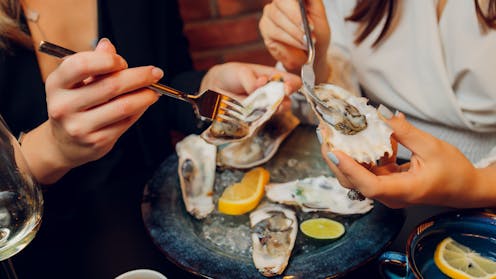
Copper is naturally found in high amounts in foods like beef, offal, shellfish, nuts, seeds and mushrooms. It’s also added to some cereals and found in whole grains and dark chocolate.
People who have had gastric bypass surgery for obesity or have bowel disorders may have trouble absorbing copper – and these conditions themselves could be linked to a higher risk of dementia.
It’s best to be cautious about taking copper supplements without careful thought. They body needs a delicate balance of essential minerals – too much iron or zinc can lower copper levels, while too much copper or iron can cause oxidative stress, which may speed up damage to brain cells.
Studies examining mineral supplements in people already diagnosed with Alzheimer’s have shown little benefit.
Paradoxically, people with Alzheimer’s often have higher copper levels in their blood, but key brain areas like the hippocampus – which is vital for memory – often show lower copper levels. This suggests that Alzheimer’s disrupts how the body handles copper, causing it to get trapped in the amyloid plaques that are a hallmark of the disease.
Some researchers suggested that after Alzheimer’s develops, eating less copper and iron and more omega-3 fats from fish and nuts might help, while saturated fats seem to make things worse. However, a lack of copper could actually increase plaque build-up before dementia shows up, highlighting the need for balanced nutrition throughout life.
There seems to be an optimal range of copper for brain function – recent studies suggest 1.22 to 1.65 milligrams a day provides copper’s cognitive benefits without causing harm. This mirrors a broader principle in medicine: for many biological systems, including thyroid hormones, both deficiency and excess can impair brain function.
The human body typically manages these intricate chemical balances with remarkable precision. But disease and ageing can disrupt this equilibrium, potentially setting the stage for cognitive decline years before symptoms emerge. As researchers continue to unravel the relationship between nutrition and brain health, copper’s role serves as a reminder that the path to healthy ageing may be paved with the careful choices we make at every meal.
Get your news from actual experts, straight to your inbox.Sign up to our daily newsletter to receive all The Conversation UK’s latest coverage of news and research, from politics and business to the arts and sciences.
Eef Hogervorst has received funding from Alzheimer’s Research UK, MRC and Wellcome to investigate diet and dementia risk. She acted as dementia expert on medical panels including ESHRE and NICE. Eef received a consultancy fee from Proctor and Gamble for a review on folate and omega 3 and cognitive funcion
The House of Lords this week approved government legislation that will allow foreign states to hold up to a 15% stake in British newspaper publishers.
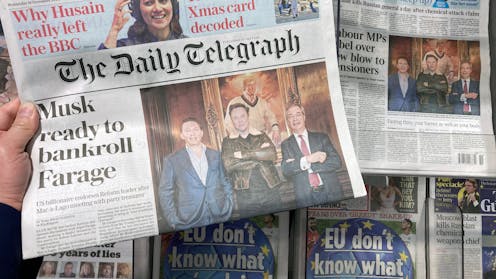
This vote clears the way for the American investment company Redbird to take control of the troubled Telegraph newspaper group following two years of uncertainty. An integral element of that bid is a 15% stake by the sovereign investment fund IMI which is owned by Sheikh Mansour bin Zayed Al Nahyan, the vice-president of the United Arab Emirates.
The heated Lords debate raised fundamental questions about who should own newspapers, and the link between ownership and editorial content. On one side were those who argued that Britain’s newspapers faced an “existential threat” without outside investment. On the other were those who warned against the potential influence of a foreign power on one of the UK’s longest standing publishers.
Media mergers and acquisitions are often contentious. But given the parlous state of the newspaper industry, they are likely to become more frequent.
A very different kind of newspaper deal was completed last December, when news website Tortoise Media bought The Observer. Tortoise, which was founded in 2018 by former Times editor and BBC director of news James Harding, startled analysts and journalists alike by taking over a newspaper first published in 1791.
The deal prompted strong opposition from some Observer and Guardian journalists. But from a business perspective, the deal suited both sides.
The Scott Trust, owners of the Observer since 1993, never seemed wholly committed to the Observer. (There was, for example, no dedicated Observer website). Tortoise, meanwhile, was keen to exploit the brand values of an established print product. It saw the Observer as a suitable vehicle for its approach of news analysis and explanation rather than breaking stories.
The media world has also been fixated on the succession story of the Murdoch family and its implications for his UK newspapers. The Sun, News of the World (until its closure in 2011), the Times and Sunday Times have been the bedrock of Rupert Murdoch’s economic and political power in the UK for decades.
In December, he lost the battle to give his eldest son Lachlan exclusive control of his media empire.
Speculation has grown as to whether any of Rupert’s progeny will want to continue the family’s print tradition after his death. His empire has suffered repeated financial and reputational hits since the phone hacking scandal. It is perfectly feasible that, once he goes, all the Murdoch press interests will be up for sale.
These various battles beg the question: why does it matter who owns a newspaper? In short, it matters because ownership, to a large extent, determines content.
Who owns the news?
From the very beginning of printed news, proprietors have exercised control over their title’s political direction and journalistic values. Prewar Britain saw Lord Beaverbrook famously exploiting his Express newspapers to campaign for free trade within the British empire.
Meanwhile, fellow newspaper baron Lord Rothermere turned his Mail newspapers into propaganda sheets for Oswald Mosley’s blackshirts, and cheerleaders for Adolf Hitler and Benito Mussolini during the 1930s.
The Rothermere family’s continued ownership of the Mail has guaranteed a consistent anti-immigration, anti-Europe rightwing worldview to the present day. How this consistent framing has been transmitted through the Mail’s editors has been well documented by journalist Adrian Addison.
Murdoch’s UK newspaper empire has also pursued his personal free market, anti-EU political vision. He has used his papers to attack the publicly funded BBC and the regulator Ofcom. Murdoch has, however, been slightly more flexible in adjusting his papers’ party political allegiance (guaranteeing a succession of prime ministerial genuflections from Margaret Thatcher through to Keir Starmer).
At the other end of the political spectrum, the Scott Trust – owners of the Guardian – was conceived by the son of C.P. Scott as a vehicle for sustaining his father’s liberal mission for the paper. It has a policy of no editorial interference, apart from continuing the paper’s editorial policy on “the same lines and in the same spirit as heretofore”. Editors are therefore enjoined to focus on the kind of progressive news agenda championed by Scott.
The trust model allows a level of freedom from traditional commercial oversight. Editors can pursue the Guardian’s well-established liberal tradition without worrying about shareholders driven by short-term profit maximisation, or an individual owner with a specific ideological agenda. This partly explains the hostility of Observer journalists to the Tortoise takeover.
Why it matters
The Lords debate focused on the risks of foreign state investment in British newspapers. But all commercial ownership models – and all owners – have their problems. Whether it be greedy shareholders, a power-hungry narcissist, an ideologically-driven family or a foreign state seeking influence in the UK, commercial models all involve editorial compromises.
One approach to the problems raised by commercial ownership is an insistence, through legislation, on a plurality of owners. But this is increasingly difficult in an industry whose traditional advertising-funded business model is under severe pressure. This context is precisely why the Telegraph’s new owner was desperate to access IMI funds.
Upmarket publications such as the Financial Times and the Times can monetise subscriptions, but paywalls discourage easy access and diminish journalistic reach. Subscriptions are also a much less attractive proposition for tabloids whose readers are less willing to pay.
Another approach is to diversify ownership models. Non-profit and charitable publishers, such as OpenDemocracy or the Bureau of Investigative Journalism, can leverage donations and are less vulnerable to the whims of corporate owners or powerful individuals. But this model is much less developed in the UK than the US.
I and colleagues have argued elsewhere that there are strong arguments for making charitable journalism easier. These models can enhance journalistic freedom, but they also come with potential downsides that need to be acknowledged.
All these options presuppose, of course, that newspapers and their online sites still have sufficient relevance and reach for us to continue to worry about ownership at all – a topic for another article.
Get your news from actual experts, straight to your inbox.Sign up to our daily newsletter to receive all The Conversation UK’s latest coverage of news and research, from politics and business to the arts and sciences.
Steven Barnett is on the management and editorial boards of the British Journalism Review. He is a member of the British Broadcasting Challenge which campaigns for Public Service Broadcasting. He is on the Advisory Board of the Charitable Journalism Project which campaigns for public interest journalism and on the board of Hacked Off which campaigns for a free and accountable press.
Maritime folklore has long been shuffled to the margins of nautical history, presented as the quaint, colourful oddities of a former age. Yet this body of beliefs, practices and stories can offer important insights into how seafarers of the 19th century viewed and understood their working environment.
Beneath the dominant histories of European exploration, heroic naval battles and imperial claims to mastery of the seas, there was the daily reality of working, living and, not uncommonly, dying in a dangerous marine environment.
This folklore – which was exchanged between multinational crews of mariners and carried across the oceans – provides a way into appreciating their everyday fears, longings and hopes. It reveals a rich emotional and psychological engagement with the ocean, a history of sea fearing that does not sit easily with the stereotypical macho image of mariners.
Looking for something good? Cut through the noise with a carefully curated selection of the latest releases, live events and exhibitions, straight to your inbox every fortnight, on Fridays. Sign up here.
Much of maritime folklore spoke to anxieties about the temperamental ocean and storms, which boiled down to a fear of disaster and drowning.
To protect themselves from such a fate, 18th- and 19th-century sailors went to sea armoured with magical charms. A popular one was a caul. It was believed owning a caul – the membrane that protects a baby in the womb – would protect a seafarer from drowning.
Such items were openly sold in newspaper advertisements in the 19th century. Three advertised in the Liverpool Mercury in 1873 were priced from 30 shillings to four guineas, no small amount for a common mariner to pay for an idle “superstition”.
Nineteenth-century sailors and fishermen also developed a rich system of omens and predictions. They were attentive to their behaviour and even words (“pig” and “rabbit” being among the worst) that might provoke the ocean or attract bad luck.
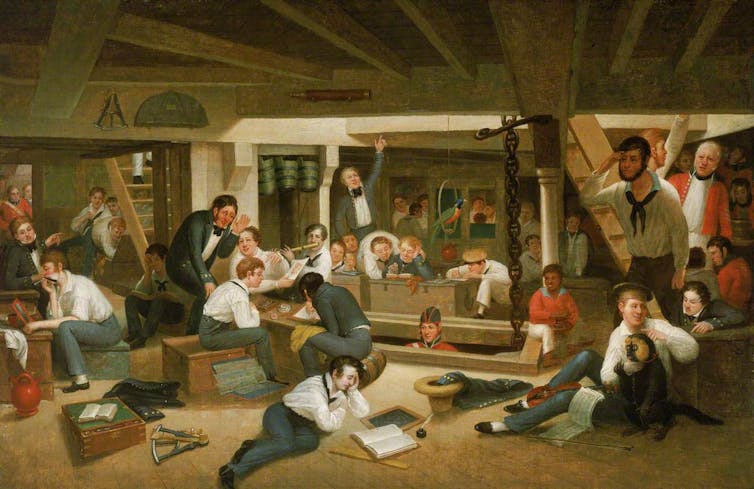
Life in the Ocean Representing the Usual Occupations of the Young Officers in the Steerage of a British Frigate at Sea by Augustus Earle (1836). National Maritime Museum
One such example was whistling aboard ships, which was believed to stir winds or gales. The idea that the temperamental winds could be provoked by the smallest actions of the tiny human beings who passed over the ocean’s surface spoke to both mariners’ vulnerability at sea, but also a sense of personal responsibility for the good or bad fortune of their voyage.
That concerns about death haunted seafarers is also seen in a superstitious reluctance to have coffins, dead bodies or clergymen (associated with funerals) aboard ship. As the author and critic William Jones wrote in Credulities Past and Present (1880), the sailor who was fearless in battle or in the face of physical danger, often “shrinks with indescribable apprehension … at the sight of a coffin”.
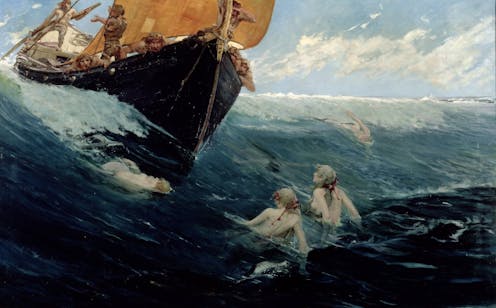
This was reinforced by maritime ghost stories. Numerous tales of ghost ships, most famously The Flying Dutchman, served as a reminder of the haunting prospect of death at sea.
In telling stories of those who had been lost, seafarers could also express concerns about their present circumstances and future travails. Aboard ships, such tales could also serve as reminders of health and safety concerns. Stories about ghostly crew members who had fallen from the rigging or been washed overboard served as cautionary tales.
The decline and return of maritime folklore
Nineteenth-century critics of mariners’ “superstitions” attempted to debunk their ideas. They pushed the idea that this body of folklore was fading out with the transition from sail to steam power.
No longer reliant on the winds, the steamship symbolised a more rational, mechanical world that had no time for the supernatural whimsy of the age of sail. Yet, indicating its ongoing importance as a way of addressing seafarers fears and concerns, such ideas did not simply disappear. Rather they adapted to the modern world.
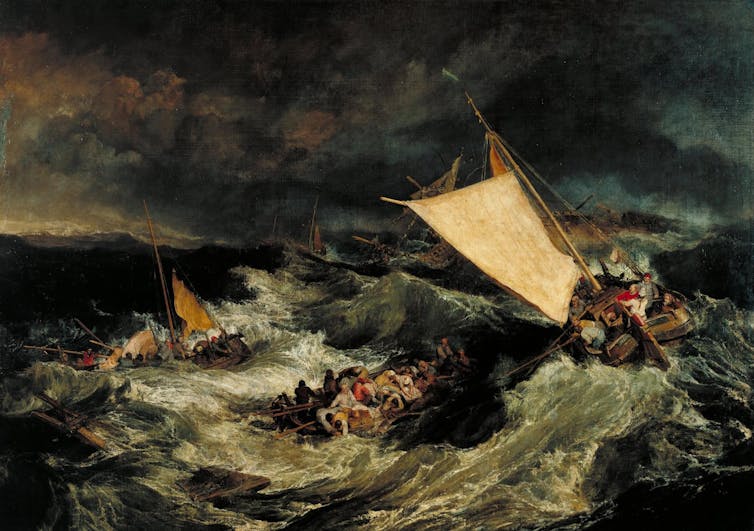
The Shipwreck by Joseph Mallord William Turner (1805). Tate
While the price of cauls had dropped in the late 19th century, suggesting declining belief in their protective power, there was a sudden revival in their trade when submarine warfare became a feature of the first world war. Accounts of ghost ships were updated to include steam and later diesel vessels in the 20th century.
Maritime folklore history reminds us that our proclaimed “mastery of the waves” has always been built on rhetoric as much as reality.
In an age of mounting concern about our relationship with the oceans, in which we are having to radically reassess our control over and influence on the natural world, it is perhaps time for this history to resurface.
This article features references to books that have been included for editorial reasons, and may contain links to bookshop.org. If you click on one of the links and go on to buy something from bookshop.org The Conversation UK may earn a commission.
Karl Bell does not work for, consult, own shares in or receive funding from any company or organisation that would benefit from this article, and has disclosed no relevant affiliations beyond their academic appointment.
Source: The Conversation – UK – By Travis Van Isacker, Senior Research Associate, School of Sociology, Politics and International Studies, University of Bristol
On a cold, wet November evening, Issa Mohamed Omar and more than 30 other men, women and children set off from their informal camp near the northern French port city of Dunkirk. They walked through the darkness in near-silence for around two hours, until they reached the beach from where they hoped to start a new and better life.
As they arrived, five men were busy pumping up an inflatable dinghy and attaching an outboard engine. These people smugglers had charged each of their customers more than a thousand euros for a trip that costs someone with the right passport less than a hundred.
The travellers were given life-vests, arranged into rows and counted. “There are 33 of you,” one of the smugglers said. For many on board, this was not their first attempt at reaching England.
Most came from Iraqi Kurdistan, including Kazhal Ahmed Khidir Al-Jammoor from Erbil, who was travelling with her three children: Hadiya, Mubin and Hasti Rizghar Hussein, respectively aged 22, 16 and seven.
A father and son from Egypt were shown how the engine worked and provided a GPS device and directions to Dover, around 35 miles (60km) to the west across the Channel. Mohamed Omar would later recall:
The Egyptian man was put in charge of steering the boat by the smugglers. He was travelling with his son, who looked like he was in his late teens or maybe early 20s. I do not know how they came to be the driver and navigator.
There were also at least three Ethiopian nationals – one of whom, father-of-two Fikiru Shiferaw from Addis Ababa, sent his wife Emebet at home in Ethiopia a final WhatsApp voice message:
We have already boarded the boat. We are on the way. I will turn off my phone now. Goodnight, I will call you tomorrow morning.
These were the last words she would ever receive from her husband.
What happened to Fikiru Shiferaw and the other passengers on the night of November 23-24 2021 has been the subject of the UK’s Cranston Inquiry which, during March 2025, heard from 22 witnesses to the disaster, including officers involved in the UK’s search-and-rescue (SAR) response. Chaired by former High Court judge Sir Ross Cranston, the independent inquiry also heard from Mohamed Omar from Somalia – one of only two survivors – as well as family members of many of the dead and missing.
These hearings not only shed light on the actions of UK Border Force and His Majesty’s Coastguard officers during the failed rescue operation – designated Incident Charlie – in the early hours of November 24, but the agencies’ approach to “small boat crossings” in general dating back to 2017.
According to the testimonies, officers had been operating under extreme pressure in the months leading up to the disaster. Kevin Toy, master of the Border Force ship Valiant which was sent out to search for the missing dinghy that night, explained that in the run-up to the incident, “night after night” he could see his crew were “utterly exhausted” by the end of their shifts.
The evidence shows the British government was aware of the growing risk that Border Force and HM Coastguard could be overwhelmed by the rising number of small boat crossings – and that people might die as a result. In May 2020, a document produced by the Department for Transport acknowledged that “SAR resources can be overwhelmed if current incident numbers persist”. At least three senior HM Coastguard officers identified the same risk in August 2021.
Multiple communication failures have also been exposed by the inquiry – among British officers, with their opposite numbers in France, and between both countries’ emergency services and the increasingly desperate people aboard the sinking dinghy.
Despite numerous distress calls and GPS coordinates being shared via WhatsApp, a rescue boat failed to reach the travellers in time. Amid the confusion, when their calls stopped, the coastguard assumed Charlie’s passengers had been picked up and were safe. In fact, they were perishing in the cold waters of the Channel over more than ten hours.
The Insights section is committed to high-quality longform journalism. Our editors work with academics from many different backgrounds who are tackling a wide range of societal and scientific challenges.
As part of my research into the digital transformation of the UK-France border, I attended the inquiry and have studied the many statements, call transcripts, operational logs, emails and meeting minutes it has made public. Initially, I wanted to understand how the November 2021 disaster became a watershed moment in the UK government’s response to people trying to cross the Channel by small boat or dinghy, catalysing the transformation of the UK’s maritime border into the hyper-surveilled space it is today.
But, after speaking to representatives for Mohamed Omar and the bereaved families as well as migrant rights organisations, larger questions have emerged. In particular, given the inquiry’s singular focus on this one catastrophic event in November 2021, those I spoke to are concerned that its recommendations will be unable to prevent further deaths from occurring in the Channel, which have risen dramatically over the last 18 months.
How ‘small boat crossings’ began
Since the UK and France began operating “juxtaposed” border controls in the early 1990s (meaning border checks occur before departure), asylum seekers trying to reach England have had to make irregular journeys across the Channel. Until 2018, these were typically aboard trains and ferries – after sneaking on to a lorry or through a French port’s perimeter security.
At the time of the “Jungle” camp near Calais in 2015-16, media coverage of collective attempts by its residents to enter French ports spiked UK government investment in the border. Between 2014 and 2018, it gave its French counterpart at least £123 million to “strengthen the border and maintain juxtaposed controls”. These funds paid for French police to patrol the ports and border cities, regularly evict migrants’ living sites, and finance detention and relocation centres.
As admitted by then-home secretary Sajid Javid in 2019, this increased security led people to find other ways across the Channel. Beginning in the winter of 2018, smugglers organised journeys in small, seaworthy vessels they had stolen from marinas along the French coast. These “small boats” continue to lend their name to this migration phenomenon – yet the unseaworthy inflatable dinghies used today, with no keel or rigid hull, are not worthy of the name.
Even in the context of the usual sensationalism surrounding irregular migration to the UK, small boat journeys were met with an especially intense response, both politically and in the media.
When 101 people crossed between Christmas and New Year in 2018, Javid declared it a major incident. Ever since, “stopping the boats” has been one of the UK government’s highest priorities. Despite small boat arrivals making up only 29% of UK asylum claimants in 2018-24, billions of pounds have been spent to try and control the route.
Frosty relations and the ‘pushback’ plan
As Channel crossings rose sharply over 2020-21, worsening relations between France and the UK due to Brexit complicated how the two governments worked together to respond. In his testimony, former clandestine Channel threat commander Dan O’Mahoney – appointed by Javid’s successor, Priti Patel, to “make small boat crossings unviable” – described relations between the two countries as already “very frosty” when he began in August 2020.
After France’s then-interior minister, Gérald Darmanin, axed a plan for UK vessels to take rescued migrants back to Dunkirk, O’Mahoney was tasked by senior ministers to come up with an alternative. The resulting “pushback” plan, called Operation Sommen, involved Border Force officers on jet skis driving into migrant dinghies to turn them back as they crossed the border line into UK waters. When France learned of the plan, O’Mahoney recalled:
They thought it went counter to their and our obligations around safety of life at sea … They objected to it very strongly, and it affected our already quite strained relationship with them further.
Operation Sommen was abandoned in April 2022 before having ever been used in anger. However, preparations were said to have taken up “a very considerable amount of time and resource” at both the Home Office and the Maritime and Coastguard Agency – and had “a detrimental effect” on the UK’s overall SAR response to small boat crossings.
At a meeting of senior officials in June 2021 to discuss Operation Sommen, ministers had made clear that the “numbers of people crossing [was] a political problem” – and that improving SAR capabilities did not “fit with [the] narrative of taking back control of borders”.
Although senior HM Coastguard officers recognised “it is extremely difficult to locate small boats or communicate with those onboard”, the inquiry heard that officers did not recall receiving “any small boat training before November 2021”, other than in the procedure to allow Border Force to push them back to French waters.
The head of Border Force’s Maritime Command, Stephen Whitton, told the inquiry he was under “a huge amount of pressure” to prevent small boat crossings, while also “providing the bulk of the support to search and rescue”. Despite carrying out 90% of all small boat rescues in the Channel and “regularly being overwhelmed”, Border Force Maritime Command received “no additional assets to manage the search and rescue response” before November 2021.
‘The pressure we were under’
When the decision was taken for Border Force – a law enforcement rather than search-and-rescue organisation – to be the primary responders to small boat crossings in 2018, only around 100 people were crossing each month. Yet by the time of the disaster three years later, according to an internal Home Office document, the total for 2021 was “already more than 25,000”.
At the inquiry, O’Mahoney stated: “As 2021 went on, it became much clearer that … frankly, we just needed more [rescue] boats.” Whitton admitted that before the disaster, Border Force, HM Coastguard, the Royal National Lifeboat Institution and other support organisations were all “on our knees in terms of the pressure we were under, and it was getting hugely challenging”.
The evidence shows this pressure was acutely felt inside Dover’s Maritime Rescue Coordination Centre, which sits atop the port’s famous white cliffs offering a commanding view of the Channel. Inside, Coastguard officers coordinate SAR operations and control vessel traffic in the Dover Strait – one of the world’s busiest shipping lanes.
On the night of November 23-24, three coastguard officers were on search-and-rescue duty: team leader Neal Gibson, maritime operations officer Stuart Downs, and a trainee – unnamed by the inquiry – who was officially only present as an observer.
HM Coastguard’s Maritime Rescue Coordination Centre at Dover overlooking the Channel. Travis Van Isacker, CC BY-NC-SA
Staffing appears to have been a longstanding issue at the Dover coastguard station where, according to divisional commander Mike Bill, there was “poor retention of staff” and “experience and competence weren’t the best”. Only the day before the disaster, during a migrant red days meeting – convened when, due to good weather, the probability of Channel crossers is considered “highly likely” – chief coastguard Peter Mizen had warned that only having two qualified officers at Dover on nights “isn’t enough”.
Over recent months, as the station had become busier responding to small boat crossings and in the wake of an unsuccessful recruitment drive, staff were having to work flat-out throughout their shifts, and were being asked to come in on scheduled days off.
On the night of November 23-24, owing to staff shortages, team leader Gibson told the inquiry he had to cover traffic control duties for three hours from 10.30pm. This meant he was away from the SAR desk at 00.41am, when a message arrived from the national rescue coordination centre along the coast in Fareham, stating that the Coastguard’s scheduled surveillance aeroplanes would not be flying over the Channel that night due to fog.
The officers were told they would be “effectively blind” – and should not allow themselves “to be drawn into relaxing and expecting a normal migrant crossing night”. The message warned: “This has the potential to be very dangerous.”
‘Their boat – there’s nothing left’
According to Mohamed Omar, the sea was calm when he and the other passengers departed the French beach around 9pm UK time. Giving his evidence to the Cranston Inquiry from Paris – he still cannot travel to the UK – a ship approached them around an hour into their voyage:
They came up to us to see what we were doing, and shone a light on us. I remember seeing a French flag on the boat. It was a big boat and I am certain it was the French coastguard. I had heard from people I met in the camp in Dunkirk that this happened sometimes, and that the French boat would follow until you reached English waters.
In fact, Mohamed Omar said, the French ship left the travellers again after about an hour. Shortly after this, the problems began.
A French warship patrols the shore of Mardyck in northern France, close to where Charlie is thought to have departed. Travis Van Isacker, CC BY-NC-SA
Around 1am, seawater began entering the dinghy. By now, it was in the vicinity of the Sandettie lightvessel, around 20 miles north-east of Dover. At first, passengers managed to bail out the 13°C water – but soon the flooding became uncontrollable. The dinghy’s inflatable tube began losing pressure, and a couple of the Kurdish men used air pumps to try to keep it inflated. Others tried to prevent panic spreading among the passengers.
Many onboard began to make frantic calls for rescue. What were reported to be leaked transcripts of some of these calls were published by French newspaper Le Monde a year after the sinking. They showed the first distress call from the dinghy was received by the French coastguard at 12.48am. Speaking in English, the caller said there were 33 people on board a “broken” boat.
According to Le Monde, three minutes later, another call was transferred to the French maritime rescue coordination centre at Cap Gris-Nez by an emergency operator who reported: “Apparently their boat – there’s nothing left.” Following procedure, the French coastguard officer asked the caller to send a GPS position by WhatsApp so she could “send a rescue boat as soon as possible”. At 1.05am UK time, the GPS position arrived.
Rather than send a French boat, Le Monde reported that the officer phoned her counterparts in Dover to warn them a dinghy 0.6 nautical miles from the border line would soon be crossing into UK waters. On the other end of the line was the trainee officer, who was handling routine calls that night despite officially only being an observer.
After the call finished, according to Downs’s evidence to the inquiry, the trainee mistakenly told him the dinghy was thought to be “in good condition” – information he recorded in the log for Incident Charlie. This miscommunication may have affected the urgency of the UK’s SAR response, preventing HM Coastguard and Border Force from appreciating the severe distress the “broken” dinghy was in.
Just before 1am, the French coastguard had sent its migrant tracker spreadsheet, containing information on all small boat crossings that night, to HM Coastguard for the first time. It showed four migrant dinghies at sea – which Gris-Nez had been aware of “for many hours”, according to Gibson.
The issue of the French coastguard appearing to withhold information about active small boat crossings had been raised by HM Coastguard’s clandestine operations liaison officer during a July 2021 review. And earlier that very evening, Gibson told one of his colleagues:
Sometimes they just seem to keep it quiet. Like we’ll not get anything – then we’ll get a tracker at three in the morning with 15 incidents, and they go: ‘Mostly these are in your search-and-rescue region.’ Wonderful.
At 1.20am, Downs phoned Border Force Maritime Command in Portsmouth to request a Border Force vessel search for the dinghy Charlie. He provided the GPS position received from his French counterpart and the number of people onboard – but also the incorrect information that “they think it’s in good condition”.
Ten minutes later, the Valiant, Border Force’s 42-metre patrol ship stationed at Dover, was tasked to proceed towards the Sandettie lightvessel. At the same time, the first direct call to the Dover rescue coordination centre came in from Charlie. The distressed caller said they were “in the water” and that “everything [was] finished”.
Around 15 minutes later, at 1.48am, Gibson took a call from 16-year-old Mubin Rizghar Hussein, who spoke good English. Despite the noise and commotion, he managed to provide Gibson with a WhatsApp number – in order to share their GPS position. The transcript of this call records voices shouting in the background: “It’s finished. Finished. Brother, it’s finished.”
A ‘grave and imminent threat to life’
Gibson told the inquiry that after his call with Rizghar Hussein, he had a “gut feeling that this doesn’t feel quite as usual”. By “usual” he meant what was, according to maritime operations officer Downs, a commonly held belief at the Dover coastguard station that with “nine out of ten”“ callers from small boats: “It would generally be overstated that the boat … was sinking, people were drowning … Whatever was going on would be overstated.”
Acting on his gut feeling, at 2.27am Gibson took the unprecedented decision to broadcast a Mayday Relay – denoting a “grave and imminent threat to life”. By maritime law, this alert required other vessels to offer their assistance.
Gibson told the inquiry he did this to get the French warship Flamant to respond. He could see on his radar screen that Flamant was closest to Charlie’s position and was the best vessel to rescue the people if the dinghy really was sinking.
Why the Flamant did not respond is at the centre of an ongoing criminal investigation in France into two of the warship’s officers and five coastguards from Gris-Nez, for “non-assistance of persons in distress”. This investigation’s strict confidentiality obligation means the inquiry was unable to access any information from the French side about their operations that night.
At 2.01 and again at 2.14am, HM Coastguard had received new GPS positions via WhatsApp showing the dinghy to be more than a mile inside UK waters.
Valiant, having been tasked at 1.30am, only exited the port of Dover at 2.22am and would need at least another hour to reach the Sandettie. Despite this, no other vessel was sent to join the search. At 3.11am, when asked during a call by Border Force Maritime Command whether Charlie was “still a Mayday situation”, Gibson replied: “Well, they’ve told me it’s full of water.”
With a total of four small boats being shown in the Channel that night by the French tracker spreadsheet, Gibson suggested there could be as many as 110 people on board these dinghies – beyond Valiant’s capacity for taking on survivors. Nevertheless, Border Force and HM Coastguard opted to “wait and see what the numbers are, and whether Valiant can deal with that … We don’t want to call any other assets out just yet.”
In a call with Christopher Trubshaw, captain of the Coastguard rescue helicopter stationed at Lydd on the Kent coast, aviation tactical commander Dominic Golden explained that Border Force was “not prepared to bring in their crews who are pretty knackered” unless “we can convince them there are people in real danger”. He then asked Trubshaw to search the Channel for the small boats shown in the French tracker, as the surveillance aeroplanes had been unable to take off.
In her closing submission to the inquiry, Sonali Naik, a legal representative of the survivors and bereaved families, highlighted Golden’s “dismissive attitude” towards Charlie’s distress when he gave Trubshaw the reason for the request, which included the following:
As usual, the catalogue of phone calls is beginning to trickle in … You know, the classic ‘I am lost, I am sinking, my mother’s wheelchair is falling over the side’ etc. ‘Sharks with lasers surrounding boat’ and ‘we are all dying’ type of thing.
Nevertheless, Golden asked the helicopter crew to pack a liferaft. “I can’t imagine we’re going to need it but … potentially you get to play with one of your new toys.”
While Golden described his words as “unwise” or “flippant”, Naik said they were “more than that” – suggesting they revealed rescuers’ general perceptions of the occupants of small boats and the widely held scepticism towards their distress calls.
‘We are dying. Where is the boat?’
With the water inside rising fast and their dinghy collapsing, Charlie’s increasingly desperate passengers kept trying to get rescuers to appreciate how dire their situation was.
At 2.31am in the Dover rescue coordination centre, Gibson received a second call from Mubin Rizghar Hussein, who pleaded: “We are dying, where is the boat?”
Gibson replied: “The boat is on its way but it has to get …” only to be interrupted by Rizghar Hussein saying: “We all die. We all die.”
“I get that,” Gibson told the terrified teenager, “but unfortunately, you’re going to be patient and all stay together, because I can’t make the boat come any quicker.” He ended the call saying:
You need to stop making calls because every time you make a call, we think there’s another boat out there – and we don’t want to accidentally go chasing for another boat when it’s actually your boat we’re looking for.
Gibson broke down briefly when recounting this second call during his evidence to the inquiry, explaining:
If you don’t understand what’s fully going on and you’re getting ‘we’re all going to die’, it’s quite a distressing situation to find yourself in, sitting at the end of a phone – effectively helpless. You know where they are, you want to get a boat to them, and you can’t.
Call records also show that coastguards on both sides of the Channel passed responsibility for rescuing the sinking dinghy off to one another. According to Le Monde, during one call a passenger told the French coastguard officer he was “in the water” – to which she replied: “Yes, but you are in English waters.”
The transcript of the last call before Charlie capsized, made at 3.12am, reveals that Downs asked “where are you?” 17 times – despite the caller being unable to answer anything beyond “English waters”. The maritime operations officer finished by instructing the caller to hang up and dial 999: “If it won’t connect on 999, then you’re probably still in French waters.”
In her closing submission, Naik pointed to “discriminatory stereotypes and attitudes towards migrants on small boats which fatally affected the SAR response” for Charlie – as rescuers, in her words, “jumped to premature conclusions”. According to survivor Mohamed Omar:
Because we have been seen as refugees … that’s the reason why I believe the rescue, they did not come at all. We feel like we were … treated like animals.
Fatal assumptions
At 3.27am, Border Force’s ship Valiant arrived at Charlie’s last recorded GPS position (from 2.14am) – but found nothing. Its master, Kevin Toy, decided to head north-easterly towards the Sandettie lightvessel, the way the tide was flowing.
En route, Valiant spotted two other dinghies in the darkness using its night vision – one still making its way towards the English coast, the other stopped in the water. The stationary dinghy was in greater danger from the Channel’s shipping traffic, so Valiant went to it and began rescuing those onboard – radioing back that it had “engaged unlit migrant crafts stopped in the water” with approximately 40 people onboard.
In the Dover rescue coordination centre, Gibson assumed this dinghy could be Charlie and gave Mubin Rizghar Hussein’s name and telephone number so Valiant’s crew could verify whether he was on board. At 4.16am, Gibson himself tried calling the WhatsApp number that Rizghar Hussein had shared, but the call failed.
At 4.20am, Valiant completed its first rescue of the morning. Two more followed after the Coastguard helicopter spotted two other dinghies in the Sandettie area – but nobody in the water. A near-capacity Valiant then returned to Dover just after 8am with 98 survivors on board.
None of the three rescued dinghies matched the description of Charlie. All were in good condition, differently coloured, and with disparate numbers of people onboard – yet the misplaced assumption Charlie had been rescued persisted amid the night’s murky information environment. Gibson stated that, while he had soon received additional information matching Valiant’s first rescue to a different dinghy, he was still “fairly certain Charlie had been picked up”.
“Once Valiant had picked up these [three] boats,” he explained, “we no longer received calls from Charlie, and a call to a known phone number on Charlie failed.” As a result, neither Valiant nor the Coastguard helicopter were sent back out to continue searching for the stricken dinghy.
In fact, Gibson’s call to Rizghar Hussein’s WhatsApp number did not fail because Charlie’s passengers had been rescued – nor because they had thrown their phones into the sea when Border Force arrived. Rather, it was because the dinghy had capsized and everyone had fallen into the Channel’s freezing waters.
‘No one came to our rescue’
In harrowing evidence to the inquiry, Mohamed Omar explained how, as one side of the dinghy deflated, the passengers – “hysterical and crying” – panicked and moved to the opposite side. This shift in weight caused the dinghy to capsize:
The screaming when the boat tipped and people fell in the water was deafening. I have never heard anything as desperate as this. I was not thinking about whether we were going to be rescued any more; it was all about how to stay alive.
As the passengers were thrown into the water, the dinghy flipped on top of them. Mohamed Omar described having to swim out from underneath to catch a breath: “It was dark and I could not really see. It was extremely cold and the sea was rough.”
As he surfaced, he saw Halima Mohammed Shikh, a mother of three also from Somalia and travelling alone, struggling as she couldn’t swim. She screamed his name for help, and he tried to get her back to what was left of the dinghy – but couldn’t. “I think she was one of the first people to drown,” he told the inquiry.
Others managed to cling to the broken inflatable, hoping rescue was on its way – but “no one came to our rescue”. Pushed and pulled by the waves, some lost their grip and drifted away before dawn. Mohamed Omar recalled:
All night, I was holding on to what remained of the boat. In the morning, I could hear the people were screaming and everything. It’s something I cannot forget in my mind.
By the time the sun finally rose at 7.26am, he estimated that no more than 15 people were left clinging to the broken dinghy – adrift on the tide in a busy shipping lane:
I do not recall speaking with anyone in the water. Those who were alive were half-dead. There was nothing we could do any more. I could see bodies floating all around us in the water. I presume most people were either already dead or were unconscious.
Shortly afterwards, Mohamed Omar said he let go of the dinghy and began to swim, thinking to himself: “I am going to die [but] I don’t want to die here. At least if I die whilst swimming, I won’t feel it.”
He swam towards a boat he could see in the distance and, as he got closer, began to wave his life jacket for attention. A French woman, out fishing with her family, saw him and jumped in the water to save him.
As he finished telling his story, Mohamed Omar told the inquiry: “I’m a voice for those people who passed away.”
Bodies are found
Around 1pm on the afternoon of November 24, 12 hours after the first distress calls from Charlie, a French commercial fishing vessel began finding bodies in the sea nine miles north-west of Calais. But as the news came in, no one at HM Coastguard or Border Force appears to have made the connection with Incident Charlie.
Days later, when the accounts of Mohamed Omar’s fellow survivor, Mohammed Shekha Ahmad from Iraqi Kurdistan, and a relative of two of the deceased emerged, the Home Office refuted their claims that the dinghy had sunk in UK waters as “completely untrue”.
However, five days after the disaster, Gibson contacted the small boats tactical commander to share his concerns that the reported deaths could be from Charlie. He had read a news article in which “the survivor states a male called Mubin called the emergency services, which could possibly be the ‘Moomin’ [sic] I spoke to”.
On December 1, clandestine Channel threat commander O’Mahoney responded to a question from the UK’s Joint Committee on Human Rights, as to whether the migrants whose bodies had been found in French waters had made distress calls to the UK authorities. O’Mahoney told the committee:
We are looking into that. To manage your expectation, though, it may never be possible to say with absolute accuracy whether that boat was in UK waters [and] I cannot tell you with any certainty that the people on that particular boat called the UK authorities.
Thanks largely to their grieving families tireless pursuit of the truth, however, it is now possible to say definitively that Charlie had been in UK waters – and that a number of its passengers spoke to HM Coastguard officers.
It was only after these families raised concerns that the disaster had involved the UK authorities that the Department for Transport commissioned a safety investigation into the incident in January 2022. A lawyer for the bereaved families suggested to me that without the threat of legal action, the Department for Transport “would likely not have done anything” – despite this being Britain’s worst maritime disaster for decades. Meanwhile, according to inquiry evidence, the Home Office is understood not to have conducted an internal review or investigation into its role in the disaster.
After a frustrating two years of waiting for the survivors and bereaved families, the Marine Accidents Investigations Branch published its report – which both confirmed most of their accounts and substantiated their criticisms of the SAR response.
Soon afterwards, the Cranston Inquiry was announced. Despite no bodies having been recovered in UK waters, it has been run almost like an inquest. In his final report – to be published by the end of 2025 – Sir Ross Cranston has promised to “consider what lessons can be learned and, if appropriate, make recommendations to reduce the risk of a similar event occurring”.
A ‘crucial and unique opportunity’
HM Coastguard and Border Force officers have repeatedly told the inquiry how the UK’s approach to small boat search-and-rescue has changed since the November 2021 disaster. More officers have been hired, Border Force has contracted additional boats to conduct rescues, information sharing has improved, and cooperation with French colleagues is better. Today, there are significantly more rescue ships on both sides of the Channel which can intervene faster when dinghies come to be in distress, and have undoubtedly saved many lives.
There has also been massive investment in drones, aeroplanes and powerful shore-based cameras to reduce the risk that HM Coastguard loses “maritime domain awareness” again if some of its surveillance aircraft are unable to fly. New technology automatically translates coastguard officers’ messages into different languages and extracts live GPS locations and images from travellers’ mobile devices.
Such investments make it unlikely that another dinghy could be lost in the middle of the Channel after its passengers call for help, in the way Charlie so catastrophically was.
Nevertheless, people continue dying while attempting to cross the Channel – with 2024 having been by far the deadliest year yet. At least 69 people lost their lives, according to the Refugee Council. So far in 2025, 24 people are documented as dead or missing at the UK-France border by Calais Migrant Solidarity, amid a record number of attempted crossings for the first half of the year.
Some migrants’ rights NGOs have suggested the UK’s “stop the boats” policies, and European efforts to disrupt the supply chain of dinghies and other equipment used in crossings, has driven such deadly overcrowding.
But it is also unlikely that the circumstances surrounding more recent deaths in the Channel will ever be investigated as thoroughly as Incident Charlie, if at all. Lawyers for the bereaved families have therefore been keen to highlight the Cranston Inquiry’s “crucial and unique opportunity” not only to look back and offer answers about one of Britain’s worst maritime disasters in recent decades – but to look forwards and “prevent the further loss of life at sea”.
The survivors, families and migrants’ rights organisations who contributed their evidence thus hope the inquiry’s recommendations go beyond purely operational and administrative improvements to search-and-rescue, to address the fundamental role that UK, France and European border policies play in why more people are dying in the Channel, despite the improvements to search-and-rescue strategies and resources.
Above all, they ask why only some people are able to travel to the UK in comfort and safety while others must make the journey in precarious, overcrowded inflatable dinghies – and thus entrust their lives to the search-and-rescue services whose success can never be guaranteed. As Halima Mohammed Shikh’s cousin, Ali Areef, told the inquiry:
It makes me feel sick to think about crossing the Channel in a ferry where others including a member of my family lost their lives because there was no other way to cross. I will never take a ferry across the Channel again.
To hear about new Insights articles, join the hundreds of thousands of people who value The Conversation’s evidence-based news. Subscribe to our newsletter.
Travis Van Isacker gratefully acknowledges the support of the Economic and Social Research Council
(UK) (Grant Ref: ES/W002639/1).
Source: The Conversation – UK – By Marc Fullman, Docotoral Researcher in Organisational Behaviour, University of Sussex Business School, University of Sussex
If your first task of the day is triaging a bulging inbox at 6am, you are not alone. A recent Microsoft report headlined “Breaking down the infinite workday” found that 40% of Microsoft 365 users online at this hour are already scanning their emails – and that an average worker will receive 117 emails before the clock rolls around to midnight.
But that’s not all. By 8am, Microsoft Teams notifications outstrip email for most workers, and the typical employee is hit with 153 chat messages during the day.
The report states that, while meetings swallow the prime 9am–11am focus window, interruptions arrive every two minutes throughout the day. This perpetual work overload means a third of professionals reopen their inbox to answer more emails at 10pm.
In short, Microsoft’s telemetry of this “triple-peak” day (first thing, mid-morning and late at night) paints a vivid picture of a work rhythm that never stops.
From an occupational psychology perspective, these statistics are more than curious trivia. They signal a cluster of psychosocial hazards.
Boundary Theory holds that recovery depends on clear and solid boundaries – both psychologically and in terms of time – between work and the rest of life. Microsoft’s findings show those limits dissolving. This includes 29% of users checking email after 10pm.
Similarly, a four-day diary study of Dutch professionals found that heavier after-hours smartphone use predicted poorer psychological detachment and exhaustion the next day.
This can have wider consequences. When people are busy, rushed or harried, one of the first things to suffer is their regulation of online behaviour. Large-scale survey research shows that ambiguous or curt digital messages occur when we are depleted. These can obviously sap wellbeing in recipients.
In a 2024 study of workers in the UK and Italy, incivility in emails between colleagues predicted work-life conflict and exhaustion via “techno-invasion”, as workers reported being exposed to an ongoing torrent of unpleasant messaging.
So-called ‘techno-invasion’ could lead to work-life conflict and emotional exhaustion. fizkes/Shutterstock
My ongoing doctoral research examines how workers respond to messages they receive, and exposes the nuance on different communication platforms. Among the 300 UK workers involved, identical messages were rated as more uncivil on email than on Teams, particularly when they were informal. Frustration on the part of a recipient (in terms of how they interpret a message) accounted for nearly 50% of perceived incivility on email, but only 30% on Teams.
These findings suggest that choice of platform significantly influences how messages are received and interpreted. Using these insights, organisations can make informed decisions about communication channels, and potentially reduce workplace stress and improve employee wellbeing in the process.
Microsoft suggests that AI “agent bosses” will rescue workers. These tools could summarise inboxes, draft replies and free up humans for higher-order work.
The data, however, exposes a cultural contradiction. Managers tell staff to switch off, yet their appraisal spreadsheets tell a different story. In one set of experiments, the same bosses who praised weekend digital detoxing also ranked the detoxers as less promotable than colleagues who were glued to their inboxes.
Little wonder Microsoft’s own data shows the same late-night peak, despite widespread wellbeing guidance to switch off after hours. Without changing how commitment is signalled and rewarded, faster tools risk accelerating the treadmill rather than dismantling it.
What organisations can do
1. Individual level – let people feel they have control
Encourage “quiet hours” and teach employees to disable non-urgent notifications. Boundary-control research shows that when workers feel they have control over connectivity, it creates a buffer against fatigue caused by after-hours email.
2. Team level – communication charters
Teams should agree explicit norms for communication. This could include capping the numbers invited to meetings and insisting on agendas. Simple charters along these lines restore predictability for workers and cut “decision fatigue”.
3. Organisational level – redesign metrics
Organisations could shift from visibility (green dots and instant replies) to outcome-based metrics for productivity. This removes the incentive for workers to stay online and aligns with evidence that autonomy is a key resource.
4. Technological level – AI for elimination, not acceleration
Workplaces should deploy AI assistants to remove low-value tasks (for example, sorting email or drafting minutes), not just speed them up. Then they should conduct workload audits to ensure the time saved is reinvested in deep work, not simply swallowed up by extra meetings.
The Microsoft dataset is enormous, but there are two important points to note. First, European jurisdictions with “right to disconnect” laws may be missing from the figures. Second, some metrics (for example, interruptions) are calculated on the most active fifth of users, potentially overstating a typical experience.
But if the numbers in Microsoft’s report feel familiar, that is precisely the point. The technology designed to liberate workers is now scripting their day minute-by-minute. Occupational psychology researchers warn that without deliberate boundary setting, rising digital job demands will continue to tax wellbeing and dull performance.
AI can be a circuit breaker, but only if it is accompanied by cultural and structural change that gives employees permission to disconnect.
The infinite workday is not a law of nature, it is a design flaw. Fixing it will take more than faster software – it will demand a collective decision to prize focus, recovery and civility as fiercely as workers currently prize availability.
Get your news from actual experts, straight to your inbox.Sign up to our daily newsletter to receive all The Conversation UK’s latest coverage of news and research, from politics and business to the arts and sciences.
Marc Fullman does not work for, consult, own shares in or receive funding from any company or organisation that would benefit from this article, and has disclosed no relevant affiliations beyond their academic appointment.
Technology platforms operating in the UK now have a legal duty to protect young people from some of the more dangerous forms of online content. This includes pornography, content that encourages, promotes, or provides instructions for violence, promotion of self-harm and eating disorders. Those failing to comply face hefty fines.
Until now, parents have had the unenviable role of navigating web content filters and app activity management to guard their children from harmful content. As of 25 July 2025, the Online Safety Actputs greater responsibility on platforms and content creators themselves.
In theory, this duty requires tech organisations to curb some of the features that make social media so popular. These include changing the configuration of the algorithms that analyse a user’s typical behaviour and offer content that other people like them usually engage with.
This is because the echo chambers that these algorithms create can push young people towards unwanted (and crucially, unsolicited) content, such as incel-related material.
The Online Safety Act directly acknowledges the impact of algorithms in targeting content to young people. It forms a key part of Ofcom’s proposed solutions. The act requires platforms to adjust their algorithms to filter out content likely to be harmful to young people.
It’s yet to become clear exactly how tech companies will respond. There has been pushback over negative attitudes to algorithms, though. A response from Meta, which owns Facebook, Instagram and WhatsApp, to Ofcom’s 2024 consultation on protecting children from harms online counters the idea that “recommender systems are inherently harmful”.
It states: “Algorithms help to sort information and to create better experiences online and are designed to help recommend content that might be interesting, timely or entertaining. Algorithms also help to personalise a user’s experience, and help connect a user with their friends, family and interests. Most importantly, we use algorithms to help young people have age-appropriate experiences on our apps.”
Age verification
A further safety measure is the use of age checks. Here, Ofcom is enforcing platforms to make “robust age checks” and, in the case of the most serious of content creation sites, these must be “highly effective”.
Users will need to prove their age. Traditionally, age-verification checks involve the submission of government-issued documents – often accompanied by a short video to verify the accuracy of the submission. There have been technological advances which some platforms are embracing. Age-estimation services involve uploading a short video or photo selfie which is analysed by AI.
If enforced, the Online Safety Act may not only restrict access to pornography and other recognised extreme content, but it could also help stem the flow of knife sales.
Research shows exposure to knife crime news on social media is linked to symptoms similar to PTSD. Research by one of us (Charlotte Coleman) and colleagues has previously shown that negative effects of seeing knife imagery may be more severe for girls and those who already feel unsafe.
Even on strongly regulated platforms, though, some harmful material can seep through the algorithm and age checks net. Active moderation is therefore a further requirement of the act. This means platforms need to have processes in place to look at user-generated content, assess the potential harm and remove it if appropriate to ensure swift action is taken against content harmful to children.
This may be through proactive moderation (assessing content before it is published), reactive moderation based on user reports, or more likely, a combination of the two.
Even with these changes, invisible online spaces remain. A host of private, encrypted end-to-end messaging services, such as messages on Whatsapp and snaps on Snapchat, are impenetrable to Ofcom and the platform managers, and rightly so. It is a vital fundamental right that people are free to communicate with their friends and family privately without fear of monitoring or moderation.
However, that right may also be abused. Negative content, bullying and threats may also be circulated through these services. This remains a significant problem to be addressed and one that is not currently solved by the Online Safety Act.
These invisible online spaces may be an area that, for now, will remain in the hands of parents and carers to monitor and protect. It is clear that there are still many challenges ahead.
Get your news from actual experts, straight to your inbox.Sign up to our daily newsletter to receive all The Conversation UK’s latest coverage of news and research, from politics and business to the arts and sciences.
Charlotte Coleman has previously received funding from UKRI to understand the negative online experiences of UK police staff.
Jess Scott-Lewis does not work for, consult, own shares in or receive funding from any company or organisation that would benefit from this article, and has disclosed no relevant affiliations beyond their academic appointment.