How the UK could reform the European convention on human rights

Source: The Conversation – UK – By Joelle Grogan, Senior Visiting Research Fellow, UCD Sutherland School of Law, University College Dublin

Whether the UK should leave the European Convention on Human Rights (ECHR) has been a debate in UK politics for years. Conservatives have long accused the convention of interfering with government policy on migration and criminal justice, and have debated repealing the Human Rights Act 1998 (which enshrines the convention in UK law).

Stories of foreign criminal deportations stopped over a child’s taste for chicken nuggets, or having a pet cat, have fuelled the debate. These stories (although debunked) give the impression that human rights law undermines border control on the most trivial grounds.

Suella Braverman, who as Conservative home secretary was one of the most vocal advocates for leaving, has laid out a 56-page plan to do so. Current Conservative leader Kemi Badenoch has commissioned a review into whether the UK should leave the ECHR and other international legal agreements.

But there are alternatives to leaving entirely. Labour justice secretary Shabana Mahmood has signalled plans for reform with a focus on foreign criminal deportations. On a visit to Strasbourg in June, Mahmood suggested that there is a perception that “the law too often protects those who break the rules, rather than those who follow them”.

Other signatories to the convention are concerned too – though none have called to leave it. In May 2025, nine countries led by Italy published an open letter calling on the European Court of Human Rights to “restore the right balance” between migration and the ECHR. They want states to have “more freedom” to tackle irregular migration and expel foreign national criminals.

How does the ECHR work?

It’s important to note that the ECHR has no right to asylum, nor a right to enter or remain in a country of which you are not a national. Deporting someone back to their country or to a safe third country does not violate the ECHR.

However, in exceptional cases, a person can challenge their removal on human rights grounds under the convention in UK courts or – very rarely – in Strasbourg. These are the cases that the UK is concerned about.

There are, generally speaking, two routes to this. A person may challenge their removal under Article 3 of the convention (prohibition of torture and other severe ill-treatment) if, for example, there is a serious risk that they may be tortured in the country to which they would be sent.

Or they can do so under Article 8 (the right to respect for private and family life). For example, if they have children who are entirely dependent on them and unable to leave with them.

Article 3 is an absolute right: nothing can justify the use of torture or allowing a person to be tortured. Article 8 is a qualified – not absolute – right. It can be limited where this is lawful, proportionate and necessary to protect the wider public interest. Deporting a foreign national who has committed a criminal offence could be such a case.

If a person believes their rights have been violated through being deported, they can make an application to the European Court of Human Rights, but only if they have exhausted every domestic route in their national courts. This is not an appeal, and the court cannot overturn a domestic judgment or invalidate national law. However, a negative judgment legally obliges the member state to stop the violation and ensure it does not happen again.

Judgments by the European Court of Human Rights against the UK are rare. Since 1980, there have been only four cases where the court ruled that the UK violated the right to family life in a deportation case.

Within the UK, while information on how many foreign national criminal deportations have been stopped on human rights grounds is scarce, the most recent available data suggests that only 2.5% of Article 8 appeals against deportation (or 645 cases over six years) were successful in UK courts. Some of these could have subsequently been overturned, but that information is not publicly available.

How could it be reformed?

As governments throughout Europe look for ways to manage migration, some states are looking at reforming the ECHR on a Europe-wide level.

The text of the convention can be amended with the unanimous consent of all 46 members of the Council of Europe. This would likely take years to negotiate and come into force.

Alternatively, member states can issue a joint declaration to try to influence how the court interprets the convention. This might, for example, call for greater deference to national decisions related to migration and the right to family life.

While it’s certain that many states have concerns regarding migration, they might not necessarily have the same view on what to do about it. Denmark led an effort on ECHR reform in 2018. But its initial draft declaration, which emphasised the primacy of states and the secondary role of the court, was roundly criticised by other member states, and ultimately a much watered-down version was passed.

Reform within the UK

Current immigration rules set by parliament establish the conditions for when Article 8 can be applied.

These rules allow courts to consider how long the foreign offender facing deportation has lived lawfully in the UK, along with how socially and culturally integrated they are, and whether there would be “very significant obstacles” for them to integrate into another country. The rules also allow an Article 8 exception where deportation would be “unduly harsh” for any dependent children.

For serious crimes, foreign offenders “must show very compelling circumstances over and above” these conditions.

The Ministry of Justice has indicated that legislation will be introduced domestically to clarify Article 8 rules and to “strengthen the public interest test” so that fewer cases are treated as “exceptional”.

The government could legislate to require the courts to heavily weight the risk of reoffending, and the threat posed to public safety by the crimes committed, in their decision. These are already implicit when courts balance the rights of the individual with the public interest, and so likely to influence cases only at the margins, but could serve the delicate politics at play without breaching international obligations.

Alternatively, parliament could legislate – as advocated by the Conservatives – to exclude all deportation decisions from the scope of the Human Rights Act. This would abandon the principle that human rights are for everyone, and in many cases, it would allow people to be sent back to conflict zones or unstable countries. Doing so would be tantamount to a departure not just from the ECHR, but from the UK’s commitment to human rights and the rule of law, risking serious political and legal consequences both domestically and to the UK’s international standing. Even then, as former home secretary James Cleverly points out, it would not be a “silver bullet” to removing the obstacles to deportations.

There are no reforms to the ECHR that would “fix” the challenges of irregular migration, the causes of which are largely unrelated to human rights guarantees.

What can be fixed, however, is the lack of accurate information about the extent to which the convention limits migration policy – particularly foreign criminal deportations. For this, review of the application of Article 8 is welcome. Without clarification of where the ECHR fits within the wider pattern of immigration, we’re left with tall tales about cats and chicken nuggets swaying migration policy.

The Conversation

Joelle Grogan does not work for, consult, own shares in or receive funding from any company or organisation that would benefit from this article, and has disclosed no relevant affiliations beyond their academic appointment.

ref. How the UK could reform the European convention on human rights – https://theconversation.com/how-the-uk-could-reform-the-european-convention-on-human-rights-259466

How the internet and its bots are sabotaging scientific research

Source: The Conversation – UK – By Mark Forshaw, Professor of Health Psychology, Edge Hill University

There was a time, just a couple of decades ago, when researchers in psychology and health always had to engage with people face-to-face or using the telephone. The worst case scenario was sending questionnaire packs out to postal addresses and waiting for handwritten replies.

So we either literally met our participants, or we had multiple corroborating points of evidence that indicated we were dealing with a real person who was, therefore, likely to be telling us the truth about themselves.

Since then, technology has done what it always does – creating opportunities for us to cut costs, save time and access wider pools of participants on the internet. But what most people have failed to fully realise is that internet research has brought along risks of data corruption or impersonation which could be deliberately aiming to put research projects in jeopardy.

What enthused scientists most about internet research was the new capability to access people who we might not normally be able to involve in research. For example, as more people could afford to go online, people who were poorer became able to participate, as were those from rural communities who might be many hours and multiple forms of transport away from our laboratories.

Technology then leapt ahead, in a very short period of time. The democratisation of the internet opened it up to yet more and more people, and artificial intelligence grew in pervasiveness and technical capacity. So, where are we now?

As members of an international interest group looking at fraud in research (Fraud Analysis in Internet Research, or Fair), we’ve realised that it is now harder than ever to identify if someone is real. There are companies that scientists can pay to provide us with participants for internet research, and they in turn pay the participants.

While they do have checks and balances in place to reduce fraud, it’s probably impossible to eradicate it completely. Many people live in countries where the standard of living is low, but the internet is available. If they sign up to “work” for one of these companies, they can make a reasonable amount of money this way, possibly even more than they can in jobs involving hard labour and long hours in unsanitary or dangerous conditions.

In itself, this is not a problem. However, there will always be a temptation to maximise the number of studies they can participate in, and one way to do this is to pretend to be relevant to, and eligible for, a larger number of studies. Gaming the system is likely to be happening, and some of us have seen indirect evidence of this (people with extraordinarily high numbers of concurrent illnesses, for example).

It’s not feasible (or ethical) to insist on asking for medical records, so we rely on trust that a person with heart disease in one study is also eligible to take part in a cancer study because they also have cancer, in addition to anxiety, depression, blood disorders or migraines and so on. Or all of these. Short of requiring medical records, there is no easy answer for how to exclude such people.

More insidiously, there will also be people who use other individuals to game the system, often against their will. We are only now starting to consider the possibility of this new form of slavery, the extent of which is largely unknown.

Enter the bots

Similarly, we are seeing the rise of bots who are pretending to be participants, answering questions in increasingly sophisticated ways. Multiple identities can be fabricated by a single coder who can then not only make a lot of money from studies, but also seriously undermine the science we are trying to do (very concerning where studies are open to political influence).

It’s getting much more difficult to spot artificial intelligence. There was a time when written interview questions, for example, could not be completed by AI, but they now can.

It’s literally only a matter of time before we will find ourselves conducting and recording online interviews with a visual representation of a living, breathing individual, who simply does not exist, for example through deepfake technology.

The capture poster.
The capture highlights the growing problem of deepfakes.
wikipedia

We are only a few years away from such a profound deception, if not months. The British TV series The Capture might seem far-fetched to some, with its portrayal of real-time fake TV news, but anyone who has seen where the state of the art now is with respect to AI can easily imagine us being just a short stretch away from its depictions of the “evils” of impersonation using perfect avatars scraped from real data. It is time to worry.

The only answer, for now, will be to simply conduct interviews face-to-face, in our offices or laboratories, with real people who we can look in the eye and shake the hand of. We will have travelled right back in time to the point a few decades ago mentioned earlier.

With this comes a loss of one of the great things about the internet: it is a wonderful platform for democratising participation in research for people who might otherwise not have a voice, such as those who cannot travel because of a physical disability, and so on. It is dismaying to think that every fraudster is essentially stealing the voice of a real person who we genuinely want in our studies. And indeed, between 20–100% of survey responses have been found as fraudulent in previous research.

We must be suspicious going forward, when our natural propensity as amenable people who try to serve humanity with the work we do, is to be trusting and open. This is the real tragedy of the situation we find ourselves in, over and above that of the corruption of data that feed into our studies.

It also has ethical implications that we urgently need to consider. We do not, however, seem to have any choice but to “hope for the best but assume the worst”. We must build systems around our research, which are fundamentally only in place in order to detect and remove false participation of one type or another.

The sad fact is that we are potentially going backwards by decades to rule out a relatively small proportion of false responses. Every “firewall” we erect around our studies is going to reduce fraud (although probably not entirely eliminate it), but at the cost of reducing the breadth of participation that we desperately want to see.

The Conversation

The authors do not work for, consult, own shares in or receive funding from any company or organisation that would benefit from this article, and have disclosed no relevant affiliations beyond their academic appointment.

ref. How the internet and its bots are sabotaging scientific research – https://theconversation.com/how-the-internet-and-its-bots-are-sabotaging-scientific-research-261796

Planning to take a degree taught in English when it’s not your first language? Here are some tips for success

Source: The Conversation – UK – By Una Cunningham, Professor emerita, Department of Teaching and Learning, Stockholm University

fizkes/Shutterstock

Every year, millions of students from all parts of the globe study for a degree through a language other than their first, usually English. In 2023, 25% of all higher education students in the UK were international students.

The understanding is that the incoming students will have, or develop, enough proficiency in English as a second language to study engineering, history, physics and other courses taught in English.

English-medium courses are also offered in countries where English is not the first language. In Sweden, where English has no official status, 66% of master’s programmes were taught through English in 2020. Universities in France primarily attract overseas students from Francophone Africa, to study in French, but they also offer courses taught in English.

Where domestic and international students study together, even those students who stay at home get to have an international experience when they meet students from other countries.

In some parts of the world, English is preferred over local languages for domestic students, in the belief that this will equip them for their professional lives.

Learning plans

If you’re planning on taking a degree taught in English and it’s not your first language, you already know that it will probably be more challenging than learning in your mother tongue would be.

Following what is being explained in lectures may be more difficult, and you may come up against unfamiliar vocabulary in the course literature. Group work can also be hard if students have varying levels of proficiency in English.

Lecturers may also be uncomfortable helping students with English, and do not see themselves as language teachers, even though all students need to become familiar with the specific language used in the field they are studying.

Overhead shot of students working on group project
Group work comes with challenges but can also allow useful collaboration.
ESB Professional/Shutterstock

Fortunately, there is a lot you can do as a student to meet the challenges of studying in a second language.

  • Continue to work on your academic literacy. Vocabulary development is key to understanding academic texts and lectures.

  • Keep a list of key concepts and expressions related to the field you are studying as you come across them in your reading and lectures. Add translations into your strongest languages. Use a dictionary to get the exact meanings of words.

  • Do the assigned reading in good time. During your reading and lectures you can take well-structured notes in any or all of your languages. Use technology to support your reading, but be careful of mistakes made by automatic translation.

  • Research effective reading and note taking strategies. Use any study support your university offers. Practise writing in English regularly – free writing or copying out paragraphs from your set texts will develop your writing fluency.

  • Before lectures you may be able to access the lecturer’s slides. Make sure you understand them. Annotate them in your first language. Becoming familiar with course materials before a lecture or other activity can support learning by reducing the amount of new information you need to deal with in class.

  • If possible, arrange a study group with other students who share your first or another language. You each read the course literature and then discuss it together in the languages you choose, to make sure everyone is on board. If the lecturer has made summaries of the literature, or shares lecture slides, discuss them before or after lectures to make sure you have understood the main points.

  • Consider multilingual collaborative note taking with other students, so that you all can access and contribute to a shared document, possibly based on the lecture slides (but be aware that these notes cannot replace your independent classwork).

  • You may be reluctant to ask questions in class, but it is important that you are clear on what you are expected to do. Your question helps the lecturer see what is difficult, and others are probably wondering the same thing.

  • Plan and write a first draft of written work using any or all of your languages. This is called translanguaging – using all the language skills that you have at your disposal to think freely about your work. If you stick to what you can easily express in English you may limit your thinking.

You don’t need to do all your studying only in English. Use your linguistic resources to make the most of your opportunities.

The Conversation

Una Cunningham does not work for, consult, own shares in or receive funding from any company or organisation that would benefit from this article, and has disclosed no relevant affiliations beyond their academic appointment.

ref. Planning to take a degree taught in English when it’s not your first language? Here are some tips for success – https://theconversation.com/planning-to-take-a-degree-taught-in-english-when-its-not-your-first-language-here-are-some-tips-for-success-254833

What to do when wasps crash your picnic – a scientist’s guide to dining safely with these insects

Source: The Conversation – UK – By Seirian Sumner, Professor of Behavioural Ecology, UCL

Wasps get a hankering for jam once the colony larvae pupate. victoras/Shutterstock

It’s summer in the northern hemisphere and that means sun, sea – and wasps.

A lot of us have been taught to fear wasps as aggressive insects that exist only to make our lives a misery. But with unsustainable wildlife loss across the planet, we need to learn to live alongside all organisms – even wasps. They are important pollinators and predators of insects.

A little knowledge about their natural history can help you dine safely alongside wasps.

The wasps that usually visit your picnic are typically the common yellowjacket (Vespula vulgaris) and the German wasp (Vespula germanica). They seem to appear from nowhere. What should you do?

1. Stay still, or she’ll think you’re a predator

Her (all workers are female) smell receptors have got her to your picnic table, but she’s now using visual landmarks (you and your surroundings) to orientate her way to the food on your plate. Keep your mouth closed and avoid breathing heavily to minimise the release of carbon dioxide, which wasps use as a cue that a predator is attacking. Similarly, if you start flapping and shouting, you are behaving like a predator (mainly badgers in the UK), which might trigger the wasp’s attack mode.

2. Watch what she is eating

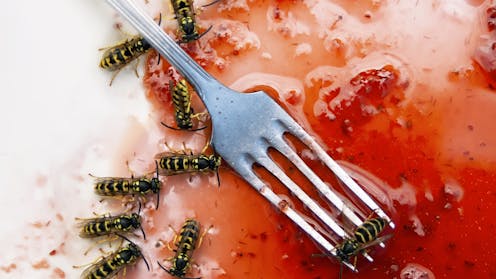
This is a worker wasp. She is looking for food to feed to her sibling larvae in her mother’s papery looking nest. Is she carving off a lump of ham, gathering a dollop of jam or slurping at your sugary drink? Watch what she is eating because this gives you a clue to what your wasp offering will be. She is so focused on her task that she won’t notice you watching.

3. Make a wasp-offering to keep her from bothering you

Before you know it, she’s off with jaws full of jam or a hunk of ham. She might zigzag away from your table – a sign that she is reorientating for a reliable return. Once landmarks are mapped, she will fly straight and fast. If you followed her, she would lead you to her nest. But you are better off using your time to prepare your wasp offering, because she’s going to come back soon. Your offering should be a portion of whatever she harvested from your plate. You can move it slightly away from the rest of your food. If you let her have her share, you too can dine in peace.

You can gradually move your wasp offering further away from you. Wasp offerings are well-tested techniques around the world, whether you’re looking to track down a wasp nest to eat, or keep customers unbothered by wasps at an outdoor restaurant.

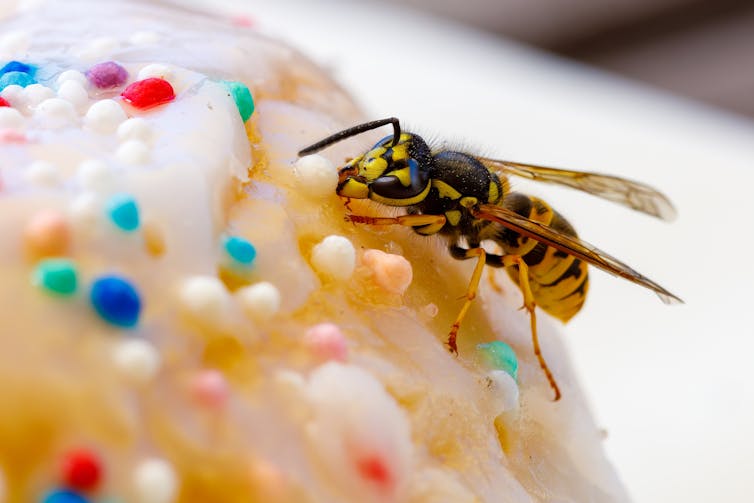
Wasp on cake with icing and sprinkles.
Are the wasps at your picnic making a beeline for sweet food?
hecke61/Shutterstock

Happily, your picnic friend is unlikely to bring a swarm of wasps to your table, because social wasps are poor recruiters. This makes sense because wasp food (insects, carrion) is usually a scattered, short-lived resource. One caterpillar doesn’t necessarily mean there’s a huge patch of them, for example.

This contrasts with honeybees, for which there has been strong natural selection for the evolution of a communication system (waggle dance) to recruit many foragers to a patch of flowers.

However, you might get a few wasps at your picnic, especially if the nest is close, just by chance. Wasps tend to be attracted to a forage source by the presence of other wasps. If she sees a few wasps gathered, then she will investigate. But if there are too many wasps, this puts her off.

Wasps’ changing feeding habits

You may already know that wasps go crazy for sugar at the end of the summer. But why do they prefer a protein earlier in the season? It depends on what is going on inside the colony – and this changes with the season.

Wasp larvae are carnivorous. Together, the workers rear thousands of larvae. If your wasp wants ham (or some other protein source) at your picnic, you know her colony is full of hungry larvae. You might notice this in early-to-mid summer – and no later than mid-to-late August.

Enjoy the knowledge that you are helping feed armies of tiny pest controllers, who will soon set to work regulating populations of flies, caterpillars, aphids and spiders.

A defining feature of an adult wasp is the tiny petiole (wasp-waist). This constriction between her thorax and abdomen evolved so her ancestors could bend their abdomens, yoga-style, to parasitise or paralyse their prey.

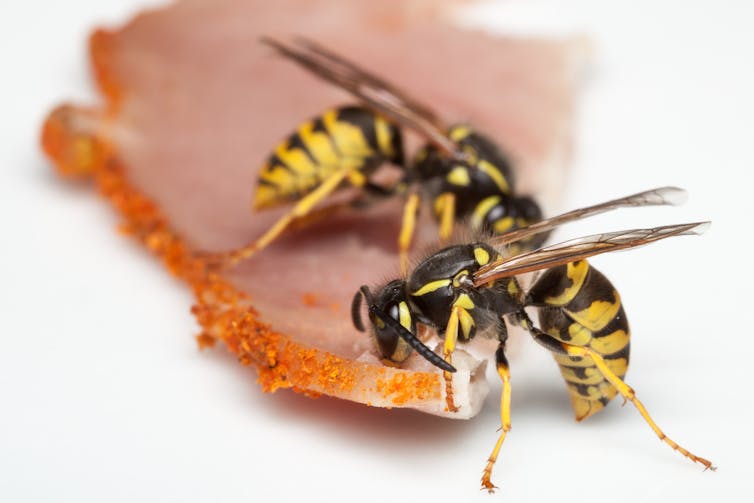
Two wasps carving up ham slice
These wasps won’t be eating the ham themselves.
Franz H/Shutterstock

The wasp-waist of an adult worker limits her to a largely liquid diet. She is like a waiter who must deliver feasts to customers without tasting it. The larvae tip her service with a nutritious liquid secretion, which she supplements with nectar from flowers. For much of the season, this is enough.

Blend science and a picnic

Towards the end of the summer, most wasp larvae have pupated – and a pupated larva doesn’t need feeding. So, demand for protein foraging diminishes, as do the sweet secretions that have kept the workers nourished.

This means worker wasps must now visit flowers for nectar – although your jam scone or sweet lemonade may also be exceedingly tempting. If your wasp is fixated on sugar at your table, then you know her colony is likely to be in its twilight phase of life.

Although time of the year is a good indicator of the balance of ham-to-jam in a wasp’s foraging preferences, weather, prey availability, local competition and rate of colony growth can influence them too. This means the switch from ham to jam this year may be different to next year.

We’d like you to help us gather data on this, to improve predictions on whether to offer your wasps ham or jam. To take part, report here whether the wasp at your picnic wanted protein (such as chicken, hummus, beef or sausage), jam (or anything sugary, including sugary drinks), or both.

The Conversation

Seirian Sumner receives funding from the UK government’s Natural Environment Research Council (NERC) and the Biotechnology and Biological Sciences Research Council (BBSRC). She is a Trustee and Fellow of the Royal Entomological Society, and author of the book ‘Endless Forms: Why We Should Love Wasps’

ref. What to do when wasps crash your picnic – a scientist’s guide to dining safely with these insects – https://theconversation.com/what-to-do-when-wasps-crash-your-picnic-a-scientists-guide-to-dining-safely-with-these-insects-261589

How ancient viruses could help fight antibiotic resistance

Source: The Conversation – UK – By Franklin Nobrega, Associate Professor, Microbiology, University of Southampton

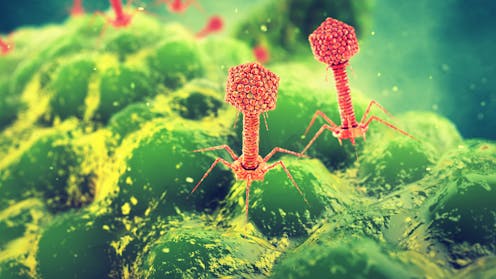
Phages (red) attacking a bacterium (green). nobeastsofierce/Shutterstock.com

If bacteria had a list of things to fear, phages would be at the top. These viruses are built to find, infect and kill them – and they have been doing it for billions of years. Now that ancient battle is offering clues for how we might fight back against antibiotic-resistant infections.

As more bacteria evolve to withstand our antibiotics, previously treatable infections are becoming harder – and in some cases, impossible – to cure. This crisis, known as antimicrobial resistance (AMR), already causes over a million deaths a year globally, and the number is rising fast. The World Health Organization has named AMR one of the top ten global public health threats.

Phage therapy – the use of phages to treat bacterial infections – is gaining attention as a potential solution. Phages are highly specific, capable of targeting even drug-resistant strains. In some compassionate-use cases in the UK, they have cleared infections where every antibiotic had failed. But phages still face a challenge that is often overlooked: the bacteria themselves.

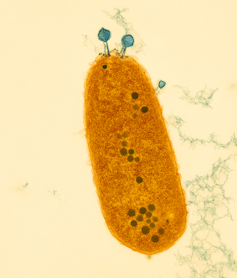
Bacteria have evolved sophisticated systems to detect and destroy phages. These defences are diverse: some cut up viral DNA, others block entry, and a few launch a kind of intracellular shutdown to prevent viral takeover. In a new study published in Cell, my colleagues and I describe a system that works differently, called Kiwa. It acts like a sensor embedded in the bacterial membrane, detecting early signs of attack.

Exactly what Kiwa is sensing remains an open question, but our findings suggest it responds to the mechanical stress that occurs when a phage latches on to the cell and injects its DNA. Once triggered, Kiwa acts fast. It shuts down the phage’s ability to make the components it needs to build new phages, stopping the infection before it can take over the cell.

But just as bacteria evolve ways to defend themselves, phages evolve ways to fight back. In our latest experiments, we saw two strategies in play.

A bacterium (orange) being attacked by phages (black dots).
Southampton University, CC BY

Some phages developed small mutations in the proteins they use to attach to the bacterial surface – subtle changes that helped them avoid triggering Kiwa’s detection system. Others took a different approach: they allowed themselves to be detected, but escaped the consequences.

These phages carried mutations in a viral protein that seems to be involved in how Kiwa shuts down the infection. We don’t yet know exactly how this works, but the result is clear: with just a few changes, the virus keeps replicating, even after Kiwa has been activated.

This evolutionary flexibility is part of what makes phages so powerful, and why they hold such promise in treating infections. But it also highlights a key challenge: to make phage therapy effective, we need to understand how these microbial battles play out.

Rules of engagement

If a bacterial strain carries a defence like Kiwa, not all phages will succeed against it. Some might be blocked entirely. But others, with just the right mutations, might slip through. That means choosing or engineering the right phage for the job is not just a matter of trial and error – it is a matter of knowing the rules of engagement.

Studying bacterial defence systems like Kiwa gives us a deeper understanding of those rules. It helps explain why some phages fail, why others succeed, and how we might design better phage therapies in the future. In time, we may be able to predict which bacterial defences a given strain carries, and select phages that are naturally equipped – or artificially tuned – to overcome them.

That is the idea behind our growing phage collection project. We are gathering phages from across the UK and beyond, including from public submissions – dirty water is often a goldmine – and testing them to see which ones can overcome the defences carried by dangerous bacteria. With over 600 types already catalogued, we are building a resource that could help guide future phage therapy, pairing the right phage with the right infection.

Kiwa is just one piece of the puzzle. Bacteria encode many such defence systems, each adding a layer of complexity – and opportunity – to this microbial arms race. Some detect viral DNA directly, others sense damage or stress, and some even coordinate responses with neighbouring cells. The more we learn, the more precisely we can intervene.

This is not a new war. Bacteria and phages have been locked in it for billions of years. But for the first time, we are starting to listen in. And if we learn how to navigate the strategies they have evolved, we might find new ways to treat the infections our antibiotics can no longer handle.

The Conversation

Franklin Nobrega receives funding from Royal Society and Wessex Medical Research.

ref. How ancient viruses could help fight antibiotic resistance – https://theconversation.com/how-ancient-viruses-could-help-fight-antibiotic-resistance-261970

No clear answers on antidepressants in pregnancy

Source: The Conversation – UK – By Urban Wiesing, Professor of Ethics and History of Medicine, University of Tübingen

The US Food and Drug Administration recently convened a panel of experts to examine a sensitive and increasingly urgent question: should antidepressants be prescribed to women suffering from depression during pregnancy?

To the surprise of many in the American medical community, the panel included not only US-based experts but also three international voices known for their critical views on psychiatric medication. Their inclusion sparked immediate controversy and foreshadowed the disagreements to come.

At the heart of the debate is a long-standing assumption in American medical practice: while antidepressants may carry some risk to the unborn child, the dangers of leaving maternal depression untreated are usually greater. Yet this mainstream position was strongly challenged. A majority of the panel appeared unconvinced that the benefits of antidepressant use in pregnancy clearly outweigh the potential risks.

As the discussion unfolded, fundamental questions remained unresolved. What exactly are the risks to the unborn child? The panel offered different answers.

How substantial are the benefits to a pregnant woman? Some experts questioned whether antidepressants deliver meaningful help in these circumstances at all. And without clarity on these points, how can the the risk-benefit ratio be reliably assessed?

It’s a familiar scenario in science: experts looking at the same data but drawing different conclusions – not only about the facts, but how to interpret them. In this case, the division seemed to reflect deeper cultural and philosophical differences in how various countries approach mental health care during pregnancy.

The outcome of the panel’s deliberations reflected that divide, with no consensus reached.

To some extent, the conflict was embedded in the very design of the panel. When those with sharply opposing views are brought together without agreement on the evidence base, gridlock is a likely result. Still, the impasse underlines the need for more independent, high-quality research on the effects of antidepressants during pregnancy – research that can inform not only regulators but also doctors and patients.

Complicating matters further is the political climate. The current US health secretary – Robert F. Kennedy Jr. – has, critics argue, an uneasy relationship with scientific consensus, which makes trust in the process all the more fragile.

FDA expert panel discussion on antidepressants and pregnancy.

A warning label is not a substitute for a conversation

Still, the panel produced one tangible suggestion: a proposal from around half of its members to place a so-called “black box” warning on antidepressant packaging, alerting pregnant women to potential risks to the unborn child. Such warnings are typically reserved for the most serious medical concerns. But is this really the right approach?

A comparison often made is to cigarette packaging. But this analogy quickly breaks down. Cigarettes are freely bought; antidepressants are prescribed following a medical consultation. To issue a blunt warning on a medicine that has already been deemed appropriate by a doctor risks undermining the doctor–patient relationship.

If stronger warnings are needed, the real problem may lie in the consultation process itself, not in the packaging.

Pregnancy presents a unique ethical dilemma. The unborn child cannot give consent, and damage sustained in the womb can result in lifelong consequences. At the same time, untreated depression in a pregnant woman carries serious risks of its own – for both mother and child. This is a classic medical conflict, with no easy solution.

And while US law gives pregnant women the right to make such decisions – albeit with variation across states – it doesn’t solve the underlying uncertainty. That must be navigated through informed, respectful dialogue between doctor and patient, not by resorting to fear-inducing labels.

Ultimately, every case is personal. Every decision must take into account the individual’s mental health, support system, risk tolerance and values. What’s needed is thoughtful communication, prudent prescribing and careful balancing of benefit and harm. In short: good medicine.

What’s not needed is to heap more guilt on women already grappling with depression. If scientists and policymakers cannot agree, pregnant women should not bear the burden of that confusion. They deserve support, not stigma.

The Conversation

Urban Wiesing does not work for, consult, own shares in or receive funding from any company or organisation that would benefit from this article, and has disclosed no relevant affiliations beyond their academic appointment.

ref. No clear answers on antidepressants in pregnancy – https://theconversation.com/no-clear-answers-on-antidepressants-in-pregnancy-261724

Older adults who follow healthy diets accumulate chronic diseases more slowly – new study

Source: The Conversation – UK – By Adrián Carballo Casla, Postdoctoral Researcher in Geriatric Epidemiology, Karolinska Institutet

Studio Romantic/Shutterstock

Imagine two people in their 70s. Both are active, live independently and enjoy life. But over the next 15 years, one of them develops two or three chronic illnesses – heart disease, diabetes, depression – while the other remains relatively healthy. What made the difference?

According to our new research, diet may be a key part of the answer.

In our new study, our group at the Aging Research Center at the Karolinska Institutet, Sweden, followed more than 2,400 older Swedish adults for 15 years.

We found that people who consistently ate a healthy diet developed chronic diseases more slowly, in contrast to those whose diets were considered more inflammatory; that is, diets high in processed meats, refined grains and sugary drinks, which are known to promote low-grade chronic inflammation in the body.

This is important because having several health conditions at the same time is one of the biggest problems older people face. It increases the risk of disability, hospitalisation and early death. It also places a huge burden on healthcare systems. But while it has been long known that diet can help prevent individual diseases, our study shows that it may also influence the overall pace of biological ageing.

We looked at four well-known dietary patterns. Three of them – the Mind diet (designed to protect brain health), the Alternative Healthy Eating Index (based on foods linked to lower disease risk) and the Mediterranean diet – were associated with slower disease accumulation. The fourth, a diet high in inflammatory foods, was linked to faster accumulation.

The strongest associations were seen for cardiovascular and psychiatric conditions. So, people who ate better were less likely to develop diseases including heart failure, stroke, depression or dementia. We did not, however, find a clear link between diet and musculoskeletal diseases such as arthritis or osteoporosis.

Some of the benefits of healthy eating were more pronounced in women and in the oldest participants: those aged 78 and above. This suggests that it is never too late to make changes. Even in very old age, diet matters.

Why does food have such a strong potential? One reason may be inflammation. As people age, many develop low-grade chronic inflammation – sometimes called “inflammaging” – which is linked to a wide range of diseases. Diets high in vegetables, fruits, whole grains, and healthy fats tend to reduce inflammation. Diets rich in highly processed foods and sugar do the opposite.


Read more:
Ageing isn’t the same everywhere – why inflammation may be a lifestyle problem


Another reason is that healthy diets support the body’s resilience. They provide essential nutrients that help maintain immune function, muscle mass and cognitive health. Over time, this can make a big difference in how people age.

Our study is one of the longest and most comprehensive of its kind. We used repeated dietary assessments and tracked more than 60 chronic health conditions. We also tested our findings using different analytical methods to make sure they held up.

Of course, diet is just one piece of the puzzle. Physical activity, social connections and access to healthcare all play important roles in healthy ageing. But improving diet quality is a relatively simple and accessible way to help older adults live longer, healthier lives.

So what should older adults eat? The message is clear: eat plenty of vegetables, fruits, legumes, nuts and whole grains. Choose healthy fats like rapeseed oil and fish. Limit red and processed meats, sugary drinks and solid fats.

These are the building blocks of the diets we studied – and they have been associated with slower ageing, better brain health and fewer chronic diseases in this and other research.

Ageing is inevitable. But people can shape how it unfolds. Our findings suggest that even small changes in diet can make a meaningful difference in how people experience later life, regardless of their age.

The Conversation

Adrián Carballo Casla receives funding from the Foundation for Geriatric Diseases at Karolinska Institutet (project numbers 2023:0007 and 2024:0011); the Karolinska Institutet Research Foundation Grants (project number 2024:0017); the David and Astrid Hagelén foundation (project number 2024:0005); and the Swedish Research Council for Health, Working Life and Welfare (project number STY-2024/0005).

Amaia Calderón-Larrañaga receives funding from the Swedish Research Council (project number 2021-06398), the Swedish Research Council for Health, Working Life and Welfare (project numbers 2024-01830 and 2021-00256), Karolinska Institutet’s Strategic Research Area in Epidemiology and Biostatistics SFOepi (consolidator bridging grant, 2023), and Alzheimerfonden (AF-1010573, 2024).

David Abbad Gomez receives funding from Hospital del Mar Research Institute as a research assistant.

ref. Older adults who follow healthy diets accumulate chronic diseases more slowly – new study – https://theconversation.com/older-adults-who-follow-healthy-diets-accumulate-chronic-diseases-more-slowly-new-study-261233

Street lamps aren’t the only form of artificial light pollution – here’s how to create darker nights

Source: The Conversation – UK – By Georgia MacMillan, PhD Scholar – Research Ireland Employment Based Scheme, University of Galway

Without a view of the stars at night, Don McLean would never have been able to write Vincent and Vincent van Gogh would not have painted Starry Night. Viewing a sky full of stars is part of what makes us human. The light from stars has travelled thousands of miles to reach our eyes.

But now, most Europeans live under unnaturally bright night skies. That ancient starlight is now diluted by human-made light pollution.

So where is all this extra light coming from? A recent German study reveals that, contrary to common assumption, public street lighting may not be the biggest cause of light pollution. The sources are closer to home. Improved energy efficiencies in LED technology means that artificial light is now cheaper than ever to run. As a result, people are lighting up front doors, sheds and garden paths like never before.

swirls of painted starry night sky blue and yellow
Artist Vincent van Gogh’s famous Starry Night painting was inspired by clear, dark skies.
Rawpixel.com/Shutterstock

Artificial light at night has undoubtedly revolutionised our productivity and transformed our social environment as the sun sets. However, when used excessively or inappropriately, artificial light at night becomes light pollution. This changes our outdoor spaces by creating daytime conditions at night.

In particular, LEDs emitting high levels of harsh blue-white light are known to scatter more widely into the atmosphere, increasing levels of light pollution, which can have unintended consequences by interrupting our sleep cycles and circadian rhythms and disrupting nature at night.

Just one lamp can attract hundreds of insects, many of them important nocturnal pollinators, away from their natural environment, every single night. Once trapped in what’s called the “vacuum cleaner effect” of artificial light, scientists estimate that over 30% of these insects will die before dawn from exhaustion or predation. This disrupts the balance of nocturnal ecosystems.

The German researchers used a specially developed mobile app called NightLights to survey sources of light at night. More than 250 citizen scientists surveyed their local surroundings. The results challenged common assumptions that streetlights are the primary contributor to urban light pollution, and showed that residential, commercial and other non-street lighting sources play a significant role in brightening our night skies.

lamp with moths flying around in darkness around light, brick wall
Insects are attracted to lights on houses, in gardens and public spaces.
eleonimages/Shutterstock

In Ireland, we are coordinating similar surveys as part of a pilot programme to raise awareness of light pollution. Some of the most noticeable sources of night light include home security lights being angled up instead of down, garden runway lights over-illuminating pathways throughout the night and considerable light spilling from large windows without blinds or curtains.

Another growing issue in Ireland is the increasing intensity of illuminated sports grounds, often reported to the environmental non-profit group Dark Sky Ireland by concerned residents.

These issues can be easily resolved. Light pollution is just about the simplest of all pollutants to fix. Our study focuses on County Mayo’s Dark Sky Park, a place where naturally dark skies are protected and internationally recognised as a cherished form of natural heritage. We examined the role of dark sky tourism and community engagement in addressing light pollution. By making some simple changes to the type of light and being a little more judicious about how it is used, the level of unnecessary light currently polluting our night skies can be reduced.

Seeing the light

The community of Newport, County Mayo, has led the way in making these changes with some impressive results. Light pollution over the town of Newport has been reduced by 50% by redesigning the town’s lighting scheme – this award-winning project focused on replacing excessive flood lighting on heritage and architectural structures with a sensitively designed lighting scheme to enhance the town’s nightscape. As a feature of this initiative, the beautiful stained glass window at St Patrick’s Church in Newport, created by 20th-century artist Harry Clarke is delicately interpreted with light at night.

Lighting solutions that help protect dark skies include angling outdoor lights downwards and using shielded lamps to avoid illuminating the sky. Only direct light towards the area that needs to be lit, not into a neighbour’s garden or home. Use a visually warmer colour of light (such as amber) to reduce glare and improve conditions for wildlife and natural sleep cycles. Employing timers ensures that lights are only switched on when needed.

By making small changes to how we light our homes and gardens at night, the beauty of a starry night can be restored for generations to come.


Don’t have time to read about climate change as much as you’d like?

Get a weekly roundup in your inbox instead. Every Wednesday, The Conversation’s environment editor writes Imagine, a short email that goes a little deeper into just one climate issue. Join the 45,000+ readers who’ve subscribed so far.


The Conversation

Georgia MacMillan is affiliated with Dark Sky Ireland as a voluntary director (unpaid). Dark Sky Ireland is a non-profit CLG.

Marie Mahon receives funding from Horizon Europe

I am the Lead PI for the Research Ireland funded PhD project for Georgia McMillan. While I don’t directly receive/benefit the funds I have a role in managing them for Georgia.

ref. Street lamps aren’t the only form of artificial light pollution – here’s how to create darker nights – https://theconversation.com/street-lamps-arent-the-only-form-of-artificial-light-pollution-heres-how-to-create-darker-nights-260514

Gaza is starving: what actions can Israel’s allies take?

Source: The Conversation – UK – By Jonathan Este, Senior International Affairs Editor, Associate Editor, The Conversation

For the past few weeks the headlines about Gaza have focused on the hundreds of people who have been killed while queueing for food. The aid distribution system put in place in May, backed by the US and Israel and run by the Gaza Humanitarian Foundation, has proved to be chaotic and allegedly resulted in violence, with both Israel Defense Forces personnel and armed Palestinian gangs blamed for killing about 1,000 people in the two months the new system has been operating.

Now the headlines are focusing on the growing number of people dying of starvation.

Harrowing reports from the Gaza Strip report almost daily on the children dying of malnutrition in hospitals and clinics that simply don’t have the food to keep them alive. Writing in the Guardian this week, a British volunteer surgeon working in one of Gaza’s hospitals, Nick Maynard, described patients who “deteriorate and die, not from their injuries, but because they are too malnourished to survive surgery”.

The UK and 27 other countries this week has condemned the “drip feeding of aid and the inhumane killing of civilians” who are trying to get food and water. And yet, writes Simon Mabon, still the world’s leaders look on: “Most are apparently content to condemn – but little action has been taken.”

Mabon, a professor of international relations at Lancaster University, quotes the latest report from the IPC, which monitors food security in conflict situations. It estimates that 500,000 people in Gaza are considered to be facing “catastrophe”, while a further 1.1 million fall into the “emergency” risk category. Both categories anticipate a steadily rising death rate among civilians in Gaza.

So how can Israel’s allies apply pressure on Benjamin Netanyahu’s government to bring an end to the violence and allow Palestinian civilians access to the food, water and medical supplies they so desperately need?

Mabon canvasses a range of options. First of all, countries that have yet to recognise the state of Palestine can do so. It’s nonsense, Madon believes, to talk of a two-state solution – as the UK government does – when you haven’t actually recognised the second state in the equation.

Then they could stop selling arms to Israel. Many countries already have. But the US still issues export licenses for some weapons that are sold to Israel.

There are a plethora of other things world leaders could do to pressure Israel. Mabon recommends having a look at what the world did to isolate South Africa during the apartheid years, measures which eventually helped bring about meaningful change there.


Read more:
Gaza is starving – how Israel’s allies can go beyond words and take meaningful action


As for Netanyahu, the Israeli prime minister is reported to be considering an early election. In previous months this looked like a move freighted with jeopardy. An election loss brought on by a disenchanted electorate, heartbroken at the hostage situation and exhausted by the conflict, would probably mean having to face the charges of corruption which have hung over him for more than five years.

But recent polls have suggested a bump in popularity following his 12-day campaign against Iran. Netanyahu is nothing if not a clever political manipulator. But Brian Brivati, a professor of contemporary history and human rights at Kingston University, believes that to have a chance of winning, the prime minister will need to fight a campaign on three narratives of his government’s success: securing the release of the hostages, defeating Hamas and delivering regional security. “It is a tall order,” Brivati concludes.


Read more:
Israel: Netanyahu considering early election but can he convince people he’s winning the war?


Anyone following the situation in Gaza over the past 18 months will have encountered Francesca Albanese, the UN’s special rapporteur for Palestine’s occupied territories. For three years she has monitored the human rights situation in Gaza and the West Bank, delivering trenchant criticism of Israel’s conduct and those who, by their inaction – and sometimes contrivance – have enabled it.

Earlier this months, the US government imposed sanctions on Albanese, because – as US secretary of state Marco Rubio insisted – she has engaged with the International Criminal Court (also subject to US sanctions) “in efforts to investigate, arrest, detain, or prosecute nationals of the United States or Israel”. Also she has written “threatening letters to dozens of entities worldwide, including major American companies”.

Alvina Hoffman, an expert in diplomatic affairs and human rights at SOAS, University of London, explains what a special rapporteur does and why their work is so valuable in the defence of human rights.


Read more:
The US has sanctioned UN special rapporteur Francesca Albanese – here’s why she’s the wrong target


Dispatches from Ukraine

To Istanbul, where delegations from Russia and Ukraine met yesterday for their third round of face-to-face talks. All 40 minutes of them. There was another agreement of prisoner swaps and the two sides decided to set up some working groups to look into various political, military and humanitarian issues – but online rather in person.

The brevity of the talks came as no surprise to Stefan Wolff. Wolff, an expert in international security at the University of Birmingham who has provided commentary for The Conversation throughout the conflict in Ukraine, points out that both sides remain wedded to their maximalist war aims. For Russia, this is for Ukraine to accept Russia’s annexation of Crimea and four provinces of eastern Ukraine, a ban on Ukraine’s membership of Nato and a much reduced military capacity. For Ukraine, it is getting their territory back and Russian acceptance of their national sovereignty, meaning it gets to determine for itself what alliances it seeks.

Donald Trump has told Vladimir Putin that, if there’s no ceasefire in 50 days, he’ll apply harsh secondary sanctions on the countries buying Russian oil and that he plans to supply Ukraine with American weapons (via Nato’s European member states, that is). Wolff believes both sides will now play the waiting game. They will calculate their next move after September 2, when the 50 days run out, and when they know more about what the US president plans to do.


Read more:
Russia-Ukraine talks: both sides play for time and wait for Donald Trump’s 50 days to run out


Volodymyr Zelensky, meanwhile, faces pressure from his own people. There have been days of protest at his decision to bring two formerly independent anti-corruption organisations under the direct control of the government. He argues that this was necessary to prevent Russian infiltration, while critics are saying that the Ukrainian president has launched a power grab designed to prevent independent investigation of alleged corruption against people close to him.

Jenny Mathers says these protests, which involve people from all political shades, including people who have fought in the defence of Ukraine since 2022, some with visible injuries, represents a fracture of the “informal agreement between the government and society to show a united front to the world while the war continues”.

Ukrainians protest after Zelensky signs law clamping down on anticorruption agencies.

It’s not as if Zelensky is in clear and present danger of losing his job. His party holds a majority of seats in the Ukrainian parliament, so he governs without having to depend on coalition partners. And the country’s constitution prohibits the holding of elections in wartime – whatever Putin, who regularly insists that Zelensky is an illegitimate leader because he is governing past his term limit, might think. Plus his approval rating sits at 65%.

Zelensky has been quick to soften his stance on this. Mathers says that political corruption is a very sore point in Ukraine, where there was decades of it until the Maidan protests of 2013-14 unseated the pro-Russian president Viktor Yanukovych. As she writes here, “the ‘Revolution of Dignity’ that rejected Yanukovych’s leadership and his policies was also a resounding demonstration of the strength of Ukraine’s civil society and its determination to hold its elected officials to account. Zelensky would be rash not to heed that.

He also knows it’s important for him to present a squeaky clean image to his supporters in the west. So while the protests may not present an immediate threat to his own position, he knows that unless he acts to root out corruption in Ukraine, it’ll be a threat to the future of the country itself.


Read more:
Ukrainian protests: Zelensky faces biggest threat to his presidency since taking power


But ethicist Marcel Vondermassen from the University of Tübingen believes another recent decision by the Ukrainian government is storing up trouble for the future. Ukraine has recently announced its decision to pull out of the Ottawa convention, the treaty that forbids the use of anti-personnel landmines.

In doing so, he’s following the example of Finland, Poland, Lithuania and Estonia which have all also quite the treaty in recent months for fear of Russian aggression.

But as Vondermassen points out, landmines don’t usually switch themselves off when a conflict ends and people are still being killed an maimed in former conflict zones around the world. Often it is farmers at work or children at play who are the victims. If other ways to protect countries from aggression aren’t pursued, as he puts it, in future decades we’ll still be “counting thousands of child casualties … from the landmines laid in the 2020s”.


Read more:
Ukraine joins other Russian neighbours in quitting landmines treaty: another deadly legacy in the making


Thailand-Cambodia: centuries-old dispute flares again

A dispute between the two south-east Asian countries that has been simmering since May flared into life yesterday when five Thai soldiers patrolling the border region were injured after stepping on a landmine – the second such incident in the past week. Both countries have sealed their border and there have been tit-for-tat ambassadorial expulsions.

Cambodia fired rockets and artillery into Thailand, killing 12 civilians. Thailand in turn has launched airstrikes against Cambodia. Both countries are blaming the other for starting it.

Petra Alderman, an expert in south-east Asian politics from London School of Economics and Political Science, traces the origins of this row, which go back to the colonial era in the 19th and early 20th centuries.


Read more:
Thailand and Cambodia’s escalating conflict has roots in century-old border dispute


World Affairs Briefing from The Conversation UK is available as a weekly email newsletter. Click here to get updates directly in your inbox.


The Conversation

ref. Gaza is starving: what actions can Israel’s allies take? – https://theconversation.com/gaza-is-starving-what-actions-can-israels-allies-take-261894

Mountains of fire: what hillwalking with my father taught me about the origins of oil exploration

Source: The Conversation – UK – By Yvonne Reddick, Reader in English Literature and Creative Writing, University of Lancashire

“Far over the misty mountains cold,” Dad read. Every evening before my light was turned out, he read me a story about a hobbit who left his comfortable burrow to journey to the Lonely Mountain. Searching for gold at the mountain’s roots, talking to eagles, scaring wolves off by starting a forest fire, tricking a dragon: these were the tales he read to me.

View of the south-eastern slopes of Braeriach. The River Dee flows out of An Garbh Choire.
By Angus, CC BY-SA

We lived in a granite house on the western edge of Aberdeen. Mum planted rhubarb and runner beans in the garden. Summer holidays meant going to Aviemore, in the lap of the Cairngorm mountains. We’d stay in a wooden chalet, where knots in the pine planks looked down at me like the eyes of owls. We’d always walk near the gentle hill of Craigellachie, fledged with silver birches. I learnt to recognise the mountains: Braeriach with its three scooped-out corries, Cairngorm scarred with ski runs.

Dad knew how to disappear. Some weeks, he’d leave before dawn to take the helicopter out to the North Sea oil platforms. During summer weekends, he’d vanish for the summits of those rounded Cairngorm hills. One day, he marched in through the door with his muddy boots still on, and hoisted his battered blue Berghaus backpack onto the kitchen table, grinning:

I’ve got a surprise for you.

What is it?

He hefted out a football-sized lump of mountain quartz and put it on the table in front of me. It shone white as a glacier.

Dad’s “Munro Book” was a gift from my mum, given shortly after I was born. It was always referred to as the Munro Book, never by its title, and it detailed all of Scotland’s peaks over 3,000 feet high – first charted by the tweedy Victorian baronet, Sir Hugh Munro. Getting to the top of all 282 of them is a popular challenge for hikers. For dad, it was an obsession.

Dad was a hillwalker, but the Munro Book was written by mountaineers. It contained sentences such as: “A pleasantly airy scramble, for which some might prefer the security of a rope.” (I only ever saw Dad attempting a climbing wall once, when the two of us clambered up – and slithered off – orange and green plastic holds at a gym in Scotland.)

He never acquired the paraphernalia that winter hikers (or walkers who fancy themselves as climbers) accumulate: crampons, ice axes, ropes, the ironmongery of nut-keys, hexes and cams. However, he did claim that he scrambled up Ben More on the Isle of Mull via a route he termed “the wrong one”. It was one of his favourite stories.

The Munro Book shared bookshelves with Mountaincraft and Leadership, The Pennine Way, The South Downs Way, The Northern Fells, and 30 battered, pink Ordnance Survey maps in miles and feet.

From the age of nine, dad dragged me out with him. At first, I’d whine about the mud and midges. Later, I felt my heart lifting when I reached a cairn and could see as far as Mull and Skye. I learnt to name the whaleback of Ben Nevis.


The Insights section is committed to high-quality longform journalism. Our editors work with academics from many different backgrounds who are tackling a wide range of societal and scientific challenges.


Dad kept a weather-eye on the forecasts. His kit list included: cheese-and-pickle sandwiches; an itchy wool balaclava; a Berghaus waterproof; a survival blanket; a map, compass and GPS; spare batteries in case the ones in the GPS went flat; a second compass, in case the first compass malfunctioned; and the phone number of Mountain Rescue. All of this was crammed into the ancient blue rucksack.

Dad’s love of the outdoors developed alongside his work as an oil reservoir engineer. There are North Sea oilfields named Everest, Banff, Cairngorm and Munro. And the ease with which Dad read charts of mountains and valleys deep below the sea translated into the mathematical precision with which he navigated with map, compass and GPS.

When I was old enough to read for myself, I read The Hobbit and longed to journey through the Misty Mountains: “The mountain smoked beneath the Moon … The trees like torches blazing bright.” I’d never seen a forest fire, but even in rainy Scotland, there were signs that blazes were becoming more frequent. Just south of Loch an Eilein (the loch with the island), you came across bunches of strange brooms and paddles by the path: fire beaters, in case the heather caught alight. Aviemore was a busy ski resort in winter, but the snowline was inching higher and higher up the mountains.

I never worried about Dad. Even when he grumbled about tightness in his chest before his last holiday in the Cairngorms, it never occurred to me that the path could run out so soon.

Peak oil

Mountains rise skywards when one of Earth’s plates collides against another. Deep in the guts of great ranges, rocks fold and buckle. Ancient seabeds, turned to stone, are heaved upwards. The same rock-fold, the anticline, can forge mountains and harbour oil.

The Rockies stand on the largest reservoir of untapped shale oil in the world. The richest oilfields west of Russia are near the Carpathians. Iran’s oil and gas deposits lie at the feet of the Zagros, the high range that transects the country from north-west to south-east. North Sea oilfields are named for Highland mountains: Beinn, Schiehallion, Foinaven.

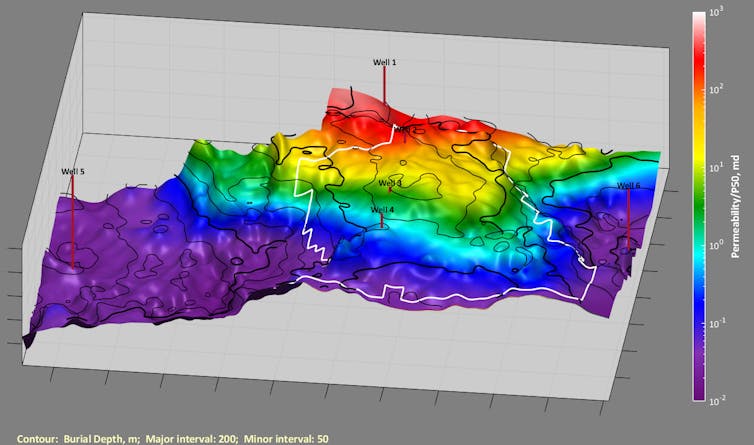
I look up a 3D schematic of an oil deposit, not unlike the one pictured below. It reminds me of a miniature massif: oil and gas seeping upwards through rock, resembling ice-falls in reverse. In place of a summit scarved with cloud, there’s a pointed deposit of trapped methane gas.

The next zone down, where a mountain’s glaciers would be, is an area on the diagram that is coloured green, showing oil. I look at a seismology map – the kind Mum used to work on in Oman. This time, the image shows a vertical cross-section through layers of rock. Its contours are shallower – more hillock than Himalayan peak. I think of knolls and hill forts – Arnside Knott on the Lancashire coast, or Torside on the shoulder of Bleaklow in the Peaks.

A 3D schematic of the reservoir properties of the Illizi Basin in eastern Algeria.
SEG Wiki, CC BY

Mountains and petroleum share a similar vocabulary. Exploration, frontiers, surveying. I look at graphs of peak oil production and note coincidences with the so-called golden age of mountaineering. 1854-1865: the dawn of a prolific decade of Alpine mountaineering, the time of Edward Whymper and the Matterhorn disaster. 1859: the drilling of the first oil well by the Pennsylvania Rock Oil Company in Titusville. The 1950s and ’60s saw western companies exploiting deposits in the Middle East and South America, leading to my grandfather’s time working in Venezuela and Iran. Expansion to the Earth’s highest peaks; drilling into its rocky depths.

Richard Bass, the first man to climb the “Seven Summits” – the highest peaks on each continent – ran a Texan oil-and-gas business. Black gold funded Bass’s Snowbird ski resort in Utah. The first rope access workers on North Sea oil platforms were climbers and cavers.

Many of dad’s friends found that a youthful passion for rock climbing gave them an intimate knowledge of the character of different kinds of stone, or that reading maps translated easily into mapping the deep layers of Earth’s bedrock. For a geology or engineering graduate with an enjoyment of adventure and a love of travel, a career in oil exploration was an exciting and well-paid career path.

But expanding oil frontiers and summiting the world’s highest peaks bring similar controversies. It is no coincidence that mountaineering exploits and oil extraction share common ground with colonialism, foreign control, nation-building and struggles for self-rule. Local and Indigenous people are determined to protect their land, or want a stake in the wealth of an industry whose history is mired in colonial exploitation.

I think of the far-north of Canada and Alaska – of Athabasca people either fierce in their resistance to the incursions of oil companies under the ice, or wanting their fair share of the industry’s colossal profits. Sherpas, Sherpanis and Nepalis reclaiming Mount Everest after decades of western exploitation, smashing the time records for summit successes.

Murky soot and tiny microplastics from the oil industry touch even the shining Alpine summits that I love. They taint the high snows of Everest. The cataclysmic impact of fires, blowouts and everyday fossil-fuel burning strips them of their ice. Oil is there in the mountains of plastic waste I saw on the outskirts of Himalayan towns. And perhaps the most explosive place where fossil fuels meet mountains is Azerbaijan’s Yanar Dag, which dad visited in 2002 on the back of a drunken horse.

Mountain of Fire

Nightfall in the countryside near Baku. The horses hung their heads in the stalls. Bahram the guide poured beer on their oats. They shook themselves awake, started munching. Dad hauled himself into the stirrups and thudded into the saddle like a sack of gravel: “Don’t drink and ride!” The horses began the slow plod uphill.

Rocks and thirsty thorn-scrub. A wooden bridge over a parched river. Bahram paused, dismounted, lit a cigarette and flicked the ash towards the riverbed. It touched off flame.

Wink of fire through twilight. Whiff of gasoline on the breeze. Flames surged from a blackened fissure in the rocks. Yanar Dag means Mountain of Fire. This fissure has burned for 3,000 years at least. People raised temples where priests tend eternal fires. Did fires like this inspire Zoroastrianism, one of the world’s most ancient faiths? I look up the prophet Zarathustra, glance through Nietzche’s imagining of his words. I read about Zoroastrian fire rituals and trial by flame. I read about sacred fire, symbolising the light of the deity and the illuminated mind.

Dad worked in the Caspian region when I was a teenager, flying to Baku for one week every month. He admired the Flame Tower skyscrapers, relished lamb-and-rice plov. Deals were toasted with copious quantities of vodka. I heard about Shah Deniz, the King of the Sea, a gargantuan gas field under fathoms of rock and water.

Dad longed to hike the ochre-red foothills of the Caucasus, and loved spinning yarns about “Hell’s Doorway”, the crater over a natural gas deposit that burst into flames after a Russian drilling rig collapsed. At garden parties for his colleagues back in the Home Counties, I met Bahram and Mehtab, their daughters Farah and Donya.

The Caspian seabed was tough drilling. One of Dad’s Azeri colleagues showed me a map of the bedrock, riddled with faults. Dad enjoyed the reservoir engineering challenge this posed, in much the same way he relished building Meccano or getting my second-hand Scalextric cars to work.

Forty-eight billion barrels lie under the world’s largest inland water-body. The Caspian is split into four basins; the most southerly is the deepest, divided from the others by the Apsheron Ridge. This anticline linked to the Caucasus Mountains spans the entire Caspian from Baku to Turkmenistan. The Caspian was formed by a complex interplay of plates shifting and rifting.

One of the greatest hazards for oil exploration in the region – apart from the earthquakes – are the mud volcanoes. Found near petroleum deposits and mountainous regions, these bizarre formations belch up methane, creating mucky splatter cones. They may bubble up under a body of water, or erupt on land. The rounder ones on land are known as “mud domes”; the flatter ones are sometimes referred to as “mud pies”.

Dad loved telling stories about them. Soviet scientists wanted to predict their habits, proposing that variable water levels in the Caspian, and even sunspots, might trigger their eruptions. Mud volcanoes are found in the Carpathians, the Caucasus, California, and even in the Gulf of Mexico. Dashli Island in the Caspian Sea is one giant mud volcano which exploded near an oil platform in 2021, erupting flames 500 metres high.

The Caspian region is one of the oldest oil-producing areas in the world. Troops of the emperor Cyrus the Great used Baku’s oil as an incendiary weapon. Caspian oil lit the way for Alexander the Great’s soldiers. Medieval Arab historians and travellers noted the region’s dependence on oil for heating and trade. An inscription from 1593 commemorates a manually-dug oil well near Baku.

Baku has been an oil town for centuries. An enterprising Azeri merchant drilled two oil wells in the Caspian in 1803, likely the world’s first offshore extraction, although a storm made short work of them in 1825. Robert Nobel arrived in Baku in 1873, tasked with finding walnut trees for wood to build rifles for the tsar’s army; instead, he decided to buy an oil refinery. Grainy sepia images of Russian oil production show forests of wooden derricks. In 1898, Franco-Russian filmmaker Alexandre Mishon filmed gushers and blowouts. Russian production of Azeri oil was the most prolific petroleum source on the planet from 1899 to 1901.

Still from Azerbaijani film Bibi Eybat, a 30-second silent film directed by Alexandre Michon in1898.
A. Mishon, Public domain, via Wikimedia Commons

Azerbaijan is the birthplace of many innovations: the first mechanically drilled oil-wells, the first pipelines, the first tankers. Following the collapse of the Soviet Union, competition for oil production partnerships in newly independent Azerbaijan was intense. A deal with BP in 1992 began three decades of exploration and drilling. The offshore platforms became enormous: photos show helipads, flarestacks, workers’ quarters, tangles of pipework. As the shallower oil reserves were exhausted, drilling became more ambitious. The Deepwater Gunashli platform began to pump petroleum from 175 metres below the water’s surface.

After “peak oil” – the height of demand and production – economists predict that we are entering the age of “tough oil”. Deep water, distant locations, greater danger. The oil reserves that dad and his colleagues explored were already becoming increasingly hazardous and hard to reach.

This article was a runner up in The Conversation Prize for writers, run in partnership with Faber and Curtis Brown.

The Conversation

Yvonne Reddick receives funding from a Leverhulme Trust International Fellowship, hosted at UCLA.

ref. Mountains of fire: what hillwalking with my father taught me about the origins of oil exploration – https://theconversation.com/mountains-of-fire-what-hillwalking-with-my-father-taught-me-about-the-origins-of-oil-exploration-250943