How selfie parks limit tourism damage to the world’s most ‘Instagrammable’ destinations

Source: The Conversation – UK – By Lauren A. Siegel, Senior Lecturer in Tourism and Events, University of Greenwich

The real thing? Getting the money shot Tegalalang Rice Terrace in Bali, Indonesia, kitzcorner/Shutterstock

It’s no secret that social media has changed travel. Holidaymakers increasingly seek to imitate images posted by influencers and their peers on platforms like Instagram and TikTok. In our increasingly digital world, travellers now chase the perfect shot like treasure hunters. That can mean navigating crowds, long lines and sometimes even danger – all for content from the world’s most “Instagrammable” spots.

In a widely viewed TikTok video, influencer Zoe Rae (the sister of Love Island star Molly-Mae Hague) voiced her disappointment after visiting Bali. Apparently, it did not look as it did when she saw it online. Her comments attracted a backlash, with critics arguing she was simply experiencing the reality behind the content she and others have helped to promote.

Research has found that many influencers and social media users participate in an “aesthetic economy”. That is, travel is “performed” for likes, views and brand deals. The result? Holidaymakers seeking out highly photogenic (“Instagrammable”) destinations from which to stage their content.

Sometimes “getting the shot” becomes more important than any meaningful cultural exchange between hosts and guests. The behaviour of social media-induced tourists has been found to be more irresponsible than that of other types of travellers.

There were 379 selfie-related deaths between 2008-21, and the quest for the perfect photo can also lead to trespassing and vandalism. Additionally, studies have found that social-media-induced tourists can cause varying levels of damage to the hotspots they visit. This can include environmental erosion, traffic congestion, pollution, increased rubbish and generally making daily life difficult for locals.

Stage-managed selfies

But the demand has fuelled the development of shadow economies like “selfie museums”. These have begun to emerge around the world: Chicago’s wndr Museum, London’s Selfie Factory, Selfie House in Prague, Brazil’s Museum Selfie Day in Sao Paulo, to name just a few.

Our new study shines a light on these parks – purpose-built, self-contained spaces that give visitors a visually stunning, curated environment in which to create content (most often of themselves). For the price of admission, they get convenient access to lighting, props, professional photographers and backdrops for creating content for social media in “Instagrammable” places.

Selfie parks in Bali, Indonesia, offer rice terraces, swings, nests and other “sceneography” associated with its destination image. And there are add-ons like dress rentals, professional photographers who can follow visitors around the park, and personalised photo-editing services.

Selfie parks can offer soft control over visitors in the form of guards, guides and security cameras to monitor behaviour. And they implement daily safety checks and regularly train staff to ensure guests are supervised as they take photos. This is an important alternative to the sometimes risky behaviour of selfie-seekers in viral hotspots.

Of course, the elephant in the room here might be the commodification and inauthenticity that selfie parks represent. Other research has found that locals can be divided about staged photo opportunities, with some seeing them as inauthentic and gimmicky.

There is an awareness that these encounters do not represent the real life of locals. Others, however, consider the money to be made and employment that these opportunities can provide.


Read more:
Why are people taking selfies in front of the LA wildfires?


Our findings from Bali showed that the selfie parks are extremely successful – with more than 1,500 visitors reported in low season. The offering has been expanded in recent years to add more photo spots, infinity pools and even a day club.

For now, all of Bali’s selfie parks are locally owned and managed. This creates an important source of employment, as well as being a launchpad for entrepreneurship among locals.

The idea of selfie parks may take a bit of getting used to. But having spaces where people can take photos, videos and create social media content safely, while bringing in revenue and employment for local communities, offers a viable solution. This is especially true of the places that struggle most with the negative impacts of tourists motivated by social media.

Love them or loathe them, selfie parks probably aren’t going away. And they may represent a broader shift in how people travel, share and consume experiences. In destinations facing an influx of selfie-seeking visitors, they might just be a surprisingly practical solution.

Other “viral” destinations should consider establishing dedicated spaces in which tourists can create content. Destinations like the island of Santorini, nicknamed Greece’s “Instagram island” amid extreme overcrowding alongside other harms, could be the type of place to benefit.

If so many of today’s tourists are chasing the perfect picture, maybe it makes sense to give them a place designed exactly for that.

The Conversation

Lauren A. Siegel does not work for, consult, own shares in or receive funding from any company or organisation that would benefit from this article, and has disclosed no relevant affiliations beyond their academic appointment.

– ref. How selfie parks limit tourism damage to the world’s most ‘Instagrammable’ destinations – https://theconversation.com/how-selfie-parks-limit-tourism-damage-to-the-worlds-most-instagrammable-destinations-262071

Storm Floris: the weather is rarely this windy in August – which makes it more dangerous

Source: The Conversation – UK – By Colin Manning, Postdoctoral Research Associate in Climate Science, Newcastle University

Storm Floris made landfall in northern parts of the UK on the morning of Monday August 4 2025, bringing intense rainfall followed by severe winds throughout the afternoon. The Met Office issued an amber weather warning for much of Scotland and yellow alerts for parts of Northern Ireland and northern England.

Affected areas can expect 20mm–40mm of rain on average, with some areas of Scotland potentially receiving up to 80mm. Wind speeds in exposed and elevated regions could reach 80mph–90mph, while gusts of 50mph-60mph are forecast for much of Scotland.

The storm’s defining characteristic is the unusually strong winds for August, a time typically less prone to severe wind events. The odd seasonal timing has increased the risk to the public, as more people are outdoors, travelling for holidays or staying in campsites. In addition, trees remain in full leaf, making them more likely to be brought down by high winds.

Authorities are anticipating significant disruption to transport and electricity networks largely due to falling trees. This is underlined by recent research showing an increased risk of large power outages during windstorms that occur in summer. A large amount of debris on the ground from trees may also block drainage systems and contribute to localised flooding.

Persistent strong winds will combine with periods of heavy rainfall for the duration of the amber alert, which expires at 23:00. This will create difficult conditions for emergency workers and prevent access to affected locations if roads are blocked, potentially prolonging disruptions to travel and power networks.

Is this typical of summer months?

Storm Floris carries all the hallmarks of a classic mid-latitude storm. These develop due to sharp temperature contrasts between the northern and southern Atlantic Ocean and intensify under the influence of a strong jet stream. This is a core of fast-moving air high in the atmosphere that stretches across the Atlantic and often steers storms towards the UK.

Such conditions are unusual for the summer months, when warmer Atlantic sea temperatures typically weaken these temperature gradients and shift them farther north, closer to the polar regions. However, it is not uncommon for such storms to occur in August.

Notable ones in the past five years include Storm Ellen, which extensively damaged electricity distribution infrastructure in Ireland and led the Irish meterological service to produce and red and amber weather warning for southern parts of Ireland. Previous storms in August cancelled the Boardmasters music festival in Cornwall in 2019 and closed two stages of Leeds festival in 2024.

Floris is classified as a Shapiro-Keyser cyclone, a type distinguished by a warm core encircled by colder air on its north, west and south sides. This structure is visible in the way the storm’s frontal system wraps around its centre, forming a characteristic comma-shape in the clouds around the cyclone centre. Storms of this kind are responsible for a significant number of the UK’s most damaging wind events.

These cyclones often feature sharp pressure gradients and strong low-level airflows, particularly an air stream known as the cold jet, or cold conveyor belt, which can produce severe surface winds. In some cases, they can also generate a sting jet, a narrow stream of air that descends rapidly from around 5km above the land surface, delivering intense, damaging gusts.

Fortunately, satellite imagery suggests that Storm Floris is unlikely to have produced a sting jet. However, the cold jet alone may still drive wind speeds high enough to cause widespread disruption.

These types of storms can also produce intense rainfall along their frontal boundaries, as seen with Storm Floris. Warmer summer temperatures allow the atmosphere to hold more moisture, increasing the potential for heavier downpours. In addition, the heat contributes to a more unstable atmosphere, encouraging strong convective ascents of air that can yield extremely heavy and localised rainfall.

Floris in the future

Research shows that climate change will influence the characteristics of storms like Floris, though not all aspects will be affected equally. Warmer temperatures are expected to make future storms wetter, as increased atmospheric moisture and convective activity enhances rainfall, particularly along frontal systems. However, projections of wind extremes remain more uncertain.

Climate models generally suggest a modest intensification of winter storms over the UK and a decrease in the intensity of summer storms, implying that systems like Floris could become less common. These projections are largely tied to expected changes in Atlantic temperature gradients and the behaviour of the jet stream.

That said, most long-term climate projections rely on relatively coarse-resolution models which often fail to capture key features that drive storm intensification. These include the gulf stream (a warm Atlantic Ocean current) and drivers of extreme winds including the cold jet and sting jet.

A higher-resolution model, like that used in real-time forecasting for Storm Floris, predicts more intense winter windstorms in a warmer climate. Much of this intensification is linked to stronger cold jets and a potential increase in storms that generate sting jets.

Many powerful summer and autumn storms in the UK originate from tropical cyclones such as hurricanes, as seen with Storm Ophelia in 2017. These systems are poorly represented in lower-resolution climate models, yet they contribute significantly to Europe’s most extreme windstorms.

While Storm Floris has no tropical origins, a variety of storms can affect northern Europe at this time of year. The complexity of assessing their risks remains an area of ongoing research.


Don’t have time to read about climate change as much as you’d like?

Get a weekly roundup in your inbox instead. Every Wednesday, The Conversation’s environment editor writes Imagine, a short email that goes a little deeper into just one climate issue. Join the 45,000+ readers who’ve subscribed so far.


The Conversation

Colin Manning receives funding from UKRI.

– ref. Storm Floris: the weather is rarely this windy in August – which makes it more dangerous – https://theconversation.com/storm-floris-the-weather-is-rarely-this-windy-in-august-which-makes-it-more-dangerous-262535

Jane Austen was a satirist – why isn’t she treated like one?

Source: The Conversation – UK – By Adam J Smith, Associate Professor in 18th-century Literature, York St John University

From the pompous vanity of Sir Walter Elliot in Persuasion (1817), to the shallow reading habits of Isabella in Northanger Abbey (1817), few characters in the works of Jane Austen are spared the gentle satire of her famously ironic narrative voice. Similarly, some of her best remembered characters, like Elizabeth Bennet in Pride and Prejudice (1813), are more than willing to share a sarcastic retort or wry observation.

And yet, Austen, like many other women writers of the period such as Frances Burney, Eliza Haywood and Mary Robinson, are almost always missing from histories of satire. This is less to do with whether their works were satirical – because they blatantly were – and more to do with our problematic understanding of satire.

Satire, as writer Dustin Griffin states, is typically defined as a work designed to “attack vice or folly”, using “wit or riducule” and engaging “in exaggeration and some sort or fiction.”


This article is part of a series commemorating the 250th anniversary of Jane Austen’s birth. Despite having published only six books, she is one of the best-known authors in history. These articles explore the legacy and life of this incredible writer.


Austen, like so many women, used satire and humour to critique her situation in a patriarchal society and, in so doing, persistently challenged deeply ingrained assumptions about women’s status as the passive, subordinate property of men. As literary critic Rachel Brownstein memorably put it, women at the time experienced a constant doubleness that frequently became “the ironic self-awareness of a rational creature absurdly caught in a lady’s place”.

And yet, when asked to name 18th-century satirists, it is so often the case that we are confronted with the same list of authors: Jonathan Swift, author of Gulliver’s Travels (1726), Alexander Pope, author of The Dunciad (1728), and sometimes Henry Fielding, author of Tom Jones (1749). Typically the thread isn’t then picked up again until a century later, when we are offered Charles Dickens (in works such as The Pickwick Papers (1837), William Makepeace Thackeray’s Vanity Fair (1848) and Anthony Trollope’s The Way We Live Now (1875).

However, there are so many examples of brilliant satire written by women at the time.

Take for instance, The Art of Ingeniously Tormenting (1753) by Jane Collier. A satirical conduct book which, rather than advising young women on how to become delicate, feminine creatures, instead gave them tips on how to torment their husbands. Why kill your spouse, it cheerfully asks, when it will be far more satisfying to “waste them by degrees”, effectively killing them slowly across a lifetime of nagging.

There was also Eliza Haywood’s satirical periodical The Parrot (1746), which adopted the perspective of a green parrot in a cage, tired of being objectified and written off as a “pretty prattler”.

Sarah Scott’s Millenium Hall (1782) is about a group of women deciding to abandon patriarchal society altogether and establish a women-only commune. It is full of withering observations. While Mary Robinson’s Walsingham (1797) exposes the many contradictions of 18th-century Britain’s sexist society by telling the story of a girl raised as a boy by parents anxious to have a male heir.

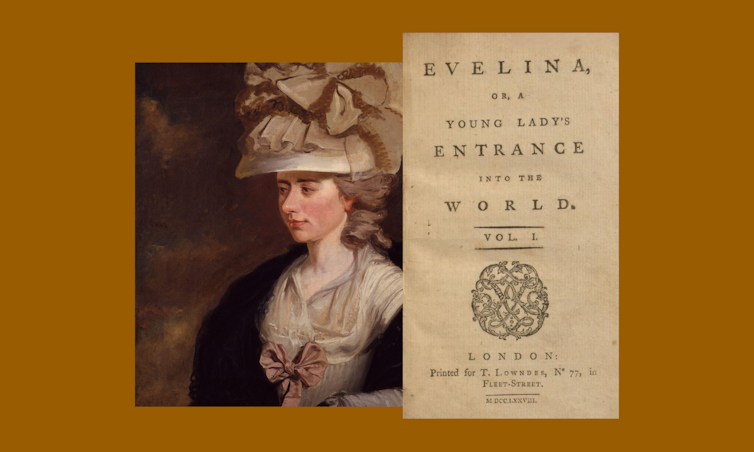
Frances Burney and a page from Evelina
Frances Burney’s Evelina skewered Bath’s fashionable society.
Wikimedia

As a girl, Austen loved Frances Burney’s Evelina (1778), a novel about a young woman who, upon arriving in Bath for the first time, cannot stop laughing at the utter absurdity of fashionable society. (Evelina is also a novel in which a monkey wearing a suit appears out of nowhere, goes berserk, and is never mentioned again. You should read it immediately.)

Similarly, the anonymous novel The Woman of Colour (1808), sees a young heroine born in Jamaica, Olivia Fairfield, travelling to England to secure her inheritance only to discover the high society she’d been raised to admire is in fact barbarous and stupid. As both spectacle and spectator, Olivia becomes a powerful engine for satire.

Even Charlotte Brontë deployed satire. Brontë was an admirer of William Makepeace Thackeray and dedicated the second edition of Jane Eyre (1847) to his famously satirical novel Vanity Fair (1848). As 19th-century literature expert Jo Smith has recently observed, Brontë also used her persona, Currer Bell, to enact satire across her career, even articulating her own theory of satire.

The subtle barb instead of the violent attack

That these women’s names don’t come up in lists of great satirists of the period is partly due to the availability of their writing. Many of the texts I’ve mentioned have only been recovered and made publicly available again over the last 50 years. But it is also to do with how we talk about satire.

The purest definition of satire is that it performs a critique of something that the author finds to be ridiculous, stupid or dangerous, and uses some kind of distortion as part of this critique. This usually takes the form of exaggeration, but can also be inversion or allegory.

However, you’ll notice that when people talk about satire they often describe the lash of the satirist’s whip, or the slash of the surgeon’s scalpel. Satire is talked about as biting, skewering and violent.

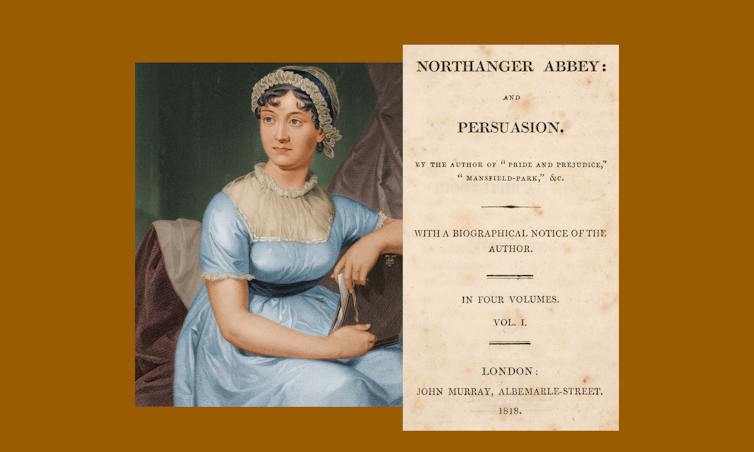
Jane Austen and a page from the publication of Persuasion and Northanger Abbey.
Jane Austen found much to skewer in Regency society and does so deftly in her books Persuasion and Northanger Abbey.
Wikimedia

The satirist, from the Roman poet Juvenal through to John Dryden and Jonathan Swift, is often imagined as a heroic aggressor, whose righteous indignation drives him to lash out at a fallen world. This is an image born of Renaissance theories of satire, and one slightly modified (but heavily promoted) during the endless, rarely objective, debates about what satire should be that dominated the 18th century.

As a result, we end up with a definition of satire that is coded in masculine language. So many definitions, even today, talk about satire “attacking”, rather than “critiquing”. But in Austen, and the work of her female contemporaries, we see another kind of satire. The joy of so many of the quips and rejoinders issued by characters like Anne Elliot and Elizabeth Bennet is that often their targets don’t even realise they have been satirised, so subtle is the critique.

Virginia Woolf said it best when called upon to describe Austen’s juvenilia, in particular her early novel Love and Freindship sic:

What is this note, which never merges in the rest, which sounds distinctly and penetratingly all through the volume? It is the sound of laughter. The girl of 15 is laughing, in her corner, at the world.


This article features references to books that have been included for editorial reasons, and contains links to bookshop.org. If you click on one of the links and go on to buy something from bookshop.org The Conversation UK may earn a commission.

The Conversation

Adam J Smith does not work for, consult, own shares in or receive funding from any company or organisation that would benefit from this article, and has disclosed no relevant affiliations beyond their academic appointment.

– ref. Jane Austen was a satirist – why isn’t she treated like one? – https://theconversation.com/jane-austen-was-a-satirist-why-isnt-she-treated-like-one-262274

Why we still don’t understand what happens to women’s bodies during labour

Source: The Conversation – UK – By Anastasia Topalidou, Research Fellow (Perinatal Biomechanics and Health Technologies), University of Lancashire

Photo by Jonathan Borba, CC BY-SA

Maternal and newborn deaths are rising globally, not just in low- and middle-income countries, but in wealthy nations too. Researchers have described the situation as a “global failure” and a “major scandal”.

In the UK, more women are now dying during pregnancy and childbirth than at any time in the past 20 years, despite a fall in the birth rate. A national maternity investigation has just been launched, and public concern is growing.

Yet while politicians and healthcare leaders debate staffing levels and service delivery, one major contributor to poor outcomes is being almost entirely overlooked: biomechanical complications during labour.

Biomechanics refers to how the body moves and responds to physical forces. During pregnancy, it describes how the body adapts to the increasing demands of carrying a growing baby. During labour, it involves some of the most physically intense and complex actions the human body can perform, as it prepares for and facilitates the delivery of a baby.

After analysing 87 studies from around the world, we discovered that not a single one had ever investigated the biomechanics of labour. None examined how women’s bodies actually move, adapt or respond during birth. All the research focused solely on pregnancy. And despite rising maternal deaths in the UK, not a single antenatal biomechanics study had been conducted here either.

This isn’t just an academic oversight. Labour is biomechanically intense, involving force, posture, motion, muscle control and joint loading. Without evidence on how positions, manoeuvres or techniques affect the birthing body, maternity care relies largely on tradition, anecdotal evidence and outdated assumptions.

A dangerous lack of diversity

Some pregnancy-related biomechanical changes have been documented, but these vary widely from person to person. There is no “typical” pathway. Yet standard guidance assumes a one-size-fits-all model, often failing to account for these variations.

Worse still, almost no studies included data on ethnicity. Only one mentioned participants’ ethnic background, but it did not analyse the data by group or explore any differences. That is a serious gap, given that anatomical features like pelvic shape, joint mobility, spinal alignment and culturally shaped movement patterns can vary across populations. These differences could significantly affect how women move and give birth, yet they remain completely overlooked.

This is a serious problem, especially in the UK. Mothers and Babies: Reducing Risk through Audits and Confidential Enquiries across the UK (MBRRACE-UK) – the national programme that investigates maternal and infant deaths – along with other official reports, consistently show that Black and Asian women are nearly three times more likely to die during childbirth than white women. If all the biomechanical knowledge we have is based on white bodies, yet clinical guidance is applied universally, we may be missing important risks or needs. This lack of inclusive data could be contributing to the persistent racial disparities in maternal outcomes.

We also found that even widely used techniques such as squatting or the McRoberts’ manoeuvre – a common emergency intervention – have never been biomechanically validated during labour. This means that no one has scientifically tested how these movements affect the body’s joints, muscles, and bones during actual childbirth. So, we don’t know if they help, hinder, or have no measurable impact on the birthing process.

A handful of studies tested some of these positions on pregnant women in static, controlled conditions, but none included women in active labour. Those studies revealed no measurable advantage for any of the positions tested. Even the McRoberts’ manoeuvre did not significantly change pelvic or spinal alignment.

That means decades of advice, clinical practice, and emergency response protocols may be based on theory and biomechanical guesswork, rather than evidence. And while these techniques are used every day – often in urgent situations – they have never been scientifically tested on women in active labour. So no clinical studies have examined how these interventions actually affect the birthing body in real time. We don’t know if they work as intended, or if they could be refined to improve safety.

Tradition over science

The consequences of this blind spot are not theoretical or a matter of academic curiosity. They’re about safety, dignity and fairness. Maternal and neonatal outcomes are getting worse. Stillbirths and deaths shortly after birth have increased. Behind these statistics are real families and real tragedies. Many of which may have been preventable.

So why haven’t we filled this gap? Part of the reason is technical: traditional biomechanical systems are difficult to use in clinical settings. But that’s no excuse. New technologies are being developed all the time. If we have the capability to launch rockets and explore space, we should surely be able – and arguably obliged – to understand the basic biomechanics of human birth.

The real barrier is structural neglect. Women were routinely excluded from clinical research until the 1990s, and even now, research into women’s health remains massively underfunded and overlooked. As a result, childbirth, one of the most common yet life-altering events in medicine, is still shaped by untested ideas.

This isn’t just a research gap. It’s a failure of safety, equity and scientific responsibility. We are delivering babies in the dark, and those most at risk are often the ones who are left behind.

The Conversation

Dr Topalidou received a Pre-Application Support Fund Award from the National Institute for Health and Care Research Applied Research Collaboration North West Coast (NIHR ARC NWC) to support this work. The views expressed in this publication are those of the author(s) and not necessarily those of the NIHR, NHS, or the Department of Health and Social Care.

– ref. Why we still don’t understand what happens to women’s bodies during labour – https://theconversation.com/why-we-still-dont-understand-what-happens-to-womens-bodies-during-labour-261803

Why people ignore debt letters – and what it says about inequality today

Source: The Conversation – UK – By Ryan Davey, Lecturer in Social Sciences, Cardiff University

Thomas Andre Fure/Shutterstock

You get a payment reminder through the letterbox, maybe for a credit card, an overdraft, a bill, or a parking fine. You ignore it and leave the envelope unopened, or put it to one side to deal with later. Many of us will recognise this scenario.

Ignoring debts and other payment commitments is often dismissed as being irresponsible. But a closer look reveals that many people see things differently, reflecting a deeper point about inequality in Britain today.

To understand people’s experiences of debt problems better, I lived in a low-income community in the south of England for 18 months, where debt problems were commonplace. I also interviewed debt advisers and their clients across the UK. It gave me a unique opportunity to understand their situation and how they respond to debt, something which I detail in my new book.

While debt relative to income is falling, the total amount of unsecured household debt now far outstrips its peak during the 2008 global financial crisis.

Amid big rises in the cost of living, more and more people have been borrowing money to cover essentials like food, energy, rent or council tax. In October 2024, 4 million low-income households held loans they took out for this purpose, and nearly nine out of ten of them were going without essentials anyway.

Meanwhile, lenders continue to charge the highest interest to those least able to afford it. In 2024, an estimated 5.5 million people were falling behind on their bills or credit repayments.

In the community where I lived, many people worked, but their wages were not enough to afford what they needed. So residents borrowed money to make ends meet, claimed welfare benefits or did cash-in-hand work. This reflects a broader reality with labour markets in Britain today, where 4.5 million wage-workers are paid below the real living wage.

As a result, most of the residents I worked with were in arrears with one or more payments. They received phone calls, letters and knocks at the door from debt collectors, threatening court orders, or they had to deal with bailiffs trying to seize their possessions. Some worried about being evicted.

This is a distressing situation that can easily lead to mental health problems. Debt problems are strongly linked to diagnosed mental health disorders and even suicide. All of the debt advice clients I interviewed had experienced anxiety, depression, suicidal thoughts or other mental health issues.

Making light

However, in the community where I temporarily lived, many residents had found ways to try to stay optimistic despite the threats of debt enforcement. Some made light of their debts by joking about how bad they were at repaying or how poor their credit ratings were.

Many people focused on their home and family life. One woman worried about it being “a skint few weeks”, saying: “We’ll get through it. We always do. You just focus on what’s around you.”

An unemployed man in his late forties told me how his pride in his 12-year-old daughter kept him from “going suicidal”.

Most of all, though, people avoided their creditors. Residents often strained to meet repayment demands, but just as often they ignored them. They hung up the telephone when debt collectors called, left envelopes unopened or stashed away, or pretended not to be at home if bailiffs visited. One man said when he received a demand to pay his water bills: “Well, they can fuck off,” and threw the letter in the bin.

Trying to deal with debt head-on, in the sense of paying what debt collectors were demanding by the exact time they demanded it, could create immense anxiety and even physical health problems. One man told me: “You know, for a while I was trying to keep on top of them and eventually … well, it was making me ill [because of worrying about it]. So I couldn’t keep on like that. I just left them and got on with things.”

These accounts reveal a deeper point about inequality in Britain. Financial lending tends to extract wealth from those with less and transfer it towards the better-off. Debt is a systemic feature of our economy, and debt problems have complex causes. However, the threat of enforcement convinces many people they are single-handedly responsible for being in debt. This places the blame for poverty on the shoulders of those experiencing it, subtly implying the wealthy are morally superior.

Stigma

More than mere personal prejudice, the stigma around debt is hard-wired into the legal system. If we assume that every legally valid debt must be paid as a moral duty, no matter what, then we ignore the economic realities that make borrowing a necessity for so many. This simplistic assumption only reinforces the hardship of those in debt.

Take the example of people ignoring their debts. Usually they are labelled as irresponsible or lacking financial skills. But ignoring debts is often a deliberate response to a situation that people find immoral or harmful to their health.

It is tempting to think that if debt is the problem, the remedy is to reform it. Subsidising credit so lower-income groups pay lower interest, restoring funding for debt advice, amplifying the voices of those who have been in debt and widening access to insolvency and debt cancellation could all improve things.

But reliance on borrowing is also a symptom of broader issues. These may be better addressed by efforts to redistribute resources and curb coercive sanctions, such as taxing wealth, guaranteeing higher incomes (both wages and benefits), controlling the cost of rent and other essentials, protecting against eviction and abolishing bailiffs.

In the meantime, many indebted people on low incomes will continue to ignore debt collectors’ demands. Through their actions, I believe they question the widely held assumption that there is always a moral duty to pay in our unequal world.

The Conversation

Ryan Davey has received funding from the Economic and Social Research Council, the William Wyse Fund and the Cambridge Political Economy Society Trust at the University of Cambridge, and a Vice-Chancellor’s Fellowship at the University of Bristol.

– ref. Why people ignore debt letters – and what it says about inequality today – https://theconversation.com/why-people-ignore-debt-letters-and-what-it-says-about-inequality-today-256293

Can Syria rebuild its economy from the ashes of war?

Source: The Conversation – UK – By Faek Menla Ali, Associate Professor in Finance, University of Sussex

More than a decade of devastating conflict has left Syria’s economy in tatters, its infrastructure in ruins and its population deeply fragmented. The fledgling transitional government in Damascus, which came to power following a lightning rebel offensive in December 2024, often speaks of a “new Syria”. But the pressing question remains: how long will recovery take?

The numbers are stark. In 2011, the year war broke out, the World Bank estimated Syria’s GDP at around US$67.5 billion (£50.7 billion). Its most recent estimate, for 2023, puts GDP at US$20 billion – a drop of more than 70%. And these figures don’t tell the whole story. Inflation and currency collapse make it difficult to compare over time.

Some organisations offer rough inflation estimates for Syria, but these are obscured by currency depreciation. The Syrian pound has lost more than 99.5% of its value against the US dollar since 2011, falling from 50 pounds per dollar to around 10,375 pounds per dollar today. This severe depreciation distorts the real domestic price picture.

To get a better sense of on-the-ground price trends, I recently conducted an informal survey of non-tradable goods and services across Syria. It included things like rent, haircuts and private clinic fees. The results of this exploratory approach suggest that, in US dollar terms, prices for such items have risen by about 50% since 2010.

In other words, inflation in Syria has been real and significant – not just a side effect of exchange rate collapse. Patterns varied sharply across the country. While prices have increased in areas of relative stability and refuge, they stagnated or declined in cities devastated by war.

With this inflation adjustment, I estimate that Syria’s real GDP in 2024 – measured in constant 2010 US dollars – is closer to US$13.3 billion, an 80% drop from its pre-war level. This figure more accurately reflects the economy’s actual performance, including wellbeing, living standards and productivity.

To put this figure in context, Syria’s GDP would now be around US$121.3 billion – excluding the anomalous pandemic year – had the economy continued growing at its pre-war average of 5% per year. The gap between this counterfactual and current output reflects the immense toll of the war.

Rebuilding Syria’s economy will be a monumental challenge. At a high growth rate of 7% per year, it would still take over 30 years for Syria to catch up to its pre-war trajectory. Even with exceptionally strong growth of 10%, the process would stretch over two decades.

Jump-starting growth

The causes of Syria’s economic collapse are well known. The war resulted in the destruction of much of its physical capital, the displacement of labour, the erosion of institutions and the imposition of sweeping international sanctions.

Some US and EU sanctions have been eased. But this alone won’t be enough to reverse Syria’s economic decline. Meanwhile, the Trump administration in the US has announced 41% tariffs on Syrian imports, hindering future trade with the US.

The Syrian government is betting heavily on foreign direct investment (FDI) to jump-start growth. This approach comes with risks. In weakly regulated markets, FDI can raise both operating and consumer costs – particularly in monopolistic or oligopolistic sectors such as utilities, telecommunications and ports. This may contribute to rising inflation and worsening inequality.

Syria’s pre-war economic model, which was characterised by crony capitalism and limited competition, raises further concerns about whether FDI will genuinely broaden opportunity or simply entrench existing elites. Without transparent policy frameworks, there is a danger that liberalisation could crowd out local firms, undermine capacity building and fail to diversify the economy.

The privatisation of state-owned enterprises in Syria is already underway, though the future of the social safety net remains unclear. Greater openness may attract capital and expertise, but it will also expose Syria to global market volatility. This is an unfamiliar dynamic for a country that has long been insulated.

The critical question is whether the Syrian government’s strategy can generate an export-driven recovery. A stronger current account and healthier foreign currency reserves would boost the capacity of Syria’s economy to withstand future economic shocks.

Agriculture, once a major contributor to GDP, should be a policy priority. So too should revitalising Syria’s once-globally competitive manufacturing sectors, such as the textile industry in Aleppo.

The oil and gas sector, which historically underpinned fiscal revenues, will also play a key role if stability returns. Other possible growth areas include boosting the tourism sector and positioning Syria as a powerhouse for light manufacturing.

Yet FDI, and the broader surge in capital inflows, cannot deliver financial stability on their own. Many post-conflict countries experience balance-of-payments pressures and renewed economic crises if capital flows are not well managed.

Research on global capital flow dynamics over the past four decades has provided strong evidence of boom-bust cycles in these flows, especially in developing and emerging market economies.

Rebuilding effective institutions, the rule of law and accountability mechanisms in Syria will thus be critical. These are essential not only to attract investment, but also to prevent the corruption and rent-seeking that often characterise post-war transitions.

A credible path forward must also include the active mobilisation of Syria’s diaspora – a deep reservoir of capital, skills and entrepreneurial energy. Approximately 400,000 Syrians have returned from neighbouring countries since December 2024, most from Turkey. This has included a handful of prominent businessmen.

A final point is that any sustainable recovery depends on political inclusion, especially given Syria’s ethnic and religious diversity. Economies that embrace pluralism tend to be more resilient and prosperous. Long-term prosperity will depend not only on sound policies but also on the kind of state Syria chooses to rebuild.

The coming years will be decisive. Syria’s economic trajectory hinges on whether it can strike the right balance between opening to global markets and protecting vulnerable domestic economic sectors from the shocks of rapid liberalisation.

With prudent policymaking, transparent governance and inclusive political solutions, Syria can begin to lay the foundation for long-term economic recovery. Much depends on the choices made in this pivotal chapter.

The Conversation

Faek Menla Ali does not work for, consult, own shares in or receive funding from any company or organisation that would benefit from this article, and has disclosed no relevant affiliations beyond their academic appointment.

– ref. Can Syria rebuild its economy from the ashes of war? – https://theconversation.com/can-syria-rebuild-its-economy-from-the-ashes-of-war-262271

Love in the age of WhatsApp – a philosopher explains how technology reduces the power of a relationship

Source: The Conversation – UK – By Tony Milligan, Research Fellow in the Philosophy of Ethics, King’s College London

antoniodiaz/Shutterstock

A sense of distance has always been part of romantic love. The experience of wanting to be with another person often requires separation, if only in the form of days apart for work and travel. Matters become more complicated, however, when that distance is mediated by technology – by dating app swipes, messaging on WhatsApp and FaceTime.

For myself, as a philosopher of love, there is no good reason to say that loving relationships of a mostly remote nature cannot endure – or that physical separation inevitably and eventually destroys love. Much of society’s collective understanding of love suggests this is simply not true. Longing for another human can continue at a distance, even if we want that distance to end.

That said, one of the most familiar uncertainties about romantic love is the fear that it is a drama played out within the self, and that the other person does not care in the same way. When technology mediates contact, this can strengthen familiar forms of scepticism about love – for example, about whether or not the other person is really who they seem to be. We want sincerity and depth of feeling. Not just a pleasing response.


Dating today can feel like a mix of endless swipes, red flags and shifting expectations. From decoding mixed signals to balancing independence with intimacy, relationships in your 20s and 30s come with unique challenges. Love IRL is the latest series from Quarter Life that explores it all.

These research-backed articles break down the complexities of modern love to help you build meaningful connections, no matter your relationship status.


If I am apart from my wife Suzanne for any length of time, I want our conversations over FaceTime and WhatsApp to be quite different from the interactions that might be possible with an AI girlfriend. I still want a real, tangible person at the other end of the technology, with whom I could share an embrace if only we were together.

In other words, our technologically mediated interactions do not stand alone – they are part of a life which is largely spent together. Location matters, and this is one of the aspects of love that accounts of the philosophy of love are generally bad at understanding (with the possible exception of some of the work on love by Japanese philosophers such as Nishida and Watsuji).

Two women holding hands and smiling
We expect our relationships to feel different in real life than they do digitally.
Anna Selle/Unsplash

I do not mention shared places at all in my own book on love. Yet they are central to being a couple. People do not typically just want to meet in some random location. We want to be together in a determinate series of places, including our homes. Too much technological mediation can undermine this sense of being somewhere together physically. Being together online is not the same.

Love and its limits

My thought then is not that technologically mediated love cannot endure, but that it becomes something second-rate if there is too much mediation and not enough actual being together in a shared physical place.

This is an unpopular thought for two reasons. First, it involves saying that Plato and a long line of western philosophers have been right: some kinds of love really are better than others. “Better” in the simple and obvious sense that they are geared towards meeting our needs, smoothing out the bad parts of life, and making sure there are also enough high points.

Scientists can see this at a neurophysiological level. Some kinds of love activate the brain’s feel-good attachment and reward networks more than others. Romantic love and parental love activate more of these networks than love for pets, though the latter does trigger a genuine response.

Second, it involves saying that love is not infinitely plastic – it cannot be just anything we want it to be. Romantic love has a social history reaching back at least a couple of thousand years and perhaps a good deal longer. Our few surviving remnants of prehistoric tales deal with loss and longing, played out across the night sky.

Yet love has an even larger history which is shared with other social animals. It is a mark of our creatureliness, our physicality as a special kind of animal. We are not ghosts flitting across the glaciers, embracing only in cyberspace.

Woman sad holding up a piece of paper that says 'I miss you' so it can be seen through her webcam.
The fact we are human sets limits on the kinds of love that can work well.
Drazen Zigic/shutterstock

Our heavily constructed romantic ideas about what we can mean to one another still depend upon a solid evolutionary foundation of wanting to be somewhere familiar with a special someone – and grieving when this is no longer possible. Dogs do it, chimps do it, and so do we.

And so, if anyone wants to say that a largely remote and mediated relationship can be just as good as being together in shared places, or that a romantic relationship with a holographic anime character can be just as good as a romantic relationship with a real person, then my response is “not for beings like us”.

The fact we are human sets limits to the kinds of love that can work well. As I explore in my research, love is not a democracy. All loves are not equal. There are limits to the ways in which technologies can mediate (or even take the place of) romantic relationships of the most fulfilling sorts.

None of which will stop Suzanne from texting me, or me texting Suzanne, with a suitable range of emojis. And none of which will stop us from video-meeting at every opportunity when we are separated by an ocean or two.

But as we do these things, the promise is always there of a return to the places where we exist physically together. Using technologies when separated by great distances is not a substitute for sharing these places. It is a way of saying that we are coming home.


This article features references to books that have been included for editorial reasons, and may contain links to bookshop.org. If you click on one of the links and go on to buy something from bookshop.org The Conversation UK may earn a commission.


Get your news from actual experts, straight to your inbox. Sign up to our daily newsletter to receive all The Conversation UK’s latest coverage of news and research, from politics and business to the arts and sciences.

The Conversation

Tony Milligan does not work for, consult, own shares in or receive funding from any company or organisation that would benefit from this article, and has disclosed no relevant affiliations beyond their academic appointment.

– ref. Love in the age of WhatsApp – a philosopher explains how technology reduces the power of a relationship – https://theconversation.com/love-in-the-age-of-whatsapp-a-philosopher-explains-how-technology-reduces-the-power-of-a-relationship-254342

Enjoyed together, Red Dwarf and Jane Austen offer a lesson in immersive world building

Source: The Conversation – UK – By Emma Newport, Associate Professor in English Literature, University of Sussex

This year marks the 250th anniversary of Jane Austen’s birth. An Austen enthusiast might attend the birthday ball at the Alton Assembly Rooms in Hampshire or take an Austen-themed walking tour. They might dance at the Pump Rooms in Bath, a city with strong Austen connections, or in Utah, which has none.

These kinds of immersive events tend to surge in times of social and economic fragility. In part, this may be due to a particular form of nostalgia that psychologists have noted helps to mitigate loneliness and forge social connection.

During the pandemic, the Netflix show Bridgerton marked a revival of Austen-adjacent worlds. Fandoms that invite participation function like virtual realities, offering the kind of immersion we might expect from a headset and game console. But is this merely escapism, or do such immersible worlds offer ways of experiencing the present differently and more reflectively?

My first encounter with the immersive potential of Austen came through science fiction. In series seven of Red Dwarf (1997), characters are dispatched into the fictional Pride and Prejudice Land. It’s part of the newly arrived crew member Kristine Kochanski’s (Chloë Annett) favourite game, Jane Austen World – a virtual reality simulation she uses to civilise the other characters.


This article is part of a series commemorating the 250th anniversary of Jane Austen’s birth. Despite having published only six books, she is one of the best-known authors in history. These articles explore the legacy and life of this incredible writer.


Kryten, the service droid, breaks into this Regency idyll aboard a second world war tank and detonates a tea party, roaring “Dinner is served!” The absurdity left a strong impression on my younger self about Austen’s perceived delicacy, and the chaotic energies that surround her cultural afterlives.

Written by Robert Llewellyn (who also plays Kryten), the episode leans hard into domestic satire. Kryten’s female-coded role as cook, cleaner, carer and emotional manager puts him at odds with the interloper Kochanski, a middle-class, degree-educated white woman determined to instil gentility into the racially diverse group who occupy the lowest rung of the ship’s hierarchy.

Kryten’s unvoiced rage culminates in literal explosion, his head detonating when his labour goes unacknowledged. The episode becomes unexpectedly dense: an examination of gender, class, race and post-human servitude. Beneath the explosive humour is a serious comment on immersion and gendered emotional labour.

Austen’s world of tea tables and letter writing, here rendered virtual, is shown to be both seductive and suffocating. It is a place where emotion is both cultivated and dangerously suppressed.

Austen’s claustrophobic worlds

Returning to Austen’s writing at university, I carried my own Dwarf-inspired desire to explode Austen – and to join Mark Twain in a desire to “dig her up and beat her over the skull with her own shin-bone” when I had to read Pride and Prejudice (1813).

I mistakenly believed Austen’s novels offered an obsessive focus on narrow domesticity while ignoring war, revolution, poverty and the illiberal qualities of a supposedly enlightened age. However, in later life I came to realise that, like the confines of a mining ship in deep space, what Austen describes is less small than it is dense and claustrophobic.

A drawing of Jane Austen by her sister, Cassandra.
NPG

Austen’s writing is sharply attentive to the relationship between imaginative freedom and physical constraint, especially for women. Her characters frequently reflect on travel and distance. In Persuasion (1817), Anne Elliot remarks that men “live in the world” while women like herself “live in it only by hearing of it”. In Mansfield Park
(1814), Edmund Bertram jokes that his cousin Fanny Price will “be taking a trip into China” through her reading.

His remark is inflected by Austen including reference to British author Samuel Johnson and his collection The Idler (1760), which Edmund lists among the books he imagines Fanny to be transported by. In an essay from The Idler, Johnson dismisses travel writing as disappointing, failing in immersing the reader for it so often only describes “the face of the country”.

Edmund and Fanny’s conversation takes place in the country house’s East Room, which Austen researchers have described as the most prominent metaphor for Fanny’s “spiritual distance” from the rest of the household. The room is filled with castoffs: faded embroidery, unwanted books, bad portraits. Fanny, too, is a penniless castoff, taken in by wealthier relations but frequently overlooked.

When her uncle sends her back to her lower-class family for refusing a lucrative match, Fanny is punished for her autonomy. She cannot leave Mansfield Park at will, and her imagined departures, whether into books, ideas or “China” – where she might enter a form of narrative virtual reality – offer no protection from real-life threats. Fanny’s reading in the East Room is abruptly curtailed by Edmund’s needs and the encroaching domestic chaos of an amateur theatrical production.

Yet this constraint is part of Austen’s point. The grand estate of Mansfield Park is funded by a shadowy West Indian plantation and enslaved labour, an economic foundation that goes unspoken and unseen. Those who travel there do so off the page.

When Fanny raises the question of the plantation’s ethics, she is met with silence. Who and what is not seen – Fanny, the plantation and its workers, the real costs of luxury – become as significant as what is. Fanny’s room, stripped of wealth, stands in quiet opposition to the brutal source of Mansfield Park’s comforts.

Immersible worlds – whether a Regency ball in Bath, a role in a household play, or a journey into “China” – can be a form of forgetting as much as imagining. The cast at Mansfield throw themselves into Elizabeth Inchbald’s Lovers’ Vows (1798), a sexually suggestive play, with little reflection on how their roles might influence or be influenced by their desires. Fanny, unwilling to participate, sees these risks more clearly, as she does with the larger social problems to which her cousins remain wilfully unseeing.

In Austen’s novels, the immersive imagination is double-edged: it contains the risk of abstraction and of losing touch with the present, even as it offers solace and self-making. What Austen reminds us, then, is to interrogate our relationship with immersible worlds.

As technology brings us ever closer to the virtual realities experienced by the boys from the Dwarf – and as our lived reality is growing more precarious, impoverished and violent – immersible worlds await the careworn. Yet we must beware simply rehearsing the silences which Austen so carefully wrote around.


This article features references to books that have been included for editorial reasons, and may contain links to bookshop.org. If you click on one of the links and go on to buy something from bookshop.org The Conversation UK may earn a commission.

The Conversation

Emma Newport does not work for, consult, own shares in or receive funding from any company or organisation that would benefit from this article, and has disclosed no relevant affiliations beyond their academic appointment.

– ref. Enjoyed together, Red Dwarf and Jane Austen offer a lesson in immersive world building – https://theconversation.com/enjoyed-together-red-dwarf-and-jane-austen-offer-a-lesson-in-immersive-world-building-259612

The Victorian sportswomen who had to fight misogynistic abuse, just like the Lionesses

Source: The Conversation – UK – By Tarini Bhamburkar, Research Affiliate, University of Bristol

Much of England has been celebrating the Lionesses’ historic win at the Uefa European Women’s Championship – the first time a senior England football team has won a major championship abroad and retained a major trophy. However, not everyone was pleased.

Former footballer and manager Joey Barton took to X to express his underwhelm, writing: “Well done to the Lioness winning the Nonsense Pottery Trophy. Those penalties were borderline embarrassing again. Don’t ever ask for equal pay again. Youse are miles off it. 🐕💨”

Barton has faced a backlash for his outdated response to the historic win, with many pointing out that the Lionesses have won more cups for England than Barton – who has won zero with the senior team, having played only 17 minutes as a substitute for them.

Sadly, Barton is just one in a long line of men who have attacked sportswomen, while refusing to recognise that women have been excelling at sport for over a century. At the same time, there is a long line of women players and fans who have repeatedly called out such misogyny.


Looking for something good? Cut through the noise with a carefully curated selection of the latest releases, live events and exhibitions, straight to your inbox every fortnight, on Fridays. Sign up here.


I have spent the last year-and-a-half digging into newspaper archives where the stories of some of these women can be found. In their own words, these sportswomen and their fans detail their experiences as pioneers – and the attacks they faced along the way.

The earliest accounts of women engaging in sport in Britain show them playing tennis or croquet, or being adept at horse riding, in the 19th century. These were seen as permissible recreational activities for the “fairer sex”, but only if the practice of them remained noncompetitive.

But in the late Victorian age this changed, as women started playing many more sports – in some cases professionally. Women’s participation in athletics and competitive sports such as cricket was furiously debated – predominantly by men, who saw it as defying traditional gender roles. At the time, a woman wanting to be a professional sportswoman was widely seen as questionable and ungraceful.

The front page of Women's Penny Paper with the interview with Daisy Stanley.
The front page of Women’s Penny Paper with the interview with Daisy Stanley.
British Library, CC BY-NC-ND

There were, however, many female sports people and fans who were arguing against such ideas. I was particularly struck by one interview from 1890 with the remarkable Miss Daisy Stanley, captain of the Blue Eleven women’s cricket team.

The Original English Lady Cricketers are one of the earliest examples of paid, professional sportswomen who toured nationally between 1890 and 1892. They comprised 30 women divided into two teams: the Red XI and Blue XI.

Stanley’s interview was published on the front page of the weekly woman-edited newspaper, Women’s Penny Paper. As a progressive women’s newspaper, it was keen to profile a professional female player and inspire its women readers.

Throughout the interview, the unnamed lady journalist refers to her interviewee as “Captain Stanley” (rarely using any other term for her), asking significant questions about herself, her team and her ambitions. The article notes the enthusiasm for these women cricketers after their first public match in Liverpool against a local men’s side, where “visitors assembled in thousands”.

But the journalist laments the unserious treatment of the players at the hands of the “gentlemen” players, noting: “Whenever the game has been between ladies and gentlemen, the latter have … assumed broomsticks and treated their adversaries as weaker vessels.”

You can trace the thread from the attitudes to this pioneering cricket match in 1890 right up to Barton’s comments about the Lionesses in 2025.

Undaunted, the “tall and well-built” Captain Stanley, who looked “capable of much execution in the way of play”, rose through these afflictions. Before becoming a professional cricket player and playing regularly, she had considered the game impossible for girls to excel in – a view she reveals in the interview to have been “materially altered” by her experience of playing the game professionally.

Stanley is full of praise for ladies’ participation in sports, deeming that “there is not a more healthy … or beneficial game than cricket for our sex”.

In the wider society of the time, though, the possibilities – and benefits – of sports for women were being puzzled out socially and publicly through articles in periodicals. An article titled “Athletics for Ladies” in Cassell’s Family Magazine in 1896 lauded the benefits of women’s cautious “physical or muscular progress”, for example, but saw “football as a man’s game”.

The idea of women playing sports, let alone playing competitively, was both mocked and rebuked by swathes of the British media and public. But despite the ubiquitous pushback around them, women like Captain Stanley remained undeterred. In the interview in the Women’s Penny Paper, she mentions her thorough knowledge of the game, gives a shout-out to worthy team members and their skills, and celebrates her love of the sport.

Reflecting on having watched the paid professional Victorian women playing their cricket match so well, the impressed interviewer notes something that we would do well to remember today: “That here, as elsewhere, when women really take a thing in hand, they can and will carry it out thoroughly.”

The Lionesses have certainly done that, and we have the facts to back it up. After all, Chloe Kelly’s winning penalty kick on Sunday was reportedly faster than any shots on goal by the men this Premier League season. Try arguing with that.


Get your news from actual experts, straight to your inbox. Sign up to our daily newsletter to receive all The Conversation UK’s latest coverage of news and research, from politics and business to the arts and sciences.

The Conversation

Tarini Bhamburkar has received funding from the Royal Historical Society.

– ref. The Victorian sportswomen who had to fight misogynistic abuse, just like the Lionesses – https://theconversation.com/the-victorian-sportswomen-who-had-to-fight-misogynistic-abuse-just-like-the-lionesses-261798

The Soviet Union’s secret tsunami

Source: The Conversation – UK – By Patrick David Sharrocks, PhD Candidate in Tsunami Geohazards, University of Leeds

On July 30, one of the largest earthquakes ever recorded struck off the Kamchatka peninsula, in Russia’s far east. Within minutes, tsunami warnings were issued in Russia, much of Asia and across the Pacific in Hawaii, New Zealand and California.

But this wasn’t the first time a huge tsunami had hit Kamchatka. In 1952, an even more powerful earthquake hit the same fault line – but it was kept hidden from the world.

Kamchatka is no stranger to seismic activity, with a large earthquake occurring as recently as 2020 (the fourth most powerful anywhere in the world that year). However, only the biggest earthquakes can create large destructive tsunamis and cause Pacific-wide warnings like those experienced on Wednesday.

On a plate boundary, where two pieces of the Earth’s crust meet, such large earthquakes often occur on consistent timescales known as “seismic cycles”. In some areas, these cycles are long: on the Cascadia boundary off the Pacific coast of North America, for instance, the last major tsunami-generating earthquake was in 1700.

However, the plates move much faster near Kamchatka (around 8 centimetres a year) and the the cycle is much shorter. Large tsunamis were generated from earthquakes in 1737, 1841, 1952 – and now 2025 is a continuation of this cycle.

Just after midday on November 5 1952, tsunami waves up to 8 foot (2.4 metres) hit Hawaii. This was an early test for the Pacific Tsunami Warning Center, which had recently been established on the islands in response to a 1946 tsunami following an earthquake in Alaska.

Earlier that day, seismologists across the world had detected signals from an earthquake pinpointed to the northwest Pacific around Kamchatka. When the wave hit Hawaii, scientists there quickly used the exact time of the wave and the known speed of tsunamis (in deep water, these are similar to a jet plane) to deduce it must have been created by that giant earthquake in the northwest Pacific. But from Kamchatka itself, there was silence.

There were no reports of an earthquake or tsunami in the Soviet press. Not a word was written in state newspaper Pravda, which instead focused on preparations for the Great October Revolution anniversary two days later.

Days and months passed without any recognition of the tsunami and earthquake. Even an interview with a Russian volcanologist, Alexander Evgenievich Svyatlovsky, was stored as a “state secret”, despite him merely explaining how the tsunami had originated.

Such secrecy was common at the height of the cold war, with Chernobyl and other disasters often being underreported by the Soviet authorities. It was only after the release of state archives in the early 2000s that the full picture could be told.

The devastation at Severo-Kurilsk

The isolated fishing town of Severo-Kurilsk lies on an island just south of the Kamchatka peninsula. According to state archives, 6,000 people lived there in 1952, spread thinly across the coastline.

On the morning of November 5, inhabitants were woken by a major earthquake, the strongest anyone there had ever felt. Around 45 minutes later a wave arrived, slowing and steepening as it reached the shore. Soldiers on lookout were able to warn people of the danger, and many fled to high ground.

But tsunamis are wave trains with a series of peaks and troughs. They act much like waves you’d experience on a beach – except that these waves stretch thousands of metres into the ocean, hitting the shore not every few seconds but with tens of minutes between each one.

Minutes after some residents had returned to their homes, a second, larger wave struck. It rose some 12 metres high – as tall as a three-storey building – and hit the town from behind. A third wave soon followed, washing away much of the town that remained.

In all, the tsunami caused 2,336 deaths out of a population of 6,000. The survivors never shared the details for fear of reprisals, and the story remained a state secret.

Today, Severo-Kurilsk sits 20 metres above sea level, rebuilt and fortified. Videos from the 2025 tsunami show flooding at the port, but there are no reported fatalities – testament to modern warning systems and urban planning.

One problem remains: the repositioning of the town has placed it in the path of deadly mudflows from the nearby volcano Ebeko (only 7km away). For Severo-Kurilsk, tsunamis represent only one of many threats in this corner of the Pacific.


Get your news from actual experts, straight to your inbox. Sign up to our daily newsletter to receive all The Conversation UK’s latest coverage of news and research, from politics and business to the arts and sciences.

The Conversation

Patrick David Sharrocks receives funding from the Natural Environment Research Council, grant number NE/S007458/1.

– ref. The Soviet Union’s secret tsunami – https://theconversation.com/the-soviet-unions-secret-tsunami-262452