ChatGPT only talks in clichés – here’s why that’s a threat to human creativity

Source: The Conversation – UK – By Vittorio Tantucci, Senior lecturer in Linguistics and Chinese Linguistics, Lancaster University

Ground Picture/Shutterstock

When you chat with ChatGPT, it often feels like you’re talking to someone polite, engaged and responsive. It nods in all the right places, mirrors your wording and seems eager to keep the exchange flowing.

But is this really what human conversation sounds like? Our new study shows that while ChatGPT plausibly imitates dialogue, it does so in a way that is stereotypical rather than unique.

Every conversation has quirks. When two family members talk on the phone, they don’t just exchange information — they reuse each other’s words, rework them creatively, interrupt, disagree, joke, banter or wander off-topic.

They do so because human talk is naturally fragmented, but also to enact their own identities in interaction. These moments of “conversational uniqueness” are what make real dialogue unpredictable and deeply human.

We wanted to contrast human conversation with AI ones. So we compared 240 phone conversations between Chinese family members with dialogues simulated by ChatGPT under the same contextual conditions, using a statistical model to measure patterns across hundreds of turns.

To capture human uniqueness in our study, we mainly focused on three levels of human interaction. One was “dialogic resonance”. That’s to do with re-using each other’s expressions. For example, when speaker A says “You never call me”, speaker B may respond “You are the one who never calls”.

Another factor we included was “recombinant creativity”. This involves inventing new twists on what’s just been said by an interlocutor. For example, speaker A may ask “All good?”, to which speaker B responds “All smashing”. Here the structure is kept constant but the adjective is creatively substituted in a way that is unique to the exchange.

A final feature we included was “relevance acknowledgement”: showing interest and recognition of the other’s point, such as “It’s interesting what you said, in fact …” or “That’s a good point …”.

What we found

ChatGPT did remarkably well – even too well – at showing engagement. It often echoed and acknowledged the other speaker even more than humans do. But it fell short in two decisive ways.

First, the lexical diversity was much lower for ChatGPT than for human speakers. Where people varied their words and expressions, AI recycled the same ones.

Most importantly, we spotted a lot of stereotypical speech in the AI-generated conversations. When it simulated giving advice or making requests, ChatGPT defaulted to predictable parental-style recommendations such as “Take care of your health” and “Don’t worry too much”.

This was unlike real human parents who mixed in clarifications, refusals, jokes, sarcasm and even impolite expressions at times. In our data, a far more human way of showing concern for a daughter’s health at college was often through making implications rather than direct instructions — for example, a mother asking, “Why in the world are you juggling two jobs?” with the implied meaning that she will burn out if she keeps being this busy.

In short, ChatGPT statistically flattened human dialogues in the context of our enquiry, replacing them with a polished, plausible but ultimately rather dry template.

Why this matters

At first glance, ChatGPT’s consistency feels like a strength. It makes the system reliable and predictable. Yet these very qualities also make it less human. Real people avoid sounding repetitive. They resist clichés. They build conversations that are recognisably theirs.

This is what defines unique identities in interaction — how we want to be perceived by others. There are words, expressions and intonations you would never use, not necessarily because they are impolite, but because they do not represent who you are or how you want to sound to others.

Being accused of being “boring” is definitely something most people try to avoid; it’s effectively what brings about American playboy Dickie Greenleaf’s death in the famous Patricia Highsmith novel, The Talented Mr Ripley, when he says it of his friend, Tom Ripley. The conversational choices we make are not simply appropriate ways to talk, but strategies for locating ourselves in society and constructing our singular identity with every conversation.

This gap matters in all sorts of ways. If AI cannot capture the uniqueness of human interaction, it risks reinforcing stereotypes of how people ought to speak, rather than reflecting how they actually do. More troubling still, it may promote a new procedural ideology of conversation — one where talk is reduced to sounding engaged yet remains uncreative; a functional but impoverished tool of cooperation.

Our findings suggest that AI is remarkably good at modelling the normative patterns of dialogue — the things people say often and conventionally. But it struggles with the idiosyncratic and unexpected, which are essential for creativity, humour and authentic human conversation.

The danger is not only that AI sounds nothing but plausible. It is that humans, over time, may begin to imitate its style in a way that AI’s stereotyped behaviour may start to reshape conversational norms.

In the long run, we may find ourselves “learning” from AI how to converse — gradually erasing creativity and uniqueness from our own speech. Conversation, at its core, is not just about efficiency. It is about co-creating meaning and social identities through innovation and extravagance, even more than we realise.

What might be at stake, then, assuming AI can’t overcome this problem, is not simply whether it can converse like humans — but whether humans will continue to converse like themselves.

The Conversation

Vittorio Tantucci receives funding from Leverhulme Trust.

ref. ChatGPT only talks in clichés – here’s why that’s a threat to human creativity – https://theconversation.com/chatgpt-only-talks-in-cliches-heres-why-thats-a-threat-to-human-creativity-263592

Four reasons why the UK lags behind its rivals on productivity

Source: The Conversation – UK – By Guilherme Klein Martins, Lecturer in Economics, University of Leeds

alice-photo/Shutterstock

Many people in the UK feel they are working harder than ever. A higher cost of living and more precarious work arrangements push many households to take on longer hours and multiple jobs. Data back this feeling: from 2010 to 2024, the UK had the largest increase in hours worked per person among OECD countries.

Yet headlines keep telling us that UK productivity is stagnating. So if everyone is working more, why isn’t the economy growing faster? Unfortunately, there’s a lot more in play than just how many hours we put in each week.

Labour productivity, measured as the total GDP produced per hour worked, is lower for the UK than for many of its peers, such as France, Germany and the USA. Yet from 2000 to 2010, UK labour productivity increased by 11%, more than France and Germany, where gains were 10.6% and 10.2% respectively.

Since then, though, the UK has faced a series of circumstances that have harmed the economy. From 2010 to 2024, fortunes shifted. While productivity in the euro area increased by about 10% and almost 15% in the US, the increase in the UK was only 6.2%.

So what happened to the UK during this time to damage its productivity, growth and earnings? Four forces stand out.

1. A prolonged dose of austerity

Beginning in 2010, the UK embarked on cuts to departmental spending and public investment at the same time as raising taxes. Austerity suppresses demand in the short run. More importantly, though, it reduces public investment and spending on things like infrastructure, skills, research and development, and public services that private firms need to expand and modernise.

The result is a slower diffusion of technology that would enhance productivity. My research has uncovered persistent “scarring” effects on output, employment and investment more than a decade after austerity.

2. Political uncertainty – Brexit and beyond

Uncertainty rose markedly from the early 2010s and spiked around the Brexit referendum and negotiations, as reflected in news-based uncertainty indices and business surveys. When uncertainty is high, firms delay or cancel investment. That is especially damaging for long-term projects (building factories, buying equipment, investing in training) and for intangible investment (spending on things like software and employee training, for example) that underpins productivity growth.

Economic uncertainty in Europe and the UK:

This leads to chronic under-investment. The UK has had the lowest level of investment among G7 countries for almost every year since 1990. And research has shown this to be the single most important element in the stagnation of UK productivity.

3. Weak industrial strategy

Across the OECD there has been a revival of modern industrial policy – multi-year programmes targeting green technologies, semiconductors, advanced manufacturing and their supply chains.

The UK published an industrial strategy earlier this year, but the mix has been comparatively light on direct public investment and specific sectors. Comparing industrial policy strategies is tricky, but evidence suggests that the UK’s approach has been smaller in scale, less predictable and less focused than that of its peers.

4. An economy tilted towards finance

A final aspect that helps explain general productivity in the UK is its economic structure – in particular, its concentration in finance. Around 8.7% of the UK’s GDP is in the financial and insurance activities, much more than that of the EU (4.6%) and more than double that of countries like Germany and France.

On the other hand, the share of manufacturing in the UK economy is 8.9%, compared to 15.7% in the EU, 10.7% in France, and 19.9% in Germany. This matters because sectors differ systematically in productivity levels and growth rates. Over the past three decades, sectors like machinery and equipment, chemicals and pharmaceuticals, and information and communications have shown much stronger productivity growth than finance.

Productivity growth in the UK:

De-industrialisation is not unique to the UK, and some of it reflects automation and reorganisation of global supply chains. But advanced economies that retained and upgraded segments of manufacturing – particularly those closest to the technology frontier – have tended to enjoy stronger productivity growth and more innovation in their service sectors.

Taken together, these forces interact and compound. Austerity removed public investment and corresponding benefits just when firms needed them, while uncertainty raised barriers and encouraged firms to wait rather than invest.

In that environment, the absence of coordinated industrial policy meant there were no clear signals or platforms for scaling new technologies. And the UK’s finance-heavy structure channelled talent and savings into financial assets rather than into projects that could expand capacity and accelerate innovation. Ultimately, this results in a chronic shortfall of productive investment.

A route out is straightforward, if politically demanding. Commit to a multi-year public investment programme that also attracts interest from the private sector. And adopt a stronger and more focused industrial strategy around the green, tech and science sectors (matched with planning and skills reform).

If these levers are pulled together – and sustained – UK productivity, and with it real wages, need not remain stuck.

The Conversation

Guilherme Klein Martins is affiliated with The Research Center on Macroeconomics of Inequalities (Made/USP)

ref. Four reasons why the UK lags behind its rivals on productivity – https://theconversation.com/four-reasons-why-the-uk-lags-behind-its-rivals-on-productivity-264149

Ultra-processed foods v minimally processed foods: how can you tell the difference?

Source: The Conversation – UK – By Aisling Pigott, Lecturer, Dietetics, Cardiff Metropolitan University

Minimally processed foods are whole foods that are altered only to make them safer or easier to prepare. GoodStudio/ Shutterstock

If you’ve ever tried to lose weight, you’ve probably been told that cooking your own meals is the way to go. This has been backed up by a recent study, which found that people who ate home-cooked, minimally processed foods lost twice the weight to those who ate mainly ultra-processed, ready-made foods.

The recent study, which was published in Nature Medicine, involved 50 adults who were randomly assigned to eat either a diet high in ultra-processed foods or one with mostly minimally-processed foods. Both diets were designed to meet the UK’s national dietary guidelines.

Both groups lost weight, which makes sense as they consumed fewer calories than they usually did. However, the group that consumed mostly minimally processed foods ultimately consumed fewer calories overall – thereby losing more weight. They also saw slightly greater improvements to other measures of their health, such as having lower fat mass, reduced triglyceride levels (linked to heart health) and fewer cravings for unhealthy foods at the end of the study.

The ultra-processed foods group still lost weight and saw some improvements in blood lipids (fat) and blood glucose (sugar), but these changes were generally smaller than those seen in the minimally processed foods group.

As a dietitian, this is both an interesting and important piece of research – even though the results are not entirely surprising. In fact, a surprising result is that the consumption of ultra-processed food still resulted in weight loss.

The minimally processed diet group consumed fewer calories overall, which would explain why this group lost more weight. But the fact that this group saw greater improvements in other areas of their health highlights how health encompasses far more than calories or a number on the scales.

Why processing matters

Despite the bad press, food processing plays an essential role in food safety and preservation.

But how much processing a food has undergone seems to be the factor associated with worse health outcomes. These foods tend to have less fibre, more added fats, sugars and salt. This is because they’re designed to be tasty and long-lasting.

The most common definition of an ultra-processed foods are foods which are industrially produced and which contain extracts of original foods alongside additives and industrial ingredients. Think crisps or frozen ready meals.

The food system in much of the world has become increasingly reliant on ultra-processed foods, with these foods contributing to about half of food intake in the UK, Europe and the US. But there’s clear evidence that high intake of ultra-processed foods is linked with poorer health outcomes, including obesity, type 2 diabetes, heart disease and certain cancers.

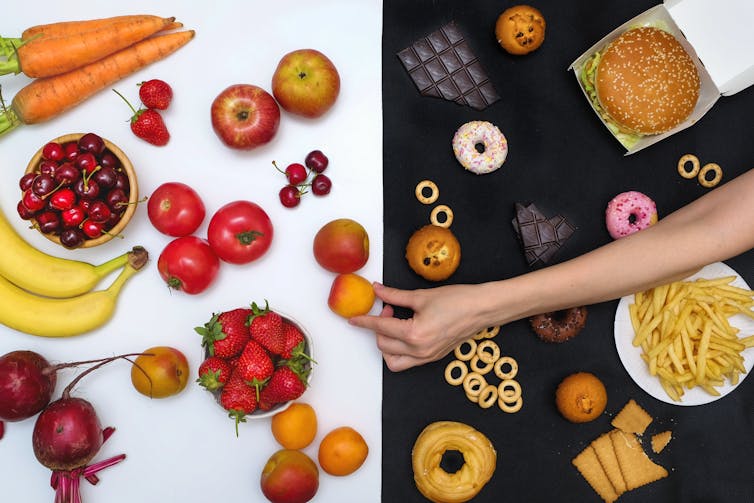
A person's hand reaches over an assortment of ultra-processed foods to chooses a minimally processed fruit instead.
Ultra-processed foods contain ingredients you wouldn’t normally find in your kitchen at home.
Natalia Mels/ Shutterstock

The more calorie-rich, less nutritious foods we consume, the more our health will suffer – as this recent study has confirmed. But how can you work out which foods are classified as “ultra-processed” and which are only “minimally processed”? In short, this depends on how much processing a food product has undergone to be ready for consumption.

Ultra-processed foods are industrially formulated products made mostly from ingredients extracted from foods (such as oils, starches and proteins) and additives.

Examples include: sugary breakfast cereals, flavoured yoghurts with sweeteners and thickeners, soft drinks, instant noodles, packaged biscuits and cakes, mass-produced bread with emulsifiers and reconstituted meat products – such as chicken nuggets.

Minimally processed foods are whole foods that are altered only to make them safer or easier to prepare. Importantly, this processing doesn’t change their nutritional value.

Examples include: fresh, frozen or bagged vegetables and fruit, plain yoghurt or milk, whole grains (such as oats or brown rice), eggs, fresh or frozen fish, and tinned beans or tomatoes without added sugar or salt.

Including minimally processed foods

It can sometimes feel overwhelming to work out whether a food is ultra-processed or minimally processed.

Some advice that is often suggested for working out whether a food is ultra-processed include checking to see if a product contains more than five to ten ingredients and considering if it contains ingredients you wouldn’t use at home.

In addition to the number of ingredients, it’s also the type of ingredients that matter. Ultra-processed foods often contain added sugars, refined starches, emulsifiers, stabilisers and flavourings that serve cosmetic purposes (such as improving colour, texture or taste), rather than preserving the food’s freshness or safety.

Minimally processed foods will not contain these types of ingredients, nor will they have as many ingredients on their label.

It’s also important to be aware of smoked meats. While this is a common preservation method, most commercially available smoked meats – such as bacon, ham or sausages – are considered ultra-processed because of the curing agents and other additives they contain. While plain smoked fish (such as smoked salmon) is still classed as a processed food, it uses fewer curing agents and additives than other smoked meat products.

A diet rich in minimally processed foods usually means more fibre, more nutrients and fewer calories – all of which can support weight and long-term health, as this recent study showed. So if you’re keen to include more minimally processed foods in your diet, here are a few tips to help you get more onto your plate:

  • build meals around vegetables, whole grains and pulses
  • use tinned or frozen products for convenience and to save time while cooking
  • choose plain dairy products without sugar or fruit purees, then add your own fruits, nuts and seeds for flavour
  • healthy meals don’t have to be complicated. Aim to include a protein source, a wholegrain carbohydrate and plenty of veggies or fruits at each meal
  • batch cook meals when you have time and freeze them if possible.

As a dietitian, it’s important to point out that there’s a distinction between the potential harms of excessive consumption of ultra-processed foods and the essential role processing can play in ensuring food safety, preservation and accessibility.

It’s also important not to panic about enjoying the occasional biscuit or ready meal, and we should avoid demonising convenience foods – especially for those who face barriers such as limited mobility or lack of cooking facilities. Because remember, the group that ate a diet high in ultra-processed foods but met dietary guidelines still lost weight and saw health benefits in the study.

Eating well doesn’t mean that you need to completely eliminate ultra-processed foods. But shifting the balance towards eating more minimally processed foods, with more home-cooked meals where possible, is a step in the right direction.

The Conversation

Aisling Pigott receives funding from Research Capacity Building Collaborative (RCBC) / Health and Care Research Wales (HCRW)

ref. Ultra-processed foods v minimally processed foods: how can you tell the difference? – https://theconversation.com/ultra-processed-foods-v-minimally-processed-foods-how-can-you-tell-the-difference-262669

Lifetime trends in happiness change as misery peaks among the young – new research

Source: The Conversation – UK – By Alex Bryson, Professor of Quantitative Social Science, UCL

Tero Vesalainen/Shutterstock

For years now, research studies across the world looking at happiness across our lifetimes have found a U-shape: happiness falls from a high point in youth, and then rises again after middle age. This has been mirrored in studies on unhappiness, which show a peak in middle age and a decline thereafter.

Our new research on ill-being, based on data from 44 countries including the US and UK, shows this established pattern has changed. We now see a peak of unhappiness among the young, which then declines with age. The change isn’t due to middle-aged and older people getting happier, but to a deterioration in young people’s mental health.

A closer look at data from the US shows this clearly. We used publicly available health data, which surveys more than 400,000 people each year, to identify the percentage of people in the US in despair between 1993 and 2024. Those we define as being in despair were the people who had answered that their mental health was not good every day in the 30 days preceding the survey.

Across most of the period, among both men and women, levels of despair were highest among the oldest age group (45-70) and higher for the middle-aged (25-44) than the young (18-24). However, the percentage of young people in despair has risen rapidly. It’s more than doubled for men, from 2.5% in 1993 to 6.6% in 2024, and almost trebled for women – from 3.2% to 9.3%.

Despair also rose markedly among the middle-aged, but less rapidly. It’s gone up from 4.2% to 8.5% for women and from 3.1% to 6.9% for men. The percentage of older men and women in despair rose only a little over the period.

As a result, by 2023-24 relative levels of despair across age groups were reversed for women. The youngest age group has the highest levels of despair, and the oldest age group the lowest. For men, the level of despair was similar for the youngest and middle-aged groups, and lowest for the oldest age group.

These trends have resulted in a very different relationship between age and ill-being over time in the US.

Between 2009 and 2018, despair is hump-shaped in age. However, the rapid rise in despair before the age of 45, and especially before the mid-20s, has fundamentally changed the lifecycle profile of despair. This means that the hump-shape is no longer apparent between 2019 and 2024.

Despair rose the most for the youngest group but also rose for those up to age 45; it remained unchanged for those aged over 45.

Our study found similar trends for Britain, based on analyses of despair in the UK Household Longitudinal Survey and anxiety in the Annual Population Survey. It also shows that the percentage in despair declines with age in another 42 countries between 2020 and 2025, based on analyses of data from the Global Minds Project.

Investigating causes

Research into the reasons for these changes is underway but remains inconclusive. The growth in despair predates the COVID pandemic by a number of years, although COVID may have contributed to an increasing rate of deterioration in young people’s mental health.

There is a growing body of evidence that identifies a link between the rise in ill-being of the young and heavy use of the internet and smartphones. Some research suggests that smartphone use is indeed a cause of worsening youth mental health. Research that limited access to smartphones found significant improvements in adults’ self-reported wellbeing.

However, even if screen time is a contributory factor, it is unlikely to be the sole or even the chief reason for the rising despair among the young. Our very recent research, which has not yet been peer-reviewed, points to a reduction in the power of paid work to protect young people from poor mental health. While young people in paid work tend to have better mental health than those who are unemployed or unable to work, the gap has been closing recently as despair among young workers rises.

Although the causes of the changes we describe have yet to be fully understood, it would be prudent for policymakers to place the issue of rising despair among young people at the heart of any wellbeing strategy.

The Conversation

Alex Bryson receives funding from the United Nations Development Program.

David Blanchflower received funding from the UN.

Xiaowei Xu receives funding from UKRI.

ref. Lifetime trends in happiness change as misery peaks among the young – new research – https://theconversation.com/lifetime-trends-in-happiness-change-as-misery-peaks-among-the-young-new-research-263665

Microplastics, pregnancy and the placenta: what we know and what we don’t

Source: The Conversation – UK – By Priya Bhide, Clinical Reader Women’s Health Research Unit, Centre for Public Health and Policy, Queen Mary University of London

alphaspirit.it/Shutterstock

During pregnancy, the placenta is the lifeline between mother and baby. It supplies the foetus with oxygen and nutrients, removes waste products and acts as a partial shield against harmful substances. But it is not an impenetrable barrier.

A 2023 systematic review found evidence that microplastics – tiny plastic particles less than five millimetres in size – may be able to cross from the mother’s bloodstream into the foetus. If confirmed, this could have serious consequences for development during pregnancy and for the long-term health of future generations.

Plastic waste does not simply disappear. Over time, sunlight, environmental conditions and mechanical wear break it down into smaller and smaller fragments: from large pieces known as macroplastics, to mesoplastics, to microplastics and eventually to nanoplastics: particles less than 100 nanometres across, small enough to be measured on the scale of molecules.

These particles come from the breakdown of everyday items: polyethylene from plastic bags and bottles, polypropylene from food containers and straws, polystyrene from takeaway cups and packaging, polyethylene terephthalate (PET) from drinks bottles, and polyvinyl chloride (PVC) from pipes, toys and clothing.

A 2025 review examining research in animals, lab-grown cells and human tissue samples found that both microplastics and nanoplastics can cross the placental barrier. Once inside, they may disrupt the delicate workings of the fetoplacental unit – the combined system of placenta and foetus – in several ways.

Studies suggest microplastics can block or interfere with the normal pathways cells use to communicate, trigger programmed cell death (apoptosis), and cause oxidative stress – a form of cellular damage that occurs when harmful oxygen-containing molecules build up faster than the body can neutralise them. Some plastics may also disrupt the endocrine system, which controls hormone release essential for growth and development.

How to limit your exposure to microplastics | BBC Global.

The ability to cross the placental barrier is especially concerning because this barrier normally acts as a highly selective filter, protecting the developing foetus from many harmful substances while allowing essential nutrients and oxygen through. If plastics bypass these defences, they could interfere with organ formation and long-term health during one of the most vulnerable stages of human development.

Exactly how these particles cross into the placenta is still not fully understood. Factors such as particle size, weight and surface charge – the tiny electrical charge carried by a particle – seem to play a role, as does the biological environment they move through.

Experiments using human placental models found that larger polystyrene particles (50–500 nanometres) did not damage placental cells and, in some cases, even seemed to improve their survival. By contrast, much smaller particles (20–40 nanometres) caused some cells to die and slowed the growth of others.

Animal studies show mixed results. In some experiments, most nanoplastics stayed in the placenta, with only a small amount reaching the foetus. In studies using human placentas in the lab, larger particles were usually trapped, while smaller ones could pass through in limited amounts.

Other research has found that nanoplastics can travel into foetal organs, including the brain, lungs, liver, kidneys and heart. Even when these organs looked normal under the microscope, researchers sometimes found smaller placentas and lower birth weights – changes that can affect a baby’s health.

Overall, this suggests that not all nanoplastics are dangerous, but certain sizes and types may pose real risks during pregnancy.

Critical window for microplastic harm

Foetal development is a finely tuned process, with cell growth, movement and death all tightly regulated. This makes it particularly vulnerable to environmental “insults” during critical windows of development. According to Barker’s foetal reprogramming theory, also known as the “developmental origins of health and disease” hypothesis, the conditions in the womb can “programme” how a baby’s organs, tissues and metabolism develop.

Harmful exposures during pregnancy, such as poor nutrition, toxins, stress, or pollutants like microplastics, can permanently alter the way organs form and function. These changes might not cause illness immediately, but they can increase the risk of chronic conditions such as diabetes, high blood pressure and heart disease later in life.

For example, if the placenta is damaged or nutrient supply is restricted, the foetus may adapt by prioritising blood flow to the brain at the expense of other organs. While this can help survival in the short term, it may result in smaller kidneys, altered metabolism or changes in blood vessel structure, all of which carry long-term health consequences.

Mothers are unknowingly passing on microplastics to unborn babies, doctors warn | 7NEWS.

Microplastics consumed through food or water may also disrupt the gut’s delicate balance of microbes, damage the intestinal lining, interfere with nutrient absorption and change how fats and proteins are processed.

Laboratory experiments show that polystyrene nanoparticles can enter embryos, accumulate in multiple organs and cause effects such as a slowed heart rate and reduced activity, even at very low doses. When inhaled by the mother, these particles can travel to the placenta and on to the foetal brain and heart.

There is also concern about potential effects on the developing brain. Some studies indicate that microplastics can build up in regions vital for learning, memory and behaviour, including the cerebellum, hippocampus and prefrontal cortex. Once there, they can cause oxidative damage, change the levels of neurotransmitters (the brain’s chemical messengers) and switch off certain genes needed for healthy brain development.


Read more:
Microplastics are in our brains. How worried should I be?


In animals, prenatal exposure to microplastics has been linked to anxiety-like behaviour, impaired learning, abnormal patterns of nerve cell growth, thinner brain tissue and disrupted connections between neurons.

Gaps in knowledge

Despite these worrying signs, there is still much we do not know. Research in this area is hampered by the fact that most studies are done in animals or in controlled laboratory settings, with little direct evidence from pregnant women.

We still do not fully understand how microplastics travel through the body, how much can accumulate in the placenta and foetus, or how easily they can be cleared.

What is clear is that further research is urgently needed. Understanding whether microplastics pose a genuine threat to reproductive health and foetal development could help shape policies on plastic production, consumption and disposal — and inform the advice given to women during pregnancy.

The Conversation

The authors do not work for, consult, own shares in or receive funding from any company or organisation that would benefit from this article, and have disclosed no relevant affiliations beyond their academic appointment.

ref. Microplastics, pregnancy and the placenta: what we know and what we don’t – https://theconversation.com/microplastics-pregnancy-and-the-placenta-what-we-know-and-what-we-dont-262820

Yaba’s grip: how cheap methamphetamine is fuelling Thailand’s addiction crisis

Source: The Conversation – UK – By Joseph Janes, Senior Lecturer in Criminology, Swansea University

Yaba, a cheap and potent methamphetamine-caffeine pill often dubbed “crazy medicine”, has become one of Thailand’s most pressing public health crises. Easy to produce and widely available, yaba is used by everyone from factory workers seeking stamina to partygoers chasing a high.

With its low price, intense effects and highly addictive nature, yaba is one of the most commonly abused stimulants in southeast Asia – and its spread shows no sign of slowing. Yaba’s rapid rise over the past 30 years as a street drug marks a troubling evolution.

Originally introduced to east Asia during the second world war to enhance soldiers’ endurance, methamphetamine has become known as “nazi speed” in some circles. And what began as a wartime stimulant is now at the heart of a regional addiction crisis.

A typical yaba pill contains around 30% methamphetamine. When mixed with caffeine it acts as a powerful central nervous system stimulant. The drug delivers a quick and intense burst of energy, euphoria and heightened alertness, often accompanied by reduced appetite.

Users often crush and smoke the pills, though some swallow them whole. The high lasts for hours, followed by a comedown marked by exhaustion, insomnia and paranoia.

Despite its dangers, yaba is alarmingly accessible. In some areas, a single pill costs as little as 10p, making it available to the region’s poorest and most vulnerable. Yaba is now the most widely abused form of methamphetamine in Thailand and its neighbouring countries, including Laos, Cambodia and Vietnam. Its use is particularly prevalent among young people, and its popularity is rapidly growing.

A Sky News report on yaba, August 2025.

The golden triangle and the yaba boom

The golden triangle, where Myanmar, Thailand and Laos meet, has long been notorious for its role in the global opium trade. But today, it’s at the heart of Asia’s methamphetamine crisis.

According to the UN, the production and trafficking of synthetic drugs in the region have grown exponentially, with methamphetamine seizures in 2024 hitting a record 236 tonnes, a 24% increase.

Much of this production is centred in Myanmar’s Shan State, where ongoing conflict has created the ideal conditions for industrial-scale drug operations. Armed groups, often relying on drug profits to fund their military activities, operate in regions beyond government control. These lawless areas, combined with relative stability in others, have allowed for the large-scale manufacturing of yaba and other methamphetamines.

Thailand continues to serve as both a primary transit route and an end market for yaba. In 2024, Thai authorities seized over 139 million yaba pills. But despite record-breaking seizures, the actual volume of yaba reaching the streets is believed to be far higher, highlighting the limitations of enforcement efforts alone.


Read more:
Synthetic drugs are having devastating effects around the world, from Sierra Leone to the UK


While Thailand leads the region in drug seizures, efforts are outpaced by the scale of the trade. Smugglers, often armed, transport hundreds of thousands of pills at a time, exploiting porous borders – particularly between Thailand and Myanmar. Thai authorities find themselves in a constant game of whack-a-mole. When they shut down one trafficking route another quickly emerges.

Meanwhile, trafficking routes are diversifying. New land corridors now link Myanmar with Cambodia through Laos, while maritime networks are expanding across Malaysia, Indonesia and the Philippines. These changes have turned a local problem into a transnational crisis.

A Vice documentary, The Meth Warlords of the Golden Triangle.

Thailand’s response to the yaba crisis has been a mix of hardline enforcement and hesitant reform, with mixed results. A controversial policy has allowed possession of up to five yaba tablets, distinguishing users from traffickers.

A government-backed proposal to cut this to one tablet has been approved in principle and is awaiting enactment. So, the five-pill rule is still in force. Though a step toward decriminalisation, it’s a policy which has failed to offer a coherent strategy for treating addiction.

Indeed, investment in drug treatment and harm reduction has been sluggish. Formal rehabilitation services remain scarce and unevenly distributed. Without accessible, evidence-based support, many users end up cycling between incarceration and relapse.

In the absence of government-led solutions, some communities have turned to grassroots alternatives. Across Thailand, Buddhist monasteries have become unlikely centres of detox, blending ritual with rudimentary treatments.

These detox programmes often involve communal steam baths followed by the ingestion of a secret herbal concoction that is said to purge toxins through vomiting. Though lacking clinical oversight, they offer discipline and belonging for those with nowhere else to turn.

Lessons

Yaba’s rapid spread is not just Thailand’s problem but a symptom of a broader, global failure. Conflict-driven economies, porous borders and the worldwide demand for cheap synthetic drugs have created the perfect conditions for yaba to thrive. When chemicals are easily sourced, production is decentralised and law enforcement is overwhelmed, illicit drug markets grow faster than they can be contained.

Thailand’s experience highlights the shortcomings of the decades-long “war on drugs”. Despite record seizures and intensified enforcement efforts, the yaba trade continues to expand. It’s cheaper, faster and more deadly than before. Criminal networks adapt faster than authorities can act, while users are often criminalised rather than supported.

What’s needed now is not more punishment, but a serious, coordinated effort that includes public health infrastructure and evidence-based harm reduction strategies.

Buddhist monasteries should not have to serve as a stand-in for state-funded addiction treatment. The resurgence of the golden triangle as a global synthetic drug hub is a warning that the world cannot afford to ignore.

The Conversation

Joseph Janes does not work for, consult, own shares in or receive funding from any company or organisation that would benefit from this article, and has disclosed no relevant affiliations beyond their academic appointment.

ref. Yaba’s grip: how cheap methamphetamine is fuelling Thailand’s addiction crisis – https://theconversation.com/yabas-grip-how-cheap-methamphetamine-is-fuelling-thailands-addiction-crisis-262765

Democrats dig in with a new type of campaign against Trump

Source: The Conversation – UK – By Dafydd Townley, Teaching Fellow in US politics and international security, University of Portsmouth

Over the past few months, the governor of California, Gavin Newsom, has increasingly become a focal point for the Democratic party’s resistance to the US president, Donald Trump.

And a poll taken in August 2025 gave Newsom a bump in support from Democrats and Democratic-leaning independents, going from 11% in June to 19% in August. He was the only potential 2028 Democratic presidential candidate who saw gains in the survey.

Touted by many as a potential replacement for the ailing Joe Biden as the 2024 Democrat presidential nominee, Newsom didn’t have a chance to stand as Biden passed the mantle directly to Kamala Harris.

But in the past few months the charismatic former mayor of San Francisco has been increasingly outspoken in his criticism of the Trump administration. On August 27 he said Americans needed to “wake up” to threats he said were posed by the current administration.

Part of Newsom’s approach has recently been to adopt the same mass communication methods as Trump has. This is not the highbrow intellectual route that Democrats have taken in the past. This is AI slop – the low-quality, mass-produced online content generated by artificial intelligence, designed to manipulate social media platform’s algorithms for greater exposure.

New social media style

Over the past few weeks, Newsom’s team has released numerous social media messages mimicking and mocking Donald Trump.

For instance, this month, Newsom’s staff posted a message on X featuring an AI-generated image of the governor wearing a crown on the cover of Time magazine, accompanied by the caption: “Long Live the King.” The following day, the same account reposted an AI-generated image of a muscular Newsom holding the American flag with the caption: “In Gavin We Trust.”

The approach seems to be popular. Newsom’s team also released parody-Trump merchandise with reports suggested that it raised US$100,000 (£73,900) online on its first day of release. And Newsom’s use of this AI-produced content may well be redefining how Democrats attack Republicans in the future.

Newsom made no excuses for taking such a route. When questioned by Fox LA about this new approach recently he said: “I’ve changed, the facts have changed; we (the Democrats) need to change.”

The California governor is not the only Democrat to stand up to Trump. While Democrats in Congress are hamstrung by the Republican majority in both the House and Senate, elected Democrat officials in state governments are working hard to limit Trump’s influence.

When Trump federalised the California National Guard to end public protests against the activities of the Immigration and Customs Enforcement agency (Ice), Newsom and California’s attorney-general, Rob Bonta, sued Trump, defense secretary Pete Hegseth, and the Department of Defense.

Newsom and Bonta argued that the president had exceeded his constitutional authority, as such action had been taken without the governor’s consent. Newsom defiantly declared that: “The president is not a king and is not above the law.”

An appeals court allowed Trump to retain control of the National Guard while the lawsuit continued. The federal trial opened in San Francisco on August 11, and a judgment had not been released as this article went live.

California governor Gavin Newsom has been testing out a new style of social media, and it’s getting noticed.

In Chicago

As well as ordering the Department of Defense to create specialist National Guard units to deal with civil unrest, Trump has also threatened to use troops in other Democrat-controlled cities such as Baltimore and New York, where he also claims that state governments are failing to deal with crime waves.

On August 26, in an eloquent but defiant speech, Illinois governor JB Pritzker warned Trump not to send troops to Chicago: “Mr President, do not come to Chicago. You are neither wanted here nor needed here,” Pritzker said.

Mirroring Newsom’s claims of executive overreach, Pritzker said that Trump’s determination to use troops to reduce crime figures in Democrat-controlled cities around the country was to “lay the groundwork to circumvent our democracy, militarise our cities and end elections”.

“If this were happening in any other country, we would have no trouble calling it what it is, a dangerous power grab,” Pritzker said.

Trump has used the National Guard as a law enforcement tool in Washington DC, another Democrat-controlled city, since the middle of August. The US president sent troops, complete with armoured vehicles, to the nation’s capital, where he claimed violent crime was out of control. While the troops were initially unarmed, in the past week officials have said that guard members have been authorised to carry either their M17 pistols or M4 rifles.

According to figures released by the Washington Metropolitan Police Department, violent offences were at their lowest level in 2024 in 30 years. The pattern appears to be continuing in 2025, with violent crime down 26% compared to this time last year and robberies falling by 28%. The Democrat mayor of Washington DC, Muriel Bowser, called Trump’s deployment of troops an “authoritarian push”.

It turns out the use of troops in Washington DC has not gone down that well with Americans. According to a Reuters/Ipsos poll during the last week in August, only 38% of Americans supported Trump’s actions, with 46% opposed.

After what had seemed to be a good start to the year for Trump, his job approval rating is fragile. With the midterms just over a year away, the Republicans need to keep one eye on the polls if they wish to retain their majorities in the House and Senate.

Whether Newsom’s pushback against the administration is the start of his campaign for 2028 is unclear, but it would do him no harm to establish himself as a national political figure, a portrayal with which he can build a campaign for 2028.

The Conversation

Dafydd Townley does not work for, consult, own shares in or receive funding from any company or organisation that would benefit from this article, and has disclosed no relevant affiliations beyond their academic appointment.

ref. Democrats dig in with a new type of campaign against Trump – https://theconversation.com/democrats-dig-in-with-a-new-type-of-campaign-against-trump-263869

Research shows children’s wellbeing drops when they start secondary school – here’s why

Source: The Conversation – UK – By Paty Paliokosta, Associate Professor of Special and Inclusive Education, Kingston University

Rawpixel.com/Shutterstock

For many pupils, the move to secondary school is a moment of anticipation – new friends, new subjects, and a growing sense of independence. But research in England shows this transition often comes with a hidden cost: a sharp and lasting decline in wellbeing.

Data from a 2024-2025 survey carried out by education support and research company ImpactEd Group with over 80,000 pupils shows a drop in children’s wellbeing between year six – the last year of primary school – and year eight.

This report found that enjoyment of school plummets, feelings of safety decline, and belief that their efforts will lead to success (known as self-efficacy) drops significantly. Children receiving free school meals were also less likely to say they enjoyed school, with this gap continuing to widen into secondary school.

This isn’t just adolescent growing pains. Secondary school pupils in the UK are more miserable than their European peers. Data from the Pisa programme, which assesses student achievement and wellbeing internationally, shows that in 2022 the UK’s 15-year-olds had the lowest average life satisfaction in Europe.

It’s a systemic problem – but one that can be changed.

Difficult transitions

Moving to secondary school involves much more than a change of location. Pupils must adapt to new teachers, routines, academic demands and social dynamics. And this takes place while they are going through puberty, one of the most intense periods of emotional and neurological development.

Research on school transitions stresses that success depends not only on a child’s “readiness,” but also on the school system’s capacity to support them.

Unfortunately, many schools prioritise performance metrics over relationships. This may leave many pupils – particularly those who are neurodivergent, have special educational needs, or who come from minoritised backgrounds – feeling disconnected and unsupported. This can deeply affect their wellbeing.

One major barrier to belonging is the use of zero-tolerance behaviour policies. These strict approaches to discipline – silent corridors, isolation booths, high-stakes punishments such as suspensions – are becoming more common in large secondaries and academies. Advocates have claimed these policies create firm boundaries in schools. But for many pupils, especially those with ADHD, autism, or a history of trauma, they may instead create anxiety, alienation and disengagement from school.

Children with special educational needs are excluded from school at some of the highest rates in the country. According to the Children and Young People’s Mental Health Coalition, a collaborative network of over 300 organisations including mental health organisations and youth support services, many of these children are not “misbehaving,” but expressing unmet emotional and mental health needs. Punitive responses frequently worsen their difficulties.

Pupils on stairs at school
The environment of secondary school can be very different to that of primary education.
Rawpixel.com/Shutterstock

Schools that adopt behaviour policies that focus on emotional literacy and building trust have reported success in building a caring environment.

A hidden curriculum

While these challenges affect many students, working-class pupils often face a more acute and entrenched form of educational alienation. A deeper look into the structure of secondary education in England reveals systemic inequalities that shape how different children experience school.

According to Professor Diane Reay, a leading expert on education and social class, the British school system continues to fail working-class children. Her research suggests that schools in disadvantaged areas are more likely to feature rigid discipline, “teaching to the test,” and a narrow, fact-heavy curriculum. In such spaces, there is little room for creativity, critical thinking, or personal expression.

Instead of feeling seen and valued, many working-class students may experience school as a place of constant control and low expectations. They are more likely to encounter deficit narratives: being told what they lack, rather than having their strengths recognised or nurtured.

This dynamic plays out most starkly during the transition to secondary school. Pupils from working-class backgrounds often enter year seven already disadvantaged – socially, economically, and in terms of cultural capital. This means that in unfamiliar settings where middle-class norms dominate, they may not speak the “right” way, dress the “right” way, or know the unspoken rules. These students frequently find themselves on the outside looking in.

Beyond class, issues of race and cultural background also play a key role in how pupils experience school. Students from minority backgrounds often also encounter what researchers refer to as the “hidden curriculum”.

This is a set of unspoken norms that reflect white, middle-class values, and which they may be unfamiliar with. This affects everything from which stories are told in the curriculum to how the behaviour of students is interpreted by teachers.

The year-seven dip is not inevitable. But reversing it requires more than tweaks to transition plans or behaviour policies. It demands a fundamental shift in how we understand inclusion, belonging and educational success. Schools need to put policies in place that help students feel safe, connected and empowered to manage conflict. And they should recognise that working-class and marginalised pupils face systemic barriers, and commit to dismantling them.

The Conversation

Dr Paty Paliokosta is an Associate Professor in Inclusive Education and leads the Inclusion and Social Justice SIG at Kingston University, London. She co-leads the National SENCO Advocacy Network.

ref. Research shows children’s wellbeing drops when they start secondary school – here’s why – https://theconversation.com/research-shows-childrens-wellbeing-drops-when-they-start-secondary-school-heres-why-260737

The First King of England: Æthelstan and the Birth of a Kingdom – a deep and nuanced analysis of a complex monarch

Source: The Conversation – UK – By Clare Downham, Professor, University of Liverpool

Æthelstan ( 894 to 939) in an illustration in a manuscript of Bede’s Life of Saint Cuthbert. Wikimedia

The reign of Æthelstan (924 to 939) has excited a significant amount of study in recent years. In 2004 there was The Age of Athelstan, by Paul Hill. In 2011, Sarah Foot published Æthelstan: The First King of England, and in 2018, Tom Holland released Athelstan: The Making of England. A key theme in these books is the role of Æthelstan as unifier of the kingdom of England.

Æthelstan’s most famous battle, Brunanburh (937) was fought against a coalition of vikings and Celtic-speaking peoples. Brunanburh was seen, perhaps erroneously, to secure the future of a unified England. As a historian of this period, I have argued that the “kings and battles” story of the past often cloaks the longer-term engines of political change.

This latest book to add to this history is The First King of England: Æthelstan and the Birth of a Kingdom by David Woodman, which addresses both themes of English unification and viking politics. It also seeks to provide deeper insights into the personality of King Æthelstan. The result is a highly engaging and informative biography.

The writing is well pitched for a general reader. The terminology used in tenth-century political history is explained in a clear and concise way without seeming patronising to the reader. This is particularly useful in the introduction where the different sources for Æthelstan’s reign are discussed, inviting the reader to consider how historical narratives are constructed from the evidence that survives.

Woodman draws on a range of contemporary sources. He also makes extensive use of the 12th-century text, Gesta regum Anglorum (Deeds of the kings of England), by historian William of Malmesbury, which is a
key source for the life of Æthelstan. Given that legends surrounding this tenth-century king were already evolving and developing a life of their own in William’s time, a deeper dive into that particular text to evaluate its reliability, would have been welcome.

There is intriguing discussion in Woodman’s book around the challenges that Æthelstan faced at the start of his reign. Tensions had arisen between Æthelstan and his father Edward the Elder, as the king appears to have favoured Æthelstan’s half and younger brother Ælfweard of Wessex as his successor. Such family rivalries provide relatable drama to usher in the reign of the new king.

Æthelstan’s support was based in Mercia (a powerful kingdom which was in the Midlands) while his brother’s was in Wessex (a major kingdom in what is now south west England). When Edward the Elder died in 924, Æthelstan was accepted as King of Mercia but reluctantly in Wessex, even though Ælfweard died shortly after his father.

These rivalries and family dramas could suggest that the rebellion at the Mercian stronghold of Chester, which just preceded the death of Edward the Elder in 924, had been instigated by Æthelstan himself (although this point is not made by Woodman). The intrigue continues as some years later, Æthelstan was implicated in the death of Ælfweard’s full brother Edwin.

The circumstances in which Æthelstan later extended his power over Northumbria and how he held together a unitary “kingdom of England” are explored in thoughtful detail. One of the greatest strengths of the book is the discussion of categories of contemporary sources: diplomas (written grants of lands and privileges), laws and coinage.

Æthelstan’s diplomas were issued at his court, recording time and place and witness lists. Their records are skilfully deployed by Woodman to trace Æthelstan’s travels, the changing membership and hierarchy of his assemblies, his claims to power, and the literary skills and possible identity of their authors.

Far from being a dry and dusty subject, Woodman writes vividly about Æthelstan’s laws. Legal punishments reveal harsh insights.

For example, according to one code, if an enslaved man is found guilty of theft of goods over a certain value, he was to be stoned to death by fellow slaves. Æthelstan took a harsher line than his predecessors on theft, and comparison with earlier codes may have merited more overarching consideration to understand his reign.

This uptick in state violence may correlate with growing imbalances of power and concerns over obedience as government became more powerful. Centralisation of authority and obedience are themes in Woodman’s discussion of coin iconography, the locations of mints and how the recorded names of those who minted the coins demonstrate cultural diversity in Æthelstan’s England.

Woodman provides a well-rounded analysis of Æthelstan’s government, dealing with ecclesiastical politics and piety. Æthelstan offered conspicuous gifts to churches whose favour he sought to win at home and abroad.

There are also insightful discussions around Æthelstan’s scholarly interests and his collection and donation of relics and manuscripts. These provide compelling glimpses into the king’s personality.

The desire to dominate neighbouring peoples also appears as a less savoury personality trait. Æthelstan sought to make his bombastic claims to be king of all Britain, or “Rex totius Britanniae,” which became a reality through negotiation and threats of violence. The 934 campaign, which the king led to North Britain (Scotland and England did not exist in 926 but this would have been modern-day Scotland), gives rise to extended discussion and helps readers understand the events leading to the famous Battle of Brunanburh, three years later.

Another significant bonus in this book is the analysis of Æthelstan’s continental links. As accounts of his reign tend to be focus on the “making of England” (and even a “making of Britain”) narrative, this dimension of his reign and his legacy has not always received the attention it deserves. Woodman brings together the significant articles on this topic composed by Sarah Foot, Simon MacLean and others, and combines them with perceptive analysis of primary sources.

Overall, Woodman presents Æthelstan as a European king, a scholar, with ruthless ambitions and a strong streak of piety. It would be easy to caricature Æthelstan within certain narratives that aligns with views of English nationhood as it is today, but this book provides a deeper and more nuanced analysis of this fascinating king.


Looking for something good? Cut through the noise with a carefully curated selection of the latest releases, live events and exhibitions, straight to your inbox every fortnight, on Fridays. Sign up here.


This article features references to books that have been included for editorial reasons, and may contain links to bookshop.org. If you click on one of the links and go on to buy something from bookshop.org The Conversation UK may earn a commission.

The Conversation

Clare Downham does not work for, consult, own shares in or receive funding from any company or organisation that would benefit from this article, and has disclosed no relevant affiliations beyond their academic appointment.

ref. The First King of England: Æthelstan and the Birth of a Kingdom – a deep and nuanced analysis of a complex monarch – https://theconversation.com/the-first-king-of-england-aethelstan-and-the-birth-of-a-kingdom-a-deep-and-nuanced-analysis-of-a-complex-monarch-264145

Sri Lanka moved to end elite impunity with arrest of former president

Source: The Conversation – UK – By Thiruni Kelegama, Lecturer in Modern South Asian Studies, Oxford School of Global and Area Studies., University of Oxford

Sri Lanka’s former president and six-time prime minister, Ranil Wickremesinghe, was arrested on August 22 for allegedly misusing state resources while in office. He is accused of using public funds to attend his wife’s graduation ceremony in London after an official visit to the US in 2023. Wickremesinghe has since been granted bail on a 5m rupee (£12,300) bond.

His arrest represents one of the most consequential moments in the Sri Lanka’s postcolonial history. It marks the first time a former head of state has ever been detained in Sri Lanka, shattering the longstanding assumption that those at the top of the country’s politics remain forever beyond the reach of the law.

The assumption of elite impunity was built on decades of precedent. This reached its apex under the Rajapaksa family, who dominated Sri Lankan politics between 2005 and 2022, as corruption was woven into the very fabric of governance.

The Rajapaksas captured state institutions, placing family members and loyalists in key positions across the bureaucracy, military and judiciary. Public wealth was also diverted for private gain. The certainty that those in power would remain beyond legal reach, regardless of the scale of abuse, became embedded in Sri Lanka’s political DNA.

That certainty cracked in 2022 when mass protests, commonly known as Aragalaya, swept the Rajapaksas from office. The following year, the Sri Lanka’s supreme court held the family responsible for bankrupting the state by mishandling the economy.

This was a landmark ruling, but one that had little material effect. The Rajapaksas were only condemned and not punished. Wickremesinghe’s arrest is different. It shows that accountability has moved beyond a single dynasty and now threatens the entire Sri Lankan political class.

Thousands of Sri Lankans waving flags at a protest.
Thousands of Sri Lankans attend a protest demanding the resignation of former president Gotabaya Rajapaksa in 2022.
Ajit Wick / Shutterstock

The timing of the arrest deepens its significance. Sri Lanka is currently under an International Monetary Fund (IMF) bailout programme to help stabilise its economy. It was negotiated by Wickremesinghe in the wake of bankruptcy and is now being carried forward by the National People’s Power (NPP) government.

The bailout loan comes with punitive terms. Higher taxes, subsidy cuts and shrinking public services are all being shouldered by ordinary citizens. They pay daily for a crisis born of elite misrule. In this context, elite accountability is not just symbolic, it is the bare minimum of justice.

Moment of truth

This moment is defining for the NPP government. Anura Kumara Dissanayake was elected in 2024 having pledged to prosecute corruption and abolish the executive presidency – the constitutional embodiment of unaccountable power since 1978. His government faces both opportunity and test in Wickremesinghe’s arrest.

Few individuals embodied establishment politics more fully than Wickremesinghe did. The immediate response to his arrest was telling. Three former presidents, Chandrika Kumaratunga, Mahinda Rajapaksa and Maithripala Sirisena, along with opposition leader Sajith Premadasa rushed to show solidarity with the detained ex-president. This suggests the old guard’s instinct for self-preservation remains strong.

If prosecutions prove selective, the NPP also risks echoing the very cynicism it sought to displace – wielding justice as a political weapon rather than institutionalising it as a principle. While the government has already launched investigations into a broad swathe of former officials – from a member of the Rajapaksa dynasty to more than 20 ex-ministers – these early moves could be symbolic.

The real test lies with the Rajapaksas. Their rule was virtually synonymous with impunity. If they too are truly held to account, it would mark a genuine transformation from dynastic protection to the beginning of rule of law.

Such moves carry risks. Prosecutions may be dismissed as political vendetta, further polarising Sri Lanka’s already fragmented society. The protests that erupted in Colombo following Wickremesinghe’s arrest offer early evidence of this dynamic.

But the danger of inaction is greater. To do nothing, after an economic collapse born of corruption and elite mismanagement, would reinforce public cynicism and effectively license future impunity. It would tell citizens already enduring austerity that, once again, those at the top remain beyond reach.

Wickremesighe’s arrest also sends a signal beyond Sri Lanka’s borders. For years, the country’s reputation was defined by scandals and violations that went unpunished.

In 2015, for example, Sri Lanka’s central bank issued ten times the advertised amount of 30-year bonds at inflated interest rates. This cost the state an estimated 1.6 billion rupees (roughly £3.9 million) in excess losses. Then, several years later, no criminal proceedings were brought against senior officials for failing to act on intelligence warnings ahead of the 2019 Easter Sunday bombings that killed 269 people.

This pattern of impunity extended beyond domestic scandals. The UN Human Rights Council had passed multiple resolutions on Sri Lanka over alleged war crimes and enforced disappearances. Yet here too the state’s response remained the same. It made promises of accountability that never materialised.

The arrest of Wickremesinghe suggests this may be changing. It is a signal that Sri Lanka is finally serious about the rule of law – not just as a slogan, but as practice.

Sri Lanka’s myth of elite untouchability has cracked, but whether it shatters completely depends on what follows. While Wickremesinghe’s arrest is historic, lasting transformation requires institutions capable of sustained accountability.

The choice before the NPP is clear: accountability as a spectacle or as a system. Having paid the price of impunity, Sri Lankans may finally be positioned to demand its opposite.

The Conversation

Thiruni Kelegama receives funding from the Rights to the Discipline Grant by the Antipode Foundation (2024). She is a Director of the Institute of Political Economy, Sri Lanka.

ref. Sri Lanka moved to end elite impunity with arrest of former president – https://theconversation.com/sri-lanka-moved-to-end-elite-impunity-with-arrest-of-former-president-263945