My artwork, A Virtuous Woman, has become the centre of a protest – it shows how our polarised society can affect art

Source: The Conversation – UK – By Layla Khoo, PhD Candidate, Public Participatory Contemporary Art, University of Leeds

My project A Virtuous Woman is both an artwork and a piece of ongoing research into the role of participatory artwork in heritage sites. As such, the artwork was always intended to be dynamic, responding to the ways in which people wanted to take part.

The artwork was inspired by the embroideries of the ancient noble women commissioned by one of the most notable women in Elizabethan court and society, Bess of Hardwick, four of which are on display at the National Trust property, Hardwick Hall. The new work was intended to be a reimagining of the missing fifth embroidery, made from recycled fabrics donated by the National Trust staff and volunteers.

Visitors to the hall could take part in sewing, cutting and adding their own expressions through embroidery. But after two participants added the name of author J.K. Rowling to the piece and another embroidered a line of stitches through both instances, things became complicated.

A protest was staged at Hardwick Hall and the artwork became the centre of a media storm. I have been subject to accusations and abuse online for displaying the work complete with these conflicting pieces of participation and the National Trust have received a barrage of complaints. So where does this leave participatory arts, the artists who create and facilitate them and the sites which commission and host them?


Looking for something good? Cut through the noise with a carefully curated selection of the latest releases, live events and exhibitions, straight to your inbox every fortnight, on Fridays. Sign up here.


Participatory arts have to consider not only the freedom of expression of the artist, but of every person who participates. Both the National Trust and I had to attempt to balance the expressions of participants in a political polarised climate, while witnessing a media fallout when groups and individuals disagree with the choices made.

Participation with the artwork took place between April and November 2024. Throughout this time, the work prompted discussion and debate around the subject of virtues and the women that visitors felt upheld these values.

Thousands of people added their embroideries. In total 186 words of virtue or value, and 804 names were added to the piece. Some were embroidered by more than one person (a few stitches, or a letter each), some participants embroidered more than one contribution, and many virtues and names were repeated multiple times.

The Hardwick Hall team and I had previously agreed that no names would be censored or removed from the work, and that participants would not be allowed to unpick each other’s embroidery. However, while not encouraged, participants would be allowed to interact with and adapt the embroidery of other participants.

In August 2024, a complaint was raised after two people added Rowling’s name to the piece. The author has sparked controversy in the last few years as a result of her “gender critical” views, which many see as transphobic (a claim which Rowling denies), while others see her as a figurehead for women’s rights. A participant then embroidered a line of stitches through both instances of the name on two separate panels (in the colours of the trans pride flag), while leaving the name clearly visible.

We now needed to consider whether staff, volunteers and visitors might feel offended, unsafe or unwelcome when encountering the recognition of a person seen by some as harmful. We also needed to think about the dismissal of someone admired by others for their cultural influence and beliefs.

At the request of the National Trust, the project was “paused” for a month while advice was taken on the most appropriate way forward. Staff were prepared through workshops run by the National Trust team on how to deal with potentially difficult interactions with participants.

I was asked by the National Trust team if I was willing to remove any embroidered names from the work, including repetitions. I said I was not, as participants had taken part in good faith and were expecting to see their contribution in the completed work.

The Hardwick Hall team and I agreed that all names would remain, and all subsequent names added would not be subject to censorship. We agreed that the lines stitched through Rowling’s name would also remain. I felt that removing them would remove an act of protest – a valid act of participation – and that leaving it on display would demonstrate the difficulties and friction involved in creative expression and participation in our often-polarised society.

Many participants saw Rowling’s crossed out name while embroidery was still taking place, and some responded by adding her name again. Participants discussed cancel culture, polarised views and the complexity of the people they admire.

When the artwork was complete, Rowling’s name appeared seven times – twice with a line stitched through, five times unaltered. The completed artwork was placed on display at Hardwick Hall in January this year.

On May 24, the Women’s Rights Network (WRN) posted a thread on X detailing a visitor complaint regarding the crossing out of Rowling’s name. They called for the National Trust to add a statement to the artwork, explaining why the crossing out remains on display. Members of the WRN subsequently carried out a protest on site and created a short film explaining their position.

On May 31, two visitors to Hardwick Hall cut away the line of stitches and posted images and video of themselves doing so on X.

The subsequent mainstream media coverage, blog posts and widespread social media attention resulted in threats of further activism.

The National Trust initially covered the work to protect it, but then removed it from display on June 4, as there was now also a risk to other artworks and collection items at Hardwick Hall, and to the staff and volunteers on site.

The National Trust released a statement on X, which appeared to do little to answer questions being raised. There are now growing calls for commentary from me, as the artist responsible for the work, to explain what has happened, how decisions were made and where I stand both on the actions taken and the wider gender debate this speaks to.

Limitations in creative expression

I believe that the arts are in a unique position to tackle difficult subjects, and participatory arts can provide an opportunity for more voices to be heard. But with this approach comes the inevitable balancing act of where freedom of expression ends and causing harm begins.

Consideration must be given to intention versus impact. Making these editorial and ethical choices creates a changing power dynamic. The participants have been invited to take part and do so in a way that is meaningful to them in what they believe to be the overall context of the work.

In participatory arts, the artist is part author, part facilitator of the expressions of others. The commissioning body or hosting site then holds the ultimate control, in being able to choose whether to display the work created.

My part in the decision to allow the stitching through of Rowling’s name essentially comes from a shared belief in singer Nina Simone’s view that “an artist’s duty … is to reflect the times”.

In my opinion, the acts of protest and activism in the crossing out of the name and the removal of that crossing out epitomise the lack of tolerance for other people’s views and beliefs that is becoming prevalent in our increasingly polarised society. As such, I think it is entirely appropriate to display these actions in the artwork. This polarisation and intolerance has been compounded in the subsequent outpouring of online vitriol and demands for what this work should and should not represent.

Both acts of activism changed the artwork, and disregarded the previous participant’s contribution. The difference is that the crossing out took place while participation was invited and expected – the removal of that crossing out was not. As the artist responsible for the artwork I have faced increasing demands not just to clarify the events leading to this point, but also to openly share my views on the actions taken by all parties. However, an artist sharing their opinion is not simple, or necessarily safe.

In its recent report, Freedom of Expression in the Arts (a five-year project aiming to tackle the culture of fear and intimidation some artists face for expressing their views) found that artists are increasingly afraid to express themselves on dangerous topics for fear of backlash from the public and cancellation of work opportunities by commissioning bodies.

My own experience has shown that social media is neither the place for nuanced, balanced, nor reasonable debate. I have been accused of transphobia for allowing the inclusion of Rowling’s name in the first place, and called (among other things) a “gender traitor” for allowing her name to be crossed out. But when a commissioning body or host site cancels a work which speaks to these debates, how else are artists able to speak out?

In a comment sent to The Conversation, a National Trust spokesperson said: “A Virtuous Woman is formed of people’s views from a variety of age groups, life experiences and beliefs … We understand that everyone may not agree on all the names included, but they are the choices of individual participants. Everyone is welcome at the National Trust, and the artwork reflects the diversity of the community and individuals we serve. Our approach is to make space for a variety of creative and personal responses to the collections and to encourage conversation.”

At the time of writing, I have been told that the redisplay of a projection of the artwork and explanatory panels is under review and is unlikely to take place until September 2025. Participatory arts hold up a mirror first to those who take part, and then again in the reception and judgement of subsequent viewers. The difficulty comes when we don’t like what it reflects.

The Conversation

Layla Khoo receives funding from the Frank Parkinson Scholarship for her PhD research.

ref. My artwork, A Virtuous Woman, has become the centre of a protest – it shows how our polarised society can affect art – https://theconversation.com/my-artwork-a-virtuous-woman-has-become-the-centre-of-a-protest-it-shows-how-our-polarised-society-can-affect-art-260349

Why Trump blames decisions on others – a psychologist explains

Source: The Conversation – UK – By Geoff Beattie, Professor of Psychology, Edge Hill University

It was US president Harry S. Truman who, in the years just after the second world war, kept a little wooden sign on his desk which read: “The buck stops here!”. It emphasised his willingness to accept ultimate responsibility for his decisions and actions as president, even the ones that didn’t quite work out.

This phrase has since become emblematic of presidential accountability and leadership. Truman wasn’t interested in trying to pass the buck, not as a man and certainly not as president.

Interestingly, the sign was made in the Federal Reformatory (prison) at El Reno, Oklahoma, suggesting an implicit moral dimension to this issue of responsibility and accountability. We’re all accountable for our actions, whoever we are, but the president above all.

But how things seem to have changed with Donald Trump in the White House.


Get your news from actual experts, straight to your inbox. Sign up to our daily newsletter to receive all The Conversation UK’s latest coverage of news and research, from politics and business to the arts and sciences.


Trump continually takes personal credit for any perceived successes as president – fixing global tariffs, Nato members paying more, the Middle East (even taking credit for things that were completed before he took office). But he makes sure that any failures are immediately attributed elsewhere.

He frequently positions himself as surprised or “blindsided” by unpopular decisions, which are always somebody else’s doing, somebody else’s fault. Subordinates are held responsible. He is not averse to pointing the finger directly at them, and often in public, high-profile settings.

That great loyal Trump supporter, defense secretary Pete Hegseth, for example, has recently been in the firing line for being personally responsible for pausing the delivery of missile shipments to Ukraine. US defence officials had apparently become concerned that weapons stockpiles were becoming low, as they needed to divert arms to Israel to help in the war with Iran.

But the pause in supplying some weapons to Ukraine announced by the Pentagon on July 2 was a hugely unpopular decision that resonated around the world. Hegseth was blamed.

Some have suggested that having loyalists such as Hegseth in critical positions like secretary of defense is highly strategic, and not just for the more obvious reasons. You could argue that having loyal supporters with delegated but overlapping authority is highly advantageous when it comes to the blame game.

Trump can publicly distance himself when things go wrong (as he did here), claim a degree of surprise, and swiftly change course. That way he is publicly reasserting his role as leader without admitting fault.

It is also noteworthy that Trump often reverses these decisions made by his subordinates in high-visibility environments, which suggests a determined pattern of strategic image management.

It’s a simple set of moves – you allow a subordinate to initiate a controversial decision, then you rein it in publicly and reassert your authority, thus showcasing your resolve. In other words, delegation to loyal insiders like Hegseth becomes a useful buffer against political fallout.

Loyal insiders still stay loyal (for the foreseeable future at least). They won’t sling mud, like some might in their position. So Trump can appear masterful.

Are you going to send weapons to Ukraine? President Trump reverses a policy and decides he will.

But of course, there’s more to this than everyday political shenanigans. Personality plays a major role. Some psychologists have argued that not internalising failure is psychologically beneficial.

If you take credit for success but externalise failure, that makes you resilient (and happy). But there are clearly limits to this, and there’s a darker side.

People with high levels of narcissism (“I like to be the centre of attention”; “I am an extraordinary person” – both items on the narcissism personality inventory, a method of measuring personalities) often avoid accountability because they perceive themselves as superior to others. But only, it should be noted, in certain “key” aspects of life.

In the words of Jean Twenge and W. Keith Campbell, authors of The Narcissism Epidemic: “Narcissists think that they are smarter, better looking and more important than others, but not necessarily more moral, more caring or more compassionate.”

Narcissistic individuals tend to externalise blame to protect their fragile self-esteem and maintain their self-image. They may refuse to admit fault because doing so threatens their grandiose concept of self.

Individuals exhibiting Machiavellian traits, characterised by manipulativeness and a lack of empathy, are also more prone to shifting blame. They may deflect responsibility to serve their self-interest, which is clearly a highly manipulative manoeuvre. You just do whatever is required.

Research also indicates that individuals with low conscientiousness, one of what are considered the “big five” personality traits, are less likely to accept responsibility for their actions. They may be somewhat careless or irresponsible in their work or actions, and when mistakes do occur – which they will – they blame external factors or other people.

In other words, certain personality traits are associated with a tendency to avoid accountability and responsibility.

It has been said that Trump’s inner circle consists of loyal sycophants who, even when it’s cringeworthy for outsiders, publicly praise him to amplify and protect his self-image. He needs this from them.

But they have another use as well. When things don’t go so well, they take it on the chin for him. That’s almost part of the job description. When things go wrong, his inner circle all understand the buck really stops with them.

The Conversation

Geoff Beattie does not work for, consult, own shares in or receive funding from any company or organisation that would benefit from this article, and has disclosed no relevant affiliations beyond their academic appointment.

ref. Why Trump blames decisions on others – a psychologist explains – https://theconversation.com/why-trump-blames-decisions-on-others-a-psychologist-explains-260877

Israel’s relocation plan for Palestinians and fading hopes for a ceasefire

Source: The Conversation – UK – By Jonathan Este, Senior International Affairs Editor, Associate Editor

This article was first published in The Conversation UK’s World Affairs Briefing email newsletter. Sign up to receive weekly analysis of the latest developments in international relations, direct to your inbox.


It was revealing this week to read reports of Benjamin Netanyahu’s meeting with Donald Trump (his third White House visit since Trump’s inauguration in January). There was no sense that the US president upped the pressure on the Israeli prime minister to soften Israel’s conditions in order to secure a ceasefire. Instead the pair appears to have discussed the prospect of moving large numbers of Palestinians out of the Gaza Strip to countries what would, as Netanyahu put it, “give Palestinians a better future”.

If Israel’s defence minister, Israel Katz, has his way, the future for those Palestinians who want to stay put does indeed look pretty bleak. And the 57,000 people who, according to figures collated by the Hamas-run Gaza health ministry, have lost their lives since the Israeli assault on Gaza began back in October 2023, have no future at all.

But the plan for the future of Gazan Palestinians that Katz unveiled this week will horrify many too. It involves the construction of a “humanitarian city” at Rafah, close to the Egyptian border at the very southern end of the Strip. Under the plan, people entering the city will be searched for weapons and checked for affiliation to Hamas. Once in, they will not be allowed to leave, except to depart from Gaza altogether.


Sign up to receive our weekly World Affairs Briefing newsletter from The Conversation UK. Every Thursday we’ll bring you expert analysis of the big stories in international relations.


This immediately prompted critics to accuse the Israeli government of ethnic cleansing. James Sweeney, an expert in human rights and international law at the University of Lancaster, believes that, if Israel were to carry out Katz’s plan, there would be strong case against political and military leaders for war crimes and crimes against humanity. He argues that the plan amounts at the very least to the forcible transfer of civilians prohibited under the Geneva conventions and the Rome statute, which underpins the International Criminal Court (ICC).

The snag, as Sweeney sees it, is going to be enforcing international law. While there is an ICC warrant out for the arrests of Netanyahu and his former defence minister, Yoav Gallant, the Israeli prime minister was able to visit Washington without fear of being apprehended. The US doesn’t recognise the ICC and, indeed, the prosecutor that issued the warrant against Netanyahu and Gallant is now subject to US sanctions.


Read more:
Plans to relocate Gazans to a ‘humanitarian city’ look like a crime against humanity – international law expert


Of course, what happens in Gaza tends to reverberate throughout the region. If hundreds of thousands of Palestinian citizens are moved out of Gaza, it’s likely to be to one of the neighbouring countries. When the idea of a Trump Riviera was first mooted earlier this year, the US president said the Palestinian population could be rehomed in Egypt or Jordan – something both those countries pushed back against with alacrity.

And the powerful Gulf States, which Trump was keen to woo as business partners when he made a tour of the region in May, are also deeply concerned about Israel’s conduct of its military campaign in Gaza. Geopolitics aside, their populations are broadly sympathetic to the Palestinian people, so a plan to force them out of their homes is unacceptable for Gulf leaders.

Scott Lucas, an expert in Middle East politics at University College Dublin, gives us a broader view of the region. He describes what he calls two “kaleidoscope moments” when one event has changed the entire region. The first was the Hamas attack of October 7. This brought to an abrupt end the process of normalisation of relations between Israel and Saudi Arabia. The second was the 12-day war between Israel and Iran, which has further isolated Israel. Lucas believes for there to be any hope of regional stability and the furthering of Israeli relations with the rest of the region, the war in Gaza must end.


Read more:
As Netanyahu meets Trump in Washington, what hope for peace in Gaza? Expert Q&A


Ali Mamouri, a Middle East scholar at Australia’s Deakin University doesn’t believe there’s much chance of this happening any time soon. Part of this is political: Netanyahu still depends on the far-right elements of his coalition represented by national security minister Itamar Ben-Gvir and finance minister, Bezalel Smotrich. They remain steadfastly opposed to even a ceasefire and want to see Israel expel Palestinians by hook or by crook.

Also, by prolonging the war, Netanyahu can keep delaying his corruption trial (incidentally, Donald Trump has called for the charges to be dropped altogether).

And the idea of full statehood for Palestine remains anathema for Israel, as Netanyahu made clear this week talking with journalists after his meeting with Trump when he made clear his insistence that far from pulling Israeli troops out of Gaza, Israel would keep full control of all security matters there: “Now, people will say: ‘It’s not a complete state, it’s not a state.’ We don’t care,” he said.

Mansour concludes: “The coming weeks will reveal whether Israel chooses the path of compromise and coexistence, or continues down a road that forecloses the possibility of lasting peace.”


Read more:
The US has high hopes for a new Gaza ceasefire, but Israel’s long-term aims seem far less peaceful


Europe must step up over Ukraine

Just as the picture remains bleak in Gaza, the prospects for peace remain very slim in Ukraine. Although given Donald Trump’s mercurial approach to foreign affairs, it’s also fair to say that anything is possible.

This week the US president decided to recommence US arms supplies to Ukraine, having previously frozen military aid (although he insists this was done by his defense secretary, Pete Hegseth, and that he was “blindsided” by the move). His relationship with Putin appears to have soured – for the present at least. He said: “We get a lot of bullshit thrown at us by Putin, if you want to know the truth. He’s very nice all of the time, but it turns out to be meaningless.”

And at the most recent Nato summit in The Hague on June 25, Trump put his signature to a declaration that Russia poses “long-term threat … to Euro-Atlantic security” and that Nato member states retain “their enduring sovereign commitments to provide support to Ukraine”.

But Stefan Wolff, an expert in international security at the University of Birmingham, believes that Nato’s European members cannot bank on the US as a reliable long-term partner. There are few signs that the US is pressuring Russia to compromise on its maximalist aims, which remain unchanged since it invaded Ukraine in February 2022. So Russia remains the most urgent threat to European security. And it’s a threat that Europe will need to prepare to confront, if necessary without US assistance.

But there are signs that many European countries are preparing to do just that, Wolff writes. Increased commitments to defence spending are a strong start. As he concludes: “They will not turn Europe into a military heavyweight overnight. But they will buy time to do so.”


Read more:
US backs Nato’s latest pledge of support for Ukraine, but in reality seems to have abandoned its European partners


Understandably, much of the reporting of the war in Ukraine has focused on the human tragedy unfolding in the war-torn country: the enormous casualty list on both sides, civilians killed or forced from their homes in the fighting, and the Ukrainian citizens forced to live under Russian occupation.

But a new film, which premiered recently at the Tribeca film festival, looks at War Through the Eyes of Animals. Janine Natalya Clark, an expert in transitional justice at the University of Birmingham, has done similar. Clark interviewed a number of Ukrainian natural scientists including botanists, ornithologists, herpetologists (who study reptiles and amphibians) and a marine biologist. She asked them to make sound recordings in their area to reflect on how the war is affecting Ukraine’s flora and fauna.

What emerged was extraordinary and reflects how the conflict has affected the natural world in both positive and negative ways. Clark believes that this information will be invaluable when it comes to rebuilding Ukraine and in securing justice and reparations for the damage done – not just to humans, but to Ukraine’s animals and the habitats in which they live.


Read more:
Sound recordings can give us an animal-eye view of the war in Ukraine


In Russia, meanwhile, a controversial measure introduced by the Putin government is dividing public opinion. In some parts of the country, schoolgirls who become pregnant are being paid more than 100,000 roubles (nearly £900) for giving birth and raising their babies.

Jannifer Mathers, a Russia expert at Aberystwyth University, looks at the rise of pronatalism in the face of declining populations and finds it’s not just an issue in Russia, but for many other countries as well, including the US.


Read more:
Russia is paying schoolgirls to have babies. Why is pronatalism on the rise around the world?


World Affairs Briefing from The Conversation UK is available as a weekly email newsletter. Click here to get updates directly in your inbox.


The Conversation

ref. Israel’s relocation plan for Palestinians and fading hopes for a ceasefire – https://theconversation.com/israels-relocation-plan-for-palestinians-and-fading-hopes-for-a-ceasefire-260933

Tackling the chaos at home might be the secret to a more successful work life

Source: The Conversation – UK – By Yasin Rofcanin, Professor of Management Strategy & Organisation, University of Bath

Maria Svetlychnaja/Shuttersotck

In a world of hybrid working and four-day weeks, most workers are asked to be agile, creative and strategic – not just at work but also at home. But what if the energy and focus workers invest into solving family life challenges could actually make them better at adapting and innovating in their jobs?

Our recent study suggests that managing household life – what we call “strategic renewal at home” – doesn’t just benefit family functioning. It also boosts employees’ ability to generate ideas, reshape their roles and respond effectively to change at work.

In short, proactively adapting and reorganising your home life could be a hidden asset for your career.

“Strategic renewal” is a concept long associated with business transformation – think of a company reinventing its operations to respond to shifts in the market. But we argue that this same concept can apply to people managing life at home.


Get your news from actual experts, straight to your inbox. Sign up to our daily newsletter to receive all The Conversation UK’s latest coverage of news and research, from politics and business to the arts and sciences.


Imagine a working parent who streamlines their childcare routine, redistributes chores with their partner or introduces a new system for managing family meals. These efforts – far from mundane – are proactive, forward-thinking moves to adapt to a changing environment. That’s strategic renewal, just in a different setting.

Our findings show that when people engage in this kind of domestic renewal, it creates powerful ripple effects, shaping how they think, feel and perform at work.

The hidden power of home life

We followed 147 dual-earning couples in the US over six weeks. Each week, employees reported how much they engaged in strategic renewal at home and at work. We also captured their experiences of “flow” at home (those rare, deeply focused and enjoyable moments).

For instance, when someone is completely absorbed in gardening, painting a room, or even following a complex recipe – activities that are both enjoyable and require focus – time seems to fly. We also captured their confidence in handling challenges (self-efficacy), and their partner’s view of how well they were managing work–family balance.

We uncovered several interesting points. Employees who took proactive steps to improve family routines felt more “in flow” at home.

These moments of flow built their confidence (self-efficacy), making them feel more capable of tackling future challenges – not just at home, but at work too. That confidence translated into more strategic renewal at work. Employees were more likely to change how they approached tasks, pitch ideas or redesign their roles.

Crucially, their partners also noticed. Employees high in self-efficacy were rated as better at balancing work and family, as well as being more effective in family life.

In other words, strategic behaviour at home doesn’t stay there – it travels with us. What happens at the breakfast table can spill over into the boardroom.

But not all environments are equal. The benefits of home-based strategic renewal were much stronger when the family was supportive of creativity. When people felt free to try new things, take risks and share ideas at home, the gains from their efforts were amplified.

This could be as simple as trying out a new meal, brainstorming weekend plans together or encouraging a partner to experiment with a new hobby. These activities reflect openness, curiosity and support for creative expression in everyday life.

The same was true at work. Employees who felt their organisations fostered a climate of creativity – valuing new ideas, experimentation and autonomy – were more likely to act on their confidence and engage in strategic behaviour.

We found a big takeaway for workers. Cultivating open, creative climates in both domains makes all the difference. Encouraging new ideas at home or at work doesn’t just make people feel good – it helps workers to be flexible and adaptive.

What employers can do

There’s a crucial lesson here for organisations too. The home is not a “black box” – some kind of impenetrable space that has no bearing on work. Instead, home life can play an active and meaningful role in shaping employees’ energy, confidence and creative capacity. Home can be a source of renewal, resilience and even innovation.

Forward-thinking companies should avoid treating home and work as separate silos. Instead, they can invest in developing self-efficacy in employees. This could be providing training, coaching and feedback that reinforces workers’ belief in their ability to handle challenges.

They should also encourage family-supportive leadership. Managers who ask about employees’ home life, support flexible arrangements and accommodate caring responsibilities help create the space for home-based renewal to thrive.

a surprised woman receiving a gift at her desk from her colleagues
Celebrating employees – for things beyond their professional achievements – is important.
La Famiglia/Shutterstock

And they should recognise “off-the-clock” moments. Celebrating life milestones, offering childcare support or simply acknowledging the mental load of home life all signal that organisations value the full person, not just the professional.

For decades, companies have looked inward for solutions to innovation and adaptability – to things like better tech, better processes and better metrics. But our study found leaders should instead look outward — toward employees’ lives beyond work.

When employees reorganise their domestic life, they’re demonstrating foresight, adaptability and leadership. These are precisely the qualities workplaces are looking for in a world of constant disruption.

When workplaces start seeing the home not just as a stressor but as a source of strength, they can open the door to smarter, more sustainable strategies for resilience, creativity and growth.

So the next time you redesign your morning routine, don’t think of it as just surviving the chaos. You might just be sharpening your edge for the workday ahead.

The Conversation

The authors do not work for, consult, own shares in or receive funding from any company or organisation that would benefit from this article, and have disclosed no relevant affiliations beyond their academic appointment.

ref. Tackling the chaos at home might be the secret to a more successful work life – https://theconversation.com/tackling-the-chaos-at-home-might-be-the-secret-to-a-more-successful-work-life-258487

Five unusual ways to make buildings greener (literally)

Source: The Conversation – UK – By Paul Dobraszczyk, Lecturer in Architecture, UCL

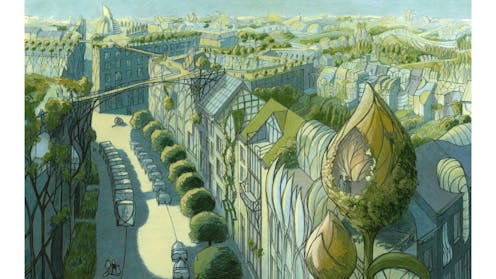
Belgian architect Luc Schuiten’s vision of ‘the Vegetal City’. Luc Schuiten

Buildings adorned with plants are an increasingly familiar sight in cities worldwide. These “green walls” are generally created using metal frames that support plastic plates, onto which pre-grown plants are inserted. These plants are able to survive without soil because they’re sustained by nutrient-packed rolls of felt and artificial sprinklers.

Some are fabulously rich tapestries of luxuriant vegetation, like French botanist Patrick Blanc’s coating of part of the Athenaeum hotel in London. Here, small shrubs sprout from an almost tropical green wall, with an abundance of mosses and ferns. In summer, butterflies peruse the flowers. All this next to Piccadilly, one of the busiest streets in central London.

Others are objects of ridicule: the sadly common outcome of poor design and a lack of maintenance (all green walls need careful planning and a great deal of care). If they’re not carefully tended, green walls will quickly turn into brown ones, with the plastic supports all too visible beneath the dying plants.

But there are many others ways of integrating plants into buildings beyond simply trying to grow them on walls. Here are five examples that straddle the mundane and the marvellous.

A wall with a metal grid and dying plants.
A wilted green wall in Tokyo, Japan.
Wikimedia Images, CC BY

Growing buildings

German architectural practice Baubotanik (a word that means “botanic building”) has taken the radical step of creating buildings that flout the conventional idea of architecture as static and inert. After all, plants grow – they are living organisms.

Baubotanik uses pre-grown trees to create multi-storey structures, with trees replacing the conventional steel girders of most tall buildings. Its Plane-Tree-Cube in Nagold, begun in 2012, is made of plane trees supported on a steel scaffold, with a built-in irrigation system to water the trees until they’re large enough for the steel to be removed.

A square-framed building composed of a metal lattice and growing plants.
Baubotanik’s Plan-Tree-Cube is intended to grow into a usable structure.
Baubotanik

It’ll probably be another ten years before this structure is ready to be used, but as what? It’s hard to imagine making a home in such an unruly structure, let alone plugging in your internet or other electrical appliances.

Building in trees

Baubotanik takes grafting, an age-old horticultural technique, and uses it to create structural frames for buildings. Grafting joins the tissue of plants so that they can grow together (it’s most commonly used in the cultivation of fruit trees).

As the architects themselves acknowledge, there are many interesting historical precedents, such as the Lindenbaum concentrated in a small region of rural Germany in northwestern Bavaria.

These are accessible platforms built into large lime (linden) trees to accommodate dancers in a yearly ritual known as the Tanzlinden (“dance linden”), which originated in the middle of the 17th century and still happen in early September.

In the surviving Lindenbaum in the small village of Peesten (one of around 12 that are still around), a stone stairwell spirals up to the wooden platform built inside the tree: dancing happens on this platform, while musicians provide accompaniment beneath.

A curved stone staircase leading into a structure obscured by a tree growing around it.
Lindenbaum in Peesten, Germany.
Wikimedia Images, CC BY

Weaving buildings

It’s possible to take this practice of integrating buildings and trees one step further and imagine whole cities redesigned in this way. This has been the lifelong preoccupation of Belgian architect Luc Schuiten, particularly in his speculative drawings of “vegetal cities”.

These are urban environments in which the branches of trees and the stems of climbing plants have become completely enmeshed with buildings made of steel and glass. One of his designs, called Habitarbres, imagines a house constructed within a living tree. The structure would flex as the tree grows, while hot-air pipes and other infrastructure would be embedded in the trunk. It’s an attempt to envisage how the infrastructure of our buildings – pipes, wire, cables and the like – can be accommodated in a living structure with its own vascular network.

An artist's sketch of a house built around the main body of a tree.
With Habitarbes, Schuiten proposes a house built within a living tree.
Luc Schuiten

It’s a speculative proposal, but perhaps not so different from a common building type normally associated with enterprising children, namely treehouses. Schuiten is merely taking a human desire – to live in a tree – and suggesting how it might be squared with our equally strong desire for comfort.

Architecture as compost

When plants die and decay they create the conditions for the next cycle of vegetal growth; they are sustainable in a way that the vast majority of our buildings are not. While there is a drive to recycle existing building materials (metals and plastics mostly), it’s another thing entirely to make buildings truly regenerative.

Martin Miller and Caroline O’Donnell’s “Primitive Hut” project from 2017 created a building that does just this. They made a wooden lattice structure to support the growth of four red maple saplings. Another lattice decomposed over time, providing food for the growing trees. Eventually the whole structure was overwhelmed by the trees.

A shed-like building composed of a lattice and trees.
Martin Miller and Caroline O’ Donnell’s ‘Primitive Hut’.
OMG!

In calling this a primitive hut, the architects questioned how western architectural thinking tends to see indigenous architecture as both an origin point and a model for more sustainable forms of construction. It asks whether the industrial technologies that dominate construction in the global north should be more informed by architects that have continued to build with natural and compostable materials for centuries.

Letting be

It’s worth remembering that we don’t have to design green buildings; given enough time, they will happen anyway.

Roof slates sandwiched together with moss.
Moss on the roof of the Sandringham estate’s visitors’ centre in Norfolk, eastern England.
Wikimedia Images, CC BY

The sloping roof of my house, directly below the window where I’m writing this article, is gradually acquiring its own green patina of lichen and moss. The roof is old and I’ve been told it needs to be replaced soon. A cloud of spores and seeds peppers this and every single roof every day with the prospect of new life.

Without any human intervention whatsoever, this process of vegetal succession can produce a complex ecosystem of not only plant but also animal life (from microbes to insects). That architects so rarely call such a surface “green” betrays something that’s deep-seated in ideas about green design. For it is precisely the absence of human control that allows vegetation to colonise a building; there is, in effect no design involved at all – unless, of course, we accept that plants have designs of their own.


Don’t have time to read about climate change as much as you’d like?

Get a weekly roundup in your inbox instead. Every Wednesday, The Conversation’s environment editor writes Imagine, a short email that goes a little deeper into just one climate issue. Join the 45,000+ readers who’ve subscribed so far.


The Conversation

Paul Dobraszczyk does not work for, consult, own shares in or receive funding from any company or organisation that would benefit from this article, and has disclosed no relevant affiliations beyond their academic appointment.

ref. Five unusual ways to make buildings greener (literally) – https://theconversation.com/five-unusual-ways-to-make-buildings-greener-literally-259721

The Bangladesh delta is under a dangerous level of strain, analysis reveals

Source: The Conversation – UK – By Md Sarwar Hossain, Senior Lecturer in Environmental Science & Sustainability, University of Glasgow

The Ganges delta in Bangladesh. Emre Akkoyun/Shutterstock

Bangladesh is known as the land of rivers and flooding, despite almost all of its water originating outside the territory. The fact that 80% of rivers that flow through Bangladesh have their sources in a neighbouring country, can make access to freshwater in Bangladesh fraught. And the country’s fast-growing cities and farms – and the warming global climate – are turning up the pressure.

In a recent analysis, my colleagues and I found that four out of the ten rivers that flow through Bangladesh have failed to meet a set of conditions known as their “safe operating space”, meaning that the flow of water in these rivers is below the minimum necessary to sustain the social-ecological systems that rely on them. These rivers included the Ganges and Old Brahmaputra, as well as Gorai and Halda.

This puts a safe and reliable food and water supply not to mention the livelihoods of millions of fishers, farmers and other people in the region, at risk.

Water flow on the remaining six rivers may be close to a dangerous state too, due to the construction of hydropower dams and reservoirs, as well as booming irrigated agriculture.


Get your news from actual experts, straight to your inbox. Sign up to our daily newsletter to receive all The Conversation UK’s latest coverage of news and research, from politics and business to the arts and sciences.


The concept of a safe operating space was devised by Stockholm University researchers in 2009 and typically assesses the Earth’s health as a whole by defining boundaries such as climate warming, water use and biodiversity loss which become dangerous to humanity once exceeded. A 2023 update to this research found that six of the nine defined planetary boundaries have been transgressed.

Since the Bangladesh delta is one of the world’s largest and most densely populated (home to around 170 million people), we thought it prudent to apply this thinking to the rivers here. We found that food, fisheries and the world’s largest intertidal mangrove forest, a haven for rich biodiversity, are all under strain from water demand in growing cities such as Dhaka.

The knock-on effects

During all seasons but winter, river flows in the Bangladesh delta have fallen over the past three decades.

An infographic depicting the relative health of five rivers in Bangladesh.
No river in the Bangladesh delta is within its safe operating space.
Kabir et al. (2024)

Our analysis highlights the limits of existing political solutions. The ability of the Ganges river to support life and society is severely strained, despite the Ganges water sharing treaty between India and Bangladesh, which was signed in 1996.

Rivers in Bangladesh have shaped the economy, environment and culture of South Asia since the dawn of human civilisation here. And humans are not the only species suffering. Hilsha (Tenualosa ilisha), related to the herring, is a fish popular for its flavour and delicate texture. It contributes 12% to national fish production in Bangladesh but has become extinct in the upper reaches of the Ganges due to the reduction of water flow.

Excessive water extraction upstream, primarily through the Farakka barrage, a dam just over the border in the Indian state of West Bengal, has also raised the salinity of the Gorai river. A healthy river flow maintains a liveable balance of salt and freshwater. As river flows have been restricted, salinity has crept up, particularly in coastal regions that are also beset by sea level rise. This damages freshwater fisheries, farm yields and threatens a population of freshwater dolphins in the Ganges.

Low river flows and increasing salinisation now threaten the destruction of the world’s largest mangrove forest, the loss of which would disrupt the regional climate of Bangladesh, India and Nepal. It would also release a lot of stored carbon to the atmosphere, accelerating climate change and the melting of snow and ice in the Himalayan mountain chain.

Resilience to climate change

Solving this problem is no simple task. It will require cooperation across national boundaries and international support to ensure fair treaties capable of managing the rivers sustainably, restoring their associated ecosystems and maintaining river flows within their safe operating spaces.

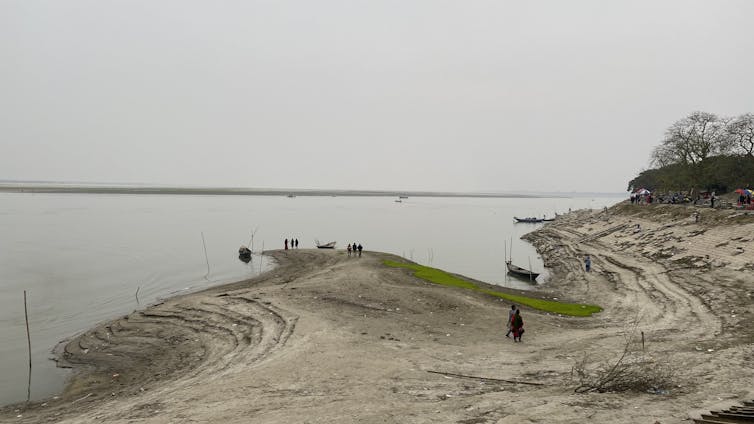
A dry river bank.
The mighty Ganges is running dry in some parts of Bangladesh during the hotter months.
Md Sarwar Hossain

This is particularly challenging in the Bangladesh delta, which contains rivers that drain many countries, including China, India, Nepal and Pakistan. The political regimes in each country might oppose transboundary negotiations, which could nevertheless resolve conflict over water which is needed to sustain nearly 700 million people.

There have been success stories, however. The Mekong river commission between Cambodia, Laos, Thailand and Vietnam is a useful template for bilateral and multilateral treaties with India and Nepal for the Ganges, and China and Bhutan for the Jamuna river.

Tax-based water sharing can help resolve conflicts and decide water allocation between countries in the river basin. The countries using more water would pay more tax and the revenue would be redistributed among the other countries who share rivers in the treaty. Additionally, water sharing should be based on the historical river flow disregarding existing infrastructure and projections of future changes.

Reducing deforestation, alternating land use and restoring wetlands could enhance resilience to flooding and drought and ensure water security in the Bangladesh delta. Ultimately, to secure a safe operating space for the rivers here is to secure a safe future for society too.


Don’t have time to read about climate change as much as you’d like?

Get a weekly roundup in your inbox instead. Every Wednesday, The Conversation’s environment editor writes Imagine, a short email that goes a little deeper into just one climate issue. Join the 45,000+ readers who’ve subscribed so far.


The Conversation

Md Sarwar Hossain does not work for, consult, own shares in or receive funding from any company or organisation that would benefit from this article, and has disclosed no relevant affiliations beyond their academic appointment.

ref. The Bangladesh delta is under a dangerous level of strain, analysis reveals – https://theconversation.com/the-bangladesh-delta-is-under-a-dangerous-level-of-strain-analysis-reveals-241097

Wimbledon’s electronic line-calling system shows we still can’t replace human judgment

Source: The Conversation – UK – By Feng Li, Chair of Information Management, Associate Dean for Research & Innovation, Bayes Business School, City St George’s, University of London

The Wimbledon tennis tournament in 2025 has brought us familiar doses of scorching sunshine and pouring rain, British hopes and despair, and the usual queues, strawberries and on-court stardust. One major difference with this year’s tournament, however, has been the notable absence of human line judges for the first time in 147 years.

In a bid to modernise, organisers have replaced all 300 line judges with the Hawk-Eye electronic line-calling (ELC) system powered by 18 high-speed cameras and supported by around 80 on-court assistants.

It has been sold as a leap forward but has already caused widespread controversy. In her fourth-round match against Britain’s Sonay Kartal, Anastasia Pavlyuchenkova was forced to replay a point she had clearly won, because ELC had failed to register that a ball had landed out. Furious, Pavlyuchenkova told the umpire: “You took the game away from me … they stole the game from me.”

British players Emma Raducanu and Jack Draper have also voiced concerns about the accuracy and reliability of the technology.

We have seen this before in business, government and elite sport (think VAR in football). Promising technologies fail, not necessarily because the systems are flawed – though some are – but because the institutions around them have not kept up. The belief that technology can neatly replace human judgement is seductive. It’s also deeply flawed.


Get your news from actual experts, straight to your inbox. Sign up to our daily newsletter to receive all The Conversation UK’s latest coverage of news and research, from politics and business to the arts and sciences.


Systems like Hawk-Eye at Wimbledon offer measurable gains in accuracy, but accuracy is not the same as legitimacy. People don’t just want correct decisions, they also want understandable and fair ones. When human line judges made mistakes, they were visible and open to appeal. When a machine fails, with no explanation and no route for redress, it breeds confusion and frustration.

Consider Formula 1. At the 2025 British Grand Prix in Silverstone, driver Oscar Piastri was handed a 10-second penalty by race stewards for erratic braking during a safety car restart. He called it inconsistent and harsh, and many fans agreed.

The key difference? We knew who made the call. There was someone to question, and a process to scrutinise. With machines, however, there’s no one to challenge. You can’t argue with a black box, or hold it to account.

Beyond performance

Technology is usually introduced to improve performance or reduce costs, but the full story is rarely made explicit. Wimbledon’s adoption of the new system was framed as a move towards greater accuracy and consistency, but it was also likely driven by the desire to speed up matches, cut costs, and reduce reliance on human labour.

Yet sport is not just about accuracy. It is entertainment. It thrives on emotion, tradition and theatre. For 147 years, line judges were part of Wimbledon’s identity. Their posture, uniforms, gestures, indeed even the drama of a close call, added to the spectacle. Removing them may have improved accuracy (and cut costs), but the atmosphere was also changed.

Tradition is often dismissed as nostalgia, but in institutions like Wimbledon, tradition is part of what makes the experience legitimate and enjoyable. When it’s stripped away with only a token explanation, players and audiences can lose trust, not just in the change, but in the institution itself. It is a cultural change, which is never easy.

One common solution is to combine human judgement with the technology especially during the transition period, but hybrids rarely work well in practice as responsibilities get blurred.

In business, this is known as the “hybrid trap”: bolting new technologies onto old systems without rethinking or redesigning either. Instead of the best of both worlds, the result is often confusion, duplication and failure.

Wimbledon did not seem to offer a formal challenge system or human override during matches. Although 80 former line judges were retained as on-court assistants, their role was not adjudicative. This might speed up play, but it leaves the system brittle. When something breaks, there is no immediate redress. We have seen this elsewhere.

What this tells us about AI

Wimbledon’s failure was a textbook case of poor tech adoption. Hawk-Eye did what it was designed to do, but the institution wasn’t ready, least of all the players, umpires and spectators.

The same pattern is playing out with artificial intelligence (AI) and other emerging technologies, from customer service bots to healthcare triage systems. These tools are being rolled out at speed, often with minimal oversight. When they hallucinate, embed bias or produce erratic results, there is rarely a clear route to appeal, and often no one to hold accountable.

The real problem is not just technical but institutional. Most organisations aren’t ready for what they’re adopting. Instead of transforming themselves to harness new technologies, they bolt them onto legacy systems and carry on as before. Key questions go unanswered: Who decides? Who benefits? Who is accountable when things go wrong? Without clear answers, new technologies don’t solve dysfunction, they entrench it. Sometimes, they hardwire it.

If we want technology to improve how the world works, we can’t just automate tasks, processes or jobs. We need to rethink and redesign the institutions these systems are meant to serve, using new capabilities these technologies make possible. Until then, even the best systems will continue to fall short, both quietly and occasionally spectacularly.

The Conversation

Feng Li does not work for, consult, own shares in or receive funding from any company or organisation that would benefit from this article, and has disclosed no relevant affiliations beyond their academic appointment.

ref. Wimbledon’s electronic line-calling system shows we still can’t replace human judgment – https://theconversation.com/wimbledons-electronic-line-calling-system-shows-we-still-cant-replace-human-judgment-260845

Superman: James Gunn’s prolonged punch-fest falls flat

Source: The Conversation – UK – By Laura Crossley, Senior Lecturer in Film, Bournemouth University

The first two superhero movies of the year examined the morality of power and politics (Captain America: Brave New World) and mental health and personal accountability (Thunderbolts*) in thoughtful and often nuanced ways. It is rather depressing, then, that the third act of Superman is largely a prolonged CGI punch-fest that lacks any narrative or visual vigour to make it interesting.

There is a lot riding on the success of the DC Universe (DCU), now under the creative stewardship of director James Gunn and producer James Safran. After the varied fortunes of the DC Extended Universe (DCEU), this iteration of Superman marks a reboot of DC properties and is the introductory instalment of the first phase, or “chapter” as they are being called, with the subtitle Gods and Monsters.

The films also marks a shift from the “Snyderverse” – the series of interconnected films made under the oversight of director Zack Snyder – which were characterised by the darkness of both their themes and their aesthetics.

This darkness, and the attendant moral ambiguity, of the Snyderverse has been replaced by a more optimistic tone. This new Superman film is more simplistic and clear-cut, with good versus bad and a bright, comic-book design.


Looking for something good? Cut through the noise with a carefully curated selection of the latest releases, live events and exhibitions, straight to your inbox every fortnight, on Fridays. Sign up here.


Anyone familiar with Gunn’s previous superhero offerings (The Guardians of the Galaxy trilogy; The Suicide Squad) will recognise much of the tone and the look. This is very much the Superman movie that Gunn wants to make. And therein lies part of the problem.

As the opening film of chapter one, this effectively sets the tone for all that is to come across the DCU. But that raises the question of how Gunn’s overall approach will work with future properties that will have (or should have) very different styles, narrative themes and concerns.

This film is deliberately not an origin story. We meet Superman (David Corenswet), bloodied and battered after having lost an off-screen fight. He’s already an established superhero in a world accustomed to them after approximately 300 years of “metahumans” – as the opening exposition dump helpfully informs us.

Superman then returns to the icy Fortress of Solitude, complete with robot staff and adorable CGI super-dog, Krypto. We are, in effect, entering the middle of the story, with Superman’s dual identity as Clark Kent already known to his girlfriend Lois Lane (Rachel Brosnahan).

The pair have a fun, palpable chemistry. In an early stand-out scene, Lois, in journalist mode, grills Clark/Superman on the finer points of superhero accountability and responsibility after he single-handedly – and without any form of legal jurisdiction – stops a war between the fictitious countries of Boravia (eastern European, evil) and Jahanipur (a south-east Asian/Middle Eastern mash-up in which the people are impoverished and entirely agency-free), just before the movie begins. Sadly, these valid and deeply relevant questions remain unexplored for the rest of the film.

The trailer for Superman.

Brosnahan is a spiky, intelligent and self-assured Lois Lane who is not given enough to do, partly because this “starting in the middle” approach robs her relationship with Clark/Superman of any real tension and complexity. But also because the film is so overstuffed that there is little room for any meaningful character development.

What we do have is incoherent plotting, clunky dialogue and exposition and too many characters who are too thinly drawn.

The gang’s back together

Corenswet is a fine Superman, commandingly heroic and believably vulnerable when required. However, there is not much opportunity for him to explore his Clark Kent alter-ego before he is in full superhero mode, thereby denying the character time to establish the humanity that is core to Superman’s personality.

Lex Luthor (Nicholas Holt), the quintessential Superman villain, is supposed to be brilliant but here is rendered more as an Elon Musk-like figure with hints of Trump. He’s a megalomaniac with a populist touch with motivations that are so unclear as to be nonsensical.

We also get members of the Justice Gang, including a horribly bewigged Nathan Fillion as Green Lantern, Hawkgirl (Isabela Merced) and Mister Terrific (Edi Gathegi).

Gathegi steals almost the entire movie with a charismatic, laid-back turn that is crying out for his own standalone entry. Mister Terrific gets the movie’s most fun set piece: a single-handed fight against multiple goons choreographed to an upbeat pop soundtrack that is straight out of the James Gunn playbook.

As is the Justice Gang’s fight against an inter dimensional giant squid, which plays out as the comedic backdrop visible through a window during a pivotal scene with Lois Lane, and in which a depressed Superman takes no part. Any moments of seriousness are immediately undercut by on the nose and often cheap jokes.

The lack of narrative focus and character development results in a story that does not give us any tangible reasons to care about these characters beyond the fact that they are already well-established cultural icons. The lack of scaffolding means that when we reach what should be the emotional turning points, there is no heft to these moments.

The phoney war between Boravia and Jahanipur also provides problematic optics. The people of Jahanipur are an anonymous mass of peasants armed only with sticks who get a single word of dialogue shared between them (“Superman!”). They are at the mercy of their warlike neighbours in Boravia, whose evil is made evident through the grotesque physicality of their leader (Zlatko Buric).

This plot device seems to be making a passing reference to both the war in Ukraine and the Israeli-Palestinian conflict, without having anything of value to say about either. The situation is resolved by the arrival of the American Justice Gang (because all metahumans are exclusively based in America, apparently) and then we’re on to the next joke.

In this Superman reboot, the humanity of the character is largely lost, something we are told about rather than see. This is ironic given that truth, justice and humanity are supposed to be the guiding principles of the Superman story.

The Conversation

Laura Crossley does not work for, consult, own shares in or receive funding from any company or organisation that would benefit from this article, and has disclosed no relevant affiliations beyond their academic appointment.

ref. Superman: James Gunn’s prolonged punch-fest falls flat – https://theconversation.com/superman-james-gunns-prolonged-punch-fest-falls-flat-260940

England’s family hubs plan aims to build on Sure Start’s success – but may struggle to overcome today’s child poverty levels

Source: The Conversation – UK – By Sally Pearse, Strategic Lead for Early Years and Director of the Early Years Community Research Centre, Sheffield Hallam University

Rawpixel.com/Shutterstock

The government has announced its strategy for “giving every child the best start in life”, laying out proposals covering early years care, education and support in England.

The strategy builds on the current local family hub model of services, which offer a range of support aimed at babies and young children. Best Start family hubs will further bring together early years and family services in a similar way to the previous Sure Start programme. The government’s commitment includes £1.5 billion in investment to implement these reforms.

The Best Start Hubs will be a one-stop shop to support families with their child’s early development, from breastfeeding advice to speech and language support and stay and play sessions. The hubs will also support families with wider challenges such as housing and benefits, and provide courses for parents.

The attempt to bring services together to deliver local, holistic support to families is understandable given the impact of the original Sure Start initiative, introduced by Tony Blair’s Labour government.


Get your news from actual experts, straight to your inbox. Sign up to our daily newsletter to receive all The Conversation UK’s latest coverage of news and research, from politics and business to the arts and sciences.


The Sure Start Local Programmes that were established from 1999 onwards had a significant positive effect on those families who had access to them. From 2010, though, when the Conservative-Liberal Democrat coalition came into power, funding was cut and many Sure Start centres closed.

In May 2025 the Institute for Fiscal Studies published a summary report on the short- and medium-term effects of Sure Start on children’s lives.

They found that the impact of the Sure Start services for under-fives was remarkably long-lasting, with improvements during their teenage years in educational attainment and behaviour in school, and reductions in hospital admissions. The Institute for Fiscal Studies estimates that these long-term benefits significantly outweigh the cost of the Sure Start programme.

Like Sure Start, the Best Start strategy has the potential to be transformational for young children and their families.

However, the current range of challenges faced by families and the depth of child poverty in the country will make bringing about this transformation challenging. A 2023 report from charity the Joseph Rowntree Foundation estimates that there are one million children growing up destitute in the UK, without the means to stay warm, dry, clean and fed.

The challenge of poverty

The day after the Best Start strategy was launched, the children’s commissioner for England published a research report on children’s experience of growing up in a low-income family. Based on interviews with 128 children, the report outlines the “almost-Dickensian” levels of poverty experienced by children whose basic needs are not being met. Children described poor housing conditions, mouldy food and lack of hot water.

The significant impact that poverty has on children’s educational attainment, health and future lives will be difficult for the benefits that the Best Start programme may provide to negate.

I have witnessed these financial challenges and the wider range of issues families are dealing with on a daily basis in my own role as the director of the Early Years Community Research Centre at Sheffield Hallam University, and through my wider research with families.

In March 2024 I was part of a team of researchers who were commissioned by the Ministry for Housing, Community and Local Government to explore how multiple insecurities, such as financial difficulties, health problems, precarious work, poor housing and lack of support networks affected people’s lives.

Parents described the difficulties of making ends meet. They talked about having to deal with many different national and local agencies, the stress this created within their family and the toll on their health and wellbeing.

Even working full-time did not necessarily make families more secure. In one family, the working pattern the parents had to adopt to make ends meet meant that they only had one day a fortnight to be together.

We have to do stupid hours. I mean my partner, she works nights. I work mainly days … we’re kind of like passing ships in the night.

The places these families turned to were local community centres run by a range of organisations. The common themes about why they accessed these centres were the warm, welcoming, non-judgemental approach taken by staff, trusting relationships with staff and the range of services and support that were offered.

This bodes well for the Best Start strategy – if it is able to deliver the full range of services the government has outlined in a local trusted space. However, this will be a significant challenge in communities that have lacked support over recent years, are suffering the hardships of poverty and that may have lost trust in government services.

The Conversation

Sally Pearse received funding from the Ministry for Housing, Communities and Local Government

ref. England’s family hubs plan aims to build on Sure Start’s success – but may struggle to overcome today’s child poverty levels – https://theconversation.com/englands-family-hubs-plan-aims-to-build-on-sure-starts-success-but-may-struggle-to-overcome-todays-child-poverty-levels-260630

A one minute scan of your foot could help prevent amputation – here’s how

Source: The Conversation – UK – By Christian Heiss, Professor of Cardiovascular Medicine, Head of Department of Clinical and Experimental Medicine, University of Surrey

YAKOBCHUK VIACHESLAV/Shutterstock

Imagine having blocked arteries in your legs and not knowing it. At first, there may be no symptoms at all. Just occasional fatigue, cramping or discomfort – symptoms easy to dismiss as ageing or being out of shape.

But as blood flow worsens, a small cut on your foot might not heal. It can turn into an ulcer. In the worst cases, it can lead to amputation. This condition is called peripheral artery disease (PAD) – and it’s far more common than many realise.

PAD affects around one in five people over the age of 60 in the UK, and is especially prevalent in people with diabetes, high blood pressure or kidney disease.

PAD is rarely an isolated issue: it’s usually a sign of widespread atherosclerosis, the build-up of fatty deposits that can also narrow arteries in the heart and brain.

It also significantly increases the risk of heart attacks, strokes and other conditions linked to poor blood flow to vital organs. Research shows that a large proportion of people diagnosed with PAD will die within five to ten years, most often due to these complications.

Early detection is key to reducing the impact of PAD, and I’ve been working with colleagues to develop a faster, simpler way to diagnose it.

PAD testing

Doctors can check circulation in the feet by comparing blood pressure in the toe with that in the arm. The result is known as the toe–brachial index (TBI). The trouble is that the test needs a toe-sized cuff, an optical sensor and a doctor who knows how to use the equipment.

Many GP surgeries and foot clinics don’t have this kit. And in many people, especially those with diabetes or stiff arteries, the test doesn’t always give a clear or reliable, result.

Our research team asked a simple question: could we turn a routine ultrasound scan into a quick, reliable way to measure blood flow in the foot?

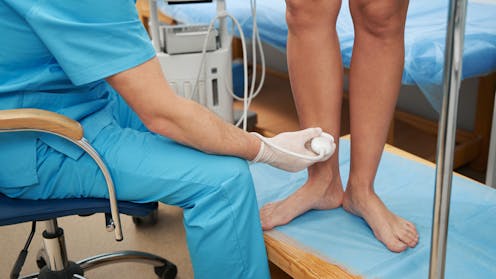
Most hospitals, and many community clinics, already have handheld ultrasound probes, which use Doppler sound to track how blood flows through vessels.

This works through the Doppler effect: as blood moves, it changes the pitch of the sound waves. Healthy blood flow creates a strong, steady “swoosh”, while a narrowed or blocked artery produces a faint or disrupted sound. Doctors are trained to hear the difference and use these sound patterns to spot circulation problems, especially in conditions like PAD.

But my research team wondered whether a computer could do more than listen: we wanted to know whether it could convert the shape of that Doppler “wave” into a number that mirrors the TBI.

To investigate, we scanned the feet of patients already being treated for PAD – 150 feet in all. For each artery, we used Doppler ultrasound to measure how quickly blood surged with each heartbeat, a pattern known as the acceleration index. We then compared these results to the standard toe–brachial index, the traditional test that measures blood pressure in the toe.

A one-minute scan, a nearly perfect match

The acceleration index alone was able to predict the standard toe–brachial index with 88% accuracy. Using a simple formula, we converted that Doppler reading into an “estimated TBI” – a number that closely mirrored the conventional result. It needed no toe cuff, no optical sensor and it took under a minute to perform.

Even more encouraging, estimated TBI rose in tandem with traditional TBI results after treatment. When patients underwent angioplasty – a procedure to reopen blocked arteries – their estimated TBI increased almost identically to the measured TBI. That means this scan doesn’t just help diagnose PAD; it could also be used to track recovery over time.

Crucially, our approach works with equipment that’s already widely available. We repeated the experiment using a basic pocket Doppler: the kind many GPs and podiatrists have tucked in a drawer.

While it wasn’t quite as precise as hospital-grade ultrasound, the results were still strong. With some additional software refinement, doctors could soon assess foot circulation quickly and accurately using tools they already own, without adding time to a busy clinic schedule.

Why early detection matters

Because early diagnosis of PAD changes everything. It can mean the difference between losing a foot, keeping your mobility and living longer with a better quality of life. It can shorten hospital stays and reduce the risk of heart attack and stroke.

But right now, too many people with PAD aren’t diagnosed until they already have chronic limb-threatening ischaemia – the most severe form of the disease. This condition occurs when blood flow to the legs or feet becomes critically low, depriving tissues of oxygen. It can cause constant foot pain (especially at night), wounds that won’t heal and, in advanced cases, tissue death (gangrene) and the risk of amputation. Without urgent treatment to restore circulation, chronic limb-threatening ischaemia can be life-threatening.

Part of the problem is that the tools used to diagnose PAD are often slow, expensive or too complicated for routine use. That’s why a simple, cuff-free Doppler scan that provides a reliable estimate of toe–brachial index is so promising. It uses equipment that many clinics already have, takes less than a minute and delivers immediate results – offering a faster, easier way to spot poor circulation before serious damage is done.

We’re now looking at ways to automate the measurement so that it can be used even by non-specialists. We’re testing it in various clinics with different patient groups and exploring its performance over time. But the evidence so far suggests that this could become a key part of vascular care – not just in hospitals, but in GP surgeries, diabetes clinics and anywhere else early intervention could save a limb.

Blocked arteries don’t need to stay hidden. With the right tools, we can find them earlier, treat them faster and protect people from the devastating consequences of late diagnosis.

The Conversation

Christian Heiss has received funding from Lipton Teas & Infusions, Ageless Science, iThera, the Medical Research Council, the ESRC, European Partnership on Metrology, co-financed from European Union’s Horizon Europe Research and Innovation Programme and UK Research and Innovation. He is member of the board of the European Society of Vascular Medicine, president of the Vascular, Lipid and Metabolic Medicine Council of the Royal Society of Medicine, and chairperson-elect of the ESC WG Aorta and Peripheral Vascular Diseases.

ref. A one minute scan of your foot could help prevent amputation – here’s how – https://theconversation.com/a-one-minute-scan-of-your-foot-could-help-prevent-amputation-heres-how-260847