Can the UK fast-track nuclear power without cutting corners on safety?

Source: The Conversation – UK – By Thomas Haynes, Lecturer in Nuclear Engineering, University of East Anglia

Before the pomp of President Trump’s state visit to the UK, Washington and London announced a series of collaborations on nuclear research and regulation. A reminder to cynics that perhaps these events have some substance.

Britain is already undergoing a nuclear revival. Large power stations are under construction (albeit much delayed) at Sizewell in Suffolk and Hinkley Point in Somerset. Rolls Royce has been confirmed as the supplier for a fleet of small modular reactors (SMRs). These reactors use similar technology to the big power plants, but with all components designed to fit into a single container.

Now, as part of the US-UK deal, we can add proposals to build 12 advanced modular reactors (AMRs), using fundamentally different technology, in Hartlepool.

The UK’s nuclear regulator is therefore being asked to consider radically different designs on a scale and pace never before seen. That’s partly why, as part of the deal, the two countries have agreed to accept each other’s safety checks. The government claims this will “halve the time for a nuclear project to be licensed”. The question is whether this can be done as safely.

Two large cooling towers
With four reactors, Plant Vogtle in Georgia is the largest nuclear power plant in the US.
PrasitRodphan / shutterstock

The US and UK take fundamentally different approaches to nuclear regulation.

The US’s Nuclear Regulation Commission (NRC) takes a “prescriptive” approach. It sets detailed rules based on its own research and enforces them directly.

Like police setting speed limits, the regulator decides the standards and then ensures nuclear operators meet them. If an accident happens, operators can point to meeting every requirement as evidence they followed the rules. They could even legitimately blame the regulator.

The UK’s Office for Nuclear Regulation (ONR) takes a “descriptive” approach. It sets broad standards but leaves operators to prove how they will meet them.

In road terms, the US sets the speed limit and checks drivers obey it. The UK simply says cars must stay on the road, leaving drivers to decide their own limits, prove they’re safe, and take full responsibility if they crash.

These two approaches are driven to a large extent by the two country’s history and make up of their nuclear industries.

The US has a few standard reactor designs, many operators, and vast federal research labs. The UK has fewer, often state-owned (or foreign state-owned) operators running bespoke reactors fleets, with in-house expertise.

The result is that the US’s regulator – the NRC – is large, well-funded, and deeply involved in design and research. The UK equivalent – the ONR – is smaller and focused on critically reviewing the judgement and processes of the operators.

Both systems have worked well. Nuclear regulation and the associated safety record in both countries is regarded as being among the best in the world.

Why collaboration now matters

A sudden surge of new nuclear in the UK would make closer alignment with US regulators more attractive. If the US has already assessed a proposed power plant design, the UK regulator could potentially rely on that evidence rather than duplicate the work. This would avoid bottlenecks and speed up approvals.

The aviation sector already does something similar. Aircraft are certified by either the US Federal Aviation Administration (FAA) or the European Union Aviation Safety Authority (EASA), with airlines around the world trusting those approvals.

There is a strong element of reciprocity, driven by the need for aircraft to fly from one nation to another. The approach makes sense, as it would be absurd for every airline or national regulator to retest the same Airbus wing. Nuclear power, some argue, should move in this direction.

The risk of imported risk

But there are dangers in relying too heavily on foreign regulators. The Boeing 737-Max scandal, in which software error caused two near-identical accidents and left 346 dead, exposed the need to get regulation right. Political pressure and weak oversight at the FAA contributed to design flaws being missed. If the UK simply rubber-stamped US approvals, it could import these risks too.

The nuclear industry has an extra history of mistrust. The US’s 1946 McMahon Act restricted the sharing of nuclear data between the US and UK, and a number of British spies were exposed in the US. Civilian and military technologies overlap, and there is a desire to prevent nuclear proliferation.

So while UK-US collaboration could boost Britain’s nuclear industry and accelerate the path to low-carbon energy, independence and transparency will be essential. Any perception of corner cutting or transatlantic political interference could undermine public trust and derail Britain’s nuclear ambitions.


Don’t have time to read about climate change as much as you’d like?

Get a weekly roundup in your inbox instead. Every Wednesday, The Conversation’s environment editor writes Imagine, a short email that goes a little deeper into just one climate issue. Join the 45,000+ readers who’ve subscribed so far.


The Conversation

Thomas Haynes receives funding from Department for Energy Security & Net Zero and the UK Atomic Energy Authority. He is affiliated with the Nuclear Institute.

ref. Can the UK fast-track nuclear power without cutting corners on safety? – https://theconversation.com/can-the-uk-fast-track-nuclear-power-without-cutting-corners-on-safety-265614

Concussion, identity loss, depression: boxing’s toughest opponent isn’t in the ring – it’s mental health

Source: The Conversation – UK – By Helen Owton, Senior Lecturer in Sport and Exercise Psychology, The Open University

Hatton, who won 45 of his 48 professional bouts across an esteemed 15-year career, last fought professionally in 2012. Go My Media/Shutterstock

Ricky Hatton’s death has reignited an all-too-familiar conversation about mental health in sport. Hatton had spoken openly about his long battle with depression, as well as the drug and alcohol addiction that began after his 2007 defeat to Floyd Mayweather.

Research shows that how a boxer thinks – their beliefs about success, identity and failure – can become harmful in the high-stakes context of the sport. The perfectionism and “must-win” mindset mean even a single loss can feel catastrophic.

The constant pressure of “winning at all costs” has negative consequences: for some, losing a fight is not just a professional setback but an identity crisis, laced with shame, guilt and a sense of personal failure.

This danger is especially acute for fighters who rise from humble beginnings to fame and glory. For a boxer, the fear of irrelevance or of being forgotten can trigger depression, anxiety and despair. When vulnerability is seen as weakness, many simply bottle up their emotions, compounding their internal struggle.

Hatton himself acknowledged in 2020 that mental-health problems are widespread in boxing. The sport is brutal by design, subjecting fighters to repeated blunt-force trauma to the head and body. Traumatic brain injury (TBI) is an accepted risk.

This trauma has been linked to a wide range of acute, subacute and chronic neurological and psychological complications, such as concussion, post-concussion syndrome (when the symptoms of a concussion don’t fade after the usual recovery period but linger for months or even longer), depression, anxiety, cognitive decline and movement disorders, and in some tragic cases even death in the ring.

Repetitive TBI is associated with chronic traumatic encephalopathy (CTE), a progressive disease once colloquially known as “being punch drunk”. CTE affects memory, mood and behaviour and is among boxing’s most severe long-term health risks.


Read more:
How routine sparring can cause short-term impairment to boxers’ brains


While head trauma is a physical injury, its impact on mental health is profound. Damage to the brain can impair emotional regulation, increase impulsivity and heighten vulnerability to depression and suicidal thoughts. Yet for all this risk, boxing offers very few long-term support systems – something Hatton himself criticised.

Outside the ring, boxers face other pressures that rarely make headlines. The extreme weight cuts required for competition can alter brain chemistry and destabilise mood. The punishing solitude of training camps and the stress of maintaining a public persona feed into chronic stress.


Read more:
Families of athletes with dementia linked to brain trauma on watching somebody you love disappear – Uncharted Brain podcast part 2


Then there is the challenge of early retirement. Most athletes have a short competitive life, often retiring in their thirties – a transition many struggle with. Instead of relief, retirement can be a rupture: daily structure disappears, the roar of the crowd fades and with it the sense of purpose, identity and belonging.

With their athletic identities tied so closely to performance and public image, stepping away can feel like vanishing. Many athletes retire without financial security, career direction or a support network, leaving them exposed to loneliness and psychological decline.

Boxing has long offered a ladder out of working-class hardship to fame, fortune and respect. Hatton, like Tyson Fury and Frank Bruno, rose from humble beginnings to become a world champion and national hero.

But the climb from gritty local gyms to Las Vegas spotlights can be steep – and the fall steeper still. The gulf between where fighters start and where they end up can create a deep sense of dislocation. For working-class athletes, the pressure to stay strong, stoic and successful, even when struggling inside, can be overwhelming.

This is intensified by boxing’s enduring culture of hyper-masculinity. The “show no weakness” mentality may breed champions in the ring, but it can be deadly outside it. The sport’s traditional ethos – resilience, toughness, silence – often prevents fighters from seeking help. The stigma around mental health means many endure private battles in silence, where loneliness prevails.

The sport teaches resilience, emotional control, body awareness, the physical self-control that comes from disciplined training, mental focus and self-belief. For some, boxing gyms are sanctuaries that offer structure, mentorship and a reinvention of the self, especially for those overlooked or underestimated by society. But the sport also reveals the danger of fighting your battles alone.


Read more:
Boxing empowered me to express my trauma – now, I help other abuse survivors do the same, combining it with creative writing


The challenge now is to shift boxing’s culture so that vulnerability weighs as much as valour and to ensure support doesn’t end when the final bell sounds. Initiatives such as The Frank Bruno Foundation offer rare lifelines. Founded after heavyweight champion Bruno’s public battle with bipolar disorder, the foundation uses non-contact boxing and wellbeing programmes to show that true strength also means seeking help.

England’s Box In Mind, backed by Great Britain boxer Jordan Reynolds, who has spoken openly about his own mental-health struggles, urges others not to suffer in silence.

After news of Ricky Hatton’s death, Chris Eubank Snr urged the boxing industry to “look after their fighters”. With proper mental-health support, medical screening, career-transition programmes and open conversations about emotional wellbeing, boxing can continue to transform lives long after fighters hang up their gloves. Winning at all costs should never mean losing yourself outside the ring.

The Conversation

Helen Owton does not work for, consult, own shares in or receive funding from any company or organisation that would benefit from this article, and has disclosed no relevant affiliations beyond their academic appointment.

ref. Concussion, identity loss, depression: boxing’s toughest opponent isn’t in the ring – it’s mental health – https://theconversation.com/concussion-identity-loss-depression-boxings-toughest-opponent-isnt-in-the-ring-its-mental-health-265317

The Long Walk: a brutal, brilliant film about suffering in the name of patriotism

Source: The Conversation – UK – By Matt Jacobsen, Senior Lecturer in Film History in the School of Society and Environment, Queen Mary University of London

The Long Walk is one of several high-profile film adaptations of Stephen King’s lesser-known works to be released this year, coming out just after The Life of Chuck.

Director Francis Lawrence’s film is adapted from the novella written while the author was at university in the late 1960s – a story wasn’t published until 1979. It was, however, released under the pseudonym Richard Bachman, which King reserved for some of his most unflinching and hard-edged writing.

The setting for this violent thriller is an alternative America in the 1970s, which has suffered economic decline in the aftermath of an unspecified war. A group of 50 young men have been called up to compete in a televised contest, which is intended to inspire patriotism and work ethic among the destitute populace. The rules they must walk continuously at a speed above 3mph, with the threat of execution if any fall behind.

King’s novella is an antecedent to Suzanne Collins’s Hunger Games and Takami Koushun’s Battle Royale, both made into successful films. Like The Long Walk, these stories depict a nation whose rulers have gamified and made spectacle the suffering of young people with the aim of encouraging a productive, obedient populace.

Written as an angry response to the Vietnam draft, in The Long Walk, young men must suffer for nationalist ideology. The impact of the Vietnam war on men of King’s generation – he was declared physically unfit for service – resonates throughout his early fiction.

It’s a brilliant choice to distil in this film many of the familiar tropes of the Vietnam movie, here inverted to have the US, not Asia, as the inhospitable, dark and violent environment that is deadly to the young men. Their continuous march feels strangely reminiscent of GIs trudging through Vietnam in films such as Full Metal Jacket or Platoon.

The essence of the film is in the relationship between protagonist Ray Garraty (Cooper Hoffman) and his competitor, Peter McVries (David Jonsson). With its focus on young male friendship, The Long Walk shares DNA with Stand by Me, Rob Reiner’s adaptation of King’s other story The Body.

Like Stand by Me, this film is about male bodily experience, particularly bodies made vulnerable through exertion. At first it mines scatalogical humour like the contestants questioning how to urinate while walking, to gross-out comedy around a contestant with diarrhoea, which later turns horrifying, humiliating and tragic.

This is an interesting film for its release at a time of debate around the activities and values of young men, incel culture and secret online lives, embodied by stories like Netflix’s Adolescence.

In The Long Walk, young men are capable of acts of kindness and generosity, they display vulnerability openly and support each other through struggle. Through playful dialogue and the boys’ wit and tenderness in the face of violence, the film successfully connects us to its characters and renders many of the inevitable and gory deaths horribly poignant.

The Long Walk is clear and overt in its criticism of American cultural experience and political stagnation. Mark Hamill, once the figurehead of youth rebellion in Star Wars, is brilliantly cast against type as the jingoistic Major, who barks like a drill sergeant at the boys. The core values they need, according to the Major’s pro-America creed, are “determination, pride and ambition”.


Read more:
The Life of Chuck: Stephen King adaptation celebrates the richness of ordinary life


The film presents a grim vision of the US that is far from the promise of the American Dream. The boy are taken along hundreds of miles of perpetually overcast rural American landscape that is desolate and “one big pile of litter”, as Garraty remarks early on.

Kings prose is sparse, heavy on dialogue and light on description. But here, in this richly shot film, we are continually shown drab depictions of American life: sprawling cornfields, dilapidated industrial buildings, rusted locomotives creaking along tracks, all imbued with the sense that the machinery of the country has ground to a halt. As the boys trudge on, increasingly ragged and physically traumatised, the Major rants obliviously “Where else in the world could you have this opportunity? Nowhere!”

Some of the imagery used to deliver this critique is a little heavy-handed: a flaming Cadillac and a trio of distressed horses galloping behind a barbed wire fence. But the film commits admirably to its presentation of a disturbingly apocalyptic US.

King’s fiction draws criticism for lack of female perspective and it’s an interesting choice that the film keeps this a contest open exclusively to young men. Like Stand by Me and the beloved Shawshank Redemption, this is a story of men bonding without women.

A female perspective is offered in a tokenistic form through brief scenes of Garraty’s idealised mother (Judy Greer), distraught but dignified as her son volunteers. It’s also curious that, like Shawshank, this film focuses on the platonic bond between a white man and a black man while race, – especially the dynamics of race within a military and white supremacist dictatorship – is not mentioned even in passing.

For their core differences in plot and resolution, both King’s story and this excellent film adaptation share in their final moments an ambiguity as to whether nationalist doctrine can be resisted and oppressive systems overthrown. Peter MrVries, the most obviously critically illuminated member of the walking party, comments at one point on the deep-seated conditioning to which the walkers and the rest of the country are subjected.

King’s bleak text is youthfully pessimistic and steeped in the despondent nihilism of the period in which it was written. This bracing, emotionally affecting film is rather more galvanising. It does go some way towards imagining the means of rebellion in the hands of the nation’s youth – even if it doesn’t commit outright to the view that there is power in acts of resistance.

The Long Walk is a brutal, brilliant film that stands among the best adaptations of Stephen King’s work.


Looking for something good? Cut through the noise with a carefully curated selection of the latest releases, live events and exhibitions, straight to your inbox every fortnight, on Fridays. Sign up here.


The Conversation

Matt Jacobsen does not work for, consult, own shares in or receive funding from any company or organisation that would benefit from this article, and has disclosed no relevant affiliations beyond their academic appointment.

ref. The Long Walk: a brutal, brilliant film about suffering in the name of patriotism – https://theconversation.com/the-long-walk-a-brutal-brilliant-film-about-suffering-in-the-name-of-patriotism-265615

How fraudsters are trying to dupe the UK’s basmati rice lovers

Source: The Conversation – UK – By Katherine Steele, Senior Lecturer in Sustainable Crop Production, Bangor University

Many Brits enjoy a curry served with a heap of fluffy white basmati rice, its delicate aroma balancing the heat of the dish. But few stop to think about the grain’s long journey. From the paddy fields of India and Pakistan, through regional markets and rice mills, then matured for a year in silos before being shipped in bulk to the UK.

It then passes through one of the country’s 16 processing sites before reaching supermarket shelves. The UK imports around 250,000 tonnes of basmati rice every year – making it one of the world’s biggest markets.

This summer, consumers got a glimpse of what happens when that supply chain goes wrong. Four people were arrested in late July after investigators found substandard rice being passed off as a well-known basmati brand.

The National Food Crime Unit uncovered the fraud when tests showed the wrong type of rice inside premium-brand packets. The operation began in Leicester, where police arrested a man suspected of repackaging ordinary rice into counterfeit basmati bags. Three more arrests followed in London.

Basmati is a prestigious grain, prized for its nutty flavour and popcorn-like aroma. Alongside jasmine from Thailand and Italy’s arborio, it sits at the top of the speciality rice market. When shoppers buy a packet of basmati, they expect quality. If it falls short, they may feel cheated and think twice about buying that brand again.

To prevent this, the UK operates strict rules under the basmati code of practice. The code sets out which varieties can legally be called basmati, how they may be blended and what level of non-basmati grain is tolerated.

There must not be more than 7% of another rice variety in a packet. It’s a figure reduced from 20% two decades ago, but which cannot be lowered further because of the realities of handling multiple varieties in large mills.

This code was agreed by the Rice Association and the British Retail Association, and it applies across Europe. When exporters in India and Pakistan develop new basmati varieties, samples are sent to the Rice Association in London for approval.

An important tool in enforcing these rules is DNA testing. Every grain carries a genetic fingerprint that can confirm whether it belongs to one of the approved basmati varieties.

Public analyst laboratories regularly test shipments entering the UK and EU. The Food Standards Agency (FSA) also runs an annual survey of basmati products bought at random from retailers.

The current DNA test for basmati authentication was developed through collaboration between my colleagues and me at Bangor University, the FSA and public analysts.

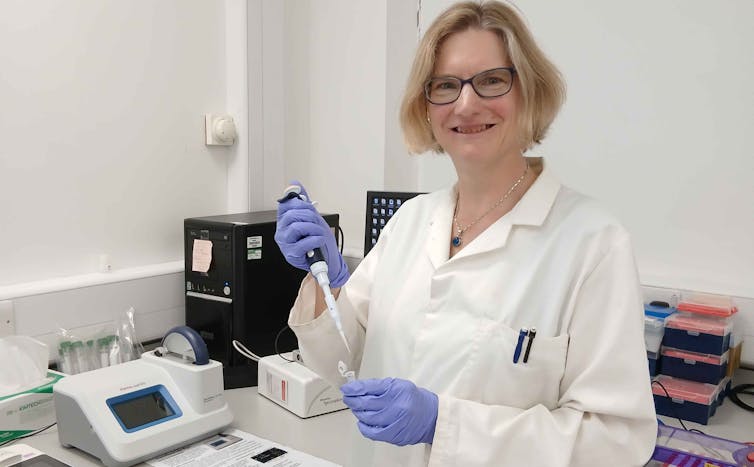
Katherine Steele wearing a white lab coat in a laboratory with scientific instruments.
Katherine Steele in the laboratory.
Bangor University, CC BY

We profiled hundreds of rice varieties and continue to refine the markers used to identify basmati. Before the method was approved, our team ran blind tests of results from known spiked mixtures of grains across different laboratories to ensure reliable results.

An age-old problem with modern costs

Food fraud is nothing new. For centuries, unscrupulous traders have substituted cheaper goods or mislabelled products.

While swapping rice is less harmful than adulterating food with toxic substances, it still matters. Consumers resent being duped, brands suffer reputational damage and companies that play by the rules lose out. The stakes are high because the UK rice industry is worth close to £1 billion a year.

There are points of vulnerability every time the grains get passed from one trader to the next. We can’t assume it all happens overseas. Economic pressures may be making the problem worse. As the UK experiences sluggish economic growth, opportunities for food crime may be increasing.

Counterfeiting is easier to identify using DNA testing than when known mixtures of varieties are introduced further up the food chain. It is probable that some of the less well-known brands of rice sold in the UK may contain varieties that are not listed in the basmati code of practice. These could easily slip through the DNA test because complex mixtures can be made to contain all the right molecular signatures.

Even so, food sold in the UK is among the most closely regulated in the world because of the work done by the FSA. Their National Food Crime unit leads the fight against food crime as exemplified by the recent case of the counterfeit basmati, but consumers must be vigilant because there are still fraudsters about. This can include being wary of poorly printed packaging labels, misspellings, broken seals and unusual pricing. Because if the price seems too good to be true, it probably is.

The Conversation

Katherine Steele receives funding from UKRI, DEFRA and Food Standards Agency.

ref. How fraudsters are trying to dupe the UK’s basmati rice lovers – https://theconversation.com/how-fraudsters-are-trying-to-dupe-the-uks-basmati-rice-lovers-264146

Climate change, through your own memories

Source: The Conversation – UK – By Will de Freitas, Environment + Energy Editor, The Conversation

This roundup of The Conversation’s climate coverage was first published in our award-winning weekly climate action newsletter, Imagine.


Two weeks ago we asked our Imagine newsletter subscribers: what climate-related changes have you noticed in your lifetime? We wanted anecdotes, not data.

We received dozens of vivid and often rather moving memories. A big thank you to everyone who contributed.

A few themes stand out, which we’ll illustrate with your words alongside expert analysis from The Conversation.

1. The loss of cold winters

“My father was at university in Cambridge during world war two – he was in the university’s ice hockey team, which practised on the Fens whenever they froze over – there was no need of an indoor ice stadium then!” – Hazel Agnew

“The frost would penetrate 20cm into the ground … such hard frosts are a distant memory.” — Graeme Brown

“I grew up in Hertfordshire. When young, it snowed well every winter, with some drifts above my head. Nowadays, [300 miles north, near Newcastle] we are lucky to see an inch of snow.” – Alan Page

Recollections like these are echoed by many of you: frosts that needed scraping off the windows, head height snowdrifts, frozen puddles to smash through. These are no longer shared, common experiences in the UK.

Scientists studying the UK climate confirm there has been a strong drop in frost and snow days in recent decades. In fact, winter is warming faster than any other season. That’s according to a team of climate scientists from the University of Bristol who we asked to investigate the decline in snow days.

A fast changing climate is more volatile, and there’s always a chance of a “Beast from the East”. But, they point out, “disruptions [like these outlier blizzards] that do occur sit on top of increasing background temperatures, reducing the likelihood of the cold spells that bring widespread snowfall.”


Read more:
Why snow days are becoming increasingly rare in the UK


2. Shifting seasons

“There was snow on the ground when I went into hospital in Chelmsford, Essex, to have my first baby on April 18, 1969. The daffodils were finally in bloom when I took him home on May 1. Daffodils are always over several weeks earlier than that now” – Jill Bruce

“Often we’d come back over to Britain [from Trinidad & Tobago] in the height of either summer, or winter for Christmas … Part of why we would come back was the UK had seasons, now we just get nine months of cool to warm drizzle then summers on fire!” – Dean Hill

We have published a lot on seasonal breakdown over the years. Academics have looked at unusual midsummer storms, leaves that linger through autumn,
why April showers are becoming more intense and how that has delayed the annual arrival of swifts.

For more stories like these, check out our series Wild Seasons.

3. Wildlife disappearing

“As a young man driving around the West Country in the summer months in the mid-80s, I would have to stop and scrape a thick layer of dead insects off the windscreen at least once on every journey. Today my windscreen is bug-free for hundreds of miles.” — Steve Tooze

“When I was young every buddleia bush was covered in butterflies during the summer, and I mean covered. We had large flocks of starlings and sparrows on the lawn in our garden during winter. My mother still lives in the same house. She does not see any butterflies on her buddleia now, and no starlings for years, but a very occasional sparrow.” – Andrew Strong

“You hardly see hedgehogs anymore … there have not been any blackbirds or thrushes for even longer.” — Claire Bristol

You told us again and again about butterflies, bees, moths and wasps – once abundant, now rare. You remembered birdsong and hedgerows teeming with life. Small mammals that once wandered quietly through gardens.

Research confirms there has indeed been a steep decline in insect biomass and species diversity. In 2022, for instance, Tim Newbold and Charlotte Outhwaite of UCL wrote about their research which found climate change has triggered a global collapse in insect numbers.

They stress there are winners as well as losers. Freshwater insects are recovering in the UK, for instance. But they say that insects are facing an unprecedented threat due to the “twin horsemen” of climate change and habitat loss, which “do not work in isolation”. “Habitat loss can add to the effects of climate change by limiting available shade, for example, leading to even warmer temperatures in these vulnerable areas.”


Read more:
Climate change triggering global collapse in insect numbers: stressed farmland shows 63% decline – new research


This loss goes far beyond insects: the UK is widely regarded as one of the world’s most nature-depleted countries. Richard Gregory, also of UCL, has written about research showing that one in six UK species are threatened with extinction. “Climate change,” he writes, “is among the biggest threats to wildlife in all ecosystems.”

4. A positive change: less pollution?

“The leaves of evergreens were coated with soot, but there were still sparrows. When I first saw a laurel in the countryside, I had to be told what it was, because I didn’t know it with its clean and shiny leaves.

“Pollution was very visible. Hair brushes and combs had to be frequently washed due to the soot on your hair.” – Carole Hegedus

Let’s end on a more positive note. Carole is a few decades older than me and grew up in the same area of London as I did. Yet I recognise none of this. By the 1990s, the coal power stations and factories that once coated the city in soot were long gone. One power station is now a world-famous art gallery. Another is a more controversial shopping centre.

But let’s not rest on our laurels. In a piece marking 70 years since London’s “great smog”, Suzanne Bartington and William Bloss of the University of Birmingham note: “Poor air quality still contributes to somewhere between 26,000 and 38,000 early deaths each year in the UK.” The days of thick smog clouds may be largely behind us (in the UK at least), but Bartington and Bloss warn that “health harms exist even at low pollutant levels and that there is no ‘safe’ level of exposure to PM2.5” (tiny particles invisible to the human eye).

Thank you again for sending such interesting recollections and I’m sorry we couldn’t feature all of them.

I hope this illustrates that the story of climate change isn’t just written in graphs and data, it’s also in frozen puddles, vanishing butterflies and February daffodils.


This roundup of The Conversation’s climate coverage comes from our award-winning weekly climate action newsletter. Every Wednesday, The Conversation’s environment editor writes Imagine, a short email that goes a little deeper into just one climate issue. Join the 45,000+ readers who’ve subscribed.


The Conversation

ref. Climate change, through your own memories – https://theconversation.com/climate-change-through-your-own-memories-265514

A volcano or a meteorite? New evidence sheds light on puzzling discovery in Greenland’s ice sheet

Source: The Conversation – UK – By James Baldini, Professor in Earth Sciences, Durham University

Buried deep in Greenland’s ice sheet lies a puzzling chemical signature that has sparked intense scientific debate. A sharp spike in platinum concentrations, discovered in an ice core (a cylinder of ice drilled out of ice sheets and glaciers) and dated to around 12,800 years ago, has provided support for a hypothesis that the Earth was struck by an exotic meteorite or comet at that time.

Our new research offers a much more mundane explanation: this mystery platinum signature may have originated from a volcanic fissure eruption in Iceland, not space.

The timing matters. The platinum spike occurs near the beginning of our planet’s last great cold period, the Younger Dryas Event. This lasted from about 12,870 to 11,700 years ago and saw temperatures plummet across the northern hemisphere.

This happened just as the planet had actually been warming up from the last ice age. Understanding what triggered this cold snap could help us understand how Earth’s climate may change in the future.

We propose that this icy phase in Earth’s climatic history was in fact caused either by a large volcanic eruption in Germany or by the eruption of an unknown volcano.

A climate mystery

Ice cores show that during the millennium-long Younger Dryas Event, temperatures across Greenland dropped to more than 15°C colder than they are today. Europe returned to near glacial conditions, with tundra replacing forests that had begun to flourish. Low-latitude rainbelts shifted to the south.

The traditionally accepted explanation involves a massive release of freshwater from melting North American ice sheets. This freshwater pulse disrupted the ocean circulation, affecting temperatures. However, other researchers have proposed that the event was triggered by a comet or asteroid impact over North America.

In 2013, researchers analysing ice cores drilled as part of the Greenland Ice Sheet Project (GISP2) discovered platinum concentrations that were well above normal levels. The ratio of platinum to a radioactive element called iridium was also unusual because space rocks usually have high levels of iridium, while the ice core spike does not. The ice core signature was very different from anything seen in known meteorites or volcanic rocks.

The authors of the space impact paper suggested that perhaps the unusual ice chemistry reflected the impact of an unusual asteroid made up of iron.

A subsequent paper proposed that the ice chemistry could reflect the German
Laacher See volcanic eruption, which had an unusual geochemistry and occurred around that time. To test this idea, we collected and analysed 17 samples of volcanic pumice from deposits left behind by the Laacher See eruption. We measured platinum, iridium, and other trace elements to create a chemical fingerprint of the eruption.

Our results were clear: the Laacher See pumices contain virtually no platinum, with concentrations below or barely at detection limits. Even though some platinum may have escaped to the atmosphere before being trapped in the rock, the eruption was clearly not the source of Greenland’s platinum spike.

Additionally, when we examined the timing carefully, using updated ice core
chronologies, we found the platinum spike actually occurred about 45 years after the Younger Dryas began – too late to have triggered the cooling.

This result was arrived at independently but was consistent with previous research finding the same thing. Importantly, the elevated platinum concentrations lasted for 14 years, suggesting a prolonged event rather than an instantaneous asteroid or comet impact.

We compared the ice core’s chemical signature with various other geological samples and found the closest match was with volcanic gas condensates (the products formed when gases released from a volcano cool from a gas to a liquid or solid state) particularly from submarine volcanoes.

Iceland’s volcanoes can produce fissure eruptions lasting years or even decades, matching the 14-year duration of the platinum spike. During the melting phase that preceded the Younger Dryas, Iceland’s volcanic activity increased dramatically as melting ice sheets reduced pressure on the Earth’s crust.

Crucially, submarine or subglacial eruptions interact with water in ways that could explain the unusual chemistry. Seawater can strip away sulphur compounds while concentrating other elements like platinum in volcanic gases. These platinum-rich gases could then travel to Greenland and be deposited on the ice sheet, explaining the odd geochemistry.

Recent research on historical Icelandic eruptions supports this mechanism. The 8th-century Katla eruption produced a 12-year spike in heavy metals like bismuth and thallium in Greenland ice cores. The 10th-century Eldgjá eruption resulted in a cadmium spike within glacial ice. Although platinum was not measured in those studies, these examples show Icelandic volcanoes regularly deliver heavy metals to the Greenland ice sheet.

Maelifell Volcano, Iceland. It is situated in the Mýrdalsjökull glacier, which covers the central part of the Katla caldera.
Research on Icelandic eruptions show that they can deliver heavy metals to the Greenland Ice Sheet.
Palmi Gudmundsson / Shutterstock

A smoking gun?

Because of the chronological mismatch, whatever mechanism was responsible for the platinum spike didn’t trigger the Younger Dryas. Our research does, however, highlight previous results showing a massive volcanic sulphate spike in multiple ice cores coinciding precisely with the onset of cooling 12,870 years ago.

This eruption, whether from the Laacher See eruption or an unknown volcano, injected enough sulphur into the atmosphere to rival the largest eruptions in recorded history. Volcanic eruptions can trigger cooling by releasing sulphur into the stratosphere, reflecting incoming sunlight and potentially setting off a cascade of positive feedbacks including sea ice expansion, changed wind patterns and disruption of ocean currents, though future research needs to explore this further.

The substantial volcanic forcing around the Younger Dryas onset – a time when climate was already sitting between a glacial and an interglacial (the periods between cold snaps) – may have provided the nudge that tipped Earth’s climate back into a cold state.

It is important to note that our research focused on the platinum spike and did not consider other evidence, such as spherules (spherical fragments of melted rock) and black mats (mysterious dark layers in soil), for an extraterrestrial impact. That said, based on our analysis of the new results and existing data, a large northern hemispheric volcanic eruption seems to be the most straightforward explanation for the Younger Dryas Event.

Understanding past climate triggers is vital for anticipating what lies ahead. Although the chance of a large meteorite impact or volcanic eruption in any given year is low, such events are virtually certain to occur eventually. Knowing how Earth’s climate responded in the past is therefore crucial for preparing for the consequences of the next major event.

The Conversation

James Baldini does not work for, consult, own shares in or receive funding from any company or organisation that would benefit from this article, and has disclosed no relevant affiliations beyond their academic appointment.

ref. A volcano or a meteorite? New evidence sheds light on puzzling discovery in Greenland’s ice sheet – https://theconversation.com/a-volcano-or-a-meteorite-new-evidence-sheds-light-on-puzzling-discovery-in-greenlands-ice-sheet-265257

From resistance to intifada to recognition: the origins of an independent Palestinian state – podcast

Source: The Conversation – UK – By Gemma Ware, Host, The Conversation Weekly Podcast, The Conversation

Rex Wholster via Shutterstock

France, the UK and Canada are expected to become the first G7 countries to recognise the state of Palestine at the UN General Assembly in late September, where Australia will also announce its recognition. Mahmoud Abbas, the leader of the Palestinian Authority, will not be present as he is banned from travelling to New York for the event.

The US decision to deny Abbas a visa mirrors what happened in late 1988 to Yasser Arafat, then leader of the Palestine Liberation Organization (PLO). A few weeks earlier, at a PLO meeting in Algiers, Arafat had read out the Palestinian Declaration of Independence. The US responded by denying Arafat permission to travel to New York. However, the UN temporarily moved its meeting to Geneva, so that he could speak.

In this episode of The Conversation Weekly podcast, Palestinian-American historian Maha Nassar from the University of Arizona  describes the events leading up to the original declaration of Palestinian independence in 1988, including the compromises made within the Palestinian liberation movement. “It’s this moment of unity among all the different fragmented parts of the Palestinian population,” she explains. “It was also a moment of tremendous hope.”

Nassar then traces how  we’ve got to the point where more than 150 countries will recognise an independent Palestinian state – a move that she believes is more of a symbolic gesture than a meaningful route to Palestinian sovereignty.

Listen to the conversation with Maha Nassar on The Conversation Weekly podcast. You can also dig deeper on the history of the Oslo Accords in our special three-part series from 2023, marking the 30th anniversary of the agreements.


This episode of The Conversation Weekly was written and produced by Mend Mariwany and Gemma Ware. Mixing and sound design by Eloise Stevens and theme music by Neeta Sarl.

Newsclips in this episode from ITN Archive, ThamesTV, AP Archive, Highlight Films Israel, Truther TV Archives, Academy for Cultural Diplomacy, Voice of America, AlJazeera English, BBC News, CNBC International Live, SABC News, CityNews and 7News Australia.

Listen to The Conversation Weekly via any of the apps listed above, download it directly via our RSS feed or find out how else to listen here. A transcript of this episode is available on Apple Podcasts or Spotify.

The Conversation

Maha Nassar is affiliated with the Foundation for Middle East Peace.

ref. From resistance to intifada to recognition: the origins of an independent Palestinian state – podcast – https://theconversation.com/from-resistance-to-intifada-to-recognition-the-origins-of-an-independent-palestinian-state-podcast-265406

Why Brazilians have been so divided in their reaction to Bolsonaro’s conviction

Source: The Conversation – UK – By Martin Moore, Senior Lecturer in Political Communication Education, King’s College London

Brazilians have been strikingly divided in their response to the trial and conviction of their former president Jair Bolsonaro for plotting a coup after his 2022 election defeat. A poll conducted shortly before the September 11 verdict found that 48% wanted to see Bolsonaro imprisoned while an almost equal proportion – 46% – wanted him to remain free.

A separate survey in late August suggested that, were a new presidential election held, 45.4% would vote for Bolsonaro and 44.6% for the incumbent president, Luiz Inácio Lula da Silva. For half of Brazilians, it would appear, the conviction of Bolsonaro was a just end for a would-be dictator. For the other half it was a politically motivated leftwing witch hunt.

The persistent loyalty of so many Brazilians to Bolsonaro seems illogical if one looks at the evidence gathered against him. The former president was shown to have considered numerous alternative ways of staying in power.

These included issuing decrees to stay in office and summoning military leaders to formalise the coup. He was also found to have endorsed a plan to assassinate Lula and his vice-president elect, Geraldo Alckmin, as well as supreme court judge Alexandre de Moraes. This was all covered extensively across Brazil’s mainstream media outlets.

Added to this is the evidence accumulated during Bolsonaro’s term of office (2019-22) that he used “digital militias” to take down his enemies, propagated “fake news” on a vast scale and pursued “antidemocratic acts” against Brazil’s institutions. When taken together, it becomes more surprising that so many Brazilians do not accept his guilt.

However, their denial makes more sense when you look at where Brazilians find their news and information. Many people in Brazil have abandoned legacy media almost entirely and rely on social media, influencers and WhatsApp for their news. Over 90% of Brazil’s adult population are active WhatsApp users.

Conscious of this, Bolsonaro and his administration built and maintained a parallel information ecosystem while in office based around social media and messaging services. This digital ecosystem comprised a vast network of alternative news sites, YouTube channels, social media influencers, Facebook pages, WhatsApp administrators and legions of bots.

Official investigations later revealed that the system was coordinated by the so-called Hate Cabinet, which was run by Bolsonaro’s sons, Carlos and Eduardo, and leading advisers such as Felipe Martins. The Hate Cabinet earned its nickname because the operation’s primary strategy was personal attack.

Whenever anyone criticised the administration, challenged Bolsonaro or showed signs of disloyalty, the Hate Cabinet would orchestrate a vicious campaign against them. This could include false claims about corruption, criminal activity or sexual impropriety, combined with threats of violence.

Joice Hasselmann, a Brazilian politician who fell out with Bolsonaro, was sent a severed pig’s head in November 2018 along with a note reading: “You will suffer and you will die”. These “reputation killings” were used to discredit a wide range of people, from journalists and judges to opposition ministers. The intention was to scare them into silence.

The information operations of the Bolsonaro administration went well beyond reputation killings. With its network of close supporters, the administration sought to undermine public confidence in Brazil’s democratic institutions and processes. This included the judiciary, mainstream media and electoral system.

They smeared supreme court justices whenever the judges made decisions with which they disagreed, while dismissing journalistic investigations as politically motivated “cultural Marxism”. They also questioned the integrity of Brazil’s electronic voting machines.

Bolsonaro’s alternative ecosystem

This parallel information ecosystem was highly sophisticated and carefully coordinated. A “news story” would be given to an alternative news site by the Bolsonaro camp, then quickly reproduced on other sites. This gave the misleading impression that the story was legitimate breaking news rather than a smear campaign by Bolsonaro insiders.

Links were then posted to the articles by a network of influencers, which was amplified by bots. Tens of thousands of WhatsApp groups were also set up, led by Bolsonaristas – unofficial Bolsonaro supporters who organised themselves according to military ranks. They disseminated content to their millions of followers.

The effort was funded largely by regime-friendly business people who wanted to keep Lula’s leftwing Workers’ party (PT) out of power. But funding also came via online advertising, some of it paid for covertly by the Bolsonaro government.

Bolsonaro’s alternative ecosystem failed to get him reelected – just. He lost to Lula by 49% to 51% in the second round of voting in October 2022. But it succeeded in undermining trust in the electoral process and in Brazil’s democratic institutions. It also succeeded in nurturing a society riven in two – where the two halves not only have different political views but live in different political realities.

Moreover, Bolsonaro showed how malleable the new digital information environment could be for those who want to construct alternate realities. And, as we show in our forthcoming book, Dictating Reality: The Global Battle to Control the News, such parallel realities are increasingly evident in democracies across the world.

A growing number of leaders and parties are manipulating the digital communication environment to promote whatever narrative serves them best.

The Conversation

The authors do not work for, consult, own shares in or receive funding from any company or organisation that would benefit from this article, and have disclosed no relevant affiliations beyond their academic appointment.

ref. Why Brazilians have been so divided in their reaction to Bolsonaro’s conviction – https://theconversation.com/why-brazilians-have-been-so-divided-in-their-reaction-to-bolsonaros-conviction-265419

Why Egypt is not bowing to pressure to accept Palestinian refugees

Source: The Conversation – UK – By Rory McCarthy, Associate Professor in Politics and Islam, Durham University

As the Israeli military advances its ground invasion of Gaza City, Egypt is coming under mounting pressure to accept a mass expulsion of Palestinians.

The Israeli military has already confined Gaza’s 2.2 million Palestinians into a small area of the occupied strip. And the Israeli prime minister, Benjamin Netanyahu, has now accused Egypt of choosing “to imprison residents in Gaza who would prefer to leave the war zone”.

US president Donald Trump has also supported the idea of forcing out the Palestinians. In February, he made the extraordinary proposal that Egypt and Jordan should accept all of Gaza’s population and said the enclave should be rebuilt as a “riviera”.

Egypt responded quickly by drafting an Arab-funded plan to reconstruct Gaza for the Palestinians. The project was soon taken up and advanced by the Arab League, with UK and European support. However, it was rejected by both Israel and the US.

Egypt’s leaders have since hardened their position against Israel over its brutal war, which the UN’s independent international commission of inquiry has just concluded constitutes genocide.


Read more:
Israel is committing genocide in Gaza, says UN commission. But will it make any difference?


There are three primary reasons why Egypt objects to any expulsion of Palestinians. First, Cairo argues it cannot be complicit in what would amount to the ethnic cleansing of Palestinians, a grave violation of international law.

Forcing Palestinians out of Gaza would erode any remaining prospect of Palestinian statehood. Previous forced expulsions of Palestinians in the Nakba (catastrophe) of 1948, and again in the 1967 war between Israel and its neighbours, proved permanent. Many of the Palestinians in Gaza are already from refugee families who were displaced from their homes in pre-1948 Palestine.

As Egypt’s foreign minister, Badr Abdelatty, warned in early September: “Displacement is not an option and it is a red line for Egypt, and we will not allow it to happen.” Jordan’s King Abdullah has been just as firm in opposing the expulsion of Palestinians into his country.

Second, the sudden arrival of hundreds of thousands of Palestinians, possibly including Hamas fighters, would present an immediate security concern. Egyptian security forces have long confronted a local Islamist insurgency in the northern Sinai desert near Gaza.

Egypt deployed more troops into the Sinai in 2024 after Israeli forces seized control of the Philadelphi Corridor, a narrow strip of land along Egypt’s border with Gaza. Egypt said Israel’s move violated their peace treaty. More Egyptian troops were mobilised ahead of the Gaza City offensive.

Third, a mass influx of refugees would create serious instability and incur heavy costs. Egypt already hosts at least 9 million migrants, including around 150,000 Palestinians.

The state has also suffered economic losses from Houthi attacks on Red Sea shipping and, in 2024, was forced to expand a loan from the International Monetary Fund to as much as US$8 billion (£5.9 billion) to rescue its ailing economy.

Egypt-Israeli relations

Egyptian president Abdel Fattah Al-Sisi, who Trump once described as his “favourite dictator”, has toughened his position against Israel. In July, he called on Trump to use his political influence to end the war and allow humanitarian aid into Gaza. He also accused Israel of mounting a “systematic war of genocide”.

Then, at a recent Arab-Islamic summit in the Qatari capital Doha, Sisi described Israel as “the enemy”. He and other Arab leaders warned their existing peace agreements with Israel were now at risk.

Egypt was the first Arab state to sign a peace treaty with Israel in 1979, after the Camp David Accords. But it has been a cold peace. Former Egyptian president Anwar Sadat was assassinated in 1981 in part because he signed the normalisation deal.

The hardening in Sisi’s rhetoric comes after Israel’s brazen attack on Hamas negotiators in Qatar on September 9, which revealed the hollowness of the US security guarantee for its Gulf allies. The strike raised concerns of further Israeli attacks on Hamas leaders elsewhere in the Middle East, possibly including Cairo.

Meanwhile, the Egyptian government has faced escalating anger at home over the war. In July, protesters attacked a police station in the town of Helwan, south of Cairo, demanding their government open the Egyptian side of the Rafah crossing to allow humanitarian aid into Gaza.

Sisi’s authoritarian regime, which relies on coercion to survive, has moved to stifle pro-Palestinian protests. It has even reportedly forced the leading cleric at Al-Azhar university to withdraw a statement condemning the starvation of Palestinians.

But Egypt’s peace treaty has tied it into complex obligations with both Israel and the US. Egypt relies on US$1.5 billion in annual aid from the US, most of it in military support, in return for upholding the agreement. Egypt and Israel coordinate on security and, for many months, worked together on negotiations with Hamas to establish a ceasefire and an end to the Gaza conflict.

The two states are also economically linked. An Egyptian firm signed a US$35 billion deal in August to import natural gas from Israel to avoid blackouts in hot summer temperatures. That deal alone provides around one-fifth of Egypt’s gas needs. Reports suggest Israel has now threatened to suspend the deal as tensions between the two countries mount.

Egypt will be calculating whether losing this financial aid and these gas imports would be less costly than giving in to an Israeli expulsion of the Palestinians from Gaza.

The Conversation

Rory McCarthy receives funding for his academic research from the British Academy and the Leverhulme Trust.

ref. Why Egypt is not bowing to pressure to accept Palestinian refugees – https://theconversation.com/why-egypt-is-not-bowing-to-pressure-to-accept-palestinian-refugees-265517

The latest Tory defector to Reform wrote David Cameron’s ‘hug a hoodie’ speech – here’s why that matters now

Source: The Conversation – UK – By Nicholas Dickinson, Lecturer in Politics, University of Exeter

Conservative party leader David Cameron gave a speech in 2007 on social justice which is remembered as the “hug a hoodie” moment. In it, he laid out the foundations of what would become the “big society” social programme and called for more compassion towards young people. The speech was written by his adviser Danny Kruger – the MP who has just defected to Nigel Farage’s Reform party.

Back then, Kruger, Philip Blond and Steve Hilton were seen as the key intellectual forces behind compassionate conservatism. But we now realise that the big society was really informed by a much darker vision of society than the hug a hoodie speech implied.

It was based on the belief that the country had been hollowed out by the moral vacuousness of governments (both left and right) since the 1960s. The picture the Conservatives painted even at the time was not one of optimism and progress but of crisis and decline.

This was exemplified by Kruger in particular. As he puts it in his essay On Fraternity, published the same year as Cameron’s speech: “Our culture is in the grip of this pernicious alliance, between … self-seeking individualism … and the bloated, all-aggrandising, all-powerful state … Between the two, society is being squeezed to death.” The political left is apportioned the majority of the blame for this state of affairs.

Blond was critical of every post-war government for creating a managerial welfare state which destroyed the old mutualism of the British working class while facilitating social permissiveness. This, he thought, had led to the commodification of sex and the creation of “empty pleasure-seeking drones” who looked to the state to solve problems. Today the right calls this being an NPC – a non-player character.

As a result of his links to Cameron, Blond became a feted public intellectual, founding a think-tank to promote his ideas. Kruger, meanwhile, pursued a career in the third sector before moving into politics. He became an MP in 2019 after a stint at the pro-Brexit Legatum institute.

Reading Cameron’s speech alongside Kruger’s essay today reveals not a coherent political philosophy but a carefully sanitised version of traditional conservatism designed for public consumption. What emerges is not genuine conservative compassion, but social conservativism dressed in progressive language.

The vanishing act

Kruger’s essay is replete with references to classic thinkers and concerns itself primarily with the abstract concept of fraternal bonds in society. Like Cameron, he defines British nationalism as primarily civic and not ethnic. Yet cultural change, including immigration’s effect on social cohesion, are rarely far from the surface.

He identifies “the presence of large communities with different national origins” as one of Britain’s three major challenges, contrasting today’s diversity with an allegedly more homogeneous past. This anxiety about rapid demographic change runs quietly throughout his analysis of social breakdown.

Cameron’s speech, by contrast, made these concerns disappear almost entirely. While discussing youth crime he avoids any suggestion that cultural diversity might complicate social cohesion. The “hoodie” instead becomes a deracinated symbol of alienated youth. Likewise, Cameron avoided golden age rhetoric by focusing entirely on the present and future.

Both texts struggle with a fundamental question: who gets to define the social values that supposedly bind communities together? Kruger writes extensively about “social authority” but rarely distinguishes benevolent community pressure from oppressive conformity except by implication. His requirement that “acts of public liberty” be “compatible with the interests and values of British society as a whole” sounds reasonable until you ask who determines that compatibility.

Cameron dodges this entirely by focusing on consensual values as well as, somewhat ironically, an appeal to expertise. But serious social problems often involve contested values around family structure, sexual morality, work ethic, and cultural integration. Compassionate conservatism had no mechanism for addressing these conflicts beyond hoping voluntary organisations would somehow resolve them.

This vagueness wasn’t accidental. It was essential to the compassionate conservative project. Specific policies force difficult choices between competing values. Better to speak in generalities about “love” and “relationships” while avoiding the hard questions about resources, priorities and trade-offs.

The collapse of compassionate conservatism

Understanding the collapse of compassionate conservatism requires recognising its primary function: electoral coalition-building. It allowed conservatives to appeal to socially liberal voters while maintaining traditional supporters. The problem is that this coalition was always unstable because it papered over genuine philosophical disagreements rather than resolving them.

Kruger’s defection represents the collapse of this synthesis. When migration pressures intensified, cultural conflicts sharpened, and mainstream conservative parties failed to address underlying tensions, the intellectual architects of compassionate conservatism abandoned the project for more explicitly populist alternatives.

Hilton abandoned British politics in the 2010s for Fox News, eventually siding with Trump and the MAGA movement. He is presently running for governor of California against progressive incumbent Gavin Newsom.

Blond still comments on British politics, using his X account in support of a variety of socially conservative positions on abortion, assisted dying, and trans rights. Today he believes the “most oppressed groups in the UK are white working-class males”, though he still interprets this as a progressive position.

Cameron’s speech worked as political rhetoric because it tells everyone what they want to hear – conservatives get individual responsibility and support for voluntary organisations, while progressives get structural understanding and emotional empathy. But when it comes to actual governance, these tensions become impossible to ignore.

Compassionate conservatism wasn’t a serious attempt to synthesise liberty and social justice. It was a marketing campaign that promised voters they could have conservative economics and progressive social policy simultaneously. The intellectual incoherence was a feature, not a bug. Politicians could avoid making difficult choices by pretending they didn’t exist.

The result was a politics of good intentions that consistently failed to deliver meaningful change, leaving both conservative and progressive goals unmet. Now that the electoral rewards of this approach have diminished, even its creators seem to have moved on to more authentic (or lucrative) expressions of their actual beliefs.

The Conversation

Nicholas Dickinson does not work for, consult, own shares in or receive funding from any company or organisation that would benefit from this article, and has disclosed no relevant affiliations beyond their academic appointment.

ref. The latest Tory defector to Reform wrote David Cameron’s ‘hug a hoodie’ speech – here’s why that matters now – https://theconversation.com/the-latest-tory-defector-to-reform-wrote-david-camerons-hug-a-hoodie-speech-heres-why-that-matters-now-265561