Zelensky says a destructive drone arms race looms – but dystopia isn’t inevitable

Source: The Conversation – UK – By Mark Lacy, Senior Lecturer, School of Global Affairs, Lancaster University

In a speech at the UN headquarters in New York, where world leaders are currently gathered for the organisation’s 80th anniversary, Ukrainian president Volodymyr Zelensky warned: “We are now living through the most destructive arms race in human history.”

The proliferation of drone technology combined with the rapid development of AI, Zelensky remarked, could create “dead zones” in the near future. He defined these as areas “stretching for dozens of kilometres where nothing moves, no vehicles, no life. People used to imagine that [scenario] only after a nuclear strike – now it’s [a] drone reality.”

AI could soon enable “swarms” of drones that operate autonomously together in a coordinated manner. So far this has only been seen in sci-fi movies but we are now starting to see the beginnings of this technology in real life, including from the Ukrainian military.

For security scholars such as Audrey Kurth Cronin of Carnegie Mellon University in the US, we are now in a time of “open tech innovation”. This is a period where people – whether terrorists or criminal groups – do not need the expertise and resources of a state to be able to orchestrate nefarious acts of disruption and destruction.

Zelensky and Kurth Cronin believe this new age of military technology requires new rules and enhanced global collaboration if the worst-case scenarios are to be avoided. “We need to restore international cooperation – real, working cooperation – for peace and for security,” said Zelensky in his UN speech. “A few years from now might already be too late.”

Days before these remarks, drone activity caused multiple airports in Denmark to close. The country’s defence minister, Troels Lund Poulsen, told a news conference that the “attack” was part of a “systematic operation”. Some reports have suggested that Russia may have been behind these acts.

One of the major concerns among security experts worldwide in recent years has been on acts of sabotage that play out below the threshold that can lead to open war. In what is known as “hybrid warfare”, states and criminal groups can orchestrate a variety of tactics to generate fear and cause disruption.

These acts may be intended for political ends – for instance, by creating discontent with political leaders. They may also be intended to test the systems of security that are important for defending against military action. The incursion of Russian drones into Polish airspace in early September, for example, generated serious debate about how Nato should respond.

These recent events may signal that the world is now in a new age of military-technological insecurity that, as Zelensky warned the UN, is only going to get worse in the years ahead.


Read more:
Russian drones over Poland is a serious escalation – here’s why the west’s response won’t worry Putin


Deterring futuristic war

Central to defence policy and strategic thinking is deterrence. Our world is built on strategies that are intended to deter countries or regimes from pursuing certain courses of action. The possession of nuclear weapons, for example, has prevented war between the world’s leading powers for decades.

Deterrence will continue to inform decisions and strategy, even as global events become increasingly chaotic. So much of the debate around what Nato countries should do about the war in Ukraine, for instance, has been informed by questions of deterrence and escalation. Ultimately, direct Nato action has been restricted by the fear that nuclear weapons could be used in a moment of strategic chaos.

Russian president Vladimir Putin has, in a similar way, been careful not to push above the threshold with actions that might lead to a direct confrontation with Nato. Acts that are hard to attribute – such as drone use over airports or cyber-espionage – are ideal for a regime that wants to create disruption but doesn’t want to escalate.

There are three elements that can be developed to prevent escalation and war. The first is deterrence by punishment. This is where an action will result in a response that will mean the risk outweighs the cost.

The second is deterrence by denial, when you make an action too difficult to orchestrate successfully and effectively. And third is deterrence by entanglement. This is when the interconnected nature of society means that an action may be counterproductive or even self-destructive.

All of these elements of deterrence will probably come into play in this new age of drones and AI. There might be technical solutions that limit the extent to which AI-enabled drone swarms become a decisive weapon in future wars. For example, a group of drones was successfully knocked out by a new radio wave weapon in an April 2025 trial by the British Army.

There may also be limits on the exploration of the destructive possibilities of drone swarms due to the concern with keeping events below the threshold that would lead to war between global powers. While Putin may authorise the use of drones in Ukraine, he may be deterred from risking the use of swarms across London. This is due to the possibility of escalation and perhaps even the threat to Russian-owned property and citizens there.

So, as terrifying as the new age of drone swarms and AI may be, there are good reasons for thinking the dystopian possibilities of future war will be controlled and contained. We should probably expect that the world will be characterised by more frequent disruptive events in the years ahead. Yet, hopefully the disruption will be limited to the nuisance caused by delayed flights.

What is more concerning is the possibility of an accident occurring that tips disruption over the threshold into an open war. The history of war and international politics is rife with accidents and miscalculations. The question now is what accidents will be generated in this new age of AI and drone swarms.

The Conversation

Mark Lacy does not work for, consult, own shares in or receive funding from any company or organisation that would benefit from this article, and has disclosed no relevant affiliations beyond their academic appointment.

ref. Zelensky says a destructive drone arms race looms – but dystopia isn’t inevitable – https://theconversation.com/zelensky-says-a-destructive-drone-arms-race-looms-but-dystopia-isnt-inevitable-263644


Geography and politics stand in the way of an independent Palestinian state

Source: The Conversation – UK – By Nils Mallock, PhD Candidate, Department of Psychological and Behavioural Science, London School of Economics and Political Science; King’s College London

There has been a recent rush of countries to formally recognise the state of Palestine. Affirming Palestinian sovereignty marks a historic diplomatic milestone, yet the exact layout of its territory, a central requirement under international law, remains fiercely contested from every hilltop in the West Bank to the ruins of Gaza.

To grasp what this moment means, we need to trace how borders have evolved – or dissolved – over Palestine’s tumultuous political history. The 1947 UN partition plan had envisioned two semi-contiguous territories for Jewish and Arab states, with Jerusalem as an international city.

But that vision quickly collapsed into the war that led to the establishment of Israel in 1948. Palestinians found themselves confined to the West Bank and Gaza Strip as fully separated territories, demarcated by the “green line” and placed under Jordanian and Egyptian control.

These initial contours remain the internationally recognised basis for Palestinian statehood until today – and are referred to as the “pre-1967 borders”. That year, the six-day war saw Israel effectively tripling its territory. It occupied all of the West Bank and Gaza Strip and annexed East Jerusalem.

Israeli settlements immediately began fragmenting Palestine’s geography, especially in the West Bank. These settlements are illegal under international law, and in many cases lacked even the government’s authorisation.

Yet they faced limited government pushback – and were often directly supported by Israeli authorities. The Oslo accords later carved the territory into Areas A, B, and C with varying degrees of Palestinian governance.

Following suicide bombings during the second intifada (2000-05), Israel built a separation barrier cutting deep inside the 1967 borders. Six decades on, the West bank resembles a fragmented archipelago more than a cohesive state territory.

Building insecurity

In a recent study, my colleagues and I used satellite imagery to show, for the first time, what exactly this does to the West Bank. We tracked all 360 settlements and outposts that existed in 2014 across the following decade.

During this time alone, the average settlement expanded by two-thirds in size. Collectively, they now occupy 151 sq km of built-up area – compared to 88 sq km ten years ago – a 72% increase. Adding to this are hundreds of new settlements, especially with a wave of approvals following October 7 2023.

Each of these settlements comes with extensive Israeli military presence and infrastructure. This has created a complicated system of roads and checkpoints that typically exclude Palestinians, severely restricting movement and economic activity.

What’s worse, violent attacks and harassment by extremist settlers are well documented in some locations. To say that building an independent state under these conditions is challenging would be a massive understatement.

A recently approved development project on the West Bank exemplifies this. On paper, the E1 project it will be yet another settlement. But if constructed, E1 – short for “East One” – will choke off the main road running north to south outside Jerusalem, effectively cutting the West Bank in half.

Israel’s far-right finance minister, Bezalel Smotrich, celebrated the move as “erasing” the idea of a Palestinian state while bolstering national security – the government’s official justification for settlement expansion.


Read more:
Israel’s plan for massive new West Bank settlement would make a Palestinian state impossible


In reality, the settlements have the exact opposite effect. Our research, involving four months of fieldwork and surveying over 8,000 Palestinians, found an alarming dynamic. Living within a few kilometres of settlements almost doubled the likelihood of engagement in high-risk and violent action (more than 82%), while moderate protest dropped by 30-36%. Similarly, support collapsed for diplomatic initiatives, and surged for violent attacks.

Critically, this isn’t simply a reaction to settler violence. Beyond the effects of such exposure, settlement presence alone intensified collective moral outrage, a cognitive state known to drive violent conflict.

Studies demonstrate how this state primes people to think in terms of threat and punishment rather than the risks of taking action – particularly dangerous in the West Bank. And this factor is likely to persist: the settler community today counts upwards of half a million people, many of them armed, violence prone, and radically opposed to leaving.

What this implies for Israeli-Palestinian relations is that, as settlements expand, so will political violence and retaliation, fuelling further cycles of conflict. The recent attack in Jerusalem, in which Palestinian gunmen shot six people just weeks after E1’s approval, tragically shows this reality already.

Looking for leaders

Any viable Palestinian state must include a vision for Gaza’s reconstruction and integration once the horrific suffering and famine caused by Israel’s brutal attacks ends. Yet as I’ve reported based on data collected in January, Gaza’s largest political constituency (32%) now consists of those who feel represented by nobody.

Hamas is militarily decimated and has lost almost all remaining support among the public. The UK and other countries have also proscribed the terrorist group. Yet no viable alternative has emerged to represent Gazans’ interests.

Over in the West Bank, a Palestinian Authority (PA) dominated by elderly men offers little better. Three decades since its establishment as part of the Oslo peace process, it is widely seen as illegitimate, corrupt and incapable, as polls consistently show.

The most realistic governance scenario involves a restructured PA administering both territories. It’s likely this will still be dominated by Fatah but with fundamentally reformed structures and leaders.

If elections were held today, the 89-year-old president, Mahmoud Abbas, would almost certainly lose. One candidate with more prospects is the imprisoned Marwan Barghouti, complicating succession planning.

Whoever eventually leads a unified Palestine will inherit decades of failed self-governance, deep public scepticism, and Israel undoubtedly attempting to intervene in this process.

Making recognition matter

Despite massive challenges, building a functioning Palestinian state is not impossible. So recognition can be more than a symbolic act. Already, it’s reshaping in tangible ways how major powers engage with Palestinian representatives while applying meaningful pressure on Israel’s leaders.

But as nations line up to recognise Palestine, they must confront what they’re actually recognising. Given the vicious cycles of settlement expansion and violence that our research shows, recognition risks becoming an empty gesture unless this issue is addressed diplomatically head on. Without creating genuine conditions for statehood that uphold the interests of all parties, neither goal will be achieved.

The choice is no longer between one-state and two-state solutions. It’s between recognising borders that have long been rendered meaningless – or committing to build something viable. Both the future of Palestinian statehood and Israeli security may depend on that choice.

The Conversation

Nils Mallock receives funding from UK International Development, in the UK government, as part of his affiliation with the XCEPT research program at King’s College London. The views expressed do not necessarily reflect the UK government’s official policies. The author declares no conflict of interest.

ref. Geography and politics stand in the way of an independent Palestinian state – https://theconversation.com/geography-and-politics-stand-in-the-way-of-an-independent-palestinian-state-265114

Do multiple tattoos protect against skin cancer, as a recent study suggests?

Source: The Conversation – UK – By Justin Stebbing, Professor of Biomedical Sciences, Anglia Ruskin University

Dima www.PHOTO-123.com/Shutterstock.com

Could tattoos be the secret weapon in the fight against skin cancer? It might sound incredibly unlikely at first, but new research suggests there’s more to tattoo ink than meets the eye, especially when it comes to melanoma risk.

For years, people worried about the possible health dangers of tattoos. But new research suggests something surprising: people with multiple tattoos appear to have less melanoma, not more. However, before anyone rushes to the tattoo parlour for cancer prevention, it’s crucial to take a closer look at the fine print because every study has its flaws, and this one is no exception.

Researchers in Utah – the US state with the highest melanoma rates – studied over 1,000 people. They compared melanoma patients with healthy people to see if tattoos, especially extensive ones, affect cancer risk.

The results suggested that people who’d had multiple tattoo sessions or possessed several large tattoos actually experienced a reduced risk of melanoma. In fact, the risk was more than halved.

This was a striking finding, especially given the longstanding concerns about tattoo inks, which contain chemicals that – in other settings – can be harmful or even carcinogenic. Scientists have previously worried that introducing foreign substances into the skin could promote cancer development.

Extensive recent research has in fact linked tattoos to a type of cancer called lymphoma. But this broad population-based study did not support these fears for melanoma.

Why the results might be misleading

Yet the evidence comes with a number of critical caveats. The first and perhaps most significant issue was the lack of data about key melanoma risk factors, which is essential for drawing reliable cause-and-effect conclusions.

Important risk factors such as sun exposure history, tanning bed use, how easily people sunburn, skin type and family history of melanoma were only recorded for people with cancer – not for the healthy people in the study. Without this information, it’s impossible to tease apart whether the observed lower risk in tattooed people actually stems from the tattoos themselves, or whether it’s merely a byproduct of other lifestyle differences.

Woman lying on a tanning bed.
Tanning bed use was only recorded for people with cancer.
Josep Suria/Shutterstock.com

Another issue lies in something called behavioural bias. Tattooed participants were more likely to report riskier sun habits, such as indoor tanning and sunburns, although here the apparent “protection” of multiple tattoos remained even after adjusting for smoking, physical activity and some other variables.

However, data on key risk factors for melanoma, such as sun protection behaviour and the use of sunscreen, weren’t available across both groups. This raises the possibility that the supposedly protective effect might actually be a result of unmeasured differences – perhaps those with many tattoos are more likely to use sunscreen or avoid sun exposure to protect their body art.

Adding further complexity, the response rate among melanoma cases was only about 41%, meaning that most people with melanoma didn’t answer questions about it, which is relatively low, though typical for studies using surveys like this. This could create what’s called selection bias. If people who answered the survey were different from those who didn’t, the results might not apply to everyone.

No information was collected on where the tattoos were located, so we don’t know if they were on sun-exposed or covered areas of the body – an important distinction since ultraviolet light is a major risk factor for skin cancer. In fact, recent research suggests air pollution may protect from melanoma and it does this by filtering out harmful UV rays.

Interestingly, the study did not show that melanomas occurred any more frequently within tattooed skin than in un-tattooed areas. This suggests that tattoo ink itself is unlikely to be directly carcinogenic, though some research suggests that it might be.

However, the researchers urge caution. This is one of the first major studies on tattoos and melanoma, so the results suggest new ideas to test rather than prove that tattoos are protective.

Comparisons with previous research, conducted in other countries, also reveal inconsistent findings. Some studies have shown skin cancers – including melanoma – in tattooed populations or areas of the body. However, these studies have also been hampered by small sample sizes, lack of information on other key risk factors, and diverse sun-bathing habits around the world.

What does this all mean in practical terms? The findings are far from a green light to seek out tattoos as a shield against melanoma. Crucially, the absence of detailed behavioural and biological data means that the observed effects could just as easily reflect differences in lifestyle or unrecorded habits in tattooed populations.

For now, the fundamental advice for melanoma prevention is unchanged: limit sun exposure, wear sunscreen, and check your skin regularly, regardless of ink status.

For those who already have multiple tattoos, the study does, however, provide some reassuring news: there is currently no evidence that tattooing increases the risk of melanoma, and any association with reduced risk may simply reflect other factors.

The broader message, though, is one of scientific caution. Interesting signals like these warrant further investigation in larger, more carefully controlled studies, that can fully account for all the complexities of cancer risk and human behaviour. Until then, tattoos may remain a personal choice, but definitely not a medically endorsed strategy for staving off skin cancer.

The Conversation

Justin Stebbing does not work for, consult, own shares in or receive funding from any company or organisation that would benefit from this article, and has disclosed no relevant affiliations beyond their academic appointment.

ref. Do multiple tattoos protect against skin cancer, as a recent study suggests? – https://theconversation.com/do-multiple-tattoos-protect-against-skin-cancer-as-a-recent-study-suggests-265704

50 years of Linder’s art – feminism, punk and the power of plants

Source: The Conversation – UK – By Katarzyna Kosmala, Chair in Culture Media and Visual Arts, University of the West of Scotland

Currently on show at the Royal Botanic Garden in Edinburgh, Linder’s retrospective Danger Came Smiling showcases half a century of trailblazing art. The exhibition delves into her fascination with plants, inviting the viewer to see beyond traditional notions of gender and sexuality.

For the Liverpool-born artist, there is enchantment in creating imaginary worlds, generating new meanings and inviting others in. Turning toward botanical themes marks a compelling evolution in Linder’s art practice. This new twist fuses a more glamorous side of her punk-feminist roots with symbolic power of the natural world.

Her fascination with plants isn’t just visual, it’s conceptual. In Danger Came Smiling she uses botanical imagery to examine how nature has historically been feminised, controlled and aestheticised, as she explores plant reproduction, horticultural histories and the cultural symbolism associated with flowers.

The Goddess Who Lives in the Mind (2020) features a gigantic lily with stamens protruding from a glamorous woman’s body, while Double Cross Hybrid (2013) reveals an enormous rose blooming out of a woman’s stomach – a monstrous “other” taken away from the domestic space, dressed in botanical themes.

A living critique of gendered power structures – the way access to power, privilege and resources is disproportionately dominated by men – the exhibition is rooted in the organic and the ephemeral, with echoes of her earlier subversive photomontages.

Linder is best known for this disruptive technique – cutting and pasting images from disparate sources to create new, often shocking visual narratives. Her work embodies the radical spirit of early 20th-century European Dada and Surrealists such as Hannah Höch, George Grosz and Dora Maar who pioneered the method, amalgamating images from popular media, magazines and photography into political and satirical statements.

Her critique of the commodification of the female body also draws inspiration from feminist artists such as Hannah Wilke, Carolee Schneemann and Martha Rosler. Here, her photomontages are like jigsaw configurations that blur the boundaries between art, ecology and mythology.

Linder’s outdoor performance A Kind of Glamour About Me was staged to great effect this summer at the opening night of the Edinburgh Art Festival. A dazzling, genre-defying spectacle, it fused Holly Blakey’s visceral choreography, Maxwell Sterling’s haunting soundscapes and Ashish Gupta’s flamboyant fashion. Showcasing an eerie synthesis of body and nature, it turned the Royal Botanic Garden into a site of transformation and storytelling. Here visitors can enjoy it as a video installation.

An improvised take on the myth of Myrrha – the Greek mythological figure who was turned into a myrrh tree after having sex with her father – three dancers in exquisite costumes appear as shifting identities, with one eventually merging into a tree for protection.

Linder draws inspiration from the mythical symbolism of plants. The word glamour in her work comes from the Scots word glamer, which means a magic spell – witches in 16th-century Scotland were hanged for casting “glamer”. Traces of Linder’s photomontage style spill over into the verdant green of the gardens – gigantic lips appear out of nowhere, like a haunting Cheshire cat’s smile.

Linder reclaims women in history and mythology as forbears and heroines. Just like her photomontages, whether in live performance or in video, they are made of parts and fragments that come together in ethereal improvisations.

Her eerie video work Bower of Bliss (2018) is inspired by the detention of Mary Queen of Scots at Chatsworth House in the late 16th century (Linder was in residence there in 2017). In the video, Mary and her custodian Bess of Hardwick are dressed in lavish, colourful costumes designed by Louise Gray. They move to a Maxwell Sterling composition that signals the pleasures and boredom of confinement through clinging, holding and posing. Here we see fabrication mixed with history, witch with knight, warden with prisoner.

Featuring themes of female empowerment and enchantment with nature, Linder’s signature tableaux vivants (living pictures), reveal performers’ dramatically made-up eyes and lips covered with herbs and flowers from the kitchen garden.

Bower of Bliss refers to an enchanted garden from Edmund Spence’s poem The Faerie Queene. The work was originally recreated for Art on the Underground as a billboard at Southwark station in 2018, featuring women who worked on London Underground and performed in the dance work created from it.

Linder’s newer digital works appear to depart from the DIY-rebellion aesthetic of the radical punk era of the 1970s and early 1980s (such as her iconic Buzzcocks’ Orgasm Addict album cover). Cut-and-paste aggression, visual noise, and an anti-polish vibe were reactions to her life story at the time, when she was fighting the feminist cause.

Newer works acknowledge the limitations of punk’s visual language and Linder’s desire to move beyond shock value toward more ritualistic, poetic and nature-infused forms of resistance. She invites us to see plants not as decorative or scientific specimens, but as symbols of survival, sensuality and subversion. These works recycle her artistic technique of combining imagery from domestic or fashion magazines with pornography and other archival material featuring petals, plants or marine life.

Her botanical turn is both a continuation of her feminist sensibility and a new way of engaging with the world, through the slow, radical language of nature. Cleansing the wounds of women represented in her works as well as her own, it leans into the language of plants as a profoundly healing experience.

It is a joy to watch this groundbreaking icon evolve her practice, transformed from an angry young rebel to an accomplished multimedia artist. At the age of 71, Linder continues to challenge societal norms while embracing the beauty and complexity of identity, cementing her legacy as a trailblazer in contemporary art.

Danger Came Smiling is on at Inverleigh House, the Royal Botanic Garden, Edinburgh, until October 19, and then transfers to the Glynn Vivian Art Gallery, Swansea, in November 2025.


Looking for something good? Cut through the noise with a carefully curated selection of the latest releases, live events and exhibitions, straight to your inbox every fortnight, on Fridays. Sign up here.


The Conversation

Katarzyna Kosmala does not work for, consult, own shares in or receive funding from any company or organisation that would benefit from this article, and has disclosed no relevant affiliations beyond their academic appointment.

ref. 50 years of Linder’s art – feminism, punk and the power of plants – https://theconversation.com/50-years-of-linders-art-feminism-punk-and-the-power-of-plants-265889

The UK, France, Canada and Australia have recognised Palestine – what does that mean? Expert Q&A

Source: The Conversation – UK – By George Kyris, Associate Professor in International Politics, University of Birmingham

The UK, France, Canada and Australia are among a group of nations that are moving to formally recognise the state of Palestine like most other states have done over the years. This move is a major diplomatic shift and turning point in one of the world’s most intractable conflicts. Here’s what it means.

What does it mean to recognise Palestine?

Recognising Palestine means acknowledging the existence of a state that represents the Palestinian people. Following from that, it also means that the recogniser can develop full diplomatic relations with representatives of this state – which would include exchanging embassies or negotiating government-level agreements.

Why have these countries moved together – and why now?

Diplomatic recognition, when done in concert, carries more heft than isolated gestures – and governments know this. A year or so ago, Spain tried to get European Union members to recognise Palestine together and when this was not possible opted to coordinate its recognition with Norway and Ireland only. Further away, a cluster of Caribbean countries (Barbados, Jamaica, Trinidad and Tobago, the Bahamas) also recognised Palestine around the same time.

By acting together, countries amplify the message that Palestinian statehood is not a fringe idea, but a legitimate aspiration backed by a growing international consensus. This collective recognition also serves to shield individual governments from accusations of unilateralism or political opportunism.

This wave of recognition comes now because of concern that Palestinian statehood is under threat, perhaps more than ever before. In their recognition statements, the UK and Canada cited Israel’s settlements in the West Bank in their reasoning.

The Israeli government has also revealed plans that amount to annexing Gaza, the other area that ought to belong to Palestinians. This is after months of assault on its people, which the UN commission of inquiry on the occupied Palestinian Territories and Israel found amounts to genocide. Public sentiment has also shifted dramatically in support of Palestine, adding to the pressure on governments.

Why do some say recognition isn’t legal?

Israel and some of its allies argue that the recognition is illegal because Palestine lacks the attributes of a functioning state, such as full control of its territory or a centralised government. Legal opinion on whether Palestine meets the criteria of statehood is divided. But, regardless, these criteria are not consistently used to recognise states.

In fact, many states have been recognised well before they had complete control over their borders or institutions. Ironically, the US recognised Israel in 1948, refuting critics that this was premature due to the lack of clear borders. Recognition has, therefore, always been political.

But even if we take a more legal perspective, the international community, through numerous UN and other texts has long recognised the right of Palestinians to have a state of their own.

Does recognition ‘reward Hamas’, as Israel claims?

Recognising a state does not mean you recognise those who govern it. At the moment, for example, many states do not recognise Taliban rule, but this doesn’t mean they have stopped recognising the existence of Afghanistan as a state.

Similarly, the fact that Netanyahu is under arrest warrant of the International Criminal Court for war crimes and crimes against humanity has not resulted in states withdrawing their recognition of the state of Israel and its people. Recognising a state is not the same as endorsing a specific government.

Not only that but all of the states that recently recognised Palestine have explicitly said that Hamas must play no role in a future government. France said that although it recognises the state of Palestine it won’t open an embassy until Hamas releases the hostages.

Will recognition make a difference?

The past few years have laid bare the limits of diplomacy in stopping the horrific human catastrophe unfolding in Gaza. This doesn’t leave much room for optimism. And, in a way, states taking brave diplomatic steps are, at the same time, exposing their reluctance to take more concrete action, such as sanctions, to press the government of Israel to end its war.

Still, the recognition brings the potential for snowball effects that would enhance the Palestinians’ international standing. They will be able to work more substantively with those governments who now recognise their state. More states may now also recognise Palestine, motivated by the fact others did the same.

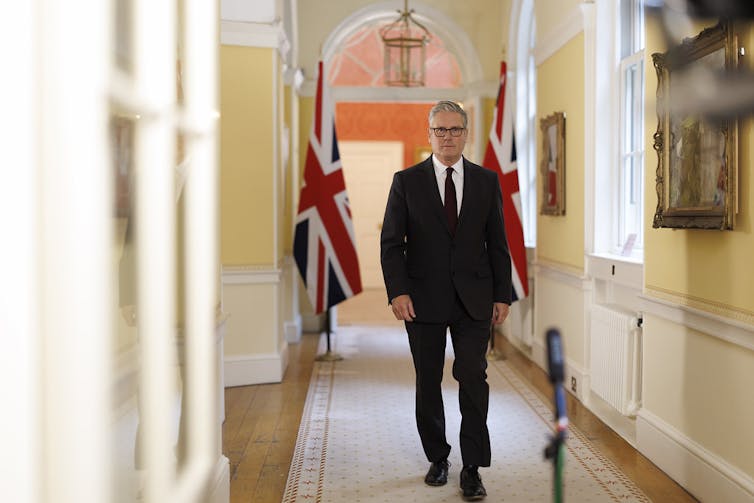
Keir Starmer walking towards a microphone.
Starmer preparing to announce UK recognition of Palestine.
Number 10/Flickr, CC BY-NC-ND

And more recognition means better access to international forums, aid and legal instruments. For example, the UN’s recognition of Palestine as an observer state in 2011 allowed the International Court of Justice to hear South Africa’s case accusing Israel of genocide and the International Criminal Court to issue an arrest warrant for Netanyahu.

The implications for the Israeli government and some of its allies could also be significant. The US will now be isolated as the only permanent member of the UN Security Council not recognising Palestine. States that do not recognise Palestine will be in a dissenting minority and more exposed to critiques in international forums and public opinion.

This growing isolation may not force immediate changes and may not bother the current US administration, which often does not follow the logic of traditional diplomacy. Still, over time, the pressure on Israel and its allies to engage with a peace process may grow.

In the end, recognition from some of the world’s biggest players breaks their longstanding alignment with consecutive Israeli governments. It shows how strongly their public and governments feel about Israel’s threat to Palestinian statehood through annexation and occupation. For Palestinians, recognition strengthens their political and moral standing. For the government of Israel, it does the opposite.

But recognition alone is not enough. It must be accompanied by sustained efforts to end the war in Gaza, hold perpetrators of violence accountable and revive peace efforts towards ending the occupation and allow Palestinians their rightful sovereignty alongside Israel.

The Conversation

George Kyris does not work for, consult, own shares in or receive funding from any company or organisation that would benefit from this article, and has disclosed no relevant affiliations beyond their academic appointment.

ref. The UK, France, Canada and Australia have recognised Palestine – what does that mean? Expert Q&A – https://theconversation.com/the-uk-france-canada-and-australia-have-recognised-palestine-what-does-that-mean-expert-qanda-265790

Dodo 2.0: how close are we to the return of this long extinct bird?

Source: The Conversation – UK – By Timothy Hearn, Senior Lecturer in Bioinformatics, Anglia Ruskin University

US biotech company Colossal Biosciences says it has finally managed to keep pigeon cells alive in the lab long enough to tweak their DNA – a crucial step toward its dream of recreating the dodo.

The firm has grown “primordial germ cells” (early embryonic cells) from Nicobar pigeons, the dodo’s closest living relative, for weeks at a time. This is an achievement avian geneticists have chased for more than a decade.

But the breakthrough’s real value lies in its potential to protect wildlife that is still living.

Those cells, once edited, Colossal Bioscience spokespeople say, could be slipped into gene-edited chicken embryos, turning the chickens into surrogate mothers for birds that vanished more than 300 years ago.

The breakthrough arrived with a bold deadline. Colossal Bioscience’s chief executive, Ben Lamm, said the first neo-dodos could hatch within “five to seven years”.

He also spoke of a goal to eventually release thousands on predator-free sites in Mauritius, where dodos lived before they became extinct. The promise sent the start-up’s valuation past US $10billion (£7.4 billion), according to the company’s website.

Almost everything we know about bird gene editing comes from chickens, whose germ cells (cells that develop into sperm or eggs) thrive in standard lab cultures. Pigeon cells typically die within hours outside the body.

Colossal Biosciences says it tested more than 300 combinations of growth factors (substances that stimulate cell multiplication) before finding one that works. Now those cells can be loaded with reconstructed stretches of dodo DNA and molecular “switches” that control skull shape, wing size and body mass.

If the edits take, the modified cells will migrate to an early-stage chicken embryo’s developing ovaries or testes so the surrogate lays eggs or produces sperm carrying the tweaked genome.

That process may create a bird that looks like a dodo, but genetics is only half the story. The draft dodo genome was pieced together from museum bones and feathers. Gaps were filled with ordinary pigeon DNA.

Due to the fact it is extinct and cannot be studied we still don’t know much about the genes behind the dodo’s behaviour, metabolism and immune responses. Recreating the known DNA regions letter by letter would require hundreds of separate edits.

The labour involved would be orders of magnitude more than any agricultural breeding or biomedical programme has ever attempted, although it seems that Colossal Biosciences are willing to throw enough money at the problem.

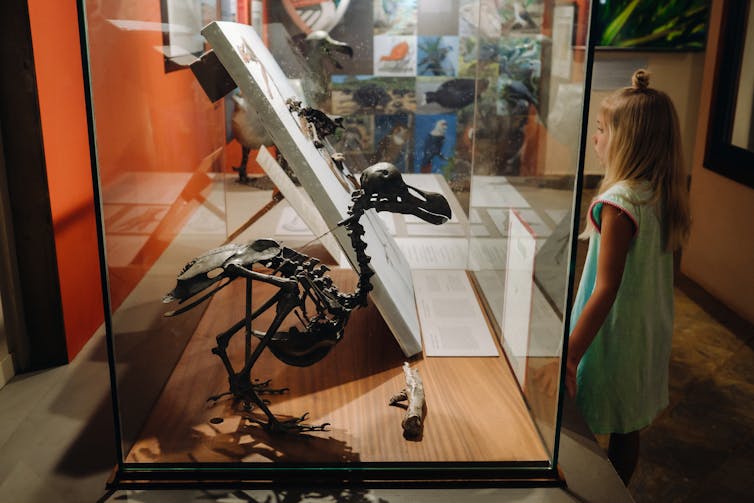
Dodo skeleton on display with child in the background.
The only dodos left are in museums or private collections.
Lobachad/Shutterstock

There is also the matter of the chicken surrogate. A chicken egg weighs much less than a dodo egg would have. In museum collections there exists only one example of a Dodo egg, and that is similar in size to an ostrich egg.

Even if the embryo survived the early stages, it would soon outgrow the chicken eggshell and be forced to hatch before full development – much like a premature baby that needs intensive care. A chick would therefore need round-the-clock care to reach the historical dodo weight of 10–20kg.

Gene-edited “blank-slate” hens have successfully laid the eggs of rare chicken breeds, showing that germ-cell surrogacy works in principle, but scaling that idea up to a larger, extinct species remains untested.

These caveats are why many biologists prefer the term “functional replacement” to “de-extinction”. What may hatch is a hybrid: mostly Nicobar pigeon, spliced with fragments of dodo DNA, gestated in a chicken.

It might peck and waddle like a dodo and even spread the large fruit seeds that once depended on the original bird. But calling it a resurrection is a marketing exercise rather than science.

Promise v practice

The tension between promise and practice has dogged Colossal Bioscience’s earlier projects. The “dire wolf” puppies unveiled in August 2025 turned out to be grey-wolf clones with a few genetic tweaks. And conservationists have warned that such announcements tempt society to treat extinction as something that is reversible, meaning it is less urgent to prevent endangered species disappearing.

Even so, the pigeon breakthrough could pay dividends for living species. Roughly one in eight bird species is already threatened with extinction, according to BirdLife International’s 2022 global assessment. Germ-cell culture offers a way to bank genetic diversity without maintaining huge captive flocks, and eventually to reintroduce that diversity into the wild.

If the technique proves safe in pigeons, it could help rescue critically endangered birds such as the Philippine eagle or Australia’s orange-bellied parrot. The latter’s wild flock now numbers around 70 birds and dipped to just 16 in 2016.

A spokeswoman for Colossal Biosciences said they remain on track with their scientific milestones but that securing appropriate elephant surrogates and eggs for their woolly mammoth project “involves complex logistics beyond out direct control” and “we prioritise animal welfare throughout, which means we won’t rush critical steps”.

She also said that the firm’s research suggests de-extinction work increases urgency around protecting endangered species. She added: “Critically, we are expanding conservation resources and public engagement, not replacing traditional efforts.

“Our work brings entirely new funding streams into conservation from sources that previously weren’t investing in biodiversity protection. We’ve attracted hundreds of millions in private capital that wouldn’t otherwise go to conservation efforts. Additionally, the genetic tools we develop for de-extinction are already being applied to help endangered species today.”

For Mauritius, any return of dodo-like birds must start with the basics of island conservation. It will be necessary to eradicate rats (which preyed on dodos), control invasive monkeys and restore native forest. Those tasks cost money and need local support but yield immediate benefits for the existing wildlife. Colossal Bioscience must follow through on its commitment to long-term ecological stewardship.

But in the strictest sense, the actual 17th-century dodo is beyond recovery. What the world may see by 2030 is a living experiment, showing how far gene editing has come. The value of that bird will lie not in nostalgia, but in whether it helps us keep today’s species from following the dodo into oblivion.

The Conversation

Timothy Hearn does not work for, consult, own shares in or receive funding from any company or organisation that would benefit from this article, and has disclosed no relevant affiliations beyond their academic appointment.

ref. Dodo 2.0: how close are we to the return of this long extinct bird? – https://theconversation.com/dodo-2-0-how-close-are-we-to-the-return-of-this-long-extinct-bird-265641

Trump looks set to abandon Ukraine peace efforts – Europe must step up to face Russian aggression alone

Source: The Conversation – UK – By Richard Whitman, Member of the Conflict Analysis Research Centre, University of Kent; Royal United Services Institute

Donald Trump appears to have had a major change of heart with regards Ukraine. On the face of it, it looks like he has embraced outright optimism that Kyiv “is in a position to fight and WIN all of Ukraine back in its original form”.

This came with the message that Europeans will need to be in the driving seat to make this happen. According to Trump, a Ukrainian victory depends on “time, patience, and the financial support of Europe and, in particular, NATO”.

The only US commitment is “to supply weapons to NATO for NATO to do what they want with them”. Most tellingly, Trump signed his Truth Social missive off with: “Good luck to all!” This is perhaps the clearest indication yet that the US president is walking away from his efforts to strike a peace deal.

It also suggests that he has given up on a separate deal with his Russian counterpart, Vladimir Putin. But this is where the good news ends – and where the European-led coalition of the willing will need to deliver security and stability for the continent in an ever more volatile environment.

After several weeks of Russian incursions into Nato airspace, drones – thought highly likely to be linked to Russia – twice disrupted Danish airspace in the vicinity of Copenhagen airport. It felt like a presentiment of the dystopian drone wars predicted by Ukrainian president, Volodymyr Zelensky, in his speech at the UN general assembly in New York on September 24.

Putin’s continuing provocations are a brazen challenge to Kyiv’s European allies. At the heart of this coalition of the willing, the European Union certainly has demonstrated it is willing to flex its rhetorical muscles to rise to this challenge.

EU institutions in Brussels have never left any doubt about their determination that Russia’s war of aggression against Ukraine “needs to end with a just and lasting peace for Ukraine”, as Ursula von der Leyen, the EU commission president, put it most recently in her state-of-the-union address.

Beyond rhetoric, however, the coalition of the willing is facing a number of potential problems. Individually, none of them is insurmountable, but taken together they illustrate the unprecedented challenge Kyiv’s European allies are facing.

Coalition confusion

To begin with, the coalition of the willing is not a coherent body. Its membership includes members of Nato and the EU, as well as Australia, New Zealand, Japan and South Korea. But the United States is not among their number.

It grew from eight countries plus the EU and Nato in February, to 33 participants in April, and 39 in September. Its relationship with the 57-member Ukraine Defense Contact Group of countries supporting Kyiv with military equipment, which held its 30th meeting in early September, is not entirely clear.

The lack of coherence in membership is mirrored by different levels of commitment, whether that’s the willingness to deploy a reassurance force after a ceasefire in Ukraine – or the capacity.

It’s also not entirely clear whether the leaders of the EU and Nato are speaking for all members of their organisations. Among EU and Nato members, Hungary and Slovakia, for example, have taken ambiguous stances when it comes to defending Europe against Russia.

These different levels of commitment also reflect partially conflicting priorities. European members of Nato are deeply – and not wrongly – concerned about US abandonment. Add to that fears of a disastrous trade war, and placating Donald Trump becomes a priority.

Doing so by buying US arms may please Trump and plug gaps in Europe’s ability to supply Ukraine. But it is perhaps not the best way of ensuring the urgently needed development of the independent European defence-industrial base.

Trump’s return to the White House swiftly ushered in the end of US largesse in support of Ukraine. Europeans have only partly filled that gap, with Germany taking the lead and the EU mobilising over €10 billion (£8.7 billion) in its current budget to 2027, with the aim to supplement efforts by member countries.

But it’s not clear how long these efforts will be sustainable in light of inflation and domestic spending pressures. France’s public finances are in distress, while Spain has openly defied Nato’s 5% spending target.

Europe needs to step up – fast

Part of the solution to these problems would be much swifter defence-industrial cooperation across the coalition, including with Ukraine. Over time, this could help to build the indigenous defence-industrial capacity needed to produce military equipment at the scale needed.

But making up for critical gaps in manpower, dealing with the Russian drone threat, strengthening air defences and long-range strike capabilities, and replacing the potential loss of US intelligence support will not happen overnight.

Individual countries and the various multilateral forums in which they cooperate will need to decide how to balance three only partially aligned priorities. Europe – whether defined as EU, European Nato members, or the core of the coalition of the willing – urgently needs to upgrade its defences. Developing a European defence-industrial capacity at scale is integral to this.

Europeans also need to keep the US engaged as much as possible, literally by buying Trump off, because they currently lack critical capabilities that will take time for them to develop themselves. And while building better defence capabilities for themselves they will need to keep Ukraine in the fight against Russia to keep it from losing the war.

Europe needs to increase the money, develop the military muscle, and build decision-making mechanisms that are not mired in procrastination to win the proxy war that the Kremlin forced on Ukraine and its allies. To do so will ensure that Europeans are best placed to prevent Russia from broadening its war against Ukraine into a full-blown military confrontation with the west.

The Conversation

Richard Whitman receives funding from the Economic and Research Council of the UK as a Senior Fellow of the UK in a Changing Europe initiative. He is a past recipient of grant funding from the British Academy of the UK, EU Erasmus+ and Jean Monnet Programme. He is a Senior Associate Fellow at the Royal United Services Institute (RUSI), and an Academic Fellow of the European Policy Centre in Brussels. He is a past Associate Fellow and Head of the Europe Programme of the Royal Institute of International Affairs (Chatham House).

Stefan Wolff is a past recipient of grant funding from the Natural Environment Research Council of the UK, the United States Institute of Peace, the Economic and Social Research Council of the UK, the British Academy, the NATO Science for Peace Programme, the EU Framework Programmes 6 and 7 and Horizon 2020, as well as the EU’s Jean Monnet Programme. He is a Trustee and Honorary Treasurer of the Political Studies Association of the UK and a Senior Research Fellow at the Foreign Policy Centre in London.

ref. Trump looks set to abandon Ukraine peace efforts – Europe must step up to face Russian aggression alone – https://theconversation.com/trump-looks-set-to-abandon-ukraine-peace-efforts-europe-must-step-up-to-face-russian-aggression-alone-266085

Paracetamol use during pregnancy not linked to autism, our study of 2.5 million children shows

Source: The Conversation – UK – By Renee Gardner, Principal Researcher, Department of Public Health Sciences, Karolinska Institutet

Andrey_Popov/Shutterstock

United States President Donald Trump recently claimed that using the common painkiller acetaminophen (also known as paracetamol and by the brand name Tylenol in the US) during pregnancy is fuelling the rise in autism diagnoses. He then went on to suggest pregnant women should “tough it out” rather than use the common painkiller if they experience fever or pain.

This announcement has caused alarm and confusion worldwide. But despite Trump’s claim, there is no strong scientific evidence to back it up. Our study of nearly 2.5 million births in Sweden published in 2024 shows no evidence that acetaminophen use during pregnancy increases a child’s risk of autism. This is the largest study conducted on the subject to date.

To understand whether acetaminophen really poses a risk in pregnancy, we turned to Sweden’s national health registers, which are among the most comprehensive in the world. Our study followed nearly 2.5 million children born between 1995 and 2019, tracking them for up to 26 years.

Using prescription records and interviews that midwives conducted during prenatal visits, we could see which mothers reported using acetaminophen (about 7.5% of pregnancies) and which did not.

We also made sure to account for any variables that may have affected the results of our statistical analysis – including controlling for health factors, such as fever or pain, which would have influenced whether or not a mother used acetaminophen during her pregnancy. This was to ensure a more fair comparison between the two groups.

We then looked at the children’s neurodevelopmental outcomes – specifically whether they were diagnosed with autism, ADHD or an intellectual disability.

The real strength of our study came from being able to compare siblings. This allowed us to compare children born to the same mother, where acetaminophen had been used during one child’s pregnancy but not the other. We compared over 45,000 sibling pairs, where at least one sibling had an autism diagnosis.

This sibling design is powerful because siblings share much of their genetics and family environment. This allows us to tease apart whether the drug itself – rather than underlying family traits or health conditions – is responsible for any apparent risks for neurodevelopmental outcomes.

Acetaminophen use

When we first looked at the entire population, we saw a pattern that echoed earlier studies: children whose mothers reported using acetaminophen during pregnancy were slightly more likely to be diagnosed with autism, ADHD or an intellectual disability.

But once we ran the sibling comparisons, that association completely disappeared. In other words, when we compared sets of siblings where one was exposed in the womb to acetaminophen and one was not, there was no difference in their likelihood of later being diagnosed with autism, ADHD or an intellectual disability.

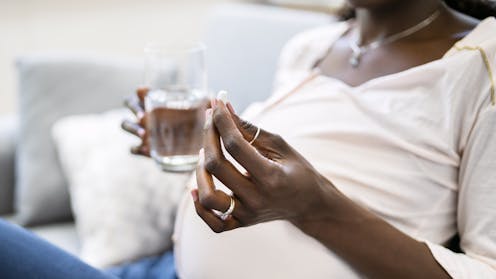
A pregnant woman holds a glass of water in one hands and a pill in the other hand.
Our study found no association with acetaminophen use during pregnancy and a child’s risk of being diagnosed with autism.
Dragana Gordic/ Shutterstock

Our study is not the only one to put this question to the test. Researchers in Japan recently published a study using a similar sibling-comparison design, and their results closely matched ours.

Importantly, they replicated our findings in a population with a different genetic background and where patterns of acetaminophen use during pregnancy are quite different. Nearly 40% of mothers in Japan reported using the drug during pregnancy. In comparison, less than 10% of Swedish mothers had used it.

Despite these differences, the conclusion was the same. When siblings are compared, there is no evidence that acetaminophen use during pregnancy increases the risk of autism or ADHD.

These findings mark an important shift from earlier studies, which relied on more limited data, used smaller cohorts and didn’t account for genetic differences. They also did not fully account for why some mothers used pain relief during pregnancy while others didn’t.

For example, mothers who take acetaminophen are more likely to also have migraines, chronic pain, fever or serious infections. These are conditions that are themselves genetically linked to autism or ADHD, as well as a child’s likelihood of later being diagnosed with one of these conditions.

These types of “confounding factors” can create associations that look convincing on the surface, but may not reflect a true cause-and-effect relationship.

That brings us to the real question on many people’s minds: what does this mean if you’re pregnant and dealing with pain or fever?

It’s important to recognise that untreated illness during pregnancy can be dangerous. A high fever in pregnancy, for example, is known to increase the risk of complications for both mother and baby. “Toughing it out,” as the president suggested, is not a risk-free option.

That’s why professional medical organisations such as the American College of Obstetricians and Gynecologists and the UK’s Medicines and Healthcare products Regulatory Agency continue to recommend acetaminophen (paracetamol) as the safest fever reducer and pain reliever during pregnancy when used at the lowest effective dose and only when necessary. This has been the guidance for decades.


Read more:
Paracetamol, pregnancy and autism: what the science really shows


Of course, if someone finds themselves needing to take acetaminophen regularly over a longer period of time, that’s a decision best made in consultation with their doctor or midwife. But the idea that acetaminophen use during pregnancy causes autism simply isn’t supported by the best available science.

The greater danger is that alarmist messaging will discourage pregnant women from treating pain or fever – putting both themselves and their babies at risk.

The Conversation

Renee Gardner receives funding from the Swedish Research Council; the Swedish Research Council for Health, Working Life, and Welfare; and the US NIH.

Brian Lee received funding from the NIH, Pennsylvania Department of Human Services, Department of Defense and Pennsylvania Department of Health CURE SAP, as well as personal fees from Beasley Allen Law Firm, Patterson Belknap Webb & Tyler LLP and AlphaSights.

Viktor H. Ahlqvist receives funding from the Swedish Society for Medical Research

ref. Paracetamol use during pregnancy not linked to autism, our study of 2.5 million children shows – https://theconversation.com/paracetamol-use-during-pregnancy-not-linked-to-autism-our-study-of-2-5-million-children-shows-265919

Russia is turning to African women and conscripted North Koreans to tackle its defence worker shortage

Source: The Conversation – UK – By Jennifer Mathers, Senior Lecturer in International Politics, Aberystwyth University

US president Donald Trump has said Ukraine could win back all of the territory it has lost in the ongoing war, but Russia’s president Vladimir Putin shows no signs of wanting a peace deal, or reducing the military offensive.

Instead, night after night Russia continues to launch hundreds of drones and missiles at Ukraine, killing civilians and destroying homes, public buildings and infrastructure.

Russia can only continue this war if it has enough workers. It has one of the world’s largest armed forces (composed of 1.32 million active military personnel), but its military recruiters face a challenging job in outpacing the enormous losses of soldiers who are killed or seriously injured in Ukraine.

However, the staffing needs of Russia’s military are tiny compared with its defence industry. Russian factories that produce weapons and equipment for the war employ approximately 4 million workers – and they have been suffering from a serious labour shortage.

According to a statement made in the Russian parliament in 2024, the country’s defence industry needs approximately 400,000 more workers than it currently employs.

But how can Russia, with a population of 143 million people have a labour shortage in a sector of the economy that is so crucial for the war?

There are a variety of reasons. An estimated 1 million Russian citizens fled Russia in 2022 – either because they opposed the war in principle or because they wanted to avoid being forced to join the military and fight – or both. Although as many as 45% of those who fled are believed to have returned to Russia over the past three years, that would mean Russia lost approximately 650,000 people from its workforce, at least for the duration of the war and perhaps permanently.

North Korean soldiers captured by Ukrainian forces have talked about the conditions they faced.

Russia’s defence industry is also in direct competition with the army for workers. The Russian state has substantially increased the salaries and various benefits that it offers to new military recruits. Salaries of 200,000 roubles – more than US$2,000 (£1,481) – a month are typical, putting combat soldiers in the top 10% of Russia’s earners.

The defence industry has had to raise the wages it offers during the war, increasing average salaries by 65% between 2022 and 2024, up to about 89,700 roubles per month. New recruits to the military, however, can expect a one-off signing bonus of as much as 4 million roubles in addition to their monthly salary.

Declining birth rate

Demographic patterns also play a part. There was a sharp drop in the birth rate in Russia in the 1990s, which means there are fewer people in their 20s and 30s seeking employment.

The defence industry has introduced a number of initiatives since the start of Russia’s mass invasion of Ukraine in February 2022 to cope with the increased demand for the production of new weapons and equipment along with the need to repair damaged and broken military hardware.

Many facilities are working around the clock: introducing compulsory 12-hour shifts and work weeks of six days on, one day off. Other parts of the defence industry are reportedly using inmates from local prisons to fill staffing gaps, including Uralvagonzavod, which is Russia’s largest manufacturer of tanks.

Russia has turned to ally North Korea to fill some of its military and labour shortages. Thousands of Koreans have been sent to Russia to work in factories and in construction, as part of a deal between Putin and North Korea’s leader Kim Jong-un. There have been reports of “slave labour” conditions and 18-hour days. North Koreans have also been sent to bolster the Russian military.

Attitudes to women

Despite all the shortages, the military industry is not recruiting Russia’s women to work in most roles. Although some Russian women do work in defence industry, labour regulations introduced in the 1970s exclude women from many roles that are important to defence production, such as working with hazardous chemicals or heavy metals.

These restrictions are designed to protect pregnant women and the fertility of future mothers. Considering Putin’s emphasis on increasing the birth rate and on presenting Russia as a bastion of traditional gender roles, this is unlikely to change.


Read more:
Putin forced to send wounded back to fight and offer huge military salaries as Russia suffers a million casualties


However, the reluctance to recruit Russian women into jobs in the defence industry does not extend to women from other countries. Around 200 women, mainly from central and west Africa, have been hired to work in defence industry factories located in the Alabuga special economic zone in Tatarstan, a Russian republic located east of Moscow. Many of these factories build drones assembled from components imported from Iran – weapons that have been used extensively by Russia in its attacks on civilians in Ukraine.

The African women employed to build drones in Tatarstan were recruited through a programme called Alabuga Start, which targets young female migrant workers.

It is advertised extensively on social media, including through paid influencers on TikTok. The salaries offered are high in relation to the wages that these women could earn in their own countries. However, Alabuga Start recruits earn around 40,000 roubles a month – less than half the amount that Russian defence industry workers receive.

The programme is focused on recruiting foreign women for a mix of practical, financial reasons and gender stereotypes. African women will work for less money than Russians. They are also believed to be easier to control than foreign men, while women are perceived to be better than men at tasks that require patience and precision.

The Alabuga Start website appears to offer an attractive package of work experience, on-the-job training, accommodation, Russian language lessons and free flights to Russia. The sectors for employment identified include catering, hospitality and service jobs with no mention of drone assembly.

However, once they arrive, the young women can find themselves living very different lives to those they had anticipated. There are reports of working long hours and exposure to dangerous chemicals, with passports being withheld to prevent women from leaving. For instance, Kenya has launched an investigation into Alabuga Start, which may see the programme shut down in that country.

The difficulties of recruiting and retaining labour for Russia’s defence industry, including bringing in foreign migrant workers and their treatment, reveal some serious weaknesses in Moscow’s military planning. While those are probably not enough to stop Russia’s war effort, they do indicate some of the strains that the war is placing on the country’s economy.

The Conversation

Jennifer Mathers does not work for, consult, own shares in or receive funding from any company or organisation that would benefit from this article, and has disclosed no relevant affiliations beyond their academic appointment.

ref. Russia is turning to African women and conscripted North Koreans to tackle its defence worker shortage – https://theconversation.com/russia-is-turning-to-african-women-and-conscripted-north-koreans-to-tackle-its-defence-worker-shortage-264731

One Battle After Another: this insane movie about leftwing radicals and rightwing institutions is a powerful exploration of US today

Source: The Conversation – UK – By Ruth Barton, Professor in Film Studies, Trinity College Dublin

The recent death of Robert Redford was a reminder of just how much All the President’s Men unsettled old certainties about American democracy. An exposé of the Watergate scandal of 1972 (when members of the campaign to re-elect Richard Nixon were caught planting secret recording devices at the Democratic National Committee’s Watergate building), Alan J. Pakula’s film fed into an increasing sense that the institutions of American governance were riddled with corruption.

Maybe not everyone agreed with Pakula’s dark vision. But he was not alone. Over the years since, Oliver Stone could also be relied on to make state-of-the-nation cinema, as could Martin Scorsese – or before them, Frank Capra. Such films attempted to capture, usually to critique, the national mood at that moment in time.

Paul Thomas Anderson’s new film, One Battle After Another, suggests that there is still a place for challenging filmmaking in today’s culture. Along with the recently released Eddington by director Ari Aster, these new state-of-the-nation films explore an America that is in crisis and throw it in our faces in staggering, epic narratives.


Read more:
The Long Walk: a brutal, brilliant film about suffering in the name of patriotism


Both films speak to the chaos of a social order that is falling apart. Both, but particularly Eddington, also threaten to be so overwhelmed by this chaos that they end up by falling into incoherence.

The term, “incoherence”, is not chosen at random. One of the seminal texts for film scholars of the 1980s was Robin Wood’s The Incoherent Text, Narrative in the 70s. Looking back at a series of films from this decade, Wood argued that “here, incoherence is no longer hidden and esoteric: the films seem to crack open before our eyes”. These two films do much the same, exposing through chaos something incomprehensible about our times and falling into incoherence in the process.

Set during the pandemic in a desert town, Eddington hurls itself from one flashpoint to the next. The sheriff, Joe Cross (Joaquin Phoenix) refuses to wear a mask and this apparently minor infraction soon pits him against his old enemy and competitor in love, Mayor Ted Garcia (Pedro Pascal). Borrowing from Maga-style campaigning, Cross enters the election as candidate for new mayor.

At home, Cross is living with his conspiracy theory-loving mother-in-law, Dawn (Deirdre O’Connell). His wife Louise (Emma Stone) is retreating further into mental illness and isolation.

On the edges of this, a mysterious conglomerate is building a data centre just outside of town. Race riots are also breaking out following the George Floyd killing. But there is much more to come.

Director Ari Aster could hardly have dreamed up more issues than he does here. With so much weight piling onto the narrative, Eddington concludes with an extended shoot-out that tips an already over-extended film into terminal disarray.

One Battle After Another, like Eddington, is a truly American film. Where Aster shot his neo-western in classic Panavision, Anderson goes one further, following The Brutalist in creating a VistaVision print, a format that is best experienced on a 70mm screen. These formats hark back to Hollywood’s grandiose epics of the 1950s, adding to the films’ evocation of history – both filmic and social.


Read more:
One Battle After Another is the latest film shot in VistaVision, a 1950s format making a big comeback


A further historical layering is Anderson’s source material for One Battle, Thomas Pynchon’s Vineland. Anderson updates Vineland’s kaleidoscopic exhumation of the revolutionary movements of the 60s by casting his ageing hippie hero, now called Bob (Leonardo di Caprio), as a relic of a fictional noughties brigade, the French 75. Led by his lover Perfidia Beverley Hills (Teyana Taylor), they robbed banks, bombed buildings and liberated detention centres in the name of their ideology of “free borders, free choices, free from fear”.

Left to bring up their daughter, Willa (Chase Infiniti) as a single parent, Bob spends his days off-grid unshaven, smoking weed, and watching the classic political drama, The Battle of Algiers. All is (somewhat) well until the brutal army veteran, Colonel Lockjaw (Sean Penn), who believes himself to be Willa’s real father, barrels back into their lives in pursuit of his “daughter”.

In common with Eddington, One Battle is at heart a family melodrama. It draws on the classic tropes of bad versus good father and conflicted mother, questioning the legitimacy of the family unit. On to these narratives bones, Anderson grafts a vision of a post-Obama America in thrall to shadowy corporate interests, a legacy of rounding up and deporting immigrants, and an old white male order hell-bent on its own agenda of personal revenge.

Robin Wood concluded his thoughts on American cinema of the 70s with the prognosis that in their incoherence they pointed to one inescapable solution: the logical necessity for radicalism.

Aster and Anderson have looked radicalism in the eye and dismissed it as yet another failed ideology. Neither names the forces behind their vision of the end of American democracy and, to be fair, the current political crisis postdates both films’ completion in early 2024.

Where Aster sees only bloodshed and impotence, Anderson clings on to a fragile utopianism that in the present day is as unlikely as it is consoling. After the lights have gone up, it may well be that what his film leaves behind is its terrifying imagery of detention centres and the horror of immigrant round-ups. It is this certainly that led Steven Spielberg to acclaim “this insane movie” as more relevant than Anderson could ever have imagined.

Looking for something good? Cut through the noise with a carefully curated selection of the latest releases, live events and exhibitions, straight to your inbox every fortnight, on Fridays. Sign up here.


The Conversation

Ruth Barton does not work for, consult, own shares in or receive funding from any company or organisation that would benefit from this article, and has disclosed no relevant affiliations beyond their academic appointment.

ref. One Battle After Another: this insane movie about leftwing radicals and rightwing institutions is a powerful exploration of US today – https://theconversation.com/one-battle-after-another-this-insane-movie-about-leftwing-radicals-and-rightwing-institutions-is-a-powerful-exploration-of-us-today-265818