I recently appeared on the BBC radio show Woman’s Hour to discuss my research on homicides committed by women. Just before my segment, singer-songwriter Katherine Priddy spoke about her song Matches, inspired by the feminist phrase “women, not witches”. It reframes witch trials as the persecution of women rather than the pursuit of the supernatural. One lyric lingered with me: “They weren’t burning witches; it was women on those fires.”
In England, Wales and their former North American colonies, that claim needs nuance. There, women were not burnt for witchcraft; they were hanged. Witchcraft was a felony under English common law, and felons were executed at the gallows. Elsewhere, the story was different. On the continent and in Scotland, witchcraft was heresy, and heretics were burnt at the stake.
In England and its colonies, no one was burnt at the stake during witch hunts: not at Pendle, not at Salem and not under the campaigns of the “witchfinder general”, Matthew Hopkins. The image of the burning witch is powerful, but in this context, it is largely a myth. If we want to understand why women were burnt in England and Wales, we need to look elsewhere – towards a different crime, and a different kind of fear.
Matches by Katherine Priddy.
In 1359 at York Castle, a woman named Alice of Tunstall was brought before the court. She was not accused of witchcraft. There were no whispers of spells or dealings with the devil. Alice stood charged with killing her husband. She was found guilty of petty treason and sentenced to be burned at the stake.
Petty treason applied to those wives and servants who “owed faith and obedience” to a social superior. A wife who killed her husband committed a rebellion against the social order itself; a husband who killed his wife had not. Husbands, and even male servants who killed their master, were hanged; women were burnt.
The logic of the law was explicit. Fire destroyed the body, denied burial and made the crime a public spectacle. It was punishment as both correction and warning. Petty treason made female disobedience visible, violent and unforgettable.
Centuries later, the law’s gendered logic persisted. In 1789, Catherine Murphy and her husband were convicted of the same crime: making counterfeit coins – a type of high treason. He was hanged like other male offenders; she was burnt at the stake.
At Newgate Prison, Catherine was led past the hanging body of her husband. She was strangled until she was dead. Only then were bundles of sticks piled and lit around her body, following the post-1652 custom of ensuring the condemned was no longer alive. Even in this modified execution, Murphy’s punishment was far harsher than that of the men she had worked with, reflecting centuries of legal gender inequality.
The execution of Murphy helped prompt reform. In 1790, the MP Sir Benjamin Hammet raised the issue in the House of Commons, citing her death as evidence that burning women – even after they were dead – was a grotesque and unnecessary punishment. The Treason Act of 1790 abolished burning as a method of execution, substituting hanging, which was the punishment for men. Even then, it was not until 1828 that a wife’s murder of her husband was formally reduced to a felony.
From Alice of Tunstall to Catherine Murphy, these fires were not about magic – they were about control. They remind us that historically, under English law, female defiance of husbands or social hierarchy has been treated far more harshly than men’s crimes. The image of the burning witch obscures this reality. In truth, it was gender, not superstition, that lit the flames.
Stephanie Brown does not work for, consult, own shares in or receive funding from any company or organisation that would benefit from this article, and has disclosed no relevant affiliations beyond their academic appointment.
Source: The Conversation – UK – By Stephen Brusatte, Chancellor’s Fellow in Vertebrate Palaeontology, University of Edinburgh
Exactly how did birds evolve from dinosaurs? It’s a mystery that has been with us for more than 150 years, and palaeontologists are still hunting for pieces of the puzzle today.
Among them is the University of Edinburgh’s Professor Steve Brusatte, whose latest book, The Story of Birds, tells the whole fascinating story. We caught up with him recently to find out more.
Of all the great dinosaur subjects, why this story?
I’ve always been fascinated by birds. They are all around us and there’s such a stunning diversity and variety. As a palaeontologist I specialised early in the theropod (two-legged) dinosaurs. This is the group that includes T.rex and Velociraptor – and gave rise to birds.
The more I studied theropods, the more I became more curious about the modern-day animals that descended from them. Back in the early 2010s my PhD was about the origin of birds. Its core involved building a big new family tree of theropod dinosaurs to understand where birds slot in, how they evolved from dinosaurs, and how their body features came together.
I wrote about the dinosaur bird connection in my first book, The Rise and Fall of the Dinosaurs (2018), but that was just one chapter. It made me think it would be really fun to do an entire book on the subject. That was how my new book, The Story of Birds, came together.
Is there still any debate about birds evolving from dinosaurs?
I think people have generally heard that birds descended from dinosaurs. In the newer Jurassic World films you even see feathers on some of them. And yet it hasn’t really broken through to the public consciousness that today’s birds really are dinosaurs. They are part of the dinosaur family tree. They just happen to be a peculiar group of dinosaurs that got small and evolved wings, took to the skies and have survived until today.
It was Charles Darwin’s great disciple, Thomas Henry Huxley, in the 1860s who first noted similarities between the skeletons of some dinosaurs starting to be found in Europe and those of modern birds. This was back before anybody knew what DNA was, for instance.
Huxley’s idea did enter the public consciousness, at least in Victorian Britain. Darwin added it to the later editions of On the Origin of Species. But then it went out of favour. This was the great era of exploration, especially in the US and Canada. The frontier was being pushed westwards, and all these new dinosaurs were being found – Stegosaurus, Brontosaurus and later Brachiosaurus and T.rex.
None look anything like birds. I think dinosaurs obtained this stereotype as giant reptilian monsters, and this still largely dominates the public consciousness today.
Yet there were also a lot of smaller dinosaurs. Many had feathers and wings, and many were very bird-like. It’s really only in the past few decades that the idea that birds evolved from dinosaurs has become scientific consensus. The discovery of feathers on dinosaurs in the 1990s really sealed the deal on that.
What mysteries remain?
There are of course still things we don’t know, like how dinosaurs started to fly. How did they start to move their wings in a way that generated enough lift and thrust to get them airborne? Did they run on the ground and use their wings to defy gravity? Did they do it from the trees down, using these wings as a way to manipulate gravity? That’s one of the biggest mysteries.
Another area of uncertainty is which dinosaurs were the closest relatives of birds. The more fossils we find, especially feathered dinosaurs in China and other places, the more it’s clear there was a whole bunch of small dinosaurs with feathers. A lot had wings, some had wings only on arms, some on arms and legs. Some had wings of feathers. Some had wings of skin like a bat.
There was a huge diversity of them right around that point in the family tree where proper modern-style birds evolved with big arm wings that they flap to keep airborne. Each new fossil gives us more information but also another layer of complexity. It makes it just a little trickier to untangle the knot of exactly which dinosaurs were the closest rivals of birds. You still see new discoveries being made every year.
You say in the book that wings evolved not to fly?
The fossils tell us clearly that feathers evolved long before any of these animals were flying. Many dinosaurs had simple feathers; they looked like little strands of hair. In fact most dinosaurs probably had them – they just don’t normally preserve because they decay away so quickly. It’s in spectacular fossil sites where lots of dinosaurs were buried quickly, usually by volcanic eruptions, where you see a lot of these feathers (Liaoning province in north-eastern China is a good example).
But these feathers were not used for flying. There’s clear evidence from the fossil record that feathers evolved in a simpler form for other reasons. Our best hypothesis is they evolved for insulation, to help them stay warm – just like hair in mammals.
The Insights section is committed to high-quality longform journalism. Our editors work with academics from many different backgrounds who are tackling a wide range of societal and scientific challenges.
Later on, these feathers evolved on some dinosaurs into quills that made up wings. But the fossil record shows that the first wings that show up in dinosaurs between the sizes of sheep and horses. Those wings were only about the size of laptop screens, and by the laws of physics, those could not keep an animal of that size in the air.
That hints that wings probably also evolved for another reason and were only later co-opted for flying. We can tell a lot of these feathers had flamboyant colours and patterns, so one leading idea is that wings first evolved for display, to attract mates; to intimidate rivals. This is still true today, of course.
You can imagine if those wings got bigger over time, more flamboyant, more ornate, at some point the laws of physics would take over and they would generate some of those aerodynamic forces. It’s not like we have fossils of the exact dinosaurs that were the first to flap their wings, but that is at least what the fossil record is telling us.
Did dinosaurs have to get smaller for flying birds to evolve?
This is a big part of the story. Some dinosaurs, such as T.rexes, got bigger over time, but the dinosaurs that evolved into birds had been getting smaller for tens of millions of years. We don’t know why exactly, but there’s all kinds ecological niches where it pays to be small: it’s easier to hide, you can grow more quickly, and so on.
So it seems you had this group, that their bodies were getting smaller, and their wings were getting bigger. At some point you had a wing that was big enough to keep a body that was small enough in the air. At that point, natural selection could take over and start refining these dinosaurs into ever better flyers.
Is it an accident of evolution that flying creatures the size of elephants don’t exist?
Animals that need to flap wings to fly can’t be that big. The biggest flapping flyers today are wandering albatrosses, and their maximum wingspan is about 3.5 metres. We have fossils of birds that were bigger: the Pelagornithids were giant soaring birds that went extinct right before the ice age. They had wingspans that were something like 7 metres long. But beyond that, I think it would be very hard to flap wings to fly.
Largest wingspan today: the wandering albatross. Imogen Warren
It makes total sense to me that it was probably a crow-sized to lapdog-sized raptor dinosaur that first started to flap as opposed to some dinosaur the size of an albatross. It’s just that the stereotype of dinosaurs being huge makes it harder to envision some small dinosaurs flapping and flying.
How did birds survive the asteroid?
That was a big mystery for a long time. There were proper birds at least 150 million years ago, which means they lived alongside their dinosaur cousins for some 80 million years. Then the asteroid comes down around 66 million years ago and all the dinosaurs die except the birds – why is that?
The reality is that lots of birds went extinct at the same time as the other dinosaurs. Many birds were still quite primitive and would have looked a lot like their dinosaur cousins. The only ones to survive were very modern-style birds. They had beaks instead of teeth, big wings and large chest muscles, and could grow really quickly like birds today.
A lot of recent research has clarified why they survived. What it comes down to is: the asteroid was a shot out of the darkness of outer space, a six-mile wide rock that smashed into the Earth one day. It changed everything instantaneously. There were earthquakes and tsunamis and wildfires. There was dust blocking out the sun, giving rise to a nuclear-style winter that lasted several years. Natural selection can’t work on that timeframe, so when the asteroid hit, all the animals had to confront the situation with the features they already had.
Most of the dinosaurs were big, and nothing bigger than a husky dog survived on land. With all these fires and acid rain and storms, simply being outside and exposed to the elements would have been bad. If you were smaller you could hide away more easily.
Also, modern-style birds had a bunch of features that turned out to be beneficial.
They grew to adult within year, so it didn’t take too long for them to nurture the next generation. They could fly away from danger. But crucially they also had beaks, which could have allowed them to eat seeds.
When the Earth went cold for many years, ecosystems collapsed. Plants did not have sunlight to photosynthesise. So plant-eaters died, which meant meat-eaters died. Seeds were probably the last foods that survived. If you could eat them, it could probably have got you through those lean years.
We have gut content of birds from the Cretaceous period (145 to 66 million years ago) and we can tell a lot of them did eat seeds. So the modern-style birds had a good hand of cards just as the world became this fickle casino and survival was a matter of the odds.
Which bird species appeared after the asteroid?
Bird fossils from the Cretaceous (meaning before the asteroid) are limited because it’s hard to fossilise birds. They’re small and their bones are really delicate. But we do know there’s birds like Vegavis and Asteriornis that lived in that period and were respectively members of the modern groups of ducks and chickens.
It doesn’t mean other modern species like owls or falcons weren’t there, but certainly they were not a major component of the ecosystems at the time. Then the asteroid hit and we start to see in the Paleocene (66 to 55 million years ago) fossils of things like penguins, mouse birds and multiple other modern groups.
Hawks are thought to be one of the species that evolved soon after the asteroid. Ram Jagan
Yet the really strong evidence about what happened is from the DNA of modern birds. Researchers are using whole genomes now. They can compare the similarities and back-calculate to predict when two groups would have diverged. When you do this, it predicts there was a big bang of bird evolution right around that time – including species like owls, parakeets, falcons and hawks.
It makes sense that if you have a mass extinction that kills 75% of species, there would have been abundant opportunity for whatever survived. But we’re still waiting for fossils to confirm this directly. It’s a real target for people doing fieldwork to confirm this story by finding the fossils of birds up to 5 to 6 million years after the asteroid.
You write that great birds have come and gone – talk us through some of those
There are more than 10,000 species of birds today, basically double the number of mammal species, so in that sense we’re still in a dinosaur world. But there are even more incredible extinct birds, some of which went extinct quite recently because of us, as we’ve spread around the world and changed the environment very quickly.
A lot of these fantastic birds got their start in the ecological vacuum after the asteroid. There were birds that became basically born-again T.rex and Triceratops – filling the top predator/top plant-eater role in a lot of ecosystems.
In South America were the “terror birds” (Phorusrhacidae). They stood taller than a person, had a head the size of a horse head and a massive hooked gnarly beak. They were the top predators there for tens of millions of years. South America was an island for lot of that time; only later did jaguars and big dogs arrive.
South America’s terror bird, once the apex predator on the continent. Harper Collins, CC BY-SA
In many places, birds were the biggest plant-eaters. Australia had birds called demon ducks (Dromornithidae) that lived for tens of millions of years. Think of the modern duck and super-size it by 100. Some were heavier than cows.
Elsewhere there was New Zealand’s moa and Madagascar’s elephant bird. Elephant birds were maybe the heaviest birds of all time. They laid eggs the size of watermelons. Many of these birds couldn’t fly. They gave up that ability as a trade-off to allow them to become really big.
The Pelagornithids also really fascinate me – the birds that were double the wingspan of an albatross. They lived for tens of millions of years, sailing the world’s thermals like giant kites. They would have been utterly spectacular animals.
Pelagornithids had twice the wingspan of the modern wandering albatross. Harper Collins, CC BY-SA
We only know about most of these birds because of fossils – except for some like the moas and elephant birds and demon ducks, which did meet humans but didn’t last long, unfortunately.
Is it surprising birds never became as intelligent as humans?
When I was growing up in the late 1980s and through the 1990s, it was an insult to say “you’re a bird brain”. It’s such an unfair biological slur, because birds are very smart.
It’s just that they have small brains – I don’t know how many hummingbirds could fit into the head of an elephant. But when it comes to the size of the brain relative to the size of the body, which is largely what matters for cognition, problem-solving and so on, birds are right up there with mammals.
Song birds learn intricate songs. Similar to a human language, they learn them from tutors, they babble when they’re young and make mistakes, then master their avian language later on.
Parrots can mimic human speech. And whereas plenty of animals use tools in a rudimentary way, some crows can make their own tools. It’s really only crows and humans and maybe some close primate relatives that do that. Crows take sticks and branches and twist and turn them. They make hooks out of them and use them to probe for food.
Since the asteroid, there were probably long stretches where it was actually birds that were the cognitive superstars. It was maybe only a few million years ago when some primates eclipsed birds in having the biggest brain relative to body size.
When did birds start singing?
Sound doesn’t fossilise, of course. But we can look at the family tree of modern birds. We can look at the songbird group and use DNA to predict when they would have originated. We can then look at the fossil record of the skeletons of birds, and see if they more or less match up with what the DNA suggests.
This tells us that song birds go back in Australia as long as 50 million years ago. Songbird evolution then probably went into overdrive about 27 million years ago. This was probably triggered by tectonic events such as little microplates, and islands moving around and forming new corridors and environments in South East Asia.
It’s only in the past 20 million years or so where you’ve had songbirds moving around the world. Nowadays, more than half of birds are song birds.
Anything else that is a priority?
The very first birds in the fossil record – proper flapping flight birds like Archaeopteryx – are from about 150 million years ago. Archaeopteryx had big feathered wings that could flap, but also teeth in its jaws, as well as big claws and a long tail. It’s the quintessential evolutionary link in transitional species, and has been known since the 1860s, when Huxley and Darwin wrote about them. Archaeopteryx was integral to their idea that birds evolved from dinosaurs.
We still haven’t discovered anything much older. We have some new fossils from China that are about the same age. Yet these birds must have had ancestors that were a bit more primitive, that could only fly in more of a rudimentary way. That’s one thing we’re waiting for, maybe from the Late Jurassic (162 to 143 million years ago) or even Middle Jurassic (174 to 162 million years). Those fossils would give us proper insight into how flapping flight really originated.
The Story of Birds US edition publishes on April 28, while the UK edition publishes on June 11 and is available for pre-order.
This article features references to books that have been included for editorial reasons, and may contain links to bookshop.org. If you click on one of the links and go on to buy something from bookshop.org The Conversation UK may earn a commission.
To hear about new Insights articles, join the hundreds of thousands of people who value The Conversation’s evidence-based news. Subscribe to our newsletter.
Stephen Brusatte publishes books with HarperCollins and Picador. He receives funding from the Swedish Research Council, European Research Council, National Geographic, and Leverhulme Trust.
Source: The Conversation – UK – By Alice Milner, Associate Professor, Department of Geography, Royal Holloway, University of London
A peat bog in Tierra del Fuego National Park, Argentina. Ororu/Shutterstock
Push a metal corer into a peatland and you pull up something remarkable: a dark, dense, sponge-like material made of partly decomposed plants. This peat is rich in carbon. In some places, that peat has been building up for thousands of years. Peatlands are the ecosystems where this happens.
Peat is often associated with the bogs of Scotland or Ireland, but peatlands occur on every continent, from the Arctic to the tropics. They can sit beneath open moorland, under swamp forest or in remote floodplains. What links them is water: in wet, oxygen-poor ground, dead plant material does not fully rot away, so carbon accumulates over centuries and millennia.
That makes peatlands globally important. Although they cover only about 3–4% of Earth’s land surface, they store nearly a third of the world’s soil carbon. When they remain intact, they can keep locking away carbon over very long timescales. But when they are drained or converted for agriculture, forestry or development, that stored carbon is exposed to air and released back into the atmosphere as greenhouse gases, including carbon dioxide. Thus, peatlands can become major sources of greenhouse gas emissions when degraded. Globally, peatland degradation is estimated to account for around 5–10% of annual human-caused carbon dioxide emissions.
For ecosystems so important to the global carbon cycle, we still know surprisingly little about some basic things.
One of the biggest questions is simply: where are all the world’s peatlands? That may sound like a question scientists should already have answered. But many peatlands are hard to detect from the surface, difficult to access, or lie beneath dense forest. Large areas of the tropics remain poorly mapped.
What may be the world’s largest tropical peatland complex, in the Congo Basin, was only formally confirmed to science in 2017. That discovery was astonishing not just because of its size, but because it showed that globally important carbon stores can still remain effectively hidden in plain sight.
This uncertainty matters. If countries do not know where their peatlands are, they cannot fully account for them in climate plans, biodiversity strategies or national greenhouse gas inventories. And if we are still refining estimates of peatland extent, we are also still refining estimates of how much carbon they store.
That gap was one reason behind a new study I co-authored. Rather than trying to answer a single peatland question, we asked a broader one: what does the peatland community think science most urgently needs to resolve?
Working with a global network of more than 100 co-authors, my team ran an open survey in 21 languages and received responses from over 450 people across 54 countries. Participants included researchers, policymakers and practitioners. An independent panel then prioritised the responses, producing 50 questions for peatland science over the next decade. What emerged was not just a set of narrow technical questions. It showed a discipline that is changing fast.
Some priorities were surprisingly fundamental. Participants highlighted the need to map peatlands better, especially in poorly surveyed tropical regions (the Congo peatland is an excellent illustration of this point), and to improve estimates of global carbon storage and greenhouse gas emissions. Others focused on how peatlands will respond to climate change: whether drought, fire and warming could push some peatlands past tipping points where they release more carbon than they store.
Restoration was another major concern. There is already broad agreement that conserving intact peatlands and rewetting drained ones are essential for climate and biodiversity goals: at least 30 million hectares of degraded peatland need to be rewetted by 2030 as a first step towards meeting climate change targets. But restoration is not one simple recipe. A damaged upland bog in Britain is different to a drained tropical peat swamp forest in Indonesia or a permafrost peatland in the Arctic. What works in one place may not translate neatly to another.
Peat, power and people
Just as striking was how often people raised questions about communities, livelihoods, power and fairness. Peatlands are not empty landscapes waiting to be fixed.
In many places they are lived in, worked and culturally significant. Participants asked how local and Indigenous knowledge can shape restoration, how wet agriculture “paludiculture” (farming crops on rewetted peatlands or wetlands) and other peatland livelihoods might work in practice, and whether the benefits of carbon finance and conservation will actually reach local communities.
So peatland science is no longer just about describing these ecosystems. It is increasingly about decisions: which peatlands are protected, which are restored, how land is used, who bears the costs and who benefits.
Our study has limits. Most respondents were researchers, and some peatland-rich regions and perspectives were less well represented than others. So this is not a final blueprint for what peatland science should look like everywhere. But it does offer a community-informed snapshot of where the biggest gaps now lie.
For a long time, peatlands were treated as marginal, soggy places at the edge of more useful land. Peatlands are now becoming central to climate regulation, water security, biodiversity and the livelihoods of many people who live on and around them.
Pulling peat from the ground means touching material that has been building up for millennia. It is a reminder that these landscapes work on timescales much longer than our own. But the decisions that will shape their future are being made now, and they will help decide not only whether peatlands remain a climate buffer or become another source of instability, but also who gets to benefit from their protection and restoration in the future.
Alice Milner did not receive funding for this work, and does not work for, consult or own shares in any company or organisation that would benefit from this article. Many co-authors on the paper on which this article is based are employed by organisations, including government agencies, intergovernmental organisations, non-governmental organisations, and environmental consultancies, whose mandates include peatland research, management, conservation or policy advice. These institutional affiliations are as stated in that paper.
This article was written in collaboration with Michelle McKeown (University College Cork, Ireland), Monika Ruwaimana (Universitas Atma Jaya Yogyakarta, Indonesia), Angela Gallego-Sala (University of Exeter, UK) and Julie Loisel (University of Nevada, Reno, USA). We are grateful to Johanna Menges (University of Bremen, Germany) and Thomas Roland (University of Exeter, UK) for their invaluable contributions, and all co-authors from around the world who contributed to PeatQuest as translators, regional contacts, and expert prioritisation panel members, as well as the many people who submitted questions anonymously to the survey and helped distribute it.
Plug-in solar panels are expected to officially go on sale in the UK in the next few months for around £500. But there are quite a few obstacles for the government and householders to overcome before this becomes the easy-to-use option that is popular in other European countries.
Plug-in solar typically consists of one or more panels, which can be mounted on the sides of a balcony (or in the garden), and then connects to the house via an inverter. The inverter converts the type of electricity that the panels generate to the voltage and frequency used by the grid.
In theory this power can be fed into a home via a standard plug. This has not been possible in the UK for safety and regulatory reasons, but these regulations are now being amended to allow this, provided the panels meet new safety standards.
In Germany, millions of panels like these were in use in 2025. The German-owned supermarket Lidl and British-owned Iceland are already working with the UK government to put them on sale in the UK. These panels could produce around 200–500kWh per year, about 10% of a typical household’s energy, depending on how the system was positioned.
What the government needs to do
The government’s plans will allow plug-in installations of up to 800W, subject to several guidelines. But it’s still not clear if there’s going to be any changes to planning laws which might be needed. Tenants would also need to check with their landlord in a shared development (as balcony solar could affect the building insurance, which is often shared across the block). There may also be restrictions under planning law for people living in a conservation area.
To get optimum power, you would want to tilt the solar panels. But this may also be contrary to existing planning rules. Without this angle, performance could be cut by 30-45%. Do planning rules need to change on this?
The government is promising new safety standards and “anti-islanding” measures for these kits. “Anti-islanding” refers to the danger that the plug prongs are live for a short time after being unplugged or if the grid was to go down and the panels continued to feed power into the house with no way to use the power. Some form of safety mechanism is needed to stop the flow of electricity in these cases.
The professional body, the Institute of Engineering and Technology, and trade association the Electrical Contractors Association have already raised some concerns about use of this type of solar panels. It’s clear that some UK homes have older electrical systems that won’t cope with plug-in solar. Previous UK building standards haven’t factored in power being fed into houses via a plug in this way.
While some of these plug-in devices available online are good quality, others are cheaply made, which is another concern. There needs to be an industry standard and enforcement.
Plug-in solar panels are popular with renters in Germany.
What householders need to think about
For most people living in houses (rather than flats) it’s going to be fairly straightforward, but some (including those in conservation areas) may need planning permission. Most people should also check with their insurers.
Balcony solar is not ideal for everyone. If your balcony is shaded part of the day or north facing you may gain little benefit. It’s worth checking this.
You will still have to notify your local district network operator, who maintain and fix your network. This is different from your energy company. You will also need to fill in a G98 notification. This online form tells your electricity supplier that you have a solar system that will be feeding power into the grid. These forms are usually filled out by electricians. It’s not clear yet if householders or tenants will be able to handle these applications themselves.
You’ll need a weatherised external plug for a unit on your balcony and to connect to your house. If you are calling out an electrician to install that, it might be safer to just have the system wired into the mains directly. But you can’t just run a cable in through an open window as that wouldn’t be safe. Also having an open window would let heat escape, and homes typically use more energy on heating than on electricity, potentially wiping out any benefits from the solar kit.
Another consideration is what to do with the power itself. The price paid by the grid for householders supplying excess energy is often a lot less than the price of buying electricity from the grid, so householders really want to use as much of that power themselves as possible. One solution to this is to buy a battery. While these can cost several hundred pounds, it means you can charge the battery during the day and then use the power at night. So, a battery improves flexibility, but it also increases costs and shortens the payback period.
The government hopes that plug-in solar could encourage more people to start using solar, which might then encourage investment in larger installations such as on rooftops, which can produce far more power. However, it’s worth remembering that in Germany it worked in reverse, first came rooftop solar (supported by government subsidies) and then balcony systems filled in the gaps.
By quickly addressing some of these practical issues, the government can encourage a wider shift to solar power.
Dylan Ryan does not work for, consult, own shares in or receive funding from any company or organisation that would benefit from this article, and has disclosed no relevant affiliations beyond their academic appointment.
Source: The Conversation – UK – By Anne Irfan, Lecturer in Interdisciplinary Race, Gender and Postcolonial Studies, UCL
There was an election, of sorts, in Gaza at the weekend. It was a very limited vote – only people registered to vote in the central Gaza city of Deir al-Balah were able to cast a ballot. This made up a total electorate of 70,000 people, and of them, only 23% actually voted.
Hamas did not field any candidates and the municipal election has been described as a largely symbolic exercise by the Palestinian Authority (PA). The PA, which is dominated by Fatah under Palestinian president, Mahmoud Abbas, wants to link the West Bank and Gaza politically ahead of a possible presidential campaign at some stage in the future.
The low turnout in the Gaza poll was not unexpected given the continuing instability in the Strip. A joint report on Gaza published earlier this month by the UN, EU and World Bank, estimated that the Israeli military has displaced more than 1.9 million Palestinians in the last two-and-a-half years.
Less reported – but no less important – is the fact that this displacement continues, despite the ceasefire agreement announced in October 2025. The situation remains volatile, with the Israeli military having killed more than 738 Palestinians in Gaza since then.
All the signs are that this displacement will last. The Israeli army remains on the ground in more than half of the Gaza Strip, which is now divided by the so-called “yellow line” established shortly after the ceasefire. Although the line was originally announced as a temporary measure ahead of the military’s full withdrawal, there is every sign of it becoming a fixed border. Israel’s military chief of staff, Lieutenant-General Eyal Zamir appeared to confirm this when he visited Gaza in December 2025 and described the yellow line as “a new border line”.
Now virtually the entire Palestinian population of Gaza – the vast majority of whom have been forced to move at least once during the conflict, now widely recognised as a genocide – are confined to its eastern side. Any Palestinian who crosses the line risks being shot by the Israeli army.
More than 200 Palestinians have already lost their lives in this way. Most infamously, the Israeli army killed 11 members of the Abu Shaaban family, including seven children, as they were driving back to their home in the early weeks of the ceasefire.
By forcibly preventing Palestinians from returning to their homes, Israel is making the Palestinian people’s displacement permanent. And as the majority of Gaza’s Palestinians were already refugees before the Israeli assault began in October 2023, many see this policy as continuation of what they call the Nakba_ – or “catastrophe”. This began in 1948, when Zionist militias and the Israeli army displaced and expelled at least 750,000 Palestinians, leading more than 200,000 to seek refuge in Gaza.
Complicating matters further still, the Israeli military has repeatedly moved the yellow line further inward, seizing more territory in a de facto land grab. According to recent estimates, the side of the line occupied by the Israeli military now comprises more than 58% of the territory of the Gaza Strip.
At the same time as this ongoing internal displacement, controversial schemes to transfer Palestinians out of Gaza altogether are continuing. Since 2023, both the Israeli government and the White House have discussed numerous proposals for the Palestinians’ mass relocation from Gaza. Indonesia, Libya, Sudan, Congo and Somalia have all been touted as possible destinations. The Trump administration also proposed offering Palestinians US$5,000 (£3,680) to leave Gaza “voluntarily”.
This operation came to light when 153 Palestinians were forced to spend 12 hours on an airport runway in South Africa after landing there without the required travel documents. Media investigations subsequently found that their journey had been facilitated by an organisation called Al Majd Europe, which calls itself a humanitarian agency working to evacuate Muslims from conflict zones. Palestinians pay US$2,000 upfront to Al Majd Europe which then arranges for their departure from Gaza.
Behind the scenes, the evacuation scheme is orchestrated by the organisation Ad Kan, whose leader Gilad Ach openly backed Trump’s plans for mass transfer from Gaza.
After bussing the Palestinians from Gaza to southern Israel, the organisations arrange for them to fly from Ramon airport to a range of destinations, including Indonesia, Malaysia and South Africa.
Some of the Palestinians who have been relocated in this way report not knowing where they are going. There are striking parallels with the 1970s, when the Israeli authorities tried to illicitly deport thousands of Palestinians from Gaza to Paraguay.
In effect, then, Israel is pushing Gaza’s 2 million Palestinians into a confined part of the Strip while simultaneously working to relocate them out of Palestine altogether. And with international attention largely now turned away from Gaza, there is alarmingly little to stop these plans getting considerably further – before it is too late.
Anne Irfan has received research funding from the British Academy
Source: The Conversation – UK – By Stephen Brusatte, Chancellor’s Fellow in Vertebrate Palaeontology, University of Edinburgh
The following is an edited extract from The Story of Birds: A New History From Their Dinosaur Origins To the Present
I will never forget my first dinosaur wing. I was a college student, on my first international expedition, preparing to venture into the mountains of Tibet in search of Jurassic dinosaurs.
Our team assembled in Beijing, and as we rushed through the galleries and storehouses of the Institute of Vertebrate Paleontology and Paleoanthropology, I stole a fleeting glance, from across the room. A skeleton of the little carnivore Microraptor, its long arms unfurled, adorned with feathers forming a broad sheet. The wings sparkled in the low light; I was mesmerised. And then we were hustled along.
Nearly a decade later, I got to spend quality time with a dinosaur wing. My friend Junchang Lü, one of China’s leading dinosaur hunters, had gotten word that a farmer in Liaoning had stumbled upon something remarkable while harvesting his crops. It was a fossil coelurosaur (a variety of two-legged dinosaurs that includes modern birds), said to be swathed in many types of feathers. A few grainy photos confirmed those details, but little more.
A museum in the city of Jinzhou had procured the specimen and invited Junchang to study it. Because I had analysed many coelurosaurs for my PhD thesis, Junchang asked for my help. We met one cold November morning at Beijing’s central railway station and boarded an eastbound train. We didn’t know what would be waiting for us when we disembarked.
Two black SUVs, as it turned out. Junchang and I were whisked inside, and we sped through the streets of Jinzhou like we were in a presidential motorcade. When we arrived at the museum, we were led through a dim hallway and into a side room, where a big slab of gray rock balanced on a table. Everyone paused. A strange tension filled the air. After a few whispered words of Mandarin, Junchang turned to me and motioned us forward.
In front of us was a dinosaur skeleton the size of a large dog. It was obviously a dinosaur, as it had the reinforced pelvis, with extra connections between the backbone and hips, that all dinosaurs inherited from their Triassic ancestors.
Beyond that, I could tell it was a dromaeosaurid – a member of the same “raptor” group as Ostrom’s Deinonychus, Jurassic Park’s Velociraptor, and the Microraptor I’d seen years earlier in Beijing – because it had the signature sickle claws on its toes. And there were indeed feathers all over its body, which a couple of decades earlier would have seemed outlandish, but by now was no surprise to us.
What was astonishing, though, were its arms. Quite simply, the arms were wings. And the individual feathers composing the wings were preserved in sublime condition. We could clearly see a line of ten fan-shaped feathers attaching to the hand, each one longer than the humerus bone of the upper arm. Making a continuous series with them, another 20 feathers followed behind, affixed to the ulna, the bow-shaped long bone of the forearm that forms the wrist where it meets the hand, and the elbow joint at its back end.
Partially covering all of these feathers, close to where they attached to the arm bones, was a blanket of about 30 additional quills. These overlain feathers were smaller than the ones attaching to the hand and forearm, so they formed a dense covering close to the arm bones, but did not extend all the way across the wing.
This was the wing of a bird. Its overall construction was exactly that of a sparrow or an eagle. If I had just seen this wing and not the raptor dinosaur it was connected to, I would probably think that it belonged to some large bird.
The feathers attached to the hand are the primaries. They are the longest and narrowest of the wing feathers, can rotate individually relative to each other, and form much of the front and side of the wing when it is unfolded. The feathers attached to the ulna are the secondaries. They are more crowded together than the primaries, and therefore make a more coherent sheet, which forms much of the back edge of the wing.
The secondaries often join to the bone via ligaments, which attach to a series of bumps along the ulna called quill knobs. And finally, the feathers that covered the primaries and secondaries are the coverts. They help protect the primaries and secondaries, and give the wing extra integrity.
We named this winged raptor Zhenyuanlong: Mr. Zhenyuan’s dragon, in honour of the museum director who secured it from the farmer. Because its wing so closely matches that of a modern bird, and because today’s birds use their wings to fly, you would probably assume that Zhenyuanlong was soaring over the Cretaceous volcanoes of China.
But it didn’t. It couldn’t. It was not capable of doing that special thing that birds can do: actively flap its wings to generate enough of those two key aerial forces: lift to get airborne and thrust to move forward through the air. This is what is called powered flight, as opposed to passive aerial manoeuvres
such as gliding.
Zhenyuanlong’s body was too big, and its wings too small in proportion: if it tried to flap it wouldn’t have been able to stay airborne. That’s not a guess; it’s the laws of physics. There is a well-known relationship between body size and wing size in birds today that are capable of powered flight. They can have approximately 2.5 grams of body weight for every square centimetre of wing area and, at least theoretically, be able to support their body in the air. Any more weight, and flapping doesn’t work.
Zhenyuanlong was nowhere close to this cutoff; it would have needed to lose about half its weight in order for its wings to work as flappers. Other aspects of its skeleton corroborate this: its arms are quite short, and it lacks the large breastbone (sternum) that anchors the bulging flight muscles of today’s birds. Maybe Zhenyuanlong could have glided a short distance, but that would have been the extent of its aerial adventures.
Sexual selection
What we see in Zhenyuanlong is part of a wider trend. Many coelurosaurs had wings of quill feathers, but their wings were too small to power their bodies through the air. If you look at trends in feather evolution across the family tree of dinosaurs, the first species with wings were oviraptorosaurs like Caudipteryx and Big Mama, animals the size of sheep with wings no bigger than a dinner plate.
There is provocative evidence from fossil quill impressions on the ulna bones of even more primitive coelurosaurs that wings might have even first evolved in horse-
size dinosaurs. Those wings would likely have been about the size of laptop screens. There’s no way any of these dinosaurs could fly with such wings – at least in an active, flapping way.
This leads to a startling realisation: dinosaur wings did not evolve for flight. Like feathers themselves, wings evolved for another reason, and were later repurposed as airfoils. It’s a conundrum. Why else would such a large and complicated structure as a wing develop in the first place?
Looking at the too-tiny-to-flap wings of Zhenyuanlong got me thinking about a famous quote from Charles Darwin. “The sight of a … peacock’s tail, whenever I gaze at it, makes me sick!” he wrote to his botanist friend Asa Gray in April 1860, less than six months after he published On the Origin of Species.
Although Darwin was notoriously prone to stomach pains and other ailments, this particular ache was metaphorical. In the flamboyant train of the peacock – built
from huge feathers longer than the bird’s body – Darwin saw an outrageous structure whose origins he could not comprehend. It wasn’t used for flying, even though it was made of big feathers. It wasn’t helpful in finding food or escaping predators.
Try as he might, he could not envision it evolving through natural selection, the mechanism for change over time that he had just articulated in his new book, in which variations that confer advantages are favoured through survival of the fittest.
Perhaps, Darwin surmised, beautiful feathers and other gaudy structures develop not because they help their bearers survive the perils of droughts and predators, but because they promote reproduction. He called this theory “sexual selection”, to distinguish it from natural selection.
In 1871, in The Descent of Man, and Selection in Relation to Sex, Darwin explained how sexually selected traits like fanciful crests, feathers and colour patterns improve an individual’s ability to acquire mates, by making them either more attractive to potential partners or better able to compete with rivals in the mating game through displays of dominance and intimidation.
Might sexual selection explain why some coelurosaurs turned their simple fuzzy feathers into wings made of quills. It’s hard to prove definitively, but I think several lines of evidence support the case.
First is the fact that many modern birds like peacocks use their feathers – and even embellish them into comically large billboard-like structures – to attract mates and intimidate rivals. Second is the fact that sexual selection was operating in some of the first true birds flying overhead of their ground-bound coelurosaur cousins.
A primitive bird from China, called Confuciusornis, is known from hundreds of fossils, half of which have ridiculously long ribbon feathers streaming off their tails, and half of which don’t. These feathers are too skinny to provide any lift or thrust during flight, they’re seen in only half the population, and, crucially, they’re not present in those individuals that have medullary bone, the unique tissue that female birds use to mine calcium to shell their eggs.
Clearly these tawdry ribbon feathers are the stuff of males, and their only plausible use could be in display. Sexual selection, therefore, was happening in birds from the very beginning of powered flight, so it’s likely it was
shaping their coelurosaur ancestors too. The most convincing evidence, however, comes from the coelurosaur fossils themselves.
Dinosaurs in colour
Many of the dinosaur books I read as a child in the late 1980s and 1990s would include a defeatist statement: we’ll never know what colours dinosaurs were. Those books were wrong.
In the late 2000s a tall, bearded Danish PhD student named Jakob Vinther was looking at fossils under high-powered scanning electron microscopes and noticed a peculiar detail. Many of them – including dinosaur feathers – preserved
a variety of small, bubble-like structures. They looked exactly like the melanosomes of modern-day animals. These are the little vessels that hold pigment, the chemicals that confer colour. We know that sausage-shaped melanosomes impart a black hue, meatball-shaped ones a rusty red, and so on.
By measuring the size and shape of the fossil melanosomes, and comparing them to melanosomes in today’s animals, Jakob could predict the colours of dinosaur feathers. It was an astounding revelation.
Before long, Jakob and his colleagues showed that coelurosaurs boasted a brilliant array of plumage. Some feathers were black, others white, gray, or ginger. One little winged coelurosaur called Anchiornis was decked out in a fancy coat, as if going to a Jurassic cocktail party. Its face was speckled black and red, a ginger mohawk erupted from its head and neck, and its wing feathers were white across most of their lengths but black at their tips, which when the various primaries and secondaries and coverts were layered together, produced a wing of alternating white and black stripes, like the hide of a zebra.
Later Jakob got me in on the action, and trained one of my undergraduates, Angus Croudace, in deciphering the colours of another coelurosaur, a raptor called Wulong, which had a drab grey body but black wings that sparkled in the sun with the iridescent sheen of a crow.
Such excessive flaunting of colour and texture could have served only one purpose: display. These coelurosaur ancestors and cousins of birds were under the spell of sexual selection, and some of the feathers forming the first dinosaur wings –
which were useless as flapping airfoils – were being used as ornaments.
Wings, therefore, might have first evolved in dinosaurs as advertising billboards sticking off of the arms. That was probably what many of these winged coelurosaurs, like Zhenyuanlong, were using their wings for.
Lift off
Then the billboards took on a new function, and became airfoils. It would have been pure happenstance. Remember that these coelurosaurs were getting smaller over time, and that there is also a tendency for display structures to become ever more fanciful in order to stay ahead in the mating race.
So while coelurosaurs like Zhenyuanlong were too big to fly with their small wings, you can imagine that if their bodies got a bit smaller, and their wings a bit bigger in order to look more attractive to mates or scary to rivals, a tipping point would be reached.
By the laws of physics, the billboards would now be broad enough, relative to the smaller size of the body, that if the coelurosaur moved them around, they could produce a little lift, a little thrust, and that dinosaur could start flickering about in the air.
The Insights section is committed to high-quality longform journalism. Our editors work with academics from many different backgrounds who are tackling a wide range of societal and scientific challenges.
These first attempts at flight would have been awkward, and the billboard wings might have initially been used more as brakes or stabilisers, to help in leaping and turning. But now, a threshold had been crossed, and Darwin’s classic natural selection could start fine-tuning these flapping dinosaurs into ever-better aerialists.
It’s a story that makes intuitive sense. A nice, orderly progression from winged coelurosaurs to flying birds. But like many things in nature, the reality was probably much more complicated – and much more interesting.
The more feathered dinosaurs we find, the more we realise that not all coelurosaurs had the same types of wings. Some, like Zhenyuanlong, look similar to today’s birds, with wings on the arms made from layers of primaries, secondaries and coverts. But then there’s Microraptor – the little dromaeosaurid that hypnotised me as a college student in Beijing – which not only had wings on its arms but also on its legs, and its tail too.
In fact, such hind limb wings are present in many other feathered coelurosaurs, which is odd, because although various birds today have feathers on their legs, none has anything approaching a broad, sheetlike wing. And weirdest of all is tiny Yi qi, a fluffy coelurosaur that would fit in the palm of your hand, which had feathers on its body but a wing made of something else entirely: skin, which stretched between its fingers and a strange rod-like bone in its wrist. It was a dinosaur that looked like a bat.
Some of these weirdly winged dinosaurs could surely glide, and a few probably were capable of powered flight. Microraptor is the prime example. My colleagues and I have done the calculations, and the wings of Microraptor were more than big enough to support its crow-size body in the air. On top of that, its feathers show many harbingers of flapping flight in modern birds.
Microraptor’s wing feathers are asymmetrical, with a much narrower leading vane in front of the shaft and a wider trailing vane. This is a telltale aerodynamic signal: It allows the overlapping feathers to form the cambered shape that a wing needs in order to function as an airfoil that can generate lift, the same way an airplane wing is curved at the top.
One stunning Microraptor fossil shows its wing feathers in mid-molt, and like flying birds today, it lost old feathers and grew new ones in a sequential pattern rather than all at once, probably so it could maintain enough of an airfoil to fly and not have to stay grounded for days at a time while it replenished its plumage. And finally, perhaps most convincing of all, scientists have built physical models of Microraptor, put them into wind tunnels, and observed how the wings are able to generate lift to keep the model airborne.
These various dinosaur wing shapes are indicative of distinct ways of gliding and flying, which, to me, implies multiple independent origins of flight among dinosaurs. We can understand it with an analogy to human aeronautics. A hot air balloon and a Boeing 737 can both get airborne, but they do so in much different ways, and look nothing alike.
No single engineer turned a hot air balloon into a Boeing 737; instead, they developed separately as different people, at different times, tinkered with ways to get into the air. But, those engineers had a common understanding of flight mechanics and properties like lift and thrust, so they built their flying machines out of the same general knowledge base.
Evolution seems to have done something similar with dinosaurs. There was a zone on the family tree of small coelurosaurs whose ancestors had already developed feathers for insulation, and elaborated them into wings for display.
Here and there, sexual selection and natural selection could make little tweaks to this common blueprint – a small decrease in body weight here, a slightly bigger advertising billboard wing there – and different coelurosaurs would be able to get
airborne. Each followed its own idiosyncratic route into the skies, some probably soaring upward from the ground and others parachuting downward from the trees, but they all emerged out of this frenzy of experimentation.
If you were back in the Jurassic or Cretaceous, trying to avoid the footfalls of a Brontosaurus or the crushing bite of a T.rex, the skies would have been aflutter with a prehistoric aviary of gliding and flapping dinosaurs. It’s hard to know exactly how many coelurosaurs independently invented flight – it might have been just a few groups, it might have been dozens.
Some were probably short-lived; others might have persisted for millions of years, particularly those raptors with arm and leg wings. All bar one, however, met the same ultimate fate: extinction. That one survivor was the group that led to modern birds, which actively flap their arm wings made of primaries, secondaries and coverts.
It would be like if the entire history of human aeronautics – every hang glider, weather balloon, prop plane, crop duster, helicopter, rocket, jumbo jet – was wiped away, except for, say, space shuttles.
To read an interview with Professor Steve Brusatte about the book, click here.
Stephen Brusatte publishes books with HarperCollins and Picador. He receives funding from the Swedish Research Council, European Research Council, National Geographic, and Leverhulme Trust.
For decades, one of the most prominent public health messages has been that smoking kills. But another everyday habit, far less dramatic and far more socially acceptable, may also be damaging our health: prolonged sitting.
Many people now spend up to ten hours a day seated at desks, in meetings or in front of screens. It may feel harmless, even unavoidable, but growing evidence suggests that too much sitting is linked to serious health risks, including cardiovascular disease, type 2 diabetes and early death.
People are often told to protect their health by exercising more and eating better. That advice matters, but it misses something important. Even those who meet recommended exercise targets may still face increased health risks if they spend most of the day sitting down.
This is because sedentary behaviour and physical inactivity are not the same thing. Physical inactivity means not doing enough moderate or vigorous exercise. Public health guidelines recommend at least 150 minutes of moderate activity a week, such as brisk walking or cycling, or 75 minutes of vigorous activity, such as running. Sedentary behaviour, by contrast, refers to long periods of sitting or reclining with very low energy expenditure, whether at a desk, in front of the television or during a long commute.
A person can therefore be physically active and still highly sedentary. Someone might go for a run before work, then remain seated for most of the next eight hours. The exercise helps, but it does not erase the effects of prolonged sitting on the body.
When the body stays still for long periods, a series of changes begins to take place. Skeletal muscle activity drops, making it harder for the body to absorb glucose from the blood. Over time, this contributes to insulin resistance, a major pathway to type 2 diabetes. Fat metabolism also slows down.
Blood flow becomes less efficient, reducing the delivery of oxygen and nutrients to tissues. This can impair vascular function and, over time, contribute to raised blood pressure.
Together, these metabolic and circulatory changes increase the risk of cardiometabolic problems, including high blood sugar, unhealthy cholesterol levels and the accumulation of abdominal fat.
Prolonged sitting also affects the musculoskeletal system. Poor posture and limited movement place strain on the neck, shoulders and lower back, helping to explain the aches and pains so common among office workers.
The effects are not only physical. Long periods of inactivity can reduce alertness, concentration and energy levels. Employees who sit for extended periods often report feeling more sluggish and less productive.
Globally, physical inactivity is estimated to contribute to around four to five million deaths each year. Much of the public health response has focused on encouraging people to exercise more, but reducing sedentary time is increasingly recognised as an important goal in its own right.
Since most adults spend a large share of their waking hours at work, the workplace is one of the most important settings for tackling the problem. Offices, universities and hospitals are not just places of productivity. They are also environments in which daily habits are shaped and reinforced.
Reducing sitting time does not require a gym membership or a dramatic office overhaul. Small, regular interruptions to sitting can make a meaningful difference.
Research suggests that standing up or moving for just two to five minutes every 30 to 60 minutes can improve glucose metabolism and reduce cardiometabolic risk.
Some organisations are already trying to build this into the working day. Walking meetings, prompts to stand or stretch and short movement breaks between tasks can all help people spend less time sitting.
Workplace design matters too. Height-adjustable desks allow employees to alternate between sitting and standing, while accessible staircases and walking routes can encourage more movement throughout the day.
A study of offices in the UK found that these kinds of measures can reduce daily sitting time by around one to one and a half hours. Employees also reported improvements in energy, focus and musculoskeletal comfort.
The message is straightforward: regular exercise is essential, but it does not fully offset the risks of sitting for too long. If smoking forced us to rethink the environments in which we worked and socialised, prolonged sitting should force us to rethink the structure of the working day itself. A short walk at lunch, standing during a phone call or simply getting up between meetings may sound like trivial adjustments. They are not. For modern workers, protecting health is not only about moving more before or after work. It is also about sitting less while work is happening.
Samina Akhtar has received funding from the Health Research Institute, National Institutes of Health, Islamabad, Pakistan. She is also a sub-recipient of a grant from the Fogarty International Center of the National Institutes of Health (USA) supporting her PhD research.
The world is full of animal viruses, and we’re pretty sure that one of them will cause the next pandemic. To prevent pandemics, we need to predict which of the vast number of animal viruses are most likely to infect humans. A new study, published in Nature, sets out an elegant and powerful way for scientists to sift through the enormous diversity of animal viruses without risking being infected by them in the process.
In this study, a team of researchers in the UK used cutting-edge lab techniques to track down a previously obscure virus infecting bats in Kenya. Here’s what they did, and how they may have helped us to get ahead of the next pandemic.
Fortunately, most animal viruses will never cause pandemics because when they try to infect human cells, they fail at the first step.
To infect a cell, the first thing a virus has to do is to bind to an “entry receptor”. This is a specific molecule on the cell’s surface that the virus attaches to so it can enter the cell.
When a virus infects a new host species, it has a problem. The cells will be coated with different molecules from the ones the virus is used to, and often the virus has nothing to grab hold of. Viruses are adept at all the stages of cellular breaking and entering, but none of them matters if they can’t even get hold of the door handle.
If we could predict which viruses could use the entry receptors found on human cells, we would know which viruses we needed to take special care around to reduce the risk of pandemics. However, for most viruses, we don’t know what their entry receptors are, let alone if human cells carry them.
Finding the door handle
In this new study, the researchers set out on a hunt for viruses that could bind to human entry receptors. They chose the alphacoronavirus family. This group of viruses includes two common cold viruses, so clearly some of them can infect humans. They also include many viruses that infect other animals, particularly bats.
Alphacoronaviruses are distant cousins of the betacoronaviruses and hence of SARS-CoV-2, which famously jumped from bats to humans to cause the COVID pandemic. Could an alphacoronavirus do something similar?
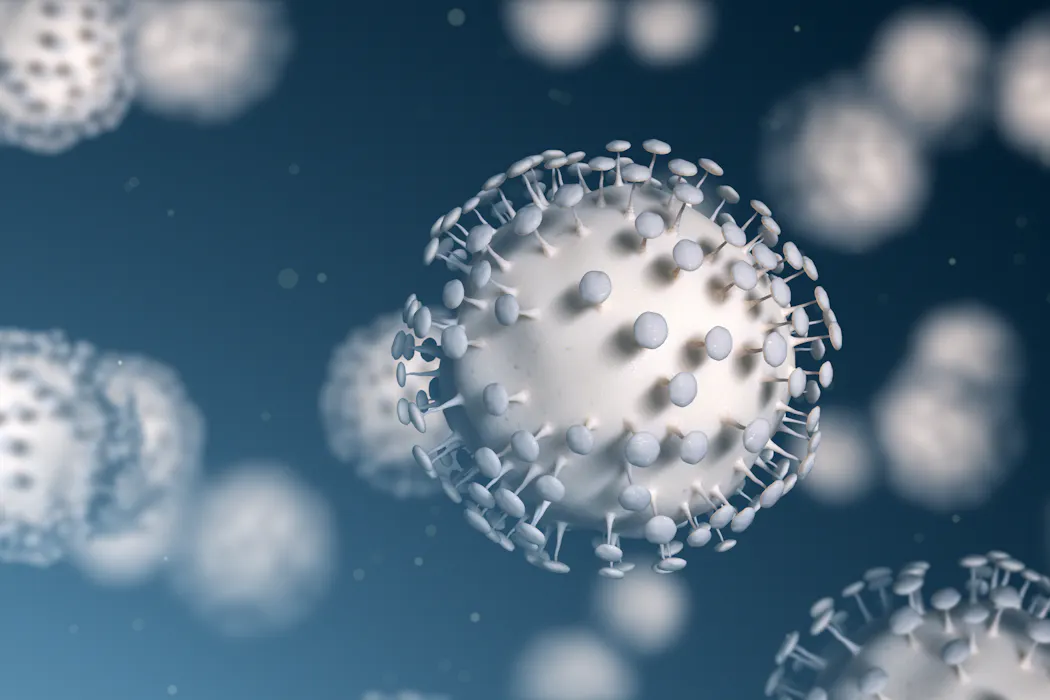
The entry receptors of almost all alphacoronaviruses, like those of the vast majority of viruses, are not known. What we do have is the virus’s genome sequences. From these, the team identified the genes of the spike proteins. If you picture a virus, such as SARS-CoV-2, the spike proteins are the bits that stick out from the surface of the virus. Their job is to bind to entry receptors.
Not unreasonably, the scientists wanted to study viral receptor binding without spending any time in the presence of potentially dangerous pathogens. They did this by creating particles called “pseudotyped viruses”: dummy virus particles that carry the spike proteins of a real virus on their surface.
Pseudotyped viruses can bind to cells but cannot replicate. As a result, they are entirely safe to work with.
As expected, pseudotypes of the two common cold viruses grabbed firmly on to human cells. Comfortingly, most of the other alphacoronaviruses could not. But there was one exception. The coronavirus KY43, a rather obscure virus previously identified in heart-nosed bats in Kenya, bound very well to a protein found on human cells.
How worried should we be about KY43? Related viruses are found in bats around the world, but, fortunately, most of them are not very good at binding to the human version of their entry receptor. The ones that can bind to human proteins are found in a relatively small region of east Africa, and people living in the part of Kenya where the virus was first identified don’t seem to show any evidence of infection.
This is reassuring, though not surprising. There are multiple steps needed for a virus to break into a human cell, after all, and binding was just the first of them. But this work marks KY43 as a virus to keep an eye on.
More generally, this paper is a powerful proof of concept for how we could carry out pre-pandemic risk assessment. Screens like this can be safely applied to any virus that we have a genome sequence for. More broadly, it should be possible to design similar screens for many of the other things a virus needs to do in order to pose a threat to humans.
The world is overflowing with animal viruses, most of which will never hurt us. But some of them could. Work like this will help us spot the ones we need to take more care of.
Ed Hutchinson receives funding from the UK Medical Research Council and the Wellcome Trust. He is a board member of the European Scientific Working group on Influenza and chairs the virus division of the Microbiology Society.
But our latest research shows that prostate cancer overdiagnosis from PSA screening is mainly a risk for men over the age of 70.
Prostate cancer overdiagnosis occurs when a person is diagnosed with prostate cancer through PSA testing – even though that cancer would not otherwise have been diagnosed within the patient’s lifetime. So had the person not been tested, they might never have known they had prostate cancer.
Overdiagnosis from PSA testing occurs for two main reasons.
The first reason is because PSA tests might identify a cancer that is so slow growing it would never cause problems – even if the man lives to be 100 years old.
The second reason is because a PSA test is able to find prostate cancer a decade or more before it would cause symptoms. Some patients may die from other causes in that time. Had they not been screened, they might have died without ever knowing they had prostate cancer.
Prostate cancer overdiagnosis is a concern because of what follows diagnosis. Subsequent treatment, such as surgery, may lead to harm – including loss of ability to maintain an erection and urinary incontinence.
Had the cancer not been found through screening, the man would not have been treated and would have avoided the side-effects of treatment. Overdiagnosis affects quality of life – and results in costs both to patients and to the healthcare system.
To help men make an informed choice, our research looked at how risk of overdiagnosis changes with age at screening. We found that the risk of prostate cancer overdiagnosis from a PSA test is low in otherwise healthy men in their 50s and early 60s. But this risk sharply increases in men screened from age 70 onward.
First, we looked at long-term data from a large UK trial of more than 400,000 men to examine, over a 15-year period, what proportion of men developed prostate cancer – and whether that proportion differed between those who were screened and those who weren’t.
We found that, on average across all age groups, 12% of prostate cancers were so slow-growing that they would not have caused symptoms or been picked up by a doctor within 15 years of a PSA test. We also found that 88% of prostate cancers detected by PSA tests would, if not treated earlier, cause symptoms and be diagnosed within 15 years – provided the patient lived long enough and did not die of other causes.
We then used national data on men’s deaths in England to understand how many men die from causes other than prostate cancer after a PSA test. Risk of death from other causes within 15 years of a PSA test increases from 10% aged 50, to 49% aged 70 and 89% if aged 80. This steep rise in risk of death drives increased overdiagnosis with old age, because, naturally, the older you are the more likely you are to die from other causes.
Taking these findings together, we projected that there was a 16% chance that the average English man diagnosed with prostate cancer at age 50 from a PSA test would not otherwise have been clinically diagnosed within 15 years. This doubled to 32% for men diagnosed aged 70, and jumped to 58% for men diagnosed at age 80 years.
Essentially, as men age, they are more likely to die from other natural causes before prostate cancer would be detected. For men older than 70 years at screening, screening offers very little, if any, benefit, but carries a high risk of unnecessary harm from overdiagnosis.
It’s also worth noting that health is more than a number based on age. Overdiagnosis risk will be lower for men who are in generally in good health and follow a healthy lifestyle.
It’s important to point out as well that healthcare is evolving. Our findings are based on data from prostate cancer screening done in the UK between 2001 and 2007. Today, doctors use magnetic resonance imaging (MRI) for targeted prostate cancer biopsy in those with an elevated PSA test. This is expected to lower overdiagnosis compared with our estimates by filtering out slower-growing cancers. More significantly, the use of MRI substantially reduces the risk of overtreatment, so the harms of overdiagnosis are smaller than they were 15 years ago.
Two new trials are also evaluating whether such innovations can improve the benefits of screening without increasing the harms.
In the meantime, men without symptoms of prostate cancer who are concerned about their risk have to decide for themselves whether to request a PSA test. For now, our recommendation, as statisticians, is to consider your age before making a decision. But if you do have symptoms, regardless of your age, you should definitely see your GP.
Adam Brentnall receives funding outside this work from Prostate Cancer UK, NIHR, Breast Cancer Research Foundation, MRC, Cancer Research UK. He is a co-applicant on the TRANSFORM trial, and member of the UK National Screening Committee Research and Methodology Group, but this work is independent and not supported by or associated with either role.
Peter Sasieni is a lead investigator on the IMProVE trial, which is investigating whether prostate cancer screening can be improved by combining PSA testing with MRI scanning.
Rhian Gabe receives funding outside this work from Prostate Cancer UK, NIHR, Cancer Research UK and Yorkshire Cancer Research. She is a co-lead on the TRANSFORM trial but this work is independent and not supported by this role.
The chief executive of the UK Biobank, one of the world’s largest biomedical databases, recently wrote to over 500,000 participants telling them that some of their data had been made available for sale online through a Chinese website. This wasn’t a data breach or hack, but rather researchers who had legitimately accessed the data trying to sell it.
Although it was stated that participants could not be identified, and there was no sign that the data had actually been bought by anyone, the fact that someone could even try to sell parts of the dataset is extremely concerning. Unfortunately, the failure was unlikely to be in the protection set up by the biobank itself, but rather in the honesty of the researchers accessing the data.
This raises the wider question of whether data – any data – can ever really be protected. Many databases, including the UK Biobank, operate secure research environments where restrictions are put on those accessing the information. This can be through secure computer portals or platforms (as used by the UK Biobank), or limiting researchers to only downloading the results of their analyses rather than the raw data itself.
But the problem is that once data exists, there is always a chance that it can be leaked through either accident or dishonesty. Legal restrictions, such as data protection laws, can give power to police or governments to try to stop this happening, or to subsequently prosecute. But in a world of international computer networks, and very different national views on privacy, even laws can only do so much. For instance, it has been claimed that data has been exposed accidentally from the UK Biobank 198 times before.
If this isn’t bad enough, the increasing availability of sophisticated AI tools means that even anonymised data can be de-anonymised. This is because AI tools are able to find complex patterns or links in data that no human would ever be able to discover.
So what is the answer? Do we revert to using pen, paper and filing cabinets, or do we need to keep evolving the way we think about our data and its security?
Harms v benefits
Possibly the main fear that people have with their data being made widely available is becoming the victim of fraud, bribery or perhaps a commercial organisation using it to make large profits or using it in other ways that we would not approve of. But the possibility of this depends on the type of data.
For instance, there are very clear reasons to keep data on personal finances, telephone records, or many other details about our personal lives confidential. However, when considering health data, including the types held in biobanks, does the potential for significant societal benefits change the way we think about risks and harms?
Medical confidentiality is considered a human right, certainly in Europe and the UK. This is because of the possibility of coercing or manipulating people if you have inside knowledge about their health. Doing this for nefarious gain is clearly wrong and must remain illegal.
Giving health data access to insurers or employers is less clear cut. While we all accept that their business practices mean that they do need to know a certain amount of information about us, many people feel uncomfortable with the idea of giving companies all of our healthcare information. This is where data protection laws come in that limit what and how commercial organisations use our data, albeit such laws require ongoing scrutiny as they are not always as effective as we may like.
However, looking beyond the individual, the real value of health data is at a group level. Humans are complex both biologically and psychologically, meaning that researchers need to look across a lot of people before patterns start to emerge. So how can this be balanced with personal privacy?
Veil of ignorance
The philosopher John Rawls proposed a thought experiment for considering issues of justice and society. His idea was to suggest people adopt a “veil of ignorance” by trying to forget their own personal position – including, race, gender, class, intelligence and health – when thinking about what might be best for society. So what would adopting a veil of ignorance mean when considering health data?
Aggregating health data is certainly not a new idea, and is the reason why organisations like UK Biobank exist, which to date has resulted in more than 18,000 research publications. So from the position of a veil of ignorance, the more data from the more individuals the better, as it does seem to lead to more research possibilities.
Second, research is very complex and now involves a wide range of disciplines, individuals and skills. Data from the UK Biobank has been used by 22,000 researchers in more than 60 countries. Again, from the veil of ignorance position, making data freely available to the widest range of researchers seems to be a good thing as the more people looking at it, in different ways, the higher the likelihood of discovering something useful.
Of course, safeguards do need to be in place to stop information being shared too widely, but these safeguards are becoming harder to implement as data processing software and AI is making it increasingly easy to identify individuals from otherwise “anonymous” data. Perhaps the issue is therefore focusing efforts less on controlling the availability of data, and instead increasing our focus on controlling how it is subsequently used.
This latest incident, alongside the wider context of daily cyber-attacks and leaks from other databases, seems to show that sooner or later most attempts at protecting data will fail. As a consequence, rather than trying to protect data, maybe we should start to accept that this type of data could now be considered a type of public good.
As with other public goods, the ethical obligation is to ensure how they are used. Yes, this may mean that commercial organisations, or even foreign governments, could use our data in ways we may not individually approve of, but disapproval of the actions of companies or other countries is hardly a new thing.
Political and international agreements regulate how all sorts of resources are used, and health data should now be included. Similarly, laws already exist to dictate what businesses can and can’t do with data.
It could be argued that if the potential benefits of fully open data sharing are truly enormous, and this incident among many others has shown we cannot protect such datasets, maybe we need to stop focusing on the futile task of trying to protect the data, and instead focus on working out how to ensure it is used in the right way.
Simon Kolstoe does not work for, consult, own shares in or receive funding from any company or organisation that would benefit from this article, and has disclosed no relevant affiliations beyond their academic appointment.