Thai villagers have moved four times to escape rising sea levels – life on the climate-change frontline

Source: The Conversation – UK – By Danny Marks, Assistant Professor in Environmental Policy and Politics, Dublin City University
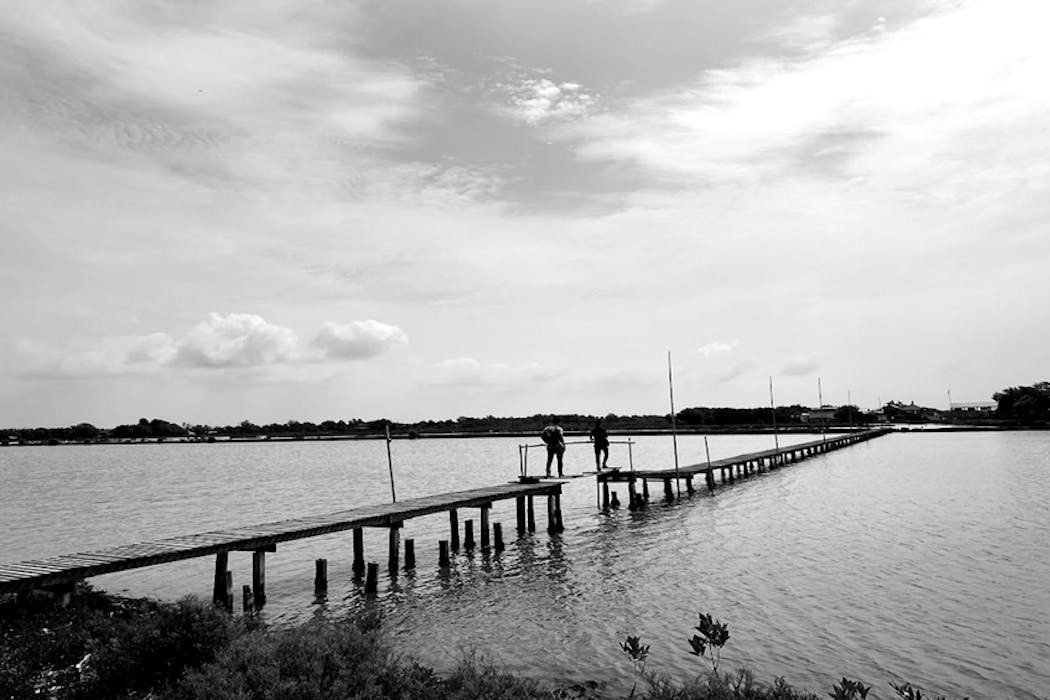
Danny Marks and a researcher walking along a small wooden pathway to the village. Danny Marks

The village of Khun Samut Chin, 50km southwest of Bangkok, Thailand, is a small, rustic fishing village similar to thousands scattered across Asia – except that it is slowly being swallowed by the sea.

Much of the country’s coastline faces severe erosion, with around 830km eroding each year at rates exceeding one metre. But in this village, the situation is far worse. Erosion occurs at three to five metres annually, the land subsides by one to two centimetres each year, and since the 1990s, around 4,000 rai (6.4km²) has already been lost to the sea.

All that remains of the original site is a Buddhist temple, now standing alone on a small patch of land that juts out into the sea so much so that locals call it “the floating temple”.

The severe erosion is partially due to climate change, but has been compounded by other human-driven factors. Upstream dams, built to provide flood control and irrigation to farmers, have reduced sediment flows in the Chao Phraya River delta, where the village is located.

Excessive groundwater extraction by nearby industries has increased land subsidence. Meanwhile, the construction of artificial ponds for commercially farming shrimp has led to widespread clearing of mangrove forests that once served as a buffer against erosion.

An image showing a line of concrete and bamboo dykes.
A wall of small concrete and bamboo dykes put in place as part of an attempt to stop coastal erosion.
Danny Marks

People move away

My new research has found that villagers have been forced to move away from the sea four times, losing both land and livelihoods in the process. The government has not provided compensation for damaged homes or financial assistance to help them relocate.

Many younger villagers, wearying of constant displacement and finding it increasingly difficult to find fish as sediment makes the sea shallower, have left for jobs in Bangkok on construction sites, in factories and other workplaces. Those who remain are mostly older villagers. Today, the local school has only four pupils, making it the smallest in Thailand.

Khun Samut Chin lies at the forefront of climate change. An estimated 410 million people, 59% in tropical Asia, could face inundation by sea level rise by 2100. Without concerted efforts to change our emission levels, many more coastal communities around the world will face similar struggles in the years to come.


Read more:
How AI can improve storm surge forecasts to help save lives


In theory, formal adaptation plans are government-led strategies designed to help communities cope with climate change. The theories assume that the state will decide when, where and how people should move, build protective structures like seawalls, and provide funding to affected communities.

In practice, however, as seen in Khun Samut Chin and many other places across Asia, low-income and relatively powerless coastal communities are often left to abandon their homes through forced displacement or try to stay put, with little or no government support, even when they ask for help.

Not giving up

Wisanu, the villager leader, says that Thai politicians have prioritised urban and industrial centres because they hold more voters and economic power. A government official told me that high land costs and limited budgets make relocation unfeasible. Instead, the state has erected bamboo walls as a temporary fix which have slowed down, but not stopped, the erosion.

Villagers are frustrated that the government has yet to implement any large-scale projects and that they are repeatedly asked to take part in consultations and surveys without any tangible results. Nor has the government provided much support to offset reduced incomes from fishing or improved transportation linkages, which remain sparse.

Coastal erosion in Thailand.

In response, the villagers have taken matters into their own hands. They have initiated a homestay programme. About 10 households, including the leader’s, host tourists who pay 600–700 Baht (£13-£16) per night, with 50 Baht going to a community fund for erosion mitigation efforts, such as purchasing or repairing bamboo dykes.

They market the programme through Facebook and other social media platforms as a place where visitors can experience life at the frontline of climate change, visit the temple, and help by replanting mangroves and buying food from the villagers. Wisanu, whose household manages five homestays, told me that the programme “enables us not to get rich but lets us walk”.

The villagers also believe that the programme helps raise awareness of their plight. They have also lobbied the local government to keep the school open and reconstruct a storm-damaged health centre.

This village offers a glimpse into what many others will likely face in the future. It shows that “managed retreat” is often not managed at all, or at least not by the state. Global frameworks like the Paris agreement and Intergovernmental Panel on Climate Change reports assume that governments have the capacity and political will to plan and fund coastal adaptation efforts.

Khun Samut Chin, however, shows how far reality can diverge from these assumptions: the sea encroaches, the state is absent, and villagers are left to mostly fend for themselves.

Yet they refuse to give up. They continue to stay, host tourists, replant mangroves, repair bamboo dykes and resist the demise of their village. They fight not only against erosion but also political neglect. If governments and global institutions fail to help them, this community will be washed away not by the water alone, but also by our inaction.

The Conversation

Danny Marks receives funding from by a seed grant from Utrecht University’s Water, Climate and Future Deltas Hub (entitled: “Human costs of shrinking deltas: Adaptation pathways of vulnerable groups to sea-level rise in three Asian deltas”).

ref. Thai villagers have moved four times to escape rising sea levels – life on the climate-change frontline – https://theconversation.com/thai-villagers-have-moved-four-times-to-escape-rising-sea-levels-life-on-the-climate-change-frontline-267278

A history of the dukes of York

Source: The Conversation – UK – By Mark McKinty, Early Career Researcher in Spanish Studies, Queen’s University Belfast

From New York City to Duke of York Island in Antarctica, the Dukedom of York has a wider cultural resonance than you might immediately realise.

The Duke of York military slow march can often be heard ringing out during the Changing the Guard in London and one of the city’s best-known theatres carries the name. The same is true for pubs in places like London and Belfast, and a second world war battleship and a passenger steamer share the same name too.

Equally, the holders of the title Duke of York have, for over six centuries, held a prominent position in British royalty and society. Customarily conferred on the second son of the reigning monarch, this dukedom has been closely associated with being the “spare to the heir” – the brother born to support the crown rather than inherit it.

Close to the sovereign but destined for a different journey, the story of the dukes of York is one of privilege and dutiful service, with a liberal peppering of scandal and twists of fate.

The current holder of the dukedom, Prince Andrew, has agreed to no longer use the titles and honours conferred upon him – the first time this has happened in the dukedom’s history.

This is a long history of men whose lives were shaped by their unique position within the monarchy. Proximity to power without possession may be the defining factor, but the dukes of York more often than not actively or accidentally flip that rule on its head – almost half of these “spares” found themselves becoming king, one way or another.

The HMS Duke of York
HMS Duke of York on an Arctic convoy to Russia in 1942.
Wikipedia/Imperial War Museum

There have been 11 men officially styled Duke of York and three holders of the title Duke of York and Albany – a fusion of two titles, one from Scotland and one from England, devised as a demonstration of unity following the 1707 Act of Union.

Edmund of Langley was the first duke, after being granted the title by his father Edward III in 1385. He is the Duke of York who appears in Shakespeare’s Richard II, a play named after the duke’s nephew and son of Edward, the Black Prince.

Following the legal principle of male primogeniture, Edward of Norwich, 2nd Duke of York, inherited the title upon his father’s death in 1402. Edward was killed at the Battle of Agincourt in 1415 and, without children, the title passed to his nephew Richard of York – 3rd Duke of York.

Richard’s death in battle in 1460, during the War of the Roses, then left the title to Edward Plantagenet. When Edward won the Battle of Towton in March 1461, subsequently becoming Edward IV, the Dukedom of York merged with the crown and became extinct, bringing a close to the 76-year existence of this first iteration of the title.

Incredibly, these are the only examples of the title being inherited. In over 560 years since, no Duke of York (or Duke of York and Albany) has ever directly passed the title to a legitimate heir. Of the subsequent ten men bearing either title, four died without heirs, five found themselves as heir to the throne following the death of their elder brother (or his abdication, as happened in 1936) and then king. And in Prince Andrew’s case, without a male heir – having had two daughters.

The duke who disappeared

Edward IV – himself a former Duke of York, recreated the dukedom for his second son, Richard of Shrewsbury, thus starting the long association of this title with the second-born son. Richard was married at the age of four and was one of the Princes in the Tower who disappeared and was presumed dead in 1483 aged 9.

The dukes who became kings

The title was revived in 1494 for Henry Tudor but again died out when Henry Tudor became King Henry VIII (1509). The same happened to Charles Stuart, who was given the dukedom in 1605 but also became king (Charles I, 1625).

A portrait of James Stuart.
James Stuart, the duke who gave his name to New York City.
Wikipedia

James Stuart, second son of Charles I, was technically Duke of York from birth, but this was formalised in 1644. In 1660, James was granted the parallel Scottish title of Duke of Albany. New York state, its capital Albany, and New York City derive their names from this duke. James succeeded his childless brother Charles II and became James II of England and James VII of Scotland in 1685, when the title merged with the crown. James was later deposed in the 1688 revolution.

In 1892 Queen Victoria bestowed the title on her grandson, Prince George, the second son of the Prince of Wales and future Edward VII. However, this creation came following the death of George’s older brother. He became George V (1910) and the title merged with the crown.

George made his second son, Prince Albert, Duke of York in 1920. Initially more than comfortable being in the shadows of his elder brother Edward VIII, the abdication crisis of 1936 – the year of three kings – unexpectedly saw Albert become George VI. Because of this duke, the future Queen Elizabeth II was initially styled “Princess Elizabeth of York”.

Three double dukes

Although the dukedoms of York and Albany have been simultaneously held by the same person at times, three men have held the unified “double dukedom” as Duke of York and Albany in the 18th century, yet all died without heirs.

They were Ernest Augustus of Brunswick-Lüneburg, who served in the nine years’ war and the war of the Spanish succession, Prince Edward, who was briefly heir-presumptive, and Prince Frederick Augustus, second son of George III.

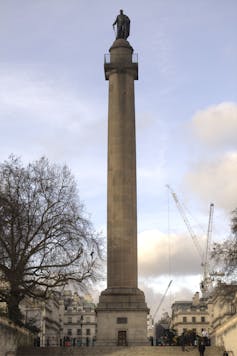
This Duke of York served a lengthy period as commander-in-chief of the British Army, including during the Napoleonic wars. He is perhaps the most likely inspiration for the “Grand Old Duke of York” rhyme. He is also memorialised on the Duke of York Column where Regent Street meets The Mall in London.

The Duke of York Column in London
The Duke of York Column in London, erected to honour Prince Frederick Augustus, also known as the Grand Old Duke of York.
Wikipedia/Prioryman, CC BY-SA

Queen Victoria again separated these titles, creating her fourth son, Prince Leopold, Duke of Albany in 1881, and her eldest grandson Duke of York in 1892.

Andrew became Duke of York in 1986 when he married Sarah Ferguson. While he has agreed to no longer be styled as such, he technically has not been stripped of the title. Nevertheless, with no male heir, the dukedom will become extinct upon his death, regardless.

Although it could be assumed that the title would have been recreated for Prince Harry as the second son of King Charles III, his self-imposed exile and ongoing controversies mean that the future of the Dukedom of York remains uncertain. Perhaps the next revival will take some consideration.

The Conversation

Mark McKinty does not work for, consult, own shares in or receive funding from any company or organisation that would benefit from this article, and has disclosed no relevant affiliations beyond their academic appointment.

ref. A history of the dukes of York – https://theconversation.com/a-history-of-the-dukes-of-york-268145

Why does putting back the clocks an hour disrupt us so much?

Source: The Conversation – UK – By John Groeger, Professor of Psychology, School of Social Sciences, Nottingham Trent University

It’s not just you – the autumn clock change really does feel that bad. Cast Of Thousands/Shutterstock

The disruption of sleeping and waking patterns from the daylight saving clock change reveals a great deal about our everyday reliance on the interaction of sleep pressure and circadian clocks.

First, you need to understand the intricate changes happening in your body the night the clocks go back an hour. On Saturday evening, assuming we are not in bright light, our bodies will begin the daily chore of secreting melatonin, a key hormone for the timing of sleep. This will accumulate in the blood stream and a few hours later it will reach its peak concentration before declining steadily until morning.

Melatonin does not make most of us sleep, and certainly doesn’t keep up asleep. It is more like a reminder, signalling that sleep should not be far away. Even brief periods of normal electric light delay or even stop this sleep signal, depending on its brightness and wavelength or colour.

In the evening as melatonin rises, the heat generated by our internal organs increases to its highest level of the day, followed by a drop – which is another sleep signal. This is why having a hot bath before bedtime can help us to sleep.

The body’s core temperature continues to drop for the first couple of hours of sleep, which is mostly slow wave sleep. This is when more of the neurons in the brain are firing simultaneously, and when our heartrate slows. It becomes more regular as we have this first episode of deep sleep. Our coldest core body temperature more or less coincides with the highest level of melatonin, showing the synchrony of these two circadian timing signals.


Read more:
Sleep quality, circadian rhythm and metabolism differ in women and men – new review reveals this could affect disease risk


A minute before 02:00 on Sunday 26 October our body’s timing systems and the
clocks will probably be aligned. Our internal core will be approaching its coldest temperature. As the body heats again, and the melatonin signal decreases, another circadian process begins – the slow sustained release of cortisol which will culminate on waking.

If melatonin is a sleep signal, then cortisol is a signal to wake. Unless we are very stressed during the daytime or drink a great deal of caffeine, it will be at its strongest at the time we typically wake. This is why waking up can sometimes seem both energising and stressful, and, why sleep is more difficult when we are stressed.

These three critical bodily timing systems, melatonin, core body temperature and cortisol, are synchronised by a central clock in the suprachiasmatic nucleus of the brain, which co-ordinates the time of the clocks in each cell of the body. The pattern of each signal repeats about every 24 hours, but can be disrupted by different aspects of our environment such as light, vigorous exercise and stress.

Woman set at desk rubbing her eyes.
It can take a few days to adjust to daylight saving time.
Nicoleta Ionescu/Shutterstock

These cycles are not fixed at exactly 24 hours. They can be a few minutes shorter or longer than 24 hours. This enables our sleep-wake regimen to gradually change with the seasons.

But the change is slow. Abrupt changes, flying east or west (which extends or shortens sunlight exposure, affecting melatonin), heat waves, cold snaps (raising or lowering core body temperature) or stress (which increases daytime cortisol) cause disruption in this regimen. We just haven’t evolved to cope with sudden changes.

It will take days for the biological and actual clock to realign. Just as flying from London to New York takes more adjustment time than New York to London, the springtime change often feels gentler, because it seems to be easier to move your clock forward than backwards.

We are likely to lose out on sleep in the morning, particularly REM sleep, which kicks in later and is involved in emotion regulation. Our biological clock will still begin the cortisol-induced daily waking process at the same time it did the day before. But you will be awake as it peaks, which may resulted in deflated mood.

This disruption is not the same for all of us. About one in a 100 of the general population have a genetic disorder called delayed phase sleep syndrome, which makes it impossible to sleep until the early hours of the morning. Their melatonin levels increase much later than in other people, which means they will probably benefit from the clocks going back, if only for a short while.

Similarly, about ten to 20 in 100 late-adolescent children – compared to adults – are biologically driven to initiate sleep later. And for them, temporarily, their sleep may align more closely with the rest of the household. But they too will be sleepier in the morning.


Read more:
Can’t sleep? Your ability to adapt to shiftwork and the changing seasons may be determined by your genes


Another group in the population, about 1% of those in middle age, feel they need to go to bed far earlier than most, usually in the early evening, and wake very early in the morning. It isn’t clear why advanced-phase sleep syndrome is more frequent in this age group, although the circadian system seems to weaken as we age. This group is more compromised by clocks being put back.

The autumn clock change is also often difficult for menopausal women who experience hot flushes – their body clock appears to be advanced and tend to need to sleep earlier. Clocks going backwards mean they will need to wait longer for sleep than they might wish and wake earlier.

The daylight saving disruption rarely lasts more than a week. But one is left asking why we put our bodily clocks under this abrupt strain. We challenge the synchrony of our bodily clocks, for the sake of fleeting moments of additional light.

The Conversation

John Groeger does not work for, consult, own shares in or receive funding from any company or organisation that would benefit from this article, and has disclosed no relevant affiliations beyond their academic appointment.

ref. Why does putting back the clocks an hour disrupt us so much? – https://theconversation.com/why-does-putting-back-the-clocks-an-hour-disrupt-us-so-much-268016

England’s new phonics target sets schools an almost impossible task

Source: The Conversation – UK – By Alice Bradbury, Professor of Sociology of Education, UCL

SpeedKingz/Shutterstock

The target for the proportion of children passing the phonics screening check – a test of how well children aged five and six in England can “decode” words – has been raised to 90%.

This increase, from 84%, comes as part of the government’s mission to “drive up standards”. It also marks a further commitment to the use of systematic synthetic phonics to teach children to read.

Systematic synthetic phonics has become dominant in education policy and in English primary schools, particularly in the last 15 years. Teachers are now well versed in teaching children how to decode words, which means that they say the right sounds – phonemes – in relation to the letters or groups of letters they see on the page.

Children who don’t pass, meaning they don’t sound out the required number of the 40 words in the test, have to take it again in year two. But results in the phonics screening check have plateaued for nearly a decade. This suggests that however hard schools try, and however good they become at preparing the children for the test, some children will still struggle to master phonic decoding.

It is a well established idea in assessment research that when a high-stakes test is introduced, the proportion of children reaching the benchmark increases initially, as teachers become familiar with how to prepare children for the test. However, there is then a ceiling figure which is reached within a few years.

In line with this, national figures for the phonics screening check show that the proportion of children passing initially increased. Pass rates rose from 58% in 2012 to 81% in 2016, as teachers began to prioritise systematic synthetic phonics teaching and learnt how to prepare children for the test.

But, since then, the pass rate has plateaued at about 80%. The only exception is a post-pandemic dip to 75% in 2022. This suggests that despite the dominance of systematic synthetic phonics as an approach, about 20% of children do not find this system works for them at this age.

Meanwhile, the cumulative figure for children who pass the test in either year one or year two stands at around 89%. This suggests that 10% of children simply need more time to pass the phonics screening check, or more input in order to master the skill of decoding. The remaining 10% who never pass may have additional learning needs – which have likely been identified long before the test – or will need to learn to read in a different way.

What this new target does is effectively require the system as a whole (for the target is a national one, not a school-level one) to ensure that those 10% of children who pass in year two, instead pass the first time around.

The importance of age

So, what can schools do to ensure that all children pass in year one? The figures show that boys are less likely to pass at this point – 76% compared to 84% of girls in 2025. Children born in the summer months are also less likely to pass, as they are younger when they take the test: 73% of August-born children pass, versus 84% of September-borns.

Department for Education data on phonics screening check pass rate by birth month:

Bar chart showing attainment by birth month.
Percentage of pupils meeting the expected standard in the phonics screening check by month of birth in English state funded schools.
Department for Education

The phonics screening check is so closely related to month of birth that it could be argued that it is a test of age rather than decoding. By the time the test is repeated in year two, the gap between August and September-borns has reduced to 7%, and 85% of August-born children pass by this stage.

The disadvantage gap

Moreover, the disadvantage gap – the difference in achievement between children from disadvantaged backgrounds and their more well-off peers – is significant. For the phonics screening check, it’s 17%, meaning that 67% of disadvantaged pupils pass compared to 84% of their peers. This would suggest that if the government wants more children to pass the test, finding ways to reduce the impact of disadvantage on children’s learning would be a highly effective way of improving the figures overall.

What remains, of course, is a deeper question of why the number who pass the phonics screening check should be such a key focus. Research has found no clear evidence that the phonics screening check improves how well children can read at primary school, or that it reduces the attainment gap.

It has also been critiqued as reducing children’s enjoyment of reading. The international comparison data shows a decline in children’s enjoyment of reading since the early 2000s. The proportion of children who really enjoy reading in England is far below the international average.

In the meantime, this is a target that is going to be very difficult to reach. It may result in an even more intense focus on phonics than we have seen thus far, at the expense of other aspects of learning to read.

The Conversation

Alice Bradbury receives funding from the Helen Hamlyn Trust which funds the Helen Hamlyn Centre for Pedagogy at UCL. She is a member of the Labour Party and the Universities and College Union.

ref. England’s new phonics target sets schools an almost impossible task – https://theconversation.com/englands-new-phonics-target-sets-schools-an-almost-impossible-task-267916

Companies now own more than $100 billion in bitcoin – but the shine may be wearing off crypto treasury companies

Source: The Conversation – UK – By Gemma Ware, Host, The Conversation Weekly Podcast, The Conversation

Mehaniq/Shutterstock

One American company called Strategy owns more than 3% of all bitcoin in existence. Its executive chairman, Michael Saylor, is the pioneer of a new business model where publicly listed companies buy cryptocurrency assets to hold on their balance sheet.

Strategy, formerly called MicroStrategy, first bought US$250 million (£187 million) worth of bitcoin in mid-2020 during the depths of the COVID economic slump. As it continued to buy bitcoin, its share price soared, and it kept buying. As of October 2025, Strategy held 640,418 bitcoin, worth around $70 billion.

In the years since, more than 100 other public companies have followed Saylor’s lead and become bitcoin treasury companies, together holding more than $114 billion of bitcoin. There’s been a new rush into crypto treasury assets in 2025 following the general crypto enthusiasm of the new Trump administration.

But holding bitcoin assets also comes with some big risks, particularly given the volatility of cryptocurrency prices, and the share prices of some of these companies are now coming under pressure.

In this episode of The Conversation Weekly podcast, we speak to Larisa Yarovaya, director of the centre for digital finance at the University of Southampton, about whether bitcoin treasury companies are the future of corporate finance, or another speculative bubble waiting to burst.

This episode of The Conversation Weekly was written and produced by Katie Flood, Mend Mariwany and Gemma Ware. Mixing and sound design by Michelle Macklem and theme music by Neeta Sarl.

Newsclips in this episode from CBC News, Bloomberg Television, Yahoo Finance, Altcoin Daily, Strategy and CNBC Television.

Listen to The Conversation Weekly via any of the apps listed above, download it directly via our RSS feed or find out how else to listen here. A transcript of this episode is available on Apple Podcasts or Spotify.

The Conversation

Larisa Yarovaya is affiliated with the British Blockchain Association.

ref. Companies now own more than $100 billion in bitcoin – but the shine may be wearing off crypto treasury companies – https://theconversation.com/companies-now-own-more-than-100-billion-in-bitcoin-but-the-shine-may-be-wearing-off-crypto-treasury-companies-268127

Sanctions on Russia have failed to stop the war so far – will Trump’s latest package be any different?

Source: The Conversation – UK – By Sergey V. Popov, Senior Lecturer in Economics, Cardiff University

Donald Trump has finally decided to hit Russia with sanctions – the first package he has imposed since he came back to the White House in January.

The sanctions target Rosneft and Lukoil, Russia’s two largest oil companies, as a retaliation for Vladimir Putin’s refusal to agree to a ceasefire in Ukraine. The announcement came in the wake of the decision to call off a planned summit between the two leaders in Budapest next month.

The US treasury secretary, Scott Bessent, said in a statement: “We encourage our allies to join us in and adhere to these sanctions.” In fact the EU has imposed 19 rounds of sanctions against Russia since the full-scale invasion in 2022.

The UK government has passed sanctions which it estimates have cost Russia more than £28 billion since the start of the war. And the Biden administration also repeatedly imposed sanctions on Russia after the invasion.

In March 2022, I wrote a piece for The Conversation explaining why I thought the sanctions imposed on Russia in the aftermath of the full-scale invasion of Ukraine wouldn’t topple Putin. Sanctions often fail to achieve their goals the Russian economy has specifically been set up to resist western sanctions.

Three years on, Russia’s land grab continues to ravage Ukraine, albeit clearly with much less success than expected by Russia’s generals. A lot of this resistance is due to Ukrainian military heroism and creativity, and a lot of it due to humanitarian and military assistance from EU, the US and other allies. But how much of it was due to sanctions is open to debate.

Russia’s economy is now focused on waging war. And even in these days of drone combat, to wage war you needs soldiers. The amounts paid to people joining up in Russia are unprecedented. Not only is their enlistment pay about the price of a decent apartment in a regional capital, but any debt they hold up to 10 million rubles (£76,500) is wiped out.

Their salary is not a large amount by western standards – a policeman in New York earns a comparable amount in a year. But when the alternative in Russia is being a security guard for £400 per month, it is clear why many people who see no future – especially convicts who are also given pardons – enlist in the Russian armed forces.

Reservists and volunteers mean that Russia is able to maintain its fighting force. While the sanctions clearly hurt Russia’s economy, having sufficient soldiers is priority number one – and this is still largely unaffected.

Russia is managing to pay for the war, sanctions or no sanctions, by passing on the cost to the public. VAT is forecast to rise from 20% to 22% in 2026 and the revenue threshold under which businesses will be required to pay will come down. This will lower investment into things like barber shops, but investment in military production will not be affected.

The sanctions do hurt the Russian economy – lifting sanctions is always the most important demand anytime Russia is consulted about a ceasefire – but not so much that the war economy is slowing down.

Finding loopholes

Thus far, Russia has managed to circumvent sanctions. Europe still buys large quantities of oil and gas from Russia (more than it has given Ukraine in aid, in fact). Moscow has also exported massive amounts to India and China, but the quantities are expected to fall sharply as a result of the US sanctions.

Earlier this year, the US president also announced a massive tariff hike on Indian exports in retaliation for India buying Russian energy supplies.

All of this will make the war more expensive – but it will not stop it. For a start, Russia controls a big “shadow fleet” of ships that have been transporting its oil and other banned goods such as military equipment and stolen Ukrainian grain. The EU has imposed port bans on 117 ships believed to be part of this shadow fleet. But experience suggests that this is by no means a foolproof way of preventing them from operating.

Death by 1,000 cuts

It’s tempting to imagine sanctions as trying to cause death by 1,000 cuts. The EU has made 19 cuts, so we are still 981 away – 980 with Trump’s latest move.

The west could have done more and it could have done it sooner. It could have acted as early as 2008 when Russia signalled its aggressive intent by invading Georgia. It could have imposed more effective sanctions after Russia annexed Crimea and parts of eastern Ukraine in 2014.

In any case, these sanctions are designed against a western democracy, if they were imposed against the US or the UK, they would have changed governments. In western democracies governments have power at the discretion of the voters who can take these mandates back. Sanctions against autocracies, where power is not in the hands of the people, need to be different.

The good news is that the Trump administration is finally doing something besides putting out the red carpet for Putin. There is hope.

The Conversation

Sergey V. Popov does not work for, consult, own shares in or receive funding from any company or organisation that would benefit from this article, and has disclosed no relevant affiliations beyond their academic appointment.

ref. Sanctions on Russia have failed to stop the war so far – will Trump’s latest package be any different? – https://theconversation.com/sanctions-on-russia-have-failed-to-stop-the-war-so-far-will-trumps-latest-package-be-any-different-268228

Russia turns to an old ally in its war against Ukrainian drones: the weather

Source: The Conversation – UK – By Peter Lee, Professor of Applied Ethics and Director, Security and Risk Research, University of Portsmouth

Russia has long used harsh weather as a defensive ally. During Napoleon’s 1812 invasion, his Grand Army was defeated as winter closed in – the ground became impassable and logistical support to his army collapsed. Similarly, Hitler’s Operation Barbarossa in 1941-42 was halted by heavy rains and deep mud followed by freezing temperatures.

Today, in a different kind of war, Russia is again turning to its old ally, harsh weather – but this time to help in its offensive against Ukraine.

Ukraine’s extensive use of small, low-cost drones has transformed attack and defence strategies across the front lines. The Modern War Institute reports that drones are responsible for around 70% of Russia’s battlefield casualties, although it is unclear which kind of drones are killing in greater numbers: loitering one-way attack drones (known as “kamikaze drones”) or quadcopter first-person view (FPV) drones, armed with small explosives.


Read more:
How drone attacks are changing the rules and the costs of the Ukraine war


Beyond direct strikes, small drones play a vital role in intelligence gathering, surveillance and reconnaissance. They allow Ukrainian units to identify targets and coordinate ground operations with far greater precision. Real-time aerial imagery enables artillery crews to rapidly adjust fire, making bombardments more accurate – and more lethal.

Drones have become the eyes and, increasingly, the hands of Ukraine’s ground forces, increasing their defensive effectiveness against the larger and often better-equipped Russian ground forces. Mass Ukrainian use of FPV and one-way-attack drones has significantly improved defensive effectiveness, blunting larger Russian ground force assaults by using real-time targeting data and precise strikes.

Both sides in the war also regularly deploy electronic jamming, rendering radio-controlled FPV drones inoperable. Russia has, of necessity, become a global leader in this area.

The jamming disrupts the radio links and video feeds that pilots rely on for navigation and targeting. This places Ukraine’s forces, which rely heavily on drones to offset Russia’s advantages, at a considerable disadvantage.

Bad weather and drones

When bad weather combines with electronic interference, the effect is even more damaging. Snow, fog, wind and cold already limit drone endurance and visibility – sharply reducing Ukraine’s technological edge in aerial reconnaissance and precision battlefield drone strikes.

Russia, in contrast, gains relative advantage in such conditions. Its older, heavier ground-based systems – tanks, artillery and armoured vehicles – are more resilient against poor weather. The battlefield becomes a place where Russia’s attritional approach to war grinds out bloody advances.

Small quadcopter drones are light, have limited endurance and are easily influenced by weather. Take the DJI Mavic 3 series, used by many Ukrainian units for frontline reconnaissance. It is only effective in temperatures between –10°C and +40 °C and winds below about 12 metres per second. Strong gusts or freezing weather can quickly push this small drone off course.

More advanced Ukrainian systems, such as the winged Shark uncrewed aerial system, can operate from –15 °C to +45 °C and withstand winds up to 20 metres per second. Yet even these are restricted to dry conditions: rain or snow can ground them.

In cold conditions, batteries drain more quickly, cutting both flight time and operational range. Icing can ground large numbers of drones if it changes the characteristics of the quadcopter propellers – ice makes propeller blades thicker, heavier and less aerodynamic, reducing performance.

Winged drones can suffer from wing-tip icing, which changes their flight characteristics – reducing lift, increasing drag and the danger of stalling, and degrading control. Fog and snow also reduce visibility, limiting the ability to identify or track targets.

Russian offensive

In October 2025, Russia timed several large ground assaults to coincide with poor weather. This approach exploited conditions that significantly reduced Ukraine’s ability to defend itself with drones. Fog, rain and cloud cover made small reconnaissance drones unreliable or even unflyable. Visibility dropped so low that attacks on individual soldiers become far less effective.

In theory, Ukraine’s allies can offset some of this loss through satellite intelligence. US reconnaissance satellites can still gather valuable information on cloudy days by using synthetic aperture radar to detect ground movements. Yet even these advanced systems cannot see visually through thick cloud banks or heavy rainstorms.

Historically, Russia’s severe weather served a defensive purpose, turning back invading armies from Napoleon to Hitler. In the present war, however, Russia is using the same harsh climate offensively, turning natural concealment into a tactical advantage as it advances across Ukrainian ground.

Winter has not yet arrived, but Ukrainian and Russian military planners will be watching the weather. Ukraine’s vaunted ability to innovate and respond to Russian tactics will be tested even further in the months ahead.

The Conversation

Peter Lee does not work for, consult, own shares in or receive funding from any company or organisation that would benefit from this article, and has disclosed no relevant affiliations beyond their academic appointment.

ref. Russia turns to an old ally in its war against Ukrainian drones: the weather – https://theconversation.com/russia-turns-to-an-old-ally-in-its-war-against-ukrainian-drones-the-weather-268019

HIV prevention jab approved for use in England and Wales – here’s how it works

Source: The Conversation – UK – By Rosalie Hayes, Research Assistant, Centre for Public Health & Policy, Queen Mary University of London

Cabotegravir is a form of pre-exposure prophylaxis (Prep). Svitlana Hulko/ Shutterstock

The first ever injectable drug that can prevent HIV has been approved for use in England and Wales.

The drug, cabotegravir, would benefit an estimated 1,000 people at risk of HIV in England and Wales. It offers a long-acting alternative to other existing preventive HIV drugs, which are only available as pills and usually must be taken on a daily basis.

The jab belongs to a group of drugs called antiretrovirals, which were originally developed to treat HIV. It’s now well established that antiretrovirals can also be used by HIV-negative people to dramatically reduce their risk of acquiring HIV.

The jab stops HIV from replicating within a person’s cells, meaning infection cannot take hold. This approach is called pre-exposure prophylaxis, or Prep.

Injectable cabotegravir for Prep is administered by a single, intramuscular injection into the buttocks every two months. It must be administered by a trained health professional to ensure that the drug is delivered correctly into the muscle.

It is important to understand that cabotegravir is not a vaccine. Vaccines work by training the immune system to fight infections – whereas cabotegravir works by ensuring there are adequate levels of the antiretroviral drug in the bloodstream to prevent the HIV virus from replicating.

That’s why people using cabotegravir as Prep need to make sure they get their injections every two months for as long as they’re at risk of HIV.

Oral vs injectable Prep

Oral Prep is around 99% effective at preventing HIV when taken as prescribed – but this is reliant on people adhering to their pill regimen. Real-world effectiveness declines depending on adherence.

In contrast, injectable cabotegravir requires only six injections per year. Largely because it is easier to adhere to, cabotegravir has been found to reduce the risk of acquiring HIV by 66% in gay men, bisexual men and transgender women, and by 88% in cisgender women, compared to daily oral Prep.

There are other differences between injectable Prep and oral Prep beyond effectiveness.

People using cabotegravir for Prep will need to attend the clinic every two months to receive their injections. In comparison, people taking oral Prep will only need to get their prescription filled every three to six months.

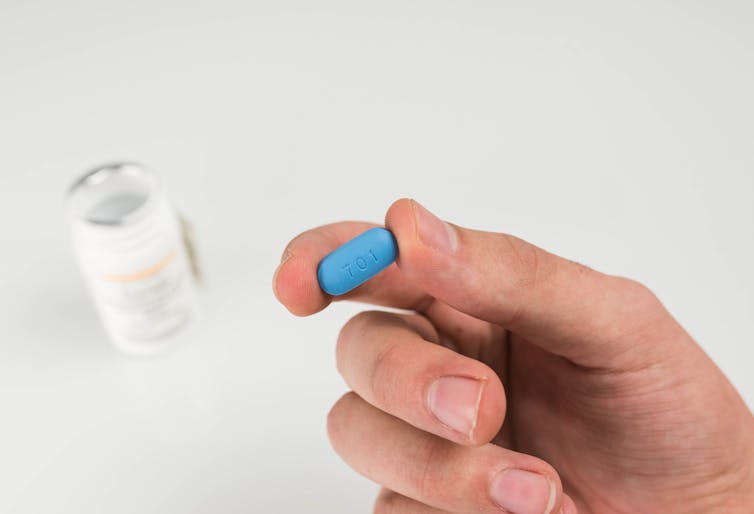
A person holds a blue Prep pill in their hand.
The jab offers an alternative to oral Prep pills.
Michael Moloney/ Shutterstock

Both injectable and oral Prep are very safe and well-tolerated medications, but possible side-effects differ between the two types. The most common side-effect of cabotegravir is swelling or tenderness around the injection site. Oral Prep’s possible side-effects can include nausea, vomiting and headaches.

At the moment, current guidelines recommend cabotegravir is offered to people in need of Prep but who cannot use oral Prep effectively. This includes the small number of people with health conditions (such as severe liver or kidney problems) which may make oral Prep unsuitable for them and those with difficulty swallowing tablets.

It also includes those who are unable to adhere to oral Prep for social or personal reasons. For example, people who are homeless or in unstable housing who may easily lose medication or have it stolen, people experiencing intimate partner violence who may worry about their partner finding their pills and people who use drugs and find regular pill-taking challenging.

A significant milestone

Cabotegravir was already approved for use in England and Wales as part of a combination treatment for people living with HIV. Now, the drug will be available to those who are HIV-negative and looking to protect themselves from acquiring HIV. This is the first time an alternative to oral Prep has been made available on the NHS.

It offers access to highly effective HIV prevention for those who previously could not use Prep. Research shows that there is a strong preference for injectable Prep among people at risk of HIV, due to its convenience and the reduced pill burden.

This approval may also pave the way for other forms of injectable Prep that have an even longer duration. For instance, lenacapavir, which is already available in the United States, only needs to be administered every six months.

Currently, there are issues around inequitable access to Prep. For example, women make up only 3% of current Prep users but 35% of new HIV diagnoses. Recent research indicates that current Prep provision does not align with women’s needs.

Giving patients more choice in the type of Prep they can access is an important step forward in addressing this inequality. But it will be crucial that sexual health services are adequately funded so they can deliver injectable Prep services.

Ongoing research also shows that delivering Prep outside of traditional sexual health settings, such as in community pharmacies and GP practices, could also make an important contribution to equitable access. Considering how injectables could be incorporated into these services will be a vital next step.

By increasing the numbers of people who can use Prep, injectables offer a critical new tool for achieving the government’s goal of eliminating new HIV infections by 2030.

The Conversation

Sara Paparini has received funding from ViiV Healthcare and Gilead Sciences.

Sophie Strachan receives funding from ViiV and Gilead and MSD she is affiliated with Sophia Forum

Rosalie Hayes does not work for, consult, own shares in or receive funding from any company or organisation that would benefit from this article, and has disclosed no relevant affiliations beyond their academic appointment.

ref. HIV prevention jab approved for use in England and Wales – here’s how it works – https://theconversation.com/hiv-prevention-jab-approved-for-use-in-england-and-wales-heres-how-it-works-268037

‘No kings’: America’s oldest political slogan is drawing millions out onto the streets

Source: The Conversation – UK – By Tom F. Wright, Reader in Rhetoric, University of Sussex

Every few decades, Americans rediscover that their republic was built on a rejection – the rejection of being ruled by a monarch. Now, in one of the largest protest movements in many years, the phrase “No kings” is everywhere: on placards, online memes, and in chants aimed at a president who seems to want to rule rather than serve.

Yet the words are hardly new. They are the first note in the American political scale, the country’s founding slogan before it even had a flag.

Long before it echoed through the colonies, the slogan “No king but Jesus” rang out in the English civil war, where it was used to declare that divine authority, not royal prerogative, should rule the conscience.


Read more:
In 1776, Thomas Paine made the best case for fighting kings − and for being skeptical


When it crossed the Atlantic, colonial Americans inherited a phrase, a stance and an image that could turn theology into politics and rebellion into virtue.

As Thomas Paine put it in his 1776 pamphlet, Common Sense: “Of more worth is one honest man than all the crowned ruffians that ever lived.” Republican speech was invented by rejecting monarchy.

When independence was achieved, America’s experiment rested on a paradox: it needed strong leadership but feared the aura of command. “No kings” was a self-diagnosis of a nervous republic. A way of keeping the charisma of a leader on a leash.

That allergy to grandeur shaped the early republic. In the 1790s when John Adams proposed that the president be addressed as “His Highness”, he was swiftly mocked as “His Rotundity”. The laughter mattered. It expressed the conviction that democracy could not survive reverence.

By the 1830s, this suspicion of pomp had become visual. Critics of the seventh president, Andrew Jackson, issued a famous broadside “King Andrew the First” showing him crowned and trampling the constitution. It wasn’t just partisan art – it was an act of democratic hygiene.

Image from cover of 1864 pamphlet depicting Abraham Lincoln as a king.
Abraham LIncoln depicted as a king in 1864.
Lincoln Financial Foundation Collection

A generation later, Abraham Lincoln faced the same charge. During the American civil war, a notorious 1864 pamphlet Abraham Africanus I accused him of seeking to become a “hereditary ruler of the United States”. His sweeping wartime powers fed old fears that emergency rule would harden into monarchy.

Sometimes, the charge is justified. When Puck magazine in 1904 depicted Theodore Roosevelt crowning himself Louis XIV (or perhaps Napoleon), it captured the public’s mixture of thrill and alarm at his trust-busting, canal-building, imperial swagger. Citizens wanted vitality in office, but not vanity.

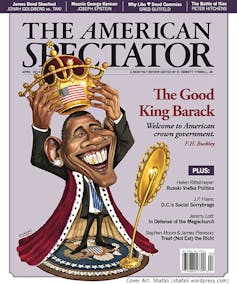
Image from cocver of American Spectgator 2014 showing a caricature of Barack Obama crowning himself king.
How the American Spectator depicted Barack Obama in 2014.
American Spectator

Other times, the imagery seemed to speak more to American paternal longings. Take images of Dwight Eisenhower as “King Ike” in the 1950s, a genial ruler among smiling courtiers, soothing cold war nerves.

In our own century, the crown returns in sharper form. The American Spectator’s 2014 cover, “The Good King Barack” showed Obama beaming beneath a red velvet crown.

When Donald Trump triumphed in 2016, crown memes returned as America’s simplest moral shorthand for power that has gone too far.

It fell to his successor Joe Biden to officially declare, in response to the July 2024 Supreme Court ruling that Trump was not immune from prosecution: “This nation was founded on the principle that there are no kings in America.”

Why the crown keeps returning

The crown is both insult and safety valve at once. It’s an instantly legible piece of political folk art reminding citizens that authority is temporary, fallible and – like its wearer – mortal.

When protesters revive “No kings”, they aren’t just quoting the revolution. They’re translating an older language of civic republican virtue into an accent everyone can understand. No person above the law, no office above criticism, no citizen beneath respect.

The slogan reawakens the moral reflex that freedom depends on vigilance, and that dignity belongs to the governed as much as the governors.

And here’s the irony: both parties were founded on that same cry. Democrats and Republicans trace their roots to the anti-monarchical Democratic-Republicans of Thomas Jefferson and James Madison, who defined their movement against the spectre of kingly power. That party later fractured, giving rise to both modern traditions.

In that sense, “No kings” was the nation’s first party platform, the point of agreement from which every later disagreement grew.

Can it still work?

In today’s fractured America, “No kings” offers something rare: a language of protest that feels constitutional rather than ideological. It has the potential to speak to conservatives alarmed by executive overreach, to progressives wary of authoritarian drift, and to independents nostalgic for civic balance.

That gives it unusual rhetorical strength. Unlike most modern slogans – “Drill baby, drill”, “Make America great again” (Maga), or “Defund the police” – it doesn’t divide, it recalls a principle. “No kings” reminds Americans that what unites them is the rejection of tyranny.

The phrase also appeals to exhaustion as much as outrage. After years of political spectacle, “No kings” gestures toward humility, order and self-restraint: the virtues both parties claim to miss.

The movement may go nowhere. But if this moment does turn out to be an inflection point, it is a fitting way to frame it.

To chant “No kings” now is not nostalgia but muscle memory. That is how a republic tests its pulse: by mocking grandeur, refusing awe and rediscovering equality in the act of saying no.

The Conversation

Tom F. Wright does not work for, consult, own shares in or receive funding from any company or organisation that would benefit from this article, and has disclosed no relevant affiliations beyond their academic appointment.

ref. ‘No kings’: America’s oldest political slogan is drawing millions out onto the streets – https://theconversation.com/no-kings-americas-oldest-political-slogan-is-drawing-millions-out-onto-the-streets-268174

The Celebrity Traitors: psychologist explains how to defend yourself when you’re accused of lying

Source: The Conversation – UK – By Lara Warmelink, Lecturer, Department of Psychology, Lancaster University

The Traitors is a game built on lies and deceit. Contestants live together in a Scottish castle. Those secretly chosen as Traitors are tasked with “murdering” their fellow players while avoiding suspicion. The rest are Faithfuls, trying to banish the Traitors.

Of course, the Traitors must tell lies all the time to avoid getting caught – but many Faithfuls tell lies as well: to throw the traitors off their scent, build alliances or manage how other players think of them.

This means all players “take heat” at the nightly roundtable, when they are accused of being Traitors and telling lies. But what does psychology tell us about how best to defend yourself from accusations that you are lying?

Outside of TV shows, when you lie you have one big advantage: the people you are trying to deceive might not be looking out for any signs that you are lying. According to communication expert Timothy Levine’s Truth Default Theory, people normally assume that anything they are told is true – in other words, truth is the default.

This makes sense: people hear and read so much information in a day, and normally this information is true. Doubting everything we experience would be exhausting, possibly dangerous, and very bad for our social relationships.

If you are crossing the road and suddenly you hear someone yell “Stop!”, your first instinct should be to stop – not keep going, thinking: “I wonder whether they are lying to me.” And your friends would probably not stay your friends for long if you responded to everything they said with suspicion that they are lying.

This is something you can rely on when you’re telling a quick white lie. Whoever you are lying to is unlikely to submit you to a third degree in response to you saying: “We’d have loved to be at your party this weekend, but we just couldn’t make it.”

Strategies to use

However, on The Traitors, neither Traitors nor Faithfuls have that luxury. All other players are on the lookout for the slightest sign – a sly smile, a head turned at the wrong moment, an above-average vocabulary. Anything can lead to you being put under the spotlight. So, what options do you have then? Here are a few strategies to consider.

1. Think about the evidence.

What does the person who is accusing you know and what can they prove? Denying something vehemently only to have a third player say “You did say that, I heard it too” is likely to land you in hot water.

And don’t just think about evidence they have already confronted you with: consider whether your accuser might be holding other evidence back, to lure you into a lie and then confront you. This “strategic use of evidence” can be very effective for an interrogator, so guard against it.

Celebrity Traitors
All players ‘take heat’ at The Traitors’ roundtable.
BBC

2. Don’t protest too much.

When trying to look like you’re telling the truth, don’t overdo it. Your first instinct might be to do everything to look Faithful, but that’s not how normal truth-telling people behave. Doing too much can be as harmful as doing too little.

For example, research shows that many liars make too much eye contact. Because people think liars avoid eye contact, they try to prove they are telling the truth by staring into people’s eyes and end up giving themselves away.

3. Tell the truth.

Sometimes it might be better to just come out and admit you lied. The cover-up can be worse than the crime.

For example, in series 3 of The Traitors, when Lisa Coupland started being put under pressure over her lies, she decided she was best off coming clean and admitting she was an Anglican priest. This worked out beautifully: everyone believed her and the other Faithfuls stopped suspecting her of being a traitor (although the truth was almost certainly a factor in her “murder” four episodes later).

Strategies might not keep you safe for long though. The Traitors is a game designed to keep you on your toes. The rules of banishment mean all players benefit from you being the one who is accused. Once you have been named as a possible Traitor, any reprieve may well be temporary.

Faithfuls have long memories and can haunt you with the tiniest mistake, roundtable after roundtable. And even if they believe what they tell you, that might only make you a more juicy target for “murder”.

The Conversation

Lara Warmelink does not work for, consult, own shares in or receive funding from any company or organisation that would benefit from this article, and has disclosed no relevant affiliations beyond their academic appointment.

ref. The Celebrity Traitors: psychologist explains how to defend yourself when you’re accused of lying – https://theconversation.com/the-celebrity-traitors-psychologist-explains-how-to-defend-yourself-when-youre-accused-of-lying-268027