Special educational needs reform could be a bureaucratic nightmare – here’s how to put families first

Source: The Conversation – UK – By Paty Paliokosta, Associate Professor of Special and Inclusive Education, Kingston University

PeopleImages/Shutterstock

Plans to reform support for children with special educational needs in England have been delayed after the government announced its new policy would not be unveiled until 2026, rather than autumn 2025.

However, there has already been some indication of what the government will do. The education secretary, Bridget Phillipson, recently promised to set “clear expectations for schools” on how they work together with pupils’ parents. She also outlined her intention to overhaul the process by which parents can make complaints.

In a statement, Phillipson said: “To help us deliver the most effective set of reforms we can, I have taken the decision to have a further period of co-creation, testing our proposals with the people who matter most in this reform – the families – alongside teachers and other experts.”

The additional wait for the schools white paper that will set out the policy will be disappointing to those who are keen to see change in the system. But it also creates an opportunity to ensure the government gets reform right.

As an expert in inclusive education, I argue the call for closer collaboration and the explicit mention of family involvement are excellent signs. However, the government should rethink its framing of parental engagement as a set of expectations that schools must meet.

On paper, this approach looks as if it could safeguard the support children are entitled to. But in reality it risks reducing what can be a mutually respectful and beneficial partnership to a transactional checklist and added bureaucracy.

What is needed instead is effective partnerships with families based on authentic engagement and courageous conversations, based on respect, openness and compassion.

This change in culture can be supported by improved teacher training. This should promote inclusion as a shared responsibility, rather than as sheer accountability.

For example, for children with additional needs, transitions in their educational journey are important and potentially difficult moments. These include starting school, moving between primary and secondary, between mainstream and alternative educational provision, and into adulthood.

Making family involvement happen

Parents and carers can and should play an important role in their children’s education, and their voices should have power. This is particularly vital for children with special educational needs and disabilities.

Parents know their children best. They see their strengths, struggles, and the little things that make a big difference. Irrespective of this, they are routinely excluded or sidelined from decisions about their child’s education.

A recent House of Commons committee report on special educational needs highlights that many parents feel treated as inconvenient or unreasonable. These adversarial dynamics have severely eroded trust in the system.

Findings from an all-party parliamentary group inquiry into “loss of the love of learning” reveal that parents lose confidence in formal education: it’s perceived as a source of anxiety, stress and exclusion for children whose needs may require different teaching and learning approaches.

For these reasons, parental involvement must be central to reform of special educational needs support. Joint planning, emotional support, and coordination at every stage with teachers and others involved in the child’s journey is needed. This can help children adjust and reach emotional and developmental milestones.

We need to move away from a situation where parents are seen only as receivers of expertise, not as experts themselves.

Parents’ knowledge and experiences of disability and difference can lead to real change. It’s right that they are involved in decision making, at school and community level and in national consultations on education policy.

Father helping girl with homework
Parents’ experiences and knowledge can offer real value.
Rido/Shutterstock

Without real input in decision making, the risk is that parental involvement becomes tokenistic rather than transformative, especially when deep-rooted systemic injustices remain in education for children with special educational needs.

Decent parental engagement requires other changes to the system. Children with special educational needs and disabilities often receive support from different services. These need to be coherent so that parent and carer involvement does not become fragmented. The Education Select Committee’s call for a joint workforce strategy on special educational needs and disabilities, including health and care services, must be taken seriously.

Equally, trust and respect needs to be reinstated towards teachers and Sencos: teachers who have an additional role as their school’s special educational needs coordinator. Despite often working in extremely hard conditions and with limited resources, teachers often absorb demonising attitudes and blame.

Sencos are not allocated the time and continued training required for their role. They also do not have the power to make strategic decisions on inclusion.

The Labour manifesto promised to “light the fire” of opportunity for every child. By truly bringing families into their children’s education, the upcoming white paper on schools could be that spark. Otherwise, it risks becoming another layer of bureaucracy in an already overwhelmed system.

The Conversation

Paty Paliokosta does not work for, consult, own shares in or receive funding from any company or organisation that would benefit from this article, and has disclosed no relevant affiliations beyond their academic appointment.

ref. Special educational needs reform could be a bureaucratic nightmare – here’s how to put families first – https://theconversation.com/special-educational-needs-reform-could-be-a-bureaucratic-nightmare-heres-how-to-put-families-first-264313


The Rose Field takes Philip Pullman’s ‘Dust’ to its philosophical conclusions

Source: The Conversation – UK – By Samuel Jesse Cox, Postdoctoral Fellow and Visiting Lecturer in English Literature, University of Tübingen

The Rose Field, the third and final volume in Philip Pullman’s The Book of Dust trilogy is finally in the hands of his readers.

This trilogy accompanies Pullman’s earlier series, His Dark Materials, and tells stories that happen both before and after those original books. Both trilogies follow Lyra Belacqua and her daemon, Pantalaimon – a manifestation of her soul in animal form. In The Rose Field, Lyra journeys deep into the desert for one final discovery about the mysterious substance that connects both series: Dust.

The title of Pullman’s first trilogy comes from John Milton’s 17th-century epic poem Paradise Lost, which tells the story of Satan’s rebellion against Heaven. In it, Milton wrote: “Unless th’ Almighty Maker them ordain / His dark materials to create more worlds.”

In Milton’s poem, the “dark materials” are the chaotic and primordial matter from which God could create new worlds. In Pullman’s stories, however, “dark materials” take the form of Dust – also called shadow particles, Rusakov particles, or dark matter.

Unlike Milton’s lifeless matter, Dust is alive and connected to consciousness and creativity. Through this idea, Pullman turns Milton’s vision upside down, rejecting divine authority and celebrating human imagination.

Across both trilogies, two opposing views of Dust exist. A restrictive theocratic organisation known as the Magisterium declares Dust original sin: “an emanation from the dark principle itself.” Yet due to Dust’s association with daemons and consciousness, Lyra, Pan and their allies remain convinced that Dust must be “good”.

To fully understand Pullman’s Dust we must go beyond Paradise Lost, back to the foundational story in the Judeo-Christian tradition: Genesis.

Dust thou art?

Northern Lights (1995) describes how Dust takes its name from a “curious verse” in the story of Adam and Eve’s fall in Genesis. In it, God curses Adam for eating forbidden fruit saying: “For dust thou art, and unto dust shalt thou return.”

In this moment, Adam and Eve leave behind their innocent, harmonious life with nature. Pullman pinpoints this as the moment in the Bible where a rift opens between humanity and the material world. From then on, humans move from living in unity with the material world to feeling separate from it, forced to struggle against nature instead of living alongside it.

The scholar Mary talking to Dust in the BBC adaptation of The Amber Spyglass.

In Pullman’s inversion, the Authority (God) did not simply create using Dust, but was, like all angels, formed from it. As one of the rebel angel characters explains in the final book of the original trilogy, The Amber Spyglass (2001): “Dust is only a name for what happens when matter begins to understand itself. Matter loves matter. It seeks to know more about itself and Dust is formed.”

This line reveals that Dust is not just connected to the human spirit – our thoughts, feelings, imagination and soul – but also presents a view of reality shaped by matter itself. Through Dust, ideas about the soul are linked to a sense of wonder at the material world.

This echoes the ancient Greek and Roman philosophers who first imagined the universe as made up of moving atoms. Yet throughout His Dark Materials, there is still a sense that humans are special, as human consciousness appears as the culmination of matter understanding itself.

New forms of alienation

In the Book of Dust trilogy, this shifts radically. Pullman has acknowledged that his new books are increasingly shaped by our current times, in which our detachment from our world is enabling the destruction of Earth.

For Pullman, belief in God has passed onto belief in another entity which will save us from the world and its toil: technology. If the split between humans and matter estranged us from the material world, now we face being alienated even from ourselves.

In this new context of alienation, Pullman’s concept of Dust evolves. It moves from being primarily associated with human creativity to implying that human consciousness is intrinsically linked to all matter.

As he writes in La Belle Savage (2017), the first instalment in the Book of Dust trilogy: “There is a field of consciousness that pervades the entire universe, and which makes itself apparent most fully – we believe – in human beings.”

After boldly overthrowing the figure of God (the Authority) in The Amber Spyglass, Pullman seems intent on challenging today’s dominant way of thinking by helping people rediscover a deeper, more imaginative relationship with the physical world.

If we see matter as just lifeless stuff that can only be measured or used, then humans aren’t really powerful – instead, we become spiritually and creatively impoverished.

Philip Pullman speaking about Dust.

In The Secret Commonwealth (2019), the second book in the Book of Dust trilogy, Lyra has fallen victim to this new disease, which grips the young of her world. A belief that: “Nothing is any more than what it is.” This separates her from her daemon Pan, who must set off in search for her “imagination”.

His Dark Materials offered a story of the endless battle against authoritarian and restrictive structures. Lyra and Pan’s final adventure in The Rose Field, meanwhile, is an allegorical search for those most human of qualities, in which society now holds a faltering faith: feeling and imagination.

Dust becomes a rich symbol that shows how deeply and permanently we’re connected to everything in the world – that we’re part of it, not separate from it.

The beauty of Pullman’s “Dust” is that we don’t need to inhabit Lyra’s world to see that this is true. The physical qualities of Dust tells us we are deeply connected to everything and everyone. We have the remnants of stars within us, as do even the most seemingly inert objects in our world.

The Roman poet Horace once declared: “We are but dust and shadow.” But in a world in a crisis of narration, we need storytellers like Pullman to illuminate our forgotten particles and darkest materials with light.


Looking for something good? Cut through the noise with a carefully curated selection of the latest releases, live events and exhibitions, straight to your inbox every fortnight, on Fridays. Sign up here.


This article features references to books that have been included for editorial reasons, and may contain links to bookshop.org. If you click on one of the links and go on to buy something from bookshop.org The Conversation UK may earn a commission.

The Conversation

Samuel Jesse Cox does not work for, consult, own shares in or receive funding from any company or organisation that would benefit from this article, and has disclosed no relevant affiliations beyond their academic appointment.

ref. The Rose Field takes Philip Pullman’s ‘Dust’ to its philosophical conclusions – https://theconversation.com/the-rose-field-takes-philip-pullmans-dust-to-its-philosophical-conclusions-268435

The Scottish king who wrote a treatise on demonology and obssessed over witches

Source: The Conversation – UK – By Gemma Ware, Host, The Conversation Weekly Podcast, The Conversation

Suspected witches kneeling before James VI in Daemonologie, his 1597 treatise on witches. Wikimedia Commons

In the 16th century, witches and demons weren’t just for Halloween. People were terrified and preoccupied with them – even kings.

In 1590, James VI of Scotland – who was later also crowned James I of England – travelled by sea to Denmark to wed a Danish princess, Anne. On the return journey, the fleet was hit by a terrible storm and one of the ships was lost.

James, a pious Protestant who would go on to sponsor the translation of the King James bible, was convinced he’d been the target of witchcraft. On his return, he set in motion the brutal North Berwick witch trials.

A few years later, James decide to write a treatise called Daemonologie, setting out his views on the relationship between witches and their master, the devil.

Meanwhile, another firm Halloween favourite – ghosts – had fallen out of favour in the wake of the Protestant Reformation because they were seen as a hangover from Catholicism.

In this episode of The Conversation Weekly podcast, Penelope Geng, an associate professor of English at Macalester College in the US who teaches a class on demonology, takes us back to a time when beliefs around witches, ghosts and demons were closely tied to religious politics. She explains how these beliefs  have come to influence the way witches and ghouls have been portrayed in popular culture ever since:

It seemed that at a very grassroots level, people believed in the existence of witches and devils. At a very high theological level, writers were talking about it. So I think, compared to today, the early modern period really was a moment in which people were somewhat obsessed with thinking about this eternal struggle between good and evil and their own place in this warfare.

You can also read an article Penelope Geng wrote on the difference between ghosts and demons, and the way they were portrayed in literature, as part of The Conversation’s Curious Kids series.

This episode of The Conversation Weekly was written and produced by Katie Flood, Mend Mariwany and Gemma Ware. Mixing by Eleanor Brezzi and theme music by Neeta Sarl.

Listen to The Conversation Weekly via any of the apps listed above, download it directly via our RSS feed or find out how else to listen here. A transcript of this episode is available on Apple Podcasts or Spotify.

The Conversation

Penelope Geng does not work for, consult, own shares in or receive funding from any company or organisation that would benefit from this article, and has disclosed no relevant affiliations beyond their academic appointment.

ref. The Scottish king who wrote a treatise on demonology and obssessed over witches – https://theconversation.com/the-scottish-king-who-wrote-a-treatise-on-demonology-and-obssessed-over-witches-268595

The surprising ways Halloween treats can interact with your medications

Source: The Conversation – UK – By Dipa Kamdar, Senior Lecturer in Pharmacy Practice, Kingston University

Yta23/Shutterstock

As Halloween approaches, the air fills with excitement. Costumes are planned, pumpkins are carved, and the promise of sweet treats is everywhere. But while dipping into chocolates and colourful candies may seem harmless, some ingredients in these festive favourites can cause trouble for people taking certain medications or living with specific health conditions.

From artificial sweeteners to liquorice and chocolate, Halloween sweets can interact with medicines or worsen some conditions in ways that may reduce their effectiveness or even trigger harmful side effects. Here’s what the science says, and why you might want to glance in your medicine cabinet before raiding the treat bowl.

1. Chocolate

Chocolate treats are everywhere this time of year, but for people taking monoamine oxidase inhibitors (MAOIs), one of the older types of antidepressant, they can carry unexpected risks. MAOIs are usually prescribed when first line antidepressants have not been effective. These drugs work by blocking an enzyme in the body called monoamine oxidase, which helps control levels of brain chemicals linked to mood. When this enzyme is blocked, it also prevents the breakdown of a natural substance called tyramine, which is found in certain foods such as chocolate, cheese and cured meats.


Read more:
Five scary myths about sugar this Halloween – by a nutritionist


Too much chocolate could interfere with some of your meds.
https://www.shutterstock.com/image-photo/chocolate-ghost-on-black-background-2488169573

When someone on MAOIs eats tyramine-containing foods such as chocolate, tyramine can build up to dangerous levels. This can cause blood vessels to tighten, leading to a sudden and severe spike in blood pressure, which is a medical emergency that can be fatal if untreated.

Exactly how much chocolate is risky depends on the dose and type of MAOI, as well as the kind of chocolate and your individual sensitivity. There’s no universally “safe” amount, but even small portions of dark chocolate, which contains more tyramine, can sometimes cause problems. Milk chocolate usually contains much less tyramine, but doctors generally advise caution or avoidance altogether, especially during the early stages of treatment or at higher doses. If in doubt, it’s safest to check with your pharmacist or prescriber before indulging.

2. Caffeine

Chocolate also contains caffeine, a stimulant that can interact with medicines used to treat attention-deficit hyperactivity disorder (ADHD), anxiety, and heart problems.

Caffeine and ADHD drugs such as methylphenidate (Ritalin) are both nervous system stimulants, although they work in slightly different ways. Together they can intensify each other’s effects, leading to jitteriness, insomnia, and a racing heartbeat. This can make it harder to manage ADHD symptoms effectively.

Caffeine may also reduce the calming effects of antidepressants and anti-anxiety medicines such as selective serotonin reuptake inhibitors (SSRIs). It can raise blood pressure and heart rate, which may cause problems for people taking beta-blockers for heart conditions.

A 50-gram bar of dark chocolate usually contains less than 25 milligrams of caffeine, while milk chocolate contains less than 10. That might not seem much, but when combined with coffee, tea, or energy drinks, caffeine intake can quickly add up. The Food Standards Agency advises that up to 400 milligrams a day is unlikely to cause side effects for most adults.

However, the safe limit during pregnancy is much lower: no more than 200 milligrams a day (about two cups of instant coffee). Exceeding that has been linked to increased risk of miscarriage and low birth weight. Sensitivity to caffeine can also vary depending on health conditions, medications, and individual metabolism, so people taking heart or mental health drugs may need to be especially cautious.

3. Liquorice

Liquorice is the ultimate love-it-or-hate-it treat. But if you’re a fan, it’s best to eat it sparingly. Black liquorice contains glycyrrhizin, a natural compound that acts like the hormone aldosterone. This can cause the body to hold on to sodium and lose potassium, leading to fluid retention, increased blood pressure and electrolyte imbalances.


Read more:
Is Halloween more trick than treat? The dangers of overeating sugar, liquorice and sherbet


These effects can be especially dangerous for people taking diuretics, antiarrhythmic drugs, or blood pressure medication, and for those with kidney disease. Even small amounts of liquorice can make a difference. A 2024 study found that just 100 milligrams of glycyrrhizic acid daily can raise blood pressure. That is the same as the upper limit recommended by the World Health Organization. If you have a heart or kidney condition, it’s safest to avoid large amounts altogether. Liquorice-flavoured sweets that do not contain real liquorice are usually fine.

4. Artificial sweeteners

Sugar-free sweets are often marketed as healthier, but they can come with their own risks. Many contain artificial sweeteners such as aspartame, which can be dangerous for people with phenylketonuria (PKU), a rare genetic disorder. Aspartame breaks down into a chemical called phenylalanine, which people with PKU cannot properly metabolise. This leads to a toxic buildup that can damage brain cells.

Phenylalanine may also be indirectly converted into tyramine, which means that consuming aspartame might contribute to higher tyramine levels. Like chocolate, this could interact with MAOI antidepressants and cause a dangerous rise in blood pressure, although more research is needed to confirm this link.

5. Food colourings

Halloween sweets are known for their bright colours, but those vibrant hues often come from synthetic dyes such as Red 40, Yellow 5, and Blue 1. These dyes have been linked to hypersensitivity reactions including hives, wheezing and itching. One study found that people who are allergic to aspirin may be more likely to react to Yellow 5.

The colourings in sweets could trigger allergies in some people.
Kabachki.photo/Shutterstock

For anyone taking antihistamines, these dyes can make things worse. They don’t clash chemically with the medicine, but they can trigger the body to release histamine – the very substance antihistamines are meant to block – or provoke allergic reactions of their own. To make matters worse, some antihistamines also contain artificial dyes, so the treatment can end up feeding the problem.

Research has also found a connection between artificial food colourings and increased hyperactivity in some children.

A few sweets won’t ruin your night, but if you take medication or have a medical condition, it’s worth being mindful. Read ingredient labels, go easy on chocolate, sugar-free sweets, or liquorice and check with your doctor or pharmacist if you are unsure.

After all, the scariest part of Halloween should be the costumes, not what’s hiding in your sweets.

The Conversation

Dipa Kamdar does not work for, consult, own shares in or receive funding from any company or organisation that would benefit from this article, and has disclosed no relevant affiliations beyond their academic appointment.

ref. The surprising ways Halloween treats can interact with your medications – https://theconversation.com/the-surprising-ways-halloween-treats-can-interact-with-your-medications-268523

The painting that haunts me – seven experts share their favourite scary artwork

Source: The Conversation – UK – By Chloe Ward, Senior Lecturer in the History of British Art, Queen Mary University of London

Saturn Devouring His Son by Francisco Goya (1820-1823). Museo del Prado

With Halloween approaching, we asked seven of our academic experts to tell us about the most unsettling artwork they’ve ever encountered. From gruesome portraits to creepy critters, these are the paintings that have stayed with them long after their first glimpse.

L’inhumation Précipitée by Antoine Wiertz (1854)

Hardly anything is more terrifying than the idea of being buried alive. In Antoine Wiertz’s painting, a cholera victim, presumed dead, revives in the crypt. Lifting the coffin lid, he glimpses a human skull through the gloom. A spider scrambles towards the open lid, while a rat slinks into an adjacent coffin. His face contorts with horror at his realisation: he has awakened into a nightmare worse than death.

A man crawls out of his coffin
L’inhumation Précipitée by Antoine Wiertz (1854).
Wiertz Museum

In 18th and 19th century Europe, the fear of premature burial was rife, and, while rarer than people imagined, the anxiety was not entirely unfounded. During epidemics, bodies were buried hastily and there were few accurate techniques for confirming death.

To guard against the grim possibility of being buried alive, some people specified that their arteries be cut or their heads severed before they were buried. Instant death was preferable to the horror of live burial that Wiertz so frighteningly portrayed.

Chloe Ward, senior lecturer in the history of British art, Queen Mary University of London

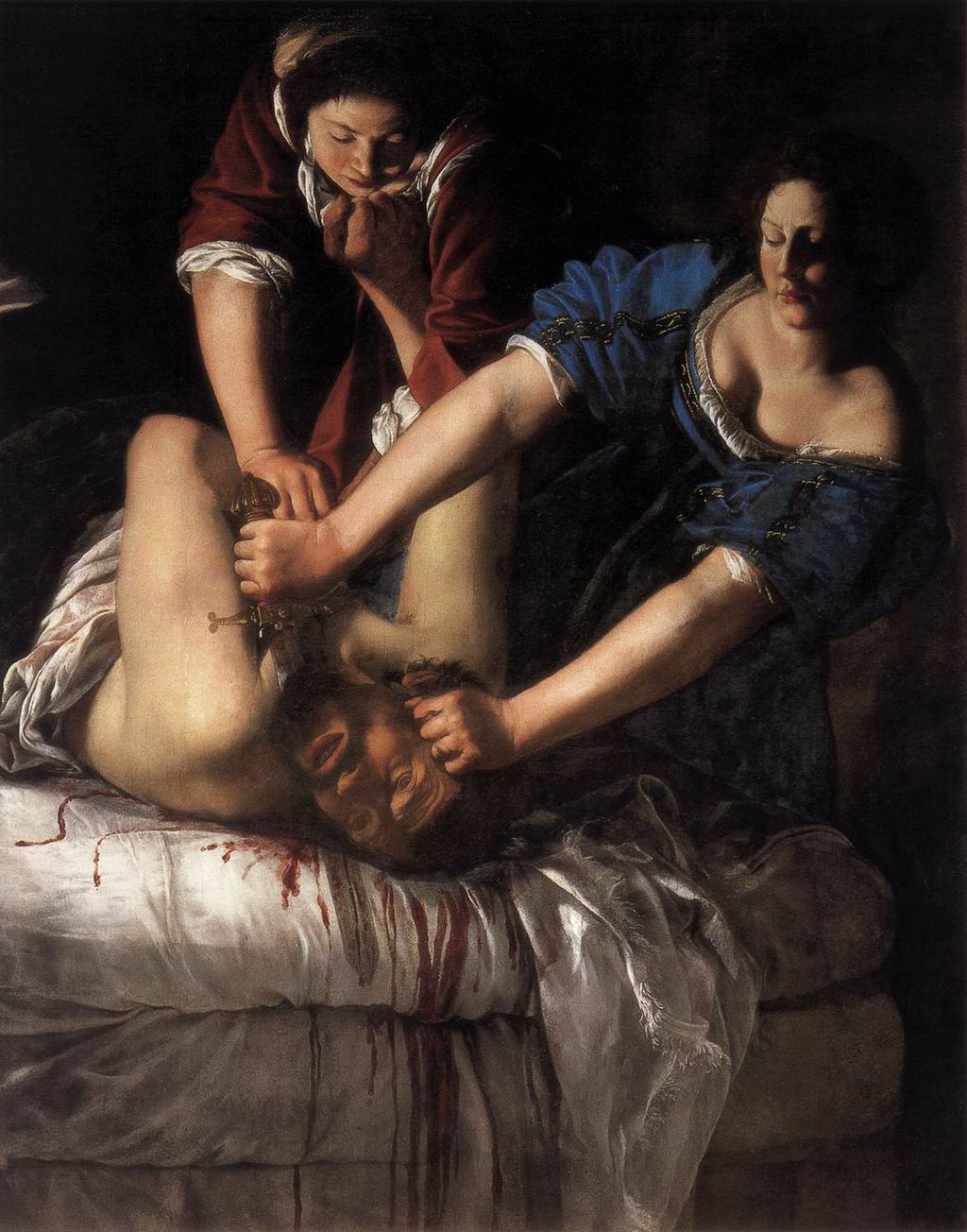
Judith Murdering Holofernes by Artemisia Gentileschi (1620)

The sheer visceral impact of this painting is heightened by its composition. Our eyes are drawn to the partially severed head of the still-struggling Holofernes.

The story comes from the Book of Judith, which is included in Catholic and Eastern Orthodox bibles. To save her city from this Assyrian general, Judith has set forth to seduce and murder him, aided by her servant Abra.

Painting showing two women beheading a man, who lies on a bed
Judith Murdering Holofernes by Artemisia Gentileschi (1620).
Uffizi Gallery

The vivid yellow and blue of the women’s dresses and the red of Holofernes’ bed contrast with the background chiaroscuro (an effect of contrasted light and shadow). This gives the artwork a claustrophobic intensity. Gentileschi painted this subject twice. But it is her 1620 version that is considered the more powerful.

In it she has shown blood spurting parabolically from Holofernes’ wounds, spattering Judith’s arms. Yet it is the grim determination of Judith and the death agonies of her victim that, for me, transports the viewer into the private moment of a gruesome murder.

Pippa Catterall, professor of history and policy, University of Westminster

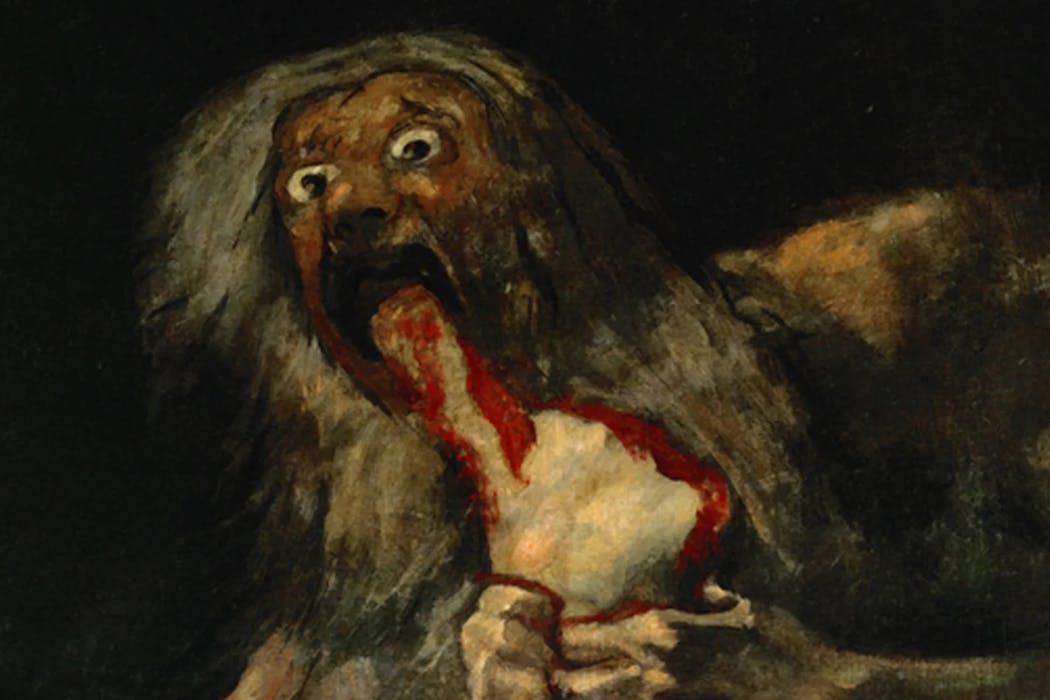
Saturn Devouring His Son by Francisco Goya (1820-23)

Painted in the aftermath of the Napoleonic wars and during Spain’s revolution of 1820-23, this nightmarish image is the most powerful of Spanish painter Francisco Goya’s 14 “black paintings”.

Said to depict Saturn (or Cronus in Greek myth) eating one of his children to prevent a prophecy that one will usurp him, it gruesomely combines the taboos of cannibalism and filicide (killing your own child). The pure black background forces the viewer to fixate on the dismembered corpse, Saturn’s strangely angular body and the madness in his eyes.

A painting showing Satan eating his infant child
Saturn Devouring His Son by Francisco Goya (1820-23).
Museo del Prado

The title was not Goya’s, and the suggestion that this is a remote mythological scene or an allegory of time destroying youth may be attempts to distance ourselves from its darker meaning.

Beneath such efforts, this painting unflinching depicts the callousness of power, the urge to destroy rivals, the old exploiting the young. Two centuries on, it remains a chilling depiction of raw human instincts when the mask of civilisation is torn away.

Karl Bell, associate professor of cultural and social history, University of Portsmouth

Three Studies for Figures at the Base of a Crucifixion by Francis Bacon (1944)

Fleshy bioforms with outstretched, eel-like necks are writhing in an orange space. They are sightless, but two of them have toothy open mouths: one is snarling, the other is screaming. They are simultaneously human and not human.

These abject creatures are the creation of the Irish-British artist Francis Bacon in his work Three Studies for Figures at the Base of a Crucifixion (1944). The artist completed the triptych over two weeks, fuelled by alcohol and hangovers.

The figures are intended to represent the ancient Greek furies: deities of vengeance from the underworld. The work’s exhibition date is poignant: it was first shown to the public in the final days of the second world war in Europe. Terror leaps out of these paintings: they are at once a visceral reminder of our mortality and bodily materiality, and an expression of the horrors that humans have inflicted upon each other. And we cannot look away.

Daisy Dixon, lecturer in philosophy, Cardiff University


Read more:
Francis Bacon: Human Presence – a compelling look at how the artist redefined portraiture


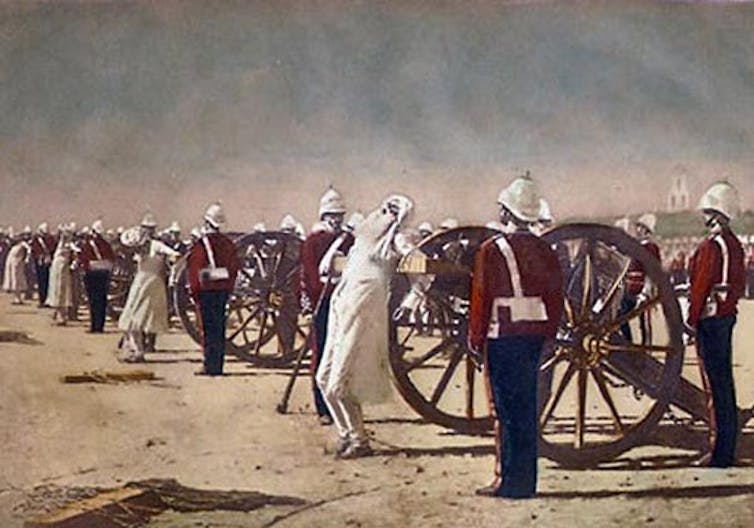
Blowing from Guns in British India by Vassily Vereshchagin (1884)

This painting by the Russian painter Vassily Vereshchagin depicts the execution of a group of rebels, the Kuka, after an uprising in Malerkotla, Punjab, in 1872. The British struck back harshly, executing the Kukas by blowing from guns. The rebels were tied to the mouths of cannons, which were then fired.

Painting showing Indian men and British troops
Blowing from Guns in British India by Vasily Vereshchagin (1884).
Wiki Commons

There is no indication that Vereshchagin witnessed the Kuka event himself. He had probably seen illustrations of the Indian rebellion of 1857, with similar compositions.

This painting was exhibited in London’s Grosvenor Gallery as part of a trilogy showing execution methods in different parts of the world. This framing is disturbing, at least to me – placing the brutal scene in combination with the detached, quasi-ethnographic mission. There is another disturbing dimension: the tension between the painting as a anti-colonial-violence statement or as a piece of political propaganda targeting the rule of the British empire.

The original painting, in storage at University of California, Berkeley, was destroyed due to water damage around 1950. A photogravure in grayscale of the work still exists, as does as a colour sketch, now exhibited at the Russian Museum in St Petersburg.

Åsa Harvard Maare, senior lecturer in visual communication, Malmö University

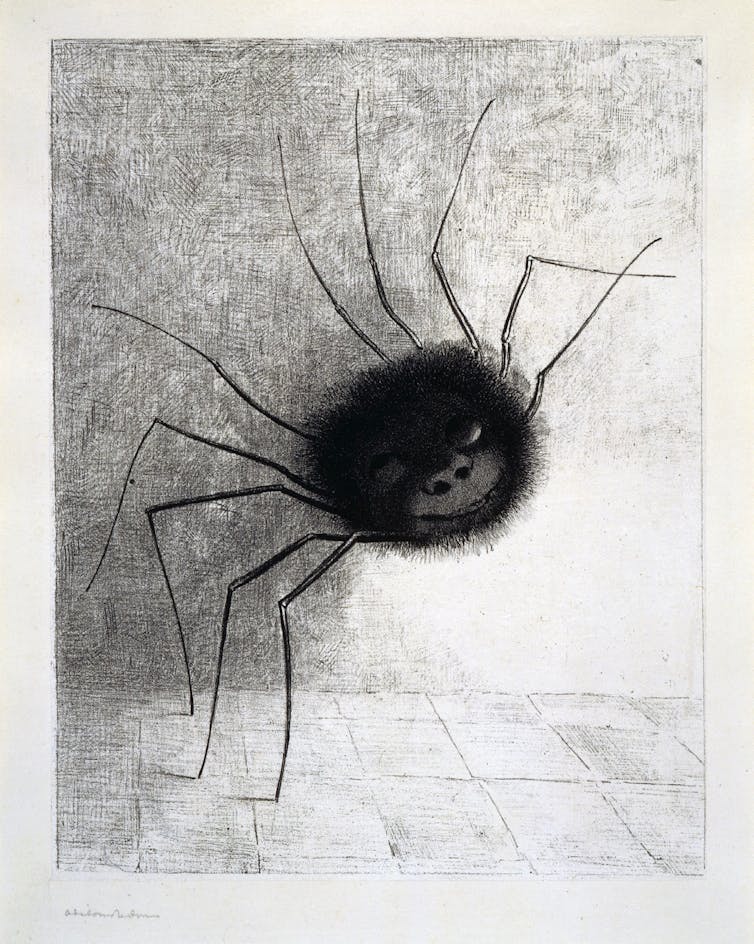
The Spider by Odilon Redon (1881)

Imagine a giant spider with ten legs and a grinning, human face emerging from the shadows in the corner of your room. The French artist Odilon Redon created this nightmarish anthropomorphic creature largely from his imagination, but was also inspired by the experience of viewing nature through a microscope.

Drawing of a smudgey black spider with a smiling face
The Smiling Spider by Odilon Redon (1881).
Musée du Louvre

Melancholic and introspective from childhood, he was introduced to the world of bugs by the botanist Armand Clavaud. Redon’s imagination was also fuelled by decadent literature such as Charles Baudelaire’s The Flowers of Evil (1857) or Edgar Allan Poe’s gothic poem The Raven (1845).

Working mainly in charcoal and lithograph, he was inspired to produce a whole series of black-and-white images – monstrous creatures and giant, floating eyes – that expressed his subconscious fears. Known as his “Noirs” (black pictures), they evoked his obsession with the terrifying, nightmarish visions that are invisible by day. The writer Joris Karl Huysmans defined them as: “A new type of fantasy, born of sickness and delirium.”

Frances Fowle, emeritus professor of 19th-century art, University of Edinburgh

Disasters and Fairy Tales by Cindy Sherman (1980s)

The artist Cindy Sherman uses her own body as the blank canvas for her art: she dresses up in makeup, prosthetics, wigs and disguises and photographs the results against carefully staged backdrops. The resulting images are often deliberately unsettling.

In her series Disasters and Fairy Tales from the 1980s, she played a series of characters from horror films and nightmarish folklore. The image that I find most difficult to look at is not the goriest or most grotesque, but Untitled #165 (1986), in which a hybrid, part-human, part-animal creature in a gingham dress lurks bashfully behind a tree.

What does it want? Is it malevolent, or just lonely? This creature seems to embody the dark things we don’t want to acknowledge in our psyche, that we push away, but which linger on the edges of our consciousness. As Sherman’s self-portraiture implies, these nightmarish things are not monsters from elsewhere, but versions of ourselves.

Catherine Spooner, professor of literature and culture, Lancaster University

Is there a petrifying painting that has stuck in your imagination? Let us know in the comments below.


Looking for something good? Cut through the noise with a carefully curated selection of the latest releases, live events and exhibitions, straight to your inbox every fortnight, on Fridays. Sign up here.


This article features references to books that have been included for editorial reasons, and may contain links to bookshop.org. If you click on one of the links and go on to buy something from bookshop.org The Conversation UK may earn a commission.

The Conversation

The authors do not work for, consult, own shares in or receive funding from any company or organisation that would benefit from this article, and have disclosed no relevant affiliations beyond their academic appointment.

ref. The painting that haunts me – seven experts share their favourite scary artwork – https://theconversation.com/the-painting-that-haunts-me-seven-experts-share-their-favourite-scary-artwork-266288

Could tactical voting block Reform in future elections? Lessons from the Caerphilly byelection

Source: The Conversation – UK – By Thomas Lockwood, PhD Researcher in Politics, York St John University

Plaid Cymru’s overwhelming victory in the recent Caerphilly Senedd byelection shattered over a century of political tradition. Lindsay Whittle took the seat with 15,691 votes. Labour, which had held the seat since it was created, came away with just 3,713 votes.

Reform came second to Plaid, with 12,113 votes. And while this was an impressive performance, the fact that it failed to win Caerphilly even after vast amounts of time and money spent on the campaign has led to speculation that tactical voting played a part in this byelection.

A big clue that tactical voting was at work in Caerphilly was the recorded turnout. Typically, byelections in Wales have been low-key affairs. Turnouts are low and incumbents generally win. The national average for a Senedd vote in a constituency has never tipped over 50%. In Caerphilly, turnout climbed from 44% in the 2021 election to 50.4% in this byelection.

And while local voters clearly backed Plaid Cymru for plenty of reasons, the extremely low vote count for other parties does suggest at least some lent their vote to Plaid to keep out Reform. The Conservative vote collapsed to fewer than 700 votes and the Lib Dems and Greens, so often the recipients of tactical votes themselves, each took just 1.5% of the votes in Caerphilly.

Anecdotes from the vote count support this. The BBC recounted “extraordinary stories” of habitual supporters of the Conservatives, a pro-union party, voting Plaid to block Reform.

The increased turnout and Plaid’s 27.4% swing both suggest a mobilisation, triggered by polling and a wider national narrative which persuasively contends that Reform is ahead of other parties. Does the result therefore imply that Reform can be beaten elsewhere if voters take the right approach to tactical voting?


Read more:
How England’s new Reform councillors compare in their views to other parties


The limits of Reform’s surge

Reform entered the Caerphilly race with no prior foothold in the constituency. The party mobilised heavily and, it had seemed, effectively. Nigel Farage and other senior Reform figures made multiple visits to the area to campaign for their candidate, Llŷr Powell. Pre-election polls, including one by Survation which had Reform leading Plaid by 42% to 38%, raised expectations of a breakthrough.

And it is true that Reform’s ultimate 36% vote share reflects its growing appeal among disaffected working-class voters. It did capitalise on the same anti-establishment sentiment that has seen the party top UK-wide polls for much of the past year.

Yet, the result also exposes Reform’s vulnerabilities. As with the Hamilton, Larkhall and Stonehouse byelection for the Scottish parliament earlier in the summer, Reform failed to convert intensive campaigning into victory.

The role and reach of tactical voting

Underneath the hype, Farage is unpopular. Polls suggest as many as 60% of voters are opposed to him being prime minister. That presents an opportunity for opponents to unite behind a more broadly acceptable candidate.

In this volatile political era, where voters show little loyalty to tradition, smaller parties like Plaid Cymru, the SNP, Greens and even Pro-Gaza independents could frame themselves as the “real alternative” to Reform. Depending on local dynamics, they could attempt to draw tactical support.

It should be noted, however, that tactical voting cuts both ways. While it denied Reform a victory in Caerphilly, the party could attract tactical support from Conservative voters eager to oust Labour governments.

In England, without equivalents to Plaid or the SNP to siphon anti-establishment sentiment, Reform may consolidate its grip on working-class disillusionment. This trend was evident in Labour’s collapse in the Runcorn and Helsby Westminster byelection in May 2025, which enabled Reform to take the seat.

In Caerphilly, Labour’s vote fell amid grievances including the slow pace of change to improve living standards, policy u-turns and a fatigue with Welsh Labour, which has been in power in the Senedd since its creation in 1999.

Such grievances can be felt across the UK more broadly – with winter-fuel policy u-turns, and a general dissatisfaction with how long it is taking Labour to deliver on promises to improve living standards. Concern about immigration is also used to punish Labour in both the regular voting intention polls and at the ballot box in council byelections.

An anti-Reform majority does exist – and it has shown up in several contests, including in races Reform has ultimately won but on less than 50% of the vote. Harnessing this anti-Reform majority, however, requires a level of co-ordination rarely seen in the UK’s electoral history.

Unlike the 1997 anti-Conservative wave, there is no single opposition brand. Instead, the anti-Reform vote is split across Labour, Liberal Democrats, Greens, nationalists and independents – and, arguably, the Conservatives too.

In Caerphilly, we saw this fragmentation briefly turn into coalescence. This implies that a clear polling trigger, showing Reform ahead in a seat, can focus the minds of voters and drive tactical thinking. It also helped that these voters were offered a Plaid candidate with deep community roots and a strong, progressive message.

What is potentially harder in a general election is the presentation of a local contest as extremely high stakes in the media. Caerphilly drew unprecedented attention precisely because it was being framed as a test case for Reform in Wales, which may explain the level of anti-Reform vote.

In a multi-polar UK, the anti-Reform majority is real – but not pro-any one party by default. Importantly, it is anti-populist, anti-incumbent and regionally variable. Nearly all of the mainstream parties on the centre ground and left wing of politics are claiming to be the real alternative to Reform.

Reform’s path to power lies in building a lead that is too large for tactical voting to overcome, or in electoral systems which reward vote share over seat efficiency. This is why it remains hopeful of success in May 2026 in Wales, where the election is being held under a proportional voting system.

As the UK heads towards the 2026 devolved elections and a likely 2029-30 general election, Caerphilly offers a blueprint for resistance to Reform’s national surge. It also offers a warning for the other parties: stopping Reform is not the same as winning.

The Conversation

Thomas Lockwood does not work for, consult, own shares in or receive funding from any company or organisation that would benefit from this article, and has disclosed no relevant affiliations beyond their academic appointment.

ref. Could tactical voting block Reform in future elections? Lessons from the Caerphilly byelection – https://theconversation.com/could-tactical-voting-block-reform-in-future-elections-lessons-from-the-caerphilly-byelection-268411

Why so many children in the youth justice system have special educational needs

Source: The Conversation – UK – By Hope Kent, Administrative Data Research UK Research Fellow, University of Exeter

Sabphoto/Shutterstock

Walk into any custodial youth justice facility in the UK – from young offender’s institutions to secure training centres and children’s homes – and you’ll be met with an unexpected reality: the majority of children in these settings have special educational needs and disabilities.

In particular, a very high proportion of children in custody have neurodisabilities. These are long-term conditions affecting the brain and nervous system, and range from autism to brain injuries and foetal alcohol spectrum disorders.

These conditions are grouped together because they affect children’s cognition (including memory, attention and concentration, and executive functioning – mental skills necessary for daily life), as well as their emotional regulation, social communication skills and physical development. This is a pattern repeated in youth justice systems across the world.

For example, estimates suggest that 50% to 87% of children in custody globally have a brain injury. However, research from Canada suggests that brain injury affects around 20% of children in the general population. Over 60% of children in custody globally have a speech, language and communication impairment, compared with 1-3% in the general population globally.

Autistic children make up between 2% and 18% of children in custody across Europe and the USA, compared with 0.3 to 1.9% in the general population in Europe and the USA. While there is significant difference between countries, approximately 30% of children in custody globally have ADHD. This compares with 7% in the general population globally.

While just 0.7% of children in the general population have foetal alcohol spectrum disorders, these affect 11% to 21% of children in custody. Foetal alcohol spectrum disorders are a range of cognitive, behavioural and physical conditions which can affect a child as a result of their mother drinking alcohol during pregnancy.

Some children in custody may have very complex needs, with multiple overlapping conditions. Additionally, children may have needs that don’t quite meet diagnostic criteria for any one condition but still have a significant impact on their lives. These children have often had disrupted educational backgrounds, with multiple school moves or periods of absence. This means that they also may not have had their needs identified in school.

Why is this happening?

Of course, having a neurodisability in no way makes children inherently criminal. The majority of children with special educational needs will never come into contact with the youth justice system. So what is it that makes this small group who do more vulnerable?

School exclusion appears to be a really key component in pathways into the justice system for these children. My research with colleagues explored rates of neurodisability and school exclusion in prisoners in Wales. We found that those who scored more highly on a measure of neurodisability were also more likely to have been excluded from school. Those who had been excluded from school were also more likely to have had their first conviction at a younger age.

This finding aligns with Department for Education statistics, which indicate that exclusions are disproportionately affecting children with an identified special educational need. Children with special educational needs represent just around half of all permanent exclusions in England. However, they represent only about 17% of the mainstream school population.

Boy looking sad sat outside alone with school bag
School exclusion plays a role in this pathway.
AlexandrMusuc/Shutterstock

There is plenty of convincing evidence that school exclusion is harmful, and increases the chances of children ending up in the criminal justice system.

Despite this, many accounts report a concerning rise in the use of zero-tolerance behavioural policies in the UK. This could be linked with a rise in the rates of school exclusions reported in the most recent Department for Education statistics.

In 2023-24 there was a 21% increase in the use of fixed-term exclusions (sometimes called suspensions) in England from the previous year. There was also a 16% increase in permanent exclusions.

Combined vulnerabilities

Children who end up in the youth justice system often have multiple other disadvantages layered on top of this systematic exclusion from school. For example, my recent study with colleagues used data from half a million children in the UK. We found that child poverty compounded the likelihood of having contact with the youth justice system for children with neurodisability. This means that it was children who had both disadvantages who were most vulnerable.

This growing body of evidence demonstrates that society is failing these children. When children with neurodisability and complex social disadvantage continue to be punished and excluded, we can’t be surprised when they end up on the fringes of society.

There are ways to remedy the problem of school exclusion. These include more specialist classrooms and units, as well as providing teachers with more options and support for children who aren’t thriving in the mainstream classroom.

In addition, more can be done to remove the layers of disadvantage that these children experience. More generous family welfare policies might help to lift children out of disadvantage and support them to have a better start in life.

Action like this could divert children away from the youth justice system long before they ever have contact with the police.

The Conversation

Hope Kent currently receives funding from ADR-UK, and has previously recieved funding from the Economic and Social Research Council. She is affiliated with the UK Acquired Brain Injury Forum.

ref. Why so many children in the youth justice system have special educational needs – https://theconversation.com/why-so-many-children-in-the-youth-justice-system-have-special-educational-needs-264144

Should young people take creatine?

Source: The Conversation – UK – By Paul Hough, Lecturer Sport & Exercise Physiology , University of Westminster

Creatine use is common among young male athletes. Miljan Zivkovic/ Shutterstock

Creatine is one of the most widely used sports supplements across the world. It’s taken by many in the hopes of boosting strength, enhancing athletic performance and promoting muscle growth.

But it isn’t only adults who are using this supplement. A growing number of teenagers and young adults report taking creatine in the hopes of reaping the supplement’s benefits.

Surveys show that as many as 72% of male athletes aged 17-18 report using creatine. Use is typically more common among athletes, especially young men.

While creatine is generally considered to be safe for young people to use, it’s no shortcut to getting fit. It’s better for young people looking to get strong or improve their athletic performance to focus on the fundamentals: exercising, eating properly and prioritising sleep.


Read more:
Creatine supplements: what the research says about how they can help you get in shape


Creatine is a natural compound stored within muscle. Although a small amount is produced in the kidneys and liver, most (around 95%) is obtained from eating meat and seafood. Creatine plays an important role in providing energy during high-intensity activities, such as sprinting and lifting weights.

Although several forms of creatine are commercially available, creatine monohydrate is the most stable and extensively studied form.

Numerous studies show that creatine supplementation enhances performance in high-intensity exercises requiring strength and power, such as strength training and sprinting. Creatine supplementation may also lead to more muscle growth when combined with resistance training, and faster recovery from exercise.

Emerging research also suggests that creatine’s benefits extend beyond the gym. Studies indicate that creatine may improve aspects of cognitive function – specifically memory and attention.

Creatine also shows promise for older adults in preventing muscle loss and protecting against neurological disorders such as Parkinson’s and Alzheimer’s.

Creatine’s safety

A typical diet that includes meat and seafood provides around 1–2 grams of creatine per day, which keeps the muscles around 60–80% full of creatine.

Taking a daily creatine supplement eventually fills the muscles with creatine. There are two common ways to do this.

The quickest and most commonly studied method involves a one week loading phase. This entails taking 0.3 grams of creatine per kilogram of body weight four times a day. For example, a 75kg person would take a total of 24g of creatine per day.

An alternative approach, which increases muscle creatine levels more gradually, is to take 3g of creatine per day for around 28 days.

Both approaches will fill muscle creatine stores. The first (loading) approach tops up creatine stores faster, which means you’ll see benefits to exercise performance faster. However, the second approach is less likely to cause temporary gastrointestinal discomfort (such as bloating and diarrhoea) which are more common when using the loading approach.

A person dumps a scoop of creatine powder into a cup.
Creatine plays an important role in providing energy during high-intensity activities.
Erhan Inga/ Shutterstock

Regardless of what approach you use, taking 3-5g of creatine daily is necessary to maintain muscle creatine levels.

Numerous studies show that short and long-term creatine supplementation (up to 30g a day for five years) is safe and has no ill effects on health when taken at the recommended dosages.

The most common side-effect of creatine is weight gain as the supplement increases water retention in muscles. This extra water remains only as long as you’re taking creatine.

Creatine and young people

Although creatine is shown to be safe and effective for adults, only a few studies have investigated the effects among children and adolescents.

The available studies show that creatine appears to be safe for young people to use and can provide performance benefits, particularly for athletes. Most studies have only looked at the safety of a creatine dosage between 0.1g and 0.3g per kg of body mass per day. As such, it’s important that any young people who choose to use creatine do not exceed this dosage.

Although creatine appears to be safe for children and adolescents to take, it is possible that, without proper nutrition education and supervision of dosing, they could be at risk of misusing creatine – potentially leading to adverse effects such as stomach cramps.

A study that evaluated young athletes’ understanding of how sports supplements should be used reported that only 11% of the athletes answered questions correctly about creatine use.

Regardless of age, it’s important to recognise that supplements such as creatine are not a shortcut to improving fitness, building muscle or losing body fat. Supplements provide much smaller performance gains compared to what can be achieved through good training and nutrition alone. While sports supplements support training and recovery, significant progress comes from consistent exercise, a balanced diet and adequate sleep.

With a well-designed training programme and healthy eating plan, young people will experience rapid improvements in strength, power and endurance without the need for supplements. Focusing too soon on taking supplements could distract young people from building good training habits and healthy eating patterns.

This is why most sport nutritionists recommend using a food-first approach, which focuses on maximising diet quality before recommending supplements such as creatine.

The Conversation

Paul Hough does not work for, consult, own shares in or receive funding from any company or organisation that would benefit from this article, and has disclosed no relevant affiliations beyond their academic appointment.

ref. Should young people take creatine? – https://theconversation.com/should-young-people-take-creatine-267365

Prince Andrew’s ‘one peppercorn’ lease exposes how little is known about royal finances

Source: The Conversation – UK – By Robert Hazell, Professor of British Politics and Government & Founder of the Constitution Unit, UCL

In announcing that Prince Andrew would no longer use his title or honours, Buckingham Palace hoped to shift the spotlight away from his friendship with Jeffrey Epstein, and the accusations of sexual abuse he has faced (and denied).

The media were encouraged to focus instead on King Charles’s visit to the Vatican, and the royal family’s good works. But this strategy has failed. Revelations about Prince Andrew’s living arrangements and finances have whetted the appetite for more.

One such revelation is his royal residence. Andrew has a 75-year lease from the crown estate on Royal Lodge, a large house in Windsor Great Park. The Times published the lease, revealing that he paid £1 million for it plus a minimum of £7.5 million in refurbishments. In return for this very large upfront cost, Andrew pays an annual rent of “one peppercorn (if demanded)”.

The crown estate is a statutory corporation operating under the Crown Estate Act 1961 (as amended in 2025), which manages a huge property portfolio including Regent Street in London and most of the foreshore around the coast, generating a big income from wind farms.

Its net revenue profit – which in 2023-24 amounted to £1.1 billion – is paid to the Treasury. The government uses 12% of the profits to fund the sovereign grant, which provides financial support for the monarchy.


Read more:
Why Prince Andrew is still a prince – and how his remaining titles could be removed


Since 2019, when he ceased to be a working royal, Prince Andrew no longer receives any public funding from the sovereign grant. Mysteries about his sources of income may be hard for the palace to dispel without being more transparent about the royal finances more generally.

One particular area of interest is the Duchy of Lancaster, which last year provided King Charles with £27 million of his income. The palace website states that this is “a portfolio of land, property and assets held in trust for the sovereign. Its main purpose is to provide an independent source of income, and is used mainly to pay for official expenditure not met by the Sovereign Grant (primarily to meet expenses incurred by other members of the Royal Family).”

Prior to the sovereign grant, the monarchy was funded through the civil list. This was an annual sum of money voted by parliament, which included the annuities received by other members of the royal family.

Since the Sovereign Grant Act 2011, those annuities are no longer published. The Duchy of Lancaster’s annual report and accounts gives lots of detail about the Duchy’s income, but none about its expenditure.

The Liberal Democrat leader Sir Ed Davey MP has called for a select committee inquiry to “properly scrutinise” the crown estate, and Baroness (Margaret) Hodge, former chair of the public accounts committee, has called for greater transparency about the royal finances.

What next for Andrew?

The nine commissioners who manage the crown estate’s holdings are property experts who operate independently of government and the crown. They cannot simply terminate Prince Andrew’s lease, but there is mounting pressure on him to relinquish the lease voluntarily.

When it comes to his remaining titles, both the palace and UK government will be desperate to close the story down and move on. The government took the line that it was all a matter for the king and the palace.

Sir Alan Campbell, leader of the House of Commons, said: “The question of [Andrew’s] titles is primarily a question for His Majesty. I know there has been speculation about legislation, but the palace has been clear it recognises that there are other matters this House needs to be getting on with, and we are guided in this by the palace.”

In practice, the palace will also be guided by the government, which will be keen to avoid legislation if at all possible. Short of legislation, there is little more the palace can do.

The king could issue letters patent declaring that Prince Andrew is no longer His Royal Highness. He could also give an undertaking that Andrew would never be called upon to serve as a counsellor of state, deputising for the monarch in his absence.

If public anger remained unabated, and legislation was deemed unavoidable, a short bill could be prepared to strip Andrew of his peerage titles and remove him as a counsellor of state. It could be passed relatively quickly: the Counsellors of State Act 2022, which added Princess Anne and Prince Edward to the list of potential counsellors of state, went through all its Commons stages in a single day.

The finances are trickier. The Commons public accounts committee may hold a single evidence session just on Andrew’s finances, or launch a wider inquiry.

It may be hard to avoid the latter. Having made public the lease on Royal Lodge, the crown estate may find it difficult to refuse to disclose the leases on other properties occupied by the royal family, or other information about its finances.

If parliament decides to launch a wider inquiry, the payments to other members of the royal family funded by the Duchy of Lancaster would be an obvious place to start.


Want more politics coverage from academic experts? Every week, we bring you informed analysis of developments in government and fact check the claims being made.

Sign up for our weekly politics newsletter, delivered every Friday.


The Conversation

Robert Hazell does not work for, consult, own shares in or receive funding from any company or organisation that would benefit from this article, and has disclosed no relevant affiliations beyond their academic appointment.

ref. Prince Andrew’s ‘one peppercorn’ lease exposes how little is known about royal finances – https://theconversation.com/prince-andrews-one-peppercorn-lease-exposes-how-little-is-known-about-royal-finances-268528

From potion to prescription: how witches’ herbs became medical marvels

Source: The Conversation – UK – By Dipa Kamdar, Senior Lecturer in Pharmacy Practice, Kingston University

Pixel-Shot/Shutterstock

As Halloween approaches, stories of witches and their potions resurface, often featuring eerie plants like belladonna, mandrake and mugwort. These botanicals, steeped in myth and folklore, have long been linked to spells and sorcery. Yet behind their spooky reputations lies a fascinating pharmacological history, and in some cases, ongoing medical relevance.

Belladonna

Belladonna (Atropa belladonna), also known as deadly nightshade, has a long and contradictory history as both poison and medicine. Its name, meaning “beautiful woman” in Italian, refers to its Renaissance-era cosmetic use, when women used juice from its berries to dilate their pupils and appear more alluring.

But this beauty comes with danger. Belladonna is highly toxic. Ingesting even a few leaves or berries can be fatal, and touching it may irritate the skin. It has also been used for its hallucinogenic properties in many cultures.

Belladonna’s dark berries are sometimes known as murderer’s berries, sorcerer’s berries and even devil’s berries.
Kabar/Shutterstock

The plant’s power comes from tropane alkaloids such as atropine and scopolamine. These compounds block the action of acetylcholine, a chemical that sends messages between nerve cells in the parasympathetic nervous system. This system helps regulate muscle movement and key body functions including heart rate, breathing, memory, learning, sweating, digestion and urination.

Modern medicine uses atropine to dilate pupils during eye exams, treat bradycardia (slow heart rate), and act as an antidote for organophosphate poisoning caused by certain pesticides and chemical warfare agents. Scopolamine is prescribed for motion sickness and postoperative nausea.

Scientific research continues to highlight belladonna’s medical relevance. Yet safety concerns persist. Multiple healthcare agencies have issued warnings about homeopathic products containing belladonna, particularly those aimed at infants for teething and colic, following reports of seizures and breathing problems. Belladonna should also be used cautiously by people taking other medicines that can increase the risk of side-effects, including antihistamines, antidepressants, and antipsychotics.

Mandrake

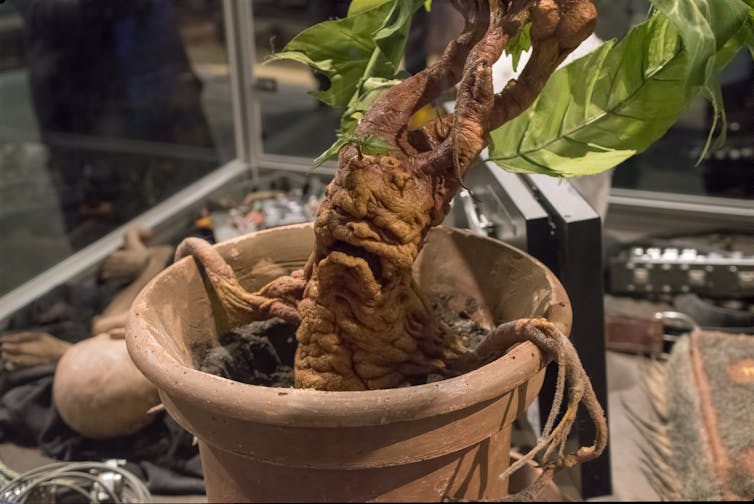
Another plant in the nightshade family is mandrake (Mandragora officinarum), whose humanoid-shaped root has inspired centuries of myth, from ancient Greek texts to the Bible. Folklore warned that pulling a mandrake from the ground would unleash a deadly scream — a story so enduring it even found its way into the Harry Potter series.

In witchcraft, mandrake was believed to be a key ingredient in flying ointments, used as amulets for fertility and protection and added to love potions, perhaps due to its hallucinogenic effects. Historically, it was used as an anaesthetic, sedative and fertility aid.

The human-like ‘mandrake’ creature from Harry Potter.
Craig Russell/Shutterstock

Like belladonna, mandrake contains tropane alkaloids such as atropine and scopolamine, which have psychoactive properties. A 2022 study catalogued 88 traditional medicinal uses for mandrake, ranging from pain relief and sedation to skin and digestive disorders.

However, science does not necessarily support all these claims. Scopolamine can act as an antispasmodic, relieving gut muscle spasms and helping with digestive issues. It can also cause drowsiness by blocking M1 antimuscarinic receptors in the brain. But extracts from mandrake leaves show mixed results, with some evidence suggesting they can cause dermatitis rather than treat it.

Mugwort

Mugwort (Artemisia species) is another herb often linked to magic and healing. Traditionally, it was used to enhance dreams and ward off evil spirits. In 2015, a Nobel prize was awarded for the discovery of artemisinin, an anti-malarial compound derived from Artemisia annua, or annual mugwort.

In traditional Chinese medicine, mugwort features in moxibustion, a therapy involving burning the herb near acupuncture points to stimulate healing. It is also used by herbalists to treat menstrual irregularities and digestive issues. Common mugwort is listed as a homeopathic ingredient in the European Pharmacopoeia, where it is used to help with irregular periods, menopause symptoms and nervous conditions such as sleepwalking, seizures, epilepsy and anxiety.

The above-ground parts of mugwort are used to make essential oil, which contains compounds like camphor, pinene and cineole. These substances are known for their antioxidant, antibacterial and antifungal properties. Artemisinin in the plant may gently stimulate the uterus and help regulate menstrual cycles. Animal studies suggest Artemisia leaf extract may help treat inflammatory skin conditions by reducing the release of inflammation-causing chemicals from immune cells.

Clinical evidence remains limited, and more rigorous research is needed to confirm its safety and effectiveness. Mugwort can also trigger allergic reactions such as skin irritation and breathing difficulties, and it should be avoided during pregnancy as it may cause uterine contractions.

The myths surrounding these plants may sound like fantasy, but the truth is just as captivating. Not witchcraft, but chemistry — complex compounds that have influenced both ancient healing and modern medicine.

As researchers continue to explore their potential, these herbs remind us that many legends have roots in real pharmacology. So as we stir our cauldrons this Halloween, it is worth remembering that the real magic of belladonna, mandrake and mugwort lies not in superstition, but in science.

The Conversation

Dipa Kamdar does not work for, consult, own shares in or receive funding from any company or organisation that would benefit from this article, and has disclosed no relevant affiliations beyond their academic appointment.

ref. From potion to prescription: how witches’ herbs became medical marvels – https://theconversation.com/from-potion-to-prescription-how-witches-herbs-became-medical-marvels-266718