Sorry, Baby: a sad, funny, profound film about life after trauma

Source: The Conversation – UK – By Laura O’Flanagan, PhD Candidate, School of English, Dublin City University

A critical success and award winner at this year’s Sundance Film Festival, Sorry, Baby is the directorial debut of its writer and star, Eva Victor. The film follows Agnes (Victor), an English professor at a small American college, in the aftermath of a sexual assault by one of her teachers when she was a student there.

The story, based on Victor’s own experience of trauma, is structured in non-linear chapters that encompass the time after, before and during the assault. This makes for a raw and unflinching, yet nuanced, depiction of trauma’s aftermath, which presents Agnes as a fully rounded and complex character.

The film resists the idea that trauma must define a character’s identity, instead exploring how people live with, around and beyond painful experiences. Agnes is funny, awkward, self-aware, sometimes messy, wholly real and excellent at her job. She refers to the sexual assault euphemistically as “the thing” or “the bad thing”, which Victor has said is an attempt to protect vulnerable audience members.

This sensitivity is evident throughout Sorry, Baby. The film is directed with a lightness of touch, and its naturalistic scenes are laced with both humour and emotion. Agnes’s story is told on her terms. The beautiful opening chapter celebrates the fierce love and loyalty of female friendship.

Agnes is visited by her friend Lydie (Naomi Ackie), who comes to announce her pregnancy. Ackie and Victor have strong onscreen chemistry, making the women’s bond a joy to watch, filled with humour, natural physical closeness and underlying emotional depth.

The narrative chapters move forwards and backwards in time. The facts of the assault are told in a tight, close-up monologue by Agnes. The assault itself is not depicted onscreen; the viewer sees Agnes enter her lecturer’s house, and the frame holds this exterior shot as darkness falls and time passes. Agnes emerges clearly upset, and the camera remains on her back as she returns home.

As she speaks to Lydie and recalls what she can remember about the assault, the camera acts like a patient and empathic listener, trained on Agnes’s face as she tells her story. This directorial choice by Victor gives Agnes agency in this moment. It is her experience, told in her words and in her own time. It is devastating.

In the decade since #MeToo, many films have emerged centring on women’s experiences of trauma. Typically, these narratives begin with the revelation of abuse or harm, move through the emotional or social consequences and then arrive at some form of reckoning or resolution.

Films such as Women Talking (2023) and Promising Young Woman (2020) follow this arc, using female trauma as a starting point for deeper questions around accountability, healing and resistance. This approach can create a powerful emotional impact while raising awareness of the issues presented.

But when film-makers like Victor depict female characters in a broader light, not solely defined by trauma, something arguably more authentic begins to emerge.

Agnes is a character who experiences trauma but also humour, joy, contradictions, desire and strength. This allows for rich storytelling and a deep emotional connection with the audience.

By rejecting a tidy narrative arc in favour of something more fragmented and realistic, Sorry, Baby becomes a reflection of Agnes’ healing journey. It engages with the realities of her trauma while also making space for agency, joy, and the absurdities of life.

Agnes’s story contains characters who are shockingly unwilling to help. She has an encounter with an indifferent doctor which must be seen to be believed. But she also meets kindness, and these scenes are often charming, bittersweet and profound. Lucas Hedges is a warm presence as Gavin, Agnes’s neighbour with whom she is in the early stages of a relationship. With care, the romantic subplot is shown as another layer of Agnes’s life, not as a means of healing or resolving her trauma, but as something which exists alongside it.

A scene with a kind stranger, a sandwich shop owner, speaks volumes without saying much and lingers powerfully. He is in exactly the right place at the right time for Agnes and shows her understanding and empathy when she needs it most.

Sorry, Baby is funny, sad and often profound. It feels real and natural, capturing the unpredictable rhythms of life with warmth and honesty. Eva Victor’s direction embraces complexity, offering a story which feels deeply lived-in and profoundly human.

Through Agnes, we see pain and humour side by side, awkwardness and strength intertwined. This debut marks Victor as a distinctive voice in contemporary cinema, one who trusts her characters and her audience alike. With Sorry, Baby, Victor shows us a new way to tell stories about trauma, healing, and the small, vital moments in between. This is a filmmaker to watch.

Sorry, Baby is in cinemas now


Looking for something good? Cut through the noise with a carefully curated selection of the latest releases, live events and exhibitions, straight to your inbox every fortnight, on Fridays. Sign up here.


The Conversation

Laura O’Flanagan does not work for, consult, own shares in or receive funding from any company or organisation that would benefit from this article, and has disclosed no relevant affiliations beyond their academic appointment.

ref. Sorry, Baby: a sad, funny, profound film about life after trauma – https://theconversation.com/sorry-baby-a-sad-funny-profound-film-about-life-after-trauma-262885

Football fans will see Nigel Farage’s branded kit for the cynical move it is

Source: The Conversation – UK – By Josh Bland, ESRC-DTP PhD Researcher, University of Cambridge

As a new season begins, Nigel Farage’s Reform UK is making a play for the affections of the nation’s football fans by launching its very own football shirt. It’s a move that has already proven popular among Reform supporters. According to Zia Yusuf, a leading figure in the party, thousands were sold on their first day of retail.

Reform’s move to exploit the cultural capital of football speaks to a wider trend in British society: the explosion of the football shirt as a cultural behemoth.

Quite simply, football shirts are everywhere. They have been incorporated into high fashion as part of the nostalgic 90s “blokecore” trend. They are used by bands such as Oasis and Fontaines DC as forms of branded merchandise. And now they are being mobilised by political movements, such as Palestinian solidarity organisation FC Palestina, to spread specific messaging.

Instead of being merely the domain of football supporters, football shirts have become cultural canvases.

Crucially, I believe football shirts are a symbolic medium that is tailor-made for Reform’s current political purposes. Ahead of the 2029 election Farage’s goal is clear. His aim is to win over and mobilise a largely working-class, provincial voting base who feel alienated by “mainstream” politics.

It appears that Reform see football as a potential weapon in this task. From its origins in the industrial cities of late Victorian England, modern football has long been a central pillar of working-class culture in Britain. In particular, it has played a potent role in binding communities around shared sentiments of local tribalism. Given that Farage’s political campaigning to date has often been based around a narrative of fighting for authentic, local community interests against out-of-touch metropolitan elites, the appeal of football in the context of Reform’s politics seems straightforward.

The efficacy of football shirts as a culturally loaded tool of communication means that Farage and Reform may feel they have found their own iteration of the Maga hat: a way for followers to embody their political allegiances with a loud, brash piece of statement clothing that also signals deep roots in the nation’s working-class culture.

But there’s a level of hypocrisy at work here. In the lead up to the Uefa Euro 2020 championship, Farage denounced the England team for taking the knee before games, imploring them to “keep politics out of football”. This was followed by another episode of public pearl clutching in 2024 when Farage decried England’s kit design for featuring a technicolour version of the England flag that bore “no relationship to St. George’s cross whatsoever”.

Now Reform has produced a shirt that both explicitly politicises football culture and features a turquoise Union Jack.

But beyond the flagrant double standards of the launch, Reform’s move into football merchandise is potentially a political miscalculation, too.

As the Labour party continues to flail, offering no resolution to the country’s gaping inequality or fixes for its failing public services, let alone a cure for the divisiveness that increasingly define contemporary Britain, it feels that the 2029 election will be won and lost in England’s football loving provinces.

Football and pride

Football’s roots in working-class culture, pride in place and patriotism means that the hard right has always seen the sport as fertile ground. In this sense, Reform’s kit launch is part of a long tradition of attempted infiltrations of the game by the hard right. Most notoriously, the National Front used terraces as recruitment grounds in the 1970s and the Football Lads Alliance attempted similar when it launched in 2017.

But here lies the problem for Reform. These attempts have largely failed. Even at the peak of the National Front’s influence in the 1970s and early 80s they only ever succeeded in establishing themselves as a fringe group on the terraces – albeit a noisy and intimidating one – and have often faced fierce and organised anti-fascist resistance.

Equally, the establishment of the Premier League in 1992 has seen professional football in the UK embrace a more cosmopolitan future. Progressive anti-racist organisations such as Kick It Out have gained significant influence. The cast of players and managers who populate elite level football is now impressively international. In short, despite its roots in local working-class communities, British football increasingly embodies many of the globalist, progressive ideals that Farage so vehemently rejects.

Even more crucially, as I have found in my own research on football supporting communities in the north-east, football culture prizes authenticity.

For the communities I work with, support of a football team is starkly different to support of a political cause. It is a form of living, breathing heritage. It is a tradition that is passed between generations of a family like an heirloom. It is a culture within which supporters constantly perform their own authenticity through a lifetime of ritual – match attendance, shirt wearing and suffering with the team through thick and thin.

The transparency of Farage’s hijacking of football culture for his own ends may therefore be his downfall. Farage’s credibility as a voice on football will simply not measure up to supporters’ lofty standards. They will be aware that he has openly declared his love of cricket over football. They will be cognisant of his lack of interest in the game other than when there’s a nationalist point to make. Above all, they will see through his cynical attempts to exploit the symbols of the football supporting culture they cherish so dearly for his own political cause.

Of course football is an everyday working-class tradition. Of course it has huge cultural salience in the provincial constituencies Farage will target to win in the 2029 election. But Reform should take heed that just because football is popular, that doesn’t mean it is inevitably populist.

The Conversation

Josh Bland receives funding from The Economic and Social Science Research Council.

ref. Football fans will see Nigel Farage’s branded kit for the cynical move it is – https://theconversation.com/football-fans-will-see-nigel-farages-branded-kit-for-the-cynical-move-it-is-263513

Edinburgh TV festival: James Harding’s MacTaggart lecture is a passionate defence of the BBC

Source: The Conversation – UK – By Paul Tucker, Senior Lecturer in Broadcast Production, University of the West of Scotland

The agenda-setting centrepiece of every Edinburgh TV Festival is the MacTaggart lecture, celebrating its 50th anniversary in 2025. This year’s lecture was delivered by former BBC news director James Harding, and billed as a speech that would examine challenges to truth and trust in the media.

Co-founder of Tortoise Media – the “slow news” organisation that has recently bought The Observer – Harding has enjoyed a long career as a journalist and was also once editor of The Times newspaper.

He isn’t really a “TV person”, so Harding seems a strange choice to deliver the 50th MacTaggart. Why not someone who has TV running through their veins, like presenter and producer Richard Osman? Or someone who might reflect the MacTaggart’s beginnings as part of a festival that sought to offer a Scottish-based perspective to the the London-centric TV industry? Or someone who could at least ask the most pressing question facing TV: does it have any kind of future?

However, the organisers of the Edinburgh TV Festival promised the lecture would be “a provocative, kick-ass and insightful view from a visionary leader”.

However, as you might expect from someone who named their company after the humble tortoise, it was much gentler than that, poking its head out of its shell and gently tearing off some conversational topics rather than ripping into things. That said, the lecture was a passionate defence of the BBC that argued for a drastic increase in its funding.

Harding started by describing the BBC as “the most important source of information in this country and around the world”. It was time for the government to give real independence to the BBC in the same way it did with the Bank of England in 1997.

He expressed concern that as things stand, the BBC chair is in essence appointed by the prime minister with a budget set by the chancellor. He also pointed out that should parliament choose not to renew the charter in 2027, the BBC would cease to exist.

Harding argued for change that would see the BBC chair and board of directors appointed by the board itself (which does seem a somewhat circular process) and then approved by Ofcom. The charter, once renewed, would be open-ended (much like those for universities) and any funding – licence fee or otherwise – would be agreed by an independent panel that impartially advises government and is scrutinised by parliament.

That funding, Harding said, needs to be doubled to allow the BBC to function properly. He cited the iPlayer and Media City in Salford as being bold, successful developments of the kind the BBC can only make when properly financed. He admitted that this rise in funding could not come from an increase in licence fee alone, and said something must be done about the 2.5 million households that currently don’t pay it, underlining his support for the “every household pays” model.

Harding also suggested that the quasi-independent and still-developing work of BBC Studios, and in particular the monetising of the BBC archive, could be ways of increasing income for the corporation.

He made an impassioned plea for the BBC World Service to be properly funded, pointing out that it already has a bigger worldwide audience than Netflix. It could, he said, reach over a billion people in the next decade, fighting misinformation globally and providing a real source of soft power for the UK.

Harding’s arguments as to what the BBC could be in the future are perhaps more daring and contentious. He imagines “a BBC that thinks of itself more as the ‘people’s platform’ as well as a public service broadcaster, one that’s home to more varied thinking, but holds true to standards of truth and accuracy, diversity of opinion and fair treatment of people in the news”.

It would, he said, be an open platform that “would invite the BBC to think not just about how it informs and entertains, but how it educates too” – a kind of YouTube run by BBC editorial policy. This, he summed up, would be “a national investment in our future that will come back to reap multi-platform rewards that an investment in no other UK organisation can”.

I don’t think there is much I would argue with in James Harding’s MacTaggart lecture. I would just ask how all this is actually going to happen – how the debate moves out of the conference rooms of the TV festival. Harding obviously believes in the BBC. Yet when he was editor of The Times, a journalist of influence and power, he couldn’t stop the paper’s – and Rupert Murdoch’s – relentless criticism of the BBC.

We also now have an unofficial government opposition in Reform that believes, as Harding reminded the audience, that the BBC is out of touch and institutionally biased, and will be scrapped by Farage’s party should they come to power.

I agree with Harding that in a fragmented media world we must fight to preserve and properly fund the BBC. But that fight won’t be easy.


Looking for something good? Cut through the noise with a carefully curated selection of the latest releases, live events and exhibitions, straight to your inbox every fortnight, on Fridays. Sign up here.


The Conversation

Paul Tucker is a member of The Royal Television Society and a voting member of BAFTA.

ref. Edinburgh TV festival: James Harding’s MacTaggart lecture is a passionate defence of the BBC – https://theconversation.com/edinburgh-tv-festival-james-hardings-mactaggart-lecture-is-a-passionate-defence-of-the-bbc-263661

The UK Space Agency has been absorbed into the science department. The potential effects are still unclear

Source: The Conversation – UK – By Bleddyn Bowen, Associate Professor in Astropolitics and Space Warfare, School of Government and International Affairs (SGIA), Durham University

Tim Peake Fred Duval / Shutterstock

The UK Space Agency (UKSA) has become part of the government’s Department for Science, Innovation and Technology (DSIT). The announcement was made on August 20 2025 by Chris Bryant MP, minister of state for data protection and telecoms.

Cutting red tape and duplicative bureaucracy within DSIT and UKSA seems to be the main rationale in the press release – that and bringing “together the people who shape space policy and those who deliver it”.

Though it sounds like a demotion for UKSA, what the changes mean in practice for the crafting of UK space policy, and the direction of UK space policy itself, remain uncertain. More importantly, rearranging the deckchairs of DSIT and UKSA will not resolve the chronic problems facing British space policy.

The first problem is that UKSA has lacked a clear identity and responsibility over policy, regulation and research within civil space activities. It is not like Nasa or the European Space Agency (Esa) – UKSA does not operate satellites, nor conduct major research and development projects by itself.

UKSA has competed with the Civil Aviation Authority (CAA) over licensing and regulatory powers for satellite launches from the UK, which the CAA has possessed since the mid-2010s.

On research, UKSA acted mostly as a research council, rivalling the work traditionally performed by the UK Research and Innovation’s and Science and Technology Funding Council (STFC).

STFC apportions funding for space science and research for universities and industry. UKSA is also the main point of contact for distributing Esa funding for British industry and university contributions to Europe-wide space projects.

UK space policymaking

UK space policy has always been an interdepartmental and Cabinet Office concern, and UKSA has traditionally only factored into consultations on the regulatory and civil space research dimensions of UK space policies. Since 2021, DSIT has taken on more space policy responsibilities regarding industrial strategy, further eroding a unique role for UKSA.

UKSA therefore has not carved out a clear niche that other departments or executive agencies cannot already claim competency within. The UK government’s position that duplication needs to be addressed is not an unreasonable one. The devil is in the details – which are missing at this time.

It is hard to say whether the bureaucratic changes will be better or worse for the creation and implementation of civil UK space policy and space science research.

The optics of this move can be easily seen and inaccurately spun as a negative in cancelling the UK space programme. No actual space projects are being cancelled.

Saxavord is one of several launch sites under development in the UK.
AlanMorris / Shutterstock

The UK government has clearly recognised this, stressing that UKSA will retain a distinctive and recognisable branding in its new role, which has been effective at home and abroad in space science, industry promotion, and facilitating high-profile projects.

The second chronic problem that pre-dates UKSA – and will continue regardless of the musical chairs in Whitehall – is the lack of a coherent, joined-up national UK space programme with the funding to match. UKSA could never resolve these problems.

For example, the UK government has long pursued a policy of encouraging small satellite launch companies, yet has never allocated the funds necessary to deliver a tangible capability within any reasonable schedule, nor has it created a national UK satellite programme (civil or military) tailored to a high latitude launch profile, which could in turn create concrete demand for such a launcher.

After 15 years of drift, UK launch has gone from being ahead of the curve in Europe (with UK-based companies such as Skyrora and Orbex) to falling behind France, Sweden, or Spain as possibly the first new European small satellite launch providers.

This is a basic lesson in space programme design that seems lost on generations of British policymakers, but one that established satellite launching countries have taken to heart.

Modestly sized space powers have focused on crucial long-term national capability programmes and stumped up the cash for them, such as France’s Spot or India’s Insat programme. Such priorities are not evident in the UK across the civil and military space sectors.

As I explained to the UK House of Lords Select Committee’s UK Engagement with Space inquiry earlier this year, British space policy spreads out too little money in too many directions on small research projects rather than bold national infrastructural space programmes.

The government must also consider the security and military dimensions of space, which cannot exclude UKSA or the civil, industrial and research dimensions as they in turn provide the capability and know how to build British space systems.

The Boris Johnson government formed the National Space Council to drive and coordinate these partnerships, yet it was abolished by the Truss government and reinstated during the Sunak government. There have been no announcements from the Starmer government yet on any meetings of the council. This bureaucratic chaos has not helped efforts to cohere a strategic direction in space.

While the Ministry of Defence claims it wishes to invest in all manner of new space capabilities in the 2025 Strategic Defence Review, it cannot do so without a large injection of new funding, far beyond the billions already allocated for the military satellite Skynet 6 and defence satellite system ISTARI. More than funding, a clear decision on a specific capability is needed, rather than doing a little bit of everything.

Developing one kind of new satellite constellation, such as radar imagery for military operational needs – numbering in dozens of new satellites – would be the biggest undertaking for the MoD in space since the Skynet satellite communications system.

Doing the same for other capabilities at the same time, such as optical imagery, signals intelligence, or laser communications relays, would be as big a challenge again, and perhaps too much to take on at the same time.

For space policy wonks, academic researchers and the space industry, this rearrangement will not change much in the short term – for good and bad. UKSA was never fully independent to begin with, so the changes are likely to be more esoteric, subtle and bureaucratic.

That would require courageous policy decisions at the top of government to deliver a coherent, focused, joined-up and fully funded UK civil and defence space programmes.

The Conversation

These are the author’s own views and not that of any institution or organisation.

ref. The UK Space Agency has been absorbed into the science department. The potential effects are still unclear – https://theconversation.com/the-uk-space-agency-has-been-absorbed-into-the-science-department-the-potential-effects-are-still-unclear-263563

Our primate ancestors evolved in the cold – not the tropics

Source: The Conversation – UK – By Jason Gilchrist, Lecturer in the School of Applied Sciences, Edinburgh Napier University

Japan’s famous snow macaques are an exception among primates today. But our early ancestors often lived through weather like this. R7 Photo / shutterstock

Most people imagine our early primate ancestors swinging through lush tropical forests. But new research shows that they were braving the cold.

As an ecologist who has studied chimpanzees and lemurs in the field in Uganda and Madagascar, I am fascinated by the environments that shaped our primate ancestors. These new findings overturn decades of assumptions about how – and where – our lineage began.

The question of our own evolution is of fundamental importance to understanding who we are. The same forces that shaped our ancestors also shape us, and will shape our future.

The climate has always been a major factor driving ecological and evolutionary change: which species survive, which adapt and which disappear. And as the planet warms, lessons from the past are more relevant than ever.

The cold truth

The new scientific study, by Jorge Avaria-Llautureo of the University of Reading and other researchers, maps the geographic origins of our primate ancestors and the historical climate at those locations. The results are surprising: rather than evolving in warm tropical environments as scientists previously thought, it seems early primates lived in cold and dry regions.

These environmental challenges are likely to have been crucial in pushing our ancestors to adapt, evolve and spread to other regions. It took millions of years before primates colonised the tropics, the study shows. Warmer global temperatures don’t seem to have sped up the spread or evolution of primates into new species. However, rapid changes between dry and wet climates did drive evolutionary change.

One of the earliest known primates was Teilhardina, a tiny tree dweller weighing just 28 grams – similar to the smallest primate alive today, Madame Berthae’s mouse lemur. Being so small, Teilhardina had to have a high-calorie diet of fruit, gum and insects.

Small lemur peers out from behind tree
The first primates were about the size of a mouse lemur: tiny.
Jason Gilchrist

Fossils suggest Teilhardina differed from other mammals of the time as it had fingernails rather than claws, which helped it grasp branches and handle food – a key characteristic of primates to this day. Teilhardina appeared around 56 million years ago (about 10 million years after the extinction of the dinosaurs) and species dispersed rapidly from their origin in North America across Europe and China.

It is easy to see why scientists had assumed primates evolved in warm and wet climates. Most primates today live in the tropics, and most primate fossils have been unearthed there too.

But when the scientists behind the new study used fossil spore and pollen data from early primate fossil environs to predict the climate, they discovered that the locations were not tropical at the time. Primates actually originated in North America (again, going against what scientists had once believed, partly as there are no primates in North America today).

Some primates even colonised Arctic regions. These early primates may have survived seasonally cold temperatures and a consequent lack of food by living much like species of mouse lemur and dwarf lemur do today: by slowing down their metabolism and even hibernating.

Challenging and changeable conditions are likely to have favoured primates that moved around a lot in search of food and better habitat. The primate species that are with us today are descended from these highly mobile ancestors. Those less able to move didn’t leave any descendants alive today.

Gallery of lots of different primates
Over 56 million years, primates have evolved into all sorts of shapes and sizes.
Monkeys: Our Primate Relatives exhibition at the National Museum of Scotland. Jason Gilchrist

From past to future

The study demonstrates the value of studying extinct animals and the environment they lived in. If we are to conserve primate species today, we need to know how they are threatened and how they will react to those threats. Understanding the evolutionary response to climate change is crucial to conserving the world’s primates, and other species beyond.

When their habitats are lost, often through deforestation, primates are prevented from moving freely. With smaller populations, restricted to smaller and less diverse areas, today’s primates lack the genetic diversity to adapt to changing environments.

But we need more than knowledge and understanding to save the world’s primate species, we need political action and individual behaviour change, to tackle bushmeat consumption – the main reason primates are hunted by humans – and reverse habitat loss and climate change. Otherwise, all primates are at risk of extinction, ourselves included.


To learn more about primate diversity, behaviour, and threats to their survival, see Monkeys: Our Primate Family, as the exhibition ends its international tour with a return to the National Museum of Scotland in Edinburgh.

The Conversation

Jason Gilchrist does not work for, consult, own shares in or receive funding from any company or organisation that would benefit from this article, and has disclosed no relevant affiliations beyond their academic appointment.

ref. Our primate ancestors evolved in the cold – not the tropics – https://theconversation.com/our-primate-ancestors-evolved-in-the-cold-not-the-tropics-263236

Let ‘performative males’ be – gender has always been a performance and our need for authenticity is bad for us

Source: The Conversation – UK – By Alexander Stoffel, Lecturer in International Politics, Queen Mary University of London

Authenticity, everyone’s looking for it, yet it seems nowhere to be found. From the political arena to pop culture to relationships, our obsessive search for authenticity is a symptom of its absence.

We have many terms to describe insincerity and inauthenticity in the age of social media. There’s virtue signalling, which is presenting yourself as aligning with an opinion, cause or social justice movement in order to look good while not really caring about it. There’s also queerbaiting, a term used to describe a person (often a celebrity) who acts as though they were queer without publicly identifying as such, often to attract an LGBTQ+ audience. And, most recently, the trope of the “performative male” seems to have sprung up.

You might catch a performative male ostentatiously reading Sally Rooney in public, while sipping a matcha latte and wearing wired headphones and a pair of Birkenstocks with socks. His profile picture on dating apps might show him holding a baby, and he probably likes to talk about his dog. His interests, gestures and style are all meant to convey a progressive political sensibility and an artistic aesthetic.

In a world where Andrew Tate is a role model and young men are being radicalised to the right, a guy quoting the black feminist scholar bell hooks over a kombucha feels like a minor miracle to many. So why are people online being snarky about men attempting to embody a reconstructed masculinity?


Dating today can feel like a mix of endless swipes, red flags and shifting expectations. From decoding mixed signals to balancing independence with intimacy, relationships in your 20s and 30s come with unique challenges. Love IRL is the latest series from Quarter Life that explores it all.

These research-backed articles break down the complexities of modern love to help you build meaningful connections, no matter your relationship status.


Well, if you trust the pages of Cosmopolitan or The New York Times, it’s all “just” a performance. And what’s worse, these men are actively trying to manipulate women into believing that they’d actually be caring and progressive partners.

This raises the question: What are we asking of men exactly? That they go back to posting gym selfies and Jordan Peterson quotes? I’m not convinced that it’s “embarrassing” when straight men try to appear as “good guys”. In fact, men reading feminist literature, openly expressing their feminine side and embracing caregiving roles all strike me as pretty hopeful things.

Now, some might say that this is not what these men are really like. But treating every stranger with deep suspicion is an existentially depressing way to go through life. Our default position shouldn’t be to relate to men as manipulators. This puts them in an impossible position.

Others might insist that a man’s social media is only about keeping up an appearance. But of course it is. That’s exactly what social media and dating apps are: self-branding tools. The irony is that we’re expected to create an authentic yet also rigorously curated presentation of ourselves.

It makes sense to complain about how shallow social media is. It makes less sense to blame individual men for social media’s shallowness. Social media highlights what has always been true about gender.

Anyone who’s ever taken a gender studies class will have heard the line, “gender is performative”. The insight here is that there is no such thing as an “authentic male”. There are only different performances of masculinity. What people are commenting on when they call someone a “performative male” is simply a different kind of performance that is less traditional and less naturalised.

We should also ask ourselves what kind of culture we create when we see the world as teeming with performative males, queerbaiters and virtue signallers. Assuming every man with a tote bag is a con artist breeds a culture of surveillance, paranoia, distrust, and the creepy belief that strangers owe us details of their private lives.

The notion that most men are just fraudsters, cynically posing as well-intentioned to deceive women, creates a toxic public environment. Its effects become most visible when celebrities like Kit Connor are forced to come out to dispel suspicions about the authenticity of their gender or sexuality.

This online authenticity discourse is all the more insidious when it cloaks itself in the language of feminism while mocking performances of non-traditional masculinity. In this sense, it shares features of what gender scholar Asa Seresin has termed “heteropessimism”: a way of voicing legitimate frustrations with heterosexuality, dating and men that looks progressive but does nothing to address them.

Desire is always an uncertain business. We find it difficult and unsettling because it sits somewhere between fantasy and reality, between appearance and truth, between representation and essence. But writing off all “good guys” as manipulators won’t do away with this difficulty. We can’t stop men from performing. At least let them audition.

The Conversation

Alexander Stoffel does not work for, consult, own shares in or receive funding from any company or organisation that would benefit from this article, and has disclosed no relevant affiliations beyond their academic appointment.

ref. Let ‘performative males’ be – gender has always been a performance and our need for authenticity is bad for us – https://theconversation.com/let-performative-males-be-gender-has-always-been-a-performance-and-our-need-for-authenticity-is-bad-for-us-263478

No end to the violence as Israel launches its assault on Gaza City

Source: The Conversation – UK – By Julie M. Norman, Senior Associate Fellow on the Middle East at RUSI; Associate Professor in Politics & International Relations, UCL

In Gaza City, Palestinians are fleeing a renewed Israeli [assault] to take control over the area, following days of air strikes that have killed dozens. Just days earlier in Cairo, Hamas officials announced their acceptance of a ceasefire proposal following negotiations with Qatari and Egyptian mediators – a deal now probably derailed by the assault. And across Israel, hundreds of thousands of Israelis demonstrated against Benjamin Netanyahu’s handling of the war, demanding an end to fighting and the return of hostages.

It may be tempting to view Hamas’s announcement, combined with the protests, as potential turning points. But for many in the region, and with Israel beginning a new ground offensive in Gaza, this week’s headlines look all-too familiar.

Gaza City has been pummelled repeatedly throughout the 22-month war. Hamas has initially responded positively to various ceasefire proposals over the past year that have then broken down in negotiations. And Israelis turned out for massive protests nearly a year ago against the government’s failure to reach a ceasefire-for-hostages deal. Weekly protests have continued since in both Tel Aviv and Jerusalem, to no avail.

Indeed, after spending the past month in the region, I find it hard to envisage an end to the violence any time soon. As one Israeli reservist told me: “Last year at this time, I didn’t imagine there could possibly be another year of war. Now, it’s hard to imagine there not still being a war in another year from now.” So where do things go from here?

Even before Israel’s renewed offensive, a ceasefire deal looked highly unlikely. This is despite the fact that the proposal accepted by Hamas is reportedly “98% similar” to the US-backed phased plan from July. This called for a 60-day truce, which would see about half of the hostages released while the two sides negotiate a lasting ceasefire. Hamas has also reportedly eased its demands regarding two of the major sticking points from the summer’s negotiations, namely the number of Palestinian prisoners serving life sentences to be released as part of the deal (reduced from from 200 to 150), and the size of an Israeli buffer zone along the Gaza border (increased from 800 metres to one kilometre).

But the Israeli government has said it is no longer interested in a partial or phased deal, only a comprehensive agreement that would see all the hostages freed. While Netanyahu has not formally ruled out the current offer, various members of his governing coalition have already rejected it.

Israel and Hamas remain far apart regarding what “ending the war” actually means. Hamas has long maintained that an end to the war means the withdrawal of Israeli troops from Gaza and a guarantee that any truce be permanent. Meanwhile, Israel’s security cabinet has approved a five-point plan for ending the war that, along with the return of the hostages, includes disarming Hamas, demilitarising Gaza, and taking security control of the Strip, as well as establishing “an alternative civil administration that is neither Hamas nor the Palestinian Authority”.

Aside from the hostage release, all of these points present major challenges, especially disarming Hamas and “security control”. Given Hamas’s depleted state, some argue that Hamas might be willing to decommission weapons as part of a negotiated disarmament, demobilisation and reintegration process, similar to the IRA in Northern Ireland or the Farc in Colombia. But this would require disarmament happening in the context of a broader long-term political agreement.

This was part of the logic behind a July declaration endorsed by all Arab League states, calling on Hamas to disarm to open up a pathway for a Palestinian state. But, given that the Netanyahu government has rejected any negotiations towards a two-state solution, Hamas’s leadership in Gaza is not likely to disarm if it is seen purely as surrendering.

Israel’s intention to maintain “security control” in Gaza arguably represents an even greater impasse to reaching a ceasefire. This is not a new position. Netanyahu articulated a plan for security control in February 2024, and has spoken openly of reoccupying Gaza since May 2025.

The government has also discussed plans to annex parts of Gaza, and continues to explore options for “resettling” Gazans to third countries – a move that would amount to forcible transfer under international law. And as the military moves forward this week with plans to retake Gaza City, all signs are pointing to a long-term or permanent Israeli presence inside Gaza.

Israeli opposition, Hamas division

These moves are happening on the backdrop of growing public wariness in Israel, where polls show more than 70% of Israelis supporting a negotiated end to the war to free the hostages. Furthermore, many view the plans to retake Gaza City as both endangering the remaining hostages in the short term and creating new security problems for Israel in the long term, as well as keeping thousands of reservists deployed.

In addition to this past week’s protests, a group of more than 600 Israeli security and intelligence officials wrote a letter earlier this month stating that Hamas no longer poses a strategic threat to Israel, and calling for an end to the war. Notably, the letter was sent to the US president, Donald Trump, whom most officials I spoke with agreed is the only person with the leverage to nudge Netanyahu towards a ceasefire.

Identifying external leverage for Hamas is equally difficult. There have long been internal rifts within Hamas, especially between the so-called pragmatists and ideologues. These internal divisions have multiplied over the course of the war as the group struggles to maintain a coherent vision amid the Israeli assassinations of most of its leadership and the weakening of its regional backers, Iran and Hezbollah.

As such, even when Qatari and Egyptian mediators manage to extract concessions from Hamas negotiators, they are often rebuffed by leaders and operatives in Gaza, where the group views mere survival as a form of victory. Indeed, even though Hamas’s military capabilities have been largely depleted, they maintain the capacity to sustain a long campaign of guerrilla warfare.

As both Netanyahu and Hamas prolong the war for their own survival, they appear to be locked in a mutually destructive cycle. But it’s Gaza’s civilians and the Israeli hostages who continue to bear the consequences.

The Conversation

Julie M. Norman does not work for, consult, own shares in or receive funding from any company or organisation that would benefit from this article, and has disclosed no relevant affiliations beyond their academic appointment.

ref. No end to the violence as Israel launches its assault on Gaza City – https://theconversation.com/no-end-to-the-violence-as-israel-launches-its-assault-on-gaza-city-263463

How the racist study of skulls gripped Victorian Britain’s scientists

Source: The Conversation – UK – By Elise Smith, Associate Professor in the History of Medicine, University of Warwick

Illustration of a skull, viewed from the left side, showing the principal craniometric points. From Gerrish’s Text-book of Anatomy (1902) Frederick Henry Gerrish (1845-1920), Public domain, via Wikimedia Commons

The recent publication of the University of Edinburgh’s Review of Race and History has drawn attention to its “skull room”: a collection of 1,500 human craniums procured for study in the 19th century.

Craniometry, the study of skull measurements, was widely taught in medical schools across Britain, Europe, and the United States in the 19th and early 20th centuries.

Today, the harmful and racist foundations of craniometry have been discredited. It’s long been proven that the size and shape of the head have no bearing on mental and behavioural traits in either individuals or groups.

In the 19th and early 20th century, however, thousands of skulls were amassed to enable research and instruction in scientific racism. Edinburgh’s skull room is by no means unique.

Unlike phrenology, a popular theory which linked personality traits to bumps on the head, craniometry enjoyed widespread scientific support in the 19th century because it revolved around data collection and statistics.

Craniometrists measured skulls and averaged the results for different population groups. This data was used to classify people into races based on the size and shape of the head. Craniometrical evidence was used to explain why some peoples were supposedly more civilised and evolved than others.

The vast accumulation of data drawn from skulls appealed to Victorian scientists who believed in the objectivity of numbers. It equally helped to validate racial prejudice by suggesting that differences among peoples were innate and biologically determined.

Medical history

The study of skulls was central to the development of 19th-century anthropology. But before anthropology was taught at British universities, markers of supposed racial difference were studied by anatomists skilled in identifying minute differences in skeletons. The study of skulls entered the university curriculum through medical schools, and particularly through anatomy departments.

For example, when Alexander Macalister was appointed as professor of anatomy at Cambridge in 1884, some of his first lectures were on “The Race Types of the Human Skull.”

Macalister’s annual report for 1892 in the Cambridge University Reporter describes how he had increased Cambridge’s cranial holdings from 55 to 1,402 specimens. In 1899, he reported the donation of more than 1,000 ancient Egyptian craniums from the archaeologist Flinders Petrie. Much of Macalister’s skull collection remains housed in the university’s Duckworth Laboratory, which was established in 1945.

As the prestige of craniometrical research increased, institutions had to compete for cranial collections as they went on the market. Statistical accuracy depended on vast series of craniums being measured to produce representative “types”. This created an increased demand for human remains.

In 1880, the Royal College of Surgeons purchased 1,539 skulls from the private collection of Joseph Barnard Davis. This was added to their existing cache of 1,018 craniums to create Britain’s largest craniological collection. This collection was largely destroyed in 1941 when the college building was bombed during world war two. The remaining skulls are no longer held by the Royal College of Surgeons.

Oxford’s University Museum of Natural History included rows of crania in their anatomical displays in the 19th century, as did the University of Manchester’s medical school (the medical school is no longer on the same site). This investment in skulls ensured that racial researchers had enough material to study and use in their teaching.

Catalogues kept by universities in the 19th and early 20th centuries reveal not only the size of their skull collections, but also the origin of individual specimens.

Historical trauma

Some medical schools, such as Edinburgh’s, repurposed skulls procured by phrenological societies earlier in the century to enhance their holdings. Others, including Oxford’s, made use of skulls unearthed by archaeologists to conduct racial research into the country’s past. This research attempted to trace the movements of Celts, Normans, Saxons, and Scandinavians across the British Isles.

Yet because craniologists wanted to capture the full extent of racial variation, skulls from abroad were especially prized. Medical graduates of British universities posted to the colonies sent foreign bones to their old professors.

In research for my forthcoming book on skull collections, I’ve found that Cambridge’s cranial register includes a skull sent from a former student stationed in India. He had plucked it from a cremation site in Bombay despite the outrage of gathered mourners. Brazen grave-robbing and colonial violence were central to the international network that furnished British universities’ skull rooms.

The racist ideology that spurred the collection of skulls 150 years ago has been completely discredited. However, some anthropologists believe these bones may still shed light on human origins, relations and migrations.

Yet ethical factors now equally shape institutional policies towards human remains. The Pitt Rivers Museum in Oxford took its infamous “shrunken heads” off display in 2020.

Increasingly, universities and museums have confronted the historic injustices and inter-generational trauma perpetuated by their retention of human remains. Since the 1970s, Indigenous groups from around the world have launched campaigns to repatriate their ancestors’ bones. Research institutions have become increasingly responsive to these requests.

In London, the Museum of the Royal College of Surgeons no longer displays the skeleton of Charles Byrne, the so-called “Irish Giant”. Byrne had explicitly denied consent for his remains to be dissected and mounted before he died in 1783.

The skulls in British universities are a testament to a vast theft of human remains from almost every territory on earth. Yet they have the potential to become powerful symbols of reconciliation if their discriminatory histories are acknowledged, and remedied through their return.

A spokesperson for the Duckworth Laboratory, University of Cambridge, said:

“We, like many institutions in the UK, are dealing with the legacies and past unethical practice in assembling the collections in our care. The Duckworth Collection and the Department of Archaeology are dedicated to fostering an open dialogue and building robust relationships with traditional communities and other stakeholders. This commitment is seen as an integral part of a continuous, reciprocal exchange of knowledge, perspectives, and cultural values. The aim is not only to address past inequities but also to enrich contemporary academic and cultural understanding through a respectful and equal partnership. In this vein, the Duckworth Collection is actively expanding its work with archival documentation and improving our records and database. In essence, the Duckworth Laboratory’s approach to repatriation and community engagement is marked by a commitment to openness, inclusivity, and a recognition of the need for an ongoing dialogue.”

The Conversation

Elise Smith does not work for, consult, own shares in or receive funding from any company or organisation that would benefit from this article, and has disclosed no relevant affiliations beyond their academic appointment.

ref. How the racist study of skulls gripped Victorian Britain’s scientists – https://theconversation.com/how-the-racist-study-of-skulls-gripped-victorian-britains-scientists-262280

Why empty supermarket shelves make you uneasy – even if you don’t want the missing items

Source: The Conversation – UK – By Dominik Piehlmaier, Associate Professor in Marketing, Department of Strategy and Marketing, University of Sussex

Kauka Jarvi/Shutterstock

Have you ever spotted an empty supermarket shelf and felt a sudden pang of discomfort, even though you weren’t looking for that item? You’re not alone. Shocks such as COVID and cyberattacks on retailers have made empty shelves a common sight in many countries. These moments often come with media coverage of panicked shoppers and long queues.

But what happens when those shelves are empty while shopping during normal times and when you weren’t even planning to buy what’s missing?

My recent study, undertaken with my colleague Ursula Dávila Gamiño, found that empty shelves can trigger anxiety in shoppers, regardless of whether they intended to buy the missing product.

We explored how consumers react emotionally to “stockouts” (when products are unavailable or shelves are bare). The findings reveal that just the sight of empty shelves can stir up feelings of anxiety.

Our research found that shoppers’ brains may still interpret the empty space as a warning sign. It appears to be a kind of emotional conditioning: after seeing empty shelves during stressful times, consumers start to associate them with anxiety.

So even for people just browsing or picking up a few essentials, the sight of a stockout can make them feel uneasy.

One of our most striking findings is that the anxiety is not tied to the specific product. Shoppers might feel stressed when they see an empty shelf of canned soup, even if they were looking for bread. The emotional response is triggered by the visual cue itself, not the item.

Previous research has shown that media coverage alone can create a sense of urgency and fear of missing out, even when consumers aren’t directly affected by stockouts.

This means that shoppers are reacting to the idea of scarcity, not the actual inconvenience. It’s a subtle but powerful shift in how we experience retail spaces.

Different countries, different reactions

Our study also compared shopper responses in two countries – the UK and Mexico. Interestingly, UK shoppers were more likely to feel anxious when they saw empty shelves, while Mexicans were less affected.

We measured their anxiety using a method known as the state anxiety inventory by asking them to describe their current feelings either in English or Spanish towards randomly allocated images of fully stocked or empty shelves. The list of feelings covered “at ease”, “frightened”, “comfortable”, “nervous”, “worried” and “pleasant”.

We found the difference came down to their experiences. In Mexico, there was widespread reporting on severe supply chain disruptions when the country was hit hard by the 2009 swine flu outbreak.

However, over the 16 years since the outbreak occurred, the association between this traumatic event and empty supermarket shelves has weakened. This appears to have made Mexicans less likely to interpret stockouts as a sign of danger even though there were also supply chain problems during the height of the COVID pandemic.

British shoppers saw a roughly 11% increase relative to their average anxiety levels when exposed to images of empty shelves. In contrast, Mexican consumers had no detectable reaction when they were shown these photos.

mexican newspaper headline in red font detailing 236 cases of swine flu
The 2009 swine flu outbreak was an anxious time for Mexicans that ultimately led to product shortages.
Frontpage/Shutterstock

In contrast, UK shoppers, who have more recently experienced sudden and dramatic shortages as a novel phenomenon during Brexit and COVID, have a stronger emotional reaction. For them, an empty shelf might not be just a gap in inventory. It could be a reminder of the uncertainty they experienced just a few years ago – official figures show that average anxiety levels in the UK jumped rapidly over the first part of 2020.

Our environment affects us, even in subtle ways. Supermarkets are not just places to buy food, they are commercially driven spaces that influence how we feel. The layout, lighting and even the state of the shelves can shape our mood and determine if and how much we buy.

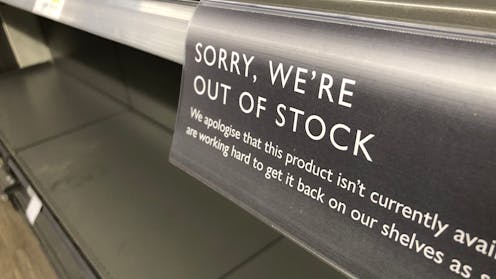
Rather than using signs to explain the shortages, one practical solution to help shoppers avoid feelings of anxiety could be for supermarkets to cover empty shelves with images of fully stocked ones.

This visual trick might help reduce anxiety and create a more pleasant shopping atmosphere. While it may sound like a small change, it could make a big difference for shoppers who are sensitive to signs of scarcity.

There is a growing body of research into how everyday experiences affect our mental and emotional wellbeing. Even routine activities such as grocery shopping can have psychological impacts, and small changes in our environment can influence how we feel.

So the next time you’re in the supermarket and the sight of an empty shelf makes your heart sink, remember it’s not just about the missing products. It’s about how your brain has learned to respond.

The Conversation

Dominik Piehlmaier does not work for, consult, own shares in or receive funding from any company or organisation that would benefit from this article, and has disclosed no relevant affiliations beyond their academic appointment.

ref. Why empty supermarket shelves make you uneasy – even if you don’t want the missing items – https://theconversation.com/why-empty-supermarket-shelves-make-you-uneasy-even-if-you-dont-want-the-missing-items-262285

Why people embrace conspiracy theories: it’s about community, not gullibility

Source: The Conversation – UK – By Robin Canniford, Professor of Markets, Business, and Society, University of Bath

TSViPhoto/Shutterstock

Psychologists have long considered how a tendency towards irrational thinking or particular personality traits might predict peoples’ interest in conspiracies. Yet these individual factors do not explain the group processes through which conspiracy theorists are extending their influence and impact.

Over five years, we sought out and got to know people on the cusp of becoming conspiracy theorists. And the results of our new study show that a sense of community activism is attracting people to these ideas.

Indeed, contrary to the stereotype of isolated keyboard warriors who have gone down the rabbit hole, conspiracy theorists are becoming organised, recruiting supporters, picketing vaccination centres and vandalising telecommunication and traffic infrastructures.

Our research examined the growing interest in conspiracy theories and how associated activism emerges. Immersive research with conspiracy theorists is rare. But revealing our status as researchers actually allowed us to build relationships with people, who shared insights into what motivates their involvement.

In particular, we spoke to people about conspiracy theories concerning 5G technology, COVID-19, 15-minute cities and low-traffic neighbourhoods. We also took part in online discussions and travelled the UK to sit in on public meetings and conferences. Ultimately, our insights revealed how people tend to follow a pathway from initial interest, to community engagement and potentially activism.

Awakenings

Belief in conspiracy theories is often initiated by traumatic life events. Job losses or the death of a loved one can trigger anger and suspicion towards public services, authority figures, and experts. This is especially so if people feel that the tragic or destructive events that affected them could have been averted. And these emotions can motivate a search for answers.

When conspiracy theories claim to explain painful personal circumstances or wider fears over COVID-19, or climate change, people can experience “awakenings”. These are moments of insight during which people come to believe that the causes of their problems lie with secretive groups which control society.

One person we spoke to described conspiracy theories as enabling him to “access the way the world really works… as if a light was switched on in my head and I could see things clearly”.

People rarely experience their awakening in isolation. In online group chats, people discover others with similar problems. In public meetings, beliefs in various theories are boosted by interactions where people discuss their suspicions over who is to blame for particular issues. In the process, these groups feed off their common emotions, building an atmosphere of energy and excitement.

The loss of traditional meeting places such as pubs and high streets, along with high levels of loneliness, may be driving people to look for new forms of connection and meaning.

QAnon protesters stand holding posters
Conspiracy theories can make people feel like they are part of something.
Mircea Moira/Shutterstock

The people we spoke to expressed surprise at the social connections they had found through these communities. As one participant put it, “there’s a lot of support out there for people who are doing their own research… there is always someone wanting to hear more, building on the work of others, giving each other support. There’s a real buzz in this community.”

Do your own research

Conspiracy theories don’t merely offer alternative explanations for events, they are resources for communities that provide identity, purpose and belonging. These benefits may explain why it is so difficult to talk people out of their beliefs in conspiracy theories.

Indeed, when conspiracy communities generate common interpretations and shared emotions, conspiracy theories can resonate powerfully, making them seem more real than they are.

This effect is compounded by the way which conspiracy theories invite believers to build on ideas by “doing their own research”. The internet serves as a vast database where conspiracy theorists can discover articles, documents and scientific reports to support their claims.

And despite the questionable quality of many such sources, contributing to conspiracy theories can provide a boost to people’s self esteem, making them feel like experts and heroic detectives. A key aspect of these communities is how they empower members to contribute.

Yet, beyond generating more theories, conspiracy communities are becoming organised networks for protest and activism. Given that conspiracy theories raise suspicion and anger over peoples’ problems, and point the blame at particular targets, we found that believers can feel compelled to take part in protests.

For example, some claim that the urban planning concept of 15-minute cities is part of secretive government scheme to limit citizens’ movement. Protesters against these and other efforts to improve urban environments are uniting under slogans such as “stop the tyranny”.

Who benefits?

Activism based on conspiracy theories can come with serious risks. Many of those involved lose contact with family and friends. Increasingly, conspiracy activists are being charged with crimes. In 2024, an anti-vaccine conspiracy theorist was sentenced to prison for five years for encouraging violence against chief medical officer for England, Chris Witty.

Moreover, when conspiracy theorists take action without tested evidence, they may misidentify targets. This can result in harm to innocent people and can undermine the very institutions needed to solve crimes.

To be sure, instances of conspiracy and foul play by powerful figures and organisations do happen. You have to wonder how much energy then, is wasted fighting imaginary enemies while actual wrongdoing is overlooked.

Perhaps the real winners here are the conspiracy entrepreneurs – people who capitalise on conspiracy theories by creating content that heightens peoples’ suspicions about problematic events. In the process, these people build attention and fame, while peddling products and services from books, merchandise and coaching, to vitamin pills and gadgets.

The Conversation

The authors do not work for, consult, own shares in or receive funding from any company or organisation that would benefit from this article, and have disclosed no relevant affiliations beyond their academic appointment.

ref. Why people embrace conspiracy theories: it’s about community, not gullibility – https://theconversation.com/why-people-embrace-conspiracy-theories-its-about-community-not-gullibility-262276