Could new tenants’ rights usher in rent controls? Here’s why that wouldn’t necessarily be a positive

Source: The Conversation – UK – By Nikhil Datta, Assistant Professor, Economics, University of Warwick

David Fowler/Shutterstock

Housing and high rental costs have been a major issue for the UK in the past decade. While other countries have moved towards protections for renters, rent control has not been a widespread feature of the British rental market for over a generation.

But now the new Renters’ Rights Act introduces provisions to protect tenants in England against rent increases. While the UK government says it “does not support the introduction of rent controls”, the act does allow tenants to appeal rent increases if they are above market rents.

Only time will tell whether the act introduces rent control through the back door. In the meantime, the Scottish parliament recently passed landmark housing legislation that will allow for limited rent controls across the country from 2027.

But among economists, rent controls are controversial. They have the potential for unintended consequences – including, ultimately, housing shortages. However, fears were raised about the unintended consequences of a proposed minimum wage three decades ago. Today, the policy is generally seen as having avoided the negative impact on employment that was once feared.

Rent control reliably offers short-term protection for sitting tenants, curbing their need to move away in the face of price pressures and keeping rents lower in covered properties.

But landlords often adjust in ways that shrink the regulated rental stock, selling properties on to owner-occupiers or converting them into short-term lets. This was the experience in San Francisco, where landlords responded by reducing the number of rent-controlled units.

Berlin’s rent freeze seemed to have similar effects, briefly pushing down regulated asking rents, which coincided with a fall in the number of rental listings.

Evidence from Catalonia in Spain, however, paints a more optimistic picture. Average rents there fell by around 4%-6% without any detectable fall in supply.

apartment blocks in berlin with the tv tower in the background
Berlin’s rent control coincided with a fall in the number of properties on the rental market.
Patino/Shutterstock

Classic economic theory – and evidence – highlight another set of risks: mis-allocation (where homes don’t go to those who could benefit most from them) and under-maintenance of properties within the controlled sector. When strict controls were abolished in Cambridge, Massachusetts, property values jumped sharply both for previously controlled homes and those that had never been subject to rent controls.

This suggests there were negative consequences from regulated properties on others in the neighbourhood, possibly driven by under-maintenance reducing overall neighbourhood appeal.

Overall, reviews of academic studies suggest that the outcome depends on the shape the policy takes – things like whether new-builds are exempt, if rents can rise between tenancies and whether controls are indexed and enforced.

Yet the broad pattern is clear: rent control tends to protect tenants in the short run. But in the longer run, supply responses often shift the pressure on to those still searching for a home.

So, what can we learn from economic analysis? The Renters’ Rights Act does not limit rents for new contracts, but seeks to regulate rent increases for incumbent tenants. Given the abolition of section 21 (“no-fault”) evictions, this is necessary to prevent landlords from raising rents far above the market rate to force tenants out.

Some economic models suggest it is reasonable to regulate rent increases for sitting tenants. Renters who are already in a property are typically less price-sensitive than those searching on the open market. They may have attachments to their homes – proximity to work and schools, or community ties, for example – and moving would be costly.

As a result, landlords may hold greater power over these tenants. Consequently, the legislation aims to ensure that tenants do not face rent increases beyond what landlords could obtain on the open market.

Theory vs practice

While well-intentioned, there are concerns when it comes to the design of rent control. A key worry is the uncertainty around what the “market rate” actually is.

If a tenant believes a rent increase exceeds that, they will be able to challenge it through the UK’s tribunal system. Right now, the first-tier tribunal hears very few cases – but an increase in complaints could overburden the system.

At present, market rent is determined by looking at properties in the area and is decided by a judge or surveyor. But this setup comes with challenges.

Homes have many dimensions that people value differently. This makes predicting what a property would rent for on the open market far from straightforward. Even surveyors valuing homes for sale tend to deviate by around 10% in either direction from actual prices. Machine learning models perform no better.

As a result, judgements could have a “luck of the draw” element for both tenants and landlords, raising issues of consistency and transparency. These problems will be even more acute for unique properties.

Finally, there is the issue of access. Evidence shows that lower-income or otherwise disadvantaged people are less likely to use formal tribunal processes.

These challenges do not mean the policy should be abandoned. But careful design could ease pressure on the judicial system and improve transparency.

One option would be to introduce a commitment mechanism for rent increases. Under this approach, if a landlord raised the rent and the tenant felt it was unfair and chose to leave, the tenant could complain to a proposed new ombudsman or tribunal.

The tribunal’s role would be limited. It would record the complaint and later review the rent agreed in the next tenancy for that property. If it was lower, the landlord would pay the former tenant compensation.

This mechanism would encourage landlords to set rent increases only at levels they genuinely believe the market will bear.

Ultimately, the success of rent regulation will depend less on the principle and more on the details of its design and enforcement. A system that protects tenants without freezing supply or overburdening the courts will need clear rules, credible oversight and realistic expectations of the “market rate”.

The Renters’ Rights Act represents a bold attempt to rebalance power in favour of the tenant. But its implementation will determine whether it provides stability for renters and improves the market, or simply adds a layer of uncertainty for both sides.

The Conversation

Nikhil Datta receives, or has received funding from the Nuffield Foundation, British Academy, Leverhulme Trust and the Economic and Social Research Council.

Jan David Bakker has received funding from the BA/Leverhulme Trust, the PRIN and the PNRR.

ref. Could new tenants’ rights usher in rent controls? Here’s why that wouldn’t necessarily be a positive – https://theconversation.com/could-new-tenants-rights-usher-in-rent-controls-heres-why-that-wouldnt-necessarily-be-a-positive-268827

Psychology can change the way food tastes – here’s how to use it to make the most of your meals

Source: The Conversation – UK – By Harmehak Singh, PhD Candidate in Psychology, Liverpool Hope University

Cast Of Thousands/Shutterstock

Ever eaten while doom-scrolling and realised you barely tasted anything? Or found your favourite pasta strangely bland after a stressful meeting, yet somehow delicious on a relaxed Saturday evening?

We often think taste comes from ingredients and cooking techniques. But taste isn’t just on the plate. Our emotions, expectations – even the people sitting with us – can shape how food tastes.

This mind-food connection sits at the heart of gastrophysics, a field that studies how our senses, brain and mental states shape our eating experience. Once we know how this works, we can start using simple psychological shifts to make everyday meals taste richer, brighter and more satisfying, without changing a single ingredient.

Mindful eating means paying attention to each bite; noticing flavours, textures, aromas and the sensations in our body as we eat.

But most of us don’t eat like this. We eat while scrolling, replying to messages or watching Netflix in the background. Our attention gets divided, our senses dull and we go into “autopilot” mode. We chew quickly, swallow automatically and miss the subtle flavours and signals from our body telling us we are full. We also lose touch with our body’s hunger cues, which makes overeating more likely. Normally, rising levels of the “hunger hormone” ghrelin and gentle stomach contractions alert us it’s time to eat.

But distraction makes those messages easier to ignore.

Essentially, our body also has a sophisticated system to tell us to stop. As we eat, our stomach stretches, sending “fullness” signals to the brain. At the same time, hormones such as leptin and cholecystokinin are released, creating a feeling of satiety that slowly builds over the course of a meal.

When we’re distracted, we may miss this delicate hormonal conversation.

A 2011 study found that people who played a computer game during lunch felt less full afterwards, remembered less about their meal and snacked more later. Distraction also weakens the memory of eating – and when the brain forgets food, it will seek more food sooner. Appetite, therefore, isn’t just about biology. It’s shaped by our attention and memory too.

Woman sitting eating at a restaurant with a disgusted expression on her face.
All in her head?
frantic00/Shutterstock

Slowing down, on the other hand, improves our sensory awareness. Suddenly, a tomato isn’t just “tomato-y”, it becomes sweet yet tangy, juicy yet firm. Chocolate doesn’t just “taste nice”, it melts slowly, bitter at first, then rich and velvety. Mindfulness acts like turning up the volume on our taste buds.

Mood as a flavour enhancer

Negative emotions such as stress, anxiety and frustration can dull our sensitivity to pleasant flavours. When we’re tense, our body prioritises survival, not enjoyment. Stress hormones narrow our attention, and pleasure-based functions such as flavour appreciation get pushed aside. That’s why food can taste flat when we’re upset.

In one experiment, published in 2021, participants who watched a horror movie felt more anxious and rated juice as less sweet than those who watched a comedy or documentary film. The participants who watched the horror movie even drank more juice than the others – possibly trying to “find” the sweetness their brain was suppressing. These effects may be linked to physiological changes, as anxiety can influence autonomic nervous system activity and hormone levels that affect taste perception and consumption.

When we feel calm, safe and socially connected, the opposite happens. Our brain releases feelgood chemicals such as dopamine and serotonin, and food tastes better. Think of how amazing your favourite food tastes when you’re laughing with friends or eating at a festival.

So if dinner suddenly tastes “off”, the recipe might be fine, your nervous system may just be in a different state. Next time you’ve had a heavy day, try pausing for five minutes before eating. Play soft music, take a few deep breaths, or eat with someone who makes you feel relaxed.

Food is what you think

Before we even taste food, our brain forms predictions about what it should taste like. And those expectations shape what we actually taste.

Visual cues do a lot of this work. We expect red foods to be sweet, green foods to feel bitter or sour, and golden-crisp foods to crunch. The sound of a crisp bite sends a signal to the brain that the food is fresh and satisfying.

Presentation matters too. Fancy plating isn’t just for Instagram. It changes taste perception. In a 2024 study, the shape, size, and colour of the plate shifted how appealing a dessert looked. The features of the plate also affected how much people thought it was worth, and even how modern or traditional it felt. Black plates made desserts seem more premium and exciting, while white plates made them feel more familiar and understated. Even the weight of cutlery changes our experience. Heavier cutlery gives the impression that the food is premium.

Our sense of smell is another factor. When people had their noses blocked with nose clips for an experiment, a sweet drink tasted less intense and less satisfying, showing how aroma shapes the full flavour experience. This is exactly why food feels bland when we have a cold or a blocked nose.

So what does all this mean for your next meal? It means you have more power than you think. Try eating something you love from a nice plate. Notice the colours. We don’t have to wait for a chef’s touch. With a little psychology, we can make everyday meals more satisfying and enjoyable.

The Conversation

Harmehak Singh does not work for, consult, own shares in or receive funding from any company or organisation that would benefit from this article, and has disclosed no relevant affiliations beyond their academic appointment.

ref. Psychology can change the way food tastes – here’s how to use it to make the most of your meals – https://theconversation.com/psychology-can-change-the-way-food-tastes-heres-how-to-use-it-to-make-the-most-of-your-meals-269212

The UK has praised India’s digital ID system – but it’s locked millions out of their legitimate benefits

Source: The Conversation – UK – By Charlotte Goodburn, Reader in Chinese Politics and Development, King’s College London

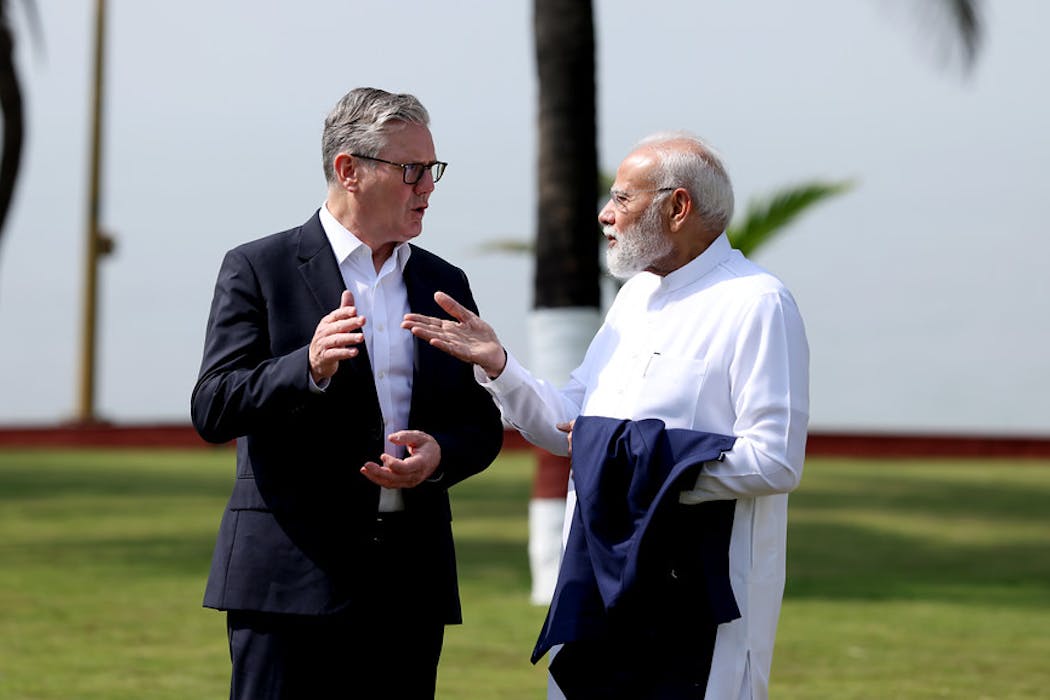
Keir Starmer met with Indian Prime Minister Narendra Modi in October. Simon Dawson/Number 10/Flickr, CC BY-NC-ND

The UK government is promoting its plan for a new digital identity scheme as a way to streamline services, prevent fraud and ensure that welfare benefits reach only those entitled to them. The prime minister, Keir Starmer, has argued that digital ID is central to modernising the welfare state and tightening immigration controls.

On his recent trip to India, Starmer praised the country’s Aadhaar programme, the world’s largest digital ID system, as a “massive success”. The UK government has cited Aadhaar’s role in “reducing fraud and leakages in welfare schemes”.

But my ongoing research on India’s digital identity registration suggests that large-scale efficiency can come at significant social cost.

Aadhaar was launched in 2009, giving every Indian resident a unique 12-digit number, linked to demographic and biometric information. Its stated aim was to eliminate duplication in welfare distribution and make the system more efficient.

Fifteen years on, however, the results tell a different story. Millions of people have lost access to subsidised food, pensions and wages for public projects, sometimes for months or years at a time.

This was not because they were ineligible for the benefits, but because they failed to satisfy the system’s rigid digital conditions. These problems are ongoing.

Officials claim that Aadhaar has saved billions of rupees in welfare spending, by removing people who didn’t qualify. But research by economist Reetika Khera and colleagues shows that much of the reduction in beneficiary numbers came from the removal of legitimate claimants whose records could not be verified.

For many households, the shift to Aadhaar-linked benefits meant replacing decisions by local officials with automation. To collect subsidised food, recipients must have their number regularly authenticated online.

When internet connections fail, names are misspelt or data not updated, access can be cancelled. The same applies to pension payments and employment schemes, where officials are no longer able to override computer-generated rejections.


Read more:
Digital ID cards: what are they and how will they help the UK deal with illegal immigration?


The effects have been severe. In Jharkhand state, an 11-year-old girl reportedly died from starvation after her family’s access to food rations was cancelled for not being linked to Aadhaar. Other deaths have been reported after households were struck from welfare lists because of data errors or missed deadlines. The victims were not impostors, but the system’s intended beneficiaries.

Digital exclusion through Aadhaar has specific impacts on women. Where their identities are linked to the mobile numbers or bank accounts of male relatives, they cannot independently authenticate their benefits, and lose access when relationships change.

Though such effects may be less pronounced in the UK, the same principle applies: digital identity systems tend to replicate existing social hierarchies.

The problem with Aadhaar is not technology alone, but how it interacts with existing institutions. Local bureaucrats are essential to making social assistance work. However, automation has curtailed their roles. Digital systems may reject applications or delay payments, while claimants are left without clear channels for appeal.

In the northwestern state of Rajasthan, thousands of pensioners went unpaid for months because errors in their Aadhaar registration were fixable only by authorities in the state capital.

Where automation replaces local, human assistance, those least able to navigate the systems – the poor, the elderly, the less literate – are most likely to lose out.

Data mobility and migration

One of Aadhaar’s stated aims was to make identity portable, allowing Indian citizens to claim benefits nationwide. In practice, this mobility has proved hard to achieve. People commonly lose access when moving between states, because data is not synchronised across administrative systems.

Making digital data mobile across bureaucracies is technically complex and socially consequential. Internal migrants and refugees can fall through the gaps. For example, people who had recently moved were unable to access COVID-19 treatment and vaccination for lack of locally-accepted Aadhaar.

Proposals indicate the UK’s system will connect tax, welfare and employment databases. Even in a smaller, more centralised state like the UK, similar issues of data mobility may arise if information has to flow between departments like the Department for Work and Pensions, HMRC and local authorities. A 2025 government review identified fragmentation of UK data systems as a key obstacle to policy coordination.

A woman in India scans her thumbprint on a device held by a man in a bank
A woman links her Aadhaar number to her bank account in 2016.
PradeepGaurs/Shutterstock

In India, as in the UK today, the introduction of digital ID was partly shaped by fears around cross-border migration. But here again the impacts have been troubling.

In the border state of Assam, concern over irregular entry from Bangladesh has blurred the line between identity verification and citizenship. Residents who fail to match records across Aadhaar and the National Register of Citizens, often due to minor discrepancies, have been excluded from both welfare and healthcare. For many, this has created a state of administrative limbo: neither formally foreigners nor recognised citizens.

It is not yet clear to what extent Britain’s proposed digital ID will use biometric data, and the country’s welfare system is structurally different from India’s. Yet the underlying rationale is similar, as are the governance issues.

If the UK looks to systems like Aadhaar for inspiration, it should also take into account the challenges. Otherwise, it risks launching a system where those with unstable housing, irregular employment or limited digital literacy may be excluded. And, as in India, errors and mismatches will likely affect those least able to contest them.

The Conversation

Charlotte Goodburn received research funding from The British Academy/Leverhulme (SG162863) for her project “Rural-urban migration and regimes of registration: comparing China and India”.

ref. The UK has praised India’s digital ID system – but it’s locked millions out of their legitimate benefits – https://theconversation.com/the-uk-has-praised-indias-digital-id-system-but-its-locked-millions-out-of-their-legitimate-benefits-268020

Why some places get better storm warnings than others – and what that means for Puerto Rico

Source: The Conversation – UK – By Ellen Ruth Kujawa, Coastal Change Research Fellow, University of Hull; University of Cambridge

Hurricane Melissa devastated Jamaica in late October, killed dozens in Haiti and forced nearly three-quarters of a million Cubans to evacuate. The death toll across the region is still unknown – but Melissa will go down as one of the strongest storms ever recorded.

It also represents a bellwether for a new era of dangerous hurricanes, driven by climate change. These storms are becoming increasingly violent and harder to predict.

Melissa’s devastation may look like a story of wind and water, but it speaks to a broader question of climate justice: who gets access to life-saving information when a storm strikes? Accurate forecasts gave the governments and residents of Jamaica, Haiti and Cuba time to prepare. This was particularly crucial, as Melissa intensified rapidly from a moderate storm to a major hurricane in less than 24 hours.

Climate change is increasing the frequency of such rapidly intensifying storms. It’s also making them harder to predict. So it’s bad news that the Trump administration is cutting funding for the state-run National Weather Service (NWS) and pushing for the privatisation of government agencies.

The potential decrease in forecast quality this foreshadows will not be borne equally. Hurricanes don’t treat all places uniformly – and neither do NWS forecasts. In my research on hurricane forecasting across the Caribbean, I’ve found that these inequalities already shape how different places receive and use lifesaving information.

Puerto Rico

Melissa underlined just how essential high-quality hurricane forecasts are – allowing officials in the Caribbean precious time to prepare for the storm’s arrival. But my research in Puerto Rico shows that the production and distribution of hurricane forecasts in the Caribbean is more complicated – and more entangled with issues of justice – than it might appear.

Over two years of interviews with meteorologists and emergency managers, I found that Puerto Rican decision-makers perceive – with some supporting evidence, including delays in information availability and deferred equipment maintenance – that their island is marginalised in terms of the forecasts it receives.

Meteorology is often framed as an objective science, but it is deeply political, embedded within systems of state power – and my research suggests that Puerto Rico’s second-tier colonial status extends to its access to forecast knowledge.

Puerto Rico’s vulnerability was widely discussed after Hurricane Maria devastated the island in 2017, killing nearly 3,000 people. The island’s vulnerability to hurricanes well known – between 1851 and 2019, nine major hurricanes made landfall in Puerto Rico, the third-highest number of major hurricanes in the Caribbean. Decades of infrastructural neglect, economic austerity and political powerlessness have compounded that vulnerability.

Forecasts are crucial to decision-making in Puerto Rico. They inform evacuations and requests for federal aid, and they help to plan how to protect critical infrastructure. But their usefulness differs from that of mainland forecasts. As one Puerto Rican meteorologist told me: “A perfect forecast for [the continental United States] is between five to ten miles; five to ten miles for us can be disaster or not disaster.”

Puerto Rico’s small size means that even a ten-mile error in a hurricane’s predicted track can be the difference between a near miss and a catastrophic landfall. For Puerto Rico, a track error that barely matters for a continental state can spell the difference between a glancing blow and a direct hit. In other words, what counts as a “perfect forecast” for a mainland state looks very different for a small island.

Inequality in forecasting

But the issues go deeper than this. Puerto Rican meteorologists told me the forecasts they receive are designed primarily to be applicable to the continental US and later adapted for Caribbean islands. One meteorologist told me: “Mostly it’s us here by ourselves.” Many believe the forecasts they receive are inferior to those that their counterparts use in the continental US, and that they receive less institutional support from the NWS.

When people making life-and-death decisions doubt the quality of the data they rely on, the resulting uncertainty has the potential to undermine both their confidence and public trust.

And there is evidence to justify decision-makers’ doubts. Puerto Rico received storm surge maps – maps of likely storm-generated increases in coastal water levels in 2017, several years after the continental US. Hawaii received them at the same time, suggesting the delay stems from island geography rather than territorial status.

Puerto Rico’s on-island radar unit, which failed as Hurricane Maria made landfall, had been flagged for maintenance in 2011, six years before Maria hit. Interviewees suggested to me that the unit would have been repaired or replaced more quickly in the continental US.

These examples suggest that inequality in forecasting isn’t just perceived – it’s demonstrable: from delayed storm-surge maps to neglected radar maintenance. Forecasts may appear objective and technical, but they are inseparable from their political and institutional contexts. Puerto Rico depends on hurricane forecasts but in practice, does not receive the same level of meteorological knowledge as the continental US.

The Trump administration has already proposed cuts and restructuring that would reduce funding for public forecasting and expand the role of private weather firms. This risks prioritising profit over public safety. It’s particularly dangerous in an above-average hurricane season, and seems likely to worsen as the Trump administration continues to push for decreased funding to the NWS.

When political pressure narrows the NWS remit, vulnerable places such as Puerto Rico risk losing the early warnings they depend on. Storms such as Hurricane Melissa and Hurricane Maria test the capacity of governments and institutions to act on forecast knowledge.

But that knowledge is not neutral. Forecasts do more than predict weather – their prioritisation effectively determines whose safety counts most. As hurricanes intensify in the region, the fairness of forecast systems – who they protect, and who they neglect – will become one of the defining questions of climate justice.

The Conversation

Ellen Ruth Kujawa received funding from a Cambridge Trust Scholarship, and grants from the Cambridge Department of Geography, the Worts Traveling Scholars Fund, the Smuts Memorial Fund, and the Mount Holyoke College Alumnae Association.

ref. Why some places get better storm warnings than others – and what that means for Puerto Rico – https://theconversation.com/why-some-places-get-better-storm-warnings-than-others-and-what-that-means-for-puerto-rico-269064

The world’s new US$125 billion rainforest trust fund revives a 1990s idea – and shows its limits

Source: The Conversation – UK – By Nick Bernards, Associate Professor of Global Sustainable Development, University of Warwick

A US$125 billion rainforest fund is being hailed as a flagship announcement from the 2025 UN climate summit in Belém, Brazil. The goal is noble: this is essentially a trust fund that will pay countries to keep their tropical forests standing. But its core idea was tried 30 years ago, and the results weren’t great.

Brazilian president Luiz Inàcio Lula da Silva suggests the so-called Tropical Forests Forever Facility (TFFF) is innovative because it is “an investment fund, not a donation mechanism”. This, in theory, means investors can benefit too, providing a long-term stability that isn’t affected by political cycles.

Turning to private markets is not in itself all that innovative. But years of efforts to mobilise private finance for climate action have routinely failed to attract sufficient investment.

The reasons for this are pretty simple. Many necessary activities simply aren’t “good” investments. Even commercial renewable energy projects often struggle to offer returns high enough to compete with other assets.

All of these problems are particularly pronounced for forest conservation. There aren’t many ways to generate income by leaving forests alone, and clearing them for timber or agriculture is generally more profitable. Indeed, this is one of the key drivers of deforestation in the first place.

Aerial view of deforested patch of forest
Drone footage of illegally deforested land in Mato Grosso, Brazil.
PARALAXIS / shutterstock

Back to the future?

The TFFF is designed to work around these constraints. Rather than investing directly in conservation projects, it functions like a large endowment or trust fund. It aims to raise US$25 billion in “sponsor capital” from government and philanthropic donors.

Brazil has pledged US$1 billion. Norway followed suit, promising about US$3 billion. The fund also plans to sell US$100 billion in bonds to private investors.

Eventually, the full US$125 billion will be invested in financial markets. After paying interest to investors and sponsors, the remaining returns will be used to pay participating countries around US$4 per hectare of standing tropical forest, minus penalties for forest loss.

By separating investors’ returns from conservation success, the TFFF does potentially create a more appealing offer for private investors than previous climate finance schemes.

However, this model has been tried before.

Trust funds for conservation

In the early 1990s, around the time of the first global negotiations on climate change, the World Bank’s Global Environment Facility financed a trust fund for biodiversity conservation in the Himalayan kingdom of Bhutan. It was followed by similar projects in Uganda, Mexico, Peru, Brazil, and Poland, Slovakia and Ukraine.

These funds were justified in terms very similar to Lula’s pitch for the TFFF. Private finance was needed, wrote one World Bank official in 1993, “because it is impossible to predict whether the current ‘boom’ in international [government] financing for conservation will last”.

Yet evaluations of these conservation trust funds highlighted recurring problems.

Returns on investment were often lower than anticipated, delaying projects sometimes by years, including the very first one in Bhutan. (And quite how much revenue the TFFF’s investments will actually generate is uncertain.)

The money was tied up in investments and only a small amount was available for conservation. And, while a trust fund can generate a steady trickle of revenue to pay operating costs, it’s much harder to use this model to start new projects.

furry monkeys on branch
The endangered golden langur exists only in Bhutan and one tiny corner of India.
Odd Man / shutterstock

In Bhutan, the managers of the trust fund struggled with how to finance start-up costs for establishing new conservation areas without eating into the fund itself. Eventually they received a separate grant from the World Wildlife Fund. The TFFF would likely face similar difficulties funding initiatives such as returning farmed land to indigenous communities.

The TFFF inherits these issues, and adds a new one. To attract private investors, interest payments will be prioritised over conservation spending. The TFFF’s concept note is explicit that payments to participating countries will fall if investment income can’t cover payments to bondholders. In other words, there is a real risk that reassuring investors may come at the expense of the fund’s ability to actually protect forests.

There are bigger questions to ask, too. For instance, a coalition of civil society organizations from across the Amazon, as well as Africa and Asia, have already rejected the initiative. They argue it risks turning forests into commodities with a price tag, and that despite claims of centring Indigenous communities, it actually allocates them a paltry amount of money in top-down fashion.

The revival of a mechanism first tried in the early 1990s should give us pause. If private capital can only be mobilised on terms that weaken climate action, then perhaps there’s no longer any alternative to greatly increased public funding and much stronger redistributive measures. Rich countries, corporations, and individuals will need to shoulder more of the cost of mitigating a crisis they’ve played a disproportionate role in creating.

In recent years activists and researchers have proposed a long list of alternative options. These include diverting some of the trillions currently spent on the world’s largest militaries, reforms to reduce corporate tax avoidance, and debt relief for climate vulnerable countries.

We can debate whether any all of these specific options is effective or appropriate. The TFFF and its limits are a sign that it’s well past time to take such measures seriously.


Don’t have time to read about climate change as much as you’d like?

Get a weekly roundup in your inbox instead. Every Wednesday, The Conversation’s environment editor writes Imagine, a short email that goes a little deeper into just one climate issue. Join the 47,000+ readers who’ve subscribed so far.


The Conversation

Nick Bernards has previously received funding from the Social Sciences and Humanities Research Council of Canada and British International Studies Association.

ref. The world’s new US$125 billion rainforest trust fund revives a 1990s idea – and shows its limits – https://theconversation.com/the-worlds-new-us-125-billion-rainforest-trust-fund-revives-a-1990s-idea-and-shows-its-limits-270238

Streamlining what universities offer could backfire for disadvantaged students

Source: The Conversation – UK – By David Allan, Reader in Professional Education and Learning, Edge Hill University

Gigi Delgado/Shutterstock

The government’s vision for higher education in England, set out in a recent policy paper, includes some changes that will benefit students from poorer backgrounds.

An increase in maintenance loans, for instance, will help to support disadvantaged students. So too will the introduction of a lifelong learning entitlement loan. Students from disadvantaged backgrounds often have learning trajectories that are far from linear, so access to a lifetime entitlement makes sense.

Other positive aspects include an aim to create more joined-up thinking in communities, greater links between higher education providers and employers and targeted funding initiatives. There is a general acknowledgement of the challenges disadvantaged students face. And these students are addressed throughout the document, albeit mostly through the lens of seeing their economic potential.

But the government’s broader strategy for universities will present significant challenges for students who come from poorer families and live in disadvantaged areas. It encourages universities to carve out particular specialisms. This means honing their expertise and concentrating on their unique selling point – their “core purpose”. It suggests that while competition can be healthy, “too many providers with similar offerings are chasing the same students”.

The implications for this in practice may be that universities axe some of their courses in favour of a narrower menu of study. The casualties of such a move would typically be arts and humanities courses. This is especially likely when the government plans to offer funding incentives for priority areas, which include science, technology and engineering.

Indeed, many reductions in the higher education portfolio have already taken place across the sector, such as for arts subjects. This is arguably due to pressures on each university to deliver “successful outcomes” for its students. These outcomes, such as employment after graduation, however, are narrowly measured. They run the risk of devaluing arts-based education. They also may constrain opportunities for many people seeking greater life chances.

Local limitations

Disadvantaged students in particular could be significantly affected by changes that reduce the variety of courses available at their local university. A diverse portfolio of courses creates opportunities for those who may not traditionally access higher education. Disadvantaged students are less likely to apply to prestigious institutions. They are more likely to study closer to home.

In recent years, closure of courses at universities has created what is known as cold spots. These are areas of the UK where certain university subjects are not offered. These closures, unfortunately, often affect lower tariff providers – universities that require lower grades for entry to a degree course. This means reduced opportunities for disadvantaged students to access the courses they might want to study in their local area.

For regional areas, too, a wealth of course availability can create wider opportunities. For instance, it can allow local businesses to make use of a wide range of skills from students who remain in the area.

Student in historic library
Streamlining might mean that only prestigious universities offer certain courses.
Gorodenkoff/Shutterstock

Streamlining what universities offer may also result in further status distinctions between higher education institutions. It could pave the way for an even more ferociously competitive sector, the rationale being that “the cream will rise to the top.” But this may mean that only universities ranking highly in a particular field will be positioned to provide courses in this field.

This is neglectful of smaller and often newer providers that may be in need of developmental support. It may close down opportunities for universities to grow and establish research excellence where it may not yet exist.

It benefits everyone if England’s higher education system grows and flourishes. But for every positive choice we make, we have to consider the possible fallout on marginalised members of society. The implementation of these policy proposals, then, will need to consider the implications of perpetuating a heavily driven and economically competitive market for higher education. This could mean careful contemplation of the purpose of higher education itself.

The Conversation

David Allan does not work for, consult, own shares in or receive funding from any company or organisation that would benefit from this article, and has disclosed no relevant affiliations beyond their academic appointment.

ref. Streamlining what universities offer could backfire for disadvantaged students – https://theconversation.com/streamlining-what-universities-offer-could-backfire-for-disadvantaged-students-268025

The Holodomor on screen: how cinema shapes memory of Ukraine’s famine

Source: The Conversation – UK – By Jeremy Hicks, Professor of Post-Soviet Cultural History and Film, Queen Mary University of London

The famine of 1932-33, known as the Holodomor, claimed the lives of millions of people in Ukraine. It was not due to climactic failure, but caused by the confiscation of grain, punitively targeted by the Soviet government and its leader Joseph Stalin at Ukrainians.

Yet it is not universally recognised as a genocide. This lack of consensus stems both from historical debates over whether Ukrainians were deliberately targeted, and from political considerations surrounding the recognition of genocides.

It is nevertheless an important historical event, memory of which serves to unite Ukrainians as a nation. However, one factor preventing wider recognition of the Holodomor as a central moment in 20th century history is the lack of compelling treatment in film.

This is in sharp contrast to the Holocaust, where film was key in cementing its place in both Jewish and wider consciousness.

It is productive to compare depictions of the Holodomor with those of the Holocaust. Like the genocide of Jewish people, the murder by famine of Ukrainians was a crime denied and covered up by its perpetrators, in particular through bans on filming and photography.

When Nazi Germany was defeated in 1945, its foes uncovered and publicised extensive evidence of its crimes. The Soviet Union didn’t collapse until 1991, however, over 50 years after the Holodomor, making its documentation harder.

This meant the first films on the subject were made by the Ukrainian diaspora in Canada: The Unknown Holocaust: 10 Million Victims, Ukraine 1933 (1983) and Harvest of Despair (1984). Both included groundbreaking interviews with survivors and eyewitnesses, but also used a number of images depicting Russian victims of the earlier famine of 1921-23. They also quoted widely circulated estimates for the number of victims that have been shown to be inflated.

This left the films open to criticism from deniers who claimed the famine didn’t happen, as was the official Soviet line. The shortcomings of the films weakened their case for the Holodomor and restricted their impact.

These films were further limited by being made outside Ukraine, where the subject was still banned. Following the Glasnost (the policy of greater freedom of expression inaugurated by Mikhail Gorbachev in the USSR from 1985) Ukrainians in Ukraine were also able to make films about the subject, even before the collapse of the Soviet system.

Famine 33 was released on the eve of the Ukrainian independence referendum.

Initially they focused on eyewitness testimony with the notable film, 33rd. Witnesses’ Testimonies (1989). The film starts by showing images from 1921, saying that that famine was filmed, unlike that of 1933, and then concentrates on interviewing eyewitnesses.

This was swiftly followed by the first acted film depicting these events, Famine 33 (1991). It was released on the eve of the Ukrainian independence referendum and is seen as contributing to the overwhelming endorsement of independence (including by Crimea, Luhansk and Donetsk).

However, despite its political impact, the film is not great. Part of the problem is the difficulty of channelling cinema’s spectacular nature and orientation towards entertainment to the task of depicting mass death and suffering. It’s the same challenge confronted by films about the Holocaust.

The films that get it right

The highly influential mini-series Holocaust (1978) was condemned for using actors to portray death by famine, trivialising immense suffering by adapting these historical events to norms of TV entertainment.

Famine 33 and the more recent international production Mr Jones (2019) have not succeeded in producing memorable representations of the terrible events of the Holodomor, but that does not mean the task is impossible.

The trailer for Mr Jones.

The most successful film representation of the Holodomor is the 2008 documentary film The Living, directed by Serhii Bukovs’kyi. Its great merit is that it avoids images of famine victims and any hint of a sensationalist emphasis on cannibalism, a chilling, but repeated feature of famines that is dwelt upon in most other films.

Instead it conveys the events through eyewitness testimony, both in interviews with survivors and accounts produced at the time, contrasted with Soviet propagandist films proclaiming that all was well. The interviews enable us to get to know the elderly Ukrainian peasants before they later recount the awful things that happened to them.

It also avoids the word genocide and the debate on total death figures. The resulting film invites viewers to reflect empathetically, rather than imposing conclusions.

In making this film, Bukovs’kyi built on his previous experience making Spell Your Name (2006). That film was about the Holocaust in Ukraine where more than 1.5 million Jewish people perished. He used the testimonies collected by Steven Spielberg’s Shoah Foundation to make the film.

Bukovs’kyi’s work explores how memory of these two catastrophes that afflicted Ukraine can be reconciled. Previous films of the Holodomor implicitly competed with memory of the Holocaust.

By contrast, the Russian state is implacably opposed to memory of the Holodomor. It removes monuments to it wherever it can in occupied Ukraine, as expressions of Ukrainian identity and sovereignty separate from Russia. The fourth Sunday in November, Holodomor Remembrance Day, acquires particular significance in this context, not just for Ukrainians.

As well as official ceremonies, commemorative events and lighting a candle, film screenings across media are part of the activities and play a vital role in conveying memory of this tragic history. Engaging with it and watching these films defies Russian attempts to suppress this memory and deny Ukraine’s sovereignty.


Looking for something good? Cut through the noise with a carefully curated selection of the latest releases, live events and exhibitions, straight to your inbox every fortnight, on Fridays. Sign up here.


The Conversation

Jeremy Hicks receives funding from the Philip Leverhulme Trust, The British Academy and the Arts and Humanities Research Council (UK). He is a member of the Labour Party (UK).

ref. The Holodomor on screen: how cinema shapes memory of Ukraine’s famine – https://theconversation.com/the-holodomor-on-screen-how-cinema-shapes-memory-of-ukraines-famine-269239

‘Robot’ buses could bring more environmental benefits than public transport with drivers

Source: The Conversation – UK – By Miguel Valdez, Lecturer in Technology and Innovation Management, The Open University

Autonomous self-driving cars and taxis are already on the roads of San Francisco and Beijing. There are also autonomous tram-style services around Oxfordshire and Dubai.

Now researchers in the Italian city of Trento are planning to pilot a scheme of autonomous 17-seater shuttle buses which can divert to the homes of travellers. The first stage of the “robot buses” pilot is expected to cover the historic city centre, where approximately ten vehicles powered by clean hydro-electric energy will operate for up to 18 hours per day.

The pilot is expected to be initially funded by government grants to demonstrate the reliability of this type of vehicle, improving user acceptance so the service could then use private funding to grow to move beyond the city. The starting date is not yet confirmed.

The plan is that members of the public would use an app to call for an autonomous, AI-driven bus to pick them up. A similar transport system already exists using human drivers (for example, there is an app-based Bus on Demand operating in Coventry, UK). Some on-demand bus services, such as Mi-link in Oxfordshire, even use autonomous vehicles, but not to the level of digital integration being explored in Trento.

The Trento pilot plans to use smart roads around the city, part of a national project, where the roads communicate with the autonomous vehicles so that they can have the data it needs to make split-second decisions. This provides driverless vehicles with information about unforeseen events and allows complex coordination and collaborative manoeuvres where driverless vehicles communicate with the roads and with each other.


Read more:
Self-driving buses that go wherever you want? How the UK is trying to revolutionise public transport


A picture of the shuttle bus design expected to be used in Trento.
The autonomous shuttle expected to be used in Trento is a compact battery-electric vehicle carrying up to 17 passengers manufactured by Toyota.
Toyota

The idea behind the project is that one-to-one replacement of cars or taxis with autonomous vehicles would add a bit of convenience but would not do much for congestion or emissions. It could even be counterproductive if the increased convenience encourages people to travel more.

A more positive scenario is possible when AI enables new transport models such as the driverless shuttle. The Trento team estimate that replacing 100,000 private petrol cars with 5,882 shared electric shuttles could potentially yield around a 92% annual CO2 reduction – an impressive figure, but one that can only be achieved if riding a shuttle becomes more attractive and convenient than driving a car.


Read more:
Driverless cars: what we’ve learned from experiments in San Francisco and Phoenix


Conventional bus services simply are not a sufficiently attractive alternative to car use outside the dense centres of major cities. as they are often infrequent and don’t come close to people’s homes in many cases.

If a new type of public transport could offer a better alternative, then more environmental benefits could emerge. Think of a system where you don’t need to conform to bus timetables and operating times – or even bus routes. The bus comes to you when you call it and takes you where you want to go. Driverless taxis can offer that, but at a higher cost not only financially, but also in terms of congestion and energy consumption.

The planned Trento design is where you have small shared autonomous vehicles offering travel at bus level fares – or lower. The use of driverless vehicles offers potentially radical improvements to the cost and quality of the service that could result in people preferring this type of shuttle to driving their cars.

Small driverless shuttles could operate more frequently and flexibly and even operate a 24/7 service. As the plan is to combine bookings to pool the journeys of passengers going in the same direction, the cost of the ride (which was already low on account of not paying for the driver) becomes even lower for a shared ride.


Read more:
AI can boost economic growth, but it needs to be managed incredibly carefully


Vehicle automation is perceived as having potential risks and benefits. On the one hand, there is a clear risk that jobs in the transport industry will disappear. On the other, autonomous transport will help ensure that people without cars or those unable to drive can maintain access to work.

This kind of public transport system that offers a convenient alternative to personal car use would substantially reduce environmental impact, reduce congestion for all and make for more socially inclusive towns and cities. As the service provides a level of convenience close to that of a taxi, but a cost similar or lower than that of a bus, the possibility of moving society away from car dependence could become more realistic.

Environmentally, it has been estimated that adoption of driverless vehicles in major cities could result in a reduction of up to 34% of the total carbon emissions from transportation by 2050.

What’s happening elsewhere?

Globally other systems are being explored and are likely to emerge in the next few years. Milton Keynes in the UK already operates a small vehicle service booked by app.

The service creates “virtual bus stops” that pick up and drop passengers in locations that are close to their homes and are also convenient to other passengers sharing the same vehicle.

Unlike the Trento service, the service in Milton Keynes is operated by human drivers. Potentially, this limits the flexibility of the service as humans cannot, and should not, operate 18 hours a day without breaks and the number of drivers available limits the size of the fleet.

There are plans to expand this with small autonomous buses on fixed routes, but trials so far have always had a human driver on board for safety purposes.

Projects, such as the one in Trento, plus other emerging autonomous vehicle service systems, start to move cities towards a reinvention of public transport using high-tech advances. This means public transport could appeal to more people if it becomes more convenient and cheaper. It, therefore, has the potential to persuade more people to leave their cars at home, with big benefits for the planet.

Don’t have time to read about climate change as much as you’d like?

Get a weekly roundup in your inbox instead. Every Wednesday, The Conversation’s environment editor writes Imagine, a short email that goes a little deeper into just one climate issue. Join the 47,000+ readers who’ve subscribed so far.

The Conversation

The authors do not work for, consult, own shares in or receive funding from any company or organisation that would benefit from this article, and have disclosed no relevant affiliations beyond their academic appointment.

ref. ‘Robot’ buses could bring more environmental benefits than public transport with drivers – https://theconversation.com/robot-buses-could-bring-more-environmental-benefits-than-public-transport-with-drivers-268809

How China cleaned up its air pollution – and what that meant for the climate

Source: The Conversation – UK – By Gemma Ware, Host, The Conversation Weekly Podcast, The Conversation

Delhi: 442. Lahore: 334. Beijing: 16. These are the levels of PM 2.5, one of the principle measures for air pollution, on November 19.

As Pakistanis and Indians struggle with hazardous air quality, in Beijing – a city once notorious for its smog – the air quality is currently rated as good.

Ahead of the 2008 Beijing Olympics, the Chinese government was so concerned about pollution that it introduced temporary restrictions on cars, shut down factories and stopped work on some construction sites. The measures worked and one study later found that levels of air pollution were down 30% during the period when the temporary Olympic restrictions were in place.

It would take a few more years before the Chinese government implemented a clean air action plan in 2013. Since then, China has achieved a dramatic improvement in its air quality.

In this episode of The Conversation Weekly podcast, we speak to Laura Wilcox, a professor at the National Centre for Atmospheric Science at the University of Reading in the UK, to understand how China managed to clean up its air pollution. But Wilcox’s recent research uncovered some unintended consequences from this cleaner air for the global climate: the pollution was actually helping to cool the atmosphere and by taking it away, it may have accelerated global warming. Wilcox explains:

 What we’re seeing is a removing of cooling that’s revealing warming that’s already there. So the air pollution isn’t the cause of the warming. It’s just letting us see stuff that we’ve already done.

Listen to the interview on The Conversation Weekly podcast. You can also read an article by Laura Wilcox and her colleague Bjørn H. Samset about their recent research on The Conversation.

This episode of The Conversation Weekly was written and produced by Mend Mariwany, Gemma Ware and Katie Flood. Mixing by Michelle Macklem and theme music by Neeta Sarl.

Newsclips in this episode from Voice of America, CBC, AP Archive, ABC (News) Australia, WFLA NBC Channel 8 and
PBS.

Listen to The Conversation Weekly via any of the apps listed above, download it directly via our RSS feed or find out how else to listen here. A transcript of this episode is available via the Apple Podcasts or Spotify apps.

The Conversation

Laura Wilcox receives funding from the Natural Environment Research Council (NERC), the Research Council of Norway, the Clean Air Fund, and Horizon Europe.

ref. How China cleaned up its air pollution – and what that meant for the climate – https://theconversation.com/how-china-cleaned-up-its-air-pollution-and-what-that-meant-for-the-climate-270170

Are things falling apart for Ukraine?

Source: The Conversation – UK – By Sam Phelps, Commissioning Editor, International Affairs, The Conversation

This newsletter was first published in The Conversation UK’s World Affairs Briefing email. Sign up to receive weekly analysis of the latest developments in international relations, direct to your inbox.


News broke this week that US and Russian officials have been working in secret on a new plan to end the war in Ukraine. The terms make grim reading for Kyiv. Reports suggest the plan requires Ukraine to cede the territory it currently controls in the east of the country and halve the size of its military.

Such a deal would be a major setback for the Ukrainian president, Volodymyr Zelensky. He has declared repeatedly that conditions identical to those outlined in the plan are non-starters for Ukraine. Yet it’s possible he may soon have little choice but to accept them.

Stefan Wolff and Tetyana Malyarenko, who are two regular contributors to our coverage of the war in Ukraine from the University of Birmingham and the Odesa Law Academy respectively, explain: “Ukraine is having a very difficult time at the moment on various fronts.”

Russian forces seem set to capture the eastern city of Pokrovsk, and they are simultaneously ramping up pressure on several other frontline areas. “For now,” write Wolff and Malyarenko, “the war of attrition clearly favours Russia.” But they do not see Ukraine’s imminent collapse as a foregone conclusion.

In their view, the Ukrainian war effort is threatened more by the continuing fallout from a sweeping domestic corruption scandal, as well as stalling efforts in Brussels to provide additional financial aid to Kyiv. Wolff and Malyarenko worry that talk of Ukraine’s political and military collapse could turn into a “self-fulfilling prophecy”.


Read more:
Ukraine and Europe’s weakness exposed as US and Russia again negotiate behind Kyiv’s back


The outlook is much more positive over the border in Russia, according to Matthew Alford, a lecturer in politics at the University of Bath. This was the impression he took away from his visit to Moscow earlier this year.

In this account of his trip, Alford recalls seeing no indication that western sanctions were having any impact on the Russian economy. “Moscow felt safe, orderly and technologically advanced,” he writes, describing how his hotel had a room service robot and people pay for the metro through facial recognition.

More obvious was the deep separation between Russia and the west. Alford recalls a conversation he had with an academic there, who said her students were already starting to learn Chinese instead of English.

This rift was a source of sadness for many of the people Alford met in Moscow. But there was a sense of resolve, too. “It seems all sides have become accustomed to the deathly chill of a new cold war.”


Read more:
An east-west divide deeper than the cold war: what I saw on my summer trip to Russia


Plans for Gaza

Elsewhere in the world, it has been a busy week for Donald Trump. Following a UN security council vote on Monday, the US president now has a legal mandate to implement his plan for a post-war Gaza.

This paves the way for a Trump-chaired transitional authority to oversee the management of Gaza for the next two years. It also authorises the deployment of peacekeepers there, who will form an international stabilisation force to secure the territory.

The plan provides for the “full resumption” of aid into Gaza, while offering Palestinians at least some hope of their own sovereignty in the future. The UN resolution references a “credible pathway to Palestinian self-determination and statehood”, reportedly following pressure from Arab states.

We asked Leonie Fleischmann, a senior lecturer in international politics at City St George’s, University of London, whether Trump’s plan does in fact raise the prospects of Palestinian statehood. She was guarded in her optimism, telling us there is plenty of room for this path to be knocked off course.

In Fleischmann’s view, there are four main barriers to establishing a Palestinian state. The first is that all of the main sticking points to a two-state solution, including the status of Jerusalem and the “right of return” for millions of Palestinian refugees living abroad, have yet to be ironed out.

Second is that meeting the conditions required for a political process towards Palestinian statehood to begin – namely, reforming the Palestinian Authority (PA) in the West Bank – will be no easy feat. The PA is plagued by rampant corruption and is deeply unpopular among the Palestinian people.

Third is Hamas’s rejection of the UN resolution and subsequent refusal to disarm, which Fleischmann says threatens to derail the peace process entirely. And fourth is that the Israeli government remains staunchly opposed to a Palestinian state.

“We are a long way off from concrete discussions of Palestinian statehood,” Fleischmann concludes. But Trump’s plan does provide some hope “that at least the Palestinians in Gaza will be able to begin to rebuild their lives”.


Read more:
UN backs Trump’s plan for Gaza but Palestinian statehood remains a distant prospect


Epstein files

Trump also signed a bill this week ordering the release of investigative files related to the late convicted sex offender Jeffrey Epstein. Their release, which the US president has spent weeks trying to stall, will be welcome news for the many people in Trump’s “Make America Great Again” (Maga) base who have long wanted to see the documents.

In this piece, Alex Hinton of Rutgers University in the US explains why the Maga movement is so concerned with Epstein. Hinton, who has been writing about Maga for The Conversation in the US for years, points to the importance of conspiracy theories to Maga thinking.

“If you look at Epstein, he’s where many of the conspiracy theories converge: Stop the Steal, The Big Lie, lawfare, deep state, replacement theory,” Hinton says. “Epstein kind of hits all of these – that there’s this elite cabal orchestrating things that ultimately are against the interests of ‘we the people,’ with a sort of antisemitic strain.”

Trump had a personal friendship with Epstein, which has fuelled speculation that the files may contain information that compromises him. But, crucially, Hinton says the files are unlikely to dent loyalty to Trump – regardless of what they say.

“The bottom line is there’s a realisation among many people in Maga that you’ve got to stay with Trump,” he says, adding that the movement will “fade away” without him. “I don’t think there’s going to be a break over this, but it certainly adds strain.”


Read more:
Why MAGA is so concerned with Epstein − and why the files are unlikely to dent loyalty to Trump


Sign up to receive our weekly World Affairs Briefing newsletter from The Conversation UK. Every Thursday we’ll bring you expert analysis of the big stories in international relations.


The Conversation

ref. Are things falling apart for Ukraine? – https://theconversation.com/are-things-falling-apart-for-ukraine-270207