The west’s image of Vladimir Putin as an untrustworthy ‘monster’ is getting in the way of peace in Ukraine

Source: The Conversation – UK – By Francesco Rigoli, Reader in Psychology, City St George’s, University of London

Ukraine and its western allies are losing ground in the war against Russia. A possible Russian victory will be costly and is likely to be followed by years of exhausting low-intensity conflict while the country remains ostracised from the western economic system.

So, all parties fighting in Ukraine need badly a diplomatic solution. The meeting between Trump and Putin in Alaska has reopened this possibility. Yet many in the west remain wary that a viable solution can be reached. What motivates this scepticism? An important reason is that many western leaders simply don’t trust the Russian president, Vladimir Putin. They believe that whatever agreement is reached to end the fighting in Ukraine, Putin will breach it when this suits his interests.

Many western analysts fear that stopping the fight in Ukraine will allow Russia to replenish its offensive capabilities to be better placed to relaunch an attack soon. Meanwhile, many reason that continuing the war will weaken Russia while giving European countries the time to rearm, boosting their deterrent power and – in the eventuality that Russia launches attacks on other European countries – allowing Europe to react energetically.

These strategic considerations are important. Yet there are also profound emotional factors that lead many politicians and journalists – backed by big chunks of public opinion – to be wary or sceptical of any deal with Putin.

This attitude stems from the moral principle that compromising with an evil person is deeply wrong. Putin is perceived by many in the west as the quintessential incarnation of a bloodthirsty tyrant. The former USA president Joe Biden repeatedly referred to Putin in these terms, calling him variously a “monster”, a “crazy SOB”, and – even before the Russian invasion of Ukraine – a “killer” with “no soul”. European leaders have often echoed this judgement, like the French president, Emmanuel Macron, who recently called Putin a “predator” and an “ogre at our doorsteps”.

As psychological research has shown, the prospect of striking a deal with people deemed to be evil often triggers strong moral repulsion. Any potential compromise is perceived as morally disgusting, since it signals that appeasers are willing to sacrifice their moral integrity in exchange for material benefits. Most recently, this moral stance has driven various commentators to blame the US president, Donald Trump, for giving Putin a red-carpet welcome to their recent summit in Alaska.

It is common to draw a historical parallel between Vladimir Putin and Adolf Hitler. The option of compromising with Hitler, as Europe’s leading statesmen did in the now notorious Munich conference in 1938, is regarded today not only as strategically naïve, but also as morally deplorable.

Incarnations of evil such as Hitler, the argument goes, do not leave space for compromise – only for complete destruction and unconditional surrender. Since, according to this view, Putin and Hitler are of the same stock, the only acceptable result for the war in Ukraine is Putin’s unconditional surrender – or something as close as possible to this outcome.

Both sides need to listen

The moral drive to avoid compromises with evil people is part of human nature. Yet rigidly applying this principle to geopolitical conflicts like the war in Ukraine is dangerous. A well-established rule in the conflict resolution literature is that the path to peace requires that the opposing parties abandon rigid views of good and evil and accept that the adversary’s perspective is at least worth listening to. So far, the west has made little effort in this direction when it comes to Russia’s motives for making war on Ukraine.

It’s hard to see what the west expect by continuing to paint Putin as some kind of devil, while Russian elites, for their part, express similar views about western leaders. Something akin to the endemic conflict between Palestinians and Israeli is a worrying, but not unrealistic, scenario. In that case, too, many view the enemy as an incarnation of evil to be annihilated, portraying any compromise as morally intolerable.

The west’s stance on this, to some extent, may even be a self-fulfilling prophecy. Depicting Putin as Hitler risks being interpreted by Russians as signalling that, for westerners, destroying Putin is the only option available. This may lead Russians to conclude that the west is not serious about diplomacy and that, if an agreement is struck, the west will continue to harbour the desire to smash Putin, thus being ready to breach the agreement at will.

Russian leaders may in turn downplay diplomacy and be ready to cheat if any agreement emerges. So, it cannot be ruled out that, in part, Putin is devious on Ukraine because he sees how the west is accustomed to portraying him.

The west can rightly blame Putin for his intransigent approach. But if Putin has left little room for reconciliation, the west has not done much in this respect either. Western leaders should consider whether adopting a more nuanced portrayal of Putin in their public discourse could help. Abandoning an excessively moralistic attitude towards Putin would signal to Russians that the west believes that an agreement is possible and is committed to respect it.

This, in turn, may encourage Russians to follow the same path. While building mutual trust is going to be hard and take time, it may be the only viable solution for an enduring peace in Ukraine and Europe. Building mutual trust will require to acknowledge that reaching an agreement with Putin is not morally wrong.

The Conversation

Francesco Rigoli does not work for, consult, own shares in or receive funding from any company or organisation that would benefit from this article, and has disclosed no relevant affiliations beyond their academic appointment.

ref. The west’s image of Vladimir Putin as an untrustworthy ‘monster’ is getting in the way of peace in Ukraine – https://theconversation.com/the-wests-image-of-vladimir-putin-as-an-untrustworthy-monster-is-getting-in-the-way-of-peace-in-ukraine-264204

Do weighted blankets work for anxiety? Here’s what the evidence shows

Source: The Conversation – UK – By Craig Jackson, Professor of Occupational Health Psychology, Birmingham City University

Victoria Antre/Shutterstock.com

They have been promoted as a remedy for anxiety and sleeplessness, with celebrities and influencers swearing by their calming effects. Weighted blankets – heavy throws filled with glass beads or plastic pellets – have gone from a niche therapeutic tool to a mainstream wellness must-have, promising better sleep and reduced stress for anyone struggling to unwind.

But do they deliver on these bold claims, or are we simply paying premium prices for an expensive placebo?

Occupational therapists have used weighted blankets since the 1970s to help children with autism and adults with sensory processing disorders. They became commercially available in the 1990s, but remained largely within special needs communities.

That changed dramatically in recent years when companies began targeting what they call the “casually anxious” – essentially, anyone struggling with modern life’s stresses. The marketing worked: Time magazine even named the weighted blanket one of the top 50 “inventions” of 2018.

The concept behind weighted blankets is appealingly simple. Typically weighing between two and 13 kilograms (experts recommend choosing one that’s 10% of your body weight), they use what occupational therapists call “deep pressure stimulation”. The gentle, even pressure across your body mimics the sensation of being held or hugged.

What the science says

The research picture is more nuanced than the marketing suggests. Several studies do show promising results, but with important qualifications.

A study of 120 psychiatric outpatients found that weighted blankets improved insomnia symptoms over four weeks in people with major depression, bipolar disorder, anxiety and ADHD. The researchers concluded they were “a safe and effective intervention for insomnia in patients with some mental health disorders”.

Smaller studies have shown similar patterns. One found that 63% of adults reported lower anxiety after just five minutes under a weighted blanket, while another study of psychiatric inpatients found 60% experienced reduced anxiety during their hospital stay.

However, these studies all focused on people with diagnosed mental health conditions, not the general population that companies are now targeting.

This is where the science diverges from the marketing: reviews of the research consistently show that benefits for healthy people are much harder to prove. While weighted blankets may help people with clinical anxiety or sleep disorders, there’s insufficient evidence that they benefit casual users without existing mental health conditions.

Also, about half the research on weighted blankets doesn’t meet quality standards for robust scientific evidence – a significant problem given the confident health claims found on product websites and glowing reviews in lifestyle magazines.

Who might benefit?

This doesn’t mean weighted blankets are entirely useless for healthy people. Shift workers, who must sleep during daylight hours when their brains are naturally alert, might find them helpful for combating the known health effects of irregular schedules. Healthcare workers, firefighters and pilots who rely on strategic power naps could benefit from faster sleep onset.

The placebo effect also shouldn’t be dismissed. If a weighted blanket helps you feel calmer and sleep better, even if the mechanism isn’t what manufacturers claim, that’s still a positive outcome, provided you understand what you’re buying.

Weighted blankets do carry some risks. They shouldn’t be used by anyone who cannot easily move beneath their weight, including young children. People with diabetes, asthma, sleep apnoea, COPD, circulation problems, high blood pressure or claustrophobia should consult their GP before opting to use one.

No studies have reported serious harms, but common sense suggests checking with a healthcare provider if you have underlying health conditions.

As a low-risk intervention that might complement good sleep hygiene and regular sleep cycles, weighted blankets aren’t inherently problematic. The issue lies in overselling their capabilities.

If you’re considering buying one, be realistic about your expectations. You’re not buying a miracle cure for modern anxiety but rather a potentially comforting sleep aid that might help you feel more settled at bedtime. For many people struggling with sleep, that gentle pressure and sense of security could be worth the investment, even if the science behind it isn’t quite as solid as the marketing suggests.

The real question isn’t whether weighted blankets work, but whether they work for you, and whether the premium price is justified for what might ultimately be an expensive hug.

The Conversation

Craig Jackson does not work for, consult, own shares in or receive funding from any company or organisation that would benefit from this article, and has disclosed no relevant affiliations beyond their academic appointment.

ref. Do weighted blankets work for anxiety? Here’s what the evidence shows – https://theconversation.com/do-weighted-blankets-work-for-anxiety-heres-what-the-evidence-shows-263591

Working together with your child’s new school can make their first weeks easier

Source: The Conversation – UK – By Poppy Gibson, Lecturer in Primary Education, The Open University

Arlette Lopez/Shutterstock

If your child is putting on their school uniform for the first few times, and learning their way from the school gate into their reception class, they’re going through what education researchers like me call a transition.

As we move through life, we undergo several key changes like this, both in education and in our adult lives. Key transitions in childhood include starting nursery, beginning school, and moving from primary to secondary school. As an adult, you may have been through many further transitions, such as starting a new job or moving into a new home.

But thinking of the start of school as one single event – one transition – doesn’t really capture the enormity of this new stage in your child’s life. A better perspective would be to expand the single word “transition” into the recognition of a number of multi-dimensional transitions, or changes, for both your child and for you. And thinking in this way may be helpful for both of you in coping with this change.

For children starting primary school, these multiple transitions may involve things such as a change in routine and their understanding of the world as they have to leave the house and travel to an unfamiliar place.

Their experience of food will be changing as they try new foods in their school, and perhaps have to eat with different rules than they have at home. Clothing changes, too. They may need to wear a uniform made of materials they haven’t felt before and that don’t feel comfortable or familiar.

Perhaps the biggest transition is being away from you for hours at a time. This is especially the case for those children who may not have attended a pre-school setting, or went to nursery part time. It is paramount, therefore, that transitions maximise the involvement of parents and carers.

Research has shown that transitional experiences have an effect on children’s attainment and wellbeing. Having a positive transitional experience can result in children developing positive attitudes, and they may learn valuable skills for embracing future change.

If we accept that transitions are multiple and have a ripple effect on a child’s life, we can take care to support all areas that will be affected. These include the child’s relationships, culture, routines, environment, perceptions and aspirations. This holistic understanding emphasises the importance of adopting collaborative approaches with children and families during transitional planning.

Fostering a purposeful partnership

The key to positive transitions is a strong partnership between home and school. Teacher-child and teacher-family relationships should be prioritised and nurtured. Having trust, respect and open channels of communication are the building blocks for future success.

Parent meeting teacher
The partnership between families and schools is really important.
Drazen Zigic/Shutterstock

It can be helpful to see the transitional period as your child begins school as the start of a purposeful partnership between you and your child’s teacher. You can meet as equal experts in your child’s welfare and support.

Teachers and support staff should welcome children in with the message: “We want you here; you belong here.” Teachers must be trusted for their professional knowledge, and well supported by their school to be lifelong learners where regular training is provided. Through mutual respect, teachers can offer care and the love of learning to help children develop both academically and socially.

It is perfectly normal if you feel nervous about your child starting a new school. Trust your judgment and knowledge of your child, and feel free to speak up when things do not seem to be going well, or if your child’s needs could be better met.

Parents need to be their child’s advocate, ready to communicate and share on the child’s behalf – especially as they may not fully be able to explain their own needs.

You could consider helping your child create a poster about themselves to give to their teacher. What do they love to do? Is it playing outdoors, or building with blocks? Do they have a favourite book or toy? Are there any things that scare your child or make them nervous? What are some things that make them feel better if they are upset?

Prioritising your child’s voice is crucial, and this could help their new teacher gain a quicker insight into who they are.

The Conversation

Poppy Gibson does not work for, consult, own shares in or receive funding from any company or organisation that would benefit from this article, and has disclosed no relevant affiliations beyond their academic appointment.

ref. Working together with your child’s new school can make their first weeks easier – https://theconversation.com/working-together-with-your-childs-new-school-can-make-their-first-weeks-easier-247024

Eight seconds and dropping? How to make the most of short attention spans

Source: The Conversation – UK – By Barbara Jacquelyn Sahakian, Professor of Clinical Neuropsychology, University of Cambridge

We are regularly bombarded with information about a steep drop in attention spans. Based on its own data in 2015, Microsoft reported that the average attention span had dropped from about 12 seconds for millennials to eight seconds for gen Z.

And as the new Premier League season kicked off, UEFA introduced a new “eight seconds rule” stating a goalkeeper cannot hold the ball for more than eight seconds or the opposing team wins a corner kick. Coincidence? The rule was introduced to avoid time wasting. It may be that the mean length of attention needed to kick the ball is on average eight seconds. And perhaps this is also how long viewers can pay attention when nothing’s happening.

But how does attention really work? How can we improve it?

Attention is crucial. Who hasn’t experienced getting distracted in the middle of a conversation and suddenly forgot what they were saying. However, what is sometimes missed is that there are many forms of attention, and not all of them are necessarily diminishing.

The football rule is more closely related to a type of attention called visual scanning. For a goalkeeper, this can be scanning the field to work out who to pass the ball to. There are many studies on visual scanning in football, though not so much on goalkeepers.

One paper studied scanning and performance in English Premier League football players. They found using a ten-second scan time gave players a small but positive performance advantage.
Other studies have shown that within elite football players, the best players, spend more time scanning than others, unless there is an opponent player in close proximity.

avid de Gea of Manchester pictured during the 2018/19 Premier League game between Tottenham Hotspur and Manchester United
Goalkeepers have to scan before they kick the ball.
Cosmin Iftode/Shutterstock

Scanning is a form of attention that allows the footballer to take advantage of a time-limited opportunity, where decisions of who to pass to or where to run to on the field have to be made very rapidly.

This is a type of “hot cognition” – a social and emotional way of thinking, a bit like a gut instinct. It is very different to the “cold” or “rational” cognition involved in the decision making that footballers do with their managers and coaches off the field, where videos of plays are analysed.

In such situations, we are more likely to use “sustained attention”, which is paying attention to something for a sustained period of time. This ultimately requires mental concentration.

Similarly there are other forms of attention, for example “divided attention” or “alternating attention” which involve shifting attention between different things over a sustained period of time. These are typically also used for more cold decisions.

Different parts of the brain are at work when we use different kinds of attention. Hot decisions involve a brain network that includes the ventromedial prefrontal or orbitofrontal cortex, which support emotional regulation and decision making. Cold decisions, on the other hand, involves a different neural network that includes dorsolateral prefrontal cortex, supporting executive functions such as controlling or inhibitions or short-term memory.

Another time we make hot, rapid decisions is with first impressions. Again, the attention used is a type of immediate gut instinct. Unsurprisingly therefore, the dorsomedial prefrontal cortex is an important brain region associated with first impressions.

When we see or meet someone for the first time, we implicitly form an impression of their attractiveness and possibly other traits as well. We may adjust that initial immediate impression later, using more sustained or divided types of attention, as we learn more about the person.

A great example of this is given by Mr Darcy and Elizabeth Bennet in Jane Austen’s Pride and Prejudice, where negative first impressions form immediately. Only later are they corrected to positive impressions as more knowledge is gained about the two protagonists.

Positive first impressions tend to stick with people. Also, if very positive first impressions are accurate, they have been shown to lead long-term relationships, which in some cases may be the “love at first sight” effect.

Motivation improves attention

All this means there isn’t a single brain region involved in “attention” in general. It is possible to get better at one form of attention and worse at another.

For example, Gen Z has the highest daily screen time with many spending 2.5 hours per day on social media – which does require some sustained attention. The eight seconds is therefore more likely to be visual scanning or surfing for something interesting. Young people also spend long periods of time listening to podcasts and are increasingly consuming audiobooks, suggesting they can focus for long periods of time, but may prefer outlets that allow them to multitask. So, if the content is interesting, motivation can improve sustained attention.

I have been told several times by mothers of children and adolescents with attention deficit hyperactivity disorder (ADHD) that they don’t understand why their kids cannot concentrate on their schoolwork when they can spend hours playing computer games. The answer is motivation. When enjoying yourself, time goes by quickly and it is easy to sustain your attention over a long period of time.

This also suggests a solution to improving attention spans. We have to make tasks that require attention more motivating or fun.

Sustained attention

That said, it isn’t just scanning attention that appears to be reducing. There have been a number of studies on how sustained attention is decreasing too. Some psychologists therefore argue that lectures to students should be shorter.

However, a study of medical students found that information presented between 15 and 30 minutes was recalled best, whereas material presented during the first 15 min had the worst retention. So it is possible to hack people’s attention and design lectures in a way that makes them remember the content better?

Interestingly, where the student sat in the lecture hall also had impact on retention. Tests were given immediately following the lecture to students sitting at the front, middle, and back of the lecture hall. They remembered 80%, 71.6%, and 68.1%, respectively. However, where you chose to sit could also reflect your natural motivation for the lecture topic.

Biophysics researcher Neil Bradbury makes a compelling case that students’ motivation and teacher enthusiasm and passion, combined with good quality content and illustrations, are key factors in determining how long a lecturer is able to hold the audience’s attention. Perhaps allowing students to shift attention between listening, viewing and writing could also be useful.

Selecting the content should not be all about cold decision making, you also need to consider hot cognition in putting yourself in the minds of the audience and considering what might interest them the most.

The Conversation

Barbara Jacquelyn Sahakian receives funding from the Wellcome Trust. Her research work is conducted within the NIHR Cambridge Biomedical Research Centre (BRC) Mental Health and Neurodegeneration Themes.

ref. Eight seconds and dropping? How to make the most of short attention spans – https://theconversation.com/eight-seconds-and-dropping-how-to-make-the-most-of-short-attention-spans-263461

Parks are public spaces – but private event organisers are muscling in

Source: The Conversation – UK – By Ian Mell, Professor in Environmental & Landscape Planning, University of Manchester

Tens of thousands of fans streamed into Manchester’s Heaton Park this summer to see Oasis return home. Over 400,000 people attended across five nights of the much-hyped reunion tour.

But the joy came at a price. For more than eight weeks, large parts of Heaton Park were fenced off and heavily secured, restricting everyday use. Families, dog-walkers and runners were displaced, and the effects rippled far beyond the park gates.

The park regularly hosts food festivals and the music festival Park Life, but Oasis was of a different scale. The concerts effectively turned much of the park into a private venue, accessible only to ticket holders and staff. Residents complained of overcrowded trams, gridlocked roads and children struggling to get home from school. What is usually Manchester’s largest green space became, in some people’s minds, a no-go zone for two months.

Local governments insist such events bring much-needed revenue. Manchester City Council has not reported a specific fee for Oasis to use Heaton Park, although it has been said that around £25,000 has been allocated to fund local projects. (At time of publication, the council had not replied to our request for clarification about the fee.)

Pubs and restaurants thrived on concertgoers, and taxi drivers got a ready-made source of customers who would pay whatever it took. The city itself basked in the global spotlight of a high-profile homecoming.

Yet the downsides for locals were obvious: noise, antisocial behaviour, litter and congestion, as well as the general fatigue of not being able to go about their daily business. Afterwards, many felt the grass and grounds had been left in a poor state, raising questions of how much – if any – of the fee would be reinvested in the park itself.

This fuels scepticism: a multi-million pound tour gives the council a relatively small fee, while thousands of locals absorb the inconvenience. In my view, people are right to wonder whether public parks should be used to support these enterprises.

The Oasis shows tap into a wider debate about the use of public parks for festivals and events. Why is a space designed for community relaxation doubling up as a mega-venue? Why not use a stadium or arena purpose-built for huge crowds? And why don’t local councils charge far greater fees to permit such events, and properly enforce penalties for any damage?

Heaton Park is not unique. Sefton Park in Liverpool and Finsbury Park in London have hosted major festivals including Africa Oye and Wireless for over a decade respectively, provoking annual complaints about noise and disruption. Each time, local councils stress the economic upside, while residents question whether public green spaces are being commercialised at their expense.

Why councils say yes

In my experience, many local authorities simply feel they cannot afford to say no. Years of budget cuts mean councils must “sweat” every asset they own. Large parks, especially those with capacity for mass gatherings, are among the few resources left to monetise.

Cultural prestige also matters. Hosting a band like Oasis in their hometown generates pride and attention that no council will want to turn away.

But if parks are to be used in this way, the terms should be stronger. The reported £25,000 fee is minimal when set against the profits of a five-night run: 80,000 people paying £100 or more each over five nights adds up to around £40 million in revenue. (In fact, many people paid hundreds and even thousands of pounds to attend the Oasis gigs.)

Councils could charge significantly more, with some of the revenue ring-fenced to fund park management and improvements, and contracts that cover damage to the park.

So, did Oasis ruin Heaton Park? Not exactly. The concerts were a cultural phenomenon for Manchester and a source of joy for thousands of fans. But they also highlighted how public parks are being commercialised to plug council finances, often with limited benefit to those who most need them.

If local authorities continue to hire out green spaces to private promoters, they should rethink the terms. At the very least, residents deserve more input, and a fairer share of the rewards.

The Conversation

Ian Mell does not work for, consult, own shares in or receive funding from any company or organisation that would benefit from this article, and has disclosed no relevant affiliations beyond their academic appointment.

ref. Parks are public spaces – but private event organisers are muscling in – https://theconversation.com/parks-are-public-spaces-but-private-event-organisers-are-muscling-in-262063

The US has deployed warships near Venezuela in a cartel crackdown – but direct military action is unlikely

Source: The Conversation – UK – By Amalendu Misra, Professor of International Politics, Lancaster University

The US is ramping up its fight against Latin America’s drug cartels. Washington has deployed several naval warships into southern Caribbean waters, alongside over 2,000 marines. A guided missile cruiser, the USS Erie, and a nuclear-powered fast attack submarine, the USS Newport News, are also reportedly due to arrive in the region soon.

These moves take place as the Trump administration escalates pressure on the Venezuelan president, Nicolás Maduro, who has now accused the US of plotting to oust him from power.

Donald Trump has long called Maduro “one of the largest narcotics traffickers in the world”, saying he heads the Venezuelan Cartel of the Suns. The US recently doubled the reward for Maduro’s arrest to US$50 million (£37.1 million).

When asked about the possibility of direct military action in Venezuela, White House press secretary Karoline Leavitt remarked: “President Trump has been very clear and consistent. He’s prepared to use every element of American power to stop drugs from flooding into our country and to bring those responsible to justice.”

Latin America is no stranger to US military interventions and regime changes. Washington sponsored covert and overt military operations in the region, from Chile to Brazil and Guatemala to Grenada, that led to regime changes in the second half of the 20th century.

So the presence of a US military submarine and guided missile cruiser close to its territorial waters has justifiably rattled Venezuela’s leadership. Maduro has called on his countrymen and women to join nationalist militias, declaring: “no empire will touch the sacred soil of Venezuela”. And Venezuela’s navy has deployed warships and drones to patrol the coastline.

The Trump administration has said little about its intentions. But most analysts agree the US is not preparing to invade Venezuela. The naval build-up is much more likely to be an attempt to get Latin American governments to take stronger action against drug traffickers.

Falling in line

Cracking down on transnational drug cartels has become a defining theme of Trump’s second presidency. Shortly after returning to office in January, he issued an executive order formally designating eight of them “foreign terrorist organisations”.

This included six organisations based in Mexico: the Cartel del Golfo, Sinaloa Cartel, Cartel de Jalisco Nueva Generacion, Carteles Unidos, La Nueva Familia Michoacana and Cartel del Noreste. It also included the Mara Salvatrucha (more commonly known as MS-13), which originated in California, and the Venezuela-based Tren de Aragua.

A White House statement at the time said: “The Cartels have engaged in a campaign of violence and terror throughout the Western Hemisphere that has not only destabilized countries with significant importance for our national interests but also flooded the United States with deadly drugs, violent criminals, and vicious gangs.”

In August, Trump then signed a secret directive ordering the Pentagon to use military force against these cartels. The US secretary of state, Marco Rubio, has gone on record defending this directive. He said on August 7 that it allows the US to “use other elements of American power, intelligence agencies, the Department of Defense, whatever … to target these groups if we have an opportunity to do it.”

There are several legal issues associated with direct US military action in Latin America, which reduce the prospect of any such assault taking place. It would violate the sovereignty of countries there, while launching strikes without congressional approval or a UN mandate would risk breaching domestic prohibitions.

For instance, there are debates over whether murder charges could be brought against US service members acting outside of a congressionally authorised armed conflict if they were to kill civilians or criminal suspects who pose no imminent threat.

Whether or not the US military is brought directly into the fight against the cartels will become clearer in the weeks and months ahead. However, there is some evidence that the mere threat of US military intervention is hardening the stance of some countries in the region towards criminal groups.

The Mexican president, Claudia Sheinbaum, for instance, has said “her government will cooperate with the US to fight drug trafficking”. To avoid any unilateral military strike against cartels that might undermine Mexican sovereignty, Sheinbaum has deployed tens of thousands of national guard troops across the country to stem the flow of drugs towards the US.

Maduro has more recently also pledged to send 15,000 Venezuelan troops to the border with Colombia. And he thanked Colombia for sending 25,000 military personnel to the border to tackle “narco-terrorist gangs”. The Colombia-Venezuela border is porous and has long been a key transit point for drug traffickers and smugglers.

Further south, in Paraguay, there is official support for Trump’s anti-cartel policies. Taking a leaf from Washington’s rule book, the Paraguayan president, Santiago Peña Palacios, has designated the Cartel of the Suns a foreign terrorist organisation.

Elsewhere in Latin America, El Salvador’s leader, Nayib Bukele, has been a trusted ally of the US in its battle against drug cartels. Bukele has been successful in curbing the power and influence of MS-13, putting most of its members behind bars in the country’s high-security prison.

El Salvador is also incarcerating kingpins and criminals deported from the US. If the increasingly focused US pressure is successful, it may be just a matter of time before all countries in Latin America fall in line with Trump’s war on drug cartels.

The Conversation

Amalendu Misra is a recipient of British Academy and Nuffield Foundation Fellowships.

ref. The US has deployed warships near Venezuela in a cartel crackdown – but direct military action is unlikely – https://theconversation.com/the-us-has-deployed-warships-near-venezuela-in-a-cartel-crackdown-but-direct-military-action-is-unlikely-264054

Why menopause may be even tougher for autistic people – and what needs to change

Source: The Conversation – UK – By Aimee Grant, Senior Lecturer in Public Health and Wellcome Trust Career Development Fellow, Swansea University

shutterstock New Africa/Shutterstock

When we first set out to explore autistic experiences of pregnancy, another topic kept surfacing in the personal accounts we recieved: menopause. Again and again, autistic people described how difficult this life stage had been and how little support they had received.

So we expanded our focus and our new review reveals a stark reality. Autistic people may face more severe menopause symptoms, struggle to access to care and are routinely dismissed by healthcare professionals.

Menopause technically only lasts one day, which marks 12 months since the person had their final menstrual period. But the menopause transition – including the years of perimenopause before and post-menopause after – is often a much longer and more disruptive phase of life.

Menopause typically occurs between the ages of 45 and 55, but it can happen earlier.

During the menopause transition, a range of symptoms are common. This includes changes affecting the urogenital system such as physical changes to the shape of genitals, vaginal dryness, urinary incontinence and pain during sex.

Other symptoms include hot flushes, night sweats, depression and changes to mood, memory and concentration. Some people have mild menopause symptoms, but for others they can be severe and extremely disruptive.

Our review

We pooled all of the research on autistic menopause which included evidence from eight studies. This small number of studies in itself demonstrates how much more research is needed to better understand autistic experiences of menopause. We also included evidence from publicly available blogs about autism and the menopause.

In our review, we found that most autistic people didn’t know what was happening to them when symptoms began. They hadn’t had access to information that spoke to their needs or experiences. Often, they couldn’t find any at all.

Many turned to online forums and peer support groups. These could be helpful, but they said they would have preferred information from a more trusted source, like a doctor or nurse.

We found that while the symptoms autistic people reported were similar to the general population, they sometimes experienced them more intensely.

Sensory sensitivities seemed to increase for some. This in turn sometimes led to more frequent and extreme meltdowns, which are moments of overwhelming distress where people might scream, cry, pace or physically remove themselves from a situation.

Mid section of woman with hormone patch on her belly.
Hormone replacement therapy is often used to treat menopause symptoms.
Cultura Creative/Shutterstock

Fatigue was also a major issue. While it’s common for all menopausal people to be more fatigued, some autistic people found this change difficult to navigate. This became particularly challenging for those who mask their autism – that is, who consciously hide or manage their autistic traits to avoid negative reactions from others.

Many said that during menopause, masking became harder or even impossible. They felt more exhausted and more socially awkward than before.

Many described changing their day-to-day routines to reduce fatigue, including doing less to allow more time to rest. When this didn’t sufficiently control their symptoms, some decided to seek medical help. Those who didn’t try to get help often reported previous negative interactions with healthcare, so didn’t trust that they would get support.

Few people mentioned hormone replacement therapy (HRT), even though it’s the gold standard for managing menopause symptoms.


Read more:
Autistic people’s experiences of periods are under-researched – here’s why that needs to change


Overall, we found autistic people received little support for menopause from the healthcare system. Almost all autistic people reported negative experiences.

That shouldn’t be acceptable, especially when we know that autistic people face worse health outcomes on almost every measure, including an increased risk of early death and higher rates of suicide.

Autism diagnoses in people who were assigned female at birth often happens later in life. This has been linked to increased masking. For many, diagnosis leads to periods of reflection on difficulties earlier in life.

That matters because this self reflection and changing identity can be life-changing, but only if professionals recognise the signs and support people to access both diagnostic and menopause-related care.

What needs to change

A rethink is needed on how to better support autistic people through menopause. Healthcare professionals need better training. Autism-specific information and resources must be co-designed with autistic people.

Peer support should be properly evaluated too. In our review, some people said they had found informal support groups incredibly helpful. But they were also unsure whether the information being shared was accurate.


Read more:
Everyone isn’t ‘a little bit autistic’ – here’s why this notion is harmful


Peer support has been used in the NHS, including for breastfeeding. But peer support services don’t always get enough funding and support from health professionals, and services aren’t always designed in a way that means they can provide support that makes a difference.

Peer support shouldn’t be a cheap or tokenistic solution. For it to work, it needs proper investment.

There’s still so much we don’t know about how autistic people experience menopause and it remains an under-researched area. What we do know is that menopause has significant effects on health and wellbeing. The fact that menopause symptom severity may be higher for autistic people means that providing adequate support is essential.

The Conversation

Aimee Grant receives funding from the Wellcome Trust and UKRI. She is a non-executive director of Disability Wales.

Harriet Axbey and Rebecca Ellis do not work for, consult, own shares in or receive funding from any company or organisation that would benefit from this article, and have disclosed no relevant affiliations beyond their academic appointment.

ref. Why menopause may be even tougher for autistic people – and what needs to change – https://theconversation.com/why-menopause-may-be-even-tougher-for-autistic-people-and-what-needs-to-change-259423

Zack Polanski becomes Green party leader – what happens next?

Source: The Conversation – UK – By Louise Thompson, Senior Lecturer in Politics, University of Manchester

Zack Polanski is the new leader of the Green party in England and Wales after winning a leadership election promising a programme of “eco-populism”. Polanski beat incumbent leader Adrian Ramsay and his partner on the ticket, Ellie Chowns.

It’s been just over a year since the party celebrated its best ever results in the most recent general election. In July 2024, it doubled its vote share and quadrupled its representation in the House of Commons to four MPs.

The same election saw terrible results for the Conservatives and even for Labour, despite its win, raising questions about whether two-party politics was well and truly over. Since then, as professor John Curtice has vividly described, things have started to look even shakier.

This year’s local election saw a “record-breaking” fragmentation of the vote in which less than a quarter of local council seats went to the two main parties. The Greens now hold over 800 seats in more than 170 different councils, adding to their electoral portfolio – which also includes two members of the House of Lords and three London Assembly members.

While Polanski will be celebrating today, party members will look to him to raise their electoral fortunes even further. The electoral challenge for the Greens in England and Wales is two-pronged.

First, the party needs to maintain its position in the seats it has already secured. Its four MPs have fairly comfortable majorities, the smallest being Chowns’ 5,800 majority in North Herefordshire. Second, and perhaps most importantly, it needs to maximise its success in the 40 constituencies where it came second. All but one of these constituencies were won by Labour, which makes Labour voters the prime targets.

My research has shown how the Green party has followed a policy of “total engagement” in recent years. It takes its parliamentary work very seriously, using any and every opportunity to get its message across, even in lower-priority policy areas.

The goal here is to build credibility with the electorate. Small parties tend to want voters to think they are bigger than they are, so they can present themselves as realistic contenders for taking on the heavy work and responsibility of government. Caroline Lucas did a fantastic job of this, punching well above her weight as the party’s only MP between 2010 and 2024.

Together, the Green MPs have made over 380 contributions in the House of Commons. Chowns in particular has been a prolific backbencher, making 161 contributions, while the previous co-leaders Carla Denyer and Ramsay have been much quieter.

With Polanski sitting in the London Assembly rather than the House of Commons, this will inevitably change. The four Green MPs will collectively have more time on their hands and, with the right direction from their new leader, will have the space to be more strategic in their parliamentary activities.

Outsiders

But the Greens have always acted as something of an atypical party too, keeping one foot outside Westminster. Lucas was regularly involved in activism, joining protesters campaigning against tuition fee increases and fracking and to support refugees, to name just a few. She was even arrested in 2013 after joining a protest against energy firm Cuadrilla in Sussex (she was later cleared of all charges in court).

The new Green MPs have continued in this vein, with Sian Berry joining a peaceful protest against far-right agitators in Brighton last year and Chowns pressing the government to water down anti-protest laws.

The new leadership will need to decide whether this strategy enhances their electoral appeal. Does it highlight the Greens’ distinctiveness from the establishment parties, or does it imply they aren’t responsible enough to manage being a party of significant size? The answer depends on who you ask. Polanski has participated in several protests in the past, so chances are this activism will continue to be a core feature of Green party politics.

An added complication for the Greens is that two other parties are also chasing left-leaning voters. One of these is Reform UK. Although associated with rightwing views on social issues, the party came second in many Labour seats in 2024 and needs to appeal to both sides of the political spectrum.

This may explain why the Greens have focused their efforts on highlighting Reform’s failures. Berry, for instance, recently challenged Nigel Farage and his colleagues to publish a log of all their meetings since entering the Commons, arguing that it would be in the public interest.

The other outside threat is Jeremy Corbyn and Zarah Sultana’s new and currently nameless party of the left. While we know little about this party’s policy platform right now, it seems to be veering towards a similarly bottom-up democratic model of organisation which has long been favoured by the Greens – possibly even with co-leaders.

The challenge for the Greens will be to better establish their niche on the left, to ensure they capture voters who are disillusioned with Keir Starmer’s wobbly start. Part of the solution could be to focus on a handful of key policy areas which go beyond the Green party’s niche of environmental issues. At the moment, its MPs take something of a scattergun approach in the Commons, contributing on everything from local buses and universal credit to Ukraine and the Middle East.

Some of the most recent questions asked during Prime Minister’s Questions by Greens hint at the options they might pursue. Ramsay has pushed for a wealth tax on the super rich, and an end to the two-child benefit cap. Both Corbyn and Sultana have, of course, been outspoken on these issues in the past.

If the Greens can’t forge a different path to this new left party, they may have no choice but to consider an electoral pact to avoid splitting the anti-Labour vote right down the middle.

The Conversation

Louise Thompson has previously received funding from the ESRC for research on small political parties.

ref. Zack Polanski becomes Green party leader – what happens next? – https://theconversation.com/zack-polanski-becomes-green-party-leader-what-happens-next-262846

How to save global cancer research from Trump’s cuts

Source: The Conversation – UK – By Michael Head, Senior Research Fellow in Global Health, University of Southampton

ImagePixel/Shutterstock.com

Cancer kills one in five people globally. Yet, except for a one-off increase in 2021, the flow of money for cancer research has trended downward every year since 2016.

Our new analysis of more than 100,000 public and philanthropic grants reveals where research funding is being allocated. There are very likely to be reductions in funding from the US under the Trump government. So it’s important to understand how other groups of countries, such as the Commonwealth, can address this shortfall.

The Commonwealth is a network of 56 nations. Membership includes high-income countries such as the UK, Canada and Australia, and lower-income members in Africa and the Caribbean. Together, its members account for over 14% of cases of common cancers globally in 2020 – a share projected to rise to 17% by 2050.

Survival rates vary dramatically, from under 5% five-year survival in some lower-income countries to 60% in wealthier countries. Understanding how research funding flows within this diverse group offers a roadmap for fairer investment and opportunities for international collaboration. This can also help address the likely funding gaps from the US.

As a part of the Lancet Oncology Commission for Cancer in the Commonwealth, we and partners across several institutions took the most comprehensive look to date at global cancer research investment (2016–23). We mapped over 107,955 awards worth US$51.4 billion (£38.1 billion), categorising each project by cancer type, type of research and funder. We then used global and Commonwealth-wide network maps to reveal which countries were central to awarded grants, publications, clinical trials and patents, and which countries remained peripheral.

Our analysis showed that laboratory studies received 76% of funding (US$39 billion), while clinical trials drew just 7.3% (US$3.7 billion).

Breast cancer accounted for 10.3% of the funds (US$5.3 billion), and blood cancers accounted for 9% (US$4.7 billion). Despite their central role in treatment, surgery research was the focus of only 1.7% (US$0.8 billion) and radiotherapy 3.1% (US$1.6 billion).

Lower-income countries received less than 0.1% of total grants, highlighting a stark mismatch between cancer burden and research capacity.

Funders’ heavy focus on laboratory science potentially starves the late-stage trials and implementation research that translate discoveries into patient care.

The small amount of investment in surgery and radiotherapy research risks slowing advances in methods that already save lives today. Equally, the near-absence of funding led by lower-income countries perpetuates a cycle where countries with the greatest projected rise in cancer cases have the least capacity to respond.

Within the Commonwealth, the UK, Australia and Canada dominate both in terms of providing and receiving grant funding. These three countries serve as hubs for collaboration – linking lower-income countries to the US and EU.

In contrast, collaboration among lower-income Commonwealth countries on developing new drugs and technology remains weak, suggesting untapped potential in turning lab discoveries into new treatments and products across a wider breadth of countries.

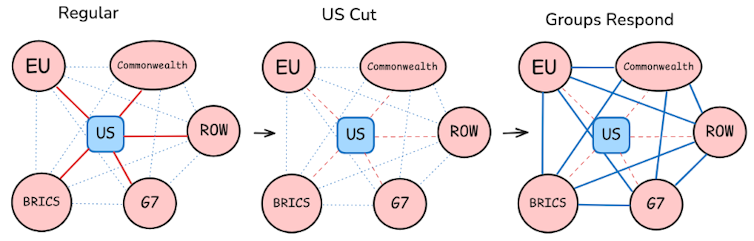
With an unpredictable president in the White House, it’s vital to understand how other groups of countries can address the likely gaps. To this end, we illustrated below the effect of a potential funding cut from the US, and then measured the effort required for each group of countries to compensate for a hypothetical 50% cut of the US funding.

Global collaboration networks before (left) and after (middle) the US funding cut, and how each group of countries can compensate for the cut (right).
CC BY-NC-SA

Cutting US funding will significantly weaken international collaboration ties, which makes sharing ideas and skills harder. Yet, as shown in the table below, each group has sufficient stock of domestic grants where turning only a small proportion into cross-border grants is enough to restore the collaboration level. That is, the EU to raise its share from 4.18% to 4.48%, non-US G7 countries from 1.11% to 1.20%, the rest of the world from 1.63% to 1.89%, the Commonwealth from 0.66% to 0.69%, and Brics (Brazil, Russia, India, China and South Africa) from 0.49% to 0.99%.

Group domestic international int_pct int_pct_target compensation
EU 5224 228 4.18% 4.48% 16
BRICS 4198 20 0.49% 0.99% 21
G7_no_US 18720 210 1.11% 1.20% 17
CW 7028 47 0.66% 0.96% 21
ROW 8114 135 1.63% 1.89% 21
Total grants per group and the extra cross-border grants needed to rebuild collaboration levels. Column ‘domestic’ is the number of grants carried out entirely within one country. Column ‘international’ (‘int_pct’) is the number (and percentage) of grants involving partners in more than one country. Column ‘int_pct_target’ is the share of international grants each group needs to reach the same level of research-link strength as before the funding cut. Column ‘compensation’ is how many additional cross-border grants each group must add to get back to the original level of research-link strength.

The numbers tell a straightforward story. When the US cuts cancer research funding, it breaks connections among researchers worldwide. This makes it harder for scientists to share discoveries and learn from each other – ultimately hurting cancer patients everywhere.

But other countries can step up to fill this gap. The table shows that each group of countries already funds plenty of domestic research. They just need to redirect a small portion of these existing grants to include international partners. This would restore the global research network to its previous strength.

This is an opportunity for governments to work together and take the lead on cancer research when the US steps back.

Four practical steps could make this happen.

  1. Match funding to where cancer hits hardest. Review current grants to ensure money goes to the deadliest cancers and the countries with the worst survival rates.
  2. Create research hubs in poorer countries. Build centres of excellence in lower-income Commonwealth countries that can train researchers, share data and run clinical trials.
  3. Fund surgery and radiotherapy research. These treatments save lives today, but get barely any research money. They deserve dedicated funding streams.
  4. Help researchers turn discoveries into treatments. Create programmes that help scientists in all Commonwealth countries – not just wealthy ones – patent their discoveries and develop them into actual medicines.

Looking ahead

Cancer kills nearly 10 million people each year, with over 20 million new cases diagnosed. By 2050, deaths are estimated to reach 18 million. The numbers are getting worse, not better.

The Commonwealth’s wealthy countries – the UK, Canada and Australia – could serve as bridges, connecting researchers across rich and poor nations. Done right, this could reshape how the world fights cancer, ensuring no country gets left behind simply because they lack resources.

The Conversation

Michael Head has previously received funding from the Bill & Melinda Gates Foundation, Research England and the UK Department for International Development, and currently receives funding from the UK Medical Research Foundation, and UK Research and Innovation

Markus Brede receives funding from UK Research and Innovation and has previously received funding from the Royal Society and the Alan Turing Institute.

Anbang Du does not work for, consult, own shares in or receive funding from any company or organisation that would benefit from this article, and has disclosed no relevant affiliations beyond their academic appointment.

ref. How to save global cancer research from Trump’s cuts – https://theconversation.com/how-to-save-global-cancer-research-from-trumps-cuts-258642

Research shows English children’s wellbeing drops when they start secondary school – here’s why

Source: The Conversation – UK – By Paty Paliokosta, Associate Professor of Special and Inclusive Education, Kingston University

Rawpixel.com/Shutterstock

For many pupils, the move to secondary school is a moment of anticipation – new friends, new subjects, and a growing sense of independence. But research in England shows this transition often comes with a hidden cost: a sharp and lasting decline in wellbeing.

Data from a 2024-2025 survey carried out by education support and research company ImpactEd Group with over 80,000 pupils shows a drop in children’s wellbeing between year six – the last year of primary school – and year eight.

This report found that enjoyment of school plummets, feelings of safety decline, and belief that their efforts will lead to success (known as self-efficacy) drops significantly. Children receiving free school meals were also less likely to say they enjoyed school, with this gap continuing to widen into secondary school.

This isn’t just adolescent growing pains. Secondary school pupils in the UK are more miserable than their European peers. Data from the Pisa programme, which assesses student achievement and wellbeing internationally, shows that in 2022 the UK’s 15-year-olds had the lowest average life satisfaction in Europe.

It’s a systemic problem – but one that can be changed.

Difficult transitions

Moving to secondary school involves much more than a change of location. Pupils must adapt to new teachers, routines, academic demands and social dynamics. And this takes place while they are going through puberty, one of the most intense periods of emotional and neurological development.

Research on school transitions stresses that success depends not only on a child’s “readiness,” but also on the school system’s capacity to support them.

Unfortunately, many schools prioritise performance metrics over relationships. This may leave many pupils – particularly those who are neurodivergent, have special educational needs, or who come from minoritised backgrounds – feeling disconnected and unsupported. This can deeply affect their wellbeing.

One major barrier to belonging is the use of zero-tolerance behaviour policies. These strict approaches to discipline – silent corridors, isolation booths, high-stakes punishments such as suspensions – are becoming more common in large secondaries and academies. Advocates have claimed these policies create firm boundaries in schools. But for many pupils, especially those with ADHD, autism, or a history of trauma, they may instead create anxiety, alienation and disengagement from school.

Children with special educational needs are excluded from school at some of the highest rates in the country. According to the Children and Young People’s Mental Health Coalition, a collaborative network of over 300 organisations including mental health organisations and youth support services, many of these children are not “misbehaving,” but expressing unmet emotional and mental health needs. Punitive responses frequently worsen their difficulties.

Pupils on stairs at school
The environment of secondary school can be very different to that of primary education.
Rawpixel.com/Shutterstock

Schools that adopt behaviour policies that focus on emotional literacy and building trust have reported success in building a caring environment.

A hidden curriculum

While these challenges affect many students, working-class pupils often face a more acute and entrenched form of educational alienation. A deeper look into the structure of secondary education in England reveals systemic inequalities that shape how different children experience school.

According to Professor Diane Reay, a leading expert on education and social class, the British school system continues to fail working-class children. Her research suggests that schools in disadvantaged areas are more likely to feature rigid discipline, “teaching to the test,” and a narrow, fact-heavy curriculum. In such spaces, there is little room for creativity, critical thinking, or personal expression.

Instead of feeling seen and valued, many working-class students may experience school as a place of constant control and low expectations. They are more likely to encounter deficit narratives: being told what they lack, rather than having their strengths recognised or nurtured.

This dynamic plays out most starkly during the transition to secondary school. Pupils from working-class backgrounds often enter year seven already disadvantaged – socially, economically, and in terms of cultural capital. This means that in unfamiliar settings where middle-class norms dominate, they may not speak the “right” way, dress the “right” way, or know the unspoken rules. These students frequently find themselves on the outside looking in.

Beyond class, issues of race and cultural background also play a key role in how pupils experience school. Students from minority backgrounds often also encounter what researchers refer to as the “hidden curriculum”.

This is a set of unspoken norms that reflect white, middle-class values, and which they may be unfamiliar with. This affects everything from which stories are told in the curriculum to how the behaviour of students is interpreted by teachers.

The year-seven dip is not inevitable. But reversing it requires more than tweaks to transition plans or behaviour policies. It demands a fundamental shift in how we understand inclusion, belonging and educational success. Schools need to put policies in place that help students feel safe, connected and empowered to manage conflict. And they should recognise that working-class and marginalised pupils face systemic barriers, and commit to dismantling them.

The Conversation

Dr Paty Paliokosta is an Associate Professor in Inclusive Education and leads the Inclusion and Social Justice SIG at Kingston University, London. She co-leads the National SENCO Advocacy Network.

ref. Research shows English children’s wellbeing drops when they start secondary school – here’s why – https://theconversation.com/research-shows-english-childrens-wellbeing-drops-when-they-start-secondary-school-heres-why-260737