How the first Bible to include a map helped spread the idea of countries with borders

Source: The Conversation – UK – By Nathan MacDonald, Professor of the Interpretation of the Old Testament, University of Cambridge

Five hundred years ago the first Bible featuring a map was published. The anniversary has passed uncelebrated, but it transformed the way that Bibles were produced. The map appeared in Christopher Froschauer’s 1525 Old Testament, which was published in Zürich and widely distributed in 16th-century central Europe.

Yet despite being a groundbreaking moment in the Bible’s history, the initial attempt was hardly a triumph.

It is flipped along the north-south axis (meaning it’s back to front). As a result, the Mediterranean appears to the east of Palestine, rather than to the west. It illustrates how little many in Europe knew about the Middle East that such a map could have been published without anyone in the printer’s workshop questioning it.

The map had originally been drawn about a decade earlier by the celebrated Renaissance painter and printmaker Lukas Cranach the Elder, based in Wittenberg in latterday Germany. Written in Latin, it shows Palestine with various important holy sites such as Jerusalem and Bethlehem. At the bottom, you can see the mountains of Sinai and the path taken by the Israelites as they escaped slavery in Egypt.

Lucas Cranach the Elder's map of the Holy Land in Christopher Froschauer's Old Testament.
Lucas Cranach the Elder’s map of the Holy Land in Christopher Froschauer’s Old Testament.
The Wren Library, The Master and Fellows of Trinity College, Cambridge, CC BY-SA

Look closely and you can see the Israelites and their tents, plus various vignettes of the events on their journey. The landscape is more European than Middle Eastern, though, reflecting the printmakers’ ignorance of this region. There are walled towns with numerous trees and, in contrast with reality, the Jordan meanders rather more dramatically towards the Dead Sea, and the coastline has more bays and coves.

In the previous century, Europeans had rediscovered the second-century Greco-Roman geographer Ptolemy, and with him the art of making accurate maps that used latitude and longitude (insofar as longitude could be estimated at that time – it greatly improved in later centuries). With the advent of printing, Ptolemy’s Cosmographia had taken Europe by storm. His scientific treatise on geography was published and his maps of the ancient world reproduced.

Printers soon discovered, however, that purchasers desired contemporary maps. Soon new maps of France, Spain and Scandinavia were published. To our eyes these are truly modern. North is at the top of the page and the locations of cities, rivers and coastlines are presented highly accurately.

Map of France from Ptolemy's Cosmographia.
Modern map of France in Ptolemy’s Cosmographia, the 1486 (1482) Ulm Printing.
Stanford University, CC BY-SA

These maps rapidly replaced medieval mapping with its symbolic approach to the world, such as the famous Hereford mappa mundi of the known world circa 1300, where it was more about conveying cultural or religious meaning than geographical accuracy. Except, that is, in one case: Palestine.

The early modern printers of Ptolemy also gave their readers a “modern map of the Holy Land” that was nothing of the sort. It was a medieval map produced not by using latitude and longitude, but using a grid to measure distances between different locations. It was orientated with the east at the top of the page and the west at the bottom. It portrayed the holy sites of Christianity and divided the land of Palestine into tribal territories.

Cranach’s map blends these two types of maps. At its top and bottom edges it has lines of meridian, but the coastline is slanted so that the entire map is orientated with the north-east at the top of the page.

It is as though Cranach couldn’t quite decide what type of map to create. Its portrayal is realistic and modern, but the map is full of symbolic geography: as your eye passes over, you journey with the Israelites from Egyptian bondage to the promised land, with all its resonant locations, such as Mount Carmel, Nazareth, the River Jordan and Jericho.

Perceptions of Palestine

The map was characteristic of Europe’s lack of interest in Palestine, then part of the Ottoman empire. What European book buyers cared for was the strange hybrid space that is the “Holy Land”: somewhere that was in our world, but also not part of it.

The towns the map portrayed were those that had flourished two millennia earlier, which for Christians were in some sense more real. They were part of the imaginative space described in their churches and scriptures.

Nicholas Poussin's The Crossing of the Red Sea 1633-34
The exodus of the Israelites as depicted in Nicholas Poussin’s The Crossing of the Red Sea (1633-34).
Wikimedia, CC BY-SA

That curious juxtaposition of ancient and modern was particularly consequential when it came to the mapping of Palestine into 12 tribal territories. The 12 tribes that descended from Jacob symbolised Christianity’s claim as true heir of Israel and its holy sites, and also what the holy sites represented: the inheritance of the heavenly Jerusalem. Lines on the map communicated the eternal promises of God.

But in the early modern period, lines began to be used to mark the borders between sovereign states. The maps of the Holy Land, neatly divided amongst the Israelite tribes, set the agenda for cartographers. As the 16th century went on, more and more maps in atlases divided the world among distinct nations with clearly defined borders.

The fact that a map divided into territories appeared in the Bible gave apparently religious authorisation for a world full of borders. Lines that had once symbolised the boundless divine promises now communicated the limits of political sovereignties.

Within Bibles themselves, maps had arrived for good. The following years saw printers experiment with various configurations, but eventually they were to settle on four maps: one of the wilderness wanderings of the Israelites, one of the territories of the 12 tribes, one of Palestine at the time of Jesus, and one of the apostle Paul’s missionary journeys.

There is a pleasing symmetry: two maps for the Old Testament, two for the New Testament. But also, two maps of journeys and two maps of the Holy Land. Such symmetries communicated the connections between events: the Old Testament was fulfilled in the New Testament, and Judaism in Christianity.

The first map in a Bible is therefore a fascinating moment in history, but a troubling one. It transformed the Bible into something like a Renaissance atlas, but deeply embedded in assumptions about Christian superiority: the Holy Land of Christian imagination displacing contemporary Palestine, and Christianity superseding Judaism.

It was also one of the agents in creating the modern world of distinct nation states. In many ways, we’ve been living with the consequences ever since.

The Conversation

Nathan MacDonald does not work for, consult, own shares in or receive funding from any company or organisation that would benefit from this article, and has disclosed no relevant affiliations beyond their academic appointment.

ref. How the first Bible to include a map helped spread the idea of countries with borders – https://theconversation.com/how-the-first-bible-to-include-a-map-helped-spread-the-idea-of-countries-with-borders-270901

Green transition targets are not realistic – how to decarbonise at the right pace

Source: The Conversation – UK – By Siavash Alimadadi, Research Associate at the Centre for Sustainable Business, King’s College London

Andrzej Rostek/Shutterstock

While the UK needs to accelerate its energy transition, targets are being missed, projects run into delays, and the public wonders why progress feels so slow. The temptation is to blame politics, funding or technology. Yet there is a deeper reason the road to net zero keeps stalling.

Everything in our modern life, from our roads to our factories, have been built around readily available fossil fuels. As a result, we expect things to happen quickly, to last indefinitely and to disappear without consequence.

Why this expectation? Burning coal, oil and gas taps carbon and sunlight that were locked away over millions of years and releases that energy in a matter of decades. That compression of deep time (the vast geological timescales of Earth’s history) into human time gives the impression that highways, buildings and plastics can be produced at speed and endure without limits. Through burning fossil fuels, millions of years worth of stored sunlight and energy can be transformed into concrete, plastics and electricity in a matter of hours.

When we talk about decarbonisation, we are not just changing fuels. We are being asked to change this entire pace of living.

Fossil fuels made energy cheap and abundant, and so our economies were organised around speed. We learned to pour concrete and we assumed it would stand for decades. We built factories that ran day and night and supply chains that delivered instantly. Convenience became normal.

In this context, it makes sense that governments promise to “accelerate” the green transition. The problem is that the very systems we are trying to fix still run on the rhythms of the fossil era. They are not designed to slow down or pivot quickly.


Read more:
Five ways to improve net zero action – our new research highlights lessons from the past


The North Sea’s recent “tieback” oil licences help show what is really happening.

The UK government’s new North Sea strategy is a case in point. The introduction of “transitional energy certificates” or “tiebacks” allow new drilling on or near existing fields. So while the UK has committed to banning all new oil and gas licences, some new fossil fuel extraction is still permitted.

Instead of marking a clean break from fossil fuels, they extend existing infrastructure by linking smaller oil fields to older platforms. This approach is faster and cheaper than starting new projects. On the surface, it looks like progress. But it keeps the old system going rather than rethinking it.

This logic shows up in how we build, too. Concrete is a telling example. In 2025 the UK announced its first carbon capture retrofit for a cement plant in Padeswood, North Wales. This so-called “net zero” cement factory will trap around 800,000 tonnes of carbon dioxide each year and start producing low-carbon cement in 2029.

This is a major technical step forward. Yet the retrofit does not change how cement is made. It simply adds a filter to an existing process that heats ancient limestone to very high temperatures. It still relies on the idea that we can turn geological time into buildings in hours and have them endure for centuries.

The four-year retrofit shows how slow it is to adapt a single plant, but the real lesson is that governments, industries and societies are investing heavily to keep the same rapid tempo of construction, rather than imagining different materials or building practices.

stone processing for cement industry
Decarbonising the cement industry will be a slow process.
Vera Larina/Shutterstock

The electricity grid reveals a similar mismatch. For years Britain’s electricity network connected projects on a first come, first served basis. This model assumed a steady trickle of large fossil fuel plants. The surge of renewables has overwhelmed it.

By late 2025 there were more than 700 gigawatts of generation and demand projects waiting in the queue – over four times the capacity needed to meet the government’s 2030 clean power target. Some developers have been waiting a decade for a connection. The backlog exists not because there is a shortage of projects, but because the system was never designed to handle so many small, decentralised schemes.

Regulators are now reforming the queue to prioritise “shovel-ready” projects. That is a necessary fix, but it is also an admission that our assumptions of endless, rapid growth have outpaced the physical network we built.

These examples reveal a deeper pattern. We are not only managing emissions or upgrading technology. We are holding on to the pace and habits shaped by the fossil era. The green transition often involves making the old system more efficient, rather than asking what a truly different future would require.

Many also expect this transition to be as quick and frictionless as the fossil fuel era made everything seem. Yet decarbonising means reworking industries and infrastructure that took decades to build.

Cement plants last half a century. Power lines take years to plan and construct. Even the most optimistic timelines involve years of design, consultation and construction. This is not a failure; it is the reality of shifting away from a system designed for speed and permanence without patience.

Resetting the clock

Recognising this mismatch does not mean giving up on urgency. Climate change demands swift action. But urgency is not the same as haste. Instead of expecting every solution to scale overnight, we need to design policies and industries in a way that respects how long things take, and, indeed, whose timing counts.

For example, do policies align with corporate investment cycles, election calendars or the slower timelines of ecosystems and future generations? Whose timeframes shape action?

Building a low-carbon economy will not feel like the rapid transformations of the past. It will involve repairing, adapting and sometimes slowing down. But if we want to move beyond fossil fuels, we cannot keep living on fossil time. A successful transition will be one that aligns our policies, industries and daily lives with the slower, more regenerative rhythms of the world we depend on.


Don’t have time to read about climate change as much as you’d like?

Get a weekly roundup in your inbox instead. Every Wednesday, The Conversation’s environment editor writes Imagine, a short email that goes a little deeper into just one climate issue. Join the 47,000+ readers who’ve subscribed so far.


The Conversation

Jonatan Pinkse receives funding from the ESRC – The Productivity Institute.

Siavash Alimadadi does not work for, consult, own shares in or receive funding from any company or organisation that would benefit from this article, and has disclosed no relevant affiliations beyond their academic appointment.

ref. Green transition targets are not realistic – how to decarbonise at the right pace – https://theconversation.com/green-transition-targets-are-not-realistic-how-to-decarbonise-at-the-right-pace-270720

Why the North Korean government is so invested in women’s youth football

Source: The Conversation – UK – By Jung Woo Lee, Senior Lecturer in Sport and Leisure Policy, University of Edinburgh

North Korea cemented its status as one of the dominant forces in women’s youth football in early November, defeating the Netherlands 3-0 in the under-17 World Cup final. They returned from the tournament victorious for a record extending fourth time, having won the past two titles.

The North Koreans also won awards for the tournament’s best and second-best overall players. These trophies went to North Korea’s forward, Yu Jong-hyang, and her teammate, Kim Won-sim, respectively. The success of North Korea’s young footballers is the product of a broader strategy aimed at strengthening national pride and boosting the country’s international standing.

It is perhaps no great surprise that North Korea, which is nominally under communist rule, was an early adopter of women’s football. Socialist ideology generally encourages women to take part in sport, seeing it as a means of achieving gender equality and promoting national strength.

In the late 1980s, when football’s global governing body Fifa was planning to launch women’s competitions, North Korea’s leaders promptly introduced football development programmes for women. This included incorporating football training for girls into the school curriculum and creating women’s football teams in the army, which allowed players to train and develop full-time at the state’s expense.

This approach soon began to pay off. From the 1990s to the early 2010s, North Korea consistently had one of the best senior national women’s football teams in Asia. North Korea won several Asian Cup titles before a major doping scandal involving five national-team players in 2011 put the breaks on this success.

North Korea was banned from the 2015 women’s World Cup and failed to qualify four years later. The country then went into a period of isolation during the pandemic, which prevented it from participating in the 2023 World Cup.

The North Korean women’s youth sides, meanwhile, have continuously shown footballing prowess on the international stage. The under-20 squad won the country’s first football World Cup in 2006, with North Korea emerging victorious from the inaugural under-17 women’s World Cup two years later.

Kim Jong-un came to power in 2011 and, like his father and predecessor Kim Jong-il, made the development of competitive sport a key policy priority. He increased investment in sport significantly, overseeing the construction of sports facilities such as the Pyongyang International Football School.

Opened in 2013, this is a state-run elite training facility that aims to identify and develop talented young footballers for the country’s national teams. Some of the best players from the current youth setup, including Yu Jong-hyang and Kim Won-sim, attended the school.

Why sport matters

Any sporting victory on the global stage is important for the North Korean government as it helps boost nationalism among the country’s people. In 2023, Kim Jong-un proclaimed: “it is a sacred duty of our athletes to raise our national flag high in foreign land”. Young North Korean women footballers have consistently performed this very act.

Jon Il Chong, who was announced as the best player at the under-17 women’s World Cup in 2024, told reporters after North Korea’s victory in the final: “It was the desire and honour of our team to give the respected fatherly marshal, Kim Jong-un, the report of pleasure and victory.” She added: “I will train harder and harder in the future so that I will demonstrate the honour of North Korea throughout the world.”

But Pyongyang’s goal extends beyond boosting nationalism among its athletes. Two days after the 2025 under-17 women’s final, the state-run Korean Central Television channel broadcast a delayed recording of the match on large outdoor screens in Pyongyang. Rodong Sinmun, the official newspaper of the ruling Workers’ party, described jubilant scenes across the capital.

“Even young mothers scolded their children to walk faster and stopped in front of the screens, holding them tight as they watched the match,” its report said. “The area around Pyongyang Station became a sea of ecstasy.”

North Korea’s under-17 World Cup win sparked street celebrations in Pyongyang.

North Korea’s leadership tends to be viewed internationally as despotic and militaristic. However, even relatively minor international sporting events like the under-17 women’s football World Cup present an opportunity for North Korea to project a more positive image of itself to the world. They also provide a channel for diplomatic dialogue.

Fifa’s webpage featured images and stories of the North Korean under-17 women’s team following their win in Morocco, with a celebratory and congratulatory undertone throughout. Even in South Korea, a country North Korea maintains frosty relations with, football fans shared their admiration for the North Korean team’s success on social media.

Clearly, the dominance of North Korea’s youth sides needs to be translated into the senior game for the state’s sporting strategy to be fully successful. North Korean football players need to join prestigious professional leagues in the west, competing on a more visible platform against the best players in the world.

But due to UN economic sanctions imposed on the regime in Pyongyang, which were first levied in 2006 and have been tightened since, no homegrown North Korean footballers can sign a contract with a foreign football club. This creates a significant barrier to the development of North Korean football beyond the youth level moving forward.

It remains to be seen whether North Korea can regather its past momentum and qualify for the senior women’s World Cup in Brazil in 2027. But, for now, North Korea’s footballing dominance seems limited to the youth ranks.

The Conversation

Jung Woo Lee does not work for, consult, own shares in or receive funding from any company or organisation that would benefit from this article, and has disclosed no relevant affiliations beyond their academic appointment.

ref. Why the North Korean government is so invested in women’s youth football – https://theconversation.com/why-the-north-korean-government-is-so-invested-in-womens-youth-football-269563

Nigel Farage’s alleged teenage comments are a distraction from the damage of his politics

Source: The Conversation – UK – By Aurelien Mondon, Senior Lecturer in Politics, University of Bath

More than 20 of Nigel Farage’s former classmates have reportedly alleged the Reform UK leader made racist and antisemitic comments between the ages of 13 and 18.

The claims – some of which have been known for some time – are truly horrendous. They include allegedly taunting Jewish students, including telling one, “Hitler was right,” and singing, “Gas ‘em all.”

After a party spokesperson emphatically denied the accusations on his behalf, Farage has now dismissed the alleged comments as banter in a playground. Asked to categorically rule out that he had engaged in racial abuse, he said he “would never, ever do it in a hurtful or insulting way”. Or at least, “not with intent”, as he clarified once pushed further.

More recently, his position appeared to change again when he said, “I can tell you categorically that I did not say the things that have been published in the Guardian aged 13, nearly 50 years ago.”

However historic, reports of such behaviour – and Farage’s reaction – give us an insight into the leader of what I argue is now the UK’s main far-right party (more on that later). Anyone who has paid attention to Farage’s political career will not be surprised by the nature of the beliefs allegedly espoused.

Reform UK selected as head of its student organisation a former academic who argued that UK-born people from minority ethnic backgrounds were not always British. And when Reform MP Sarah Pochin came under fire for her complaints about adverts “full” of black and Asian people, Farage said he thought the “intention” behind her comments was “ugly”, but not “racist”.

Reform campaigners have been caught making homophobic and racist slurs. Councillors have resigned or candidates dropped from ballots for allegedly making offensive or racist comments. And of course, there is always the image of Farage with Ukip’s “breaking point” poster.

With the latest allegations, Farage appears to be taking an approach of plausible deniability: who is to know what he thought at the time?

This has been part of the reactionary playbook for decades. Public figures cross the line before denying intent or pretending they are “just asking questions”. This strategy allows them to make their ideas enter the mainstream public discourse, while facing few real risks of repercussion or accountability.

What really matters is seeing this episode as part of a wider political project. In other words, even if Farage had not acted like this as a teenager, would that mean the politics he has helped mainstream for decades are now acceptable?

Reactionary playbook

Recent history shows that focusing only on extreme actions at the expense of more subtle discourse can help, rather than hurt, right or far-right political projects.

Jean-Marie Le Pen, the former head of France’s far-right Front National and father of current far-right leader Marine Le Pen, was fined on a number of occasions for describing the Holocaust as a “detail of history”. These claims again should not have surprised us, considering his political trajectory and the simple fact the Front National was born out of a neo-fascist alliance.

Yet the outrage caused by Le Pen’s Holocaust denialism did not prevent the mainstreaming of his party or politics. He remained president of the FN until 2011 and an MEP until 2019. Crucially, it paved the way for his daughter to become a leader who could appear more moderate by comparison while espousing similar politics.

Legitimisation through contradistinction is a key chapter in the far-right playbook. Find an extreme example to make your political project appear moderate by comparison. Marine Le Pen benefited from this again in 2022 when the extremist campaign of Eric Zemmour made her seem like a palatable alternative.

Farage himself benefited from this in the 2010s by portraying the British National Party as beyond the pale, claiming even to have destroyed the far right in the UK. Of course, this flies in the face of the politics that Ukip, the Brexit Party and Reform have pushed since – but it has worked wonders in the mainstream media.

Thanks to his more affable persona, his own elite status and connections and his more polished discourse, Farage was able to portray himself as acceptable by comparison with the extreme right, thus shifting the dial right regarding what is acceptable in mainstream discourse.

Farage speaking in front of an American flag and CPAC background.
Farage onstage at the US Conservative Political Action Conference.
Joshua Sukoff/Shutterstock

The threat cannot simply be resolved through individual introspection, apologies for crossing the line or indeed, the downplaying of deeply offensive speech as “banter”.

Even if Farage were to admit fault and apologise, this would not have the impact many hope. The cat is out of the bag: far-right views on immigration, Islam or trans rights are now core to mainstream public discourse and shaping the agenda, thanks in part to politicians like Farage.


Read more:
Look to the mainstream to explain the rise of the far right


Far-right politicians have been incredibly successful at forcing their ideas into mainstream discourse under a thin veneer of respectability, or by hijacking potentially progressive or liberal values such as free speech or violence against women and girls to push deeply reactionary politics.

Though I and others argue that Reform fits the academic definition of “far right”, there is a tendency among mainstream politicians and media to take the party at its word or to back away from confrontation. Something of the sort happened with the BBC apology to Reform in 2024 for calling the party “far right”.

Not calling out these politics for what they are can only legitimise them. This is done through euphemism (calling them “populist” for example), by absorbing and mimicking them or accepting them as “legitimate grievances” from “the people”.

Focusing on extreme events such as the reports of Farage’s teenage past can exceptionalise the nature of far-right politics and make it harder to call out. This sensationalist approach centred on one person’s behaviour prevents us from actually interrogating the wider process of mainstreaming, which takes more mundane forms and has a much deeper impact on our public discourse and democracy. It also downplays the role played by the mainstream media and politicians in the process of mainstreaming.

Creating individual monsters to symbolise extremism is a distraction away from the very real and systemic nature of the far-right threat.

The Conversation

Aurelien Mondon does not work for, consult, own shares in or receive funding from any company or organisation that would benefit from this article, and has disclosed no relevant affiliations beyond their academic appointment.

ref. Nigel Farage’s alleged teenage comments are a distraction from the damage of his politics – https://theconversation.com/nigel-farages-alleged-teenage-comments-are-a-distraction-from-the-damage-of-his-politics-270617

Prostate cancer screening rejected by UK government advisers – here’s why

Source: The Conversation – UK – By David C. Gaze, Senior Lecturer in Chemical Pathology, University of Westminster

Thailand Jarun Ontakrai/Shutterstock.com

A roster of high profile advocates, including sportsmen, actors, two previous prime ministers and over 100 MPs, have recently joined patient groups and charities in calling for a UK national prostate cancer screening programme.

However, the UK National Screening Committee (UKNSC) has announced its draft decision to advise the government against routine population screening for all men. It has also rejected calls for a specific screening programme for black men due to “uncertainties” given the lack of clinical trials in this population group.

Instead, it recommended targeted screening every two years for a small proportion of men – those aged 45 to 61 years with a confirmed BRCA1 or BRCA2 gene mutation. Three in every 1,000 men carry these gene variants and may develop faster-growing and more aggressive cancer at a younger age.

Why such caution?

The UK screening committee commissioned the Sheffield Centre for Health and Related Research (Scharr) to model the cost-effectiveness of prostate cancer screening. It looked at screening all-risk men, black men, men with family history of cancer and BRCA carriers. Its initial findings were that screening for BRCA carriers was the most cost-effective, and there was the most uncertainty about screening all-risk men.

These findings reflect limitations with the way screening would be carried out. The evidence shows that the standard blood test used for early detection, the prostate‑specific antigen (PSA) test, is not accurate enough when used as a general screening tool.

The PSA test often fails to distinguish between cancers that would cause serious illness and those that would remain harmless for a man’s lifetime, such as a benign enlargement of the prostate called benign prostatic hyperplasia or BPH. That means screening with PSA alone could result in false positive tests.

As a result, many men could face invasive follow-up procedures or treatments, including surgery or radiotherapy that carry serious risks, such as incontinence and sexual side-effects, even when their cancer posed little threat. Conversely, the PSA test may also miss some cancers (called “false negatives”) with dangerous health consequences if not detected and appropriately treated.

Compounding the problem is a lack of convincing evidence that mass screening reduces the number of deaths from prostate cancer. The UKNSC has so far concluded that the balance of harms and benefits does not support a nationwide screening programme.

That said, the committee recognises the debate is not over. Screening proponents point to newer data. A recent study in the BMJ showed that PSA-based screening could reduce prostate cancer deaths by about 13% over time.

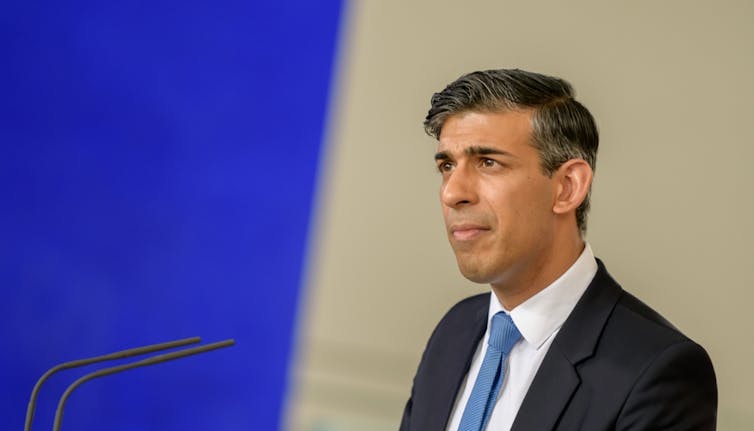
Former UK prime minister, Rishi Sunak.
Former PM, Rishi Sunak, called for a national prostate cancer screening programme.
photocosmos1/Shutterstock.com

Meanwhile, advances in technology have improved diagnostic pathways. Many men with high PSA levels are now offered an MRI scan before biopsy, reducing unnecessary biopsies and the risks associated with them.

Assuming the government follows the committee’s advice, what this means for now in practical terms is that most men in the UK will not be invited for regular prostate cancer checks. The only widespread option remains the “informed choice” route, where men aged 50 years or over who want a PSA test can ask their GP, but even then, they should be informed of the possible risks as well as the benefits of testing.

However, this may not be the end of the story. The committee has opened a consultation on its draft recommendation and on the Scharr study. It is due to make its final recommendation in March 2026. It has also commissioned Scharr to undertake further modelling.

The health secretary, Wes Streeting, who will make the final decision on screening, said: “I will examine the evidence and arguments in this draft recommendation thoroughly, bringing together those with differing views, ahead of the final recommendation in March.”

The week before the recommendation was announced, a major two-year trial was launched to assess and compare different screening methods, including fast MRI scans, genetic testing and PSA blood testing.

But until screening can reliably tell harmful cancers from harmless ones, the risk of overdiagnosis and overtreatment will remain a real and serious concern.

The Conversation

David C. Gaze does not work for, consult, own shares in or receive funding from any company or organisation that would benefit from this article, and has disclosed no relevant affiliations beyond their academic appointment.

ref. Prostate cancer screening rejected by UK government advisers – here’s why – https://theconversation.com/prostate-cancer-screening-rejected-by-uk-government-advisers-heres-why-270918

Five tips for becoming a cinephile in the age of streaming algorithms

Source: The Conversation – UK – By Alexander Sergeant, Lecturer in Digital Media Production, University of Westminster

GoodStudio/Shutterstock

So you want to be a cinephile? It used to be easy enough. When the first generation of film audiences emerged in the early 1900s, film clubs began springing up in urban centres across the globe. From New York to Paris to Mumbai, people would gather to watch, discuss and pontificate over the nature of the world through the lens of the screen.

Yet, as time and technology has progressed, the birth of home viewing and then streaming has created a much more fragmented and bewildering landscape – particularly for the young film fan wanting to progress to the elite ranks of the cinephile.

Far from simply becoming a member of an actual club, it can feel daunting for modern film fans to know where to start if they have a desire to learn more about movies. To help those in need, I present these handy tips for how to become a modern-day cinephile in the age of streaming algorithms.


No one’s 20s and 30s look the same. You might be saving for a mortgage or just struggling to pay rent. You could be swiping dating apps, or trying to understand childcare. No matter your current challenges, our Quarter Life series has articles to share in the group chat, or just to remind you that you’re not alone.

Read more from Quarter Life:


1: Take ‘best of’ lists with a grain of salt

A useful starting activity for the digitally-savvy film fan looking to get up to speed with the history of cinema is to consult the wealth of “best of” lists available online.

These can be useful in drawing your attention to the wealth of films that exist that you might not have heard of. But these lists are inherently subjective and say far more about the people who produced them than they do about the supposed objective quality of the films highlighted.

Historically, cinephiles came from a particular subsection of society. This was not a club that made a lot of room for people working blue collar jobs, marginalised people, or anyone who didn’t have a lot of free capital and leisure time to spend in large urban centres. It is not surprising that the films and filmmakers that appear on “best of” lists are usually for, and from, that audience.

2: Ignore the algorithms

Another temptingly easy way to consume more films is to allow technology to do the work for us, particularly in the age of AI. Netflix has built its entire business model on this approach, providing suggestions for what we should watch as part of its platform model so that we all feel individually catered for, even if what we actually watch is very similar to everyone else.

Cinephiles through history have developed ways to watch beyond that which was available in their local multiplex or video store. You must find ways to watch beyond that which your streaming service recommends for you. Alternative streaming sites like Mubi draw from a wider range of both historical and world cinema.

These might be useful platforms to access films from a richer cultural heritage. But keep in mind rule number one: these services should not get to decide your favourite films either.

Group of friends watching a film
Only you get to decide whether you enjoy a film or not.
GoodStudio/Shutterstock

3: Be a contrarian

There’s a varied tasting menu of film history out there. Only you get to decide which of that is special. Delight in defying expectations. Mix a course of French new wave arthouse filmmaking with a marathon session of all the High School Musicals. Find value in the onscreen charisma of figures like Vin Diesel or Kevin Hart while enjoying the method acting of Marlon Brando or Viola Davis. Enjoy the directing of Michael Bay or Uwe Boll as much as Christopher Nolan, Greta Gerwig or Martin Scorcese.

Don’t be pigeonholed into liking only one kind of filmmaking. The more the merrier.

4: Try to love rather than judge

Cinephiles should be haunted by the spectre of the words of Anton Ego, the ghoulish restaurant critic and antagonist in the Pixar film Ratatouille (2007): “[Critics] thrive on negative criticism, which is fun to write and to read … But there are times when a critic truly risks something, and that is in the discovery and defence of the new.”

The critic scene in Ratatouille.

Being a cinephile is about loving the new. It is not about degrading works you feel superior to. Avoid attending quote-a-longs of infamous flops like The Room (2003), or embracing cynical “so bad it’s good” rewatches. All these do are enforce fixed ideas of what is good and bad, while arching an eyebrow to seem subversive in the process.

Love whatever you want to love, sincerely and passionately, and find ways to articulate why.

5: Let’s get physical

We assumed when everything went online that, well, everything would go online. But the utopia of that worldview is long gone. When Netflix first launched as a DVD postal subscription service back in 1998, it boasted to its customers a back catalogue of over 70,000 films.

In 2020, it was estimated that the platform offered approximately 3,800 film titles. It turns out it’s cheaper to tell us what we should like, rather than letting us find that out for ourselves.

To find the films you want to see, you might have to go back into the physical world. Embrace older technology. Dust off your parent’s DVD or Blu-ray player (if they still own one). Visit your local library. Attend local film festivals or free screenings, especially if they are showing films you’ve never head of.

Better yet, go to the cinema. Switch off your mobile phone. Make conversation with the person sitting next to you (before and after the film only, please). Cinephilia was always supposed to be a way of bringing people together. Let’s turn it into that once more.


Looking for something good? Cut through the noise with a carefully curated selection of the latest releases, live events and exhibitions, straight to your inbox every fortnight, on Fridays. Sign up here.


The Conversation

Alexander Sergeant does not work for, consult, own shares in or receive funding from any company or organisation that would benefit from this article, and has disclosed no relevant affiliations beyond their academic appointment.

ref. Five tips for becoming a cinephile in the age of streaming algorithms – https://theconversation.com/five-tips-for-becoming-a-cinephile-in-the-age-of-streaming-algorithms-269659

What the budget means for the NHS

Source: The Conversation – UK – By Catia Nicodemo, Professor of Health Economics, Brunel University of London

The NHS didn’t receive a great deal of specific attention in Rachel Reeves’ budget. She mentioned it, but in fairly general terms around plans to invest and cut waiting lists.

But the overall plan presented by the chancellor effectively incorporates the NHS into a high tax, high spend economic model. Those revenue-raising taxes include a long freeze in income tax thresholds, higher rates on property, dividends and savings, plus new levies on gambling and electric vehicles.

And structurally, this arrangement does two things for the NHS. First, it shifts more of the tax burden onto wealth and higher incomes, which may be politically easier to defend when channelling money into health. Second, it broadens the tax base that pays for day-to-day NHS running costs, reducing reliance on borrowing to fund nurses’ salaries or catching up on elective (non-emergency) procedures.

On the spending side, there was talk of protecting “record investment” and a promise of 250 new neighbourhood health centres.

Reeves said the government was “expanding more services into communities so that people can receive treatment outside of hospitals and get better, faster care where they live”.

This is an encouraging sign of plans to boost primary and community care capacity rather than just pour more money into hospitals. And it could be the only route to a sustainable NHS. For if more problems are dealt with earlier and closer to home, acute care becomes less overwhelmed.

Away from the NHS frontline, the “milkshake tax” – extending the sugar levy to high-sugar dairy drinks – is a relatively small move economically. But it is an important strategic step which shows that the Treasury realises that diet-related disease should be treated not just as a clinical problem, but a fiscal one too.

Even modest reductions in obesity and diabetes can significantly ease future NHS demand and improve people’s chances of working.

That said, critics could argue that it also functions as a kind of “sin tax” because lower-income households spend a higher share of their income on cheap, high-sugar products. So the levy risks being regressive unless it is paired with affordable healthy alternatives and targeted support, so that it changes behaviour without simply squeezing the poorest.

Alongside this, the decision to remove the two-child cap on some benefits pulls in the opposite direction. It is a redistributive measure that should reduce child poverty rather than penalise it.

Health risks

For the NHS, that matters just as much as any health-specific tax. Children growing up in poverty are more likely to experience poor nutrition, overcrowded housing, chronic stress and worse mental health. All of these drive higher use of health and social care over their lifetime.

Lifting the cap therefore acts as a preventative health intervention by boosting household resources for larger families, improving the chances that children have access to adequate food, heating and stability.

Pink milkshake in a glass.
Reeves the milk(shake) snatcher.
Seventh Studio/Shutterstock

So in combination, a sugar levy that nudges diets in a healthier direction and a benefits system that no longer structurally penalises the children of larger families could, if well designed and properly supported, start to lessen long-term demand on the NHS. And that could work out to be a better approach compared to simply funding ever-rising treatment costs.

Overall, the budget nudges the UK towards paying more tax now to avoid an even more financially fragile NHS later.

But that comes with risks too. If economic growth, productivity and the UK’s general health do not improve quickly enough, a tax-heavy model with a still-overstretched health service could prove politically and economically unstable.

The Conversation

Catia Nicodemo is affiliated with the University of Oxford

ref. What the budget means for the NHS – https://theconversation.com/what-the-budget-means-for-the-nhs-270900

Drug use is changing in England – with more adults showing signs of dependence

Source: The Conversation – UK – By Sally McManus, Professor of Social Epidemiology, City St George’s, University of London

Cannabis dependence nearly doubled in the past decade. Kit Viatkins/ Shutterstock

Drug use appears to be changing in England – both in the types of drugs people take and their potency, according to our latest survey of adult mental health and wellbeing.

The Adult Psychiatric Morbidity Survey (APMS) began in 1993 and is the longest running mental health survey series in the world. This national study gives us one of the clearest pictures of mental health in England. Because it includes people from all walks of life, not just those using NHS services, it shows how mental health is changing across the population.

In the latest survey, a random sample of around 7,000 adults aged 16 to 100 living in England took part in detailed interviews at home, each lasting about an hour and an half. Participants were asked questions about their mental health, whether they used any of a range of illicit drugs, and if they had experienced signs of dependence, such as symptoms of withdrawal or increased tolerance.

Although the Crime Survey for England and Wales (CSEW) is the government’s official source of statistics on illicit drug use in England, it is a survey about crime. As such, those surveyed may not be comfortable disclosing their illegal activities – meaning the CSEW might not fully capture the extent of drug use across the population.

Because our survey is of the population’s health and wellbeing, participants may be more willing to disclose their drug use. This gives us a valuable alternative lens on drug use and an opportunity to cross-check against official figures.

Our report has highlighted important shifts in what we know about the extent of drug use in England, the types of drugs adults take and the degree to which people may be dependent on those drugs.

Drug use may be more widespread

Our findings suggest a higher proportion of adults in England use drugs than official figures have shown.

We found that around 18.1% of 16- to 24-year-olds reported using an illicit drug in the past year. This is higher than the 16.5% reported by the CESW for the same age group and time period.

A few factors could be at play here.

Our survey doesn’t include Wales – so the geographic coverage isn’t identical between the two surveys – and we also asked participants about substances which aren’t covered in the CSEW. This included amyl nitrites, prescription opioids, synthetic cannabinoids and volatile substances. This broader scope may contribute to a more complete picture of drug use in the population – and account, to some extent, for the higher prevalence we found.

But even when we compared just one drug type, differences are evident: 4.3% of 16- to 24-year-old participants reported using ketamine in the past 12 months, compared with 2.9% of 16- to 24-year-olds in the CSEW.

This suggests that surveys framed around crime might lead to under-reporting, as people may be less willing to disclose illegal behaviour in that context. Approaching drug use through the context of mental health may offer a more accurate picture of what’s really going on.

Non-medical use of prescription opioids

Until now, due to a lack of data little was known about what proportion of people in England use prescription opioids without a prescription. So our survey asked people whether they had ever used opioid medications such as buprenorphine, fentanyl, morphine, oxycodone and tramadol that hadn’t been prescribed to them.

Around 3% of participants reported that they had – much higher than the proportion reporting use of another opioid, heroin (which was below 1%). This suggests that non-medical use of prescription opioids may be a distinct and more widespread problem.

A person pours pills from a prescription bottle into the palm of their hand.
Young people are the highest users of non-medical prescription opioids.
Rohane Hamilton/ Shutterstock

Men and women were equally likely to report using prescription opioids that had not been prescribed to them. Prevalence was highest in 25- to 34-year-olds. This indicates that usage probably can’t be explained solely by self-medication for medical conditions and physical pain, which tend to be more common in older age groups.

Gender profile of drug dependence

Among 25- to 34-year-olds, men were twice as likely as women to report signs of dependence – possibly reflecting gender differences in family responsibilities or life stage. But in 16- to 24-year-olds, signs of drug dependence were similarly common in men and women.

This is a noticeable shift. In earlier waves of the survey series, young men consistently showed the highest levels of drug use and dependence. It appears this is no longer the case.

These results suggest that young women may be engaging in similar levels of risk-taking – or that young men are starting to use drugs at a later age, with problems emerging later down the line.

But given the relatively small number of 16- to 24-year-olds in the sample, it’s too early to say for sure.

Cannabis dependence rising

The proportion of adults reporting signs of cannabis dependence nearly doubled this decade – from 2.8% in 2014 to 5.4% in 2023-2024. Yet this rise doesn’t appear to be explained by an increase in the number of people using cannabis. In 2014, 7.2% of people reported having used cannabis in the past year. In 2024, this figure only rose to 8.7%.

So it’s likely this increase in cannabis dependence is due to changing potency or other factors.

A 2018 analysis of drug seizures indicated that the UK’s cannabis market is increasingly populated by high-potency varieties. Stronger cannabis potency has been linked to higher risk of addiction. The growing range of cannabis products, such as cannabinoid vapes, may also be making it easier to access and use cannabis more frequently.

Lack of specialist support

Only about one adult in every five who showed signs of drug dependence reported they’d ever received support or treatment for their drug use.

The survey also revealed a strong overlap between dependence and depression or anxiety.

This can present further challenges for mental health services in terms of engagement and recovery.

Patterns of drug use and dependence in England appear to be shifting. It’s important that there’s awareness of these changing trends so that support can be targeted effectively.

The Conversation

This chapter was produced by a team of researchers: Maxineanu, I., Roop,S., Morris, S., McManus, S., Roberts, E., Strang, J. (2025) Drug use and dependence. In Morris, S., Hill, S., Brugha, T., McManus, S. (Eds.), Adult Psychiatric Morbidity Survey: Survey of Mental Health and Wellbeing, England, 2023/4. NHS England.

Sally McManus led the 2007 and 2014 Adult Psychiatric Morbidity Surveys and is part of the team running the 2023/4 survey. She is Professor of Social Epidemiology and Director of the Violence and Society Centre at City St George’s, University of London. She is a deputy director of the VISION consortium, which is funded by UKRI.

Sarah Morris leads the Adult Psychiatric Morbidity Survey and works on the Health Survey for England at the National Centre for Social Research, which is commissioned by NHS England, with funding from England’s Department of Health and Social Care.

ref. Drug use is changing in England – with more adults showing signs of dependence – https://theconversation.com/drug-use-is-changing-in-england-with-more-adults-showing-signs-of-dependence-270839

Net migration has dropped to pre-Brexit levels – why it may not be enough to satisfy voters

Source: The Conversation – UK – By Mihnea Cuibus, Researcher at The Migration Observatory, University of Oxford

Reshetnikov_art/Shutterstock

Net migration to the UK has fallen to levels last seen before Brexit. The latest ONS figures show net migration reached just over 200,000 in the year ending in June. This marks a 78% decline over the past two years, from a peak of more than 900,000.

The Labour government will welcome this development. It has made bringing down net migration (the difference between the number of people entering the country and expected to stay long term, and the number leaving) one of its key pledges.

The government also recently announced a series of reforms to asylum and immigration with the aim of deterring people from coming to the UK. These include making refugee status temporary and requiring people to wait for 20 to 30 years in some cases before becoming eligible for permanent status – longer than any other European country.

As numbers fall and restrictions are implemented, are high public concerns about immigration also likely to come down, reducing pressure on the government? Not necessarily, for several reasons.

First, numbers will not necessarily stay this low for the long term. EU citizens are currently subtracting around 70,000 per year from the total net migration figure, because more are leaving than arriving.

This is unlikely to continue indefinitely. People from outside the EU may also push up net migration figures over the medium term. Fewer of these migrants have arrived recently, which is likely to mean fewer people departing the UK in the future and hence lower emigration.

Recent numbers might also be revised up at a later date. The ONS has raised concerns about the accuracy of data showing an unexpected decline in net migration of family migrants (close family members of British nationals and other migrants with settlement in the UK) that seems inconsistent with other data sources.

Even if numbers do remain around the 200,000 mark, it is difficult to know how this will affect public opinion. In the past, the salience of migration has tended to go up when numbers were higher, although the relationship is not always precise.

The public may not be aware that numbers have fallen, and those who are aware may not consider 200,000 to be particularly low. The sharp decline in net migration may also raise some concerns about why an increasing number of people choose to leave the UK, particularly if they are British nationals.

Second, asylum applications and unauthorised arrivals by small boat – the least popular and most salient forms of migration – have not declined. Opinion polling suggests that asylum is the category the public would most like to see reduced.

Asylum applications rose to an all-time high of 110,000 in the year ending September 30 2025. This was partially driven by a substantial rise in small boat arrivals to almost 46,000, close to the record seen in 2022.

There were also growing numbers of asylum claims from people who arrived to the country on legal visas, particularly from countries such as Pakistan, which was the top nationality among new asylum seekers.

The number of people living in asylum hotels – which the government promised to close by the end of this parliament – increased by 13% to 36,000, due to a rapidly growing appeals backlog and the lack of alternative accommodation.

The government will be hoping that numbers decline in the future due to the newly announced reforms to the asylum system which aim to deter arrivals, as well as the combined impact of increased enforcement and the returns deal with France. However, it is unclear if, and to what extent, the new measures will lead to fewer people claiming asylum. Any effect might take time to become visible.

Migration and the economy

Third, there are important trade-offs facing the government. A sharp decline in arrivals for work and study means that people claiming asylum now make up a significantly higher share of overall migration – 11% of total immigration into the UK, compared to 5% before the pandemic.

All things equal, this makes migration less beneficial to the economy, since asylum seekers require more support, and refugees are less likely to be employed and make fiscal contributions.


Read more:
UK to overhaul asylum policy – will the new measures work?


The newly announced policies to keep refugees on temporary status for long periods of time may plausibly deter at least some people from coming. But they are also likely to make integration more difficult for those who remain in the UK, and give them less incentive to invest in their skills and social integration in the UK.

Essentially, all migration policies come with both costs and benefits. Public concerns become difficult to address if they stem from a desire to achieve goals that are sometimes contradictory, such as reducing net migration, keeping public services afloat, enforcing immigration rules and complying with international law.

Migration is hence likely to be a central political issue for the foreseeable future. Potential changes in numbers, ongoing problems in the asylum system and the inherent trade-offs in policy may all sustain public concern and create enduring challenges – something most UK governments in the last two decades have struggled to address.

The Conversation

The Migration Observatory receives funding from the John Armitage Charitable Trust, the Barrow Cadbury Trust, the Esmée Fairbairn Foundation and the Paul Hamlyn Foundation, and has also received support from the Economic and Social Research Council (ESRC).

ref. Net migration has dropped to pre-Brexit levels – why it may not be enough to satisfy voters – https://theconversation.com/net-migration-has-dropped-to-pre-brexit-levels-why-it-may-not-be-enough-to-satisfy-voters-270903

Ukraine’s peace talks reveal the risks of replacing diplomats with dealmakers

Source: The Conversation – UK – By Alexandros Koutsoukis, Lecturer in International Relations, University of Lancashire

Recent reports about the role of Donald Trump’s special envoy, American businessman Steve Witkoff, in the Ukraine peace negotiations have raised wider questions about why political leaders turn to business figures in high-stakes diplomacy – and whether this can ever work.

A leaked recording of Witkoff advising Russian officials on how to present their proposals to Washington has intensified concern about the direction of the process. Some see it as a symptom of the US president’s personalised foreign policy, while others view the process as a sign of a broader shift away from professional diplomacy altogether.

Diplomacy is often portrayed as the preserve of seasoned professionals, and for good reason. Skilled negotiators such as the UK’s Jonathan Powell – who played a key role in the Northern Ireland peace process – understand how to manage escalation, read political constraints and build agreements that can survive leadership changes.

Yet political outsiders sometimes play constructive roles. Businesspeople can think creatively, take risks that cautious officials avoid and open up transactional trade-offs that traditional diplomats might have dismissed as impossible.

When diplomatic processes are stuck and international pressures are high, a different perspective can widen the space for compromise and create opportunities for what earlier leaders could not achieve: a working deal.

One of history’s most striking examples of a businessman-turned-diplomat is Jean Monnet. After starting his career in his family’s cognac business, Monnet was appointed by the French government in 1939 to coordinate Franco-British war supplies.

He was one of the key figures to propose and advocate the idea that became the Lend-Lease Act of 1941 to the then-US president, Franklin D. Roosevelt. This agreement saw the US provide military and other supplies to its European allies without the need for immediate payment.

Jean Monnet (right) at the signing of the lend-lease agreement in 1941.
Jean Monnet (right) at the signing of the Lend-Lease Act in 1941.
United States Library of Congress / Wikimedia Commons

Monnet later conceived the plan that led to the 1950 Schuman Declaration. This produced the European Coal and Steel Community and laid the foundations for the European Economic Community, which eventually evolved into the EU.

What made Monnet successful was not only his creativity, positive political vision and ability to work behind the scenes. He was helped by a political context in which the US and Europe shared a desire to find a way to unite. This contributed to effective, cooperative and stable outcomes.

Strengths like those displayed by Monnet only matter when business envoys operate within political contexts and organisational structures that keep their transactional instincts in check. Unlike Monnet, Witkoff is operating within a context that amplifies – rather than restrains – these tendencies.

Dangerous tendencies

Witkoff’s first tendency is to lean towards a “victor’s peace”. His advising of Russian officials on how to persuade Trump of their peace plan reflects a transactional mindset that prioritises what is politically easy for the presumed victor, rather than what is just or stable.

But if negotiations begin from the assumption that Russia will ultimately win the war, and therefore Ukraine must accept the terms of its anticipated defeat sooner rather than later, the result may look less like a lasting peace and more like a humiliating capitulation.

This fear has already been voiced by European leaders. The French president, Emmanuel Macron, warned on November 25 that Europe cannot support “a peace that is in essence a capitulation” as this would leave Ukraine weakened and Russia emboldened.

Witkoff’s second tendency is to focus on the outcome of the negotiations rather than the process, neglecting to realise that peace agreements endure only when they are recognised as legitimate by those who must live with them.

The carefully calibrated balance of coercion and consent is the real art of diplomacy, and requires appreciating how the defeated can learn to live with defeat and not see it as humiliation. This occurred in Japan after the second world war, where defeat was gradually transformed into pride in a new liberal pacifist culture.

Witkoff’s third tendency is that he, like many businesspeople, appears to view negotiations as direct dealings between the most powerful players. This is what I have referred to in my research as the “great power bias”.

Approaching negotiations in this way can reinforce the idea that the US and Russia are the “real” players in the peace negotiations, while Ukraine and its European allies become peripheral. This could result in a deal based on the idea that the strongest party does what it wants and the weakest suffers what it must.

These three tendencies are manageable on their own. But the danger arises when they all move in the same direction and experience very little pushback. In an era of rising populism and a political environment dominated by Trump’s personalised style, there is little room for such counterweights. Witkoff’s influence is based on proximity to the president, not on a mandate shaped by allies, diplomats or Congress.

Ordinarily, allies would act as a counterweight to such tendencies. Yet Europe’s ability to shape the negotiations is limited by its own dependency. Without greater capacity to support Ukraine militarily or to provide the satellite intelligence on which Kyiv relies to continue fighting the war, European governments are forced to depend on the US even as they question its approach. This leaves them able to offer guidance but with diminished influence on the terms of the negotiation.

Peace in Ukraine will ultimately require a combination of creativity and restraint: an openness to new ideas but within a framework that ensures a degree of fairness, legitimacy and security. Businesspeople can contribute to such a process, but not when their tendencies are unchecked. The balance that makes outsider involvement constructive is precisely what is missing in the case of Ukraine.

The Conversation

Alexandros Koutsoukis does not work for, consult, own shares in or receive funding from any company or organisation that would benefit from this article, and has disclosed no relevant affiliations beyond their academic appointment.

ref. Ukraine’s peace talks reveal the risks of replacing diplomats with dealmakers – https://theconversation.com/ukraines-peace-talks-reveal-the-risks-of-replacing-diplomats-with-dealmakers-270827