Gin Lane by William Hogarth is a critique of 18th-century London’s growing funeral trade

Source: The Conversation – UK – By Dan O’Brien, Visiting Research Fellow, Centre for Death and Society, University of Bath
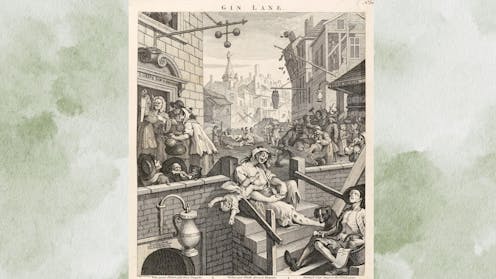
Gin Lane by William Hogarth (1751). Royal Academy of Arts

In 1751, the English painter William Hogarth created a nightmarish depiction of the London slum of St Giles. The familiar spire of the parish church towered over a scene of human ruin. This is Gin Lane, an imagined thoroughfare where the consumption of gin has deprived the inhabitants of sense, finances – and in some instances life.

At the heart of the image, Hogarth depicted a series of steps on which different characters illustrated the gin drinker’s descent from propriety to death. At the top of the steps, residents deposited their goods with the prosperous pawnbroker, including a carpenter who handed over his saw – a reminder that gin disrupts industry.

Just below on the steps is a drunken mother whose eagerness to take a pinch of snuff causes her baby to slip from her arms to its death below. The drunken mother is the most striking aspect of Hogarth’s image, a focal point that represents how gin detaches the drinker from their closest bonds and duties. Beneath the mother, reclines an emaciated gin drinker whose skeletal features hint at his imminent death. He even lacks the strength to hold his gin glass.


This article is part of Rethinking the Classics. The stories in this series offer insightful new ways to think about and interpret classic books, films and artworks. This is the canon – with a twist.


Gin Lane was one of two contrasting Hogarth visions of life in England’s capital in which the fortunes of Londoners were shaped by the drinks they consumed. The inhabitants of the other, Beer Street (1751), are artisans enjoying a foaming tankard during their long day of work.

Black and white engraving of a busy London street, filled with people drinking beer.
Beer Street by William Hogarth (1751).
Royal Academy of Arts

A blacksmith and paviour (person who lays paving) are in the foreground, while a man tasked with carrying a sedan chair quenches his thirst in the background.

Beer Street is a scene of industriousness in which draughts were consumed without disrupting the effort of the day. High in the scene, a group of workers enjoys beer shared from a jug while a tailor toasts them from a nearby window. The inhabitants’ prosperity has just one noticeable consequence in the tattered premises of the pawnbroker.

While Gin Lane can be read as a commentary on the dangers of vice, I believe it also comments on another significant development in 18th-century London – the growth of the funeral trade.

Birth of the undertaker

Just above the shoulder of the drunken mother are two coffins. One lies on the ground as a body is placed in it and the other is suspended outside the premises of an undertaker. This latter coffin was a shop sign, which could be seen across the city in the mid- to late-18th century. Undertaking was a developing trade that had many advocates. These undertakers were artisans or traders who supplemented their existing businesses with funerary work.

Undertakers were primarily middlemen who sourced the items required for a funeral, as well as providing items from their own stock. A carpenter acting as undertaker, for example, might build a coffin himself, before turning to ironmongers, drapers and painters for other elements of funerary display.

The supplemental nature of early undertaking enabled many people to adopt the title and some of the most successful eventually specialised fully in funerary work. In the closing decades of the 17th century, the earliest undertakers organised the elaborate funerals of elites, having previously supplied goods for these occasions. As the trade spread, its development was driven by profit and therefore thrived in urban centres where there were more prospective customers.

drawing of an undertaker's shop
Detail of the undertaker’s shop in Gin Lane by William Hogarth (1751).
Royal Academy of Arts

The presence of the undertaker’s shop in Hogarth’s Gin Lane is a reflection of the trade’s increasing popularity beyond the early origins in funerals of the elite.

By the mid-18th century, undertaker-led funerals were a common sight on the city’s streets, travelling from bereaved households to parish churches. The upstart trade had drawn criticism as early as 1699 when the author Thomas Tryon argued that undertakers were diminishing the worth of the funerary customs of the elites. And for many critics, there was no group thought less deserving of funerary spectacle than the gin-drinking poor.

Critiquing the undertaker

Hogarth’s inclusion of the undertaker was also a comment on the motives of the developing trade and the worth of its service. In Gin Lane, he emphasised the way that undertakers profited from the misfortune and misery of others.

He places the undertaker’s shop at the heart of a ruined street, where other trades have failed and the residents lie incapacitated and dying. His message is clear – the undertaker gains from the loss of others and so is little different from the other thriving businesses of the fictional street, the pawnbroker and the gin shop.

engraving of people lowering a body into a coffin.
The open coffin and the distant funeral party, detail from Gin Lane by William Hogarth (1751).
Royal Academy of Arts

The opened coffin and distant funeral party can also be read as a comment on the worth of the funerary products that underpinned the trade’s success. The lidless coffin is presented as little more than a box to contain the half-naked remains of the woman who is lowered into it. And the depiction of the dead woman reminds us that the coffin does nothing for its inhabitant – its purpose is purely aesthetic.

A uniform aesthetic is important to the funerary party, wearing hatbands and mourning cloaks as they wander through the tattered background. Yet the neatly attired procession is lost within the image and fails to hold the attention of the neighbourhood. The cost of these items cannot influence the attitudes of those outside of the funeral. Through these small details, Hogarth reminds the viewer that funerary goods are a hollow expenditure, which cannot improve the circumstances of the dead or the bereaved.

Much as the inhabitants of Gin Lane ruin themselves in pursuit of gin, so might the viewer waste their money on funerary goods that do not serve any practical purpose. As such, Hogarth’s work is more than a simple comment on the consequences of the gin craze – it’s a wider critique of how 18th-century Londoners spent their money.

Beyond the canon

As part of the Rethinking the Classics series, we’re asking our experts to recommend a book or artwork that tackles similar themes to the canonical work in question, but isn’t (yet) considered a classic itself. Here is Dan O’Brien’s suggestion:

Juan Manuel Echavarría has used photography to document how people experience death in a time of crisis and brutality. His work Réquiem NN (2006-13) uses imagery of graves in a Colombian cemetery to explore how people’s treatment of the dead is both an act of dignity and a form of resistance.

Réquiem NN depicts graves used for unidentified bodies that have been recovered from Colombia’s Magdalena River as a result of civil war. We see each grave in two periods, bringing to life the act of mourning, which has been performed for the unnamed dead, and revealing how the living use the graves to record the names of victims who were their own relatives.


Looking for something good? Cut through the noise with a carefully curated selection of the latest releases, live events and exhibitions, straight to your inbox every fortnight, on Fridays. Sign up here.


The Conversation

Dan O’Brien does not work for, consult, own shares in or receive funding from any company or organisation that would benefit from this article, and has disclosed no relevant affiliations beyond their academic appointment.

ref. Gin Lane by William Hogarth is a critique of 18th-century London’s growing funeral trade – https://theconversation.com/gin-lane-by-william-hogarth-is-a-critique-of-18th-century-londons-growing-funeral-trade-234761

Why preserved vegetables can turn deadly – and how to stay safe

Source: The Conversation – UK – By Manal Mohammed, Senior Lecturer, Medical Microbiology, University of Westminster

Kmpzzz/Shutterstock

A food truck in southern Italy recently became the centre of a deadly health scare. A food-borne outbreak linked to preserved vegetables killed two people and sent more than a dozen to hospital.

At the same time, the UK’s Food Standards Agency warned shoppers to avoid jars of broccoli from a specific batch code, fearing they too could contain the same hidden danger, Clostridium botulinum, the bacterium that produces the toxin responsible for botulism – one of the deadliest food-borne illnesses known.

The canning process removes air from food and seals it tightly, creating an oxygen-free (anaerobic) environment. This is normally what keeps food safe for long storage – but it also creates the perfect conditions for C botulinum. Unlike many bacteria, it doesn’t need oxygen to grow.

Its spores, which are commonly found in soil, can survive cooking and processing. In low-acid foods such as broccoli, green beans, corn, beets and peas, if the canning process isn’t hot enough or long enough, those spores can “wake up”, multiply and release their toxin. Because the toxin is invisible, tasteless and odourless, contaminated food can look and smell perfectly normal while being deadly.

Botulism is rare but extremely serious and even a tiny amount can be deadly – just two nanograms per kilogram of body weight can be fatal.

The spores themselves are usually harmless if swallowed. But in an anaerobic environment they can germinate and release toxin. That’s why homemade preserved foods are a common cause of outbreaks.

Why botulism is so dangerous

Botulism is caused by a neurotoxin that attacks the nerves, leading to muscle weakness, breathing difficulties, paralysis, and, in severe cases, death. Symptoms usually appear within 18 to 36 hours of eating contaminated food, but can range from six hours to ten days.

Early signs include difficulty swallowing or speaking, drooping eyelids, blurred or double vision, facial weakness, vomiting and progressive muscle paralysis, which can cause respiratory failure.

Diagnosis is tricky, as symptoms can mimic other conditions, including stroke, Guillain-Barré syndrome (a rare autoimmune disorder where the body’s immune system attacks the nerves), and myasthenia gravis (a chronic condition that causes muscle weakness due to problems with communication between nerves and muscles). Doctors usually confirm botulism through clinical assessment and laboratory testing of serum, stool or food samples.

The main treatments for botulism are supportive care and antitoxin. Supportive care means treating the complications of the illness — for example, patients may need a ventilator if they develop breathing difficulties, or help managing infections. Antitoxin is a medication that binds to and neutralises the toxin circulating in the body. If given early, it can stop the toxin from causing further harm, though it cannot reverse damage already done. Survivors often face long recoveries with lingering fatigue and breathing problems.

There are simple but vital ways to reduce the risk of foodborne botulism. First, never eat food from cans or jars that are dented, bulging, leaking, or discoloured. If you can your own low-acid foods, make sure you boil them for ten minutes before eating to kill spores. And make sure use proper pressure canners and always follow tested canning instructions.

When in doubt, throw it out.

A deadly toxin with a double life

Despite its dangers, botulinum toxin also has important medical uses. When injected in minute, controlled doses, botulinum toxin can reduce muscle spasticity (a condition where muscles tighten or stiffen abnormally), treat chronic migraines, and manage conditions such as strabismus (crossed eyes) and cervical dystonia (a painful condition where the neck muscles contract involuntarily). The US Food and Drug Administration first approved it for medical use in 1989, and it has since been authorised for a wide range of treatments.

Botulinum toxin works by blocking nerve signals that trigger muscle contraction, smoothing wrinkles and fine lines, and has become a global cosmetic phenomenon. But the same toxin that has medical and aesthetic benefits can also cause catastrophic harm if misused. Unlicensed or poorly regulated injections are risky – and in August 2025, botulinum toxin was linked to a deadly outbreak in the UK.

Food-borne botulism is rare but deadly. Prevention depends on safe food handling, proper canning and avoiding suspicious-looking jars and cans. And while botulinum toxin has life-saving medical uses and cosmetic appeal, outside of controlled and licensed conditions it remains one of the most lethal substances on earth.

The Conversation

Manal Mohammed does not work for, consult, own shares in or receive funding from any company or organisation that would benefit from this article, and has disclosed no relevant affiliations beyond their academic appointment.

ref. Why preserved vegetables can turn deadly – and how to stay safe – https://theconversation.com/why-preserved-vegetables-can-turn-deadly-and-how-to-stay-safe-263161

Sustainable fuels could reduce the climate impact of military aircraft

Source: The Conversation – UK – By Elna Heimdal Nilsson, Professor of Aeronautical Sciences, Department of Aviation and Aeronautical Sciences, Lund University

Staff Sgt. Madelyn Brown

Military aircraft – from fighter jets to transport planes – are playing a significant role in today’s unstable world. Cumulatively, the operations carried out by these fleets, from combat missions to training flights, consume large amounts of fossil fuel.

Nevertheless, military aviation is rarely included in national climate inventories. In addition to greenhouse gases, aviation also emits other pollutants such as soot and particles, which affect both climate and air quality, and have detrimental effects on human health and ecosystems.

Recently, the UK government announced that it would purchase 12 F-35A fighter aircraft, some of which will be used to reduce a backlog in pilot training. The F-35A is the standard variant of the F-35 fighter jet.

While the decision is primarily motivated by defence and alliance commitments, it also has environmental implications. Expanding training activities will increase the number of flight hours, and consequently, fuel use and emissions. Fighter jets consume large quantities of fuel per flight hour.

The combustion process in aircraft engines releases carbon dioxide (CO₂), but the impact on the climate and environment extends further: emissions of soot particles, nitrogen oxide compounds, water vapour and sulphuric compounds influence atmospheric chemistry and cloud formation.

The persistent contrails and the cirrus clouds they generate are estimated to cause an impact on the climate comparable in magnitude to the warming effect of CO₂ from commercial aviation.

Any assessment of mitigation options must therefore consider both CO₂ and non-CO₂ effects arising from aircraft engine combustion. To mitigate aviation-related climate effects, the civil aviation sector has been promoting the development of sustainable aviation fuels (SAF).

When produced from waste oils or residues, hydroprocessed esters and fatty acids (Hefa) fuels – which are forms of sustainable aviation fuel – typically achieve 50–70% lower life-cycle CO₂ emissions compared with fossil-based jet fuel. Synthetic aviation fuels known as advanced power-to-liquid (PtL) e-fuels, produced using renewable electricity, could reduce emissions by more than 80%, though they are not yet available at scale.

Wars and climate change are inextricably linked. Climate change can increase the likelihood of violent conflict by intensifying resource scarcity and displacement, while conflict itself accelerates environmental damage. This article is part of a series, War on climate, which explores the relationship between climate issues and global conflicts.

In addition to a lower carbon footprint compared to fossil fuels, SAFs have
also been shown to produce fewer soot particles during combustion, reducing the likelihood and severity of contrails and cirrus clouds.

For technical reasons, down to the specific molecular composition SAF compared to fossil based jet fuel, commercial SAFs are currently not certified as standalone fuels. However, they are available for blends of up to 50% along with fossil-based jet fuels.

The quality of the sustainable fuels is very high and there is no technical barrier to their use in military aviation. The question is: to what extent can the climate and environmental impact of military aviation operations be reduced if sustainable aviation fuels are introduced?

Sustainable fuel and the F-35

Let’s take the example of the F-35, which was the aircraft purchased recently by the UK government. Under certain conditions, the F-35 can burn five tonnes of jet fuel in a single sortie lasting an hour. For comparison, a diesel car like the Volvo V70 would, in its whole lifespan, burn an amount of fuel corresponding to just four hours of combat manoeuvring with the F-35.

Technically, the F-35 is already approved to operate on blends of conventional kerosene and certified synthetic fuels. Similar to civil aviation standards, military standards allow for blending ratios of up to 50%, depending on the production pathway.

No modifications to engines or fuel systems are required. F-35 flights that used commercially available fuel with 40% SAF were carried out by the Norwegian Air Force in early 2025.

There are no significant technical barriers to the new F-35A aircraft entering UK service to operate on commercially available SAF blends with up to 50% renewable fuel. Compatibility is not the limiting factor, but, unfortunately, the availability and cost of fuel are.

For military training flights, which may involve large numbers of sorties, SAF can therefore provide significant reductions in life-cycle greenhouse gas emissions. A 50% blend of Hefa, for instance, could cut average CO₂ emissions per flight by around one third.

Since contrails can account for a large fraction of aviation’s total climate impact, this effect is potentially important. The strategic allocation of SAF to flights that are most likely to generate persistent contrails, like training missions at high altitude in humid conditions, could amplify the climate benefit of limited SAF supplies.

The UK’s acquisition of additional F-35A aircraft will help address a backlog in pilot training, but it will also increase emissions. From both a climate and national security perspective, SAFs represent the most practical near-term mitigation option.

The F-35 is technically compatible with sustainable aviation fuels – and substantial life-cycle emission reductions are achievable this way. Additional benefits may come from reduced contrail formation. However, limitations in global SAF production and their higher costs restrict the extent to which these fuels can currently be deployed.

SAFs will not make military aviation climate neutral, but they could substantially reduce its environmental footprint at a time when both security and sustainability are pressing concerns.

The Conversation

Elna Heimdal Nilsson does not work for, consult, own shares in or receive funding from any company or organisation that would benefit from this article, and has disclosed no relevant affiliations beyond their academic appointment.

ref. Sustainable fuels could reduce the climate impact of military aircraft – https://theconversation.com/sustainable-fuels-could-reduce-the-climate-impact-of-military-aircraft-264792

What we’ve learned about narcissism over the past 30 years

Source: The Conversation – UK – By Sarah A. Walker, Assistant Professor of Educational Psychology, Durham University

Nicoleta Ionescu/Shutterstock

You’ve probably seen the word “narcissist” thrown around online in headlines, on dating apps or in therapy-themed TikToks. But the label that people often unthinkingly slap on toxic bosses or reality TV villains hides a much more complicated psychological picture.

Psychologists have studied narcissism for many years, but over time, our understanding has evolved. One of the biggest changes is that today, narcissism is no longer seen as just grandiosity, arrogance or egotism.

Early scientific descriptions of narcissism focused on dominance, ambition and self-importance, all of which are traits associated with traditional masculine stereotypes. That meant narcissistic tendencies in women were often misread or overlooked. When those traits show up as emotional sensitivity, insecurity or relational manipulation, they sometimes still are misdiagnosed as anxiety, mood disorders or borderline personality disorder traits.

The most extreme and persistent forms of narcissism can sometimes be diagnosed as narcissistic personality disorder. This condition was added to the Diagnostic and Statistical Manual of Mental Disorders, the American Psychiatric Association’s diagnostic manual, in 1980. But most people with narcissistic tendencies won’t meet the threshold for a diagnosis.

So what does the research actually say?

Narcissism in general is now understood as a complex set of personality characteristics that can show up in different ways.

Psychologists had long suspected that there might be different kinds of narcissism, but it wasn’t until 1991 – when researcher Paul Wink and his colleagues presented a model including grandiose and vulnerable subtypes – that they were more formally recognised. Although there are other models, this remains one of the more popular approaches to understanding narcissistic tendencies in the wider population.

A 2021 review by US psychologist Joshua Miller and his colleagues pulled together decades of research to offer one of the most authoritative summaries of how psychologists now understand narcissism. It explains that narcissism has a common foundation, which includes things such as self-importance and entitlement. It then branches into different forms of narcissism, such as grandiosity, antagonism and vulnerability.

Researchers now often use the terms grandiose and vulnerable to describe two major forms of narcissism. One person with narcissistic traits may be bold with high levels of grandiose traits, confidence and emotional resilience. Another might be defensive, anxious and hypersensitive to criticism. Both show signs of narcissistic self-focus, but they end up looking quite different in how they experience and express emotion.

In a 2022 research paper I wrote with colleagues, we carried out the first meta-analysis examining how narcissistic traits relate to the ability to control one’s emotions. The results showed that vulnerable narcissism is consistently associated with greater emotional difficulty, which means these people might find it harder to keep their emotions in check.

In particular, people with high scores on vulnerable narcissism scales are more likely to rely on suppression. Suppression is a strategy that people use to hide or inhibit their emotional expressions, and has been linked to poorer wellbeing. On the surface, suppression might sound like self-control.

In some situations, it can be. For example, keeping a lid on your emotions when your boss is yelling at you. But trying to mute emotional expression without addressing the underlying emotions increases stress when it becomes our default strategy. It can worsen mental and physical health over time.

Montage of man against purple background with celebratory symbols.
Narcissism isn’t always this overt.
Roman Samborskyi/Shutterstock

In contrast, grandiose narcissism wasn’t linked with emotion regulation difficulties. In fact, several of the studies included in our analysis suggest that people with higher levels of grandiose traits may not experience as much emotional distress in the first place. This challenges the popular idea among researchers that people who exhibit narcissistic tendencies are also experiencing emotional instability.

Emotional intelligence and self-perception

The differences between forms of narcissism show up in emotional intelligence research as well. In a 2021 systematic review on narcissism and emotional intelligence, my colleagues and I found that people with grandiose traits often said they were good at understanding and managing emotions. For instance, how well they think they can handle anger or recognise other’s emotions.

But when their skills were tested using emotion tasks (such as recognising facial expressions or identifying the best way to respond to an emotional situation), their performance didn’t always match up with how skilled they said they were. This is consistent with a 2018 study which also found that people with grandiose tendencies rated themselves as emotionally skilled but performed worse on skill-based emotional intelligence tasks compared to other participants.

In contrast, people with vulnerable narcissistic traits tend to rate themselves lower in emotional intelligence, and seem to genuinely struggle more with managing emotions in everyday life.

So what should we make of all this?

It’s time to move beyond the pop-psych trend of labelling difficult people as narcissists. Narcissism isn’t about taking too many selfies. And no, the partner who ghosted you or the colleague who dominates meetings isn’t necessarily high in narcissistic traits either – no matter how much we might like to complain about them over coffee.

These kinds of casual diagnoses aren’t just unhelpful, they’re often wrong.

Narcissism is a complex psychological pattern that can show up in different ways and can reflect a deeper struggle with things such as self-esteem, emotion regulation and social connection. Understanding this doesn’t excuse people’s bad behaviour – not at all. But it does help us look past the stereotypes to get a clearer picture of what narcissistic traits look like in everyday life.

The Conversation

Sarah A. Walker does not work for, consult, own shares in or receive funding from any company or organisation that would benefit from this article, and has disclosed no relevant affiliations beyond their academic appointment.

ref. What we’ve learned about narcissism over the past 30 years – https://theconversation.com/what-weve-learned-about-narcissism-over-the-past-30-years-258505

What we learned about North Korea at the summit in Beijing

Source: The Conversation – UK – By Jim Hoare, Honorary Research Associate in the Centre of Korean Studies, SOAS, University of London

China invited world leaders to its capital, Beijing, recently to celebrate the 85th anniversary of Japan’s surrender in the second world war. Western leaders were notably absent. But despite the presence of many other leaders, such as Russian president Vladimir Putin, it was the arrival of North Korea’s Kim Jong-un that seemed to attract most international media attention.

This was Kim’s fifth visit to China since he assumed power in 2011 – the last was in 2019 before the COVID pandemic. And it was the first time he had attended a multilateral international meeting.

Kim travelled to Beijing by train – an armoured train at that. Although he does not seem to have the fear of flying his father had, it is not the first time Kim has used a train to travel overseas. In 2019, he went to Hanoi in Vietnam – a much longer journey – to meet US president Donald Trump the same way.

The train allows for a large entourage and provides an opportunity to prepare for meetings. It may also be more secure than the country’s aircraft after some years of no or little use due to the pandemic and the effective sealing off of North Korea from most of the rest of the world.

Aside from the travel preferences of its leadership, here are three things we learned about North Korea from the summit in Beijing.

1. There is no obvious succession plan

Kim was accompanied not by his wife, Ri Sol-ju, who was with him on at least one previous visit to China. Nor did he travel with his sister, Kim Yo Jong, who has been seen by many as a power in her own right. He arrived in Beijing with his daughter, Kim Ju Ae, who is believed to be about 13.

She first appeared in public in 2022, joining the North Korean leader at an inspection of a major intercontinental ballistic missile launch. Kim Ju Ae has been seen with her father, and occasionally her mother, on several subsequent occasions. This has led to speculation that she is being groomed to be Kim’s successor.

However, she made no appearances with her father after arriving in Beijing. This may have been a learning trip rather than an indication that she has been selected to succeed her father.

Before 2022, there was similar speculation about Kim Yo Jong, who was noted for hostile statements on relations with South Korea. While she has not disappeared from the scene, Kim Yo Jong is not shown the same level of deference as her niece.

If Kim is preparing a successor, he is departing from the approach of his grandfather and first North Korean supreme leader, Kim Il-sung, as well as his father, Kim Jong-il. Kim Jong-il did not make public appearances until he was in his 30s. He was not identified as the successor until later.

Only after he suffered a stroke in 2008 did Kim Jong-il select Kim Jong-un, aged 24, as his successor. To select a child – and a female at that – seems fraught with difficulties. Korean society, north and south, still tends to attach a high value to age and experience. And despite formal equality in both countries, there is a strong belief in male superiority.

2. It can rely on strong regional support

More significant than the presence of his daughter was the reception given to Kim Jong-un in Beijing. He was beside the Chinese president, Xi Jinping, and Russia’s Putin in front of the other leaders on the viewing platform for the ceremonial parade. This was the first time that leaders of the three countries had met together since Kim Il-sung, Mao Zedong and Nikita Khrushev met in China in 1959.

Kim Jong-un also held summit meetings with Putin and Xi, both of whom had signed up to sanctions on North Korea just a few years ago because of its nuclear programme. All of that now seems forgotten. The meeting with Putin reinforced the rapidly developing relations between the two countries, especially over the war in Ukraine.

Following Putin’s acknowledgement of the role North Korean troops have played in Ukraine, Kim said: “If there is any way we can assist Russia, we will certainly do it as a fraternal duty.” This may open the door for North Korea to send more troops to Ukraine and provide Russia with arms and ammunition.

In return for North Korea’s assistance, Kim has had economic support and, probably, some help in updating his country’s military capacity. Troops sent to support Russia will also have learned lessons about the nature of modern warfare.

The meeting with Xi produced pledges of further economic cooperation. Despite signing up for sanctions over the nuclear issue, China has not stopped providing food and oil to North Korea. This support now seems likely to increase.

Xi said the two countries were “friends with a common destiny”, while the Korean Central News Agency reported that North Korea would invariably support China’s interests.

3. It has been recognised as a nuclear state

Absent from both meetings was any reference to the denuclearisation of the Korean peninsula. This seems to indicate that both Russia and China accept that North Korea is a nuclear state.

According to a 2025 assessment by the US Office of the Director of National Intelligence, Kim views nuclear weapons as a “guarantor of regime security”. Some experts estimate that North Korea has produced enough fissile material to build up to 90 nuclear warheads.

Russia, China and North Korea can all show benefits from the summit in Beijing. Russia has a promise of continued North Korean support in the Ukraine conflict.

China, meanwhile, has reinforced its traditionally close relationship with North Korea. And Kim has not only been treated as a major world leader, but has gained additional practical support from his two big neighbours.

In such circumstances, it seems unlikely that he will be very receptive to overtures from Trump or to make any concessions over the nuclear issue.

The Conversation

Jim Hoare does not work for, consult, own shares in or receive funding from any company or organisation that would benefit from this article, and has disclosed no relevant affiliations beyond their academic appointment.

ref. What we learned about North Korea at the summit in Beijing – https://theconversation.com/what-we-learned-about-north-korea-at-the-summit-in-beijing-264718

How cancer misinformation exploits the way we think

Source: The Conversation – UK – By Andy Levy, Reader in Psychology, Edge Hill University

Lenar Nigmatullin/Shutterstock.com

When TV personality Danielle Lloyd was diagnosed with melanoma earlier this year, she faced not only the anxiety of cancer treatment but also a disturbing reality: influencers spreading dangerous misinformation about sun protection.

After having a suspicious mole removed and awaiting results from a second biopsy, the 41-year-old has become an outspoken critic of social media personalities who lie to their followers about sunscreen products.

Cancer misinformation can have serious consequences, such as leading people to delay or even avoid life-saving treatments, and eroding trust in medical professionals.

Misinformation spreads easily because it taps into people’s emotions and reasoning about health. When faced with a cancer diagnosis, fear, confusion and a desire for control can drive people to seek remedies that offer hope – even if that hope comes from sources that don’t use credible evidence.

Misinformation often offers simple, comforting answers, while real medicine is complex, uncertain and sometimes difficult to accept. Fake cancer claims can feel convincing because they seem to eliminate the uncertainty about whether treatment will work, or if the cancer will return.

Social media platforms can amplify false cancer messages, making them appear more credible or popular than they actually are. This is compounded by the role of influencers and unqualified practitioners, who often profit from promoting pseudoscience.

Message framing plays a significant role in the spread of cancer misinformation. Studies show that we respond more to messages focused on what we might lose rather than what we could gain. This happens because of loss aversion – our psychological tendency to fear losses more than we value equivalent gains.

Cancer messages that highlight potential losses – such as health, comfort or life itself – feel more urgent, personal and motivating than those focusing on potential gains, like improved survival or better quality of life.

Cancer misinformation that emphasises scary losses can be especially persuasive because it taps directly into people’s fears. False claims warning about dangerous side-effects of treatments, hidden risks or conspiracies suggesting doctors want to harm patients strike a deep emotional chord. This makes people more likely to believe and share these messages, even when untrue.

For instance, misinformation claiming that chemotherapy doesn’t cure cancer – and instead causes it to spread and shortens your life – can trigger fear and resistance to treatment.

In contrast, truthful messages stating that chemotherapy can have side-effects, but it greatly increases your chance of survival, may seem less frightening and, sometimes, less compelling because they focus on potential gains rather than losses.

Cancer is an emotionally charged and high-stakes diagnosis. Loss-framed misinformation spreads quickly and can influence decisions that can put people at risk. Even when presented with correct medical information, the emotional weight of loss-informed cancer misinformation can override rational thought.

The psychological principle that bad is stronger than good (also called “negativity bias”) explains why cancer misinformation that triggers fear or anxiety often sticks more than hopeful, fact-based messages. Negative information simply has a bigger impact on how we think and feel in times of uncertainty.

Prebunking

One effective way to help people avoid falling victim to cancer misinformation is through prebunking. This approach involves teaching people how to spot and resist false or misleading messages before they take hold.

In particular, it focuses on exposing the tactics people use to deceive or scare others, so they’re easier to recognise and dismiss when encountered.

The tactics people can learn to look out for – and prebunk – include fear-mongering, where messages exaggerate risks to induce anxiety, or promises of miraculous cures lacking scientific evidence and misleading statistics that distort facts to support false claims.


Read more:
Can a game stop vaccine misinformation? This one just might


By being aware of these common techniques, people with cancer can become more vigilant and sceptical when they encounter suspicious information online, on social media, or through word of mouth.

Research suggests that when people understand the strategies behind misinformation, they are less likely to accept false claims at face value. This increased awareness empowers them to pause, question and seek reliable advice before making important decisions about their health.

Prebunking explained.

In the end, prebunking can help people with cancer stay protected against misinformation. It allows them to navigate through the emotionally charged cancer claims out there and make smarter, safer choices.

Scientist Carl Sagan said it best: “Extraordinary claims require extraordinary evidence.” It’s a straightforward idea, but a powerful one — especially when it comes to pushing back against cancer misinformation.

Sagan’s quote is a reminder to slow down, think critically and ask for solid evidence — especially when cancer information sounds unbelievable, too perfect, or just plain alarming.

The Conversation

Andy Levy does not work for, consult, own shares in or receive funding from any company or organisation that would benefit from this article, and has disclosed no relevant affiliations beyond their academic appointment.

ref. How cancer misinformation exploits the way we think – https://theconversation.com/how-cancer-misinformation-exploits-the-way-we-think-260236

Alzheimer’s disease: new three-minute test can spot memory issues – here’s how it works and what it can tell you

Source: The Conversation – UK – By Eleftheria Kodosaki, Research Fellow in Neuroimmunology, UCL

The Fastball EEG test measures how the brain responds to images flashed on a screen. Dmytro Zinkevych/ Shutterstock

A new test could help to diagnose memory issues associated with Alzheimer’s disease in as little as three minutes. According to recently published findings the test, called the Fastball EEG test, may one day help doctors flag people who need further checks for Alzheimer’s disease without the need for unnecessary waits or time-consuming procedures.

Alzheimer’s disease affects millions of people worldwide. It’s a progressive condition, in which brain cells are slowly damaged and die – leading to memory loss, confusion and difficulties with thinking and daily tasks.

The disease process begins long before symptoms manifest. Proteins called amyloid and tau gradually build up in the brain, forming plaques and tangles that interfere with communication between nerve cells. By the time memory problems are significant enough for diagnosis, much of the damage has already been done.

It’s important to note that the signs of Alzheimer’s disease and symptoms don’t develop similarly in all patients. This means the amount of amyloid plaques and tau tangles a person has in their brain doesn’t always match the severity of the disease.

In addition, the amount of plaques and tangles can only be estimated via imaging or blood tests. These factors make Alzheimer’s disease difficult to diagnose and predict how it will progress. This is why researchers are keen to develop tests that can spot signs of the disease earlier.

Traditionally, diagnosis has relied on cognitive screening tests, where a doctor asks a patient to remember words, copy drawings or complete problem-solving tasks. These tools are effective, but take time and require trained staff. They may also be stressful for the patients and can be influenced by factors such as a person’s education level, their language skills or test-related performance anxiety.

More advanced diagnostic options, including brain scans and laboratory analysis of cerebrospinal fluid (a fluid which protects the brain and spinal cord), can indicate the presence of Alzheimer’s disease in the brain. But these tests are expensive and invasive.

But the Fastball EEG test uses a different approach.

Instead of asking patients to actively recall or solve problems, it measures how the brain responds to images flashed on a screen. Participants first see a set of eight pictures, which they’re asked to name but not memorise.

Then, during the test, hundreds of images are shown in quick succession – around three per second. Every fifth image is one of the eight previously shown. The EEG headset records the brain’s electrical activity, picking up tiny signals that reveal whether the brain recognises these familiar images.

In healthy people, the recognition response is clear. But in people with mild cognitive impairment (problems with thinking, memory or problem-solving which often precedes Alzheimer’s disease) and especially those with memory issues, the response is weaker.

To understand the test’s suitability, researchers recruited 106 participants to their study. This included 54 healthy adults and 52 people with mild cognitive impairment (MCI). Among the latter group, some had memory-specific problems (amnestic MCI), while others had difficulties unrelated to memory – such as problems with attention (non-amnestic MCI).

A digital drawing depicting amyloid and tau forming tangles and plaques around a nerve cell in the brain.
The build-up of amyloid-beta and tau disrupt communication between the brain’s nerve cells.
nobeastsofierce/ Shutterstock

The researchers found that the Fastball test was sensitive enough to distinguish between these groups. Those with amnestic MCI showed significantly reduced brain responses to the familiar images compared to healthy adults and those with non-amnestic MCI. In other words, the test quickly identified the kind of memory impairment most closely linked to early Alzheimer’s.

They then repeated the test a year later. Some of the participants who’d only had mild cognitive impairment in the first test had progressed to either Alzheimer’s disease dementia or another type of dementia, called vascular dementia, which manifests in symptoms similar to Alzheimer’s.

The researchers also asked the participants who developed dementia to perform the standard cognitive tests currently used to diagnose Alzheimer’s. These participants showed no or little difference in this test, which means the test wasn’t sensitive enough to detect the transition from mild cognitive impairment to dementia. But with the Fastball test, the participants performed marginally worse than they had previously.

However, of the 42 participants with mild cognitive impairment who repeated the Fastball test a year later, only eight had transitioned to dementia. So, although the results are very promising in illustrating the test’s accuracy, they should be interpreted with caution as they’re based on a small number of people.

The future of diagnosis

Crucially, the test is fast – lasting only three minutes. It also doesn’t rely on the participant’s effort, mood or test-taking ability, which can influence cognitive test results. It can also be done at home or in a GP’s office, which might reduce anxiety for patients and make it easier to reach a larger group of people.

However, the study did not include other conditions where memory impairment is also present – such as depression or thyroid problems – so it cannot be used as a standalone diagnostic tool for Alzheimer’s disease. Future studies in more diverse populations which take these other conditions into account will be needed to better understand the test’s strengths, limitations and potential.

Other tests, which are currently in development, may be better for diagnosing Alzheimer’s disease specifically. For example, blood tests could transform Alzheimer’s diagnosis once they’re more widely rolled out.


Read more:
Alzheimer’s disease blood tests: here’s what they look for, and what they can tell you about your risk


These measure proteins linked to Alzheimer’s and can give a snapshot of disease processes happening in the brain. Some tests currently being studied would only require a finger-prick of blood. If they prove to be accurate, this could mean patients could do these tests at home and mail them in for analysis.

Tools such as the Fastball test and blood tests could help shift the focus of Alzheimer’s care from late diagnosis to early intervention. By identifying people at risk of the disease years earlier, doctors could recommend lifestyle changes, monitor patients more closely or provide them with appropriate therapies earlier, while they can still make the most difference.

The Conversation

Eleftheria Kodosaki does not work for, consult, own shares in or receive funding from any company or organisation that would benefit from this article, and has disclosed no relevant affiliations beyond their academic appointment.

ref. Alzheimer’s disease: new three-minute test can spot memory issues – here’s how it works and what it can tell you – https://theconversation.com/alzheimers-disease-new-three-minute-test-can-spot-memory-issues-heres-how-it-works-and-what-it-can-tell-you-264519

Why building nature-centric housing involves a mindset shift

Source: The Conversation – UK – By Tom Oliver, Professor of Applied Ecology, University of Reading

The Italian city of Milan’s vertical forest. Ivan Kurmyshov/Shutterstock

How do you build 1.5 million new homes in five years without destroying nature? Housing is unaffordabe for most people, so the UK government plans to build as many homes as possible, as soon as possible. Assuming this brings house prices down (which isn’t a given), how can it be done without harming wildlife and worsening climate change?

The UK is already one of the most nature-depleted countries in the world. According to UK government reports, nature loss drives a loss of benefits to humans, leading to increased risks of flooding, food insecurity, disease and pollution. Nature loss already contributes significantly to the declining physical and mental health of the UK population, with nature poverty varying markedly between postcodes.

In my research as an ecologist, I study how urban planning can be nature-centric. Being sensitive to the history of a place when designing housing, asking what other beings already have their homes there and how people can live alongside them, puts humans on par with other species, rather than objectifying them as lifeless “assets”.

No longer seeing humans as the centre of everything is a worldview shift that’s recognised by organisations such as the UN and the European Environment Agency as essential for a sustainable civilisation. It might seem radical, but when existing approaches aren’t working, you need to change tack.

Even with current environmental regulations, the UK government is failing to meet its own targets for restoring wildlife and providing clean water and air. It remains on track for just nine out of 43 environmental commitments. Environmental protection policies and their implementation are failing.

Take, for example, the concept of biodiversity net gain. This policy outlines how much habitat needs to be “restored” in exchange for developers destroying nature to build homes. Yet the promised nature restorations rarely happen.

Doubling down on this approach, under new planning-system reforms to quickly build new homes, the government is enabling developers to pool promised habitat “units” and restore them elsewhere.

But simply destroying nature in one place and rebuilding it elsewhere isn’t the answer. Not least because ecosystems (such as the complex interactions between soil fungi, plants and insects) take decades to mature. Plus, people living in new homes in areas where nature has been cleared will experience fewer health benefits.

close up shot of plants growing all over surface of tower block
Plants grow on every surface of Milan’s vertical forest tower block.
MC MEDIASTUDIO/Shutterstock

Instead of treating nature something as separate from us, like a property we have a right to destroy, we can reassess our relationship to it. Nature as being an intrinsic part of us is a more scientifically accurate worldview, as well as essential for protecting it.

Last year, an international science body produced a report ratified by 147 governments, including the UK. The conclusion identified the main causes of global biodiversity loss as the disconnection from and domination over nature, the concentration of power and wealth, plus the prioritisation of short-term, individual and material gains. That report, along with many others, states the need for “fundamental system-wide shifts in views, structures and practices”.

Scaling up eco-homes

Many nature-centric housing solutions already exist in Brazil, Italy and the Netherlands. The challenge is how to build them at scale, while adapting them to the nature in a local region. Housing design and surrounding areas can be tailored to help regionally rare animals like otters, certain bats as well as amphibians, insects and plants.

I recently led a workshop with experts from law, urban planning, architecture, garden design and housing policy, and they agreed that the technical expertise to build such homes already exists. What is missing, they said, is the deeper mindset shift needed to bring about such an ambitious programme of social change.

The key challenge is to expand our imaginations for how we can live more in harmony with other species and build political courage for such housing. Building these homes may take longer than the government’s five-year target, but anything less will continue to drive the loss of nature on which our health and prosperity depends.

Research my colleagues and I conducted shows that promoting this nature-centric shift in worldviews must become a top priority. It goes beyond just the housing sector and relates to the design of our businesses, governance and education systems.

Without a change in underlying attitudes, environmental regulations are simply rules that get ignored, hence the poor state of our rivers and the loss of our nations plants and wildlife.

We cannot build 1.5 million homes with a casual attitude to trashing nature in the process. The real solutions to the housing crisis go beyond bricks and mortar and rules about where to put them. We need to rebuild our care and responsibility to the natural world, acknowledging nature as something we humans are deeply part of, instead of apart from.

More effective institutions and legal innovations (such as giving rights to nature) then follow from that. To solve the housing crisis in ways that are genuinely sustainable requires a shift in mindset as a prerequisite for housing development.


Don’t have time to read about climate change as much as you’d like?

Get a weekly roundup in your inbox instead. Every Wednesday, The Conversation’s environment editor writes Imagine, a short email that goes a little deeper into just one climate issue. Join the 45,000+ readers who’ve subscribed so far.


The Conversation

Tom Oliver has received research funding from BBSRC, NERC, Natural England and VKRF for developing climate adaptation plans for humans and other species, and for critically investigating ‘nature-centric’ governance approaches. He was affiliated with Defra as a senior scientific fellow on their Systems Research Programme, with the Government Office for Science working on long-term risks to the UK, and spent four years with the European Environment Agency on their scientific committee. He currently sits on the Food Standards Agency science council and Office for Environmental Protection expert college. He is author of The Self Delusion: The Surprising Science of Our Connection To Each Other and the Natural World, published by Weidenfeld and Nicholson, and the forthcoming book The Nature Delusion: Why We Can’t Fix The World Without Fixing Ourselves, published by Bristol University Press.

ref. Why building nature-centric housing involves a mindset shift – https://theconversation.com/why-building-nature-centric-housing-involves-a-mindset-shift-261995

Russia has provided fresh evidence of its territorial ambitions in Ukraine

Source: The Conversation – UK – By Jennifer Mathers, Senior Lecturer in International Politics, Aberystwyth University

After a meeting hosted by the French president, Emmanuel Macron on September 4, 26 countries have pledged to create a “reassurance force” to provide security guarantees for Ukraine in the event that a peace agreement with Russia is reached. The Russian president reacted by saying that Russia would target any European troops deployed in Ukraine.

He said if they appeared in Ukraine while Russia’s “military operation” was still underway, “we proceed from the fact that these will be legitimate targets for destruction”. And if a peace deal were eventually agreed, he added: “I simply do not see any sense in their presence on the territory of Ukraine, full stop.”

Russia is maintaining its demand that any peace deal should involve Ukraine ceding the regions it has occupied or part occupied: Crimea, Donetsk, Luhansk, Kherson and Zaporizhzhia.

But new evidence has come to light suggesting that Putin’s territorial ambitions in Ukraine go well beyond those regions.

A map, spotted in the background during a briefing given by Russia’s chief of the general staff, Valery Gerasimov, in August, shows the two countries divided by a thick black line. On the Russian side of the line are not only the five publicly claimed regions of Ukraine but also the territories of Odesa and Mykolaiv.

These areas, which hug the coastline of the Black Sea, are of considerable geostrategic significance. Russian occupation of Odesa and Mykolaiv would go a long way towards fulfilling one of Russia’s longstanding ambitions: domination of the Black Sea region.

Control of this territory would give Russia a land corridor to Transnistria, a breakaway region in eastern Moldova with strong pro-Russian sympathies. The leaders of Transnistria declared independence from Moldova following a civil war in the early 1990s. In a 2006 referendum, 97% of respondents supported Transnistria joining Russia. Russia currently has approximately 1,500 troops stationed there, and the territory has long been discussed in the west as a possible platform for a Russian invasion of Moldova.

Like Ukraine, Moldova was formerly part of the Soviet Union but is now orienting itself more towards western Europe and is currently seeking EU membership.

In addition to putting Russia in a strong position to exert pressure on Moldova, a more significant Russian presence in the Black Sea would increase Moscow’s ability to project power in neighbouring regions. This includes the Mediterranean, the Middle East and Africa.

Black Sea strategy

The Black Sea is also a vital site for east-west transport and communications. So much so that the European Union announced a Black Sea strategy in May 2025. The strategy recognises the region’s significance for different forms of security, including its importance for the environment, access to energy and other forms of trade and economic links. The EU plans to address these security issues by developing mutually beneficial partnerships with countries in the region.

Russian control of Ukraine’s Black Sea coast would be disastrous for Ukraine. It would mean the loss of Ukraine’s naval assets, which make extensive and effective use of maritime drones to target Russian ships and targets in occupied Crimea.

Being cut off from direct access to the Black Sea would also severely restrict Ukraine’s ability to export agricultural produce, an important source of income for an economy that has been hit hard by the war. Re-establishing and expanding Ukraine’s role as a producer of food for the world also forms the centrepiece of Kyiv’s efforts to build stronger relationships with Africa and other developing regions.

Putin’s hunger for ‘Novorossiya’

In addition to its strategic importance, these regions along Ukraine’s Black Sea coast also have special historical and symbolic significance for Putin’s Russia. Putin himself has described Odesa as a “Russian city” and claimed that the entire coastal area rightfully belongs to Russia as spoils of its war with Turkey in the 18th century.

The Black Sea coast also plays an important role in Putin’s use of Russian imperial history to justify his war against Ukraine. Empress Catherine the Great significantly expanded the Russian empire into southern Ukraine and Crimea. For more than a decade, Putin has presented his own actions in Ukraine as a continuation of Catherine’s legacy in increasing the territory controlled by Russia.

An important example of this practice came in April 2014, just weeks after Russia’s annexation of Crimea, when Putin used the phrase “Novorossiya” on Russian television. This is a term dating from Catherine the Great’s reign that refers to a large part of southern Ukraine, including Crimea. By invoking this historical term, Putin was signalling his intention to follow in the footsteps of the 18th century ruler and claim these lands for Russia.

In 2014, Moscow not only made a rhetorical claim on the city of Odesa and its surrounding region – it took active steps to turn that claim into reality. In the spring of that year, Russia used disinformation to persuade local people in eastern parts of Ukraine that the government in Kyiv did not have their best interests at heart and even posed a danger to them. At the same time, Russia provided money, weapons and training to local militant groups looking to stir up trouble.

These efforts were not limited to areas of the Donbas region, where they met with some success. They were also attempted in Odesa, where they were rebuffed.

More than a decade later, a map on the walls of Russia’s ministry of defence showing Odesa region as part of Russia demonstrates that Moscow has not abandoned its ambition to gather up lands that were once part of the Russian empire. As Kyiv’s European allies debate the extent of their involvement in providing security guarantees for Ukraine, there are still plenty of unanswered questions about the precise nature of the reassurance force being planned by the “coalition of the willing”.

But there is no question about the need for Ukraine’s international supporters to provide Kyiv with the strongest possible security guarantees.

The Conversation

Jennifer Mathers does not work for, consult, own shares in or receive funding from any company or organisation that would benefit from this article, and has disclosed no relevant affiliations beyond their academic appointment.

ref. Russia has provided fresh evidence of its territorial ambitions in Ukraine – https://theconversation.com/russia-has-provided-fresh-evidence-of-its-territorial-ambitions-in-ukraine-264592

Labubu is not the only Chinese cultural icon to be making a big hit in 2025

Source: The Conversation – UK – By Tom Harper, Lecturer in International Relations, University of East London

While Beijing has been showing off its latest military hardware to an array of international leaders, Chinese cultural icons are making their mark with a very different audience.

At Naomi Osaka’s opening match at the US Open, she had a Labubu attached to her racket bag as she walked on to court which attracted a lot of attention. After the match she told reporters that the doll was a tribute to Billie Jean King (it has big BJK trademark glasses and she calls it Billie Jean Bling).

One of the most notable symbols of the increasing global reach of China’s popular culture is the popularity of the Labubu, a collectable toy with rabbit ears and a grin. Rihanna, David Beckham and Blackpink’s Lisa are among the celebrities photographed with a Labubu doll.

While the doll has been on the market for a few years, sales really took off in 2025. The doll’s Chinese manufacturer, Pop Mart, saw toys from The Monsters franchise, primarily the character Labubu, create US$670 million (£498 million) in revenue in the first six months of 2025, a 668% increase compared to the same period in 2024. And about 40% of its toy sales were outside China.

There have even been fights over the doll in the UK, which led to Pop Mart temporarily suspending sales of the doll at its UK stores.

Xinhua, the Chinese state news agency, said that Labubu “shows the appeal of Chinese creativity, quality and culture in a language the world can understand”.

Chinese pop culture is also starting to be more influential in the video game industry. For instance, Black Myth Wukong, a retelling of the classic Chinese novel Journey to the West, sold 10 million copies within three days of its 2024 launch. A follow up, Black Myth Zhong Kui, was quickly announced by developer Game Science.

Changing global images

The popularity of these cultural trends could have benefits for China’s soft power, a theory of how countries can influence other nations, or change their international image, by using culture, rather than military power or conflict.

This concept was first detailed by the late US academic Joseph Nye in the late 1980s. China may be looking to follow in the footsteps of soft power titans such as Japan and South Korea, which have had some success creating a different, more modern international image by exporting their pop culture.

Since 2010, the Japanese government has encouraged the spread of its pop culture outside its national borders under the “Cool Japan” initiative. A particular style of Japanese comics (manga) and stylised cartoons (anime) gained international popularity, spreading a different image of what modern Japan was, while delivering significant economic benefits.

These kinds of modern icons went some way to creating a more attractive image of the country, moving it away from the western concept of Japan, often based on its role as a hostile power in the second world war.

Soft power superstars

South Korea, another Asian soft power superstar, has been exporting its popular culture since the removal of censorship in the 1980s allowed for greater creativity in its cultural industries. The most notable examples have been the global popularity of K-pop, with streams of K-pop songs (online listens) exceeding 90 billion in 2023.

South Korea has also used its K-pop music in its relationship with North Korea, with artists such as Girls’ Generation and Bigbang gaining popularity in the communist state through recordings smuggled over the border.

Meanwhile, South Korean dramas, such as Squid Game, won large worldwide audiences, with the first season receiving 265 million views.

These initiatives have allowed Japan and South Korea to increase their influence in global affairs, to connect with huge audiences and to reshape and modernise their national image.

What’s changed?

Labubu and Black Myth Wukong have marked a break with more traditional forms of Chinese soft power influence, such as its programme to lend its pandas to zoos around the world.


Read more:
Panda diplomacy: what China’s decision to send bears to the US reveals about its economy


Meanwhile, the share of people with a favourable view of China has increased since last year in 15 of the 25 countries surveyed by Pew Research. Overall 54% still have an unfavourable opinion (down from 61% in 2024), compared with 36% having a favourable view (31% in 2024).

Other Pew data shows that younger Americans (aged 18 to 29) are less likely to view China as an enemy (19%), compared to those aged 65 and older (47%). Overall, the percentage of Americans who see China as an enemy has fallen to 33% in 2025 from 42% in 2024.

What this means for Taiwan

Chinese pop culture is also making inroads into the self-governing island of Taiwan, which China sees as part of its territory.

Taiwanese pop culture was popular in mainland China in the 1990s and early 2000s, with music from Jay Chou and S.H.E. being regularly featured on Chinese radio. More recently, the Chinese dance craze Subject Three, inspired by a traditional Chinese wedding dance, took off in Taiwan as well as on global TikTok and YouTube. There is also growing use of Chinese social media platforms, such as Douyin and Xiaohongshu, among younger Taiwanese.

The Section Three dance craze.

This has coincided with a wider push by Beijing to make China more attractive to younger Taiwanese people, including offering them financial incentives to move to China to work.

2025 was the year that Chinese pop culture reached big new audiences. China’s most successful exports, such as Labubu, may now join anime and K-pop as enduring global phenomena with lasting cultural influence.

The Conversation

Tom Harper does not work for, consult, own shares in or receive funding from any company or organisation that would benefit from this article, and has disclosed no relevant affiliations beyond their academic appointment.

ref. Labubu is not the only Chinese cultural icon to be making a big hit in 2025 – https://theconversation.com/labubu-is-not-the-only-chinese-cultural-icon-to-be-making-a-big-hit-in-2025-263872