How diamonds, gold and platinum became medical gamechangers

Source: The Conversation – UK – By Adam Taylor, Professor of Anatomy, Lancaster University

Imagine a world where dangerous conditions in unborn babies can be treated with diamonds smaller than a virus, where gold can find and destroy cancer cells with laser-like precision, and where platinum can change the genetic code of tumours. This isn’t science fiction – it’s happening in modern medicine.

For example, scientists are developing a way to treat a rare but often fatal condition in babies called congenital diaphragmatic hernia using nanodiamonds. At just five nanometres wide – about 10,000 times narrower than a human hair – the diamonds can slip through cell walls to deliver hormones to help babies’ lungs grow while they are still in the womb – giving them a better chance at survival.

So far, the treatment has only been tested on lab-grown mini-lungs.

Nanodiamonds are just the latest example of how gemstones, precious metals and rare elements are being harnessed to save lives. They are a potential answer to the problem of finding materials that the body can handle safely – ones that don’t cause immune reactions or toxicity, or break down in the body.

Gold

Gold has been used in medicine for centuries. Archaeologists have found evidence of gold treatments dating back to AD300. Today, gold is still used in surprising ways.

You might even encounter gold at your doctor’s office without realising it. Rapid tests for COVID, flu, malaria and HIV rely on tiny amounts of gold to produce the lines that show test results.

Gold nanoparticles can also help detect cancer early, when treatments work best. They can even act as tiny heat weapons for tumours. Exposed to near-infrared light, they heat up and destroy cancer cells while leaving healthy cells unharmed.

Gold is still used in dentistry, though less often as patients prefer tooth-coloured fillings. And, until a few years ago, gold-based drugs were prescribed to treat rheumatoid arthritis, though newer drugs with fewer side-effects have replaced them.

Gold in its pure form is inert in the body, meaning it doesn’t interfere with bodily processes. In fact, the average human body contains about 0.2mg of gold, mainly found in the liver, blood, brain and joints. It enters the body through the water we drink and the air we breathe.

Platinum

Platinum, which is 20 times rarer than gold, is key in cancer drugs like carboplatin, cisplatin and oxaliplatin.

These drugs enter cancer cells, and the platinum molecule attaches to the cancer cells’ DNA, stopping the cells from multiplying. In effect, the drugs rewrite the tumour’s genetic instructions. They work against cancers of the blood, breast, head and neck, stomach, testicles, ovaries and more.

The downside is that platinum can’t always tell cancer cells from healthy ones, which can cause serious side-effects. Still, for many patients, the benefits outweigh the risks.

It isn’t just cancer cells that platinum is killing; it is being used in alloys as an antimicrobial coating for prosthetics that go into the body, such as knees and hips, where it has been shown to kill germs such as Staphylococcus and E coli.

Platinum also helps the heart. The electrodes in implantable cardioverter defibrillators – devices that shock the heart back into rhythm if it falters – use platinum-iridium alloys to deliver lifesaving pulses.

A prosthetic hip joint on a table, with bones in the background showing a worn-out hip socket.
Hip prostheses are sometimes coated with a platinum alloy to kill germs.
joel bubble ben/Shutterstock.com

Rare metals

Other rare elements are transforming medicine, too. Gadolinium is used in over a third of all MRI scans. As a contrast agent, it highlights inflammation, cancers, blood vessels and certain organs, making them stand out more clearly against surrounding tissue.

A cutting-edge approach called “theranostics” combines therapy and diagnostics. It uses the same target to both find and treat diseases, often cancer. For example, thyroid cancer can be located with technetium-99 and treated with radioactive iodine. Other metals like scandium and yttrium are being tested to detect and destroy cancer using different versions of the same element.

The future treasure hunt

As medicine becomes more precise and personalised, the demand for these rare materials will grow. This raises questions about mining, sustainability and how far we’ll go to get elements that save lives.

From ancient gold remedies to tomorrow’s designer elements, some of Earth’s rarest treasures are most valuable not in jewellery or investment, but in healing people.

Next time you see a diamond ring or gold necklace, remember: similar materials might be quietly working inside someone’s body, fighting cancer, imaging organs or saving an unborn child’s life. In medicine, real value isn’t measured in carats or cash, but in lives saved and improved.

The Conversation

Adam Taylor does not work for, consult, own shares in or receive funding from any company or organisation that would benefit from this article, and has disclosed no relevant affiliations beyond their academic appointment.

ref. How diamonds, gold and platinum became medical gamechangers – https://theconversation.com/how-diamonds-gold-and-platinum-became-medical-gamechangers-264075

Thousands of flies keep landing on North Sea oil rigs then taking off a few hours later – here’s why

Source: The Conversation – UK – By Toby Doyle, Research Associate, Centre for Ecology and Conservation, University of Exeter

On a North Sea oil rig several years ago, an engineer noticed a strange phenomenon. A cloud of insects would descend from the sky and land on the upper reaches of the platform.

There were thousands of them, carpeting the superstructure and barely moving. They would sit there for a few hours, then suddenly they would all rise up into the sky and fly off again.

The engineer, whose name was Craig Hannah, was also a keen naturalist and photographer. He saw the same thing happening repeatedly and wondered if it would be of interest to insect researchers. This led him to the University of Exeter’s Centre for Ecology and Conservation, to which we are both affiliated.

Craig diligently collected small specimen-tubes of flies at the rig, which is in the UK Britannia oil field, and they started arriving regularly on our desks. We’ve spent the past few years studying them, and the results have now been published for the first time.

The insect cloud mostly consisted of hoverflies. Hoverflies are a stripey little class of winged insects that sometimes get mistaken for wasps or hornets. They play an unsung role as nature’s pest controllers, gobbling up aphids on plants, and also have another important claim to fame: they are the second most important pollinators after bees.

Unlike bees, which are territorial creatures that generally stay in their patch, hoverflies can move over great distances. If you’re wondering why they don’t become the king pollinators as a result, it’s to do with their larvae.

Bee larvae depend on nectar and pollen, so when bees land on flowers, they are collecting for the hive. Infant hoverflies, on the other hand, eat aphids, leaving adult hoverflies to gorge on all the pollen and nectar themselves.

Long insect journeys

It has been shown before that insects can carry pollen for many miles. Painted Lady butterflies, for instance, have been shown to travel from west Africa all the way to French Guiana in South America.

The evidence about hoverflies has been more limited. There was a 2019 paper from our centre that used radar to show billions of them carrying pollen across the English Channel. But for the first time, our paper shows this happening over much greater lengths.

We focused on the marmalade hoverfly, so-called because of its distinctive orange and black stripes, which made up a large proportion of the flies landing on the rig. There were also a lot of other hoverflies, particularly the common hoverfly, as well as some blowflies and root-maggot flies. (It’s not unusual for different insect species to move together in this way; we’ve previously observed it in mountain passes in the Pyrenees, for instance).

From analysing the pollen on the bodies of the marmalade hoverflies, we showed that they were carrying it from as far as 500km away. This was only part of a much bigger journey, however.

Just like birds, some species of hoverfly migrate with the seasons. They move to southern Spain in the early autumn and then as far north as Norway in spring (the northern leg is less well understood, and seems to take place over several generations, since each fly only actually lives for a few weeks).

This migration is an incredible feat of nature: hoverflies don’t go all the way to sub-Saharan Africa in the way that, say, swallows would, but they move much more slowly so there’s perhaps an even greater effort involved overall.

We know from previous research that many insects will make these trips by burning carbohydrates and stores of body fat. Thankfully their pollen luggage is at least light, so it’s not making the journey much more arduous. That said, the flies seem exhausted when they land on the oil platforms. Craig was able to coax them into specimen tubes with a little nudge.

The pollen count

The flies’ pollen came from a much wider range of plants than might have been expected – more than 100 species in all – which demonstrates why these insects are such good pollinators. The most common types on their bodies were common nettle, black elder and meadowsweet, all of which are ubiquitous from one end of Europe to the other.

One thing that isn’t yet clear is whether by the time it has been carried long distances, this pollen is viable for pollination (it may have been degraded by UV light for instance). There weren’t ideal conditions for preserving the insects on the oil rig, meaning that the pollen was always dead by the time it reached us.

We’re aiming to remedy that in future either by finding a better way to store the flies or by collecting them ourselves on another site. We also have a PhD student looking at the physiology of hoverflies, to get a better understanding of how they are able to migrate such long distances.

Meanwhile, Craig is still sending us regular samples, and now even has a friend providing a similar service from a neighbouring rig. This is enabling us to study all the species of hoverflies that land on the rig to see if they have the same pollen preferences as their marmalade cousins. It’s a great example of how fruitful a collaboration can be between researchers and members of the public. If anyone else is encountering bugs behaving unusually, we’d love to hear from you.

The Conversation

Toby Doyle is affiliated with The University of Exeter.

Eva Jimenez-Guri is affiliated with The University of Exeter.

ref. Thousands of flies keep landing on North Sea oil rigs then taking off a few hours later – here’s why – https://theconversation.com/thousands-of-flies-keep-landing-on-north-sea-oil-rigs-then-taking-off-a-few-hours-later-heres-why-265622

The nuance of flags – why one symbol can have many meanings

Source: The Conversation – UK – By John Byrom, Associate Dean, School of Management, University of Liverpool

Across England, flags are visible like never before. They are being hoisted on lamp-posts. Hastily painted representations of the St George’s flag, typically little more than a couple of red lines painted on an available white background, are popping up on mini-roundabouts and other surfaces.

For some, this impromptu flagging of England’s streets is a celebration of patriotism. For others, it’s a far-right, borderline-racist provocation. In 2012, a survey by the thinktank British Future found that around a quarter of the English consider their flag to be racist, presumably as a result of its appropriation by rightwing groups.

To be sure, debates about what flags mean have been around for years. The association of the English flag with a particular type of politics and thinking has certainly generated heat in the past.

One notable example occurred during 2014’s Rochester and Strood by-election, when Labour MP Emily Thornberry tweeted a photo of a house with St George’s flags and a white van, captioning it “Image from Rochester”. The post was widely criticised as Thornberry supposedly being snobbish towards precisely the type of voter Labour was seen to have lost touch with. She was forced to resign from the shadow cabinet.

But it’s not only in England where we see debates over flags and their political meanings. In the US, the Confederate flag is viewed by some as a racist symbol connected with slavery and the oppression of black Americans, while for others it remains a source of pride in the historical defiance of the southern states.

The territorial marking of communities through the flying of flags, or the painting of constituent colours on kerbs, has long been recognised as a visual manifestation of political divisions in Northern Ireland. And in Scotland, the Saltire – which, after the 2014 referendum, had come to be associated by many with the independence movement – has assumed new meanings as the country’s flag has proliferated in urban settings, mirroring events south of the border.

In a 2019 paper focusing on the social and spatial dimensions of flags and flag performances, my co-authors and I showed that we need to recognise that flags are complex signs open to multiple interpretations and meanings. In turn, these interpretations are affected by how, why and where a flag is being displayed. It also matters who or what organisation or movement is displaying the flag.

Of equal importance is the intended audience. Different people will interpret the same flag in various ways, according to their socio-political beliefs and perspectives. Any such interpretation can be influenced not only by the facts people have about a particular display but also by their assumptions, correct or otherwise.

There may be more than one interpretation of how a flag relates to the space around it – characterised by what is known as semiotic “slippage”.

A St George’s flag flying on an Anglican church tower, for example, projects a different meaning to one flown on an English municipal building in an area with a Reform-led council. Similarly, a flag painted on the face of an England football fan at an international fixture is attached to a different kind of emotion than one held by a Britain First supporter at a protest rally.

What’s more, an inability to recognise this semiotic nuance can inflame debate and entrench societal divisions. When we assume we all see the flag in the same way, we find it harder to tolerate different perspectives. This is evident in the current flag debate.

Certainly, it is not always possible to know the exact motivations of those hoisting flags. It’s also difficult to prosecute a convincing case to police their activities.

But what is clear is that no one benefits from a national moral panic about flags, other than those who wish to sow political and social division. Instead, it might be best to let people hang their flags, whatever their motivations, and have their moment of semiotic free speech.

In any case, as with many other contemporary concerns, the issue may soon fade into the background and be left, like the flags themselves, to hang in the breeze.


Want more politics coverage from academic experts? Every week, we bring you informed analysis of developments in government and fact check the claims being made.

Sign up for our weekly politics newsletter, delivered every Friday.


The Conversation

John Byrom does not work for, consult, own shares in or receive funding from any company or organisation that would benefit from this article, and has disclosed no relevant affiliations beyond their academic appointment.

ref. The nuance of flags – why one symbol can have many meanings – https://theconversation.com/the-nuance-of-flags-why-one-symbol-can-have-many-meanings-265253

The tech prosperity deal is huge. But will the UK reap the benefits?

Source: The Conversation – UK – By Richard Whittle, University Fellow in AI and Human Decision Making, University of Salford

The much-lauded UK-US tech deal landed to coincide with President Donald Trump’s state visit to the UK. It has been dubbed the “tech prosperity deal”, but who, exactly, is set to prosper? After all, the deal will make the UK more reliant on US tech and may hasten the embedding of US artificial intelligence (AI) throughout the UK economy.

Having said all that, it is a significant investment by a variety of US firms in the UK. Headline announcements include a £10 billion commitment from private equity firm Blackstone supporting an AI growth zone in the north-east of England; Palantir to invest up to £1.5 billion to help make the UK a defence innovation leader, a £22 billion commitment from Microsoft (with half of this for capital expenditure for AI and cloud services); and an £11 billion injection into the UK economy from chip maker Nvidia.

Further announcements include CoreWeave (a data centre company) investing £1.5 billion in UK data centre sites, software firm Salesforce investing £1.4 billion in the UK; Google’s parent company Alphabet investing £5 billion in AI; and further investment from Nvidia in UK AI startups.

A record-breaking £150 billion of investment has been announced in total. All of this is also expected to bring forward billions of pounds of investment into nuclear energy to power this tech explosion.


Read more:
Can the UK fast-track nuclear power without cutting corners on safety?


It’s impressive stuff – investment at the size and scale to make a difference. It is clear that the UK government sees AI as a way to bring jobs, productivity and economic growth. From the government’s perspective, AI is a panacea for the UK’s economic woes.

This deal signals confidence in the UK’s tech sector. Nvidia’s CEO Jensen Huang has predicted that the country will become an “AI superpower”, noting that the UK has the expertise and research facilities to excel. But he added that what is currently missing from the UK is the infrastructure. This deal could build that.

It could be that the puzzle pieces are slotting into place. The UK’s world-leading research and expertise, long hamstrung by the lack of infrastructure is finally getting the boost it needs. AI is boom and bust in nature, but these long-term strategic investments should outlast an AI hype cycle.

Money in people’s pockets?

However, a thriving AI tech sector does not automatically translate to Prime Minister Keir Starmer’s promise to put more money in people’s pockets and spread the economic and employment benefits across the UK. Even those high up in the industry concede that capturing the upside of the AI boom is not guaranteed.

Many of the announcements are of investment that the AI firms need to make. They could invest in other countries – these firms need data centres and are building them globally – and so capturing the investment for the UK is an achievement. There is a sense that Trump’s state visit has allowed the firms to garner US political capital by promising UK investment at the same time.

The UK’s technology secretary Liz Kendall has said the deal did not include guarantees on scrapping a tax for big tech or on copyright for AI companies. But on the other hand, is this the same as guaranteeing the tax won’t be scrapped or watered down?

The Trump administration has argued that the UK’s new Online Safety Act (which obliges tech companies to protect users from harmful content) and its digital services tax erode free speech rights and unfairly target American tech giants.

And the UK’s former deputy prime minister Nick Clegg, also a former executive at Facebook parent company Meta, has argued that the deal will simply make the UK more reliant on US technology. The UK, he has argued, will be “defanged” as it is not building its own AI capacity.

Indeed, these considerable investments show US companies harnessing the latent potential (and ownership) of UK artificial intelligence. For example the announcements also include Huang’s £500 million equity stake in NScale – a UK cloud computing company – which he predicts will have revenues of up to £50 billion over the next six years.

Of course those who invest and take the risk should get their returns. But if AI is seen as the technology to revitalise the UK economy, and if the prime minister’s AI Opportunities Action Plan talks of sovereign AI, should this investment not come from the UK itself?

The same could be said for much of the capital investment that has been announced. Data centres may have significant environmental costs – certainly questions are being asked about their water usage and burden on the grid.

US ownership of these facilities could leave the UK dealing with the negatives and not receiving maximum benefits from the returns. And will they create long-term employment for the regions that may suffer the impacts? The evidence is mixed. Data centres certainly create jobs in their construction (some are very large indeed and they are generally getting bigger). But once they are operational they need far fewer staff.

The US-UK tech deal may take the UK a step closer to achieving its tech ambitions. But even if it does become an AI superpower, the country will need to do more if it really wants to feel the widespread benefits.

The Conversation

Richard Whittle receives funding from numerous sources including Research England, UKRI and local government. It is unlikely any organisation would benefit from the content of this article.

ref. The tech prosperity deal is huge. But will the UK reap the benefits? – https://theconversation.com/the-tech-prosperity-deal-is-huge-but-will-the-uk-reap-the-benefits-265621

How I tracked the biggest hidden sources of forever chemical pollution in our rivers – new study

Source: The Conversation – UK – By Patrick Byrne, Professor of Water Science, Liverpool John Moores University

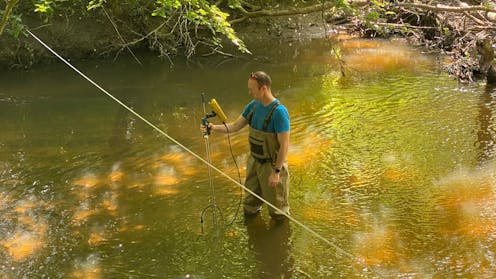
Patrick Byrne samples the water in the Mersey catchment. Patrick Byrne, CC BY-NC-ND

The amount of toxic “forever chemicals” flowing into the River Mersey in north-west England has reached some of the highest levels recorded anywhere in the world.

My team’s research links much of this contamination to old landfills, waste facilities and past industrial activity. Even if these chemicals were banned tomorrow, they would continue polluting our rivers for decades, possibly centuries.

But there is a path forward. We’ve developed a new method
to track and prioritise the largest sources for clean-up, giving regulators a clearer picture of where to act first.

Per- and polyfluoroalkyl substances (PFAS), more commonly known as “forever chemicals”, are a large family of human-made chemicals found in everyday products like food packaging, water-repellent clothes and fire-fighting foams. They are valued for their ability to resist very high temperatures and to repel water and oil, but these same properties make them extremely persistent.

Once released, some PFAS could take thousands of years to break down. They accumulate in the environment, build up – with different compounds accumulating at different rates – inside the bodies of wildlife and people, and have been associated with harms to health. The most studied types have been linked to cancers, hormone disruption and immune system problems.

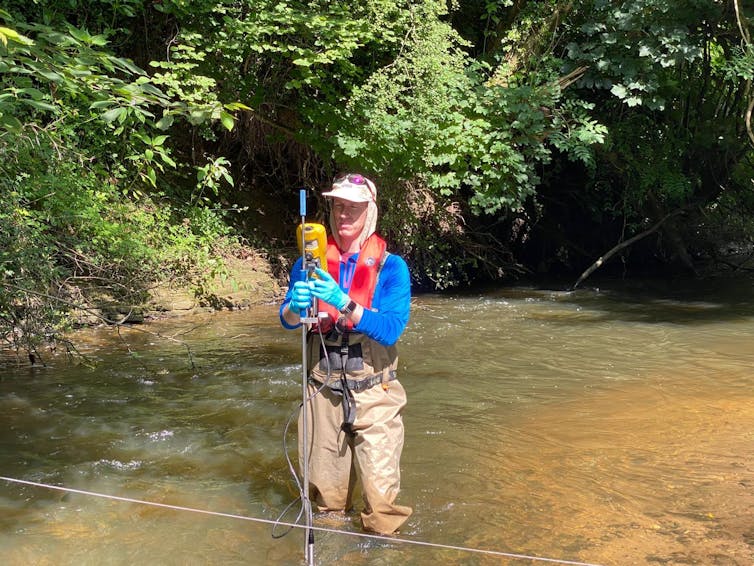
Patrick Byrne has been measuring PFAS ‘loads’ in rivers over a period of time, not just the concentration at one moment.
CC BY-NC-ND

Last year, my research team discovered that the amount of two potentially cancer-causing PFAS chemicals washing off the land and into the Mersey was among the highest in the world. In our follow-on research, we travelled upstream to try and locate where these PFAS are coming from. But with hundreds of potential PFAS sources, how do we isolate the largest ones?

The secret is measuring something called the PFAS load – the total amount of PFAS flowing through the river at a given point, rather than just the concentration in the water.

Here’s why that matters: a small stream can have high concentrations but carry only a small total amount, while a large river with lower concentrations can be transporting far more PFAS overall. If we only look at concentration, we risk missing the really heavy polluters.

By measuring PFAS loads at multiple points along the Mersey system, we could see exactly where the largest increases occurred. That told us both the location and the scale of PFAS inputs.

We detected PFAS chemicals at 97% of our sample sites, even in supposedly pristine streams draining from the Peak District national park. But the big breakthroughs came when we matched the largest PFAS load increases to specific areas.

PFBS (a type of PFAS) was coming in huge amounts from land draining old landfills in the Glaze Brook watershed near Leigh, west of Manchester. PFOA, a globally banned and cancer-causing PFAS, appeared to originate from a waste management facility on the River Roch, north of Manchester. PFOS, another banned PFAS, was entering the River Bollin, with strong evidence pointing to historic firefighting foam use at Manchester Airport.

What’s most striking to me is that all these sources are rooted in the past – old landfills, waste sites or historic industrial use. These chemicals are no longer in production, but they are still escaping into the environment, decades later.

alt text
This unmanned survey vessel is packed with sensors that measure PFAS loads in large rivers.
credit, CC BY-NC-ND

This is where PFAS load measurements make a real difference. Instead of chasing the highest concentrations – which might lead to cleaning up small streams that contribute little overall – we can target the sites releasing the largest total amounts of PFAS into our rivers.

It’s a simple idea with major implications. In a world where environmental regulators face tight budgets and limited monitoring capacity, knowing exactly which sites are the biggest sources is vital.

The Mersey is just one example. Around the world, PFAS contamination follows a similar pattern: numerous potential sources scattered across the landscape, many of them historical. The chemicals’ extreme persistence means they will continue cycling through rivers, soils and wildlife for generations unless active steps are taken to remove or contain them.

Our latest study shows that measuring PFAS load can help solve one of the toughest challenges in managing chemical pollution: working out where to start. By identifying and prioritising the biggest sources, regulators have a realistic chance of reducing the flow of forever chemicals into our rivers – and perhaps one day, making that nickname a little less true.


Don’t have time to read about climate change as much as you’d like?

Get a weekly roundup in your inbox instead. Every Wednesday, The Conversation’s environment editor writes Imagine, a short email that goes a little deeper into just one climate issue. Join the 45,000+ readers who’ve subscribed so far.


The Conversation

Patrick Byrne receives funding from the Natural Environment Research Council.

ref. How I tracked the biggest hidden sources of forever chemical pollution in our rivers – new study – https://theconversation.com/how-i-tracked-the-biggest-hidden-sources-of-forever-chemical-pollution-in-our-rivers-new-study-261967

The Lady from the Sea: a fierce play that shies from the wonderful unknowability of Henrik Ibsen’s original

Source: The Conversation – UK – By Dan Rebellato, Professor of Contemporary Theatre in the Department of Drama, Theatre and Dance Creative Writing and Practice-based Research, Royal Holloway University of London

Henrik Ibsen’s 19th-century play about a woman caught between a stormy past and respectable present has been reimagined for the 21st century in a new production at the Bridge Theatre, London.

This new adaptation arrives bristling with contemporary relevance. Writer and director Simon Stone has included references to Beyoncé and Just Stop Oil activism. It also features a millennial protagonist wrestling with climate anxiety.

Ellida is married to Edward, a doctor, who has two daughters, Asa and Hilda, from a first marriage that ended in their mother’s suicide. But Ellida has secrets, and they’re starting to come out. The first is a history of teenage climate activism. The second is an older man, Finn (Brendan Cowell), someone who was both guru and predator to her in her youth. When he returns, Ellida has a decision to make.

Simon Stone has a distinctive method when working on classics, transplanting the action to different places and times, and working with the actors to find contemporary equivalents to the original language, characters and story.

This play has been transplanted from Norway to England and from the 19th century to the 21st. This works well (even if the Yorkshire coast is hardly the Norwegian fjords). The family is, if anything, wealthier than in Ibsen’s original, though this gives them all a fragile sense of entitlement that makes the family’s disruption all the more potent.


Read more:
What’s next for Afghanistan? Two experts make predictions


The production is set in the round, with the stage in the middle of the audience. This choice places the vivid action under intense scrutiny, but it raises a problem: where is the sea?

The sea is an insistent presence in the play, a source of danger and seduction, luring Ellida back from her settled life. Lizzie Clachan’s design offers some elegant solutions – particularly the interval transformation from white to black, suggesting watery depths beneath shiny surfaces – but the format loses a sense of the ocean, when the ocean is nowhere to be seen. This Ellida feels less like a woman haunted by the sea’s mysteries than an advocate of wild swimming.

Alicia Vikander brings a touching vulnerability to Ellida, her awkwardness cutting through this family’s banter. I might have liked to see a less contained performance; we hear about her inner strength without quite seeing it, so we never feel the pull of the sea and the force of her decision.

Andrew Lincoln is a fine Edward – charming, intelligent, confident bordering on complacent, dangerously slow to recognise the disintegration of his world. The triangle of Ellida, Edward, and Finn feels genuinely dangerous, capable of tilting this world off its axis.

The daughters, exuberantly played by Gracie Oddie-Jones and Isobel Akuwudike, embody a cracklingly funny gen Z self-righteousness and bring a sense of generational change and discontent that broadens the political landscape of the production. The archly knowing dialogue is performed with pleasing, overlapping off-handedness by the ensemble cast.

The production’s relationship with Ibsen is rich and interesting, extending beyond this single play. Ibsen brought back one of the characters from The Lady from the Sea four years later in The Master Builder, an otherwise quite separate play. Stone has clearly sensed Ibsen’s breaking of boundaries between his plays in this decision, which allowed us to glimpse an expanded Ibsen universe.

Running with this shared universe idea, in 2017, Stone created the play Ibsen House for Internationaal Theater Amsterdam, a collage of Ibsen narratives in a three-dimensional glass-sided house. He’s at it again here, nicking bits of other plays to enrich this one.

Ellida’s confrontation with Finn (the climate activist with whom she had a sexual relationship aged 15) borrows from a similar confrontation in The Master Builder (1893). In the character of her family friend Heath (Joe Alwyn), Stone combines the terminal illness of Dr Rank from A Doll’s House (1879) with the sculptural ambitions of Rubek from When We Dead Awaken (1900).

But this adaptation shies away from the alien strangeness that makes Ibsen genuinely radical. Ibsen’s plays wrestle uncompromisingly with themselves. Many of his mature plays seem transformed by the forces unleashed by their stories, such that works like A Doll’s House, An Enemy of the People (1882), Hedda Gabler (1891), or John Gabriel Borkman (1897) start as one kind of play and end as quite another.

The Lady from the Sea is the same, beginning as a bucolic family play and ending somewhere mythological and elemental. But Stone’s version, for all its contemporary references, remains a family drama. The last scene, in which everyone explains their feelings at length is the kind of neat and tidy playwriting that Ibsen worked hard to abolish.

There are choices here that echo those made when A Doll’s House first reached Britain in 1884. Then, its title was changed to Breaking a Butterfly and its protagonists, Nora and Torvald Helmer, were domesticated as Flossy and Humphrey Goddard. The original’s radical ending of Nora’s shattering departure was replaced with Humphrey rescuing his wife and burning an incriminating document. He does this while mansplaining that: “Flossy was a child yesterday: today she is a woman.”

Stone’s adaptation isn’t so egregious, but does share a bit of that impulse. The production makes Ibsen relatable, but Ibsen’s plays are always strange, always challenging audiences to confront compelling difference. By translating Ibsen’s environmental and psychological radicalism into familiar contemporary anxieties, Stone is leaving some of the challenge behind.

Perhaps we think we know Ibsen so well and he needs updating. But, as with this year’s Ghosts (Lyric Hammersmith) and My Master Builder (West End), the updating sometimes lightens and tames their dark strangeness. I worry that a generation will only ever see smart versions of Ibsen but will never get a chance to know the originals.

This is a fierce, powerful evening of theatre. But should we not sometimes, like Ellida, meet the challenge of the alien stranger from across the sea?


Looking for something good? Cut through the noise with a carefully curated selection of the latest releases, live events and exhibitions, straight to your inbox every fortnight, on Fridays. Sign up here.


The Conversation

Dan Rebellato does not work for, consult, own shares in or receive funding from any company or organisation that would benefit from this article, and has disclosed no relevant affiliations beyond their academic appointment.

ref. The Lady from the Sea: a fierce play that shies from the wonderful unknowability of Henrik Ibsen’s original – https://theconversation.com/the-lady-from-the-sea-a-fierce-play-that-shies-from-the-wonderful-unknowability-of-henrik-ibsens-original-265515

What will the UN’s Gaza genocide report achieve?

Source: The Conversation – UK – By Jonathan Este, Senior International Affairs Editor, Associate Editor, The Conversation

This article was first published in The Conversation UK’s World Affairs Briefing email newsletter. Sign up to receive weekly analysis of the latest developments in international relations, direct to your inbox.


The report of the UN’s independent international commission of inquiry on Palestine, released this week, makes for gruelling reading. It found that Israel’s 23-month campaign in Gaza is being waged “with intent to destroy, in whole or in part, a national, ethnic, racial or religious group”. This, according to the commission, amounts to genocide under the Geneva conventions.

The detailed 72-page report has found that Israel’s military, under the direction of its political leaders, satisfy four of five acts specified by the convention as genocidal. This includes the genocidal act of “imposing measures intended to prevent births within the group”. This, the report said, was due to the Israel Defense Forces’ (IDF) attack on Gaza’s only IVF clinic at the end of 2023, destroying an estimated 4,000 embryos and 1,000 sperm samples.

The key issue in arguments around genocide, and the reason why charges are so rarely brought, is the word “intent”. To show the intent to destroy the Palestinian people, the report quotes Israeli prime minister Benjamin Netanyahu, his former defence minister Yoav Gallant, Israeli president Isaac Herzog and other political and military leaders using “inciting, provocative, dehumanising language”. The report gives several examples of this language. It concludes: “The statements were received by the Israeli security forces as an order to destroy Palestinians in Gaza and such order was indeed executed through military operations.”

Malak Benslama-Dabdoub, an expert in international human rights law at Royal Holloway, University of London, walks us through the report and summarises its findings. But crucially she asks: will this report make any difference? Attempts to condemn the violence and call for an end to the campaign in the UN security council have always fallen foul of America’s use of its security council veto.

Neither Israel not the US are signatories to the International Criminal Court, which has issued warrants against Netanyahu and Gallant. So Netanyahu has been able to visit the US without fear of arrest and the death toll in Gaza continues to rise daily. While Israel continues to be protected by its allies, writes Benslama-Dabdoub, it will continue to act with impunity.


Read more:
Israel is committing genocide in Gaza, says UN commission. But will it make any difference?


And so it goes on. Israel has just launched a major new ground offensive on Gaza City, where scores are already reported to have been killed and thousands have been forced to flee for their lives.

It’s hard to tell how many people lived in Gaza City before the assault began, but some estimates put it at around 590,000. A large proportion of these people will now be forced south, along with much of the rest of the population of the Strip.

It’s not hard to divine that the intention of the Netanyahu government is to push many, if not all, of these displaced people through the Rafah crossing into Egypt. Rory McCarthy, a Middle East expert and former Guardian correspondent in Jerusalem, says this much should be clear from a recent statement by the Israeli prime minister that: “The Egyptian foreign ministry prefers to imprison residents in Gaza who would prefer to leave the war zone.”

Egypt will not accept this, writes McCarthy. It already hosts around 150,000 displaced Palestinians and reacted very strongly against a suggestion by the US president, Donald Trump, that the population of Gaza could be relocated to Egypt and Jordan. (Jordan, which has more than 2 million Palestinians displaced in various conflicts, was also vehemently opposed to the idea.)

This is all putting Egypt’s relationship with Israel under severe pressure and destabilising the regime of Egypt’s strongman leader, Abdel Fattah al-Sisi, as well, McCarthy writes.


Read more:
Why Egypt is not bowing to pressure to accept Palestinian refugees


Relations between the two countries have been under pressure since the war began two years ago. It has reached the point that, at an emergency summit of Arab states after Israel launched an airstrike against Hamas leaders who were discussing a peace deal in Doha, the capital of Qatar earlier this month, the Egyptian leader referred to Israel – technically Egypt’s ally – as “the enemy”.

The strike against Qatar is likely to have serious repercussions across the region and is a disaster for diplomacy and mediation, writes M. Waqas Haider, an expert in Middle East diplomacy at Lancaster University. Qatar had built up a reputation as a safe haven in which warring parties could meet in safely for talks. Israel’s strike on Hamas in Qatar risks destroying that at a stroke.


Read more:
Israel’s strike on Qatar was a serious blow against diplomacy in the Middle East


Trump’s vision of a Gaza ‘Riviera’

The US president’s intention to move displaced Palestinians from Gaza to Egypt and Jordan was made clear in February shortly after the news emerged of a proposal to turn the post-war Gaza Strip into an enormous real estate investment. Trump posted a video, which few took too seriously at the time as it featured a large golden statue of the US president himself.

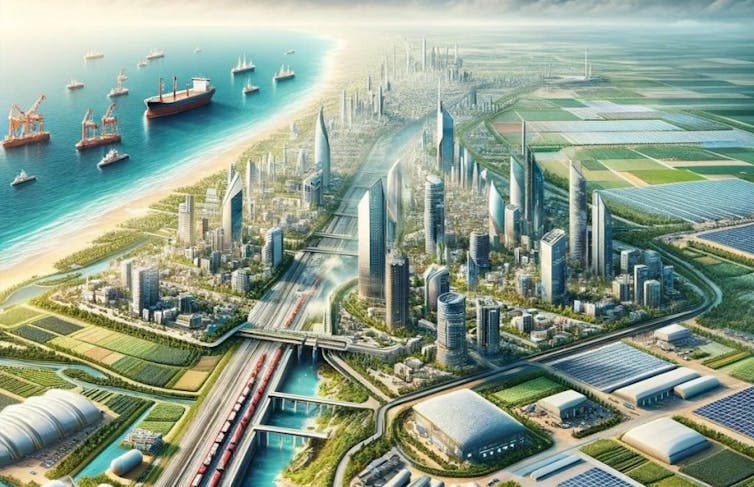
But last week the Washington Post published a 38-page document, resembling a property developer’s prospectus, which lays out in some detail a plan to turn Gaza from “a demolished Iranian proxy to a prosperous Abrahamic ally”. Any Palestinians left in the Strip would be given cash incentives to leave or tokens in return for their land entitling them to an apartment in one of the shiny new high-rise apartment blocks the plan envisages.

Artists impression of the Gaza Reconstitution, Economic Acceleration and Transformation plan.
A real estate developer’s dream: Gaza ‘Riviera’.
Image supplied.

Rafeef Ziadah says it’s a part of an ambitious plan to reposition the Middle East as part of a new US-led order linking India to Europe. Imec (the India–Middle East–Europe Economic Corridor) is envisaged as a counterweight to China’s belt and road initiative, writes Ziadah, who researches regional politics at King’s College London and has made something of a speciality of the politics of major infrastructure plans.


Read more:
Donald Trump’s vision for Gaza’s future: what a leaked plan tells us about US regional strategy


The forced relocation of people as a result of conflict is considered to be a war crime under international law. But once again, it is difficult to make such judgments unless they are tested in court. Another category of war crime arguably taking place regularly across Palestinian areas is collective punishment. This is defined as “a form of sanction imposed on persons or a group of persons in response to a crime committed by one of them or a member of the group”.

Leonie Fleischmann asserts that Israel has been using this tactic as a form of deterrence for years. Just last week the IDF detained 1,500 Palestinian men in retaliation for a bomb which went off in Jerusalem, injuring two. Days before two gunmen boarded a bus in the same city and started shooting, killing six people. Israel imposed harsh penalties against the shooters’ villages.

Fleischmann, an expert in Israeli politics at City St George’s, University of London, says Israel argues that this is legal, as an occupying power it has the right to protect its own security against what is likely to be a hostile population. But there are flaws to this argument, says Fleischmann, who explains how the laws against collective punishment work.


Read more:
What international law says about Israel’s collective punishments against Palestinian civilians


With the UK expected to recognise Palestinian statehood as soon as this weekend, the latest edition of our podcast, The Conversation Weekly, is a history of the Palestinian people’s aspirations for an independent state. Podcasts editor Gemma Ware interviews Maha Nassar, a US-based Palestinian historian, about the Palestinian liberation movement.


Read more:
From resistance to intifada to recognition: the origins of an independent Palestinian state – podcast


Sign up to receive our weekly World Affairs Briefing newsletter from The Conversation UK. Every Thursday we’ll bring you expert analysis of the big stories in international relations.


The Conversation

ref. What will the UN’s Gaza genocide report achieve? – https://theconversation.com/what-will-the-uns-gaza-genocide-report-achieve-265617

A ceremonial sword and ‘beating the retreat’: decoding the rituals of Donald Trump’s state visit

Source: The Conversation – UK – By Francesca Jackson, PhD candidate, Lancaster Law School, Lancaster University

State visits are always grand occasions, but Donald Trump’s second was unprecedented in terms of scale and spectacle. The president was treated to the most impressive ceremonial welcome ever laid on for any head of state.

After enjoying a carriage ride through the grounds of Windsor Castle with the king, queen and prince and princess of Wales, the president was greeted by the largest guard of honour ever, comprising 1,300 troops and 120 horses. A lunch, private tour of St George’s Chapel and a Red Arrows flypast followed, before the day culminated in a lavish white-tie state banquet.

All this pomp and pageantry has a purpose and a keen eye can spot meaning in most parts of the itinerary.

For example, there were obvious nods to the government’s priorities for this visit throughout the first day, even before the government meetings began. Prime minister Keir Starmer has wanted to focus on tech and defence, so we saw key business leaders, including the head of Apple and CEO of OpenAI, on the guest list for the state banquet.

There was also a clear focus on defence throughout the first day’s proceedings. As well as inspecting the customary guard of honour, the President took part in the “beating the retreat” ceremony – the first time that this historic military parade has been performed at an incoming state visit.

British and American F-35 fighter jets were part of the aerial flypast and when symbolic gifts were exchanged, Trump presented the king with a replica of a President Eisenhower sword. This, he said, was a “reminder of the historical partnership that was critical to winning World War II”.

But perhaps the government’s objectives were seen most clearly in the speeches delivered during the state banquet. King Charles explicitly reminded the President that the UK had agreed “the first trade deal” of any country with his administration, which he said had brought “jobs and growth” to both countries and hoped would allow for them to “go even further as we build this new era of our partnership”.

Most striking of all, however, were the king’s comments on defence. He explicitly told Trump that “in two world wars, we fought together to defeat the forces of tyranny. Today, as tyranny once again threatens Europe, we and our allies stand together in support of Ukraine, to deter aggression and secure peace”.

The first day of any state visit is all about royal pageantry, with discussions of politics usually left for day two. This is because in the UK’s constitutional monarchy, the monarch is bound by the doctrine of political neutrality, which means that the king must remain neutral on political matters.

But some have argued that Charles was, with these comments, straying into politics and went too far. The journalist Michael Wolff said the king was effectively correcting Trump over his failure to strike a peace deal in Ukraine and that the President would have been “super irritated” by the intervention.

However, it is important to note that the king’s words will have been chosen carefully for him by the UK government. This is because Charles is bound by the cardinal convention, a constitutional rule according to which he must act on the advice of the government. All his speeches are written by ministers, and this particular speech reportedly went through many drafts to ensure that the king “pushes the right buttons without crossing political lines”.

The button that this speech was designed to push was peace in Ukraine. After his very public spat with Ukrainian president Volodymyr Zelenskyy in the Oval Office earlier this year, the UK government has been concerned that Trump is indifferent about who wins the Russia-Ukraine war and favours an appeasement solution with Putin. It wants to get Trump firmly on Ukraine’s side – and thought the king was the best person to deliver this message.

The king is a skilled diplomat whose unrivalled soft power gives him the unique ability to influence some of the biggest political issues of our time. And he seems to get on well with Trump. The king met the President during his first state visit in 2019, wrote to him following his assassination attempt and, unusually, invited him for an unprecedented second state visit with a special hand written note.

There seemed to be genuine warmth between the two men during this second visit. The President, for example, praised the king, describing him as “his friend who everybody loves” and “a great gentleman and a great king”.

And there are signs that this flattery and warmth nullified any potential annoyance over the Ukraine comments. In his own speech, Trump effused that the day was “one of the highest honours” of his life and that “the word ‘special’ does not begin to do justice” to the UK-US relationship.

If the state visit helps increase US support for the British economy and Ukraine, it will be a job well done for the royals.

The Conversation

Francesca Jackson does not work for, consult, own shares in or receive funding from any company or organisation that would benefit from this article, and has disclosed no relevant affiliations beyond their academic appointment.

ref. A ceremonial sword and ‘beating the retreat’: decoding the rituals of Donald Trump’s state visit – https://theconversation.com/a-ceremonial-sword-and-beating-the-retreat-decoding-the-rituals-of-donald-trumps-state-visit-265595

Trump state visit: behind talk of harmony there are notes of discord

Source: The Conversation – UK – By Jason Ralph, Professor of International Relations, University of Leeds

An unusual feature of Donald Trump’s second state visit to the UK was the spectacle of the Royal Marines, the Coldstream Guards and the Royal Air Force “beating retreat” as the president and King Charles looked on.

This is a traditional military ceremony that started in the 17th century and marked the closing of camp gates and the lowering of flags. It is, by all accounts, the kind of British “soft power” that excites the president and consolidates “the special relationship” between allies.

But one cannot help wondering if what this ceremony marked was in fact the final retreat of the US and UK from their self-defined role as defenders of an international order based on liberal and democratic values.

How are we otherwise to reconcile the fact that a “populist” American president, supposedly elected on an anti-elitist message, so visibly revelled in facing an audience composed almost exclusively of the elites of a monarchical system (on Wednesday) and the tech-business community (on Thursday)?

Trump may have had the unprecedented honour of a second state visit. But what does it say about “the special relationship” between common people (if not heads of state) when the visit was arranged to land in a week the House of Commons was not sitting, meaning he would not be able to address the national parliament?

Perhaps it says something about the retreat of American Republican virtues and the rise of an “imperial presidency” (just as King George III in Hamilton the musical predicted). Trump would not want to be reminded that it was President Obama who had the recent honour of speaking to the British people through their elected representatives in Westminster Hall.

Meanwhile, how do we reconcile the sense that Prime Minister Keir Starmer knows how to handle President Trump with Starmer’s apparent inability to prevent the political retreat of his own government?

The answer to that is that the prime minister may be a better diplomat than he is a politician. He understands that flattery makes Trump the man happy, but he seems less certain about how to deal with Trumpism the idea.

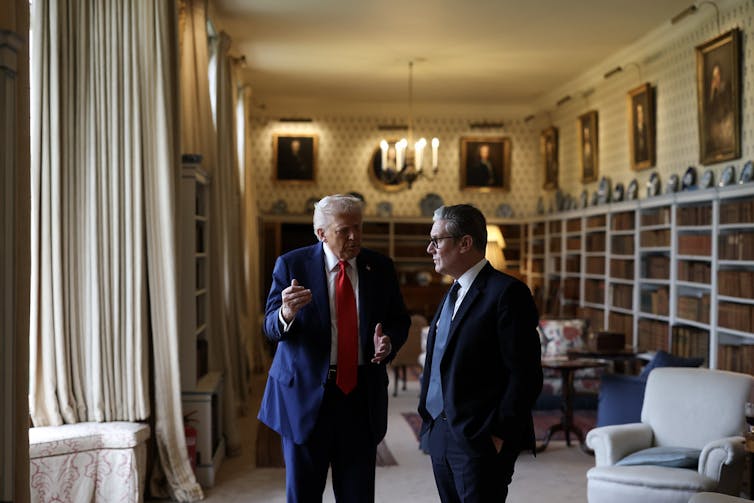
Donald Trump talking to Keir Starmer.
Trump and Starmer behind the scenes.
Number 10/Flickr, CC BY

Trumpism has inspired so-called “new right” movements throughout the western world. In the UK, it defeated Starmer’s preferred brand of progressive internationalism when Nigel Farage pushed for and won a vote to leave the European Union in 2016.

In the wake of this state visit, the government will claim success by pointing to the £150 billion of investment apparently secured through tech deals. It is not, however, clear what role the US state, or indeed the state visit, had in securing (as opposed to announcing) that.

In the meantime, Starmer’s Labour is still reluctant to push back against new right thinking by pointing to the cost Brexit has had on government tax revenues.

A similar concern is being voiced on the cost of the new right’s approach to immigration in the US. The president proudly defended his administration’s actions on immigration and even recommended the UK deploy the military to manage migration. But armed raids on Hyundai factories in the US have left another key ally, South Korea, questioning its longstanding commitment to invest there.

This state visit has coincided with the United Nations Commission of Inquiry finding that Israel has engaged in four of the five genocidal acts as defined under international law since the beginning of its war with Hamas in 2023.

One cannot expect policy – and certainly not policy differences – to make their way into banquet speeches. But the expectation that Trump will simply ignore UK pleas to pressure Israel into stopping its offensive makes the Windsor scenes difficult viewing for many.

Middle East policy differences were on display at the Chequers press conference and the UK government will seek to mollify its critics by following through on its intention to imminently recognise Palestine as a sovereign state. But without US support, the UK cannot expect this to make an immediate difference to the humanitarian situation.

Notes of discord

There was an additional musical theme to the speeches at the state banquet during Trump’s visit. The president described the US and UK as “two notes in the same chord”.

That may be the case, but there are many discordant notes sounded when the president’s words are mixed with the political soundtrack beyond Windsor castle and Chequers. Outside these sheltered surroundings, the mood music is changing.

The images of militaries marching in royal gardens resonate with the recent ceremonial displays of hard power in Washington and Beijing. Putin standing alongside Xi no doubt disappointed Trump, who reportedly tried to ally with Russia to balance the power of China. He was explicit on that at Chequers. Trump feels “let down” by Putin.

The progressive side of UK foreign policy thinking hopes this now means Trump will be more committed to Ukraine and the liberal principle of national self-determination. But perhaps the wider implication of these discordant notes is that “the special relationship” is being reimagined as a focal point in an international order of competing power blocks. This state visit may indeed come to symbolise the retreat of the liberal international order.

The Conversation

Jason Ralph has previously received funding from UK Research Councils and the European Union. He is a member of the Labour Party.

ref. Trump state visit: behind talk of harmony there are notes of discord – https://theconversation.com/trump-state-visit-behind-talk-of-harmony-there-are-notes-of-discord-265519

Can the UK fast-track nuclear power without cutting corners on safety?

Source: The Conversation – UK – By Thomas Haynes, Lecturer in Nuclear Engineering, University of East Anglia

Before the pomp of President Trump’s state visit to the UK, Washington and London announced a series of collaborations on nuclear research and regulation. A reminder to cynics that perhaps these events have some substance.

Britain is already undergoing a nuclear revival. Large power stations are under construction (albeit much delayed) at Sizewell in Suffolk and Hinkley Point in Somerset. Rolls Royce has been confirmed as the supplier for a fleet of small modular reactors (SMRs). These reactors use similar technology to the big power plants, but with all components designed to fit into a single container.

Now, as part of the US-UK deal, we can add proposals to build 12 advanced modular reactors (AMRs), using fundamentally different technology, in Hartlepool.

The UK’s nuclear regulator is therefore being asked to consider radically different designs on a scale and pace never before seen. That’s partly why, as part of the deal, the two countries have agreed to accept each other’s safety checks. The government claims this will “halve the time for a nuclear project to be licensed”. The question is whether this can be done as safely.

Two large cooling towers
With four reactors, Plant Vogtle in Georgia is the largest nuclear power plant in the US.
PrasitRodphan / shutterstock

The US and UK take fundamentally different approaches to nuclear regulation.

The US’s Nuclear Regulation Commission (NRC) takes a “prescriptive” approach. It sets detailed rules based on its own research and enforces them directly.

Like police setting speed limits, the regulator decides the standards and then ensures nuclear operators meet them. If an accident happens, operators can point to meeting every requirement as evidence they followed the rules. They could even legitimately blame the regulator.

The UK’s Office for Nuclear Regulation (ONR) takes a “descriptive” approach. It sets broad standards but leaves operators to prove how they will meet them.

In road terms, the US sets the speed limit and checks drivers obey it. The UK simply says cars must stay on the road, leaving drivers to decide their own limits, prove they’re safe, and take full responsibility if they crash.

These two approaches are driven to a large extent by the two country’s history and make up of their nuclear industries.

The US has a few standard reactor designs, many operators, and vast federal research labs. The UK has fewer, often state-owned (or foreign state-owned) operators running bespoke reactors fleets, with in-house expertise.

The result is that the US’s regulator – the NRC – is large, well-funded, and deeply involved in design and research. The UK equivalent – the ONR – is smaller and focused on critically reviewing the judgement and processes of the operators.

Both systems have worked well. Nuclear regulation and the associated safety record in both countries is regarded as being among the best in the world.

Why collaboration now matters

A sudden surge of new nuclear in the UK would make closer alignment with US regulators more attractive. If the US has already assessed a proposed power plant design, the UK regulator could potentially rely on that evidence rather than duplicate the work. This would avoid bottlenecks and speed up approvals.

The aviation sector already does something similar. Aircraft are certified by either the US Federal Aviation Administration (FAA) or the European Union Aviation Safety Authority (EASA), with airlines around the world trusting those approvals.

There is a strong element of reciprocity, driven by the need for aircraft to fly from one nation to another. The approach makes sense, as it would be absurd for every airline or national regulator to retest the same Airbus wing. Nuclear power, some argue, should move in this direction.

The risk of imported risk

But there are dangers in relying too heavily on foreign regulators. The Boeing 737-Max scandal, in which software error caused two near-identical accidents and left 346 dead, exposed the need to get regulation right. Political pressure and weak oversight at the FAA contributed to design flaws being missed. If the UK simply rubber-stamped US approvals, it could import these risks too.

The nuclear industry has an extra history of mistrust. The US’s 1946 McMahon Act restricted the sharing of nuclear data between the US and UK, and a number of British spies were exposed in the US. Civilian and military technologies overlap, and there is a desire to prevent nuclear proliferation.

So while UK-US collaboration could boost Britain’s nuclear industry and accelerate the path to low-carbon energy, independence and transparency will be essential. Any perception of corner cutting or transatlantic political interference could undermine public trust and derail Britain’s nuclear ambitions.


Don’t have time to read about climate change as much as you’d like?

Get a weekly roundup in your inbox instead. Every Wednesday, The Conversation’s environment editor writes Imagine, a short email that goes a little deeper into just one climate issue. Join the 45,000+ readers who’ve subscribed so far.


The Conversation

Thomas Haynes receives funding from Department for Energy Security & Net Zero and the UK Atomic Energy Authority. He is affiliated with the Nuclear Institute.

ref. Can the UK fast-track nuclear power without cutting corners on safety? – https://theconversation.com/can-the-uk-fast-track-nuclear-power-without-cutting-corners-on-safety-265614