Source: The Conversation – UK – By Ignazio Cabras, Professor of Regional Economic Development, Northumbria University, Newcastle
English pubs will receive a 15% discount on their business rates from April this year. The government deal, which also applies to music venues, follows a backlash from landlords who were facing a steep increase in their tax bills.
Some industry campaigners have said the support package – worth around £1,600 per pub – will allow landlords to breathe a sigh of relief. Some opposition politicians think it doesn’t go far enough.
Either way, it’s been a tough few years. High energy costs, inflation and wage increases have contributed to the serious financial difficulties facing many pubs.
The sector was also among the worst affected (alongside retail and leisure) by the social distancing and lockdowns of COVID. The government responded at the time by giving pubs significant business rate discounts in a show of support.
Then, in November 2025, it was announced that those discounts would be reduced and then phased out completely. This move, combined with big increases in the rateable values of pub premises, left landlords with the prospect of much higher bills.
But pubs are far more than cash machines for the Treasury. To many, they represent a vital part of British traditions and heritage. They also play a pivotal role in building and maintaining social relationships among the people who live near them.
Whether that’s a family meeting up for Sunday lunch, university students at their society gathering, or some elderly fans of real ale, pubs have a clear and long-standing role in creating community cohesion.
Several scientific studies have measured their positive effects on people, economies and societies.
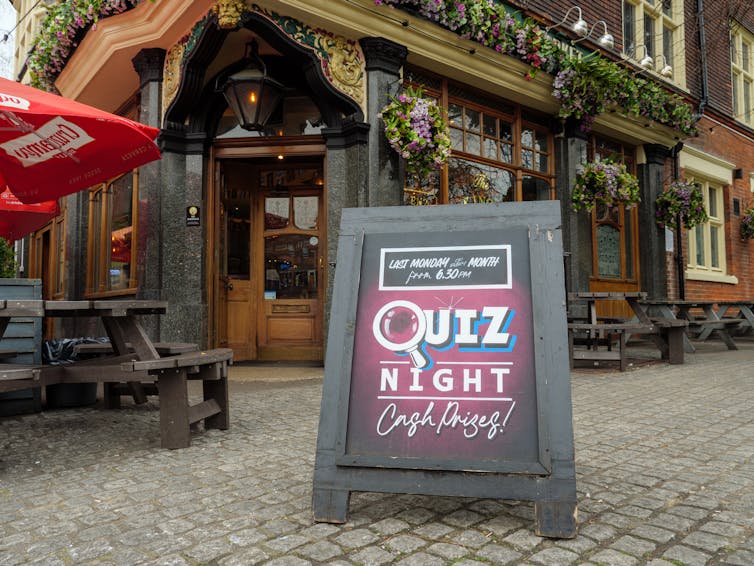
One, for example, confirms the strong link between pubs and local community events. It has also been shown that pubs are often more effective than other organisations at stimulating a wide range of social activities. This could include everything from sports teams and quiz nights to hosting book groups, as well as charitable and volunteering initiatives.
Pubs also frequently promote community events – such as charity events and social clubs – more effectively than other places such as sport or village halls. Research has shown that in rural areas especially, pubs are very effective – more so than village shops for example – at building community cohesion and local social networks.
Overall, opportunities for communal initiatives in some areas would be extremely reduced, if not nonexistent, without pubs. This is why the loss of a pub has a much broader impact than a mere business closure.
Yet despite all of this proven positive impact, the number of UK pubs has been constantly declining since the start of the century. According to the British Beer and Pub Association, there were 60,800 in 2000, compared to about 45,000 in 2024, meaning one in four closing its doors in the past 25 years.
Life for publicans has been extremely hard for a long time. This is why the changes proposed in the last budget prompted a significant pushback from the industry.
Last orders
But other businesses probably deserve a tax break too. High street shops can also help maintain higher levels of socialisation and community cohesion.
Particularly in remote and rural areas, which suffer from a general lack of local services and public transport options compared to urban areas, these businesses are important in terms of economic development and social activity.
They are also a vital part of their local economic structure, providing employment opportunities and training for local residents. This is why the Treasury should consider a rethink about business rates across the board.
Like pubs, local businesses have value beyond the revenue they generate. A tax system which recognises their positive social impact would be a better and fairer fiscal tool all round.
In the past, Ignazio Cabras’ research work has received financial support from multiple funding bodies, including the British Academy, the Society of Independent Brewers (SIBA), and the Vintners Federation of Ireland (VFI). He is a Fellow of the Academy of Social Sciences (FAcSS).
Time feels like the most basic feature of reality. Seconds tick, days pass and everything from planetary motion to human memory seems to unfold along a single, irreversible direction. We are born and we die, in exactly that order. We plan our lives around time, measure it obsessively and experience it as an unbroken flow from past to future. It feels so obvious that time moves forward that questioning it can seem almost pointless.
And yet, for more than a century, physics has struggled to say what time actually is. This struggle is not philosophical nitpicking. It sits at the heart of some of the deepest problems in science.
Modern physics relies on different, but equally important, frameworks. One is Albert Einstein’s theory of general relativity, which describes the gravity and motion of large objects such as planets. Another is quantum mechanics, which rules the microcosmos of atoms and particles. And on an even larger scale, the standard model of cosmology describes the birth and evolution of the universe as a whole. All rely on time, yet they treat it in incompatible ways.
When physicists try to combine these theories into a single framework, time often behaves in unexpected and troubling ways. Sometimes it stretches. Sometimes it slows. Sometimes it disappears entirely.
The Insights section is committed to high-quality longform journalism. Our editors work with academics from many different backgrounds who are tackling a wide range of societal and scientific challenges.
Einstein’s theory of relativity was, in fact, the first major blow to our everyday intuition about time. Time, Einstein showed, is not universal. It runs at different speeds depending on gravity and motion. Two observers moving relative to one another will disagree about which events happened at the same time. Time became something elastic, woven together with space into a four-dimensional fabric called spacetime.
Quantum mechanics made things even stranger. In quantum theory, time is not something the theory explains. It is simply assumed. The equations of quantum mechanics describe how systems evolve with respect to time, but time itself remains an external parameter, a background clock that sits outside the theory.
This mismatch becomes acute when physicists try to describe gravity at the quantum level, which is crucial for developing the much coveted theory of everything – which links the main fundamental theories. But in many attempts to create such a theory, time vanishes as a parameter from the fundamental equations altogether. The universe appears frozen, described by equations that make no reference to change.
This puzzle is known as the problem of time, and it remains one of the most persistent obstacles to a unified theory of physics. Despite enormous progress in cosmology and particle physics, we still lack a clear explanation for why time flows at all.
Now a relatively new approach to physics, building on a mathematical framework called information theory, developed by Claude Shannon in the 1940s, has started coming up with surprising answers.
Entropy and the arrow of time
When physicists try to explain the direction of time, they often turn to a concept called entropy. The second law of thermodynamics states that disorder tends to increase. A glass can fall and shatter into a mess, but the shards never spontaneously leap back together. This asymmetry between past and future is often identified with the arrow of time.
This idea has been enormously influential. It explains why many processes are irreversible, including why we remember the past but not the future. If the universe started in a state of low entropy, and is getting messier as it evolves, that appears to explain why time moves forward. But entropy does not fully solve the problem of time.
For one thing, the fundamental quantum mechanical equations of physics do not distinguish between past and future. The arrow of time emerges only when we consider large numbers of particles and statistical behaviour. This also raises a deeper question: why did the universe start in such a low-entropy state to begin with? Statistically, there are more ways for a universe to have high entropy than low entropy, just as there are more ways for a room to be messy than tidy. So why would it start in a state that is so improbable?
The information revolution
Over the past few decades, a quiet but far-reaching revolution has taken place in physics. Information, once treated as an abstract bookkeeping tool used to track states or probabilities, has increasingly been recognised as a physical quantity in its own right, just like matter or radiation. While entropy measures how many microscopic states are possible, information measures how physical interactions limit and record those possibilities.
This shift did not happen overnight. It emerged gradually, driven by puzzles at the intersection of thermodynamics, quantum mechanics and gravity, where treating information as merely mathematical began to produce contradictions.
One of the earliest cracks appeared in black hole physics. When Stephen Hawking showed that black holes emit thermal radiation, it raised a disturbing possibility: information about whatever falls into a black hole might be permanently lost as heat. That conclusion conflicted with quantum mechanics, which demands that the entirety of information be preserved.
Resolving this tension forced physicists to confront a deeper truth. Information is not optional. If we want a full description of the universe that includes quantum mechanics, information cannot simply disappear without undermining the foundations of physics. This realisation had profound consequences. It became clear that information has thermodynamic cost, that erasing it dissipates energy, and that storing it requires physical resources.
In parallel, surprising connections emerged between gravity and thermodynamics. It was shown that Einstein’s equations can be derived from thermodynamic principles that link spacetime geometry directly to entropy and information. In this view, gravity doesn’t behave exactly like a fundamental force.
Instead, gravity appears to be what physicists call “emergent” – a phenomenon describing something that’s greater than the sum of its parts, arising from more fundamental constituents. Take temperature. We can all feel it, but on a fundamental level, a single particle can’t have temperature. It’s not a fundamental feature. Instead it only emerges as a result of many molecules moving collectively.
Similarly, gravity can be described as an emergent phenomenon, arising from statistical processes. Some physicists have even suggested that gravity itself may emerge from information, reflecting how information is distributed, encoded and processed.
These ideas invite a radical shift in perspective. Instead of treating spacetime as primary, and information as something that lives inside it, information may be the more fundamental ingredient from which spacetime itself emerges. Building on this research, my colleagues and I have explored a framework in which spacetime itself acts as a storage medium for information – and it has important consequences for how we view time.
In this approach, spacetime is not perfectly smooth, as relativity suggests, but composed of discrete elements, each with a finite capacity to record quantum information from passing particles and fields. These elements are not bits in the digital sense, but physical carriers of quantum information, capable of retaining memory of past interactions.
A useful way to picture them is to think of spacetime like a material made of tiny, memory-bearing cells. Just as a crystal lattice can store defects that appeared earlier in time, these microscopic spacetime elements can retain traces of the interactions that have passed through them. They are not particles in the usual sense described by the standard model of particle physics, but a more fundamental layer of physical structure that particle physics operates on rather than explains.
This has an important implication. If spacetime records information, then its present state reflects not only what exists now, but everything that has happened before. Regions that have experienced more interactions carry a different imprint of information than regions that have experienced fewer. The universe, in this view, does not merely evolve according to timeless laws applied to changing states. It remembers.
A recording cosmos
This memory is not metaphorical. Every physical interaction leaves an informational trace. Although the basic equations of quantum mechanics can be run forwards or backwards in time, real interactions never happen in isolation. They inevitably involve surroundings, leak information outward and leave lasting records of what has occurred. Once this information has spread into the wider environment, recovering it would require undoing not just a single event, but every physical change it caused along the way. In practice, that is impossible.
This is why information cannot be erased and broken cups do not reassemble. But the implication runs deeper. Each interaction writes something permanent into the structure of the universe, whether at the scale of atoms colliding or galaxies forming.
Geometry and information turn out to be deeply connected in this view. In our work, we have showed that how spacetime curves depends not only on mass and energy, as Einstein taught us, but also on how quantum information, particularly entanglement, is distributed. Entanglement is a quantum process that mysteriously links particles in distant regions of space – it enables them to share information despite the distance. And these informational links contribute to the effective geometry experienced by matter and radiation.
From this perspective, spacetime geometry is not just a response to what exists at a given moment, but to what has happened. Regions that have recorded many interactions tend, on average, to behave as if they curve more strongly, have stronger gravity, than regions that have recorded fewer.
This reframing subtly changes the role of spacetime. Instead of being a neutral arena in which events unfold, spacetime becomes an active participant. It stores information, constrains future dynamics and shapes how new interactions can occur. This naturally raises a deeper question. If spacetime records information, could time emerge from this recording process rather than being assumed from the start?
Time arising from information
Recently, we extended this informational perspective to time itself. Rather than treating time as a fundamental background parameter, we showed that temporal order emerges from irreversible information imprinting. In this view, time is not something added to physics by hand. It arises because information is written in physical processes and, under the known laws of thermodynamics and quantum physics, cannot be globally unwritten again. The idea is simple but far-reaching.
Every interaction, such as two particles crashing, writes information into the universe. These imprints accumulate. Because they cannot be erased, they define a natural ordering of events. Earlier states are those with fewer informational records. Later states are those with more.
Quantum equations do not prefer a direction of time, but the process of information spreading does. Once information has been spread out, there is no physical path back to a state in which it was localised. Temporal order is therefore anchored in this irreversibility, not in the equations themselves.
Time, in this view, is not something that exists independently of physical processes. It is the cumulative record of what has happened. Each interaction adds a new entry, and the arrow of time reflects the fact that this record only grows.
The future differs from the past because the universe contains more information about the past than it ever can about the future. This explains why time has a direction without relying on special, low-entropy initial conditions or purely statistical arguments. As long as interactions occur and information is irreversibly recorded, time advances.
Interestingly, this accumulated imprint of information may have observable consequences. At galactic scales, the residual information imprint behaves like an additional gravitational component, shaping how galaxies rotate without invoking new particles. Indeed, the unknown substance called dark matter was introduced to explain why galaxies and galaxy clusters rotate faster than their visible mass alone would allow.
In the informational picture, this extra gravitational pull does not come from invisible dark matter, but from the fact that spacetime itself has recorded a long history of interactions. Regions that have accumulated more informational imprints respond more strongly to motion and curvature, effectively boosting their gravity. Stars orbit faster not because more mass is present, but because the spacetime they move through carries a heavier informational memory of past interactions.
From this viewpoint, dark matter, dark energy and the arrow of time may all arise from a single underlying process: the irreversible accumulation of information.
Testing time
But could we ever test this theory? Ideas about time are often accused of being philosophical rather than scientific. Because time is so deeply woven into how we describe change, it is easy to assume that any attempt to rethink it must remain abstract. An informational approach, however, makes concrete predictions and connects directly to systems we can observe, model and in some cases experimentally probe.
Black holes provide a natural testing ground, as they seems to suggest information is erased. In the informational framework, this conflict is resolved by recognising that information is not destroyed but imprinted into spacetime before crossing the horizon. The black hole records it.
This has an important implication for time. As matter falls toward a black hole, interactions intensify and information imprinting accelerates. Time continues to advance locally because information continues to be written, even as classical notions of space and time break down near the horizon and appear to slow or freeze for distant observers.
As the black hole evaporates through Hawking radiation, the accumulated informational record does not vanish. Instead, it affects how radiation is emitted. The radiation should carry subtle signs that reflect the black hole’s history. In other words, the outgoing radiation is not perfectly random. Its structure is shaped by the information previously recorded in spacetime. Detecting such signs remains beyond current technology, but they provide a clear target for future theoretical and observational work.
The same principles can be explored in much smaller, controlled systems. In laboratory experiments with quantum computers, qubits (the quantum computer equivalent of bits) can be treated as finite-capacity information cells, just like the spacetime ones. Researchers have shown that even when the underlying quantum equations are reversible, the way information is written, spread and retrieved can generate an effective arrow of time in the lab. These experiments allow physicists to test how information storage limits affect reversibility, without needing cosmological or astrophysical systems.
Extensions of the same framework suggest that informational imprinting is not limited to gravity. It may play a role across all fundamental forces of nature, including electromagnetism and the nuclear forces. If this is correct, then time’s arrow should ultimately be traceable to how all interactions record information, not just gravitational ones. Testing this would involve looking for limits on reversibility or information recovery across different physical processes.
Taken together, these examples show that informational time is not an abstract reinterpretation. It links black holes, quantum experiments and fundamental interactions through a shared physical mechanism, one that can be explored, constrained and potentially falsified as our experimental reach continues to grow.
What time really is
Ideas about information do not replace relativity or quantum mechanics. In everyday conditions, informational time closely tracks the time measured by clocks. For most practical purposes, the familiar picture of time works extremely well. The difference appears in regimes where conventional descriptions struggle.
Near black hole horizons or during the earliest moments of the universe, the usual notion of time as a smooth, external coordinate becomes ambiguous. Informational time, by contrast, remains well defined as long as interactions occur and information is irreversibly recorded.
All this may leave you wondering what time really is. This shift reframes the longstanding debate. The question is no longer whether time must be assumed as a fundamental ingredient of the universe, but whether it reflects a deeper underlying process.
In this view, the arrow of time can emerge naturally from physical interactions that record information and cannot be undone. Time, then, is not a mysterious background parameter standing apart from physics. It is something the universe generates internally through its own dynamics. It is not ultimately a fundamental part of reality, but emerges from more basic constituents such as information.
Whether this framework turns out to be a final answer or a stepping stone remains to be seen. Like many ideas in fundamental physics, it will stand or fall based on how well it connects theory to observation. But it already suggests a striking change in perspective.
The universe does not simply exist in time. Time is something the universe continuously writes into itself.
To hear about new Insights articles, join the hundreds of thousands of people who value The Conversation’s evidence-based news. Subscribe to our newsletter.
Florian Neukart does not work for, consult, own shares in or receive funding from any company or organisation that would benefit from this article, and has disclosed no relevant affiliations beyond their academic appointment.
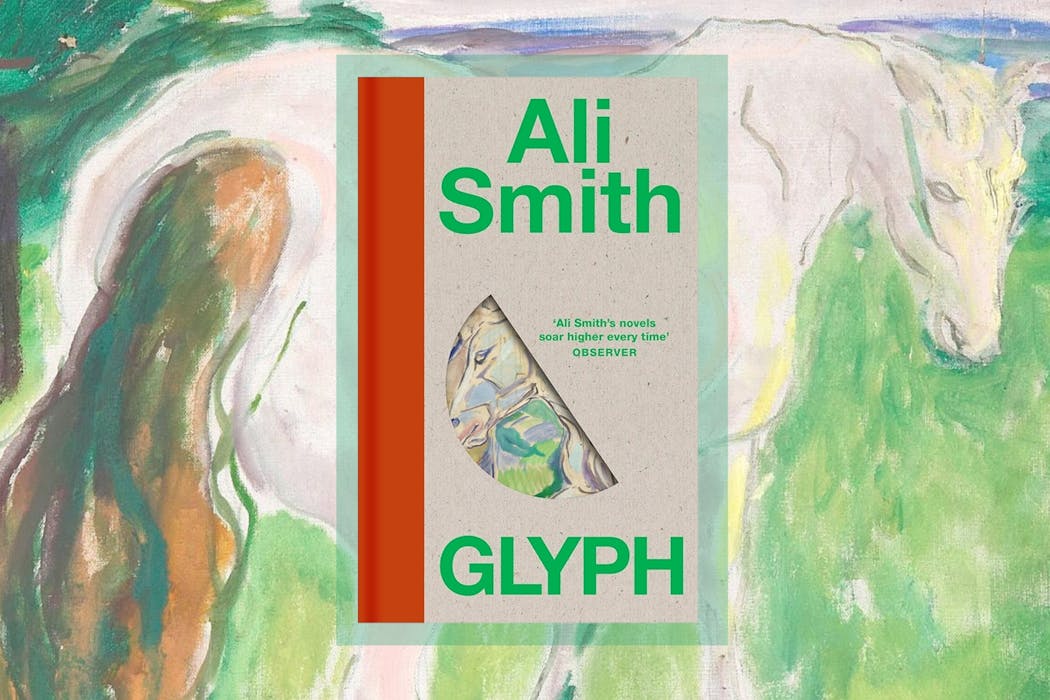
White Horse in a Green Meadow by Edvard Munch (1917) and the cover for Glyph. Munch Museum/Penguin
Ali Smith’s Glyph is the companion novel to her earlier novel, Gliff (2024). Gliff was set in a surreal near-future dystopia. Glyph, meanwhile, is set in the present. But like Smith’s earlier Seasonal Quartet, it offers the reader an uncanny version of our world, haunted by ghostly voices from the past.
The novel focuses on two sisters, Petra and Patricia (aka Patch). The action moves between scenes from their childhood in the 1990s and their present-day estrangement.
Two chance family anecdotes of wartime tragedy have a shaping influence on their imaginative lives. One is the story of a first world war soldier who deserted the army, fleeing with a blinded horse he wished to save. We learn that he was eventually court-martialled and executed.
The other is the curious account of how a female agent, travelling under cover through France in the second world war, discovered a mysteriously flattened corpse on the road.
When young Patch becomes distressed by the fate of the flattened man, Petra pretends that she can communicate with him in the afterlife. Episodes from his life are presented in vivid detail, and the reader is invited to speculate that the ghost may be real.
Smith teasingly draws attention to the different levels of reality at work in the novel. The image of a flattened corpse becomes a metaphor for other kinds of flattening, including that of characters in fiction. At one point the narrating voice, with apparent authorial detachment, refers to “the flat character / literary device called Patricia”.
It is then revealed that Patricia herself is narrating this section. And the ghost of the flattened man – who may simply be Petra’s invention – remembers reading a book in which books are described as “flattened flowers at best”.
The novel also asserts a powerful link between stories and ghosts: “Story, however. It is haunting. Everything tells it.”
Glyph v Gliff
Although it can be read as a standalone work, Glyph inevitably invites the reader to explore its relationship with Gliff (2024), adding yet a further dimension to this multilayered novel.
In many ways Petra and Patch’s relationship mirrors that between Gliff’s siblings, Briar and Rose. Both younger sisters share a fondness for puns and sly malapropisms. And the soldier’s doomed escape with the horse seems to echo the mysterious disappearance of Rose on the back of a horse she rescued from being slaughtered.
Smith adds a further complication into the mix when it is revealed that the novel Gliff exists in the world of Glyph. A brief discussion of its merits (and weaknesses) between Petra and Patch offers a humorous reflection of real-world reader responses to Gliff: “A bit too dark for me. A bit too clever-clever, a bit too on the nose politically, for a novel.”
The presence of Gliff within Glyph also complicates the meaning of some of the links between the two novels. Petra is sure she is being haunted by the blind horse of family legend. But Patch suggests that this is a delusion sparked by reading Gliff. The duology forms a kind of textual Möbius strip – a mind-bending twisted loop with just one side – perhaps nodding back to the double strands of Smith’s 2014 novel How to be Both.
Alongside all this playful twistiness sits a passionate commitment to a more just society. Billie, Patch’s teenage daughter, is central to this element of the novel. She resembles young Florence in Ali Smith’s earlier novel Spring (2019). Both are charismatically exuberant Greta Thunberg-style campaigners for social justice.
The future world of the earlier novel Gliff seemed horrifyingly absurd in its unfairness. Viewed through Smith’s bitterly satirical lens in Glyph, our own present world seems little less surreal in its destructiveness, its attacks on creativity, freedom and the environment, and its addiction to war and violence.
Like all of Smith’s works, Glyph is multifaceted. She is equally adroit at capturing the emotional nuances of family life, mapping out the larger political landscape, or beguiling the reader with joyfully witty metafictional and linguistic games.
Readers often feel pulled in two directions when reading her novels. There is so much to pause on, so many startling turns of phrase or clues to hidden mysteries. Yet there is also an irresistible compulsion to turn the pages, to find out what happens next.
Looking for something good? Cut through the noise with a carefully curated selection of the latest releases, live events and exhibitions, straight to your inbox every fortnight, on Fridays. Sign up here.
This article features references to books that have been included for editorial reasons, and may contain links to bookshop.org. If you click on one of the links and go on to buy something from bookshop.org The Conversation UK may earn a commission.
Sarah Annes Brown does not work for, consult, own shares in or receive funding from any company or organisation that would benefit from this article, and has disclosed no relevant affiliations beyond their academic appointment.
Many Kurdish people will be feeling betrayed by the US after the Syrian army, backed by the US and armed by Turkey, launched an offensive against the Kurdish-led Syrian Democratic Forces (SDF) in early January. The SDF has long been hailed as the west’s most effective partner against the Islamic State (IS) terrorist organisation.
Led by Ahmed al-Sharaa, the Syrian president who was formerly an al-Qaeda commander, the army initially targeted two Kurdish neighbourhoods in the city of Aleppo. Government forces then captured the SDF-held provinces of Deir ez-Zor and Raqqa further east before advancing on the Kurdish-majority regions of Hasakah and Kobani in the north-east corner of the country.
The Syrian army and the SDF are currently observing a fragile 15-day ceasefire, brokered by the US. But according to the UN, at least 134,000 Kurds have already been displaced. And many Kurdish civilians fear a repeat of the 2025 sectarian mass killings and widespread abuse against Syria’s Alevi and Druze communities.
Kobani, a city famous as the site of heroic Kurdish resistance against IS in 2014, is under siege with its water and electricity supplies cut off. And Elham Ahmad, a senior Kurdish official, claims the Syrian army has already executed hundreds of captured Kurdish fighters and civilians. She has characterised the actions of the state as a “war of extermination” against the Kurds.
Abandoning Kurdish allies
The geopolitical fulcrum of this upheaval is US regional strategy. Shortly after becoming Nato’s first secretary general in 1952, Lord Hastings Ismay said the organisation’s purpose was “to keep the Soviet Union out, the Americans in and the Germans down”. In a similar vein, the US strategy in Syria arguably seeks to keep America afar, Iran out and Israel and Turkey apart.
In line with the Trump administration’s 2025 national security strategy, Washington has sought to block Iranian influence in the Middle East. Keen to shift the burden for overseeing the region’s security away from the US, it has also looked to withdraw US forces from Syria after al-Sharaa’s Hay’at Tahrir al-Sham (HTS) coalition of Turkey-backed Islamist groups toppled longtime dictator Bashar al-Assad in December 2024.
A strong HTS-led Sunni Muslim state that is hostile to Iran and its Shia proxies in Iraq and Lebanon, under Turkish tutelage and supported by the Gulf states, was deemed the best option. Yet diverging Israeli and Turkish priorities have complicated this approach.
Israel viewed al-Sharaa’s al-Qaeda past and the inclusion of foreign jihadist fighters in the Syrian military as grave security threats. This helps explain why, immediately after Assad’s fall, Israel destroyed much of Syria’s strategic military infrastructure to prevent it from falling into Islamist hands.
Turkey, meanwhile, has long regarded the autonomy of Syrian Kurds (effective since 2012) as a threat, given the decades-long struggle of its own large Kurdish population for political and cultural rights. Washington sought to square these competing interests through a two-pronged approach.
First, it pushed Syria and Israel towards negotiating a security-economic deal, addressing Israeli concerns in return for sanctions relief and reconstruction aid for Syria. Seeking state consolidation, al-Sharaa accepted the de facto demilitarisation of Syria’s southern regions. He also signalled Syria’s readiness to join the Abraham accords, a series of agreements to normalise relations between Israel and Middle Eastern countries.
Second, the US pressured the Kurds to integrate their military and administrative institutions into the new Syrian state to address Turkish concerns. This led to an agreement between the SDF and Damascus in March 2025, with precise details left to be worked out by joint special working committees.
However, implementation soon stalled over Kurdish demands for local autonomy and integrating the SDF into the national army as a bloc to preserve its organisational coherence, akin to the Kurdish Peshmerga forces in Iraq. Spurred by Ankara, Damascus rejected Kurdish demands, producing a deadlock.
During US-mediated talks in Paris in early January 2026, the security-economic deal between Israel and Syria was agreed and will soon be finalised. At the same meeting, a Syrian government proposal for a limited operation to recapture SDF-held territory reportedly met no objections. And almost immediately thereafter, the Syrian army launched its offensive.
Another blowback in the making?
US policy in west Asia has repeatedly generated blowback – from support for the anti-Soviet Afghan jihad of the 1980s to the 2003 invasion of Iraq and the chaotic 2022 withdrawal from Afghanistan. Abandoning the Kurds in favour of an anti-Iranian government in Syria risks repeating this pattern.
Domestically, it could embolden al-Sharaa to forcibly subordinate Druze, Alawite, Assyrian and other minority groups. This would reproduce a centralised state sustained by repression, like Saddam Hussein’s Ba’athist Iraq, and risks renewed civil war.
Regionally, it destabilises neighbouring Iraq. Nouri al-Maliki, an influential politician who has been nominated for prime minister by dominant Shia factions in the Iraqi parliament following the October 2025 elections, has described al-Sharaa’s Syria as being governed by terrorists.
Indeed, alarmed by the handover of camps holding former IS fighters from the SDF to Damascus, the Iraqi government asked Washington to relocate thousands of IS detainees to Iraq. The US has accepted this request, despite having admitted Syria into the global anti-IS coalition only two months earlier.
Maliki is also closely aligned with Iran. Meanwhile, Iran-backed Shia militia groups in Iraq are concerned about the deployment of Syrian government forces on border crossings previously held by the SDF. Any US attack on Iran, as Donald Trump has threatened recently, could thus draw in Iraq.
Internationally, the danger of abandoning the Kurds is the return of IS terrorism to cities in the west. Reports suggest many IS detainees escaped from detention camps as SDF forces guarding them came under attack. And videos released by the SDF show what it claimed were IS members being broken out of a prison by armed “Damascus factions”.
Washington must honour its own conditions: support for Syria’s transitional government must be contingent on the creation of a genuinely democratic, plural and inclusive political order that constitutionally enshrines and protects minority rights – including those of the Kurds.
Kamran Matin is affiliated with Kurdish Peace Institute.
When Industry first aired in 2020 it seemed, ostensibly, to be a drama about a recent cohort of ambitious young graduates entering the cut-throat world of investment banking. But as the opening season unfolded and its central characters were established, it became clear that although the trading floor of the fictional-but-all-so-familiar Pierpoint and Co. was its setting, this was not just a show about finance.
In 2021, I had the opportunity to speak to the show’s co-writers and creators, Mickey Down and Konrad Kay. In this conversation, Down described the show as “a universal take on workplace culture”, which, he explained, was why they gave it such a generic title.
Indeed, Industry is about work, and how central work has come to all facets of our lives. As it heads into its fourth season and beyond the trading floor, the show is set to expose the all consuming nature of work more than ever before.
Industry was, and remains, a show about how work has become more than a mere site of economic activity. For some people, work is the main arena in which a person’s self-worth is awarded or withdrawn. In this, ambition is sharpened into pathological obsession and the employment contract contains a Faustian logic where total submission to work will be answered with “more” – more money, more power, more life.
In its fourth season, Industry continues to capture the tragic underbelly of modern professional life. The tone is set in the opening episode by Harper Stern, the series’ most vivid engine of ruthless ambition.
Early on she announces: “The story of our lives – giving everything to something that kills you.” If the previous seasons are anything to go by, this line works as a verdict not only on her, but on the entire grammar of contemporary professional life.
With Pierpoint collapsing in the finale of season three, the pathology of work that Industry has shed a light on is definitively revealed as a universal issue – the trading floor was simply its first and most visible stage. As the workplace drama grows outward beyond the office, the conditions of competition, appraisal, self-preservation and self-assertion are set to be revealed as something even more totalising.
In episode one, Harper is introduced on her 30th birthday as heading her own fund. By episode two, she has already alienated her investors. And, by episode three, she is starting again – back alongside her old Pierpoint mentor, Eric Tao, pitching a new venture to investors.
Indeed, a dark irony and dramatic tension in Industry is that it so often places its characters near power – money, titles, access, invitations – only to show how little control they possess.
For instance, the two remaining characters from the first season have risen in status: Harper begins season four as head of an asset management fund and Yasmin is now tied to the peerage through her marriage to Sir Reginald Henry Ferrers de Chartley Norton Muck, the failed green-tech prince of season three.
However, they remain perpetually devoured by the same forces that shaped their self-destructive trajectories (and relationship) from the beginning. The difference now is that these forces have extended beyond the office and have spilled over into the intoxicating worlds of politics, start-ups, high-finance, aristocracy and celebrity.
The spilling over of work culure is most clear in episode two where Harper attends a birthday party hosted by Yasmin. As ever, the lines between work and play, networking and socialising, intimacy and leverage blur into a heady mix of debauchery, embarrassment and new business opportunities.
Only those who refuse to keep any part of life separate from the job are set to gain: “It starts and ends with work. And being proven fucking right”, Harper tells Eric in episode three.
Season four will likely be bigger and glossier but also the bleakest yet: more wealth, more ambition, more politics, and more reputational warfare. But, more subtly, we can expect Industry to reveal more of what has been its deepest cruelty and deepest truth from the beginning: that for so many, life no longer interrupts work – life is work.
Looking for something good? Cut through the noise with a carefully curated selection of the latest releases, live events and exhibitions, straight to your inbox every fortnight, on Fridays. Sign up here.
Peter Watt does not work for, consult, own shares in or receive funding from any company or organisation that would benefit from this article, and has disclosed no relevant affiliations beyond their academic appointment.
Source: The Conversation – UK – By Christopher J. Parker, Senior Lecturer in UX Design, School of Design and Creative Arts, Loughborough University
Variations of the iPhone ‘Liquid Glass’ display.Apple
Apple introduced Liquid Glass in June 2025 in a self-declared attempt to bring “joy and delight to every user experience”. The visual design style – which is being applied to all Apple products from iPhone to watch to TV – is named for the company’s new type of screen designed to look like translucent liquid.
Standing out by design has been paramount for Apple ever since Steve Jobs co-founded the company half a century ago. He was quick to kill off every uninspired idea, declaring: “Deciding what not to do is as important as deciding what to do.”
Jobs’ leadership style could verge on the tyrannical, yet his approach was essential to Apple’s enduring success, which, more than 14 years after his death, still ranks as the world’s most valuable brand.
To Jobs, the twin importance of design aesthetics and user experience (UX) was non-negotiable – both must be perfect for the public to see the product. But the recent history of Liquid Glass – introduced under Jobs’ successor as CEO, Tim Cook – suggests Apple may now be losing that ethos.
A review by the UX consultancy NN/g was equivocal at best: “At first glance, the system looks fluid and modern. But try to use it, and soon those shimmering surfaces and animated controls start to get in the way.”
Wired magazine called the new system “awful”, concluding: “People don’t enjoy forking over data and dollars in exchange for annoyance.”
An introduction to Liquid Glass. Video: Apple.
With OS 26 and Liquid Glass, Apple opted to throw away many of the interactions that its users had spent years ingraining into their motor functions. Poor usability feels unforgivable for a company built on Jobs’ mantra: “It works like magic.” Evidently, it didn’t.
Apple’s difficult 2025 culminated in the sudden departure of its vice-president of human interface design, Alan Dye, to big tech rival Meta in December.
While this was primarily seen as a coup for Meta, some speculated that Dye’s departure might have been partly due to Liquid Glass’s underwhelming reception. When the news broke, Cook stressed that Apple “prioritises design and has a strong team”.
Where did Apple go wrong?
As a senior lecturer in UX design, I have devoted much of my professional life to understanding how and why digital interactions shape the way we live and our consumer behaviour. Small interactions matter.
Central to the criticisms of Liquid Glass has been OS 26’s poor usability – in particular, how the “transparency” of Liquid Glass made everything hard for many users to read.
Even during its pre-launch beta testing, Apple realised its new design had some issues, pushing design changes to reduce the transparency effects on notification backgrounds, for example. On the iPhone, the (very) transparent elements looked good on some stock wallpapers – but were widely rated unusable on others.
The first update, two months after the official September 2025 launch, let users disable Liquid Glass’s transparency to increase legibility. But by reducing transparency and blurs on some backgrounds, the user experience also became more sterile.
There’s still plenty to admire in Liquid Glass’s design and functionality. When using my iPhone, for example, I find the “glass bubble” magnifying glass effect during text selection exquisitely decadent.
Yet all the while, the great German designer Dieter Rams’ tenth principle haunts me: “Good design is as little design as possible.” Jony Ive, Apple’s design guru for more than two decades, based almost all of the iPhone’s original aesthetic on Rams’ designs.
Liquid Glass’s usability issues become (literally) clearest when I select the “clear” homescreen setting – a flagship visual aesthetic in Apple’s promotional material. Not only is it hard to read, but the app icons become almost indistinguishable.
Every time I look at my screen in this mode, I feel pain from the lack of colour and muddiness of the icons blending into the background (I can’t find the WhatsApp icon!). Selecting the “wrong” kind of wallpaper, such as a photo of my child on holiday, compounds the issue.
It feels a peculiar decision to let users get rid of the core colour signals that have underpinned Apple’s exceptional usability for so long. After one day I can no longer take the pain, switching back to the default colour setting.
What’s next for Liquid Glass?
I believe Liquid Glass’s design and UX issues are symptomatic of wider cultural issues at Apple. Dye’s departure came hard on the heels of the announcement of John Giannandrea’s retirement – the British software engineer who presided over the company’s AI chatbot system, Apple Intelligence.
Like Liquid Glass, this has so far failed to signal excellence, having been unfavourably compared with rivals such as Google Gemini and ChatGPT since its (delayed) 2024 introduction.
These leadership shifts come at a time when, according to one UK survey, 69% of consumers desire more affordable smart products – a market now well served by Chinese brands. Where once brands such as Oppo copied Apple mercilessly, now they are producing highly distinctive handsets.
Fixing Liquid Glass’s flaws will happen – I’ll put money on March’s OS 27 release making the necessary adjustments. But the necessity for them betrays an underlying problem: Apple is fallible. While a single poor design decision can be addressed, the pattern of underwhelming UX is eroding Apple’s luxury status.
Apple’s core philosophy of perfectionism should be non-negotiable. What it needs now is a bolder vision for the way people will interact with its products in future, not just yet another new aesthetic. To quote the American ice hockey legend Wayne Gretzky, as Jobs was fond of doing: “I skate to where the puck is going to be, not where it has been.”
Christopher J. Parker does not work for, consult, own shares in or receive funding from any company or organisation that would benefit from this article, and has disclosed no relevant affiliations beyond their academic appointment.
Who grows our food? This seemingly simple question is getting harder to answer in a world where our food crosses borders to get to our plate.
As countries increasingly rely on food imports, the mention of distant countries on our food labels is commonplace. Today, only one in seven countries are food self-sufficient across key food groups. So to understand who farms our food, researchers like me need to take a global vantage point.
The contribution of small and industrial-scale farming to global food supply has attracted much attention and debate. Yet, my research shows we’ve been measuring the wrong thing – production and not consumption. Focusing only on national farming systems skews our perception of which farmers are feeding the world by ignoring the food – and farmers – that sustain our daily diets.
This approach also amplifies the assumption that industrial farming is the foundation of global security. But when we lift the lid on our globalised food system, the story is very different.
By studying production and trade patterns of 198 countries, I have found that it’s small-scale farms (typically smaller than 20 hectares), not huge industrial operations, that underpin our daily diets. My team’s research, published in Nature Food, reveals that small-scale farmers contribute a third of the food consumed in high-income nations such as the UK and the US.
This insight has been overlooked by previous studies that solely focused on food distribution from farmers within national borders. These small-scale farms are often unrecognisable from the mega-farms that have come to dominate rural landscapes in Europe, South America and the US.
Although concentrated in sub-Saharan Africa and across Asia, small farms play a key role in exporting fruit, vegetables, pulses, and root and tuber crops, to western countries. A few key cases stand out.
Despite small-scale farms making up less than 1% of Australian farms they supply around 15% of their food needs. In Canada and Europe, small farms contribute nearly 20% to national food needs, mostly from overseas. They also make up the majority of the food supply in 46 of the countries we studied, meeting the bulk of food needs for 5 billion people every day.
Agri-food export of food crops such as lentils and sweet potatoes from small-scale farms comes at a cost to low- and middle-income countries where these farming systems are dominant. These nations end up importing vast amounts of cereals and oil crops from high-income nations, to compensate for food and nutrition insecurity created by cash cropping and contract farming.
These dynamics bear the signature of colonial extractivism in the global agri-food system. They also signal a growing consolidation of food supply chains in low- and middle-income countries due to imports from industrial farms, a dependency that is set to grow with increased appetite for meat and processed food in rapidly industrialising countries.
Fruit shipped around the world is often produced on relatively small-scale farms. Dusan Petkovic/Shutterstock
Small-scale farms play a crucial role in creating global food security. But farmers of small farms often find themselves facing insecure land tenure, climate risk, unequal terms of trade and international trade regimes.
This new research, also reported in the latest State of Food and Agriculture report from the UN’s Food and Agriculture Organization, shows that such risks are not only contained to domestic food systems but will cross borders. Food and land insecurity for small-scale farmers means food insecurity for us all. Cuts to overseas aid from high-income nations makes this more likely, as support for climate-resilient farming dries up.
Safeguarding production from smallholders relies not only on domestic efforts to protect farmer livelihoods but transboundary measures to secure their land, rights and access to markets, such as land titles, small loans and living wages.
Subsidies, trade agreements and corporate consolidation erode these pillars of smallholder security and threaten the healthiest food on our plates – fruit, vegetables and pulses. Shining a light on the farmers hidden in national supply chains is a first step to ensure agri-food finance and regulation delivers sustainable livelihoods for all food producers.
This new study highlights the key role small-scale farmers play in meeting current food needs and hints to their importance in a sustainable food future. A plant-rich dietary transition, as called for by scientists, will rely on fruit, vegetable and pulse production, disproportionality produced by smaller farms, farms which typically produce more diverse food types than large-scale farms, higher yields and greater biodiversity. Now that we know who grows our food, we must give farmers equal priority in national farming policy, within and beyond our borders.
Don’t have time to read about climate change as much as you’d like?
Morfa Halen means “salt marsh” in Welsh. This tidal island is a delicious invention of Sky Arts’ new detective drama, Under Salt Marsh, although it has very real antecedents in north Wales. Shell Island on the Mochras peninsula, near Harlech, inspired writer and director Claire Oakley.
Morfa Halen is cut off from the mainland nightly, when the tide swamps the causeway. This isolation is emphasised through an overhead shot of a car cutting a foamy, white swathe through the blues and browns of saltwater and sunken grasses. Immediately, Morfa Halen is established as the kind of closed community on which the detective genre thrives: think monasteries, country houses and Oxbridge colleges.
Under Salt Marsh uses familiar detective tropes to tell a story about environmental precarity and community displacement – but its treatment of Welsh language and identity is more conflicted than its ecological politics.
The opening moments establish that central character, Jackie Ellis (Kelly Reilly), cares. We see it when the primary school teacher soothes her pupils’ troubles. It is evident when she discovers her student Cefin’s body face down in a drainage ditch, breaks the news to his parents, then babysits their other children. She cares because something similar has happened before. Her niece, Nessa, disappeared at the same age, from the same town, and is presumed dead. A police officer at the time, Ellis was unable to solve the case.
Ellis immediately interferes in the investigation, questioning witnesses and ordering the police team around. They are led by Detective Eric Bull (Rafe Spall). He was Ellis’s junior partner when her niece went missing. She wants him pulled from the case, saying he messed up the investigation then betrayed her. He claims Ellis was suspended for gross professional misconduct.
The trailer for Under Salt Marsh.
Their antipathy is complicated: she lies for him on her own initiative, getting him out of a scrap with a local lad. The gesture pays off. By the end of episode two, Ellis drags a reluctant commitment out of Bull to an illicit co-investigation. So far, so standard detective fare: a professional v amateur odd couple.
Furthermore, Bull’s encyclopaedic knowledge of flora and fauna; willingness to work viscerally by tasting ditchwater and chomping on samphire; and queer sexuality repackage classic detective traits from the likes of Sherlock Holmes. However, Bull’s character updates his aristocratic precedent with an urban English accent and football club tattoo.
Imagined communities
Place and its influence on people’s thinking and behaviour has long made for compelling detective television, from the Oxford of Inspector Morse to the Scandinavian borderland of The Bridge.
Morfa Halen’s community faces displacement due to climate change. This is a reality along the north Wales coast. In the short term, a severe storm threatens a forced evacuation. Evidence of the crime will be washed away, making the investigators’ work a race against time.
Sea defences are being built by workers who temporarily swell the village’s population and offer additional lines of inquiry. The earliest clues come when Cefin’s autopsy detects the salinity of the water in his lungs although he drowned in a rainwater ditch, and acid on his skin associated with landfill sites. Illegal dumping is discovered in a former quarry on land owned by Cefin’s grandfather, Solomon Bevan (Jonathan Pryce).
The community’s “deep connection to the land” is both materialised on the corpse and called into question. The series feels fresh in its ecological concern, but salty in its environmental critique. Oakley told the audience at the preview I attended: “Salt marsh stores carbon, it is a buffer from erosion. If we don’t protect it, it can’t protect us.”
Oakley clearly loves the setting. She nails the rise and fall atmosphere of neglected seaside towns: the seasonal highs of ice cream parlours and lows of seasonal unemployment, the pretty painted cottages and drab pebble-dash bungalows. Oakley pours herself into the speech of a fellow incomer, an Irish engineer who has been motivated to oversee the flood defences by memories of childhood summers.
North Wales is established visually through a familiar repertoire: sea-to-mountain views; heavy rain and sheep. Though the rain was faked by machines, the sheep are real enough. However, the scene in which Solomon herds them into his own village pub to protest resettlement is fantastical (don’t sheep where you eat).
Characters of colour momentarily promise to redress the usual white default in constructions of Welsh identity, especially in the countryside. However, except for Irene, we barely hear from these characters in the first few episodes.
Audibly, the show is dominantly English. There are the Welsh accents of some actors, such as Pryce, although these are mainly south Walian. The few identifiably “Gog”/north Walian accents include those of Cefin’s cousins and mother. This reinforces the skew in media representation to Wales’ southeast.
The Welsh language is spoken occasionally, though more fleetingly than in the show’s nearest geographical and generic rival Hinterland (2013). The latter’s bilingual version was credited as the first BBC television drama featuring dialogue in both Welsh and English.
Sometimes Under Salt Marsh reinforces the Anglophone stereotype of the Welsh language being used as “code speak” to evade English ears. A family discusses what to do with evidence as the English-speaking police pass by unaware. Road and street signs make fleeting contributions but the scarcity of bilingual shop fronts, menus and display boards in the village undercuts its resemblance to north Wales.
Author Saunders Lewis’s proclamation that “Wales without the Welsh language will not be Wales” applies to the sight of Welsh, as well as its sound. The omission is, however, unlikely to be noticed by Sky Arts’ far-flung audience.
Watch Under Salt Marsh because it promises excellent environmentally engaged detective drama, not to learn about Wales or Welshness.
Looking for something good? Cut through the noise with a carefully curated selection of the latest releases, live events and exhibitions, straight to your inbox every fortnight, on Fridays. Sign up here.
Sarah Olive is an Honorary Senior Research Fellow at Bangor University and has received Welsh Government funding for research on teaching literature.
Cleansing has long been an important part of hygiene rituals across cultures. Nowadays, cleansing remains an essential part of daily skincare routines, helping to remove sweat, makeup and old skin cells.
But with skincare routines becoming more and more extensive (and expensive), it can be difficult to know which cleanser to use – and how to use it. The right product can benefit skin health and overall wellbeing, while the wrong product could potentially damage the skin.
What does cleanser do?
Cleansers are designed to clean the surface of the skin. They remove excess oils, dirt and other products – such as makeup or sun cream.
Cleansers can be divided into four base ingredients: soap, detergent, surfactants and emulsifiers. These are all compounds with properties that allow them to solubilise particles – a process which allows particles (such as makeup or dirt) to be dissolved in water. This process separates these particles from the surface of the skin so they can be washed away – leaving the surface of the skin clean.
The first cleansers were soaps. These are relatively harsh on the skin as they strip away the skin’s natural oils, causing dryness or even irritation.
Most modern cleansers contain synthetic detergents, which are less irritating to the skin. Some cleansers also contain a higher proportion of lipids (fats). This prevents the skin from becoming dry by replacing the oils that are removed by cleansing.
When should we cleanse?
How often you should cleanse is a personal matter, depending on factors such as lifestyle, skin type and genetics.
For instance, if you have dry skin, cleansing less frequently or with milder products may suit your skin better. But if you’re someone with oily skin you may want to cleanse more often.
How do you pick the right cleanser?
The type of cleanser that works best for a specific person will vary depending on a whole host of factors such as skin type, age and lifestyle. So what works for one person doesn’t guarantee it will work well for the next.
Cleansers are typically made with a specific base ingredient – such as water or oil. Water-based cleansers remove water-soluble particles, such as dirt and sweat, while oil-based cleansers can remove oil-soluble particles, such as makeup and sun cream. Additional ingredients are also often added to cleansers to help provide specific results.
For example, salicylic acid is often found in cleansers for blemish control. It has anti-inflammatory properties and slows down cell growth.
Benzoyl peroxide, has anti-bacterial properties, which is why it’s useful in treating mild acne.
If you don’t have acne or a skin condition where these compounds have been proven useful, cleansers containing salicylic acid or benzoyl peroxide may be unnecessarily harsh and could harm the skin.
Cleansers containing ceramides, which are naturally-occurring lipids that are an important component of the skin barrier, may be a good option for those looking to protect their skin. The addition of ceramides to a cleanser means less of the skin’s natural oils are lost during cleansing.
Why is using the right cleanser so important?
The skin is delicate. If you use ingredients that are too harsh, it could negatively affect the skin.
For instance, soaps and detergents can be harsh on the skin – specifically to the skin’s lipid components, which are key to the skin’s function as a protective barrier.
Harsh cleansers (or cleansing too often) could also potentially disrupt the skin microbiome – the many different types of bacteria, fungi and viruses that live on our skin and are essential to overall skin health. should be fixed now
If the skin microbiome is disrupted, it could lead to a microbial imbalance, where one bacterial strain grows out of control. This could lead to breakouts or even exacerbate other skin issues, such as eczema.
Dry skin after cleansing may be a sign the skin barrier (the outer layer of dead skin cells that protect the underlying cells from harm) has been damaged. Moisturising after cleansing can combat this. Alternatively, using a cleanser that has a moisturising component – such as ceramides or a micellar water – may be helpful, though it’s still worth monitoring how your skin feels after cleansing.
How do you cleanse properly?
Washing your face with water alone won’t be enough to remove any oil, dirt or makeup that has built up.
Usually a single cleanse will work just fine for removing these things from the surface of the skin – including makeup.
Double cleansing is something that has been popularised by Korean beauty trends. This involves cleansing in two steps – first using an oil-based cleanser, which may work better to remove oily products (such as makeup or sunscreen), and following this up with a water-based cleanser. This procedure is meant to provide a deeper clean, which can be useful.
However, a water cleanser will not be very efficient at removing any residue that may be left behind from the oil cleanser. This could lead to a build-up of the oil-based cleanser which could lead to irritation or breakouts.
When deciding on how to cleanse and which products to use it’s important to consider what will be best for your lifestyle and your skin type. Just be sure your cleanser contains ingredients that allow you to clean your skin without destroying your skin barrier.
Rebecca Wagner receives funding from the Wenner Gren Foundation.
Source: The Conversation – UK – By Brian J. Phillips, Reader (Associate Professor) in International Relations, University of Essex
It’s only one year into Donald Trump’s second term as US president, and he has already massively transformed US counter-terrorism policy.
The list of designated terrorist groups has grown at an unprecedented rate. Counter-terror policies are being stretched to include drug cartels – with serious international consequences, as we saw in Venezuela at the beginning of January.
And, importantly, the US is taking these steps without its longtime allies.
Since early 2025, Trump has added a whopping 26 new groups to the Foreign Terrorist Organization (FTO) list. In most years since the list started in 1997, only two or so groups were added. The past 12 months have seen the largest single year increase in US-declared terrorist organisations.
The FTO list imposes serious consequences on listed groups. It is a felony for anyone to “materially support” an FTO, so a US citizen could be sent to prison for transferring funds to a group member.
Banks have to freeze funds of anyone associated with a designated group. Alleged associates of designated organisations can also be barred from entering the US or kicked out if already in the country.
Terrorist designation implies a great deal of work on the part of law enforcement, financial institutions, the military and others, first in identifying and then in pursuing and countering organisations on the list.
In the mid-2010s, at the height of the threat from the Islamic State, there were about 60 FTOs – now there are more than 90. With such an inflated list, it is unclear that officials can focus on the highest priorities.
Other FTOs continue to carry out or direct attacks, such as the Bondi massacre of Jewish people celebrating Hanukkah in Sydney in December 2025, or Iran’s Revolutionary Guard Corps plotting the assassination of Israel’s ambassador in Mexico in 2024.
Drug dealers or terrorists?
The main US terrorist list has sprawled beyond traditional terrorist organisations. These are defined as ideologically motivated groups using intentional violence against civilians to achieve political goals.
In February 2025, the Trump administration added 15 groups to the terrorist list that are probably best described as drug cartels or gangs – such as the Sinaloa cartel in Mexico and gangs in Haiti and Central America.
Especially perplexing to many analysts is why criminal groups would be added to a terrorist list. There are already US sanctions for criminal organisations, such as the Kingpin Act, which bans financial transactions with drug cartels and freezes their assets.
Apart from anything else, it stretches the resources of US crime-fighting agencies away from actual terrorist groups. And it seems to green-light excessive and counterproductive policies toward criminal organisations. A growing body of research shows that counter-terrorism and counter-insurgency used against drug cartels or gangs often backfires, leading to increased violence.
This expansion of the “war on terror” to criminal groups has been used to justify more than 100 deaths (so far) in missile strikes, and the overthrow of Venezuelan president Nicolás Maduro. The Trump administration has justified the missile strikes with the language of counter-terrorism. Trump announced the first attack, on September 2 2025, with an explanation on social media indicating that the targeted group, Tren de Aragua, is an FTO.
There have now been 35 similar strikes, killing approximately 120 people.
America does not claim, however, that the targeted boats carry bombs or guns, the typical tools of terrorists. The boats are attacked because they are alleged to carry drugs – even though drug trafficking is almost never a death penalty offence in the US.
PBS footage of a US strike on alleged ‘narco-terrorists’ in the Caribbean.
There have not been any missile strikes since Maduro’s capture on January 3. The US president justified the raid by saying that Maduro was the head of the Cartel de los Soles, which was designated as an FTO in 2025.
But, two days after Maduro’s capture, the US justice department dropped the claim that the cartel exists. It changed its indictment against the Venezuelan president to instead nominate him as sitting at the top of a system of corrupt patronage under which drug trafficking has flourished.
The US has certainly carried out regime change before, notably in Panama in 1989 when it captured and removed the country’s dictator, Manuel Noriega, who had been indicted before his capture. He was subsequently convicted and jailed in the US.
But the use of counter-terrorism law, language and lethal tactics abroad for drug traffickers – to this degree, in an extended military campaign – represents an unprecedented escalation.
A new path
These changes are all the more remarkable because they are part of a decoupling from traditional US allies on counter-terrorism. For decades, the US set the standard on counter-terrorism. Analyses of the dozens of terrorist lists around the world demonstrate that when the US designated a certain group as terrorists, its allies tended to follow suit – until 2025, that is.
Over the past year, the US has far outstripped all other countries when it comes to adding to the list of groups deemed to be “terrorists” proscribing terrorist groups. And most have not followed Washington down the road of listing criminal groups as terrorist organisations.
A few Trump-aligned Latin American countries, such as Argentina, labelled some of the cartels as terrorists. Canada also followed suit, listing seven cartels, but the move was widely reported to be part of an effort to gain a favourable trade deal.
States that historically copied US counter-terrorism priorities, from Australia to the UK, have not stretched their terrorist proscription regimes to include organised crime.
Longtime US allies have gone in another direction on counter-terrorism in recent years, proscribing far-right groups. The UK, for example, added two white supremacist networks to its terrorist list (alongside the pro-Palestine group Palestine Action) in 2025. The Trump administration did not include any far-right groups among its 26 new FTOs.
Overall, the decoupling of the US and its traditional allies is occurring more broadly than just on counter-terrorism, as the recent debate about Greenland makes clear. But when they can’t see eye to eye on who the main threats are, it begins to present a problem for the people tasked with keeping the world safe.
Brian J. Phillips does not work for, consult, own shares in or receive funding from any company or organisation that would benefit from this article, and has disclosed no relevant affiliations beyond their academic appointment.