Digital Storytelling Team does not work for, consult, own shares in or receive funding from any company or organisation that would benefit from this article, and has disclosed no relevant affiliations beyond their academic appointment.
“Microdosing” originally meant taking tiny amounts of psychedelics (such as mushrooms) to enhance mood or performance, with fewer side effects.
But the term has taken off to mean anything where you incorporate a much lower “dose” of something – and still reap the benefits.
So, does this work for exercise? If you can’t make time for a 30-minute run, will shorter bursts of activity do anything for your health?
Here’s what the evidence says.
The minimum you should move
According to the World Health Organization (WHO), adults should aim each week for either a minimum of 150 minutes of moderate intensity aerobic exercise – meaning it’s hard to hold a conversation – or 75 minutes of vigorous intensity – you are gasping for air at the end of it. Or you can do a combination of moderate and vigorous activity.
This can include activities such as brisk walking, cycling, running, swimming or rowing, and team sports such as football and basketball.
If you exercise every day, you’d need to do 20–30 minutes of these activities. Or you might do a couple of longer training sessions or matches two or three times a week.
WHO guidelines also recommend including muscle-strengthening activities (such as lifting weights, or high-impact exercise like sprinting) at least twice a week.
What counts as exercise?
Incidental activity – unplanned or everyday movement, such as playing with kids or walking to the bus stop – may contribute to your physical activity levels over the week.
So, yes, housework can count. For example, chores like mopping and vacuuming tend to have a similar physical demand as going for a walk.
While this activity wouldn’t be considered vigorous, it could contribute to your moderate intensity minutes.
So, do smaller chunks work?
Yes, the good news is doing small amounts of exercise throughout the day is just as effective as doing one long session.
In fact, it may have some additional benefits.
A 2019 review of 19 studies looked at this question, involving more than 1,000 participants. It found multiple, shorter “chunks” of exercise in a day improved heart and lung fitness and blood pressure as much as doing one longer session.
And there was some evidence these chunks actually led to more weight loss and lower cholesterol.
The most common way this exercise was compared in the 19 studies was with one group doing three ten-minute bouts of exercise five days a week, and another doing one 30-minute session, five days a week.
Even very short bouts might help
Another 2019 study in young adults examined the effect of short “exercise snacks” on fitness. While small, it had some interesting and positive results.
The exercise “snack” group did three very short sessions per day, three times a week, for six weeks. Each session involved a light two-minute warm-up, followed by a 20-second maximal effort sprint – where you push as hard as you can – and then a one-minute cool-down.
In total: just three minutes and 20 seconds of exercise, three times a day, three days a week.
The control group did one session a day, three days a week, but it was longer – a total of ten minutes. It involved a two-minute warm-up, followed by three 20-second sprints, with three minutes of light recovery between sprints, then a one-minute cool-down.
The “snack” group saw significant improvements in aerobic fitness, which is one of the strongest predictors of your risk of dying early and overall health.
Similar research has suggested this same approach can have positive effects on lowering cholesterol levels. However, it may not provide enough total exercise time to lose weight.
Shorter – but harder?
The research outlined above suggests the shorter your exercise session, the harder you need to push.
So you might need to adapt your exercise to increase intensity. For example, one minute of maximal intensity exercise might be worth two minutes of moderate intensity exercise.
Basically, if you’re short on time you will get more bang-for-your-buck by going harder.
So, is it worth still doing longer sessions?
For health and general fitness, the research suggests there aren’t downsides to breaking a long workout into smaller chunks.
But there are some reasons you might still want to keep exercising longer.
If you are training for a longer duration event (maybe a 10 kilometre run, a 30km ride, or even a marathon), you will need to do some longer sessions. This will ensure your muscles and joints are prepared to tolerate the demands of the event, and help your body adapt to maximise performance on the day.
For mental health, there is also some evidence to suggest doing more than the recommended minimum exercise might be better.
For example, two recent meta-analyses (studies which review the available evidence) found that around one hour of moderate intensity exercise a day can significantly improve anxiety and depression symptoms.
But these studies didn’t compare the benefits of one session versus chunks, so it’s likely you can still break up your exercise across the day and feel an effect.
The bottom line
Any exercise is better than none. If you struggle for time, as little as three minutes a day, spread across three sessions, can have a positive effect on our health.
But don’t forget – the shorter the session, the harder it needs to be.
Hunter Bennett does not work for, consult, own shares in or receive funding from any company or organisation that would benefit from this article, and has disclosed no relevant affiliations beyond their academic appointment.
On April 20 1972, 100 newly elected parliamentarians gathered in Port Moresby for the opening of the Third House of Assembly, Papua New Guinea’s legislative body.
Many of these members were young and some were new to politics: Chief Minister (later Grand Chief) Michael Somare was 37, Minister of Finance Julius Chan was 33, and Josephine Abaijah, the only woman, was 32.
Within three years, these trailblazers would steer the country from a colonial territory of Australia to a newly independent nation, declared on September 16 1975, 50 years ago this week.
As they moved from colony to self-government to independence, the members of the Third House of Assembly held sophisticated debates on decolonisation.
Leaders did not simply inherit Australian institutions. They reimagined them, arguing about land, law, unity, culture and what the concept of “development” should mean in a Melanesian society.
Papua New Guinea prepared for independence with a radical approach to the drafting of its constitution. The task fell to the Constitutional Planning Committee (CPC) — led in practice by Bougainville priest-politician John Momis.
Over three years, the committee held meetings across the country, gathering the “raw materials” of people’s views on citizenship, governance and development. The result was a constitution known as the “mother law”. It was one of the most inclusive in the world, and, in Momis’ words, a truly “home-grown” document.
At its heart was a redefinition of development in the context of PNG. Momis believed progress should not just be measured in gross domestic product (GDP) and prestige projects, but also in the continuation of the traditional values of PNG – liberally sprinkled with the progressive ideals of the 1970s, which celebrated small-scale societies.
Momis declared that true development was “integral human development” – measured by people’s wellbeing, not wealth or power.
This was a radical stance in the 1970s. It defined development in terms of human dignity, fairness between regions, grassroots participation and the preservation of cultural and spiritual values. It foreshadowed the “Melanesian Way”, the celebration of Melanesian communalism developed by another central figure in PNG independence, the esteemed jurist and philosopher Bernard Narokobi.
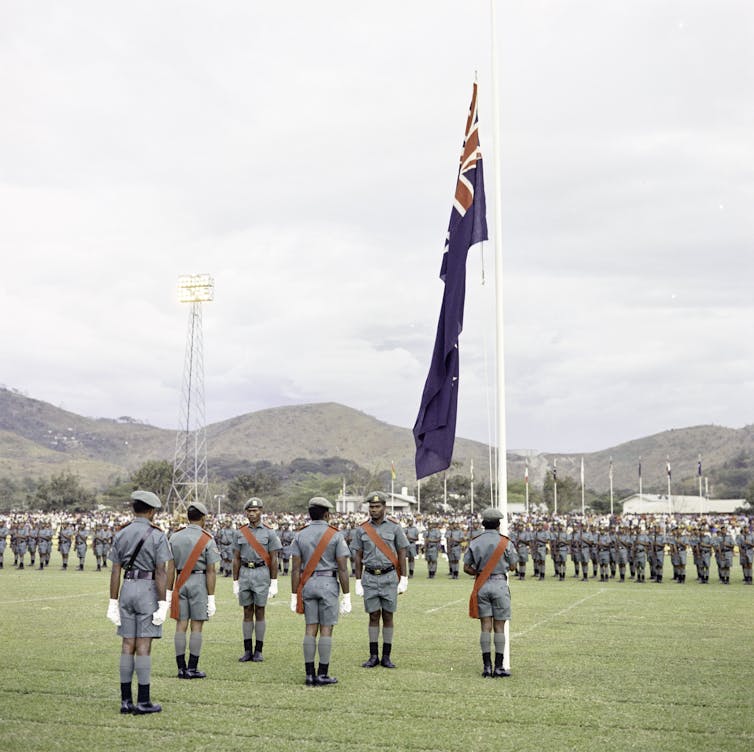
Independence day ceremonies in 1975. National Archives of Australia
Putting policy into action
If the constitution set out the vision for the nation, the Eight-Point Plan put forth by Somare, who would become the country’s first prime minister, translated it into policy.
It called for Papua New Guinean control of the economy, decentralisation, support for village industries, equal participation for women and self-reliance. Somare warned against foreign dependency and of a “very rich black elite [emerging] here at the expense of village people.”
Turning ideals into practice also required new institutions. That task fell in part to Chan, the finance minister, who in 1972 delivered the first budget by a Papua New Guinean — a symbolic moment in the transfer of power.
For Chan, controlling the purse strings was the foundation of self-government, and he insisted the country must “look to its own resources” if it was to pay its own way. Within three years, the Central Bank and the kina were also in place.
Citizenship proved explosive. Many Australians living in the territory feared they would be expelled from an independent PNG and were loud in their demands.
Parliamentarians such as Ron Neville urged an open, multi-racial citizenship model to attract investment.
Momis argued, however, that three million Papua New Guineans “had nothing” and needed protection from Australian control. United Party leader Tei Abal rejected dual citizenship for Papua New Guineans and Australians and insisted the law should be “firm but not racist”.
The eventual compromise — single citizenship, no automatic rights for expatriates, but scope for naturalisation — reflected the balancing act between inclusion and integrity. But if citizenship defined who belonged to the new nation, the harder question was whether the nation itself would hold together.
The trials of decolonisation
Unity was not guaranteed. Secessionist movements such as Abaijah’s Papua Besena, which advocated for an independent Papuan state separate from New Guinea, threatened the territorial integrity of the new nation, but it was not the only threat.
At the same time, leaders on the island of Bougainville pushed for their own secession, citing grievances over the Panguna copper mine, which began production in 1972 under a subsidiary run by Rio Tinto.
Somare declared, however, that unity was not up for negotiation. He staved off the disintegration of the nation by introducing provincial governments and a federalised system in the months before independence.
Holding the country together was only part of the challenge. Independence also demanded a deeper transformation — freeing PNG from the colonial institutions and mindsets that still shaped daily life.
As Momis argued in 1974, true freedom was a difficult task when education and the very institutions of nationhood were all created by the colonial regimes, first under the Germans and British, and then the Australians. Decolonisation meant more than simply raising a new flag – it entailed building a society grounded in justice, dignity and local values.
Those ideals still shape PNG today, but they also matter for Australia. PNG’s independence is part of Australia’s story.
When PNG became independent in 1975, many people on both sides of the Torres Strait feared fragmentation or chaos. But despite secessionist pressures and economic challenges, PNG has remained a parliamentary democracy for 50 years: no coups, no military takeovers, no descent into dictatorship.
That outcome was not inevitable. It was the product of hard debates and principled choices in the 1970s. Leaders such as Somare, Chan, Abel, Momis, Abaijah and John Guise fought over unity, land and development — but they fought in parliament, not through violence.
Half a century later, their words still resonate. At the University of Papua New Guinea symposium we attended in August, speaker after speaker referred to the ideals of the founders. They reminded us the constitution was never just a legal framework. It was a profound statement about what development actually means. This is not simply growth, but dignity, participation, fairness and cultural identity.
That is a legacy Australians should not forget.
Brad Underhill receives funding for the “Debating the Nation” book from the Department of Foreign Affairs and Trade.
Helen Gardner received funding for Debating the Nation from the Department of Foreign Affairs and Trade
They live in Africa’s largest forest, extending over the continent’s west and central regions. Large populations are found in Gabon and the Republic of Congo and smaller groups in Cameroon, the Central African Republic, the Democratic Republic of Congo, Equatorial Guinea, Côte d’Ivoire, Liberia, Ghana, Sierra Leone and Nigeria.
But ivory poaching means their numbers have plummeted by 86% over the past three decades.
The sharp reduction of their population has a knock-on effect on the Congo Basin forest itself. This is because African forest elephants are the rainforest’s gardeners. They disperse more plant species than any otheranimal, regenerating and reshaping plant communities.
I’m a conservation scientist and part of a research team of international and Cameroonian scientists who set out to examine how forest elephants interact with West African ebony trees.
We wanted to know if the decline of elephants had negative, cascading effects on other Congo Basin forest species. We focused on ebony because it was known to be a food for elephants and its wood is prized for numerous uses.
The research team set up tree plots and experiments in forests with and without elephants (often lost due to hunting). We used hidden cameras to record which animals ate ebony fruit and how ebony seeds enclosed in dung grew into seedlings. Our lead researcher, Vincent Deblauwe, spent years in the field conducting these experiments and even built a custom camera trap to observe ebony pollinators for the first time in the canopy.
We also collected ebony seeds from within elephant dung, manually planted them, and carefully monitored germination rates and seedling survival.
Additionally, the project developed cloning propagation methods to support future replanting of ebony trees and ebony plantations.
These little four-tonne elephants support ebony reproduction in at least two ways.
Distance matters: Elephants move the ebony seeds quite far away from the parent tree. This reduces the risk of ebony trees growing close together and inbreeding. Inbreeding weakens the genetics and lowers their chances of being resilient and adaptable to future environmental change.
Dung as armour: Elephants consume ebony fruits whole and the pulp is digested from around the seeds before they poop them out intact. We found digestion did not help the ebony seeds germinate. However, being encased in dung protected the seeds from rodents that eat and kill the seeds. This greatly improved the seeds’ chances of survival and germinating.
Our research found that there are nearly 70% fewer small (younger) ebony trees in the areas where elephants have disappeared. Most adult ebony trees alive today were dispersed by elephants decades ago because ebony is a slow growing wood that can take 50 years to begin reproducing, and 60 to 200 years to fully grow.
Our conclusion is that it is not certain that ebony trees in the Congo Basin will be able to survive naturally without the help of elephants.
Both elephants and rare ebony lie at the heart of the national heritage of Cameroon. By safeguarding elephants, Cameroon can protect the long-term viability of sustainably managed ebony and other valuable timbers.
A wake-up call for Central African forests
The West African ebony tree (Diospyros crassiflora) can grow up to 25 metres tall. It is a culturally iconic and economically valuable tree prized for its deep black heartwood. Ebony has been used for centuries to make carvings, piano keys and guitars due to its special harmonics.
Our research found that no other animals in the Congo Basin are able to disperse the ebony tree’s seeds in the same way. This has left a functional gap in the forest – one that current conservation strategies too often overlook. Forest elephants have been poached out of two-thirds of the ebony trees’ natural habitat so most of the Congo Basin’s adult ebony trees are in elephant-free areas. This means they won’t be able to get any help from elephants in dispersing or concealing their seeds within dung.
It’s not only the future of ebony that’s at stake. Other large-seeded trees may also rely on elephants to move their seeds. Elephant declines could be quietly reshaping forests in ways scientists are only beginning to uncover.
The takeaway is clear: plant-animal interactions are not a luxury add-on to conservation plans; they’re foundational to keeping forests functioning.
What needs to happen next
There are already many efforts to protect elephants and the processes they drive. Sadly, these seem insufficient to date.
The most urgent conservation action is halting the killing of elephants for ivory. Reducing illegal logging of ebony trees is also important. Both of these can be accomplished by better education with local residents about the ecological and economic importance of elephants and ebony, and improved enforcement of existing poaching and logging regulations.
Another important step is monitoring less charismatic tree species that also depend on elephants. Similar plant-animal relationships and the species and services they provide might be at risk.
Our project increases international research partnerships with Cameroon’s domestic experts and attracted expertise and funding for local institutions. For example, this research project provided education and capacity-building for Cameroonian researchers and practitioners, growing national expertise in biodiversity management.
Finally, African forest elephants don’t just live in the Congo Basin’s rainforests – they shape them. Increased poaching of elephants for ivory not only threatens the ebony tree – forest elephant declines can ripple through forest structure, biodiversity, and carbon storage.
This work was part of the Congo Basin Institute at UCLA and was largely funded by Taylor Guitars, which uses ebony for their instruments. They have invested nearly a decade in ebony research and conservation.
Matthew Scott Luskin receives funding from NASA, ARC, and the National Geographic Society.
Jair Bolsonaro’s conviction on Sept. 11, 2025, puts the former Brazilian president in a rogues’ gallery of failed coup plotters to be held to account for their attempted power grab.
Brazil’s Supreme Court found Bolsonaro guilty of being part of an armed criminal organization and other counts relating to a coup plot to overturn the ex-president’s 2022 election defeat to Luiz Inácio Lula da Silva. Prosecutors had earlier argued that Bolsonaro and others discussed a scheme to assassinate Lula and incited a riot on Jan. 8, 2023, in hopes that Brazil’s military would intervene and return Bolsonaro to power.
Four of the five justices on the panel voted to convict. Justice Cármen Lúcia, who was among the majority, said that the right-winger acted “with the purpose of eroding democracy and institutions.” sentenced to 27 years and three months behind bars, but is expected to appeal the verdict.
Not all coup plotters are held accountable for their actions. And even for those, like Bolsonaro, who are – it doesn’t necessarily mark the end of their political ambitions.
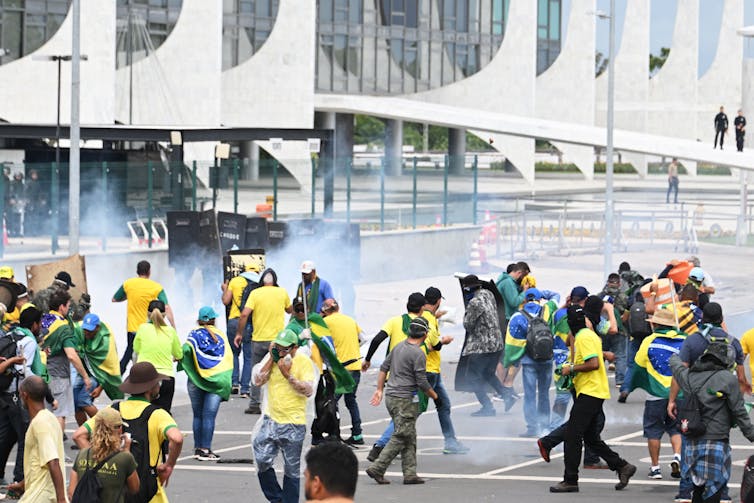
Supporters of former President Jair Bolsonaro clash with police outside the Planalto Palace in Brasilia on Jan. 8, 2023. Evaristo Sa/AFP via Getty Images
Coup and punishments
Plotting a coup is risky business. Some of those who attempt to seize or usurp power unconstitutionally are killed during their takeover bid, particularly when security forces loyal to the incumbent leader foil the attack. Christian Malanga, an exiled former army captain who led a violent attempt to seize power in the Democratic Republic of Congo, is one such example. He was killed in the ensuing shootout in May 2024.
But most leaders of failed coups survive.
And although they typically face punishment, the severity of consequences varies greatly; it often depends on whether the attempt is a self-coup, which is a power grab by an incumbent leader, or an attempt to oust a sitting government.
Some coup plotters and their co-conspirators are charged in a court and, if convicted, sent to prison. Malanga’s American co-conspirators were ultimately sentenced to life in prison in April 2025.
A similar fate has now befallen Bolsonaro. His conviction means that unless successful on appeal, Bolsonaro could end his days in confinement.
Still, it could have been worse – failed coupmakers are often punished outside of independent courts, where the penalty is often more severe. Coup plotters have been summarily executed or sentenced to death by a military tribunal or a “people’s court.” The longtime Zairean dictator Mobutu Sese Seko executed over a dozen junior officers and civilians after his government uncovered an alleged coup plot in 1978.
One recent estimate suggests 40% of coup conspirators suffer relatively light punishment. Many coup backers are simply demotedor purged from the government without facing trial or execution. An especially popular move is to send coup plotters into exile to discourage their supporters from mobilizing against the regime. Former Haitian president Dumarsais Estimé was forced into exile after his self-coup attempt failed in May 1950; he died in the U.S. a few years later.
Punishment doesn’t always end threat
The problem facing governments is that failed putschists pose a lingering political threat. Ousted leaders often plot “counter-coups” to return to power. For example, former president of the Philippines Ferdinand Marcos, after being ousted in the 1986 People Power movement, masterminded coup plots from exile, though he never returned to power.
Some succeed, such as David Dacko, who returned from exile to grab power in the Central African Republic in 1979, but only with the help of French forces.
Even when convicted or exiled, coup plotters may be later freed. Some members of Brazil’s Congress had already, prior to the verdict, introduced a bill that could grant Bolsonaro amnesty.
A few former failed coup leaders manage to come to power later. Ghana’s Jerry Rawlings led a failed coup in May 1979 but went on to seize power in subsequent coups in June 1979 and 1981; Hugo Chavez was convicted and jailed for leading a failed coup in 1992 but ended up being elected president in Venezuela in 1998.
Though Bukele temporarily backed down, he faced no legal or political backlash. His party won a legislative supermajority in 2021, and he won reelection in 2024. Bukele’s ruling party recently lifted presidential term limits, allowing him to potentially rule for life.
The good news about punishing unsuccessful coup plotters is that because they’ve failed, they do not have to be coaxed out of power. Thus, holding them accountable for their actions should deter future plotters from attempting the same thing. In contrast, for a leader who has done unsavory things while still in office – such as killing domestic dissidents or committing war crimes – the threat of punishment once they leave power can backfire by giving them a reason to fight to stay in power.
In the long term, failed coup leaders who escape punishment are more likely to make a political comeback.
When defeated at the polls, both Donald Trump and Bolsonaro tried to overturn the official results. Both attempted to altervotetotals after they had lost andblock an election winner from being inaugurated.
In contrast, a conviction for Bolsonaro means it is now unlikely he will follow the same path to political resurrection. Even if he’s eventually pardoned, a guilty verdict makes him ineligible to compete again for Brazil’s presidency.
Joe Wright received funding for research on coups from the National Science Foundation and the Minerva Research Initiative.
John Joseph Chin does not work for, consult, own shares in or receive funding from any company or organization that would benefit from this article, and has disclosed no relevant affiliations beyond their academic appointment.
Kevin M. Schultz is Chair of the Department of History at the University of Illinois Chicago, where he specialises in 20th- and 21st-century American history. In Why Everyone Hates White Liberals (Including White Liberals), he explores how the word liberal – and particularly its variant white liberal – became a term of derision across the American political spectrum.
Why, he asks, are so many Americans unwilling to identify as liberals, white or otherwise, even while supporting government programs that fall squarely within the American liberal tradition?
Review: Why Everyone Hates White Liberals (Including White Liberals): A History – Kevin M. Schultz (University of Chicago Press)
Why Everyone Hates White Liberals is written by an American academic for an American audience. It tries to assess the current political situation in the United States in the light of history. It asks how American liberals should respond to a situation where they are often viewed with disdain.
The book’s relevance is less obvious for those of us who live outside the US, but it promises to shed light on America’s political volatility and culture warring, which eventually affect us all in one way or another.
This thing called liberalism
Unfortunately, liberalism defies definition. Its roots can be traced to early European modernity, and especially to debates over religious toleration in the 16th and 17th centuries. Its more immediate background was the 18th-century Age of Enlightenment, culminating in great revolutions in America and France.
From the beginning of the 19th century, liberalism evolved into something distinct, with its own name, founding figures and institutions. It responded to a changed world marked by population growth, revolutionary turmoil, an expanding sphere of public discussion in Europe and North America, and the beginnings of industrialisation and corporate capitalism.
Schultz skates over this quickly, but he correctly refers to Madame de Staël and Benjamin Constant as originating figures in 19th-century France, and to Spain and Sweden as pioneers in the rise of liberal political parties.
It’s worth adding that, as liberalism took its early forms, it had input from numerous groups. These included religious non-conformists, free-market economists inspired by Adam Smith, utilitarian philosophers, and European thinkers (such as de Staël and Constant) who admired the French Revolution in its early years before the Reign of Terror.
Given its mix of influences, liberalism never became a unified ideology or political theory. It was more a tradition or tendency in politics. It took many directions, frequently questioned itself, discarded old ideas and embraced new ones, and changed emphases in response to emerging circumstances.
Comprehensive histories of liberalism give the impression of a chameleon-like quality. At different times, liberals have accommodated economic policies from unfettered free-market capitalism to a degree of socialism. Confronted with such a rich – or even contradictory – tradition, we might feel at a loss in giving liberalism any recognisable content.
Still, we can find some common themes. At a certain level of abstraction, liberalism favours toleration, individual freedom, acceptance of social pluralism, and cautious optimism about the possibilities for intellectual and social progress. With these core ideas go more specific political principles, including free speech, secular government, and the rule of law. To this we can add values such as individuality, creativity and suspicion of hierarchies of birth.
With that in mind, it’s usually clear enough what is being alleged if someone is accused, in a political context, of being “illiberal”. The accusation suggests intolerance, especially of opposed viewpoints or unusual ways of life, and hostility to individual freedom.
People who advertise themselves as liberals can sometimes be revealed as illiberal in this broad sense. If that sounds paradoxical, the paradox is easily resolved as long as we’re clear about what concepts are in play.
American liberals
After a sketchy introduction to liberalism, Schultz zooms in on the 1930s in the US, when the depression-era presidential rivals Herbert Hoover and Franklin D. Roosevelt each claimed to be a true liberal. As Schultz observes, few Americans before this had thought of themselves as liberals.
Roosevelt succeeded in redefining the words liberal and liberalism for the purposes of American electoral politics. In Roosevelt’s usage, they meant openness to new kinds of government intervention to address social problems. Thereafter, American liberalism can trace its history from the 1930s New Deal. It came to mean, in large part, policies of wealth redistribution and economic intervention.
Roosevelt’s success as a national leader lent prestige to his redefined conception of liberalism. For several decades, it attracted allegiance across social and political divides.
For Schultz, therefore, American liberalism in the New Deal tradition means “generosity of spirit and expansion of individual freedom” or using the power of the state “to ensure individual freedom for the maximum number of people”.
These definitions fall within the general tradition of liberalism, but they have a more specific suggestion of government interventions for the common good.
That might seem attractive as a political vision – so what went wrong?
Liberalism unravels
As Schultz tells the story, by the late 1950s and early 1960s, some figures on America’s left were losing patience with what they saw as a stultifying, bureaucratic, politically timid liberal establishment.
Schultz pinpoints 1964 as a key year when American liberalism began to lose its prestige. As he describes in detail, there was a marked change in political tone between 1963 and 1964, when Black radicals started to criticise white liberal allies, whom they had come to regard as spineless and hypocritical. From this point, white liberal crystallised as a term of abuse on the political Left.
Schultz appears sympathetic to the Black civil rights leaders of the time, whose impatience with the pace of change was understandable. But he also reminds us of the considerable effort, self-sacrifice and achievements of white liberals during the 1950s and early 1960s, culminating in dramatic initiatives such as the landmark Civil Rights Act.
Part of the problem was a mismatch, not only of priorities, but perceptions of what was realistically achievable. As radical left-wing movements emerged during the 1960s, their leaders distanced themselves from liberals and liberalism.
American liberals endured much worse from the conservative side of politics. During the “long” 1960s – the decade and a half from the late 1950s to the early 1970s – there was a right-wing backlash. Key conservative figures, such as William F. Buckley, ceded the term liberal to their opponents, which Herbert Hoover had refused to do in the 1930s. Then they attacked it and everything that it stood for within their understanding.
Political conservatives associated liberals with radical politics, atheism, communism, and what Schultz refers to as “cultural effeteness”. Richard Nixon and Spiro Agnew weaponised this narrative in the the 1972 presidential election and inflicted a catastrophic defeat on the Democratic Party’s candidate, George McGovern.
Schultz sees the term liberal as having been abandoned during the 1970s, in the sense that almost nobody in politics or public debate wanted to identify with it. Instead, it was used to label others. More recently, liberalism has been blamed for the harshest outcomes of what is known as neoliberalism, although the latter has little to do with traditional liberal ideas such as individual freedom, social toleration, or the rule of law.
The term neoliberal has a history dating back to at least the 1930s, but has been applied to regimes and administrations not otherwise regarded as liberal. As Schultz reminds us, it was first applied pejoratively to the economic policies of the brutal Chilean dictator Augusto Pinochet.
Schultz emphasises an “owning the libs” strategy that has recently prevailed on the American right. Anybody with even slightly left-wing, liberal or progressive tendencies is now painted by conservatives as an unhinged radical deserving of mockery and political, if not personal, destruction. The “libs” have thus become an imaginary enemy against which disparate groups on the right can unify and rally.
Ironically, historic liberal reforms in areas such as health care and social security remain widely popular with the American electorate, but the actual words liberal and liberalism seem to have become toxic.
Some deeper issues
In explaining the challenges to American liberalism during the long 1960s, Schultz adds to our understanding. Yet Why Everyone Hates White Liberals is seriously incomplete: it glosses over important issues and entire decades.
I can only go so far in exploring what it omits, but for a start, Schultz ignores important developments in the late 1970s and the 1980s. This was a time marked by fraught debates over censorship, pornography, abortion and numerous other hot-button issues. These debates severely tested what liberalism stood for in the US.
As the legal scholar Owen M. Fiss has argued, the debates of that era revealed “liberalism divided”. On the left side of politics, identity-based demands, (mild) socialist influences, and activist approaches to legal interpretation increasingly clashed with the liberal instinct to restrain government power and support individual freedom. This rupture within American liberalism, or perhaps within America’s broader political left, has never healed.
At one point, Schultz drops a clue to some of the deeper issues. Following the historian David L. Chappell, he identifies a fundamental disconnect between white liberal reformers in the 1960s and the Black activists who came to despise them. Despite some common goals, they had different temperaments and worldviews, grounded in different experiences and cultural histories.
The white liberals’ optimism about human nature and the possibilities for incremental progress clashed with the Black activists’ prophetic sensibility, their more pessimistic view of human nature, and their demands for national repentance and total transformation of American society.
This points to a larger problem that only became more difficult in the decades that followed. It’s one thing to defend the rights and freedoms of one or another oppressed group, viewing the issues from a traditional liberal perspective. It’s a different thing to defend a group’s rights and freedoms by adopting whatever ideology or rationalisation the group itself (or its leaders) might develop.
Moreover, as oppressed groups recognise each other’s struggles and form pragmatic political coalitions, they tend to see analogies between each other’s causes and attempt an ideological synthesis. As they do so, they are likely to seek insights from whatever sources they can find. Importantly, they needn’t confine themselves to ideas and thinkers from the liberal political tradition.
A demonstration by members of the Black Panther Party on the steps of the Washington State Capitol building in Olympia, Washington, February 28, 1969. CIR Online, via Wikimedia Commons, CC BY
Thus, liberals can find themselves supporting demographic groups whose representatives are, in turn, nourished by various kinds of religious fervour – or else by Marxism, feminism, postmodernism and other -isms that are not especially concerned with liberalism’s traditional ideas, such as freedom and toleration. Goals might be shared at a high conceptual level, but with starkly different perceptions of legitimate methods and acceptable costs.
In this setting, liberals face a conundrum. How far should they maintain traditional liberal ideals, and how far should they move towards non-liberal, and potentially illiberal, ideologies if these seem more promising for the purposes of social change?
When rapid and comprehensive change seems imperative, might this justify illiberal methods, such as attempts to control what people say and think? In the past, revolutionaries have often believed so, but the conflict with traditional liberalism is obvious.
Yet Schultz appears dismissive of any idea that American liberals sometimes veer in illiberal directions, or that this might undermine their credentials if they still claim to be part of the broader liberal tradition springing from the Enlightenment.
Useful, but frustrating
Why Everyone Hates White Liberals offers a useful, if limited, defence of America’s (white) liberals and their achievements, particularly in the face of unfair criticism and derision since the 1960s.
As far it goes, the book’s history is accurate. But it is incomplete, and hand-in-hand with this there’s a frustrating analytical shallowness.
For Schultz, the actual words liberal and liberalism are irredeemable in the US. For all I know, this might be correct (though it might also be slightly hyperbolic). Be that as it may, Schultz backs off examining how the problems for American liberals go deeper than slogans and words. These problems deserve a bolder reckoning.
Russell Blackford does not work for, consult, own shares in or receive funding from any company or organisation that would benefit from this article, and has disclosed no relevant affiliations beyond their academic appointment.
In yet another shocking act of political violence in the United States, Charlie Kirk, who came to prominence as a conservative influencer and supporter of Donald Trump, was assassinated while debating with students at a university in Utah.
The 31-year-old, who came to fame by doing just that – debating whoever wanted to engage with him – was undeniably the most influential figure in young conversative politics.
News of his killing sent social media into an all-too familiar frenzy, with opposing political camps blaming each other for the increasingly febrile environment in contemporary America. It has also raised fears it may provoke even more violence.
Who was Charlie Kirk?
The meagre tent in which Kirk would set up shop on university campuses around America to engage in debate with university students should not be mistaken for meagre support.
Kirk’s political organisation, Turning Point USA (TPUSA), had a revenue of US$78,000 (A$118,000) when he founded it in 2012. As of last year, its annual revenue had grown to US$85 million (A$129 million).
His podcast, The Charlie Kirk Show, boasted between 500,000 and 750,000 downloads for each episode, ranking it as one of the top 25 most listened to podcasts in the world. Even Kirk’s 7 million X account followers is greater than MSNBC’s 5 million.
Outside the online world, TPUSA today has a presence in more than 3,500 high school and college campuses, with more than 250,000 student members, and more than 450 full- and part-time staff. But perhaps the most important metric is the fact that a TikTok survey of users under 30 found that, among those who voted for Trump, they trusted Kirk more than any other individual.
As much as Kirk’s many detractors abhorred his views and his conduct – particularly his views of Black people, Jews, trans people and immigrants, as well as his efforts to denounce professors engaging in “leftist propaganda” – there was no denying he was willing to debate practically anyone.
Whether it was in storied lecture halls at Oxford University or a progressive university campus in the US, Kirk engaged in political debate with anyone willing to come to the open microphone at his events, encouraging students to “prove me wrong”. The dissemination of clips of these interactions – typically an unwitting progressive student asking Kirk a question only to have Kirk counter-argue – garnered hundreds of millions of views across a variety of social media channels.
Support for Trump
Kirk first came to prominence championing more conventional Republican politicians, including Texas Senator Ted Cruz and former Wisconsin governor Scott Walker. But he eventually came around to supporting Trump in 2016, and never looked back.
Indeed, when many – particularly within the Republican party – sought to distance themselves from Trump after incidents such as the infamous Access Hollywood tape in 2016 or the violence at the US Capitol on January 6 2021, Kirk stayed the course.
The combination of his unceasing loyalty to Trump and his increasing popularity among young voters saw him increase his power within conservative circles. This power saw his organisation contribute millions of dollars to various Trump-aligned campaigns. TPUSA also bolstered support for embattled cabinet nominee, and now defence secretary, Pete Hegseth, and initiate efforts to oust former chair Ronna McDaniel from the Republican National Committee.
But perhaps Kirk’s most notable political win was harnessing a record number of young people to vote for Trump in 2024, despite the fact he was the oldest ever person to lead the Republican presidential ticket.
US political violence
Some may look at yet another instance of deadly US political violence and wonder whether it would have any sort of lasting impact. After all, the creation of the US followed an act of political violence known to Americans as the Revolutionary War. And this founding preceded more political violence, including the Civil War, Reconstruction and Civil Rights movement, among others.
Yet, as much as the entirety of US history is filled with such incidents, there is no denying that for the past generation in particular, it has also grown worse.
Numerous studies have found that the number of attacks and plots against elected officials, political candidates, political party officials, and political workers is exponentially higher now than in recent history. In examining 30 years of data, the Center for Strategic and International Studies (CSIS) found the number of attacks and plots in the past five years is nearly triple that of the preceding 25 years combined.
But beyond the numbers, US politicians themselves increasinglycite the spectre of violence as a reason why they have either retired from politics or – perhaps more worryingly – changed their votes.
Ultimately, there’s little question as to whether the US will continue to suffer from political violence. The greater question is to what extent and at what cost.
Kirk’s death will affect far more than just his friends and his family – including his widow and two young children. Today marked the loss of a unique leader in the US conservative movement.
Jared Mondschein does not work for, consult, own shares in or receive funding from any company or organisation that would benefit from this article, and has disclosed no relevant affiliations beyond their academic appointment.
Israel launched a targeted airstrike on the Hamas leadership in Doha, the capital of Qatar, on Tuesday. Six people were reported killed, including the son of a senior Hamas figure.
Global condemnation was swift. The Qatari government called the strike a “clear breach of the rules and principles of international law”, a sentiment echoed by Turkish President Recep Tayyip Erdogan, Malaysian Prime Minister Anwar Ibrahim, and others.
UN Secretary-General António Guterres called the attack “a flagrant violation of sovereignty and the territorial integrity of Qatar”. The prime ministers of both the UK and Australia also said the strike violated the sovereignty of Qatar.
Even US President Donald Trump, Israel’s strongest ally, distanced himself from the attack:
Unilaterally bombing inside Qatar, a Sovereign Nation and close Ally of the United States, that is working very hard and bravely taking risks with us to broker Peace, does not advance Israel or America’s goals.
So, what does the law say about this? Was Israel’s attack against Hamas on the territory of another country lawful?
Israel’s justification
Israeli Prime Minister Benjamin Netanyahu justified the strike by saying it targeted the political leadership of Hamas in retaliation for two attacks: a shooting in Jerusalem that killed six people and an attack on an army camp in Gaza that killed four soldiers. He said:
Hamas proudly took credit for both of these actions. […] These are the same terrorist chiefs who planned, launched and celebrated the horrific massacres of October 7th.
Netanyahu speaks after the Qatar strike.
What does international law say?
Article 2(4) of the UN Charter prohibits the use of force against the “territorial integrity or political independence” of another state.
Any use of force requires either the authorisation of the UN Security Council, or a justification that force is being used strictly in self-defence and in accordance with Article 51 of the UN Charter.
So, does this mean Israel could claim self-defence against Hamas’ leadership in Qatar, if the group did indeed direct the two attacks against its citizens in Jerusalem and Gaza?
As such, it has restricted the use of self-defence to armed attacks that can be attributable to a state, not merely to non-state actors operating from a state’s territory.
After the September 11 2001 terror attacks, the United States and other countries claimed they could use force in self-defence against non-state actors (such as terrorist groups) that are sheltering and operating from another state’s territory, even if that state was not directly involved.
In response to these developments, Sir Daniel Bethlehem, an expert in international law and foreign policy advisor to the UK government, proposed several principles aimed at curtailing this justification within the intent of Article 51.
The “Bethlehem principles”, which remain contested, argue that Article 51 can cover actual or imminent attacks by terrorist groups, but only if necessity (the use of force in self-defence is truly a last resort) and proportionality are satisfied.
Moreover, as a rule, force on another state’s soil requires the consent of that state. The only narrow exceptions are when there’s a reasonable, objective belief the host state is colluding with the group or is unable or unwilling to stop it – and no other reasonable option short of force exists.
Israel argues Hamas’ leadership based abroad in countries such as Qatar, Lebanon and Iran remains part of the command structure that orchestrates hostilities against its soldiers in Gaza and citizens in Israel.
That alone, however, is not enough to justify self-defence according to the Bethlehem principles.
By Netanyahu’s own admission, the objective of the Qatar strike was retaliatory, not to prevent an ongoing or imminent attack.
Questions could also be raised about whether proportionality was observed given the diplomatic context of striking a sovereign state and the potential for disproportionate civilian harm in this part of Doha, which houses many diplomatic residences.
Targeting political leaders meeting in a third state — especially one engaged in mediation — also raises questions about whether force was the only means available to address the threat posed by Hamas in this situation.
Moreover, under these principles, Israel would need to demonstrate that Qatar is either colluding with or is unable or unwilling to stop Hamas – and that there was no other effective or reasonable way to respond to the situation.
Qatar has hosted Hamas’ political offices since 2012 and has been one of the group’s main financial backers since it came to power in Gaza.
At the same time, Qatar has played an important mediation role since the October 7 attacks.
This makes it difficult to argue Qatar is unwilling or unable to neutralise Hamas’ operations from its territory. Its mediation would also suggest there is a reasonably effective alternative to force to counter Hamas’ actions.
Final verdict
Without UN Security Council authorisation, Israel’s strikes on Qatar do appear to be a violation of territorial sovereignty and possibly an act of aggression under the UN Charter.
This is further bolstered by the narrow approach the ICJ has taken on self-defence against non-state actors in third-party states, and its stringent requirements of proportionality and necessity – neither of which appear to have been met here.
Shannon Bosch does not work for, consult, own shares in or receive funding from any company or organisation that would benefit from this article, and has disclosed no relevant affiliations beyond their academic appointment.
Carl Knox, OzGrav, Swinburne University of Technology
Ten years ago, scientists heard the universe rumble for the first time. That first discovery of gravitational waves proved a key prediction from Albert Einstein’s theory of general relativity and began a new era of astronomy.
Now, a new gravitational-wave discovery marks the anniversary of this major breakthrough. Published today in Physical Review Letters, it puts to the test a theory from another giant of science, Stephen Hawking.
What are gravitational waves?
Gravitational waves are “ripples” in the fabric of space-time that travel at the speed of light. They are caused by highly accelerated massive objects, such as colliding black holes or the mergers of massive star remains known as neutron stars.
These ripples propagating through the universe were first directly observed on September 14 2015 by the twin Laser Interferometer Gravitational-wave Observatory (LIGO) detectors in the United States.
That first signal, called GW150914, originated from the collision of two black holes, each more than 30 times the mass of the Sun and more than a billion light years away from Earth.
This was the first direct proof of gravitational waves, exactly as predicted by Einstein’s theory of relativity 100 years earlier. The discovery led to the award of the 2017 Nobel Prize in Physics to Rainer Weiss, Barry Barish and Kip Thorne for their pioneering work on the LIGO collaboration.
This simulation shows the gravitational waves produced by two orbiting black holes.
Hundreds of signals in less than a decade
Since 2015, more than 300 gravitational waves have been observed by LIGO, along with the Italian Virgo and Japanese KAGRA detectors.
Just a few weeks ago, the international LIGO/Virgo/KAGRA collaboration released the latest results from their fourth observing run, more than doubling the number of known gravitational waves.
Now, ten years after the first discovery, an international collaboration including Australian scientists from the Australian Research Council’s Centre of Excellence for Gravitational Wave Discovery (OzGrav), has announced a new gravitational-wave signal, GW250114.
The signal is almost a carbon copy of that very first gravitational wave signal, GW150914.
The observed gravitational wave GW250114 (LVK 2025). The observed data is shown in light grey. The smooth blue curve represents the best fit theoretical waveform models, showing excellent agreement with the observed signal. LIGO, Virgo and KAGRA collaboration
The black hole collision responsible for GW250114 had very similar physical properties to GW150914. However, due to significant upgrades to the gravitational wave detectors over the past ten years, the new signal is seen much more clearly (almost four times as “loud” as GW150914).
Excitingly, it’s allowed us to put to the test the ideas of another groundbreaking physicist.
Hawking was right, too
More than 50 years ago, physicists Stephen Hawking and Jacob Bekenstein independently formulated a set of laws that describe black holes.
Hawking’s second law of black hole mechanics, also known as Hawking’s area theorem, states that the area of the event horizon of a black hole must always increase. In other words, black holes can’t shrink.
Meanwhile, Bekenstein showed that the area of a black hole is directly related to its entropy, a scientific measure of disorder. The second law of thermodynamics tells us that entropy must always increase: the universe is always getting messier. Since the entropy of a black hole must also increase with time, it tells us that its area must also increase.
How can we test these ideas? Colliding black holes, it turns out, are the perfect tool.
The precision of this recent measurement allowed scientists to perform the most precise test of Hawking’s area theorem to date.
Previous tests using the first detection, GW150914, showed that signal was in good agreement with Hawking’s law, but could not confirm it conclusively.
Black holes are surprisingly simple objects. The horizon area of a black hole depends on its mass and spin, the only parameters necessary to describe an astrophysical black hole. In turn, the masses and spins determine what the gravitational wave looks like.
By separately measuring the masses and spins of the incoming pair of black holes, and comparing these to the mass and spin of the final black hole left over after the collision, scientists were able to compare the areas of the two individual colliding black holes to the area of the final black hole.
The data show excellent agreement with the theoretical prediction that the area should increase, confirming Hawking’s law without a doubt.
Which giant of science will we put to the test next? Future gravitational wave observations will allow us to test more exotic scientific theories, and maybe even probe the nature of the missing components of the universe – dark matter and dark energy.
Simon Stevenson receives funding from the Australian Research Council. He works for Swinburne University of Technology. He is a member of OzGrav and the LIGO Scientific collaboration.
You’re introduced to someone and your attention catches on their eyes. They might be a rich, earthy brown, a pale blue, or the rare green that shifts with every flicker of light. Eyes have a way of holding us, of sparking recognition or curiosity before a single word is spoken. They are often the first thing we notice about someone, and sometimes the feature we remember most.
Across the world, human eyes span a wide palette. Brown is by far the most common shade, especially in Africa and Asia, while blue is most often seen in northern and eastern Europe. Green is the rarest of all, found in only about 2% of the global population. Hazel eyes add even more diversity, often appearing to shift between green and brown depending on the light.
So, what lies behind these differences?
It’s all in the melanin
The answer rests in the iris, the coloured ring of tissue that surrounds the pupil. Here, a pigment called melanin does most of the work.
Brown eyes contain a high concentration of melanin, which absorbs light and creates their darker appearance. Blue eyes contain very little melanin. Their colour doesn’t come from pigment at all but from the scattering of light within the iris, a physical effect known as the Tyndall effect, a bit like the effect that makes the sky look blue.
In blue eyes, the shorter wavelengths of light (such as blue) are scattered more effectively than longer wavelengths like red or yellow. Due to the low concentration of melanin, less light is absorbed, allowing the scattered blue light to dominate what we perceive. This blue hue results not from pigment but from the way light interacts with the eye’s structure.
Green eyes result from a balance, a moderate amount of melanin layered with light scattering. Hazel eyes are more complex still. Uneven melanin distribution in the iris creates a mosaic of colour that can shift depending on the surrounding ambient light.
What have genes got to do with it?
The genetics of eye colour is just as fascinating.
For a long time, scientists believed a simple “brown beats blue” model, controlled by a single gene. Research now shows the reality is much more complex. Many genes contribute to determining eye colour. This explains why children in the same family can have dramatically different eye colours, and why two blue-eyed parents can sometimes have a child with green or even light brown eyes.
Eye colour also changes over time. Many babies of European ancestry are born with blue or grey eyes because their melanin levels are still low. As pigment gradually builds up over the first few years of life, those blue eyes may shift to green or brown.
In adulthood, eye colour tends to be more stable, though small changes in appearance are common depending on lighting, clothing, or pupil size. For example, blue-grey eyes can appear very blue, very grey or even a little green depending on ambient light. More permanent shifts are rarer but can occur as people age, or in response to certain medical conditions that affect melanin in the iris.
The real curiosities
Then there are the real curiosities.
Heterochromia, where one eye is a different colour from the other, or one iris contains two distinct colours, is rare but striking. It can be genetic, the result of injury, or linked to specific health conditions. Celebrities such as Kate Bosworth and Mila Kunis are well-known examples. Musician David Bowie’s eyes appeared as different colours because of a permanently dilated pupil after an accident, giving the illusion of heterochromia.
Celebrities such as David Bowie, Mila Kunis and Kate Bosworth (L to R) are well-known examples of people whose eyes are different colours. Wikimedia Commons/The Conversation
In the end, eye colour is more than just a quirk of genetics and physics. It’s a reminder of how biology and beauty intertwine. Each iris is like a tiny universe, rings of pigment, flecks of gold, or pools of deep brown that catch the light differently every time you look.
Eyes don’t just let us see the world, they also connect us to one another. Whether blue, green, brown, or something in-between, every pair tells a story that’s utterly unique, one of heritage, individuality, and the quiet wonder of being human.
Davinia Beaver does not work for, consult, own shares in or receive funding from any company or organisation that would benefit from this article, and has disclosed no relevant affiliations beyond their academic appointment.