Are you in a mid-career to senior job? Don’t fear AI – you could have this important advantage

Source: The Conversation – Global Perspectives – By Kai Riemer, Professor of Information Technology and Organisation, University of Sydney

Have you ever sat in a meeting where someone half your age casually mentions “prompting ChatGPT” or “running this through AI”, and felt a familiar knot in your stomach? You’re not alone.

There’s a growing narrative that artificial intelligence (AI) is inherently ageist, that older workers will be disproportionately hit by job displacement and are more reluctant to adopt AI tools.

But such assumptions – especially that youth is a built-in advantage when it comes to AI – might not actually hold.

While ageism in hiring is a real concern, if you have decades of work experience, your skills, knowledge and judgement could be exactly what’s needed to harness AI’s power – without falling into its traps.

What does the research say?

The research on who benefits most from AI at work is surprisingly murky, partly because it’s still early days for systematic studies on AI and work.

Some research suggests lower-skilled workers might have more to gain than high-skilled workers on certain straightforward tasks. The picture becomes much less clear under real-world conditions, especially for complex work that relies heavily on judgement and experience.


This article is part of The Conversation’s series on jobs in the age of AI. Leading experts examine what AI means for workers at different career stages, how AI is reshaping our economy – and what you can do to prepare.


Through our Skills Horizon research project, where we’ve been talking to Australian and global senior leaders across different industries, we’re hearing a more nuanced story.

Many older workers do experience AI as deeply unsettling. As one US-based CEO of a large multinational corporation told us:

AI can be a form of existential challenge, not only to what you’re doing, but how you view yourself.

But leaders are also observing an important and unexpected distinction: experienced workers are often much better at judging the quality of AI outputs. This might become one of the most important skills, given that AI occasionally hallucinates or gets things wrong.

The CEO of a South American creative agency put it bluntly:

Senior colleagues are using multiple AIs. If they don’t have the right solution, they re-prompt, iterate, but the juniors are satisfied with the first answer, they copy, paste and think they’re finished. They don’t yet know what they are looking for, and the danger is that they will not learn what to look for if they keep working that way.

Experience as an AI advantage

Experienced workers have a crucial advantage when it comes to prompting AI: they understand context and usually know how to express it clearly.

While a junior advertising creative might ask an AI to “Write copy for a sustainability campaign”, a seasoned account director knows to specify “Write conversational social media copy for a sustainable fashion brand targeting eco-conscious millennials, emphasising our client’s zero-waste manufacturing process and keeping the tone authentic but not preachy”.

This skill mirrors what experienced professionals do when briefing junior colleagues or freelancers: providing detailed instructions, accounting for audience, objectives, and constraints. It’s a competency developed through years of managing teams and projects.

Younger workers, despite their comfort with technology, may actually be at a disadvantage here. There’s a crucial difference between using technology frequently and using it well.

Many young people may become too accustomed to AI assistance. A survey of US teens this year found 72% had used an AI companion app. Some children and teens are turning to chatbots for everyday decisions.

Without the professional experience to recognise when something doesn’t quite fit, younger workers risk accepting AI responses that feel right – effectively “vibing” their work – rather than developing the analytical skills to evaluate AI usefulness.

So what can you do?

First, everyone benefits from learning more about AI. In our time educating everyone from students to senior leaders and CEOs, we find that misunderstandings about how AI works have little to do with age.

A good place to start is reading up on what AI is and what it can do for you:

If you’re not even sure which AI platform to try, we would recommend testing the most prominent ones, OpenAI’s ChatGPT, Anthropic’s Claude, and Google’s Gemini.


Read more:
The biggest barrier to AI adoption in the business world isn’t tech – it’s user confidence


If you’re an experienced worker feeling threatened by AI, lean into your strengths. Your decades of experience with delegation, context-setting, and critical evaluation are exactly what AI tools need.

Start small. Pick one regular work task and experiment with AI assistance, using your judgement to evaluate and refine outputs. Practice prompting like you’re briefing a junior colleague: be specific about context, constraints, and desired outcomes, and repeat the process as needed.

Most importantly, don’t feel threatened. In a workplace increasingly filled with AI-generated content, your ability to spot what doesn’t quite fit, and to know what questions to ask, has never been more valuable.

The Conversation

Kai Riemer is co-author of the annual “Skills Horizon” research project, which identifies key leadership skills (including in AI), based on interviews with global and Australian leaders and executives across various fields. He also educates leaders in AI fluency through Sydney Executive Plus at the University of Sydney.

Sandra Peter is co-author of the annual “Skills Horizon” research project, which identifies key leadership skills (including in AI), based on interviews with global and Australian leaders and executives across various fields. She also educates leaders in AI fluency through Sydney Executive Plus at the University of Sydney.

ref. Are you in a mid-career to senior job? Don’t fear AI – you could have this important advantage – https://theconversation.com/are-you-in-a-mid-career-to-senior-job-dont-fear-ai-you-could-have-this-important-advantage-262347


Move over Mercury – Chiron is in retrograde. What even is Chiron?

Source: The Conversation – Global Perspectives – By Laura Nicole Driessen, Postdoctoral Researcher in Radio Astronomy, University of Sydney

An artist’s impression of Chiron and its coma of gas. William Gonzalez Sierra / UCF

You might have seen an interesting phrase popping up in your social media feeds lately: “Chiron is in retrograde.” If you’re anything like me, you’ve never heard of Chiron before – and I’m a professional astronomer.

So what is Chiron, and what does it mean to be in retrograde? The short answer is that Chiron is an asteroid-slash-comet orbiting somewhere past Jupiter and Saturn. And until January 2026, it’s going to look like it’s going backwards in the sky. If you can spot it.

But there’s a bit more to the story.

What is Chiron?

Chiron’s official name is (2060) Chiron. First things first: it’s pronounced “kai-ruhn”, with a hard K sound.

It was discovered by astronomer Charles Kowal in 1977. This was long after the system of Western astrology was developed, which probably explains why people who check their daily horoscopes are also blissfully unaware of its existence.

It was initially classified as an asteroid, or a rock in space. In 1989 astronomers discovered Chiron sometimes has a tail or “coma”, which tells us that it’s actually a comet or a “dirty snowball”. Since then, Chiron has been classified as both an asteroid and a comet.

A black background with a fuzzy, white blob in the centre.
Hubble Space Telescope image of Chiron showing its fuzzy coma.
Hubble Space Telescope/Karen Meech, CC BY-SA

In 2023, more than 45 years after it was first discovered, astronomers confirmed Chiron has rings. This makes it the fourth non-planet in the Solar System to have rings. (The planets Jupiter, Saturn, Uranus and Neptune have rings, as do the asteroid Chariklo and the dwarf planets Haumea and Quaoar.)

A rocky asteroid is in the foreground and a bright fuzzy dot representing the Sun is in the background. The asteroid has two narrow rings around it. The background is black and full of stars.
Artist’s impression of the Centaur asteroid 10199 Chariklo. Chariklo was the first asteroid and fifth object in our Solar System, after Saturn, Jupiter, Uranus and Neptune, found to have a ring around it.
NASA, ESA, CSA, Leah Hustak (STScI), CC BY-SA

Chiron orbits the Sun in an oval-shaped orbit. The closest it gets to the Sun is about 1.3 billion kilometres (about eight times the distance between Earth and the Sun) and the furthest it gets from the Sun is a whopping 2.7 billion km (about 19 times the distance between Earth and the Sun).

This puts it between the orbits of Jupiter and Uranus, cutting through the orbit of Saturn.

Centaurs in space

Chiron is a member of the Centaurs. This is a group of small Solar System bodies that orbit the Sun between Jupiter and Neptune. Their orbits are highly unstable: they change over time because of gravitational interactions with the giant planets.

In Greek mythology, centaurs were creatures with the lower body and legs of a horse and the torso and arms of a human. Chiron was the oldest centaur, the son of the Titan Kronos. He was considered the wisest centaur.

Fans of Percy Jackson and the Olympians may also recognise Chiron as the director of Camp Halfblood.

A black background with multiple colourful circles and ovals demonstrating the orbits of planets and small solar system bodies in orbits outside Jupiter’s orbit. The many overlapping circles demonstrate how many objects there are out there in a bunch of d
The orbits of various centaurs, including Chiron. We can see the orbits of Jupiter, Saturn, Uranus and Neptune as well of the orbits of various Small Solar System bodies and dwarf planets.
Nick Anthony Fiorenza, CC BY-SA

Chiron in retrograde

In astronomy, retrograde motion is when something is going backwards compared with everything else.

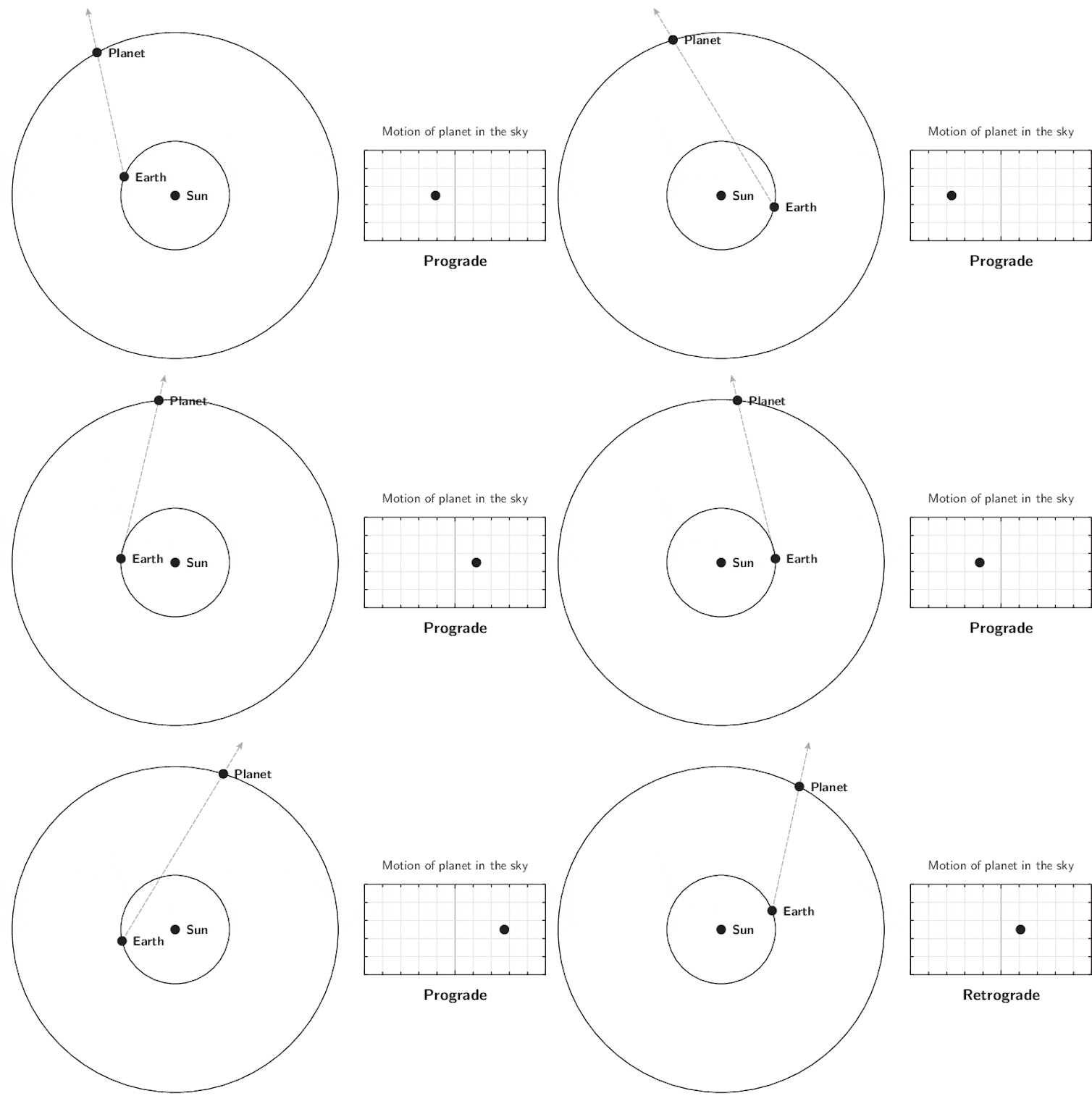
Apparent retrograde motion is where an object in the sky, such as a planet, appears to be going backwards when we look at it from Earth. The object hasn’t actually changed direction; it just looks like it from our perspective.

All the planets (and Chiron) orbit the Sun in the same direction. This means the planets typically look like they are moving in a west-to-east direction across the sky. But when Earth “catches” up to a planet (or a planet catches up to Earth) and overtakes it, the planet temporarily appears to move in a west-to-east direction in the sky.

This temporary illusion is apparent retrograde motion. It’s just like when you’re driving in a car and overtake a slower car, that slower car looks like it’s going backwards as you overtake it.

Black and white animation demonstrating retrograde motion. On the left are two concentric circles with the Sun as a dot in the centre. The Earth orbits the Sun by orbiting on the inner circle. A planet orbits the Sun by orbiting on the outer circle. A lin
Animation demonstrating apparent retrograde motion. We can see the Earth and an outer planet orbiting the Sun in a circular motion on the left. On the right, we can see the direction the planet appears to be moving from Earth’s perspective.
Dominic Ford, CC BY-SA

Chiron went into retrograde (that is, apparent retrograde motion) on July 30 2025 and will go back to normal on January 2 2026. But unless you have a telescope or do some long-exposure photography, you’d never know which way Chiron is travelling. Chiron is very faint, so you can’t see it with your eyes.

Painting of a centaur teaching a boy to play the lyre.
An ancient Roman fresco showing the centaur Chyron teaching Achilles to play the lyre.
National Archaeological Museum of Naples / Muesse / Wikimedia

The ancient astrologers didn’t know about Chiron, but I like to think they’d appreciate a centaur in space with a ring on it.

The Conversation

Laura Nicole Driessen is an ambassador for the Orbit Centre of Imagination at the Rise and Shine Kindergarten, in Sydney’s Inner West.

ref. Move over Mercury – Chiron is in retrograde. What even is Chiron? – https://theconversation.com/move-over-mercury-chiron-is-in-retrograde-what-even-is-chiron-262509

Spy novelist Stella Rimington, the first female head of MI5, was a ‘true trailblazer’

Source: The Conversation – Global Perspectives – By Sue Turnbull, Honorary Professor of Communication and Media Studies, University of Wollongong

Dame Stella Rimington, former director general of the UK’s domestic counter-intelligence and security agency, MI5, and author of several spy thrillers, has died this week, aged 90.

A decade ago, Rimington came to Melbourne to promote her latest spy thriller, featuring her alter ego Liz Carlyle, also an MI5 agent. I was invited, as convenor of Sisters in Crime Australia, to interview her before an appreciative audience at Readings bookshop in Hawthorn. They were clearly delighted to be hearing from a real-life spy – especially one widely credited as the blueprint for Judi Dench’s version of M in the Bond movies.

Tall, elegant, impeccably dressed and sharp as a stiletto, Dame Stella was everything we wanted her to be: a woman who had made it to the top in the macho world of espionage.

Her literary legacy includes a 2001 autobiography, Open Secret, (widely seen as disappointing) and several spy thrillers, which gained a dedicated following. Her 2004 debut thriller, At Risk, was praised in the Guardian as “a cracking good thriller” with “nitty-gritty insider detail”. Together, her books provide a fascinating insight into a clandestine world more usually presented from what she herself described as a masculine point of view.

“When you think about it, all fictional spies are blokes, and spy writers when I started were chaps too,” she told the Edinburgh International Book Festival of her Liz Carlyle novels in 2015. “So I was certain that my character was going to be female. I wanted her to reflect accurately what a female does in my former service.”

Both of her female protagonists, Carlyle and CIA agent Manon Tyler (in her final two novels), reflected aspects of her own personality. Their adventures, blended with the challenges of ordinary life – relationships, workplace politics, insecurities – took readers around the world as they dealt with “fictional” threats to the nation.

An accidental spy

Sir Richard Moore, head of MI6, the foreign intelligence branch of the UK secret service, has called Rimington a “true trailblazer”. MI5 itself states it “underwent far-reaching transformation under Dame Stella’s leadership”, reports the BBC.

But she never set out to be a spy. Born in South London in 1935, she went to Edinburgh University in 1954, where she earned a master’s degree in English and literature – which shows where a good humanities degree can get you. After training as an archivist, she married John Rimington, who she accompanied to India when he took up a position at the High Commission in New Delhi.

After two years of tea parties and amateur dramatics, Rimington was asked to help out with some office work for one of the First Secretaries, who just happened to be working for MI5. As she later explained, she was subsequently “tapped on the shoulder”. Eventually, she would climb from the “typing pool to the top”.

Her elevation was never going to be easy in the hard-drinking, masculine culture of the 1970s secret service, when women were paid much less than their male counterparts. Describing herself and her female colleagues as “restive”, Rimington admitted it took something of a rebellion in the ranks before women were recognised as equals, culminating in her appointment as the first female director of MI5 in 1992.

She was also the first head of MI5 to be publicly identified, before retiring in 1996. Her family were forced to flee their London house to escape the tabloids, which published headlines like “Housewife super spy”. She later said it was the point where she “felt most unsafe”. She was, however, broadly in favour of greater public openness about the UK’s intelligence services.

Given the presumed end of the Cold War, the major threats Rimington had to deal with were largely those of domestic terrorism: threats she was required to report to then prime minister John Major. Apparently, there was often very little information to go on, at which point Major would respond “Oh well, Stella, do your best”, which she invariably did.

Booker judging and a publishing uproar

After her retirement, Rimington maintained an active public life, joining the boards of such venerable British institutions as Marks and Spencer.

In 2011, she served as chair of the judging panel for the Man Booker Prize. This created something of a stir, when the judges espoused “readability” and the ability to “zip along” as criteria they would use to assess the prize. This did not go down well – and some critics called the subsequent shortlist “was the worst in decades”.

Defending the judges’ decision at the awards ceremony, Rimington had the temerity to compare the publishing world to the KGB, thanks to its use of “black propaganda, destabilisation operations, plots and double agents”. Sounds like a great idea for a crime novel – of which she wrote a few.

Her autobiography and novels had to be submitted to MI5 for vetting and clearance. She was occasionally asked to change names and places.

Asked to write a new introduction to an anthology of stories edited by Hugh and Graham Greene, The Spy’s Bedtime Book, Rimington suggested the spy novel is “in a special class of literature in which the real and the imaginary can be mixed in any proportion, so long as they both are present”. Arguably, this is true of all literature.

The world is still dangerous

As Rimington informed the audience at the Wheeler Centre in Melbourne in 2012, the world is still a dangerous place. Then, she pointed to the continuing rise of domestic terrorism, instability in the Middle East and Putin’s ongoing aggression towards the West. How right she has proved to be – which is hardly any consolation.

“There’s so much to discover in spy stories,” she once said. “It’s a small ‘lifting of the curtains’ of a world that people know exists but don’t know much about.”

Rimington was an exceptional woman whose books document the challenging times she lived through, from an insider’s unique perspective on the front line. The line between the reality of Stella Rimington and the fiction she created may be hard to draw – which makes them fascinating reading.

The Conversation

Sue Turnbull isChair of the BAD Sydney Crime Writers Festival

ref. Spy novelist Stella Rimington, the first female head of MI5, was a ‘true trailblazer’ – https://theconversation.com/spy-novelist-stella-rimington-the-first-female-head-of-mi5-was-a-true-trailblazer-262799

Cambodia is vowing to ‘rid’ the country of scam compounds. But we’ve seen several still operating in the open

Source: The Conversation – Global Perspectives – By Ivan Franceschini, Lecturer, Chinese Studies, The University of Melbourne

Last month, the Cambodian government launched the largest crackdown to date on the online scam industry that has taken root in the country and operated largely in the open.

On July 16, a directive from Prime Minister Hun Manet acknowledged the growing threat posed by the industry and instructed provincial officials, law enforcement agencies, the courts and the national gambling commission to take action.

As police began raiding scam sites across the country, Telegram channels used by cyber criminals went into a frenzy, warning others of the seriousness of the crackdown.

Some posts claimed the police were setting up roadblocks across the country, detaining people without passports and demanding bribes for their release. Videos also circulated showing mass evacuations from compounds.

The government was soon trumpeting its success. In late July, it announced that raids had been conducted at nearly 140 locations, leading to the arrests of more than 3,000 suspects from at least 19 countries, more than half of them from China and Vietnam.

Significantly, the authorities said very few of these “suspects” had been held against their will. However, we know from our research, previously published in The Conversation, that thousands of people have been trafficked or duped into these compounds and forced to work in conditions akin to modern slavery.

The crackdown was met with praise from China and other countries. Many of these governments have been struggling with the consequences of the scam industry, whether through the trafficking of their citizens to Cambodia or scammers targeting victims in their countries.

However, despite the scale of the operation – and the government’s pledge to “get rid” of scam syndicates in Cambodia – there is widespread scepticism these efforts will be enough to dismantle the industry.


Read more:
Scam Factories: the inside story of Southeast Asia’s brutal fraud compounds


Simmering border tensions

The crackdown last month coincided with a brief conflict between Thailand and Cambodia that displaced more than 300,000 people.

Analysts have pointed to long-simmering tensions over the countries’ border and rising tensions over the death of a Cambodian soldier in a skirmish in May as the reason for the hostilities.

However, Thailand has attributed the conflict to its own crackdown on Cambodian scam operations.

Earlier this year, Thailand cut power and internet service to the border scam hotspot of Poipet City.

Then, in early July, Thailand took the unprecedented step of going after a powerful Cambodian senator and tycoon known to own large properties in Poipet that Thai authorities allege are connected to online scam operations.

Thailand’s criminal court issued an arrest warrant for the senator and raided his properties in Thailand. The authorities also targeted his children and their Thai assets.

In response, a Cambodian official accused Thailand of long being a “central hub for transnational crimes” in Southeast Asia and “shifting blame” for the problem to Cambodia.

A spokesperson for Cambodia’s Senate also said the case against the senator was exaggerated and false, calling it an act of “revenge”. The senator himself did not respond to attempts by Cambodian media to reach him.

Although Thailand has ramped up efforts to tackle the scam industry in recent years, its leaders are likely using the issue to bolster public support at home, while bloodying the noses of Cambodian elites they allege are profiting from the industry.

Large operations continue to operate

Amid this war of words, Cambodian authorities insist the crackdown on the industry will continue.

To Cambodia’s credit, this latest campaign was national in scope, unlike previous crackdowns that were mostly confined to the coastal city of Sihanoukville, a major scamming hub.

Still, familiar patterns quickly began to surface. As in the past, the authorities have focused on small to mid-sized operations, while the largest operators seem to have been left untouched.

In many cases, these major compounds were reportedly tipped off in advance and evacuated. A significant number of scammers have since relocated to large compounds close to the Vietnam border, which seem to be operating without interference.

Indeed, one of us (Ling) joined a rescue team in early August trying to reach a Chinese man who claimed to have been trafficked into a compound hidden deep in the hills of Mondulkiri Province near the border.

The man couldn’t pinpoint his exact location, but through messages with the rescue organisation over several months, the team was able to gradually determine where he was being held – and the scale of the scamming enterprise.

Weeks after the crackdown, Ling joined the team on a field visit to assess the situation. From the hilltops at night, they saw lights flickering across the slopes coming from what appeared to be several buildings surrounded by sparse jungle.

With only one exposed access road to the site, the team couldn’t get close without being detected. But there was no doubt the compound was active and bustling, as were several others in the area that Ling observed on her trip.

The Chinese man was still inside at that time, but since then, there has been no word from him.

What needs to be done

Crackdowns on scam compounds have failed in the past because they don’t address the two fundamental pillars that allow the industry to flourish. One is the powerful local networks that protect scam operators. The other is the sophisticated physical infrastructure of the compounds.

As long as the elites who provide scam operators with cover remain untouched and the compounds remain intact, scammers can quickly get back to work when the pressure subsides.

Periodic crackdowns may shake things up temporarily, but the people being arrested tend to be low-level workers, not those at the top.

Once these campaigns are over, scamming activities simply restart. Operators may go quiet until the storm passes or move to safer locations. Confiscated equipment can be replaced, as can the workers.

The cycle can only be broken by longer-term measures to tackle the structural and systemic issues that prop up the industry in these countries, such as corruption and weak law enforcement.

Given the transnational nature of the industry and complicity of the authorities and elites in host countries, it also requires a more determined effort from global governments, law enforcement, and the finance and tech companies whose products and services are exploited by scam operators.


Independent researcher Mark Bo contributed to this report.

The Conversation

The authors do not work for, consult, own shares in or receive funding from any company or organisation that would benefit from this article, and have disclosed no relevant affiliations beyond their academic appointment.

ref. Cambodia is vowing to ‘rid’ the country of scam compounds. But we’ve seen several still operating in the open – https://theconversation.com/cambodia-is-vowing-to-rid-the-country-of-scam-compounds-but-weve-seen-several-still-operating-in-the-open-262792

Is Israel committing genocide in Gaza? We asked 5 legal and genocide experts how to interpret the violence

Source: The Conversation – Global Perspectives – By Melanie O’Brien, Associate Professor in International Law, The University of Western Australia

In January 2024, the International Court of Justice (ICJ) issued a provisional ruling in a case brought by South Africa against Israel, alleging genocide in Gaza. The court found Palestinians have a “plausible” right to protection from genocide in Gaza and that Israel must take all measures to prevent a genocide from occurring.

Since then, United Nations experts and human rights groups have concluded that Israel is committing genocide in Gaza. In recent weeks, others have done the same, including leading genocide scholars and two Israeli human rights groups.

While the ICJ case may take years to play out, we asked five Australian experts in international law and genocide studies what constitutes a genocide, what the legal standard is, and whether the evidence, in their view, shows one is occurring.

The Conversation

Melanie O’Brien is the president of the International Association of Genocide Scholars (IAGS). This piece does not represent the view of IAGS.

Ben Saul is the United Nations special rapporteur on human rights and counter-terrorism, an independent expert appointed by consensus of the member states of the United Nations Human Rights Council.

Eyal Mayroz served as a counterterrorism specialist with the Israeli Defence Forces in the 1980s.

Paul James and Shannon Bosch do not work for, consult, own shares in or receive funding from any company or organisation that would benefit from this article, and have disclosed no relevant affiliations beyond their academic appointment.

ref. Is Israel committing genocide in Gaza? We asked 5 legal and genocide experts how to interpret the violence – https://theconversation.com/is-israel-committing-genocide-in-gaza-we-asked-5-legal-and-genocide-experts-how-to-interpret-the-violence-262688

Climate-fuelled El Niño events are devastating butterflies, beetles and other tropical insects

Source: The Conversation – Global Perspectives – By Nigel Stork, Emeritus Professor in the Centre for Planetary Health and Food Security, Griffith University

Insects are arguably the most important animals on the planet. Their variety is unparalleled in nature, and they carry out vital tasks such as pollinating plants and providing food for other animals.

But all is not well in the insect world. Research over the last few years has shown sustained declines in insect species and numbers. It appeared Earth was witnessing a global-scale crash in insects – and climate change was partly to blame.

The evidence was mostly confined to temperate regions in the Northern Hemisphere. But our new research – published today in Nature – shows it’s also happening in the tropics, where most of Earth’s species live.

We found significant biodiversity loss in spiders, as well as insects including butterflies and beetles. The likely culprit is long-term changes to the El Niño cycle, caused by climate change. It suggests the life-support system underpinning the tropics is at serious risk in a warmer world.

Uncovering the effects of El Niño

El Niños vary massively across tropical regions, but are often characterised by hot and dry conditions (as opposed to the cool and moist conditions of La Niña).

Alternating El Niño and La Niña events can naturally cause many insects to come and go. That’s due to changes in temperature and moisture levels which can affect insect breeding, life cycles and behaviour.

But as climate change worsens, strong El Niño events are becoming more frequent and intense. We wanted to know how this affected insects in tropical regions.

To find out, we examined 80 existing studies of insects in relatively pristine tropical forests – mostly from the tropical Americas. We linked that data to measures of strength in El Niño and La Niña through time.

We found cause for concern. El Niño events appear to cause a rapid decline in both insect biodiversity, and the ecological tasks they perform. These trends were persistent and highly unnatural.

Several types of insects have become more rare in the tropical Americas over recent decades. These included butterflies, beetles and “true bugs” – insects from the order Hemiptera distinguished by two sets of wings and piercing mouthparts used to feed on plants. Butterflies in tropical Asia were also declining.

The strongest declines were in rare insects that would naturally decrease during El Niño. These insect populations would usually bounce back in a La Niña. But climate-fuelled El Niños are causing many populations to fall so far, they cannot recover.

Drastic changes to forests

Our findings suggest the diversity of tropical insects could be chipped away with every El Niño event. This is not just a problem for the species themselves, but other parts of the ecosystem that depend on them.

Our research also involved modelling the decomposition and consumption of leaves by insects across the tropical Americas, Asia and Africa. Both processes are crucial to the health of tropical forests.

Decomposition fluctuated in line with the abundance of termites, which are probably the most important decomposers in the tropics. And worryingly, the amount of live leaves consumed by insects appears to have crashed in recent decades. This correlated strongly with the crash in butterflies and beetles.

These drastic changes may have implications for food webs and other organisms that rely on insects.

a black beetle
The diversity of tropical insects could be chipped away with every El Niño event.
Li Ajang/Shtterstock

A difficult future ahead

Our research could not take in the huge diversity of tropical insects – most of which have not yet been formally described by scientists. But it points to a difficult future for insects – and their habitats – as climate change worsens.

Little data exists on insect numbers in Australia’s Wet Tropics, in Queensland. However, monitoring work is underway at facilities such as the Daintree Rainforest Observatory. Such projects will help us better understand changes in insect biodiversity under climate change.

More research is also needed at other locations around the world. Given the fundamental role insects play in supporting life on Earth, the urgency of this work cannot be overstated.

The Conversation

Nigel Stork receives funding from Australian Research Council grant DP200103100

Adam Sharp receives funding from Hong Kong University Grants Committee Collaborative Research Fund (C7048-22GF).

ref. Climate-fuelled El Niño events are devastating butterflies, beetles and other tropical insects – https://theconversation.com/climate-fuelled-el-nino-events-are-devastating-butterflies-beetles-and-other-tropical-insects-262625

This stone tool is over 1 million years old. How did its maker get to Sulawesi without a boat?

Source: The Conversation – Global Perspectives – By Adam Brumm, Professor of Archaeology, Griffith University

A stone tool from 1.04 million year ago. M.W. Moore/University of New England

Stone tools dating to at least 1.04 million years ago have been found on the Indonesian island of Sulawesi. This means early hominins made a major sea crossing from the Asian mainland much earlier than previously thought – and they likely didn’t have any boats.

This discovery, made by a team of Indonesian archaeologists working in collaboration with Australian researchers, is published today in Nature.

It adds to our understanding of how extinct humans once moved across the Wallace Line – an imaginary boundary that runs through the Lombok Strait in the Indonesian archipelago.

Beyond this line, unique and often peculiar animal species – including hominins – evolved in isolation.

Hominins in Wallacea

The oceanic island zone between the Asian and Australian landmasses is known as Wallacea.

Previously, archaeologists have found hominins lived here from at least 1.02 million years ago, thanks to discoveries of stone tools at Wolo Sege on the island of Flores. Meanwhile, tools dated to around 194,000 years ago have been found at Talepu on Sulawesi.

The human evolutionary story in the islands east of the Asian landmass is strange.

The ancient human species that used to live on the island of Flores were small in stature. We know this thanks to the fossils of Homo floresiensis (popularly known as “hobbits”), as well as the 700,000-year-old fossils of a similar small-bodied hominin.

These discoveries suggest it could have been the extinct Asian hominin Homo erectus that breached the formidable marine barrier between this small Wallacean island and mainland Southeast Asia. Over hundreds of thousands of years, their body size reduced in what’s known as island dwarfism.

To the north of Wallacea, the island of Luzon in the Philippines has also yielded evidence of hominins from around 700,000 years ago. Just recently, fossils of a previously unknown diminutive hominin species, Homo luzonensis, were found here.

So how and when did ancient human species cross the Wallace Line?

The Sulawesi stone tools

Our new study reveals the first evidence a sea crossing to Sulawesi may have happened at least 1 million years ago. That’s much earlier than previously known, and means humans reached here at about the same time as Flores, if not earlier.

A field team led by senior archaeologist Budianto Hakim from the National Research and Innovation Agency of Indonesia (BRIN), excavated a total of seven stone artefacts from the sedimentary layers of a sandstone outcrop in a modern corn field at Calio in southern Sulawesi.

In the Early Pleistocene, there was a river channel nearby. This would have been the site of hominin tool-making and other activities such as hunting.

The Calio artefacts consist of small, sharp-edged fragments of stones (flakes) that the early human tool-makers struck from larger pebbles they most likely found in nearby riverbeds.

To produce these flakes, the hominins hit the edge of one stone with another in a controlled manner. This would fracture the first stone in a predictable way.

This tool-making activity left telltale marks on the stones that can be clearly distinguished from naturally broken rocks. So we can say unequivocally that hominins were living in this landscape, making stone tools, at the time the ancient river sediments that comprise the sandstone rock were accumulating.

And that was a very long time ago. Indeed, the team confirmed an age of at least 1.04 million years for the stone artefacts based on paleomagnetic dating of the sandstone itself, along with direct dating of a pig fossil found alongside the artefacts.

A group of people on an archaeological dig under a blue shade cloth.
Excavations at the Early Pleistocene site of Calio in South Sulawesi, Indonesia.
BRIN

Who were these hominins and how did they get to Sulawesi?

As noted earlier, previous research has shown that archaic, stone tool-making hominins managed to get across from the Asian continental landmass to colonise at least some islands in Wallacea.

The discovery of the extremely old stone tools at Calio is another significant new piece of the puzzle. This site has yet to yield any hominin fossils, however. So while we now know there were tool-makers on Sulawesi 1 million years ago, their identity remains a mystery.

Indeed, there are many fascinating questions that remain unanswered, including how these hominins were able to cross the Wallace Line in the first place.

When sea levels were at their lowest, the shortest possible distance between Sulawesi and the nearest part of the adjacent Asian landmass would have been about 50 kilometres.

This is too far to swim, especially since the ocean currents are far too strong. It’s also unlikely these archaic hominins had the cognitive ability to develop watercraft capable of making sea voyages. Setting sail over the horizon to an unseen land would have required advanced planning to gather resources – something they probably weren’t capable of.

Most likely, then, they crossed to Sulawesi from the Asian mainland in the same way rodents and monkeys are suspected to have done – by accident. Perhaps they were castaways on natural “rafts” of floating vegetation.

Our discovery also leads us to wonder what might have happened to Homo erectus on the world’s 11th largest island. Sulawesi is more than 12 times the size of Flores, and much closer to the adjacent Asian mainland.

In fact, Sulawesi is a bit like a mini-continent in itself, which sets it apart from other Wallacean islands. If hominins were cut off in the ecologically rich habitats of this enormous island for a million years, would they have undergone the same evolutionary changes as the Flores hobbits? Or might something completely different have happened?

To unravel this fascinating story, we will continue to search the islands of Wallacea – especially those close to the Asian mainland – for ancient artefacts, fossils and other clues.

The Conversation

Adam Brumm receives funding from the Australian Research Council.

Basran Burhan is a researcher at Pusat Kolaborasi Riset Arkeologi Sulawesi (BRIN-Universitas Hasanuddin).

Gerrit (Gert) van den Bergh has received funding from the Australian Research Council.

Maxime Aubert receives funding from the Australian Research Council.

Renaud Joannes-Boyau receives funding from the Australian Research Council.

ref. This stone tool is over 1 million years old. How did its maker get to Sulawesi without a boat? – https://theconversation.com/this-stone-tool-is-over-1-million-years-old-how-did-its-maker-get-to-sulawesi-without-a-boat-262337

Soaring food prices prove the Gaza famine is real – and will affect generations to come

Source: The Conversation – Global Perspectives – By Ilan Noy, Chair in the Economics of Disasters and Climate Change, Te Herenga Waka — Victoria University of Wellington

Abdalhkem Abu Riash/Anadolu via Getty Images

The words and pictures documenting the famine in the Gaza strip are horrifying.

The coverage has led to acrimonious and often misguided debates about whether there is famine, and who is to blame for it – most recently exemplified by the controversy surrounding a picture published by the New York Times of an emaciated child who is also suffering from a preexisting health condition.

While pictures and words may mislead, numbers usually don’t.

The Nobel prize-winning Indian economist Amartya Sen observed some decades ago that famines are always political and economic events, and that the most direct way to analyse them is to look at food quantities and prices.

This has led to decades of research on past famines. One observation is that dramatic increases in food prices always mean there is a famine, even though not every famine is accompanied by rising food costs.

The price increases we have seen in Gaza are unprecedented.

The economic historian Yannai Spitzer observed in the Israeli newspaper Haaretz that staple food prices during the Irish Potato Famine showed a three- to five-fold increase, while there was a ten-fold rise during the Great Bengal Famine of 1943. In the North Korean famine of the 1990s, the price of rice rose by a factor of 12. At least a million people died of hunger in each of these events.

Now, the New York Times has reported the price of flour in Gaza has increased by a factor of 30 and potatoes cost 50 times more.

Israel’s food blockade

As was the case for the UK government in Ireland in the 1840s and Bengal in the 1940s, Israel is responsible for this famine because it controls almost all the Gaza strip and its borders. But Israel has also created the conditions for the famine.

Following a deliberate policy in March of stopping food from coming in, it resumed deliveries of food in May through a very limited set of “stations” it established through a new US-backed organisation (the Gaza Humanitarian Foundation), in a system that seemed designed to fail.

Before Israel’s decision in March to stop food from coming in, the price of flour in Gaza was roughly back to its prewar levels (having previously peaked in 2024 in another round of border closures). Since March, food prices have gone up by an annualised inflation rate of more than 5,000%.

The excuse the Israeli government gives for its starvation policy is that Hamas controls the population by restricting food supplies. It blames Hamas for any shortage of food.

However, if you want to disarm an enemy of its ability to wield food supplies as a weapon by rationing them, the obvious way to do so is the opposite: you would increase the food supply dramatically and hence lower its price.

Restricting supplies and increasing their value is primarily immoral and criminal, but it is also counterproductive for Israel’s stated aims. Indeed, flooding Gaza with food would have achieved much more in weakening Hamas than the starvation policy the Israeli government has chosen.

The UN’s top humanitarian aid official has described Israel’s decision to halt humanitarian assistance to put pressure on Hamas as “cruel collective punishment” – something forbidden under international humanitarian law.

The long-term aftermath of famines

Cormac Ó Gráda, the Irish economic historian of famines, quotes a Kashmiri proverb which says “famine goes, but the stains remain”.

The current famine in Gaza will leave long-lasting pain for Gazans and an enduring moral stain on Israel – for many generations. Ó Gráda points out two main ways in which the consequences of famines endure. Most obvious is the persistent memory of it; second are the direct effects on the long-term wellbeing of exposed populations and their descendants.

The Irish and the Indians have not forgotten the famines that affected them. They still resent the British government for its actions. The memory of these famines still influences relations between Ireland, India and the UK, just as Ukraine’s famine of the early 1930s is still a background to the Ukraine-Russia war.

The generational impact is also significant. Several studies in China find children conceived during China’s Great Leap Forward famine of 1959–1960 (which also killed millions) are less healthy, face more mental health challenges and have lower cognitive abilities than those conceived either before or after the famine.

Other researchers found similar evidence from famines in Ireland and the Netherlands, supporting what is known as the “foetal origins” hypothesis, which proposes that the period of gestation has significant impacts on health in adulthood. Even more worryingly, recent research shows these harmful effects can be transmitted to later generations through epigenetic channels.

Each day without available and accessible food supplies means more serious ongoing effects for the people of Gaza and the Israeli civilian hostages still held by Hamas – as well as later generations. Failure to prevent the famine will persist in collective memory as a moral stain on the international community, but primarily on Israel. Only immediate flooding of the strip with food aid can help now.

The Conversation

Ilan Noy is a dual citizen of both New Zealand and Israel.

ref. Soaring food prices prove the Gaza famine is real – and will affect generations to come – https://theconversation.com/soaring-food-prices-prove-the-gaza-famine-is-real-and-will-affect-generations-to-come-262486

It might seem like Trump is winning his trade war. But the US could soon be in a world of pain

Source: The Conversation – Global Perspectives – By Peter Draper, Professor, and Executive Director: Institute for International Trade, and Director of the Jean Monnet Centre of Trade and Environment, University of Adelaide

Students from an art school in Mumbai, India, created posters in response to Trump’s latest tariff announcement. SOPA Images/Getty

Last week, US President Donald Trump issued an executive order updating the “reciprocal” tariff rates that had been paused since April.

Nearly all US trading partners are now staring down tariffs of between 10% and 50%.

After a range of baseline and sector-specific tariffs came into effect earlier this year, many economists had predicted economic chaos. So far, the inflationary impact has been less than many predicted.

However, there are worrying signs that could all soon change, as economic pain flows through to the US consumer.

Decoding the deals

Trump’s latest adjustments weren’t random acts of economic warfare. They revealed a hierarchy, and a pattern has emerged.

Countries running goods trade deficits with the US (that is, buying more than they sell to the US), which also have security relationships with the US, get 10%. This includes Australia.

Japan and South Korea, which both have security relationships with the US, were hit with 15% tariffs, likely due to their large trade surpluses with the US.

But the rest of Asia? That’s where Trump is really turning the screws. Asian nations now face average tariffs of 22.1%.

Countries that negotiated with Trump, such as Thailand, Malaysia, Indonesia, Pakistan and the Philippines, all got 19%, the “discount rate” for Asian countries willing to make concessions.

India faces a 25% rate, plus potential penalties for trading with Russia.

Is Trump winning the trade war?

In the current trade war, it is unsurprising that despite threats to do so, no countries have actually imposed retaliatory tariffs on US products, with the exception of China and Canada. Doing so would drive up their consumer prices, reduce economic activity, and invite Trump to escalate, possibly limiting access to the lucrative US market.

Instead, nations that negotiated “deals” with the Trump administration have essentially accepted elevated reciprocal tariff rates to maintain a measure of access to the US market.

For many of these countries, this was despite making major concessions, such
as dropping their own tariffs on US exports, promising to reform certain domestic regulations, and purchasing various US goods.

Protests over the weekend, including in India and South Korea, suggested many of these tariff negotiations were not popular.

Even the European Union has struck a deal accepting US tariff rates that once would have seemed unthinkable – 15%. Trump’s confusing Russia-Ukraine war strategy has worried European leaders. Rather than risk US strategic withdrawal, they appear to have simply folded on tariffs.

Some deals are still pending. Notably, Taiwan, which received a higher reciprocal tariff (20%) than Japan and South Korea, claims it is still negotiating.

Through the narrow prism of deal making, it is hard not to escape the conclusion that Trump has gotten his way with everyone – except China and Canada. He has imposed elevated US tariffs on many countries, but also negotiated to secure increased export market access for US firms and promised purchases of planes, agriculture and energy.

Why economic chaos hasn’t arrived – yet

Imposing tariffs on goods coming into the US effectively creates a tax on US consumers and manufacturers. It drives up the prices of both finished goods (products) and intermediate goods (components) used in manufacturing.

Yet the Yale Budget Lab estimates the tariffs will cause consumer prices to rise by 1.8% this year.

This muted inflationary impact is likely a result of exports to the US being “front-loaded” before the tariffs took effect. Many US importers rushed to stockpile goods in the country ahead of the deadline.

It may also reflect some companies choosing to “eat the tariffs” by not passing the full cost to their customers, hoping they can ride things out until Trump “chickens out” and the tariffs are removed or reduced.

A US flag seen flying with the port of Los Angeles in the background
Earlier this year, many companies raced to bring inventory to the US before tariffs were imposed.
Robyn Beck/AFP/Getty

Who really pays

Despite Trump’s repeated claims that tariffs are a tax paid by foreign countries, research consistently shows that US companies and consumers bear the tariff burden.

Already this year, General Motors reported that tariffs cost it US$1.1 billion (about A$1.7 billion) in the second quarter of 2025.

A new 50% tariff on semi-finished copper products took effect on August 1. That announcement in July sent copper prices soaring by 13% in a single day. This affects everything from electrical wiring to plumbing, with costs ultimately passed to US consumers.

The average US tariff rate now sits at 18.3%, the highest level since 1934. This represents a staggering increase from just 2.4% when Trump took office in January.

This trade-weighted average means that, on typical imported goods, Americans will pay nearly one-fifth more in taxes.

Alarm bells

The US Federal Reserve is concerned about these potential price impacts, and last week opted to maintain interest rates at their current levels, despite Trump’s pressure on Chairman Jerome Powell.

And on August 1, economic data released in the US showed significant slowing in job creation, some worrying signs in economic growth, and early signs of business investment paralysis due to the economic uncertainty unleashed by Trump’s ever-changing tariff rates.

Trump responded to the report by firing the US Bureau of Labour Statistics commissioner, a shock move that led to widespread concerns official US data could soon become politicised.

But the worst economic impacts could still be yet to come. The domestic consequences of Trump’s tariff policies are likely to amount to a massive economic own goal.

The Conversation

Nathan Howard Gray receives funding from the Department of Foreign Affairs and Trade.

Peter Draper does not work for, consult, own shares in or receive funding from any company or organisation that would benefit from this article, and has disclosed no relevant affiliations beyond their academic appointment.

ref. It might seem like Trump is winning his trade war. But the US could soon be in a world of pain – https://theconversation.com/it-might-seem-like-trump-is-winning-his-trade-war-but-the-us-could-soon-be-in-a-world-of-pain-262434

World’s biggest coral survey confirms sharp decline in Great Barrier Reef after heatwave

Source: The Conversation – Global Perspectives – By Daniela Ceccarelli, Reef Fish Ecologist, Australian Institute of Marine Science

Official analysis of 124 reefs on the Great Barrier Reef shows coral cover has dropped sharply after a record-breaking marine heatwave in 2024, prompting grave fears over the trajectory of the natural wonder.

Over the past few years, fast-growing corals had pushed the Great Barrier Reef’s coral cover to record highs. But those corals were known to be extremely vulnerable and one bad summer away from losing those gains.

Our new report by the Australian Institute of Marine Science (AIMS) shows these fears have been realised. The percentage of living hard coral covering the Great Barrier Reef’s surface dropped in each region we surveyed.

The recent extreme highs and lows in coral cover are a troubling phenomenon. It raises the prospect that the Great Barrier Reef may reach a point from which it cannot recover.

Another global marine heatwave

In healthy corals, tiny algae produce both the coral’s main food source and its vibrant colours. When the water gets too warm, the algae are expelled and the coral’s tissue becomes transparent – revealing the white limestone skeleton beneath. This is called coral bleaching.

Coral can recover if temperatures are reduced and the relationship with the algae is restored, but it’s a stressful and difficult process. And if recovery takes too long, the coral will die.

In June 2023, a marine heatwave bleached coral reefs from the Caribbean to the Indian and Pacific Oceans.

It reached Australia’s east coast in February 2024, causing extensive coral bleaching. Aerial surveys showed three quarters of 1,080 reefs assessed had some bleaching. On 40% of these reefs, more than half the corals were white.

In the aftermath, in-water surveys measured how much coral died in the northern, central and southern Great Barrier Reef. The worst damage lined up with the highest levels of heat stress.

Sharp declines in coral cover

AIMS has surveyed reefs of the Great Barrier Reef each year since 1986, in a project known as the Long-Term Monitoring Program. It is the most extensive record of coral status on any reef ecosystem in the world.

One component of the surveys involves towing an expert observer behind a boat around the full perimeter of each reef. The observer records the amount of live, bleached and dead coral. These observations are then averaged for each location, and for each of the three regions of the Great Barrier Reef.

After each monitoring season we report on the percentage of living hard coral covering the Great Barrier Reef’s surface. It’s a coarse but robust, reliable indicator of the state of the Great Barrier Reef.

Coral losses this year were not uniform across the Great Barrier Reef. On the northern Great Barrier Reef, from Cape York to Cooktown, average coral cover dropped by about a quarter between 2024 and 2025 (from 39.8% to 30%). The largest declines on individual reefs (up to 70% loss) occurred near Lizard Island.

Reefs with stable or increasing coral cover were mostly found in the central region, from Cooktown to Proserpine. However, there was still a region-wide decline of 14% (from 33.2% to 28.6%), and reefs near Cairns lost between 17-60% of their 2024 coral cover.

In the southern reef (Proserpine to Gladstone) coral cover declined by almost a third. In the summer of 2024, southern reefs experienced the highest levels of heat stress ever recorded, resulting in substantial coral loss (from 38.9% to 26.9%).

The declines in the north and south were the largest in a single year since monitoring began 39 years ago.

Despite these losses, the Great Barrier Reef still has more coral than many other reefs worldwide, and remains a major tourist attraction. It’s possible to find areas that still look good in an ecosystem this huge, but that doesn’t mean the large-scale average hasn’t dropped.

More frequent bleaching events

Mass coral bleaching is becoming more frequent as the world warms.

Before the 1990s, mass bleaching was extremely rare. That changed in 1998 with the first major event, followed by another in 2002.

Back-to-back bleaching events occurred for the first time in 2016 and 2017. Since then, bleaching has struck the Great Barrier Reef in 2020, 2022, 2024, and again this year. The impacts of this year’s bleaching event will be revealed following the next round of surveys.

The time between these events is shrinking, giving corals less time to recover. Cyclones and crown-of-thorns starfish are also continuing to cause widespread coral loss.

You’ll see in the following charts how the percentage of coral cover has changed over time. The vertical yellow lines show the mass coral bleaching events increasing in frequency.

Confronting questions

The coral reefs of the future are unlikely to look like those of the past. The loss of biodiversity seems inevitable.

But will the reefs of the future still sustain the half a billion people that depend on them for food and income? Will they continue to protect coastlines from increasing storm activity and rising sea levels? These are confronting questions.

Effective management and research into reef adaptation and recovery interventions may bridge the gap until meaningful climate action is achieved. But above all, the key to securing a future for coral reefs is reducing greenhouse gas emissions.

The Conversation

Daniela Ceccarelli works for the Australian Institute of Marine Science, a publicly funded research organisation that receives funding from the Australian government, state government departments, foundations and private industry.

David Wachenfeld works for the Australian Institute of Marine Science, a publicly funded research organisation that receives funding from the Australian government, state government departments, foundations and private industry.

Mike Emslie works for the Australian Institute of Marine Science, a publicly funded research organisation that receives funding from the Australian government, state government departments, foundations and private industry.

ref. World’s biggest coral survey confirms sharp decline in Great Barrier Reef after heatwave – https://theconversation.com/worlds-biggest-coral-survey-confirms-sharp-decline-in-great-barrier-reef-after-heatwave-260563