Charges against Canadian Army members in anti-government terror plot raise alarms about right-wing extremism

Source: The Conversation – Canada – By Kawser Ahmed, Adjunct Professor at the Political Science department, University of Winnipeg

This week, the RCMP arrested four men in Québec, alleging they were attempting to create an anti-government militia.

The RCMP used the umbrella term “Ideologically Motivated Violent Extremism” to categorize the suspects. Essentially, this means the RCMP alleges they share violent right-wing ideologies. Their arrests raise questions about whether Canada’s problem with right-wing extremism is getting worse.

The group is accused of storing explosive devices, dozens of firearms and thousands of rounds of ammunition. The RCMP seized all of it, and the four suspects are due to appear in Québec City court next week. Three are charged with facilitating a terrorist activity, along with weapon-possession offences.

The suspects include active members of the Canadian Armed Forces, according to the RCMP. Given the allegations that they were planning terrorist attacks for an extremist militia, the inclusion of army personnel might not be surprising.

But it could represent a stark manifestation of a deeply troubling and accelerating trend: the rise of violent right-wing extremism and anti-government or anti-authority radicalization within western democracies. This is a shift dramatically exacerbated by the COVID-19 pandemic as many seized the opportunity to spread anti-government ideas based on restricted freedoms.
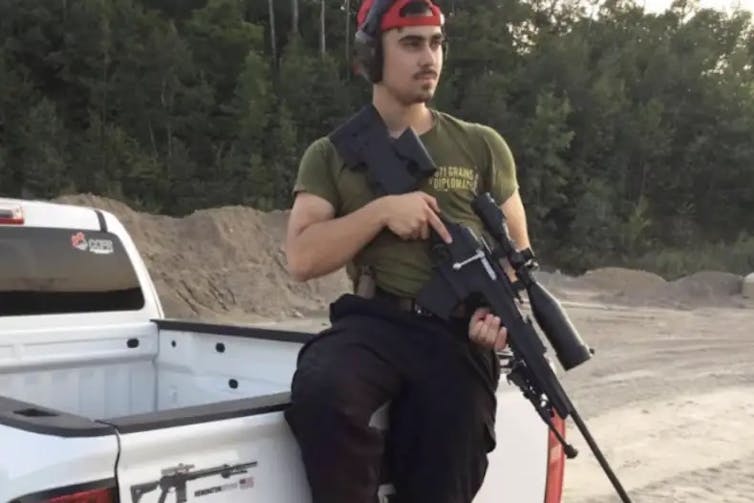
Raphaël Lagacé, one of the suspects charged by the RCMP.
(Instagram)

Canada not immune to violent movements

Canada often thinks it’s safe from violent movements, but it’s becoming more vulnerable. This is especially evident in places like Québec, where there has been ideological conflict in the past, including the massacre at a Québec mosque in January 2017.

However, the threat is also clear on a national level.

According to a Canadian intelligence report, far-right extremist groups actively recruit past and present members of the military and police.

There’s also a long-running pattern of militia activity in North America. Activities in the United States show how dangerous it is when violent ideologies spread.

This includes the nihilistic doctrine of accelerationism, which is a white-supremacist belief that the current state of society cannot be fixed and that the only way to repair it is to destroy and collapse the “system”.

There are versions of accelerationism on both the right and left.

The rise in right-wing extremism globally

The charges in Québec shine a spotlight on the global trend of rising right-wing extremism that has been worsening since 2016.

In the past decade, white supremacist, anti-government and militia groups have gained traction. That’s due in part to online echo chambers, growing political and social divisions and the rise and rapid spread of conspiracy theories.

The U.S. is the best and most immediate example. Groups like the Oath Keepers and Proud Boys are well-known, playing a significant role in the Jan. 6 insurrection at the U.S. Capitol. These groups are keen to recruit current and former military and law enforcement officers because they know how to handle weapons and use explosives.

In 2023, the FBI repeatedly said domestic violent extremism continues to pose a threat, especially racially or ethnically motivated extremists and anti-government groups.

Accelerationism is behind a lot of this violence. It underpins efforts to speed up the disintegration of society through targeted violence and technology, with the goal of starting a racial war or civil war to bring down liberal democratic institutions.

The Base is an example of this trend. It’s a multinational, trans-border white supremacist network that supports violence to create chaos.

But this is not just a North American problem. Before Russia’s full-scale invasion of Ukraine, far-right members of the Ukrainian Azov Regiment reportedly drew western extremists to their cause, many of whom were looking for paramilitary training, possibly to use against their own governments.

Canada: The Base, the ‘freedom convoy’

This global tide doesn’t leave Canada out. The arrests in Québec are the most recent and concerning example.

Patrik Mathews, a former Canadian Army reservist from Winnipeg, was involved in a well-known Canadian case that involved recruiting for The Base, as well as a plot to harm a journalist, Canadian investigative journalist Ryan Thorpe. His reports in the Winnipeg Free Press exposed Mathew’s membership in the The Base.

Mathew fled to the U.S. in 2019. The FBI subsequently arrested him and charged him with gun-related crimes and taking part in a riot at a Virginia protest. Mathew is now serving a long prison sentence for his part in what the FBI called a “neo-Nazi plot to instigate a race war in the United States.”

These examples clearly show how extremists work within national military systems to learn tactical capabilities.

The so-called “freedom convoy” occupation of Ottawa in 2022 also showed troubling connections between radicalism and some parts of the Canadian Armed Forces.

Investigations found numerous active and former Army members were either actively involved with the convoy or donated a lot of money. Some were found to have posted extreme anti-government views online. Some Army members are also vulnerable to the right-wing ideologies of a “white-ethnostate” fuelled by political rhetoric and hate.

All of this paints a bleak picture: extremist ideas are slowly taking hold in Canada as adherents aim to leverage military training to spread cynicism in democratic institutions. Previous studies back this up.

Countering the threat

To deal with this complicated and changing threat, we need a whole society, integrated approach that includes reliable top-down enforcement and monitoring and proactive, bottom-up societal resilience.

To quickly disrupt and deter extremist groups, top-down actions are very important. To properly monitor, penetrate and break up violent extremist networks, law enforcement and security services like CSIS and the RCMP need more resources, updated laws and better co-ordination.

It’s also important for the Canadian Armed Forces and other security-sensitive organizations to have better screening processes to find and purge those with extremist ideas.

But law enforcement isn’t enough. For one, it could be seen as biased, which could lead to more radicalization. Bottom-up methods are just as important for long-term prevention.

We need programs that provide teachers, social workers, community leaders and families with the tools they need to spot early signs of radicalization and do something about it in a positive way.


Read more:
How not to counter the radical right


Dialogue, education

It’s important to teach people how to think critically, read the news to fight false information and learn about civic duties that stress democratic principles and diversity. This is especially critical to fight against rising hate-motivated crimes.

I am involved in a one such project. It’s called Extremism and Radicalization to Violence Prevention in Manitoba (ERIM). We strive to build resilient communities by creating awareness and early detection of radicalism.

Dialogue and education are paramount.

Canada can’t afford to wait for a disaster to happen before acting. It can’t let its soldiers — those tasked with protecting Canadians and Canada’s security — get caught up in right-wing extremism. They are a source of national pride and should remain so.

The Conversation

Kawser Ahmed has led a Public Safety project called Extremism and Radicalization to Violence Prevention in Manitoba (ERIM)

ref. Charges against Canadian Army members in anti-government terror plot raise alarms about right-wing extremism – https://theconversation.com/charges-against-canadian-army-members-in-anti-government-terror-plot-raise-alarms-about-right-wing-extremism-260778
Charges against Canadian Army members in anti-government terror plot raises alarms about right-wing extremism

Source: The Conversation – Canada – By Kawser Ahmed, Adjunct Professor at the Political Science department, University of Winnipeg

This week, the RCMP arrested four men in Québec, alleging they were attempting to create an anti-government militia.

The RCMP used the umbrella term “Ideologically Motivated Violent Extremism” to categorize the suspects. Essentially, this means the RCMP alleges they share violent right-wing ideologies. Their arrests raise questions about whether Canada’s problem with right-wing extremism is getting worse.

The group is accused of storing explosive devices, dozens of firearms and thousands of rounds of ammunition. The RCMP seized all of it, and the four suspects are due to appear in Québec City court next week. Three are charged with facilitating a terrorist activity, along with weapon-possession offences.

The suspects include active members of the Canadian Armed Forces, according to the RCMP. Given the allegations that they were planning terrorist attacks for an extremist militia, the inclusion of army personnel might not be surprising.

But it could represent a stark manifestation of a deeply troubling and accelerating trend: the rise of violent right-wing extremism and anti-government or anti-authority radicalization within western democracies. This is a shift dramatically exacerbated by the COVID-19 pandemic as many seized the opportunity to spread anti-government ideas based on restricted freedoms.

Raphaël Lagacé, one of the suspects charged by the RCMP.
(Instagram)

Canada not immune to violent movements

Canada often thinks it’s safe from violent movements, but it’s becoming more vulnerable. This is especially evident in places like Québec, where there has been ideological conflict in the past, including the massacre at a Québec mosque in January 2017.

However, the threat is also clear on a national level.

According to a Canadian intelligence report, far-right extremist groups actively recruit past and present members of the military and police.

There’s also a long-running pattern of militia activity in North America. Activities in the United States show how dangerous it is when violent ideologies spread.

This includes the nihilistic doctrine of accelerationism, which is a white-supremacist belief that the current state of society cannot be fixed and that the only way to repair it is to destroy and collapse the “system”.

There are versions of accelerationism on both the right and left.

The rise in right-wing extremism globally

The charges in Québec shine a spotlight on the global trend of rising right-wing extremism that has been worsening since 2016.

In the past decade, white supremacist, anti-government and militia groups have gained traction. That’s due in part to online echo chambers, growing political and social divisions and the rise and rapid spread of conspiracy theories.

The U.S. is the best and most immediate example. Groups like the Oath Keepers and Proud Boys are well-known, playing a significant role in the Jan. 6 insurrection at the U.S. Capitol. These groups are keen to recruit current and former military and law enforcement officers because they know how to handle weapons and use explosives.

In 2023, the FBI repeatedly said domestic violent extremism continues to pose a threat, especially racially or ethnically motivated extremists and anti-government groups.

Accelerationism is behind a lot of this violence. It underpins efforts to speed up the disintegration of society through targeted violence and technology, with the goal of starting a racial war or civil war to bring down liberal democratic institutions.

The Base is an example of this trend. It’s a multinational, trans-border white supremacist network that supports violence to create chaos.

But this is not just a North American problem. Before Russia’s full-scale invasion of Ukraine, far-right members of the Ukrainian Azov Regiment reportedly drew western extremists to their cause, many of whom were looking for paramilitary training, possibly to use against their own governments.

Canada: The Base, the ‘freedom convoy’

This global tide doesn’t leave Canada out. The arrests in Québec are the most recent and concerning example.

Patrik Mathews, a former Canadian Army reservist from Winnipeg, was involved in a well-known Canadian case that involved recruiting for The Base, as well as a plot to harm a journalist, Canadian investigative journalist Ryan Thorpe. His reports in the Winnipeg Free Press exposed Mathew’s membership in the The Base.

Mathew fled to the U.S. in 2019. The FBI subsequently arrested him and charged him with gun-related crimes and taking part in a riot at a Virginia protest. Mathew is now serving a long prison sentence for his part in what the FBI called a “neo-Nazi plot to instigate a race war in the United States.”

These examples clearly show how extremists work within national military systems to learn tactical capabilities.

The so-called “freedom convoy” occupation of Ottawa in 2022 also showed troubling connections between radicalism and some parts of the Canadian Armed Forces.

Investigations found numerous active and former Army members were either actively involved with the convoy or donated a lot of money. Some were found to have posted extreme anti-government views online. Some Army members are also vulnerable to the right-wing ideologies of a “white-ethnostate” fuelled by political rhetoric and hate.

All of this paints a bleak picture: extremist ideas are slowly taking hold in Canada as adherents aim to leverage military training to spread cynicism in democratic institutions. Previous studies back this up.

Countering the threat

To deal with this complicated and changing threat, we need a whole society, integrated approach that includes reliable top-down enforcement and monitoring and proactive, bottom-up societal resilience.

To quickly disrupt and deter extremist groups, top-down actions are very important. To properly monitor, penetrate and break up violent extremist networks, law enforcement and security services like CSIS and the RCMP need more resources, updated laws and better co-ordination.

It’s also important for the Canadian Armed Forces and other security-sensitive organizations to have better screening processes to find and purge those with extremist ideas.

But law enforcement isn’t enough. For one, it could be seen as biased, which could lead to more radicalization. Bottom-up methods are just as important for long-term prevention.

We need programs that provide teachers, social workers, community leaders and families with the tools they need to spot early signs of radicalization and do something about it in a positive way.


Read more:
How not to counter the radical right


Dialogue, education

It’s important to teach people how to think critically, read the news to fight false information and learn about civic duties that stress democratic principles and diversity. This is especially critical to fight against rising hate-motivated crimes.

I am involved in a one such project. It’s called Extremism and Radicalization to Violence Prevention in Manitoba (ERIM). We strive to build resilient communities by creating awareness and early detection of radicalism.

Dialogue and education are paramount.

Canada can’t afford to wait for a disaster to happen before acting. It can’t let its soldiers — those tasked with protecting Canadians and Canada’s security — get caught up in right-wing extremism. They are a source of national pride and should remain so.

The Conversation

Kawser Ahmed has led a Public Safety project called Extremism and Radicalization to Violence Prevention in Manitoba (ERIM)

ref. Charges against Canadian Army members in anti-government terror plot raises alarms about right-wing extremism – https://theconversation.com/charges-against-canadian-army-members-in-anti-government-terror-plot-raises-alarms-about-right-wing-extremism-260778

We’re hiring: Culture & Society Editor

Source: The Conversation – Canada – By Kim Honey, CEO|Editor-in-Chief, The Conversation Canada

The Conversation Canada is looking for a Culture & Society editor for a 10-month contract position. (Sandra Seitamaa/Unsplash)

The Conversation Canada is seeking a dynamic and thoughtful Culture & Society Editor with a background in critical race scholarship to join our editorial team. This remote, full-time, 10-month contract position is ideal for an experienced editor who is passionate about shaping public discourse through rigorous, accessible journalism.

As the Culture & Society Editor, you will work closely with academics from across Canada, and sometimes globally, to commission, edit and publish articles that explore the intersections of culture, identity, race, media, politics and society. You will play a key role in ensuring our coverage reflects a diversity of voices and perspectives, particularly those grounded in critical race theory, decolonial thought, Indigenous studies and other transformative frameworks that challenge dominant narratives.

Your responsibilities will include identifying timely and relevant story ideas, working collaboratively with academics to develop their ideas into clear, compelling content and upholding The Conversation Canada’s editorial standards of evidence-based, non-partisan journalism. You will also help expand our network of contributors from equity-deserving communities and ensure inclusive representation in our content, and will work closely and collaboratively with team members to publish stories in a timely fashion.

This role offers the opportunity to influence national conversations by bringing scholarly expertise into the public sphere, especially on matters of racial justice, cultural expression and societal transformation.

DEADLINE FOR APPLICATIONS: August 5, 2025

The ideal candidate will have:

  • A degree in the humanities, social sciences or journalism
  • Demonstrated experience in editing
  • A strong grasp of current debates in race, identity, culture and power
  • Excellent editorial judgment
  • A network of academic and news contacts
  • An understanding of audience development, including SEO practices, web analytics, social media and newsletter engagement
  • Strong organizational skills, with an ability to edit to daily deadlines, manage multiple tasks and work as part of a collaborative team
  • Care and attention to detail
  • Bilingualism is an asset
  • Must be based in Canada

About The Conversation Canada

The Conversation Canada is a successful news startup in its eighth year of operation, which has a French-language sister site, La Conversation, in Quebec. It is a unique collaboration between academics and professional journalists, and we belong to a global network with eight other editions covering Africa, Australia, Brazil, France, Indonesia, New Zealand, the U.K. and the U.S. The Conversation Canada has editors in Toronto, Montreal, Vancouver and Victoria, and we offer a friendly working environment with a passionate and mission-driven team.

How to apply

Please send applications, including a cover letter, CV, three writing and/or editing samples and three story ideas to Kim Honey at kim.honey@theconversation.com and Lee-Anne Goodman at lee-anne.goodman@theconversation.com.

Please note only candidates under consideration will be contacted.

We are committed to diversity and building an inclusive environment for people of all backgrounds and ages. We encourage members of traditionally underrepresented communities to apply, including women, people of colour, Indigenous Peoples, LGBTQ+ people and people with disabilities.

The Conversation

ref. We’re hiring: Culture & Society Editor – https://theconversation.com/were-hiring-culture-and-society-editor-260789

How a lottery-style refund system could boost recycling

Source: The Conversation – Canada – By Jiaying Zhao, Associate Professor, Psychology, University of British Columbia

Imagine you’re standing at a bottle depot with an empty pop can. You can get a dime back, or you can take a chance at winning $1,000. Which would you choose?

Every year, the world produces two trillion beverage containers but only 34 per cent of glass bottles, 40 per cent of plastic bottles and 70 per cent of aluminium cans are recycled.

To increase recycling rates, many countries have adopted deposit refund systems, where you pay a small deposit, say 10 cents, when you buy an eligible beverage container and get this deposit back when you return it to a local depot.

Through this system, approximately 80 per cent of containers in British Columbia and almost 85 per cent of containers in Alberta are recovered. Still, that leaves millions of containers as litter, in landfills or incinerated every year, contributing to pollution and greenhouse gas emissions.

With Canada’s goal of zero plastic waste by 2030 drawing near, a new approach to recycling beverage containers could make a difference.

We recently conducted a research experiment to find out if more people would recycle more often if they had a chance to win a prize.

A lottery-style refund to boost recycling

Psychology research shows that people tend to prefer a small chance to win a large reward over a guaranteed small reward. For example, people would more often prefer a small chance to win $5,000 over receiving a $5 reward.

Applying this insight to recycling, we turned the small guaranteed refund of $0.10 in B.C. and Alberta into a 0.01 per cent chance of getting $1,000. We set up recycling tables at food courts in Vancouver and at a RibFest event in Spruce Grove, Alta.

When people brought their beverage containers to us to recycle, we presented them with five options for a refund. They could get their guaranteed 10 cents, or a chance to win a larger amount of money, the highest option being $1,000.

We found that people preferred the chance to win $1,000 over the other options, and they felt the happiest after making this choice.

To see if the lottery option actually increased recycling, we conducted an experiment where we told people ahead of time that they would get their guaranteed 10-cent refund or that they had a chance to win $1,000 for each bottle they brought to our study.

We found that people brought 47 per cent more beverage containers when we offered them a chance to win $1,000 than when we offered them the guaranteed refund.

Overall, our findings suggest that offering a chance to win a larger amount of money can meaningfully boost beverage container recycling. The excitement of a potential big win can motivate people who may not be enticed by the typical small, guaranteed refund.

Choice matters

A one-size-fits-all approach won’t work. People recycle for different reasons. They also have different risk tolerances, and some may rely on the guaranteed refund for additional income. To capture diverse preferences and needs, it’s vital that the lottery-style refund is offered in addition to the guaranteed refund, not instead of it.

It would also be beneficial to include smaller, more frequent prizes alongside the grand prize, so people win relatively frequently to keep motivations high.

This is Norway’s approach to their recycling lottery, with 39 per cent of people choosing the lottery option when they recycle. In 2023, Norway’s recycling lottery achieved a 92.3 per cent container return rate.

Importantly, our research does not capture people who collect large bags of containers to return to the depot. It’s possible that this demographic may have different preferences for the refund, and future research should examine this group in particular.

Green lottery for good

The lottery-style refund has the same expected payout as the 10-cent refund per bottle. This means that, on average, people will take home the same amount of money as with the guaranteed option, without incurring additional losses or gains. This benevolent factor distinguishes the lottery-style refund from other types of lotteries or gambling that often profit off the players.

Since the only way to enter this lottery-style refund is to recycle beverage containers, it’s impossible to directly re-enter any winnings into the lottery. There are also no near-misses, losses disguised as wins, exciting lights and sounds or other sensory stimulation often associated with gambling.

Some might be apprehensive about potential gambling dangers of creating a lottery system. However, there has not been a single case linking the recycling lottery to gambling addiction. There is also no evidence that purchases of beverage containers would increase as a result of the lottery-style refund.

Our study’s transparent design, with clear odds, ensures fairness, unlike casino games built to take players’ cash. For this approach to be successful, deposit refund systems must maintain this transparency in lottery-style program operations and payouts.

If done right, offering a chance to win a higher amount of money for recycling can meaningfully increase recycling rates, contribute to a circular economy and allow people to choose the refund option that works best for them.

The Conversation

Jiaying Zhao receives funding from the Social Sciences and Humanities Research Council of Canada.

Jade Radke receives funding from the Social Sciences and Humanities Research Council of Canada Doctoral Fellowship and the University of British Columbia Indigenous Graduate Fellowship.

ref. How a lottery-style refund system could boost recycling – https://theconversation.com/how-a-lottery-style-refund-system-could-boost-recycling-259896

The Great Lakes are powerful. Learning about ‘rip currents’ can help prevent drowning

Source: The Conversation – Canada – By Chris Houser, Professor in Department of Earth and Environmental Science, and Dean of Science, University of Waterloo

Between 2010 and 2017, there were approximately 50 drowning fatalities each year associated with rough surf and strong currents in the Great Lakes.

In addition to the personal loss experienced by family and friends, these drownings create an annual economic burden on the regional economy of around US$105 million, and that doesn’t include the direct costs of search and rescue.

Types of rip currents

Rip currents — commonly referred to as rips or colloquially as rip tides — are driven by the breaking of waves. These currents extend away from the shoreline and can flow at speeds easily capable of carrying swimmers far from the beach.

Structural rips are common throughout the Great Lakes (Grand Haven on the eastern shore of Lake Michigan, for example) and develop when groynes, jetties and rock structures deflect the alongshore current offshore, beyond the breaking waves. Depending on the waves and the structure, a shadow rip can also develop on the other side of the groyne or jetty.

Rips can also develop anywhere that variations in the bathymetry (the topography of the sand underwater) — such as nearshore bars — causes wave-breaking to vary along the beach, which makes the water thrown landward by the breaking waves return offshore as a concentrated flow at the water’s surface. These are known as channel or bathymetric rips and are they can form along sand beaches in the Great Lakes.

While it can be difficult to spot a channel rip, they can be identified by an area of relatively calm water between breaking waves, a patch of darker water or the offshore flow of water, sediment and debris.

A person caught in a rip is transported away from shore into deeper water, but they are not pulled under the water. If they are a weak swimmer or try to fight the current, they may panic and fail to find a way out of the rip and back to shore before submerging.

Rip current hazards

Most rip fatalities occur on unsupervised beaches or on supervised beaches when and where lifeguards are not present. While many popular beaches near large urban centres have lifeguards, many beaches don’t. Along just the east coast of Lake Huron, there are more than 40 public beaches, including Goderich, Bayfield, Southampton and Sauble Beach, but only two have lifeguard programs (Sarnia and Grand Bend).

Simple warning signs are used on many beaches, but visitors either don’t pay attention or don’t know how to interpret the warning.

Non-local visitors are a high-risk group for drownings. They are less likely to make safe swimming choices than residents or regular beach-goers, because visitors are generally unfamiliar with the beach and its safety measures, have poor knowledge of beach hazards like rip currents and breaking waves and are overconfident in their swimming ability.

Recent findings from a popular beach on Lake Huron suggest that those with less experience at the beach tend to make decisions of convenience rather than based on beach safety. Residents with greater knowledge of the local hazards tend to avoid swimming near where the rip can develop.

But even when people are aware of rip currents and other beach hazards, they may not make the right decisions. Despite the presence of warnings, people’s actions are greatly influenced by the behaviour of others, peer pressure and group-think. The social cost of not entering the water with the group may appear to outweigh the risk posed by entering the water.

Rip channel and current on Lake Huron. (Chris Houser)

The behaviour of beach users is affected by confirmation bias, a cognitive shortcut where a person selectively pays attention to evidence confirming their pre-existing beliefs and ignores evidence to the contrary. When someone enters the water and does not encounter strong waves or currents, they’re more likely to engage in risky behaviour on their next visit to that beach or a similar beach.

Vacationers and day visitors can stay safe only if they are aware that there is the potential for rip currents and rough surf at beaches in the Great Lakes. Just because a beach is accessible and has numerous attractions does not mean it is safe.

Advocating for beach safety

In the United States, the National Oceanographic and Atmospheric Administration runs programs designed to educate beach users about surf and rip hazards. But Canada hasn’t implemented a national beach safety strategy.

Education about rips and dangerous surf falls on the shoulders of advocates, many of whom have been impacted by a drowning in the Great Lakes. The Great Lakes Surf Rescue Project has been tracking and educating school and community groups about rip currents and rough surf in the Great Lakes since 2010.

Several new advocacy groups have started in recent years, including Kincardine Beach Safety on Lake Huron and the Rip Current Information Project on Lake Erie. Given that there is limited public interest in surf-related drownings and limited media coverage, these advocacy groups are helping to increase awareness of rip currents and rough surf across the Great Lakes.

To ensure a safe trip to the beach, beachgoers should seek out more information about rip currents and other surf hazards in the Great Lakes.

The Conversation

Chris Houser receives funding from NSERC.

ref. The Great Lakes are powerful. Learning about ‘rip currents’ can help prevent drowning – https://theconversation.com/the-great-lakes-are-powerful-learning-about-rip-currents-can-help-prevent-drowning-260060

I’m a statistics professor who became embroiled in the world of online chess drama

Source: The Conversation – Canada – By Jeffrey S. Rosenthal, Professor of Statistics, University of Toronto

As a mild-mannered statistics professor, it’s not often that I get
contacted directly by the CEO of a multi-million-dollar company, much less regarding allegations of cheating and malfeasance among world champions.

But that’s precisely what happened last summer. Erik Allebest, CEO of the world’s largest online chess site, Chess.com, asked me to investigate former world chess champion Vladimir Kramnik’s concerns about the long winning streaks of top player Hikaru Nakamura.

Kramnik argued that these streaks had very low probability and were therefore very suspicious and “interesting.” He didn’t quite accuse Hikaru of cheating, but the implication was clear. Feelings were running high, with Kramnik’s supporters posting angry comments (often in Russian) about cheating as many Chess.com players and Hikaru partisans dismissed the accusations.

Who was right? Who was wrong? Who could say?

Allebest asked me to conduct an independent, unbiased statistical analysis to see just how unlikely those chess winning streaks actually were.

Now, I am no stranger to public statistical disputes, having published a
best-selling book about everyday probabilities and conducted the statistical analysis for the high-profile lottery retailer scandal. But could statistical analysis really help to clarify this simmering controversy on the world’s biggest chess stage?

Statistician Jeffrey Rosenthal responds to questions about statistics for WIRED in a video that has received 2.4 million views since February 2022.

Calculating probabilities

To sort this out, I first had to calculate the probability of each player winning or tying each game. Different players can have very different abilities, and more advanced players have a greater chance of defeating less experienced opponents. But just how great?

Chess.com assigns a chess rating to each player after each game, and these ratings were shared with me. My analysis suggested that a certain logistic — or s-shaped — curve function provided an accurate estimate of each game’s probabilities.

Furthermore, deviations from this probability in successive game results were approximately independent, so the influence of one game on the next could be safely ignored. This gave me a clear probability of each player winning each game.

I could then analyze those winning streaks that had provoked so much ire. It turned out that Hikaru, unlike most other top players, had played lots of games against much weaker players. This gave him a very high probability of winning each game. But even so, should he have such long winning streaks, sometimes more than 100 games in a row?

Testing randomness

To check this, I conducted some Monte Carlo simulations, which repeat a test with random variations.

I wrote computer programs to randomly assign wins and losses and draws to each of Hikaru’s games, according to the probabilities from my model. I had the computer measure the most surprising winning streaks each time. This allowed me to measure how Hikaru’s actual streaks stacked up against what we should expect.

I found that in many of the Monte Carlo simulations, the
simulated results included streaks just as unlikely as the actual ones.
This demonstrated that Hikaru’s chess results were just about what might
be expected. He had such a high probability of winning each game, and had played so many games on Chess.com, that such long winning streaks were likely to emerge according to the rules of probability alone.

Responses to findings

I wrote up a brief report of my findings, and sent it to Chess.com.
It ran a news item on its site, which elicited many comments, mostly supportive.

Hikaru then posted his own video commentary, also supporting my analysis. But meanwhile, Kramnik posted a 29-minute video criticizing my research.

Kramnik did include some substantive points, so I wrote an addendum to my report to address his concerns and show that they would not effect the conclusion. I also converted my report into a formal paper, which I submitted to a research journal.

I then got busy with my teaching duties and put the chess controversies
out of my mind until I received a response in December. It consisted of three referee reports and editor comments, with detailed comments totalling six single-spaced pages.

I also then discovered that Kramnik had posted a second 59-minute video critiquing my addendum and raising additional points, too.

I addressed Kramnik’s and the referees’ additional points while revising my article for publication. My paper was finally published in the Harvard Data Science Review.

I was glad to have my findings published in a prestigious statistics journal, thus giving them a formal stamp of approval. And perhaps, at long last, to settle this particular champion-level chess controversy.

The Conversation

Jeffrey S. Rosenthal receives research funding from NSERC of Canada, but received no compensation from Chess.com or anyone else for this work.

ref. I’m a statistics professor who became embroiled in the world of online chess drama – https://theconversation.com/im-a-statistics-professor-who-became-embroiled-in-the-world-of-online-chess-drama-256294

Alcohol sales changed subtly after Canada legalized cannabis

Source: The Conversation – Canada – By Michael J. Armstrong, Associate Professor, Operations Research, Brock University

In Canada, some studies indicate alcohol consumption declined slightly as medical cannabis use became more common. Did similar decreases follow recreational legalization? (Unsplash+)

Before Canada legalized recreational cannabis in October 2018, it was unclear how the change might affect beverage alcohol consumption. Would consumers drink less or more after cannabis became legal?

Drinking might decrease, for example, if people used cannabis in place of alcohol. That switch potentially could reduce alcohol-related harms. But economically, it would mean any gains in the cannabis industry would likely come at the expense of alcohol producers.

Conversely, drinking might increase if people used alcohol along with cannabis. That could boost alcohol industry profits and government tax revenues, but at the cost of increased health risks of both substances.

In response to this uncertainty, some businesses diversified. One alcohol producer bought a cannabis grower, while a cannabis firm took took over several beer brewers.

Research from the United States into the relationship between alcohol and cannabis use is inconclusive. Some studies report that alcohol use decreased in states that allowed cannabis, while others said usage increased or didn’t significantly change. Those conflicting conclusions might reflect the complex legal situation in the United States, where cannabis remains illegal under federal law, even in states that allow its use.

In Canada, some studies indicate alcohol consumption declined slightly as medical cannabis use became more common. Did similar decreases follow recreational legalization?

To investigate this question, I first collaborated with health science researchers Daniel Myran, Robert Talarico, Jennifer Xiao and Rachael MacDonald-Spracklin to study Canada’s overall alcohol sales.

Total sales looked stable

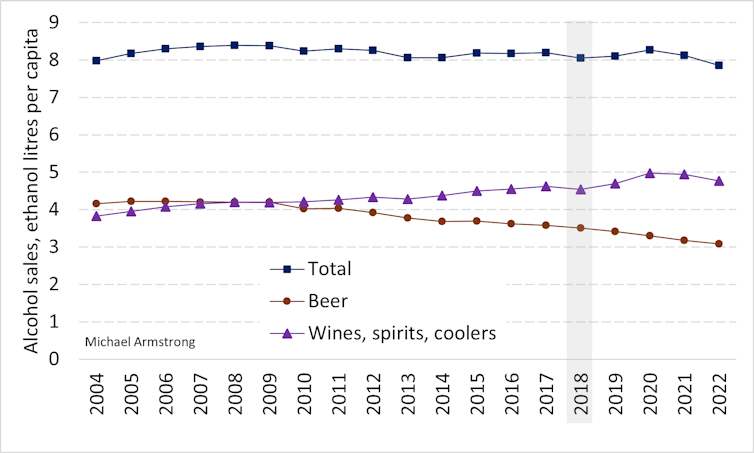
We started our research by examining annual alcohol sales from 2004 to 2022. During that period, beer sales gradually fell, while the sale of coolers and other drinks steadily rose. That left total sales basically unchanged.

So consumers were apparently switching from beer to other beverages. But there were no obvious effects from 2018’s cannabis legalization.

This diagram shows how beer sales declined while other beverage sales increased from 2004 to 2022. Total alcohol sales remained roughly constant.
Annual Canadian beverage alcohol sales from 2004 to 2022, in litres of ethanol content per capita. The vertical gray bar marks cannabis legalization.
(Statistics Canada), CC BY-ND

We also compared monthly sales during the 12 months before legalization versus the 12 after. This included national average sales by liquor retailers and beer producers. In both cases, sales trends showed no significant changes in October 2018.

However, this research on Canada-wide sales was mainly designed to detect large changes. To find subtler ones, I focused on the province of Nova Scotia.

Some liquor stores sold cannabis

When Canada legalized cannabis, most provinces banned liquor stores from selling it to avoid tempting alcohol drinkers into trying cannabis.

Nova Scotia did the opposite. Its government-owned liquor corporation became the main cannabis retailer. After legalization in October 2018, most provincial liquor stores kept selling only alcohol, but some began selling cannabis as well.

This unique situation prompted me to study the province’s sales. I focused on the 17 months before and 17 months after legalization.

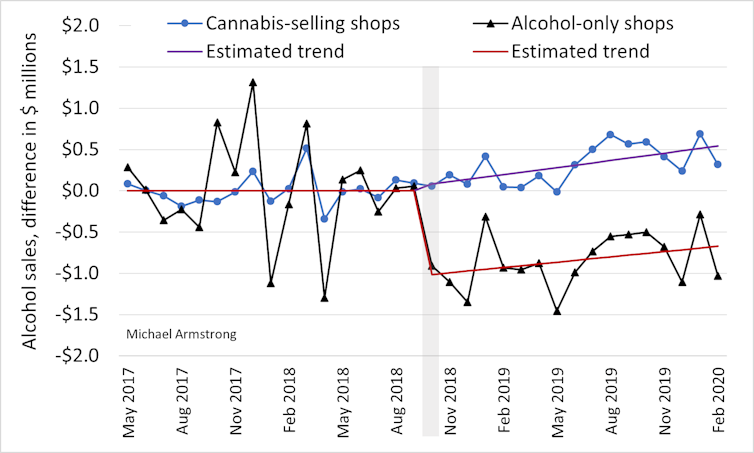
The corporation’s total alcohol sales initially fell in October 2018, then slowly regrew. As a result, monthly sales after legalization averaged about $500,000 below their earlier levels.

More interestingly, the changes differed between the cannabis-selling stores and the alcohol-only ones. At the alcohol-only stores, sales immediately fell. They averaged $800,000 below previous levels.

But at cannabis-sellers, alcohol sales began growing. Total monthly sales from October 2018 to February 2020 averaged $300,000 above earlier levels.

This diagram shows that after October 2018, alcohol sales rose gradually at liquor stores that sold cannabis but fell quickly at stores selling only alcohol.
Seasonally adjusted Nova Scotia Liquor Corporation retail sales of beverage alcohol in Canadian dollars, from May 2017 to February 2020. The vertical gray bar marks cannabis legalization.
(Nova Scotia Liquor Corporation), CC BY-ND

The divergence in sales was larger for beers than for spirits or wines.

Interestingly, alcohol-only stores located near cannabis-selling stores had changes similar to those located farther away, suggesting that cannabis-seller proximity didn’t matter.

Switching substances or stores?

My data can’t say why the sales split occurred, but I can speculate.

Consider the immediate sales drop at alcohol-only stores — this could suggest some consumers switched from alcohol to cannabis right after legalization.

Meanwhile, the lack of a drop at cannabis sellers might mean some consumers simply changed where they shopped. Instead of visiting their local alcohol-only retailer, they went to cannabis sellers to shop for alcohol and cannabis together.

The cannabis sellers’ ongoing growth might reflect people increasingly buying cannabis from licensed stores instead of illegal dealers. They went to those stores to buy weed, but picked up some extra booze while they were there.

Looking ahead

My research so far has focused on the initial post-legalization period, from October 2018 to February 2020.

I plan to study later periods next, when cannabis retailing was more widespread and perhaps more influential.

That will be more challenging, however, because COVID-19 arrived in March 2020. The pandemic disrupted sales of alcohol, though not of cannabis. It will be tricky to separate cannabis effects from pandemic ones, or from Canadian consumers’ evolving drinking habits in general.

My guess is that cannabis legalization had little short-term impact on existing drinkers overall. Most Canadians didn’t suddenly consume cannabis with their cabernet or replace vodka with vapes.

Instead, we might see gradual long-term shifts. Young Canadians now reach legal age in a context where cannabis and alcohol are both allowed. Some folks who previously would have started drinking alcohol might now choose cannabis instead, or in addition.

For now, alcohol drinking is still three times more common than cannabis use. Whether that continues, only time will tell.

The Conversation

Michael J. Armstrong does not work for, consult, own shares in or receive funding from any company or organisation that would benefit from this article, and has disclosed no relevant affiliations beyond their academic appointment.

ref. Alcohol sales changed subtly after Canada legalized cannabis – https://theconversation.com/alcohol-sales-changed-subtly-after-canada-legalized-cannabis-260375

Cancellations at Canadian film festivals raise questions about accountability

Source: The Conversation – Canada – By Dorit Naaman, Alliance Atlantis Professor of Film and Media, Queen’s University, Ontario

Film festivals are unique cultural institutions, spaces to see diverse films by local and global filmmakers and an important market for distributors. These films are often difficult to see, or even know about, outside of festival circuits.

Festivals are also answerable to funders and to different stakeholders’ interests. Cancellations of planned films raise questions about festivals’ roles and accountability to community groups who find certain films objectionable, the wider public, politicians, festival sponsors, audiences, filmmakers and the films themselves.

In September 2024, The Toronto International Film Festival (TIFF) faced a backlash from pro-Ukrainian groups — and former deputy prime minister Chrystia Freeland, who is of Ukrainian descent — when the documentary Russians at War was included in the program.


Read more:
‘Russians at War’ documentary: From the Crimean to the Iraq War, soldier images pose questions about propaganda


The Ukrainian Canadian Congress and other advocates called on TIFF to cancel the film, directed by Russian Canadian Anastasia Trofimova, which they accused of being Russian propaganda.

TIFF did cancel festival screenings after it was “made aware of significant threats to festival operations and public safety,” but once the festival was over, showed Russians at the TIFF Lightbox Theatre.

In November, the Montréal International Documentary Festival (RIDM) cancelled the Canadian premiere of Rule of Stone, directed by Israeli Canadian director Danae Elon. As a film and media professor, I supervised Elon’s research for the film while she pursued a master’s degree at Queen’s University.

RIDM acknowledged Elon’s “personal commitment to criticizing and questioning the state of Israel” through her story about the stone that, by Israeli law, has to be used on the exterior of every new building in Jerusalem.

In the film, Elon examines how, in post-1967 Jerusalem, “architecture and stone are the main weapons in a silent, but extraordinarily effective colonization and dispossession process” of Palestinians.

As a documentarist and a researcher in Israeli and Palestinian media representations of fighters, I have analyzed both films and followed the controversies. Each focuses on contemporary political issues relevant to our understanding of current affairs.

While the reasons for the cancellations are different, in both cases the festivals responded to pressures from community groups, placing the public right to a robust debate at the festival and beyond as secondary.

‘Russians at War’

Director Anastasia Trifamova embedded herself in a Russian supply unit, and later a medical team, eventually making her way to the front lines in occupied Ukraine.

Trifamova comes across as a naive filmmaker, using an observational, non-judgmental form of filmmaking common in 21st-century war documentaries, as seen in films like Armadillo and Restrepo (respectively following Danish and U.S. troops in Afghanistan).

As noted by TIFF, Russians was “an official Canada-France co-production with funding from several Canadian agencies,” and Trifamova said she did not seek or receive official permission from the Russian army to film.

The film documents the machination of war, where soldiers are both perpetrators of violence and its victims. It humanizes the soldiers, which understandably can be upsetting to Ukrainian and pro-Ukrainian publics. But should emotions of one group, outraged and incensed as they may be, prevent the public from having the difficult conversations promoted by the film?

Early in the film, Trifamova confronts the soldiers about why they are fighting and they respond with Russian propaganda (fighting Nazism, defending the borders).

Later, soldiers approach Trifamova — on camera — to express doubts about the justification of the war and their presence in Ukraine. The film provides an unflattering view of Russia’s attack on Ukraine, emphasizing the futility of the war and the incredible toll on soldiers and civilians (including some Ukrainian civilians). Russian troops appear untrained and poorly equipped to fight in chaotically managed battles.

Like Armadillo and Restrepo, Russians at War represents the soldiers without judgment and contributes to necessary conversations about war. In my analysis, while Trifamova refrains — in her sporadic voice-over — from condemning the war outright, it is difficult to read the film as Russian propaganda.

While TIFF cited security concerns as the reason for cancellation, security was in place for another film that attracted controversy, Bliss.

A cancellation from such an established festival likely has an effect on how a film is able to circulate. For example, TVO, one of the funders of Russians at War, cancelled its scheduled broadcast days after the TIFF cancellation.

‘Rule of Stone’

Rule of Stone, as noted by RDIM, “critically examines the colonialist project of East Jerusalem following its conquest by Israeli forces in 1967.”

The title references a colonial bylaw to clad building with stone, first introduced by the British, which still exists today.

The film, which examines architecture’s role in creating modern Jerusalem, is led by Elon’s voice-over. It mixes her memories of growing up in 1970s Jerusalem and her reckoning with the “frenzy of building,” which included projects by architect Moshe Safdie, a citizen of Israel, Canada and the United States. Elon recounts that her father, journalist and author Amos Elon, was a close friend of Safdie, as well as legendary Jerusalem mayor Teddy Kolek.

Safdie is among the Israeli architects, architectural historians and planners who Elon interviews. The expansion of Jewish neighbourhoods is contrasted with the restrictions on and disposession of Palestinians in Jerusalem. Multiple scenes show the demolition of Palestinian homes or the aftermath. In intervwoven segments, Izzat Ziadah, a Palestinian stonemason who lives in a stone quarry, gives a tour of what is left of his destroyed home.

Viewers hear how the planning, expansion and building of Jewish neighbourhoods, post-1967, were designed to evoke biblical times. As architectural historian Zvi Efrat notes, the new neighbourhoods look like, or attempt to look like, they were there forever.

‘Rule of Stone’ trailer.

As reported by La Presse, the RIDM cancellation came after the festival received information about the documentary’s partial Israeli financing, something that “embarrassed” them with some of the festival’s partners. Funding for the development of the film came from the Makor Foundation for Israeli Films, which receives support from Israel’s Ministry of Culture and Sport.

Two organizations, the Palestinian Film Institute and Regards Palestiniens, opposed the film’s showing on the basis of their commitment to the Palestinian Campaign for the Academic and Cultural Boycott of Israel (PACBI).

In the organizations’ logic, Israel state funding means a film should be subject to boycott as “PACBI specifically targets Israeli institutional funding in the arts which serves to culturally whitewash and legitimize the Israeli state.”

In my view, this position differs from the PACBI guidelines, which state:

“As a general overriding rule, Israeli cultural institutions, unless proven otherwise, are complicit in maintaining the Israeli occupation and denial of basic Palestinian rights, whether through their silence or actual involvement in justifying, whitewashing or otherwise deliberately diverting attention from Israel’s violations of international law and human rights.”

Makor should be exempted since it regularly funds films that draw attention to Israel’s violations of Palestinian human rights. In 2024 alone, the list includes The Governor, The Village League and Death in Um al hiran.

RIDM’s website does not disclose support for a boycott. In the end, RIDM announced that Elon withdrew her film. She stated: “Screening my film at RIDM does not serve the long-term purpose of the festival, nor is it possible now to address the nuances in our common fight for justice for Palestine. I am deeply saddened and distressed by [what] has brought it to this point.”

To date, the film has not found a cinema in Montréal willing to screen it.

Provoking important conversations

The two festivals’ mission statements promise high-quality films that transform or renew audiences’ relationships to the world.

It is clear why programmers chose both films, since they’re cinematically innovative and provoke important conversations.

However, both festivals silenced these films and signalled to other filmmakers that these festivals are not brave spaces to have difficult and necessary conversations.

The Conversation

Dorit Naaman does not work for, consult, own shares in or receive funding from any company or organisation that would benefit from this article, and has disclosed no relevant affiliations beyond their academic appointment.

ref. Cancellations at Canadian film festivals raise questions about accountability – https://theconversation.com/cancellations-at-canadian-film-festivals-raise-questions-about-accountability-250892

Calls to designate the Bishnoi gang a terrorist group shine a spotlight on Canada’s security laws

Source: The Conversation – Canada – By Basema Al-Alami, SJD Candidate, Faculty of Law, University of Toronto

British Columbia Premier David Eby recently called on Prime Minister Mark Carney to designate the India-based Bishnoi gang a terrorist organization.

Brampton Mayor Patrick Brown echoed the request days later. The RCMP has also alleged the gang may be targeting pro-Khalistan activists in Canada.

These claims follow a series of high-profile incidents in India linked to the Bishnoi network, including the murder of a Punjabi rapper in New Delhi, threats against a Bollywood actor and the killing of a Mumbai politician in late 2024.

How terrorism designations work

Eby’s request raises broader legal questions. What does it mean to label a group a terrorist organization in Canada and what happens once that label is applied?

Under Section 83.05 of the Criminal Code, the federal government can designate an entity a terrorist organization if there are “reasonable grounds to believe” it has engaged in, supported or facilitated terrorist activity. The term “entity” is defined broadly, covering individuals, groups, partnerships and unincorporated associations.

The process begins with intelligence and law enforcement reports submitted to the public safety minister, who may then recommend listing the group to cabinet if it’s believed the legal threshold is met. If cabinet agrees, the group is officially designated a terrorist organization.

A designation carries serious consequences: assets can be frozen and financial dealings become criminalized. Banks and other institutions are protected from liability if they refuse to engage with the group. Essentially, the designation cuts the group off from economic and civic life, often without prior notice or public hearing.

As of July 2025, Canada has listed 86 entities, from the Islamic Revolutionary Guard Corps to far-right and nationalist organizations. In February, the government added seven violent criminal groups from Latin America, including the Sinaloa cartel and La Mara Salvatrucha, known as the MS-13.

This marked a turning point: for the first time, Canada extended terrorism designations beyond ideological or political movements to include transnational criminal networks.

Why the shift matters

This shift reflects a deeper redefinition of what Canada considers a national security threat. For much of the post-9/11 era, counterterrorism efforts in Canada have concentrated on groups tied to ideological, religious or political agendas — most often framed through the lens of Islamic terrorism.

This has determined not only who is targeted, but also what forms of violence are taken seriously as national security concerns.

That is why the recent expansion of terrorism designations — first with the listing of Mexican cartels in early 2025, and now potentially with the Bishnoi gang — feels so significant.

It signals a shift away from targeting ideology alone and toward labelling profit-driven organized crime as terrorism. While transnational gangs may pose serious public safety risks, designating them terrorist organizations could erode the legal and political boundaries that once separated counterterrorism initiatives from criminal law.

Canada’s terrorism listing process only adds to these concerns. The decision is made by cabinet, based on secret intelligence, with no obligation to inform the group or offer a chance to respond. Most of the evidence remains hidden, even from the courts.

While judicial review is technically possible, it is limited, opaque and rarely successful.

In effect, the label becomes final. It brings serious legal consequences like asset freezes, criminal charges and immigration bans. But the informal fallout can be just as harsh: banks shut down accounts, landlords back out of leases, employers cut ties. Even without a trial or conviction, the stigma of being associated with a listed group can dramatically change someone’s life.

What’s at stake

Using terrorism laws to go after violent criminal networks like the Bishnoi gang may seem justified. But it quietly expands powers that were originally designed for specific types of threats. It also stretches a national security framework already tainted by racial and political bias.


Read more:
Canadian law enforcement agencies continue to target Muslims


For more than two decades, Canada’s counterterrorism laws have disproportionately targeted Muslim and racialized communities under a logic of pre-emptive suspicion. Applying those same powers to organized crime, especially when it impacts immigrant and diaspora communities, risks reproducing that harm under a different label.

Canadians should be asking: what happens when tools built for exceptional threats become the default response to complex criminal violence?

As the federal government considers whether to label the Bishnoi gang a terrorist organization, the real question goes beyond whether the group meets the legal test. It’s about what kind of legal logic Canada is endorsing.

Terrorism designations carry sweeping powers, with little oversight and lasting consequences. Extending those powers to organized crime might appear pragmatic, but it risks normalizing a process that has long operated in the shadows, shaped by secrecy and executive discretion.

As national security law expands, Canadians should ask not just who gets listed, but how those decisions are made and what broader political agendas they might serve.

The Conversation

Basema Al-Alami does not work for, consult, own shares in or receive funding from any company or organisation that would benefit from this article, and has disclosed no relevant affiliations beyond their academic appointment.

ref. Calls to designate the Bishnoi gang a terrorist group shine a spotlight on Canada’s security laws – https://theconversation.com/calls-to-designate-the-bishnoi-gang-a-terrorist-group-shine-a-spotlight-on-canadas-security-laws-259844

Northern B.C. shows how big resource projects can strain rural health care

Source: The Conversation – Canada – By Gary N. Wilson, Professor of Political Science, University of Northern British Columbia

American tariffs and fears of a prolonged recession have increased calls to expand resource development and infrastructure projects in Canada. The pace and scope of expansion projects like these have major implications for Canada on many levels, including: commitments to environmental sustainability, relations with Indigenous Peoples and the quality of local health services.

In a study that I conducted with environmental health researcher Barbara Oke in northern British Columbia, we found that major resource projects can strain local health-care services in rural and remote regions. In particular, the influx of workers connected with development projects puts significant pressures on health-care providers. This is especially concerning as local health-care services are already experiencing funding, infrastructure and staff shortages.

Therefore, it’s critical that government and industry actively consider these pressures when planning new projects.

Health-care services under pressure

In recent years, northern British Columbia has been home to some of the biggest capital investment projects in Canada, including a major hydroelectric dam, liquefied natural gas (LNG) facilities, pipelines and mines.

Our interviews with leaders from Northern Health, the region’s main health-care provider, have highlighted the link between major development projects and the pressures experienced by their health-care system.

Pressures on the local health-care system mainly stem from the influx of a non-local workforce when compared to the size of the nearest community, and local contexts. The smaller the community, the more vulnerable its health-care system is to additional pressures, especially if capacity challenges already exist.

How well a project manages its health service impacts clearly matters. When project workers resided in well-managed camps supported by competent onsite medical service providers, the pressures on the local system were less than when workforces did not have adequate accommodation and health supports.

An older workforce

Contrary to some popular assumptions that itinerant project workforces consist mainly of young, risk-taking individuals, most workers seeking health-care services were older and managing multiple chronic illnesses or disease risk factors.

Therefore, most of the pressure on health-care services did not come from what one would consider typical “workplace injuries” but, rather, from workers experiencing injuries and illnesses common within any population.

One health-care interviewee said: “It’s not that [project workers] are asking for special services, but just having more people needing health care adds to [the] pressure.”

Emergency departments

Impacts to the health-care system were felt primarily in the emergency departments of local hospitals and health-care centres.

Many communities in northern B.C. do not have walk-in clinics and most doctor’s offices are already at patient capacity.

So if a project does not provide its own on-site medical supports, the only option for workers is to seek care at a local emergency department, which are supposed to respond to urgent issues.

When staff have to deal with non-urgent needs, such as prescription renewals, sick notes or to manage regular ailments, it compounds the challenges and congestion faced by emergency departments.

Cumulative impacts on health services

Beyond emergency departments, industry pressures have cascaded throughout the system, affecting services such as primary care, infectious disease, diagnostic and lab services, and administrative and ambulance transfer services.

Rising workloads, combined with higher private-sector wages and an industry-driven increase in the cost of living, have made it harder to retain and recruit staff — especially in housekeeping, food services, laundry, administration, ambulance services and care aide roles.

Several people interviewed noted the consistent and cumulative pressures of projects on the health-care system.

While the pressures from a single project may seem inconsequential, the impacts from multiple projects in the same area pose a significant challenge to health-care services.

Balancing resource development and health care

The strategic and economic value of resource development is difficult to ignore.

Major infrastructure projects contribute to both local and provincial economies. When managed well, the economic benefits of such projects can positively contribute to community health.

But when not managed properly, the pressures that major infrastructure projects place on local health-care services can be significant. Therefore, we strongly urge governments and businesses to consider their impacts on overburdened and hard-working health-care providers in rural and remote communities.

Barbara Oke contributed to this article. She recently completed her Master’s of Arts in Political Science at UNBC.

The Conversation

The authors do not work for, consult, own shares in or receive funding from any company or organisation that would benefit from this article, and have disclosed no relevant affiliations beyond their academic appointment.

ref. Northern B.C. shows how big resource projects can strain rural health care – https://theconversation.com/northern-b-c-shows-how-big-resource-projects-can-strain-rural-health-care-256059