Ancient DNA reveals Maghreb communities preserved their culture and genes, even in a time of human migration

Source: The Conversation – Africa (2) – By Giulio Lucarini, Senior Researcher, Institute of Heritage Science, National Research Council (CNR)
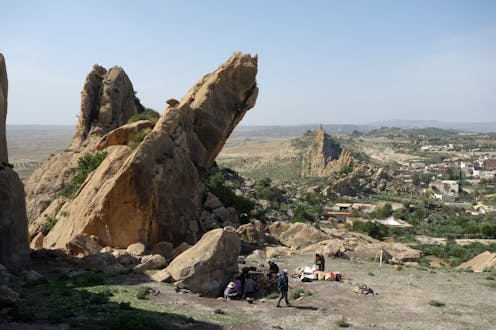
Doukanet el Khoutifa, Tunisia, where some of the remains were found. Giulio Lucarini, CC BY-NC-ND

The Neolithic period began in southwest Asia around 12,000 years ago. It marked a major shift in human history as societies transitioned from hunting and gathering to farming. This sparked migrations across Europe and dramatically reshaped the continent’s gene pool.

For a long time, North Africa was seen as a passive participant in this transformation. The dominant narrative suggested that farming economies never fully took root there.

Some studies proposed that North African communities actively resisted agriculture, except perhaps in the Nile Delta and the western Maghreb (modern-day Morocco). They continued to rely on land snails, wild plants, and hunting for survival. Only later, they also began herding domesticated sheep, goats, and cattle, introduced from southwest Asia.

Genetic studies have only recently tested this reconstruction in North Africa. This has never been done in the eastern Maghreb (modern-day Tunisia and eastern Algeria) – until now.

A clearly ancient human skeleton in a grave alongside a scale bar
A burial at one of the study sites, SHM-1 (Hergla) in Tunisia.
Simone Mulazzani, CC BY-NC-ND

As an Africanist archaeologist, I specialise in the study of ancient societies across Mediterranean Africa and the Sahara. My focus is on how humans adapted to their environments and the rise of food production in these regions. I recently conducted research in the eastern Maghreb alongside an international team of archaeologists, geneticists, and physical anthropologists to trace ancient population movements.

Our new study has just been published in Nature. We analysed the ancient genomes (complete DNA sequences) of nine individuals who lived in the eastern Maghreb between 15,000 and 6,000 years ago.

This may seem like a small sample. But, in the field of ancient DNA research, even a few well-preserved genomes can provide significant insights. They serve as reference points for tracing genetic lineages and identifying ancestral connections.

By adding genetic evidence to broader archaeological findings, we reconstructed patterns of population continuity, interaction and change over thousands of years.

Our results were striking. It’s clear from these genomes that some influence from farmers did reach north Africa from across the Mediterranean. But much of the genetic makeup of the eastern Maghreb populations remained rooted in their ancient foraging heritage.

This challenges the long-held narrative about migration into and out of north Africa before and during the Neolithic. It deepens our understanding of the past and highlights the incredible complexity of human movement and cultural exchange.

As we continue to unravel the genetic legacy of our ancestors, studies like this remind us of the complexity of human history. They show that the history of agriculture in the Mediterranean was not merely one of population replacement. Rather, it was a tale of cultural exchange, adaptation and continuity.

And researching these ancient human movements is more than just a matter of understanding history. It also provides insights into the patterns of migration and adaptation that can help us understand similar processes today.

Extraction and analysis

A map that shows the Mediterranean Sea, the Strait of Sicily and Pantelleria Island
A map of the eastern Maghreb showing the study sites (1: Afalou Bou Rhummel; 2: Djebba; 3: Doukanet el Khoutifa; 4: SHM-1, Hergla)
Giulio Lucarini, CC BY-NC-ND

We worked with ancient genomes extracted from human skeletal remains housed in museum or heritage institution collections. They came from excavations at four sites Afalou Bou Rhummel, Djebba, Doukanet el Khoutifa and SHM-1 (Hergla), all in the eastern Maghreb.

We chose the specimens because they were well-preserved, which is not always the case with ancient DNA.

The analysis found that some of the sampled individuals possessed European farmer ancestry around 7,000 years ago. Europeans contributed some genes to the region – but no more than 20% per individual.
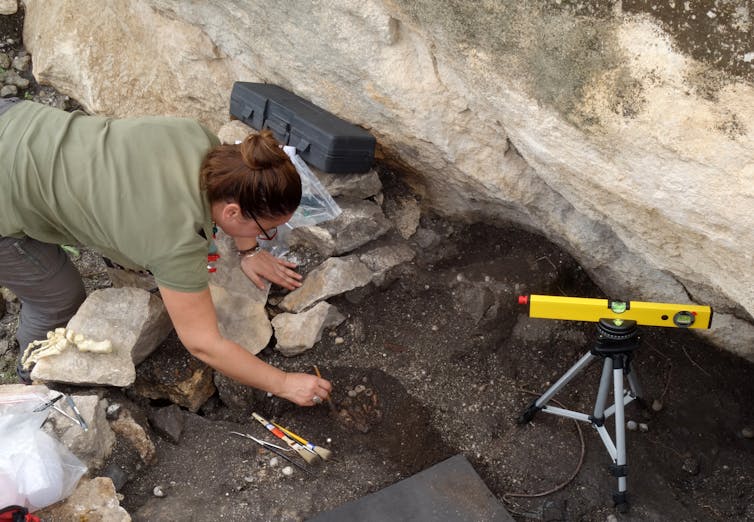
A person working with small bones in a pit alongside some scientific equipment
Excavation of human remains at Doukanet el Khoutifa, Tunisia.
Giulio Lucarini, CC BY-NC-ND

This is a modest genetic influence compared to ancient western Maghreb populations where, at some sites, European farmer ancestry can reach as high as 80%.

Our findings suggest that food-producing economies were introduced to the eastern Maghreb not by a large-scale replacement of the population (as seen in Europe) but more gradually. Change happened through sporadic migrations, mixing of cultures, and the spread of knowledge.

Across sea and land

One of the most intriguing discoveries was the genetic trace of European hunter-gatherers found in one individual from Djebba, Tunisia, dating to around 8,000 years ago. This suggests that early European and north African populations could interact via seafaring routes across the Strait of Sicily.

Researchers have long known that cultural exchange took place across the Mediterranean. We see this from the spread of technologies such as the so-called pressure technique – a method of shaping stone tools by carefully applying force with a pointed implement rather than striking the stone directly.

The discovery in Tunisia of obsidian (volcano glass) from Pantelleria, a small island in the Strait of Sicily, strengthens the link between the Mediterranean’s northern and southern shores.

Prehistoric wooden artefacts are seldom preserved over time. This may explain the absence of boat remains from this period in North Africa. However, dugout canoes from similar periods found in central Italy (Bracciano Lake) suggest that seafaring skills were well established around the Mediterranean. While there is no direct evidence linking these specific canoes to connections between Europe and North Africa, they support the idea that navigation was within the technological capabilities of the time.

Our study is the first time the connections suggested by this existing evidence have been substantiated genetically.


Read more:
Discovery of 5,000-year-old farming society in Morocco fills a major gap in history – north-west Africa was a central player in trade and culture


Another exciting aspect of our study is the identification of early Levantine (modern southwest Asia)-related ancestry in the eastern Maghreb. This was detected in human remains dated to around 6,800 years ago. It’s a genetic signature that postdates the arrival of European farmer ancestry by several centuries. It likely reflects the movement of people associated with early pastoralism, who introduced domesticated animals, such as sheep and goats, to the region.

Backing up archaeological evidence

It is especially rewarding to see the genetic evidence aligning with the archaeological record. This underscores the value of multidisciplinary research in uncovering past human dynamics.

What emerges overall is a region of strong genetic and cultural resilience, consistent with archaeological evidence.

The Conversation

Giulio Lucarini receives funding for this study from the National Research Council of Italy (CNR) and ISMEO – International Association for Mediterranean and Oriental Studies, Italy. He is affiliated with the National Research Council of Italy, Institute of Heritage Science (CNR-ISPC).

This study resulted from a collaboration between the following institutions: Harvard University, USA; the Max Planck Institute, Germany; the National Research Council of Italy (CNR); the Institut National du Patrimoine (INP), Tunisia; the Centre National de Recherche Préhistorique, Anthropologique et Historique (CNRPAH), Algeria; the Institut de Paléontologie Humaine (IPH), France; the University of Vienna, Austria; Sapienza University of Rome, Italy; and ISMEO – International Association for Mediterranean and Oriental Studies, Italy.

ref. Ancient DNA reveals Maghreb communities preserved their culture and genes, even in a time of human migration – https://theconversation.com/ancient-dna-reveals-maghreb-communities-preserved-their-culture-and-genes-even-in-a-time-of-human-migration-248338
Black holes spew out powerful jets that span millions of light-years – we’re trying to understand their whole life cycle

Source: The Conversation – Africa (2) – By Gourab Giri, Postdoctoral researcher, University of Pretoria

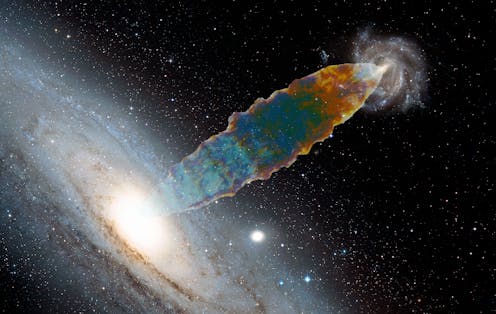
An artistic representation of what a giant cosmic jet the size of the distance between the Milky Way and Andromeda could look like. Author provided, CC BY-SA

There is a supermassive black hole at the centre of nearly every big galaxy – including ours, the Milky Way (it’s called Sagittarius A*). Supermassive black holes are the densest objects in the universe, with masses reaching billions of times that of the Sun.

Sometimes a galaxy’s supermassive black hole “wakes up” due to a sudden influx of gas and dust, most likely supplied from a neighbouring galaxy. It begins eating up lots of nearby gas and dust. This isn’t a calm, slow or passive process. As the black hole pulls in material, the material gets superheated on a scale of millions of degrees, far hotter than the surface temperature of our Sun, and is ejected from the galaxy at near-light speeds. This creates powerful jets that look like fountains in the cosmos.

The accelerated high-speed plasma matter prompts these “fountains” to emit radio signals that can only be detected by very powerful radio telescopes. This gives them their name: radio galaxies. While black holes are common, radio galaxies are not. Only between 10% and 20% of all galaxies exhibit this phenomenon.

Giant radio galaxies are even less common. They account for only 5% of all radio galaxies and take their name from the fact that they reach enormous distances. Some radio galaxies’ jets reach nearly 16 million light-years. (That’s almost six times the distance between the Milky Way and the Andromeda galaxy.) The largest jet discovered spans nearly 22 million light-years across.


Read more:
South African telescope discovers a giant galaxy that’s 32 times bigger than Earth’s


But how do these structures cover such enormous distances? To find out, I led a study in which we used modern supercomputers to develop models that simulated behaviour of giant cosmic jets within a mock universe, constructed on the basis of fundamental physical laws governing the cosmos.

This allowed us to observe how radio jets propagate over hundreds of millions of years – a process impossible to track directly in the real universe. These sophisticated simulations provide deeper insights into the life cycle of radio galaxies, highlighting the differences between their early, compact stages and their later, expansive forms.

Understanding the evolution of radio galaxies helps us unravel the broader processes that shape the universe.

Supercomputing

Cutting-edge technology was key to this study.

Sensitive observations from world-class radio telescopes like South Africa’s MeerKAT and LOFAR in the Netherlands have recently led to several discoveries of cosmic fountains.


Read more:
MeerKAT: the South African radio telescope that’s transformed our understanding of the cosmos


However, modelling their origins has been challenging. Tracking events over millions of years is impossible in real-time.

That’s where supercomputers come in. These high-performance computing systems are designed to process massive amounts of data. They can perform complex simulations at incredible speeds. In this study, their power was crucial for modelling the evolution of giant radio jets over millions of years.

The necessary supercomputing power was provided by South Africa’s Inter-University Institute for Data Astronomy, a network comprising the University of Pretoria, the University of Cape Town and the University of the Western Cape.

Our universe is governed by fundamental forces like gravity, which can be described through mathematical formulas. These formulas, essentially numbers, are fed into supercomputers to create a simulated “mock universe” that follows the same physical laws as the real cosmos. This allows scientists to experiment with how jets from supermassive black holes evolve over time. With their immense processing power, supercomputers can simulate millions of years of cosmic jet evolution in just a month.

Key takeaways

Gravity is the dominant force in the universe, pulling heavier matter and dragging nearby lighter matter. If gravity were the only force at play, the universe might have collapsed by now. Yet we see galaxies, galaxy clusters and even life itself thriving. We suspect that these cosmic fountains play a key role in solving the mystery of how this happens.

By releasing thermal and mechanical energy, they heat up the surrounding collapsing gas, counteracting gravity and maintaining a balance that sustains cosmic structures.

Our models also shed light on why some radio galaxies’ jets bend sharply, forming an “X” shape in radio waves instead of following a straight trajectory, and revealed the conditions under which giant fountains can continue growing even in dense cosmic environments (that is, in a galaxy cluster).

The study also suggests that giant radio galaxies may be statistically more common than previously believed. There are potentially thousands of undiscovered giant cosmic fountains. Thanks to world-class telescopes like MeerKAT and LOFAR – and the power of supercomputers – there’s plenty more to explore as we try to understand our universe.

The research on which this article is based required extensive collaboration with an international team, including Jacinta Delhaize from the University of Cape Town, Joydeep Bagchi from Christ University, India, and DJ Saikia from the Inter-University Centre for Astronomy and Astrophysics in India. Essential contributions by Kshitij Thorat and Roger Deane from the University of Pretoria also played a crucial role in shaping the study.

The Conversation

Gourab Giri does not work for, consult, own shares in or receive funding from any company or organisation that would benefit from this article, and has disclosed no relevant affiliations beyond their academic appointment.

ref. Black holes spew out powerful jets that span millions of light-years – we’re trying to understand their whole life cycle – https://theconversation.com/black-holes-spew-out-powerful-jets-that-span-millions-of-light-years-were-trying-to-understand-their-whole-life-cycle-250073

Los animales que usan plantas para curarse nos inspiran para descubrir nuevos fármacos

Source: The Conversation – (in Spanish) – By Eva María Domínguez Martín, Profesora Ayudante Doctora en la Facultad de Farmacia, Universidad de Alcalá

Los chimpancés ingieren ciertas plantas para combatir infecciones o problemas intestinales. Oliver Gorgis/Shutterstock

Los productos naturales, principalmente las especies vegetales, han jugado un papel clave en la medicina tradicional de diversas regiones a nivel global. Por ejemplo, ya en torno al año 65, el médico, botánico y farmacólogo griego Dioscórides describió en su obra De Materia Medica unas 600 plantas medicinales. Muchas de ellas se continúan empleando hoy en día.

Desde principios del siglo XIX comenzaron a aislarse e identificarse numerosos compuestos químicos con una gran diversidad y complejidad estructural. Estos procedían, precisamente, de esas plantas conocidas desde la Antigüedad. Más tarde, a partir de finales del siglo XX, surgió el interés por otras fuentes, como los productos de origen marino.

En la actualidad, uno de los principales y mayores desafíos sanitarios a los que nos enfrentamos es la resistencia a múltiples fármacos, no solo a antiinfecciosos como los antibióticos, sino también antitumorales. Este problema afecta tanto a los seres humanos como a los animales y las plantas.

Por tanto, es necesario invertir en el desarrollo de nuevos tratamientos que hagan frente a las patologías en las que aparecen resistencias y a otras enfermedades para las que actualmente no existe cura.

Esta situación ha dado lugar a que se hayan vuelto a revisitar fuentes tradicionales de descubrimiento de fármacos, como son las plantas, bajo un nuevo enfoque. Y aquí el estudio de la conducta animal puede jugar un papel importante.

Los animales también se automedican

La llamada “zoofarmacognosia” es la ciencia que investiga el uso de diversas sustancias por parte de los animales con fines tanto preventivos como curativos. Es considerada una disciplina científica desde 1987, aunque existen datos sobre este tipo de estudios también desde la Antigua Grecia.

Entre las sustancias utilizadas por los animales con esos fines, las más empleadas –y de las que más información existe– son las plantas.

En los últimos 10 años, la zoofarmacognosia ha suscitado un renovado interés. Por ejemplo, han comenzado a publicarse diversos trabajos que conectan este tipo de conductas animales con la fitoquímica, la ciencia que estudia los compuestos químicos de las plantas.

En el mundo vegetal, las principales líneas de defensa pueden ser físicas (por ejemplo, espinas) y químicas. Dentro de estas últimas, las plantas son capaces de producir una amplia variedad de metabolitos secundarios para cumplir distintas funciones no esenciales: defensivas (frente a depredadores), adaptativas y comunicativas con su entorno. Ejemplo de ello son compuestos como los terpenos, las saponinas y los taninos.

El caso de los chimpancés

Diversos estudios han revelado ejemplos de automedicación en distintas especies de mamíferos rumiantes, simios y elefantes, entre otros.

Las investigaciones más relevantes y numerosas hasta la fecha son las que han constatado este tipo de conductas en los primates. Uno de los casos más conocidos es el de los chimpancés, que mastican hojas de la planta Vernonia amygdalina (vernonia amarga, por su nombre vulgar) cuando sufren distintos tipos de infecciones.

También se ha observado que estos simios ingieren hojas y cortezas de raíces de Albizia grandibracteata y de hojas de Rubia cordifolia cuando presentan problemas intestinales relacionados con parásitos.

Pero ¿por qué usan esas plantas? ¿Funcionan? ¿Cómo lo hacen? La fitoquímica intenta racionalizar y dar explicación a estas cuestiones. Su método de trabajo se basa en extraer, fraccionar, aislar y caracterizar los metabolitos secundarios presentes en los extractos de las especies consumidas por estos animales. Tras realizar ensayos de bioactividad con los extractos, fracciones y compuestos aislados, se consigue relacionar los comportamientos observados en animales (de prevención y tratamiento) con las actividades que han sido probadas en los ensayos.

Así, se ha podido constatar que la especie V. amygdalina es rica en lactonas sesquiterpénicas, que tienen propiedades antibióticas y antitumorales; que A. grandibracteata contiene saponinas, efectivas contra parásitos gusanos (helmintos); y que R. cordifolia es abundante en diversos compuestos, como terpenos y naftoquinonas, que han mostrado actividad antiparasitaria, antiinflamatoria y antitumoral.

Otros trabajos han recogido el aumento del consumo de plantas ricas en taninos en corderos parasitados. Adicionalmente, estos comportamientos de automedicación no solo se ha detectado en especies vertebradas, sino también en insectos.

Una ventana al desarrollo de nuevos fármacos

Otro aspecto relevante es que los animales emplean las mismas especies y géneros de plantas que las comunidades humanas rurales presentes en su área geográfica, como reflejan las farmacopeas tradicionales.

Si a este dato añadimos los ejemplos de zoofarmacognosia recopilados, cuyos usos han comenzado a racionalizarse científicamente mediante la fitoquímica, cabe afirmar que nos hallamos ante una línea de investigación prometedora para desarrollar nuevos fármacos. Además, muchos de estos ejemplos se han obtenido de grandes simios, filogenéticamente muy relacionados con el ser humano.

Por todo ello, es necesario realizar un esfuerzo multidisciplinar para identificar plantas empleadas por los animales que tengan propiedades bioactivas, sin olvidar la búsqueda de otras especies vegetales dentro del mismo género eficaces frente a infecciones y cánceres resistentes. El mundo vegetal es una farmacia al alcance del ser humano, y otros animales pueden ayudarnos a explorarla.

The Conversation

Eva María Domínguez Martín no recibe salario, ni ejerce labores de consultoría, ni posee acciones, ni recibe financiación de ninguna compañía u organización que pueda obtener beneficio de este artículo, y ha declarado carecer de vínculos relevantes más allá del cargo académico citado.

ref. Los animales que usan plantas para curarse nos inspiran para descubrir nuevos fármacos – https://theconversation.com/los-animales-que-usan-plantas-para-curarse-nos-inspiran-para-descubrir-nuevos-farmacos-253143

La ciencia de las algas entra en MasterChef

Source: The Conversation – (in Spanish) – By Rocío Ibarra Arias, Responsable de Comunicación IEDIS y Colaboradora GICID, Universidad de Zaragoza

Plato preparado con algas wakame. vsl/Shutterstock

¿Qué tienen en común un plato de alta cocina, un superalimento y el cuidado medioambiente? Los jueces de MasterChef España lo tienen claro. “Las algas suponen un antes y un después en la cocina”, afirmaba Samantha Vallejo-Nágera. “Aportan lo mejor de las hortalizas y del mar”, añadía Jordi Cruz. Y para Pepe Rodríguez, son “un ingrediente sostenible que enriquece caldos, sopas y hasta platos tradicionales”.

Cuando ciencia y televisión cocinan juntas

El caso de las algas marinas es un buen ejemplo de cómo el conocimiento científico y la cultura mediática pueden colaborar para transformar percepciones y hábitos de consumo. Gracias a su presencia en programas de gran audiencia y al respaldo de la investigación, las algas han pasado de lo exótico a lo cotidiano, de lo anecdótico a lo estratégico.

En MasterChef, las algas han dejado de ser una rareza para convertirse en protagonistas. Y su impacto va mucho más allá de la televisión: están transformando la forma en que comemos, cocinamos y pensamos el futuro de la alimentación. La sinergia entre gastronomía y ciencia sitúa a las algas como motor de innovación culinaria, nutricional y medioambiental.

Las algas como protagonistas en MasterChef

Desde sus primeras temporadas, MasterChef ha incorporado las algas de manera habitual tanto en pruebas de plató como en exteriores. Codium, kombu, espagueti de mar, wakame o lechuga de mar forman parte del “supermercado” al que acceden los concursantes en un 40 %-60 % de los cocinados.

Además, chefs invitados presentan platos emblemáticos con algas como ingrediente central, como el coral de amaranto con emulsión de codium o la sopa de escabeche de mar con agua de algas del chef Ángel León.

Los finalistas del programa también han apostado por ellas en los menús decisivos, como en la final de Ángela, con su plato “Perfumadita de Brea”, o en elaboraciones como el solomillo con pesto de algas de Nacho Manzano.

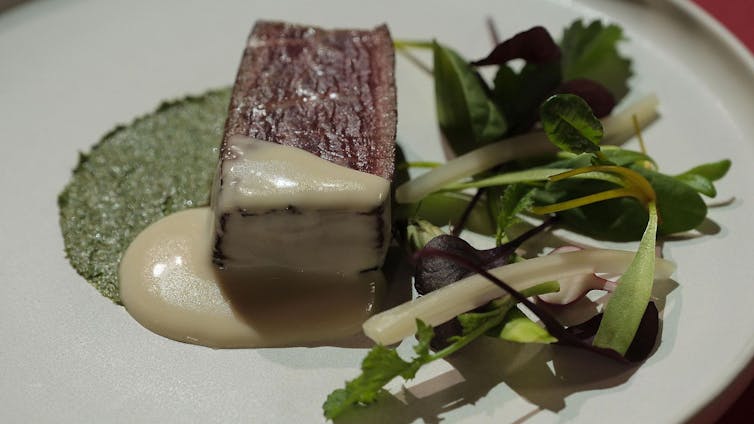
plato de carne con ensalada y verduras
Receta de MasterChef de solomillo de vaca rubia, con pesto de algas y ensalada.
RTVE, CC BY

Más allá del atractivo gastronómico, MasterChef también ha aprovechado su alcance para concienciar sobre la sostenibilidad. En una reciente prueba, los aspirantes cocinaron con especies invasoras como el wakame o el kombu, originarias de Asia y el Pacífico. Estas algas, al no tener depredadores naturales, se reproducen rápidamente y alteran los ecosistemas. El programa destacó su consumo controlado como estrategia para mitigar su impacto ambiental, siguiendo las recomendaciones internacionales sobre biodiversidad.

Un superalimento con respaldo científico

Desde la ciencia, las algas también han captado la atención por su extraordinario perfil nutricional. Ricas en minerales como yodo, calcio, hierro y magnesio, también destacan por su contenido en vitaminas A, C, D, E, K y B12.

Este último nutriente, escaso en dietas vegetales, hace de las algas un recurso clave para la nutrición global. En palabras de Jordi Cruz, se aúna en un solo producto lo mejor de las hortalizas y del mar, lo que refuerza su potencial como superalimento integral.

Su fácil cultivo y alto rendimiento las posicionan como una solución realista para combatir deficiencias nutricionales en regiones con acceso limitado a otros alimentos ricos en micronutrientes.

Industria alimentaria: mucho más que ensaladas

La aplicación de algas va mucho más allá del plato. Compuestos como el alginato o el agar se emplean como gelificantes y estabilizantes en productos procesados. Estudios recientes han demostrado que pueden enriquecer alimentos con ácidos grasos poliinsaturados y proteínas de alta calidad, impulsando una alimentación vegetal más saludable y tecnológicamente avanzada. Pepe Rodríguez subraya que “las algas funcionan de maravilla para enriquecer caldos y sopas”, lo que demuestra su valor funcional en la cocina profesional y en la industria.

Economía azul y empoderamiento social

El mercado global de algas ha crecido exponencialmente, pasando de 5 000 a 17 000 millones de dólares en apenas dos décadas. Este auge no solo beneficia a la industria, sino también a comunidades costeras en países en desarrollo. En zonas de Asia y África, más del 50 % de las personas que trabajan en su cultivo son mujeres, muchas de ellas liderando proyectos que mejoran su autonomía económica y social.

Lo único que nos falta es encontrar ese supermercado donde las algas estén fácilmente disponibles, lo que fomentaría que más personas las compren y experimenten con ellas.

Hacia una sostenibilidad activa

El impacto ambiental positivo de las algas es doble. Por un lado, su cultivo captura CO₂ de forma eficiente, ayudando a mitigar el cambio climático. Por otro, se exploran sus aplicaciones en la fabricación de bioplásticos y biocombustibles, con tasas de crecimiento prometedoras en el mercado. Las algas son un recurso sostenible y si cuidamos nuestros mares, siempre estarán disponibles como alimento y no solo como recurso marino.

Además, su uso responsable como ingrediente culinario, como ejemplificó MasterChef en la prueba sobre especies invasoras, puede convertirse en una estrategia ecológica que combine alimentación sostenible y protección de la biodiversidad marina.

Hoy, comer algas no solo es tendencia: es una apuesta por la salud, la sostenibilidad y la innovación alimentaria. Como dirían los jueces de MasterChef: ¡pongámosle sabor a la vida!

The Conversation

Las personas firmantes no son asalariadas, ni consultoras, ni poseen acciones, ni reciben financiación de ninguna compañía u organización que pueda obtener beneficio de este artículo, y han declarado carecer de vínculos relevantes más allá del cargo académico citado anteriormente.

ref. La ciencia de las algas entra en MasterChef – https://theconversation.com/la-ciencia-de-las-algas-entra-en-masterchef-259472

Iran and Ethiopia have a security deal – here’s why they signed it

Source: The Conversation – Africa (2) – By Eric Lob, Associate Professor of Politics and International Relations, Florida International University

Ethiopia and Iran signed a memorandum of understanding (MOU) on 6 May 2025. Under it, their national police agencies will cooperate on security and intelligence. This will include combating cross-border crime, sharing intelligence and building capacity. They will also share experiences and training.

For Iran, the MOU marks a significant step towards strengthening relations with a regional power that’s strategically located in the Horn of Africa.

Tehran has been using its security apparatus and military capabilities to establish and expand political and economic ties with countries in Africa. This has included drone transfers to the Ethiopian government that helped it turned the tide of the Tigray war, a separatist struggle in the country’s north that took place from 2020 to 2022.

Iran has also supplied the Sudanese army with surveillance and combat drones. These have been used against the paramilitary Rapid Support Forces in Sudan’s ongoing civil war.

The agreement is important for Ethiopia for two reasons.

Firstly, it’s likely to enable the Ethiopian government in Addis Ababa to combat ethnic militias more effectively. It faces increasing internal instability, including tensions with hostile factions of the separatist Tigray People’s Liberation Front.

Secondly, the agreement comes after a meeting in Addis Ababa between the Ethiopian police chief, Demelash Gebremichael, and a delegation from Iran’s regional rival, the United Arab Emirates (UAE). The exchange concentrated on investigating and extraditing cross-border criminals.

Addis Ababa’s willingness to work with regional rivals in the Middle East shows its pragmatic approach to foreign relations. Ethiopia needs all the friends it can muster as an embattled and weakened state. Since the Tigray war, it has battled the rise of ethnic militias and confronted economic adversity. It is also facing renewed hostility with neighbouring Eritrea.

What Iran stands to gain

Since 2016, Ethiopia has been a gateway for Iran to gain a foothold in the Horn of Africa. That year, other countries in the region severed relations with Iran. This followed Tehran’s disengagement from sub-Saharan Africa under Hassan Rouhani, who served as president from 2013 to 2021, and his prioritisation of a nuclear deal with the US.

The severing of ties was also a byproduct of geopolitical pressure exerted by Saudi Arabia and the UAE on countries in the region. The Middle Eastern states wanted to reduce, if not eliminate, Iran’s presence in the Horn of Africa and Red Sea to limit its support for Houthi rebels in the ongoing Yemeni civil war.


Read more:
Iran’s intervention in Sudan’s civil war advances its geopolitical goals − but not without risks


Ethiopia was the first country in sub-Saharan Africa to establish relations with Iran during the 1960s. It was also one of its top trading partners on the continent before and after the 1979 Iranian Revolution.

Strategically and ideologically, this special relationship was based on the pro-western and anti-communist stances of their monarchs: the Shah of Iran Mohammad Reza Pahlavi, who ruled from 1941 to 1979, and Emperor Haile Selassie, who was in power from 1930 to 1974.

After the revolution, Iran-Ethiopia relations revived under Mahmoud Ahmadinejad, who served as Iranian president from 2005 to 2013. He pursued an active Africa policy to mitigate Iran’s international isolation and circumvent US sanctions.

After Rouhani initially downgraded these relations, they were renewed during his second term. This followed US withdrawal from the nuclear deal.

Relations firmed when Ebrahim Raisi, who served as Iranian president from 2021 to 2024, delivered military drones and other aid to Addis Ababa during the Tigray war.

What’s in it for Ethiopia

Ethiopia is facing increasing instability and uncertainty. The Tigray war has depleted the state’s resources. There is an economic crisis caused by rising inflation and unemployment.

Addis Ababa continues to confront ethnic tensions. Hostile factions of the Tigray People’s Liberation Front remain. It also faces tensions with the Amhara Fano militia, which initially fought alongside the government against Tigrayan forces. Forced disarmament policies and ongoing land disputes caused the militia to take up arms against the government.


Read more:
Somaliland-Ethiopia port deal: international opposition flags complex Red Sea politics


Ethiopian prime minister Abiy Ahmed also faces growing opposition and resistance from his own ethnic group, the majority Oromo, and their Oromo Liberation Army. The reason for their discontent is Abiy’s imposition of centralised rule on their regional state within a federal system.

The security and intelligence cooperation with Iran could allow Addis Ababa to combat ethnic militias more effectively.

It would also enable Ethiopia to prepare for another possible war against neighbouring Eritrea.

Ethiopia and Eritrea normalised relations and fought together against Tigrayan forces. However, tensions between the two countries have been brewing again. These have been triggered by two factors. First, the conditions of the 2022 Pretoria peace agreement caused Eritrea to maintain forces inside Ethiopia. Second are the ambitions of Addis Ababa to acquire a Red Sea port in Somaliland, a breakaway region of Somalia. Eritrea has supported Somalia’s opposition to the deal.

Regional power games

This isn’t the first time that Ethiopia has tried working with two regional rivals – Iran and the UAE. The UAE is also among its top trading partners, along with Saudi Arabia.

In 2016, Ethiopia was the only country in the Horn of Africa that didn’t cut ties with Iran, though it was under pressure from the UAE and Saudi Arabia to do so. The decision was taken by Abiy’s predecessor, Hailemariam Desalegn, whose term ran from 2012 to 2018.

During the Tigray war, Ethiopia received military drones and other assistance from Iran and the UAE, alongside Turkey.

The civil war in Sudan has presented an even more complicated story. Ethiopia has vacillated between engaging with the Rapid Support Forces and the Sudanese Armed Forces at different points in the conflict.

For its part, Iran has supported the Sudanese army. The UAE has backed the paramilitary Rapid Support Forces.

Ethiopia’s efforts to strengthen its security ties with Iran and the UAE show a unique case of convergence between regional rivals that have otherwise remained on opposite sides of conflicts in countries like Yemen and Sudan.

The Conversation

Eric Lob does not work for, consult, own shares in or receive funding from any company or organisation that would benefit from this article, and has disclosed no relevant affiliations beyond their academic appointment.

ref. Iran and Ethiopia have a security deal – here’s why they signed it – https://theconversation.com/iran-and-ethiopia-have-a-security-deal-heres-why-they-signed-it-256486

Trump’s worldview is causing a global shift of alliances – what does this mean for nations in the middle?

Source: The Conversation – Global Perspectives – By Dilnoza Ubaydullaeva, Lecturer in Government – National Security College, Australian National University

Since US President Donald Trump took office this year, one theme has come up time and again: his rule is a threat to the US-led international order.

As the US political scientist John Mearsheimer famously argued, the liberal international order

was destined to fail from the start, as it contained the seeds of its own destruction.

This perspective has gained traction in recent years. And now, Trump’s actions have caused many to question whether a new world order is emerging.

Trump has expressed a desire for a new international order defined by multiple spheres of influence — one in which powers like the US, China and Russia each exert dominance over distinct regions.

This vision aligns with the idea of a “multipolar” world, where no single state holds overarching global dominance. Instead, influence is distributed among several great powers, each maintaining its own regional sphere.

This architecture contrasts sharply with earlier periods – the bipolar world of the Cold War, dominated by the US and the Soviet Union; and the unipolar period that followed, dominated by the US.

What does this mean for the world order moving forward?

Shifting US spheres of influence

We’ve seen this shift taking place in recent months. For example, Trump has backed away from his pledge to end the war between Russia and Ukraine and now appears to be leaving it to the main protagonists, and Europe, to find a solution.

Europe, which once largely spoke in a unified voice with the US, is also showing signs of policy-making which is more independent. Rather than framing its actions as protecting “Western democratic principles”, Europe is increasingly focused on defining its own security interests.

In the Middle East, the US will likely maintain its sphere of influence. It will continue its unequivocal support for Israel under Trump.

Donald Trump fist pumping next to Benjamin Netanyahu outside the White House.
Amid shifting global alliances, the Trump administration will continue to support Israel, led by Prime Minister Benjamin Netanyahu.
noamgalai/Shutterstock

The US will also involve itself in the region’s politics when its interests are at stake, as we witnessed in its recent strikes on Iranian nuclear facilities.

This, along with increasing economic ties between the US and Gulf states, suggests US allies in the region will remain the dominant voices shaping regional dynamics, particularly now with Iran weakened.

Yet it’s clear Trump is reshaping US dynamics in the region by signaling a desire for reduced military and political involvement, and criticising the nation building efforts of previous administrations.

The Trump administration now appears to want to maintain its sphere of influence primarily through strong economic ties.

Russia and China poles emerging elsewhere

Meanwhile, other poles are emerging in the Global South. Russia and China have deepened their cooperation, positioning themselves as defenders against what they frame as Western hegemonic bullying.

Trump’s trade policies and sanctions against many nations in the Global South have fuelled narratives (spread by China and Russia) that the US does not consistently adhere to the rules it imposes on others.

Trump’s decision to slash funding to USAID has also opened the door to China, in particular, to become the main development partner for nations in Africa and other parts of the world.

And on the security front, Russia has become more involved in many African and Middle Eastern countries, which have become less trustful and reliant on Western powers.

Vladimir Putin and Xi Jinping shaking hands.
Russian President Vladimir Putin and Chinese leader Xi Xinping see opportunities to spread their influence in the Global South.
plavi011/Shutterstock

In the Indo-Pacific, much attention has been given to the rise of China and its increasingly assertive posture. Many of Washington’s traditional allies are nervous about its continued engagement in the region and ability to counter China’s rise.

Chinese leader Xi Jinping has sought to take advantage of the current environment, embarking on a Vietnam, Malaysia and Cambodia push earlier this year. But many nations continue to be wary of China’s increasing influence, in particular the Philippines, which has clashed with China over the South China Sea.

Strategic hedging

Not all countries, however, are aligning themselves neatly with one pole or another.

For small states caught between great powers, navigating this multipolar environment is both a risk and an opportunity.

Ukraine is a case in point. As a sovereign state, Ukraine should have the freedom to decide its own alignments. Yet, it finds itself ensnared in great power politics, with devastating consequences.

Other small states are playing a different game — pivoting from one power to another based on their immediate interests.

Slovakia, for instance, is both a NATO and EU member, yet its leader, Robert Fico, attended Russia’s Victory Day Parade in May and told President Vladimir Putin he wanted to maintain “normal relations” with Russia.

Then there is Central Asia, which is the centre of a renewed “great game,” with Russia, China and Europe vying for influence and economic partnerships.

Yet if any Central Asian countries were to be invaded by Putin, would other powers intervene? It’s a difficult question to answer. Major powers are reluctant to engage in direct conflict unless their core interests or borders are directly threatened.

As a result, Central Asian states are hedging their bets, seeking to maintain relations with multiple poles, despite their conflicting agendas.

A future defined by regional power blocs?

While it is still early to draw definitive conclusions, the events of the past few months underscore a growing trend. Smaller countries are expressing solidarity with one power, but pragmatic cooperation with another, when it suits their national interests.

For this reason, regional power blocs seem to be of increasing interest to countries in the Global South.

For instance, the China-led Shanghai Cooperation Organisation has become a stronger and larger grouping of nations across Eurasia in recent years.

Trump’s focus on making “America Great Again,” has taken the load off the US carrying liberal order leadership. A multipolar world may not be the end of the liberal international order, but it may be a reshaped version of liberal governance.

How “liberal” it can be will likely depend on what each regional power, or pole, will make of it.

The Conversation

Dilnoza Ubaydullaeva does not work for, consult, own shares in or receive funding from any company or organisation that would benefit from this article, and has disclosed no relevant affiliations beyond their academic appointment.

ref. Trump’s worldview is causing a global shift of alliances – what does this mean for nations in the middle? – https://theconversation.com/trumps-worldview-is-causing-a-global-shift-of-alliances-what-does-this-mean-for-nations-in-the-middle-257113

Is Kenya’s president safe in a crowd? Security expert scans VIP protection checklist

Source: The Conversation – Africa (2) – By Douglas Lucas Kivoi, Principal Policy Analyst, Governance Department, The Kenya Institute for Public Policy Research and Analysis (KIPPRA)

Protecting any president requires multiple layers of intelligence, physical security and rapid response security protocols. Exact operational details are classified, but there are global best practices in VIP protection.

The issue of presidential protection in Kenya has become particularly relevant following an incident in early May 2025 when someone in a crowd threw a shoe at President William Ruto during a public event, hitting his hand.

I have studied policing and security policies in Kenya for over 15 years, interacting closely with the country’s security protocols. In my view this incident exposed several critical security lapses around the elite officers tasked with protecting the president.

The security of the president is a critical issue in Kenya. The country is exposed to terror groups like the Somalia-based Al-Shabaab and other criminal networks in the region.

In 2021, a businessman embedded himself into the presidential motorcade and drove into then president Uhuru Kenyatta’s official residence. In 2017, an unidentified man who was said to have illegally accessed the highly protected state house grounds was shot dead by presidential guards.

There are multiple layers to Kenya’s protection protocols. They include National Intelligence Service officers, the Kenya Defence Force, Presidential Escort Police officers drawn from the highly trained General Service Unit, bomb disposal experts and regular police officers. Their deployment depends on the nature of the presidential engagement.

While the shoe incident may be passed off as simply embarrassing, it should serve as a wake-up call to tighten security protocols around the president without necessarily compromising his public engagement with citizens.

What’s in place

Prior to any presidential visit across the country, security teams conduct a thorough reconnaissance of the destination. This includes coordinating with local policing agencies, clearing airspace, mapping secure transport routes and identifying nearby medical facilities in case of emergencies.

Presidential motorcade routes are pre-planned and a dry run is made. This often includes mapping alternative routes to avoid predictability should there be assailants along a presidential route. It is common to see some roads temporarily closed and security officers conducting sweeps for any threats or explosives. In areas deemed high risk, counter security sniper teams are covertly deployed in strategic areas.

Cases of attacks on presidential motorcades are rare in Kenya. However, in 2002 during presidential campaigns, angry opposition supporters stoned then president Daniel Moi’s motorcade. In November 2021, an angry mob hurled rocks at then deputy president Ruto’s motorcade.

The National Intelligence Service and Presidential Escort Unit covertly scout locations in advance, assessing potential security vulnerabilities. Crowd sizes, and entry and exit points for the head of state are mapped out in advance.

In cases where meetings are held in town halls or huge tents, attendees are screened using metal detectors and/or physical searches. Uniformed and plainclothes security officers embed themselves in the crowd to monitor any threats.

The president and any dignitaries accompanying him have at least three layers of security.

The inner ring consists of close protection officers who are always within an arm’s length of the president to physically thwart any threats. The middle ring has armed security guards who watch for, among others, sudden movements and abnormal behaviour within the crowd. The outer ring consists of regular police and paramilitary units from the General Service Unit who secure the outside perimeter.

The presidential motorcade is a coordinated convoy of heavily armoured vehicles. It includes lead and chase cars, communication units and emergency response teams. Traffic is managed by local traffic police officers to ensure unobstructed movement. Routes are kept confidential until necessary.

The president’s security may opt to use a decoy vehicle if there is a security threat, to confuse and derail potential risk sources. In all these cases, there is a contingent of specialised General Service Unit officers, called the Recce unit, that always accompanies the president.

Kenya’s presidential security precautions follow standard VIP security protection like those for heads of state across the world. However, in some neighbouring countries, for instance, presidents move in heavily armed military convoys. This has not been seen in Kenya.

If a potential threat is detected, the president is immediately shielded and whisked away to a secure vehicle or evacuated by air in high-risk events. In such cases, the Kenya Defence Forces secures the president.

Despite stringent security measures, incidents can occur. For instance, in March 2025, a British tourist was fatally hit by a vehicle in Ruto’s motorcade. This prompted investigations and reviews on motorcade safety protocols.

Such events highlight the challenges of balancing presidential security with public safety, especially in densely populated urban areas.

Security failures

The shoe-throwing incident targeting Ruto highlighted five major failures in presidential protection protocols.

First, crowd screening and access control failures. The alleged assailant was very close to the president, suggesting an inadequate distance between the crowds and the president. The inner ring of security also failed to spot the perpetrator raising a shoe in the air to use as a projectile. This indicates weak front-row eye sweeps and scans by the president’s security.

Second, there was an apparent delay in security response. The elite officers around the president should have subdued the alleged attacker within seconds. It could mean most had their eyes on the president or cameras, as opposed to scanning the crowds for any sudden movements.

Third, security allowed the president to stand too close to a crowd that hadn’t been screened. Best practices require a no-go zone of three to five metres for individuals who have not been scanned or screened.

Fourth, there was an apparent gap in intelligence and threat assessment. Aggressive or agitated people next to the president should draw the attention of security officers. Plainclothes security officers are usually deployed to monitor crowd behaviour. It isn’t enough to rely on uniformed officers.

Undercover agents are critical for flagging pre-attack signals, such as nervousness or repeated adjustments of positions.

Fifth, there was no clear evacuation plan for the president. After the incident, the president continued speaking. In high-risk scenarios, protocols often demand instant relocation of the president to a secure vehicle or helicopter, where the military takes over and airlifts him to safety.

What should change

Kenya’s presidential security detail may be forced to:

  • increase standoff distance between the president and crowds

  • deploy more plainclothes officers to blend in and monitor crowds around the president

  • mandate stricter screening of those in close proximity to the president

  • conduct more frequent security risks drills for rapid neutralisation of potential threats.

The exact details of presidential security in Kenya are confidential. However, the overarching structure aims to provide comprehensive protection to the president while maintaining public safety and order during official engagements. No security protocol is 100% foolproof. But a balance needs to be struck between overly aggressive crowd control and accessibility.

The Conversation

Douglas Lucas Kivoi does not work for, consult, own shares in or receive funding from any company or organisation that would benefit from this article, and has disclosed no relevant affiliations beyond their academic appointment.

ref. Is Kenya’s president safe in a crowd? Security expert scans VIP protection checklist – https://theconversation.com/is-kenyas-president-safe-in-a-crowd-security-expert-scans-vip-protection-checklist-256268

We have drugs to manage HIV. So why are we spending millions looking for cures?

Source: The Conversation – Global Perspectives – By Bridget Haire, Associate Professor, Public Health Ethics, School of Population Health, UNSW Sydney

Alim Yakubov/Shutterstock

Over the past three decades there have been amazing advances in treating and preventing HIV.

It’s now a manageable infection. A person with HIV who takes HIV medicine consistently, before their immune system declines, can expect to live almost as long as someone without HIV.

The same drugs prevent transmission of the virus to sexual partners.

There is still no effective HIV vaccine. But there are highly effective drugs to prevent HIV infection for people without HIV who are at higher risk of acquiring it.

These drugs are known as as “pre-exposure prophylaxis” or PrEP. These come as a pill, which needs to be taken either daily, or “on demand” before and after risky sex. An injection that protects against HIV for six months has recently been approved in the United States.

So with such effective HIV treatment and PrEP, why are we still spending millions looking for HIV cures?

Not everyone has access to these drugs

Access to HIV drugs and PrEP depends on the availability of health clinics, health professionals, and the means to supply and distribute the drugs. In some countries, this infrastructure may not be secure.

For instance, earlier this year, US President Donald Trump’s dissolution of the USAID foreign aid program has threatened the delivery of HIV drugs to many low-income countries.

This demonstrates the fragility of current approaches to treatment and prevention. A secure, uninterrupted supply of HIV medicine is required, and without this, lives will be lost and the number of new cases of HIV will rise.

Another example is the six-monthly PrEP injection just approved in the US. This drug has great potential for controlling HIV if it is made available and affordable in countries with the greatest HIV burden.

But the prospect for lower-income countries accessing this expensive drug looks uncertain, even if it can be made at a fraction of its current cost, as some researchers say.

So despite the success of HIV drugs and PrEP, precarious health-care systems and high drug costs mean we can’t rely on them to bring an end to the ongoing global HIV pandemic. That’s why we also still need to look at other options.

Haven’t people already been ‘cured’?

Worldwide, at least seven people have been “cured” of HIV – or at least have had long-term sustained remission. This means that after stopping HIV drugs, they did not have any replicating HIV in their blood for months or years.

In each case, the person with HIV also had a life-threatening cancer needing a bone marrow transplant. They were each matched with a donor who had a specific genetic variation that resulted in not having HIV receptors in key bone marrow cells.

After the bone marrow transplant, recipients stopped HIV drugs, without detectable levels of the virus returning. The new immune cells made in the transplanted bone marrow lacked the HIV receptors. This stopped the virus from infecting cells and replicating.

But this genetic variation is very rare. Bone marrow transplantation is also risky and extremely resource-intensive. So while this strategy has worked for a few people, it is not a scalable prospect for curing HIV more widely.

So we need to keep looking for other options for a cure, including basic laboratory research to get us there.

How about the ‘breakthrough’ I’ve heard about?

HIV treatment stops the HIV replication that causes immune damage. But there are places in the body where the virus “hides” and drugs cannot reach. If the drugs are stopped, the “latent” HIV comes out of hiding and replicates again. So it can damage the immune system, leading to HIV-related disease.

One approach is to try to force the hidden or latent HIV out into the open, so drugs can target it. This is a strategy called “shock and kill”. And an example of such Australian research was recently reported in the media as a “breakthrough” in the search for an HIV cure.

Researchers in Melbourne have developed a lipid nanoparticle – a tiny ball of fat – that encapsulates messenger RNA (or mRNA) and delivers a “message” to infected white blood cells. This prompts the cells to reveal the “hiding” HIV.

In theory, this will allow the immune system or HIV drugs to target the virus.

This discovery is an important step. However, it is still in the laboratory phase of testing, and is just one piece of the puzzle.

We could say the same about many other results heralded as moving closer to a cure for HIV.

Further research on safety and efficacy is needed before testing in human clinical trials. Such trials start with small numbers and the trialling process takes many years. This and other steps towards a cure are slow and expensive, but necessary.

Importantly, any cure would ultimately need to be fairly low-tech to deliver for it to be feasible and affordable in low-income countries globally.

So where does that leave us?

A cure for HIV that is affordable and scalable would have a profound impact on human heath globally, particularly for people living with HIV. To get there is a long and arduous path that involves solving a range of scientific puzzles, followed by addressing implementation challenges.

In the meantime, ensuring people at risk of HIV have access to testing and prevention interventions – such as PrEP and safe injecting equipment – remains crucial. People living with HIV also need sustained access to effective treatment – regardless of where they live.

The Conversation

Bridget Haire has received funding from the National Health and Medical Research Council. She is a past president of the Australian Federation of AIDS Organisations (now Health Equity Matters).

Benjamin Bavinton receives funding from the National Health and Medical Research Council, the Australian government, and state and territory governments. He also receives funding from ViiV Healthcare and Gilead Sciences, both of which make drugs or drug classes mentioned in this article. He is a Board Director of community organisation, ACON, and is on the National PrEP Guidelines Panel coordinated by ASHM Health.

ref. We have drugs to manage HIV. So why are we spending millions looking for cures? – https://theconversation.com/we-have-drugs-to-manage-hiv-so-why-are-we-spending-millions-looking-for-cures-258391

Somaliland’s 30-year quest for recognition: could US interests make the difference?

Source: The Conversation – Africa (2) – By Aleksi Ylönen, Professor, United States International University

More than three decades after unilaterally declaring independence from Somalia, Somaliland still seeks international recognition as a sovereign state. Despite a lack of formal acknowledgement, the breakaway state has built a relatively stable system of governance. This has drawn increasing interest from global powers, including the United States. As regional dynamics shift and great-power competition intensifies, Somaliland’s bid for recognition is gaining new currency. Aleksi Ylönen has studied politics in the Horn of Africa and Somaliland’s quest for recognition. He unpacks what’s at play.


What legal and historical arguments does Somaliland use?

The Somali National Movement is one of the main clan-based insurgent movements responsible for the collapse of the central government in Somalia. It claims the territory of the former British protectorate of Somaliland. The UK had granted Somaliland sovereign status on 26 June 1960.

The Somali government tried to stomp out calls for secession. It orchestrated the brutal killing of hundreds of thousands of people in northern Somalia between 1987 and 1989.

But the Somali National Movement declared unilateral independence on 18 May 1991 and separated from Somalia.

With the collapse of the Somali regime in 1991, the movement’s main enemy was gone. This led to a violent power struggle between various militias.

This subsided only after the politician Mohamed Egal consolidated power. He was elected president of Somaliland in May 1993.

Egal made deals with merchants and businessmen, giving them tax and commercial incentives to accept his patronage. As a result, he obtained the economic means to consolidate political power and to pursue peace and state-building. It’s something his successors have kept up with since his death in 2002.

What has Somaliland done to push for recognition?

Successive Somaliland governments continue to engage in informal diplomacy. They have aligned with the west, particularly the US, which was the dominant power after the cold war, and the former colonial master, the UK. Both countries host significant Somaliland diaspora communities.

The US and the UK have for decades flirted with the idea of recognising Somaliland, which they consider a strategic partner. However, they have been repeatedly thrown back by their respective Somalia policies. These have favoured empowering the widely supported Mogadishu government to reassert its authority and control over Somali territories.

This Somalia policy has been increasingly questioned in recent years, in part due to Mogadishu’s security challenges. In contrast, the Hargeisa government of Somaliland has largely shown it can provide security and stability. It has held elections and survived as a state for the last three decades, though it has faced political resistance and armed opposition.


Read more:
Somaliland elections: what’s at stake for independence, stability and shifting power dynamics in the Horn of Africa


As new global powers rise, Somaliland administrations have pursued an increasingly diverse foreign policy, with one goal: international recognition.

Hargeisa hosts consulates and representative offices of Djibouti, Ethiopia, Kenya, Taiwan, the UK and the European Union, among others.

The government has also engaged in informal foreign relations with the United Arab Emirates. The Middle Eastern monarchy serves as a business hub and a destination of livestock exports. Many Somalilanders migrate there.

Somaliland maintains representative offices in several countries. These include Canada, the US, Norway, Sweden, the UK, Saudi Arabia, Turkey and Taiwan. Hargeisa has alienated China because it has collaborated with Taiwan since 2020. Taiwan is a self-ruled island claimed by China.

On 1 January 2024, Somaliland’s outgoing president Muse Bihi signed a memorandum of understanding with Ethiopian prime minister Abiy Ahmed for increased cooperation. Bihi implied that Ethiopia would be the first country to formally recognise Somaliland. The deal caused a sharp deterioration of relations between Addis Ababa and Mogadishu.

Abiy later moderated his position and, with Turkish mediation, reconciled with his Somalia counterpart, President Hassan Mohamud.

What’s behind US interest in Somaliland?

The US, like other great powers, has been interested in Somaliland because of its strategic location. It is on the African shores of the Gulf of Aden, across from the Arabian Peninsula. Its geographical position has gained currency recently as Yemeni Houthi rebels strike maritime traffic in the busy shipping lanes. Somaliland is also well located to curb piracy and smuggling on this global trade route.

The US Africa Command set up its main Horn of Africa base at Camp Lemonnier in Djibouti in 2002. This followed the 11 September 2001 attacks.


Read more:
Somaliland’s quest for recognition: UK debate offers hint of a sea change


In 2017, China, which had become the main foreign economic power in the Horn of Africa, set up a navy support facility in Djibouti. This encouraged closer collaboration between American and Somaliland authorities. The US played with the idea of establishing a base in Berbera, which hosts Somaliland’s largest port.

With Donald Trump winning the US presidential election in 2024, there were reports of an increased push for US recognition of Somaliland. This would allow the US to deepen its trade and security partnerships in the volatile Horn of Africa region.

Since March 2025, representatives of the Trump administration have engaged in talks with Somaliland officials to establish a US military base near Berbera. This would be in exchange for a formal but partial recognition of Somaliland.

What are the risks of US recognition of Somaliland?

Stronger US engagement with Somaliland risks neglecting Somalia.

Mogadishu depends on external military assistance in its battle against the advancing violent Islamist extremist group, Al-Shabaab. It also faces increasing defiance from two federal regions, Puntland and Jubaland.

US recognition would reward Hargeisa for its persistent effort to maintain stability and promote democracy. However, it could encourage other nations to recognise Somaliland. This would deliver a blow to Somali nationalists who want one state for all Somalis.

The Conversation

Aleksi Ylönen is affiliated with the Center for International Studies, Iscte-Instituto Universitário de Lisboa, and is an associate fellow at the HORN International Institute for Strategic Studies.

ref. Somaliland’s 30-year quest for recognition: could US interests make the difference? – https://theconversation.com/somalilands-30-year-quest-for-recognition-could-us-interests-make-the-difference-255399

B.C.’s mental health law is on trial — and so is our commitment to human rights

Source: The Conversation – Canada – By Anne Levesque, Associate professor, Faculty of Law, L’Université d’Ottawa/University of Ottawa

The British Columbia Supreme Court has begun hearing a long-awaited constitutional challenge to the province’s Mental Health Act.

The case, nearly a decade in the making, is now drawing greater attention in the wake of the tragedy at the Filipino Lapu Lapu Day street festival earlier this year that left 11 people dead in Vancouver.

The event has shaken many in the community, leaving behind grief and fear. Furthermore, in light of reports that the person accused of the crime was under Mental Health Act supervision, difficult questions arise. The pain is real, and any conversation about mental health must begin with compassion for all of those affected.


Read more:
Vancouver SUV attack exposes crowd management falldowns and casts a pall on Canada’s election


At the same time, it’s important to ensure this moment of reckoning leads to thoughtful dialogue, not reactive policy. Unfortunately, much of the public discourse has become mired in fear and misinformation, creating a false and dangerous choice: that Canada must sacrifice individual rights in order to protect public safety.

As a legal scholar in equality rights and public interest litigation, I don’t believe Canadians have to choose. A mental health system that respects Canada’s Charter of Rights and Freedoms can also promote safety.

What’s the case is about?

The case currently before the B.C. Supreme Court was initiated by the Council of Canadians with Disabilities (CCD), a national human rights organization led by people with disabilities. The group is fighting provisions in the province’s Mental Health Act that strip patients of any right to choose their own health care, or to appoint a loved one to make health care decisions on their behalf.

The CCD’s motto — “Nothing about us without us” — reflects a longstanding commitment to ensuring that people most affected by policies and systems have a voice in shaping them. This litigation will amplify the voices of people who underwent psychiatric treatment without consent and to shine a light on the deep and lasting harms they have suffered.

Let’s be clear about what this Charter challenge actually seeks and what it doesn’t. It doesn’t aim to eliminate involuntary hospitalization. It does not change who can be detained, how long they can be held or the legal criteria for involuntary admission.

What it does seek is something far more modest and humane: to ensure that when psychiatric care is forced, it is delivered with dignity, oversight and the involvement of trusted supporters in accordance with the Canadian Charter of Rights and Freedoms.

One of the key reforms that CCD has long advocated for is the right for people to name a family member or friend to be involved in treatment decisions. Far from undermining care, this kind of involvement can help bridge the gap between medical necessity and personal dignity.

It’s a safeguard that respects patients’ values and builds trust, which the current system desperately lacks. And yes, it could even enhance public safety. Reports suggest that a family member of the man accused in the Lapu Lapu mass murders in April was concerned about his deteriorating mental health and had reached out for help just before the tragedy occurred. A more responsive system with the embedded involvement of trusted decision-makers might have made a difference.


Read more:
Fraudulent crowdfunding after the Lapu Lapu tragedy highlights the need for vigilance and oversight


Reforming the Mental Health Act

British Columbia is currently an outlier in Canada. It’s the only province where people detained under mental health laws are automatically deemed to consent to any treatment authorized by the facility — regardless of their actual wishes or capacity.

There’s no right to name a substitute decision-maker, no ability to appeal a treatment decision, no independent oversight, and treatment is often imposed through isolation, physical restraints or security force.

Advocates have been calling for change for decades. But in the wake of the Lapu Lapu attack, some politicians are proposing not a more compassionate or rights-respecting approach, but harsher, more coercive powers over people with mental health issues. That would be a mistake.

The current system, which experts have long said is inconsistent with human rights, did nothing to prevent this tragedy. Violating the rights of people in crisis did not and will not keep the public safer.

B.C. Premier David Eby has acknowledged the shortcomings in the current system, but has said that engaging in law reform while litigation is undergoing would pose a risk. Instead, he says it’s better to wait to hear what the court decides before changing the law.

That logic is arguably akin to a citizen saying it’s risky to stop driving at a speed they know is over the lawful limit until they’re pulled over.

Pointless to wait

Waiting for the courts to force change wastes precious time, and public resources, that could be better spent on designing a new, Charter-compliant mental health system in collaboration with experts, service providers, families and people with lived experiences.

Meanwhile, substantial public funds are being spent on government lawyers to fight a legal battle defending a regime that is clearly unconstitutional and fails both patients and public safety.

That money would be far better spent consulting with experts, families and people with lived experiences and developing legislation that upholds constitutional rights and keeps communities safe.

The time for delay is over. The B.C. government must act now to rewrite the Mental Health Act in order to protect the public and respect Charter rights.

The Conversation

Anne Levesque is co-chair of the Disability Justice Litigation Initiative of the Council of Canadians with Disabilities.

ref. B.C.’s mental health law is on trial — and so is our commitment to human rights – https://theconversation.com/b-c-s-mental-health-law-is-on-trial-and-so-is-our-commitment-to-human-rights-258671