Is the AI bubble about to burst? What to watch for as the markets wobble

Source: The Conversation – UK – By Alex Dryden, PhD Candidate in Economics, SOAS, University of London

Phonlamai Photo/Shutterstock

The global investment frenzy around AI has seen companies valued at trillions of dollars and eye-watering projections of how it will boost economic productivity.

But in recent weeks the mood has begun to shift. Investors and CEOs are now openly questioning whether the enormous costs of building and running AI systems can really be justified by future revenues.

Google’s CEO, Sundar Pichai, has spoken of “irrationality” in AI’s growth, while others have said some projects are proving to be more complex and expensive than expected.

Meanwhile, global stock markets have declined, with tech shares taking a particular hit, and the value of cryptocurrencies has dipped as investors appear increasingly nervous.

So how should we view the health of the AI sector?

Well, bubbles in technology are not new. There have been great rises and great falls in the dot-com world, and surges in popularity for certain tech platforms (during COVID for example) which have then flattened out.

Each of these technological shifts was real, but they became bubbles when excitement about their potential ran far ahead of companies’ ability to turn popularity into lasting profits.

The surge in AI enthusiasm has a similar feel to it. Today’s systems are genuinely impressive, and it’s easy to imagine them generating significant economic value. The bigger challenge comes with how much of that value companies can actually keep hold of.

Investors are assuming rapid and widespread AI adoption along with high-margin revenue. Yet the business models needed to deliver that outcome are still uncertain and often very expensive to operate.

This creates a familiar gap between what the technology could do in theory, and what firms can profitably deliver in practice. Previous booms show how quickly things wobble when those ideas don’t work out as planned.

AI may well reshape entire sectors, but if the dazzling potential doesn’t translate quickly into steady, profitable demand, the excitement can slip away surprisingly fast.

Fit to burst?

Investment bubbles rarely deflate on their own. They are usually popped by outside forces, which often involve the US Federal Reserve (the US’s central bank) making moves to slow the economy by raising interest rates or limiting the supply of money, or a wider economic downturn suddenly draining confidence.

For much of the 20th century, these were the classic triggers that ended long stretches of rising markets.

But financial markets today are larger, more complex, and less tightly tied to any single lever such as interest rates. The current AI boom has unfolded despite the US keeping rates at their highest level in decades, suggesting that external pressures alone may not be enough to halt it.

Instead, this cycle is more likely to end from within. A disappointment at one of the big AI players – such as weaker than expected earnings at Nvidia or Intel – could puncture the sense that growth is guaranteed.

Alternatively, a mismatch between chip supply and demand could lead to falling prices. Or investors’ expectations could quickly shift if progress in training ever larger models begins to slow, or if new AI models offer only modest improvements.

Overall then, perhaps the most plausible end to this bubble is not a traditional external shock, but a realisation that the underlying economics are no longer keeping up with the hype, prompting a sharp revaluation across related stocks.

Artificial maturity

If the bubble did burst, the most visible shift would be a sharp correction in the valuations of chipmakers and the large cloud companies driving the current boom.

These firms have been priced as if AI demand will rise almost without limit. So any sign that the market is smaller or slower than expected would hit financial markets hard.

This kind of correction wouldn’t mean AI disappears, but it would almost certainly push the industry into a more cautious, less speculative phase.

Computer chip marked 'AI' on circuit board.
When the chips are down.
Blue Andy/Shutterstock

The deepest consequence would be on investment. Goldman Sachs estimates that global spending on AI-related infrastructure could reach US$4 trillion by 2030. In 2025 alone, Microsoft, Amazon, Meta and Google’s owner Alphabet have poured almost US$350 billion into data centres, hardware and model development. If confidence faltered, much of this planned expansion could be scaled back or delayed.

That would ripple through the wider economy, slowing construction, dampening demand for specialised equipment, and dragging on growth at a time when inflation remains high.

But a bursting AI bubble would not erase the technology’s long-term importance. Instead, it would force a shift away from the “build it now, profits will follow” mindset which is driving much of the current exuberance.

Companies would focus more on practical uses that genuinely save money or raise productivity, rather than speculative bets on transformative breakthroughs. The sector would mature. But it would probably do so only after a painful period of adjustment for investors, suppliers and governments who have tied their growth expectations to an uninterrupted AI boom.

The Conversation

Alex Dryden does not work for, consult, own shares in or receive funding from any company or organisation that would benefit from this article, and has disclosed no relevant affiliations beyond their academic appointment.

ref. Is the AI bubble about to burst? What to watch for as the markets wobble – https://theconversation.com/is-the-ai-bubble-about-to-burst-what-to-watch-for-as-the-markets-wobble-270113


How the Louvre thieves exploited human psychology to avoid suspicion – and what it reveals about AI

Source: The Conversation – UK – By Vincent Charles, Reader in AI for Business and Management Science, Queen’s University Belfast

On a sunny morning on October 19 2025, four men allegedly walked into the world’s most-visited museum and left, minutes later, with crown jewels worth €88 million (£76 million). The theft from Paris’s Louvre Museum – one of the world’s most surveilled cultural institutions – took just under eight minutes.

Visitors kept browsing. Security didn’t react (until alarms were triggered). The men disappeared into the city’s traffic before anyone realised what had happened.

Investigators later revealed that the thieves wore hi-vis vests, disguising themselves as construction workers. They arrived with a furniture lift, a common sight in Paris’s narrow streets, and used it to reach a balcony overlooking the Seine. Dressed as workers, they looked as if they belonged.

This strategy worked because we don’t see the world objectively. We see it through categories – through what we expect to see. The thieves understood the social categories that we perceive as “normal” and exploited them to avoid suspicion. Many artificial intelligence (AI) systems work in the same way and are vulnerable to the same kinds of mistakes as a result.

The sociologist Erving Goffman would describe what happened at the Louvre using his concept of the presentation of self: people “perform” social roles by adopting the cues others expect. Here, the performance of normality became the perfect camouflage.

The sociology of sight

Humans carry out mental categorisation all the time to make sense of people and places. When something fits the category of “ordinary”, it slips from notice.

AI systems used for tasks such as facial recognition and detecting suspicious activity in a public area operate in a similar way. For humans, categorisation is cultural. For AI, it is mathematical.

But both systems rely on learned patterns rather than objective reality. Because AI learns from data about who looks “normal” and who looks “suspicious”, it absorbs the categories embedded in its training data. And this makes it susceptible to bias.

The Louvre robbers weren’t seen as dangerous because they fit a trusted category. In AI, the same process can have the opposite effect: people who don’t fit the statistical norm become more visible and over-scrutinised.

It can mean a facial recognition system disproportionately flags certain racial or gendered groups as potential threats while letting others pass unnoticed.

A sociological lens helps us see that these aren’t separate issues. AI doesn’t invent its categories; it learns ours. When a computer vision system is trained on security footage where “normal” is defined by particular bodies, clothing or behaviour, it reproduces those assumptions.

Just as the museum’s guards looked past the thieves because they appeared to belong, AI can look past certain patterns while overreacting to others.

Categorisation, whether human or algorithmic, is a double-edged sword. It helps us process information quickly, but it also encodes our cultural assumptions. Both people and machines rely on pattern recognition, which is an efficient but imperfect strategy.

A sociological view of AI treats algorithms as mirrors: they reflect back our social categories and hierarchies. In the Louvre case, the mirror is turned toward us. The robbers succeeded not because they were invisible, but because they were seen through the lens of normality. In AI terms, they passed the classification test.

From museum halls to machine learning

This link between perception and categorisation reveals something important about our increasingly algorithmic world. Whether it’s a guard deciding who looks suspicious or an AI deciding who looks like a “shoplifter”, the underlying process is the same: assigning people to categories based on cues that feel objective but are culturally learned.

When an AI system is described as “biased”, this often means that it reflects those social categories too faithfully. The Louvre heist reminds us that these categories don’t just shape our attitudes, they shape what gets noticed at all.

After the theft, France’s culture minister promised new cameras and tighter security. But no matter how advanced those systems become, they will still rely on categorisation. Someone, or something, must decide what counts as “suspicious behaviour”. If that decision rests on assumptions, the same blind spots will persist.

The Louvre robbery will be remembered as one of Europe’s most spectacular museum thefts. The thieves succeeded because they mastered the sociology of appearance: they understood the categories of normality and used them as tools.

And in doing so, they showed how both people and machines can mistake conformity for safety. Their success in broad daylight wasn’t only a triumph of planning. It was a triumph of categorical thinking, the same logic that underlies both human perception and artificial intelligence.

The lesson is clear: before we teach machines to see better, we must first learn to question how we see.

The Conversation

The authors do not work for, consult, own shares in or receive funding from any company or organisation that would benefit from this article, and have disclosed no relevant affiliations beyond their academic appointment.

ref. How the Louvre thieves exploited human psychology to avoid suspicion – and what it reveals about AI – https://theconversation.com/how-the-louvre-thieves-exploited-human-psychology-to-avoid-suspicion-and-what-it-reveals-about-ai-269842

How the rich world is fortifying itself against climate migration

Source: The Conversation – UK – By Andrea Rigon, Professor, Politecnico di Milano, and, UCL

US Customs and Border Protection field officers during ICE deportation protests in Los Angeles, June 2025. Matt Gush / shutterstock

The UK has announced much harsher rules for asylum seekers including the prospect of more deportations for those whose applications fail. The US is trebling the size of its deportation force. The EU is doubling its border budgets. And in the coming decades, hundreds of millions of people might be displaced by ecological changes.

In the face of this challenge, those countries which are most responsible for climate change have two options. Either they can share resources more equitably, and fund adaptation plans on a massive scale. Or they can prevent others from accessing resources and liveable land through physical and regulatory walls, enforced through mass deportation.

Recent events show that, faced with this choice, many governments are choosing not to share resources to anywhere near the extend needed, and are instead building higher walls.

Climate change is already making life unliveable in some parts of the world. According to a 2020 report from thinktank the Institute for Economics and Peace (IEP), 2.6 billion people face high or extreme water stress. By 2040, this may jump to 5.4 billion. Droughts, heatwaves, floods, cyclones, food shortages and related conflicts will force millions from their homes.

The IEP warns that up to 1.2 billion people globally might be displaced by 2050, while even the more-cautious World Bank predicts 216 million climate migrants.

Most of these people will move internally within nations, but this too is likely to mean more walls and borders. In very unequal countries, internal migration has already triggered security-driven responses, with a rise in gated communities and other segregated living arrangements to keep the poorer away from the wealthy.

Many other climate migrants will be pushed to travel internationally. It’s likely their motivation will be characterised by many as economic rather than due to climate change. But it’s misleading to separate “economic” from “climate” migrants. When drought kills crops in Somalia or floods wash away farmland in Pakistan, the loss of income is inseparable from the climate shocks that caused it.

Even before the worst impacts hit, climate change is already woven into the economic pressures that push people to move – shrinking harvests, emptying wells and ruining livelihoods. The most severe climate-driven displacement is still ahead, but it has already begun.

Importantly, these pressures come with inequalities in causing climate change and bearing the costs. The richest 1% of the world’s population produces as much carbon as the poorest two-thirds, according to a study of global emissions in 2019 by Oxfam. Northern Europe and the US alone account for 92% of historical emissions.

Those who have contributed the least to climate change are the worst affected and often have the fewest resources to adapt, forcing many people to migrate.

More walls, more deportations

In this context, governments of wealthier countries are massively increasing spending on migration policing. In the US, proposed funding levels are extraordinary.

Recent legislation allocates nearly US$30 billion (£22 billion) to the Immigration and Customs Enforcement agency (Ice) for enforcement and deportation operations – roughly three times its current budget.

The US has also authorised US$45 billion for new detention centres – a 265% increase, more than the entire defence budget of Italy – and US$46.6 billion for additional border walls. Under this plan, Ice would become the largest US law enforcement agency, three times the size of the FBI.

Donald Trump’s policies can be easily labelled as the excess of one would-be autocrat, but this is a global trend across the political spectrum, albeit implemented with more acceptable language by the centre-left.

Introducing the UK Labour government’s new asylum and returns policy, Prime Minister Keir Starmer said: “We need an approach with a stronger deterrent effect and rules that are robustly enforced.” But previously-supportive MPs from his own party have warned this will mean “Ice-style raids” to deport asylum seekers.

The European Commission’s 2028–34 budget proposal earmarks €25.2 billion (£21.7 billion) for border management and €12 billion for migration, plus €11.9 billion for the Frontex border agency – more than double its current resources.

All this effectively triples current migration and border spending. In 2024, the EU ordered 453,000 non-EU nationals to leave, and actually deported 110,000 of them.

This is part of a much wider pattern, with borders today being far more militarised than at the end of the cold war. After decades of globalisation, states are now reterritorialising, building armoured fortifications against unwanted flows.

In the past two decades, more than 70 new international barriers have gone up, including Poland’s barbed-wire fence with Belarus, Greece’s steel wall on the Turkish border, Turkey’s stone wall on its Iranian border, and the new sections of the infamous wall between the US and Mexico.

Israel has built an “iron wall” around Gaza and border fences through much of the West Bank. Supposedly built to prevent Palestinians moving into Israel, these barriers have become a clear example of migration control tied to power grabs for land and resources.

A crossroads for human rights

Resource-driven migration pressures are rising just as the world is hardening its borders. In July 2025, the International Court of Justice declared that countries have a legal responsibility to address and compensate for climate change – and can be held accountable for their emissions. It is another signal that as humanity, we are at a crossroads.

The world can either prioritise universal human rights by sharing resources. Or it can attempt to protect a small, wealthy minority through walls, mass deportations and border violence on an unprecedented scale.

The Conversation

Andrea Rigon has received funding from UKRI and now receives funding from Fondation Botnar.

ref. How the rich world is fortifying itself against climate migration – https://theconversation.com/how-the-rich-world-is-fortifying-itself-against-climate-migration-262936

Should we eat dinner earlier in winter? Why timing might matter more than you think

Source: The Conversation – UK – By Catherine Norton, Associate Professor Sport & Exercise Nutrition, University of Limerick

There’s a connection between daylight and our metabolism. Strela Studio/ Shutterstock

Once the clocks have gone back and darkness falls before many of us even leave work, the rhythms of winter can feel heavier — shorter days, darker evenings, and often, later dinners. But shifting when we eat during the winter could make these months a little easier on our bodies and minds.

Our bodies operate on circadian rhythms – internal 24-hour clocks that regulate sleep, metabolism, digestion and hormone cycles. These rhythms are naturally synchronised with light and dark, so when daylight fades earlier, our metabolism also begins to wind down.

This connection between metabolism and daylight may help explain why a growing body of research from the field of chrononutrition suggests that when we eat may be nearly as important as what we eat. Chrononutrition examines how meal timing interacts with out internal body clock, and what affect short days might have on mood, metabolism and health.

For instance, one study found that healthy adults who ate dinner at 10pm experienced 20% higher blood sugar peaks and burned 10% less fat compared to those who ate dinner at 6pm. This was despite both groups eating identical meals and having similar bedtimes.

Broader analyses support the same trends, with a meta-analysis of 29 trials reporting that earlier eating windows, fewer meals and eating the bulk of one’s calories earlier in the day were linked to greater weight loss and improved metabolic markers (such as better blood pressure and lower blood sugar and cholesterol levels).

Other research links consistent late-night eating – especially close to bedtime – with poorer health outcomes and a greater risk of obesity and metabolic disorders such as type 2 diabetes.

Earlier dinners may better align with the body’s natural metabolic rhythms, particularly when the last meal occurs well before the body enters its “rest” phase. This might explain why eating earlier has health benefits.

Many chronobiologists conclude that aligning food intake with circadian biology represents a promising, low-cost method of improving metabolic outcomes – especially when combined with other lifestyle factors such as physical activity and healthy eating.

Eating with intent

In winter, especially in northern latitudes, shorter days and longer nights can disrupt circadian rhythms.

Reduced sunlight can lower serotonin levels, contributing to low mood or seasonal affective disorder (SAD). When paired with longer evenings indoors, it’s common for people to snack more often or delay eating dinner until later at night.

But digestion, hormone release (including those that help with sleep and digestion) and even the amount of calories you burn throughout the day all follow circadian rhythms. When meals are pushed too close to sleep, these processes overlap in ways that can affect both metabolism and rest – potentially increasing risks of poor sleep and metabolic ill health.

A family eats dinner at a candlelit table.
It’s best not to eat dinner too close to bedtime.
Drazen Zigic/ Shutterstock

While light and dark have the biggest influence on circadian rhythms, food intake, stress, physical activity and temperature also affect them.

So, should you eat dinner earlier in winter?

For some people, yes — at least a little earlier. There are three main reasons why.

The first has to do with metabolic alignment. Eating when your metabolism is still active supports better blood sugar control, energy use and fat burning.

The second has to do with digestion. Leaving a few hours between dinner and bedtime allows digestion to wind down before sleep, which may improve sleep quality and recovery.

The third reason has to do with supporting mood and circadian rhythms. A consistent eating window and earlier dinner can help anchor daily routines – especially helpful when other time cues (such as daylight) are weaker.

But here’s the caveat: this isn’t a one-size-fits-all solution. Many different factors – such as how active you are, if you have any chronic conditions and your schedule – need to be taken into account.

An elite athlete training in the evening may need a later meal to support performance and recovery. But someone less active might benefit more from an earlier, lighter dinner.

So rather than rigid rules, think of meal timing as a flexible tool in your nutrition toolkit. The real focus should be on eating with intent.

This means taking into account your goals (such as whether you want to lose weight or boost athletic performance), how often you exercise, how close to bedtime you normally eat, how you feel depending on the time of day you eat dinner and what’s realistic given your schedule.

If you’re eating after 9pm most nights and waking up sluggish or find sleep less restful, experimenting with earlier meals may be worthwhile. But if you’re training late or eating socially, that’s fine too — focus on quality over timing, choosing lighter, balanced meals and allowing at least two to three hours before bed.

Some other mealtime tips you can try during the darker months include:

  • finishing dinner earlier, ideally between 5.30pm–7.00pm, or at least two to three hours before bedtime
  • front loading your calories by making breakfast and lunch more substantial while there’s more daylight and your metabolism is more active
  • planing around activity, so if you exercise late, have your main meal earlier and a small recovery snack afterwards
  • keeping a consistent eating window, finishing eating by around 8pm most nights to support circadian alignment
  • reflecting and adjusting by noting how meal timing affects your energy, sleep quality and mood for a week or two then changing as needed
  • staying flexible by remembering perfection isn’t required – a regular schedule and awareness of what you need is what counts.

As winter settles in, paying attention to when you eat may be just as important as what you eat. Aligning mealtimes with your body’s natural rhythms can help steady energy, mood and sleep through the darker months.

But the real key is intentionality: making choices that serve your health, not rigid rules that create stress. The healthiest rhythm is the one that harmonises with both your biology and your lifestyle.

The Conversation

Catherine Norton does not work for, consult, own shares in or receive funding from any company or organisation that would benefit from this article, and has disclosed no relevant affiliations beyond their academic appointment.

ref. Should we eat dinner earlier in winter? Why timing might matter more than you think – https://theconversation.com/should-we-eat-dinner-earlier-in-winter-why-timing-might-matter-more-than-you-think-269559

New study finds that ingesting even small amounts of plastic can be fatal for marine animals

Source: The Conversation – Canada – By Britta Baechler, Adjunct Professor, Department of Physical & Environmental Sciences, University of Toronto

When swallowed, plastics can block or puncture an animal’s organs or cause lethal twisting of the digestive tract, also known as torsion. (Troy Mayne/Ocean Conservancy)

Plastics are everywhere, and the ocean is no exception: 11 million metric tons of plastics enter the ocean every year, where they spread far and wide, making their way to the deepest trenches and remote Arctic islands.

We have long known that marine animals can mistake plastic bags and other plastic pollution for food. To date, every family of marine mammal and seabird, and all seven species of sea turtles, have been documented to ingest plastics — nearly 1,300 species in total.

We also know that eating plastics can prove fatal for wildlife. When swallowed, macroplastics — plastics larger than five millimetres in size in any single direction — can block or puncture an animal’s organs or cause lethal twisting of the digestive tract, also known as torsion.

But understanding the link between ingestion of these large plastics and animal death has long been difficult. In an effort to investigate this connection, our team at the Ocean Conservancy non-profit collaborated with experts at the University of Toronto, the Federal University of Alagoas and the University of Tasmania to answer a deceptively simple question: how much ingested plastic is too much?

This question led us to undertake an ambitious effort to compile more than 10,000 animal autopsies — called necropsies — where both cause of death and data on plastic ingestion were known. These necropsies had been reported in peer-reviewed literature, in stranding network databases (collections of information about marine wildlife that have become stranded) and in two original datasets.

What we found

Our dataset included 31 species of mammals, 57 species of seabirds, and all seven species of sea turtles. We then modelled the relationship between plastics in the gut and likelihood of death for each group, looking both at total pieces of plastics as well as volume of plastics.

Our findings are sobering.

First, we found that plastic consumption was common among all types of animals: nearly half of sea turtles, over one-third of seabirds and one in eight marine mammals had plastic in their guts. For sea turtles who ingested plastic, roughly five per cent died directly as a result — an alarming figure given that five of seven sea turtle species are already endangered.

Second, we found that the lethal dose was much smaller than we had initially guessed, especially for small seabirds.

For example, if an Atlantic puffin consumes plastic around the size of three sugar cubes, it faces a 90 per cent chance of death.

A loggerhead sea turtle that consumes just over two baseballs’ worth of plastic has the same odds. And for a harbour porpoise, consuming a soccer ball’s worth of plastic is fatal 90 per cent of the time.

Third, we found that not all plastics cause equal harm. When modelling lethal ingestion thresholds, we looked at the number of plastic pieces and the volume of plastic, and found that the type of plastic is actually very important, as each impacts the gastrointestinal tract differently.

For seabirds, rubber materials like balloons were the deadliest; consuming just six pea-sized shards could be lethal. For marine mammals, lost fishing gear — also known as ghost gear — posed the greatest risk: as few as 28 tennis ball-sized pieces could kill a sperm whale.

Nearly half of the individual animals in our dataset who had ingested plastics were red-listed as threatened by the International Union for Conservation of Nature — that is, near-threatened, vulnerable, endangered or critically endangered.

Protecting marine life from plastics

The most impactful way to protect ocean wildlife is to reduce how much plastic enters the ocean in the first place. By pinpointing which plastics are deadliest to key marine species, we can help guide targeted actions such as bans on some of the most dangerous items like balloons, fishing line and plastic bags.

Last year, Florida banned the intentional release of balloons with major implications for protecting seabirds and manatees, which also featured heavily in our dataset.

The research also demonstrates the potentially significant impact of removing plastics from shorelines, waterways and the ocean through cleanups and other removal efforts.

By modelling lethal doses, providing our data open-access for anyone to search or us and generating this new framework to help guide risk-assessment efforts, we hope our findings will inform the continued development and implementation of solutions that protect vulnerable ocean species from the dangers of ocean plastics.

The Conversation

Britta Baechler is Director of Ocean Plastics Science and Research at Ocean Conservancy, a U.S.-based nonprofit that spearheaded the study in this article. This study was funded by the Seale Family Foundation, the Wayne Hollomon Price Foundation, and Carla Itzkowich in memory of Moisés Itzkowich.

Erin Murphy is the Manager of Ocean Plastics Science and Research at Ocean Conservancy, a U.S.-based nonprofit that spearheaded the study. This study was funded by the Seale Family Foundation, the Wayne Hollomon Price Foundation, and Carla Itzkowich in memory of Moisés Itzkowich.

ref. New study finds that ingesting even small amounts of plastic can be fatal for marine animals – https://theconversation.com/new-study-finds-that-ingesting-even-small-amounts-of-plastic-can-be-fatal-for-marine-animals-269882

Trump’s aggression in the Caribbean could violate a Victorian-era court ruling on cannibalism at sea

Source: The Conversation – Canada – By Martin Danahay, Professor, English Language and Literature, Brock University

The Donald Trump administration in the United States has authorized killing people in boats on the Caribbean Sea and eastern Pacific, claiming they’re transporting illegal drugs.

Maritime and international law experts have raised concerns about the legality of the attacks. And based on a maritime court case from 1884, this use of force may well be illegal.

The Trump administration argues its actions are part of a war against what it has termed “narco-terrorists.” Killing the people manning these boats, it has said, will save the lives of Americans who might otherwise die of drug overdoses from the substances that are allegedly being transported by these boats.

The rationale that the U.S. is justified to kill people at sea in order to save people is similar to what used to be called the “custom of the sea”, which excused “survival cannibalism” if the consumption of one shipwrecked sailor helped the others survive. This custom, which basically excused “murder by necessity,” was essentially outlawed in a landmark case in 1884.

The story of The Mignonette

The case involved an incident of cannibalism after the yacht The Mignonette sank off the west coast of Africa and its four crew members escaped in a small dinghy with no time to gather food and water.

After three weeks at sea, their situation became so dire that two of the men decided that the ailing youngest member of the crew, a 17-year-old boy named Richard Parker, should be sacrificed so the rest of them could survive. They killed Parker and used his body for food and drink; the third crew member later said he opposed their actions, though feasted on Parker anyway.

Four days after they killed the boy, the three survivors were rescued.

Two of them, Tom Dudley and Edwin Stephens, were arrested for murder and cannibalism. They were brought to trial in the case R v Dudley and Stephens. The trial opened in Exeter, England after Dudley and Stephens pleaded not guilty.

A panel of judges found them both guilty of murder and they were initially sentenced to death. This judgment was later commuted to six months imprisonment due to errors in trial conduct. Nonetheless, the case did establish that their actions constituted murder and that necessity was not a valid defence for cannibalism.

Justifying murder

Like the crew members of The Mignonette, U.S. President Donald Trump has claimed that killing people at sea is justified because it will preserve the lives of others.

A sketch of a man with a beard on a ship wearing a bowler hat.
A sketch of Tom Dudley, commander of the La Mignonette.
(Wikimedia Commons)

This is the same reasoning behind the now discredited “custom of the sea.”

Rather than “survival cannibalism,” this amounts to “survival killing” based on the argument that other people will live if those on the boats die.

The Dudley and Stephens precedent means that if anyone ever goes to trial for the boat strikes, they could potentially be convicted of murder following the landmark 19th century ruling that killing and eating people is wrong.

The case is taught in law classes because of the difficult issues it raises:

  • When, if ever, is murder justified?
  • If it is justified, in what circumstances would it be viewed as the only viable option?

While ongoing American attacks on boats in the Caribbean and eastern Pacific don’t involve cannibalism, but instead military attacks that have resulted in the deaths of the people manning those boats, the case of The Mignonette may still be relevant.

Either international norms turn back to the era of the “custom of the sea” and regard murder for the greater good as legal, or they uphold the verdict in R v Dudley and Stephens and view the actions in the Caribbean Sea as unjustified acts of murder.

The Conversation

Martin Danahay does not work for, consult, own shares in or receive funding from any company or organisation that would benefit from this article, and has disclosed no relevant affiliations beyond their academic appointment.

ref. Trump’s aggression in the Caribbean could violate a Victorian-era court ruling on cannibalism at sea – https://theconversation.com/trumps-aggression-in-the-caribbean-could-violate-a-victorian-era-court-ruling-on-cannibalism-at-sea-270012

Alberta’s education legislation erodes gender-based violence prevention in K-12 schools

Source: The Conversation – Canada – By Jamie Anderson, PhD Candidate, Werklund School of Education, University of Calgary

The Supreme Court of Canada recently released its ruling that mandatory minimum sentences for access or possession of child sexual abuse and exploitation material — previously called child pornography — may be unconstitutional in some cases.

The court found that these crimes are uniquely damaging and deserve severe sentences, but faulted how the Criminal Code applies mandatory minimums to “a very wide range of circumstances.

Certain Canadian politicians have publicly criticized the decision, prompting some legal experts to warn them not to mislead the public by attacking the legal system.

Gender-based violence (GBV) prevention research shows it’s more effective to address the social conditions that enable people to cause harm than to intervene after the harm has been caused.

While Alberta Premier Danielle Smith stoked outrage about the Supreme Court decision, a closer look at her legislative record reveals a suite of policies that are damaging GBV prevention in the province.

Anti-trans policies in health, education and sport will normalize gender-based inequality for transgender Albertans, girls and women.

Additionally, limits on sexual health education and resources mean that fewer students in Alberta will receive sexual violence prevention education.

Online child exploitation

Online child exploitation describes a number of criminal behaviours. In 2022, there were 9,131 online child sexual abuse material offences, which increased to 16,892 in 2023.

This number includes incidents reported to police, which does not demonstrate the full scope of the problem. Unfortunately, the criminal legal system is not very effective in responding to most forms of sexual violence.

Advocates argue for more legal interventions that focus on prevention and not only prosecution, with a focus on greater accountability for technology platforms.

They also call for alternative forms of justice that centre survivors.

Advocates have been calling on federal and provincial governments to do more to prevent sexual and gender-based violence in all forms.

Understanding gender-based violence

Gender-based violence includes any form of violence based on someone’s gender, gender expression, gender identity or perceived gender.

This includes sexual violence, like child sexual abuse and exploitation materials, as well as hate-motivated violence. If we consider the Alberta government’s definition of GBV, homophobia and transphobia would be included.

It is widely accepted that GBV is rooted in forms of structural violence like racism, sexism and colonialism.

Primary prevention strategies address gender-based violence through education and programs that decrease inequality and address its root causes.

Prevention efforts target the beliefs that normalize violence and address risk factors for offender behaviours — to stop victimization before it begins.

Things like traditional gender norms, homophobic teasing and victim-blaming are examples of attitudes and behaviours that contribute to sexualized violence.

School-based programs

Prevention education includes public awareness, training and school programs. School-based comprehensive sexual health education, child sexual abuse prevention education and even gay-straight and queer-straight alliances (GSAs/QSAs) help prevent violence.

Beyond producing positive health outcomes, comprehensive sex-ed teaches human rights, bystander intervention, digital literacy, healthy relationships and more. When sexuality education is comprehensive, it reduces sexual violence. Programs that use queer and trans joy as a framework affirm identities, prioritize care and challenge norms that perpetuate homophobia and transphobia.

Eroding prevention strategies

Despite the evidence supporting primary prevention in schools, Smith’s legislative agenda has thoroughly weakened GBV prevention in schools.

The Alberta government announced a 10-year strategy to end GBV in May, but gender-based violence can not be eradicated when the governing United Conservative Party’s policies are based on harmful myths.

Teaching about gender inequality and diversity is an important aspect of primary prevention, but Alberta’s curriculum scores the lowest in Canada on 2SLGBTQIA+ inclusion.

In Alberta, students between kindergarten to Grades 6 only have one opportunity to learn about 2SLGBTQIA+ identities. During Grade 3 physical education and wellness classes, students learn that families can have two mothers or two fathers — but under Alberta legislation, these lessons aren’t universally taught: families must opt their children in.

Alberta has become the only province that requires parent permission for lessons on puberty, hygiene and consent. Experts worry that this means fewer students will have access to sex ed.

In addition to the opt-in policies, Smith’s government now requires prior minister approval for all resources and third-party organizations that support human sexuality education.

Despite being separate from human sexuality, these regulations also apply to sexual assault centres that teach abuse prevention.

As of November, only four organizations have been approved, leaving significant programming and expertise gaps in schools across the province, especially in rural communities that have higher rates of gender-based violence.

Policy harms

As well, under Smith’s leadership, parent permission and notification is now required for trans youth to use a different name or pronouns at school. This policy denies access to a very reasonable accommodation when it is requested for “trans” reasons.

One study shows that being able to use a preferred name in various contexts — like school — reduces suicidal behaviour by nearly 60 per cent in trans youth.

Saskatchewan’s top court ruled that their province’s name and pronoun policy — which Alberta copied — creates the risk of irreparable harm to youth, including the increased risk of family violence.

Still, the government has legislated that teachers must participate in the harm of their trans students or face disciplinary action.

Smith’s government has also moved to limit gender-affirming health care for trans youth. First introduced in a video titled “protecting future choices of children” Smith’s policy bans a number of gender-affirming procedures that are already unavailable under the age of 18.

Smith said her goal was to preserve the future fertility of children until they can make decisions as adults. In other words, Smith believes that someone’s ability to reproduce is a matter of state concern. This belief is rooted in misogyny, especially rigid gender roles that expect women to be mothers and exerts control over their reproductive autonomy. Misogyny is a key driver of gender-based violence.

Bodily autonomy is core to preventing gender-based violence and is strictly limited by the ban on gender affirming care for trans youth included in Bill 26.

Although the courts granted an early injunction that delayed its implementation, Smith intends to invoke the notwithstanding clause for all of her anti-trans bills, denying rights to trans Albertans.

Effective violence prevention needed

Without effective prevention, gender-based violence will continue to grow and strain the already underfunded and overburdened networks of support for survivors.

If Smith were invested in gender-based violence prevention, her legislative agenda — not just her X account — should reflect as much.

The Conversation

Jamie Anderson has previously received funding from the Social Sciences and Humanities Research Council of Canada and the University of Calgary.

Hilary Jahelka does not work for, consult, own shares in or receive funding from any company or organisation that would benefit from this article, and has disclosed no relevant affiliations beyond their academic appointment.

ref. Alberta’s education legislation erodes gender-based violence prevention in K-12 schools – https://theconversation.com/albertas-education-legislation-erodes-gender-based-violence-prevention-in-k-12-schools-269366

South Africans have lost trust in the police, in parliament and in political parties – what that means

Source: The Conversation – Africa (2) – By Amanda Gouws, Professor of Political Science and Chair of the South African Research Initiative in Gender Politics, Stellenbosch University

For democracies to function well, citizens have to trust their institutions. Every incidence of bad service delivery or corruption will influence how much citizens trust institutions.

The latest incident that will most likely shake confidence in South Africa’s political system, and specifically the police and the criminal justice system, is the accusation by General Nhlanhla Mkhwanazi, provincial commissioner of KwaZulu-Natal province, that members of these institutions are involved in organised crime. The accusations are being investigated by the Madlanga Commission and heard in parliament by an ad hoc committee.

General Mkhwanazi alleged that the police minister, other members of the South African Police Force and members of the judiciary interfered with the investigation he was leading into political assassinations. He alleged they attempted to close down the “political killings task team” because of their own links to organised crime.

Signs of corruption have, over time, eroded political trust among citizens in South Africa.

In this article we discuss the findings of the most recent survey by Afrobarometer, a pan-African research network, and two attitude surveys done by Citizen Surveys for the South African Research Chairs Initiative chair in Gender Politics. The data of the SARChI Chair will be made public once the research project is concluded.

Prof Gouws specialises in the construction of surveys and analysis of survey data and Dr Kupolusi is a statistician who is her post-doctoral fellow and did the statistical analysis for this article.

The reports show a decline of trust over a four-year period. The 2022 Afrobarometer data supports the findings of our two attitude surveys.

Citizens have to trust a political system if they are to accept its legitimacy and support it. When they see the system as legitimate, citizens are more willing to obey the laws of the country. They then support the rule of law.

Political trust and legitimacy

We understand “political trust” as it was conceptualised by David Easton, an American political scientist, in 1975. It is the perceived likelihood that the political system will deliver public goods without having to be closely scrutinised by citizens. Political trust is closely linked to the concepts of political support and legitimacy.

These three concepts relate to each other in the following way. Support for the political authorities or a regime will typically express itself in two forms: trust or confidence in them, and belief in their legitimacy.

Trust is present when citizens feel that their own interests would be attended to even if the authorities were exposed to little supervision or scrutiny. Legitimacy is present when people believe it is right and proper to accept and obey the authorities, and abide by the requirements of the political system.

Trust and legitimacy are therefore distinct concepts. Trust is measured through political support for the regime and its authorities. Easton distinguishes between two types of support.

Diffuse support is a reservoir of positive attitudes and goodwill towards the regime as a whole, its underlying principles, and the larger political community. Diffuse support is more durable than specific support, which is trust in the incumbents of the political system.

Research
has shown that levels of trust in institutions like parliament, parties and courts far outweigh judgements on national and personal economic well-being. Economic performance is more important in high income countries, but trust in institutions, coupled with free and fair elections, is more important in newer democracies.

Declining levels of trust

In this article, through the use of different surveys conducted at different points in time (2018 and two different surveys in 2022), we show how institutional trust has declined over time in South Africa, to the detriment of the political system.

We also show that there’s a gender gap – that men and women differ in their attitudes towards the rule of law.

The most recent Afrobarometer survey (Round 9, 2022) had a national sample of 1,582 respondents. It found “no trust” at 66% for the police, 73% for parliament, 75% for the ruling party and 72% for opposition parties. It is only for the courts where “no trust” is below 50%.

Afrobarometer’s findings corroborate those of our own surveys, done in 2018 and 2022 by Citizen Surveys, a survey company in Cape Town. The survey was conducted with a national stratified sample of 1,300 respondents in all nine provinces and translated into seven languages. The interviews were done face to face by the fieldworkers of Citizen Surveys.

What our surveys show are declining levels of trust over time in the most important institutions of the police, parliament and political parties, with “no trust” in all of them over 50%.

When it comes to the rule of law our 2022 data showed that 45.8% of respondents said it was “not necessary to obey the laws of a corrupt government”, 69% indicated that it was fine to “get around the law as long as you don’t break it”, 62% agreed that it was fine if “the law is suspended in times of emergency” and 50.4% thought it was “better to ignore the law and solve problems immediately than wait for a legal solution” (vigilante justice).

What surprised us was the difference between the attitudes of men and women for the rule of law in our 2022 data. For “it is not necessary to obey the laws of a corrupt government” 44% of men agreed vs 47% of women. For “it is all right to get around the law as long as you don’t actually break it” 65.6% of men agreed vs 71.4% of women. For “suspending the law in times of emergency” 61.2% of men agreed vs 63.5% of women. And for “sometimes it is better to ignore the law and solve problems immediately” 46.2% of men vs 53.4% of women agreed.

What this shows is that women are more militant in their attitudes towards (breaking) the rule of law – findings that were quite unexpected. It seems that women, who are often at the receiving end of crime, have had enough.

What needs to happen

Declining trust and support for the rule of law undermines the legitimacy of government. The courts have been a beacon of legitimacy but even for courts the level of “no trust” is close to 50%.

A serious problem is that citizens do not distinguish between institutions (diffuse support) and incumbents (specific support). This means that corrupt officials undermine trust in institutions (such as the police, parliament and political parties).

A decline in specific support affects diffuse support – that reservoir of goodwill toward institutions. When corruption is not dealt with, erosion of trust in institutions is a consequence of the behaviour of incumbents.

Political trust and support for the rule of law are important in democracies to sustain stability, and so that citizens will not start to look for alternative ways such as protest or political violence to make their demands known to those who govern them.

The Conversation

Amanda Gouws receives funding from the National Research Foundation through her SARChI Chair in Gender Politics.

Joseph Ayodele Kupolusi receives funding from the National Research Foundation through Amanda Gouws SARChI Chair in Gender Politics

ref. South Africans have lost trust in the police, in parliament and in political parties – what that means – https://theconversation.com/south-africans-have-lost-trust-in-the-police-in-parliament-and-in-political-parties-what-that-means-268804

New Zealand slumps again in climate-change league table

Source: Radio New Zealand

View of the logo of COP30 UN Climate Change Conference, in Belem, Para state, Brazil, taken on November 6, 2025. (Photo by Ludovic MARIN / AFP)

New Zealand’s backflip on emission targets earned it ‘Fossil of the Day’ at the COP30 summit in Brazil. Photo: AFP / Ludovic Marin

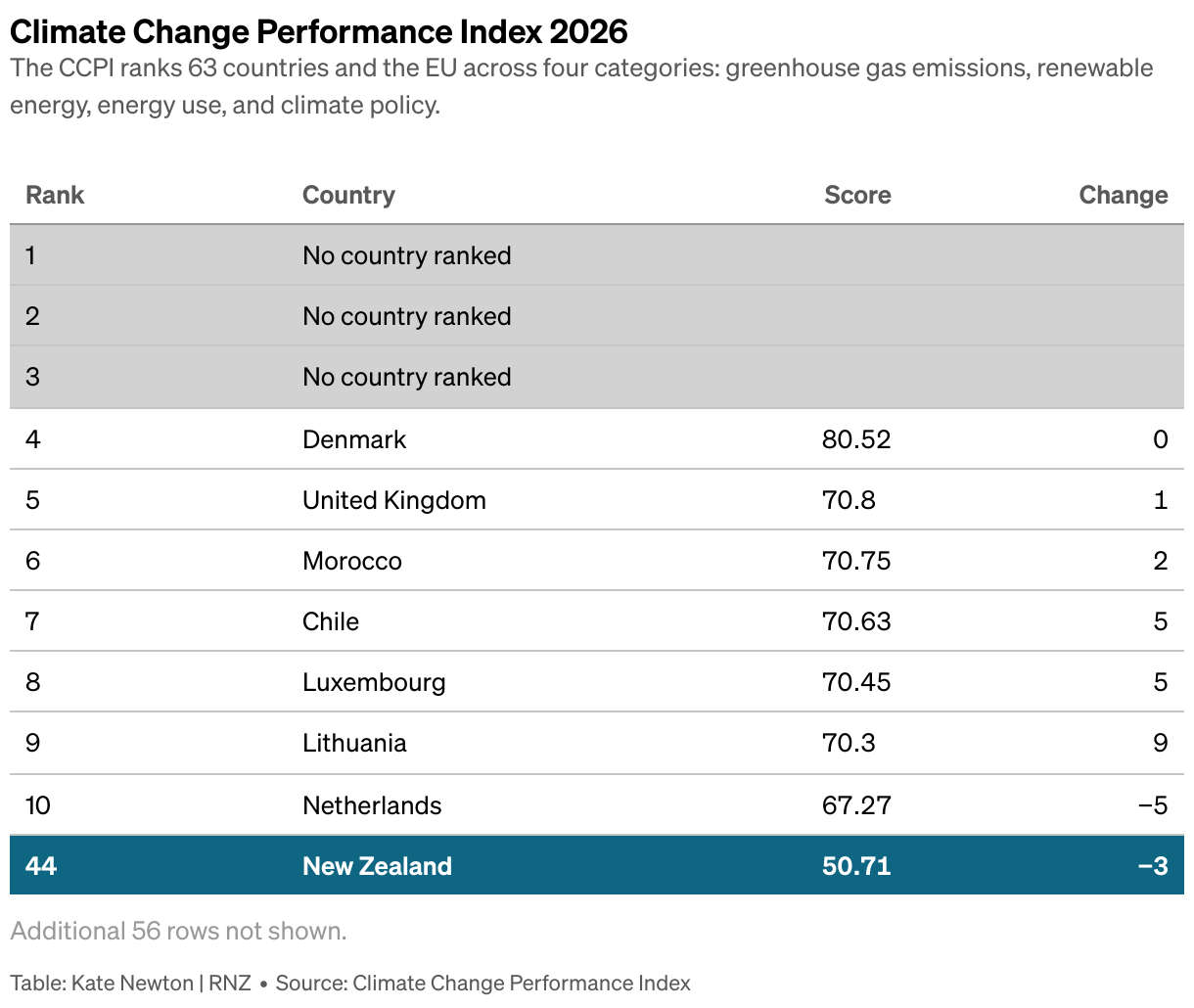
New Zealand has tumbled in an international climate-change league table, with authors now ranking it as “low-performing”.

The country fell three places to 44th in the Climate Change Performance Index, after already falling seven places last year.

The report’s authors said New Zealand’s continued slump was mainly due to a series of policy changes that amounted to “backsliding” on climate action.

The index, which has been compiled by international non-governmental organisations Germanwatch and NewClimate Institute every year since 2007, ranks 63 countries and the European Union.

Countries are rated across four categories – greenhouse gas emissions, renewable energy, energy use and climate policy.

Co-author Thea Uhlich, from Germanwatch, said no country was ranked in first, second or third place.

“Like in the last years, the first three ranks are empty, because across all four categories… no country manages to be very good or good enough to be in the top three positions.”

Denmark was the first country to be ranked, followed by the UK and Morocco.

Saudi Arabia, Iran and the US rounded out the bottom three places in the rankings.

“The USA has suffered a particularly remarkable decline – ranking third to last in the overall standings, just behind Russia,” Uhlich said.

“The largest oil and gas-producing countries are virtually among themselves, and show no sign of departing from fossil fuels as a business model.”

New Zealand-based experts and activists who contributed to the report said New Zealand had a “relatively robust policy framework”, which had been largely stable since 2019.

“The political consensus has been a strength of the scheme, but this is being eroded by the current government, which announced in October 2025 that it will amend the 2050 target’s methane component.” the report said.

The government signalled the target would drop from a 24-47 percent emissions reduction by 2050, from 2017 levels, to a 14-24 percent reduction.

This change prompted climate activists at the annual COP climate summit, currently taking place in Brazil, to award New Zealand ‘Fossil of the Day’.

Uhlich said there were other contributors to New Zealand’s lower ranking.

“New Zealand’s climate action is backsliding,” she said. “For example, we see that they have a rollback on the ban on new offshore oil and gas fuel exploration, which is again focusing on fossil fuels and not on renewables.”

However, she said New Zealand’s high rating for renewables – which make up more than 80 percent of electricIty supply – was a “spark of hope”.

The report noted that previous progress on developing further renewable supply had stalled.

David Tong, a New Zealander who works as a campaigner for Oil Change International, has contributed to the index for a decade.

The report could not take into account some of the most recent policy changes, such as this week’s announcement that the government would further loosen clean car standards.

“New Zealand could expect an even worse rating, if the Climate Change Performance Index were re-assessed today,” Tong said. “A lot has happened in the last four weeks, even since we provided the draft.”

The latest changes would be taken into account in next year’s report.

Climate Change Minister Simon Watts is in Brazil for the second week of talks at COP and did not respond to RNZ’s request for comment on the ratings.

World Wildlife Fund NZ chief executive Kayla Kingdon-Bebb, whose organisation also contributed to the index, said the index received international attention, when it was released each year.

“It is seen as respected and authoritative analysis, and to see New Zealand plummet down the rankings in the last two iterations is pretty depressing and rather shameful.”

New Zealand was risking its “very credible role” in the Pacific, a region that was becoming increasingly strategically important.

“Pacific leaders, leaders throughout our region, have repeatedly pleaded with governments, both Australia and New Zealand, to take meaningful climate action, not to restart offshore oil and gas exploration.

“Embracing the role of climate pariah is not going to advance New Zealand’s interests with our Pacific partners.”

The effects went beyond reputation, she said.

The policy changes were “setting up future generations of Kiwis to shoulder a relatively unconscionable burden, in terms of the cost of dealing to future climate-related weather”.

Sign up for Ngā Pitopito Kōrero, a daily newsletter curated by our editors and delivered straight to your inbox every weekday.

– Published by EveningReport.nz and AsiaPacificReport.nz, see: MIL OSI in partnership with Radio New Zealand

Maladie de Lyme : comment la bactérie Borrelia burgdorferi nous infecte

Source: The Conversation – France in French (3) – By Sébastien Bontemps-Gallo, Microbiologiste – Chargé de recherche, Centre national de la recherche scientifique (CNRS); Université de Lille

Cette image obtenue par microscopie électronique à balayage (fausses couleurs) montre des bactéries anaérobies à Gram négatif <em>Borrelia burgdorferi</em>, responsables de la maladie de Lyme. Claudia Molins/CDC

Pour échapper à notre système immunitaire, la bactérie responsable de la maladie de Lyme utilise une méthode de camouflage particulièrement efficace. Après avoir décrypté son fonctionnement, les scientifiques commencent à mettre au point des vaccins afin de s’attaquer à la bactérie avant qu’elle puisse recourir à ce stratagème.


Avec près de 500 000 personnes diagnostiquées chaque année aux États-Unis et entre 650 000 et 850 000 cas estimés en Europe, la maladie de Lyme, ou borréliose de Lyme, représente un problème de santé publique majeur dans tout l’hémisphère Nord.

Les symptômes de la maladie sont très variables, ils vont de lésions cutanées à des atteintes cardiovasculaires, articulaires ou neurologiques. Ces différences s’expliquent notamment par le fait que les bactéries impliquées peuvent différer en fonction de la zone géographique considérée. Mais, malgré leurs différences, toutes les bactéries impliquées ont un point commun : leur capacité à se rendre invisibles à l’œil du système immunitaire de leur hôte.

Des symptômes variables

La maladie de Lyme résulte d’une infection bactérienne transmise par les tiques du genre Ixodes, de petits animaux hématophages qui se nourrissent du sang des animaux, et parfois du nôtre.

Le microbe responsable est une bactérie, Borrelia burgdorferi, ainsi nommée en l’honneur du Dr Willy Burgdorfer, qui l’a découverte en 1982 aux Rocky Mountain Laboratories (Montana, États-Unis).

Dix ans plus tard, le Pr Guy Baranton, à l’Institut Pasteur, a montré qu’en Europe, plusieurs bactéries proches de B. burgdorferi peuvent provoquer la maladie.

Ces espèces forment ce qu’on appelle le complexe Borrelia burgdorferi sensu lato (s.l.), littéralement les Borrelia burgdorferi « au sens large », par comparaison avec Borrelia burgdorferi sensu stricto, autrement dit Borrelia burgdorferi « au sens strict ».

Aux États-Unis, c’est surtout Borrelia burgdorferi sensu stricto qui cause la maladie, tandis qu’en Europe, Borrelia afzelii et Borrelia garinii dominent.

Ces différences expliquent la variabilité des formes que peut revêtir la maladie selon les régions. Ainsi, B. afzelii provoque plus souvent des manifestations cutanées, tandis que B. garinii est plutôt associée à des atteintes neurologiques.

Une bactérie pas comme les autres

Borrelia burgdorferi est une bactérie en forme de spirale, appelée spirochète, qui se déplace activement. Elle possède un petit patrimoine génétique, constitué d’ADN, dont la taille est environ trois fois moindre que celle du patrimoine génétique d’Escherichia coli, la bactérie bien connue dans les laboratoires de recherche.

Mais l’ADN de B. burdgorferi a une organisation unique. Les génomes bactériens sont habituellement constitués d’un seul chromosome circulaire. Mais au lieu d’un chromosome circulaire classique, B. burgdorferi possède un chromosome linéaire, comme les cellules humaines. Ce chromosome est accompagné de plus d’une dizaine de plasmides (petites molécules d’ADN) circulaires et linéaires.

Les gènes indispensables à la survie de la bactérie sont majoritairement retrouvés sur le chromosome linéaire, qui est bien conservé entre les différentes espèces du complexe B. burgdorferi s.l. (ce qui signifie qu’il diffère très peu d’une espèce à l’autre).

Les plasmides contiennent quant à eux des gènes qui permettent à la bactérie d’infecter, de se cacher du système immunitaire et de survivre dans la tique. Le nombre et le contenu de ces plasmides varient d’une espèce à l’autre, et ils peuvent se réorganiser comme des pièces de puzzle, offrant potentiellement à la bactérie de nouvelles capacités pour s’adapter.

S’adapter pour survivre : les secrets de B. burgdorferi

Pour survivre, B. burgdorferi doit être capable de prospérer dans des environnements opposés : celui de la tique et celui du mammifère. Lorsqu’une tique se nourrit sur un animal infecté, la bactérie colonise l’intestin de l’arachnide acarien (rappelons que les tiques ne sont pas des insectes !). Elle y reste en dormance entre deux repas sanguins. Dans cet organisme, elle doit supporter le froid (puisque les tiques – contrairement aux mammifères – ne régulent pas leur température corporelle), le manque de nourriture et un environnement acide.

Dès qu’une tique commence à se nourrir sur un animal à sang chaud tel qu’un mammifère, la chaleur du sang et les modifications chimiques associées à son absorption déclenchent un changement de programme moléculaire. Tout se passe comme si le sang jouait le rôle d’un interrupteur activant un « mode infection ». Ce mode permet aux bactéries B. burgdorferi de migrer vers les glandes salivaires de la tique, et donc d’être transmises à un nouvel hôte avec la salive.

Une fois dans le mammifère, les bactéries doivent encore contrer les défenses du système immunitaire. Heureusement pour elles, la salive de la tique contient des molécules protectrices vis-à-vis du système immunitaire de leur hôte commun. Certains de ces composés bloquent le système du complément, un groupe de protéines sanguines capables de détecter et de détruire les microbes.

C’est le cas des protéines de la salive de tique appelées Salp15. En se fixant à des protéines situées à la surface de la bactérie (nommées OspC), les protéines Salp15 se comportent comme un bouclier temporaire, qui protège la bactérie pendant qu’elle commence à se disséminer dans l’organisme.

Mais les bactéries B. burgdorferi ne s’arrêtent pas là. Elles changent continuellement d’apparence, pour mieux se fondre dans chacun des environnements où elles évoluent, tels des caméléons. Lorsqu’elles sont à l’intérieur de la tique, elles produisent des protéines appelées OspA, qui leur permettent d’adhérer à l’intestin du parasite. Mais juste avant la transmission, elles remplacent ces protéines OspA par des protéines OspC, qui leur permettent d’envahir les tissus de l’hôte.

Cependant, ces protéines OspC attirent rapidement l’attention du système immunitaire. Une fois la bactérie installée dans le mammifère, les protéines OspC sont donc à leur tour remplacées par d’autres protéines, appelées VlsE.

Le gène vlsE qui sert à les fabriquer a la particularité de subir des transformations (on parle de recombinaisons), ce qui permet aux bactéries B. burgdorferi de fabriquer différentes versions de la protéine VlsE, les rendant ainsi très difficiles à reconnaître par le système immunitaire de l’hôte.

Tout se passe en quelque sorte comme si les B. burgdorferi changeaient régulièrement de « vêtement », afin que le système immunitaire ne puisse pas les reconnaître. Ce jeu de cache-cache moléculaire, appelé « variation antigénique », les rend presque invisibles au système immunitaire, ce qui leur permet de continuer à se multiplier discrètement.

Depuis quelques années, les scientifiques tentent de contrer ce stratagème, en développant notamment des vaccins contre les bactéries B. burgdorferi.

Les pistes pour prévenir et contrôler la maladie de Lyme

En 2025, deux projets de vaccins ont ravivé l’espoir d’une victoire contre la maladie de Lyme. Ceux-ci ciblent la protéine OspA, présente à la surface de la bactérie lorsqu’elle se trouve dans la tique. À Paris, l’Institut Pasteur, en partenariat avec Sanofi, a présenté un candidat vaccin à ARN messager, basé sur la même technologie que celle utilisée contre le Covid-19.

De leur côté, les laboratoires pharmaceutiques Valneva et Pfizer développent un vaccin qui cible lui aussi OspA, mais via une autre approche, fondée sur l’emploi de protéines recombinantes. Ces protéines, produites en laboratoire, correspondent à plusieurs variantes d’OspA exprimées par différentes souches de Borrelia burgdorferi présentes en Amérique du Nord et en Europe. Lors de l’injection, elles sont associées à un adjuvant afin de renforcer la réponse immunitaire et d’induire une production plus efficace d’anticorps. Les premiers résultats de ce vaccin, baptisé VLA15, semblent encourageants.

Bien qu’ils soient différents dans leur conception, ces deux vaccins reposent sur une approche originale qui a déjà fait ses preuves. En effet, en 1998 aux États-Unis, la Food and Drug Administration (FDA), l’agence chargée de la surveillance des denrées alimentaires et des médicaments avait autorisé la commercialisation du vaccin LYMErix, développé par l’entreprise pharmaceutique GSK, qui ciblait uniquement la protéine OspA produite par la souche américaine de Borrelia burgdorferi.

Commercialisé à partir de 1999, ce vaccin conférait une protection de 76 % contre la maladie aux États-Unis. Bien qu’imparfait, il s’avérait intéressant notamment pour les personnes les plus à risque de contracter la maladie. Il a cependant été retiré du marché en 2002 par GSK, en raison d’une polémique concernant la survenue de potentiels effets secondaires chez certaines personnes vaccinées.

L’analyse des données n’a pas permis de déceler de problème sur les cohortes étudiées, ce qui a amené la FDA à maintenir l’autorisation de mise sur le marché. Cependant, l’importante couverture médiatique a entraîné une chute des ventes, menant les responsables de GSK à décider d’en stopper la production et la commercialisation.

Concrètement, les vaccins ciblant OspA permettent de bloquer la bactérie dans le corps de la tique, empêchant son passage à l’être humain. Lorsqu’une tique infectée pique une personne vaccinée, elle aspire du sang contenant les anticorps anti-OspA produits suite à la vaccination. Dans son intestin, ces anticorps se fixent sur la surface des bactéries Borrelia burgdorferi, les empêchant de migrer vers les glandes salivaires. Résultat : la bactérie n’atteint jamais le site de la piqûre, et l’infection est bloquée avant même de commencer.

Cette approche a été privilégiée, car cibler la bactérie directement dans le corps humain est beaucoup plus difficile. Comme on l’a vu, grâce aux recombinaisons du gène vlsE, qui s’active lorsque B. burgdorferi entre dans le corps d’un mammifère, la bactérie devient alors une experte dans l’art de se cacher.

Mais la lutte est loin d’être terminée. En continuant à décoder toujours plus précisément les stratégies de survie et d’évasion des bactéries Borrelia, les chercheurs espèrent ouvrir la voie à de nouveaux outils de diagnostic, de traitement et de prévention.

The Conversation

Sébastien Bontemps-Gallo travaille au Centre d’Infection et d’Immunité de Lille (Institut Pasteur de Lille, Université de Lille, Inserm, CNRS, CHU Lille). Il a reçu des financements de l’Agence Nationale de la Recherche, de l’I-SITE Université Lille Nord-Europe, de l’Inserm Transfert et du CNRS à travers les programmes interdisciplinaires de la MITI.

ref. Maladie de Lyme : comment la bactérie Borrelia burgdorferi nous infecte – https://theconversation.com/maladie-de-lyme-comment-la-bacterie-em-borrelia-burgdorferi-em-nous-infecte-267829