« N’oublions pas le climat ! », ou comment maintenir l’environnement à l’agenda dans un monde en crise

Source: The Conversation – France in French (3) – By Lucile Maertens, Professeure adjointe en science politique et relations internationales, Graduate Institute – Institut de hautes études internationales et du développement (IHEID)

Les efforts de lutte contre le changement climatique sont régulièrement mis au second plan quand surviennent des crises immédiates nécessitant la mobilisation de moyens importants. On l’a constaté durant la pandémie de Covid-19 et dernièrement avec la guerre en Ukraine, entre autres. Comment préserver la conscience de l’urgence climatique et maintenir les programmes visant à y faire face dans un contexte où l’urgence change sans cesse de visage ?


Cet article a été co-écrit avec Lorenzo Guadagno, consultant en innovation climatique et mobilité à l’Organisation internationale des migrations (OIM).


La COP30 qui vient de se conclure au Brésil l’a encore une fois mis en évidence : la diplomatie climatique se heurte à un contexte géopolitique saturé par les urgences et l’obstruction politique. Guerres, crises humanitaires et gouvernements hostiles à l’action climatique détournent l’attention politique et médiatique de la cause environnementale et menacent de la reléguer au second plan. Pourtant, des stratégies d’action demeurent possibles pour éviter que la crise écologique ne disparaisse derrière d’autres impératifs internationaux.

L’équipe d’organisation brésilienne a ainsi lancé la campagne mondiale du « mutirão », inspirée des traditions autochtones : elle symbolise le travail collectif, fondé sur l’entraide et la réciprocité, d’une communauté qui s’engage pour une tâche commune, dans un esprit de solidarité et de responsabilité partagée. De son côté, le secrétaire général des Nations unies António Guterres continue de faire du climat sa priorité absolue, rappelant inlassablement que le dépassement de la limite de 1,5 °C constituerait un « échec moral et une négligence mortelle ».

Maintenir la crise écologique à l’agenda

Lorsqu’une crise internationale éclate, les regards s’orientent, à raison, vers les victimes et les solutions possibles pour résoudre rapidement la situation. L’urgence vient bousculer les priorités tandis que les problèmes dont l’échéance paraît plus lointaine perdent en visibilité, au risque de s’aggraver par manque d’action.

C’est pour éviter cette mise entre parenthèses que des organisations internationales, comme l’Organisation des Nations unies (ONU), se lancent dans ce que l’on a appelé le maintien à l’agenda : des efforts visant à maintenir un enjeu à l’ordre du jour alors que tous les regards sont rivés ailleurs.

Pour cela, quatre stratégies sont possibles : associer le défi de long terme à la crise immédiate ; le positionner comme une menace lente mais plus profonde ; garantir un espace politique pour agir sur cette question ; et préserver un sentiment d’urgence malgré la temporalité longue du problème.

Pandémie de Covid-19, guerre en Ukraine, crises humanitaires sont autant d’exemples d’urgences venant rediriger l’attention portée à la crise environnementale durant lesquelles agences onusiennes et autres organisations internationales ont tenté de maintenir cette dernière à l’agenda.

La gouvernance climatique et environnementale à l’épreuve de la crise sanitaire

En 2020, alors que la pandémie de Covid-19 monopolise l’attention politique et médiatique, les organisations internationales tentent d’éviter que la question écologique ne soit éclipsée, notamment en la reformulant à l’aune de la crise sanitaire.

D’emblée, les liens entre la dégradation environnementale, le déclin de la biodiversité et l’émergence de nouveaux pathogènes sont soulignés. On les retrouve tant dans les discours officiels d’institutions onusiennes, qu’à travers la publication de rapports dédiés ou la remise au premier plan One Health, approche intégrée de la santé humaine, animale et environnementale. Rapidement, António Guterres en appelle pour sa part à « reconstruire en mieux » (build back better), un slogan martelé pour encourager l’intégration systématique de mesures en faveur de la transition écologique dans la relance post-Covid.

D’autres s’efforcent de préserver la conscience de l’urgence de la crise climatique, par exemple en exigeant des États qu’ils présentent leur plan d’action malgré le report de la COP26. Rencontres et négociations internationales sont également conduites dans un format hybride, garantissant des espaces (virtuels) de prise de décision en matière d’environnement, malgré la pandémie.

Quand la guerre en Ukraine alerte sur les crimes environnementaux

Depuis le 24 février 2022, une autre crise, cette fois militaire, menace de reléguer les enjeux environnementaux au second plan : la Russie lance son invasion de l’Ukraine et exécute une stratégie consistant à détruire et tuer systématiquement des cibles militaires et civiles.

Alors que l’Europe s’inquiète de ce conflit et de ses effets sur les approvisionnements énergétiques, le gouvernement ukrainien cherche rapidement à sensibiliser l’opinion publique aux écocides commis dans le pays. Le Programme des Nations unies pour l’environnement (PNUE) contribue à ce débat, sa directrice exécutive s’entretenant personnellement avec les autorités ukrainiennes, afin de maintenir l’attention sur la crise écologique.

Dans un rapport, le PNUE présente la guerre en Ukraine comme un problème pour l’environnement et les dégradations environnementales comme un enjeu de sécurité publique. Il propose aussi des solutions communes telles que la « relance verte » qui vise à associer la reconstruction d’après-guerre à un plan d’action environnemental. Le programme onusien va jusqu’à emprunter la rhétorique militaire, pour entretenir un sentiment d’urgence qui justifie l’attention accordée à la crise écologique en temps de guerre.


À lire aussi :
Crimes contre l’environnement dans la guerre en Ukraine : que dit le droit ?


Crises humanitaires et crise écologique, même combat

Actuellement, les organisations internationales doivent composer avec un climat politique et budgétaire particulièrement défavorable. Face à une double crise de visibilité, de financement et d’espace opérationnel, affectant tant la crise écologique que le monde humanitaire, elles plaident pour une attention conjointe visant à maintenir les deux causes à l’agenda.

Depuis le début de l’année et l’effondrement du soutien états-unien en matière d’aide internationale, des organisations humanitaires alertent sur les conséquences directes des changements climatiques. À la COP30, la Fédération internationale des sociétés de la Croix-Rouge et du Croissant-Rouge et l’Agence des Nations unies pour les réfugiés ont défendu des politiques environnementales fortes afin de réduire la fréquence et la portée des événements météorologiques extrêmes.

À l’inverse, les organisations environnementales mobilisent les crises humanitaires et cycles de violence, comme l’invasion israélienne de la bande de Gaza, pour quantifier les impacts des conflits armés sur les ressources naturelles, et estimer leurs conséquences à court et à long terme sur la santé et les droits fondamentaux des populations affectées. La boucle est bouclée : les effets dévastateurs des conséquences environnementales des crises humanitaires et violences armées requièrent des approches intégrées où la protection de l’environnement devient une composante essentielle de l’action humanitaire.

Alors que les crises se multiplient et se chevauchent, préserver l’attention politique pour les questions de fond est un véritable défi. C’est aussi à cela que servent les COP : nous rappeler que l’on ne peut pas mettre le changement climatique sur pause, même si d’autres enjeux peuvent sembler plus urgents dans l’immédiat. À l’échelle globale, les organisations internationales telles que l’ONU jouent un rôle central de maintien à l’agenda pour s’assurer que les urgences n’éclipsent pas totalement les problèmes de long terme qui ne peuvent pas, ou plus, attendre que le vent tourne.

The Conversation

Lucile Maertens a reçu des financements du Fonds national suisse de la recherche scientifique dans le cadre du projet « First things first ! How to keep the United Nations environmental agenda in times of crisis » (Subside n°100017_200834).

Adrien Estève a reçu des financements du Fonds national suisse de la recherche scientifique dans le cadre du projet « First things first ! How to keep the United Nations environmental agenda in times of crisis » (Subside n°100017_200834).

Luis Rivera-Vélez a reçu des financements du Fonds national suisse de la recherche scientifique dans le cadre du projet « First things first ! How to keep the United Nations environmental agenda in times of crisis » (Subside n°100017_200834).

Zoé Cheli a reçu des financements du Fonds national suisse de la recherche scientifique dans le cadre du projet « First things first ! How to keep the United Nations environmental agenda in times of crisis » (Subside n°100017_200834).

ref. « N’oublions pas le climat ! », ou comment maintenir l’environnement à l’agenda dans un monde en crise – https://theconversation.com/noublions-pas-le-climat-ou-comment-maintenir-lenvironnement-a-lagenda-dans-un-monde-en-crise-270203


« Le discours monotone du dictateur » ou comment Franco a construit un autoritarisme sans charisme

Source: The Conversation – France in French (3) – By Susana Ridao Rodrigo, Profesora catedrática en el Área de Lengua Española (UAL), Universidad de Almería

On associe volontiers les dictateurs aux discours tonitruants et exaltés d’un Hitler ou d’un Mussolini et à une mise en scène exubérante pensée pour galvaniser les foules. Franco, lui, a fait exactement l’inverse : les prises de parole de l’homme qui a verrouillé l’Espagne pendant près de quarante ans se distinguaient par une élocution froide et monotone et un style volontairement très austère.


Francisco Franco (1892-1975) a été le chef de l’État espagnol de la fin de la guerre civile (1936-1939) jusqu’à sa mort. Le régime franquiste a instauré une dictature autoritaire, qui a supprimé les libertés politiques et a établi un contrôle strict sur la société. Pendant près de quarante ans, son leadership a profondément marqué la vie politique, économique et culturelle de l’Espagne, dont l’empreinte durable a souvent fait et fait encore l’objet de controverses.

Mais d’un point de vue communicationnel, peut-on dire que Franco était un grand orateur ?

Cela dépend de la façon dont on définit « grand orateur ». Si l’on entend par éloquence la capacité à émouvoir, persuader ou mobiliser par la parole – comme savaient le faire Churchill ou de Gaulle –, Franco n’était pas un grand orateur. Cependant, si l’on analyse sa communication du point de vue de l’efficacité politique et symbolique, son style remplissait une fonction spécifique : il transmettait une impression d’autorité, de distance et de contrôle.

Son éloquence ne visait pas à séduire le public, mais à légitimer le pouvoir et à renforcer une image de stabilité hiérarchique. En ce sens, Franco a développé un type de communication que l’on pourrait qualifier de « discours de commandement », caractérisé par une faible expressivité et une rigidité formelle, mais qui cadrait avec la culture politique autoritaire du franquisme.

Sur le plan verbal, Franco s’appuyait sur un registre archaïque et protocolaire. Son lexique était limité, avec une abondance de formules rituelles (« tous espagnols », « glorieuse armée », « grâce à Dieu ») qui fonctionnaient davantage comme des marqueurs idéologiques que comme des éléments informatifs.

Du point de vue de l’analyse du discours, sa syntaxe tendait à une subordination excessive, ce qui générait des phrases longues, monotones et peu dynamiques. On observe également une préférence pour le mode passif et les constructions impersonnelles, qui diluent la responsabilité de l’émetteur : « il a été décidé », « il est jugé opportun », « il a été nécessaire ».

Ce choix verbal n’est pas neutre ; il constitue un mécanisme de dépersonnalisation du pouvoir, dans lequel la figure du leader est présentée comme l’incarnation de l’État, et non comme un individu qui prend des décisions. Ainsi, sur le plan verbal, Franco communique davantage en tant qu’institution qu’en tant que personne.

Communication paraverbale : voix, rythme et intonation

C’est un aspect caractéristique de sa communication. Franco avait une intonation monotone, avec peu de variations mélodiques. D’un point de vue prosodique, on pourrait dire que son discours présentait un schéma descendant constant : il commençait une phrase avec une certaine énergie et l’atténuait vers la fin, ce qui donnait une impression de lenteur et d’autorité immuable.

Le rythme était lent, presque liturgique, avec de nombreux silences. Cette lenteur n’était pas fortuite : dans le contexte politique de la dictature, elle contribuait à la ritualisation du discours. La parole du caudillo ne devait pas être spontanée, mais solennelle, presque sacrée.

Son timbre nasal et son articulation fermée rendaient difficile l’expressivité émotionnelle, mais renforçaient la distance. Ce manque de chaleur vocale servait la fonction propagandiste. Le leader n’était pas un orateur charismatique, mais une figure d’autorité, une voix qui émanait du pouvoir lui-même. En substance, sa voix construisait une « éthique du commandement » : rigide, froide et contrôlée.

Contrôle émotionnel

Sa communication non verbale était extrêmement contrôlée. Franco évitait les gestes amples, les déplacements ou les expressions faciales marquées. Il privilégiait une kinésique minimale, c’est-à-dire un langage corporel réduit au strict nécessaire.

Lorsqu’il s’exprimait en public, il adoptait une posture rigide, les bras collés au corps ou appuyés sur le pupitre, sans mouvements superflus. Ce contrôle corporel renforçait l’idée de discipline militaire et de maîtrise émotionnelle, deux valeurs essentielles dans sa représentation du leadership.

Son regard avait tendance à être fixe, sans chercher le contact visuel direct avec l’auditoire. Cela pourrait être interprété comme un manque de communication du point de vue actuel, mais dans le contexte d’un régime autoritaire, cela consistait à instaurer une distance symbolique : le leader ne s’abaissait pas au niveau de ses auditeurs. Même ses vêtements – l’uniforme, le béret ou l’insigne – faisaient partie de sa communication non verbale, car il s’agissait d’éléments qui transmettaient l’idée de la permanence, de la continuité et de la légitimité historique.

Charisme sobre d’après-guerre

Le charisme n’est pas un attribut absolu, mais une construction sociale. Franco ne jouait pas sur une forme de charisme émotionnel, comme Hitler ou Mussolini, mais il avait un charisme bureaucratique et paternaliste. Son pouvoir découlait de la redéfinition du silence et de l’austérité, car dans un pays dévasté par la guerre, son style sobre était interprété comme synonyme d’ordre et de prévisibilité. Son « anti-charisme » finit donc par être, d’une certaine manière, une forme de charisme adaptée au contexte espagnol de l’après-guerre.

Du point de vue de la théorie de la communication, quel impact ce style avait-il sur la réception du message ? Le discours de Franco s’inscrivait dans ce que l’on pourrait appeler un modèle unidirectionnel de communication politique. Il n’y avait pas de rétroaction : le récepteur ne pouvait ni répondre ni remettre en question. L’objectif n’était donc pas de persuader, mais d’imposer un sens.

En appliquant là théorie de la communication du linguiste Roman Jakobson, on constate que les discours solennels de Franco, la froideur de son ton, visaient à forcer l’obéissance de l’auditoire en empêchant toute forme d’esprit critique et en bloquant l’expression des émotions.

Anachronique devant la caméra

Au fil du temps, son art oratoire n’a évolué qu’en apparence. Dans les années 1950 et 1960, avec l’ouverture du régime, on perçoit une légère tentative de modernisation rhétorique, tout particulièrement dans les discours institutionnels diffusés à la télévision. Cependant, les changements étaient superficiels : Franco usait de la même prosodie monotone et du même langage rituel. En réalité, le média télévisuel accentuait sa rigidité. Face aux nouveaux dirigeants européens qui profitaient de la caméra pour s’humaniser, Franco apparaissait anachronique.

L’exemple de Franco démontre que l’efficacité communicative ne dépend pas toujours du charisme ou de l’éloquence, mais plutôt de la cohérence entre le style personnel et le contexte politique. Son art oratoire fonctionnait parce qu’il était en accord avec un système fermé, hiérarchique et ritualisé. Dans l’enseignement de la communication, son exemple sert à illustrer comment les niveaux verbal, paraverbal et non verbal construisent un même récit idéologique. Dans son cas, tous convergent vers un seul message : le pouvoir ne dialogue pas, il dicte.

Aujourd’hui, dans les démocraties médiatiques, ce modèle serait impensable ; néanmoins, son étude aide à comprendre comment le langage façonne les structures du pouvoir, et comment le silence, lorsqu’il est institutionnalisé, peut devenir une forme de communication politique efficace.

The Conversation

Susana Ridao Rodrigo ne travaille pas, ne conseille pas, ne possède pas de parts, ne reçoit pas de fonds d’une organisation qui pourrait tirer profit de cet article, et n’a déclaré aucune autre affiliation que son organisme de recherche.

ref. « Le discours monotone du dictateur » ou comment Franco a construit un autoritarisme sans charisme – https://theconversation.com/le-discours-monotone-du-dictateur-ou-comment-franco-a-construit-un-autoritarisme-sans-charisme-270336

More than half of new articles on the internet are being written by AI – is human writing headed for extinction?

Source: The Conversation – USA (2) – By Francesco Agnellini, Lecturer in Digital and Data Studies, Binghamton University, State University of New York

Preserving the value of real human voices will likely depend on how people adapt to artificial intelligence and collaborate with it. BlackJack3D/E+ via Getty Images

The line between human and machine authorship is blurring, particularly as it’s become increasingly difficult to tell whether something was written by a person or AI.

Now, in what may seem like a tipping point, the digital marketing firm Graphite recently published a study showing that more than 50% of articles on the web are being generated by artificial intelligence.

As a scholar who explores how AI is built, how people are using it in their everyday lives, and how it’s affecting culture, I’ve thought a lot about what this technology can do and where it falls short.

If you’re more likely to read something written by AI than by a human on the internet, is it only a matter of time before human writing becomes obsolete? Or is this simply another technological development that humans will adapt to?

It isn’t all or nothing

Thinking about these questions reminded me of Umberto Eco’s essay “Apocalyptic and Integrated,” which was originally written in the early 1960s. Parts of it were later included in an anthology titled “Apocalypse Postponed,” which I first read as a college student in Italy.

In it, Eco draws a contrast between two attitudes toward mass media. There are the “apocalyptics” who fear cultural degradation and moral collapse. Then there are the “integrated” who champion new media technologies as a democratizing force for culture.

An older man with a beard, glasses and a suit poses while holding a cigarette.
Italian philosopher, cultural critic and novelist Umberto Eco cautioned against overreacting to the impact of new technologies.
Leonardo Cendamo/Getty Images

Back then, Eco was writing about the proliferation of TV and radio. Today, you’ll often see similar reactions to AI.

Yet Eco argued that both positions were too extreme. It isn’t helpful, he wrote, to see new media as either a dire threat or a miracle. Instead, he urged readers to look at how people and communities use these new tools, what risks and opportunities they create, and how they shape – and sometimes reinforce – power structures.

While I was teaching a course on deepfakes during the 2024 election, Eco’s lesson also came back to me. Those were days when some scholars and media outlets were regularly warning of an imminent “deepfake apocalypse.”

Would deepfakes be used to mimic major political figures and push targeted disinformation? What if, on the eve of an election, generative AI was used to mimic the voice of a candidate on a robocall telling voters to stay home?

Those fears weren’t groundless: Research shows that people aren’t especially good at identifying deepfakes. At the same time, they consistently overestimate their ability to do so.

In the end, though, the apocalypse was postponed. Post-election analyses found that deepfakes did seem to intensify some ongoing political trends, such as the erosion of trust and polarization, but there’s no evidence that they affected the final outcome of the election.

Listicles, news updates and how-to guides

Of course, the fears that AI raises for supporters of democracy are not the same as those it creates for writers and artists.

For them, the core concerns are about authorship: How can one person compete with a system trained on millions of voices that can produce text at hyper-speed? And if this becomes the norm, what will it do to creative work, both as an occupation and as a source of meaning?

It’s important to clarify what’s meant by “online content,” the phrase used in the Graphite study, which analyzed over 65,000 randomly selected articles of at least 100 words on the web. These can include anything from peer-reviewed research to promotional copy for miracle supplements.

A closer reading of the Graphite study shows that the AI-generated articles consist largely of general-interest writing: news updates, how-to guides, lifestyle posts, reviews and product explainers.

The primary economic purpose of this content is to persuade or inform, not to express originality or creativity. Put differently, AI appears to be most useful when the writing in question is low-stakes and formulaic: the weekend-in-Rome listicle, the standard cover letter, the text produced to market a business.

A whole industry of writers – mostly freelance, including many translators – has relied on precisely this kind of work, producing blog posts, how-to material, search engine optimization text and social media copy. The rapid adoption of large language models has already displaced many of the gigs that once sustained them.

Collaborating with AI

The dramatic loss of this work points toward another issue raised by the Graphite study: the question of authenticity, not only in identifying who or what produced a text, but also in understanding the value that humans attach to creative activity.

How can you distinguish a human-written article from a machine-generated one? And does that ability even matter?

Over time, that distinction is likely to grow less significant, particularly as more writing emerges from interactions between humans and AI. A writer might draft a few lines, let an AI expand them and then reshape that output into the final text.

This article is no exception. As a non-native English speaker, I often rely on AI to refine my language before sending drafts to an editor. At times the system attempts to reshape what I mean. But once its stylistic tendencies become familiar, it becomes possible to avoid them and maintain a personal tone.

Also, artificial intelligence is not entirely artificial, since it is trained on human-made material. It’s worth noting that even before AI, human writing has never been entirely human, either. Every technology, from parchment and stylus paper to the typewriter and now AI, has shaped how people write and how readers make sense of it.

Another important point: AI models are increasingly trained on datasets that include not only human writing but also AI-generated and human–AI co-produced text.

This has raised concerns about their ability to continue improving over time. Some commentators have already described a sense of disillusionment following the release of newer large models, with companies struggling to deliver on their promises.

Human voices may matter even more

But what happens when people become overly reliant on AI in their writing?

Some studies show that writers may feel more creative when they use artificial intelligence for brainstorming, yet the range of ideas often becomes narrower. This uniformity affects style as well: These systems tend to pull users toward similar patterns of wording, which reduces the differences that usually mark an individual voice. Researchers also note a shift toward Western – and especially English-speaking – norms in the writing of people from other cultures, raising concerns about a new form of AI colonialism.

In this context, texts that display originality, voice and stylistic intention are likely to become even more meaningful within the media landscape, and they may play a crucial role in training the next generations of models.

If you set aside the more apocalyptic scenarios and assume that AI will continue to advance – perhaps at a slower pace than in the recent past – it’s quite possible that thoughtful, original, human-generated writing will become even more valuable.

Put another way: The work of writers, journalists and intellectuals will not become superfluous simply because much of the web is no longer written by humans.

The Conversation

Francesco Agnellini does not work for, consult, own shares in or receive funding from any company or organization that would benefit from this article, and has disclosed no relevant affiliations beyond their academic appointment.

ref. More than half of new articles on the internet are being written by AI – is human writing headed for extinction? – https://theconversation.com/more-than-half-of-new-articles-on-the-internet-are-being-written-by-ai-is-human-writing-headed-for-extinction-268354

Social media can be understood as a role-playing game like Dungeons & Dragons

Source: The Conversation – Canada – By Stephen M Yeager, Professor of English, Concordia University

It’s a cliché that any “geek” who knows how to program computers will also probably play Dungeons & Dragons, or D&D. If you need to find someone at work who can explain to you the latest episode of Stranger Things, then you could probably safely start in the IT department and the D&D fans working there.

This isn’t an accident, and it isn’t a new development. The history of D&D and the history of the personal computer are closely aligned, and today’s social media platforms are basically just free-to-play mobile role-playing games.

D&D is more popular than it’s ever been. In October 2024, D&D’s owners, Wizards of the Coast, estimated that 85 million people either played the game or engaged with the brand, either through its physical “table-top” games or through smash success video games like Baldur’s Gate 3.

A 2022 survey determined that the average age of a D&D player was 30 years old, and that more than 40 per cent of players identified as female, non-binary or gender-fluid.

Jon Peterson, a major D&D historian, traces the origins of D&D back to the war-game hobbyists of the late 1960s. He refers to them as a “conservative youth movement” of overwhelmingly white male gamers who kept in touch through a loose social network based in hobby magazines.

D&D’s growth over the last 50 years was driven by digital social networks in the same way that the evolution of digital social networks was driven by D&D.

Progression mechanics

Social media platforms like X, Facebook, Instagram and LinkedIn all make money from views, refreshes and eyeballs on advertisements. To motivate their users to stay on the apps, these platforms have developed algorithms to govern what posts are seen by which users.

These algorithms deploy what game designers call “progression mechanics,” which is to say systems of points where the more points you have, the more control you have over events in the game.

If you get a high score in Tetris, you still start over at zero the next time you play. But if you get a high number of likes and followers on Facebook, then it’s more likely that other people will see your posts, and in that sense your high scores are a form of “progress.”

The most important precedent for social media progression mechanics is the “experience points” of D&D’s collaborative story-telling game system. When D&D players choose actions to shape the story surrounding their characters, they roll dice, which determines if their actions succeed or fail.

Experience points — or “XP” — reward player successes by improving the odds in future rolls, thereby giving them more control over the shared narrative of their D&D adventure. Similarly, social media progression mechanics give users control over what public relations specialists call “the narrative” about whatever subject those users choose to discuss.

There’s a long history of D&D progression mechanics in the design of social media platforms, going back to the dial-up “BBS” or “Bulletin Board System.”

A BBS was a computer hooked up to a modem that let users log in one at a time to leave messages for other users to read, like a cork bulletin board in a community space. Like D&D, the community of computer hobbyists who built and ran the very first BBS systems were mostly white, male and midwestern — the first edition of D&D was published in Lake Geneva, Wisconsin in 1974, and the first BBS was started in Chicago in 1978.

Also like D&D, BBS communities started out as subscribers to hobby magazines: the Avalon Hill General for D&D, Byte for BBS users.

The role of BBS

In 1986, a programmer named Guy T. Rice launched a BBS named TProBBS, which in Version 4.2f was both an early social media platform and an early digital role-playing game.

Like other BBS systems, TProBBS 4.2f required its users to create user profiles. But 4.2f took this a step further to ask users to create D&D characters for themselves: you weren’t just “User3788,” but “User3788 the Novice Bard.” The more you logged into the system, the more treasure and experience points you could gain, and so the more motive you had to log in to make use of the resources you’d accumulated.


Read more:
How the bulletin board systems, email lists and Geocities pages of the early internet created a place for trans youth to find one another and explore coming out


In his book The Modem World: A Prehistory of Social Media, Internet historian Kevin Driscoll identifies another BBS designed around fantasy role-playing progression mechanics: Seth Able Robinson’s Legend of the Red Dragon (LoRD), launched in 1989.

In LoRD, players were allowed a limited number of “actions” per day: exploring, trading, duelling, hunting, hanging out in the tavern. The more days you dialled in, the more actions you could complete, and so the more “progress” you could make in the fantasy world of the BBS.

In 2006, Facebook introduced the first social media algorithm, EdgeRank. It curated the posts on each users’ feed, assessing, among other factors, the evidence of each poster’s engagement to promote certain posts over other posts. The more you liked other users’ posts, the more “affinity” you built with those other users, and so the more likely your posts would be visible to a wider audience.

These progression mechanics aren’t just similar to the progression mechanics of D&D — they co-evolved alongside the progression mechanics of D&D towards the same ends.

The Conversation

Stephen M Yeager receives funding from SSHRC.

ref. Social media can be understood as a role-playing game like Dungeons & Dragons – https://theconversation.com/social-media-can-be-understood-as-a-role-playing-game-like-dungeons-and-dragons-266440

How new asylum policies will affect child refugees

Source: The Conversation – UK – By Ala Sirriyeh, Senior Lecturer in Sociology, Lancaster University

shutterstock Sean Aidan Calderbank/Shutterstock

The home secretary, Shabana Mahmood, has announced plans for the biggest overhaul of the UK asylum system in decades. Some of the harshest criticism of the proposals has come from Labour peer Lord Alf Dubs, a former child refugee who came to Britain on the Kindertransport from Prague in 1939. He has said that the home secretary is seeking to “use children as a weapon”.

There is a long history of refugee children becoming moral touchstones in debates around asylum. For example, photos of the body of Syrian toddler Alan Kurdi, during the 2015 so-called refugee crisis, were a catalyst for an unprecedented outpouring of compassion among media, the public and politicians.

In the year ending June 2025, there were 88,738 asylum applications to the UK relating to 111,084 people. Of these, 15,123 were child dependents (children who are included on a parent’s asylum application).

Other children enter through family reunion visas once their parent has gained refugee status. In 2024, 10,728 family reunion visas were granted to children under the age of 18. However in September 2025, in the face of growing public discontent with the asylum system, the government paused new applications for family reunion from refugees.

Under the new plans, refugees will not be allowed to apply for family reunion, unless they are able to transfer to a work or study visa.

Removing support

The UK currently has a legal duty to provide accommodation to asylum seekers who would otherwise be destitute. The government argues that this incentivises people to make dangerous journeys across the English Channel, including with babies and children.

Labour minister Steve Reed has claimed that the new system would remove such incentives and save lives. This is a familiar justification for restrictive asylum policies and an example of what I call “compassionate refusals”, whereby politicians argue that the removal of support or the infliction of punitive measures will alleviate suffering or avoid future suffering.

The Home Office says that the current system allows people to “exploit the fact that they have had children and put down roots in order to thwart removal”.
Currently, destitute families with children who are refused asylum and have exhausted their appeal rights can continue to receive accommodation and basic financial support. Under the new plans, the Home Office will look to remove financial support from families who have been refused asylum, even if they have children.

A smiling Shabana Mahmood walks out of Downing Street with a red folder
The home secretary, Shabana Mahmood, says the asylum overhaul will remove incentives for people to cross the English Channel in small boats.
Zeynep Demir Aslim/Shutterstock

The most significant change appears to be in the government’s approach to removals. Currently, families are not prioritised by the government for deportation. “Our hesitancy around returning families creates particularly perverse incentives,” the proposals say. “To some, the personal benefit of placing a child on a dangerous small boat outweighs the considerable risks of doing so.”

Under the plans, people refused asylum, including children, could be deported if they fail to leave voluntarily.

For families who are granted asylum, the proposals also introduce a new level of uncertainty. Refugee status will be reassessed every 30 months, with the possibility of being returned to their country of origin if it is deemed safe. Some will have to wait 20 years instead of the current five years before they can apply for settlement.

This means that refugees brought to the UK as children could live their entire childhoods in Britain with no guarantee that they will remain in the place they have come to think of as home.

Facial recognition

Specific measures also focus on unaccompanied child asylum applicants. In the year ending June 2025, 3,553 unaccompanied children applied for asylum. They are looked after by local authorities in foster care, or shared semi-independent accommodation with social work support.

A recurring aspect of debate over asylum has to do with arrivals who are age disputed – that is, those who claim to be under 18, but may be older. The assumption is that they claim to be younger to try to access temporary leave to remain, services and support provided to minors. In the year ending June 2024, 6,270 age disputes were raised.

Under the new asylum plan, young people whose age is disputed will be subjected to facial age estimation technology. This technology uses artificial intelligence to estimate the age of the young person, despite concerns about its accuracy.

This issue of age disputes has been under regular media scrutiny, most notably when 220 children were transferred to the UK in late 2016 from Calais. As these (predominantly teenage) boys arrived in Britain, media headlines disputed their age, focusing on appearance such as facial hair and demeanour. Such an approach can reinforce Eurocentric understandings of age, and ignore the toll that conflict and arduous journeys take on bodies and behaviour.

According to current Home office guidance, when claiming asylum, if the young person claims to be a minor they should be treated as such unless their physical appearance and demeanour very strongly suggests they are significantly over the of 18. There have previously been calls to use invasive or discredited methods of age testing such as dental examinations and bone scans.

Currently, if a young person is age disputed, they are usually referred to the local authority who conducts a holistic age assessment. This takes into account appearance, demeanour, documents, the young person’s own account and observations by adults working with them, among other evidence. Given the uncertainties over the use of AI, introducing this technology to the age determination process is unlikely to resolve the existing challenges.

The Conversation

Ala Sirriyeh receives funding from the British Academy

ref. How new asylum policies will affect child refugees – https://theconversation.com/how-new-asylum-policies-will-affect-child-refugees-270118

Red hair and fair skin gene may also play role in healing chronic wounds – new research

Source: The Conversation – UK – By Jenna Cash, Lecturer, School of Regeneration and Repair, University of Edinburgh

The gene MC1R is not only responsible for red hair and fair skin – it can also help with wound healing. Super8/ Shutterstock

Millions of people around the world live with wounds that simply won’t heal. These long-lasting wounds, often caused by diabetes, poor circulation or pressure, can be painful, prone to infection and can seriously affect quality of life. In severe cases, they can lead to amputation.

Current treatments help manage symptoms, but they don’t always address the underlying problem. That means dressings, antibiotics and repeated clinic visits, often for months or years. For many people, that cycle never truly ends.

But the latest research published by my colleagues and myself offers a new perspective on why some wounds just won’t heal – and points to a potential new way of treating them.

By studying both human tissue and experimental models, we found that a molecule in the skin called MC1R is consistently disrupted in chronic wounds. When we stimulated this molecule, the skin was able to reduce inflammation and begin healing again.

MC1R is best known for something quite different from wound healing: the gene is responsible for red hair and very fair skin. But MC1R does far more than influence pigment.

MC1R is found on many different types of skin cells, including immune cells, keratinocytes (the cells that form the outer layer of the skin), fibroblasts (the cells that make scar tissue) and the cells that line blood vessels. This means MC1R can influence several parts of the healing process.

The healing process is more complex than simply “closing” a wound. The skin first triggers inflammation (the body’s early defence response that removes microbes and damaged tissue), then gradually turns that inflammation off to allow repair. When that switch-off fails, wounds can remain inflamed for months.

Because MC1R has known anti-inflammatory roles in other conditions such as arthritis, we wanted to know whether its behaviour might also help explain why chronic wounds fail to heal.

To answer this, we used two complementary approaches. First, we analysed human tissue samples from three major types of chronic wounds: diabetic foot ulcers, venous leg ulcers and pressure ulcers. Despite having different causes, these wounds showed a similar problem: the mechanism that normally helps calm inflammation was disrupted. Both MC1R and its natural partner molecule, POMC, were also out of balance – and this imbalance was present across all wound types.

Second, we used experimental models to understand how this disruption affects healing. We examined mice that carry a non-functional version of MC1R. These animals developed wounds that were slow to heal and showed some of the same features we see in human chronic wounds.

Their wounds contained many inflammatory immune cells and abundant “neutrophil extracellular traps” – sticky webs of DNA and proteins that, when they persist, are associated with ongoing inflammation and delayed repair.

To better replicate human chronic wounds, we also created a new mouse model that produces slow-healing, inflammation-rich ulcers. This allowed us to test potential treatments in conditions that closely mimic human disease.

When we applied a topical drug that selectively activates MC1R, healing improved dramatically. The ulcers produced less exudate (the fluid that often leaks from chronic wounds), blood-vessel growth increased (improving the supply of oxygen and nutrients to the wound bed) and the outer layer of skin began to recover and close over the wound. Importantly, activating MC1R reduced neutrophil extracellular traps and limited the arrival of new inflammatory cells.

We also applied the drug to a small cut on healthy animals. Stimulating MC1R further boosted blood flow, improved lymphatic drainage and reduced scarring. This suggests MC1R supports healing not only when wounds are stuck, but also under normal conditions.

Together, these findings indicate that MC1R plays a meaningful role in coordinating several key aspects of skin repair. When the pathway is disrupted, inflammation persists. When MC1R is activated, that inflammation can resolve and allow other healing processes to progress.

Healing chronic wounds

Chronic wounds affect millions of people – and the numbers are rising alongside global rates of diabetes, ageing and obesity. They’re also extremely costly for healthcare systems. Even small improvements in healing could make a significant difference to patients and reduce strain on services.

Our findings raise the possibility of new treatments that target MC1R to help the skin move out of a chronic inflammatory state. Because we saw positive effects with a topical application, future therapies might take the form of ointments or gels that patients could apply themselves.

While more research is needed, identifying MC1R as a key pathway disrupted in chronic wounds gives us a clearer understanding of why some wounds fail to heal – and offers hope for finding new ways to help the skin repair itself.

The Conversation

Jenna Cash receives funding from the Wellcome Trust, Royal Society and the British Skin Foundation. She has provided consulting services for third parties including pharmaceutical companies.

ref. Red hair and fair skin gene may also play role in healing chronic wounds – new research – https://theconversation.com/red-hair-and-fair-skin-gene-may-also-play-role-in-healing-chronic-wounds-new-research-268915

How a desperate lie saved a Gustav Klimt portrait from the Nazis – and helped shape its record sale price

Source: The Conversation – UK – By Benedict Carpenter van Barthold, Lecturer, School of Art & Design, Nottingham Trent University

Portrait of Elisabeth Lederer by Gustav Klimt (1914-1916). Wiki Commons

Gustav Klimt’s Portrait of Elisabeth Lederer has sold to an anonymous phone bidder for US$236.4 million (£180.88 million) at Sotheby’s New York. Only Leonardo Da Vinci’s Salvator Mundi has achieved a higher hammer price. For modern art, Klimt is the uncontested champion.

What’s more, this record was achieved despite a cooling global art market, and with Klimt lacking the universal household recognition of Da Vinci in much of the world.

The painting is valued so highly because it carries a deep personal and political history – and because the artist’s incredible skill once helped it serve as a life-saving disguise.

Standing over six-foot tall, the canvas depicts Elisabeth Lederer, daughter of Klimt’s most important patrons, August and Szerena Lederer. Painted between 1914 and 1916, it represents the artist’s late, ornamental style.

Elisabeth is swaddled in a billowing, diaphanous dress, nestled within a textured and ornamental pyramid, an implied Imperial dragon robe. The upper half of her torso is ensconced in an arc of stylised Chinese figures. The effect reminds me of a halo in an icon (religious images painted on wooden panels).

Black and white photo of a woman stood next to a life-size portrait
Elisabeth’s mother Szerena in her apartment in Vienna with the portrait.
Wiki Commons

The setting is fantastical, abstracted, unreal, ornamental – above all, rich. Despite the jewel-like setting, Elisabeth’s face is painted with a striking, psychological realism. Her expression is detached, enigmatic, perhaps isolated. Her hands seem fretful.

It is hard not to project meaning with the benefit of hindsight, but she seems to gaze out from a world of immense Viennese wealth, a world unknowingly on the brink of annihilation.

The Lederers were a prominent Jewish family. After the 1938 Anschluss (the annexation of Austria by Nazi Germany), they faced persecution. The family scattered. But Elisabeth remained, divorced and isolated, in Vienna.

Classified as a Volljüdin (“full Jew”) under the Nazi regime’s antisemitic rule, she faced a likely death. In desperation, she circulated a rumour that she was the illegitimate child of Klimt, the Austrian and Aryan painter of her earlier portrait.

To aid this endeavour, her mother Szerena, who had fled to Budapest, swore an affidavit that Elisabeth’s biological father was not her Jewish husband, August, but Klimt, a notorious philanderer. The claim was not without plausibility. Klimt had a long personal relationship with the Lederer household. Elisabeth’s portrait is itself a document of this interest and closeness.

The Nazis, eager to reclaim Klimt’s genius for the Reich, accepted the fabrication. If Elisabeth was not a “full Jew” but instead a Mischling (half-Jewish), then the painting itself could be reclassified as an Aryan work of art. With Elisabeth’s desperate sleight of hand, both she and the painting were saved.

Aided by her former brother-in-law, a high-ranking Nazi official, Elisabeth was legally reclassified as illegitimate and “half-Aryan”. This lie successfully shielded her from the death camps, uniting art history, gossip and survival in a single legal document.

Klimt in a painter's gown
Klimt in 1914, the same year he began the portrait of Elisabeth.
Wiki Commons

This deception also ensured the painting’s physical survival. The Lederer Klimts fell into two camps. The Jewish portraits were degenerate art, and were set aside to be sold. But the rest were considered important heritage. While the Nazis moved the bulk of the looted Lederer collection to the castle Schloss Immendorf for safekeeping, Elisabeth’s portrait remained in Vienna due to its newly contested “Aryan” status, in limbo. In May 1945, SS troops set fire to the Schloss, incinerating over a dozen Klimt masterpieces, including a painting of Elisabeth’s grandmother. But in Vienna, the painting of Elisabeth, and another of her mother, Szerena, survived. This brutal and arbitrary destruction is what makes Elisabeth’s painting such a statistical anomaly.

As one of only two full-length Klimt portraits remaining in private hands, its scarcity is near absolute. For collectors, this auction was an inelastic opportunity. On Tuesday November 18, if you wanted to own a major Klimt portrait, it was this one, or none.

The work’s post-war provenance further amplifies its value. The painting was restituted to Elisabeth’s brother Erich in 1948. In 1985, it was purchased by the cosmetics billionaire Leonard A. Lauder.

Unlike many investment-grade masterpieces that are sequestered in free ports, unseen and treated as financial assets, Lauder lived intimately with the work for 40 years, reportedly eating lunch beside it daily.

He frequently loaned it anonymously to major institutions, ensuring its visibility to art history and scholarship, but without testing its value on the market for four decades. Lauder’s loving stewardship added a premium, presenting the work not just as a commodity, but as a cherished, well-documented piece of cultural heritage.

Ultimately, the US$236.4 million price tag reflects a value proposition that transcends simple supply and demand. The anonymous buyer has acquired an object of extreme aesthetic power, but also a tangible relic of resilience. It is a painting saved by a daughter’s lie, a mother’s perjury, the vanity and cupidity of an odious regime, emerging intact from the wreckage of the second world war.

In a market characterised by hype and speculation, this sale rewards deep historical density and incredible technical prowess. Elisabeth’s portrait, which is both monumental and deeply personal, opens a window to the tragic heart of the 20th century.

This legacy should not be financialised, but it is disturbing to speculate to what extent its dark past is reflected in the hammer price. Let’s hope the new owner treats the work as lovingly as her previous custodian. The painting deserves to be shared with the world.


Looking for something good? Cut through the noise with a carefully curated selection of the latest releases, live events and exhibitions, straight to your inbox every fortnight, on Fridays. Sign up here.


The Conversation

Benedict Carpenter van Barthold does not work for, consult, own shares in or receive funding from any company or organisation that would benefit from this article, and has disclosed no relevant affiliations beyond their academic appointment.

ref. How a desperate lie saved a Gustav Klimt portrait from the Nazis – and helped shape its record sale price – https://theconversation.com/how-a-desperate-lie-saved-a-gustav-klimt-portrait-from-the-nazis-and-helped-shape-its-record-sale-price-270395

How technology is reshaping children’s development – the good, the bad and the unknown

Source: The Conversation – UK – By Valentina Fantasia, Associate Professor of Cognitive Science, Lund University

arthierry/Shutterestock

It’s a common scene on public transport. A parent holds a mobile phone showing noisy cartoons to their young child. The pair is looking at the screen together, laughing. Yet parent and child rarely exchange a gaze or look out across the landscape.

While many parents can relate to such moments, this is just an example of how technology (mainly digital screens but also vocal assistants, domestic robots and so on) have become part of our daily routines, changing the way we interact and engage with the world around and – most importantly – with each other.

But how does all this change how young children develop?

Human development is essentially a social practice. From infancy, we participate in the world around us and learn from experience, especially from unfamiliar situations and cultural encounters, with the help of more knowledgeable partners.

As adults interact with kids, they share views and create new knowledge. We make sense of the world around us, in its variety, complexity and beauty. Children learn from it, and adults learn how to see the world from the child’s eyes. How can we possibly encounter the world or make sense of it when our attention is captured by a screen?

Five decades of research in developmental disciplines have shown just how much human development is dependent on the fine-grained details of daily social communication. For infants and young children, communicating is not an abstract or conceptual thing: it’s based on the small, routine moments shared with others, from stopping to observe a slow-paced slug on the way to school to reading a book together at the breakfast table. This is how we become humans.

What makes those early activities between children and adults special is the fact that they are co-constructed moment by moment through talk, gaze, gestures (such as pointing to something) and movements.

As our research has extensively shown, in the first months and years of life, infants experience and learn the patterns of interaction with others, in which the timings of gaze, movements, vocalisations and language are crucial.

This includes how long you look at each other, or learn to make pauses and take turns in a conversation or activity. It’s also about making eye contact before pointing to an interesting object in the room. These patterns teach us how to relate to others and participate in joint activities, and there is currently no substitute for such learning.

Becoming post-digital humans

Smart devices and streaming tools have made digital media become an integral part of family life. Two-thirds of children aged two to five use screens for more than an hour a day, and the average starting age of screen use is getting dramatically lower.

During the past two decades, researchers have showed how digital technologies are changing the way children cope with everyday tasks and activities, from playing and paying attention to remembering things and sleeping.

Exposure to digital devices on a daily basis has been linked to difficulties with completing homework, finishing tasks and staying calm when issues arise in the family. Sleep quality also seems negatively affected by screens, particularly if it’s right before bedtime.

Even having a TV on in the background can negatively influence very young children’s play time, disturbing the quality of their focused attention and shortening their play activity.

But although neuroscience is telling us that recurrent exposure to smart technologies is already rewiring humans’ brains, not all of it is negative. High-quality media content, offered for instance by cartoons or educational apps, may help children cope better with their emotions and improve language skills.

So are we evolving into techno-hybrid super-intelligent creatures? As we let kids roam free on Sesame Street on our smartphones, are they becoming smarter?

Maybe it is not a completely negative thing after all, as writers and academics such as Jeannette Winterson and Katherine N. Hayles suggest. Becoming post-human, in their view, is the next step in humans natural evolution towards adapting and transforming into something different – not better, not worse.

Ultimately, while there is potential for technology to make children smarter in some domains, we also know it can disrupt their attention, play and sleep. What we don’t know is exactly how it impacts how children and parents relate to each other. Our group, SITE, at the Robotic lab at Lund University, is currently investigating how children understand technology and how digital practices shape interactions in early school and family.

No magic recipe

A century ago, Maria Montessori suggested that attention is the finest gift an adult can give to a child. Attention, in her view, was the capacity to attend to a child’s way of discovering the world, and then share it together.

When adults and children’s attention is oriented towards something else, detached from its context, like watching a video on the phone while sitting in a park, there might be missing opportunity to discover and learn together through moments of mutual attention.

Father swinging a child in the air.
Attention is crucial.
Valentina Fantasia, CC BY-SA

It is there that children test their agency and influence, and learn to engage and disengage with others. As technology is advancing faster than ever, we need to gauge how much technology is changing this vital contact.

Western parents are increasingly concerned over their kids’ screen time and for most, negotiating this time is a real struggle. But instead of blaming family practices, we should support parents in understanding that no magic recipe exists. The key is to find out which shared moments are best out-sourced to tech devices and which should be preserved as tech-free.

And this is our suggestion: any moment of the day spent together without screens is precious, even the ones which seem irrelevant. Reading a book at bedtime, telling invented stories while driving the car, picking up chestnuts on the street on the way home or even being bored together are all crucial.

Keep those moments and choose which ones may just be worth screens, for example when the adult’s energy is simply too low to offer anything better. No size fits everyone – just find what works for your own family.

In a few years, we might see that our slow-pace process of learning with and through others has profoundly changed. And while technology itself should not be seen as all bad or good, a deeper understanding of how children are watching, playing and doing things with digital tools is necessary.

The Conversation

Valentina Fantasia receives funding from The Wallenberg AI, Autonomous Systems and Software Program – Humanity and Society (WASP-HS). She is affiliated with the Department of Philosophy and Cognitive Science at Lund University, Sweden.

Joanna Rączaszek-Leonardi is a professor at the University of Warsaw. Her research was funded by the Polish-German collaborative research Beethoven on “Early Semantic Development” and EU H2020 Twinning project “Towards Human-centered Technology Development.”

ref. How technology is reshaping children’s development – the good, the bad and the unknown – https://theconversation.com/how-technology-is-reshaping-childrens-development-the-good-the-bad-and-the-unknown-268148

From invasive species tracking to water security – what’s lost with federal funding cuts at US Climate Adaptation Science Centers

Source: The Conversation – USA (2) – By Bethany Bradley, Professor of Biogeography and Spatial Ecology, UMass Amherst

Mahonia bealei, also known as Beale’s barberry or leatherleaf mahonia, is invasive but still sold for landscaping. HQ Flower Guide via Wikimedia Commons, CC BY-SA

When the Trump administration began freezing federal funding for climate and ecosystem research, one of the programs hit hard was ours: the U.S. Geological Survey’s Climate Adaptation Science Centers.

These nine regional centers help fish, wildlife, water, land – and, importantly, people – adapt to rising global temperatures and other climate shifts.

The centers have been helping to track invasive species, protect water supplies and make agriculture more sustainable in the face of increasing drought conditions. They’re improving wildfire forecasting, protecting shorelines and saving Alaska salmon, among many other projects.

All of this work happens through partnerships: Scientists, many of them affiliated with universities, team up with public and private resource managers – the people who manage water supplies, wildlands, recreation areas, shorelines and other natural resources – to develop the research and solutions those managers need.

A map of the Northeast and Midwest showing the projected rise of invasive species, with the large number in the northern areas.
The Northeast Climate Adaptation Science Center has been tracking invasive species to help natural resource managers prepare. Federally funded scientists develop risk maps and work with local communities to head off invasive species damage.
Regional Invasive Species and Climate Change Network, CC BY

But in spring 2025, after 15 years of operation of the centers, the president’s proposed federal budget zeroed out funding for them. Federal workers at the centers were threatened with layoffs.

Three of the nine regional centers – covering the South Central, Pacific Islands and Northeast regions – were left unfunded when the Office of Management and Budget withheld and then blocked funds Congress had already appropriated.

In spite of these challenges, we have hope that the work will eventually continue. Congress’ proposed budgets in both the U.S. House and Senate recommend fully funding the Climate Adaptation Science Centers, and there’s a reason: Natural resources managers and the public have consistently told their elected officials that the work is important.

Here are three examples of projects in regions where funding has been blocked that show why resource managers are speaking up.

Sustainable water supplies in arid lands

In south-central Texas, the Edwards Aquifer Authority is responsible for providing sustained water resources for 2.5 million people in cities such as San Antonio and Uvalde. It also maintains the groundwater-fed springs that support threatened and endangered species.

In recent decades, however, both heavy rainfall and prolonged, intense droughts have increased uncertainty about how much water will be available from the aquifer.

At the South Central Climate Adaptation Science Center, researchers from the University of Oklahoma teamed up with the aquifer authority to develop high-resolution climate projections for assessing future changes to groundwater recharge and ecologically sensitive springs.

The climate projections are helping the authority determine whether its existing drought-mitigation practices are effective for sustaining freshwater springs and groundwater levels.

A panorama photo of a lake next to a building
The San Marcos springs on the Texas State University campus, shown in this panorama photo, are fed by the Edwards aquifer.
Adrienne Wootten

Losing funding for the Climate Adaptation Science Center means this technical guidance for water management and many other projects in the region are no longer available.

Stalled science doesn’t just hurt Texas. Many arid and semi-arid regions of the U.S. rely on aquifers to provide water supplies for homes, businesses and agriculture, and they need this type of research to maintain water security.

Solutions for agriculture and fire protection

On the Hawaiian island of O’ahu, up to 40% of agricultural land is unmanaged and unplanted pasture that is often invaded by non-native grasses. These grasses increase fire risk as the islands face more intense and longer-lasting droughts.

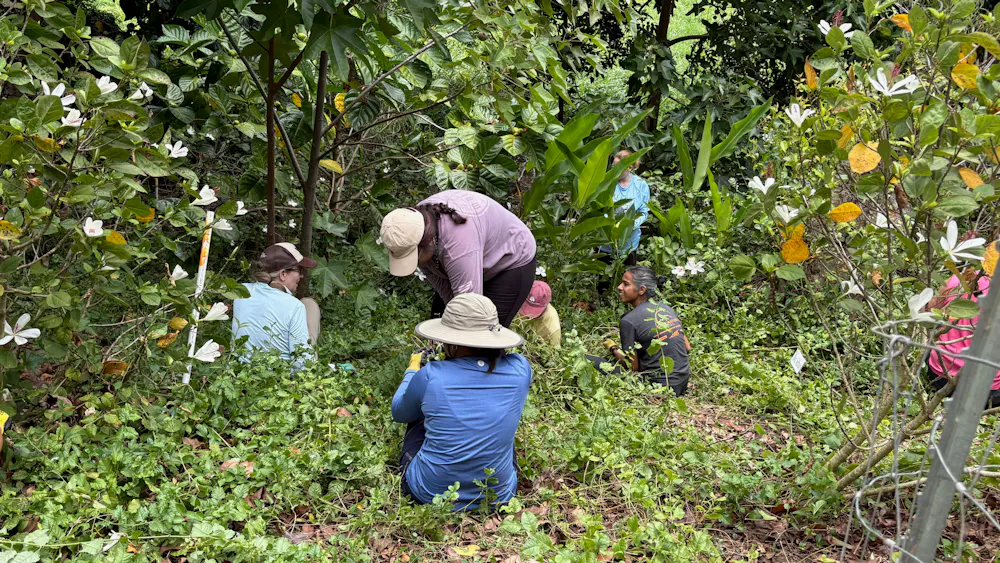
The Pacific Islands Climate Adaptation Science Center has been working on a solution to help restore fallow lands through agroforestry, in which farmers grow crops among trees, mirroring Indigenous practices.

People plant crops among existing trees on Oahu.
In agroforestry, crops such as coffee are grown among trees, preserving the trees’ carbon storage while helping to keep invasive plants at bay.
Leah Bremer/University of Hawaii at Mānoa Institute for Sustainability and Resilience

Climate Adaptation Science Center researchers at the University of Hawai’i Mānoa partnered with Kākoʻo ʻŌiwi, a nonprofit organization that is restoring Indigenous food systems, to identify lands that will remain suitable for agroforestry even under worsening drought caused by climate change. The research has shown how management practices can increase soil health and increase the soil’s carbon storage.

Since 2019, researchers have taught hundreds of volunteers from the community and student groups about restoration practices that include food production, forest conservation and climate resilience.

Lost funding for Climate Adaptation Science Centers put the brakes on science that supports local communities.

Managing invasive species in a warming world

Invasive species cost the U.S. economy an estimated US$10 billion a year in damage to crops, forests and ecosystems. At the same time, climate change is increasing the range of many invasive species and making them harder to control.

A map of the Northeast shows the spread of an invasive evergreen shrub.
Scientists involved in the Northeast Climate Adaptation Science Center map invasive species risks. This map shows the current and potential range map of Beale’s barberry, or leatherleaf mahonia, an invasive evergreen shrub that is still being sold for ornamental uses. The plant, which deer don’t eat, has taken over habitat and outcompeted native species in parts of the U.S.
Regional Invasive Species and Climate Change Network, CC BY

In 2016, researchers from the Northeast Climate Adaptation Science Center at the University of Massachusetts Amherst learned that resource managers were concerned about how climate change would affect invasive species ranges. To understand and address the needs of resource managers, Climate Adaptation Science Center researchers created the Regional Invasive Species and Climate Change Network, which has become a primary source for mapping invasive species’ movement and sharing invasive species research across the region.

Climate Adaptation Science Center researchers conducted a series of projects to identify invasive plants expanding into northern and southern New England and mid-Atlantic states. The results have helped the state of Massachusetts update its invasive plant risk assessment and expanded regulators’ lists of invasive species to prohibit from sales in New York and Maine.

States recently asked the center’s researchers to develop a database of current and emerging invasive plants across the Northeast to help them build consistent and proactive defenses against emerging invasive species. Stalled funding has also stalled this project.

These are the kind of real-world solutions that federal funding cuts are stopping. When that work disappears, it leaves America and Americans more vulnerable to climate change.

The Conversation

Bethany Bradley receives funding from the US Geological Survey as the University Director of the Northeast Climate Adaptation Science Center.

Adrienne Wootten previously received funding from the US Geological Survey for research projects through the South Central Climate Adaptation Science Center and is currently engaged in research with the Edwards Aquifer Authority.

Ryan Longman receives funding from the US Geological Survey as the University Director of the Pacific Islands Climate Adaptation Science Center

ref. From invasive species tracking to water security – what’s lost with federal funding cuts at US Climate Adaptation Science Centers – https://theconversation.com/from-invasive-species-tracking-to-water-security-whats-lost-with-federal-funding-cuts-at-us-climate-adaptation-science-centers-269908

Nonprofit news outlets are often scared that selling ads could jeopardize their tax-exempt status, but IRS records show that’s been rare

Source: The Conversation – USA (2) – By Katherine Fink, Associate Professor of Media, Communications, and Visual Arts, Pace University

Volunteer Bonnie Ralston hosts a show in the Allegheny Mountain Radio studio in Monterey, Va., in September 2025. Pierre Hardy/AFP via Getty Images

Although advertising revenue largely sustained the news media in the 20th century, it’s been harder to come by in the digital age. News media outlets just aren’t as important these days for advertisers when they can reach potential customers so many other ways, including through social media.

Some news outlets are relying more on subscription revenue. But that can also be a tough sell when readers have so many alternatives – often free – for finding news, if they’re even looking for it at all.

Increasingly, local news media outlets are adopting nonprofit models to be able to obtain grants from foundations and donations from individuals as new revenue sources.

At the same time, some nonprofit news leaders have avoided selling ads because the IRS has said their organizations would have to pay taxes on that revenue. They have also heard that selling too many ads might jeopardize their tax-exempt status altogether.

My research suggests that they need not worry about that – although, given recent threats by the Trump administration against Harvard University and other nonprofits, they may have reasons to be wary.

Encouraging earned revenue

I’m a former public radio journalist who now researches the nonprofit news sector.

I interviewed 23 nonprofit news leaders in 2023 about their fundraising practices. I also reviewed hundreds of 990 forms that most nonprofits are required to file annually with the IRS.

In early 2025, I published a study that found most nonprofit news leaders still depended heavily on foundations and individual donors. That’s despite calls from foundations and the Institute for Nonprofit News, an organization representing these media outlets, that they should diversify their revenue sources.

The Institute for Nonprofit News especially encourages news nonprofits to consider adding earned revenue. That category can include lots of things, but most often it means selling ads. The nonprofit news leaders I spoke with had mixed feelings about that.

Taxing unrelated business income

The philanthropic dollars that charitable nonprofits get from foundations, individual donors and corporations are exempt from taxes. But their earned revenue from sources such as advertising, sponsorships or ticketed events is often taxable.

That’s because U.S. tax law requires nonprofits to pay taxes on income deemed to be “not substantially related” to their public service missions.

Take, for example, money that a nonprofit museum earns through its gift shop. The government taxes that as unrelated business income so nonprofits don’t get an unfair edge over their for-profit competitors.

Money raised through ad sales has also historically counted as unrelated business income for nonprofits, according to the IRS. Some nonprofit news leaders say that’s not how it should be.

Some news nonprofits are directly challenging the traditional classification of advertising revenue as unrelated business income.

For example, the San Antonio Report, a nonprofit news outlet, reported receiving US$361,649 in advertising revenue in tax year 2022. But the organization did not pay taxes on it, because it identifies advertising as part of its mission. In fact, a Supreme Court ruling in the 1986 United States v. American College of Physicians case left open the possibility that advertising could be a tax-exempt form of revenue if it had an “educational function” related to the nonprofit’s purpose.

Someone writes using a laptop in a hazy photo.
Nonprofit news outlets need revenue, and their donors want them to find new sources of it.
Maria Korneeva/Moment via Getty Images

Selling ads anyway

Nonprofit news leaders not trying to challenge that classification still had reason to be concerned about running paid ads.

The IRS has warned it could revoke the tax-exempt status of nonprofits that had too much unrelated business income in their portfolios. That’s one of the top six reasons organizations lose their nonprofit status, according to the IRS. Other reasons include failure to serve an exempt purpose, lobbying, political campaigning, mission drift and failure to complete annual 990 forms.

How much unrelated business income is too much? The IRS has not provided clear guidance on this, despite pleas from local nonprofit news advocates.

One editor I interviewed, whose free weekly newspaper had recently converted from a for-profit enterprise to a nonprofit, lamented that her copious ad portfolio could put her tax-exempt status in jeopardy. Ads had always been part of what readers appreciated about her newspaper, she said – it was how they learned about restaurants and nightlife.

Some tax advisers recommend that nonprofits keep unrelated business income below 25% of their total revenue. But the ambiguity is enough to make some nonprofit news leaders prefer to not get any at all.

Some local news nonprofits are selling ads, despite their reservations about the potential tax impact and the potential threat of the IRS revoking their tax-exempt status. Of the Institute for Nonprofit News’ roughly 201 local newsroom members, 21 reported earning at least $1,000 in unrelated business income in the most recent year for which data was available when I conducted these interviews – usually 2022 or 2023. That happens to be the minimum reportable amount.

Paying no taxes

Only three of these 21 local news nonprofits paid taxes on their advertising revenue – and the ones that paid did so at reduced amounts. The outlets were largely able to avoid taxes due to exemptions the IRS allows nonprofits to claim for advertising-related expenses, such as commissions, agency fees and production. Several news nonprofits were also able to deduct readership costs, such as printing and distribution.

Local news nonprofits also appeared not to draw the ire of the IRS for accepting too much advertising revenue. While most reported unrelated business income that amounted to less than 25% of their total revenue, five news nonprofits did exceed that percentage, sometimes by quite a bit.

Rarely revoking tax exemptions

It turns out the IRS rarely revokes the tax-exempt status of charitable nonprofits of any kind for collecting too much unrelated business income.

IRS records indicate that the most common reason for revocations was the failure of nonprofits to file their 990 forms annually.

Not doing so for three years in a row triggers an automatic revocation, which can be reversed if nonprofits get back into compliance by belatedly filing their overdue paperwork. Revocations for all other reasons, including excessive unrelated business income, have impacted less than 0.1% of nonprofits, according to my analysis of IRS records.

In other words, two common concerns about advertising expressed by the nonprofit news leaders I interviewed – the potential tax burden and the risk of running afoul of the IRS – appear to have been unfounded.

At the same time, it can be hard to keep up with what might run afoul of IRS rules.

Starting in April 2025, the Trump administration threatened to revoke the nonprofit status of Harvard University after its leaders resisted numerous demands, including changes to its leadership and admissions policies.

Nonprofit news organizations have also faced pressure from the Trump administration. Several public media outlets are planning to shut down or reduce their operations following the Corporation for Public Broadcasting’s loss of government funding in 2025. It’s part of what’s widely seen as the administration’s attempt to control news media, a campaign that has also led to defamation lawsuits, a leadership shakeup at CBS News, and the Federal Communications Commission’s deregulation efforts.

So far, Harvard’s nonprofit status remains intact, and legal experts say it’s likely to stay that way. Still, at a time when many local news nonprofits are struggling to keep the lights on, I can understand why they might choose to tread lightly.

The Conversation U.S. is a member of the Institute for Nonprofit News and does not get any revenue from advertising.

The Conversation

Katherine Fink does not work for, consult, own shares in or receive funding from any company or organization that would benefit from this article, and has disclosed no relevant affiliations beyond their academic appointment.

ref. Nonprofit news outlets are often scared that selling ads could jeopardize their tax-exempt status, but IRS records show that’s been rare – https://theconversation.com/nonprofit-news-outlets-are-often-scared-that-selling-ads-could-jeopardize-their-tax-exempt-status-but-irs-records-show-thats-been-rare-268844