Tracking with care: The ethics of using location tracking technology with people living with dementia

Source: The Conversation – Canada – By Madalena Pamela Liougas, PhD Candidate, Rehabilitation Science Institute, University of Toronto

Imagine you’re 83 years old, living with dementia in a long-term care home. Lately, your caregivers keep asking you to wear a bracelet on your wrist 24/7. They say it’s for your safety, so they can locate you quickly when needed.

At first, you think it’s OK, and it looks like a watch, so you go along. But you soon notice it never comes off. You must wear it everywhere, even in private spaces like your bed and bathroom. This becomes annoying, especially when you realize that it doesn’t have any functions that are useful to you.

What you may be unaware of is that it also collects information about your daily movements.

This technology is a real-time location system (RTLS), and it’s becoming increasingly common in hospitals and long-term care homes. They are promoted as improving physical safety and quality of care and are used for nurse calls, contact tracing, preventing unaccompanied exits and more.

Research demonstrating RTLS’s worth is sparse, and its use raises questions around data security, privacy and control. This is the case for those most affected by RTLS — older adults, family caregivers and direct care staff — whose perspectives are often overlooked in technology research.
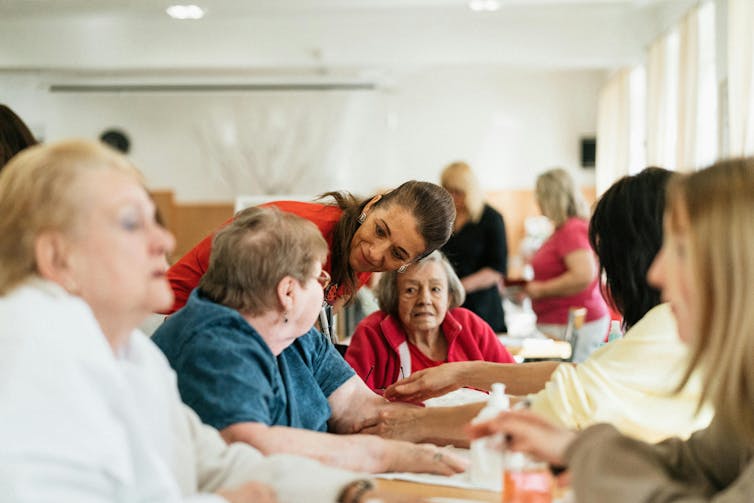
Older people sitting at a table and a younger person standing, speaking with them
Care staff in a study said it was often simpler to locate residents in person.
(Pexels/Jsme Mila)

Real-time location systems

An RTLS works like an indoor GPS. Residents under care at a long-term care home (and sometimes staff) wear a tag or a bracelet with a sensor that communicates with beacons placed throughout the walls and ceilings of the building. The system enables the tracking of people wearing the sensor in real time, and collects movement data. It can also send automated geo-fencing alerts, such as when someone enters or exits a room.

Interest in RTLS in long-term care and other health-care settings largely stems from the belief that they can be useful for predicting changes in health and well-being if clinical algorithms could be developed to analyze movement data.

As part of a larger project, our research team conducted a study with residents, family caregivers, direct care staff and administrators in one home that purchased an RTLS. Administrators and family caregivers told us that RTLS could make care safer and more efficient by increasing staff’s ability to continuously monitor residents and enable quicker intervention.

However, staff informed us that it was often simpler to locate residents in person, and that they lacked time and resources for continuous remote monitoring of residents or to investigate and respond in real time.

This reinforced our findings from an earlier study of this technology in a hospital setting that similarly suggested that RTLS may increase staff workload. More concerningly, we found that administrators, staff and caregivers had limited awareness of this technology’s ethical implications, including its impact on residents, and lacked the knowledge and skills to involve residents in decision-making.

Power and control

In the setting we studied, consent for the use of RTLS came from substitute decision-makers — often a family caregiver — as most residents of the home lived with severe cognitive impairment or dementia. Many caregivers consented quickly, believing RTLS would help staff stay aware of residents’ whereabouts, without fully considering residents’ preferences. Few family caregivers involved residents in the consent process, despite their legal obligation as their substitute decision-makers to align decisions with residents’ values.

While most residents agreed to wear the bracelet, some explicitly rejected the idea of sharing their location data with family or staff. Over time, many wearers found no direct value in it and frequently described it as uncomfortable and heavy.

Caregivers didn’t fully know what data was collected by RTLS, who owned the data or how it would be used to improve care beyond localization. Still, most believed that having more information about residents’ movements was beneficial and morally justified the continuous surveillance.

Although privacy rights are protected by law in Canada and the United States, many family caregivers told the researchers they believed residents gave up those rights by entering long-term care. Some also sought access to RTLS data collected about their family members, expecting it would be shared to enhance transparency, although this never happened.

Staff faced their own challenges. Some were unsure how to explain RTLS’s benefits and risks to residents and to their families or respond to residents’ concerns. They lacked guidance on whether to respect a resident’s refusal to wear the tracking bracelet or override it based on family consent.

This left staff uncertain about how to balance residents’ autonomy with their duty of care, and contributed to moral distress among employees.

Future considerations

Our research suggests RTLS offers uncertain benefits and creates new challenges in an already under-resourced sector. Its use also raises ethical concerns, particularly around surveillance and control, which can exacerbate power imbalances and perpetuate digital ageism and digital ableism.

Digital ageism refers to discrimination on the basis of age that intersects with digital economies. Examples include limited or stereotypical representation of old age or older people in data training sets, tech design that doesn’t reflect the heterogeneity of older users, the push to replace humans with technologies in caring for older adults and automated algorithmic decision-making that discriminates against older adults.

Decision-making around RTLS needs to fully involve those who will be affected by these technologies. Before deciding to wear a tracking bracelet, residents and families should be supported in discussing this with care staff who help them to understand and reflect on:

  • What information will this technology collect?
  • Who will see it?
  • How will it be used in practice to improve my care?
  • Are these improvements worth compromising my privacy?

This is ethical decision-making: transparent, collaborative and grounded in dignity.

The Conversation

Alisa Grigorovich receives funding from AMS Healthcare (Fellowship in Compassion and Artificial Intelligence) and SSHRC.

Madalena Pamela Liougas does not work for, consult, own shares in or receive funding from any company or organisation that would benefit from this article, and has disclosed no relevant affiliations beyond their academic appointment.

ref. Tracking with care: The ethics of using location tracking technology with people living with dementia – https://theconversation.com/tracking-with-care-the-ethics-of-using-location-tracking-technology-with-people-living-with-dementia-268459

Robert Irwin wins Dancing with the Stars – a decade after sister Bindi

Source: Radio New Zealand

Robert Irwin has shimmied his way to victory and won the American version of Dancing with the Stars, lifting the coveted Mirror Ball trophy a decade after his sister won the same title.

Paired with professional ballroom dancer Witney Carson, the 21-year-old wildlife conservationist and presenter pulled off impressive choreography week after week to win the series — and the attention of international audiences.

Irwin battled four other celebrities and their partners in the finale: influencer Alix Earle, Olympic gymnast Jordan Chiles, actor Elaine Hendrix, and Zac Efron’s brother, Dylan Efron.

The marathon three-hour finale saw the five couples perform three dances, with the judges’ overall scores and audience votes being combined to determine the winner.

Irwin went into the final with a rib injury, requiring Carson to adapt their choreography.

After receiving 29 points out of a possible 30 for his first dance, Irwin fought back to net a perfect score for his final two dances.

At the end of the night, Irwin was tied second on the leaderboard with Chiles, with an overall score of 89 out of 90, behind Earle’s perfect score of 90.

As the audience votes were tallied, it was revealed Irwin and Earle were the top two contestants, with Irwin ultimately taking out the win.

The son of the late Steve Irwin cried after his final performance and said he wanted to make his dad proud.

I wish he could see it, I really wish he could be here,” he said.

In 2015, Bindi Irwin won her season of the celebrity dance competition show when she was just 17.

Dancing with the Stars, now in its 34th season, averaged about 6 million same-day viewers, according to Nielsen data, with the biggest gains this year among younger audiences.

Irwin’s weekly performances also racked up millions of views on YouTube — dwarfing those of his competitors.

The win marks yet another highlight in Irwin’s meteoric rise.

Swapping the zoo for the ballroom

Irwin’s debut on the Dancing with the Stars stage was quintessentially Australian — and quintessentially Irwin.

Dressed in his signature khaki, Irwin crouched on the hood of a 4WD with a pair of bedazzled binoculars as a kookaburra’s call rang out.

Suddenly, he leapt into the air, ripped off his khaki shirt and broke out into a jive to Steppenwolf’s ‘Born to be Wild’.

Over the course of the competition, Irwin and Carson tackled a technically difficult tango, a sultry salsa and a Wicked-inspired jazz routine to the musical’s hit ‘Dancing Through Life’.

But Irwin’s family ties became more prominent as the competition progressed.

For “dedication night”, Robert paid tribute to his mother Terri Irwin, who raised Robert and Bindi after Steve Irwin’s death in 2006.

Performing an emotional contemporary routine to ‘You’ll Be In My Heart’ by Phil Collins, a moment of strategic camera work saw Carson slip away, only to seamlessly be replaced by Terri.

My mum and dad were just … the ultimate team,” Irwin said post-show, choking up when talking to Entertainment Tonight.

“They created something so much bigger than themselves. In their love and passion, they created a legacy that I get to continue.

“My mum and her strength … that’s the reason why I’m here. I can not even imagine — I can’t put into words — how proud my dad would be of her.

“And I truly feel in some way, I don’t know how, but I really feel in some way … that he’s here in some way. And I hope he’s proud.”

Weeks later, Irwin paid tribute to his late father with a foxtrot to ‘Footprints in the Sand’ by Leona Lewis — the same song Bindi Irwin used for a similar tribute during her time on the show years earlier.

Bindi herself joined the pair on stage before a montage of Steve Irwin with a baby Robert was projected onto the dance floor, prompting Robert to break down.

The dance earned Irwin 10s across the board from the judges to net his highest score at the time — a perfect 40.

Afterwards, Irwin called the performance “healing”.

“I carry Dad’s legacy with me in every I do,” he wrote on Instagram.

“Dancing with the Stars” has capped off its renaissance season.

“Dancing with the Stars” has capped off its renaissance season.

Eric McCandless/Disney General Entertainment Con/Getty Images via CNN Newsource

A new era

Winning the hit American dance competition is yet another boon for Irwin’s burgeoning career.

In 2024, he was announced as the new co-host of I’m A Celebrity … Get Me Out of Here!

The move saw the then-20-year-old replace Dr Chris Brown and host the series alongside veteran presenter Julia Morris.

Only months later, he bagged a Gold Logie nomination, making him the youngest male nominee for the award — though he would miss out to television mainstay Larry Emdur.

Earlier this year, Irwin’s Bond’s campaign — which saw the star posing in only his underwear with various Australian reptiles — went viral.

“The defining moment I think for me when people kind of had an optical shift in the view of ‘Robert Irwin’ was when I got my kit off, got my gear off and did that ad,” he told People in September.

“All of a sudden, people kind of didn’t know how to react. I had people coming up to be like, ‘that’s … good for you!?’ Mostly my family!

“But it’s a new era, I want to embrace that I’m all grown up.”

– Published by EveningReport.nz and AsiaPacificReport.nz, see: MIL OSI in partnership with Radio New Zealand

Hong Kong high-rise fire: Similar renovations at Kiwi’s apartment building

Source: Radio New Zealand

Residents check clothing donated for them after a major fire swept through several apartment blocks at the Wang Fuk Court residential estate in Hong Kong's Tai Po district on November 27, 2025. Hong Kong firefighters were scouring a still-burning apartment complex for hundreds of missing people on November 27, a day after the blaze tore through the high-rises, killing at least 44. (Photo by Dale DE LA REY / AFP)

Residents check clothing donated for them after a major fire swept through several apartment blocks at the Wang Fuk Court residential estate in Hong Kong’s Tai Po district on November 27, 2025. Photo: AFP / Dale De la Rey

A New Zealander living in Hong Kong says the deadly apartment building fires have left him feeling he’s had a lucky escape.

The blaze that spread throughout a massive Tai Po housing complex ripped though bamboo scaffolding and mesh netting put up for renovations, [https://www.rnz.co.nz/news/world/580234/hong-kong-s-deadliest-blaze-in-decades-kills-at-least-83-scores-missing

killing more than 80 people, with hundreds more still missing.

In Hong Kong, bamboo has long been the material of choice for scaffolding because it’s cheap, abundant and flexible.

Michael Rudman said he and his family live in a high rise that’s part of group of nine buildings which have recently been renovated.

“They were also clad in bamboo and the net scaffolds for about a year and a half, that was only taken off three or four months ago,” he said.

“When the bamboo’s up, you don’t really think about that, it’s only when a disaster happens you think … that could have been my building.”

People watch the still burning Wang Fuk Court residential estate in Hong Kong's Tai Po district on November 27, 2025. Firefighters were still dousing a devastating fire on November 27 which ripped through a Hong Kong high-rise complex, killing at least 44 people and leaving hundreds missing according to authorities. (Photo by Peter PARKS / AFP)

People watch the still burning Wang Fuk Court residential estate in Hong Kong’s Tai Po district on November 27, 2025. Photo: AFP / Peter Parks

Rudman lives on Lantau Island, on the opposite side of Hong Kong.

“I was just relieved that my family was safe, but I really feel for those guys and everyone in Tai Po,” he said.

Rudman’s neighbours are renovating their property at present, and they have bamboo scaffolding up while the air conditioning is being replaced.

He understood the bamboo scaffolding industry was on its way out, and there would be a transition to metal, but he was not sure when.

During renovations it was normal for the entire building to be clad, he said.

“They basically block all the windows so you have to look through nets,” he said.

In March, the Hong Kong government announced half of all new public works contracts would use metal scaffolding, following the deaths of more than 20 bamboo scaffolders between 2019 and 2024.

– Published by EveningReport.nz and AsiaPacificReport.nz, see: MIL OSI in partnership with Radio New Zealand

Ukraine: deal or no deal?

Source: The Conversation – UK – By Jonathan Este, Senior International Affairs Editor, Associate Editor, The Conversation

This newsletter was first published in The Conversation UK’s World Affairs Briefing email. Sign up to receive weekly analysis of the latest developments in international relations, direct to your inbox.


At times this year, it has been difficult to pin down where the Trump administration stands on the war in Ukraine. Under Joe Biden, America’s position was clear: the Russian invasion was illegal and the US and its allies would do everything in their power – short of actually taking up arms – to bring the conflict to an end and secure a just and lasting peace for Ukraine.

This involved hundreds of billions of dollars in military and other aid and unrelenting diplomatic pressure. This was clearly not enough, and with Russia regularly issuing bloodcurdling nuclear threats, Biden and his advisers baulked at supplying Kyiv with the weapons that might have helped swing the conflict in Ukraine’s favour.

Since Donald Trump was sworn in for a second term, however, his administration’s mercurial approach to diplomacy has kept everyone guessing. The president’s position has oscillated between contempt for the Ukrainian president, Volodymyr Zelensky, and warmth towards the Russian president, Vladimir Putin, to anger at Putin and affection towards Zelensky.

It would be wrong to say that the US president hasn’t poured energy into securing some kind of deal with Russia. An article in the New York Times this week counted eight phone calls with Putin, five meetings between his envoy Steve Witkoff and the Russian leader and an in-person summit in Alaska.

But when news of a new peace plan emerged last week, it appeared as if the US had become, for all intents and purposes, the Kremlin’s interlocutor. Developed in Miami by Witkoff and Russian businessman Kirill Dmitriev, head of Russia’s sovereign wealth fund, the plan called for international recognition of Crimea and all land occupied by the Russians – by force – since 2014 as being henceforth sovereign Russian territory. Ukraine would also have to cede the remainder of the Donetsk and Luhansk oblasts, where fighting continues. Kyiv would have to accept restrictions on the size of its army and the door to Nato membership would be closed.

It reads like Putin’s original wishlist and is neither just nor fair, writes Selbi Durdiyeva, an expert in transitional justice at Nottingham Trent University. Nor does the deal pass muster legally. Durdiyeva walks us through the main objections. She also points out that research has shown that peace agreements imposed over the top of one party’s objections and interests and with no mechanism for accountability, more often than not fail to last.


Read more:
Any peace deal in Ukraine must be just and fair – the plan proposed by the US and Russia was neither


Once details of the deal were revealed, European leaders scurried to come up with a response. A revised and slimmed down plan was developed, which deferred some of the key points – including decisions on territory or Ukraine’s Nato membership – to a later date to be discussed between Zelensky and Trump. It also beefed up the language around security guarantees. This is the mechanism by which a peace deal would ensure that Russia cannot simply regroup and attack Ukraine again.

ISW map showing the state of the conflict in Ukraine, November 26 2025.
The state of the conflict in Ukraine, November 26 2025.
Institute for the Study of War

But while security guarantees are vital, Zelensky and his aides will be only too well aware of how flimsy they can be without real teeth. Ukrainians remember the Budapest Memorandum signed by Russia, the US and the UK in 1994, when Ukraine agreed to give up its nuclear arsenal – the third largest on the planet – in return for an agreement by all parties to henceforth respect Ukrainian sovereignty and the country’s internationally recognised borders.

At the risk of stating the obvious, that didn’t work out well for Ukraine. But as Jennifer Mathers points out, the agreement struck in Budapest was hardly robust when it came to guaranteeing Ukrainian security. It pledged, if Ukraine were to be attacked or threatened “with a nuclear weapon”, that the signatories would refer the situation to the UN security council.

Mathers, whose research in international relations at the University of Aberystwyth has a strong focus on modern Russian history, reports that the then president of Ukraine, Leonid Kuchma, remarked after the deal was done (prophetically as it turns out): “If tomorrow Russia goes into Crimea, no one will raise an eyebrow.”


Read more:
Ukraine peace deal will hinge on security guarantees – but Kyiv has been there before


Meanwhile, the killing continues. The Washington-based military thinktank, the Institute for the Study of War, says that while the progress on the battlefield remains extremely slow (it estimates that at the current rate, Russia could take until August 2027 to occupy the whole of the contested Donetsk region), the long-range strikes campaign against Ukraine’s cities is taking an increasingly heavy civilian toll.

Much of the killing, on both battlefield and in Ukraine’s cities, is being done by drones, which are estimated to be responsible for 60 to 70% of military deaths and thousands of civilians, in contravention of international law, according to the UN.

But, as Matthew Powell notes, just as drones have transformed the way this conflict has been waged, so technology is already being developed, which, it is hoped, will counter the devastating effect of unmanned aerial vehicles. This is a story as old as warfare itself. As soon as a new class of weapon has proved successful in battle, scientists and engineers find a way to thwart it.

Powell describes two weapons being developed by the British army and navy, which could be deployed relatively soon and which, it is hoped, will go a long way towards countering the threat posed by drones. Both are what’s known as “direct- energy weapons”. One, DragonFire, fires a laser capable of finding and shooting down targets from a distance of one metre. It can lock in on an object as small as a one-pound coin.

The other uses a pulse of directed radio waves to disable a drone’s internal electronics. It has the advantage of not having to lock on to one target (handy when there is cloud cover or fog) and can potentially be used to knock out several targets at once (handy when facing a swarm of drones).


Read more:
Drones have changed warfare. Two new weapons might be about alter its course again


Cry the beloved country

For two years, Sudan has been riven by a horrific civil war. Sudan’s army and the powerful paramilitary group, the Rapid Support Forces (RSF), have struggled for control of the central African country. Reports of massacres have become distressingly common, including of thousands killed when El Fasher, the capital of the western Darfur region, was captured after a lengthy siege.

An international group of researchers travelled to Sudan’s southern border, where they interviewed nearly 700 people who were trying to cross into South Sudan. Many of them had already crossed the same border, fleeing the civil war in South Sudan – now they were trying to get to a precarious safety there.

Many of the most harrowing stories were of the sexual violence experienced by women. And the horrifying finding by the research team was that it was adolescent girls who were most at risk. The Conversation’s Insights team worked with the researchers to compile this report, which will shock and upset in equal measure.


Read more:
‘I have to talk about it so that the world can know what happened to women and girls in Sudan’ – rape and terror sparks mass migration


Sign up to receive our weekly World Affairs Briefing newsletter from The Conversation UK. Every Thursday we’ll bring you expert analysis of the big stories in international relations.


The Conversation

ref. Ukraine: deal or no deal? – https://theconversation.com/ukraine-deal-or-no-deal-270850

A stranger’s face? The unresolved questions of face transplantation 20 years on

Source: The Conversation – UK – By Fay Bound-Alberti, Professor in Modern History and UKRI Future Leaders Fellow, King’s College London

When he saw the newspaper headlines in 2002, James Partridge was furious. Severely burned in a fire at 18, he spent his life advocating for people with “visible difference” through charities like Changing Faces and Face Equality International. Yet he found himself used as tabloid fodder in discussions about face transplants: how much better might James look with one?

The question emerged during a wave of publicity surrounding the UK’s bid to undertake the world’s first face transplant. Plastic surgeon Peter Butler and his team at the Royal Free Hospital in north London argued they were ready, claiming that nothing could match a face transplant for restoring appearance and function after severe injury.

The debate had been building for decades. The first successful kidney transplant in 1954 showed that replacing organs was possible. Since then, surgeons have transplanted hearts, lungs and most recently, hands. Some surgeons saw a natural progression: “a face is just like a hand”, they argued. But not everyone agreed.

James Partridge, for one, described the idea of face transplantation as ethically fraught and potentially harmful. As he argued in his commentary on the UK proposals, the procedure risked sending a message that disfigurement must be “fixed” at any cost.

The risks were already clear. Early reviews noted the potential for graft rejection, life-threatening infections, cancers and other complications linked to lifelong immunosuppressants. Yet the UK media were enthralled, especially after reports suggested the Royal Free team had identified a 14-year-old burns survivor as a potential first patient.

Partridge stepped in. He persuaded Sir Peter Morris, then President of the Royal College of Surgeons (RCS), to convene an expert working party. The resulting RCS report advised against proceeding at that stage. The psychological implications of giving someone a new face were unknown, making fully informed consent impossible. And what would it mean for others living with facial differences, if the surgical message implied their faces were not good enough?

Then everything changed. On November 27 2005, a French team led by Bernard Devauchelle and Jean-Michel Dubernard carried out the world’s first partial face transplant. The recipient was Isabelle Dinoire, a 38-year-old woman mauled by her pet Labrador after taking an overdose. When she woke on her sofa and tried to smoke, she couldn’t. In the bathroom mirror, she discovered the dog had chewed off part of her face.

At a press conference a few months later, Dinoire drank from a cup with new lips, spoke quietly, and expressed gratitude to surgeons and the donor.

Dinoire’s story became a global media spectacle.

In 2006, the RCS shifted position. Recognising that face transplants were now a surgical reality, it suggested they could proceed – but only with extreme caution. By that time, however, the UK programme had lost momentum, while centres in China, the US and elsewhere moved ahead.

Two decades on, only around 50 face transplants have been performed worldwide. Some patients have required re-transplantation after graft failure, but long-term survival data remains limited.

A face, it turns out, is not like a hand. Failed hand grafts can be removed; a rejected face leaves few good options. And immunosuppressants still carry significant risks.

Dinoire’s experience also underscores the psychological toll. She struggled with depression and intense media scrutiny, describing herself in one interview as feeling like a “circus animal”.

These are not the kinds of issues kidney or liver recipients usually face. A face is visible, social and symbolic. We meet the world with it; we recognise ourselves in it. Questions of identity, belonging and self-recognition sit at the centre of face transplantation.

James Partridge understood this. In his 2015 reflection on Dinoire’s operation, he praised her for taking what he called “a leap into the dark”. But he also warned that innovation must not outrun psychological support or a deeper understanding of what faces mean to people who live with visible difference.

At the same time, wider cultural pressures have only intensified. Social media has been linked with rising appearance anxiety among young people. Cosmetic surgery rates have climbed in recent years, and research also shows high rates of suicide and thoughts of suicide among people with body dysmorphic disorder, when perceived flaws in appearance become overwhelming. For this reason, surgeons often describe face transplants as “life-enhancing” rather than “life-saving”.

Understanding how and why faces matter – how they ground identity, relationships and social life – is far more complex than any single operation can capture. In my forthcoming book, I explore how faces act as a foundational marker of identity.

Twenty years after Isabelle Dinoire’s transplant, the world is still learning what it means to give someone a stranger’s face. The surgery itself is possible. The long-term consequences – medical, psychological and cultural – remain deeply uncertain.

The Conversation

Fay Bound-Alberti receives funding from a UKRI Future Leaders Fellowship

ref. A stranger’s face? The unresolved questions of face transplantation 20 years on – https://theconversation.com/a-strangers-face-the-unresolved-questions-of-face-transplantation-20-years-on-270698

Venezuela’s Cartel de los Soles: what are the implications of its US ‘terrorist’ designation?

Source: The Conversation – UK – By Brian J. Phillips, Reader (Associate Professor) in International Relations, University of Essex

The US escalated its dispute with Venezuela on November 24 when the state department added the Cartel de los Soles to its list of foreign terrorist organisations. It claims the network is a drug trafficking organisation led by the Venezuelan president, Nicolás Maduro. The reality is more complicated, but either way, the designation has serious implications.

The Cartel de los Soles is an interesting choice for the foreign terrorist organisation list. While it is indeed foreign to the US, it is probably not a terrorist organisation as most people understand them. Whether it is even an organisation in a formal sense is also up for debate.

The term “terrorist organisation” has traditionally been used for groups with political motivations. This includes groups that want to impose their religion on a country, or groups that are fighting for the political rights of an ethnic minority. Criminal groups like drug trafficking organisations, on the other hand, are mostly devoted to making money illicitly.

This distinction is important because some research, including my own, shows that counterterrorism tactics can lead to adverse consequences when used against criminal groups. The targeting of cartel leadership in Mexico, for example, has often led to more bloodshed as newly fragmented groups fight viciously for control of drug markets.

Experts also do not consider the Cartel de los Soles a formal organisation, but rather an informal network of individuals involved in the drug trade. There does not seem to be one single leader or other indicators of an organisation such as a clearly defined membership or meetings. No “member” of the group seems to use the term Cartel de los Soles.

Journalists in Venezuela started using the term Cartel de los Soles in the 1990s as a figure of speech for corrupt military officials apparently involved in the drug trade. Soles means suns in Spanish, and high-level military officers in Venezuela wear sun-shaped badges on their uniforms.

Venezuela located on a world map.
Venezuela’s geography helps it play a key role in the global drug trade.
BOLDG / Shutterstock

Venezuela’s geography helps it play a key role in the cocaine trade. While some cocaine is produced in Venezuela, even more passes through the country from neighbouring Colombia towards Europe and the US.

This creates an opportunity for corrupt officials – of which there are many in Venezuela – to profit substantially. Many sources say high-level Venezuelan generals are involved in the drug trade, but it is difficult to know exactly how widespread the problem is.

Implications of designation

A foreign terrorist organisation designation has several legal ramifications. First, “material support” for the group becomes a crime, so a person can be prosecuted for donating to or doing business with a designated organisation. Second, people deemed to be associates of the group could possibly be barred from entering the US. And third, US financial institutions with any funds connected to the group will need to report these to the US government.

It is unclear if the designation will actually affect the cartel’s supposed leaders given they have long been subject to US economic sanctions anyway. Venezuelan interior minister Diosdado Cabello, who is alleged to be a leader in the network, has been subject to sanctions since 2018. The US government already sanctions suspected drug traffickers through laws such as the Kingpin Act.

Venezuela’s government has denied the existence of the Cartel de los Soles, describing the new terrorist label as a “vile lie to justify an illegitimate and illegal intervention against Venezuela”. But it’s worth emphasising that a terrorist designation does not necessarily justify or authorise war, which Venezuelan officials seem to fear. The legislation behind terrorist listing does not mention military actions.

A terrorist designation is also meant to communicate US government priorities. It creates focal points for US agencies, while also signalling to other countries the threats they should join the fight against and the groups they should not support.

A US terrorist designation can be powerful. Other countries, especially US allies like the UK and Australia, have followed American terrorist designation patterns for decades. In 2008, the US designated the Somalia-based Islamist militant group al-Shabaab as a foreign terrorist organisation. Australia followed suit the following year, with Canada and the UK doing so soon after.

However, the pattern has not held so far in 2025 as the Trump administration has started to add criminal groups to its list of foreign terrorist organisations for the first time. This began in February, when the US government listed eight criminal groups, mostly Mexican drug cartels.

Few countries have joined the US in declaring these groups as terrorist organisations. European countries, for example, generally do not seem to see these groups as threats worthy of their terrorist lists.

As for the Cartel de los Soles, several countries have made pronouncements similar to the US terrorist designation. However, these are all Latin American countries like Argentina and Ecuador that currently have Trump-allied conservative governments. There has not been a wider international response, even from traditional US partners like Canada.

This is not ideal for the US government, as international cooperation is highly important for confronting transnational challenges like drug trafficking. The Trump administration’s approach of labelling criminal groups as terrorists does not look set to be adopted by most of its longtime allies.

The Conversation

Brian J. Phillips does not work for, consult, own shares in or receive funding from any company or organisation that would benefit from this article, and has disclosed no relevant affiliations beyond their academic appointment.

ref. Venezuela’s Cartel de los Soles: what are the implications of its US ‘terrorist’ designation? – https://theconversation.com/venezuelas-cartel-de-los-soles-what-are-the-implications-of-its-us-terrorist-designation-270627

To truly tackle child poverty, the UK needs to look again at migration

Source: The Conversation – UK – By Lucy Leon, Researcher – Centre on Migration, Policy & Society, University of Oxford

wavebreakmedia/Shutterstock

The UK government is expected to soon publish its ten-year child poverty strategy, designed to tackle the root causes of poverty for children.

Poverty is an issue for families from all backgrounds. But it is often particularly acute for the children of people born outside the UK. These families may not be permitted to access benefits because of their immigration status.

Instead, they may receive help from local authorities who, research my colleagues and I conducted shows, are operating a parallel welfare system – one that’s patchy and poorly resourced.

Or these families may get no help at all. They may avoid asking for support, fearful that contacting governmental services will jeopardise their families or their ability to stay in the UK.

Current Home Office proposals to extend the time migrants must spend in the UK before becoming eligible for settled status, and to introduce further welfare restrictions, may deepen poverty. This would not only prolong the time children and families have no access to public funds but also increase the number of children and families affected.

The government’s child poverty strategy must address the effect of immigration policy if it is to improve the lives of all children.

No recourse to public funds

The UK’s current “no recourse to public funds” immigration policy was formalised through the Immigration and Asylum Act 1999. It restricts access to most income-based welfare benefits for large numbers of people residing in the UK. It applies to most people holding temporary or time-limited visas to enter or remain in the UK.

These could be people on a time-limited work visa, health and care workers and students. It can include people who have come to the UK because they are married to or the family of a British person, and people building lives in the UK who have leave to remain on routes to settlement.

It is also applied by default to people with an irregular immigration status. This covers European nationals without EU settled status, families who have overstayed their visas and those awaiting an immigration decision.

The no recourse to public funds policy is aimed at “temporary migrants”. But many children in households subject to the policy are British-born or have spent most of their childhood in the UK. The policy is one of the biggest contributors to poverty, destitution, and social exclusion among children in resident migrant families.

In 2024, over half a million children – 578,954 – under the age of 18 were recorded as having a visa or leave to remain in the UK, which generally comes with a no recourse to public funds condition.

Sad girl hugging teddy
It’s likely that hundreds of thousands of children live in families with no recourse to public funds.
MAYA LAB/Shutterstock

While not all of them will experience poverty, children in migrant families living in the UK are at a disproportionately high risk of poverty and destitution. No recourse to public funds restrictions mean that families cannot access any benefits regardless of need. These include child benefit, universal credit, housing and disability-related benefits.

The Home Office maintains that there are existing safeguards, comprising of local authority social care teams with a statutory duty to provide a basic safety net to families facing destitution. While these safeguards can offer a lifeline to some, the system was designed for families at risk of destitution, the most severe hardship. It wasn’t intended to alleviate poverty or to be a substitute for the social security system.

The parallel safety net

Local authorities are, essentially, forced to provide a parallel welfare system, at a significant and unfunded cost. Our findings indicate that local authorities spent an estimated £65 million supporting families with no recourse to public funds in 2021-22.

However, at best, local authorities provide below-poverty-level weekly subsistence payments and substandard temporary accommodation for families with no recourse to public funds. However, there is a significant discrepancy in the level of support provided. With no clear statutory minimum rates, vulnerable families face a postcode lottery.

In some areas, a lack of financial policy means families receive only vouchers and foodbank referrals, while others rely on already-stretched social workers to define acceptable amounts. Many families end up turning to charities and food banks for emergency support.

There is no official data on the number of families with no recourse to public funds receiving local authority support across the UK. Through conducting our own survey, the local authorities that did respond reported supporting 3,108 of these destitute families, including 5,831 children between 2021-22.

However, many authorities do not record this data and were therefore unable to provide figures. Our research estimates the true number across all UK local authorities to be closer to 5,400 families, including around 10,500 children.

Even this estimate is unlikely to truly represent the wider need. Many parents do not ask for help. They are afraid that seeking help from statutory services will jeopardise their visa or future applications to remain in the UK. “I didn’t face them as I heard horrible, horrible stories,” one parent told us.

“I was told that if I didn’t have a safe and good home for my kids, they would take my kids,” another said. “People feel scared, so they won’t ask for help.”

The lack of support from the central government goes beyond just the finances. While there are some pockets of good practice within some local authorities, without statutory guidance for social care teams in England, many councils fail to provide the information, accommodation and support that families with children facing destitution are legally entitled to. We spoke to families who described the process of accessing support as humiliating, distressing and intrusive.

To tackle child poverty over the next decade, addressing both the impact of these welfare restrictions and the severe limitations of the parallel safety net system is vital. In the meantime, if local authorities are expected to provide a safety net, they need – at a minimum – dedicated central government funding and clear statutory guidance to fulfil their duties effectively.

Without this support, growing pressure on an inadequate system will continue to mount. The true cost will extend far beyond the overstretched budgets of social care teams.

The Conversation

As part of her research on migrant destitution, Lucy Leon has previously received research funding from the Aberdeen Group Charitable Trust (formerly known as abrdn financial fairness trust) and is currently receiving research funding from Trust for London.

ref. To truly tackle child poverty, the UK needs to look again at migration – https://theconversation.com/to-truly-tackle-child-poverty-the-uk-needs-to-look-again-at-migration-270335

The-two child limit failed – all it did was increase poverty

Source: The Conversation – UK – By Ruth Patrick, Professor in Social Policy, University of Glasgow

UK chancellor Rachel Reeves has taken decisive action in getting rid of the two-child limit – a policy that has held a totemic place in the UK for more than a decade. Since 2017, this policy has limited the means-tested support that families can receive from the state to the first two children in a household, with some specific exceptions.

But now, the two-child limit is to be scrapped from April 2026. My own research has shown how the limit often leaves families struggling to meet essential costs, and forced to forgo everyday activities. This could even be things like reading children a bedtime story as parents instead hunt round supermarkets for discounted food.

Both the two-child limit and the benefit cap (a ceiling on the support that a household where no one works 16 hours a week can receive, and which remains in place) were launched at the height of the UK’s austerity years.

At the time, the public were being served sensationalised portrayals of people receiving social security support. Politicians were happy to denigrate social security recipients too.

Amid claims of seeking to create more fairness in the tax and social security systems, politicians returned to binary divisions between “strivers” and “shirkers”. These representations bore little relationship to reality but they appeared to be electorally popular. And they provided the rationale to take a wrecking ball to what remained of the social security “safety net”.

Announcing the two-child limit in an emergency budget in 2015, the then chancellor, George Osborne, spoke of the need to support families while being fair to “working” people. This ignored the reality that millions of families require social security to top up the incomes they receive from paid employment.

The narrative does not align with the realities of in-work social security recipients – 2.7 million UK workers receive universal credit, a third of total recipients. And 59% of those affected by the two-child limit live in working households.

Neither is it possible to divide the UK into those who do and do not pay taxes. Everyone pays them, both through income taxation and taxes on goods and services. Some taxes, such as VAT, even leave those with the least handing over a much greater share of their income every time they pay for an item.

Hard realities

In introducing both the benefit cap and then the two-child limit, the Conservatives were seeking to change the behaviour of the people affected by these policies. In the case of the two-child limit, there was the suggestion that claimants would think differently about how many children they could afford to have, or change their employment patterns.

And in the case of the benefit cap, they hoped people would move into work. Or, where high rents were the issue, that people would move into cheaper properties.

But all of this was a mirage, and research I have undertaken with colleagues has shown how both of these policies fail. This failure is complete even in the terms set out by those who introduced them.

That is, with the two-child limit, there has been almost no noticeable impact on fertility, nor have there been changes to employment.

three children holding hands and playing in a forest
Families with more children are often vulnerable to economic shocks.
maxim ibragimov/Shutterstock

None of this is surprising because no one knows what their future holds. As Reeves argued in the budget, people lose their jobs, get sick or die prematurely. That’s why the social security system should be there to support people, providing help when times are hard.

The same applies with the benefit cap. The cheaper homes that the Conservatives hoped families would move into simply do not exist in many parts of the UK. Families living under the cap often face real and serious barriers to employment such as a lack of good childcare and poor transport links. These are not addressed by simply limiting financial support.

Instead, these policies create and deepen poverty and hardship. Both have directly resulted in rapid rises in poverty risks, especially for vulnerable groups like larger families, single parents and people with disabilities.


Read more:
In the struggle to get Britain working, the long shadow of austerity could be part of the problem


Given all of this evidence, it is surprising that the two-child limit was not scrapped earlier. Perhaps it has endured in part because of the pervasiveness of anti-welfare rhetoric – the prevalence of the language of “scroungers” and “skivers” that sociologists describe as constituting an “anti-welfare commonsense”.

While Reeves’ decision to axe the two-child limit prompted some predictably negative headlines, the vast majority of the UK public (83% according to recent polling) actually wants to see action on child poverty.

When kids can have the very best childhood possible it is good for all of us. Children free of poverty now will become adults who are more able to flourish and make a real and lasting contribution as workers, parents or carers in future.

Reeves set this out in her budget speech, and it would be great to hear more of these arguments from her and others in Labour in the weeks and months ahead. Perhaps this could even begin a reset of the UK’s relationship with social security after those long years of austerity.

The Conversation

Ruth Patrick leads research projects that are funded by various charitable foundations, including Nuffield Foundation, Trust for London and The Robertson Trust. She is a member of the Labour Party.

ref. The-two child limit failed – all it did was increase poverty – https://theconversation.com/the-two-child-limit-failed-all-it-did-was-increase-poverty-270841

La revolución que inició Francisco Suárez, el primer arquitecto del Estado de derecho

Source: The Conversation – (in Spanish) – By Angel Poncela-Gonzalez, Profesor Doctor en Filosofía. Especialización: suarismo; hispanismo filosófico; historia de la filosofía medieval y renacentista., Universidad de Salamanca

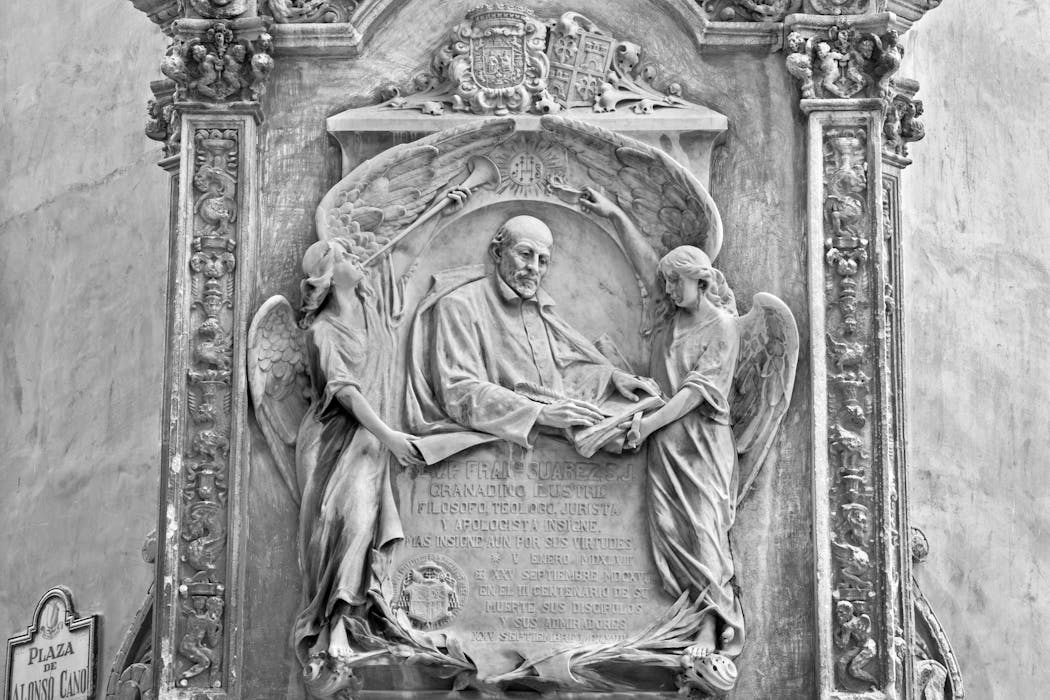
Relieve conmemorativo de Francisco Suárez en la fachada del Palacio Arzobispal de Granada, de 1917.

Renata Sedmakova/Shutterstock

A comienzos del siglo XVII, un jesuita español transformó el pensamiento político y jurídico europeo. Francisco Suárez (1548–1617), el más ilustre heredero de la Escuela de Salamanca, sistematizó y reelaboró sus ideas proyectándolas hacia la modernidad.

En una época de monarquías absolutas y guerras de religión, defendió que la ley no nace de la fuerza, sino de la razón; que la soberanía pertenece al pueblo y que la libertad humana es el fundamento de la justicia. Suárez fue, en cierto modo, el primer arquitecto del Estado de derecho.

En su Tratado de las leyes, afirmó que “la libertad es un don inseparable de la naturaleza racional del hombre”. Rompía entonces con la visión medieval del ser humano como súbdito de la voluntad divina. Para él, la razón humana puede descubrir el orden moral por sí misma. La libertad no se concede, sino que se posee por naturaleza. De esta idea brota el principio moderno que Immanuel Kant formularía un siglo y medio después al sostener que “la autonomía de la voluntad es el principio supremo de la moral”.

Este concepto de libertad es la raíz de su concepción jurídica. Suárez redefine el derecho como una “facultad moral que pertenece al individuo en cuanto persona libre”. El derecho deja de ser un conjunto de normas impuestas desde el exterior y se convierte en el poder legítimo del sujeto racional. Esta innovación, el derecho subjetivo –el paso del derecho como orden al derecho como facultad– será la semilla de la noción moderna de los derechos humanos.

El filósofo inglés John Locke lo retoma al afirmar que “cada hombre tiene una propiedad en su propia persona”, y se consagra en el ideario kantiano: “El hombre no tiene precio, sino dignidad”.

Un sistema jurídico para abarcarlos a todos

Sobre estos fundamentos, Suárez erige su sistema jurídico. En su Tratado de las leyes distingue entre ley eterna, ley natural, ley humana y ley divina positiva. Pero su gran innovación consiste en concebirlas no como un orden jerárquico y estático, sino como expresiones coordinadas de una misma razón.

“La ley humana –dice– es participación de la ley natural en la razón práctica del hombre”. Así, la legitimidad de la norma civil no depende de su naturaleza religiosa, sino de su racionalidad. El jurista y escritor neerlandés Hugo Grocio recoge esta idea cuando sostiene que el derecho natural “sería válido incluso si Dios no existiera”.

Negativo de una imagen de un dibujo de Francisco Suárez que forma parte de la colección de Harris & Ewing.
Library of Congress’s Prints and Photographs division

La ley natural, para Suárez, es “un dictamen de la razón recta que muestra que un acto es conforme a la naturaleza racional, y por ello, conforme a la ley eterna”. El énfasis en el papel fundacional de la razón supone el tránsito hacia una moralidad universal. La noción moderna de derecho subjetivo nace con él.

En relación con el pensamiento jurídico internacional define el derecho de gentes como “un consenso del género humano”. Al concebir la paz como fruto del acuerdo racional y no de la imposición religiosa, Suárez abre el camino a la diplomacia contemporánea y a la noción de comunidad internacional. En Sobre las tres virtudes teologales sostiene que “la guerra solo es justa cuando se ordena a reparar una injuria y es declarada por autoridad legítima”. Kant recogerá esa línea al afirmar que “ningún Estado debe intervenir violentamente en la constitución y gobierno de otro”. Los dos pensadores coinciden a la hora de subordinar la fuerza al derecho.

La soberanía popular

En el terreno político, el pensamiento de Suárez no fue menos revolucionario. En la Defensa de la fe católica, sostuvo que “Dios no confiere el poder político a un hombre determinado, sino al conjunto del pueblo”. El poder, por tanto, procede de la comunidad, que lo delega para el bien común. Esta tesis influiría en los filósofos Thomas Hobbes (quien la interpreta como pacto de obediencia), Locke (quien la considera delegación revocable) y Jean-Jacques Rousseau (quien la contempla como expresión de la voluntad general).

Suárez subrayó que la soberanía popular es el fundamento de toda legitimidad: “El poder reside radicalmente en el pueblo, que lo transfiere a los gobernantes para el bien común”. Precisamente por ello, si el gobernante abusa de ese poder, el pueblo conserva su derecho a retirárselo y en casos límite, cumple el deber ciudadano de recuperarlo.

La difusión de sus ideas fue sorprendente. Aunque la Facultad de Teología de París y Jacobo I condenaron y mandaron quemar sus obras en 1614 y 1615, sus tratados circularon ampliamente por las universidades reformadas. Uno de los juristas más importantes del siglo XVII en los Países Bajos, Arnold Vinnius, reconoció que nadie había explicado mejor las leyes divinas que Francisco Suárez.

El suarismo inspiraría después a los juristas alemanes. En opinión del historiador del pensamiento político Richard Tuck, “la influencia de Suárez en el pensamiento protestante” fue “la semilla del individualismo político moderno”.

Más allá del océano

Pero las ideas de Suárez no se circunscribieron al ámbito continental; también cruzaron el Atlántico. El principio de soberanía inspiró la revolución liberal y los movimientos independentistas americanos, que vieron en Suárez un antecedente del derecho de rebelión contra la tiranía. Su huella está presente en los puritanos de Nueva Inglaterra –como John Cotton y Roger Williams– y, más tarde, en los libertadores latinoamericanos, desde Francisco de Miranda hasta Simón Bolívar.

Como ha señalado el filósofo político Leo Strauss, “la modernidad política nace del intento de racionalizar el orden suareciano: conservar la forma de la ley natural, eliminando su referencia teológica. Suárez es el último teólogo de la cristiandad y el primer jurista de la razón moderna”.

La obra de Suárez es la demostración de que la modernidad no surgió por oposición a la escolástica, sino a partir de ella. Su racionalismo jurídico y su fe en la libertad anticipan los principios del Estado constitucional contemporáneo.

Cuando los límites del poder en ocasiones se vuelven difusos, la legitimidad de algunas leyes se pone en cuestión y el uso de la fuerza impera sobre la razón discursiva, volver a los escritos de Suárez es una invitación a recordar cuáles son los fundamentos del Estado de Derecho, qué papel cumple el ciudadano en su relación con el poder político y cómo las relaciones entre los diversos estados están sometidas a unas normas jurídicas para la resolución pacífica de los conflictos que no se pueden ignorar.


Este artículo surge de la colaboración con la Fundación Ignacio Larramendi, institución centrada en desarrollar proyectos relacionados con el pensamiento, la ciencia y la cultura en Iberoamérica con el objetivo de ponerlos a disposición de todo el público.

Más información aquí.


The Conversation

Angel Poncela-Gonzalez no recibe salario, ni ejerce labores de consultoría, ni posee acciones, ni recibe financiación de ninguna compañía u organización que pueda obtener beneficio de este artículo, y ha declarado carecer de vínculos relevantes más allá del cargo académico citado.

ref. La revolución que inició Francisco Suárez, el primer arquitecto del Estado de derecho – https://theconversation.com/la-revolucion-que-inicio-francisco-suarez-el-primer-arquitecto-del-estado-de-derecho-267256

De tiaras a manuscritos de Pushkin: cómo proteger nuestra historia de los robos de arte

Source: The Conversation – (in Spanish) – By Cristina de Juana Ortín, Personal docente e investigador, miembro del grupo de investigación ART-QUEO, UNIR – Universidad Internacional de La Rioja

shutterstock Baloncici/Shuttersock

A pesar de que Francia ya había implementado un plan de seguridad en todo su territorio debido a otros robos recientes, no pudo impedir la sustracción de algunas de las joyas expuestas en la Galería de Apolo del Louvre hace semanas. ¿Cómo proteger el patrimonio cuando los ladrones actúan en museos y bibliotecas?

La respuesta pasa por lo que la UNESCO llama justicia patrimonial: una forma de restitución que va más allá de lo económico.

Y es que cada pieza robada deja un hueco en la colección, una carencia en la memoria. Supone la interrupción de un vínculo cultural, histórico y simbólico. Y plantea una demanda de responsabilidad institucional y estatal.

Tiara de María Amalia de Nápoles y Sicilia y de Hortensia de Beauharnais, robada en el Louvre el 19 de octubre de 2025.
Wikimedia Commons., CC BY

El golpe Pushkin

En este sentido, el robo de libros o manuscritos raros en bibliotecas europeas adquiere una dimensión aún más grave, si cabe. Entre 2022 y 2023, desaparecieron, al menos, 170 libros antiguos y raros valorados en más de 2,8 millones de euros de bibliotecas de varios países europeos.

Fue un acto organizado y sistemático que las autoridades han calificado como “golpe Pushkin”, porque la mayoría habían sido escritos por este novelista y poeta ruso. Las obras no solo representaban ejemplares materiales de valor, sino memorias literarias de gran importancia para las culturas rusa y europea.

Retrato de Pushkin por Orest Kiprenski (1827). Galería Tretiakov, Moscú.
Orest Kiprenski.

Las implicaciones de este caso abren la puerta a la dimensión geopolítica del problema: ¿cómo articular la justicia patrimonial cuando los Estados, las redes de subastas, los mercados y las redes criminales se entrecruzan?

Una restitución auténtica exige cooperación internacional, transparencia en el comercio patrimonial y responsabilidad compartida entre los Estados implicados.

Memoria compartida

Aplicar la justicia patrimonial significa reconocer que el patrimonio no pertenece a una élite ni a una nación hegemónica. Este reconocimiento, por tanto, debe gestionarse desde la inclusión, la memoria compartida y la reparación.

En esta línea, la UNESCO ha presentado recientemente su Museo Virtual de Bienes Robados, gracias al cual un objeto retirado o robado deja de estar oculto y pasa a formar parte de un relato global de robo, restitución y memoria.

Como se explica en el blog del grupo de Investigación Museotech (UNIR), la digitalización ofrece un nuevo tipo de restitución simbólica: las piezas robadas pueden ser accesibles al público en formato virtual, devolviendo parte de su presencia cultural.

Nuestro derecho cultural

La justicia patrimonial tiene tres implicaciones clave. Primero, promueve el reconocimiento de las comunidades afectadas como sujetas de derecho cultural. No basta con que un objeto vuelva a su lugar de origen: debe restaurarse su valor simbólico, su contexto social y su función comunitaria.

Segundo, exige a las instituciones culturales prácticas transparentes de adquisición, conservación y devolución.

Tercero, impulsa políticas internacionales contra el tráfico ilícito basadas en cooperación policial, controles de mercado y herramientas digitales de acceso público.

En el caso de los libros raros robados, la pérdida cultural se agrava porque esos textos representaban legados literarios que ya no pueden ser reproducidos íntegramente. La solución no se limita a su devolución: debe contemplar la restauración de su acceso público, la documentación del robo y la implicación de los lectores y comunidades en su memoria.

Asimismo, el museo virtual abre la vía para que las piezas aún no recuperadas físicamente puedan aparecer en el ámbito digital, lo que convierte la restitución simbólica en un paso complementario hacia la justicia patrimonial.

Sustraer un trozo de historia

Finalmente, a través de la educación se debe incidir en que los robos de libros, joyas u otro tipo de piezas no supone solo la sustracción de esa obra, sino de una porción de la memoria colectiva.

La protección del patrimonio no es un empeño académico, es parte del tejido social que da sentido a nuestra historia en común. Por eso, son necesarios mecanismos eficaces para que el patrimonio pueda circular, se comparta y democratice en entornos seguros. Solo así podremos garantizar el acceso universal al patrimonio como derecho cultural.

Garantizar su acceso y preservación física y digital es el verdadero significado de hacer justicia patrimonial.

The Conversation

Cristina de Juana Ortín no recibe salario, ni ejerce labores de consultoría, ni posee acciones, ni recibe financiación de ninguna compañía u organización que pueda obtener beneficio de este artículo, y ha declarado carecer de vínculos relevantes más allá del cargo académico citado.

ref. De tiaras a manuscritos de Pushkin: cómo proteger nuestra historia de los robos de arte – https://theconversation.com/de-tiaras-a-manuscritos-de-pushkin-como-proteger-nuestra-historia-de-los-robos-de-arte-268409