En Afrique de l’Ouest, les services de prise en charge du VIH sous pression après la baisse des financements états-uniens

Source: The Conversation – France in French (3) – By Sophie Desmonde, Chargé de Recheche Inserm (CRCN) en santé publique – Centre d’Epidémiologie et de Recherche en santé des POPulations (CERPOP), Inserm UMR 1295, Université de Toulouse, Inserm

Réorganisations voire interruptions d’activités de soins, difficultés à assurer la continuité des traitements par antirétroviraux, stress pour les équipes soignantes et les malades… les conséquences de la réduction des fonds alloués à la lutte contre le VIH par l’administration Trump 2 se font déjà sentir. C’est ce que révèle une étude menée au sein de sites de prise en charge d’enfants et d’adultes vivant avec le VIH, répartis dans sept pays d’Afrique de l’Ouest. Nous dévoilons ses résultats en primeur, à l’occasion de la Journée mondiale de lutte contre le sida du 1er décembre 2025.


Depuis janvier 2025, le gouvernement des États-Unis d’Amérique a changé ses priorités en matière de santé. Cela s’est traduit par une réduction brutale de l’aide internationale fournie par le « Plan présidentiel américain d’aide d’urgence à la lutte contre le sida » (PEPFAR), programme clé du renforcement des systèmes de santé dans la lutte contre le VIH, ainsi que le démantèlement de l’Agence des États-Unis pour le développement international (USAID), qui était le principal bailleur de fonds américain pour l’aide sanitaire à l’échelle mondiale.

L’apport de ces programmes a été largement démontré et a sauvé des vies. En Afrique de l’Ouest, une partie importante des programmes de prise en charge du VIH dépend de ces soutiens.

Une enquête auprès de sites pour adultes et enfants, dans sept pays d’Afrique de l’Ouest

Pour mieux comprendre l’impact direct de ces coupes budgétaires, nous avons mené une étude descriptive détaillant l’organisation administrative, les ressources humaines, la distribution des traitements antirétroviraux, le suivi virologique, et le vécu au quotidien des patientes, des patients et des équipes soignantes de 13 sites cliniques adultes et enfants participant à la collaboration de recherche International Epidemiologic Database to Evaluate AIDS in West Africa. Ces résultats ont été acceptés en communication orale à la 9e édition des Rencontres des études africaines en France.

En 2024, l’Afrique de l’Ouest et du Centre comptait plus de 5 millions de personnes vivant avec le VIH, dont 37 % d’enfants. Face à la dette publique, la région n’a que peu de marge budgétaire pour financer les services de santé et de lutte contre le VIH. Il en résulte une forte dépendance aux financements extérieurs, en particulier au « Plan présidentiel américain d’aide d’urgence à la lutte contre le sida » (PEPFAR) qui contribue à garantir la disponibilité des médicaments antirétroviraux, indispensables à la survie des personnes vivant avec le VIH.

De plus, les ONG et associations locales, majoritairement financées pour leur part par l’agence USAID, ont un rôle essentiel dans la mise en œuvre de la prise en charge des personnes vivant avec le VIH en apportant un soutien logistique et humain. Pour mieux comprendre les conséquences à court terme de cette nouvelle situation de rupture budgétaire, et comment les équipes soignantes et les malades s’y adaptent, nous avons mené une enquête dans 13 sites cliniques répartis dans sept pays d’Afrique de l’Ouest, avec lesquels nous collaborons depuis vingt ans dans le cadre de nos recherches sur le VIH au Bénin, Burkina Faso, Côte d’Ivoire, Ghana, Mali, Nigeria et Togo. Ces sites suivent chacun en médiane plus de 3 000 malades adultes et enfants chaque année.

Entre avril et mai 2025, un questionnaire en ligne a été transmis aux responsables de sites. Le questionnaire comportait cinq volets : organisation du partenariat avec les bailleurs, ressources humaines, distribution des médicaments antirétroviraux, suivi de la charge virale, et ressenti des malades et des équipes soignantes vis-à-vis de la prise en charge globale.

Interruptions de soins communautaires, licenciements et autres impacts de la baisse des financements

Au total, 10 des 13 sites contactés ont complété le questionnaire. Parmi eux, cinq étaient directement financés par le plan PEPFAR et les autres par des ONG soutenues par l’agence USAID. La moitié des sites avaient déjà reçu des consignes de leur gouvernement pour adapter leurs activités en mode dégradé, démontrant une capacité de réponse rapide de la part des programmes nationaux de lutte contre le VIH.

Six sites sur dix ont dû suspendre ou supprimer des postes, touchant aussi bien des médecins que du personnel infirmier ou des conseillers techniques. Dans l’un des centres, une réduction de 25 % des primes a été décidée pour éviter des licenciements. Comme ces primes constituent l’essentiel du revenu pour les emplois associatifs, cette mesure a entraîné la démission de quatre médiateurs.

Dans un autre site, toutes les activités communautaires (groupes de soutien, séances d’éducation, conseil, dépistage) ont dû être interrompues entraînant le licenciement des personnes impliquées. Or ces activités jouent un rôle central dans la prise en charge du VIH : elles aident les malades à suivre leur traitement, assurent le suivi et renforcent le lien entre les équipes de soins et les communautés. Leur suspension fragilise l’accompagnement des personnes vivant avec le VIH.


À lire aussi :
L’éducation par les pairs dans la lutte contre le VIH menacée par les réductions de l’aide publique au développement


À la suite de ces suspensions et licenciements, les sites ont été obligés de revoir leur organisation. Ainsi ils ont mis en place des astreintes pour le personnel fonctionnaire, redéployé le personnel hospitalier, et redistribué les tâches afin d’éviter le surmenage du personnel soignant encore en poste, tout en assurant la continuité des soins VIH. En conséquence, s’ajoutent à la suspension des activités communautaires, des temps d’attente en salle de consultation rallongés, avec un impact direct sur la qualité globale de la prise en charge des patients.

La continuité du traitement à vie par antirétroviraux mise à mal

Dans huit des dix sites, tous les antirétroviraux restaient disponibles mais n’étaient plus délivrés pour une durée de six mois selon le calendrier habituel, mais seulement pour des périodes allant d’un à trois mois, ce qui a augmenté la fréquence des visites et la charge de travail pour les équipes comme pour les patientes et patients. Dans deux autres sites, des ruptures de stock déjà présentes avant les coupes budgétaires, persistaient et concernaient plusieurs antirétroviraux utilisés chez l’adulte.

Dans un centre, une situation particulièrement préoccupante et non éthique a été signalée : comme les contrats nationaux avec le plan PEPFAR imposent de garantir la continuité des soins à vie pour les personnes déjà sous traitement antirétroviral, les équipes ont eu pour instruction de prioriser ces malades en raison du risque de pénurie, et de ne pas commencer le traitement antirétroviral chez les adultes nouvellement diagnostiqués comme infectés par le VIH, contrairement aux recommandations universelles qui préconisent de tester et de traiter.

Cinq sites ont indiqué qu’il leur manquait des réactifs indispensables pour faire les tests de charge virale. Plusieurs sites ont reprogrammé les mesures de charge virale, alors que d’autres ont dû les faire réaliser par d’autres plateformes. Or, le suivi de la charge virale est un indicateur clé de la prise en charge du VIH : il permet de vérifier l’efficacité du traitement, de détecter les échecs thérapeutiques et de réduire le risque de transmission. Ces interruptions ou retards ont fragilisé le suivi clinique des patients les exposant à un risque accru de complications.

Trois sites ont rapporté une augmentation des interruptions de traitement ou des abandons de la part des patientes ou patients alors que deux sites n’ont pas constaté d’impact notable au moment de l’enquête.

Augmentation du stress et baisse de la satisfaction professionnelle

Ailleurs, les cliniciens ont observé une montée de l’anxiété des malades, liée à l’incertitude sur la disponibilité future des médicaments, de la frustration face aux examens retardés ou impossibles à réaliser, et la crainte que le traitement devienne moins efficace. Certains malades s’inquiètent de « ce qu’il adviendra si les financements américains s’arrêtent complètement ».

Dans les sites pédiatriques, les équipes rapportent un stress accru chez les enfants, lié notamment à l’arrêt de certaines activités récréatives qui jouaient un rôle important dans leur accompagnement.

Six sites sur dix rapportent un impact direct sur leurs équipes soignantes, avec un sentiment d’impuissance face aux restrictions, une baisse de la satisfaction professionnelle, et une augmentation du stress, notamment face à l’agressivité des malades dans ce contexte d’incertitude.

Et se profile un désengagement des pays donateurs au Fonds mondial de lutte contre le sida

Ces mesures documentent l’impact à court terme des réductions de financement dans un contexte géopolitique évolutif, et montrent que la dépendance aux financements extérieurs fragilise la continuité des soins.

D’autres pays, dont la France, ont déjà annoncé qu’ils allaient diminuer leur aide internationale, réduisant ainsi leurs engagements au profit du Fonds mondial de lutte contre le VIH.


À lire aussi :
La France, championne de la lutte mondiale contre le VIH/sida ? Retour sur 40 ans de diplomatie face à la pandémie


Les conséquences à long terme pour les personnes vivant avec le VIH sont malheureusement déjà prévisibles, mais nous devrons les documenter en tenant compte de la résilience des systèmes de santé face à un tel événement.

The Conversation

Sophie Desmonde a reçu des financements de l’ANRS-MIE, Sidaction, et NICHD

Antoine Jaquet a reçu des financements de l’ANRS-MIE et des NIH.

Kiswend-Sida Thierry Tiendrebeogo a reçu des financements de l’ANRS-MIE.

Valériane Leroy a reçu des financements de l’ANRS-MIE, Expertise France, Sidaction, Europe-EDCTP, NICHD, UNITAID.

ref. En Afrique de l’Ouest, les services de prise en charge du VIH sous pression après la baisse des financements états-uniens – https://theconversation.com/en-afrique-de-louest-les-services-de-prise-en-charge-du-vih-sous-pression-apres-la-baisse-des-financements-etats-uniens-270724

Israel’s Netanyahu seeks pardon in years-long corruption trial

Source: Radio New Zealand

By Alexander Cornwell, Tamar Uriel-Beeri and Omri Taasan

Israeli Prime Minister Benjamin Netanyahu participates in a joint press conference with US President Donald Trump (off frame) in the State Dining Room of the White House in Washington, DC on September 29, 2025. US President Donald Trump said on Monday that Washington was "very close" to securing peace in the Gaza war, after meeting with Israeli Prime Minister Benjamin Netanyahu and releasing a 20-point peace plan. (Photo by ANDREW CABALLERO-REYNOLDS / AFP)

Israeli Prime Minister Benjamin Netanyahu. Photo: AFP / ANDREW CABALLERO-REYNOLDS

Israeli Prime Minister Benjamin Netanyahu has asked the country’s president for a pardon in his long-running corruption trial, arguing that criminal proceedings were hindering his ability to govern and a pardon would be good for Israel.

Netanyahu, the country’s longest-serving prime minister, denies the bribery, fraud, and breach of trust charges. His lawyers said in a letter to the president’s office that the prime minister still believes the legal proceedings would result in a complete acquittal.

“My lawyers sent a request for pardon to the president of the country today. I expect that anyone who wishes for the good of the country support this step,” Netanyahu said in a brief video statement released by his political party, the Likud.

Neither the prime minister, who has been on trial for five years, nor his lawyers made any admission of guilt.

Opposition leader Yair Lapid said Netanyahu should not be pardoned without admitting guilt, expressing remorse, and immediately retiring from political life.

Pardons in Israel have typically been granted only after legal proceedings have concluded and the accused has been convicted. Netanyahu’s lawyers argued that the president can intervene when public interest is at stake, as in this case, with a view to healing divisions and strengthening national unity.

President Isaac Herzog’s office described the request as “extraordinary” with “significant implications”. The president “will responsibly and sincerely consider the request” after receiving relevant opinions, his office said.

US President Donald Trump wrote to Herzog this month, urging him to consider granting the prime minister a pardon, saying the case against him was “a political, unjustified prosecution”.

Herzog’s office said the request would be forwarded to the pardons department in the justice ministry, as is standard practice, to collect opinions, which would be submitted to the president’s legal adviser, who will formulate a recommendation for the president.

Israel’s Justice Minister, Yariv Levin, is a member of Netanyahu’s Likud party and a close ally of the prime minister.

In the letter, Netanyahu’s lawyers argued that criminal proceedings against him had deepened societal divisions and that ending the trial was necessary for national reconciliation. They also wrote that increasingly frequent court hearings were burdensome while the prime minister was attempting to govern.

“I am required to testify three times a week … That is an impossible demand that is not made of any other citizen,” Netanyahu said in the video statement, emphasising that he had received the public’s trust by repeatedly winning elections.

Netanyahu was indicted in 2019 in three separate but related cases that centre around accusations that he granted favours to prominent business figures in exchange for gifts and sympathetic media coverage.

The prime minister has repeatedly denied any wrongdoing.

Coalition allies issued statements supporting Netanyahu’s request for a pardon, including National Security Minister Itamar Ben-Gvir and Finance Minister Bezalel Smotrich.

Opposition politician Yair Golan, a former deputy chief of the military, called on the prime minister to resign, urging the president not to grant a pardon.

Netanyahu is one of the country’s most polarising political figures, who was first elected prime minister in 1996. He has since served in government and opposition and returned to the prime minister’s office following the 2022 election.

The next election is due by October 2026, and many polls indicate that his coalition, the most right-wing in Israel’s history, would struggle to win enough seats to form a government.

Throughout his career, Netanyahu has cultivated a reputation for prioritising security and economic issues, but he has also been dogged by the corruption charges. He was prime minister on 7 October 2023, when Hamas launched its attack on Israel, widely regarded as the most traumatic event in the country’s history and the deadliest assault on Jews since the Holocaust.

Since then, he has overseen the devastating war in Gaza, which has killed tens of thousands of Palestinians and levelled much of the territory, drawing broad international criticism and condemnation. Israel has severely weakened Hamas and also Lebanese militant group Hezbollah and this year launched a war against Iran that destroyed critical military infrastructure.

– Reuters

– Published by EveningReport.nz and AsiaPacificReport.nz, see: MIL OSI in partnership with Radio New Zealand

Calls for accountability over lethal Hong Kong fire silenced

Source: Radio New Zealand

By Holmes Chan

Miles Kwan, a 24-year-old student, speaks to AFP while handing out flyers outside a train station in Hong Kong's Tai Po district on November 28, 2025, following the deadly fire at the Wang Fuk Court residential complex. Local media reported that Kwan was arrested by national security police for sedition on November 29 after starting an online petition with "four key demands", which include an independent probe into the fire. (Photo by Holmes CHAN / AFPTV / AFP)

Miles Kwan. Photo: AFP / HOLMES CHAN

Not long before he was reportedly detained, Miles Kwan approached commuters outside a Hong Kong train station, urging them to demand accountability for the deadly inferno that tore through nearby apartment blocks.

“We all feel unhappy that (Hong Kong) has come to this and we want things to improve,” the 24-year-old student told AFP on Friday while handing out flyers that called for an independent probe into the blaze, which killed at least 146 people this week.

“We need to be frank about how today’s Hong Kong is riddled with holes, inside and out.”

The demands by Kwan and other organisers turned into an online petition that gained more than 10,000 signatures in less than a day.

However, Hong Kong media reported on Saturday night that Kwan was arrested by national security police on suspicion of sedition and the text of the online petition had been deleted, showing how, under Beijing’s watchful eye, dissenting voices in Hong Kong can vanish as quickly as they appear.

Police declined to confirm the arrest on Saturday, saying only that they “will take actions according to actual circumstances and in accordance with the law”.

Thick smoke and flames rise as a major fire engulfs several apartment blocks at Wang Fuk Court in Hong Kong's Tai Po district on November 26, 2025. Four people died after multiple blocks in a Hong Kong residential estate went up in flames on November 26, with local media earlier reporting that some residents were trapped. (Photo by Yan ZHAO / AFP)

Thick smoke and flames rise as a major fire engulfs several apartment blocks at Wang Fuk Court in Hong Kong’s Tai Po district on November 26, 2025. Photo: Yan Zhao / AFP

AFP sought further comment from the police on Sunday, while calls to Kwan went unanswered.

Hong Kong was once home to spirited political activism, but that has faded since Beijing imposed a strict national security law in 2020 following huge pro-democracy protests in the Chinese finance hub.

Kwan was reportedly detained not long after Beijing’s national security arm in Hong Kong publicly condemned “anti-China forces” for exploiting the disaster and “inciting social division and stirring hatred against authorities”.

Asked on Friday if he feared arrest, Kwan said he was only “proposing very basic demands”.

“If these ideas are deemed seditious or ‘crossing the line’, then I feel I can’t predict the consequences of anything anymore, and I can only do what I truly believe.”

Grenfell comparisons

The flyers Kwan and a handful of activists gave out at the train station near the charred residential estate demanded government accountability, an independent probe into possible corruption, proper resettlement for residents and a review of construction oversight.

The demands reflected a belief that the fire was “not an accident” but a man-made disaster, he said.

Authorities have arrested 11 people in connection to the blaze that tore through seven of the eight high-rise blocks of Wang Fuk Court, the world’s deadliest residential building fire since 1980.

Hong Kong has previously used judge-led commissions of inquiry to undertake complex fact-finding exercises in a public forum — a practice left over from British colonial rule.

By contrast, city officials have so far announced only an inter-departmental task force to investigate the blaze.

When Britain was grappling with public fury over the devastating Grenfell Tower fire in 2017, which killed 72 people, the government there announced a public inquiry.

Lawyer Imran Khan, who represented the bereaved and survivors in the inquiry, told AFP “the lessons from Grenfell apply around the world” because all governments need to ensure high-rise residential buildings are safe.

Khan said a public inquiry with court-like powers was a better option for the situation in Hong Kong because “an internal investigation will not get to the truth and there will be no faith in it by the bereaved, survivors and residents”.

Based on his experience with Grenfell residents, he said, “without justice they cannot grieve”.

Many commuters took the flyers at the Hong Kong station on Friday, although few stopped to chat with Kwan or his companions.

A short walk away near the site of the blaze, a long queue snaked through a park as mourners brought flowers and handwritten notes of remembrance.

One unsigned note left on the ground read: “This is not just an accident, it is the evil fruit of an unjust system, which landed on you. It’s not right.”

– AFP

– Published by EveningReport.nz and AsiaPacificReport.nz, see: MIL OSI in partnership with Radio New Zealand

Sri Lanka flooding: ‘Entire lives swept away in a single night’

Source: Radio New Zealand

People in New Zealand with family in Sri Lanka are describing the widespread devastation caused by severe flooding from Cyclone Ditwah.

The [https://www.rnz.co.nz/news/world/331910/death-toll-continues-to-rise-half-a-million-displaced-by-sri-lanka-floods extreme weather system has destroyed homes, leaving thousands displaced. A state of emergency has also been declared.

There are also reports that entire villages have been washed away in landslides and many villages have been completely cut off.

Cyclone Ditwah in the Spring Valley area (part of Badulla) in Sri Lanka.

Cyclone Ditwah in the Spring Valley area (part of Badulla) in Sri Lanka. Photo: Supplied / Lasitha Buddika

Statistics from the Sri Lanka Disaster Management Centre [DMC] showed 212 people had died and 218 people were missing as of Sunday evening.

Aucklander Sachindra Amarasekara grew up in Sri Lanka and has family in Hanwella near the capital of Colombo.

“They are surrounded by flood water. Fortunately, their house itself has not been severely damaged, but they are in complete isolation.

“And also, the electricity lines are destructed [damaged], leaving them without power, and all internet connections are down due to damage to the service providers.

‘We heard reports that the flooding has affected the main water treatment plant in Colombo at the moment, which means they may soon lose access to drinking water as well, unfortunately.”

Cyclone Ditwah in the Spring Valley area (part of Badulla) in Sri Lanka.

Cyclone Ditwah in the Spring Valley area (part of Badulla) in Sri Lanka. Photo: Supplied / Lasitha Buddika

Amarasekara said it is a really hard time for many people.

“I’m very sure many people have seen their entire lives swept away in a single night. There’s a sense of helplessness, that’s what I felt from my father when I last I spoke to him.

“And also most of my friends and families, when I speak to them or when they’re receiving the text messages, I felt like they are quite feeling like hopeless.

“I’m sure many of them are mentally scattered, trying to understand what comes next.”

Cyclone Ditwah in the Spring Valley area (part of Badulla) in Sri Lanka.

Cyclone Ditwah in the Spring Valley area (part of Badulla) in Sri Lanka. Photo: Supplied / Lasitha Buddika

Amarasekara said many communities are isolated due to landslides, making it hard to get supplies and rescue teams to some areas.

“All three forces and the police are working really hard to reach the affected areas and get people out, and communities are also stepping to collect dry food and preparing warm meals to distribute.

“Unfortunately, most of the places, they can’t reach still because of the severe landslides, and also, the roads are not there some places and there is still floods going on.

“So many people trapped inside, so many people missing at the moment.” she said.

Cyclone Ditwah in the Spring Valley area (part of Badulla) in Sri Lanka.

Cyclone Ditwah in the Spring Valley area (part of Badulla) in Sri Lanka. Photo: Supplied / Lasitha Buddika

She said it is hard to see, as her country had already been through so much recently.

“I feel so sorry for my people because we’re just coming out from the economic crisis and we’re just about to stand on our own feet, and this is the worst we faced so far.

“We have faced wars, we have faced tsunamis, we have faced so many things, we lost so many people along the way.”

Amarasekara said as a nation, the country always comes back stronger but: “This is the very first time in Sri Lanka, I have seen that we are seeking for international help,” she said.

Cyclone Ditwah in the Spring Valley area (part of Badulla) in Sri Lanka.

Cyclone Ditwah in the Spring Valley area (part of Badulla) in Sri Lanka. Photo: Supplied / Lasitha Buddika

Samith Hettiarachchi lives in Mulleriyawa, and was told to evacuate, leaving everything behind, and said water would reach up to 20 feet and was rising 1 foot an hour.

Hansana Yaddehige also told RNZ his friends entire village was flooded, causing homes to collapse, power to go out, with no access to water.

Nipun Fernando said it was hard to get access to food.

“There is a shortage of grocery supply due to transportation issues. Devastation is pretty bad.

“Access to some areas totally blocked due to landslides and bridges been damaged. No more rain but as a result of all that rain rivers are overflowing, this is the worst ever flooding in the recent past,” he said.

Cyclone Ditwah in the Spring Valley area (part of Badulla) in Sri Lanka.

Cyclone Ditwah in the Spring Valley area (part of Badulla) in Sri Lanka. Photo: Supplied / Lasitha Buddika

The New Zealand Ministry of Foreign Affairs and Trade said it is providing consular assistance to a family travelling in Sri Lanka.

There are 200 New Zealanders registered on SafeTravel in Sri Lanka.

Sign up for Ngā Pitopito Kōrero, a daily newsletter curated by our editors and delivered straight to your inbox every weekday.

– Published by EveningReport.nz and AsiaPacificReport.nz, see: MIL OSI in partnership with Radio New Zealand

A-t-on un libre arbitre pour suivre les innovations technologiques ?

Source: The Conversation – France (in French) – By Xavier Pavie, Philosophe, Professeur à l’ESSEC, Directeur de programme au Collège International de Philosophie, ESSEC

Pour le philosophe Ivan Illich, l’individu se trouve pris dans les fers de l’innovation. Subh_Naskar/Shutterstock

Le prix de la Banque de Suède en sciences économiques en mémoire d’Alfred Nobel, décerné notamment à Philippe Aghion, a remis l’accent sur les bienfaits de l’innovation technologique, et son rôle crucial sur la croissance économique. Mais n’existe-t-il pas des innovations forcées ? La philosophie d’Ivan Illich peut nous éclairer à ce sujet.


En théorie, nous sommes tous libres d’acheter ou non les nouveaux modèles de smartphones, ou d’adopter les nouvelles générations technologiques. Dans la pratique, il est très difficile de résister. Les travaux sur la résistance des clients à l’innovation se multiplient. Certains abordent la question de l’innovation forcée, principalement à l’intérieur des entreprises et des administrations. L’organisation même des marchés peut mener à ces situations d’innovations forcées.

Un certain nombre d’acteurs, dominants sur le marché, peuvent imposer des produits plus rentables ou plus avantageux pour eux. Un exemple emblématique en est le compteur « intelligent » Linky d’Enedis. Malgré les résistances des particuliers et même parfois des collectivités locales, très bien analysées dans les travaux de Cécile Chamaret, Véronique Steyer et Julie Mayer, l’installation de ce compteur est devenue obligatoire.

Alors a-t-on un libre arbitre pour décider ou non d’adopter une nouvelle technologie ?

Contrôle du libre arbitre

Le philosophe Ivan Illich s’interrogeait dans son ouvrage la Convivialité (1973) sur la notion de création de besoins à partir de ce qu’il nomme des « monopoles radicaux ». Selon ce penseur critique de la société industrielle, les institutions exercent un contrôle sur le libre arbitre de chacun en créant des besoins et des solutions de toutes pièces, ce qui crée des dépendances. Ces monopoles radicaux peuvent s’incarner dans la médecine, le système de transport ou encore l’école.

Cette situation s’avère particulièrement problématique, car elle engendre une dépendance généralisée des individus envers ces « monopoles radicaux » qui contrôlent la satisfaction des besoins. La recherche du profit dans la production industrielle prime sur la réponse authentique aux besoins de la population. À terme, elle engendre une société de consommation aliénante où les individus n’ont plus ni autonomie ni capacité à faire des choix éclairés.

« Il y a monopole radical lorsque l’outil programmé évince le pouvoir-faire de l’individu. Cette domination de l’outil instaure la consommation obligatoire et dès lors restreint l’autonomie de la personne. »

L’individu pris dans les fers de l’innovation

Pour Ivan Illich, l’innovation a un rôle clef puisqu’elle est la réponse à ces besoins créés ; l’individu se trouve pris dans ses fers. Cette contre-productivité de l’innovation se manifeste par la détérioration qu’elle cause sur l’être humain lui-même, sur son autonomie et sa capacité de conscience. Elle l’est également sur son environnement, car les institutions « créent des besoins plus vite qu’elles ne peuvent les satisfaire et, tandis qu’elles s’efforcent en vain d’y parvenir, c’est la terre qu’elles consument ».


À lire aussi :
Le prix Nobel d’économie 2025 met à l’honneur la création et la destruction économique


Le manque de réflexion sur la nécessité réelle de l’innovation, et l’inexistence de son évaluation a priori, finissent par avoir des conséquences sur nos ressources. Chaque nouveau smartphone, ordinateur, réseau social, nanotechnologie, intelligence artificielle n’apporte pas moins de contre-productivité face à ce que ces innovations seraient censées apporter : liberté, ouverture et connexion aux autres, indépendance, etc.

La course à laquelle se livre l’innovation, à une vitesse sans cesse accrue, ne mène-t-elle pas progressivement l’humain non pas au progrès, mais à sa perte ?

Avoir ou utiliser le dernier cri

Au cours des derniers mois, deux innovations très médiatiques ont été lancées sur le marché : ChatGPT 5 d’Open AI et l’iPhone 17 d’Apple. La première, nouvelle version de l’IA générative d’Open AI promet une meilleure logique, une multimodalité élargie (texte, image, vidéo) et une rapidité accrue par rapport à la version précédente. La nouvelle version du plus célèbre des smartphones propose, quant à elle, un nouvel écran légèrement plus lumineux, une double caméra arrière optimisée dans un contexte de faible éclairage, et rend possible un enregistrement simultané des caméras avant et arrière.

Pour l’immense majorité des usages, dans un cas comme dans l’autre, aucune différence n’est réellement perceptible par les utilisateurs. Les propositions relèvent plus de bénéfices symboliques (avoir ou utiliser le dernier cri) que de bénéfices liés à l’usage. Le baromètre de l’innovation responsable européen montre ainsi que 59 % seulement de la population, en France, pense que les sciences et technologies « rendent [sa] vie plus facile, plus confortable et les f[ai]t vivre en meilleure santé ».

En revanche, la fabrication d’un smartphone nécessite l’extraction d’une cinquantaine de métaux différents, et la fabrication des nouveaux terminaux représente 60 % de l’impact environnemental du numérique en France, lui-même en forte croissance. Quant à Chat GPT5, selon une étude récente de l’Université Rhode Island, il utilise en moyenne 18 wattheures par réponse fournie, soit l’équivalent du fonctionnement d’une ampoule incandescente pendant dix-huit minutes.

Peu de valeur ajoutée fonctionnelle

Ces deux exemples récents n’ont rien à envier à d’autres développements équivalents.

L’image 4K sur Netflix nécessite des équipements de captation (caméras) et de diffusion (ordinateur ou téléviseur) renouvelés et un abonnement Premium, plus cher, et ce malgré une différence minime à l’œil nu. Le protocole wifi 7 offre plus de débit et permet le passage d’une trentaine de secondes à dix secondes pour télécharger un film en haute définition, mais nécessitant de changer l’ensemble des équipements (box, terminaux).

On peut s’étonner que ces innovations rencontrent le succès malgré le peu de valeur ajoutée fonctionnelle qu’elles apportent. Mais pouvons-nous, en tant que consommateurs, résister à cette déferlante technologique ?

Mise à jour permanente

Dans le domaine du numérique, le fonctionnement des produits en réseau a pour corollaire un système de mises à jour permanentes. Il rend concrètement inutilisables les anciens modèles de hardware ou les anciennes versions des software. Pour faire fonctionner les dernières versions de messagerie, il est nécessaire de télécharger un système d’exploitation suffisamment récent, qui nécessite lui-même une mémoire dont ne dispose que les modèles plus récents de smartphone.

Le choix de conserver une ancienne version n’est pas disponible, même lorsque l’on n’est pas intéressé par les nouvelles fonctionnalités qu’elle propose, souvent très spécialisées. Les individus se trouvent contraints de suivre, même à distance, les avancées technologiques. Sans en avoir eu le désir ou l’intention, les individus se voient entraînés dans des usages nouveaux, qui peuvent ensuite être ressentis comme de véritables besoins.

Biais pro-innovation

Faire une économie globale des innovations est devenu clé. Si les êtres humains ne peuvent résister individuellement, les sociétés le peuvent-elles au niveau global ? Comme le souligne le professeur de management Franck Aggeri, la théorie schumpéterienne souffre d’un biais pro-innovation, en minorant ou ignorant souvent les impacts négatifs des innovations.

La notion de valeur étendue qui ajoute à la valeur pour le consommateur, la valeur – positive ou négative – pour la planète ou pour la société permet de prolonger la réflexion, mais n’est pas opérée au niveau macro-économique.

L’économie globale des innovations technologiques n’est jamais pensée, aucune innovation n’est présentée dans une perspective globale, complexe, avec pertes, profits, et dégâts collatéraux.

The Conversation

Les auteurs ne travaillent pas, ne conseillent pas, ne possèdent pas de parts, ne reçoivent pas de fonds d’une organisation qui pourrait tirer profit de cet article, et n’ont déclaré aucune autre affiliation que leur organisme de recherche.

ref. A-t-on un libre arbitre pour suivre les innovations technologiques ? – https://theconversation.com/a-t-on-un-libre-arbitre-pour-suivre-les-innovations-technologiques-269002

Droits de douane américains : en attente d’une décision historique de la Cour suprême

Source: The Conversation – France in French (3) – By Antoine Bouët, Directeur, CEPII

Depuis son retour à la Maison Blanche en janvier 2025, Donald Trump ne cesse de jouer des droits de douane afin d’obtenir les conditions les plus avantageuses possible pour les États-Unis dans leurs rapports commerciaux avec leurs nombreux partenaires. Mais le président dispose-t-il réellement de telles prérogatives ? La plus haute juridiction du pays, la Cour suprême, va devoir trancher. Et contrairement à ce qu’on croit souvent, bien que sa composition penche nettement à droite, elle ne va pas nécessairement aller dans le sens de la présidence…


Parmi tous les droits de douane appliqués par l’administration Trump depuis le début de l’année, une bonne partie ont été promulgués par décret présidentiel au nom de la loi des pouvoirs économiques liés à une urgence internationale (IEEPA, pour International Emergency Economic Power Act). Ce sont les droits de douane imposés en février sur le Canada, la Chine et le Mexique pour que ces pays fassent davantage d’efforts pour arrêter le trafic de fentanyl et le flux de migrants illégaux (« trafficking tariffs »), mais aussi les tarifs « réciproques » annoncés le 2 avril 2025 sur la pelouse de la Maison Blanche pour combattre les déficits commerciaux « inéquitables » que les États-Unis enregistrent avec certains de leurs partenaires.

Si ces décisions ont provoqué la stupeur et l’indignation dans de nombreux pays, un certain nombre d’entreprises et de secteurs d’activité aux États-Unis ont aussi réagi en déposant plainte auprès de juridictions inférieures sur l’utilisation de l’IEEPA par le président des États-Unis pour imposer des droits de douane.

La Cour suprême, acquise à Trump ? Pas si sûr…

L’IEEPA est une loi fédérale américaine autorisant le président à réguler le commerce après avoir déclaré l’état d’urgence nationale en réponse à toute menace inhabituelle et extraordinaire pesant sur les États-Unis et provenant d’une source étrangère.

Ce printemps, la Cour du district de Columbia et la Cour internationale du commerce ont conclu que cette utilisation de l’IEEPA n’était pas constitutionnelle. Elles ont cependant permis que les droits de douane en question continuent d’être appliqués, tout en faisant, à la demande de l’administration Trump, appel à un jugement de la Cour suprême des États-Unis. Celle-ci a procédé à une audition des plaignants et d’un certain nombre de personnalités de l’administration le 5 novembre 2025.

La Cour suprême va-t-elle remettre en cause les droits de douane imposés par Donald Trump au nom de l’IEEPA ?

Sachant qu’elle est composée de six juges réputés républicains (dont trois nommés par Donald Trump durant son premier mandat) et de trois démocrates, on pourrait penser que la réponse sera négative. Cependant, une majorité républicaine parmi les juges n’est pas la garantie d’une décision favorable à Donald Trump, et il semble aujourd’hui possible que la Cour suprême déclare ces droits de douane illégaux. Les arguments juridiques en faveur d’une telle décision sont solides.

Que disent les textes en vigueur ?

Aux États-Unis, comme dans de nombreux pays, c’est le Congrès qui a le pouvoir de décider des taxes. Et les droits de douane en sont. L’article 1 section 7 de la Constitution stipule que tout projet de loi comportant une levée d’impôt doit émaner de la Chambre des représentants, avec possibilité d’amendement par le Sénat.

Le terme de « droit de douane » (tariff) n’est pas contenu dans le texte de l’IEEPA. Celui-ci mentionne soit une régulation, soit un gel d’actifs ou une confiscation de propriété, soit un blocage de transactions. L’IEEPA a d’ailleurs été utilisé pour imposer des sanctions internationales à des individus ou des nations : par exemple, le gel des actifs financiers et immobiliers de personnes ayant gêné les efforts de stabilisation politique et la reconstruction en Irak en 2007 ou la prohibition d’importation de diamants bruts de Sierra Leone en 2001. Un droit de douane peut-il être considéré comme une régulation ? Si tel était le cas, alors toutes les agences en charge d’une régulation pourraient imposer des taxes.

Ensuite, il est difficile de considérer que le déficit commercial de biens des États-Unis constitue une urgence internationale, sachant que cette situation prévaut depuis 1975 et qu’un excédent substantiel est dégagé dans les services.

Enfin et surtout peut-être, les membres républicains de la Cour suprême se sont, ces dernières années, prononcés en faveur de la doctrine des « questions majeures » qui spécifie que lorsque le Congrès délègue une autorité sur une question majeure, il ne peut le faire qu’à condition d’énoncer clairement les conditions de cette délégation, c’est-à-dire les limites et les principes de son application. Or cela n’a pas été fait pour les droits de douane.

Bien sûr, la Cour suprême n’a jamais utilisé cet argument contre un président républicain, mais la doctrine des « questions majeures » est une doctrine républicaine ! Et, lors des premières auditions, les juges de la Cour suprême – notamment trois juges républicains, à savoir Amy Coney Barrett, Neil Gorsuch et le président de la Cour John Roberts – sont apparus soucieux de ne pas concéder un pouvoir trop important au président, soucieux aussi de l’incertitude créée par la politique commerciale de Donald Trump.

Les deux options possibles

Bien qu’il soit difficile d’anticiper le verdict de la Cour suprême, examinons les conséquences qu’auraient les deux réponses possibles.

Si la Cour suprême désavoue l’administration Trump, alors l’administration pourra chercher d’autres outils législatifs pour imposer ses droits de douane.

La première solution serait de faire voter une loi sur le commerce (Trade Act) par le Congrès américain. Mais ce processus est long. En novembre 2026, la Chambre des représentants sera renouvelée dans son intégralité, le Sénat au tiers. Un an, c’est peu de temps pour faire passer une telle loi. En outre, il y a de plus en plus d’opposition, y compris parmi les républicains, aux mesures protectionnistes. Quatre sénateurs républicains se sont en 2025 alliés plusieurs fois aux démocrates pour adopter une résolution annulant des tarifs de Donald Trump. Et si cette résolution n’a pas eu force de loi, cela montre tout de même qu’un projet de loi protectionniste pourrait être refusé par le Sénat.

Les sections 232 et 301 des Trade Acts, respectivement de 1962 et 1974, attribuent au président le pouvoir d’imposer des droits de douane pour, respectivement, un objectif de sécurité nationale et en réponse à des pratiques déloyales. Mais l’application de ces droits doit être précédée d’une enquête du département du Commerce, enquête qui peut être longue. Et les droits de douane doivent concerner des secteurs spécifiques, alors que ceux mis en place au titre de l’IEEPA taxent tous les biens. Toutefois, les avantages de ces sections sont qu’elles n’incluent aucune limite de temps d’imposition ou de niveau de taxe.

La section 122 du Trade Act de 1974 donne le pouvoir au président d’imposer des droits pour corriger un problème « majeur et sérieux » de déficit de la balance des paiements. Mais ces droits ne doivent pas dépasser 15 % et 150 jours, et sont soumis à l’autorisation préalable du Congrès.

La section 338 du Trade Act de 1930 autorise le président des États-Unis à imposer des droits de douane sur des pays qui ont pris des mesures déraisonnables ou discriminatoires à l’encontre des États-Unis. Le rapport du US Trade Representative publié en début d’année, « 2025 National Trade Estimate Report on Foreign Trade Barriers », pourrait fournir toute la matière nécessaire. Deux contraintes rendent cette option un peu moins intéressante que l’IEEPA : le droit maximum est de 50 % et la collecte de droits ne peut commencer que 30 jours après la publication du décret exécutif. Par rapport aux autres options, ce pourrait toutefois être l’outil législatif que l’administration Trump utiliserait en cas d’invalidation par la Cour suprême de l’utilisation de l’IEEPA.

Néanmoins, ce serait un désaveu pour l’administration Trump, qui pourrait, en plus, avoir à rembourser les recettes douanières perçues en 2025 au titre de l’IEEPA, soit 140 milliards de dollars (0,5 % du PIB), selon une estimation de la banque d’investissement Piper Sandler. La suspension des tarifs de l’IEEPA pourrait aussi remettre en cause les « deals » négociés depuis août avec de nombreux pays, dont l’Union européenne, puisque les négociations se sont appuyées sur ce texte.

Si, en revanche, la Cour suprême confirme l’administration dans son utilisation de l’IEEPA, cela créera évidemment un précédent dont l’importance ne peut être minorée. À l’avenir, sans rendre le moindre compte au Congrès américain et sans limites, le président des États-Unis pourra taxer des produits importés « en réponse à toute menace inhabituelle et extraordinaire ».

La décision que va rendre la Cour suprême sera véritablement historique ! Il faudra attendre la fin de l’année 2025 ou le début de 2026 pour la connaître.

The Conversation

Antoine Bouët ne travaille pas, ne conseille pas, ne possède pas de parts, ne reçoit pas de fonds d’une organisation qui pourrait tirer profit de cet article, et n’a déclaré aucune autre affiliation que son organisme de recherche.

ref. Droits de douane américains : en attente d’une décision historique de la Cour suprême – https://theconversation.com/droits-de-douane-americains-en-attente-dune-decision-historique-de-la-cour-supreme-270742

The AI bubble isn’t new — Karl Marx explained the mechanisms behind it nearly 150 years ago

Source: The Conversation – Canada – By Elliot Goodell Ugalde, PhD Candidate, Political Economy, Queen’s University, Ontario

When OpenAI’s Sam Altman told reporters in San Francisco earlier this year that the AI sector is in a bubble, the American tech market reacted almost instantly.

Combined with the fact that 95 per cent of AI pilot projects fail, traders treated his remark as a broader warning. Although Altman was referring specifically to private startups rather than publicly traded giants, some appear to have interpreted it as an industry-wide assessment.

Tech billionaire Peter Thiel sold his Nvidia holdings, for instance, while American investor Michael Burry (of The Big Short fame) has made million-dollar bets that companies like Palantir and Nvidia will drop in value.

What Altman’s comment really exposes is not only the fragility of specific firms but the deeper tendency Prussian philosopher Karl Marx predicted: the problem of surplus capital that can no longer find profitable outlets in production.

Marx’s theory of crisis

The future of AI is not in question. Like the internet after the dot-com crash, the technology will endure. What is in question is where capital will flow once AI equities stop delivering the speculative returns they have promised over the past few years.

That question takes us directly back to Marx’s analysis of crises driven by over-accumulation. Marx argued that an economy becomes unstable when the mass of accumulated capital can no longer be profitably reinvested.

An overproduction of capital, he explained, occurs whenever additional investment fails to generate new surplus value. When surplus capital cannot profitably be absorbed through the production of goods, it is displaced into speculative outlets.

Tech investments mask economic weakness

Years of low interest rates and pandemic-era liquidity have swollen corporate balance sheets. Much of that liquidity has entered the technology sector, concentrating in the so-called “Magnificent Seven” — Amazon, Alphabet, Meta, Apple, Microsoft, Nvidia and Tesla. Without these firms, market performance would be negative.

This does not signal technological dynamism; it reflects capital concentrated in a narrow cluster of overvalued assets, functioning as “money thrown into circulation without a material basis in production” that circulates without any grounding in real economic activity.

The consequence of this is that less investment reaches the “real economy”, which fuels economic stagnation and the cost-of-living crisis, both of which remain obscured by the formal metric of GDP.

How AI became the latest fix

Economic geographer David Harvey extends Marx’s insight through the idea of the “spatio-temporal fix,” which refers to the way capital temporarily resolves stagnation by either pushing investment into the future or expanding into new territories.

Over-accumulation generates surpluses of labour, productive capacity and money capital, which cannot be absorbed without loss. These surpluses are then redirected into long-term projects that defer crises into new spaces that open fresh possibilities for extraction.

The AI boom functions as both a temporal and a spatial fix. As a temporal fix, it offers investors claims on future profitability that may never arrive — what Marx called “fictitious capital.” This is wealth that shows up on balance sheets despite having little basis in the real economy rooted in the production of goods.


Read more:
Yes, there is an AI investment bubble – here are three scenarios for how it could end


Spatially, the expansion of data centres, chip manufacturing sites and mineral extraction zones requires enormous physical investment. These projects absorb capital while depending on new territories, new labour markets and new resource frontiers.

Yet as Altman’s admission suggests, and as U.S. President Donald Trump’s protectionist measures complicate global trade, these outlets are reaching their limits.

The costs of speculative capital

The consequences of over-accumulation extend far beyond firms and investors. They are experienced socially, not abstractly. Marx explained that an overproduction of capital corresponds to an overproduction of the means of production and necessities of life that cannot be used at existing rates of exploitation.

In other words, stagnant purchasing power prevents capital from being valorized at the pace it is being produced. As profitability declines, the economy resolves the imbalance by destroying the livelihoods of workers and households whose pensions are tied to equities.

History offers stark examples. The dot-com crash wiped out small investors and concentrated power in surviving firms. The 2008 financial crisis displaced millions from their homes while financial institutions were rescued.

Today, large asset managers are already hedging against potential turbulence. Vanguard, for instance, has shifted significantly toward fixed income.

Speculation drives growth

The AI bubble is primarily a symptom of structural pressures rather than purely a technological event. In the early 20th century, Marxist economist Rosa Luxemburg questioned where the continually increasing demand required for expanded reproduction would come from.

Her answer echoes Marx and Harvey: when productive outlets shrink, capital moves either outward or into speculation. The U.S. increasingly chooses the latter.

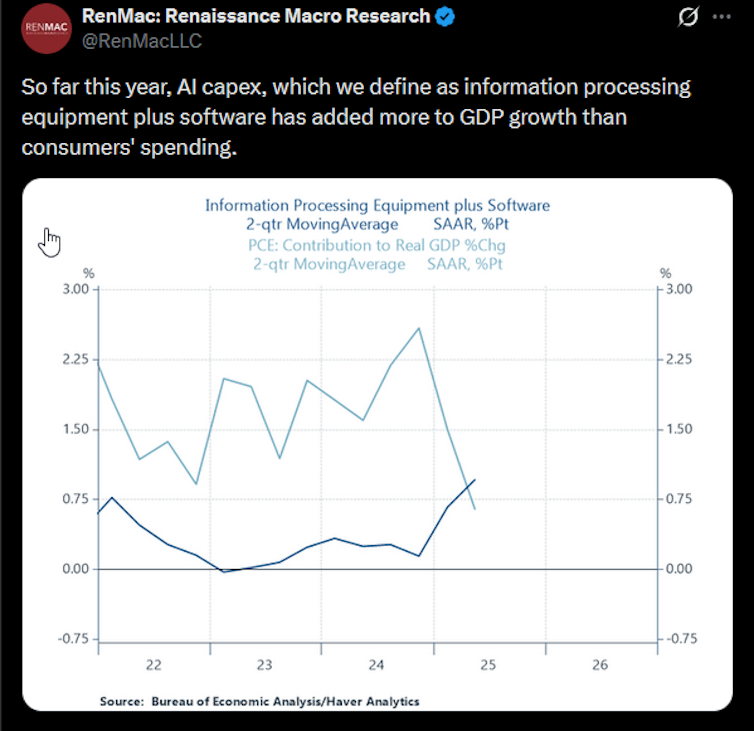
Corporate spending on AI infrastructure now contributes more to GDP growth than household consumption, an unprecedented inversion that shows how much growth is being driven by speculative investment rather than productive expansion.

This dynamic pulls down the rate of profit, and when the speculative flow reverses, contraction will follow.

A screenshot of a post from X illustrating that AI capex has added more to GDP growth than consumers' spending via a graph

(X/Twitter)

Tariffs tighten the squeeze on capital

Financial inflation has intensified as the traditional pressure valves that once allowed capital to move into new physical or geographic markets have narrowed.

Tariffs, export controls on semiconductors and retaliatory trade measures have narrowed the global space available for relocation. Since capital cannot readily escape the structural pressures of the domestic economy, it increasingly turns to financial tools that postpone losses by rolling debt forward or inflating asset prices; mechanisms that ultimately heighten fragility when the reckoning comes.

U.S. Federal Reserve Chair Jerome Powell’s openness to interest rate cuts signals a renewed turn toward cheap credit. Lower borrowing costs let capital paper over losses and pump up fresh speculative cycles.

Marx captured this logic in his analysis of interest-bearing capital, where finance generates claims on future production “above and beyond what can be realized in the form of commodities.”

The result is that households are pushed to take on more debt than they can manage, effectively swapping a crisis of stagnation for a crisis of consumer credit.

Bubbles and social risk

If the AI bubble bursts when governments have limited room to shift investment internationally and the economy is propped up by increasingly fragile credit, the consequences could be serious.

Capital will not disappear, but will instead concentrate in bond markets and credit instruments inflated by a U.S. central bank eager to cut interest rates. This does not avert crisis; it merely transfers the costs downward.

Bubbles are not accidents, but recurring mechanisms for absorbing surplus capital. If Trump’s protectionism ensures that spatial outlets continue to close and temporal fixes rely on ever riskier leverage, the system moves toward a cycle of asset inflation, collapse and renewed state intervention.

AI will survive, but the speculative bubble surrounding it is a sign of a deeper structural problem — the cost of which, when finally realized, will fall most heavily on the working class.

The Conversation

Elliot Goodell Ugalde does not work for, consult, own shares in or receive funding from any company or organisation that would benefit from this article, and has disclosed no relevant affiliations beyond their academic appointment.

ref. The AI bubble isn’t new — Karl Marx explained the mechanisms behind it nearly 150 years ago – https://theconversation.com/the-ai-bubble-isnt-new-karl-marx-explained-the-mechanisms-behind-it-nearly-150-years-ago-270663

Are harp seals responsible for the stalled recovery of Atlantic cod?

Source: The Conversation – Canada – By Tyler Eddy, Research Scientist, Fisheries & Marine Institute, Memorial University of Newfoundland

In June 2024, the Canadian government lifted the moratorium on northern cod fishing in Newfoundland and Labrador after 32 years. The decision was controversial because cod numbers had not recovered since they collapsed in the early 1990s.

The collapse of Atlantic cod stocks in Newfoundland and Labrador had a huge impact on the economic and social fabric of the province. The subsequent fishing moratorium in 1992 put nearly 30,000 people in the province out of work.

Several explanations have been put forward for the stalled cod recovery, including environmental conditions, historical overfishing and prey availability.

Another explanation has identified predation by harp seals as the reason cod numbers have remained low. However, given the severity of historical overfishing that occurred, Atlantic cod population growth may be impaired by a number of factors.

The Northwest Atlantic harp seal population was estimated at 4.4 million in 2024, the second-largest seal population in the world. Fishermen have long been concerned about the amount of fish that harp seals consume. However, a 2014 Fisheries and Oceans Canada study concluded that harp seals do not strongly impact the northern cod stock.

The concerns of fishermen about the impact of seals on fish stocks were heard by the Canadian government. In September 2023, the Department of Fisheries and Oceans announced funding for independent seal science. It was through this funding opportunity that I recruited postdoctoral fellow Pablo Vajas and MSc student Hannah West to dive deeper into the issue.

Historical overfishing

The magnitude and duration of overfishing increase the time fish stocks need to recover. By 1993, northern cod had declined by 99 per cent of its historical biomass, while the other Newfoundland Atlantic cod stocks declined by 77 per cent to 95 per cent. During the fishing moratorium on the offshore fishing fleet, inshore and recreational fisheries continued to operate, but fisheries catches were very low.

Capelin, a small forage fish that is important prey for cod and other predators, is linked to cod population growth and is included in the northern cod stock assessment. Capelin also collapsed in the 1990s and has not recovered to pre-collapse levels, limiting ecosystem productivity. It remains unknown why capelin has not recovered.

Do harp seals eat more than fisheries catch?

Harp seals eat a range of items — their diet varies by prey availability, season, location and time. In our recently published study, we compared diet estimates from stomach content analyses from 7,710 harp seals as well as laboratory analyses of muscle tissue using fatty acids and stable isotopes.

In general, our findings told a consistent story: harp seals are generalists that eat a range of prey, including American plaice, Arctic cod, Atlantic cod, Atlantic herring, capelin, flounder, redfish, sand lance, shrimp, squid and zooplankton. We incorporated these results into a food-web model of predator and prey interactions to calculate the total harp seal consumption of prey and their contribution to mortality. We compared these consumption and mortality rates to those from fisheries.

Our analysis revealed that harp seals consume a higher biomass of shared target species than caught by fisheries. Harp seal consumption rates were 24 times higher than fisheries catch rates for Atlantic cod, Greenland halibut and American plaice from 2018 to 2020.

We also found that harp seals caused 17 times more deaths of shared target species than fishing did. Stock assessments have reported elevated levels of northern cod natural mortality since the collapse. Consistently, our research found that the impact of harp seals on other species in the ecosystem has increased since the fish stocks collapsed.

The harp seal population has declined by 41 per cent since 1998, when it peaked at 7.5 million. This has happened while the number of harp seals harvested for their meat and pelts has also declined. Harp seals have recently been listed as near-threatened by the International Union for Conservation of Nature due to Arctic sea ice loss.

Marine ecosystems in a changing world

Newfoundland and Labrador’s marine ecosystems are highly dynamic. Since the cod collapse, ecosystems have been less productive, leading to a declining harp seal population and limiting the recovery of collapsed fish stocks.

Despite the decline in harp seal numbers, our findings show that harp seal predation remains an important factor that should be included in Atlantic cod stock assessments.

It should be noted that climate change is an additional factor affecting marine ecosystems and fisheries. More than ever, it is crucial to track the productivity of fish stocks and marine ecosystems to achieve sustainable resource management.

The Conversation

Tyler Eddy receives funding from the Natural Sciences and Engineering Research Council of Canada, Fisheries and Oceans Canada’s Sustainable Fisheries Science Fund, and the Canada First Research Excellence Fund.

ref. Are harp seals responsible for the stalled recovery of Atlantic cod? – https://theconversation.com/are-harp-seals-responsible-for-the-stalled-recovery-of-atlantic-cod-269337

The Canadian Museum for Human Rights finally grapples with the Nakba

Source: The Conversation – Canada – By Jonah Corne, Assistant Professor in the Department of English, Theatre, Film and Media, University of Manitoba

Even as it claims to champion the stories of global injustice, the Canadian Museum for Human Rights (CMHR) has struggled, if not refused, to meaningfully acknowledge Palestine for more than a decade.

Its newly announced exhibition to launch in the summer of 2026 — Palestine Uprooted: Nakba Past and Present — marks a significant reversal for an institution that has often been criticized for its silences.

The omission of Palestinian history dates all the way back to before the museum’s official opening in Winnipeg in 2014, when Palestinian-Canadian community advocate Rana Abdulla replied, fruitlessly, to the museum’s call for suggestions for content.

After years of continued advocacy from the Palestinian community in Winnipeg and across Canada — and in the midst of so much tragedy and what a UN commission of inquiry has called genocidal violence in Gaza — the announcement comes as a remarkable sliver of good news.

The development is also surprising because the museum, Canada’s first federal one located outside the nation’s capital, has historically had difficulties with the living legacy of settler colonialism — a key issue in discussions about Palestine — in Canada.

Prior to construction, the museum was criticized for failing to provide sufficient funds for a full excavation of the archeological heritage on the sacred Indigenous site where the museum is located. Until the stance was reversed in 2019, the museum had resisted describing the experience of Indigenous Peoples in Canada in terms of genocide.

Naming Palestinian dispossession

Bringing exhibition-level attention to the massive dispossession of Palestinians that occurred by the founding of the state of Israel in 1948 — an event known as al Nakba (Arabic for “the catastrophe”) — emerges as an ethically and educationally responsible move for the museum. It also signals a shift under CEO Isha Khan, who came on board in 2020 in the wake of the museum struggling to present an accountable and consistent message of human rights.

Despite its recent recognition of Palestinian statehood, the Canadian government has repeatedly resisted calls to grant the Nakba, and by extension Nakba Day, official acknowledgement. Neither has the Nakba had a place in the curricula of Canadian schools.

The CMHR’s Nakba exhibit therefore stands as an important repositioning in relation to these concerning national absences.

Of course, we don’t know how the exhibit — slated to involve oral histories, art and artifacts — will turn out. But judging only the title, the naming of the Nakba is immensely consequential and allows an opening to inquire further into the constellation of terms — dispossession, ethnic cleansing, settler colonialism, occupation and genocide — that cluster around it.

Meanwhile, the word “uprooted” to describe what befell 750,000 Palestinians in 1948 is, if perhaps muted, not inaccurate.

Holocaust memory and Nakba denial

Pro-Israel groups have predictably condemned the museum’s announcement of the exhibition in statements consistent with a trend of Nakba denial in mainstream pro-Israel discourse.

What underpins such a trend, implicitly or explicitly, is a Zionist narrative that sees the Holocaust as both radically unique and as the ultimate justification for the founding of the Israeli state.


Read more:
The conflation problem: Why anti-Zionism and anti-semitism are not the same


Accordingly, to acknowledge the Nakba introduces a perceived impermissible rival to the Holocaust for suffering and remembrance, as well as a complicating factor that casts the founding of the Israeli state as something other than a strictly unimpeachable redemption for the Nazi genocide against Jews.

Attending to the Nakba requires that we see the creation of Israel as entailing a radical — and violent — escalation in a project of settler colonialism that, by 1948, had been underway for several decades, having received decisive momentum under the auspices of British colonialism from the Balfour Declaration of 1917.

This history deserves to be recognized, first and foremost for the sake of Palestinians living in and outside of Palestine who continue to endure the Nakba’s rippling aftermath. In addition, historical ignorance and amnesia are detrimental for the well-being of a society. Not to mention, the CMHR has an extensive and permanent Holocaust gallery.

This new exhibit might also help us to consider the ways in which the Holocaust and the Nakba can be thought of in constructive relation to one another. Such co-thinking is part of the project of an edited collection of essays, The Holocaust and the Nakba: A New Grammar of Trauma and History, where in the foreword, the late Lebanese intellectual, novelist and longtime activist for Palestinian liberation, Elias Khoury, articulates a compelling moral argument.

Khoury movingly affirms:

“The Holocaust is my responsibility as a member of the human race, despite it having been a product of European fascism. As such, my deeply ingrained moral duty is to be an active participant in the struggle against antisemitism as well as all other forms of racism anywhere in the world. This path leads me to continue the struggle against the Zionist colonialist occupation project in Palestine. Two wrongs do not make a right, one crime does not wipe out another, and racism is not remedied by counterracism.”

Khoury’s argument is consistent with what I have come to extract from the well-known mantra of Holocaust education, “never again.” I take the mantra’s lack of a specified referent as an open space where, without the burden of exact equation-drawing, one can speak out against racist, oppressive, eliminationist logics in any form that they may appear.

Historical accuracy and relevancy

Something must also be said about the claims by pro-Israel groups that the CMHR Nakba exhibition will be invalidatingly one-sided because of inattention to the Jewish (Mizrahi and Sephardi) displacement from Middle Eastern and North African countries in the wake of 1948.

The larger regional repercussions of the founding of the Israeli state bear no pertinence to the Palestinians’ own experience of dispossession: the focus of the exhibition and a topic that has been historically overlooked.

Moreover, the exoduses that occurred in Iraq, Yemen, Morocco and elsewhere were not perpetrated by Palestinians, so the call for “balance” in considering the Nakba vis-à-vis Mizrahi and Sephardi refugeehood is a non-starter.

In the face of such baseless attempts to cast doubt on the credibility of the exhibit, I hope that the CMHR will hold the line.

With its long overdue decision to engage substantially with Palestinians, who continue to endure a world-shaking crisis of displacement, occupation and genocide, the institution sets out on a crucial journey towards reestablishing its own credibility and fulfilling its ambitious aim of serving as a leading, capaciously inclusive space for exploring and educating about human rights.

The Conversation

Jonah Corne does not work for, consult, own shares in or receive funding from any company or organisation that would benefit from this article, and has disclosed no relevant affiliations beyond their academic appointment.

ref. The Canadian Museum for Human Rights finally grapples with the Nakba – https://theconversation.com/the-canadian-museum-for-human-rights-finally-grapples-with-the-nakba-270351

Thomas King: As we learn another ‘hero’ is non-Indigenous, let’s not ignore a broader cultural problem

Source: The Conversation – Canada – By Celeste Pedri-Spade, Associate Professor, Department of Anthropology, McGill University

Years ago, when I first began researching Indigenous identity theft — something that intrigued me intellectually and impacted me personally — I remember trying to explain it to my Indigenous family members back home in northwestern Ontario.

We are Anishinaabeg and member citizens of Nezaadiikaang (Lac des Mille Lacs First Nation).

The women in my family responded with humour, seeing the absurdity of it all. My mother laughed and said: “Geez, I remember when not even Natives wanted to be Native … whatever happened to those times!”

Her comment highlighted a major shift in how desirable Indigenous identity has become, and how false claims tend to rise after events that draw public attention to the harms settler states have caused our families and communities.

This desirability is, indeed, heightened as educational institutions engage in processes of Indigenization and seek to recruit Indigenous people into faculty and administrative roles that assist them in advancing their reconciliation plans.


Read more:
Stolen identities: What does it mean to be Indigenous? Don’t Call Me Resilient Podcast EP 8 Transcript


Think of how many white settlers were quick to shake a Cherokee “princess” from their family tree after the Civil Rights Movement, or how recent cases of Indigenous identity fraud in Canada align with the era of Truth and Reconciliation. This era, we know, has revealed very hard truths about Canada’s relationship with Indigenous Peoples.

Cultural phenomenon

These patterns reveal more than individual acts of deception. They expose
a cultural phenomenon: when non-Indigenous people appropriate our lived experiences — our stories, struggles and traumas — on such a wide scale, it signals a broader cultural and social sickness and deterioration.

What we come to learn through the public “outings” of author Thomas King, Buffy Sainte-Marie, Mary Ellen Turpel-Lafond, Michelle Latimer and Joseph Boyden is that they offer a projection of “Indigenous success” that is often nothing more than settler fantasies: commodified versions of Indigeneity that Canadians find palatable.


Read more:
How journalists tell Buffy Sainte-Marie’s story matters — explained by a ’60s Scoop survivor


These figures become a kind of counterfeit currency, granting Canadians easy access to digestible versions of Indigenous identity and experience. But they are not ours, they are not us and they are not our stories. My mother believes this happens because Canadians do not truly want the truth of who we are, past or present.

This raises a hard question: how did these figures become Indigenous icons in the first place?

Western ‘hero’ narratives

Many Indigenous cultures caution against the concept of “heroes,” which is rooted in western narratives that elevate people as saviours. Turning people into heroes isolates collective struggles, conceals the systemic problems behind them and reinforces colonial ideas of individual exceptionalism — celebrating those who manage to succeed in oppressive systems instead of valuing relationships and community resilience.

Liberation doesn’t hinge on extraordinary individuals; it requires
structural transformation. When we elevate “heroes,” we risk distorting accountability and reinforcing inequity.

The truth is, these heroes were largely created by settler-controlled industries like publishing, media and academia — not by us. Their success was sustained by gatekeepers who valued marketable versions of Indigeneity over authentic voices. And while community voices questioned their authenticity from the start, we must ask why those warnings were ignored.

Concerns raised

In cases of a “pretendian” — false claims of Indigeneity — there are people firmly grounded in community who raise concerns right from the beginning because they cannot find themselves in the paragraphs and crescendos of those who don’t sing or speak truth. As Indigenous Peoples, we need to reflect on why such voices are often not collectively amplified and protected.

Underlying identity fraud is a belief that Indigenous Peoples are “not good enough” — that impostors can be better Natives than us. They reconcile their theft by convincing themselves they can achieve what we cannot, that we need them to “be us.” That is profoundly damaging.

It reinforces colonial hierarchies and perpetuates the idea that our worth must be validated through settler recognition.

Power to repair harm

In King’s recent opinion piece in The Globe and Mail, he wrote he was devastated to learn, contrary to what he believed, that he did not have Cherokee ancestry. He discovered this, he said, after he requested a meeting with Tribal Alliance Against Frauds, an American Cherokee organization, because he was aware of “a rumour that appeared” accusing him of not being Cherokee.


Read more:
Fraudulent claims of indigeneity: Indigenous nations are the identity experts


He said he’ll need to “survive a firestorm of anger, disbelief and betrayal” and will then “sort through rubble to see if there is anything left of my reputation, of my career.”

This was the most troubling for me — not only because it sounds like self-victimization, but because King has the power to repair harm. Accountability begins with truth-telling: admitting the false claim, making no excuses and disclosing and returning all benefits gained.

It means returning awards, redirecting funds and submitting to processes defined by the affected Nation — in King’s case, the Cherokee Nation. It means investing in long-term reparations that strengthen Indigenous self-determination, such as funding community priorities, supporting displaced Indigenous writers and investing in the brilliance of future generations.

We are more than stories

Accountability is not a one-time op-ed; it is an ongoing commitment, verified by Indigenous oversight and grounded in relational ethics.

King once wrote: “The truth about stories is that that’s all we are.” I admit to referencing it in my own writing. It is poetic, but incomplete.

We are more than stories. We are land. We are family. We are community. And we deserve a future where our identities are not commodities, where our truths are not distorted for profit or prestige and where accountability is measured not by words but by actions that build trust and repair harm.

The Conversation

Celeste Pedri-Spade does not work for, consult, own shares in or receive funding from any company or organisation that would benefit from this article, and has disclosed no relevant affiliations beyond their academic appointment.

ref. Thomas King: As we learn another ‘hero’ is non-Indigenous, let’s not ignore a broader cultural problem – https://theconversation.com/thomas-king-as-we-learn-another-hero-is-non-indigenous-lets-not-ignore-a-broader-cultural-problem-270773