Benin’s failed coup: three factors behind the takeover attempt

Source: The Conversation – Africa (2) – By John Joseph Chin, Assistant Teaching Professor of Strategy and Technology, Carnegie Mellon University

Military elements attempted to topple Benin’s government in early December 2025. However, unlike other coups across the Sahel and west Africa since 2020, this bid triggered a military response from Benin’s neighbours.

Benin is a west African state of 14.8 million people bordered by Togo, Burkina Faso, Niger and Nigeria.

Responding to two requests for assistance from the government of President Patrice Talon, Nigeria deployed fighter jets and the Economic Community of West African States (Ecowas) deployed elements of its standby force to target and dislodge the pro-coup forces.

Ecowas intervention likely played an important role in undermining the coup’s momentum and restoring order. The dozen or so putschists scored early tactical successes. They captured and broadcast from the national television station, occupied a military camp, and even took the two senior-most army officers hostage. But once Ecowas intervened militarily, any fence-sitters concluded that loyalists would prevail. Rather than a broad-based uprising, only 14 were arrested with a few plotters still at large.

I’m a scholar who maintains the Colpus dataset of coups and I have documented the history of post-second world war coups. As part of this work, I have sought to document the complex causes and effects of Africa’s post-2020 “epidemic of coups”, now entering its fifth year.

Though details remain scant on the motives of the coup plotters led by Lt. Col. Pascal Tigri, three structural factors likely contributed to the latest coup attempt:

From democratic backsliding to democratic u-turn?

Benin does not have a history of recent coups. It had not suffered a bona fide coup attempt since January 1975.

In the first 15 years after independence from France in 1960, Dahomey (as the country was then called) experienced nine coup attempts, making it one of the most coup-prone countries in sub-Saharan Africa during the early Cold War period.

However, political instability through the early 1970s gave way to the stable and durable personalist regime of Mathieu Kérékou (1972-1990). This was followed by electoral democracy after the Cold War.

Until recently, Benin had been heralded as one of Africa’s “democratic outliers” and success cases of democratic survival despite challenging conditions. Though poor, Benin has seen decades of improving average living standards. Economic growth in 2025 was 7.5%; the latest unrest cannot be blamed on poverty or an economic crisis.

However, data on three key dimensions of democracy shows that although electoral contestation and participation have endured, constraints on the executive (and thus liberal democracy overall) have declined in Benin since Talon’s election as president in 2016.

According to autocratic regime data from US political scientists Barbara Geddes, Joe Wright and Erica Frantz as well as the Varieties of Democracy (V-Dem) project (which surveys experts about democracy worldwide), Benin slipped back into an electoral autocracy in 2019. That is when opposition candidates were prevented from competing in parliamentary elections. The polls were marred by repression of mass protests and an internet shutdown.

In 2021, an electoral boycott led to Talon’s easy re-election.

V-Dem data show a very partial and incomplete democratic rebound since 2022. The opposition was allowed to compete in the January 2023 parliamentary elections. And earlier this year Talon confirmed that he would not seek an unconstitutional third term.

The potential for a coup, however, was foreshadowed last fall when the regime alleged that it had uncovered a coup plot involving a presidential hopeful in 2026. Last month, parliament’s vote to create a Senate was condemned by the opposition as allowing Talon a means to influence affairs after he steps down.

With the main opposition party barred from running in next year’s presidential election, Talon is expected to hand off power to his ally and finance minister, Romuald Wadagni.

Though the political leanings of Tigri and coup plotters remain unclear, Tigri claimed to seek to “free the people from dictatorship”.

The coupmakers also presumably sought to block the upcoming 2026 parliamentary and presidential elections.

A growing jihadist threat

Among the coup leaders’ key complaints was Talon’s mismanagement of the country. In particular, they cited “continuing deterioration of the security situation in northern Benin and “the ignorance and neglect of the situation of our brothers in arms who have fallen at the front” due to worsening jihadist violence.

A number of coups in nearby countries since 2020 have been preceded by rising levels of political violence and deepening insecurity born of jihadist insurgencies. That was certainly the case in Mali, Burkina Faso and to a lesser extent Niger.

Since last year, it has been clear that the jihadist violence was spilling over from Sahel neighbours such as Burkina Faso and Niger into the borderlands of west Africa. This included Benin’s north. ACLED data show a major increase in political violence events since 2022. And a spike in political fatalities in 2024:

Much of this increased violence is attributable to the advance of operations by the al-Qaida affiliated group Jama’at Nusrat al-Islam wal-Muslimin (JNIM). The group also managed to launch its first fatal attack in Nigeria at the end of October.


Read more:
Nigeria’s new terror threat: JNIM is spreading but it’s not too late to act


Russia has become the primary security partner for the Sahel Alliance. The defence pact was signed in 2023 by post-coup juntas of Burkina Faso, Mali and Niger to defeat jihadists and maintain power.

Nevertheless, Benin has continued to rely on western security partners to aid its counter-insurgency efforts and bolster border security. Notably, Benin continues to welcome military cooperation with France. Since 2022 Paris has pledged greater military aid to combat terrorism.

In September, US Africa Command commander General Dagvin Anderson visited Benin to underscore cooperation to oppose terrorism.

During the coup attempt, Tigri reportedly warned against French intervention and railed against “imperialism”. The speech reportedly ended with the phrase “The Republic or Death”, which echoes the new motto of Burkina Faso’s junta.

This suggests that the coup makers may have been inspired by others in the Sahel.

Risk of the coup belt expanding

The Benin events mark the third coup attempt and first failed coup this year in the Sahel region. There have been 17 coup attempts in Africa since 2020, including 11 successful coups. This makes the African coup belt stretching across the Sahel and west Africa the global epicentre of coups.


Read more:
Africa’s power grabs are rising – the AU’s mixed response is making things worse


West Africa’s latest “copycat” coup attempt was condemned by the African Union, European Union and Ecowas. Yet it was praised by pro-Russian social media accounts, reflecting a growing cleavage between the Russia-aligned juntas of the Sahel Alliance and the remaining Ecowas-aligned civilian regimes of west Africa.


Read more:
Coups in west Africa have five things in common: knowing what they are is key to defending democracy


Although Nigeria-led Ecowas threatened military intervention after the coup in Niger in July 2023, the regional body only actually militarily intervened to defeat the coup attempt in Benin. Nigeria, it appears, has drawn a line in the sand to retain a buffer from further instability – including JNIM operations. On the same day of the coup attempt in Benin, it was reported that Nigeria was seeking greater aid from France to combat insecurity.

The Conversation

John Joseph Chin does not work for, consult, own shares in or receive funding from any company or organisation that would benefit from this article, and has disclosed no relevant affiliations beyond their academic appointment.

ref. Benin’s failed coup: three factors behind the takeover attempt – https://theconversation.com/benins-failed-coup-three-factors-behind-the-takeover-attempt-271540
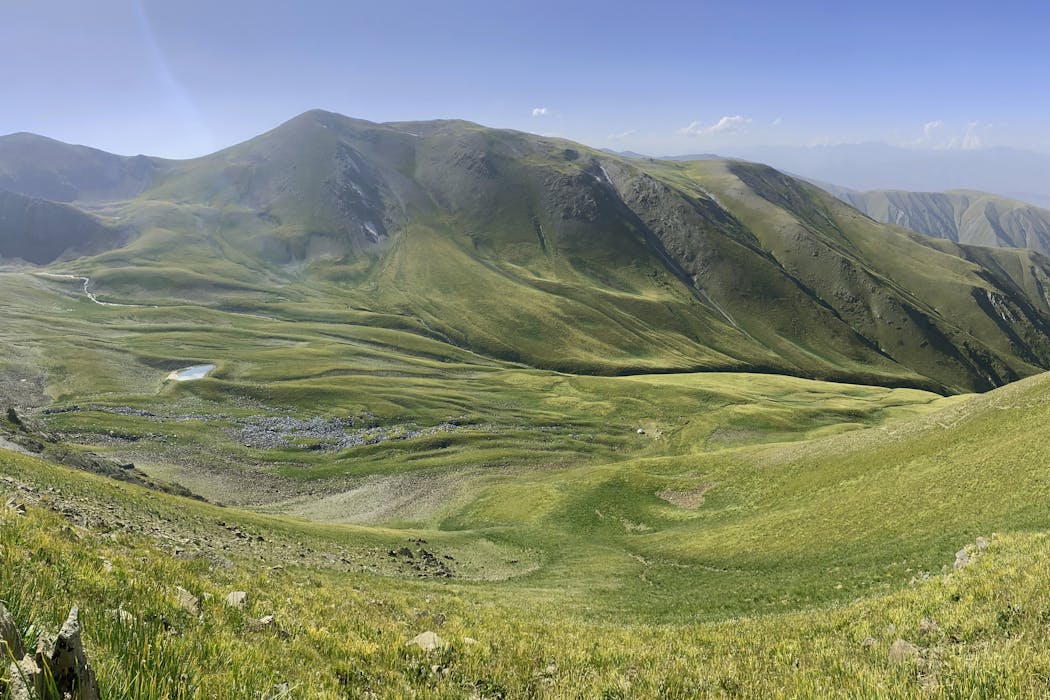
En las alturas de Kirguistán buscamos descifrar y proteger los grabados rupestres del valle de Saimaluu Tash

Source: The Conversation – (in Spanish) – By David Martín Freire-Lista, Geólogo. Investigador Ramón y Cajal. Atracción de talento. Especialista en patrimonio cultural, Instituto Geológico y Minero de España (IGME – CSIC)

Vista general del valle glaciar de Saimaluu Tash (Kirguistán). D.M.F.L.

A más de 3 000 metros sobre el nivel del mar, en la cordillera kirgui de Ferganá, los grabados rupestres del valle de Saimaluu Tash cuentan la historia de una población que se resiste a perder sus tradiciones ancestrales. No lo hacen con palabras, sino con imágenes: mapas de situación y migración de ungulados, así como escenas de caza ilustran las piedras de este valle glaciar.

Son los petroglifos de Saimaluu Tash (piedra estampada en kirguís), uno de los conjuntos de arte rupestre más grandes y mejor conservados del mundo, con decenas de miles de grabados que abarcan desde la Edad del Bronce hasta el periodo túrquico.

Estos petroglifos no son solo arte: son vestigios de la memoria de una cultura nómada a punto de desaparecer. Reflejan escenas cinegéticas, mapas y lugares apropiados para la caza y el pastoreo, combinado influencias locales e indoeuropeas. Las representaciones más frecuentes son principalmente íbices y ciervos. También aparecen lobos, zorros, jabalíes, así como figuras antropomórficas, escenas de caza y agrícolas y animales domesticados como caballos, camellos, vacas, yaks y perros.

Vista general del río de piedras con grabados rupestres en el valle de Saimaluu Tash.
D.M.F.L.

Además, en ellos se pueden observar senderos en zigzag, indicando rutas de tránsito de animales cinegéticos. Estos grabados parecen tener una ubicación comunicativa. Por lo tanto, estas piedras ofrecen un registro excepcional de la evolución de la caza y sus útiles. Son testigos de un tiempo en que pastores y agricultores de altura dejaron su visión grabada en las piedras para quien supiera leerla, aportando un testimonio excepcional sobre la tradición nómada centro asiática.

Una misión científica para proteger

En este paisaje de glaciares, morrenas y praderas de altura, el equipo internacional multidisciplinar que dirijo desarrolla un estudio pionero: analizar las piedras que sirven de soporte a estos grabados. Los geólogos Ramón Jiménez y Javier Luengo, del Centro Nacional Instituto Geológico y Minero de España (IGME-CSIC), están analizando su petrografía y porosidad. Con los resultados se podrán explicar las características petrofísicas que han permitido el grabado de arte rupestre y su conservación.

Analizando el color y la rugosidad de los mismos grabados se podrá obtener información sobre las técnicas utilizadas y su edad relativa. Además, utilizando técnicas de termoluminiscencia en los restos de cazuelas cerámicas encontradas en la excavación arqueológica a 1,70 metros y espectroscopía de masas en los carbones encontrados al lado de estas cazuelas, se podrá conocer la edad de los petroglifos.

La geomorfóloga Julia García-Oteyza Ciria estudiará la formación de las morrenas y las datará para reconstruir la evolución glaciar del valle y relacionarla con los periodos de ocupación nómada en los que se realizaron los grabados. Esto permitirá determinar no solo cómo se acumularon las piedras, sino también cómo el relieve influyó en las que se elegían para ser grabadas, ya que se puede observar una gran concentración de petroglifos en la acumulación de piedras longitudinal al valle, pero también existen miles de bloques dispersos con grabados rupestres.

Estas piedras, acumuladas por procesos glaciares durante miles de años, presentan una brillante pátina de color oscuro. Al raspar esta pátina, resurge un color pardo, generando un contraste cromático que permitió la creación y conservación del arte rupestre. Los biólogos Sergio Pérez-Ortega, científico titular del Real Jardín Botánico (CSIC), y Asunción de los Ríos, investigadora científica del Museo Nacional de Ciencias Naturales (CSIC), especialistas en diversidad de líquenes y microorganismos asociados a sustratos líticos, analizarán mediante métodos moleculares la composición biológica y el desarrollo de estas pátinas para comprender los procesos que, sin proponérselo, han hecho más visibles los petroglifos.

Grabado de cabras montesas en una piedra el río de piedras de Saimaluu Tash.
D.M.F.L.

El proyecto cuenta con un pilar fundamental: la arqueóloga Aidai Sulaimanova, que actúa como enlace entre el IGME-CSIC y las instituciones kirguisas, aportando además el marco histórico y cultural necesario para interpretar los hallazgos. Su participación garantiza que el trabajo científico esté alineado con las necesidades de preservación y valorización del patrimonio local.

Este conocimiento será esencial para plantear estrategias de conservación frente a amenazas como la meteorización, el cambio climático o el creciente turismo. Después de todo, la investigación pretende sentar las bases científicas para proteger el lugar e incluirlo en la Lista de Patrimonio Mundial de la UNESCO.

Mirar al pasado para proteger el futuro

El valle glaciar de Saimaluu Tash es un escenario singular: depósitos morrénicos, lagos en forma de corazón, laderas esculpidas por la erosión, y un microclima que, paradójicamente, ha ayudado a preservar los grabados. Al investigar en él no solo queremos conocer la historia geológica de las piedras, sino entender el contexto que permitió que estos grabados rupestres se hayan conservado casi intactos durante miles de años. Después de todo, la historia geológica del valle está entrelazada con la historia humana que estos representan.

Aunque su difícil acceso, a seis horas de camino por un sendero y nueve meses al año bajo nieve, ha protegido los grabados, las huellas del cambio climático y el vandalismo empiezan a ser visibles. La nieve, la altura y el aislamiento son aliados, pero no eternamente. De hecho, el glaciar que originó este espectacular paisaje está desapareciendo.

Grabado de cazador en una piedra del río de piedras de Saimaluu Tash.
D.M.F.L.

Hoy en día, las comunidades nómadas de Kirguistán conservan un estilo de vida ancestral basado en el pastoreo y la convivencia en las montañas. Cada verano, las familias se desplazan a los pastos altos y levantan sus yurtas, hogares circulares tradicionalmente de fieltro. Allí crían caballos, vacas, yaks y ovejas que pastan en las praderas.

Los que viven en los alrededores de Saimaluu Tash mantienen hoy una relación más territorial que ritual con los antiguos grabados rupestres. Aunque continúan usando esos mismos pastos y montañas, ya no se instalan en Saimaluu Tash en verano, pues la zona está protegida. Más que como parte activa de sus prácticas tradicionales, su vínculo actual con los petroglifos es de respeto e identidad: reconocen el sitio como un legado de sus antepasados y un símbolo cultural de la región.

Ahora, más de siglo después de la primera visita del pintor, etnógrafo y topógrafo Nikolay Gavrilovich Khludov en 1902, la ciencia española, en colaboración con expertos kirguises, vuelve a escuchar el mensaje grabado en las piedras de Saimaluu Tash hace miles de años. El reto es doble: descifrarlas y, sobre todo, asegurarnos de que sigan hablando durante muchos más milenios.

The Conversation

David Martín Freire-Lista es un contratado Ramón y Cajal. Atracción de Talento del IGME-CSIC. Esta publicación es parte del contrato RYC2023-042760-I, financiada por MCIU/AEI/10.13039/501100011033 y por el ESF+

ref. En las alturas de Kirguistán buscamos descifrar y proteger los grabados rupestres del valle de Saimaluu Tash – https://theconversation.com/en-las-alturas-de-kirguistan-buscamos-descifrar-y-proteger-los-grabados-rupestres-del-valle-de-saimaluu-tash-265416

¿Por qué la IA no habla igual todos los idiomas? La brecha lingüística que esconden los algoritmos

Source: The Conversation – (in Spanish) – By Isabel Durán Muñoz, Profesora Titular de Universidad, Universidad de Córdoba

witsarut sakorn

Cuando usamos una inteligencia artificial para traducir un texto, responder una pregunta o escribir un correo, tendemos a imaginar que funciona igual en cualquier idioma. La idea resulta lógica: si es “inteligente”, debería manejar todas las lenguas con la misma soltura. Sin embargo, la realidad es bien distinta. Los modelos no rinden igual en inglés que en español, ni en español que en euskera. ¿Por qué? ¿Es una limitación tecnológica inevitable o el reflejo de desigualdades más profundas del mundo digital?

Para entenderlo, hay que mirar la base de estas tecnologías: los datos. Los modelos de lenguaje, como ChatGPT, se entrenan con cantidades inmensas de texto, tanto originales como creados por personas que los han entrenado. Pero aquí aparece la primera gran asimetría: la mayor parte del contenido escrito en la red está en inglés. No es una preferencia del modelo, simplemente es lo que hay.

Idiomas de entrenamiento

OpenAI, la empresa que hay detrás de ChatGPT, y otras compañías no publican porcentajes exactos del peso de cada idioma en el entrenamiento, y los modelos tampoco pueden calcularlos con los datos que manejan. Aun así, la tendencia es evidente: el inglés domina con diferencia este contexto, seguido por grandes idiomas globales como el español, el francés o el alemán. Con bastante distancia, encontramos lenguas con presencia digital limitada como son el catalán o el galés. Y a una distancia aún mayor, idiomas minoritarios cuyo rastro textual en internet es escaso o casi inexistente.

Con esta distribución, el resultado es previsible: los modelos funcionan mejor en los idiomas con más datos. No se trata de afinidad, sino de oportunidad de aprendizaje. Cuando un modelo ve millones de ejemplos en inglés, aprende mejor su gramática, su vocabulario, sus distintos registros y su trasfondo cultural. En cambio, cuando recibe pocos ejemplos en una lengua tiene menos material para deducir patrones fiables.


Leer más:
Por qué las máquinas no hablan bien español y por qué deberían hacerlo


Esto explica por qué, en algunos idiomas, sobre todo en inglés, la inteligencia artificial parece más precisa y natural, mientras que en otros comete errores: fallos de concordancia, expresiones que suenan “traducidas”, construcciones rígidas o un estilo demasiado neutro o poco familiar. La falta de datos afecta también al tipo de escritura: lenguas que usan el alfabeto latino suelen estar mejor cubiertas que aquellas con sistemas menos extendidos digitalmente, como la escritura árabe o alfabetos indígenas, donde la escasez de ejemplos genera más errores.

¿Se puede reducir esta brecha?

Afortunadamente, la IA moderna no se limita a reproducir pasivamente esta desigualdad. Existen numerosas estrategias diseñadas para mitigar de alguna manera la falta de datos en idiomas escasos. Una de las más importantes es el equilibrado del corpus, es decir, el número de textos que emplea para responder. Así pues, incluso si el inglés es miles de veces más abundante, durante el entrenamiento se puede aumentar la frecuencia con la que el modelo consulta idiomas minoritarios y reducir la exposición al inglés. Es una forma de evitar que los idiomas minoritarios queden sepultados.

Otra técnica clave es la transferencia multilingüe. Los modelos no aprenden cada idioma por separado: comparten representaciones internas. Si el modelo aprende español, parte de ese conocimiento se aprovecha para el portugués o el italiano. Del mismo modo, el alemán refuerza al neerlandés. Esta transferencia ayuda a los idiomas con pocos datos siempre que pertenezcan a una familia lingüística con parientes más abundantes. En cambio, lenguas más aisladas –como japonés o coreano– se benefician menos de este proceso.

Enseñar idiomas a la IA

También se generan datos sintéticos mediante traducción automática o se utilizan corpus paralelos multilingües, como documentos de organismos internacionales o versiones de Wikipedia, para aprender equivalencias entre idiomas. En etapas posteriores, intervienen instructores humanos nativos, que corrigen expresiones poco acertadas, refuerzan el tono adecuado y afinan detalles culturales que los datos masivos no capturan.

Por último, existen técnicas específicas para evitar lo que se llama “olvido catastrófico”: cuando el modelo sigue entrenándose con datos en un idioma dominante y, sin querer, empieza a degradar lo que sabía en idiomas minoritarios. De esta manera, los métodos de regularización y de aprendizaje continuo ayudan a mantener cierto equilibrio.


Leer más:
Qué supone el experimento con Sam, el niño que enseña a hablar a las máquinas


¿Qué ocurre con la diversidad lingüística?

Aun así, ningún recurso técnico puede compensar completamente la falta de datos en una lengua y con poca renovación de su contenido, por lo que el inglés sigue siendo la lengua predominante y, por tanto, la brecha persiste.

Esto abre una pregunta importante: ¿puede la inteligencia artificial contribuir a la pérdida de diversidad lingüística? Es un riesgo real. Si funciona mejor en inglés, algunas personas pueden preferir usarla en ese idioma. Si los textos generados tienden a un estilo homogéneo, pueden influir en la escritura institucional, académica o mediática y desplazar, así, registros locales. Y si una lengua apenas aparece en internet, puede quedar fuera de las herramientas tecnológicas que moldean cada vez más nuestra comunicación.

Revitalizar lenguas minoritarias

También hay un potencial opuesto: la IA puede revitalizar lenguas minoritarias. Puede generar materiales educativos, ayudar a documentar vocabulario, servir como interlocutora en procesos de aprendizaje o apoyar proyectos de digitalización. Con voluntad política y cultural, la tecnología puede ser una aliada.

El rendimiento desigual de la IA entre lenguas no es solo una cuestión técnica: es un espejo de las desigualdades del mundo real. No se trata de preguntar si la IA habla mejor unos idiomas que otros, puesto que la respuesta resulta clara: sí, lo hace. La pregunta es cómo podemos construir un futuro en el que la tecnología no reproduzca, sino que reduzca, las brechas lingüísticas.

The Conversation

Isabel Durán Muñoz no recibe salario, ni ejerce labores de consultoría, ni posee acciones, ni recibe financiación de ninguna compañía u organización que pueda obtener beneficio de este artículo, y ha declarado carecer de vínculos relevantes más allá del cargo académico citado.

ref. ¿Por qué la IA no habla igual todos los idiomas? La brecha lingüística que esconden los algoritmos – https://theconversation.com/por-que-la-ia-no-habla-igual-todos-los-idiomas-la-brecha-linguistica-que-esconden-los-algoritmos-270017

¿Por qué la lechuga se queda lacia y se estropea tan pronto?

Source: The Conversation – (in Spanish) – By Victoria Fernández, Researcher, Universidad Politécnica de Madrid (UPM)

siamionau pavel/Shutterstock

Tradicionalmente, hemos aprendido que la función de las hojas es realizar la fotosíntesis (convertir la luz solar en energía química) y evitar que la planta pierda agua. Y así es principalmente, también en el caso de las hojas de lechuga que nos comemos.

Sin embargo, la superficie de las hojas no es un simple escudo, sino un complejo entramado de compuestos químicos con diferentes propiedades en cada zona. Al saber dónde se concentra la debilidad de la lechuga (sus zonas hidrofílicas), podemos plantear buscar nuevos métodos para protegerla, prolongar su duración y mejorar su comercialización.

El impermeable no lo es tanto

Para protegerse, las hojas y otras partes aéreas de las plantas, como flores, tallos o frutos, están cubiertas por una especie de “capa más bien impermeable” hecha de grasa (lípidos), llamada cutícula. Es algo así como un chubasquero natural, pero de composición y estructura variable.

Pero ¿qué pasa si las hojas no son tan impermeables como esperábamos?

Esta idea explica uno de esos enigmas domésticos tan comunes: la lechuga se queda lacia y se estropea muy pronto.

Asomados al nanomundo

Si la cutícula es una capa de grasa impermeable como se ha creído durante siglos, ¿cómo es posible que el agua penetre y salga del interior de las hojas?

Para desvelar este misterio, un equipo multidisciplinar de científicos nos hemos “asomado” al nanomundo de la hoja de lechuga, un nivel de detalle mil veces más pequeño que un cabello humano. Gracias a la microscopía de fuerza atómica y a otras técnicas avanzadas , hemos descubierto que la superficie de las plantas no es un manto de grasa continuo y uniforme, sino que presenta “parches” o heterogeneidad química a micro y nano escala. Lo hemos observado en los pétalos de rosa, las hojas de olivo, y ahora también en las lechugas. Es como si el chubasquero tuviera zonas de tela que repelen el agua y otras zonas que la atraen.

Elegimos la hoja de lechuga para nuestro estudio, por ser un vegetal poco duradero y muy mojable por el agua.

Buscábamos responder a una pregunta: ¿Por qué es tan perecedera y susceptible a la contaminación microbiana esta hoja? Es decir, ¿por qué se estropea tan pronto? ¿Acaso su superficie tiene pocas propiedades de barrera para evitar la deshidratación y el ataque de patógenos?

La lechuga y sus células epidérmicas

En un estudio desarrollado entre la Universidad Politécnica de Madrid, la Universidad de Murcia y la Universidad de Valencia, hemos analizado en detalle la superficie del haz y envés de una variedad de lechuga.

Seleccionamos la lechuga variedad romana, una verdura que todos conocemos y que es muy perecedera. Se deshidrata y estropea rápidamente, y es muy susceptible a la contaminación microbiana. Esto sugiere que su “chubasquero” (la cutícula) no es tan efectivo como barrera de protección, comparado con el de otras plantas.

La superficie de la hoja está compuesta principalmente por dos tipos de células. Por un lado, las células “pavimento”, que actúan como “adoquines” cubriendo la mayor parte de la superficie. Por otro, las células “guarda”, dos células con forma de riñón que se unen para formar una abertura llamada estoma (del griego, stoma, que significa “boca”).

En el envés de las hojas, encontramos una densidad de estomas ligeramente superior. Pero, en general, ambos lados son similares en estructura y composición química.

La función principal de los estomas es abrirse para dejar entrar el dióxido de carbono para la fotosíntesis, aunque a su vez dejan escapar vapor de agua. La apertura estomática está bien regulada a nivel de planta y puede verse afectada por diversas condiciones de estrés.

El análisis de la lechuga reveló algo crucial. Mientras que las células pavimento tienen una superficie bastante homogénea y rica en grasa (repelente al agua), las células guarda que forman el estoma son diferentes. La superficie de los estomas es químicamente heterogénea, diversa. Concentra zonas hidrofílicas (amigas del agua) entre las zonas hidrófobas (repelentes al agua).

Importancia de la heterogeneidad química

Nuestro estudio muestra por primera vez que la superficie de los estomas, aparte de ser rugosa, presenta heterogeneidad química. Y esto, ¿qué significa?

La misión de los estomas es abrirse y permitir la entrada de dióxido de carbono al interior de las hojas para hacer la fotosíntesis, limitando la pérdida de agua. Sin embargo, suponemos que la heterogeneidad química concentrada en la superficie probablemente aporta algún tipo de funcionalidad adicional que aún tenemos que explorar más.

De momento, podemos anticipar posibles implicaciones, como que las zonas hidrofílicas probablemente se asocien a la susceptibilidad de este vegetal a la contaminación por bacterias o virus. También favorecen la pérdida de agua desde el interior de las hojas. Y al perder más agua, se estropean antes durante el proceso posterior a su recolección, incluyendo la comercialización.

Asimismo, es posible que esta composición heterogénea de los estomas limite la pérdida de dióxido de carbono y el transporte de sustancias hidrófobas, además de afectar a las propiedades mecánicas de la hoja.

Estomas de las hojas de lechuga Romana. (A) Imagen de la topografía de un estoma obtenida con un microscopio electrónico de barrido. (B) Sección trasversal de un estoma, observada mediante microscopía electrónica de transmisión. (C) Imagen de microscopía de fuerza atómica (AFM) de un estoma, que muestra una composición química heterogénea, con un diagrama de color que destaca zonas hidrofílicas (azuladas) e hidrófobas. (D) Distribución de los carotenoides en zonas cercanas a un estoma, observadas con microscopía confocal-Raman.

La lechuga es la primera especie hortícola en la que se ha llevado a cabo un estudio tan detallado. Sin embargo, creemos que la caracterización de la superficie de las frutas y hortalizas es un requisito fundamental para buscar métodos que prologuen y mejoren su duración tras la cosecha y alarguen su vida, lo que beneficiará la comercialización.

The Conversation

Victoria Fernández realizado este estudio, dentro de un proyecto financiado con fondos del MCINN/AEI y European Union NextGenerationEU/PRTR, que ha finalizado en Septiembre de 2025.

Ana Cros Stötter recibe fondos de MICINN. Los fondos ya se terminaron (final de septiembre de 2024)

Jaime Colchero recibe fondos de MCINN/AEI y European Union NextGenerationEU/PRTR a través de los proyectos TED2021-130830B, PID2022-139191OB y PDC2023-145906.

ref. ¿Por qué la lechuga se queda lacia y se estropea tan pronto? – https://theconversation.com/por-que-la-lechuga-se-queda-lacia-y-se-estropea-tan-pronto-270530

Heptacloro en aguas de lavado industriales: ¿existe en España un mercado negro de plaguicidas prohibidos?

Source: The Conversation – (in Spanish) – By Dr. Borja Garrido Arias, Profesor Dpto. Ingeniería Mecánica, Escuela ICAI, Universidad Pontificia Comillas

Funtay/Shutterstock

Desde hace más de una década, la prohibición de plaguicidas y biocidas con toxicidad elevada y comportamiento recalcitrante (difícil de eliminar) y persistente ha reducido su uso en España. Entre algunos de los ejemplos más representativos destacan los plaguicidas carbamatos, organoclorados, organofosforados y los arsenicales.

No obstante, el caso más llamativo es el del heptacloro, que se va acumulando de forma paulatina en suelo. Puede causar cáncer y actuar como disruptor endocrino, con la capacidad de provocar alteraciones hormonales en medios acuáticos y terrestres.

De entre todos sus impactos nocivos, éste último es el que más preocupa, ya que fomenta la toxicidad neurológica y cambios hormonales tanto en la fauna como en los humanos. Por otro lado, su paso al ciclo del agua y su posterior ingesta producen daños en la salud muchas veces insospechados, ya que la patología surge sin observarse una causa clara ni definida. Además, este tipo de sustancias pueden actuar de forma lenta pero acumulativa.


Leer más:
Peligro silencioso: compuestos químicos que alteran las hormonas tiroideas y el desarrollo fetal


¿No estaba este plaguicida prohibido?

Las políticas ambientales, tanto nacionales como europeas, implantan textos legales muy restrictivos en cuanto a vertidos al medio ambiente. La preocupación no se enfoca en el material de desecho en sí, sino en su composición y en la categoría de toxicidad de los compuestos que lo conforman.

Su caracterización, la determinación de la composición química, física y microbiológica y su análisis cuantitativo resultan procedimientos decisivos e imprescindibles no sólo para su posible reutilización, sino también para su propio vertido bajo el cumplimiento de los estándares establecidos.

El uso del heptacloro lleva tiempo regulado en la recolección y procesamiento de alimentos. La mayor parte de los países define los límites atendiendo a los Límites Máximos de Residuos (LMR), establecidos por organismos tan relevantes como la Organización Mundial de la Salud (OMS).

En España, la comercialización y el uso de heptacloro se prohibieron hace más de tres décadas. No obstante, trazas del pesticida encontradas recientemente en aguas de lavado indican que el uso de este compuesto, totalmente restringido por la normativa, se estaría volviendo a emplear en tratamientos plaguicidas de productos hortícolas.

Después de tantos años prohibido, el heptacloro debería haber desaparecido del medio ambiente, al menos a nivel de concentración de trazas en agua y suelos. Si bien se trata de un producto
muy persistente, el paso del tiempo y los agentes bióticos y abióticos del entorno deberían haber eliminado la mayor parte del mismo.

No obstante, diversos análisis de líquidos procedentes del lavado de productos hortícolas españoles han identificado su presencia, con valores que exceden los niveles mínimos y sospechosos de ser peligrosos. Este problema –que no ocurre en un contexto industrial concreto, sino en varios de forma aleatoria en diferentes muestras– podría revelar la existencia de un mercado negro de pesticidas.


Leer más:
¿Podemos prescindir de los pesticidas para controlar las plagas en cultivos?


Los desafíos de una agricultura productiva que no contamine

Además de determinar y cuantificar la prevalencia del heptacloro, resulta prioritario analizar las causas de su posible posible uso fraudulento. El escenario actual que afronta la agricultura es desafiante. Mientras surgen plagas nuevas con propiedades más agresivas, resistentes e inesperadas, muchos compuestos biocidas o fitosanitarios presentan un bajo poder para reducirlas. Además, las políticas en torno al uso de ciertas sustancias para el sector agrícola son cada vez restrictivas. Se trata de un problema complejo que requiere de soluciones entre muchos agentes.

La importancia de la agricultura en nuestro país obliga a llevar a cabo un control coherente del uso de determinados plaguicidas y a ser conscientes de los riesgos y persistencia de productos como el heptacloro, con tantas repercusiones en el medio ambiente y en la salud.


Leer más:
Cómo eliminar el lindano, un plaguicida prohibido que persiste en los suelos


Por eso resulta urgente aunar entre todos el uso racional del agua y reducir su contaminación. Tóxicos como el heptacloro, entre otros tantos plaguicidas, son difíciles de eliminar y no deberían ser empleados bajo ninguna circunstancia.

Se necesita implementar procesos de depuración más complejos y actualizar la legislación ante procesos nuevos derivados de cambios como la reducción y mayor control de vertidos de determinados productos de higiene personal, tratamientos hormonales o la disminución de aditivos en la síntesis de polímeros de uso cotidiano con los que se elabora ropa, juguetes, envases o dispositivos médicos, entre otros.

También se requiere una mejora del ciclo del agua que permita optimizar recursos hídricos. Una forma de hacerlo es recuperar efluentes (líquidos procedentes de plantas industriales) y estudiarlos para analizar sus distintos orígenes. Todas estas medidas deben llevarse a cabo manteniendo, además, los principios deontológicos de un ingeniero químico: el respeto por el medio ambiente.

La sostenibilidad en el ámbito de la ingeniería química implica el diseño, la implementación y el análisis de modelos que fomenten el ahorro de recursos, la economía circular y el respeto por el medio ambiente, así como por los trabajadores y todos los ciudadanos. Los ingenieros químicos disponemos de medios y financiación que podríamos dirigir a la investigación con el fin de para aportar soluciones factibles, viables y escalables a nivel industrial.

The Conversation

Dr. Borja Garrido Arias no recibe salario, ni ejerce labores de consultoría, ni posee acciones, ni recibe financiación de ninguna compañía u organización que pueda obtener beneficio de este artículo, y ha declarado carecer de vínculos relevantes más allá del cargo académico citado.

ref. Heptacloro en aguas de lavado industriales: ¿existe en España un mercado negro de plaguicidas prohibidos? – https://theconversation.com/heptacloro-en-aguas-de-lavado-industriales-existe-en-espana-un-mercado-negro-de-plaguicidas-prohibidos-265804

Joel Mokyr, premio Nobel 2025: cuando la economía trabaja con la historia

Source: The Conversation – (in Spanish) – By Mauro Hernández, Profesor Titular de Historia Económica, UNED – Universidad Nacional de Educación a Distancia

A propósito de las relaciones entre la historia y el análisis económico, el economista estadounidense Kenneth Arrow –laureado con el Nobel en 1972 por sus teorías del equilibrio económico general y de la elección social– escribió:

¿Qué clase de médico se atrevería a diagnosticar o prescribir sin conocer antes la historia clínica del paciente?

Con esta frase, Arrow reconocía que eran mayoría los economistas que diagnosticaban problemas y proponían políticas económicas sin prestar atención a la historia. Y así ha seguido siendo casi hasta ahora.

Otorgar el Nobel de Economía de 2025 al historiador económico Joel Mokyr parece indicar que esa disciplina vuelve a ser un socio relevante en el análisis económico. El propio Banco de Suecia arranca su comunicado con una reflexión en clave histórica:

En los dos últimos siglos, por primera vez en la historia, el mundo ha asistido a un crecimiento económico sostenido.

Economía e historia

Mokyr es un historiador a tiempo completo, cuyas contribuciones al estudio del cambio tecnológico le han merecido el galardón. Y, aunque lo comparte con dos economistas puros (Philippe Aghion y Peter Howitt), el orden en que se anunciaron los ganadores no es casual. Además, Mokyr se llevará la mitad –no un tercio– del premio: 6,5 millones de coronas suecas, unos 467 000 euros aproximadamente.

A este reconocimiento se suma que los dos últimos años también han sido galardonados profesores e investigadores que, aunque no son estrictamente historiadores económicos, sí son economistas que dan a la historia un peso muy relevante. Es el caso de Daron Acemoglu, James A. Robinson y Simon Johnson, (2024) así como el de Claudia Goldin (2023).

Los primeros basaron su explicación del desarrollo en la existencia de dos tipos de élites y marcos institucionales: las extractivas (cuyo fin era maximizar la renta de unos pocos a costa de una mayoría de súbditos) y las inclusivas (que buscaban integrar a todos los ciudadanos en el proceso y el reparto de beneficios del desarrollo). Su argumento se basa en el análisis de numerosos ejemplos históricos de ambos tipos de marco institucional.

Claudia Goldin, por su parte, obtuvo el Nobel –el primero otorgado en solitario a una mujer– por sus investigaciones sobre el papel económico de las mujeres y, en especial, sobre la brecha de género en los salarios.

¿Por qué ahora?

Hasta 1993 nunca se había concedido el premio a un historiador económico. Ese año lo recibieron Robert Fogel (director de la tesis de Goldin) y Douglass North por “haber renovado la investigación en historia económica mediante la aplicación de la teoría y los métodos cuantitativos a los cambios económicos e institucionales”. Tuvieron que pasar tres décadas para que los historiadores económicos volvieran a entrar en el Olimpo sueco.

La pregunta es por qué ahora. Los economistas, y en general los científicos sociales, no creen en las casualidades, y tres premios seguidos es una racha que desafía al mero azar. La clave, creo, se revela al hacer una lectura atenta de los comunicados de concesión del premio. Una acotación: si quieren profundizar más en el tema, el Banco de Suecia distribuye tanto una nota divulgativa como una nota académica, más completa y sesuda.

Nobel 2024: ¿por qué fracasan los países?

En el caso de Acemoglu, Robinson y Johnson, la nota de prensa comienza hablando de la colonización de buena parte del globo por los europeos, un proceso que arranca a finales del siglo XV y por el cual se produjeron grandes cambios en los territorios colonizados. Estos cambios afectarían también a sus instituciones, pero no siempre de la misma forma.

En algunos casos, los colonizadores se dedicaron a explotar a las poblaciones indígenas y los recursos naturales, conformando lo que los autores llamaron unas instituciones y unas élites extractivas. En otros, sin embargo, se produjo una ocupación donde eran más numerosos los colonos europeos, que se dotaron de marcos económicos y políticos inclusivos, abiertos a la participación más o menos libre e igualitaria de todos (no de todas).

La tesis de Acemoglu y Robinson es que sólo los segundos países fueron capaces de salir de la maldición de los recursos –que condena a la pobreza a los territorios donde éstos abundan– y desarrollar economías prósperas y capaces de estimular el crecimiento económico. Se trata, como resulta evidente, de un análisis histórico para un problema económico: por qué fracasan los países.

Nobel 2023: la mujer en el mercado laboral

Claudia Goldin, por su parte, fue premiada por sus investigaciones sobre la participación de la mujer en los mercados de trabajo “a lo largo de los siglos”, como destaca el comunicado de concesión. Este subrayaba cómo Goldin ha buceado en fuentes de archivo para estudiar los cambios en los roles de género en el ámbito laboral. Pero la galardonada también ha publicado estudios de historia económica pura, desde su tesis doctoral (sobre la economía de la esclavitud) hasta diversas publicaciones sobre el papel de las mujeres en los mercados de trabajo en los siglos XIX y XX.

Exactitud matemática versus comprensión histórica

Los tres premios Nobel de Economía de los últimos tres años coinciden en señalar que el análisis histórico es relevante para explicar procesos de largo alcance. Ya sea el crecimiento económico sostenido como resultado de la innovación técnica, el papel de las instituciones en el desarrollo económico o las brechas de género en el empleo y el ingreso.

Todos estos temas se resisten a ser modelizados matemáticamente. Aunque la otra mitad del Nobel 2025 ha recaído en dos economistas modelizadores –Philippe Aghion y Peter Howitt–, su aportación se ciñe a un problema concreto e importante: la destrucción creativa generada por los procesos de innovación, que alteran las estructuras económicas vigentes.

Frente a unas ciencias económicas que llevan décadas afilando unas herramientas metodológicas basadas en las matemáticas y los datos cuantitativos, los últimos premios Nobel nos recuerdan que la exactitud no es lo mismo que la verdad y que los procesos complejos no admiten modelos simples.

Dar respuesta a temas complejos

El mundo se está enfrentando en las últimas décadas a problemas enormemente complejos. ¿Por qué hemos sido incapaces de acabar con la pobreza de tantos países? ¿Cómo es que seguimos sujetos a fuertes ciclos económicos marcados por crisis generales, como la de 2008? ¿Qué tipo de soluciones debemos buscar para un cambio climático que exige cooperación, no competencia? ¿Cómo va a cambiar la inteligencia artificial nuestros modos de producir y consumir? La reflexión y el trabajo de los historiadores económicos, aun con series de datos menos fiables y herramientas econométricas menos sofisticadas, pueden ofrecer respuestas complejas –aunque no necesariamente precisas– a estas preguntas.

Por cierto, aunque se lo den a nuestros colegas historiadores económicos, les recuerdo que el Nobel de Economía no existe: lo que entregará este miércoles 10 de diciembre la Academia Sueca a Joel Mokyr, Philippe Aghion y Peter Howitt será el Premio del Banco de Suecia en Ciencias Económicas, en memoria de Alfred Nobel.

The Conversation

Mauro Hernández recibe fondos de la Agencia Estatal de Investigación (Ministerio de Ciencia e Innovación) como investigador del proyecto “Transformaciones sociales en Madrid y la Monarquía hispánica en la edad moderna. Movimientos ascendentes y descendentes. Entre cambios y resistencias” (PID2022-142050NB-C22) coordinado por José Antolín Nieto (UAM).

ref. Joel Mokyr, premio Nobel 2025: cuando la economía trabaja con la historia – https://theconversation.com/joel-mokyr-premio-nobel-2025-cuando-la-economia-trabaja-con-la-historia-268704

PFAS in pregnant women’s drinking water puts their babies at higher risk, study finds

Source: The Conversation – USA (2) – By Derek Lemoine, Professor of Economics, University of Arizona

Studies show PFAS can be harmful to human health, including pregnant women and their fetuses. Olga Rolenko/Moment via Getty Images

When pregnant women drink water that comes from wells downstream of sites contaminated with PFAS, known as “forever chemicals,” the risks to their babies’ health substantially increase, a new study found. These risks include the chance of low birth weight, preterm birth and infant mortality.

Even more troubling, our team of economic researchers and hydrologists found that PFAS exposure increases the likelihood of extremely low-weight and extremely preterm births, which are strongly associated with lifelong health challenges.

What wells showed us about PFAS risks

PFAS, or perfluoroalkyl and polyfluoroalkyl substances, have captured the attention of the public and regulators in recent years for good reason. These man-made compounds persist in the environment, accumulate in human bodies and may cause harm even at extremely low concentrations.

Most current knowledge about the reproductive effects of PFAS comes from laboratory studies on animals such as rats, or from correlations between PFAS levels in human blood and health outcomes.

Both approaches have important limitations. Rats and humans have different bodies, exposures and living conditions. And independent factors, such as kidney functioning, may in some cases be the true drivers of health problems.

We wanted to learn about the effects of PFAS on real-world human lives in a way that comes as close as possible to a randomized experiment. Intentionally exposing people to PFAS would be unethical, but the environment gave us a natural experiment of its own.

We looked at the locations of wells that supply New Hampshire residents with drinking water and how those locations related to birth outcomes.

We collected data on all births in the state from 2010 to 2019 and zoomed in on the 11,539 births that occurred within 3.1 miles (5 kilometers) of a site known to be contaminated with PFAS and where the mothers were served by public water systems. Some contamination came from industries, other from landfills or firefighting activities.

A conceptual illustration shows how PFAS can enter the soil and eventually reach groundwater, which flows downhill. Industries and airports are common sources of PFAS. The homes show upstream (left) and downstream (right) wells.
Melina Lew

PFAS from contaminated sites slowly migrate down through soil into groundwater, where they move downstream with the groundwater’s flow. This created a simple but powerful contrast: pregnant women whose homes received water from wells that were downstream, in groundwater terms, from the PFAS source were likely to have been exposed to PFAS from the contaminated site, but those who received water from wells that were upstream of those sites should not have been exposed.

Using outside data on PFAS testing, we confirmed that PFAS levels were indeed greater in “downstream” wells than in “upstream” wells.

The locations of utilities’ drinking water wells are sensitive data that are not publicly available, so the women likely would not have known whether they were exposed. Prior to the state beginning to test for PFAS in 2016, they may not have even known the nearby site had PFAS.

PFAS connections to the riskiest births

We found what we believe is clear evidence of harm from PFAS exposure.

Women who received water from wells downstream of PFAS-contaminated sites had on average a 43% greater chance of having a low-weight baby, defined as under 5.5 pounds (2,500 grams) at birth, than those receiving water from upstream wells with no other PFAS sources nearby. Those downstream had a 20% greater chance of a preterm birth, defined as before 37 weeks, and a 191% greater chance of the infant not surviving its first year.

Per 100,000 births, this works out to 2,639 additional low-weight births, 1,475 additional preterm births and 611 additional deaths in the first year of life.

Looking at the cases with the lowest birth weights and earliest preterm births, we found that the women receiving water from wells downstream from PFAS sources had a 180% greater chance of a birth under 2.2 pounds (1,000 grams) and a 168% greater chance of a birth before 28 weeks than those with upstream wells. Per 100,000 births, that’s about 607 additional extremely low-weight births and 466 additional extremely preterm births.

PFAS contamination is costly

When considering regulations to control PFAS, it helps to express the benefits of PFAS cleanup in monetary terms to compare them to the costs of cleanup.

Researchers use various methods to put a dollar value on the cost of low-weight and preterm births based on their higher medical bills, lower subsequent health and decreased lifetime earnings.

We used the New Hampshire data and locations of PFAS-contaminated sites in 11 other states with detailed PFAS testing to estimate costs from PFAS exposure nationwide related to low birth weight, preterm births and infant mortality.

The results are eye-opening. We estimate that the effects of PFAS on each year’s low-weight births cost society about US$7.8 billion over the lifetimes of those babies, with more babies born every year.

We found the effects of PFAS on preterm births and infant mortality cost the U.S. about $5.6 billion over the lifetimes of those babies born each year, with some of these costs overlapping with the costs associated with low-weight births.

An analysis produced for the American Water Works Association estimated that removing PFAS from drinking water to meet the EPA’s PFAS limits would cost utilities alone $3.8 billion on an annual basis. These costs could ultimately fall on water customers, but the broader public also bears much of the cost of harm to fetuses.

We believe that just the reproductive health benefits of protecting water systems from PFAS contamination could justify the EPA’s rule.

Treating PFAS

There is still much to learn about the risks from PFAS and how to avoid harm.

We studied the health effects of PFOA and PFOS, two “long-chain” species of PFAS that were the most widely used types in the U.S. They are no longer produced in the U.S., but they are still present in soil and groundwater. Future work could focus on newer, “short-chain” PFAS, which may have different health impacts.

A woman holding a small child fills a glass with water.
If the water utility isn’t filtering for PFAS, or if that information isn’t known, people can purchase home water system filters to remove PFAS before it reaches the faucet.
Compassionate Eye Foundation/David Oxberry via Getty Images

PFAS are in many types of products, and there are many routes for exposure, including through food. Effective treatment to remove PFAS from water is an area of ongoing research, but the long-chain PFAS we studied can be removed from water with activated carbon filters, either at the utility level or inside one’s home.

Our results indicate that pregnant women have special reason to be concerned about exposure to long-chain PFAS through drinking water. If pregnant women suspect their drinking water may contain PFAS, we believe they should strongly consider installing water filters that can remove PFAS and then replacing those filters on a regular schedule.

The Conversation

Ashley Langer receives funding from the National Science Foundation.

Bo Guo and Derek Lemoine do not work for, consult, own shares in or receive funding from any company or organization that would benefit from this article, and have disclosed no relevant affiliations beyond their academic appointment.

ref. PFAS in pregnant women’s drinking water puts their babies at higher risk, study finds – https://theconversation.com/pfas-in-pregnant-womens-drinking-water-puts-their-babies-at-higher-risk-study-finds-270051

Gen Z is burning out at work more than any other generation — here’s why and what can be done

Source: The Conversation – Canada – By Nitin Deckha, Lecturer in Justice Studies, Early Childhood Studies, Community and Social Services and Electives, University of Guelph-Humber

Gen Z workers are reporting some of the highest burnout levels ever recorded, with new research suggesting they are buckling under unprecedented levels of stress.

While people of all age levels report burnout, Gen Z and millennials are reporting “peak burnout” at earlier ages. In the United States, a poll of 2,000 adults found that a quarter of Americans are burnt out before they’re 30 years old.

Similarly, a British study measured burnout over an 18-month period after the COVID-19 pandemic and found Gen Z members were reporting burnout levels of 80 per cent. Higher levels of burnout among the Gen Z cohort were also reported by the BBC a few years ago.

Globally, a survey covering 11 countries and more than 13,000 front-line employees and managers reported that Gen Z workers were more likely to feel burnt out (83 per cent) than other employees (75 per cent).

Another international well-being study found that nearly one-quarter of 18- to 24-year-olds were experiencing “unmanageable stress,” with 98 per cent reporting at least one symptom of burnout.

And in Canada, a Canadian Business survey found that 51 per cent of Gen Z respondents felt burnt out — lower than millennials at 55 per cent, but higher than boomers at 29 per cent and Gen X, at 32 per cent.

As a longstanding university educator of Gen Z students, and a father of two of this generation, the levels of Gen Z burnout in today’s workplace are astounding. Rather than dismissing young workers as distracted or too demanding of work-life balance, we might consider that they’re sounding the alarm of what’s broken at work and how we can fix it.


No one’s 20s and 30s look the same. You might be saving for a mortgage or just struggling to pay rent. You could be swiping dating apps, or trying to understand childcare. No matter your current challenges, our Quarter Life series has articles to share in the group chat, or just to remind you that you’re not alone.

Read more from Quarter Life:


What burnout really is

Burnout can vary from person to person and across occupations, but researchers generally agree on its core features. It occurs when there is conflict between what a worker expects from their job and what the job actually demands.

That mismatch can take many forms: ambiguous job tasks, an overload of tasks or not having enough resources or the skills needed to respond to a role’s demands.

In short, burnout is more likely to occur when there’s a growing mismatch between one’s expectations of work and its actual realities. Younger workers, women and employees with less seniority are consistently at higher risk of burnout.

Burnout typically progresses across three dimensions. While fatigue is often the first noticeable symptom of burnout, the second is cynicism or depersonalization, which leads to alienation and detachment to one’s work. This detachment leads to the third dimension of burnout: a declining sense of personal accomplishment or self-efficacy.

Why Gen Z is especially vulnerable to burnout

Several forces converge to make Gen Z particularly susceptible to burnout. First, many Gen Z entered the workforce during and after the COVID-19 pandemic.

It was a time of profound upheaval, social isolation and changing work protocols and demands. These conditions disrupted the informal learning that typically happens through everyday interactions with colleagues that were hard to replicate in a remote workforce.

Second, broader economic pressures have intensified. As American economist Pavlina Tcherneva argues, the “death of the social contract and the enshittification of jobs” — the expectation that a university education would result in a well-paying job — have left many young people navigating a far more precarious landscape.

The intensification of economic disruption, widening inequality, increasing costs of housing and living and the rise of precarious employment have put greater financial pressures on this generation.

A third factor is the restructuring of work that is taking place under artificial intelligence. As workplace strategist Ann Kowal Smith wrote in a recent Forbes article, Gen Z is the first generation to enter a labour market defined by a “new architecture of work: hybrid schedules that fragment connection, automation that strips away context and leaders too busy to model judgment.”

What can be done?

If you’re reading this and feeling burnt out, the first thing to know is that you’re not overreacting and you’re not alone. The good news is, there are ways to recover.

One of burnout’s most overlooked antidotes is combating the alienation and isolation it produces. The best way to do this is by building connection and relation to others, starting with work colleagues. This could be as simple as checking in with a teammate after a meeting or setting up a weekly coffee with a colleague.

In addition, it’s important to give up on the idea that excessive work is better work. Set boundaries at work by blocking out time in your calendar and clearly signalling your availability to colleagues.


Read more:
Managers can help their Gen Z employees unlock the power of meaningful work − here’s how


But individual coping strategies can only go so far. The more fundamental solutions must come from workplaces themselves. Employers need to offer more flexible work arrangements, including wellness and mental health supports. Leaders and managers should communicate job expectations clearly, and workplaces should have policies to proactively review and redistribute excessive workloads.

Kowal Smith has also suggested building a new “architecture of learning” in the workplace that includes mentorship, provides feedback loops and rewards curiosity and agility.

Taken together, these workplace transformation efforts could humanize the workplace, lessen burnout and improve engagement, even at a time of encroaching AI. A workplace that works better for Gen Z ultimately works better for all of us.

The Conversation

Nitin Deckha is a member of the Institute for Performance and Learning and the Canadian Community of Corporate Educators.

ref. Gen Z is burning out at work more than any other generation — here’s why and what can be done – https://theconversation.com/gen-z-is-burning-out-at-work-more-than-any-other-generation-heres-why-and-what-can-be-done-270237

Parental child abduction: why extending criminalisation is not the answer

Source: The Conversation – UK – By Allison Wolfreys, Lecturer in Law, The Open University

PrasitRodphan/Shutterstock

The government is proposing a change in the law on parental child abduction. The crime and policing bill, under consideration in parliament, would make it a crime for a parent to take their child on holiday and then not return them at the end of the agreed holiday period. This would be punishable by up to seven years’ imprisonment.

The government is attempting to remedy what could be seen as a gap in the law. But this approach fails to take into account what we know about the situations in which this kind of parental child abduction occurs. In many cases, it involves a mother fleeing domestic abuse with her children.

Parental child abduction happens when a child is taken to another country without the other parent’s knowledge or consent, or when one parent takes the children abroad for a holiday and keeps them overseas beyond the agreed holiday period. Currently, the recourse for parents left behind is contained in the 1980 Hague Convention on the Civil Aspects of Child Abduction.

This was created with the objective of minimising harm to children. It enables the left-behind parent to apply to the court in the country the children were taken to for their prompt return. The Convention remains the primary legal instrument of response, with 103 signatory member states.

The crime and policing bill currently before Parliament will leave the 1980 Convention untouched but bolster criminal sanctions against parents who take children by amending the Child Abduction Act 1984, which applies to England and Wales.

The 1984 Act made it an offence for a parent to take or send a child out of the jurisdiction without the other parent’s consent. The parent who took the children is sanctioned only if police pursue a complaint made by the left-behind parent, which is then subject to a decision by the Crown Prosecution Service to prosecute.

Silhouetted man and child
The key focus in existing legislation is the return of children.
KieferPix/Shutterstock

Now, the government seeks to strengthen criminal sanctions against parents who fail to return children. But the proposed seven years’ imprisonment does not align with what research and practice tells us about parental child abduction in 2025.

Profile of the abductor

There was little hard statistical data available on parental child abduction when the Hague Convention was created. However, the abduction of children was primarily seen as something done by fathers who were not the primary carer of their children.

The picture is now very different. Research conducted in 2015 found that 73% of taking parents were mothers, an increase from earlier years, and of these 91% are primary carers. My research and that of other scholars has found that domestic abuse features heavily in these cases. Essentially, these mothers are taking their children and attempting to escape an abusive situation. Research suggests that domestic abuse may be present in approximately 70% of child abduction cases.

If this amendment proceeds, then mothers who have fled overseas with their children to escape an abusive relationship may refuse to return for fear of prosecution. But through the mechanism set up under the Hague Convention, the children can still be ordered to go back. This proposed change in law takes no account of the impact on children of criminalising the parent who will most often be their primary carer. The potential criminalisation of primary carers will inevitably compound the trauma for children at the centre of these cases.

The reasons for parental child abduction are multifaceted and complex. The forum for resolving family law disputes is the family court, and punitive criminal sanctions are likely to cause harm to children. Furthermore, the potential criminalisation of mothers in the context of domestic abuse flies in the face of current government policy to support victims of abuse. It also fails to prioritise the individual needs of children caught up in parental conflict.

It is disappointing to note that the House of Commons has to date given scant attention to this proposed change to the law. It was not debated at report stage (when MPs have an opportunity to consider amendments to a bill).

Currently there are several members of the House of Lords with expertise in family law. Now that the bill has reached committee stage – a detailed examination of each line – in the House of Lords, I hope that they will draw attention to this issue and persuade others that the change in law should be abandoned. These complex cases should be left to the family court where they properly belong.

The Conversation

Allison Wolfreys does not work for, consult, own shares in or receive funding from any company or organisation that would benefit from this article, and has disclosed no relevant affiliations beyond their academic appointment.

ref. Parental child abduction: why extending criminalisation is not the answer – https://theconversation.com/parental-child-abduction-why-extending-criminalisation-is-not-the-answer-271019

Warm oceans seem to be turning even ‘weak’ cyclones into deadly rainmakers

Source: The Conversation – UK – By Ligin Joseph, PhD Candidate, Oceanography, University of Southampton

The final week of November was devastating for several South Asian countries. Communities in Sri Lanka, Indonesia and Thailand were inundated as Cyclones Ditwah and Senyar unleashed days of relentless rain. Millions were affected, more than 1,500 people lost their lives, hundreds are still missing, and damages ran into multiple millions of US dollars. Sri Lanka’s president even described it as the most challenging natural disaster the island has ever seen.

When disasters like this happen, the blame often falls on a failure in early warnings or poor preparedness. This was the case with major floods in Kerala, south India, in 2018, which devastated my hometown.

But this time, the forecasts were largely accurate; the authorities knew the storms were coming, yet the devastation was still immense.

So, if the forecasts were good enough, why were the impacts still so severe?

Weak winds, extreme rain

One emerging explanation is that these storms were not dangerous because of their winds, but because they produced unusually intense rainfall.

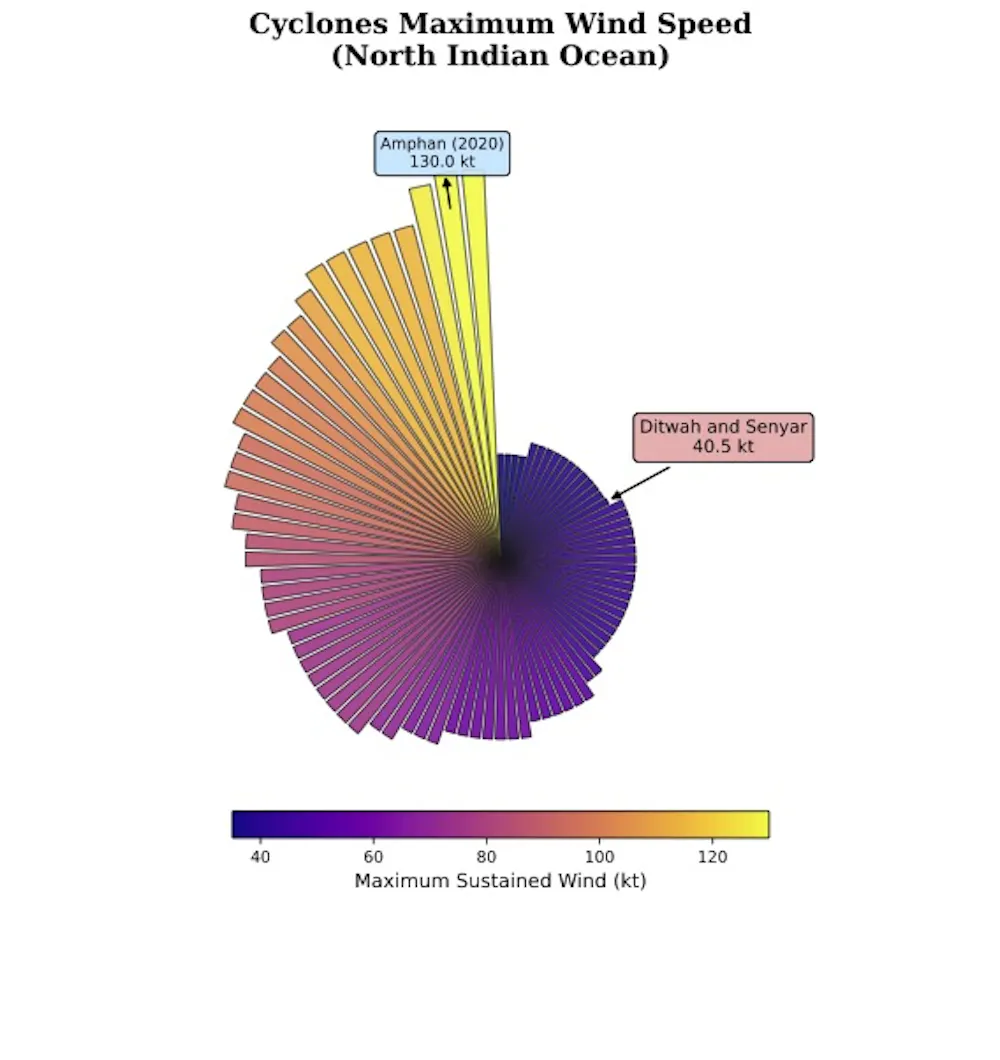
Graph of wind speeds
This graph of all cyclonic storms over the north Indian Ocean since 2001 shows Ditwah and Senyar weren’t particularly windy. (Wind speed measured in knots. 1 knot is about 1.15 mph or 1.85 kph)
Ligin Joseph (data: IBTrACS), CC BY-SA

Consider Cyclone Ditwah. Its peak winds were around 75 km/h (47 mph). That’s windy, but nothing special. In the UK, it would be classified merely as a “gale” rather than a “storm”. It was far weaker than the 220 km/h winds of the powerful 1978 cyclone that also struck Sri Lanka. Yet Ditwah still caused massive devastation.

What explains this apparent contradiction? It’s too early to say definitively, but climate change is likely a part of the story. Even when storms are not especially strong in wind terms, the amount of rain they carry is increasing.

A warmer atmosphere holds more water

A well established meteorological rule helps explain why. For every degree of global warming, the atmosphere can hold about 7% more moisture.

As the planet warms, the air above us becomes a larger reservoir, waiting to dump more water on us. When storms form, they can tap into this expanded supply, often in extremely short bursts. Even if wind speeds are modest, the rainfall alone can be catastrophic.

The oceans matter even more

Warming oceans play an even more powerful role, as cyclones draw their energy from warm ocean waters. Satellite data from late November shows just how warm the eastern Indian Ocean was, with large areas more than 1°C above normal during Ditwah and Senyar.

Coloured map of Indian Ocean and SE Asian seas
In the days before the cyclones formed (20–24 November), the oceans were even warmer than usual, creating conditions that could have fuelled and intensified the rainfall.
Ligin Joseph (Data: OISST; track positions are approximate), CC BY-SA

Such warm anomalies are no longer unusual. The oceans have absorbed more than 90% of the excess heat trapped by greenhouse gases, and long-term observations show a clear upward trend in ocean temperatures.

That doesn’t necessarily mean cyclones are becoming more frequent – their formation still depends on other ingredients, such as low wind shear (small differences in wind speed and direction with height) and the right atmospheric structure.

What warmer oceans do change, however, is the amount of energy available to any storm that does manage to form. When the ocean is warmer, cyclones have more fuel and evaporation increases, loading the atmosphere with moisture that can fall as intense rain once a storm develops. Even weak cyclones can therefore hold exceptional amounts of rain.

Coloured map of Indian Ocean and SE Asian seas
Evaporation averaged for 26–27 November. Ditwah especially travelled over warm waters supplying large amounts of moisture to the atmosphere.
Ligin Joseph (Data: ERA5), CC BY-SA

The winds near the surface help this process along. As they move across the ocean, they sweep away the moisture-filled air just above the water and replace it with drier air, allowing evaporation to continue. Put together, warmer oceans, higher evaporation, and an atmosphere that can store more moisture, these factors can significantly intensify the rainfall associated with cyclones.

Coastline hugging makes flooding worse

Local geography amplified these effects. Both Ditwah and Senyar formed unusually close to land and travelled along the coastline for an extended period. This meant they stayed over warm waters long enough to continuously draw moisture, but remained close enough to land to dump that moisture as intense rainfall almost immediately.

Cyclone Ditwah, in particular, moved slowly as it approached Sri Lanka. Slow-moving storms can be especially dangerous as they repeatedly dump rain over the same area. Even if winds are weak, this combination of warm seas, coastal proximity and slow forward speed can be devastating.

A new threat

These storms suggest that climate change – especially ocean warming – is reshaping the risks posed by cyclones. The most dangerous storms may no longer simply be the ones with the strongest winds, but also the ones with the most moisture.

Forecasting systems, including new AI-powered weather models, are getting better at predicting cyclone tracks and wind speeds. Yet rainfall-driven flooding remains far harder to forecast. As oceans continue to warm, governments and disaster agencies will need to prepare for storms that may be weak in wind but extreme in rain.

These insights are based on preliminary analysis and emerging scientific understanding. More detailed peer-reviewed studies will be needed to pinpoint exactly why Ditwah and Senyar produced such extreme rainfall. But the pattern that is emerging – weak cyclones delivering outsized floods in a warming world – must not be ignored.

The Conversation

Ligin Joseph receives funding from the UK’s Natural Environment Research Council (NERC).

ref. Warm oceans seem to be turning even ‘weak’ cyclones into deadly rainmakers – https://theconversation.com/warm-oceans-seem-to-be-turning-even-weak-cyclones-into-deadly-rainmakers-271550