How can Labour escape the doom loop in 2026?

Source: The Conversation – UK – By Matthew Flinders, Founding Director of the Sir Bernard Crick Centre for the Public Understanding of Politics, University of Sheffield
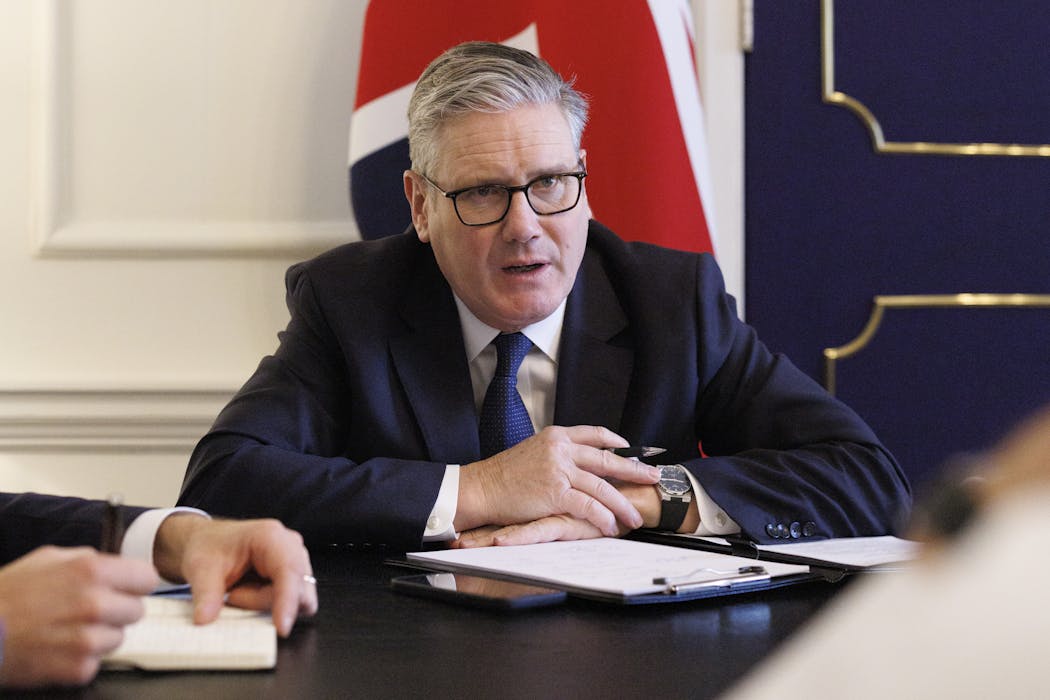
The PM insists he’ll still be in office at the end of the year. Flickr/Number 10 , CC BY-NC-ND

The British media’s obsession with the end of Keir Starmer’s premiership continues, with New Year’s coverage focusing on whether the prime minister will survive 2026.

Starmer began the year by telling BBC broadcaster Laura Kuenssberg that he can – and even that he will lead the Labour party into the next general election. But unless the most unradical of politicians does something very radical very quickly, the elections in May 2026 are likely to produce a leadership challenge.

However, leadership is not the core problem that the Labour party – or indeed, any party – really needs to focus on. The problem is that British politics is trapped in a “doom loop” that is, to some extent, of its own making.

It is lost in a self-reinforcing negative feedback cycle in which an initial problem triggers responses that worsen the original problem, locking the system into a spiral of decline.

Poor economic performance since the 2008 global financial crisis and a marked slowdown in productivity growth has led to poor UK performance in real wage growth and living standards. Low growth, high taxes and rising debt interest leads to declining confidence on the bond markets which leads to higher borrowing costs which, in turn, stifle growth and make deficits harder to tackle.

Although Rishi Sunak fought the 2024 election on the basis that it was possible to “reverse the creeping acceptance of a narrative of decline”, the public was not convinced.

In opposition, Starmer rejected the need for grand narratives or ideological ties. And he did not “win” the election thanks to a positive vision for Britain but largely due to the weight of disillusionment with the chaos of successive Conservative governments.

If anything, the doom loop has simply continued under Starmer, this time as what would become known as “miserabilism”. His governing style has been based around dampening expectations, emphasising national crises and blaming previous governments.

A perceived lack of ambition and a style and persona that emphasised grim necessity over hope and belief has exacerbated the problem. The paradox of such a pessimistic approach is that it has only added to a narrative of “broken Britain” that has increased populist pressures.

The problem is not (just) Starmer. The deeper problem is that none of the main contenders to replace him seem capable of offering a bold story of renewal and achievement that can stimulate collective confidence and national self-belief. Nor, if we are honest, are the leaders of the main opposition parties.

Towards the end of 2025 the doom loop was almost deafening. In October, BBC Radio 4 asked its listeners, “What kind of a state are we actually in?” before summarising their responses in the following terms:

If you pull out the kaleidoscope there are record delays for court cases, prisoners are being released, doctors are striking, water companies are pumping raw sewage wherever they can (preferably into lakes, rivers and the sea, that’s where they like to put it). We are one of the world’s richest seven economies and yet it does not feel like that by listening to the news … Bins on the streets, rats in the kitchen, gangs running prisons, knifes in the schools, university system broken, asylum system broken, benefits system broken, social housing system broken, politics broken, broken railways, poisoned rivers, failing high streets … you’d head for the hills if they weren’t strewn with rubbish.

An absence of ideas in response to these problems has created the political vacuum that Nigel Farage’s Reform party has exploited with such zeal. For Farage the story is simple – the UK is stuck in a spiral of decline that can only be broken by a combination of economic nationalism, cultural conservatism and populist politics.

Whether you believe in Farage’s diagnosis of the problem or prescriptions for reform, what he offers is a vaunted solution to the doom loop problem that is clear and confident.

The power of narrative

As academics Alex Prior and Clara Eroukhmanoff have argued, political leaders not only need a clear narrative but they also have to be compelling characters within that narrative. Margaret Thatcher offered both the narrative and persona. She acknowledged the existence of challenges while telling a story about how she intended to fix them.

Tony Blair did the same. Meanwhile, the loss of a Conservative majority in 2017 was attributed to Theresa May “performing neither the narrative nor the persona”.

Starmer is not, and never has been, a storyteller. The limits of his performative competence were demonstrated in his 2026 New Year “things will get better” message to the British public. His argument that “decline” really will be “reversed” was unconvincing, his body language and facial expressions betrayed a lack of inner belief and the whole video has a tragi-comic dimension that is difficult to miss.

A New Year message from the PM.

It’s easy to dismiss political storytelling as spin or selective framing – to call it propaganda or a manipulative tool for circumnavigating rational thought. But humans are storytelling animals. Understanding and ideas evolve through narratives.

Stories are sense-making and sense-giving modes of communication. They frame issues and they have an emotional appeal that resonates with their audiences. The “story paradox” is that they can bind people together and they can tear communities apart.

The dominant narrative in British politics is destructive, cynical and polarising. It focuses on failure and perpetuates the doom loop.

The question for 2026 is less about Starmer’s future and more about whether the political class can rebut this dominant and dangerous narrative of “broken Britain” with a positive and inclusive story about nurturing social change, building flourishing communities, generating inclusive growth and playing a role in the emergent world order.

But most of all this story must connect with the day-to-day concerns and lived experiences of voters and be able to radically reshape the tone of public debate. Britain urgently needs to tell a different story.

The Conversation

Matthew Flinders does not work for, consult, own shares in or receive funding from any company or organisation that would benefit from this article, and has disclosed no relevant affiliations beyond their academic appointment.

ref. How can Labour escape the doom loop in 2026? – https://theconversation.com/how-can-labour-escape-the-doom-loop-in-2026-272758

V&A East: the spirit of the 19th-century cultural campus of ‘Albertopolis’ lives on

Source: The Conversation – UK – By Bill Sherman, Director of the Warburg Institute, School of Advanced Study, University of London

This year the V&A opens its new outpost in east London. In 2025 it unveiled the so-called Storehouse, and its new V&A East Museum opens in April 2026. V&A East is part of a new cultural campus, on the site of the 2012 Summer Olympics, dedicated to collections, education and policy.

Designed by Diller Scofidio + Renfro (DS+R), the architecture firm best known for the giant Shed at the end of Manhattan’s High Line, the Storehouse serves as the new home for hundreds of thousands of objects that are not on display in the Museum’s main galleries in South Kensington.

It will be joined by the V&A East Museum, which will aim to spotlight making and the power of creativity to drive social change. It will open with the exhibition The Music Is Black: A British Story, which will reveal how Black British music has shaped British culture.

When the V&A East Storehouse opened it was met with both critical and popular acclaim, offering a beleaguered museum sector a glimpse of what London’s deputy mayor for culture called “the museum of the future”. However, if the V&A has created a new kind of institution, it’s fair to say, it has done so by going “back to the future”.

Indeed, that was the title of one of the early presentations I myself helped to create in 2016, when I was the V&A’s director of research and collections, to secure the approval of both the Museum’s Board of Trustees and London’s Mayor.


Read more:
How the new V&A Storehouse is reshaping public access to museum collections


We drew inspiration from our recent record. As it happens, the three-year period during which V&A East was conceived saw three of the most successful exhibitions in the Museum’s history – David Bowie Is (2013), Disobedient Objects (2014) and Alexander McQueen: Savage Beauty (2015). Each of these exhibitions was a masterclass in museology (the practice of organising, arranging and managing museums) devoted to subjects once seen as difficult if not impossible to display.

We also met with people who had designed ambitious commercial and cultural infrastructures, including one of Germany’s largest hardware chains and one of Australia’s busiest public libraries. We visited other institutions devoted to giving new access to non-displayed collections such as Glasgow’s Museums Resource Centre and Rotterdam’s Boijmans Van Beuningen Museum, whose dramatic Depot opened in 2021 as “the world’s first publicly accessible art storage facility.”

These new projects pointed us, in turn, to a history that stretched back to the middle of the 19th century, when the V&A grew out of the Great Exhibition of 1851. This first World’s Fair attracted more than six million visitors and provided both collections and capital for the South Kensington Museum (the precursor to the V&A and the Science Museum). This institution was the first to offer food to visitors and evening hours. It was also supported by the first system of artificial lighting.

The decades that followed the fair saw pioneering developments in how museums were run. There were strides in technologies of reproduction such as photography and plaster casts. There was increasing circulation of collections to remote locations. Makers and artists were incorporated more into the galleries. There was also a core commitment to integrating research and teaching in the museum.

In those years, the Victoria and Albert Museum became part of a campus (known half-jokingly as Albertopolis) bringing together complementary institutions devoted to collections, education and policy. This was the explicit model not only for V&A East but for the redevelopment of the entire Queen Elizabeth Park in the wake of the 2012 Summer Olympics. In planning both the Storehouse and the new museum that will open next spring, we worked closely with partners (first UCL and the Smithsonian and later Sadler’s Wells, London College of Fashion, BBC Symphony Orchestra and others) who could create new synergies with old collections.

The V&A East Storehouse may well be the world’s largest cabinet of curiosities. It is certainly the most democratic: the Victoria and Albert Museum’s new facility in East London is free to visit and sits at the intersection of four of the UK’s most diverse and deprived neighbourhoods.

“It holds everything,” according to the V&A’s website, “from the pins used to secure a 17th century ruff to a two-storey section of a maisonette flat from the Robin Hood Gardens housing estate, demolished in 2017.” Other artefacts include The Kaufmann Office, the only complete interior by architect Frank Lloyd Wright outside of the US.

Visitors can not only see these “reserve collections” through a dizzying vista of open shelving but can order up to five items for a closer look. They can explore displays made by artists-in-residence and members of the community. They can look down through the glass-panelled floor into a state-of-the-art conservation lab. The project puts a national collection into the hands of the people and makes the experience no more daunting than a trip to the local Ikea, or, for that matter, the Westfield Shopping Centre, through which most people will pass on their short walk from Stratford Station.

When the project was conceived, Martin Roth, the V&A’s Director, asked us to turn the museum inside out, giving our visitors new insights into how collections are made, preserved and shown. Gus Casely-Hayford, the Director of V&A East, wants to bring a different demographic to the V&A, including local people who may never have been to a museum.

Its opening will complete East London’s new cultural campus. Only time will tell if the experiment of V&A East is as successful as Prince Albert’s visionary model in South Kensington.


Looking for something good? Cut through the noise with a carefully curated selection of the latest releases, live events and exhibitions, straight to your inbox every fortnight, on Fridays. Sign up here.


The Conversation

Bill Sherman receives funding from Research England.

ref. V&A East: the spirit of the 19th-century cultural campus of ‘Albertopolis’ lives on – https://theconversation.com/vanda-east-the-spirit-of-the-19th-century-cultural-campus-of-albertopolis-lives-on-272103

Apprendre les maths autrement : les pistes de la recherche

Source: The Conversation – in French – By Florence Peteers, MCF Didactique des mathématiques, CY Cergy Paris Université

Si les mathématiques sont unanimement considérées comme décisives dans notre société, elles suscitent nombre de craintes chez les élèves. Les rendre plus accessibles suppose donc de changer leur enseignement. Mais comment ? Le succès de situations « adidactiques » offre quelques pistes à la recherche. Explications.


Parus en décembre 2025, les résultats de la grande consultation nationale sur la place des mathématiques lancée par le CNRS montrent que beaucoup de Français se sentent peu à l’aise avec les mathématiques même s’ils reconnaissent l’importance de cette discipline pour la société. À la suite de cette consultation et des Assises des mathématiques de 2022, le CRNS a défini des orientations prioritaires, dont l’amélioration de l’inclusion. Mais comment rendre les mathématiques plus accessibles à tous ?

Les participants à la consultation de 2025 suggèrent notamment de « généraliser des méthodes d’enseignement variées, concrètes, ludiques et encourageantes, qui valorisent notamment le droit à l’erreur, tout au long de la scolarité ».

Dans ce sens, depuis plusieurs années, nous expérimentons dans des classes ordinaires (avec l’hétérogénéité des profils d’élèves qui les caractérisent !) des séquences de mathématiques inclusives. En quoi se distinguent-elles des modes d’enseignement classiques ? Et que nous apprennent leurs résultats ?

Mettre l’élève en situation de recherche

Ces séquences de maths inclusives s’appuient sur des situations à dimension adidactique, c’est-à-dire des situations qui intègrent des rétroactions de sorte que l’élève n’ait pas besoin que l’enseignant lui apporte des connaissances. C’est en interagissant avec la situation et en s’adaptant aux contraintes de celle-ci que l’élève construit de nouvelles connaissances. Il ne le fait pas en essayant de deviner les intentions didactiques de l’enseignant (c’est-à-dire en essayant de deviner ce que l’enseignant veut lui enseigner), d’où l’appellation « adidactique ».

Comme le dit le spécialiste de l’enseignement des maths Guy Brousseau, à l’origine de ce concept dans les années 1970-1980 :

« L’élève sait bien que le problème a été choisi pour lui faire acquérir une connaissance nouvelle, mais il doit savoir aussi que cette connaissance est entièrement justifiée par la logique interne de la situation et qu’il peut la construire sans faire appel à des raisons didactiques. »

Ces situations ont un potentiel identifié depuis longtemps et mis à l’épreuve dans les classes à grande échelle depuis 40 ans (surtout du premier degré, notamment dans l’école associée au Centre d’observation et de recherches sur l’enseignement). Ces travaux ont également donné lieu à des ressources pour les enseignants, par exemple la collection Ermel.

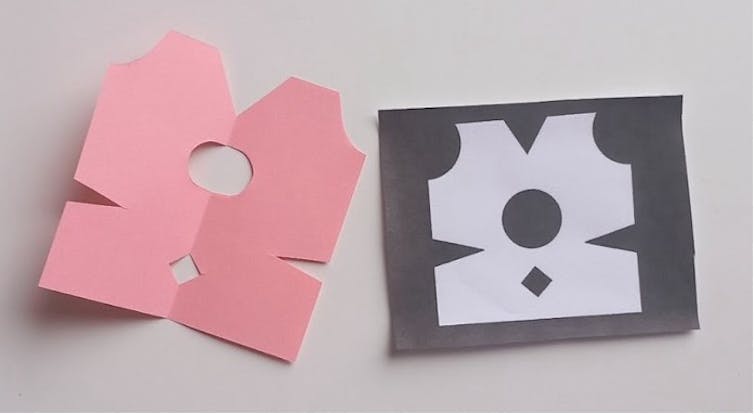
Dans le cadre de nos recherches, nous avons, par exemple, conçu et testé dans plusieurs écoles (REP+, milieu rural, milieu urbain…) une séquence en CM1-CM2 qui s’appuie sur la situation des napperons de Marie-Lise Peltier. Les élèves y ont à disposition une feuille de papier carrée, ils doivent reproduire un modèle de napperon en pliant et en découpant leur feuille. C’est la notion de symétrie axiale qui permet de découper un napperon conforme au modèle, et l’élève peut s’autovalider en comparant sa production au modèle donné.

Découper un napperon et découvrir la notion de symétrie axiale.
Fourni par l’auteur

Mettre en œuvre une situation à dimension adidactique peut s’avérer complexe, car le rôle de l’enseignant diffère de ce dont il a l’habitude ; ici, il n’apporte pas directement les connaissances même s’il peut aider les élèves à résoudre la tâche.

De plus, les élèves peuvent élaborer des stratégies très diverses, ce qui peut les déstabiliser. Cependant, cette diversité constitue également une richesse du point de vue de l’inclusion, car chaque élève peut s’investir à la hauteur de ses moyens. Par ailleurs, ces situations permettent de stimuler l’engagement des élèves et les mettent dans une véritable activité de recherche, ce qui constitue le cœur des mathématiques.

Donner du sens aux notions mathématiques

À l’heure actuelle, ce type de situations est peu mis en œuvre, en particulier auprès des élèves en difficulté, car les enseignants ont plutôt tendance à penser qu’il faut découper les problèmes complexes en tâches les plus simples possibles pour s’assurer de la réussite des élèves. Cependant, la réalisation juxtaposée de tâches simples et isolées ne permet pas, souvent, de donner du sens aux notions mathématiques en jeu ni de motiver les élèves.

Dans l’exemple autour des napperons, nous avons constaté qu’en s’appuyant sur les rétroactions, mais aussi parfois sur leurs pairs et sur les conseils de l’enseignant, la majorité des élèves de CM1-CM2 que nous avons observés réussit à produire un napperon conforme au modèle, alors même que, parmi ces élèves, plusieurs avaient été signalés comme étant « en difficulté ».

Même les élèves n’étant pas arrivés à produire un napperon conforme dans le temps imparti se sont fortement engagés, comme en témoigne le nombre important de réalisations. Nous pouvons faire l’hypothèse que cette situation pourra constituer une situation de référence pour eux quand ils aborderont de nouveau la notion de symétrie axiale.


À lire aussi :
Six façons de faire aimer les maths à votre enfant


Les aspects positifs et les défis que nous avons pu identifier dans notre recherche corroborent les résultats obtenus par d’autres chercheurs et chercheuses qui ont étudié la mise en œuvre de situations à dimension adidactique pour travailler diverses notions mathématiques, à différents niveaux scolaires, auprès de publics variés, notamment auprès d’élèves présentant une déficience intellectuelle ou un trouble dys, en France et au Québec.

Ainsi, même si ce concept n’est pas nouveau, l’appui sur les situations à dimension adidactique nous semble toujours une piste intéressante et actuelle pour penser l’enseignement des mathématiques pour tous. Cependant, il est nécessaire de donner aux enseignants les moyens de les mettre en œuvre de manière satisfaisante, par exemple en allégeant le nombre d’élèves par classe et en les accompagnant en formation initiale et continue.

The Conversation

Florence Peteers est porteuse de la Chaire Junior SHS RIEMa financée par la région Île-de-France et a reçu des financements du PIA3 100% IDT (inclusion, un défi, un territoire) porté par l’Université de Picardie Jules Verne.

Elann Lesnes a reçu reçu des financements du PIA3 100% IDT (inclusion, un défi, un territoire) porté par l’Université de Picardie Jules Verne.

ref. Apprendre les maths autrement : les pistes de la recherche – https://theconversation.com/apprendre-les-maths-autrement-les-pistes-de-la-recherche-272586

As the Milan Winter Olympics approach, what are the environmental expectations?

Source: The Conversation – Global Perspectives – By Alizée Pillod, Doctorante en science politique, Université de Montréal

Italy is preparing to host the 25th Winter Olympic Games next month — from Feb. 6 to the 22nd, followed by the Paralympic Games from March 6 to the 15th.

After the excitement of the Paris Summer Games in 2024, which had sustainability at the heart of its planning strategy, the Milan Winter Games will be decisive in determining whether there’s truly a major shift happening within the Olympic movement.

Will the organizing committee be able to keep its green promises?

As a doctoral student in political science at the University of Montréal, my work focuses on both climate communication and environmental policy development, including in the sports sector.

Winter Games in the climate era

It should be noted that few sectors are as dependent on weather conditions as outdoor sports.

The climate crisis is making it increasingly difficult to practise sports, especially winter sports. The cancellation of the Alpine Ski World Cup in Mont Tremblant last year due to lack of snow is just one striking example of what’s happening.

According to a study by the University of Waterloo, only 10 former Olympic sites will remain viable for hosting future Winter Games by the year 2050. By 2080, that number could drop to just six.

At the same time, hosting mega sporting events such as the Olympics generates a considerable carbon and environmental footprint.

Although generally smaller than the Summer Games, the Winter Games have been the subject of many environmental controversies, particularly in relation to the destruction of preserved nature reserves.

For the most recent Games in Beijing in 2022, more than 20,000 ancient trees were felled to make room for an expanded ski area and the construction of infrastructure, including access roads, car parks and lodging facilities.

High-level sport is therefore caught in a conflict of both being affected by and contributing to global warming.

Agendas set new standards

In light of these challenges, the International Olympic Committee (IOC) has adopted several policies in recent years to reduce the footprint of the Games, such as the Olympic Agenda 2020, with strategic objectives that were reiterated in 2021 with the Olympic Agenda 20+5.

After Paris 2024, the Milan-Cortina Games will be the first Winter Games to have to comply with these requirements.

Two of the goals are to promote sustainable Games and to make the Games a springboard for achieving the United Nations’ Sustainable Development Goals.

To this end, the IOC now requires host cities to reduce their CO₂ emissions and promote the concept of legacy to encourage the reuse or converstion of existing venues when the event is over.

Milan-Cortina on the green track

Fortunately, it looks like the Italian organizing committee has decided to make the fight against global warming a central part of its strategic plan. From the outset, it implemented a rigorous process for assessing its greenhouse gas emissions.

In its second report on its sustainability strategy, published in September 2025, the committee also presented several measures to further reduce the carbon footprint of the event.

The flagship initiatives include a commitment to use 100 per cent renewable energy and limit food waste by redistributing any surplus food to local charities. In an effort to encourage the circular economy, more than 20,000 pieces of equipment from the Paris Games were repurchased.

In terms of infrastructure, the focus is once again on reusing existing facilities and using temporary structures that will be dismantled after the Games, as they were in Paris. In total, nearly 90 per cent of the venues will fall into this category.

The few new permanent buildings being built will become training centres for Italy’s future elite athletes, or be converted for other uses. Like the one in Paris, the new Olympic Village in Milan will become a university residence, for example.

The plan also includes adaptation measures. With global warming, natural snowfall is becoming increasingly rare and the use of artificial snow is becoming the new norm to offer athletes optimal performance conditions. The organizing committee has therefore decided to modernize its artificial snow production systems to respond more effectively to needs in the event of abnormally warm temperatures this winter.

An ambitious plan, but not flawless

While the plan looks reassuring on paper, its implementation still presents a number of challenges.

Beyond the chronic delays in the progress of the work and colossal budget overruns (spending so far is at least double the initial budget), the construction of new infrastructure in the mountains necessarily has a significant environmental footprint.

It’s also worth noting that the Milan-Cortina Games will take place at venues spread across four areas in northern Italy: Milan, Cortina, Valtellina and Val di Fiemme. Together, these venues cover an area of more than 20,000 square kilometres, making these the most widely dispersed Games in history. As a result, there will be not one but six resort sites for athletes.

This undoubtedly explains why most of the budget is allocated to the development of public transport, particularly the rail network, in order to facilitate travel between the various venues. Sports infrastructure, meanwhile, accounts for less than a quarter of the total budget.

In addition, some of the construction projects have been controversial. The brand new bobsled track in Cortina, for example, has been heavily criticized because it required the felling of several hundred trees. Although these numbers are far lower than those in Beijing, the fact remains that hosting the Games leads to the disruption of local biodiversity.

In terms of temporary facilities, the committee has pledged to restore ecosystems and, more broadly, offset all residual emissions, in particular by buying carbon credits. However, pessimists will argue that what has been destroyed can never be fully restored, and that no financial or ecological compensation can truly erase the impact.

In terms of adaptation, it should be noted that the production of artificial snow, even when it’s optimized, uses a lot of water and energy, in addition to degrading soil quality. So this solution, which is supposed to mitigate the effects of global warming, paradoxically ends up contributing to it, highlighting the importance of better thinking about adaptation solutions.

Finally, residents fear gentrification. In Milan, the construction of the Olympic Village led to the eviction of residents, and the rents planned once the site is converted into student accommodation are considered too high. From a social justice perspective, therefore, it’s worth asking who will truly benefit from the new facilities in the longer term.

A genuine turning point?

Overall, the Milan-Cortina strategy shows a real evolution in the way we think about the sustainability of the Winter Games. The organizers have learned from previous Games and are now proposing even more innovative approaches.

Although the anticipated greenhouse gas emissions are lower than in Beijing or in Pyeongchang, those for Milan-Cortina are still estimated at nearly one million tonnes of CO₂ equivalent. In this context, hopefully the committee will succeed in implementing all the measures planned to offset as much as possible.

Furthermore, the next Winter Games will take place in the French Alps. The brand new organizing committee for the 2030 Games is no doubt closely monitoring the choices that were made on the Italian side, aware of the growing climate challenges that await it.

In the meantime, we can count on the athletes and para-athletes, who, as I write these lines, are already hard at work getting ready to dazzle us once again, if only for a moment.

La Conversation Canada

Alizée Pillod is affiliated with the Centre d’Études et de Recherches Internationales de l’Université de Montréal (CERIUM), the Centre de recherche sur les Politiques et le Développement Social (CPDS) and the Centre for the Study of Democratic Citizenship (CSDC). Her research is funded by the Fonds de Recherche du Québec (FRQ). Alizée has also been awarded the Departmental Recruitment Scholarship in Public Policy (2021), the Rosdev Scholarship for Excellence in Environmental Studies (2023), and the Scholarship for Excellence in Public Policy from the Maison des Affaires Publiques et Internationales (2025). She has previously collaborated with the Ouranos consortium, the Quebec Ministry of the Environment, and the INSPQ.

ref. As the Milan Winter Olympics approach, what are the environmental expectations? – https://theconversation.com/as-the-milan-winter-olympics-approach-what-are-the-environmental-expectations-270626

Venezuelans are reacting to Maduro’s capture with anger, fear, hope and joy

Source: The Conversation – Global Perspectives – By Matt Wilde, Lecturer in Human Geography, University of Leicester

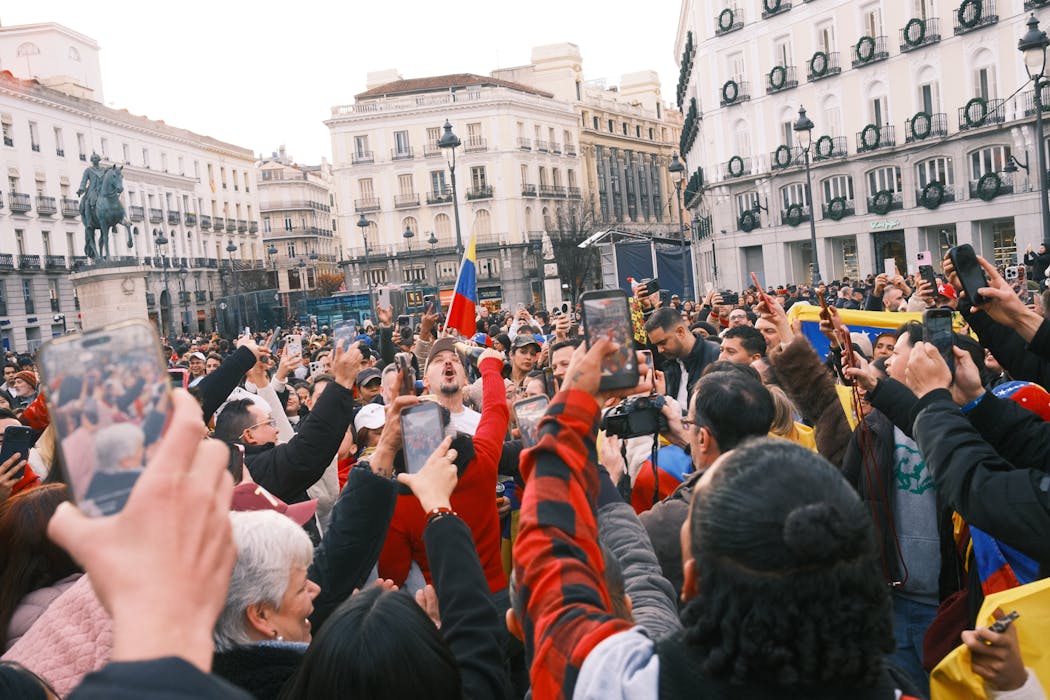
Venezuelans celebrate the news of Nicolás Maduro’s capture in Puerta del Sol, Madrid, on January 3. Harry Rodgers

When the news broke of Nicolás Maduro’s arrest following a US attack on Venezuela on January 3, que locura (“what madness”) was the line that seemed to capture the moment. As Venezuelans around the world reached for their phones and anxiously followed the news, they grappled to make sense of what they were seeing.

Drawing on our long-term ethnographic research with Venezuelans living in Spain, the US and Venezuela itself, the insider accounts and interviews detailed below show the diverse ways in which these events are being experienced and understood.

In the Spanish capital of Madrid, many Venezuelan migrants celebrated what they saw as a long-awaited turning point. But across Venezuela’s diaspora and inside the country, others described an uneasy quiet and deep fears about what might come next. These contrasting reactions reveal a moment shaped as much by uncertainty and suspicion as by relief and hope.

At the Puerta del Sol square, home of Madrid’s regional government, we joined hundreds of Venezuelans as they met to celebrate the news that Maduro had been taken into US custody. After beginning as a small gathering, the numbers soon swelled and a party atmosphere took hold.

Anti-government chants such as y ya cayó, y ya cayó, este gobierno ya cayó (“it fell, it fell, this government fell”) and se fue, se fue, (“he’s gone, he’s gone”) reverberated around the square.

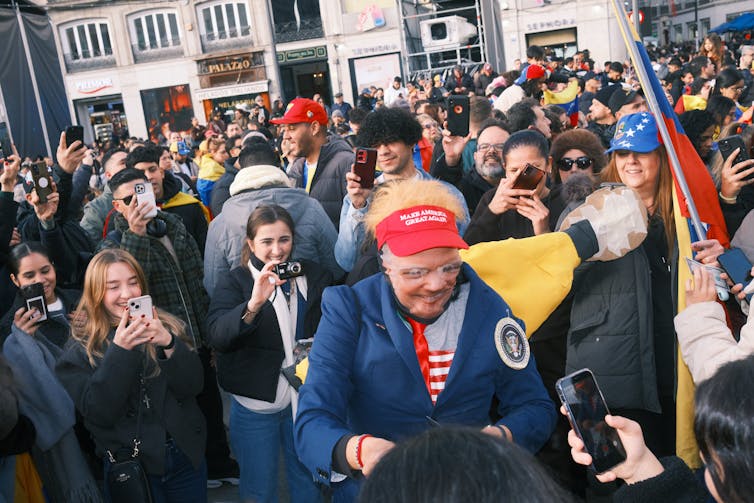
Venezuelans, many of whom have claimed political asylum in Spain, hugged, shouted, cried and danced under a 32-metre-high Christmas tree, enjoying a welcome moment of reprieve. One older Venezuelan woman dressed as the US president, Donald Trump, handed out fake dollar bills as a “reward” for capturing Maduro.

Another attendee, a 26-year-old delivery rider, described how he partied until the early hours of the morning in a bar hung with Venezuelan flags. “I’m very, very happy,” he said. “They finally captured that dictator.”

A woman dressed as Donald Trump during celebrations in a public square in Madrid.
A woman dressed as Donald Trump during celebrations in the Puerta del Sol square in Madrid, Spain.
Harry Rodgers

But these jubilant scenes were not the only reaction. Other Venezuelans we spoke to expressed a more cautious and contingent hope. In an interview conducted over the weekend in Madrid, a Venezuelan woman called Araceli described how she didn’t feel comfortable attending the Puerta del Sol celebrations.

“I just feel very sad. I am happy Maduro’s going to be in jail, but I know the repercussions. I know what a war means.” She continued through tears: “I just want my family to be safe. I just want the simple things. I can’t celebrate until I know my family are safe.”

Such sentiments were echoed by Guillermo, a Venezuelan man we interviewed online who is currently living in the US city of Chicago. “It’s confusing. I’m happy that Maduro has lost power, but scared because I fear the consequences of the US taking over my country.”


Read more:
Donald Trump’s raid on Venezuela foreshadows a new ‘great power’ carve-up of the world


Many Venezuelan migrants want the chance to return home to a stable country, but are concerned about how Venezuela’s heavily militarised regime will respond to the US attack. Since Maduro’s capture, security forces and pro-government motorcycle gangs known as colectivos have patrolled the streets of Venezuela’s capital, Caracas.

They are also deeply suspicious of Trump’s motives. In the aftermath of Maduro’s abduction, Trump said the US would “run” Venezuela, though several prominent Republicans swiftly backpedalled on this assertion.

Reaction inside Venezuela

This sense of caution is playing out on Venezuela’s streets as well. Ernesto, a small business owner in the central city of Barquisimeto, described to us how his friends and neighbours are responding to Maduro’s arrest.

“A lot of anticipation and uncertainty. There’s joy that Maduro has been taken away, but no one is celebrating in public. Lots of people won’t go out because they’re worried that they’ll be stopped and robbed of their car and money if they’re out on the street. Others have gone out to stock up on groceries and gas in case of shortages.”

The removal of Maduro is also bringing longstanding political tensions to the fore. Luis, originally from the Venezuelan city of Valencia, sent us a voice note describing how he had to leave family WhatsApp groups to avoid political arguments. “Oh, you’re the best Donald Trump, oh thank you so much! Make Venezuela Great Again! It makes me so sad and angry,” he recounted sarcastically.

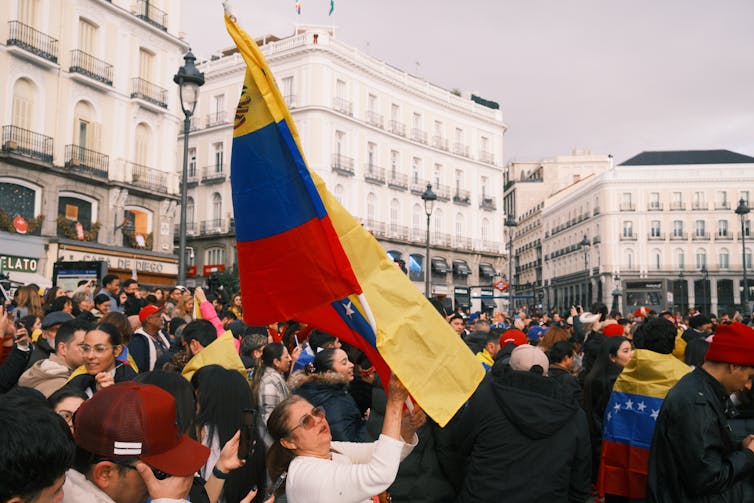
A woman waves the Venezuelan flag during celebrations in Madrid.
Harry Rodgers

Anger at what many perceive to be naked imperialism from the US is expressed by Venezuelans across the political spectrum, including those who never supported the Bolivarian Revolution that was initiated by Maduro’s predecessor, Hugo Chávez.

“I am sceptical,” says Jaime, a resident of Caracas. “I don’t know if I should be happy because I don’t like Trump’s tone. He continues with his theory that we stole his oil and it sets a terrible precedent. Losing our sovereignty over the resource that sustains Venezuela would be something terrible.”

Such concerns are shared by Valentina, a retired academic based in Valencia. She told us: “Imagine, we’re being invaded by the US! It’s horrible but we can’t do anything, just wait and see what their administration will be like.”

These diverse reactions show how geopolitical ruptures are lived through families, friendships and daily routines, shaping intimate decisions and relationships in the process. As Venezuela becomes the focal point for a seismic realignment of the global political order, ordinary Venezuelans once again find their lives being restructured by forces beyond their control.

Across Venezuela’s transnational population, the present moment is marked simultaneously by hope, fear and profound uncertainty about what the future holds.

The Conversation

The research for this article was funded by the British Academy (SRG2324240415) and the Economic and Social Research Council (ES/2878167).

ref. Venezuelans are reacting to Maduro’s capture with anger, fear, hope and joy – https://theconversation.com/venezuelans-are-reacting-to-maduros-capture-with-anger-fear-hope-and-joy-272717

‘Neither Gaza nor Lebanon!’ Iranian unrest is about more than the economy − protesters reject the Islamic Republic’s whole rationale

Source: The Conversation – Global Perspectives – By Kamran Talattof, Professor of Near Eastern Studies, University of Arizona

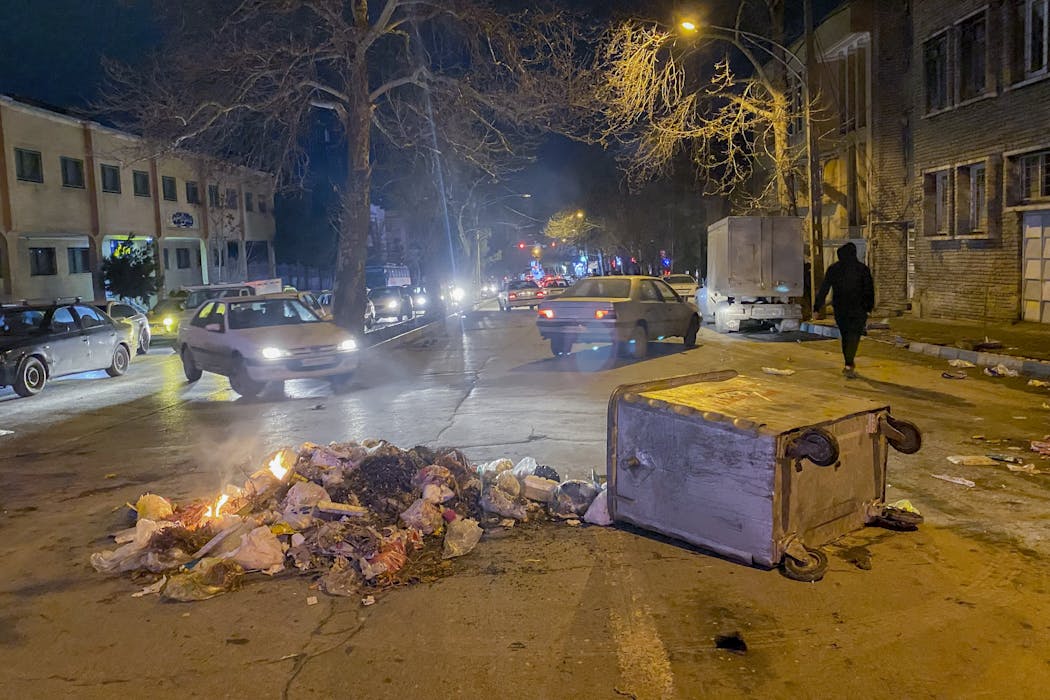
The aftermath of a protest in Hamedan, Iran, on Jan. 1, 2026. Mobina/Middle East Images/AFP via Getty Images

A familiar slogan has echoed through the streets of various Iranian cities in recent days: “Neither Gaza nor Lebanon, I sacrifice my life for Iran.”

That phrase has been chanted at protests that have sprung up around Iran since Dec. 28, 2025. The spark of the uprising and bazaar strikes has been economic hardship and government mismanagement.

But as an expert of Iranian history and culture, I believe the slogan’s presence signals that protests go deeper than economic frustration alone. When people in Iran chant “Neither Gaza nor Lebanon,” they are, I believe, rejecting the theocratic system in Iran entirely. In other words, the current crisis isn’t just about bread and jobs, it’s about who decides what Iran stands for.

The origins of the slogan

The phrase “Neither Gaza nor Lebanon, I sacrifice my life for Iran” first gained prominence during the 2009 Green Movement, when hundreds of thousands of people protested a disputed presidential election in Iran.

It has since appeared in successive major demonstrations, from the 2017-18 economic protests to the 2019 fuel price uprising. It was also prominent during the 2022 “Women, Life, Freedom” movement, sparked by the death of an Iranian-Kurdish woman, Mahsa Amini, following her detention by Iran’s morality police for not wearing a “proper” hijab.

The phrase ties together two key aspects of successive Iranian protest movements: domestic economic, political or social grievances and an explicit rejection of the government’s justification for that hardship – namely, that sacrifice at home is necessary to fulfill ideological goals of “resistance” abroad.

In particular, the slogan targets the Islamic Republic’s decades-long support for Hezbollah in Lebanon and Hamas in Gaza.

Estimates suggest that the regime has channeled between US$700 million and $1 billion annually to regional allies since the 1980s – funds that many Iranians argue should instead address domestic infrastructure, health care and education.

From alliance to resentment

Understanding the full meaning of the slogan requires historical context. Under the U.S.-aligned Pahlavi monarchy, which ruled from 1925 to 1979, Iran maintained diplomatic and economic ties with Israel while pursuing modernization.

The Shah’s opponents, particularly leftist groups, exploited these connections, using slogans like “Iran’s become Palestine, why sit still, O people?” to mobilize against the monarchy.

Indeed, many of the Islamic revolutionary leaders that ousted the Shah in 1979 had ties with Palestinian groups.

After the revolution, the Islamic Republic inverted both its ties to the U.S. and Iran’s relationship with Israel, making anti-Israel rhetoric and support for Palestinian causes central to its identity.

Ruhollah Khomeini, the leader of the Islamic Revolution, declared solidarity with oppressed Muslims worldwide, positioning Iran as the vanguard of resistance against what he called “Western imperialism and Zionism.”

But this ideological commitment came with substantial costs for Iranians.

Iran’s support for Hezbollah during Lebanon’s civil war, its backing of Hamas in the Palestinian group’s fight against Israel, and its involvement in Syrian and Iraqi conflicts have contributed to international sanctions, diplomatic isolation and economic pressure on Iran. And these burdens have fallen disproportionately on ordinary citizens rather than the ruling elite.

Economic crisis and political defiance

“Down with the Islamic Republic” is also chanted alongside “Neither Gaza nor Lebanon” in the current uprising – the most serious that the Iranian government has faced in years.

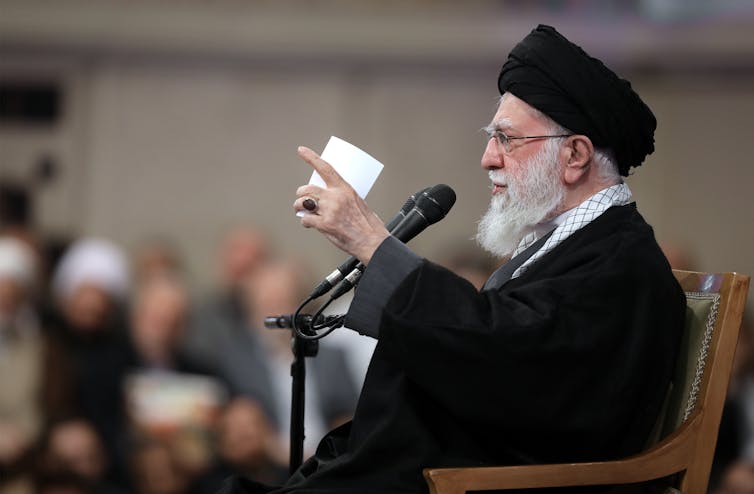
But neither lethal force – at least 1,203 arrests and more than two dozen deaths thus far – nor supreme leader Ali Khamenei’s Jan. 3 order for a harsher crackdown has quelled the unrest.

A man in traditional Iranian garb speaks.
Supreme leader Ayatollah Ali Khamenei speaks in Tehran on Jan. 3, 2026.
Office of the Iranian Supreme Leader via AP

Instead, protests have expanded to 110 cities and villages.

The demonstrations illustrate how economic and political grievances intersect in Iran. When demonstrators chant “Neither Gaza nor Lebanon” while protesting bread prices and unemployment, they are not compartmentalizing issues – they are drawing a direct line between foreign policy choices and domestic suffering.

The slogan makes three simultaneous arguments.

First, it rejects imposed solidarity. Many Iranians, including those sympathetic to Palestinian rights, resent being conscripted into conflicts that are not their own. And the government’s insistence that Iranians must make sacrifices for distant causes breeds resentment rather than unity. Take the government’s effort to portray the 12-day war with Israel in June 2025 as a moment of national resistance. Rather, many Iranians instead blamed the leadership for either provoking the conflict or failing to meaningfully defend the country from Israeli – or American – bombs.

The slogan also demands accountability for resource allocation. When state media broadcasts funerals for fighters killed in Syria or Yemen while Iran’s hospitals lack basic supplies, the disconnect between rhetoric and reality becomes glaring.

And finally, the protest message reclaims political belonging rooted in Iranian national history – and not just the ideological concerns of the Islamic Republic. By invoking Iran specifically, “I sacrifice my life for Iran,” protesters assert that their primary allegiance is to their own country, not to transnational ideological movements, regional proxies or the ruling government’s ideology.

The limits of solidarity

For all its longevity, however, the slogan has proven divisive. While some see it as a necessary assertion of self-determination after decades of enforced sacrifice, others – including some Iranian leftist intellectuals and activists – view it as abandoning solidarity with oppressed peoples.

But it doesn’t need to be an either/or. Many protesters risking bullets to demand “Iran first” are not expressing indifference to the suffering of Palestinians. Rather, they are insisting that effective solidarity requires a functioning state capable of supporting its own citizens, and that genuine liberation begins at home.

Regardless, the Islamic Republic’s response has been to frame criticism as betrayal, suggesting that those who question support for Gaza or Lebanon are complicit with imperialism – a narrative enforced through a mix of rhetoric and coercion.

But this framing increasingly fails to persuade a population that has watched living standards decline while billions of dollars flow to foreign conflicts. The effects of sanctions and shrinking foreign-currency revenues have pushed the Iranian state to raise taxes on households while shielding military and ideological spending. Meanwhile, the dollar’s daily surge and the rial’s rapid collapse have accelerated inflation and eroded purchasing power.

Authoring one’s own story

Undoubtedly, economic grievances underpin the current protests in Iran. However, the slogans used in Iranian protests – be they over election disputes, economic crises or women’s rights – indicate a broader critique of the Islamic Republic’s governing philosophy.

In the current wave of protests, demonstrators articulate through slogans both what they reject – “Down with the Islamic Republic” – and what many now seek to happen: “This is the final battle; Pahlavi will return,” a reference to the exiled Crown Prince Reza Pahlavi.

The “Neither Gaza nor Lebanon” chant asks: What does it mean for a government to prioritize foreign conflicts over domestic welfare? How long can imposed solidarity substitute for actual prosperity? And who has the right to determine which causes are worth sacrifice?

Such questions extend beyond Iran. They challenge assumptions about how governments invoke international causes to justify domestic policies and when citizens have the right to say, “Our story comes first.”

As such, the chant “Neither Gaza nor Lebanon, I sacrifice my life for Iran” is, I believe, both protest and reclamation. It rejects the Iranian state’s narrative of mandatory sacrifice while asserting the right of people to author a national story focused on Iran’s own needs, challenges and aspirations.

The Conversation

Kamran Talattof does not work for, consult, own shares in or receive funding from any company or organization that would benefit from this article, and has disclosed no relevant affiliations beyond their academic appointment.

ref. ‘Neither Gaza nor Lebanon!’ Iranian unrest is about more than the economy − protesters reject the Islamic Republic’s whole rationale – https://theconversation.com/neither-gaza-nor-lebanon-iranian-unrest-is-about-more-than-the-economy-protesters-reject-the-islamic-republics-whole-rationale-265696

Autocrats have long lists of political enemies. This is how Donald Trump has tried to silence his

Source: The Conversation – Global Perspectives – By Justin Bergman, International Affairs Editor, The Conversation

The list of people Donald Trump has punished or threatened to punish since returning to office is long. It includes the likes of James Comey, Letitia James, John Bolton, as well as members of the opposition, such as Adam Schiff, Mark Kelly and Kamala Harris.

In fact, he has gone so far as to call Democrats “the enemy from within”, saying they are more dangerous than US adversaries like Russia and China.

According to Lucan Way, a professor of democracy at the University of Toronto, when a leader attacks the opposition like this, it’s a clear sign a country is slipping into authoritarianism.

As Way says in episode 5 of The Making of an Autocrat:

 In other kind of countries with weaker justice systems, you can literally jail members of opposition or bankrupt them. In a country like the United States, where the rule of law is quite robust, this is not possible, you can’t just jail rivals at will.

But Trump has other ways of making the cost of opposing him too high for his critics to bear. This includes investigations, lawsuits, audits, personal attacks – anything to distract and silence them.

The effect is his opponents become much more reluctant to engage in behaviour they know that Trump won’t like, Way says.

So it really has this kind of broader silencing effect that I think is quite pernicious.

Listen to the interview with Lucan Way at The Making of an Autocrat podcast, available at Spotify, Apple, or wherever you get your podcasts.

This episode was written by Justin Bergman and produced and edited by Isabella Podwinski and Ashlynne McGhee. Sound design by Michelle Macklem.

Newsclips in this episode WCNC, MS NOW, WHAS11, and Radio Free Europe.

Listen to The Conversation Weekly via any of the apps listed above, download it directly via our RSS feed or find out how else to listen here. A transcript of this episode is available via the Apple Podcasts or Spotify apps.

The Conversation

Lucan Way has received funding from the Social Science and Humanities Research Council of Canada.

ref. Autocrats have long lists of political enemies. This is how Donald Trump has tried to silence his – https://theconversation.com/autocrats-have-long-lists-of-political-enemies-this-is-how-donald-trump-has-tried-to-silence-his-272252

From Kathmandu to Casablanca, a generation under surveillance is rising up

Source: The Conversation – Global Perspectives – By Amani Braa, Assistant lecturer, Université de Montréal

In 2025, youth-led protests erupted everywhere from Morocco to Nepal, Madagascar and Europe. A generation refused to remain silent in the face of economic precariousness, corruption and eroding democratic norms and institutions.

Although they arose in different contexts, all the protests were met with the same playbook of responses: repression, contempt and suspicion towards youth dismissed as irresponsible.

Mobilization across several continents

In Morocco, the #Gen212 movement, which originated on social media, denounced the high cost of living, police violence, muzzling of civil society and lack of opportunities. This mobilization, which began digitally on platforms such as Discord, quickly spilled over from screens into concrete action taken in several cities across the country.

In Madagascar, young people took to the streets at the end of September in a climate of high pre-election tensions to demand real change before being violently repressed. In Nepal, thousands of young people occupyied public spaces, demanding genuine democracy and an end to the corruption that is undermining the country.


À lire aussi :
Gen Z protests brought about change in Nepal via the powers — and perils — of social media


In Europe, too, youth are mobilizing against authoritarian excesses and persistent inequalities. In Italy, France, and Spain, young people are taking to the streets to protest gender-based violence, unpopular reforms and police repression and to demand recognition of their political rights.

Although the contexts are very different, these mobilizations share the same goal of refusing injustice and demanding that marginalized voices be heard.

Authorities call youth immature and irrational

These movements are often treated as fleeting emotional outbursts, even though they express structured political demands for social justice, freedom, economic security, access to dignity and participation.

Yet the responses by governments have been heading in a totally different direction — towards increased repression. Young protesters are being monitored, arrested, stigmatized and sometimes accused of treason or of being manipulated by foreign powers.

In Morocco, for example, nearly 2,500 young people have been prosecuted, with more than 400 convicted — including 76 minors — since September 2025. The charges include “group rebellion,” “incitement to commit crimes” and participating in armed gatherings. More than 60 prison sentences have been handed down, some of them for up to 15 years.

This mass judicialization of a peaceful movement has been denounced by Amnesty International, which points to excessive uses of force and the increasing criminalization of protest.

In Madagascar, the response was just as brutal: at least 22 deaths, more than 100 injuries and hundreds of arbitrary arrests were recorded during youth demonstrations against corruption and electoral irregularities.

According to the United Nations, security forces used rubber bullets and tear gas to disperse the crowds. The crisis culminated in the flight of President Andry Rajoelina, which confirmed that, far from defusing the conflict, the crackdown revealed institutions’ fragility in the face of politicized youth.


À lire aussi :
Coups in Africa: how democratic failings help shape military takeovers – study


A discourse referring to parental responsibility

The actions of the young people who have been arrested during recent protests are often attributed to lack of parental responsibility.

In Morocco, for example, the Home Office has called on parents to supervise and guide their children. In Indonesia, the Philippines, Peru and Nepal alike, authorities call on parents to supervise, guide or restrain their children, shifting the political conflict into the family sphere.

This trend illustrates what national security researcher Fatima Ahdash calls the “familialization” of politics: instead of addressing the social, economic and ideological causes of protests, governments turn them into a matter of home education, depoliticizing, individualizing and privatizing the protests in the process. Families become the prism through which young people’s political behaviour is interpreted, evaluated and sometimes punished.

This response isn’t new, but it’s taking on unprecedented proportions in a global context of democratic fragility and authoritarian recentring of power marked by the restriction of freedoms, the control of protest and the criminalization of social movements.

States are adopting a defensive stance, treating youth engagement not as a civic resource but as a threat to be neutralized. This hardened stance is symptomatic of a deeper problem: youth are refusing to be satisfied with empty promises and forced compromises, but they face powers unable to recognize the legitimacy of their anger and aspirations..

Silencing criticism

Repression in response to criticism has become a tactic governments use to avoid being questioned. But this strategy is becoming increasingly fragile.

That’s because first, it denies the legitimacy of the anger being expressed. Secondly, it ignores a fundamental reality: that this anger is rooted in collective experiences of social decline, discrimination and political powerlessness. It’s not empty anger. It expresses a demand for social, political and environmental change that institutions are struggling to grasp.

Unlike mobilizations likr the Arab Spring of 2011, the current protests led by Generation Z are horizontal; they are decentralized, have no identifiable leaders, and are rooted in the urgency of the present.

They also originate on social media, organize themselves into autonomous micro-cells, reject structuring ideological narratives, and favour a politics of everyday life — meaning they reject precariousness while calling for immediate dignity and concrete justice.

Their esthetic is fluid, borrowing from digital codes — memes, manga, visual remixes — and their forms circulate through emotional affinities rather than imitation. This makes them elusive to the powers that be, but powerfully viral.

These movements stir up political emotions (anger, but also hope) and create new languages, digital practices and forms of engagement that often lie outside traditional parties.

One unifying visual element keeps coming up: the black flag with a skull and crossbones wearing a straw hat, a symbol taken from the manga One Piece. More than just a nod to pop culture, this Jolly Roger embodies a thirst for justice, freedom and rebellion shared by a globalized youth, from Kathmandu to Rome.

In Serbia, for example, a student uprising in early 2025 with no visible leader united thousands of people around a simple slogan: more democracy. The movement spread to other generations, without any party or hierarchy, challenging a government that tried to stifle the protests through force and stigmatization.

Evading censorship

Meanwhile, the young people of Cuba Decide are mobilizing on digital platforms to demand a democratic referendum in the midst of constant surveillance. Thanks to encrypted tools and alliances abroad, they are circumventing censorship and amplifying their voices beyond borders.

While criminalizing young people and their protests may slow their momentum, it doesn’t solve anything. It only undermines the social contract, fuels political disenchantment and reinforces polarization. What’s more, it risks pushing demands for reform to outright refusal of the status quo.

Recent protests remind us of an obvious fact: young people are not “the future,” but political entities in the present. Governments need to hear not just the noise of protest, but the clarity of the demands: justice, dignity, representation and a future.

La Conversation Canada

Amani Braa received funding from the Fonds de Recherche du Québec – Sociétés et Culture (FRQ-SC).

ref. From Kathmandu to Casablanca, a generation under surveillance is rising up – https://theconversation.com/from-kathmandu-to-casablanca-a-generation-under-surveillance-is-rising-up-270624

The battle over a global energy transition is on between petro-states and electro-states – here’s what to watch for in 2026

Source: The Conversation – USA (2) – By Jennifer Morgan, Senior Fellow, Center for International Environment and Resource Policy and Climate Policy Lab, Tufts University

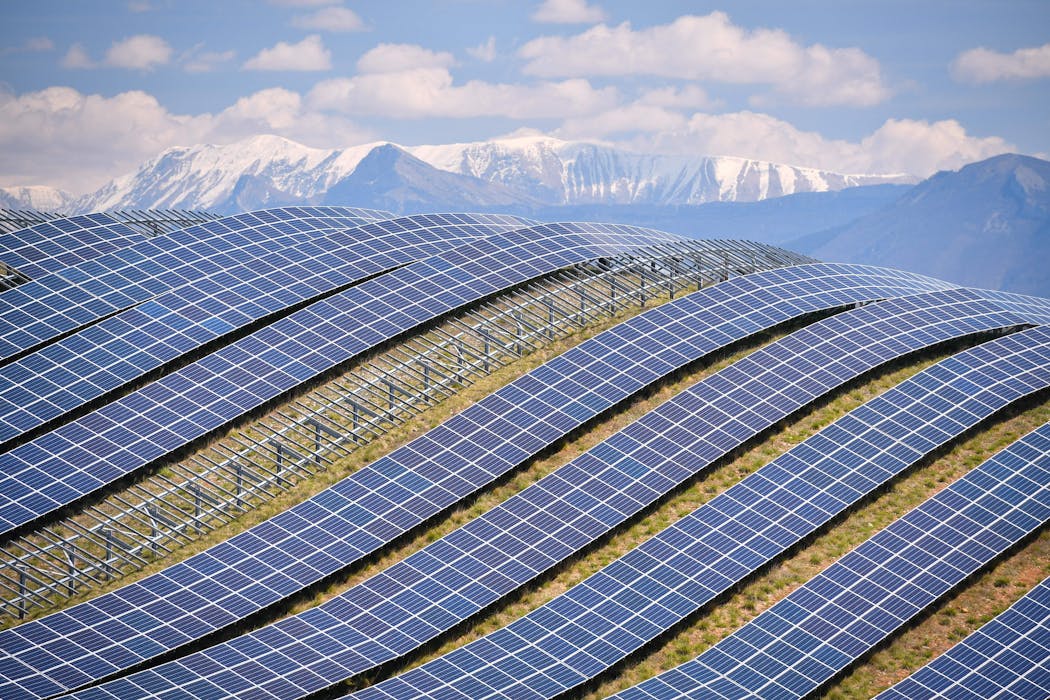
Solar power has been expanding quickly, but natural gas is also booming. Gerard Julien/AFP via Getty Images

Two years ago, countries around the world set a goal of “transitioning away from fossil fuels in energy systems in a just, orderly and equitable manner.” The plan included tripling renewable energy capacity and doubling energy efficiency gains by 2030 – important steps for slowing climate change since the energy sector makes up about 75% of the global carbon dioxide emissions that are heating up the planet.

The world is making progress: More than 90% of new power capacity added in 2024 came from renewable energy sources, and 2025 saw similar growth.

However, fossil fuel production is also still expanding. And the United States, the world’s leading producer of both oil and natural gas, is now aggressively pressuring countries to keep buying and burning fossil fuels.

The energy transition was not meant to be a main topic when world leaders and negotiators met at the 2025 United Nations climate summit, COP30, in November in Belém, Brazil. But it took center stage from the start to the very end, bringing attention to the real-world geopolitical energy debate underway and the stakes at hand.

Brazilian President Luiz Inácio Lula da Silva began the conference by calling for the creation of a formal road map, essentially a strategic process in which countries could participate to “overcome dependence on fossil fuels.” It would take the global decision to transition away from fossil fuels from words to action.

President Lula Da Silva gestures with his hands as he speaks in front of a picture of the Amazon.
Brazilian President Luiz Inácio Lula da Silva speaks at COP30, where he promoted the idea of a road map to help the world speed up its transition from fossil fuels to clean energy.
AP Photo/Andre Penner)

More than 80 countries said they supported the idea, ranging from vulnerable small island nations like Vanuatu that are losing land and lives from sea level rise and more intense storms, to countries like Kenya that see business opportunities in clean energy, to Australia, a large fossil-fuel-producing country.

Opposition, led by the Arab Group’s oil- and gas-producing countries, kept any mention of a “road map” energy transition plan out of the final agreement from the climate conference, but supporters are pushing ahead.

I was in Belém for COP30, and I follow developments closely as former special climate envoy and head of delegation for Germany and senior fellow at the Fletcher School at Tufts University. The fight over whether there should even be a road map shows how much countries that depend on fossil fuels are working to slow down the transition, and how others are positioning themselves to benefit from the growth of renewables. And it is a key area to watch in 2026.

The battle between electro-states and petro-states

Brazilian diplomat and COP30 President André Aranha Corrêa do Lago has committed to lead an effort in 2026 to create two road maps: one on halting and reversing deforestation and another on transitioning away from fossil fuels in energy systems in a just, orderly and equitable manner.

What those road maps will look like is still unclear. They are likely to be centered on a process for countries to discuss and debate how to reverse deforestation and phase out fossil fuels.

Over the coming months, Corrêa plans to convene high-level meetings among global leaders, including fossil fuel producers and consumers, international organizations, industries, workers, scholars and advocacy groups.

For the road map to both be accepted and be useful, the process will need to address the global market issues of supply and demand, as well as equity. For example, in some fossil fuel-producing countries, oil, gas or coal revenues are the main source of income. What can the road ahead look like for those countries that will need to diversify their economies?

A man speaks into a microphone. Behind him, a person holds a sign reading: 'Shell: Own up, clean up, pay up'
Nigeria’s Bodo community is suing Renaissance Africa Energy Company Limited, an oil consortium that acquired Shell’s Nigerian subsidiary, over two major oil spills in the Niger Delta in 2008. Shell admitted liability and settled with the community in 2014, committing to cleanup efforts. However, the Bodo community has been critical of the quality and transparency of Shell’s cleanup, and is seeking further damages and remediation. Here, activists protest the company’s actions.
Leon Neal/Getty Images

Nigeria is an interesting case study for weighing that question.

Oil exports consistently provide the bulk of Nigeria’s revenue, accounting for around 80% to over 90% of total government revenue and foreign exchange earnings. At the same time, roughly 39% of Nigeria’s population has no access to electricity, which is the highest proportion of people without electricity of any nation. And Nigeria possesses abundant renewable energy resources across the country, which are largely untapped: solar, hydro, geothermal and wind, providing new opportunities.

What a road map might look like

In Belém, representatives talked about creating a road map that would be science-based and aligned with the Paris climate agreement, and would include various pathways to achieve a just transition for fossil-fuel-dependent regions.

Some inspiration for helping fossil-fuel-producing countries transition to cleaner energy could come from Brazil and Norway.

In Brazil, Lula asked his ministries to prepare guidelines for developing a road map for gradually reducing Brazil’s dependency on fossil fuels and find a way to financially support the changes.

His decree specifically mentions creating an energy transition fund, which could be supported by government revenues from oil and gas exploration. While Brazil supports moving away from fossil fuels, it is also still a large oil producer and recently approved new exploratory drilling near the mouth of the Amazon River.

Norway, a major oil and gas producer, is establishing a formal transition commission to study and plan its economy’s shift away from fossil fuels, particularly focusing on how the workforce and the natural resources of Norway can be used more effectively to create new and different jobs.

Both countries are just getting started, but their work could help point the way for other countries and inform a global road map process.

The European Union has implemented a series of policies and laws aimed at reducing fossil fuel demand. It has a target for 42.5% of its energy to come from renewable sources by 2030. And its EU Emissions Trading System, which steadily reduces the emissions that companies can emit, will soon be expanded to cover housing and transportation. The Emissions Trading System already includes power generation, energy-intensive industry and civil aviation.

Fossil fuel and renewable energy growth ahead

In the U.S., the Trump administration has made clear through its policymaking and diplomacy that it is pursuing the opposite approach: to keep fossil fuels as the main energy source for decades to come.

The International Energy Agency still expects to see renewable energy grow faster than any other major energy source in all scenarios going forward, as renewable energy’s lower costs make it an attractive option in many countries. Globally, the agency expects investment in renewable energy in 2025 to be twice that of fossil fuels.

At the same time, however, fossil fuel investments are also rising with fast-growing energy demand.

The IEA’s World Energy Outlook described a surge in new funding for liquefied natural gas, or LNG, projects in 2025. It now expects a 50% increase in global LNG supply by 2030, about half of that from the U.S. However, the World Energy Outlook notes that “questions still linger about where all the new LNG will go” once it’s produced.

What to watch for

The Belém road map dialogue and how it balances countries’ needs will reflect on the world’s ability to handle climate change.

Corrêa plans to report on its progress at the next annual U.N. climate conference, COP31, in late 2026. The conference will be hosted by Turkey, but Australia, which supported the call for a road map, will be leading the negotiations.

With more time to discuss and prepare, COP31 may just bring a transition away from fossil fuels back into the global negotiations.

The Conversation

Jennifer Morgan does not work for, consult, own shares in or receive funding from any company or organization that would benefit from this article, and has disclosed no relevant affiliations beyond their academic appointment.

ref. The battle over a global energy transition is on between petro-states and electro-states – here’s what to watch for in 2026 – https://theconversation.com/the-battle-over-a-global-energy-transition-is-on-between-petro-states-and-electro-states-heres-what-to-watch-for-in-2026-272205

Et si quelques minutes de méditation de pleine conscience pouvaient aider à réduire le stress ?

Source: The Conversation – France in French (3) – By Alexis Barbry, Maître de conférences en STAPS, Université de Lorraine

Une revue systématique de la littérature scientifique met en évidence les effets bénéfiques de temps courts de pleine conscience sur un marqueur physiologique du stress. Cela plaide pour une intégration de ce type de méditation dans la vie quotidienne.


Nous sommes toutes et tous confrontés au stress dans notre vie de tous les jours. Il est tout à fait normal de le ressentir. Il peut se définir comme un état de tension interne causé par une situation complexe, qui excède nos ressources cognitives, sociales ou affectives. L’important n’est pas tant le stress, mais plutôt la manière dont nous y réagissons.

La recherche souligne la nécessité de s’équiper d’outils issus de la psychologie pour nous apprendre à mieux gérer les situations perçues comme menaçantes dans l’objectif de réguler le stress.

La pleine conscience : un outil de régulation du stress ?

Parmi les techniques psychologiques, la pleine conscience a récemment connu un essor important. Bien que cette dernière soit considérée comme un concept « à la mode », elle dispose d’une longue histoire, qui aurait débuté il y a plus de 2 500 ans à travers la pensée bouddhiste. Cette pleine conscience, également connue sous le nom de mindfulness, est une technique de méditation attentionnelle simple qui consiste à porter délibérément son attention sur ce qui se passe ici et maintenant, sans jugement. Autrement dit, c’est être attentif au moment présent, sans se laisser contaminer par ses pensées !

La pleine conscience a pris un essor scientifique sous l’impulsion du professeur Jon Kabat-Zinn dans les années 1980. Le premier programme de pleine conscience ayant vu le jour est le Mindfulness-Based Stress Reduction (MBSR), qui signifie « programme de réduction du stress par la pleine conscience ». Depuis le début des années 1980, d’autres programmes de pleine conscience ont émergé. Ces derniers se sont adaptés aux caractéristiques de différents publics (personnes souffrant d’épisodes dépressifs, sportifs, etc.…).

Aujourd’hui, les bienfaits de ces programmes sur la réduction du stress sont bien établis. Cependant, un des freins à la pratique de la pleine conscience réside dans la durée et dans l’engagement requis. Par exemple, le MBSR nécessite un engagement sur huit semaines, comportant une pratique quotidienne individuelle de 45 minutes et une pratique hebdomadaire en groupe de 2,5 heures.

Bien qu’efficace pour réguler les intensités de stress, la durée de ces programmes ne semble pas s’adapter à nos rythmes de vie actuels. Compte tenu de leur dimension chronophage, certains chercheurs ont proposé des temps plus courts de pleine conscience.

Quelle efficacité des temps brefs de pleine conscience contre le stress

Un programme bref de pleine conscience se réalise sur quatre semaines et engendre une pratique inférieure à 1,6 heure (100 minutes, soit une heure et quarante minutes) par semaine. La durée de la séance ne doit pas excéder 30 minutes. Bref, nous sommes bien loin des temps proposés par les programmes plus classiques comme le MBSR… Si ces temps courts s’accordent davantage à nos contraintes temporelles, leurs bénéfices sur le stress restent mal connus.

Notre interrogation a donc été la suivante : est-ce que les temps brefs de pleine conscience pourraient réduire notre stress ?

Pour répondre à cette question, nous avons effectué une revue systématique de la littérature évaluant les effets des temps brefs de pleine conscience sur un marqueur physiologique du stress : la variabilité de la fréquence cardiaque (VFC). La VFC reflète l’activité du système nerveux autonome jouant un rôle crucial dans le maintien de notre équilibre.

Ce système nerveux autonome se divise en deux branches : le système nerveux sympathique (qui prédomine lors des situations stressantes) et le système nerveux parasympathique (qui prédomine lors des situations de repos). Une faible VFC est représentative d’une moindre capacité à gérer les situations stressantes, alors qu’une VFC plus élevée reflète une meilleure capacité à réguler les situations stressantes.

Les résultats de notre étude mettent en évidence que les temps courts de pleine conscience augmentent la VFC. Autrement dit, ces moments de pleine conscience parviennent à réduire notre niveau de stress.

À la vue de ces résultats, nous recommandons donc d’intégrer de brefs temps de pleine conscience dans notre quotidien pour minimiser les effets du stress et éviter que ce dernier consomme toutes nos ressources.

Un exemple pour débuter : la prise de conscience du souffle

Il existe de nombreuses manières d’introduire la pleine conscience dans notre quotidien. On distingue généralement deux types de pratiques : formelles et informelles.

Les pratiques formelles sont les plus connues. Elles consistent à s’arrêter et à se poser pour pratiquer un exercice de pleine conscience.

Par exemple, la prise de conscience du souffle est considérée comme l’exercice de référence pour s’initier à cette pratique. Il consiste à s’asseoir sur un coussin ou sur une chaise de manière digne et droite. Une fois la position correctement maintenue, il suffit de diriger intentionnellement son attention sur le souffle. L’objectif n’est pas ici de contrôler sa respiration, mais plutôt de l’observer sans chercher à la modifier.

Cet exercice peut paraître facile, mais généralement l’esprit a tendance à s’éloigner de l’exercice. C’est ce que l’on appelle le vagabondage de l’esprit. Cette errance est tout à fait normale. Elle fait partie de la nature même de l’exercice. Lorsque vous vous rendrez compte que votre esprit s’égare, la pratique de la pleine conscience vous invitera à ramener votre attention avec douceur et bienveillance vers le souffle et les sensations qui lui sont associées.Lorsque vous débuterez cet exercice, il est fort probable que vous rencontriez des difficultés à maintenir votre attention sur la respiration. Encore une fois, cela est ordinaire. À force de répéter cet exercice, vous éduquerez votre esprit à (r) amener son attention vers la respiration.

La prise de conscience du souffle n’est qu’un exemple, il existe de nombreuses autres formes de pratiques formelles (par exemple, le scan corporel qui consiste à observer les différentes sensations présentes dans notre corps).

Vous trouverez sur Internet de nombreuses vidéos et/ou audios faites par des professionnel·les qui vous permettront de pratiquer.

Un exemple d’exercice momentané (5 minutes) de prise de conscience du souffle, vous est proposé en cliquant ici ou sur le QR code ci-joint.

À noter le fait que certaines personnes ne sont pas « réceptives » à la pleine conscience. Lorsqu’ils débutent cette pratique, certains sujets peuvent également ressentir une légère angoisse quant aux faits de se poser et de centrer son attention sur sa respiration. Et dans le cadre de graves problèmes de santé mentale (dépression, anxiété…), la pleine conscience ne remplace pas une prise en charge par un professionnel de santé.

Pratiquer seul·e (ou pas), de manière formelle (ou non)

Pour débuter la pratique, on peut se faire accompagner – par une ou un médecin, psychologue, psychothérapeute, chercheur ou chercheuse, préparateur ou préparatrice mentale, etc. – mais qui doit avoir été formé à la pleine conscience dans le cadre d’un diplôme universitaire (DU), d’une formation courte qualifiante par exemple. Mais ce n’est pas une obligation. Étant donné que cette pratique s’avère très simple à mettre en œuvre, tout le monde peut l’intégrer de manière brève dans son quotidien. Des livres écrits par des professionnel·les peuvent également aider.

La pleine conscience peut aussi s’intégrer de manière informelle dans notre quotidien. En effet, il est possible de marcher, de courir ou encore de manger en pleine conscience… Dans ce type d’exercices, l’objectif est d’être pleinement attentif à ce que l’on est en train de faire. Par exemple, vous pouvez essayer une fois par semaine de manger sans écrans, en étant pleinement attentif aux sensations gustatives, olfactives ou visuelles de ce que vous mangez.

Que la pratique soit réalisée de manière formelle ou informelle, nous vous conseillons de débuter par des temps de trois à cinq minutes avant d’augmenter progressivement si vous le souhaitez !

Essayez, et vous verrez. Bonne pratique !

The Conversation

Cette revue systématique, et donc cet article de vulgarisation, s’intègre dans la thèse CIFRE 0331 co-financée par l’Institut des Rencontres de la FOrme (IRFO) et l’Association Nationale de la Recherche et de la Technologie (ANRT).

Annie Carton est membre du Racing Club Arras Athlétisme en tant qu’entraîneur, et vice-présidente de l’Office des Sports d’Arras en charge de la santé et du bien-être.

Jérémy Coquart a été le directeur d’Alexis Barbry, le doctorant financé.

ref. Et si quelques minutes de méditation de pleine conscience pouvaient aider à réduire le stress ? – https://theconversation.com/et-si-quelques-minutes-de-meditation-de-pleine-conscience-pouvaient-aider-a-reduire-le-stress-272375