Structurally complex with a challenging anatomy, the brain is believed to comprise more than 3,000 different types of cells, whereas most tissues have no more than a dozen. It is dynamic, reacting to the environment and changing over time. It is also difficult to access, and rarely biopsied.
To flourish, our societies and economies depend in large part on our brains’ ability to function optimally. Given our aging populations and declining birth rates, we are facing a perfect storm — fewer children and more elderly citizens — underscoring the vital need to optimize brain health for every citizen.
There are many factors influencing brain health over a human lifetime. For instance, some children are born with neurodevelopmental abnormalities such as intellectual disability, autism spectrum disorder and learning disabilities.
Some children experience sub-optimal environmental conditions, such as poor pre-natal care, inadequate nutrition and abuse, which can reduce the young brain’s ability to achieve peak levels of performance and predispose them to mental health challenges.
These children may end up with fewer opportunities to live happy and fulfilling lives, and may be less able to contribute to our society’s success.
Our aging society requires a renewed focus on brain health. (Unsplash)
At the other end of the spectrum, our aging population is subject to a variety of age-related neurodegenerative diseases, which cause suffering. Alzheimer’s, Parkinson’s, amyotrophic lateral sclerosis (ALS) and other dementing illnesses are increasing in frequency in G7 countries, leading also to rising health-care costs.
While there are many validated interventions to improve brain health, they are generally poorly taken up. Even if they were adopted by everyone, they would still fall significantly short of what’s needed to reduce neurodevelopmental and neurodegenerative diseases. The second strategy is to develop new interventions to improve brain health.
To make this possible, we need targeted and sustained funding for brain research across the world — especially in the G7 countries, who have aging populations and the infrastructure and financial ability to invest in brain health research.
Genomics, proteomics, single cell biology, advanced brain imaging, artificial intelligence, induced pluripotent stem cells (iPSCs) and new animal models must all be used to further our understanding of how the brain develops, functions and degenerates.
Open science research model
The great complexity of the brain and the challenges associated with its study will require large collaborative teams of scientists to work together. That’s why it’s essential that we adopt an open science research model so that data, algorithms and materials can be rapidly and freely shared, while preserving confidentiality and sovereignty.
For example, to best harness the power of AI, large high-quality data sets need to be made freely available.
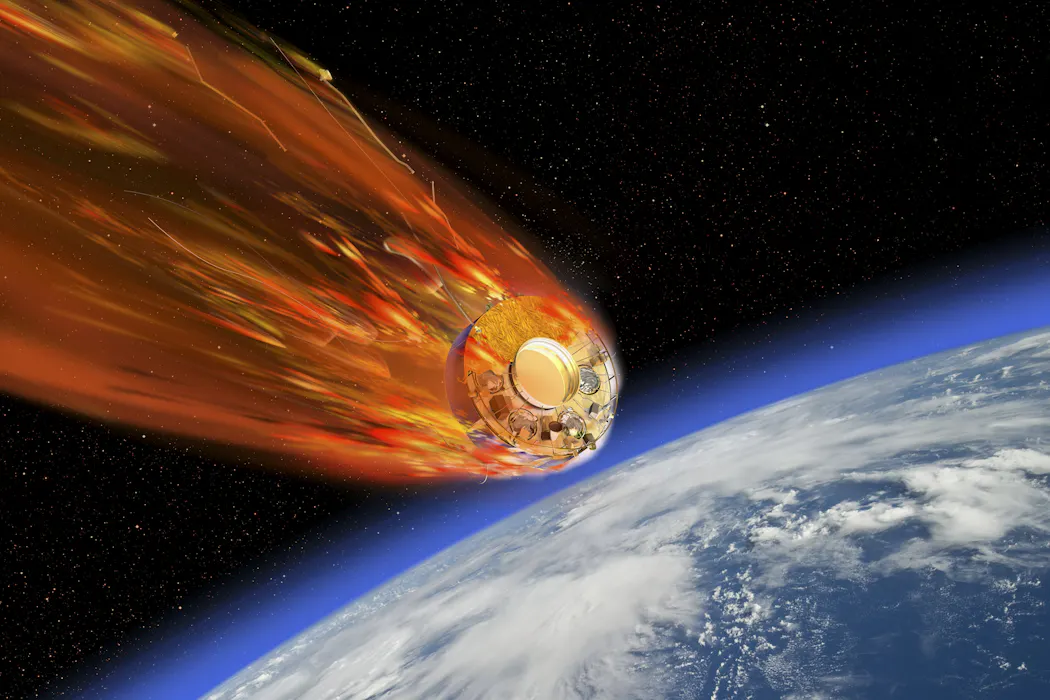
A satellite burns up as it travels through Earth’s atmosphere. Several of these large satellite re-entries now occur every day.(European Space Agency/David Ducross), CC BY-SA
The explosive growth of large satellite constellations over the last decade offers great promise for near-universal access to broadband internet. But this growth comes with risks that are not yet fully understood.
Our understanding of the human impact on the near-Earth space environment is at a similar stage to our understanding of climate change back in the 1990s. We know that increased human activity is causing large disruptions to the space environment, but whether a tipping point is soon to be reached is not yet clear.
Research and understanding of human impacts in space is still at a very early stage. For example, we don’t really know when some orbital altitudes will become so overpopulated with space debris that they reach operational capacity.
Similarly, we are aware that satellites burning up as they fall back to the Earth’s atmosphere will have significant effects on the chemistry in the upper atmosphere. We know there are now several of these large satellite re-entries occurring every day, but the full effects of this are not clear.
Messy space governance
Several scientific bodies now advise on policy in different areas of space sustainability. One is the Inter-Agency Space Debris Coordination Committee, which focuses on space debris degradation of the environment.
An image of NGC 6302, known as the ‘Butterfly Nebula,’ taken using the Hubble Space Telescope. The telescope is increasingly impacted by satellite constellations in low-Earth orbit. (NASA)
Like the IPCC, an IPSS should include several working groups to provide transparent and accessible summaries of scientific results for policy makers.
One should focus on the physical science of the orbital environment. This means the state of low-Earth orbit as a finite resource — including estimates of space debris and collision growth, effects of space weather and models of sustainable future launch traffic.
A satellite breaks up in orbit. (ESA/ID&Sense/ONiRiXEL), CC BY-SA
Another working group should centre on the environmental and societal impacts of large satellite constellations. This would assess stratospheric ozone depletion caused by rocket launch emissions, the effects of higher satellite re-entry rates, changes to atmospheric chemistry and increased casualty risks. It would also quantify their impact on ground-based astronomy.
Finally a working group on mitigation and policy could set the stage for clear international standards for post-mission satellite disposal, active debris removal and new licensing requirements that account for a constellation’s “system-wide” rather than “per-satellite” risk.
Space traffic footprints
A useful addition to the IPSS would be a Task Force on Space Traffic Footprints. Modelled after the IPCC’s Task Force on National Greenhouse Gas Inventories, this body would develop standardized methodologies for states to report their “space traffic footprint” — the burden their space objects pose to the safety and sustainability of the low-Earth orbit environment.
Similar to the IPCC’s role in vetting climate models, the IPSS needs to provide independent assessment of claims regarding satellite demisability — the way satellites are safely decommissioned and de-orbited. This should evaluate how successful de-orbiting technologies are and how well we can track satellites and estimate their location uncertainties.
By creating a co-ordinated international approach now, the IPSS will help balance the enormous promise of commercial activity in space with the environmental risks — just as the IPCC has done with Earth’s changing climate from human activities.
Peter Brown receives funding from the Natural Sciences and Engineering Research Council of Canada, the United Sstates National Aeronautics and Space Administration, the European Space Agency, Natural Resources Canada and Defence Research and Development Canada
Tout le monde a une boîte de sardines dans un placard. Pas sûr qu’avant de l’acheter on ait pourtant pris le temps de lire et de décrypter ce qui était écrit dessus. C’est beaucoup plus long que de l’ouvrir. Et, de toute façon, on sait que la sardine en boîte est bonne pour la santé, pas chère du tout et bien pratique. Une analyse garantie 100 % sans Patrick Sébastien dedans.
Lors de votre prochain achat de sardines en conserve, prêtez quand même attention à l’étiquette. Cela vous évitera de manger des sardines préalablement congelées, baignées dans des huiles médiocres ou issues d’une pêche irresponsable.
Un article pour découvrir l’économie de la sardine, et acheter malin. En bonus, ma recette préférée de pâté de sardines.
Une lutte commerciale
La sardine est un joli petit poisson : corps fuselé, flancs argentés, dos sombre et ventre blanc. Elle est facile à reconnaître chez le poissonnier. Dommage finalement qu’elle ait perdu sa tête et sa queue pour être mise en boîte. Si seul le mot « sardines » est inscrit dessus, il s’agit forcément d’une Sardina Pilchardus, la sardine commune pêchée sur les côtes de l’Atlantique et dans les eaux de la Méditerranée. Si le poisson provient du Pérou, la face de la boîte mentionnera en sous-titre Sardinops Sagax, le nom d’une cousine du Pacifique.
Cet étiquetage différencié entre nos sardines et celles des mers lointaines résulte d’une bataille économico-juridique tranchée par les juges de l’Organisation mondiale du commerce (OMC), il y a déjà plus de vingt ans ; le monde d’avant en somme : celui de la mondialisation des échanges et de l’application du droit international. D’un côté, la Commission européenne qui autorisait la seule Sardina pilchardus à bénéficier de l’appellation de « sardine ». De l’autre, le Pérou, dont l’industrie de la pêche et de la conserve tenait à vendre en Europe ses sardines en boîte comme… des sardines en boîte.
Fourni par l’auteur
Risque de confusion
La Commission, soupçonnée d’ériger une entrave à l’importation sous prétexte de protéger les consommateurs d’un risque de confusion, a perdu l’affaire. Pas complètement quand même puisque l’étiquetage réglementaire maintient un statut à part pour notre sardine commune. Il n’est toutefois pas certain que cette distinction ait produit un quelconque effet sur les consommateurs. Le nom latin des sardines exotiques écrit en petit fait penser aux notes de bas de page que presque personne ne lit.
L’Union européenne impose également aux boîtes de sardines son estampille sanitaire des produits animaux. Elle est reconnaissable à sa forme de pastille ovale. Elle mérite d’être patiemment recherchée sur les côtés de la boîte car elle garantit le respect des normes et l’indication géographique de la conserverie. Si vous ne la trouvez pas, même muni d’une loupe, c’est que les sardines ont été mises en boîte hors des frontières de l’Europe. Sinon FR signalera une transformation en France, ES en Espagne, PT au Portugal. Et HR pour… Hrvatska, la Croatie (vous le saviez peut-être, moi non). À la suite de ces deux lettres apparaît une série de chiffres qui sert de plaque d’immatriculation de chaque conserverie. Elle permet de remonter à l’origine de la mise en boîte, une trace utile en cas de problème de sécurité alimentaire.
Une internationale marocaine
La sardine fraîche voyage peu ; congelée ou en boîte, elle saute les frontières et ne craint alors aucune distance. Le Maroc en sait quelque chose puisqu’il occupe de loin la première place au monde. Les chiffres calculés pour l’année 2022 sont impressionnants tant pour la capture (64 % des pêches de sardines de la planète) que pour les marchés d’exportation de la sardine congelée et de la sardine en conserve (respectivement 69 % et 79 % de parts de marché)
Pour manger des sardines marocaines fraîches, il faudra se rendre au Maroc ou tout près. Pour celles vendues en boîte, vous les retrouverez dans toute l’Afrique et aussi en Europe. Ce sont les moins chères.
Pour les sardines congelées, ne pensez pas à Picard. Elles sont achetées principalement par des conserveries lointaines : du Brésil et d’Afrique du Sud, notamment. Elles fournissent aussi des clients plus proches, en Turquie et en Espagne par exemple. Pour les conserveries européennes historiquement spécialisées dans la mise en boîte de sardines fraîches, l’approvisionnement en congelé permet de faire tourner les usines quand les captures locales deviennent insuffisantes.
Embargo sur la sardine
Mais depuis le 1er février, le Maroc a suspendu ses exportations de sardines congelées. La chute des prises dans les eaux « sur-pêchées » du royaume en est la cause immédiate. Rabat veut rediriger une partie des exportations vers le marché national dans le but de satisfaire la demande intérieure et de contenir la hausse des prix de la sardine, une source de mécontentement de la population.
La décision du gouvernement marocain s’explique aussi par une raison plus profonde. La logique du développement économique et industriel veut que les pays émergents exportateurs de ressources naturelles intègrent progressivement les activités en aval de semi-transformation et de transformation finale. Elles procurent plus de revenus et d’emplois que la simple exploitation. L’intérêt du Maroc est d’exporter ses sardines en boîte plutôt que congelées. Pour les conserveries très dépendantes de cet approvisionnement, comme celles de l’Espagne, l’interdiction marocaine n’est évidemment pas une bonne nouvelle.
L’indication manquante
Pour les consommateurs, la congélation reste inaperçue. Aucune indication n’est portée sur la boîte. À défaut, un prix bas peut fournir un indice. Idem si la chair est molle et friable, mais cette texture peut aussi provenir de la cuisson ou du vieillissement. Pour éviter d’acheter des sardines qui auraient été congelées, les seuls recours sont une étiquette label rouge ou des mentions marketing du type « Préparées à partir de sardines fraîches ».
Mais dans ce dernier cas, le consommateur peut aussi penser que cette information est purement gratuite. Il ne sait pas qu’il aurait pu en être autrement, comme moi d’ailleurs avant d’étudier la question. J’ignorais également que 60 % des sardines mises en boîte en France avaient été préalablement conservées à – 18 °C avant d’être cuites dans les conserveries.
Réserves d’oméga-3
D’un autre côté, cette information n’est pas absolument cruciale. La congélation n’altère ni le goût ni a qualité nutritionnelle de la sardine en boîte à l’exception d’une perte modérée de certaines vitamines. Rappelons à ce propos les bienfaits de ce petit poisson. Il contient de bons acides gras, les fameux oméga-3 dont parlent tous les magazines et les livres de diététique, des oligo-éléments très prisés comme le sélénium, des vitamines (B 12 notamment) et plein de protéines et de minéraux comme le calcium. L’essentiel de ces informations diététiques apparaissent sur la boîte sous l’étiquetage obligatoire des valeurs nutritionnelles.
Si vous êtes soucieux de manger sain, lisez aussi la liste, également obligatoire, des ingrédients. Évitez celles qui mentionnent les huiles d’arachide ou de tournesol, toutes deux très riches en oméga-6, ce qui déséquilibre l’apport en oméga-3 des sardines. L’intérêt de les acheter pour leur contenu en bon gras devient alors bien mince. Préférez l’huile d’olive vierge. Ou même l’eau. Rien de plus allégé que la sardine dite au naturel.
Responsable mais pas forcément soutenable
Certaines boîtes portent la mention « pêche responsable » sur leur face. Le terme recouvre toute une série d’engagements. Ils concernent aussi bien des exigences sociales, de qualité et de transparence que des exigences en matière d’environnement. Par exemple, les conserves de la marque bretonne Phare d’Eckmühl ne respectent pas moins d’une quarantaine de critères.
Si vous achetez des sardines issues de pêche responsable sachez alors qu’elles ont été capturées près des côtes, de façon sélective et sans dommage pour les fonds marins. C’est toute une pêche particulière avec un filet spécial qui va entourer le banc de poisson et relever la prise comme dans une sorte de baluchon. Si vous jouez au Scrabble, retenez que ce filet porte le nom de « bolinche », ça peut servir.
Rien n’assure que le poisson de pêche responsable appartienne à une population exploitée de façon équilibrée. Le stock de sardines du golfe de Gascogne où croisent les bolincheurs est, depuis 2019, évalué comme surpêché. Pour manger du poisson de pêche soutenable, il faut se fier à la mention « Pêche durable », un label décerné par un organisme international non lucratif, le Marine Stewardship Council (MSC).
De plus en plus maigres
L’Association des bolincheurs de Bretagne a bénéficié un temps de cette certification. Elle a été suspendue quand l’effort de pêche à la sardine dans le golfe a été estimé trop élevé au regard de l’évolution de la ressource. La perte du label ne s’est cependant pas traduite par des effets dommageables pour les pêcheurs et les conserveries concernées, sauf pour l’exportation. Contrairement aux pays anglo-saxons, la plupart des consommateurs de l’Hexagone ne connaissent pas le logo MSC tandis que les consommateurs avertis ne lui accordent pas une grande crédibilité. La certification MSC fait en effet l’objet de vigoureuses critiques : conflit d’intérêt, tolérance de techniques de pêche discutables, certifications accordées à des stocks contestés, etc.
Contrairement à d’autres espèces marines, la sardine n’est pas menacée de disparition, mais elle s’amaigrit. Le taux de matière grasse qui est mesuré par les conserveurs a diminué de 40 % en quinze ans, soit une baisse de qualité nutritionnelle. Sur la même période, le poids individuel moyen de la sardine a été divisé par deux. Plus petites, les sardines doivent être plus nombreuses pour remplir la boîte. Ce qui nécessite plus de temps de travail de préparation et de mise en conserve, et en augmente ainsi le coût et, finalement, le prix.
À quoi tient principalement cette évolution ? Petit quiz :
A) À la surpêche qui capturerait des individus toujours plus jeunes,
B) À la multiplication des prédateurs naturels de la sardine comme les fous de Bassan ou les merlus,
C) Au changement climatique.
Bonne réponse : C
Moins d’oxygène
Eh oui, encore une fois, le réchauffement climatique se rappelle à nous. La température de la mer augmentant, elle offre moins d’oxygène dissous, ce qui entraîne des besoins énergétiques plus élevés, ce qui favorise les petits poissons. Mais surtout la chaleur entraîne aussi une diminution de la taille des organismes planctoniques dont se nourrissent les sardines. Cette diminution implique une nage plus soutenue et plus longue des sardines pour se nourrir, donc encore une fois une plus grande dépense d’énergie, donc une moindre croissance. Ce lien entre taille des sardines et taille de leur nourriture a même été prouvé expérimentalement en bassin par des chercheurs de l’Ifremer.
Plus modestement, nous avons cherché à établir le lien entre les informations indiquées sur les boîtes et les aspects économiques, sanitaires et environnementaux de la pêche et de la conservation de la sardine. Ce décryptage long et fastidieux mérite de se terminer par une note d’humour potache.
Comme annoncé dans l’introduction, ma recette préférée est celle du pâté de sardines. Elle calque celle de Pierre Desproges : « Écrasez deux boîtes de sardines (après avoir enlevé les boîtes et les arêtes centrales) avec 150 g de beurre salé vendéen (les sardines sont habituées). » L’humoriste ajoute ketchup, estragon, ciboulette, piment, fenouil et une cuillerée à café de pastis.
Pour ma part, je verse aussi quelques gouttes de garum, cette sorte de nuoc mam élaboré principalement à partir de sardines salées et fermentées et dont beaucoup comme moi ont découvert l’existence en lisant Astérix en Lusitanie. C’était bien avant de savoir conserver des sardines dans des boîtes en fer blanc.
François Lévêque ne travaille pas, ne conseille pas, ne possède pas de parts, ne reçoit pas de fonds d’une organisation qui pourrait tirer profit de cet article, et n’a déclaré aucune autre affiliation que son organisme de recherche.
Le rat pygmée de rizière à longue queue, Oligoryzomys longicaudatus, est un réservoir naturel du hantavirus. Et en particulier de la souche Andes, soupçonnée d’être responsable du décès de plusieurs passagers d’un bateau de croisière. Ce rongeur endémique d’Amérique du Sud est longtemps resté mal connu, mais les études d’écologie menée depuis 1995, date du premier cas d’infection humaine à hantavirus, permettent de tracer son portrait-robot et les conditions qui favorisent sa transmission à l’humain.
Le rat pygmée de rizière à longue queue Oligoryzomys longicaudatus est exclusivement sud-américain. Il vit en Argentine et au Chili et peut transmettre aux humains le hantavirus Andes (ANDV), transmissible d’humain à humain, en cas d’inhalation d’aérosols de ses urines, de ses fèces ou de ses sécrétions. Il est le principal réservoir animal de ce virus propulsé sur les devants de la scène depuis la mort de plusieurs passagers du bateau de croisière Hondius.
Sa description originale date de 1832. Le naturaliste britannique Edward Turner Bennett le dépeint, depuis la région de Valparaiso au Chili, comme ayant une longue queue écailleuse à poils courts, une fourrure douce brun-jaune sur le dessus, des lèvres blanches, une longue moustache noire et argent et des oreilles rondes. À cette époque, il en fait une espèce de souris (Mus longicaudatus).
Ce n’est qu’en 1894 qu’il sera finalement intégré dans le genre Oryzomys puis en 1900 sous le genre Oligoryzomys par l’ornithologue états-unien Outram Bangs. Malgré son nom, l’animal n’est ni particulièrement petit (ce que laisse supposer le préfixe oligo), ni résident des rizières (comme le signifie pourtant l’étymologie d’oryzomys).
Connu depuis 1995, date de la découverte du premier cas d’infection humaine à hantavirus, le hantavirus Andes est un problème de santé publique récurrent au Chili et en Argentine, ce qui a suscité plusieurs études d’écologie sur ce rongeur resté jusqu’à présent mal connu. Celles-ci livrent quelques clés pour comprendre ce qui favorise la circulation du virus chez le rongeur et sa transmission à l’humain.
Le « colilargo », un rongeur tout terrain et opportuniste
Au Chili, on le surnomme « raton colilargo » (rat à longue queue). Il fait partie de la famille des Cricetidae qui comprend les hamsters, les campagnols, les lemmings ainsi que les rats et les souris du « Nouveau Monde ». C’est la deuxième famille la plus diversifiée des rongeurs après celle des Muridae (rats et souris d’Europe).
Au sein des Cricétidés, le genre Oligoryzomys appartient au groupe (tribu) des Oryzomyini, qui comprend 141 espèces de rongeurs distribués en Amérique du Nord et du Sud. Le genre Oligoryzomys se rencontre exclusivement en Amérique centrale et australe, du Mexique à la Patagonie. Le nombre d’espèces connues est passé de 21 espèces en 2017 à 25 à l’heure actuelle.
Malgré son nom, il s’agit de la plus grande espèce du genre. En effet, le corps d’un rat pygmée des rizières à longue queue adulte peut mesurer de 9 cm à 12 cm, auxquels il faut ajouter une queue de 11 cm à 13 cm pour un poids variant de 33 g à 50 g. C’est plus que la souris domestique (de 15 g à 20 g) mais moins que le rat brun de nos villes européennes (de 100 g à 500 g).
Le Nothofagus pumilio, appelé « hêtre de la Terre de Feu », est un arbre emblématique des forêts andio-patagoniques du Sud du Chili et de l’Argentine.
Sa dénomination est même doublement trompeuse, car il ne vit pas dans les rizières, mais fréquente les forêts tempérées patagoniennes de Nothofagus (arbre à feuilles caduques ou pérennes pouvant atteindre 30 m de hauteur, encore appelé « faux-hêtre » ou « hêtre austral », présent dans l’hémisphère Sud) et de bambous, où il est le rongeur le plus abondant.
Cependant, il semble également capable de vivre dans les steppes herbeuses à buissons des toundras de Patagonie ainsi que dans les bordures de champs cultivés et les pâtures, buissons des zones péridomestiques en Argentine. Il n’a jamais été capturé dans les maisons. Il peut vivre du niveau de la mer jusqu’à 2 000 m d’altitude, mais n’est jamais loin d’un cours d’eau car il ne peut s’en passer.
L’écologie de ce rongeur a été étudiée dans les années 1980 par Oliver Pearson, mais depuis la découverte en 1995 du hantavirus Andes dont ce rat est porteur, les études se sont multipliées. On sait que ce rongeur est nocturne et terrestre, mais il peut parfois grimper jusqu’à 3 m de haut dans les arbres. C’est un opportuniste qui a été décrit comme omnivore avec un régime alimentaire présentant souvent une dominance de graines, de fleurs ou de fruits. Il consomme cependant aussi, de manière variable, de l’herbe, des insectes, des vers ou des champignons.
Des périodes de prolifération appelées « ratadas » lors de la floraison des bambous
On lui connaît des augmentations brutales de population liées à la floraison cyclique synchronisée, tous les douze à quatorze ans, de bambous dont il consomme les graines. Ces épisodes se produisent également après des épisodes de grande pluviosité et des étés chauds, en lien avec le phénomène climatique d’El Niño.
Ces augmentations de population sont appelées « ratadas » par les populations locales. Lors de ces épisodes, on peut dénombrer jusqu’à 100 individus par hectare, contre 5,7 individus par hectare en moyenne en temps normal.
La durée de vie du rat pygmée de rizière à longue queue a été estimée à un an à l’état sauvage. La reproduction de ce rongeur peut avoir lieu toute l’année quand les conditions sont favorables, mais on observe un pic de naissances au printemps et en été. Les femelles peuvent avoir entre cinq et sept petits en moyenne, après une gestation de vingt-trois jours, et ce, trois ou quatre fois par an.
La compétition entre mâles responsable de la circulation du virus
En Argentine, les femelles ont des territoires variant de 200 à 3 400 mètres carrés (m²), alors que ceux des mâles, plus grands en moyenne, peuvent couvrir jusqu’à 9 000 m².
Lorsque la population augmente, la compétition entre les mâles pour l’accès aux femelles augmente elle aussi. Une étude a montré que 40 % des mâles seulement arrivaient à s’accoupler. Les territoires des mâles ne se recoupent pas, et de nombreux mâles portent des cicatrices et des blessures témoignant de combats violents entre eux, surtout lorsque les densités de population sont élevées.
Toutes ces caractéristiques particulières font du rat pygmée de rizière à longue queue un modèle pour la connaissance de la transmission du virus des Andes à l’être humain. On sait que le contact avec les aérosols d’urine de fèces ou des sécrétions de mucus sont en cause.
En Argentine, des cas de hantavirus corrélés avec les épisodes de pullulation du rongeur
Dans la région de Buenos Aires, en Argentine, l’étude de la distribution des cas de syndrome respiratoire pulmonaire provoqué par le virus chez l’humain (syndrome pulmonaire à hantavirus, ou HPS de son acronyme anglais) entre 1998 et 2001 a montré une forte saisonnalité et surtout une corrélation avec les conditions écologiques. Les périodes de pullulation du rongeur pourraient ainsi favoriser les contacts avec l’être humain et la transmission interespèce du virus.
Présent en Argentine et au Chili depuis le Pléistocène (soit il y a environ deux millions d’années), le rat pygmée de rizière à longue queue a coévolué avec les forêts natives d’Amérique du Sud et le cortège des autres rongeurs qui en sont endémiques. Il faut d’ailleurs noter que le rongeur ne fait ici que s’adapter aux changements climatiques causés par l’humain, de la transformation des paysages à la fragmentation des forêts.
Mais l’augmentation du tourisme, de la fréquence des feux de forêt, des évènements El Niño ou La Niña et leurs conséquences sur la faune et la flore du bétail en pâture ou encore des interactions avec les espèces invasives sont autant d’inconnues pour l’avenir. Et cela, aussi bien pour le futur de cette espèce que pour la souche de hantavirus transmissible à l’humain qu’elle héberge.
Christiane Denys ne travaille pas, ne conseille pas, ne possède pas de parts, ne reçoit pas de fonds d’une organisation qui pourrait tirer profit de cet article, et n’a déclaré aucune autre affiliation que son organisme de recherche.
Car crash. Cancer diagnosis. Mental health crisis. Autoimmune disease flareup.
A serious medical condition can turn your life upside down in an instant, making everyday tasks feel overwhelming. And if you’re employed, you may find that work emails keep coming and your manager keeps calling – when the only job you should focus on is healing.
In these moments, a medical leave of absence from work can serve as a vital lifeline.
We are organizationalbehaviorprofessors who research how people balance their personal and work lives. In a study published in the Journal of Applied Psychology in March 2026, we found that employers can design and enact medical leave policies in ways that support healing rather than adding more stress during what is already one of the hardest periods of an employee’s life.
We conducted interviews with 30 employees who had taken medical leave from a wide range of professions, such as teaching, management consulting, nursing and landscaping. We also interviewed 18 human resources professionals who manage the medical leave process. By systematically analyzing what people said during the interviews and looking for patterns, we determined what many employers are doing to help their workers heal.
2 in 3 Americans can take paid medical leave
Employees take medical leave when sick leave is not enough – when recovery will require weeks or months off.
But many workers make their jobs a higher priority than their health. Some fear being seen as less committed or losing their job if they take leave. Others simply cannot afford to lose income. As a result, many people work while getting chemotherapy, postpone surgeries doctors have told them they need, or forego other necessary treatments altogether, even when laws and workplace benefits may exist to protect them.
About 2 in 3 employed Americans had access to paid leave for their own serious health condition as of 2022, and about 9% of the people who had paid leave didn’t use it when they needed it.
Under the Family and Medical Leave Act, eligible U.S. workers who have worked for a company with more than 50 employees for at least one year can take up to 12 weeks off to heal from their own serious health condition, or to care for a loved one such as a new baby or seriously ill family member.
But that policy protects your job, not your paycheck. It’s up to your employer, or your state, to determine whether medical leave is paid or unpaid.
If you are undergoing intensive medical treatment, see if you can take time off to focus on the healing process. bankerwin/E+ via Getty Images
What to do when you need it
If your symptoms or treatments are making it hard to your job, don’t wait to get started. Chances are that you need to take time off from work to heal. And you should not delay treatment to accommodate what’s going on at work.
Experiencing stress from your job when you’re ill or injured can be like gasoline on a fire – it can exacerbate health problems and make it much harder to bounce back. We were surprised by how many people we interviewed waited until their circumstances were dire before stepping away from work.
It’s also important to check what benefits are available to you.
To protect your paycheck, you may have access to a short-term disability policy through your employer benefits package that you can use in conjunction with the Family and Medical Leave Act.
Alternatively, you may already be paying into your state’s paid leave program through payroll deductions. These programs work like insurance, helping replace part of your income while you are on leave.
Your human resources department can serve as your first point of contact and can get you in touch with a leave coordinator, if your employer has one.
However, you do not have to share detailed information about your medical condition with your supervisor, or even HR, if you prefer to keep that information private. Your doctor only needs to provide documentation confirming that you have a serious condition and detailing how much time you need off.
Some employers also offer extra support through employee assistance programs, which can provide free counseling sessions, or financial and legal assistance.
Some best practices
We found that access to paid leave is important, but not sufficient, for helping workers heal.
Many large employers that effectively support workers in need of medical leave have trained specialists in their human resources departments who help employees understand their options. That makes it easier for workers to take enough time off to recover.
Employers that handle medical leave well also train managers on the basics.
They make sure managers know how to clearly communicate the available benefits to their subordinates, understand who is eligible for them, and know who from human resources can support workers throughout the process.
But a manager’s role ends there. Managers do not have discretion over when or whether an employee may take leave. Good managers know that, and understand that their role is to support their employees during what is likely one of the most difficult moments of their life.
Employers can proactively prepare for workers to take extended absences by cross-training employees ahead of time. Doing this signals that taking leave is acceptable, expected and supported. If the need for leave arises, workers are less likely to feel guilty about stepping away to focus on their health because they know someone else can temporarily cover their work.
We believe that the best employers ensure medical leave benefits are available from day one on the job.
Under federal law, workers must be employed for at least 12 months before they qualify for the Family and Medical Leave Act’s protections. But illness and injury do not happen on convenient schedules.
A car accident after 11 months on the job is just as devastating as one after 11 years. Someone who starts having unexpected seizures eight months into the job still needs the time away from work to seek treatment and a diagnosis. Employers that really want to support their employees and their well-being recognize this and do not make employees wait.
Even if you’re not a manager, you can play a role. If any of your coworkers are getting ready to take medical leave or are already on leave, you can support them by learning more about their daily tasks and helping fill the gaps.
Liza Barnes receives funding from the Society for Human Resource Management and the Academy of Management.
Ashley Hardin and Christina Lacerenza do not work for, consult, own shares in or receive funding from any company or organization that would benefit from this article, and have disclosed no relevant affiliations beyond their academic appointment.
Source: The Conversation – USA – By Alex Krasnok, Assistant Professor of Electrical & Computer Engineering, Florida International University
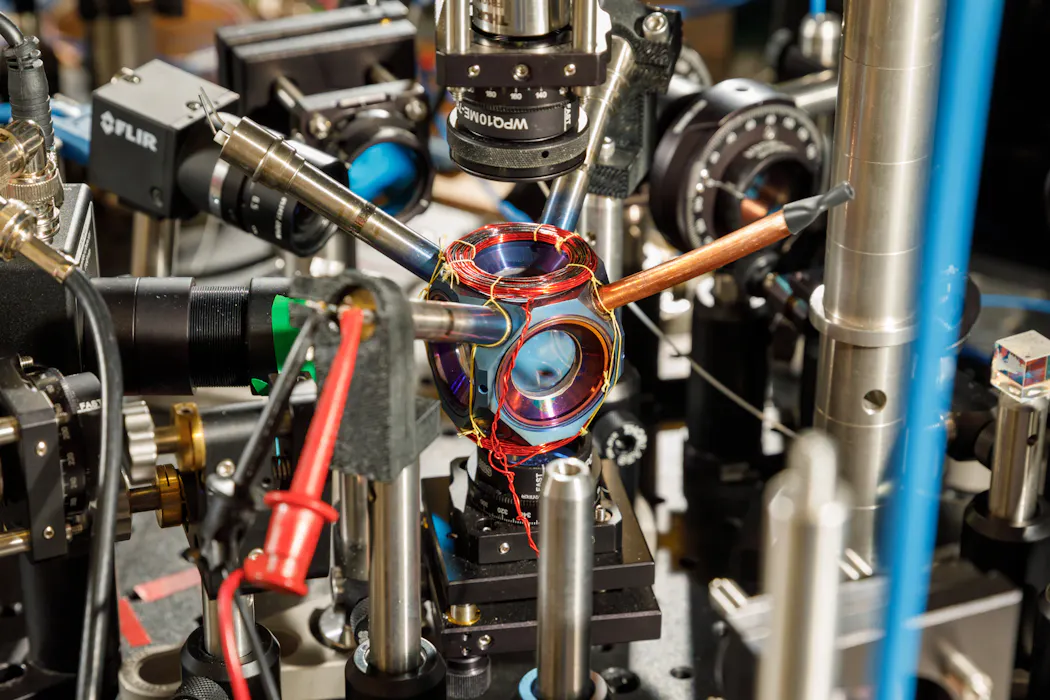
This device measures acceleration and rotation by shining lasers into small clouds of rubidium atoms.Sandia National Laboratories
Quantum computers get a lot of attention, even though they are not ready for prime time, but quantum sensors are already doing useful work. These sensors measure fields, forces and motion so small that ordinary background noise can drown them out. Some sensors are already in daily use, while others are moving from research labs into flight tests, hospitals and field instruments.
For example, a human brain produces magnetic signals in the femtotesla-to-picotesla range – billions of times weaker than a refrigerator magnet – far weaker than the magnetic noise in an ordinary room. That is why brain scanners that measure these signals need ultrasensitive detectors and strong magnetic shielding. In some hospitals, these detectors use quantum technology to help map brain activity before epilepsy surgery, without touching the brain.
Quantum sensors are showing up in other fields as well, including in navigation when GPS signals are jammed or spoofed, mapping gravity to reveal what’s underground, and boosting astronomers’ ability to measure gravitational waves. I am a photonics and quantum technologies researcher. My lab applies physics to develop a range of devices, including quantum sensors.
What is a quantum sensor?
A sensor turns a physical effect – temperature, pressure, light, acceleration or magnetic field – into a number. Most sensors do this with engineered parts: springs, coils or computer chips. But these can drift, or become less accurate, as they age or warm up.
An atom has a fixed set of energy levels, like rungs on a ladder. Light or microwaves can move it between those levels only at exact frequencies. A magnetic field, motion or gravity can shift those frequencies or change the phase of the atom’s wave, and the sensor turns that shift into a measurement.
A spin is a built-in property of electrons that makes them act like an infinitesimal cross between a spinning top and a bar magnet. Using spins as a sensor means measuring how a magnetic field causes the spin to “wobble.” The spin is like a spinning top and the magnetic field is like your finger gently touching the top. How much the top wobbles in response indicates how forcefully you touched the top, an analogy to measuring the strength of the magnetic field.
Another type of quantum sensor is a superconducting circuit, an electrical circuit cooled to extremely low temperatures so current flows with no resistance. A superconducting quantum interference device, or SQUID, is a superconducting loop. This electrical loop is sensitive to tiny changes in magnetic fields, which register as measurable changes in an electrical signal from the device.
Most quantum sensors follow a three-step loop: They prepare a known quantum state, let the world nudge it, then read out the change. Many devices form a wave-like interference pattern between two quantum systems, similar to the way in which two overlapping ripples create patterns on a pond. The devices measure how this pattern changes in response to changes in the environments around the devices shift.
Quantum sensor advantage
Quantum sensors are not automatically better at everything, and they still rely on classical engineering. But here are three advantages they offer:
They are naturally uniform. Atoms of the same kind are identical, so the sensing element is consistent from one device to the next and less prone to drift than many manufactured parts.
They respond to tiny nudges. A small field can shift a quantum state in a measurable way – if the device is shielded enough from interference, or noise.
Engineers can reshape the noise. Techniques like “squeezed” light do not remove noise, but they can move uncertainty away from the part of the measurement that matters most.
Magnetism: From brain scans to chip debugging
One mature example of a quantum sensor is the clinical brain-imaging method, called magnetoencephalography, or MEG. MEG measures the magnetic fields produced by brain activity and is used in research and clinics, including for mapping seizure activity and important brain areas before surgery. It typically uses sensors coupled to SQUIDs inside shielded rooms.
Shining a laser through a tiny chamber of atoms turns the cloud of atoms into a sensor that can detect the extremely weak magnetic fields of the brain. Brookes et al Trends in Neurosciences, CC BY
Newer magnetometers may not need the same extreme cooling as SQUIDs do. The National Institute of Standards and Technology, or NIST, has developed chip‑scale atomic magnetometers that operate at room temperature. NIST and other research teams are exploring them for biomedical work because they can measure weak fields from the brain and heart without cryogenic cooling eqipment needed by SQUIDs. In one example, researchers reported fetal heart measurements using an array of optically pumped magnetometers, and they discuss these room-temperature sensors as a route toward more flexible systems than fixed cryogenic setups.
Nitrogen‑vacancy centers are another type of quantum system that can be used as a sensor. It relies on a specific “flaw” in diamond: a nitrogen atom sitting next to a gap from a missing carbon atom. That defect acts like a quantum spin that can be prepared with light, perturbed by magnetic fields, and read out by counting emitted photons.
Nitrogen‑vacancy center sensors are not designed to do whole-head brain scans. Their strength is fine spatial resolution: They can map magnetic fields over tens of nanometers, or billionths of a meter. That can help image tiny magnetic structures, study materials, and even map currents in microwave and electronic devices such as computer chips.
Motion: Navigation when satellite signals are untrusted
When satellite navigation signals are blocked or untrusted, navigation falls back on accelerometers and gyroscopes like those in your smartphone. The challenge is drift: Tiny errors build up over time. Cold‑atom sensors offer a different route. In a normal accelerometer, a small object inside the sensor lags behind when you accelerate. In an atom interferometer, a cloud of laser-cooled atoms plays that role and their matter waves interfere in a way that depends on acceleration and rotation.
These quantum navigation systems are not yet standard equipment. But agencies and companies are testing them because they could provide a backup when satellite signals are weak, blocked or spoofed. The European Space Agency has described “hyper-sensitive” quantum sensors as possible supplementary navigation tools, while noting that the challenge is making them reliable and robust outside the lab. The U.K. government has also publicly described flight trials of quantum navigation technology as an added layer of resilience.
Gravity: Maps that reveal water, minerals and voids
NASA is developing a quantum gravity sensor to improve maps like this one that shows differences in the strength of gravity at different places on Earth. NASA
Gravity sensing uses related physics. If you can measure tiny changes in gravity from place to place, you can infer hidden structure underground. NASA’s Jet Propulsion Laboratory is developing the Quantum Gravity Gradiometer Pathfinder, a space-based quantum sensor aimed at mapping subtle gravity changes linked to underground features such as aquifers and mineral deposits.
This gravity sensor is still under development. The system would use two clouds of ultra-cold rubidium atoms as test masses. Cooled near absolute zero, the atoms behave like waves. The instrument would compare the acceleration of the two atom waves. A small difference sensed at the two clouds’ locations points to a gravity anomaly caused by hidden mass.
Seeing the universe: ‘Squeezing’ light to beat quantum noise
Some of the most famous sensors in science measure incredibly small changes in distance. Gravitational-wave observatories such as the Laser Interferometric Gravitational-Wave Observatory, or LIGO, do this by splitting a laser beam to travel along a pair of 2.5-mile-long (4-kilometer-long) tracks at right angles and bounce back off mirrors at the ends. When a gravitational wave caused by a distant cosmic event like two black holes merging passes through the device, the travel times of the two beams is slightly different.
This is quantum-enhanced sensing. The observatory measures a distance change, but quantum physics sets one of its noise limits. Quantum noise can limit how well those instruments work. LIGO reports that it uses “frequency-dependent squeezing,” a method to reduce quantum noise, to help the detectors probe a larger volume of the universe and find about 60% more mergers than before LIGO.
The catch
Quantum states are delicate. Vibrations, stray fields and temperature swings can wash out an interference pattern or scramble a spin state. That is why many of the most sensitive devices still use vacuum chambers, lasers and shielding.
Quantum sensors are already working where tiny signals matter: in clocks, hospitals and observatories. The next step is to make these sensors smaller, cheaper and tough enough to work outside specialized labs.
Alex Krasnok does not work for, consult, own shares in or receive funding from any company or organization that would benefit from this article, and has disclosed no relevant affiliations beyond their academic appointment.
When you look up at the sky on a sunny day, the Sun might seem like a bright spot, unchanging in the sky. But the Sun is a complex, dynamic celestial body, wrapped in electrical currents and magnetic fields that constantly move and tangle as it rotates. At times the Sun’s surface is very active, casting out powerful bursts of plasma called coronal mass ejections, while at other times it is calmer.
I’m a solar physicist who has spent over a decade researching the Sun. Its movement and activity is directly linked to conditions on Earth: Solar flares and ejections can cause space weather that produces beautiful Northern lights but threatens satellites. This activity follows a roughly 11-year-long cycle, and learning about this cycle helps researchers predict future space weather.
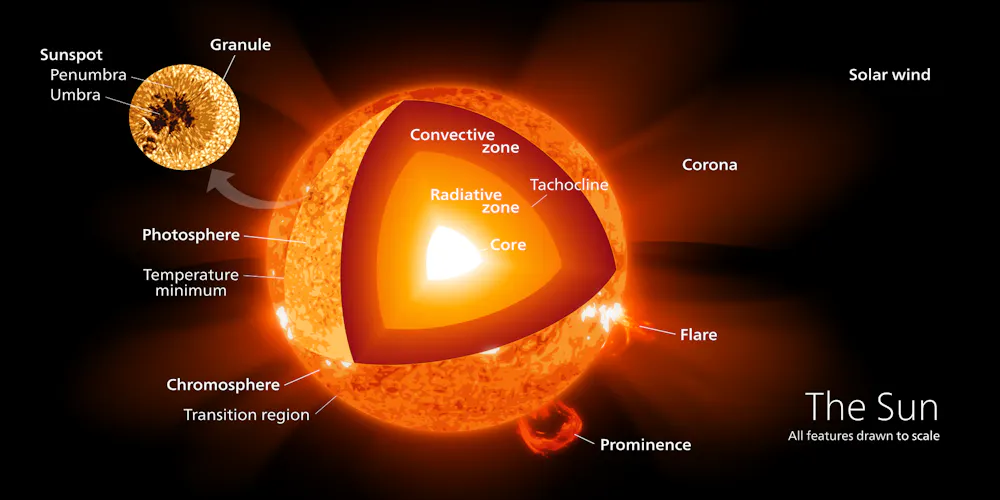
The Sun has a solid core at its center and a dense layer outside the core, where particles of light bounce around, transferring energy outwards. Beyond that layer is a thin line called the tachocline that separates those inner layers from the outer layer. This outer zone is cooler and less dense, allowing plasma to move around.
Inside the core, particles collide and release incredible amounts of energy, which radiate out from the Sun in the form of light – a process called nuclear fusion. The light travels outward towards the radiative zone outside the core, before reaching the tachocline.
At the outer layer of the Sun above the tachocline, called the convective zone, the hot plasma travels from deep in the Sun to its surface. As it moves, the plasma cools and contracts, causing it to sink back down. This cyclic process is called convection.
Explaining sunspots, solar cycle and solar dynamo.
The Sun is constantly generating magnetic fields that grow and twist below its surface. Two processes control these magnetic fields by moving the electric charges around in the plasma. One is convection, and the other is the Sun’s rotation.
Scientists think that together, these two processes are ultimately responsible for the Sun’s magnetic activity cycle, during which the Sun shifts from an organized to a less organized magnetic field arrangement. The entire cycle, called the Schwabe Cycle, takes roughly 11 years. Over the course of two Schwabe cycles, the Sun’s magnetic poles flip, and then return to their original orientation.
The Schwabe cycle
When the Sun is in an organized state, the center of the Sun resembles a giant vertical bar magnet with positive and negative ends at the top and bottom, or vice versa – called a magnetic dipole. In the 11-year solar cycle, this phase is known as solar minimum.
During the solar minimum, the Sun’s magnetic field is a simple dipole, with a positive pole and a negative pole on either end. Throughout the solar cycle, the magnetic fields go from simple lines to tangled chaos. NSF/AURA/NSO
Although you cannot see the invisible magnetic field directly, the glowing plasma sticks to these field lines. The magnetic field’s shape during the solar minimum is similar to Earth’s magnetic field, with open-ended magnetic field lines at the north and south poles and closed, looped fields near the equator. After the solar minimum state, the Sun’s magnetic field grows tangled over time. Eventually, it reaches its solar maximum state, where the solar atmosphere resembles tangled up spaghetti.
Two main forces tangle the magnetic field as the Sun rotates and plasma churns away in the convection zone: the Omega and Alpha effects.
Alpha and Omega effects
The Sun doesn’t rotate as a solid body everywhere. The interior of the Sun – the core and radiative layers – spins as a solid sphere, like a basketball. Outside these layers, the convection zone and the surface of the Sun do not spin all together.
By observing the Sun’s visible surface, scientists found out that the solar equator in the center rotates faster than the poles, near the top and bottom of the Sun. It takes the solar equator about 25 days to make a full rotation, while the poles take longer – about 35 days. Because the equator moves faster, it overtakes the poles in a phenomenon called differential rotation.
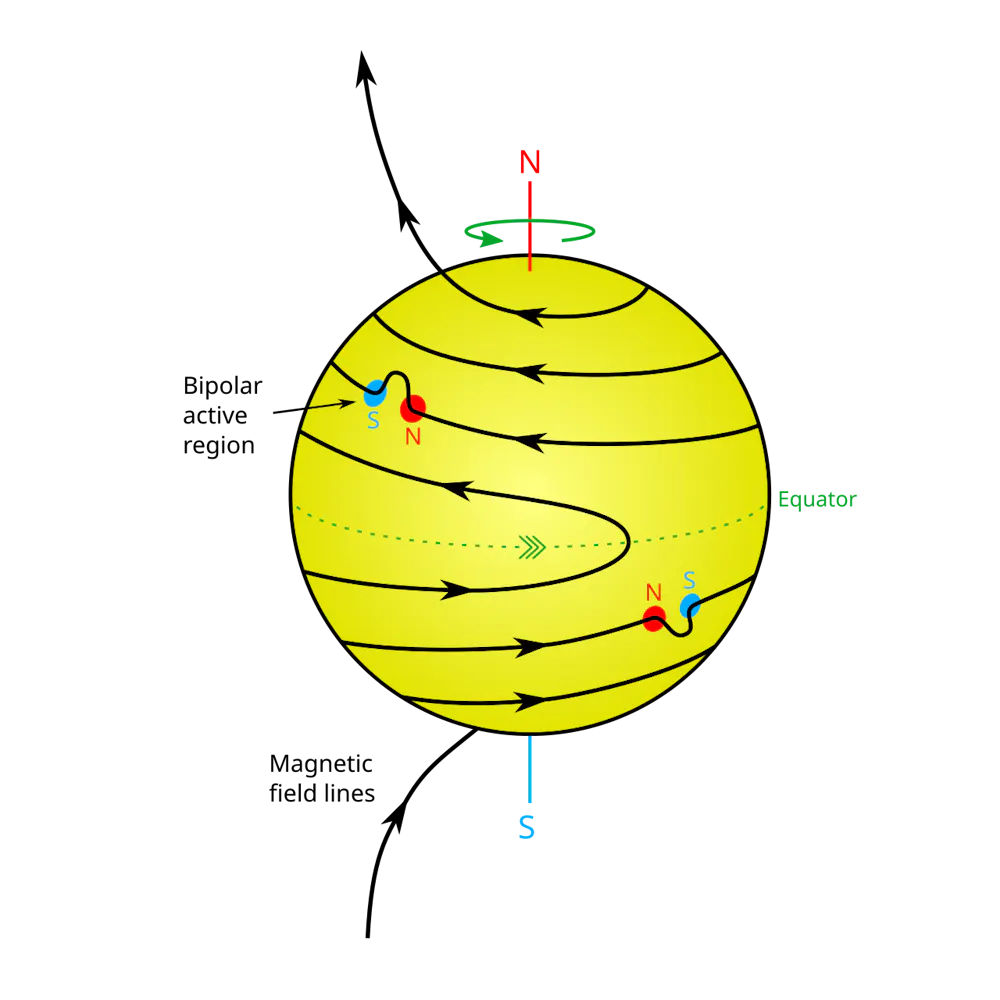
Differential rotation stretches the vertical magnetic field lines around the Sun, causing them to wrap around the Sun horizontally like a belt. The field lines pull on the Sun more tightly as differential rotation continues throughout the solar cycle, in a process known as the Omega Effect.
Differential rotation – where the poles of the Sun rotate more slowly than the center – leads the solar magnetic field lines to stretch as they wrap around the Sun. CoronalMassAffection/Wikimedia Commons, CC BY
The second effect, called the Alpha Effect, is thought to arise from convection taking place below the Sun’s surface coupled with its rotation. Like bubbles rising to the surface in boiling water, the tangled magnetic field becomes buoyant and kinked, popping through the surface to create sunspots.
Sunspots look like clusters of dark spots on the Sun’s surface. Scientists can also identify active regions of intensely strong and complex magnetic field bundles by taking images of the Sun in ultraviolet light, where the bundles appear as bright structures.
Solar eruptions called solar flares and coronal mass ejections occur most frequently in these active regions. The appearance of more sunspots, active regions and solar eruptions all signal to scientists that the Sun is entering its solar maximum phase.
Moving magnetic poles
Over the course of the solar cycle, the Sun’s magnetic poles move. At solar minimum, the magnetic poles are oriented vertically through the Sun’s center. But over the course of the solar cycle, the poles begin to tilt, until the pole previously at the top of the Sun is pointed roughly at its equator.
The Sun flipping its magnetic field.
But at the same time, all the tangled magnetic fields make the poles less defined. This chaotic magnetic state partially leads to sunspots and solar eruptions. After solar maximum, as the Sun’s magnetic state grows more organized again, the poles reappear and continue migrating back towards the top and bottom of the Sun.
However, the magnetic pole previously pointed at the top now points to the bottom, and vice versa. The configuration appears upside down from what it was 11 years ago. A full magnetic cycle takes two Schwabe Cycles – during this time, the Sun’s poles flip twice and return back to the original orientation.
Scientists have observed that several other stars, not just our Sun, have a magnetic activity cycle, though their duration can vary. And, like our Sun, other stars also produce eruptions like stellar flares and coronal mass ejections, likely due to their activity cycles.
Studying magnetic cycles in other stars can help astronomers determine whether distant planets could support life. A star’s magnetic activity directly dictates the amount of space weather the planets around that star experience. These effects can strip away the protective atmospheres around planets, prohibiting them from supporting life.
Yeimy J. Rivera does not work for, consult, own shares in or receive funding from any company or organization that would benefit from this article, and has disclosed no relevant affiliations beyond their academic appointment.
For decades, the U.S. Environmental Protection Agency has relied on an independent scientific program to answer two basic questions when chemicals come up for review: Does the chemical pose a threat to human health? If so, how much exposure is necessary before it becomes a problem?
The scientists involved in that program, known as the Integrated Risk Information System, or IRIS, served as neutral scientific referees.
Now, the Trump administration is dismantling the program and moving the scientific assessment role to policy offices, opening the door for political pressure. The administration is also making it easier for past IRIS assessments to be revisited or overturned.
This change is not merely bureaucratic: It reshapes whether future assessments of chemical dangers will be ignored, delayed by time-consuming legal fights, or understated by the federal government, potentially with real consequences for public health.
Numerous chemicals are hazardous to human health. For example, ethylene oxide is used to sterilize medical equipment. However, studies show ethylene oxide poses elevated cancer risks to people who live near facilities that release it. Chromium‑VI, used as a corrosion inhibitor and for metal finishing, can contaminate drinking water. Made famous by the Erin Brockovich case, it has been linked to cancer and other adverse health effects. Formaldehyde, found in building materials and household products, has long raised concerns about cancer and respiratory disease.
EPA scientists assessed each of these chemicals through the IRIS program. Now, the IRIS program itself, as well as many of its formal assessments of over 550 chemicals developed over four decades, is being challenged under the Trump administration.
What IRIS did – and what it didn’t do
In any high‑stakes game, the referee enforces the rules so the outcome rests on the facts, not on who shouts the loudest or has the most at stake.
IRIS assessments were written by EPA scientists and rigorously reviewed by independent external peer reviewers with experience in each specific chemical. The assessments have been used across EPA programs and by states, local governments and tribes, and internationally. Industry representatives, environmental groups, other federal agencies and members of the public all had opportunities to comment on the drafts of assessments before they were finalized.
A scientist prepares samples while doing research on PFAS at a U.S. Environmental Protection Agency lab. Understanding of chemicals’ risks has been built on IRIS assessments. AP Photo/Joshua A. Bickel
When disagreements arose over IRIS assessments, independent scientific experts were asked to weigh the evidence and advise the EPA on how to move forward. That process, relying on scientists, not stakeholders, was meant to ensure that scientific judgments were grounded in evidence, not in policy preferences or financial interests.
IRIS assessments effectively set the standard for assessing chemical hazards internationally. Other agencies and countries rely on IRIS assessments precisely because they are comprehensive, transparent and independently reviewed.
However, independent scientific reviews have repeatedly examined these concerns and found that IRIS methods reflect the current state of the science and have strengthened in rigor, transparency and consistency over time.
It’s true that IRIS assessments often took years to complete, but that was because extensive interagency review and limited staffing slowed the pace at which assessments could inform regulatory decisions. Delay is not the same as poor science.
What changes when the referee disappears?
With IRIS eliminated as an independent program, chemical hazard assessments will be overseen by regulatory offices that also weigh economic impacts, legal risk and policy priorities.
When scientific assessments are developed within offices responsible for policy decisions, it becomes harder to maintain a clear separation between evaluating evidence and weighing its regulatory consequences. That separation has historically helped ensure that scientific conclusions are grounded in evidence alone.
When public health is at stake, I believe independent referees are essential to ensure that facts are determined by evidence, not by the industries that would benefit. Shifting away from independent scientific review risks undermining that foundation.
I served as Deputy Assistant Administrator for Science Policy at the U.S. Environmental Protection Agency from 2021 to 2022, and as Assistant Administrator for Research and Development at the U.S. EPA from 2022 to 2024.
The Election Security Group turns intelligence about foreign election threats into warnings and offensive operations.Charly Triballeau/AFP via Getty Images
With the 2026 midterms less than six months away, the Election Security Group would normally be busy helping prepare the nation’s election infrastructure. The federal task force typically briefs Congress on upcoming threats and engages with state and local leaders to game out scenarios ranging from ransomware to critical infrastructure attacks on Election Day.
These losses – and the disbanding of other federal offices that counter foreign influence operations – make it harder for local officials to learn of threats to election infrastructure, like AI-enabled targeting of voting tabulation systems or deepfakes of candidates. Little is known about whether the proactive cyber deterrence that has defined U.S. elections for much of the past decade remains in place in any other form.
I’m a scholar of global efforts to secure democracy, and I co-edited a book called “Securing Democracies” about cyberattacks and disinformation worldwide. I can attest to the importance of guarding against foreign efforts to undermine trust in U.S. elections and believe that, without groups like the EI-ISAC and the Election Security Group in place, the 2026 midterms could mark a milestone: For the first time in perhaps a decade, the next election may be less secure than the last.
Gen. Joshua Rudd, who’s in charge of the two agencies that jointly run the Election Security Group, told the Senate Armed Services Committee on April 28, 2026, that he didn’t know if the group had been set up yet for the midterm elections. AP Photo/Cliff Owen
A decade of election defense
The Russian-backed Internet Research Agency began targeting the U.S. political system to sow divisions in 2014. Thanks to Internet Research Agency troll farms – organized groups paid to flood social media platforms with fake or divisive content – disinformation proliferated through the 2016 election. At the same time, Russia’s GRU – its military intelligence agency – homed in on the Democratic National Committee and probed all 50 state election systems. It breached Hillary Clinton’s campaign and compromised election systems in Illinois.
Though there is no evidence that votes were altered as a result, Russian influence exposed the country’s election vulnerabilities and set the stage for extensive investigations and hearings questioning how the U.S. government should respond. It left lasting damage in its wake, like lower trust in electoral processes and widened political divides.
In the final weeks of the Obama administration, the Department of Homeland Security designated election infrastructure as critical, akin to water and electricity. The first Trump administration built on that designation and created the Cybersecurity and Infrastructure Security Agency, a component of the Department of Homeland Security, in 2018. That same year, the National Security Agency and U.S. Cyber Command – the military nerve center for cybersecurity – partnered to launch what was initially called the Russia Small Group, a task force to guard U.S. election infrastructure against Russian interference.
Since at least the Obama administration, the U.S. had been largely focused on defensive measures to protect elections, like multifactor authentication and encryption, which make it harder to compromise systems in the first place. The Trump administration wanted to be more proactive, to put adversaries on notice and deter future attacks. This approach is known as defending forward, or persistent engagement.
The test for this new, more activist policy came during the 2018 midterms, as the Internet Research Agency again tried to widen divisions in U.S. society through hundreds of thousands of manufactured tweets and posts that made divisive views appear more widely shared than they were on both sides of hot-button issues. This time, however, the Russia Small Group took the Internet Research Agency offline during and immediately after the election. Although the details are classified, public reporting indicates that Cyber Command temporarily disrupted the Internet Research Agency’s internet access and sent direct messages to operatives warning them against such activities and instructing them to not interfere in U.S. elections.
By the 2020 presidential election, the Russia Small Group had been renamed the Election Security Group, and its scope expanded beyond Russia to include China, Iran, North Korea and nonstate actors. It worked to “disrupt, deter and degrade foreign adversaries’ ability to interfere with and influence how U.S. citizens vote and how those votes are counted.”
The Election Security Group does this through detailed information-sharing across agencies and with local officials and the private sector. If, for instance, a foreign influence campaign falsely claims that polling places have closed early in a swing state, the Election Security Group can alert election officials, platforms and distributed cybersecurity teams before the claim goes viral. In true “defend forward” spirit, it can also help cut off foreign trolls and state-backed hackers from what’s needed to run an influence operation, like internet access, servers and accounts.
Typically, it is active during election years, serving as a vital coordination hub and turning intelligence about foreign election threats into warnings, defensive measures and offensive operations.
The Election Security Group’s absence comes at a time when both threats and technological vulnerabilities are multiplying.
These challenges – combined with losing the EI-ISAC and, possibly, the Election Security Group – could leave the U.S. less prepared this November. Local and state election officials have fewer places to turn for the latest intelligence, and Congress is less informed about pressing threats – all while global U.S. standing is slipping and foreign adversaries could feel emboldened.
The Election Security Group, which was created by the first Trump administration – alongside both the Elections Infrastructure Information Sharing and Analysis Center and the Cybersecurity and Infrastructure Security Agency – has been an important weapon in the U.S. arsenal to defend vulnerable election systems. What fills these gaps remains unclear. One outlet has reported that plans to revive the Election Security Group are beginning to move through senior intelligence and defense channels, weeks after Rudd’s testimony. Even if the group is activated immediately, it will have less than six months to do what it has historically done across a full election year. With early voting beginning in some states even sooner, the clock is ticking.
The views expressed in this article are the author’s own.
Former CBS President William S. Paley, left, who once called broadcasting ‘an instrument of American democracy,’ speaks on his radio network in 1934.Bettmann/Getty Images
When CBS Radio News goes silent on May 22, 2026, Americans will lose access to news programming they’ve tuned into from their living rooms, kitchens and cars for nearly a century.
The once-bipartisan idea that the nation’s media should exist to serve democracy continues to fade with it, too.
As a media historian, I think the story of CBS Radio News’ rise and fall cannot be told without telling another parallel story: the story of how the U.S. stopped demanding that media serve the public interest.
When CBS was born in 1927, radio was ascendant, and this new form of mass communication was spurring vibrant discussions about how media could better serve democracy.
Americans had already seen how concentrated wealth during the Gilded Age had tilted the news ecosystem by overemphasizing the concerns of the rich while glossing over inequality, graft and corruption. World War I further demonstrated the power of mass media to shape public opinion through propaganda, reinforcing calls for democratic oversight of broadcasting.
Just how to regulate radio was up for debate. But there was broad consensus across party lines that government could play a role in protecting the public from concentrated media power and, with it, foreign misinformation, bad-faith special interest messaging or fraudulent advertising.
The formative years
CBS radio traces its origins to the United Independent Broadcasters, a network of 16 local stations founded by music manager Arthur L. Judson. When Columbia Records bought a stake, it was renamed the Columbia Phonographic Broadcasting System.
Paley was no public media crusader. He was a businessman who wanted radio to turn a profit. But his management reflected a belief that radio could serve two masters: the public interest and advertisers.
Though they differed on how best to achieve it, Democrats and Republicans agreed that radio ought to serve the public interest. In other words, because the airwaves belonged to all Americans, broadcasters had obligations beyond profit. They needed to provide reliable information, platform diverse viewpoints and cover matters of public concern.
A cartoon from the March 22, 1924, edition of The Literary Digest reflects the fear that radio would be subsumed by corporate interests. Internet Archive
In the 1920s, then-Secretary of Commerce Herbert Hoover was charged with formulating federal radio policy. Though he was a staunch, pro-business conservative, Hoover was also an engineer who thought that the radio system should be “free of monopoly” and, like any machine, could be gradually improved so it would better serve democracy.
“The ether is a public medium, and its use must be for the public benefit,” he said in November 1925.
Republican President Calvin Coolidge signed the Radio Act of 1927 into law. Passed with overwhelming support, it required radio stations to demonstrate a commitment to “public interest, convenience and necessity” in order to receive a license.
With fascism threatening democracy across Europe, Murrow launched “World News Roundup” in 1938. The longest-running news program in American media, it featured live reports transmitted by shortwave from locations around the world. American audiences huddled around their radios nightly to hear CBS’ reports, which showed how live news could unite a nation and cultivate a richer information ecosystem than the uniform propaganda of Europe’s fascist strongmen.
After the war, television challenged radio’s dominance. Paley understood that Murrow had built a deep trust among listeners, and he put him in charge of CBS News as the network expanded its programming to TV.
In a 1954 broadcast, CBS News anchor Edward Murrow famously framed Wisconsin Sen. Joseph McCarthy’s anti-communist investigations as antidemocratic.
Yet Murrow grew uneasy with shifts in the network’s coverage, which, in his view, increasingly served the economic interests of its owners.
Speaking to the Radio Television News Directors Association in 1958, Murrow lamented how radio and television had forgotten “to operate in the public interest.” He worried that “we have currently a built-in allergy to unpleasant or disturbing information” and saw mass media increasingly “being used to distract, delude, amuse and insulate us.”
Without serious reporting and civic responsibility as their animating principles, radio and television were losing their democratic utility, becoming mere “wires and lights in a box.”
Corporations gain the upper hand
Throughout the 1960s and 1970s, many of the rules dating from when CBS Radio News was born, like ownership restrictions and requirements for educational programming, remained on the books.
But during this period, media companies started spending enormous sums of money on donations to legislators who could do their bidding – and capturing the regulatory bodies that were supposed to be holding them accountable. The spirited debates about how radio could better serve democracy largely disappeared. Instead, the conversation shifted to whether government should have any role at all in regulating the media.
Principles that once had broad public support – producing public interest news as a quid pro quo for licensing, limits on foreign ownership and fairness rules that required stations to give equal time to both sides of an issue – faded away.
Any societal obligation outside of earning profit started being described as a threat to the American way of life. Those arguing that media should be regulated like a public utility in a pluralistic democracy were effectively ignored.
After President Bill Clinton signed the 1996 Telecommunication Act, critics argued that industry lobbying had helped dismantle much of the public interest framework that had long governed American broadcasting. The legislation relaxed ownership caps and cross-ownership rules, allowing a small number of large corporations to acquire far more stations and weakening the older public interest obligations tied to broadcast licensing.
Before the act, corporations were limited to owning 40 radio stations. Now, conglomerates like iHeartMedia and Audacy can own thousands.
‘The tube is flickering’
Through it all, CBS Radio News’ top-of-the-hour bulletins remained on the air, a reminder of its original public mission.
Yet increasingly, the deregulated radio ecosystem failed to perform that function.
In a 1938 radio address on CBS’ ethical commitments, Paley argued that “broadcasting as an instrument of American democracy must forever be wholly, honestly and militantly non-partisan.” By 2016, CEO Les Moonves defended CBS’ decision to increase its coverage of President Donald Trump’s spectacularly divisive politics to juice ratings: “It may not be good for America, but it’s damn good for CBS.” Four years later, Trump awarded one of radio’s most polarizing partisan propagandists, Rush Limbaugh, the Presidential Medal of Freedom.
In his second term, Trump has abused his power over the media ecosystem. In 2025, the Trump administration’s FCC approved the merger of Paramount Global, the parent company of CBS, with Skydance Media. But it only did so after Paramount Global settled a lawsuit Trump had filed against CBS for $16 million.
Though Paramount Skydance is using its enormous debt load to justify taking CBS Radio News off the air, the conglomerate is trying to purchase CNN’s parent company, Warner Bros. Discovery, in a move that would only further the monopolization of the news media.
“The tube is flickering,” he said in 1958. And unless Americans reclaim their right to information not colored by profit motive and special interests, “we will soon see that the whole struggle is lost.”
Matthew Jordan does not work for, consult, own shares in or receive funding from any company or organization that would benefit from this article, and has disclosed no relevant affiliations beyond their academic appointment.