D’où venons-nous ? Un voyage de 4 milliards d’années jusqu’à l’origine de nos cellules

Source: The Conversation – in French – By Purificación López García, Directrice de recherche CNRS, Université Paris-Saclay

Entrée à l’Académie des sciences en janvier 2025, Purificación López García s’intéresse à l’origine et aux grandes diversifications du vivant sur Terre. Elle étudie la diversité, l’écologie et l’évolution des microorganismes des trois domaines du vivant (archées, bactéries, eucaryotes). Avec David Moreira, elle a émis une hypothèse novatrice pour expliquer l’origine de la cellule eucaryote, celle dont sont composés les plantes, les animaux et les champignons, entre autres. Elle est directrice de recherche au CNRS depuis 2007 au sein de l’unité Écologie- Société-Évolution de l’Université Paris-Saclay et a été récompensée de la médaille d’argent du CNRS en 2017. Elle a raconté son parcours et ses découvertes à Benoît Tonson, chef de rubrique Science et Technologie.


The Conversation : Vous vous intéressez à l’origine du vivant. Vivant, que l’on classifie en trois grands domaines : les eucaryotes, des organismes dont les cellules ont un noyau, comme les humains ou les plantes par exemple ; les bactéries, qui ne possèdent pas de noyau, et un troisième, sans doute le moins connu, les archées. Pouvez-vous nous les présenter ?

Purificación López García : Ce domaine du vivant a été mis en évidence par Carl Woese à la fin des années 1970. Quand j’ai commencé mes études, à la fin des années 1980, cette découverte ne faisait pas consensus, il y avait encore beaucoup de résistance de la part de certains biologistes à accepter un troisième domaine du vivant. Ils pensaient qu’il s’agissait tout simplement de bactéries. En effet, comme les bactéries, les archées sont unicellulaires et n’ont pas de noyau. Il a fallu étudier leurs gènes et leurs génomes pour montrer que les archées et les bactéries étaient très différentes entre elles et même que les archées étaient plus proches des eucaryotes que des bactéries au niveau de leur biologie moléculaire.

Comment Carl Woese a-t-il pu classifier le vivant dans ces trois domaines ?

P. L. G. : On est donc à la fin des années 1970. C’est l’époque où commence à se développer la phylogénie moléculaire. L’idée fondatrice de cette discipline est qu’il est possible d’extraire des informations évolutives à partir des gènes et des protéines codées dans le génome de tous les êtres vivants. Certains gènes sont conservés chez tous les organismes parce qu’ils codent des ARN ou des protéines dont la fonction est essentielle à la cellule. Toutefois, la séquence en acides nucléiques (les lettres qui composent l’ADN : A, T, C et G ; U à la place de T dans l’ARN) et donc celle des acides aminés des protéines qu’ils codent (des combinaisons de 20 lettres) va varier. En comparant ces séquences, on peut déterminer si un organisme est plus ou moins proche d’un autre et classifier l’ensemble des organismes en fonction de leur degré de parenté évolutive.

Carl Woese est le premier à utiliser cette approche pour classifier l’ensemble du vivant : de la bactérie à l’éléphant, en passant par les champignons… Il va s’intéresser dans un premier temps non pas à l’ADN mais à l’ARN et, plus précisément, à l’ARN ribosomique. Le ribosome est la structure qui assure la traduction de l’ARN en protéines. On peut considérer que cette structure est la plus conservée dans tout le vivant : elle est présente dans toutes les cellules.

La classification du vivant en trois grands domaines selon Carl Woese.
CC BY

Avec ses comparaisons des séquences d’ARN ribosomiques, Woese montre deux choses : que l’on peut établir un arbre universel du vivant en utilisant des séquences moléculaire et qu’un groupe de séquences d’organismes considérés comme de bactéries « un peu bizarres », souvent associées à des milieux extrêmes, forment une clade (un groupe d’organismes) bien à part. En étudiant leur biologie moléculaire et, plus tard, leurs génomes, les archées s’avéreront en réalité beaucoup plus proches des eucaryotes, tout en ayant des caractéristiques propres, comme la composition unique des lipides de leurs membranes.

Aujourd’hui, avec les progrès des méthodes moléculaires, cette classification en trois grands domaines reste d’actualité et est acceptée par l’ensemble de la communauté scientifique. On se rend compte aussi que la plupart de la biodiversité sur Terre est microbienne.

Vous vous êtes intéressée à ces trois grands domaines au fur et à mesure de votre carrière…

P. L. G. : Depuis toute petite, j’ai toujours été intéressée par la biologie. En démarrant mes études universitaires, les questions liées à l’évolution du vivant m’ont tout de suite attirée. Au départ, je pensais étudier la biologie des animaux, puis j’ai découvert la botanique et enfin le monde microbien, qui m’a complètement fascinée. Toutes les formes de vie m’intéressaient, et c’est sûrement l’une des raisons pour lesquelles je me suis orientée vers la biologie marine pendant mon master. Je pouvais travailler sur un écosystème complet pour étudier à la fois les microorganismes du plancton, mais aussi les algues et les animaux marins.

Puis, pendant ma thèse, je me suis spécialisée dans le monde microbien et plus précisément dans les archées halophiles (celles qui vivent dans des milieux très concentrés en sels). Les archées m’ont tout de suite fascinée parce que, à l’époque, on les connaissait comme des organismes qui habitaient des environnements extrêmes, très chauds, très salés, très acides. Donc, c’était des organismes qui vivaient aux limites du vivant. Les étudier, cela permet de comprendre jusqu’où peut aller la vie, comment elle peut évoluer pour coloniser tous les milieux, même les plus inhospitaliers.

Cette quête de l’évolution que j’avais toujours à l’esprit a davantage été nourrie par des études sur les archées hyperthermophiles lors de mon postdoctorat, à une époque où une partie de la communauté scientifique pensait que la vie aurait pu apparaître à proximité de sources hydrothermales sous-marines. J’ai orienté mes recherches vers l’origine et l’évolution précoce de la vie : comment est-ce que la vie est apparue et s’est diversifiée ? Comment les trois domaines du vivant ont-ils évolué ?

Pour répondre à ces questions, vous avez monté votre propre laboratoire. Avec quelle vision ?

P. L. G. : Après un bref retour en Espagne, où j’ai commencé à étudier la diversité microbienne dans le plancton océanique profond, j’ai monté une petite équipe de recherche à l’Université Paris-Sud. Nous nous sommes vraiment donné la liberté d’explorer la diversité du vivant avec les outils moléculaires disponibles, mais en adoptant une approche globale, qui prend en compte les trois domaines du vivant. Traditionnellement, les chercheurs se spécialisent : certains travaillent sur les procaryotes – archées ou bactéries –, d’autres sur les eucaryotes. Les deux mondes se croisent rarement, même si cela commence à changer.

Cette séparation crée presque deux cultures scientifiques différentes, avec leurs concepts, leurs références et même leurs langages. Pourtant, dans les communautés naturelles, cette frontière n’existe pas : les organismes interagissent en permanence. Ils échangent, collaborent, entrent en symbiose mutualiste ou, au contraire, s’engagent dans des relations de parasitisme ou de compétition.

Nous avons décidé de travailler simultanément sur les procaryotes et les eucaryotes, en nous appuyant d’abord sur l’exploration de la diversité. Cette étape est essentielle, car elle constitue la base qui permet ensuite de poser des questions d’écologie et d’évolution.

L’écologie s’intéresse aux relations entre organismes dans un écosystème donné. Mais mes interrogations les plus profondes restent largement des questions d’évolution. Et l’écologie est indispensable pour comprendre ces processus évolutifs : elle détermine les forces sélectives et les interactions quotidiennes qui façonnent les trajectoires évolutives, en favorisant certaines tendances plutôt que d’autres. Pour moi, les deux dimensions – écologique et évolutive – sont intimement liées, surtout dans le monde microbien.

Sur quels terrains avez-vous travaillé ?

P. L. G. : Pour approfondir ces questions, j’ai commencé à travailler dans des environnements extrêmes, des lacs de cratère mexicains au lac Baïkal en Sibérie, du désert de l’Atacama et l’Altiplano dans les Andes à la dépression du Danakil en Éthiopie, et en m’intéressant en particulier aux tapis microbiens. À mes yeux, ces écosystèmes microbiens sont les véritables forêts du passé. Ce type de systèmes a dominé la planète pendant l’essentiel de son histoire.

Purificación López García dans le Salar de Quisquiro (Chili), tenant un tapis microbien.
Ana Gutiérrez-Preciado, Fourni par l’auteur

La vie sur Terre est apparue il y a environ 4 milliards d’années, alors que notre planète en a environ 4,6. Les eucaryotes, eux, n’apparaissent qu’il y a environ 2 milliards d’années. Les animaux et les plantes ne se sont diversifiés qu’il y a environ 500 millions d’années : autant dire avant-hier à l’échelle de la planète.

Pendant toute la période qui précède l’émergence des organismes multicellulaires complexes, le monde était entièrement microbien. Les tapis microbiens, constitués de communautés denses et structurées, plus ou moins épaisses, formaient alors des écosystèmes très sophistiqués. Ils étaient, en quelque sorte, les grandes forêts primitives de la Terre.

Étudier aujourd’hui la diversité, les interactions et le métabolisme au sein de ces communautés – qui sont devenues plus rares car elles sont désormais en concurrence avec les plantes et les animaux – permet de remonter le fil de l’histoire évolutive. Ces systèmes nous renseignent sur les forces de sélection qui ont façonné la vie dans le passé ainsi que sur les types d’interactions qui ont existé au cours des premières étapes de l’évolution.

Certaines de ces interactions ont d’ailleurs conduit à des événements évolutifs majeurs, comme l’origine des eucaryotes, issue d’une symbiose entre procaryotes.

Comment ce que l’on observe aujourd’hui peut-il nous fournir des informations sur le passé alors que tout le vivant ne cesse d’évoluer ?

P. L. G. : On peut utiliser les communautés microbiennes actuelles comme des analogues de communautés passées. Les organismes ont évidemment évolué – ils ne sont plus les mêmes –, mais nous savons deux choses essentielles. D’abord, les fonctions centrales du métabolisme sont bien plus conservées que les organismes qui les portent. En quelque sorte, il existe un noyau de fonctions fondamentales. Par exemple, il n’existe que très peu de manières de fixer le CO₂ présent dans l’atmosphère. La plus connue est le cycle de Calvin associé à la photosynthèse oxygénique de cyanobactéries des algues et des plantes. Ce processus permet d’utiliser le carbone du CO₂ pour produire des molécules organiques plus ou moins complexes indispensables à tout organisme.

On connaît six ou sept grandes voies métaboliques de fixation du carbone inorganique, qui sont en réalité des variantes les unes des autres. La fixation du CO₂, c’est un processus absolument central pour tout écosystème. Certains organismes, dont les organismes photosynthétiques, fixent le carbone. Ce sont les producteurs primaires.

Ensuite vient toute la diversification d’organismes et des voies qui permettent de dégrader et d’utiliser cette matière organique produite par les fixateurs de carbone. Et là encore, ce sont majoritairement les microorganismes qui assurent ces fonctions. Sur Terre, ce sont eux qui pilotent les grands cycles biogéochimiques. Pas tellement les plantes ou les animaux. Ces cycles existaient avant notre arrivée sur la planète, et nous, animaux comme plantes, ne savons finalement pas faire grand-chose à côté de la diversité métabolique microbienne.

Les procaryotes – archées et bactéries – possèdent une diversité métabolique bien plus vaste que celle des animaux ou des végétaux. Prenez la photosynthèse : elle est héritée d’un certain type de bactéries que l’on appelle cyanobactéries. Ce sont elles, et elles seules, chez qui la photosynthèse oxygénique est apparue et a évolué (d’autres bactéries savent faire d’autres types de photosynthèse dites anoxygéniques). Et cette innovation a été déterminante pour notre planète : avant l’apparition des cyanobactéries, l’atmosphère ne contenait pas d’oxygène. L’oxygène atmosphérique actuel n’est rien d’autre que le résultat de l’accumulation d’un déchet de cette photosynthèse.

Les plantes et les algues eucaryotes, elles, n’ont fait qu’hériter de cette capacité grâce à l’absorption d’une ancienne cyanobactérie capable de faire la photosynthèse (on parle d’endosymbiose). Cet épisode a profondément marqué l’évolution des eucaryotes, puisqu’il a donné naissance à toutes les lignées photosynthétiques – algues et plantes.

À l’instar de la fixation du carbone lors de la photosynthèse, ces voies métaboliques centrales sont beaucoup plus conservées que les organismes qui les portent. Ces organismes, eux, évoluent en permanence, parfois très rapidement, pour s’adapter aux variations de température, de pression, aux prédateurs, aux virus… Pourtant, malgré ces changements, les fonctions métaboliques centrales restent préservées.

Et ça, on peut le mesurer. Lorsque l’on analyse la diversité microbienne dans une grande variété d’écosystèmes, on observe une diversité taxonomique très forte, avec des différences d’un site à l’autre. Mais quand on regarde les fonctions de ces communautés, de grands blocs de conservation apparaissent. En appliquant cette logique, on peut donc remonter vers le passé et identifier des fonctions qui étaient déjà conservées au tout début de la vie – des fonctions véritablement ancestrales. C’est un peu ça, l’idée sous-jacente.

Finalement, jusqu’où peut-on remonter ?

P. L. G. : On peut remonter jusqu’à un organisme disons « idéal » que l’on appelle le Last Universal Common Ancestor, ou LUCA – le dernier ancêtre commun universel des organismes unicellulaires. Mais on sait que cet organisme était déjà très complexe, ce qui implique qu’il a forcément été précédé d’organismes beaucoup plus simples.

On infère l’existence et les caractéristiques de cet ancêtre par comparaison : par la phylogénie moléculaire, par l’étude des contenus en gènes et des propriétés associées aux trois grands domaines du vivant. En réalité, je raisonne surtout en termes de deux grands domaines, puisque l’on sait aujourd’hui que les eucaryotes dérivent d’une symbiose impliquant archées et bactéries. Le dernier ancêtre commun, dans ce cadre, correspondrait donc au point de bifurcation entre les archées et les bactéries.

À partir de là, on peut établir des phylogénies, construire des arbres, et comparer les éléments conservés entre ces deux grands domaines procaryotes. On peut ainsi inférer le « dénominateur commun », celui qui devait être présent chez cet ancêtre, qui était probablement déjà assez complexe. Les estimations actuelles évoquent un génome comprenant peut-être entre 2 000 et 4 000 gènes.

Cela nous ramène à environ 4 milliards d’années. Vers 4,4 milliards d’années, on commence à voir apparaître des océans d’eau liquide et les tout premiers continents. C’est à partir de cette période que l’on peut vraiment imaginer le développement de la vie. On ne sait pas quand exactement, mais disons qu’autour de 4-4,2 milliards d’années, c’est plausible. Et on sait que, à 3,5 milliards d’années, on a déjà des fossiles divers de tapis microbiens primitifs (des stromatolites fossiles).

Et concernant notre groupe, les eucaryotes, comment sommes-nous apparus ?

P. L. G. : Nous avons proposé une hypothèse originale en 1998 : celle de la syntrophie. Pour bien la comprendre, il faut revenir un peu sur l’histoire des sciences, notamment dans les années 1960, quand Lynn Margulis, microbiologiste américaine, avance la théorie endosymbiotique. Elle propose alors que les chloroplastes des plantes et des algues – les organites qui permettent de réaliser la photosynthèse dans les cellules de plantes – dérivent d’anciennes bactéries, en particulier de cyanobactéries, qu’on appelait à l’époque « algues vert-bleu ». Et elle avance aussi que les mitochondries, l’organite eucaryote où se déroule la respiration et qui nous fournit notre énergie, proviennent elles aussi d’anciennes bactéries endosymbiotes – un endosymbiote étant un organisme qui vit à l’intérieur des cellules d’un autre.

Ces idées, qui avaient été déjà énoncées au début du vingtième siècle et que Margulis a fait revivre, ont été très débattues. Mais à la fin des années 1970, avec les premiers arbres phylogénétiques, on a pu démontrer que mitochondries et chloroplastes dérivent effectivement d’anciennes bactéries endosymbiotes : les cyanobactéries pour les chloroplastes, et un groupe que l’on appelait autrefois les « bactéries pourpres » pour les mitochondries.

L’hypothèse dominante, à cette époque, pour expliquer l’origine des eucaryotes, repose sur un scénario dans lequel un dernier ancêtre commun se diversifie en trois grands groupes ou domaines : les bactéries, les archées et les eucaryotes. Les archées sont alors vues comme le groupe-frère des eucaryotes, avec une biologie moléculaire et des protéines conservées qui se ressemblent beaucoup. Dans ce modèle, la lignée proto-eucaryote qui conduira aux eucaryotes et qui développe toutes les caractéristiques des eucaryotes, dont le noyau, acquiert assez tardivement la mitochondrie via l’endosymbiose d’une bactérie, ce qui lancerait la diversification des eucaryotes.

Sauf que, dans les années 1990, on commence à se rendre compte que tous les eucaryotes possèdent ou ont possédé des mitochondries. Certains groupes semblaient en être dépourvus, mais on découvre qu’ils les ont eues, que ces mitochondries ont parfois été extrêmement réduites ou ont transféré leurs gènes au noyau. Cela signifie que l’ancêtre de tous les eucaryotes avait déjà une mitochondrie. On n’a donc aucune preuve qu’une lignée « proto-eucaryote » sans mitochondrie ait jamais existé.

C’est dans ce contexte que de nouveaux modèles fondés sur la symbiose émergent. On savait déjà que les archées et les eucaryotes partageaient des similarités importantes en termes de protéines impliquées dans des processus informationnels (réplication de l’ADN, transcription, traduction de l’ARN aux protéines). Nous avons proposé un modèle impliquant trois partenaires : une bactérie hôte (appartenant aux deltaprotéobactéries), qui englobe une archée prise comme endosymbionte, cette archée devenant le futur noyau. Les gènes eucaryotes associés au noyau seraient ainsi d’origine archéenne.

Puis une seconde endosymbiose aurait eu lieu, avec l’acquisition d’une autre bactérie (une alphaprotéobactérie) : l’ancêtre de la mitochondrie, installée au sein de la bactérie hôte.

Toutefois, à l’époque, ces modèles fondés sur la symbiose n’étaient pas considérés très sérieusement. La donne a changé avec la découverte, il y a une dizaine d’années, d’un groupe particulier d’archées, appelées Asgard, qui partagent beaucoup de gènes avec les eucaryotes, qui sont en plus très similaires. Les arbres phylogénétiques faits avec des protéines très conservées placent les eucaryotes au sein de ces archées. Cela veut dire que les eucaryotes ont une origine symbiogénétique : ils dérivent d’une fusion symbiotique impliquant au minimum une archée (de type Asgard) et une alpha-protéobactérie, l’ancêtre de la mitochondrie. Mais la contribution d’autres bactéries, notamment des deltaprotéobactéries, des bactéries sulfato-réductrices avec lesquelles les archées Asgard établissent des symbioses syntrophiques dans l’environnement, n’est pas exclue.

Aujourd’hui, l’eucaryogénèse est un sujet étudié activement. La découverte des archées Asgard a renforcé la vraisemblance de ce type de modèle symbiogénétique. Des chercheurs qui considéraient ces idées comme trop spéculatives – parce qu’on ne pourra jamais avoir de preuve directe d’un événement datant d’il y a 2 milliards d’années – s’y intéressent désormais. Tous ceux qui travaillent sur la biologie cellulaire des eucaryotes se posent la question, parce qu’on peut aujourd’hui remplacer certaines protéines ou homologues eucaryotes par leurs variantes Asgard… et ça fonctionne.

The Conversation

Purificación López García ne travaille pas, ne conseille pas, ne possède pas de parts, ne reçoit pas de fonds d’une organisation qui pourrait tirer profit de cet article, et n’a déclaré aucune autre affiliation que son organisme de recherche.

ref. D’où venons-nous ? Un voyage de 4 milliards d’années jusqu’à l’origine de nos cellules – https://theconversation.com/dou-venons-nous-un-voyage-de-4-milliards-dannees-jusqua-lorigine-de-nos-cellules-271900


Une proposition de loi veut supprimer l’obligation d’utiliser un cercueil et relancer le débat sur la liberté des funérailles

Source: The Conversation – in French – By Jordy Bony, Docteur et Professeur en droit à l’EM Lyon, EM Lyon Business School

Une proposition de loi déposée à la toute fin 2025 entend rouvrir un débat ancien mais de plus en plus actuel : celui du choix réel des modalités de disposition du corps après la mort, au-delà du seul face-à-face entre inhumation et crémation.


L’actualité du droit funéraire est très vivante ces dernières années et cela n’est pas prêt de s’arrêter. Pour preuve, une proposition de loi a été déposée le 23 décembre 2025, proposition visant à rendre effective la liberté des funérailles à travers le développement d’alternatives à l’inhumation et à la crémation et s’inscrivant dans la lignée d’une proposition précédente visant à développer l’humusation, un sujet qui reste dans l’actualité depuis 2023 malgré une certaine instabilité politique.

Quel est l’objet de cette nouvelle proposition de loi ?

La proposition de loi n° 2297 portée par le député Insoumis François Piquemal (4ème circonscription de la Haute-Garonne) vise « à rendre effective la liberté des funérailles ». Autrement dit, l’enjeu de ce texte n’est pas de promouvoir une alternative en particulier à l’inhumation et à la crémation mais d’offrir une plus grande marge de manœuvre aux citoyennes et citoyens français quant au choix de leurs funérailles. Pour rappel, il s’agit normalement d’une liberté déjà inscrite dans la loi de 1887 sur la liberté des funérailles mais qui est souvent interprétée comme une liberté “contrainte” puisque cantonnée au choix entre inhumation ou crémation avec obligation de recourir à un cercueil dans les deux cas.

Ainsi, le texte propose de renforcer cette liberté par une mesure forte : l’abrogation de l’obligation d’utiliser un cercueil au profit d’une liberté de choix de l’enveloppe mortuaire (article 2), suivie d’une invitation à la reconnaissance légale d’alternatives à l’inhumation et la crémation (la terramation, l’humusation et l’aquamation sont ainsi nommées dans l’article 3 de la proposition).

Là est la différence majeure entre cette proposition de loi et celle de 2023 citée en introduction : la liberté de choix de l’enveloppe mortuaire. Autant les alternatives à l’inhumation et à la crémation commencent à être connues, autant il s’agit là d’une mesure totalement inédite qui vient porter un coup à plus de 200 ans de tradition juridique, l’obligation légale d’utiliser un cercueil datant d’un arrêté du préfet de Paris de 1801 pour des raisons d’hygiène.

Enfin, là où cette nouvelle proposition de loi rejoint la précédente, c’est sur la technique légistique de l’expérimentation. Les deux propositions proposent de passer par la voie de l’expérimentation avec un délai plus crédible pour la nouvelle proposition (5 ans) contre 6 mois seulement dans celle de 2023.

Une proposition inspirée par l’actualité internationale du droit funéraire

Cette nouvelle proposition de loi n’est pas une initiative isolée. Cela commence à faire plusieurs années que nous entendons parler de reconnaissances légales d’alternatives à l’inhumation et à la crémation. C’est le cas notamment aux États-Unis, en Allemagne et peut-être bientôt en Suisse.

Ce mouvement de légalisation dans le monde témoigne d’une nouvelle sensibilité écologique et de l’aspiration de nos concitoyens à davantage de liberté dans l’organisation des funérailles.

La France n’est d’ailleurs pas le seul pays à réfléchir à l’abrogation de l’obligation légale d’utiliser un cercueil. En région bruxelloise (Belgique) il est ainsi permis depuis janvier 2019 de s’affranchir du cercueil au profit d’un linceul. On reconnait ici la théorie défendue par Alexandre Flückiger, légisticien, selon laquelle « le droit d’un État voisin est susceptible de déployer des effets d’ordre recommandationnel sur un territoire limitrophe. Le droit étranger déploie dans ce contexte un effet symbolique qui agirait sur les comportements au même titre qu’une recommandation très implicite. »

La situation en France

Enfin, en dehors de la proposition de loi, il est possible de trouver plusieurs indicateurs sur le sol français qui démontrent un vif intérêt pour une plus grande liberté des funérailles et pour l’abrogation de l’obligation légale du cercueil.

A défaut de pouvoir supprimer le cercueil, certains réfléchissent à le rendre plus vert. A Saint-Étienne la jeune entreprise Pivert Funéraire a ainsi créé un modèle pour crémation fabriqué à partir de déchet des industries sylvicoles et oléicoles.

D’autres organisent des colloques académiques sur le sujet. C’est l’exemple du colloque récent intitulé Cercueil(s) & droit(s) qui s’est tenu à l’université Toulouse capitole le 28 novembre 2025.

D’autres encore mènent des expériences effectives sur le déploiement d’alternatives à l’inhumation et la crémation. C’est l’exemple de l’expérimentation sur des brebis qui à lieu en Essonne à travers le projet ANR F-Compost.

En somme, les acteurs de la recherche et des pompes funèbres préparent le terrain pour que des projets comme celui porté par cette proposition de loi puisse voir le jour. Si une réserve pouvait être émise il y a quelques années sur l’intérêt du Parlement pour ces questions, il est permis de penser qu’à plus de 100 ans la loi sur la liberté des funérailles pourrait bientôt connaître une nouvelle vie…

The Conversation

Jordy Bony a travaillé avec le comité de recherche de l’association Humo Sapiens, pour une mort régénérative qui œuvre pour promouvoir et expérimenter la terramation en France.

ref. Une proposition de loi veut supprimer l’obligation d’utiliser un cercueil et relancer le débat sur la liberté des funérailles – https://theconversation.com/une-proposition-de-loi-veut-supprimer-lobligation-dutiliser-un-cercueil-et-relancer-le-debat-sur-la-liberte-des-funerailles-272831

Venezuela’s civil-military alliance is being stretched — if it breaks, numerous armed groups may be drawn into messy split

Source: The Conversation – Global Perspectives – By Rebecca Hanson, Associate Professor of Latin American Studies, Sociology and Criminology, University of Florida

Armed demonstrators march in support of President Nicolas Maduro in Caracas, Venezuela, on Sept. 23, 2025.
AP Photo/Ariana Cubillos

The immediate political void left in Venezuela by Nicolás Maduro’s abrupt removal from power has been filled by the former vice president, Delcy Rodríguez, who was sworn in as interim president on Jan. 5, 2026.

But the situation is far from stable. Rodríguez represents just one of multiple and competing interests within a Venezuela elite composed of a precarious civil-military alliance officially committed to a leftist populist ideology called Chavismo.

Delcy and her brother Jorge Rodríguez, the longtime right-hand man of Maduro, are the leading faces of the civilian factions. Interior Minister Diosdado Cabello and Defense Minister Vladimir Padrino López, both members of the armed forces, represent its military interests.

Even this rough civilian-military split represents just the institutional dimensions of power in Venezuela. There are also numerous armed groups and organizations with distinct interests that will respond differently to what happens in the coming days and weeks.

As scholars who have spent decades researching these armed groups, we know that Chavista leadership now faces a stark dilemma: Does it acquiesce to U.S. pressure and coercion over domestic economic and policy decisions or does it resist? Both paths risk armed conflict of varying severity, with wide-ranging consequences for the country’s future stability.

Below, we identify the main armed actors and examine how they may respond to choices made by Chavismo’s leadership in response to Trump’s use of force.

A fragile unity

If current elite cohesion holds and Chavista leadership acquiesces to Trump’s designs on the country, in our opinion the likelihood of large-scale armed conflict remains low.

Over the years, the government has consolidated loyalty by installing officers at the helm of state institutions and granting access to resources such as oil, gold mining and drugs. Future government cohesion would be contingent on the military’s continued control of key institutions, as well as the legal and illicit markets that underpin senior officers’ wealth.

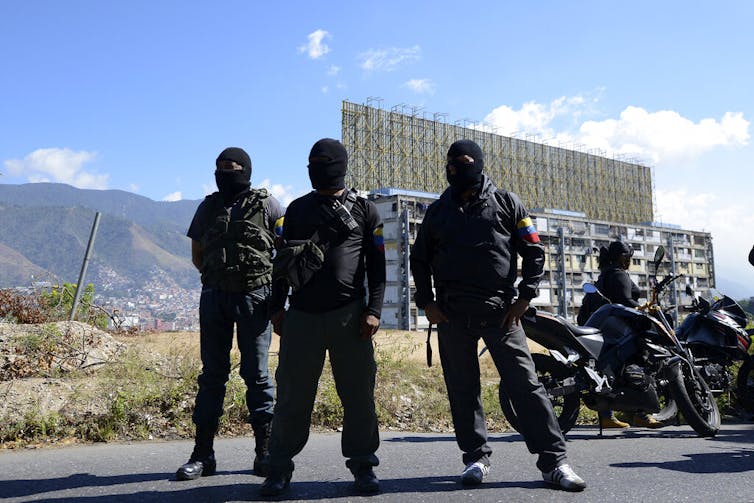
But the risk of instability also lies outside of elite unity, with the armed “colectivos.” These diverse groups range from loyal government supporters to factions more critical of the government. Although their numbers are unknown, colectivos are numerous, coordinated, often heavily armed and control significant territory – including in the country’s capital.

Three masked and armed men stand guard.
Masked members of a ‘colectivo’ group stand on the sidelines of a political march in Venezuela in 2020.
AP Photo/Matias Delacroix

While many are now driven primarily by economic interests, a subset retains insurgent, ant-imperialist commitments. Should Chavista elites be perceived as acquiescing to U.S. pressure going forward, these groups could interpret such accommodation as ideological betrayal and turn to guerrilla violence.

As a founder of one of the largest and most powerful colectivos put it when we interviewed him in 2021: “As long as imperialism exists, armed struggle will always be present because imperialism seeks to destroy the people.”

While colectivo members were largely quiet immediately after Maduro’s abduction, some videos released on social media and news outlets have shown men believed to be colectivo members harassing reporters and people in the streets.

Potential for political rupture

It remains unclear how durable the current unified but already fraught Chavista front will prove. Indeed, the Rodríguez civilian wing and the Cabello-Padrino López military apparatus likely have different levels of tolerance for Trump’s propositions.

The Rodríguez siblings have generally adopted a pragmatic posture: In recent years, Delcy has shown a willingness to move away from state-led socialism toward market-oriented policies in an effort to stabilize the Venezuelan economy. Moreover, embracing free-market policies could help the siblings attract support from business elites and segments of the broader population.

Military factions have increased their political weight since the death of Hugo Chávez, Maduro’s predecessor. These military forces want economic controls that allow them to benefit from crony capitalism and guarantee their interests in strategic enterprises – including oil, gold, food distribution and drug markets. Moreover, Chavismo’s anti-imperialist nationalist ideology is particularly salient within the armed forces.

Trump’s statements indicating the U.S. would be the de facto ruler of Venezuela was likely perceived within Chavista circles as overtly blatant imperialism and an intentional public humiliation. While the Rodríguez siblings may be prepared to absorb this to preserve stability and their own survival, hard-line military figures could be far less inclined to do so.

For now, the civilian leadership is at least officially committed to Maduro. Still, Trump’s framing of the Maduro operation as an overt spectacle of subjugation raises the military’s political cost of continued alignment with a civilian leadership potentially seen as acquiescing to Washington’s demands.

Whether this perceived affront translates into defection will also depend on how any potential Rodríguez realignment threatens or preserves the military’s economic interests.

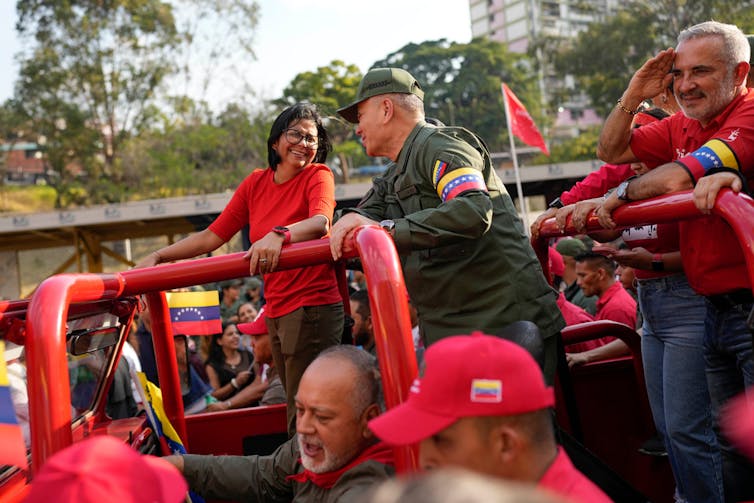
Two political leaders smile at one another as they ride a car during a rally.
Interim Venezuelan leader Delcy Rodríguez, left, smiles at Venezuelan Defense Minister Padrino Lopez during a commemoration of Hugo Chavez in Caracas, Venezuela, in 2023.
AP Photo/Matias Delacroix

The contours of resulting conflict

An open rupture over the role of the U.S. in Venezuela would likely result in asymmetrical conflict between the U.S. and Venezuelan armed forces.

The National Bolivarian Armed Forces of Venezuela consists of roughly 123,000 active personnel supported by about 8,000 reservists. The Bolivarian Militia, a fifth component of the armed forces that integrates civilian volunteers into the military, adds an estimated 200,000–300,000 members to this count. Although severely weakened by a years-long economic crisis, Venezuela’s armed forces remain a formidable actor.

This conflict would also probably engage the colectivos, who have collaborated with the armed forces for years as part of what Maduro has called the Unión Cívico Militar. In short, we would see both formal armed conflict and guerrilla warfare break out.

The relationship between the government and police forces has long been characterized by mistrust, but high-ranking officials are aware that the continued future of their institutions are tied up with Chavismo’s survival.

Of Venezuela’s more than 140 police forces, the most powerful are the Policía Nacional Bolivariana, or PNB, the CICPC, the investigative and forensic police, and the SEBIN, the political intelligence police that have become synonymous with torture. The PNB and CICPC have benefited from widespread corruption under Chavismo. Their officers are involved in rampant extortion and kidnapping, and both have played central roles in systematic state violence during the Maduro era. At the same time, the CICPC is widely seen as lacking ideological loyalty to the government and at some moments has bucked state policy and directives.

Three armed police officers ride in the back of a pickup truck.
Police patrol in La Guaira, Venezuela, after President Donald Trump announced that President Nicolás Maduro had been captured and flown out of the country.
AP Photo/Matias Delacroix

Police forces are more closely aligned with the military than Delcy and Jorge Rodríguez’s civilian faction. In the case of a rupture, this alignment would likely hold.

The role of criminal and guerrilla groups

Meanwhile, numerous gangs and criminal organizations operate across Venezuela, ranging from groups of 10 to 12 men to more sophisticated “mega-gangs” with over 100 members. While the Trump administration has often mischaracterized these groups, it is true that relationships between the Maduro government and some groups allowed them to become more organized, better armed and more capable of governing the territories they control, though others were weakened or dismantled by the state.

Gangs and criminal organizations have no ideological loyalty to the government; their priority is preserving control over illicit markets, including drugs, kidnapping, extortion and food distribution. In the event of a civil-military split, such groups may well remain neutral, choosing instead to focus on protecting their criminal businesses and potentially using instability to expand them.

At the same time, Delcy and Jorge Rodríguez could revive a familiar strategy: negotiating informal agreements with gangs in exchange for calm in the streets and tacit support.

In the past, Chavista governments have barred police forces from entering gang-controlled areas and tolerated gang dominance over illicit markets. While such arrangements can produce short-term territorial stability, they also deepen tensions with the police.

The final major armed players in Venezuela are guerrilla political groups. The National Liberation Army, or ELN, and FARC dissident groups operate in multiple states along the Venezuela-Colombia border. Well-armed and deeply enmeshed in illegal mining, extortion and smuggling, both groups have benefited from Chavismo’s rule. They have largely moved away from pursuing national political power toward capturing local state infrastructure and establishing parallel authorities to control illicit markets. Nevertheless, insurgent ideologies and opposition to demobilization efforts in Colombia remain central to understanding their motivations.

Guerrilla organizations such as the ELN and FARC dissidents would also likely seek to preserve – and potentially expand – their control over illicit economies in any future political arrangement. Unlike local gangs, however, these groups maintain articulated political agendas, even if those agendas remain largely oriented toward Colombia. Any future alignment of these groups would reflect both ideological commitments and a strategic calculation that civilian factions aligned with Washington would pose a greater threat to their political and economic interests.

Addressing this constellation of armed groups through state-building and multilateral cooperation could go some way toward providing Venezuelans with stability in the post-Maduro era. But that is far from guaranteed in this uncertain moment, especially if the Trump administration continues its policy of direct coercion over Venezuelan affairs.

The Conversation

The authors do not work for, consult, own shares in or receive funding from any company or organization that would benefit from this article, and have disclosed no relevant affiliations beyond their academic appointment.

ref. Venezuela’s civil-military alliance is being stretched — if it breaks, numerous armed groups may be drawn into messy split – https://theconversation.com/venezuelas-civil-military-alliance-is-being-stretched-if-it-breaks-numerous-armed-groups-may-be-drawn-into-messy-split-272670

LA fires showed how much neighborliness matters for wildfire safety

Source: The Conversation – USA (2) – By Elizabeth A. Logan, Associate Director of the Huntington-USC Institute on California and The West, USC Dornsife College of Letters, Arts and Sciences

Eaton fire survivors gather in Altadena, Calif., to talk about recovery six months after the LA fires. Sarah Reingewirtz/MediaNews Group/Los Angeles Daily News via Getty Images

On Jan. 7, 2025, people across the Los Angeles area watched in horror as powerful winds began spreading wildfires through neighborhood after neighborhood. Over three weeks, the fires destroyed more than 16,000 homes and businesses. At least 31 people died, and studies suggest the smoke and stress likely contributed to hundreds more deaths.

For many of us who lived through the fires, it was a traumatic experience that also brought neighborhoods closer together. Neighbors scrambled to help each other as burning embers started spot fires that threatened homes. They helped elderly and disabled residents evacuate.

A man turns a hose on a burning house while another runs.
Samuel Girma runs to get another hose as he and others try to stop the Eaton fire from spreading to more homes in Altadena, Calif. Girma was in the area on a construction job. The other man lives nearby.
Robert Gauthier/Los Angeles Times via Getty Images

As the LA region rebuilds a year later, many people are calling for improvements to zoning regulations, building codes, insurance and emergency communications systems. Conversations are underway about whether rebuilding in some locations makes sense at all.

But managing fire risk is about more than construction practices, regulations and rules. It is also about people and neighborliness – the ethos and practice of caring for those in your community, including making choices and taking steps on your own property to help keep the people around you safe.

Three men, one an older man, stand in the still-smoky ruins of what was once a home, with fire damage all around them.
Neighbors who lost their homes to a fire in Altadena, Calif., on Jan. 9, 2025, talk amid the ruins.
Zoë Meyers/AFP via Getty Images

As LA-area residents and historians who witnessed the fires’ destruction and have been following the recovery closely, we believe building a safer future for fire-risk communities includes increasing neighborliness and building shared knowledge of the past. Much of that starts in the schools.

Neighborliness matters in community fire safety

Being neighborly means recognizing the connectedness of life and addressing the common good, beyond just the individual and family network.

It includes community-wide fire mitigation strategies that can help prevent fires from spreading.

During the Southern California fires, houses, fences, sheds, roofs and dry vegetation served as the fuel for wind-blown fires racing through neighborhoods miles away from forested land. Being neighborly means taking steps to reduce risks on your own property that could put your neighbors at risk. Following fire officials’ recommendations can mean clearing defensible space around homes, replacing fire-prone plants and limiting or removing burnable material, such as wood fencing and sheds.

A woman closes her eyes as she hugs her cat.
Denise Johnson holds her cat Ramsey after the Eaton Fire. Her home was one of the few in her immediate neighborhood that survived, but recovery will take time for everyone.
AP Photo/Jae C. Hong

Neighborliness also recognizes the varying mental health impacts of significant wildfire events on the people who experience them. Being neighborly means listening to survivors and reaching out, particularly to neighbors who may be struggling or need help with recovery, and building community bonds.

Neighbors are often the first people who can help in an emergency before local, state and federal responders arrive. A fast neighborhood response, whether helping put out spot fires on a lawn or ensuring elderly residents or those without vehicles are able to evacuate, can save lives and property in natural disasters.

Fire awareness, neighborliness start in school

Community-based K-12 schools are the perfect places for learning and practicing neighborliness and providing transformative fire education.

Learning about the local history of wildfires, from the ecological impact of beneficial fire to fire disasters and how communities responded, can transform how children and their families think about fires and fire readiness.

However, in our view, fire history and safety is not currently taught nearly enough, even in fire-prone California.

A man pushes an older woman in a shopping cart along a pathway with apartments on one side and sand on the other, and thick smoke behind them.
Jerome Krausse pushes his mother-in-law in a shopping cart on a path along the beach as they evacuate amid fires in Pacific Palisades on Jan. 7, 2025.
AP Photo/Richard Vogel

California’s Department of Education Framework and Content Standards for K-12 education offer several opportunities to engage students with innovative lessons about wildfire causes, preparedness and resilience. For example, fourth grade history and social science standards include understanding “how physical environments (e.g., water, landforms, vegetation, climate) affect human activity.” Middle school science standards include mapping the history of natural hazards, though they only mention forest fires when discussing technology.

Schools could, and we believe should, include more fire history, ecological knowledge and understanding of the interconnectedness of neighborhoods and neighbors when it comes to fire safety in those and other classes.

Elementary schools in many states bring in firefighters to talk about fire safety, often through programs run by groups like the California Fire Prevention Organization. These efforts could spend more time looking beyond house fires to discuss how and where wildfires start, how they spread and how to make your own home and neighborhood much safer.

Models such as the U.S. Fire Administration’s collaboration with Sesame Workshop on the Sesame Street Fire Safety Program for preschool kids offer examples, blending catchy phrases with safety and science lessons.

The National Fire Protection Association’s Sparky the Fire Dog shares some simple steps that kids can do with their parents and friends to help keep their neighborhood safer from wildfire.

Including knowledge from Indigenous tribal elders, fire management professionals and other community members can provide more robust fire education and understanding of the roles people play in fire risk and risk reduction. Introducing students to future career pathways in fire safety and response can also help students see their roles in fire safety.

As LA recovers from the 2025 fires, fire-prone states can prepare for future fires by expanding education about fire and neighborliness, and helping students take that knowledge home to their families.

Remembering, because it will happen again

Neighborliness also demands a pivot from the reflexive amnesia regarding natural and unnatural disasters to knowing that it will happen here again.

There’s a dangerous, stubborn forgetfulness in the vaunted Land of Sunshine. It is all part of the myth that helped make Southern California such a juggernaut of growth from the late 19th century forward.

The region was, boosters and public officials insisted, special: a civilization growing in the benign embrace of the environment. Anything grew here, the endless Los Angeles Basin could absorb everyone, and if there wasn’t enough water to slake the thirst of metropolitan ambitions, engineers and taxpayers would see to it that water from far away – even very far away – would be brought here.

The Southland is beautiful, but a place can be both beautiful and precarious, particularly in the grip of climate change. These are lessons we believe should be taught in K-12 classrooms as an important step toward lowering disaster risk. Living with fire means remembering and understanding the past. That knowledge, and developing more neighborly behavior, can save your life and the lives of your neighbors.

The Conversation

Elizabeth A. Logan receives funding from the Sierra Nevada Conservancy and the WHH Foundation.

William Deverell receives funding from the Sierra Nevada Conservancy and the WHH Foundation.

ref. LA fires showed how much neighborliness matters for wildfire safety – https://theconversation.com/la-fires-showed-how-much-neighborliness-matters-for-wildfire-safety-272505

RFK Jr. guts the US childhood vaccine schedule despite its decades-long safety record

Source: The Conversation – USA (3) – By Jake Scott, Clinical Associate Professor of Infectious Diseases, Stanford University

Vaccines on the childhood schedule have been tested in controlled trials involving millions of participants and are constantly monitored for safety. GeorgiNutsov/iStock via Getty Images

The Trump administration’s overhauling of the decades-old childhood vaccination schedule, announced by federal health officials on Jan. 5, 2026, has raised alarm among public health experts and pediatricians.

The U.S. childhood immunization schedule, the grid of colored bars pediatricians share with parents, recommends a set of vaccines given from birth through adolescence to prevent a range of serious infections. The basic structure has been in place since 1995, when federal health officials and medical organizations first issued a unified national standard, though new vaccines have been added regularly as science advanced.

That schedule is now being dismantled.

In all, the sweeping change reduces the universally recommended childhood vaccines from 17 to 11. It moves vaccines against rotavirus, influenza, hepatitis A, hepatitis B and meningococcal disease from routine recommendations to “shared clinical decision-making,” a category that shifts responsibility for initiating vaccination from the health care system to individual families.

Health and Human Services Secretary Robert F. Kennedy Jr., who has cast doubt on vaccine safety for decades, justified these changes by citing a 33-page assessment comparing the U.S. schedule to Denmark’s.

But the two countries differ in important ways. Denmark has 6 million people, universal health care and a national registry that tracks every patient. In contrast, the U.S. has 330 million people, 27 million uninsured and a system where millions move between providers.

These changes follow the CDC’s decision in December 2025 to drop a long-held recommendation that all newborns be vaccinated against hepatitis B, despite no new evidence that questions the vaccine’s long-standing safety record.

The CDC announced an overhaul to the childhood vaccine schedule, bypassing the established process for making vaccine recommendations.

I’m an infectious disease physician who treats vaccine-preventable diseases and reviews the clinical trial evidence behind immunization recommendations. The vaccine schedule wasn’t designed in a single stroke. It was built gradually over decades, shaped by disease outbreaks, technological breakthroughs and hard-won lessons about reducing childhood illness and death.

The early years

For the first half of the 20th century, most states required that students be vaccinated against smallpox to enter the public school system. But there was no unified national schedule. The combination vaccine against diphtheria, tetanus and pertussis, known as the DTP vaccine, emerged in 1948, and the Salk polio vaccine arrived in 1955, but recommendations for when and how to give them varied by state, by physician and even by neighborhood.

The federal government stepped in after tragedy struck. In 1955, a manufacturing failure at Cutter Laboratories in Berkeley, California, produced batches of polio vaccine containing live virus, causing paralysis in dozens of children. The incident made clear that vaccination couldn’t remain a patchwork affair. It required federal oversight.

In 1964, the U.S. surgeon general established the Advisory Committee on Immunization Practices, or ACIP, to provide expert guidance and recommendations to the CDC on vaccine use. For the first time, a single body would evaluate the evidence and issue national recommendations.

A drawing of a boy on crutches watching children play
This editorial cartoon commenting on the polio vaccine won the Pulitzer Prize in 1956.
Tom Little via Wikimedia Commons

New viral vaccines

Through the 1960s, vaccines against measles (1963), mumps (1967) and rubella (1969) were licensed and eventually combined into what’s known as the MMR shot in 1971. Each addition followed a similar pattern: a disease that killed or disabled thousands of children annually, a vaccine that proved safe and effective in trials, and a recommendation that transformed a seemingly inevitable childhood illness into something preventable.

The rubella vaccine went beyond protecting the children who received it. Rubella, also called German measles, is mild in children but devastating to fetuses, causing deafness, heart defects and intellectual disabilities when pregnant women are infected.

A rubella epidemic in 1964 and 1965 drove this point home: 12.5 million infections and 20,000 cases of congenital rubella syndrome left thousands of children deaf or blind. Vaccinating children also helped protect pregnant women by curbing the spread of infection. By 2015, rubella had been eliminated from the Americas.

Hepatitis B and the safety net

In 1991, the CDC added hepatitis B vaccination at birth to the schedule. Before then, around 18,000 children every year contracted the virus before their 10th birthday.

Many parents wonder why newborns need this vaccine. The answer lies in biology and the limitations of screening.

An adult who contracts hepatitis B has a 95% chance of clearing the virus. An infant infected in the first months of life has a 90% chance of developing chronic infection, and 1 in 4 will eventually die from liver failure or cancer. Infants can acquire the virus from their mothers during birth, from infected household members or through casual contact in child care settings. The virus survives on surfaces for days and is highly contagious.

Early strategies that targeted only high-risk groups failed because screening missed too many infected mothers. Even today, roughly 12% to 18% of pregnant women in the U.S. are never screened for hepatitis B. Until ACIP dropped the recommendation in early December 2025, a first dose of this vaccine at birth served as a safety net, protecting all infants regardless of whether their mothers’ infection status was accurately known.

This safety net worked: Hepatitis B infections in American children fell by 99%.

A unified standard

For decades, different medical organizations issued their own, sometimes conflicting, recommendations. In 1995, ACIP, the American Academy of Pediatrics and the American Academy of Family Physicians jointly released the first unified childhood immunization schedule, the ancestor of today’s familiar grid. For the first time, parents and physicians had a single national standard.

The schedule continued to evolve. ACIP recommended vaccinations for chickenpox in 1996; rotavirus in 2006, replacing an earlier version withdrawn after safety monitoring detected a rare side effect; and HPV, also in 2006.

Each addition followed the same rigorous process: evidence review, risk-benefit analysis and a public vote by the advisory committee.

More vaccines, less burden

Vaccine skeptics, including Kennedy, often claim erroneously that children’s immune systems are overloaded because the number of vaccines they receive has increased. This argument is routinely marshaled to argue for a reduced childhood vaccination schedule.

One fact often surprises parents: Despite the increase in recommended vaccines, the number of immune-stimulating molecules in those vaccines, called antigens, has dropped dramatically since the 1980s, which means they are less demanding on a child’s immune system.

The whole-cell pertussis vaccine used in the 1980s alone contained roughly 3,000 antigens. Today’s entire schedule contains fewer than 160 antigens, thanks to advances in vaccine technology that allow precise targeting of only the components needed for protection.

What lies ahead

For decades, ACIP recommended changes to the childhood schedule only when new evidence or clear shifts in disease risk demanded it. The Jan. 5 announcement represents a fundamental break from that norm: Multiple vaccines moved out of routine recommendations simultaneously, justified not by new safety data but by comparison to a country with a fundamentally different health care system.

Kennedy accomplished this by filling positions involved in vaccine safety with political appointees. His hand-picked ACIP is stacked with members with a history of anti-vaccine views. The authors of the assessment justifying the change, senior officials at the Food and Drug Administration and at HHS, are both long-time critics of the existing vaccine schedule. The acting CDC director who signed the decision memo is an investor with no clinical or scientific background.

The practical effect will be felt in clinics across the country. Routine recommendations trigger automatic prompts in medical records and enable nurses to vaccinate under standing orders. “Shared clinical decision-making” requires a physician to be involved in every vaccination decision, creating bottlenecks that will inevitably reduce uptake, particularly for the more than 100 million Americans who lack regular access to primary care.

Major medical organizations, including the American Academy of Pediatrics and the American College of Obstetricians and Gynecologists, have said that they will continue recommending the full complement of childhood vaccines. Several states, including California, New York and Illinois, will follow established guidelines rather than the new federal recommendations, creating a patchwork where children’s protection depends on where they live.

Portions of this article originally appeared in a previous article published on Dec. 18, 2025.

The Conversation

Jake Scott does not work for, consult, own shares in or receive funding from any company or organization that would benefit from this article, and has disclosed no relevant affiliations beyond their academic appointment.

ref. RFK Jr. guts the US childhood vaccine schedule despite its decades-long safety record – https://theconversation.com/rfk-jr-guts-the-us-childhood-vaccine-schedule-despite-its-decades-long-safety-record-272788

2025 was the year protein ‘jumped the shark’

Source: The Conversation – Canada – By Stuart Phillips, Professor, Kinesiology, Tier 1 Canada Research Chair in Skeletal Muscle Health, McMaster University

Thirty years ago, when I began studying protein metabolism, I would never have guessed that 2025 would be spent explaining why more protein is not always better.

Protein was once the quiet macronutrient that was always assumed sufficient. Carbs had their era, and fat had its moment in the sun. Protein arrived late, but I welcomed the attention.

The phrase “jumped the shark” comes from a now-infamous 1977 episode of the iconic sitcom Happy Days, when the character Fonzie (Henry Winkler) literally water-skied over a shark. It was the moment the show sacrificed solid plot and logic for spectacle. In 2025, dietary protein repeated Winkler’s performance and crossed the line from evidence-based nutrition into performance theatre.

In 2025, protein became a metabolic Jack-of-all nutrients: protein for fat loss, protein for longevity, protein for weight loss, protein for hormone balance, protein for menopause, protein for people on GLP-1 drugs, protein for people who exercise, protein for people who do not. Protein everywhere, and the more, the better.

Despite a number of prominent voices promoting very high protein intakes in 2025, the reality is that the research data hadn’t changed. It was the messaging and volume that had been turned up.

Protein is not the cake

One reason protein is so easy to overhype is that its effects are real, but conditional. Protein supports muscle function and adaptation, but it does not act in isolation.

I use analogies because they capture biology surprisingly well. Protein does not bake the cake; exercise does. Protein is the (thin) layer of icing (or the sprinkles on the icing). Once the cake is properly iced, adding more icing does not turn it into something else. At some point, you are just decorating.

Biology is full of plateaus. Protein is no exception.

How much protein is enough?

The recommended dietary allowance (RDA) of 0.8 grams of protein per kilogram of body weight per day (g/kg/day) was never designed to optimize muscle mass, muscle strength or support healthy aging. It was designed to be the minimal dose to balance nitrogen in the body. Nitrogen balance is used as a proxy for protein balance since protein is the only significant source of nitrogen we consume.

Over the past two decades, many researchers, including myself and several colleagues, have argued that higher protein intakes are often justified. Intakes of 1.2 to 1.6 g/kg/day appear to support better muscle maintenance and adaptation, but in reality, only when combined with resistance exercise.

But here is the critical point that was lost in 2025’s protein enthusiasm: there is no strong, rational, evidence-based case for going beyond this range for most people (and yes, that includes folks in the process of weight loss and those crushing the big weights five or six days per week).

Meta-analyses pooling dozens of resistance exercise training (strength training) studies consistently show that the benefits of protein supplementation plateau at about 1.6 g/kg/day. Beyond that, additional protein does not increase lean mass or strength.

This axiom is not controversial, even if it became controversial in the minds of online influencers.

Muscle is built by resistance exercise

Protein is the bricks. Resistance exercise is the construction crew. You can deliver bricks all day long, but without workers and a blueprint, nothing gets built. When protein intake is increased to above deficiency intakes in people who are not performing resistance exercise, changes in lean mass are trivial or nonexistent.

When resistance exercise is present, additional protein can (very) modestly enhance gains in lean mass and strength, but the effects are small and saturable. More is not endlessly better.

Protein and weight loss: managing expectations

Protein hype was especially evident in discussions of weight loss. Protein was credited with boosting metabolism, melting fat, preventing fat gain in perimenopause or suppressing appetite indefinitely. These claims sound appealing. They are also grossly overstated.

Protein does not cause weight loss on its own; you need an energy deficit for that. It does not meaningfully increase long-term energy expenditure, and while it can reduce appetite in short-term studies, these effects often diminish over time, leaving a small overall benefit.

Where protein does matter during weight loss is in helping preserve lean tissue, particularly when paired with resistance exercise. But even here, the protein effect is modest, and the distinction between lean mass and muscle mass is frequently blurred.

Protein without resistance exercise, during weight loss, does very little. Exercise is the major driver that helps lean mass retention. Protein is the supporting material.

Protein leverage: Real, but not limitless

Another concept that resurfaced in 2025 was protein leverage, the idea that humans eat until protein needs are met, potentially over-consuming energy when diets are lower in protein.

There is good evidence that protein leverage exists. But it operates within limits. Once basic protein needs are met, adding more protein does not continue to suppress appetite and depress energy intake endlessly. Notably, the intake at which protein’s appetite-suppressing effect wanes is, uncomfortably for social media pundits, only marginally higher than intakes people generally consume. Again, biology is not fooled by abundance.

Why did this happen in 2025?

My best explanation is that it often takes about 17 years for solid scientific evidence to filter into public awareness and practice.

Perhaps the social media world needed time to “do their research” — that is, read papers and form their conclusions — to catch up to what protein researchers had been doing for decades? But social media can spin things, and not always in the right direction.

Protein research matured in the 1990s and early 2000s. We refined methods, tested dose responses and clarified mechanisms. What we are seeing now is not a scientific breakthrough, but a delayed cultural uptake, amplified by social media, marketing and a wellness industry that thrives on extremes.

Unfortunately, as another lesson learned in 2025, neither science nor nuance fares well online.

Bringing protein back to reality

Protein matters. It always has. It supports muscle, function and health across the lifespan. Many people, especially older adults, very likely benefit from consuming more than the RDA.

But 2025 was not the year protein finally got its due. It was the year protein was oversold, overvalued and overhyped. Protein supports adaptation; it does not cause it. It helps preserves lean tissues (which is not muscle) during weight loss; it does not drive fat loss. And beyond a certain point, more protein is simply more protein, not more benefit.

The science of protein has not been revolutionized; we just need to listen to it again.

The Conversation

Stuart Phillips owns patents licensed to Exerkine and has received honoraria for speaking from Nestle, Optimum Nutrition and Danone. He receives funding from the National Science and Engineering Research Council, the Canadian Institutes for Health Research, the US National Institutes of Health, Dairy Famers of Canada, teh US National Dairy Council.

ref. 2025 was the year protein ‘jumped the shark’ – https://theconversation.com/2025-was-the-year-protein-jumped-the-shark-272614

La guerre de l’information autour des métaux stratégiques

Source: The Conversation – in French – By Michel Jébrak, Professeur émérite en ressources minérales, Université du Québec à Montréal (UQAM)

La transition énergétique repose sur une utilisation accrue de métaux. À mesure que cette dépendance augmente, l’attention portée à ces ressources a explosé. En vingt ans, un sujet autrefois réservé aux spécialistes est devenu un enjeu public majeur, et parfois même un motif de tensions internationales.

Dans cet espace de plus en plus exposé, l’information circule vite… et pas toujours correctement. Dans les médias et sur les réseaux sociaux, les fausses nouvelles abondent. Certaines relèvent d’erreurs sincères, d’autres d’approximations intéressées, d’autres encore de stratégies délibérées visant à peser sur les marchés ou à renforcer la position géopolitique d’un pays.

Ces dérives prennent des formes multiples : confusion technique, exagérations, chiffres gonflés, récits séduisants, mais trompeurs, jusqu’aux montages sophistiqués destinés à orienter l’opinion ou les investissements. On peut les regrouper sous une même étiquette : la désinformation minérale.

Pour y voir clair, l’Unesco propose un cadre utile distinguant bien les registres de mésinformation, malinformation et désinformation — un outil précieux pour comprendre comment, dans le domaine des métaux, l’information peut devenir une arme.


À lire aussi :
Le rôle stratégique et essentiel des métaux rares pour la santé


Mésinformation : promesses trop belles et confusion des termes

La mésinformation renvoie à des informations inexactes ou incomplètes. Elle est fréquente au stade de l’exploration minière, quand les promoteurs doivent attirer des capitaux pour des projets miniers tout en rassurant les populations locales. Les chercheurs français Brice Laurent et Julien Merlin parlent d’ « ingénierie de la promesse », des récits optimistes, voire enjolivés, qui mêlent parfois écoblanchiment et espoirs de rendements exceptionnels. Ces approximations peuvent devenir lourdes de conséquences : l’exagération de la taille d’un gisement peut créer l’illusion de prospérité et servir à lever des fonds ou faire monter artificiellement la valeur de l’entreprise en bourse.

La confusion entre « ressources » (un potentiel géologique encore théorique) et « réserves » (une évaluation rigoureuse intégrant la faisabilité économique) demeure répandue, d’autant que les normes de classification varient selon les pays.

Cette ambiguïté a alimenté plusieurs emballements médiatiques. C’est que la multiplication des informations et la vitesse des diffusions augmentent le risque ! En Ukraine, par exemple, l’administration Trump et certains médias ont présenté le pays comme disposant d’immenses « réserves » de terres rares, capables de rivaliser avec la Chine. Or il ne s’agissait pas de réserves au sens strict, mais d’hypothèses géologiques très préliminaires : aucun gisement n’avait été évalué selon les normes internationales ni confirmé économiquement.

L’affaire rappelle le scandale Shell : en 2004, la compagnie reconnaissait avoir surévalué de 20 % ses réserves de pétrole, ce qui a entraîné une chute de valeur d’environ 12 milliards de dollars. Ces cas illustrent combien un vocabulaire précis et des méthodes transparentes sont indispensables.

Autre source d’imprécision : la notion même de « minéraux critiques ». Il n’existe pas de définition internationale consensuelle. Un minéral est dit « critique » lorsqu’il est essentiel à l’industrie et à la technologie d’un pays, mais que son approvisionnement est vulnérable. Chaque État établit donc sa propre liste selon ses besoins et ses risques, certains y incluant même l’or ou le charbon.

Ce pluralisme n’est pas illégitime en soi, mais il ouvre une brèche narrative. Un métal peut être déclaré « critique » pour attirer les investissements ou justifier une politique, puis « déclassé » lorsqu’il suscite trop de convoitises. À l’ère des réseaux sociaux, l’anecdotique peut rapidement prendre l’allure d’un basculement mondial.


À lire aussi :
Le projet d’accord sur les métaux stratégiques Ukraine-États-Unis repose-t-il sur une méprise ?


Malinformation : gonfler les chiffres pour peser sur les marchés

La malinformation relève d’informations exagérées ou fausses destinées à tromper. Des responsables politiques et des États y recourent pour attirer des capitaux étrangers ou rehausser leur poids diplomatique. En 2023, le ministère iranien de l’Industrie, des Mines et du Commerce a annoncé la « découverte de 8,5 millions de tonnes de lithium ». Les États-Unis se sont alors inquiétés, tandis que la Chine y a vu une opportunité stratégique. En réalité, il s’agissait surtout d’hectorite, un minéral argileux ne représentant qu’environ 500 tonnes de lithium exploitable.

En Zambie, le ministre des Mines a vanté « le plus grand gisement de cuivre du monde découvert par intelligence artificielle », alors que KoBold Metals, une start‑up américaine qui utilise l’IA pour repérer ce type de gisement, précisait que la zone était en réalité explorée depuis des décennies. Ces récits séduisent les médias, alimentent les espoirs politiques et attirent des investisseurs, masquant la réalité. Dans ce contexte, le cadre de l’Unesco sur les « désordres informationnels » fournit un vocabulaire utile pour distinguer l’erreur, l’exagération et la manipulation.

Désinformation : l’information comme outil d’influence stratégique

La désinformation consiste à diffuser sciemment de l’information trompeuse pour miner la confiance, manipuler l’opinion ou affaiblir un adversaire. Le concept émerge dans l’orbite soviétique au XXe siècle, lié à toute une panoplie d’opérations destinées à orienter l’opinion internationale. Chez Staline, l’objectif est moins de décrire la réalité que de la produire : énoncer une version officielle, la répéter, mobiliser l’appareil d’État pour la faire croire, puis punir ceux qui la contredisent. La Russie a poursuivi ces pratiques, comme le montre sa stratégie au Sahel, qui visait à évincer l’influence diplomatique et militaire française et à sécuriser des ressources clés — diamants en République centrafricaine, or au Mali et uranium au Niger.


Déjà des milliers d’abonnés à l’infolettre de La Conversation. Et vous ? Abonnez-vous gratuitement à notre infolettre pour mieux comprendre les grands enjeux contemporains.


Aujourd’hui, la guerre informationnelle autour des ressources prend de nouvelles formes : campagnes numériques contre des projets concurrents — par exemple, des opérations russes destinées à décrédibiliser le gaz de schiste américain en Europe, ou le lobbying américain présentant son GNL comme l’alternative « démocratique » au gaz russe —, spéculation coordonnée sur les marchés, espionnage industriel et gouvernemental dans le domaine des minéraux critiques. L’Australie estime déjà à plusieurs milliards de dollars les pertes liées à l’espionnage dans le secteur des ressources. Derrière les mots et les chiffres, c’est une lutte pour le contrôle des données qui se joue — et donc pour un avantage technologique et financier durable.

Transparence, vérification, formation, éthique

L’idée d’une science — ici, les sciences de la Terre — entièrement neutre est tentante. Les faits suggèrent pourtant autre chose : l’information géologique agit comme un instrument de pouvoir. Elle peut stabiliser les marchés ou les faire exploser, favoriser la coopération internationale… ou attiser la méfiance.

Pour sortir du brouillard informationnel, un chantier éthique s’impose : promouvoir la transparence des données publiques, renforcer la vérification, et mieux former journalistes et grand public à la lecture critique des annonces techniques. Par exemple, le Service géologique américain publie régulièrement des rapports détaillés sur la production et les réserves de minéraux stratégiques, permettant aux chercheurs, médias et investisseurs de croiser les informations et de détecter les exagérations ou erreurs, tout en masquant cependant certaines informations sensibles.

Sans confiance dans les données géologiques, il ne peut y avoir de transition énergétique crédible. Défendre la fiabilité de l’information scientifique comme bien commun — au même titre que l’eau, l’air ou la biodiversité — devient indispensable. Il est grand temps de construire une éthique de la géo-information.

La Conversation Canada

Michel Jébrak ne travaille pas, ne conseille pas, ne possède pas de parts, ne reçoit pas de fonds d’une organisation qui pourrait tirer profit de cet article, et n’a déclaré aucune autre affiliation que son organisme de recherche.

ref. La guerre de l’information autour des métaux stratégiques – https://theconversation.com/la-guerre-de-linformation-autour-des-metaux-strategiques-269586

Digital payments can expand financial inclusion — but only under the right conditions

Source: The Conversation – Canada – By Mesbah Sharaf, Professor of Economics, University of Alberta

Digital payments are often presented as a way to bring more people into the financial system. Mobile wallets, online transfers and app-based payment systems are now central to how governments, banks and technology firms talk about expanding access to financial services.

This is particularly significant today. Around the world, governments are investing heavily in digital finance as part of broader development and sustainability strategies. In Canada, public efforts have focused on strengthening digital payment infrastructure and regulation rather than expanding access directly.

Payments Canada is undertaking a multi-year modernization of core payment systems, including the development of a real-time payment rail, while the federal government has introduced a consumer-driven banking framework to support secure data sharing and innovation in financial services.

From emerging economies to high-income countries, digital payments are seen as tools for inclusion, resilience and growth, from India’s Unified Payments Interface to Brazil’s PIX instant payment system.

At the same time, digital payments do not work equally for everyone. Our recent research suggests a more complex picture of digital payments.

A more complex picture

Digital payment technologies can support financial inclusion, especially in places where traditional banking services are limited.

By reducing the need for physical bank branches, digital platforms can lower costs, save time and make basic financial services easier to use, particularly for low-income and rural populations who can access accounts and payments through mobile phones rather than in-person banking.

Evidence from multiple countries shows that digital financial services reduce transaction costs and expand access to formal financial tools for households and small businesses that were previously excluded.

For many households and small businesses — particularly in developing and emerging economies — this has expanded access to accounts and payment services.

Foundations matter for adoption

In our study, we reviewed research from the past decade about how digital payment technologies affect financial inclusion worldwide.

One of our key findings is that digital payment systems tend to perform best when certain conditions are already in place. Reliable internet and mobile networks, affordable devices and basic digital skills all matter for people to be able to use and benefit from digital payments.

Where these foundations are weak or uneven, adoption remains limited, even when digital payment options are widely available. Research shows that limited digital infrastructure, low internet access and weak technology readiness can act as significant barriers to adoption, meaning that simply introducing new technology does not guarantee that people will use it.

Trust also plays a crucial role. People are more likely to use digital payments when they trust the financial system behind them and feel confident their money is safe, and when security and privacy concerns are addressed.

In countries where financial institutions are weak or consumer protection is limited, digital platforms often struggle to gain widespread acceptance. This was the case with Nigeria’s eNaira, where fewer than 0.5 per cent of the population was using the digital currency a year after launch and most wallets remained inactive.

In such settings, cash frequently remains the preferred option, even when digital alternatives exist.

Persistent gender and socioeconomic gaps

Gender gaps are another recurring pattern. Across many countries, women are less likely than men to use digital financial services. These differences aren’t caused by technology itself, but by broader social and economic factors.

Women often have less access to mobile phones, lower digital literacy and less control over financial resources. As a result, digital payment systems can reflect — and sometimes reinforce — existing inequalities rather than eliminate them.

Income and education levels also influence adoption. People with higher incomes or more education are generally better positioned to adopt digital payments and benefit from them.

For lower-income users, concerns about fees, data costs, security and usability can discourage regular use. This helps explain why many digital payment platforms report high registration numbers but much lower levels of sustained activity.

The institutional and regulatory environment also shapes outcomes. Evidence shows that digital payments are more effective when supported by clear rules, strong consumer protections and well-functioning oversight.

When regulation is unclear or enforcement is weak, users may hesitate to rely on digital platforms for everyday transactions. When digital payments are integrated into a broader, trustworthy financial ecosystem, they are more likely to contribute to meaningful inclusion.

Promises and limits of technology

Newer technologies, such as blockchain-based payment systems, are sometimes presented as a way to overcome these challenges. While they may offer advantages in specific contexts, our research shows the evidence remains cautious.

Their effectiveness depends heavily on regulation, institutional capacity and user confidence. As with other digital tools, outcomes vary widely across countries and communities.

It’s clear that digital payments are not a simple solution. Their impact depends on how they’re designed, regulated and used within existing social and economic systems.

For policymakers and firms, this has important implications. Expanding financial inclusion is not just about introducing new technologies or increasing the number of digital accounts. It requires attention to affordability, usability, trust and the barriers faced by groups that are already disadvantaged. Without this broader perspective, digital finance risks widening gaps rather than closing them.

Digital payments can play a valuable role in promoting financial inclusion, but only under the right conditions. The evidence shows that technology can support inclusion, but it cannot replace the institutional, social and policy foundations on which inclusive financial systems ultimately depend.

The Conversation

The authors do not work for, consult, own shares in or receive funding from any company or organisation that would benefit from this article, and have disclosed no relevant affiliations beyond their academic appointment.

ref. Digital payments can expand financial inclusion — but only under the right conditions – https://theconversation.com/digital-payments-can-expand-financial-inclusion-but-only-under-the-right-conditions-272555

Venezuela attack, Greenland threats and Gaza assault mark the collapse of international legal order

Source: The Conversation – Canada – By Jorge H. Sanchez-Perez, Assistant Professor, Department of Philosophy, University of Alberta

The American invasion of Venezuela — along with fresh threats to annex Greenland — provide the world with a unique opportunity to perform a post-mortem examination on what was once known as the international rules-based legal order.

This legal order was based on rules enshrined in the United Nations Charter of 1945. Its collapse creates uncertainty that requires careful consideration from all those interested in world peace.


Read more:
Trump’s intervention in Venezuela: the 3 warnings for the world


First, however, it’s important to understand what legal orders are and how they can collapse.

Social rules come in different forms — some might be religious, some moral. But complex political communities tend to be ruled by another set of rules, legal ones.

Legal rules tend to be organized in what are commonly called legal orders, and these orders guide the actions of members of the political communities in their everyday lives. One goal of most legal orders is, usually, co-ordination among those who are part of a social group.

When we think about legal orders, we usually focus on the ones that are closer to our political communities, such as those connected to our cities, provinces and states. But there’s one legal order that tends to be ignored more often than not — the international legal order.

International law

One defining feature of international legal orders is that they are far removed from people within their own political communities, so negotiations to establish shared rules are usually carried out by representatives of large states or other powerful political entities.

Even though the international legal order feels isolated from everyday rules — like city laws telling us which side of the road to drive on — it shares the same basic features that make any system of co-ordination work.

One key feature is meeting the expectations of the people within a political community. For a legal order to last over time, it must do this. In other words, because legal orders are systems of co-ordination, they tend to endure as long as their rules are expected and accepted, even if those rules are unjust.

Although some people believe that a law must be just to count as law, that view is hard to sustain when we look at the past few hundred years of human history. Many periods offer clear examples of both domestic and international legal systems that upheld deeply unjust and morally troubling positions.

Yet it would be difficult to argue that there was no legal order in places like the Ottoman Empire or Nazi Germany. In both cases, genocide — among the gravest moral failures imaginable — occurred within functioning legal systems. This suggests that legal orders can persist even while enabling repeated immoral actions.

History also shows, however, that legal orders do collapse, and often more quickly and more frequently than many might expect.

The Ottoman Empire and Nazi Germany, for example, ceased to exist a long time ago. From a broader historical perspective, the legal order of the Roman Republic in the second century BCE no longer exists and bears little resemblance to the system governing modern Rome within Italy today.

Like the other legal orders mentioned, the post–Second World War order increasingly looks like a relic rather than a binding reality — a fact we must clearly recognize if we hope to save some of its positive features.

Fundamental rights

After the Second World War, one of the main agreements among most political communities around the world was that the previously held right to wage wars against other countries was no longer acceptable. Sovereignty consequently became one of the cornerstones of the international legal order.

This was enshrined in Articles 1 and 2 of the United Nations Charter. The logic was simple: as the charter’s preamble notes, repeated wars had brought immense suffering to people entitled to fundamental rights based on their dignity, worth and equality. As a result, this new order abolished the right of political communities to wage war for any reason.

In practice, however, this order rested on a watered-down version of that ideal. Even when sovereignty and human rights were violated via military action, the appearance of an aim to protect them had to be maintained. Powerful states could breach these principles so long as they preserved the illusion that they were attempting to uphold and safeguard sovereignty and rights.

This unspoken rule — that power could override law if the façade remained intact — underpinned the international legal order from 1945 to 2023.

As the world watched the assault on Gaza unfold — deemed a genocide by the United Nations — many western political communities that had helped build the post-war legal order abandoned even the pretense that sustained it.

Once the illusion of respect for sovereignty and human rights collapsed, the system lost a key element that had kept it functioning. This is why I’ve argued previously that the rules-based international order went to Gaza to die at the hands of those who created it.

Annexation made easy

Unlike U.S. President George W. Bush’s war in Iraq, which was framed by American diplomats as defending human rights, Donald Trump’s invasion of Venezuela and the capture of Nicolás Maduro weren’t presented as respecting any lofty principles.

His actions were grounded on the views that the U.S. has a claim to Venezuela’s oil. The intervention was driven by economic interests and hearkened back to the the Monroe Doctrine, an 1823 U.S. policy that promoted American imperialism.

The events in Venezuela suggest the post-1945 international legal order, which emphasized sovereignty and fundamental rights, has been replaced by one more like the pre-Second World War system, when nations could go to war for almost any reason.


Read more:
Trump’s squeeze of Venezuela goes beyond Monroe Doctrine – in ideology, intent and scale, it’s unprecedented


Under the legal order now in place, Canada and Greenland could easily be the next targets of American annexation. Similarly, Taiwan could be annexed by China and Ukraine by Russia.

What the world is witnessing now is the international rules-based order being stripped of whatever value it once had. It is time to accept this reality if we are to build a better international order next time.

The Conversation

Jorge H. Sanchez-Perez receives funding from the Social Sciences and Humanities Research Council of Canada (SSHRC).

ref. Venezuela attack, Greenland threats and Gaza assault mark the collapse of international legal order – https://theconversation.com/venezuela-attack-greenland-threats-and-gaza-assault-mark-the-collapse-of-international-legal-order-272690

La maternidad que heredamos: palabras, silencios y juicios que pasan de generación en generación

Source: The Conversation – (in Spanish) – By Patricia Catalá Mesón, Profesora Titular de Universidad del Area de Psicología Social, Universidad Rey Juan Carlos

Jurij Krupiak/Shutterstock

En cada conversación sobre maternidad hay algo más que consejos o anécdotas. Hay una herencia emocional que pasa de generación en generación, a veces en palabras, otras en gestos y muchas veces en silencios. Heredamos no solo maneras de cuidar, sino también formas de callar, de resistir, de amar y de temer. Las experiencias de maternidad se heredan, pero también los silencios.

En psicología perinatal sabemos que la experiencia de la maternidad no se limita al vínculo con el bebé: es también una transformación identitaria y emocional. Estudios sobre apego intergeneracional y memoria transgeneracional muestran cómo las vivencias, los miedos y las creencias de las generaciones anteriores influyen en la manera en que las mujeres viven su propia maternidad. Cada mujer, consciente o no, negocia entre lo heredado y lo elegido.

Durante los últimos años, como investigadora en este campo, he escuchado a cientos de mujeres hablar de su embarazo, su parto y su posparto. En esas conversaciones aparecen risas, cansancio, ternura, culpa y una tensión sutil. La que se da entre mujeres que se quieren, pero que a veces no saben cómo entenderse.

Tías, suegras o abuelas que “observan”

Muchas madres recientes me cuentan que se sienten observadas por las mujeres de su entorno: madres, tías, suegras, abuelas… Mujeres que también cuidaron Y que hicieron lo que pudieron con lo que tenían. Pero a menudo sus consejos suenan más a juicio que a apoyo.

En entrevistas de investigación y conversaciones clínicas, estas observaciones aparecen con frecuencia formuladas en expresiones como:

“Antes comíamos de todo en el embarazo y no pasaba nada”. “Antes bañábamos a los niños todos los días”. “Antes no había tantas tonterías con la comida”. “Nosotras no teníamos tiempo para esas cosas”. “Con tanto leer en internet, se os olvida el instinto”…

Formulaciones aparentemente cotidianas que no siempre se dicen con mala intención, pero que duelen. Duelen porque detrás hay una idea: que la forma en que hoy se vive la maternidad debe justificarse, defenderse o explicarse. Como si cada decisión tuviera que demostrar que es la correcta.

Maternidad intensiva: en busca de madres infalibles

La socióloga Sharon Hays definió hace tres décadas este fenómeno como “maternidad intensiva”, una forma de crianza en la que se espera que las madres sean emocionalmente disponibles, informadas y casi infalibles. Esa exigencia cultural se mezcla con los juicios intergeneracionales y refuerza la sensación de estar siempre siendo evaluada.

Lo paradójico es que antes también existían redes de apoyo, pero muchas de ellas eran silenciosas. Mujeres que acompañaban, que sostenían, pero que también callaban. Callaban el miedo, el dolor, la tristeza. Callaban porque no había espacio para hablar de la maternidad desde la vulnerabilidad. Y quizá por eso, cuando hoy las madres expresan su necesidad de espacio o de calma, esas generaciones pasadas no siempre saben cómo acompañarlas sin repetir el patrón del consejo o la corrección.

Algunas madres me cuentan que han tenido que pedir que no haya familiares en la sala de espera del paritorio o que las primeras visitas esperen unos días. No porque no quieran compañía, sino porque necesitan intimidad, silencio y reconocimiento. Pero esa petición, a menudo, se vive como rechazo. “Nosotras también parimos y no nos quejamos”, responden algunas. Y sí, ellas también lo hicieron, pero lo hicieron muchas veces sin ser escuchadas, sin poder elegir, sin poder parar.

La maternidad actual, en cambio, busca un lugar donde cuerpo y palabra se encuentren. Donde cada decisión (comer o no ciertos alimentos, elegir epidural o parto natural, amamantar o no, destetar o seguir) pueda hacerse desde la libertad, no desde el miedo al juicio. Porque la maternidad no es una competencia entre generaciones, sino un diálogo que aún está aprendiendo a hablar.

Frases que dejan huella

Incluso la lactancia, que debería ser un espacio íntimo y sereno, se convierte a menudo en tema de debate. “Tu leche no le llena y por eso llora tanto”. “Dale un biberón que así duerme mejor”. “Ya es mayor para seguir mamando”.

Son frases que parecen pequeñas, pero dejan huella. Minan la confianza, generan culpa y cuestionan el vínculo. Detrás de cada decisión hay una mujer que siente, duda y sostiene con su cuerpo y su mente. Que busca hacerlo bien, aunque a veces el entorno solo sepa decirle cómo debería hacerlo.

Hoy, desde la psicología, sabemos que la validación emocional y la escucha activa son factores protectores frente a la depresión posparto y el aislamiento materno. Acompañar sin juzgar no solo alivia: también previene sufrimiento psicológico y fortalece el bienestar del vínculo madre-bebé.

Quizá ha llegado el momento de romper esa cadena de juicios heredados. De sustituir el “antes se hacía así” por un “cuéntame cómo lo haces tú”. De pasar del consejo automático a la escucha auténtica. Acompañar no es enseñar, es estar. Es ofrecer presencia sin imponer, empatía sin corrección. Es aceptar que cada mujer, cada historia y cada época tienen su propio lenguaje.

Las investigaciones sobre transmisión emocional intergeneracional sugieren que los silencios también se heredan: no solo a través de relatos explícitos sobre la maternidad, sino también mediante una transmisión emocional implícita, hecha de gestos, climas afectivos y emociones no dichas.

Las heridas que una generación no pudo nombrar, la siguiente a menudo las siente sin saber por qué. Por eso cuando una mujer pide calma, busca silencio o defiende su manera de cuidar, no está rechazando a nadie. Está intentando escucharse. Está aprendiendo a cuidar desde un lugar más consciente, más propio y más en paz.

Agradecer la historia que nos trajo hasta aquí, con sus luces y sus sombras, es una manera de reconciliarnos. De honrar a las que nos precedieron sin cargar con sus silencios. De entender que no necesitamos tener razón para acompañarnos, solo respeto para mirarnos sin juicio.

Porque en cada generación hay una mujer que cuida, que sostiene y que aprende a hacerlo de nuevo, a su manera. Y cada vez que una de nosotras se atreve a hablar (a poner palabras donde antes hubo silencio), está tejiendo un puente entre pasado y futuro. Un puente hecho de escucha, ternura y presencia.

The Conversation

Este artículo se deriva del proyecto I-MARTERNA, financiado por la Comunidad de Madrid y la Universidad Rey Juan Carlos en el marco del convenio para la promoción de la investigación y transferencia de tecnología 2023–2026 (Código: 2023/00423/017, Línea A: Doctores emergentes).

ref. La maternidad que heredamos: palabras, silencios y juicios que pasan de generación en generación – https://theconversation.com/la-maternidad-que-heredamos-palabras-silencios-y-juicios-que-pasan-de-generacion-en-generacion-268420