Programar jugando: cómo un robot educativo potencia el pensamiento computacional desde edades tempranas

Source: The Conversation – (in Spanish) – By Horacio Gómez Rodríguez, Investigador en tecnologías aplicadas a la educación y Sistemas de comunicación y Redes de computadora, Universidad de Guadalajara

AlesiaKan/Shutterstock

En mis años como maestro en el nivel superior y la experiencia de participar en algunas escuelas rurales, he sido testigo de cómo la curiosidad de los niños puede encenderse con las herramientas adecuadas.

Hace algunos años, un grupo de compañeros tuvimos la oportunidad de comprar y compartir 14 robots educativos y 14 tabletas con niños y niñas de educación básica. Desde ese momento, mi manera de ver la enseñanza cambió para siempre. La robótica educativa no solo permite aprender programación, sino que también abre puertas al pensamiento computacional, lógico y creativo.

Descubriendo al robot en el aula

Existen varias opciones de robots, con diferentes precios según el país y la marca: mBot, Bee Bot y Thymio II, que pueden ser ensamblados por los propios niños. Lo que los hace más fáciles de usar es su sistema de programación visual basado en bloques. Esto significa que incluso los niños que apenas comienzan a familiarizarse con la tecnología pueden darle instrucciones y ver cómo el robot las ejecuta.

Recuerdo la primera vez que un alumno de sexto grado de primaria logró programar el robot para seguir una línea en el suelo; sus ojos brillaban como si hubiera descubierto un truco de magia.

En algunas escuelas primarias del área metropolitana, y también en aulas multigrado rurales, el estado de Jalisco en México regaló mBots, como parte del programa de tecnologías. Bastó un solo mBot para transformar la dinámica de aprendizaje. Los niños se reunían alrededor del robot, compartían ideas y discutían cómo resolver problemas que surgían al programarlo. Se volvió un catalizador de colaboración y diálogo.

Aprender haciendo: la fuerza de la experiencia

Una de las mayores virtudes de estos robots es que permiten a los niños aprender mientras experimentan. Por ejemplo, en una ocasión planteé el reto de diseñar un cruce de semáforo para que el robot esquivara a los mBot de sus compañeros. Los estudiantes, divididos en equipos, comenzaron a proponer soluciones. Algunos programas no funcionaron al primer intento, pero eso no desanimó a nadie. Al contrario, reían, debatían y modificaban las instrucciones hasta lograr que el robot evitara chocar con sus compañeros.


Leer más:
Por qué enseñar a los niños a pensar como las máquinas


A través de estas actividades, los niños desarrollan lo que ahora conocemos como pensamiento computacional: la capacidad de descomponer un problema en partes pequeñas, detectar patrones y crear soluciones paso a paso. Pero, más allá de la lógica, también cultivan la paciencia, la creatividad, la imaginación y la capacidad de trabajar juntos.

Forma de trabajo

Es importante considerar que para aprovechar al máximo el potencial del robot, se recomienda contar con al menos 12 sesiones de trabajo con los niños, bajo la supervisión del docente. Esto permite planificar actividades que combinen las prácticas con los temas de cada sesión, logrando reforzar y ampliar el aprendizaje de los contenidos curriculares al integrarlos con el uso de robots. Este enfoque favorece una comprensión más profunda y significativa de las materias vistas en clase.

Además, se sugiere implementar estas actividades principalmente con estudiantes de cuarto, quinto y sexto de primaria, con edades entre los 9 y los 12 años, quienes ya cuentan con las bases necesarias para aprovechar las posibilidades que ofrece la robótica educativa y están en una etapa ideal para desarrollar habilidades de pensamiento crítico y resolución de problemas.

Historias de éxito y aprendizajes

Recuerdo a José, un alumno de sexto grado que al principio se mostraba tímido y con poco interés por las matemáticas. Cuando comenzamos a usar el mBot, se convirtió en uno de los más entusiastas. Ideó un programa para que el robot se moviera en zigzag mientras encendía sus luces LED en distintos colores. Su proyecto fue tan creativo que se lo mostró a la directora, quien quedó impresionada. Meses después, José me dijo que quería ser ingeniero. En ese momento supe que el esfuerzo había valido la pena.


Leer más:
Diez pasos para implantar el enfoque tecnológico y científico en las aulas


Estos pequeños logros demuestran que la robótica educativa no es un lujo, sino una necesidad para preparar a los estudiantes a enfrentar los retos del siglo XXI.

Consejos para docentes que desean implementar el robot

Para los maestros que estén pensando en introducir robots en sus clases, recomiendo empezar con actividades sencillas. Por ejemplo, programar al robot para avanzar, retroceder y girar. A medida que los estudiantes ganen confianza, pueden plantearse retos más complejos como simular un semáforo o diseñar un recorrido con obstáculos.

Es fundamental adoptar una actitud de guía y facilitador. En lugar de dar respuestas, formule preguntas que inviten a los niños a pensar y buscar soluciones. En mis clases siempre recordamos que equivocarse no es fracasar, sino un paso necesario para aprender.

Además, integre el robot en otras materias. En ciencias, los niños pueden explorar conceptos como sensores de luz o sonido. En matemáticas, pueden calcular distancias y ángulos para que el robot siga un trayecto específico. De esta manera, el aprendizaje se vuelve interdisciplinario y más significativo.

Curiosidad, equipo y emoción

Traer la robótica a las aulas rurales ha sido una de las experiencias más enriquecedoras de mi carrera. Los robots no solo enseñan a programar; también despiertan la curiosidad, fortalecen el trabajo en equipo y demuestran que aprender puede ser divertido y emocionante.

En contextos donde la tecnología a menudo parece lejana, herramientas como los robots mencionados tienen el poder de cerrar brechas tecnológicas y ofrecer a los niños nuevas posibilidades para imaginar su futuro. Como docentes, tenemos la responsabilidad de buscar estrategias que conecten a nuestros estudiantes con el mundo y los preparen para ser protagonistas activos de la sociedad.

The Conversation

Horacio Gómez Rodríguez no recibe salario, ni ejerce labores de consultoría, ni posee acciones, ni recibe financiación de ninguna compañía u organización que pueda obtener beneficio de este artículo, y ha declarado carecer de vínculos relevantes más allá del cargo académico citado.

– ref. Programar jugando: cómo un robot educativo potencia el pensamiento computacional desde edades tempranas – https://theconversation.com/programar-jugando-como-un-robot-educativo-potencia-el-pensamiento-computacional-desde-edades-tempranas-259917
‘Aprender a vivir y a ser virtuosos entre lo ridículo’: el verano de Margaret Fuller

Source: The Conversation – (in Spanish) – By Antonio Fernández Vicente, Profesor de Teoría de la Comunicación, Universidad de Castilla-La Mancha

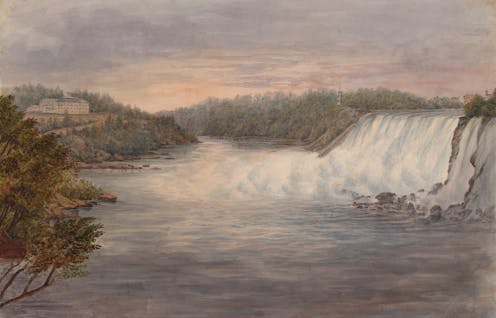
Dibujo de Clifton House y Niágara, de Michael Symour, 1846. Library of Congress

El título de este artículo hace referencia a una frase que aparece en Verano en los lagos. Se trata de una especie de diario de viaje que escribió la periodista y activista estadounidense Margaret Fuller, quien decidió aventurarse hacia los grandes lagos del noroeste de su país en mayo de 1843. Quería vivir más allá de los libros y las bibliotecas.

Portada de _Verano en los lagos_, de Margaret Fuller.
Portada de Verano en los lagos, de Margaret Fuller.
La línea del horizonte

Era aún el tiempo de lo que la mitología contemporánea da en llamar Conquista del Oeste, aunque nuestra heroína no se adentró tan lejos. Dormía en ocasiones a la intemperie, viajaba a veces en tren, otras a pie, en canoa o en carromato. Y mantenía bien abiertos los ojos para observar con detalle lo que a su paso encontraba. Desde el este de EE. UU. llegó hasta las cataratas del Niágara, los frondosos bosques de Wisconsin e Illinois y los ríos Fox y Rock.

Era una especie de viaje de descubrimiento, que tan propicio es en la época estival. Sabemos que el verano es una suerte de interludio. A veces, marca un antes y un después, como puede hacer lo propio un viaje, un buen viaje en el que dejamos atrás nuestros prejuicios, claro está.

Insisto: era hora de vivir, no de leer ni de escribir. De hecho, Fuller dejó para su regreso la redacción de Verano en los lagos. Tuvo que pedir permiso a la Universidad de Harvard para entrar en la biblioteca a documentarse, ya que a ninguna mujer le era posible, y acabó siendo la primera en hacerlo. Así estaban las cosas en esa medianía del siglo XIX en EE. UU.

Como decía, el verano es un buen momento para replantearnos nuestro lugar en el mundo e, incluso, para cuestionarnos dicho mundo. Aunque hay que dar la razón a quienes aducen que la gente nunca, o casi nunca, cambia y que este será el mismo lugar inhóspito que siempre ha sido: habrá que teñir con un manto de esperanza tal constatación. Es lo que nos queda.

Y es lo que leemos en este fabuloso libro: las peripecias de Fuller desde lo que se llamaba “civilización” hacia las tierras de promisión donde se agolpaban colonos en busca de fortuna y una vida mejor. Un periplo a lo salvaje, para tomar conciencia de que siempre tachamos de salvaje lo que no conocemos, lo que no nos es familiar. Cómo cuesta salir del propio punto de vista y del ombliguismo de creer que la nuestra es la cultura ejemplar… y las demás, meros errores de la evolución humana. En fin.

Fuller frente al sueño americano

Eran tiempos de colonización de unas tierras vírgenes y paradisíacas. Se extendía por doquier el gran sueño americano, que atraía a cientos de miles de menesterosos y advenedizos.

Retrato de una mujer sentada que se sujeta la cabeza con la mano.
Retrato de Margaret Fuller por John Plumbe Jr en 1846.
National Portrait Gallery

Pero las impresiones de Fuller no ensalzaban este sueño. Antes al contrario, lo que encontraba era una devastación moral que asolaba los parajes naturales y sometía a la indigencia y al más abyecto menosprecio a la población india autóctona. Los que emigraban a la tierra prometida deseaban regeneración material, monetaria, pero no dejar a un lado las miserias morales.

Los colonos que encontraba no seguían más que el móvil del afán de lucro, el triunfo económico. El culto al dinero era su divisa. Despreciaban los paisajes naturales, a los que Fuller comparaba con un auténtico Edén. Si los miraban, era para adivinar cómo podrían explotarlos y obtener ganancias, aunque fuese al precio de destruirlos –ya saben, los resorts en lugares inapropiados… no digo más–. Y también despreciaban a los indígenas y sus ancestrales costumbres, sus modos de vivir pausados y genuinos, tan extraños para el ajetreado hombre moderno.

La vida era otra cosa

Retorno al título del artículo: ¿por qué aprender a vivir, a ser virtuosos?, y a la postre y para más inri, en una época ridícula.

Aprender a vivir porque nadie nos da un libro de instrucciones, por muchos manuales de autoayuda que parasiten las librerías. Porque cuando sólo nos preocupa ganarnos la vida, nos olvidamos de vivirla. La vida, como el amor, es un arte en el que hay alumnos aventajados y principiantes que nunca pasarán de la mediocridad. Y esto es lo que descubrió Fuller al integrarse en tribus indias, entre pieles rojas que no precisaban de ninguna medalla para ser felices. O entre vendedores ambulantes que pasaban el tiempo sentados en cualquier parte, a la espera de que alguien les comprase algo tras un bonito cambalache.

Ilustración de una roca con forma de arco.
Ilustración de Arch Rock (en Mackinac Island, Michigan) para la primera edición de Verano en los lagos.
Online Computer Library Center

Aprender a vivir es reconocer que no somos instrumentos canjeables ni cosas que explotar, y que la misma dignidad del águila que vuela majestuosa tendría que guiar cada uno de nuestros pasos por el mundo. Fuller admiraba la sencillez de las gentes sencillas con sus sencillas existencias, sin tanta codicia ni sed de reconocimientos, sin aspavientos ni frivolidades. Admiraba la virtud sincera que no tiene más recompensa que la de saber que hace lo correcto, que no es indiferente a lo que a otros les suceda.

La suya era una época ridícula, como la nuestra, además de despiadada. Su crítica a los convencionalismos del sueño americano hacía notar que el afán de lucro y la soberbia de los “civilizados” expolian el planeta y los pueblos vulnerables. No hace falta imaginar demasiado para hacerse una idea de lo que Fuller pensaría de los tiempos actuales, que me permito no nombrar para no manchar estas líneas de improperios.

Quizás la vida sea así y sea inútil calificarla de ridícula. Pero al menos, con Fuller, deberíamos intentar conocer mejor cuáles son las reglas del juego. Y no seguirlas si son injustas e inhumanas. La vida era otra cosa, imagino que pensó mientras escuchaba las conversaciones de gentes que nunca leyeron un libro, pero sabían apreciar la belleza de un paisaje, la belleza de un rostro, la belleza de una mirada.

The Conversation

Antonio Fernández Vicente no recibe salario, ni ejerce labores de consultoría, ni posee acciones, ni recibe financiación de ninguna compañía u organización que pueda obtener beneficio de este artículo, y ha declarado carecer de vínculos relevantes más allá del cargo académico citado.

– ref. ‘Aprender a vivir y a ser virtuosos entre lo ridículo’: el verano de Margaret Fuller – https://theconversation.com/aprender-a-vivir-y-a-ser-virtuosos-entre-lo-ridiculo-el-verano-de-margaret-fuller-259205

Frío imposible: intentamos abrazar el cero absoluto de temperatura (y fallamos)

Source: The Conversation – (in Spanish) – By José Ygnacio Pastor Caño, Catedrático de Universidad en Ciencia e Ingeniería de los Materiales, Universidad Politécnica de Madrid (UPM)

CornelPutan/Shutterstock

En las noches sofocantes del verano, mientras giramos en la cama y la almohada parece un trozo de lava volcánica, ¿quién no quisiera escapar a un gélido laboratorio criogénico, enfundarse en un abrigo digno de la remota Antártida y conquistar la frontera definitiva del frío: el cero absoluto?

Sin embargo, despertaríamos antes de lograrlo, porque esta frontera no solo es difícil de cruzar, sino literalmente imposible. Por más que nuestros termómetros digan otra cosa. Y eso nos lleva al fascinante sueño de William Thomsom Kelvin, más conocido en el “barrio científico” como Lord Kelvin.

El primer intento de llegar al 0 absoluto

Allá por 1848, este físico escocés, amante de los barcos a vapor y con una peculiar afición por medir absolutamente todo, decidió inventarse una nueva escala de temperatura. Hasta entonces, los físicos Anders Celsius y Daniel Gabriel Fahrenheit manejaban cifras caprichosas para definir el cero de temperatura. Sus respectivos ceros arbitrarios se definían según la temperatura de congelación de una solución de salmuera, hecha de una mezcla de agua, hielo y cloruro de amonio (una sal).

Pero William Thomson Kelvin perseguía algo más riguroso, más absoluto. Su cero sería la temperatura más baja posible, aquella en la que las partículas que componen la materia que vemos se detienen por completo. O casi, porque en física siempre hay trampas.

Un fenómeno de equilibrio

Durante décadas, la escala Kelvin de temperatura se definió tomando como referencia un fenómeno curioso llamado el punto triple del agua .

Para entender de qué se trata, imaginemos un espectáculo de equilibrio circense a escala molecular del H₂0 en tres estados distintos (el hielo sólido, el agua líquida y el vapor) logrando coexistir pacíficamente a exactamente a 273,16 kelvin (K, en su formato abreviado), es decir 0,01 °C, que se consigue a una presión de 657 Pascales (Pa), aproximadamente 0,0060366 veces la presión atmosférica habitual. Bonito número, ¿verdad?

Este escenario, digno de un tratado diplomático, sirvió de referencia universal hasta que los físicos nos cansamos de depender del agua para establecer la frontera del 0.

El valor de la K

En 2019, la física cambió de tercio. Se decidió fijar el kelvin a partir de una constante fundamental, algo así como el ADN térmico del universo: la constante de Boltzmann (otro científico increíble, padre de la Física Estadística y de otras muchas cosas).

Desde aquel momento, un kelvin quedó definido oficialmente por una energía microscópica de exactamente 1,380649 × 10⁻²³ julios por partícula. Es una cifra extraña y ridículamente pequeña, pero a la física le encantan los decimales interminables, así que no había mucho remedio.

Ahora bien, ¿por qué tanto empeño en esta escala tan peculiar? ¿Acaso no basta para entendernos cuando hace frío o calor con los grados Celsius o Centígrados? (que, por cierto, no son lo mismo y deberían reemplazar a los Fahrenheit en algún acuerdo internacional que nos facilitase la vida cuando salimos de viaje).

No todos los 0 son 0

La respuesta es sencilla pero profunda. Celsius fija el cero donde se congela el agua, algo práctico, admitámoslo, pero impreciso, porque el hielo puede estar a temperaturas bajo cero.

Por el contrario, el kelvin se conecta directamente con el corazón íntimo de la materia. Es una escala absoluta porque este cero de temperatura corresponde al mínimo movimiento posible de cualquier partícula. A eso lo llamamos “cero absoluto”, aunque aquí viene el chiste sideral: jamás podremos alcanzarlo.

Como diría Walther Nernst, autor de la tercera ley de la termodinámica –y probablemente aguafiestas profesional–, el cero absoluto es un límite al que podemos acercarnos infinitamente, pero jamás tocar.

Y no es que nos falten ganas: científicos de todo el mundo llevan décadas tratando de reducir en sus laboratorios la temperatura de la materia, de milikelvin en milikelvin, acercándose aventuradamente a ese frío cero perfecto. Pero siempre queda una fracción imposible de superar, un último peldaño que parece burlarse de nosotros desde el fondo del congelador cósmico.

El experimento más frío conocido

Esa tensión fértil entre límite teórico e innovación experimental es, justamente, lo que mantiene viva y pujante esta área de la Física.

Los físicos experimentales no cesan en la búsqueda del “santo grial” termodinámico, pero el cero absoluto –exactamente 0 K, donde toda actividad térmica cesa– sigue resistiendo con obstinación cualquier intento de alcanzarlo, aunque cada vez está más cerca.

En experimentos recientes se han logrado temperaturas extraordinariamente bajas. Por ejemplo, en 2021, científicos alemanes enfriaron átomos de rubidio hasta unos impresionantes 38 picokelvin (38 billonésimas de kelvin), aprovechando la microgravedad en la torre de caída de Bremen (Alemania). Este experimento es uno de los más fríos jamás realizados en nuestro planeta y muestra la increíble capacidad técnica actual para rozar los límites del 0 K.

A esa línea se suma la investigación en órbita espacial a bordo de la Estación Espacial Internacional, con el Laboratorio de Átomos Fríos (Cold Atom Lab) de la NASA, donde también se han producido y manipulado condensados con energías en el régimen de picokelvin y en escalas de duración temporal inalcanzables en la Tierra.

El Laboratorio de Átomos Fríos de la NASA se sometió a una importante actualización de hardware a bordo de la Estación Espacial Internacional en enero de 2020.

Pero ni siquiera estas impresionantes hazañas han logrado –ni lograrán– romper la barrera final: la teoría termodinámica actual indica claramente que el cero absoluto es inalcanzable en la práctica, ya que requiere energía y tiempo infinitos (Masanes & Oppenheim, 2017).

El frío cósmico

¿Y si miramos a la nada, al vacío cósmico? Por más que lo parezca, el universo no está muerto de frío. El espacio interestelar, ese páramo desolado entre galaxias, conserva un leve susurro térmico: 2,725 kelvin, la temperatura del fondo cósmico de microondas, ese eco sordo del Big Bang que aún vibra por los pasillos del tiempo. Ni siquiera los rincones más solitarios del cosmos consiguen librarse de él.

El cero absoluto, ese ideal de congelación total donde los átomos deberían rendirse y quedarse quietos de una vez, sigue siendo tan inalcanzable como la imparcialidad en un debate político. Siempre hay algo molestando, una radiación rezagada, una fluctuación cuántica inoportuna, la omnipresente gravedad metiendo baza.

Así que no, el universo no puede apagar del todo su calefacción. El 0 K es como el horizonte: lo ves, lo sueñas en una noche de verano shakesperiana, pero nunca lo pisas.

The Conversation

José Ygnacio Pastor Caño no recibe salario, ni ejerce labores de consultoría, ni posee acciones, ni recibe financiación de ninguna compañía u organización que pueda obtener beneficio de este artículo, y ha declarado carecer de vínculos relevantes más allá del cargo académico citado.

– ref. Frío imposible: intentamos abrazar el cero absoluto de temperatura (y fallamos) – https://theconversation.com/frio-imposible-intentamos-abrazar-el-cero-absoluto-de-temperatura-y-fallamos-261869

Cómo la gripe y la covid-19 pueden despertar un cáncer dormido

Source: The Conversation – (in Spanish) – By Isidoro Martínez González, Científico Titular de OPIs, Instituto de Salud Carlos III

Representación 3D de una célula tumoral 3dMediSphere

Muchas veces pensamos que superar un cáncer es el final de la historia. Sin embargo, en algunos casos, la enfermedad deja una sombra silenciosa: células tumorales que viajan a otros órganos y permanecen inactivas durante años o incluso décadas. Ahora, un nuevo estudio publicado en la prestigiosa revista Nature revela que infecciones respiratorias como la gripe o la covid-19 pueden “despertar” a esas células dormidas, favoreciendo su proliferación y aumentando el riesgo de recaída.

Más allá del titular que ya ha circulado en diferentes medios de comunicación, la investigación abre preguntas profundas para la oncología, la inmunología y la salud pública: ¿qué mecanismos biológicos están detrás? ¿Podemos prevenir este “despertar” sin comprometer la defensa contra infecciones? ¿Deberíamos repensar las estrategias de seguimiento y vacunación para personas con cánceres en remisión?

El interruptor biológico: de la inflamación a la metástasis

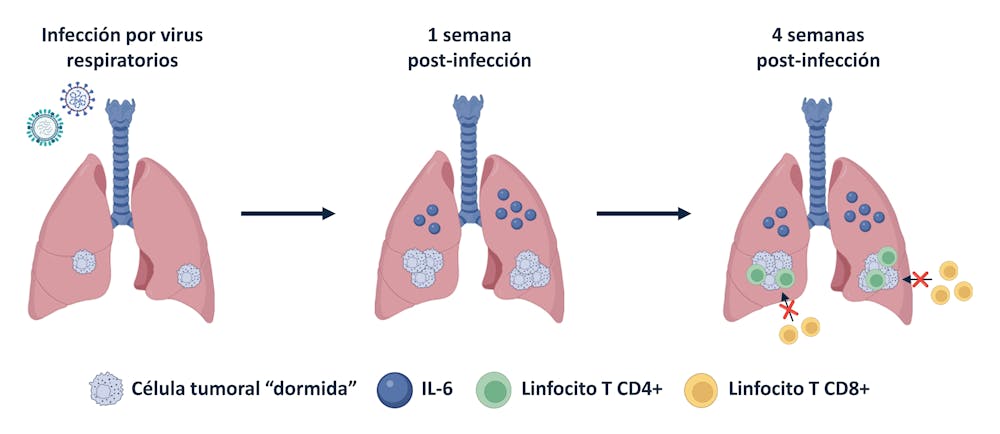
Durante una infección viral en las vías respiratorias, nuestro organismo responde liberando unas pequeñas proteínas llamadas citocinas que actúan como mensajeros que activan nuestras defensas. Entre ellas destaca la interleucina-6 (IL-6), clave para coordinar la defensa, pero que también tiene un lado oscuro: puede favorecer la proliferación de células cancerígenas. De hecho, IL-6 actúa como un “termómetro” de la inflamación en infecciones respiratorias como la covid-19, en las que niveles más elevados de esta molécula se asocian con una peor evolución y mayor gravedad de la enfermedad.

El estudio encontró que, en modelos animales con cáncer de mama que ha formado metástasis en los pulmones, la infección por virus de la gripe o la covid-19 aumentó rápidamente los niveles de IL-6, y con ello, el número de células tumorales activas.

Estas no solo “despertaron” de su estado latente, sino que continuaron dividiéndose durante meses. Lo más sorprendente es que, incluso cuando la IL-6 volvió a niveles normales, las células siguieron activas, lo que sugiere que hay otros factores que toman el relevo para mantener este estado proliferativo.

Mecanismo propuesto para la alianza entre virus respiratorios y células tumorales.
Autores

El papel inesperado de las células T

El trabajo identificó además otro actor clave: las células T CD4+, que normalmente ayudan a regular la respuesta inmunitaria. En este contexto, lejos de eliminar las células cancerígenas, parecen protegerlas de ser atacadas por las células T CD8+, las verdaderas “asesinas” del sistema inmune. Cuando los investigadores eliminaron las CD4+, los tumores proliferantes disminuyeron, indicando que estas células pueden mantener encendido el “interruptor” del cáncer tras la infección.

Este hallazgo plantea una paradoja inquietante: componentes esenciales de nuestra defensa frente a virus pueden, en ciertas circunstancias, favorecer la reactivación tumoral.

Aunque la mayor parte de los resultados descritos proviene de modelos animales, análisis de grandes bases de datos humanas (como UK Biobank) sugieren un patrón similar. En personas en remisión que se infectaron por SARS-CoV-2 (el virus de la covid-19), el riesgo de muerte por cáncer se duplicó en los meses posteriores a la infección.

¿Solo gripe y covid-19? Una puerta abierta a nuevas preguntas

Aunque el trabajo se centró en gripe y covid-19, es probable que otros virus respiratorios capaces de inducir inflamación intensa tengan efectos similares. Esto abre un campo de investigación sobre cómo patógenos comunes podrían influir en la progresión de enfermedades crónicas.

También queda por aclarar si este fenómeno ocurre en otros tipos de cáncer, en órganos distintos de los pulmones, o con infecciones no virales.

De la ciencia básica a la prevención clínica

El impacto de este hallazgo no es inmediato en términos de cambiar protocolos médicos, pero plantea varios escenarios posibles:

  • Uso de fármacos que bloquean la IL-6 durante infecciones graves en personas con alto riesgo oncológico. La buena noticia es que estos fármacos ya existen.

  • Recomendaciones más estrictas de vacunación contra gripe y covid-19 para supervivientes de cáncer.

  • Mantener un seguimiento oncológico regular, especialmente en los meses posteriores a una enfermedad respiratoria.

En resumen, este hallazgo conecta dos mundos que rara vez se cruzan en la mente del público: las infecciones virales y el cáncer metastásico. No significa que una gripe cause cáncer, sino que, en personas con células tumorales latentes, la inflamación generada por el virus puede ser el empujón que esas células necesitan para volver a crecer.

La ciencia apenas empieza a descifrar este proceso, pero entenderlo podría salvar vidas en un futuro no muy lejano.

The Conversation

Las personas firmantes no son asalariadas, ni consultoras, ni poseen acciones, ni reciben financiación de ninguna compañía u organización que pueda obtener beneficio de este artículo, y han declarado carecer de vínculos relevantes más allá del cargo académico citado anteriormente.

– ref. Cómo la gripe y la covid-19 pueden despertar un cáncer dormido – https://theconversation.com/como-la-gripe-y-la-covid-19-pueden-despertar-un-cancer-dormido-262646

Wildfire season is starting weeks earlier in California – a new study shows how climate change is driving the expansion

Source: The Conversation – USA (2) – By Gavin D. Madakumbura, Postdoctoral Researcher, University of California, Los Angeles

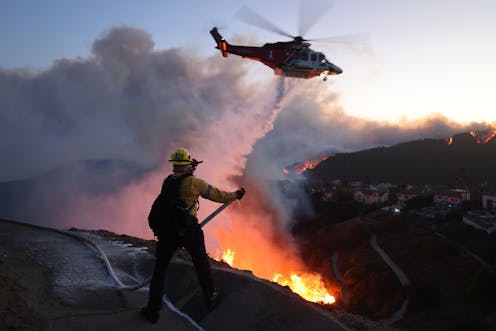
Firefighters battle in Pacific Palisades, Calif., on Jan. 7, 2025 David Swanson/AFP via Getty Images

Fire season is expanding in California, with an earlier start to wildfire activity in most of the state. In parts of the northern mountains, the season is now starting more than 10 weeks earlier than it did in the 1990s, a new study shows.

Atmospheric scientists Gavin Madakumbura and Alex Hall, two authors of the study, explain how climate warming has been driving this trend and why the trend is likely to continue.

What did your study find about how wildfire season is changing?

Over the past three decades, California has seen a trend toward more destructive wildfire seasons, with more land burned, but also an earlier start to fire season. We wanted to find out how much of a role climate change was playing in that shift to an earlier start.

We looked at hundreds of thousands of fire records from 1992 to 2020 and documented when fire season started in each region of the state as temperatures rose and vegetation dried out.

While other research has observed changes in the timing of fire season in the western U.S., we identified the drivers of this trend and quantified their effects.

The typical onset of summer fire season, which is in May or June in many regions, has shifted earlier by at least one month in most of the state since the 1990s, and by about 2½ months in some regions, including the northern mountains. Of that, we found that human-caused climate change was responsible for advancing the season between six and 46 days earlier across most of the state from 1992 to 2020.

Our results suggest that as climate warming trends continue, this pattern will likely persist, with earlier starts to fire season in the coming years. This means longer fire seasons, increasing the potential for more of the state to burn.

California typically leads the nation in the number of wildfires, as well as the cost of wildfire damage. But the results also provide some insight into the risks ahead for other fire-prone parts of North America.

What’s driving the earlier start to fire season?

There are a few big contributors to long-term changes in wildfire activity. One is how much fuel is available to burn, such as grasses and trees. Another is the increase in ignition sources, including power lines, as more people move into wildland areas. A third is how dry the fuel is, or fuel aridity.

We found that fuel aridity, which is controlled by climate conditions, had the strongest influence on year-to-year shifts in the timing of the onset of fire season. The amount of potential fuel and increase in ignition sources, while contributing to fires overall, didn’t drive the trend in earlier fires.

Year-to-year, there will always be some natural fluctuations. Some years are wet, others dry. Some years are hotter than others. In our study, we separated the natural climate variations from changes driven by human-caused climate warming.

We found that increased temperatures and vapor pressure deficit – a measure of how dry the air is – are the primary ways climate warming is shifting the timing of the onset of fire season.

Just as a warmer, drier year can lead to an earlier fire season in a single year, gradual warming and drying caused by climate change are systematically advancing the start of fire seasons. This is happening because it is increasing fuel flammability.

Why has the start to fire season shifted more in some regions than others?

The biggest shifts we’ve seen in fire season timing in California have been in the northern mountains.

In the mountains, the winter snowpack typically keeps the ground and forests wet into summer, making it harder for fires to burn. But in warmer years, when the snowpack melts earlier, the fire potential rises earlier too.

A map of California shows where fires season is starting earlier. Most of the state is starting at least 1 days per year earlier now.

Gavin Madakumbura, et al., Science Advances, 2025

Those warmer years are becoming more common. The reason climate change has a stronger impact in mountain regions is that snowpack is highly sensitive to warming. And when it melts sooner, vegetation dries out sooner.

In contrast, drier regions, such as desert ecoregions, are more sensitive to precipitation changes than to temperature changes. When assessing the influence of climate change in these areas, we mainly look at whether precipitation patterns have shifted due to climate warming. However, there is a lot of natural year-to-year variability in precipitation, and that makes it harder to identify the influence of climate change.

It’s possible that when precipitation changes driven by climate warming become strong enough, we may detect a stronger effect in these regions as well.

The Conversation

Gavin D. Madakumbura receives funding from the Gordon and Betty Moore Foundation.

Alex Hall receives funding from the NSF, DOE, NOAA, LADWP, and State of California, among other sources.

– ref. Wildfire season is starting weeks earlier in California – a new study shows how climate change is driving the expansion – https://theconversation.com/wildfire-season-is-starting-weeks-earlier-in-california-a-new-study-shows-how-climate-change-is-driving-the-expansion-262666

How to talk to your friends about climate action

Source: The Conversation – UK – By Bella Zanin, Knowledge Exchange Associate, Centre for Climate Change and Social Transformations, University of Bath

DimaBerlin/Shutterstock

How often do you chat about climate change? When the weather’s been “a bit crazy”? Maybe with an estranged uncle over Christmas dinner? Recent polling reveals that over half of British adults rarely or never share their opinions about our warming planet.

Why does this matter? Because talking about climate change is one of the most important things we can do to tackle it. Conversations shape social norms, and social norms shape behaviour.

To be clear: it’s not about convincing your friends, family, neighbours or colleagues to care about climate change. Chances are they already do. It’s about letting them know you care too – that it’s normal to care, and typical to take action.

Talking about climate change is how we break the taboo, build a sense of unity, inspire hope and kickstart action. And it’s easier than you might think.

The analysis by insights platform Climate Barometer finds that 56% of Brits say they “rarely” or “never” share their opinions about climate change in day-to-day life. Its survey of 2,796 British adults, conducted in April 2025, revealed that only one in ten regularly express their climate views. This “climate silence” persists even among supporters of environmental policies.

Other studies paint a slightly chattier picture. In Ireland, 33% of people reportedly discuss climate change with family and friends “often”, while 39% of respondents to the Scottish Climate Survey had spoken about climate change at least weekly in the last month.

A similar pattern emerges in sport. Research by my colleagues at the Centre for Climate Change and Social Transformations found one-third of UK football fans speak to their friends, family and colleagues “often” or “very often” about climate change – although they are much less likely to speak to other football fans and strangers about the topic.

While climate chatter varies with things like age, social grade, education and political affiliation, generally people aren’t talking about climate change very often, especially when it involves sharing their opinion.

Yet numerous surveys show that most people are worried about rising global temperatures, willing to make sustainable lifestyle swaps, and support ambitious government climate policy. The problem is, many of us don’t know that others are feeling and behaving this way.

two women chatting outside in park
People care more about climate change than some might think.
Bricolage/Shutterstock

Polling demonstrates that 89% of people globally want stronger political action on climate issues, with eight in ten being in favour of taxing oil and gas corporations to pay for climate damages. In Britain, the public support most net zero policies, despite media reports of a shattered consensus, and want more of their energy produced by renewables.

They are acting, too. Recently, over 5,000 people travelled to Westminster for one of the decade’s largest climate lobbies. And earlier this summer, over 110,000 UK residents urged the government to ban fossil fuel advertising. Heat pump installations, electric car sales and consumption of meat-free meals are all on the rise too.

However, if we don’t talk to each other about climate issues – and climate lobbies don’t make front-page news – it’s easy to mistakenly assume that others aren’t willing to act on climate change.

This cognitive error – repeatedly making incorrect assumptions about other people’s beliefs and behaviour – is called “pluralistic ignorance”. This phenomenon, also known as “perception gaps”, is something that politicians unfortunately fall victim to as well, because they consistently underestimate public support for net zero policies.

Social influence is incredibly powerful. If you’ve ever laughed at a joke that everyone else was laughing at even though you didn’t understand it, you’ll know this to be true. People don’t like deviating from social norms. So, if we think the norm is not to care about climate change, we won’t take collective climate action.

Talking is the antidote to this “spiral of silence” – it makes climate action socially acceptable, sparking change beyond our own lives. Indeed, just knowing someone with a heat pump makes people more likely to consider installing one. So, chatting can be an effective form of climate action.

How to talk about climate change

You might be hesitant to chat about climate change. But luckily, research shows you don’t need to be an expert or get political to have effective climate conversations.

In fact, you could be the best climate messenger for the people in your life. We tend to trust information from our friends and family, and more readily accept advice from those with common interests – as researchers investigating how to encourage meat-eaters to reduce their meat intake discovered.

There’s little to be gained from discussing climate change with climate deniers, because people with strong views tend to dismiss information that challenges their beliefs. Instead, talk to the majority of people who are worried about climate change, but don’t know what to do about it.

Chatting to your mates is a good place to start: you probably already have a trusting relationship and shared interests. You could also approach your MP or local councillor to call for stronger policy action – our academic review and interviews with MPs show that voters’ views influence politicians’ engagement with climate change.

If you’re wondering how to begin a climate conversation, start by finding some common ground. Find a value or interest that you and your conversation partner share and explore how it relates to climate change. It can be as simple as asking a foodie friend: “I’m really enjoying cooking more veggie meals – have you got any good recipes?”

Climate framings that tend to unite rather than divide include improving health, benefiting the local community, protecting future generations, achieving balance with nature and avoiding waste. Your experience of climate impacts (hot days, storms, flooding) can also be a good bridging topic – Brits love talking about the weather.

Chatting about climate change is one of the most powerful (and overlooked) climate solutions. It normalises caring, boosts hope and catalyses action. You’re an expert on your own experience of climate impacts and solutions. So why not share it? Ask a question. Start a conversation. You never know who you might inspire.


Don’t have time to read about climate change as much as you’d like?

Get a weekly roundup in your inbox instead. Every Wednesday, The Conversation’s environment editor writes Imagine, a short email that goes a little deeper into just one climate issue. Join the 45,000+ readers who’ve subscribed so far.


The Conversation

Bella Zanin receives funding from The Economic & Social Research Council.

– ref. How to talk to your friends about climate action – https://theconversation.com/how-to-talk-to-your-friends-about-climate-action-261023

A parents’ guide to keeping kids safe online in the summer holidays

Source: The Conversation – UK – By Michelle McManus, Professor of Safeguarding and Violence Prevention, Co-Director of the Institute for Children’s Futures, Manchester Metropolitan University

aerophoto/Shutterstock

Parenting over the summer holidays, especially when juggling work and childcare, comes with significant challenges. One of those is screen time and staying safe online.

Children’s time online has the potential to soar in the summer, and when you’re doing your best to work from home with the kids around, it’s pretty difficult to monitor what they’re doing on the tablet or TV. Devices help us get through the day, but they also open the door to risks we may not fully see.

I get it because I live it. I’m a safeguarding expert who researches child online safety, and I’m also the parent of two children currently on their school summer holidays.

According to a 2025 Ofcom report on child media use, over half (55%) of under-13s are already using social media, although many of these apps – such as TikTok, Snapchat and Instagram – have a 13+ age limit.

Among older children, around one in five (21%) of 13- to 17-year-olds are now livestreaming their own videos, adding a further layer of visibility and vulnerability. Around 30% of children aged between 13 and 17 couldn’t correctly identify a fake social media profile.

So how do we keep kids safe online this summer without becoming full-time tech experts? Here are four real-life scenarios and some practical ways to stay ahead.

You’re working from home… and they’re on YouTube

You finally have 15 quiet minutes to answer that backlog of emails. Meanwhile, your child is watching YouTube in the next room.

Even with the best intentions, YouTube’s autoplay and content suggestions can lead children down unexpected rabbit holes. According to Ofcom, YouTube is the most-watched online platform for children aged three to 17 – and therefore likely to be one of the first platforms where they may come across unsafe or confusing content.

Use YouTube Kids for younger children, and set restricted mode on regular YouTube for older ones. Turn off autoplay, which automatically plays a new video after the one you chose finishes, and check the watch history regularly.

Watch a few videos with them when you have a moment, and make it routine to ask: “What’s the funniest (or weirdest, or most interesting) video you watched today?” Openness beats surveillance every time.

Even among younger children, Ofcom’s data shows that social media is often used unsupervised, highlighting the importance of settings, filters and shared conversations about what they’re watching.

Your kids’ friends come over, and bring their phones

You might have set your own digital rules at home: no Snapchat or TikTok yet, for instance. Then a friend visits and pulls out their phone, casually opening apps your child isn’t allowed to use.

This kind of peer-led digital exposure is a challenge for parents, especially when visiting devices come with open access and fewer restrictions. Establish clear and simple house rules that are easy to apply to all devices, such as “No phones upstairs”. Limiting where children use their devices is helpful because it encourages openness and reduces the risk of hidden or unsupervised activity.

Talk with your child about why these rules matter: they might encounter age-inappropriate content, for instance. Make communal areas like the living room or kitchen tech-visible zones: places where screens are used in plain sight. This helps normalise check-ins and casual supervision, so it feels natural rather than intrusive.

What matters most is that children feel safe talking to you when something doesn’t feel right, whether it’s their phone or someone else’s.

“Everyone’s on Snapchat – why can’t I be?”

This is the classic peer-pressure moment. Your child tells you they’re the only one without a particular app and they just want to stay in touch with friends over the holidays.

This exact situation came up in our household. My daughter told me all her friends were using Snapchat, and she didn’t want to feel left out. Instead of simply saying no, I invited her to do some research first. She wrote a short summary explaining why she wanted the app, what the benefits were for her, what the potential dangers were and how she would reduce those risks.

She took the task seriously – she wanted the app! It turned into a great learning moment for both of us and gave her a sense of ownership and responsibility.

If this comes up in your household, you could try the same approach. Ask your child to present a case for any new app, including how they plan to stay safe. Discuss age limits (Snapchat is rated 13+) and why they exist.

You can say no to their request, but talk about why, and perhaps make a plan for when they can use it. If you agree, explore the app together. Review privacy settings, turn off location visibility, and look at any built-in safety tools.

When children feel informed and included in the process, they’re more likely to come to you when something doesn’t feel right.

You’re not a tech expert – and you’re worried

Let’s face it, many of us feel outpaced by the variety of new platforms. But here’s the truth: you don’t need to master every app. What matters most is creating a home culture where communication is open, boundaries are clear, and digital safety is part of everyday life, not something reserved for a crisis.

Set screen time limits early and revisit them together as your child grows. Where possible, link accounts, use family management tools or set up parental controls (even older children can benefit from some guardrails). Don’t be afraid to pick up your child’s phone and scroll through it, but with them, not behind their back. Openness builds trust.

If something feels off, talk about it. And if you’re unsure, ask for help, from schools, other parents, or one of the many expert resources available.

You don’t need to know everything. You just need to stay curious, stay involved and let your child know that if something goes wrong, you’re the first person they can turn to for support.

The Conversation

Michelle McManus has received funding from Home Office, Department for Education and National Independent Safeguarding Board Wales. She is also currently seconded as part of a Chancellor’s Fellowship at Manchester Met, with the VKPP, which is part of the National Centre for VAWG and Public Protection.

– ref. A parents’ guide to keeping kids safe online in the summer holidays – https://theconversation.com/a-parents-guide-to-keeping-kids-safe-online-in-the-summer-holidays-262361

Israel’s plans for a full occupation of Gaza would pave the way for Israeli resettlement

Source: The Conversation – UK – By Leonie Fleischmann, Senior Lecturer in International Politics, City St George’s, University of London

Israeli prime minister, Benjamin Netanyahu is reportedly considering an expansion of fighting and a “full occupation of the Gaza Strip”.

There is strong opposition to the idea from within Israel’s senior military ranks, amid growing international condemnation of Israel for the increasingly dire humanitarian disaster in Gaza. Yet Netanyahu is expected to present the plan to his cabinet to capture the last areas of the strip not held by the Israeli military, including areas where the remaining hostages are believed to be being held.

A majority of Israelis want the war to end and see any remaining live hostages returned safely. But a section of the population are preparing for the very real possibility that their dreams of resettling Gaza will be realised. Netanyahu’s decision is not necessarily driven by the same motives as the would-be settlers, but the consequences on the ground may end up aligning.

This reflects similar dynamics in the history of Israeli settlement building. Based on security rationale, successive Israeli governments have set about controlling the Palestinian population.

In the wake of military conquest, settlers have moved in to establish outposts. Gradually, these outposts have become settlements as families have flooded in, whether driven by secular Zionist ideology, encouraged by cheaper properties, stirred through religious beliefs, or inspired by dreams of a better quality of life.

The Gaza Strip was first occupied by Israel at the beginning of what became known as the “six-day war”. Responding to intelligence reports that its neighbours were mobilising against it, Israel launched a series of pre-emptive strikes against Syria, Jordan and Egypt.

On June 5 1967, Israel Defense Forces (IDF) major general, Yeshayahu Gavish, commanded his troops to occupy the Gaza Strip, which was then under the control of Egypt. He did so in defiance of orders from Israel’s then defence minister, Moshe Dayan, who had warned against being “stuck with a quarter of a million Palestinians” in an area “bristled with problems … a nest of wasps”.

But once it had moved IDF troops into the Strip, the Israeli government followed a policy of breaking up Palestinian-populated areas by establishing military outposts, which then became civilian settlements.

In 1970, Israel’s then Labour government established two “Nahal settlements”. Named after the Nahal brigade, founded by Israel’s first prime minister, David Ben Gurion, these settlements were agricultural communities established by military force. By 2005, there were 21 civilian settlements in the strip, with a total estimated population of 8,600, living alongside a Palestinian population of around 1.3 million.

Map of Israeli settlements in the Gaza Strip before disengagement: May 2005.
US Central Intelligence Agency via Wikipedia

The settlers’ ideology at that stage did not include the sort of racist anti-Arab sentiments that have become prolific in the ultranationalist corners of the settler movement. But the disparities between the overpopulated Palestinian refugee camps and the flourishing Israeli settlements in the Gaza Strip – protected by IDF troops – led to growing Palestinian resentment.

Disengagement from Gaza

Things began to change with the second intifada (uprising), which erupted in 2000 and led to a reassessment of Israel’s settlement policy. Security considerations and a desire to reduce confrontations between the IDF and Palestinian civilians necessitated a new policy of separation.

The Israeli government also wanted to maintain a majority-Jewish population in areas under its control. So the idea of separating off majority Arab areas under the control of a Palestinian authority was appealing to the government of the then prime minister, Ariel Sharon.

Sharon had previously been known as the father of the settlement project. But in 2004 he ordered the evacuation of all Israeli settlements from the Gaza Strip and four settlements in the north of the West Bank, a project which was accomplished in 2005.

Ariel Sharon speaking into microphones.
Former Israeli prime minister Ariel Sharon.
Jim Wallace/Smithsonian Institution via Wikimedia Commons, CC BY-SA

The previously consistent alignment between the settler movement and the state came to an abrupt end. While the majority of Israelis supported the plan, the religious right was violently opposed.

The Jerusalem Post reported: “For Religious Zionists, who link Torah, people, and land, the state’s bulldozers felt like a theological betrayal.”

The “disengagement plan” had significant consequences on the settler movement which then fragmented. A militant racist wing emerged, which has since grown in power and influence.

After the 2022 Israeli national elections, two of the wing’s leaders, Itamar Ben-Gvir and Bezalel Smotrich, were included in Netanyahu’s cabinet. The pair have been able to use their leverage over the prime minister to influence the trajectory of the war in Gaza.

The call for renewed Jewish settlement

Since Israel began its onslaught in Gaza, settler groups have been calling for the resettlement of Gaza. These radicals go beyond the families that were evacuated in 2005. They include the Nachala settler organisation whose raison d’etre is establishing Jewish settlements to control the West Bank and Gaza.

The liberal newspaper Haaretz recently reported a Nachala-organised march by thousands of Israelis on July 30 to the borders of Gaza, calling for the settlement of areas of the northern Gaza Strip currently occupied by the IDF. Operational plans to establish settlements have been drawn up and 1,000 families have signed up to reestablish a Jewish community in Gaza.

It’s not yet clear whether Netanyahu will order the full occupation of Gaza – or whether he plans to allow the establishment of civilian settlements there. But historical precedent makes this a very real possibility.

The Conversation

Leonie Fleischmann does not work for, consult, own shares in or receive funding from any company or organisation that would benefit from this article, and has disclosed no relevant affiliations beyond their academic appointment.

– ref. Israel’s plans for a full occupation of Gaza would pave the way for Israeli resettlement – https://theconversation.com/israels-plans-for-a-full-occupation-of-gaza-would-pave-the-way-for-israeli-resettlement-262723

Animal Farm at 80: George Orwell’s enduring commitment to socialist revolution

Source: The Conversation – UK – By Glenn Burgess, Professor of Early Modern History, University of Hull

During the early years of the second world war, George Orwell believed that England’s revolutionary moment had arrived. The defeat at Dunkirk had discredited the country’s ruling elite. Their bungling had left England on the verge of invasion and defeat.

To win the war and defeat fascism, a social revolution was needed, as Orwell explained in his socialist manifesto, The Lion and the Unicorn (1941). Now was the time, he argued, to turn “this war into a revolutionary war and England into a socialist democracy”.

Orwell believed this revolution, though likely to be violent, would also conserve much, setting free “the native genius of the English people”. England’s long liberal tradition would be retained and enhanced, and the revolution would be more patriotic than class-based:

From the English-speaking culture … a society of free and equal human beings will ultimately arise.

However, while Orwell never overtly abandoned his commitment to socialist revolution, he quickly came to lose heart in its imminence. He came to think that the war would defeat fascism but not totalitarianism, and that real socialism still lay a long way in the future.

In this mood, he wrote Animal Farm in the last months of 1943 and first half of 1944 – with much support and possibly substantial input from his first wife, Eileen O’Shaughnessy. August 17 2025 marks the 80th anniversary of the novel’s publication.


This article is part of Rethinking the Classics. The stories in this series offer insightful new ways to think about and interpret classic books and artworks. This is the canon – with a twist.


In September 1944, just after completing Animal Farm (it wouldn’t be published for another year), Orwell explained some of his wider purposes in a letter to the American intellectual and fellow liberal socialist, Dwight Macdonald.

The Soviet Union, Orwell thought, really did provide people with hope in a socialist future, and for that reason it would not be good to see it destroyed. But at the same time, working people in the west needed “to become disillusioned about it and to realise that they must build their own Socialist movement without Russian interference”. The success of this might then have a “regenerative influence upon Russia” itself.

Orwell, Zamyatin and Animal Farm

It was while writing Animal Farm that Orwell first learned something of substance about the Russian author Yevgeny Zamyatin and his dystopian satire, We, published in 1924.

That book became a significant influence for Nineteen Eighty-Four (1949). Though Orwell did not read We in full until late 1945, he knew a little about the book from Gleb Struve’s anthology 25 Years of Soviet Russian Literature in early 1944, and wrote to Struve to tell him it had whetted his appetite to know more about Zamyatin.

Struve’s anthology quotes a passage that Orwell would pick out as important. In it, one character declares that “our revolution was the last and there can never be another”. To which his interlocutor responds: “Just like numbers, revolutions are infinite and there can never be a final one.”

black and white photo of Orwell
George Orwell in 1943.
BNUJ

When he adapted Animal Farm for the radio in 1946, Orwell had Napoleon the pig say: “When there has been one rebellion, there can never be another.” But he must surely have had in mind the reply: “There can always be another.”

It was again to Macdonald that Orwell spelled out the implications of Animal Farm in December 1946. Though “primarily” a “satire on the Russian revolution”, Orwell was clear it had “wider application” as a denunciation of “that kind of revolution (violent, conspiratorial) that can only lead to a change of masters”. Revolutions can improve things, he wrote, but only when “the masses … know how to chuck out their leaders as soon as … they have done their job”.

Orwell had earlier written in September 1944 that “all revolutions are failures, but they are not all the same failure”. They all fail because perfection is beyond human grasp – the challenge is to fail better and in ways that improve things, as he told Macdonald:

If people think I am defending the status quo [in Animal Farm], that is … because they have grown pessimistic and assume that there is no alternative except dictatorship and or laissez faire capitalism.

Animal Farm is one of those very short and very accessible books that defy easy interpretation. Classic examples are Niccolo Machiavelli’s The Prince (1532) and Thomas More’s Utopia (1516). Though political, they are not manifestos, unlike Orwell’s The Lion and the Unicorn – that book sought to mobilise people behind a clear vision of an attainable better future.

Animal Farm, in contrast, is a melancholy reflection on the corruption of revolution, and the need to keep looking for a better one.

Beyond the classics

As part of the Rethinking the Classics series, we’re asking our experts to recommend a book or artwork that tackles similar themes to the canonical work in question, but isn’t (yet) considered a classic itself. Here is Glenn Burgess’s suggestion:

Painting of a man in a suit
Yevgeny Zamyatin as painted by Boris Kustodiev (1923).
Wiki Commons

Orwell could not have read anything by Yevgeny Zamyatin other than his dystopian novel, We. It is not much easier for us. Little of Zamyatin’s other fiction is currently in print in English translation, apart from a very recent collection of a few stories from Alma Classics.

His two short satires of middle-class English sanctimonious hypocrisy, which Orwell would have greatly enjoyed, were once available as Islanders and the Fisher of Men. Penguin also used to publish a collection of Zamyatin’s diverse short fiction: The Dragon and Other Stories. This contains, among much else, “two tales for grown-up children” (a description that could apply to Animal Farm). One of them is a two-page story, The Church of God, which tells what happens when violent acts are used to pursue noble (in this case, holy) purposes.

Like Animal Farm, the story is a reflection on the relationship of ends to means. Zamyatin’s stories include more on this theme. He was an early supporter of the Bolsheviks, and an equally early critic of the Bolshevik revolution.


This article features references to books that have been included for editorial reasons, and may contain links to bookshop.org. If you click on one of the links and go on to buy something from bookshop.org The Conversation UK may earn a commission.


Looking for something good? Cut through the noise with a carefully curated selection of the latest releases, live events and exhibitions, straight to your inbox every fortnight, on Fridays. Sign up here.


The Conversation

Glenn Burgess does not work for, consult, own shares in or receive funding from any company or organisation that would benefit from this article, and has disclosed no relevant affiliations beyond their academic appointment.

– ref. Animal Farm at 80: George Orwell’s enduring commitment to socialist revolution – https://theconversation.com/animal-farm-at-80-george-orwells-enduring-commitment-to-socialist-revolution-251952

By changing our diets now, we can avoid the food chaos that climate change is bringing

Source: The Conversation – UK – By Paul Behrens, British Academy Global Professor, Future of Food, Oxford Martin School, University of Oxford

5PH/Shutterstock

Climate change is pushing up the prices of the food that we buy and therefore changing what we eat. One-third of UK food price increases in 2023 resulted from climate change, according to research by agricultural economists. This extra cost contributed to food price inflation and the UK’s cost-of-living crisis.

By ratcheting up food prices and driving food insecurity, the climate crisis already affects the stability of societies around the world. Several studies have found that shocks to the food supply have been increasing and that climate-related losses of food in major breadbasket regions (the areas of the world that produce most food) are likely to increase.

These projections often omit difficult-to-model consequences like the spread of crop pests and damage to infrastructure. Real-world impacts could be worse than those that can be modelled.

Studies predict significant food price increases every year in the coming decade. Food industry professionals are raising the alarm to food vulnerabilities unprecedented in scale and variety. In the long term, climate change could make it impossible to grow food in one-third of current food production areas.

Sustainable food system researchers are now considering scenarios of significant food system stress and even collapse. One study found that 40% of UK food experts think that civil unrest from food supply issues is possible within the next decade. This increases to 80% of experts when asked if it was possible over a 50-year timeline.

Without a rapid response, climate-driven increases in food prices could cause havoc in the global food system. High-income nations are not safe, as grinding inflation can destabilise society, taking down governments and institutions. Given the febrile political atmosphere throughout the 2022-23 cost-of-living crisis, I would argue that some of these dynamics are already playing out.

A fork in the road

This trajectory of climate-driven food price hikes – leading to social unrest and political decay – is not inevitable. The scientific consensus shows that the biggest opportunity we have for reducing food’s environmental impacts across many countries is increasing the amount of plants we eat and reducing meat and dairy intake.

This could help us better deal with shocks. It’s likely such shifts would be better for related climate shocks such as flooding and storm surges.

Plant-rich diets are beneficial because eating plants is a far more efficient way of delivering the calories and nutrients we need for a healthy lifestyle than eating animals that are fed on plants.

My team and I found that a shift to plant-rich diets in the UK would free an area almost the size of Scotland. As climate change hits food production, some land currently producing animal feed could be used for human crops instead. There would still be plenty of land left which could – if sufficient policies are put in place – be used to meet biodiversity targets while improving access to nature for millions and improving mental health.

The plant-rich diet we investigated isn’t vegan. It’s not even vegetarian, although it does include a reasonable (and healthier) amount of meat and dairy. For example, it still includes a hamburger every fortnight.

woman biting into burger with bread bun
A healthy plant-rich diet still includes eating a burger once a fortnight.
oneinchpunch/Shutterstock

This shift to plant-rich diets means the scale of the whole agricultural system becomes much smaller, giving more space to grow crops on saved land and deal with flood waters while saving money (plant-rich diets are generally cheaper to produce and buy than meat-heavy diets in high-income nations).

This shift could trigger a rural renaissance that supports farmers changing to different farming methods, enhances nature restoration and builds flood water protection. But this all needs joined-up action, including support from the government and demand from the public.

Working with nature would become a job many would leap at, including farmers. UK farmers consistently report concerns about mental health due to industry pressures. There is some evidence that livestock farmers face the largest mental health challenges, driven largely by how little time they can take off.

Giving options like more subsidy support for plant agriculture or nature restoration might be just the exit strategy many farmers need.

Green shoots

By transforming how we grow food and what we eat – rather than letting climate change dictate the pace of change – we have so much to gain. If you are a proponent for less but better meat, for increased crop diversity or organic food, then the answer is more plants in our diets. This extends beyond agriculture to anything that requires more land. If you promote timber buildings, biofuels, nature restoration, more housing, bioplastics or anything else that needs land, the answer is, again, more plants.


Read more:
How Denmark’s oysters are transforming foodies into citizen scientists


Some countries have already developed plant-rich action plans. Denmark, a major pig producer, has developed policies to encourage plant-rich diets along the supply chain – from supporting chefs in creating new, environmentally-friendly dishes to driving the government’s procurement of organic food (which will encourage more fruit and veg as organic meat is more expensive).

This is a story of exploration, adaptation and improved health, not one of abstinence. Landscapes, human health and diversity in diets can all be transformed for the better. Once we’ve made the transition we’ll look back and wonder why on Earth we didn’t do it sooner.


Don’t have time to read about climate change as much as you’d like?

Get a weekly roundup in your inbox instead. Every Wednesday, The Conversation’s environment editor writes Imagine, a short email that goes a little deeper into just one climate issue. Join the 45,000+ readers who’ve subscribed so far.


The Conversation

Paul Behrens receives funding from the British Academy and the Horizon Europe programme.

– ref. By changing our diets now, we can avoid the food chaos that climate change is bringing – https://theconversation.com/by-changing-our-diets-now-we-can-avoid-the-food-chaos-that-climate-change-is-bringing-256828