From sovereignty to sustainability: a brief history of ocean governance

Source: The Conversation – (in Spanish) – By Kevin Parthenay, Professeur des Universités en science politique, membre de l’Institut Universitaire de France (IUF), Université de Tours

The United Nations Ocean Conference (UNOC 3) will open in Nice, France, on June 9, 2025. It is the third conference of its kind, following events in New York in 2017 and Lisbon in 2022. Co-hosted by France and Costa Rica, the conference will bring together 150 countries and nearly 30,000 individuals to discuss the sustainable management of our planet’s oceans.

This event is presented as a pivotal moment, but it is actually part of a significant shift in marine governance that has been going on for decades. While ocean governance was once designed to protect the marine interests of states, nowadays it must also address the numerous climate and environmental challenges facing the oceans.

Media coverage of this “political moment” however should not overshadow the urgent need to reform the international law applicable to the oceans. Failing that, this summit will risk being nothing more than another platform for vacuous rhetoric.

To understand what is at stake, it is helpful to begin with a brief historical overview of marine governance.

The meaning of ocean governance

Ocean governance changed radically over the past few decades. The focus shifted from the interests of states and the corresponding body of international law, solidified in the 1980s, to a multilateral approach initiated at the end of the Cold War, involving a wide range of actors (international organizations, NGOs, businesses, etc.).

This governance has gradually moved from a system of obligations pertaining to different marine areas and regimes of sovereignty associated to them (territorial seas, exclusive economic zones (EEZs), and the high seas) to a system that takes into consideration the “health of the oceans.” The aim of this new system is to manage the oceans in line with the sustainable development goals.

Understanding how this shift occurred can help us grasp what is at stake in Nice. The 1990s were marked by declarations, summits and other global initiatives. However, as evidenced below, the success of these numerous initiatives has so far been limited. This explains why we are now seeing a return to an approach more firmly rooted in international law, as evidenced by the negotiations on the international treaty on plastic pollution, for example.

The “Constitution of the Seas”

The law of the sea emerged from the Hague Conference in 1930. However, the structure of marine governance gradually came to be defined in the 1980s, with the adoption of the United Nations Convention on the Law of the Sea (UNCLOS) in 1982.

UNOC 3 is a direct offshoot of this convention: discussions on sustainable ocean management stem from the limitations of this founding text, often referred to as the “Constitution of the Seas”.

UNCLOS was adopted in December 1982 at the Montego Bay Convention in Jamaica and came into force in November 1994, following a lengthy process of international negotiations that resulted in 60 states ratifying the text. At the outset, the discussions focused on the interests of developing countries, especially those located along the coast, in the midst of a crisis in multilateralism. The United States managed to exert its influence in this arena without ever officially adopting the Convention. Since then, the convention has been a pillar of marine governance.

It established new institutions, including the International Seabed Authority, entrusted with the responsibility of regulating the exploitation of mineral resources on the seabed in areas that fall outside the scope of national jurisdiction. UNCLOS is the source of nearly all international case law on the subject.

Although the convention did define maritime areas and regulate their exploitation, new challenges quickly emerged: on the one hand, the Convention was essentially rendered meaningless by the eleven-year delay between its adoption and implementation. On the other hand, the text also became obsolete due to new developments in the use of the seas, particularly technological advances in fishing and seabed exploitation.

The early 1990s marked a turning point in the traditional maritime legal order. The management of the seas and oceans came to be viewed within an environmental perspective, a process that was driven by major international conferences and declarations such as the Rio Declaration (1992), the Millennium Declaration (2005), and the Rio+20 Summit (2012). These resulted in the 2030 Agenda and the Sustainable Development Goals (SDGs), the UN’s 17 goals aimed at protecting the planet (with SDG 14, “Life Below Water”, directly addressing issues related to the oceans) and the world’s population by 2030.


A weekly e-mail in English featuring expertise from scholars and researchers. It provides an introduction to the diversity of research coming out of the continent and considers some of the key issues facing European countries. Get the newsletter!


The United Nations Conference on Environment and Development (UNCED, or Earth Summit), held in Rio de Janeiro, Brazil, in 1992, ushered in the era of “sustainable development” and, thanks to scientific discoveries made in the previous decade, helped link environmental and maritime issues.

From 2008 to 2015, environmental issues became more important as evidenced by the regular adoption of environmental and climate resolutions.

A shift in UN language

Biodiversity and the sustainable use of the oceans (SDG 14) are the two core themes that became recurring topics in the international agenda since 2015, with ocean-related issues now including items like acidification, plastic pollution and the decline of marine biodiversity.

The United Nations General Assembly resolution on oceans and the law of the seas (LOS is a particularly useful tool to acknowledge this evolution: drafted annually since 1984, the resolution has covered all aspects of the United Nations maritime regime while reflecting new issues and concerns.

Some environmental terms were initially absent from the text but have become more prevalent since the 2000s.

This evolution is also reflected in the choice of words.

While LOS resolutions from 1984 to 1995 focused mainly on the implementation of the treaty and the economic exploitation of marine resources, more recent resolutions have used terms related to sustainability, ecosystems, and maritime issues.

Toward a new law of the oceans?

As awareness of the issues surrounding the oceans and their link to climate change has grown, the oceans gradually became a global “final frontier” in terms of knowledge.

The types of stakeholders involved in ocean issues have also changed. The expansion of the ocean agenda has been driven by a more “environmentalist” orientation, with scientific communities and environmental NGOs standing at the forefront of this battle. This approach, which represents a shift away from a monopoly held by international law and legal practitioners, clearly is a positive development.

However, marine governance has so far relied mainly on non-binding declaratory measures (such as the SDGs) and remains ineffective. A cycle of legal consolidation toward a “new law of the oceans” therefore appears to be underway and the challenge is now to supplement international maritime law with a new set of measures. These include:

Of these agreements, the BBNJ is arguably the most ambitious: since 2004, negotiators have been working toward filling the gaps of the United Nations Convention on the Law of the Sea (UNCLOS) by creating an instrument on marine biodiversity in areas beyond national jurisdiction.

The agreement addresses two major concerns for states: sovereignty and the equitable distribution of resources.

Adopted in 2023, this historic agreement has yet to enter into force. For this to happen, sixty ratifications are required and to date, only 29 states have ratified the treaty (including France in February 2025, editor’s note).

The BBNJ process is therefore at a crossroads and the priority today is not to make new commitments or waste time on complicated high-level declarations, but to address concrete and urgent issues of ocean management, such as the frantic quest for critical minerals launched in the context of the Sino-American rivalry, and exemplified by Donald Trump’s signing of a presidential decree in April 2025 allowing seabed mining – a decision that violates the International Seabed Authority’s well established rules on the exploitation of these deep-sea resources.

At a time when U.S. unilateralism is leading to a policy of fait accompli, the UNOC 3 should, more than anything and within the framework of multilateralism, consolidate the existing obligations regarding the protection and sustainability of the oceans.

The Conversation

Kevin Parthenay is a member of the Institut Universitaire de France (IUF).

Rafael Mesquita ne travaille pas, ne conseille pas, ne possède pas de parts, ne reçoit pas de fonds d’une organisation qui pourrait tirer profit de cet article, et n’a déclaré aucune autre affiliation que son organisme de recherche.

ref. From sovereignty to sustainability: a brief history of ocean governance – https://theconversation.com/from-sovereignty-to-sustainability-a-brief-history-of-ocean-governance-258200


How a postwar German literary classic helped eclipse painter Emil Nolde’s relationship to Nazism

Source: The Conversation – (in Spanish) – By Ombline Damy, Doctorante en Littérature Générale et Comparée, Sciences Po

Emil Nolde, Red Clouds, watercolour on handmade paper, 34.5 x 44.7 cm. Emil Nolde/Museo Nacional Thyssen-Bornemisza, Madrid, CC BY-NC-ND

Paintings by German artist Emil Nolde (1867-1956) were recently on display at the Musée Picasso in Paris as part of an exhibition on what the Nazis classified as “degenerate art”. At first glance, his works fit perfectly, but recent research shows that Nolde’s relationship to Nazism is much more nuanced than the exhibition revealed.

The German Lesson: a postwar literary classic

While Nolde was one of the many victims of the Third Reich’s repressive responses to “degenerate art”, he was also one of Nazism’s great admirers. The immense popularity of The German Lesson (1968) by author Siegfried Lenz, however, greatly contributed to creating the legend of Nolde as a martyr of the Nazi regime.

La Leçon d’allemand, Siegfried Lenz, pavillons Poche

The cover of the French edition, which was on sale in the Musée Picasso bookstore, subtly echoes one of Nolde’s works, Hülltoft Farm, which hung in the exhibition.

Set against the backdrop of Nazi policies on “degenerate art”, the novel is about a conflict between a father and son. It addresses in literary form the central postwar issue of Vergangenheitsbewältigung, a term referring to the individual and collective work of German society on coming to terms with its Nazi past.

The German Lesson was met with huge success upon publication. Since then, it has become a classic of postwar German literature. Over 2 million copies have been sold across the world, and the novel has been translated into more than 20 languages. It is still studied in Germany as part of the national school curriculum. Adding to its popularity, the book was adapted for the screen in 1971 and in 2019. More than 50 years after its publication, The German Lesson continues to shape the way we think about Nazi Germany.

Max Ludwig Nansen, a fictional painter turned martyr

Set in Germany in the 1950s, the novel is told through the eyes of Siggi, a young man incarcerated in a prison for delinquent youths. Asked to pen an essay on the “joys of duty”, he dives into his memories of a childhood in Nazi Germany as the son of a police officer.

He remembers that his father, Jens Ole Jepsen, was given an order to prevent his own childhood friend, Max Ludwig Nansen, from painting. As a sign of protest against the painting ban, Nansen created a secret collection of paintings titled “the invisible pictures”. Because he was young enough to appear innocent, Siggi was used by his father to spy on the painter.

Siggi found himself torn between the two men, who related to duty in radically opposite ways. While Jepsen thought it his duty to follow the orders given to him, Nansen saw art as his only duty. Throughout the novel, Siggi becomes increasingly close to the painter, whom he sees as a hero, all the while distancing himself from his father, who in turn is perceived as a fanatic.

The novel’s point of view, that of a child, demands of its reader that they complete Siggi’s omissions or partial understanding of the world around him with their adult knowledge. This deliberately allusive narrative style enables the author to elude the topic of Nazism – or at least to hint at it in a covert way, thus making the novel acceptable to a wide German audience at the time of its publication in 1968.

Nevertheless, the book leaves little room for doubt on the themes it tackles. While Nazism is never explicitly named, the reader will inevitably recognize the Gestapo (the political police of the regime) when Siggi speaks of the “leather coats” who arrest Nansen. Readers will also identify the ban on painting issued to Nansen as a part of Nazi policies on “degenerate art”. And, what’s more, they will undoubtedly perceive the real person hiding behind the fictional character of Max Ludwig Nansen: Emil Nolde, born Hans Emil Hansen.


A weekly e-mail in English featuring expertise from scholars and researchers. It provides an introduction to the diversity of research coming out of the continent and considers some of the key issues facing European countries. Get the newsletter!


Emil Nolde, a real painter become legend

Much like his fictional counterpart Max Ludwig Nansen, the painter Emil Nolde fell victim to Nazi policies aimed at artists identified as “degenerate”. More than 1,000 of his artworks were confiscated, some of which were integrated into the 1937 travelling exhibition on “degenerate art” orchestrated by the regime. Nolde was banned from the German art academy, and he was forbidden to sell and exhibit his work.

A photograph of Nazi propagandist Joseph Goebbels’ visit to the exhibition titled Entartete Kunst (Degenerate Art) in Munich, 1937. At left, from top, two paintings by Emil Nolde: Christ and the Sinner (1926) and the Wise and the Foolish Virgins (1910), a painting that has disappeared
A photograph of Nazi propagandist Joseph Goebbels’ visit to the exhibition titled Entartete Kunst (Degenerate Art) in Munich, 1937. At left, from top, two paintings by Emil Nolde: Christ and the Sinner (1926) and the Wise and the Foolish Virgins (1910), a painting that has disappeared.
Wikimedia

After the collapse of the Nazi regime, the tide turned for this “degenerate” artist. Postwar German society glorified him as a victim and opponent of Nazi politics, an image which Nolde carefully fostered. In his memoirs, he claimed to have been forbidden to paint by the regime, and to have created a series of “unpainted pictures” in a clandestine act of resistance.

Countless exhibits on Nolde, in Germany and around the world, served to perpetuate the myth of a talented painter, fallen victim to the Nazi regime, who decided to fight back. His works even made it into the hallowed halls of the German chancellery. Helmut Schmidt, chancellor of the Federal Republic of Germany from 1974 to 1982, and Germany’s former chancellor Angela Merkel decorated their offices with his paintings.

The popularity of The German Lesson, inspired by Nolde’s life, further solidified the myth – until the real Nolde and the fictional Nansen became fully inseparable in Germany’s collective imagination.

Twilight of an idol

Yet, the historical figure and the fictional character could not be more different. Research conducted for exhibits on Nolde in Frankfurt in 2014 and in Berlin in 2019 revealed the artist’s true relationship to Nazism to the wider public.

Nolde was indeed forbidden from selling and exhibiting his works by the Nazi regime. But he was not forbidden from painting. The series of “unpainted pictures”, which he claimed to have created in secret, are in fact a collection of works put together after the war.

What’s more, Nolde joined the Nazi Party as early as 1934. To make matters worse, he also hoped to become an official artist of the regime, and he was profoundly antisemitic. He was convinced that his work was the expression of a “German soul” – with all the racist undertones that such an affirmation suggests. He relentlessly tried to convince Goebbels and Hitler that his paintings, unlike those of “the Jews”, were not “degenerate”.

Why, one might ask, did more than 70 years go by before the truth about Nolde came out?

Yes, the myth built by Nolde himself and solidified by The German Lesson served to eclipse historical truth. Yet this seems to be only part of the story. In Nolde’s case, like in many others that involve facing a fraught national past, it looks like fiction was a great deal more attractive than truth.

In Lenz’s book, the painter Nansen claims that “you will only start to see properly […] when you start creating what you need to see”. By seeing in Nolde the fictional character of Nansen, Germans created a myth they needed to overcome a painful past. A hero, who resisted Nazism. Beyond the myth, reality appears to be more complex.

The Conversation

Ombline Damy received funding from la Fondation Nationale des Sciences Politiques (National Foundation of Political Sciences, or FNSP) for her thesis.

ref. How a postwar German literary classic helped eclipse painter Emil Nolde’s relationship to Nazism – https://theconversation.com/how-a-postwar-german-literary-classic-helped-eclipse-painter-emil-noldes-relationship-to-nazism-258310

Defence firms must adopt a ‘flexible secrecy’ to innovate for European rearmament

Source: The Conversation – (in Spanish) – By Sihem BenMahmoud-Jouini, Associate Professor, HEC Paris Business School

In the face of US President Donald Trump’s wavering commitments and Russian President Vladimir Putin’s inscrutable ambitions, the talk in European capitals is all about rearmament.

To that end, the European Commission has put forward an €800 billion spending scheme designed to “quickly and significantly increase expenditures in defence capabilities”, in the words of Commission President Ursula von der Leyen.

But funding is only the first of many challenges involved when pursuing military innovation. Ramping up capabilities “quickly and significantly” will prove difficult for a sector that must keep pace with rapid technological change.

Of course, defence firms don’t have to do it alone: they can select from a wide variety of potential collaborators, ranging from small and medium-sized enterprises (SMEs) to agile start-ups. Innovative partnerships, however, require trust and a willingness to share vital information, qualities that appear incompatible with the need for military secrecy.

That is why rearming Europe requires a new approach to secrecy.

A paper I co-authored with Jonathan Langlois of HEC and Romaric Servajean-Hilst of KEDGE Business School examines the strategies used by one leading defence firm (which we, for our own secrecy-related reasons, renamed “Globaldef”) to balance open innovation with information security. The 43 professionals we interviewed – including R&D managers, start-up CEOs and innovation managers – were not consciously working from a common playbook. However, their nuanced and dynamic approaches could serve as a cohesive role model for Europe’s defence sector as it races to adapt to a changing world.

How flexible secrecy enables innovation

Our research took place between 2018 and 2020. At the time, defence firms looked toward open innovation to compensate for the withdrawal of key support. There was a marked decrease in government spending on military R&D across the OECD countries. However, even though the current situation involves more funding, the need for external innovation remains prevalent to speed up access to knowledge.

When collaborating to innovate, firms face what open innovation scholars have termed “the paradox of openness”, wherein the value to be gained by collaborating must be weighed against the possible costs of information sharing. In the defence sector – unlike, say, in consumer products – being too liberal with information could not only lead to business losses but to grave security risks for entire nations, and even prosecution for the executives involved.

Although secrecy was a constant concern, Globaldef’s managers often found themselves in what one of our interviewees called a “blurred zone” where some material could be interpreted as secret, but sharing it was not strictly off-limits. In cases like these, opting for the standard mode in the defence industry – erring on the side of caution and remaining tight-lipped – would make open innovation impossible.

A weekly e-mail in English featuring expertise from scholars and researchers. It provides an introduction to the diversity of research coming out of the continent and considers some of the key issues facing European countries. Get the newsletter!

Practices that make collaboration work

Studying transcripts of more than 40 interviews along with a rich pool of complementary data (emails, PowerPoint presentations, crowdsourcing activity, etc.), we discerned that players at Globaldef had developed fine-grained practices for maintaining and modulating secrecy, even while actively collaborating with civilian companies.

Our research identifies these practices as either cognitive or relational. Cognitive practices acted as strategic screens, masking the most sensitive aspects of Globaldef’s knowledge without throttling information flow to the point of preventing collaboration.

Depending on the type of project, cognitive practices might consist of one or more of the following:

  • Encryption: relabelling knowledge components to hide their nature and purpose.

  • Obfuscation: selectively blurring project specifics to preserve secrecy while recruiting partners.

  • Simplification: blurring project parameters to test the suitability of a partner without revealing true constraints.

  • Transposition: transferring the context of a problem from a military to a civilian one.

Relational practices involved reframing the partnership itself, by selectively controlling the width of the aperture through which external parties could view Globaldef’s aims and project characteristics. These practices might include redirecting the focus of a collaboration away from core technologies, or introducing confidentiality agreements to expand information-sharing within the partnership while prohibiting communication to third parties.

When to shift strategy in defence projects

Using both cognitive and relational practices enabled Globaldef to skirt the pitfalls of its paradox. For example, in the early stages of open innovation, when the firm was scouting and testing potential partners, managers could widen the aperture (relational) while imposing strict limits on knowledge-sharing (cognitive). They could thereby freely engage with the crowd without violating Globaldef’s internal rules regarding secrecy.

As partnerships ripened and trust grew, Globaldef could gradually lift cognitive protections, giving partners access to more detailed and specific data. This could be counterbalanced by a tightening on the relational side, eg requiring paperwork and protocols designed to plug potential leaks.

As we retraced the firm’s careful steps through six real-life open innovation partnerships, we saw that the key to this approach was in knowing when to transition from one mode to the other. Each project had its own rhythm.

For one crowdsourcing project, the shift from low to high cognitive depth, and high to low relational width, was quite sudden, occurring as soon as the partnership was formalised. This was due to the fact that Globaldef’s partner needed accurate details and project parameters in order to solve the problem in question. Therefore, near-total openness and concomitant confidentiality had to be established at the outset.

In another case, Globaldef retained the cognitive blinders throughout the early phase of a partnership with a start-up. To test the start-up’s technological capacities, the firm presented its partner with a cognitively reframed problem. Only after the partner passed its initial trial was collaboration initiated on a fully transparent footing, driven by the need for the start-up to obtain defence clearance prior to co-developing technology with Globaldef.

How firms can lead with adaptive secrecy

Since we completed and published our research, much has changed geopolitically. But the high-stakes paradox of openness is still a pressing issue inside Europe’s defence firms. Managers and executives are no doubt grappling with the evident necessity for open innovation on the one hand and secrecy on the other.

Our research suggests that, like Globaldef, other actors in Europe’s defence sector can deftly navigate this paradox. Doing so, however, will require employing a more subtle, flexible and dynamic definition of secrecy rather than the absolutist, static one that normally prevails in the industry. The defence sector’s conception of secrecy must also progress from a primarily legal to a largely strategic framework.

The Conversation

Les auteurs ne travaillent pas, ne conseillent pas, ne possèdent pas de parts, ne reçoivent pas de fonds d’une organisation qui pourrait tirer profit de cet article, et n’ont déclaré aucune autre affiliation que leur organisme de recherche.

ref. Defence firms must adopt a ‘flexible secrecy’ to innovate for European rearmament – https://theconversation.com/defence-firms-must-adopt-a-flexible-secrecy-to-innovate-for-european-rearmament-258302

No packaging, no problem? The potential drawbacks of bulk groceries

Source: The Conversation – (in Spanish) – By Fanny Reniou, Maître de conférences HDR, Université de Rennes 1 – Université de Rennes

High-income professionals over the age of 50 make up 70% of all consumers of bulk products.
DCStudio/Shutterstock

The bulk distribution model has been in the news again lately, with well-known brands such as The Laughing Cow making their way into French supermarkets. Stakeholders in the bulk sector are seeking to introduce innovations in order to expand and democratise the concept. But is the bulk model such a clear-cut approach to consuming in a sustainable way?

Bulk can be described as a consumer practice with a lower impact on the environment, since it involves the sale of products with no packaging, plastic or unnecessary waste and the use of reusable containers by consumers. In this type of distribution, predetermined manufacturer packaging becomes a thing of the past.

In this model, distributors and consumers take on the task of packaging the product themselves to ensure the continuity of the multiple logistical and marketing functions that packaging usually fulfils. Unaccustomed to this new role, stakeholders in the bulk sector may make mistakes or act in ways that run counter to the environmental benefits that are generally expected to result from this practice.

Contrary to the usually positive discourse on bulk products, our research points to the perverse and harmful effects of bulk distribution. When bulk stakeholders are left to “cope with” this new task of packaging products, can bulk still be described as ecologically sound?

A new approach to packaging

Packaging has always played a key role. It performs multiple functions that are essential for product distribution and consumption:

  • Logistical functions to preserve, protect and store the product: packaging helps to limit damage and loss, particularly during transport.

  • Marketing functions for product or brand recognition, which is achieved by distinctive colours or shapes to create on-shelf appeal. Packaging also has a positioning function, visually conveying a particular range level, as well as an informative function, serving as a medium for communicating a number of key elements such as composition, best-before date, etc.

  • Environmental functions, such as limiting the size of packaging and promoting certain types of materials – in particular recycled and recyclable materials.

In the bulk market, it is up to consumers and distributors to fulfil these various functions in their own way: they may give them greater or lesser importance, giving priority to some over others. Insofar as manufacturers no longer offer predetermined packaging for their products, consumers and distributors have to take on this task jointly.

Assimilation or accommodation

Our study of how consumers and retailers appropriate these packaging functions used a variety of data: 54 interviews with bulk aisle and store managers and consumers of bulk products, as well as 190 Instagram posts and 428 photos taken in people’s homes and in stores.

The study shows that there are two modes of appropriating packaging functions:

  • by assimilation – when individuals find ways to imitate typical packaging and its attributes

  • by accommodation – when they imagine new packaging and new ways of working with it

Woman filling her container with detergent
Bulk packaging can lead to hygiene problems if consumers reuse packaging for a new purpose.
GaldricPS/Shutterstock

Some consumers reuse industrial packaging, such as egg cartons and detergent cans, because of their proven practicality. But packaging may also mirror its owners’ identity. Some packaging is cobbled together, while other packaging is carefully chosen with an emphasis on certain materials like wax, a fabric popular in West Africa and used for reusable bags.


A weekly e-mail in English featuring expertise from scholars and researchers. It provides an introduction to the diversity of research coming out of the continent and considers some of the key issues facing European countries. Get the newsletter!


Once packaging disappears, so does relevant information

Appropriating the functions of packaging is not always easy. There is a “dark side” to bulk, with possible harmful effects on health or the environment, and social exclusion. Bulk can lead, for example, to hygiene-related problems or misinformation when consumers fail to label their jars correctly, or use packaging for another purpose. For example, using a glass juice bottle to store detergent can be hazardous if a household member is unaware of its contents.

Bulk shopping can also appear exclusive for people with less culinary education. (High-income professionals over the age of 50 make up 70% of all consumers of bulk products.) Once the packaging disappears, so does the relevant information. Some consumers actually do need packaging to recognize, store and know how to cook a product. Without this information, products may end up in the garbage can!

Our study also shows the ambivalence of the so-called “environmental function” of bulk shopping – the initial idea being that bulk should reduce the amount of waste generated by packaging. In fact, this function is not always fulfilled, as many consumers tend to buy a great deal of containers along with other items, such as labels, pens and so on, to customise them.

Some consumers’ priority is not so much to reuse old packaging, but to buy new storage containers, which are often manufactured in faraway lands! The result is the production of massive amounts of waste – the exact opposite of the original purpose of the bulk trade.

Lack of consumer guidance

After a period of strong growth, the bulk sector went through a difficult period during the Covid-19 pandemic, leading to closures for many specialist stores in France, according to a first survey on bulk and on reuse. In supermarkets though, some retailers invested to make their bulk aisles more attractive – though in the absence of any effective guidance, consumers failed to make them their own. Bulk aisles have become just one among a host of other aisles.

Things seem to be improving however, and innovation is on the rise. In France, 58% of the members of the “Bulk and Reuse Network” (réseau Vrac et réemploi) reported an increase in daily traffic between January and May 2023 compared with 2022.

Distributors need to adapt to changing regulations. These stipulate that, by 2030, stores of over 400 m2 will have to devote 20% of their FMCG (Fast-Moving Consumer Goods) sales areas to bulk sales. Moreover, bulk sales made their official entry into French legislation with the law on the fight against waste and the circular economy (loi relative à la lutte contre le gaspillage et à l’économie circulaire) published in the French official gazette on February 11, 2020.

In this context, it is all the more necessary and urgent to support bulk stakeholders, so that they can successfully adopt the practice and develop it further.

The Conversation

Fanny Reniou has received funding from Biocoop as part of a research partnership.

Elisa Robert-Monnot has received funding from Biocoop as part of a research partnership and collaboration.

Sarah Lasri ne travaille pas, ne conseille pas, ne possède pas de parts, ne reçoit pas de fonds d’une organisation qui pourrait tirer profit de cet article, et n’a déclaré aucune autre affiliation que son organisme de recherche.

ref. No packaging, no problem? The potential drawbacks of bulk groceries – https://theconversation.com/no-packaging-no-problem-the-potential-drawbacks-of-bulk-groceries-258305

Lower revenues, pricier loans: how flooding in Europe affects firms and the financial system they depend on

Source: The Conversation – (in Spanish) – By Serena Fatica, Principal Economist — Team Leader, Joint Research Centre (JRC)

In Europe, the fastest-warming continent, the intensification of extreme weather events and changes in precipitation patterns have led to widespread and catastrophic flooding. Last year, storms and flooding affected an estimated 413,000 people, resulting in the loss of at least 335 lives. Material damage is estimated to amount to at least €18 billion, according to the 2024 European State of the Climate report from the Copernicus Climate Change Service and the World Meteorological Organization.

The flooding in October that hit southeastern Spain and the Valencia province in particular took the heaviest toll. Intense and prolonged rainfall and river flooding led to 232 fatalities, and infrastructure damage and economic losses totalled around €16.5 billion. More than seven months later, the local economy has rebounded, thanks in part to public aid packages worth 0.5% of the country’s GDP. However, in early May, the same part of Spain found itself exposed again to the disruptive consequences of climate change when extreme weather hit.

The costs of flooding

The direct costs from the damage to public infrastructure and private assets are only part of the economic losses originating from flooding. The indirect costs might not be immediately visible, but they are certainly not less significant. Business interruptions reduce firms’ revenue and cash flows, straining liquidity and, in the worst cases, threatening their survival. In addition, the increasing likelihood of future flooding may be priced into the valuation of assets and real estate in areas exposed to these types of climate risks. Firms impacted by climate-related hazards might find it difficult to pay back loans or bonds, or to raise finance as physical assets that can be pledged as collateral for bank credit lose value. Ultimately, this can affect the stability of the financial system.

For these reasons, climate change is not just a long-term environmental issue, but a threat to our economy and financial systems now. Economists at the European Commission’s Joint Research Centre (JRC) have been conducting research to better understand how the links between the business sector and the financial system amplify its impact.

A JRC study of flood events between 2007 and 2018 finds that flooding significantly worsened the performance of European firms. Manufacturers exposed to flooding experienced reductions in sales, number of employees and the value of their assets. These impacts occurred in the year following the flooding and tended to be persistent, with no clear signs of recovery seven years after the disaster. Some firms even went out of business. The study also finds that companies in flood-prone areas were better able to weather the shock than businesses exposed to less frequent flooding. This is consistent with the fact that adaptation and protection measures reduce the impacts of flooding.

Threats to smaller firms

Water damage is particularly disruptive for companies that are highly indebted. A second JRC study zooms in on the mechanisms whereby financing choices, and reliance on bank loans in particular, amplify the impact of climate change. This study focuses on loans extended to small and medium-sized enterprises (SMEs) in Italy, Spain and Belgium between 2008 and 2019. It was motivated by the idea that smaller firms, which are more financially fragile than larger ones, might also be more vulnerable to the localised impact of climate-related hazards, not least because of their limited capacity to geographically diversify their operations and access market-based finance. The study shows that flood episodes under analysis strained SMEs’ ability to meet their debt obligations. Flooded firms were more likely to incur delays in servicing their loans and eventually fail to repay them, even two years after the disaster.

In turn, this entails losses for the banks that finance these firms. In general, if banks anticipate the impact of flooding on business operations, they could be expected to divert lending toward safer borrowers or charge a higher interest rate on credit extended to at-risk firms. Indeed, the study finds evidence that prospective flood risk is priced into new loans. In the period under analysis, the “flood risk premium” was especially high for loans to smaller firms and for those granted by local, specialised banks, both of which tend to have geographically concentrated activities that are more exposed to disaster impacts. Loans to borrowers exposed to high flood risk were 12 percent more expensive, all things being equal.


A weekly e-mail in English featuring expertise from scholars and researchers. It provides an introduction to the diversity of research coming out of the continent and considers some of the key issues facing European countries. Get the newsletter!


Thus, flooding causes worse financial conditions for businesses and exposes the banking sector to losses on their loan portfolios. The numbers can be staggering: days after the October 2024 flooding, the Spanish Central Bank said that banks’ exposure in the affected areas would total €20 billion, with €13 billion in household loans and €7 billion in business loans (60% to SMEs), impacting 23,000 companies and 472,000 individuals.

With extreme weather events becoming more frequent and severe, the direct and indirect costs of climate change are projected to increase, unevenly affecting households, firms and territories across Europe. Increasing investments in adaptation, eg in flood defence, and closing the climate insurance protection gap – the uninsured portion of economic losses caused by natural hazards – are crucial to increase the resilience of our economies and financial systems and preserve the wellbeing of our societies. The complex structure of investment incentives calls for a multilayered approach, with a mix of private and public funding and risk-sharing mechanisms.

The Conversation

Serena Fatica ne travaille pas, ne conseille pas, ne possède pas de parts, ne reçoit pas de fonds d’une organisation qui pourrait tirer profit de cet article, et n’a déclaré aucune autre affiliation que son organisme de recherche.

ref. Lower revenues, pricier loans: how flooding in Europe affects firms and the financial system they depend on – https://theconversation.com/lower-revenues-pricier-loans-how-flooding-in-europe-affects-firms-and-the-financial-system-they-depend-on-258755

Testing between intervals: a key to retaining information in long-term memory

Source: The Conversation – (in Spanish) – By Émilie Gerbier, Maîtresse de Conférence en Psychologie, Université Côte d’Azur

The proverb “practice makes perfect” highlights the importance of repetition to master a skill. This principle also applies to learning vocabulary and other material. In order to fight our natural tendency to forget information, it is essential to reactivate it in our memory. But, how often?

Research in cognitive psychology provides answers to this question. However, it is also important to understand underlying principles of long-term learning to apply them in a useful and personalised way.

The ‘spacing effect’

There are two key principles for memorising information in the long term.

First, test yourself to learn and review content. It is much more effective to do this using question-and-answer cards than just to reread the material. After each attempt to recall pieces of information, review the one that could not be retrieved.

The second principle is to space out reactivations over time. This phenomenon, known as the “spacing effect”, suggests that when reviews of specific content are limited to, for instance, three sessions, it is preferable to space them over relatively longer periods (eg every three days) rather than shorter ones (every day).

Reviewing material at long intervals requires more effort, because it is more difficult to recall information after three days than one. However, it is precisely this effort that reinforces memories and promotes long-term retention.

When it comes to learning, we must therefore be wary of effortlessness: easily remembering a lesson today does not indicate how likely we are to remember it in a month, even though this feeling of easiness can cause us to mistakenly believe that review is unnecessary.

Robert Bjork of the University of California coined the term “desirable difficulty” to describe an optimal level of difficulty between two extremes. The first extreme corresponds to learning that is too easy (and therefore ineffective in the long run), while the other extreme corresponds to learning that is too difficult (and therefore ineffective and discouraging).

Finding the right pace

There is a limit to how much time can pass between information retrievals. After a long delay, such as a year, information will have greatly declined in memory and will be difficult, if not impossible, to recall. This situation may generate negative emotions and force us to start learning from scratch, rendering our previous efforts useless.

The key is to identify the right interval between retrievals, ensuring it is not too long and not too short. The ideal interval varies depending on several factors, such as the type of information that needs to be learned or the history of that learning. Some learning software use algorithms taking these factors into account, to test each piece of information at the “ideal” time.

There are also paper-and-pencil methods. The simplest method is to follow an “expansive” schedule, which uses increasingly longer intervals between sessions. This technique is used in the “méthode des J” (method of days), which some students may be familiar with. The effectiveness of this method lies in a gradual strengthening of the memory.


A weekly e-mail in English featuring expertise from scholars and researchers. It provides an introduction to the diversity of research coming out of the continent and considers some of the key issues facing European countries. Get the newsletter!


When you first learn something, retention is fragile, and memorised content needs to be reactivated quickly not to be forgotten. Each retrieval strengthens the memory, allowing the next retrieval opportunity to be delayed. Another consequence is that each retrieval is moderately difficult, which places the learner at a “desirable” level of difficulty.

Here is an example of an expansive schedule for a given piece of content: Day 1, Day 2, D5, D15, D44, D145, D415, etc. In this schedule, the interval length triples from one session to the next: 24 hours between Day 1 and Day 2, then three days between D2 and D5, and so on.

Gradually incorporating new knowledge

There is no scientific consensus on the optimal interval schedule. However, carrying out the first retrieval on the day after the initial moment of learning (thus, on D2) seems beneficial, as a night’s sleep allows the brain to restructure and/or reinforce knowledge learned the previous day. The subsequent intervals can be adjusted according to individual constraints.

This method is flexible; if necessary, a session can be postponed a few days before or after the scheduled date without affecting long-term effectiveness. It is the principle of regular retrieval that is key here.

The expansive schedule also has a considerable practical advantage in that it allows new information to be gradually integrated. For instance, new content can be introduced on D3, because no session on the initial content is scheduled for that day. Adding content gradually makes it possible to memorise large amounts of information in a lasting way without spending more time studying it.

The other method is based on the Leitner box system. In this case, the length of interval before the next retrieval depends on the outcome of the attempt to retrieve information from memory. If the answer was easily retrieved, the next retrieval should happen in a week. If the answer was retrieved with difficulty, then three days need to elapse before the next test. If the answer could not be retrieved, the next test should take place the following day. With experience, you will be able to adjust these intervals and develop your own system.

In short, effective and lasting learning not only requires that a certain amount of effort be made to retrieve information from memory, but a regular repetition of this process, at appropriate intervals, to thwart the process of forgetting.

The Conversation

Émilie Gerbier ne travaille pas, ne conseille pas, ne possède pas de parts, ne reçoit pas de fonds d’une organisation qui pourrait tirer profit de cet article, et n’a déclaré aucune autre affiliation que son organisme de recherche.

ref. Testing between intervals: a key to retaining information in long-term memory – https://theconversation.com/testing-between-intervals-a-key-to-retaining-information-in-long-term-memory-246511

L’avenir des véhicules électriques selon les experts du secteur de l’énergie

Source: – By Anne-Lorène Vernay, Chargée de cours en stratégie, Grenoble École de Management (GEM)

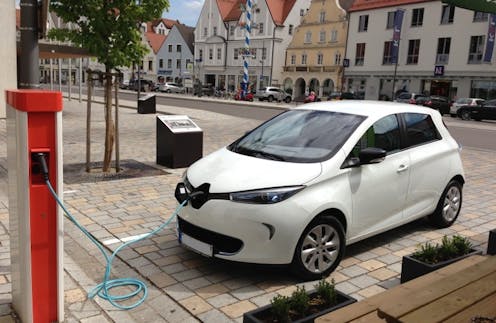
Renault Zoé est actuellement le véhicule électrique le plus vendu au sein de l’Union européenne (15% de parts de marché) et leader en France (avec 70% de parts de marché). Wikimedia Commons, CC BY

Depuis que Tesla a commercialisé son premier véhicule électrique (VE) au milieu des années 2000, plusieurs constructeurs automobiles tels que le Chinois BYD, Renault-Nissan ou BMW se sont positionnés clairement sur ce marché. Les VE promettent d’améliorer la qualité de vie en milieu urbain grâce à la réduction de la pollution de l’air et des nuisances sonores. L’augmentation significative de la part des VE devrait également réduire les émissions de gaz à effet de serre, notamment si l’électricité utilisée pour la recharge des batteries provient de sources décarbonées.

Selon le dernier rapport global sur les VE de l’Agence internationale de l’énergie, en 2016, le chiffre record de 750 000 véhicules électriques vendus a été atteint, dont plus de la moitié en Chine. Le marché des VE devrait continuer sa croissance dans les années à venir et d’ici à 2020, entre 9 et 20 millions de VE sont attendus sur les routes. À noter également qu’en 2016, les infrastructures de stations de recharge publiques ont crû sur un rythme annuel de 72%.

Pour soutenir le développement des VE, plusieurs pays proposent des réductions de prix aux acheteurs. En France, cette aide peut s’élever à 6 000 euros (plus une prime additionnelle de 2 500 euros si un véhicule diesel de plus de 16 ans est mis à la casse). En 2017, près de 31 000 véhicules électriques ont été immatriculés en France. Ce chiffre correspond à une part de marché de 1,2%, ce qui reste bien en dessous du pays champion du VE, la Norvège, où 17% des ventes sont électriques. En Allemagne pour la même période, les ventes sont un peu moindres mais se situent dans une fourchette assez similaire à la France.

En lien avec ces développements, l’édition hiver 2017-2018 du Baromètre du marché de l’énergie de Grenoble École de Management et du Zentrum für Europäische Wirtschaftsforschung (Centre pour la recherche économique européenne) questionne les perceptions des experts du secteur de l’énergie sur le développement du véhicule électrique en France et en Allemagne.

Adaptation majeure des réseaux de distribution

Experts français et allemands s’accordent pour dire qu’aucun changement majeur ne sera requis au niveau de la production d’électricité et du réseau de transport. Selon une grande majorité des spécialistes de notre échantillon français, une part de 10% de véhicules électriques en France d’ici 2025, soit environ 4 millions de voitures, ne nécessite pas de tels changements.

En revanche, les experts des deux pays pensent que si la part des VE atteint 10%, cela nécessitera de larges investissements dans le réseau de distribution, c’est-à-dire au niveau des transformateurs et des câbles dont la puissance devra être augmentée.

À titre d’exemple, recharger un VE pourrait doubler la demande électrique d’un foyer. Les réseaux de distribution existants pourraient ne pas être en mesure de supporter la charge supplémentaire si les véhicules sont chargés en parallèle des usages conventionnels. Les niveaux d’investissements sont incertains mais une étude récente d’Artelys montre que pour la France, la facture pourrait s’élever à 150 millions d’euros par an et ce jusqu’en 2030. À défaut, le système électrique risque de ne pas pouvoir faire face.

Domination des distributeurs d’électricité

Pour réduire le stress que les VE pourraient imposer au réseau d’électricité et aux capacités de production, un pilotage de la charge peut être mis en œuvre afin de recharger les véhicules électriques en dehors des périodes de pointe et lorsque beaucoup d’électricité renouvelable est injectée dans le réseau. Ainsi, le pilotage des batteries et la charge des VE peut apporter un réel service au système électrique et à son équilibrage. Beaucoup d’incertitudes demeurent sur qui pourrait profiter de ce marché émergent, et l’opinion des spécialistes est assez divisée.

Les experts des deux côtés du Rhin s’attendent à ce que les distributeurs d’électricité jouent un rôle important, quitte à développer des nouvelles compétences (sur la gestion des données par exemple). Cependant, ils ont des opinions assez divergentes en ce qui concerne le rôle des constructeurs automobiles, traders (négociants), start-ups, ou fournisseurs historiques d’électricité, et les experts allemands envisagent un rôle plus prononcé pour ces deux derniers.

Ces divergences peuvent refléter des potentiels différents dans chacun des deux pays et sont révélatrices de l’intérêt exprimé par des acteurs très divers pour ce marché porteur.

Des prix élevés et une faible autonomie

Interrogés sur les freins à l’achat de véhicules électriques, les experts se montrent assez pessimistes et voient de nombreuses barrières à surmonter avant que les VE puissent véritablement concurrencer les voitures thermiques. Ils s’accordent autour du besoin d’améliorer considérablement la performance technologique des VE afin de diminuer leur prix et d’augmenter leur autonomie. Environ 38% des Français et 52% des Allemands pensent que les prix d’achats élevés sont une barrière très importante. Actuellement, les coûts d’achat d’un VE sont de 15 à 25% plus élevés que pour un véhicule traditionnel.

Dans un futur proche, l’augmentation des volumes de production de voitures électriques devrait permettre de réduire les coûts, et notamment le prix des batteries. Les constructeurs automobiles eux-mêmes ne manquent pas d’annoncer la sortie de véhicules électriques à bas coût, comme Tesla et son modèle 3 (vendu à partir de 35 000 dollars) ou Renault qui ambitionne de commercialiser une version électrique de la Renault Kwid pour 7 à 8 000 dollars dès 2019 en Chine.

De même, les VE ont des coûts de fonctionnement plus limités tant en carburant qu’en entretien du fait d’une mécanique simplifiée (pas de vidange, pas besoin de changer les bougies, etc.). Cependant, l’autonomie reste limitée à environ 250 kilomètres pour la plupart des modèles (c’est environ le double pour la Tesla Model S). Ainsi, il n’est pas étonnant de constater que 44% des experts français et 64% des experts allemands voient la faible autonomie des VE comme un frein très important.

Le développement des infrastructures de recharge est également souligné. Ainsi, 61% des Français et 47% des Allemands considèrent le manque de stations de recharge comme une barrière importante – et respectivement 29% et 45% comme très importante. Le fait que la France dispose d’un faible taux de densité de station à 0,1 site pour 1 000 voitures immatriculées (comparé à 3 pour le Land de Baden-Württemberg en Allemagne par exemple) peut expliquer ce résultat.

Les temps de charge trop longs sont aussi considérés comme des barrières importantes par 60% des Français et 56% des Allemands. Vraisemblablement, des temps de charge de batteries jusqu’à 12 heures expliquent ces résultats, même si des sites de charge rapide de 30 minutes existent. Cela devrait s’améliorer dans les années à venir. Ainsi, l’Ademe soutient financièrement l’installation de 13 200 bornes de recharges et plusieurs énergéticiens investissent dans le développement de bornes de recharges (EDF, Engie ou Total notamment).

Il est à noter que les spécialistes allemands s’affichent comme plus pessimistes que leurs collègues français, les barrières à la diffusion du véhicule électrique étant plus importantes selon eux. Cela peut refléter une baisse de confiance dans les annonces faites par l’industrie automobile à propos des performances technologiques des véhicules après le scandale Volkswagen.

Interdiction des véhicules thermiques d’ici 25 ans

En présentant le volet mobilité de son « Plan Climat », le ministre de la Transition écologique et solidaire, Nicolas Hulot, a annoncé l’objectif d’arrêter les ventes de véhicules diesel et essence d’ici 2040 en France. D’autres pays, comme la Norvège, les Pays-Bas et le Royaume-Uni ont des plans pour interdire la mise en circulation de véhicules à moteur thermique dans les vingt prochaines années. Ces interdictions faciliteront la réduction de la pollution en ville, où les concentration d’oxydes d’azote (NOx) posent des problèmes de santé publique importants.

Les experts ont pu exprimer leur opinion sur la possibilité d’une interdiction des voitures diesel et à essence dans les 20-25 prochaines années. À ce sujet, spécialistes français et allemands semblent en désaccord. Alors que la majorité des Français (près de 65%) pensent que les véhicules thermiques seront interdits dans certaines villes en France, peu d’Allemands (13%) pensent que ce sera le cas outre-Rhin. Et si cela arrivait, l’interdiction serait mise en place au niveau national et non local. Signalons aussi que 60% des experts allemands ne pensent pas qu’un ban aura lieu ou jugent la question complètement ouverte – contre environ 14% seulement des experts français.

On peut présumer que les résultats pour la France reflètent l’impact de l’annonce faite par la ville de Paris d’interdire les véhicules diesel et à essence. Il est à noter également que plusieurs villes en régions (comme Grenoble, Lille, Lyon ou Toulouse) ont pris des décisions en ce sens en instaurant des restrictions de circulation (certificat Crit’air) lors des pics de pollution.

L’analyse globale des résultats de ce nouveau Baromètre du marché de l’énergie confirme que la route vers un changement de modèle dominant de la mobilité est encore longue. Si quelques signaux sont favorables et encourageants pour une transition bas carbone, l’adaptation du réseau, la compétitivité des offres et l’origine renouvelable de l’électricité resteront trois défis majeurs pour la décennie à venir.


Le Baromètre du marché de l’énergie mené fin 2017 (en novembre pour l’Allemagne, en décembre pour la France) interroge 250 spécialistes français et allemands qualifiés dans le secteur de l’énergie et opérant dans l’industrie, la science et l’administration publique sur les défis de la mobilité électrique (e-mobilité) pour le secteur de l’électricité. L’intégralité de l’étude pour la France est à retrouver ici et pour l’Allemagne ici.

Les datavisualisations de cet article ont été réalisées par Diane Frances.

The Conversation

Nikolas Wölfing is working at ZEW, a research institute which takes funds from third parties for research and consulting work. He moreover received the “EEX Excellence Award”, a research prize of the European Energy Exchange which is awarded for “outstanding research in the field of energy and exchange trading”.

Olivier Cateura a reçu entre 2003 et 2006 des financements publics de l’ANRT (Association Nationale Recherche Technologie) et privés de Electrabel (Engie) dans le cadre d’une Convention CIFRE (Thèse de doctorat) . Par ailleurs, il est membre-auditeur de l’IHEDN (Institut des Hautes Etudes de Défense Nationale).

Anne-Lorène Vernay, Joachim Schleich, Swaroop Rao et Wolfgang Habla ne travaillent pas, ne conseillent pas, ne possèdent pas de parts, ne reçoivent pas de fonds d’une organisation qui pourrait tirer profit de cet article, et n’ont déclaré aucune autre affiliation que leur poste universitaire.

ref. L’avenir des véhicules électriques selon les experts du secteur de l’énergie – https://theconversation.com/lavenir-des-vehicules-electriques-selon-les-experts-du-secteur-de-lenergie-91048

Un étudiant, combien ça coûte ? Des inégalités dans l’enseignement supérieur

Source: – By François Métivier, Géophysicien, Dynamique des fluides géologiques , Institut de physique du globe de Paris (IPGP)

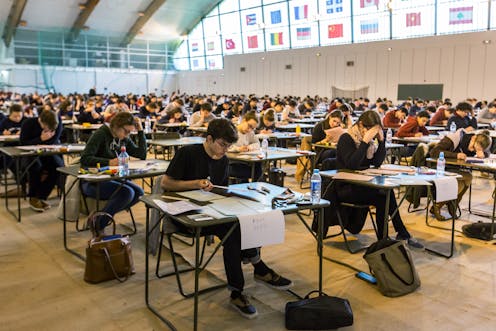
Les épreuves écrites du concours 2016 de l’Ecole polytechnique. © École polytechnique – J.Barande, CC BY-SA

Nous présentons ici une data visualisation tirée de notre travail, Inégalités de traitement des étudiants suivant les filières en France publié en 2015 dans le cadre de Sciences en marche. Les données existantes montrent sans ambiguïté que le financement par l’État des étudiants à l’université est largement inférieur à celui consenti aux élèves des CPGE (classes préparatoires aux grandes écoles) et des écoles d’ingénieurs. Cette analyse confirme les résultats obtenus il y a plus de dix ans par S. Zuber. Il faut de plus mettre ces inégalités de financement en regard des inégalités sociales : près de 50 % des étudiants des filières sélectives sont issus de milieux socialement favorisés et un étudiant issu des milieux favorisés a 20 fois plus de chance d’intégrer une grande école qu’un étudiant issu de milieux populaires. En conclusion, l’État finance bien mieux les études des plus aisés, et les politiques universitaires poursuivies depuis des années n’ont en rien résolu ces inégalités sociales.

Cette infographie repose sur trois sources de données.

  • Pour les universités, le nombre d’étudiants provient des données mises en ligne par le Ministère de l’Enseignement supérieur et de la Recherche (MESR).

  • En ce qui concerne le budget, en l’absence de données disponibles sur le site du MESR, nous avons utilisé les dotations 2014 publiées par l’Étudiant. Nous avons dû chercher sur Internet et pour chaque université son budget consolidé. L’essentiel des données provient des rapports du HCERES. Suivant l’université, l’année pour laquelle nous avons trouvé un chiffre « officiel » varie entre 2011 et 2015 (budgets prévisionnels). Ces budgets varient de façon relativement marginale d’une année sur l’autre. Étant donné que les effectifs étudiants sont en croissance rapide, la dépense par étudiant à l’université est probablement inférieure à ce que nous rapportons. Enfin, la dépense par étudiant calculée ici est une valeur maximale car une part du budget, qui peut être importante pour certaines universités scientifiques, est consacrée au financement d’activités de recherche. Le budget rapporté au nombre d’étudiants des l’université est aujourd’hui très probablement inférieur à ce que nous rapportons.

  • Enfin, pour les écoles, les chiffres proviennent du classement 2013 de l’Usine Nouvelle et représentent un échantillon de 126 écoles d’ingénieurs dans lequel nous n’avons conservé que les écoles de statut public ou possédant un contrat quadriennal ou quinquennal avec l’État.

En conclusion de cette note méthodologique, les chiffres indiqués ne sont donc pas à prendre au pied de la lettre et encore moins à l’euro prêt. La situation de certaines écoles ou universités a pu évoluer, leur place aussi. Ils constituent néanmoins une estimation viable de l’état des dépenses par étudiants dans un ensemble significatif d’établissements du supérieur financés par l’État. Ils traduisent enfin une situation étonnamment stable alors que des réformes profondes de l’enseignement supérieur et de la recherche se succèdent depuis plus de dix ans.

La datavisualisation de cet article a été réalisée par Raphaël da Silva.

The Conversation

Les auteurs ne travaillent pas, ne conseillent pas, ne possèdent pas de parts, ne reçoivent pas de fonds d’une organisation qui pourrait tirer profit de cet article, et n’ont déclaré aucune autre affiliation que leur organisme de recherche.

ref. Un étudiant, combien ça coûte ? Des inégalités dans l’enseignement supérieur – https://theconversation.com/un-etudiant-combien-ca-coute-des-inegalites-dans-lenseignement-superieur-91502

Salaires des sportifs français : le podium des inégalités

Source: – By Pierre Rondeau, Professeur d’économie, Sports Management School

Le média spécialisé L’Équipe, via son magazine hebdomadaire, a publié samedi 24 février le classement des 50 sportifs français les mieux payés (salaires, revenus sponsoring et marketing). Traditionnel top 50 dévoilé tous les ans depuis maintenant une quinzaine d’années, cette hiérarchie permet de dévoiler l’état de l’économie des sportifs hexagonaux et des évolutions structurelles et conjoncturelles.

Que dégagent les investigations de L’Équipe ? Que disent-elles sur le niveau de redistribution et de répartition des rémunérations ? Quels sont les critères qui déterminent le poids des salaires ?

Les sports collectifs sur-représentés

Au total, les 50 sportifs français les mieux payés se partagent 430,2 millions d’euros par an. Le premier est le joueur de football de Manchester United, Paul Pogba, avec 22,2 millions de salaire annuel. Il est suivi par le basketteur Tony Parker, avec 19,7 millions d’euros, puis par l’attaquant de l’équipe de France Antoine Griezmann, à 19,1 millions d’euros.

À noter que les sports collectifs sont sur-représentés puisqu’on ne trouve que deux représentants des sports individuels : le champion de rallye Stéphane Ogier, à la 15e place, émargeant à 9,5 millions d’euros par an, et le double champion olympique de judo Teddy Riner, 37e avec 5,5 millions d’euros.

En théorie, la science économique suppose pourtant que les sports individuels sont plus rentables : on y récompense directement l’utilité de l’agent, alors que dans les sports collectifs, c’est la moyenne des utilités individuelles qui compte (à la fois celles des opportunistes et des agents maximisateurs).

Le sport individuel valorise plus les performances personnelles tandis que dans le sport collectif, les résultats sont basés à la fois sur l’individu et l’équipe, sur le groupe dans son intégralité. Et les rémunérations s’en trouvent alors influencées : un très bon joueur dans une mauvaise équipe n’arrivera jamais à être aussi bien payé qu’un très bon joueur dans un sport individuel, qui ne gagne que grâce à ses performances propres.

Par exemple, en 2015, le classement Forbes des 100 sportifs les mieux payés de l’année avait mis aux deux premières places les boxeurs Floyd Mayweather et Manny Pacquiao, avec respectivement 300 millions et 160 millions de dollars de gains. Le premier représentant des sports collectifs, le footballeur Cristiano Ronaldo, gagnait alors moitié moins que le Philippin Pacquiao, avec 79,6 millions.

Où sont les femmes ?

Au-delà de la comparaison « sport individuel, sport collectif », ce qui interpelle lorsqu’on regarde le classement, c’est l’absence unilatérale de sportives. Aucune femme n’apparaît dans le top 50. D’après L’Équipe, cette absence est malheureusement courante puisque, en 13 ans, la gent féminine n’y a été représentée que 9 fois

Cet état de fait n’est pas propre au cas français. Quand on regarde le classement mondial des sportifs en 2017, sur les 100 premières places, on ne trouve qu’une seule femme, la tenniswoman Serena Williams… à la 51e place (avec 27 millions de dollars engrangés dans l’année).

Comment expliquer cette malheureuse absence ? Comment expliquer cette inégalité sociétale généralisée et internationalisée ?

Le premier élément est économique et médiatique. Sur le marché, le sport féminin ferait, par hypothèse, moins d’argent et moins d’audience que le sport masculin. Résultat : la Ligue de football professionnel française coûte, en droits de retransmission télévisée, 748,5 millions d’euros par an, contre un peu plus d’un million d’euros pour la première division féminine.

Et qui dit moins de valeur économique dit moins de médiatisation, moins de sponsors, moins de partenariats marketing et merchandising. En 2012, 81 % des montants investis par les 100 premiers sponsors concernaient le sport masculin, et seuls 3 % le sport féminin.

Seulement, dans les faits, rien ne justifie ces inégalités économiques. Lorsqu’on se penche sur les audiences télévisuelles, on se rend compte que le sport féminin, notamment le football, fait autant voire plus d’audience que le sport masculin.

Un match de Ligue 1 diffusé sur Canal+ ou beIN Sports enregistre, en moyenne, 1 million de téléspectateurs cumulés contre parfois plus de 2 millions pour des matchs de la Coupe du monde féminine et certains matchs du Championnat de France, en clair.

De plus, d’après une étude publiée par Havas Sports & Entertainment en 2013, 70 % des Français trouvent le sport féminin aussi intéressant que le sport masculin. La différence salariale n’a donc pas lieu d’être.

Tous logés à la même enseigne ?

En étudiant en profondeur le classement, on constate une répartition et une distribution inégalitaire.

Paul Pogba, le sportif le mieux payé, gagne 17,2 millions d’euros de plus que le défenseur du Barça Samuel Umtiti, dernier du top 50, à 5 millions d’euros par an. Le salaire moyen (entre les 50 sportifs) s’affiche à 8,6 millions d’euros alors que la médiane (qui coupe en deux parties égales l’effectif des sportifs) n’est qu’à 6,9 millions d’euros.

En statistiques, on admet que le groupe étudié est inégalitaire lorsque la moyenne n’est pas égale à la médiane. Et si cette dernière est inférieure à la moyenne, les inégalités se situent en haut de l’échelle. Autrement dit, les très très riches gagneraient énormément, et les « moins » riches se partageraient équitablement leurs gains.

En utilisant des outils d’analyse plus pointus, le coefficient de Gini (meilleur indicateur de mesure des inégalités) apparaît à 0,36 contre 0,29 dans le reste de la société française. Dans une situation d’égalité parfaite, cet indice est égal à 0.

La répartition des salaires des 50 sportifs français les plus riches est donc plus inégalitaire que dans la société elle-même. Par comparaison, ce niveau de 0,36 se retrouve dans les sociétés britannique et états-unienne. Même chez les riches, il y a des écarts importants.

Comment expliquer ces rémunérations ?

Reste maintenant à expliquer et à comprendre ces salaires aussi élevés. Au-delà de la question de l’inflation, la hausse des salaires est multifactorielle.

Premièrement, la mondialisation et l’internationalisation du sport ont provoqué une augmentation considérable de la valeur des droits télévisés : 1 milliard d’euros en moyenne dans le foot européen, 2,1 milliards d’euros pour la NBA (le championnat de basket nord-américain), 1,5 milliard pour les Jeux olympiques, etc.

Ensuite, cette inflation des droits a attiré de nouveaux investisseurs étrangers, les « sugar daddies ». Ces derniers, russes, chinois, qataris, émiratis, etc., ont injecté énormément d’argent (d’abord dans un but symbolique avant lucratif) et soutenu les budgets du sport.

Puis, toujours à travers la mondialisation, le nombre de fans a augmenté, ce qui a permis une hausse considérable des recettes. Plus de fans à travers le monde, ce sont plus de ventes de maillots, de goodies, de places, de billets… donc plus d’argent à dépenser et à redistribuer aux acteurs.

D’ailleurs, dans un sens très marxiste, le sportif est à la fois un « bourgeois » et un « prolétaire ». Il est le propriétaire des moyens de production et de sa force de travail. C’est lui, et lui seul, qui crée le spectacle et attire les foules de consommateurs. Il n’y a pas d’intermédiaire ou de donneur d’ordres.

La rémunération se base sur la capacité de production du sportif, dont le salaire correspond parfaitement au fruit des ventes. Ainsi, puisque le salaire est négocié en fonction du niveau réel, ceux qui gagnent le plus présentent une productivité marginale supérieure à la moyenne et, par le jeu de la concurrence, poussent continuellement leur contrat à la hausse.

Karl Marx, père du communisme et de la lutte des classes, justifie ici le niveau des rémunérations des sportifs. C’est parce qu’ils rapportent et qu’ils sont bons qu’ils sont bien payés : « De chacun selon ses moyens, à chacun selon ses besoins. »


Les datavisualisations de cet article ont été réalisées par Diane Frances.

The Conversation

Pierre Rondeau ne travaille pas, ne conseille pas, ne possède pas de parts, ne reçoit pas de fonds d’une organisation qui pourrait tirer profit de cet article, et n’a déclaré aucune autre affiliation que son organisme de recherche.

ref. Salaires des sportifs français : le podium des inégalités – https://theconversation.com/salaires-des-sportifs-francais-le-podium-des-inegalites-92944

La blockchain aux portes de l’entreprise

Source: – By Philippe Dupuy, Professeur Associé au département Gestion, Droit et Finance, Grenoble École de Management (GEM)

La progression forte de la notoriété de ces technologies auprès des responsables financiers devrait leur assurer un avenir radieux. Bergadder/Pixabay, CC BY

Grenoble École de Management et l’association des Directeurs financiers et des contrôleurs de gestion (DFCG) recueillent chaque trimestre l’avis des responsables financiers français. Les résultats sont agrégés au niveau mondial par un réseau d’universités coordonnées par Duke University aux États-Unis. Pour le premier trimestre 2018, l’enquête s’est déroulée du 13 février au 2 mars 2018.


Ce trimestre, nous avons interrogé les entreprises au sujet de l’émergence des nouvelles technologies telles que la blockchain, les contrats intelligents, l’intelligence artificielle ou encore le machine learning. Il est frappant de constater à la lecture des résultats à quel point ces technologies sont désormais connues du plus grand nombre.

Ainsi, grâce à la médiatisation du bitcoin et de ses soubresauts, 84 % des responsables financiers européens nous disent avoir une connaissance au moins partielle de la blockchain sur laquelle s’appuie le protocole de gestion du bitcoin. Il y a exactement deux ans, à cette même question, 57 % des répondants nous disaient n’en avoir jamais entendu parler. De même, les contrats intelligents gagnent du terrain, du moins en notoriété : un directeur financier sur deux serait désormais capable d’en définir les grands principes, contre moins d’un sur trois en 2016. Il y a fort à parier que la diffusion importante des concepts clés de ces technologies permettra leur adoption rapide par les entreprises.

En revanche, les crypto-actifs comme le bitcoin et l’ethereum n’ont pas la côte auprès des responsables financiers : moins de 10 % d’entre eux estiment que ces instruments pourraient avoir un impact éventuel sur leurs activités dans l’avenir. À titre de comparaison, 43 % pensent que l’intelligence artificielle aura un impact sur leur fonction et jusqu’à 66 % pour le big data. La compréhension de ces enjeux et de leurs impacts potentiels semble identique, quelle que soit la taille des entreprises observées. En revanche, le secteur d’activité est un facteur clairement différenciant : les responsables financiers des secteurs du conseil et de la banque semblent en avance sur leurs pairs dans la compréhension de ces mécanismes.

Vers une réduction des effectifs ?

Ces nouvelles technologies devraient bientôt permettre de réduire les coûts de traitement des données, notamment par la réduction des erreurs et la hausse de la productivité. Doit-on s’attendre à une révolution en entreprise ? En Europe, un peu moins de la moitié des entreprises ont déjà réduit ou s’attendent à réduire les effectifs de la fonction finance d’ici à cinq ans. Mais si ces nouvelles technologies pouvaient avoir un impact à moyen terme, c’est essentiellement l’émergence de nouveaux modes de fonctionnement (du type centre de services partagés ou centres d’expertise, par exemple) qui justifie ou a justifié ces réorganisations dans l’immédiat.

Aux États-Unis, le phénomène est comparable – même si ces nouveaux modes d’organisation semblent moins répandus qu’en Europe. Ainsi, moins de 35 % des directeurs administratifs et financiers américains disent bien connaître les centres de services partagés ou centres d’expertise, alors que ce chiffre est supérieur à 50 % en Europe. En conséquence, moins de 30 % des entreprises américaines ont déjà connu ou envisagent des réductions d’effectifs dans la fonction finance.

La blockchain et l’intelligence artificielle n’ont donc pas encore pris le dessus mais sont aux portes des entreprises. La progression forte de la notoriété de ces technologies auprès des responsables financiers devrait leur assurer un avenir radieux et relancer une vague de réorganisation à moyen terme.

Climat des affaires au beau fixe

Notre indicateur de climat des affaires enregistre de nouveaux points hauts ce trimestre en Europe. Il s’établit à 67 au premier trimestre 2018 contre 66,9 au quatrième trimestre 2017 sur une échelle de zéro à cent. Ce niveau est compatible avec une croissance soutenue de l’économie, et ce d’autant plus que l’ensemble des pays pour lesquels nous avons des données dépasse le niveau de 55 – à l’exception de la Grèce. La France et l’Allemagne sont les moteurs principaux de cette performance. L’Hexagone enregistre une nouvelle amélioration qui porte l’indicateur de climat des affaires à 70,1 contre 64,5 au trimestre précédent. Outre-Rhin, le niveau de confiance reste élevé, même s’il s’affiche un recul à 76,8 contre 78,6 précédemment.

Signe d’un climat des affaires très favorable à la croissance, la hausse de la confiance est désormais visible sur l’ensemble des entreprises. En particulier, les entreprises de taille intermédiaire (ETI) et les PME semblent désormais avoir rattrapé leur retard. Le regain d’activité, d’abord enregistré par les plus grandes entreprises portées par la reprise mondiale, se diffuse maintenant dans l’ensemble de l’économie.

Aux États-Unis, la tempête boursière qui a secoué Wall Street début février ne semble pas avoir eu d’incidence sur la confiance des responsables financiers. Le climat des affaires ressort ainsi à 71,2 ce trimestre, contre 68,6 au précédent. L’adoption de la réforme fiscale du président Trump par le Congrès, courant décembre, est le moteur principal de ce regain d’optimisme. En particulier, les entreprises nous disent penser que la réforme aura probablement un impact favorable sur l’emploi, les salaires et les investissements dans les années à venir.

Elle pourrait notamment rendre les États-Unis plus attractifs en termes d’investissements pour les entreprises étrangères. Ainsi, 50 % des entreprises asiatiques percevraient le pays de l’Oncle Sam comme une destination plus attractive pour leurs investissements suite à la réforme fiscale. Enfin, dans le contexte actuel de difficulté à trouver et retenir les talents, 44 % des entreprises américaines envisagent, selon nos données, une augmentation des salaires grâce aux ressources dégagées par la réforme fiscale.

Si le climat des affaires reste élevé partout dans le monde, nous notons néanmoins pour ce trimestre une chute significative en Asie : l’indicateur recule à 61 contre 66,3 au trimestre précédent. Le risque sur les devises est mis en avant par les entreprises interrogées comme un frein à l’activité dans la zone. En Amérique latine, le climat des affaires continue de rebondir pour atteindre 70 au Mexique, 69 au Chili et 62 au Brésil. Ce rebond est frappant puisque ces trois pays ont enregistré des niveaux inférieurs à 50 au cours des deux années précédentes.

Enfin, en Afrique, le climat des affaires enregistre un rebond soudain, entraîné notamment pas l’Afrique du Sud, où la démission du président Zuma semble faire souffler un vent d’optimisme, portant le climat des affaires à 59 contre 42 au trimestre précédent.


L’enquête Duke University–Grenoble École de Management mesure chaque trimestre depuis plus de 20 ans le climat des affaires tel que perçu par les responsables financiers des entreprises à travers le monde. L’enquête est courte (environ 10 questions). Elle recueille plus de 1 000 réponses anonymes d’entreprises de tous secteurs et de toutes tailles. C’est désormais la plus grande enquête de ce type dans le monde. Une analyse détaillée par pays peut être envoyée à chaque participant.

Les datavisualisations de cet article ont été réalisées par Diane Frances.

The Conversation

Philippe Dupuy ne travaille pas, ne conseille pas, ne possède pas de parts, ne reçoit pas de fonds d’une organisation qui pourrait tirer profit de cet article, et n’a déclaré aucune autre affiliation que son organisme de recherche.

ref. La blockchain aux portes de l’entreprise – https://theconversation.com/la-blockchain-aux-portes-de-lentreprise-93405