Massive marine heatwave caused Caribbean coral reefs to collapse much faster than predicted – new research

Source: The Conversation – UK – By Chris Perry, Professor in Tropical Coastal Geoscience, University of Exeter

For decades, coral reefs throughout the Caribbean have been suffering from disease, pollution, overfishing and rising sea temperatures, yet most have continued to grow – until now.

In 2023 and 2024, surface temperatures climbed to record highs in the world’s oceans, and a marine heatwave of unprecedented length and intensity spread across the tropics. Satellites from the US National Oceanic and Atmospheric Administration detected heat stress that could cause corals to bleach across more than 80% of the planet’s reef areas.

During these periods of extreme stress, corals expel the symbiotic algae that give them their colour and most of their food – turning them stark white and leaving them vulnerable to starvation, diseases and eventually death.

Across the North Atlantic, including the Caribbean, the heat stayed for months, with heat stress two-to-three times higher than reefs had ever experienced. Heat stress, the phenomena of high temperatures putting fragile ecosystems under pressure, can permanently alter their ability to function.

This triggered what is now recognised as the fourth global coral bleaching event, the most severe one that has been documented.

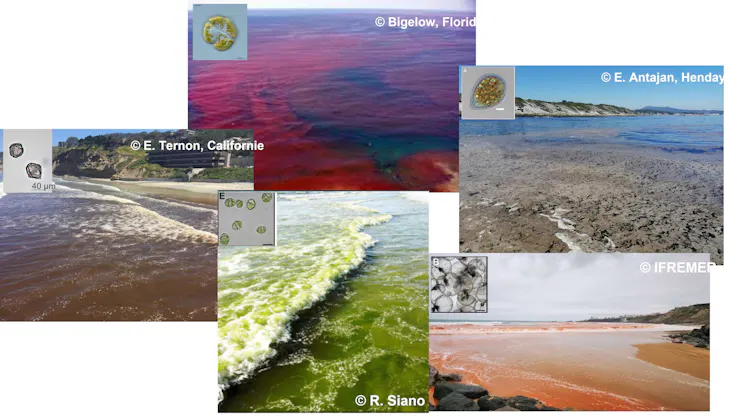
Widespread coral bleaching during the 2023 marine heatwave.

Coral reefs are among the most productive ecosystems on Earth, and their importance to people is fundamental. They feed hundreds of millions through small-scale fisheries, underpin tourism across the Caribbean, and serve as natural breakwaters that protect the coast from storms and reduce flooding events.

Caribbean reefs are eroding fast

In a new study, we found that across the Caribbean, the 2023 marine heatwave – combined with a deadly disease known as stony coral tissue loss disease – has pushed reefs over a threshold scientists thought was a decade or more away. They are now eroding faster than corals can rebuild them.

We studied reefs in the Mexican Caribbean and the Gulf of Mexico, comparing data collected before the heatwave (2018–2022) with surveys after it (2023–24). At each reef, we counted live corals and organisms that break down the reef, like parrotfish and sea urchins. From those counts, we estimated how much reef-building (carbonate production) and reef-breaking (bioerosion) was happening, then calculated the net result – whether the reef was gaining or losing material.

The results were stark: between 70% and 75% of our Caribbean sites had tipped from net growth into net erosion. They are now losing calcium carbonate faster than corals can add it. The threshold that earlier models had suggested might be crossed over during the next decade or so has already arrived.

This shift was driven by the loss of fast‑growing, branching and plate‑forming corals, especially the Acropora species, which have very high growth rates and disproportionately contribute to reef building.

One of our most unsettling findings is that the Caribbean reef sites that still had high coral cover and high carbonate production before the disease and heatwave were the ones that lost the most. Some lost up to 8 kilograms of calcium carbonate per square metre per year.

A tale of two seas

Our survey also revealed a striking contrast. While Caribbean reefs collapsed, reefs in the Gulf of Mexico largely held their ground. The great majority of Gulf sites remained net positive after the heatwave.

The difference comes down to which corals are pre-eminent in each region. In the Gulf of Mexico, reefs are dominated by slow-growing, mound-shaped corals. They grow more slowly, but they are tougher when the heat kicks in. They bleached during the heatwave but mostly survived, keeping the reef’s carbonate budget positive.

This is the balance between the constructing and eroding processes. When more is added than removed, the coral reef can grow. When that balance flips, the reef stops growing and may even erode.

Moreover, sites in the Gulf of Mexico have not yet been affected by stony coral tissue loss disease, which preferentially kills the same massive, long-lived species that are keeping Gulf reefs alive. By the time the heat arrived, large parts of the Caribbean had already lost their most resilient corals because of the disease outbreak. What it started, the heatwave finished.

Why reef erosion matters

All the benefits reefs provide rely on a delicate balance between reef construction and erosion.

Tropical reefs are essentially vast limestone structures, built slowly over centuries as corals deposit calcium carbonate skeletons. At the same time, waves and various reef organisms like parrotfish, sea urchins and boring sponges chip away at them.

An eroding, flattening reef begins to lose its capacity to provide benefits to other species, and people.

We did not expect to be documenting the moment at which a major region of the ocean crossed from growing to eroding. The fact that it happened this quickly, and at some of the most iconic and well-studied reefs in the Caribbean, suggests the timelines scientists have been using may be too optimistic.

Main reef-builders in the Caribbean died as heat stress increased.

Our findings may also force a rethink of how to approach coral restoration. Programmes across the Caribbean have invested heavily in replanting fast-growing branching species of coral, such as Acropora, because they rebuild structural complexity quickly. The 2023–24 heatwave wiped out many of these restored populations, along with wild ones.

Restoration will have to diversify. Exploring approaches such as moving heat-tolerant genes between populations (assisted gene flow) and breeding corals that survive heat better (selective breeding) might be a promising path.

But restoration alone will not be enough. Reversing the decline requires rapid cuts in greenhouse gas emissions to slow the frequency and intensity of marine heatwaves, alongside serious local action on pollution, nutrient runoff, sedimentation and disease – the stressors that weaken corals before the heat arrives.

The Conversation

Chris Perry receives funding from the UK Natural Environment Research Council.

Lorenzo Alvarez-Filip does not work for, consult, own shares in or receive funding from any company or organisation that would benefit from this article, and has disclosed no relevant affiliations beyond their academic appointment.

ref. Massive marine heatwave caused Caribbean coral reefs to collapse much faster than predicted – new research – https://theconversation.com/massive-marine-heatwave-caused-caribbean-coral-reefs-to-collapse-much-faster-than-predicted-new-research-281478

School dinners are changing: the strong emotions and memories around these meals reflect their social, economical and cultural importance

Source: The Conversation – UK – By Heather Ellis, Vice-Chancellor’s Fellow, School of Education, University of Sheffield

The UK government has launched its first review of school food standards in over a decade, alongside plans to extend free school meals to an additional 500,000 children in families receiving universal credit.

Much of the coverage has focused on specific menu changes, including the possible removal of sugary desserts such as steamed sponge. The focus on such changes might be reflective of how school food has never been only about nutrition for those who have experienced it. It is also about welfare, discipline, pleasure, stigma and care.

The School Meals Service: Past, Present – and Future? is a project I worked on that brings together archival research, oral histories and ethnographic work in schools across the UK. We were also the principal academic partner for the Food Museum’s ongoing School Dinners exhibition near Ipswich, which explores the changing history of school meals through objects, menus, memories and tastes – from semolina and sponge pudding to Turkey Twizzlers.

Since school meals were first introduced in legislation in 1906, they have changed repeatedly. Early provision was patchy and often associated with charity. After the 1944 Education Act, school meals became part of the postwar welfare settlement, intended to provide children with a nutritious meal during the school day.

For decades, the classic image of the school dinner was “meat and two veg”, followed by puddings such as sponge, semolina, rice pudding, jam roly-poly or custard.

From the 1980s, the provision of school meals became more fragmented. Nutritional standards were removed, local authorities had more freedom, and commercial catering reshaped menus. Later debates around Turkey Twizzlers and processed food, driven by people like celebrity chef Jamie Oliver, were part of this longer story. Today’s government review of school food standards is another chapter in that history.

What children remember

When people recall school dinners, they rarely talk about calories or guidelines. They remember texture, smell and noise.

Joanne, who attended school in Surrey and East Yorkshire from the late 1960s to 1980, described being served vegetables she could not eat: “Mush. Cold … you can’t have that unless you eat your beans … it put me off for life.”

The dining hall mattered as much as the food. Ella, who went to school in Rotherham from 1996 to 2010, remembered the anxiety of a space where “someone would puke and I would freak out … I can’t be in here”. Lauren, who attended schools in Northumbria and Merseyside from 1998 to 2012, recalled mashed potato that “you could pick up with a fork and it would just stick”.

Stigma, inequality and school food

School meals could also expose inequality. Free school meals have long been a vital safety net, but they have also carried stigma.

Joyce, who went to school in Glasgow in the 1960s, remembered the teacher calling children forward with the phrase “come out the frees”. She described it as “the walk of shame”.

Naomi, who attended school in Birmingham in the 1980s, showed how this could intersect with racism. Her mother paid for school meals despite financial strain because she worried Naomi might be singled out: “there weren’t many Black kids in my school”.

Yet school dinners were also remembered with affection. For many people, puddings such as sponge and custard were the best part of the day. For others they evoke control, compulsion or, like for Joyce and Naomi, embarrassment. That is why the removal of steamed sponge resonates. It is not just dessert. It is part of a shared national memory.

Beyond the menu

The Food Museum exhibition captures this complexity. Visitors encounter the familiar foods, but also the people behind them: pupils, parents, cooks, dinner staff, teachers and policymakers.

The exhibition, which has been shortlisted for a 2026 Museums and Heritage Award, draws directly on our research into how school meals changed over time and why those changes mattered socially, economically and culturally.

Today’s reforms emphasise healthier ingredients, more fruit and vegetables, fewer fried foods and less sugar. These aims matter. History and our research suggests what is served matters. So do the dining hall, the queue, the noise, the payment system, the stigma, the pleasure and the memories children carry into adulthood.

School dinners are one of the most widely shared experiences of British childhood. As they continue to evolve it is worth considering not just what is on the plate, but how it feels to eat it.

The School Dinners Exhibition is on at the Food Museum in Suffolk until February 21 2027

The Conversation

Heather Ellis received ESRC funding for The School Meals Service: Past, Present – and Future? project

ref. School dinners are changing: the strong emotions and memories around these meals reflect their social, economical and cultural importance – https://theconversation.com/school-dinners-are-changing-the-strong-emotions-and-memories-around-these-meals-reflect-their-social-economical-and-cultural-importance-281917

Probiotics: what are we swallowing?

Source: The Conversation – UK – By Berenice Langdon, Senior Lecturer and Honorary Consultant, St George’s, University of London

BearFotos/Shutterstock.com

Standing by the counter at the pharmacist waiting to pick up my prescription, I couldn’t help noticing the prominent display of probiotics on the counter. It was two years ago, and I was reading everything I could find on microbiomes and probiotics – whether in books, journals or in shops – in preparation for writing my book The Microbiome: What Everyone Needs to Know.

For days I had focused just on probiotics and here they were, temptingly in front of me, ready for me to buy. The packaging was so glossy and it’s claims so intriguing, I found myself picking up the box to see what they were saying.

“Supporting gut health.” “Friendly bacteria.”

I was about to get antibiotics for my tonsillitis. Should I get some probiotics? I’d heard they might help replace the “good” gut bacteria that antibiotics can wipe out.

The pharmacist knew me by sight, partly because he had just looked down my throat and prescribed them for me and partly because I’m a local GP. He nodded encouragingly and pointed at the display. “These are very popular,” he said.

I turned the box over. The packaging did best when describing what it contained. Thirty capsules to be taken every day, each containing 5 billion live cultures. I compared it with the others on the shelf. Some contained 2 billion, some 10 billion. One contained 25 billion bacteria per capsule. It was a huge number and a huge dosage range. Were these dosages safe?

It wasn’t so clear on what live cultures were exactly, describing them variously as “trusted” or “friendly”. Higher-dose brands described themselves as “diverse” or “powerful”, sounding more like the boardroom of a Fortune 500 company than a dietary supplement.

When it came to what they did, things became vague. Apparently, probiotics are there to “complement your natural gut bacteria” or alternatively to “complement your everyday life”.

It took a bit of time for the pharmacist to package up my medication and label it, so I carried on and read the small print. Each brand was very confident its ability to survive the stomach acid: they were also confident on the research. “Most researched live culture.” “Highly researched strains.” I had no difficulty in believing this, it was the lack of claims to efficacy that baffled me.

Finally, I found the actual ingredients. Each listed their various combinations of bacteria, some containing up to 15 different sorts, but always including several versions of lactobacilli and bifidobactera.

Lactobacillus acidophilus I knew as a bacteria needed to make yogurt. Bifidobacteria are also often used in the food industry. Both are typical residents of our guts, known to account for about 12% of our usual gut bacteria.

So why do probiotic products all seem to contain the same bacterial species? And why are their claims always so deliberately vague?

Almost one in 20 adults are taking probiotics: typically those of us with higher educational levels, higher incomes and better diets. If we just knew a bit more about microbes, would we still want to take them?

Stomach acid – the great destroyer

It is normal to consume a lot of bacteria on our food. Even with freshly washed or cooked food, on a typical day we consume 1.3 billion bacteria a day either on or in our food.

As soon as our food hits the stomach, our high levels of stomach acid kill or injure almost all the bacteria we consume. Only a few ever reach the colon and those few probiotic bacteria that survive usually only ever stay a few days.

But to swallow a probiotic capsule containing 25 billion, is 20 times the number of bacteria our body is used to handling: a huge microbial load. Even “friendly” probiotic bacteria can cause a serious infection if they get in the wrong place, such as the blood stream. It’s true that most people can manage this huge microbial load fine because of our innate gut defence systems. But probiotics should be avoided by those with weak immune systems, who may be less able to keep these bacteria contained and are at higher risk of them spreading and causing infection.

The reason that out of all the millions of bacteria available in the world, probiotic brands always home in on exactly the same microbes is because these are all bacteria that are known to be safe or used in the food industry since before 1958. If a microbe is officially designated “Generally Recognized As Safe”, then the producer need undertake no further research. And if the producer then sticks to general claims of efficacy – what’s known as a “qualified health claim”, they don’t even have to prove it works.

Generally Recognized as Safe explained.

But even with no efficacy claims at all, the probiotic industry still seems to get its message across – and, as I handled the box of probiotics, I still had a strong feeling that this product was good for me, would make me healthier and that I should buy it.

I held the box uncertainly. “Do you want these as well?” the pharmacist asked.
I checked the price: £17.99 for 30 probiotic capsules (low dose) for something I already had inside me from eating ordinary food. I decided to stick to the antibiotic prescription only, for £9.90.

So, do probiotics work? I have learned to equivocate when asked this, because people who ask me – usually enthusiastically and with a smile – are invested in the concept of probiotics and have often already been taking them. To avoid upsetting people I now usually say: “Well, they probably haven’t done you any harm.” Apart from the cost.

The Conversation

Berenice Langdon is the author of: The microbiome: What Everyone Needs to Know, published by Oxford University Press.

ref. Probiotics: what are we swallowing? – https://theconversation.com/probiotics-what-are-we-swallowing-280999

Vent de panique sur l’indépendance des banques centrales avec la nomination de Kevin Warsh et la succession de Christine Lagarde

Source: The Conversation – in French – By Camila Villard Duran, Associate Professor of Law, ESSCA School of Management

La nomination de Kevin Warsh à la tête de la Réserve fédérale (Fed), considéré comme la « marionnette » de Donald Trump, interroge sur l’indépendance de la banque centrale états-unienne. Or, le dollar états-unien représente environ 57 % des réserves de change mondiales. En Europe, la succession de Christine Lagarde en 2027 ouvre la boîte de Pandore à la redéfinition de l’orientation de la politique monétaire et le profil du futur président.


Pendant les dernières décennies, l’autonomie des banques centrales s’est imposée comme un principe structurant de la gouvernance macroéconomique. L’argument était simple : soustraire la gestion de la monnaie aux pressions électorales devait permettre de maîtriser l’inflation et soutenir une croissance plus stable.

Ce modèle, apparu en réponse aux crises inflationnistes des années 1970 et 1980, s’est progressivement transformé en norme institutionnelle, acceptée par tous. En protégeant la banque centrale des pressions politiques de court terme, ce que l’on appelle l’incohérence temporelle, elle vise à garantir la crédibilité de la politique monétaire, à assurer la stabilité des prix et à éviter des décisions opportunistes susceptibles de fragiliser l’économie à long terme.

Dans un contexte de cycles politiques instables, garantir aux banques centrales le dernier mot relatif aux taux d’intérêt, à la régulation financière et à la supervision bancaire demeure essentiel. Ce principe est par exemple strict dans le cas de la Banque Centrale européenne (BCE), dont l’indépendance est juridiquement protégée.

Aux États-Unis, cette fragilité institutionnelle se manifeste par des pressions politiques directes de l’exécutif sur la politique monétaire et la gouvernance de la Fed – une situation qui contraste avec le cadre plus juridiquement verrouillé de la BCE. Car les banques centrales font face à un paradoxe : être à la fois protégées et réactives, détachées des contingences politiques quotidiennes, tout en étant attentives aux effets distributifs, au débat démocratique et aux dynamiques géopolitiques.

Calendriers électoraux aux États-Unis

Aux États-Unis, la position de la Réserve fédérale (Fed) est regardée de près. Le dollar états-unien représente environ 57 % des réserves de change mondiales. Toute remise en cause de la gouvernance de la Fed a de facto des répercussions mondiales. Les décisions de taux influencent directement le rendement des actifs libellés en dollars détenus par un large éventail d’acteurs, publics comme privés.

Durant le second mandat de Donald Trump, les pressions publiques sont devenues récurrentes. Le président a affirmé que les États-Unis devraient avoir « les taux d’intérêt les plus bas du monde ». La situation a pris une dimension nouvelle lorsque des poursuites pénales ont été engagées contre le président de la Fed Jerome Powell. Le contexte politique a été interprété comme révélateur d’une pression accrue sur l’autonomie opérationnelle de la Fed.

« Marionnette du président »

Jerome Powell n’est que le deuxième membre de la Réserve fédérale que Trump a cherché à révoquer de ses fonctions. Une controverse, portée devant la Cour suprême, mettait en lumière une tentative de révocation de Lisa Cook, la première femme afro-américaine à siéger au conseil des gouverneurs de la Fed. La question de savoir si une telle révocation pouvait intervenir for cause (c’est-à-dire, pour motif valable), puisque le Federal Reserve Act touche au cœur même de l’architecture institutionnelle de la Fed.


À lire aussi :
Les pressions de Donald Trump sur la Fed annoncent-elles la fin du dollar ?


Les mandats longs et échelonnés ont précisément été conçus pour éviter la synchronisation entre cycles monétaires et calendriers électoraux. Affaiblir la protection contre la révocation reviendrait à redéfinir l’équilibre des pouvoirs entre l’exécutif et l’autorité monétaire.

L’épisode rappelle la décision Humphrey’s Executor v. United States en 1935, qui avait consolidé la position des agences indépendantes en limitant la révocation présidentielle.

Lors de son audition, Kevin Warsh a cherché à rassurer les sénateurs en affirmant qu’il ne serait pas « la marionnette du président » et qu’il n’avait pris aucun engagement en faveur d’une baisse des taux, tout en reconnaissant que l’indépendance monétaire « dépend avant tout de la Fed » elle-même – une formulation qui souligne le caractère désormais contingent de cette indépendance.

La BCE, modèle le plus abouti d’indépendance

Dans le cas de la Banque centrale européenne (BCE), les débats autour de la succession de Christine Lagarde en 2027 illustrent la tension persistante entre technocratie monétaire et légitimité politique. Ils révèlent des lignes de fracture entre États membres, tant sur le profil du futur président que sur l’orientation de la politique monétaire en termes d’inflation, de souveraineté ou de transition climatique.

La BCE représente pourtant le modèle institutionnel le plus abouti en matière d’indépendance. L’article 130 du Traité sur le fonctionnement de l’Union européenne interdit explicitement à toute institution européenne, à tout gouvernement ou à tout autre organisme de chercher à influencer ses décisions. Contrairement à la Fed, dont l’indépendance repose sur une loi ordinaire – le Federal Reserve Act, que le Congrès peut en théorie modifier –, celle de la BCE est consacrée par un traité international, dont la révision requiert l’accord unanime de l’ensemble des États membres.

Contrairement au modèle états-unien, la nomination à la tête de la BCE implique le Conseil européen, sur recommandation du Conseil de l’Union européenne et après consultation du Parlement européen et du Conseil des gouverneurs de la Banque centrale européenne. Ce mécanisme expose néanmoins la fonction de président de la BCE à des arbitrages politiques entre États membres, où les considérations de nationalité, d’équilibre géographique et de sensibilité économique jouent un rôle déterminant.

Préserver l’État de droit

Les formules institutionnelles héritées de la fin du XXᵉ siècle semblent ne plus suffire.

L’enseignement est clair : l’autonomie des banques centrales n’est jamais autoentretenue. Elle subsiste tant que les règles juridiques, les institutions politiques et l’opinion publique la soutiennent activement. Dans un monde où la monnaie est devenue un actif stratégique et où les réseaux financiers peuvent être instrumentalisés, préserver une capacité de décision techniquement fondée revient aussi à préserver la démocratie et l’État de droit.

The Conversation

Camila Villard Duran ne travaille pas, ne conseille pas, ne possède pas de parts, ne reçoit pas de fonds d’une organisation qui pourrait tirer profit de cet article, et n’a déclaré aucune autre affiliation que son organisme de recherche.

ref. Vent de panique sur l’indépendance des banques centrales avec la nomination de Kevin Warsh et la succession de Christine Lagarde – https://theconversation.com/vent-de-panique-sur-lindependance-des-banques-centrales-avec-la-nomination-de-kevin-warsh-et-la-succession-de-christine-lagarde-277030

L’engagement sociétal local des marques suscite une consommation socialement et localement plus responsable

Source: The Conversation – in French – By Yolande Piris, Professeure des Universités, Université Bretagne Sud (UBS)

Les marques qui s’ancrent dans leur territoire ne font pas seulement du bien à la communauté : elles renforcent aussi leur relation avec les consommateurs. Mais attention, tout dépend de la manière dont cet engagement est perçu.


Les Français sont non seulement concernés par l’engagement des marques dans des causes sociétales mais ils ont également compris que c’est par leur choix de consommation, et grâce aux marques, qu’ils peuvent eux aussi agir. Ainsi, l’étude menée par BVA Xsight, montre que 75 % des Français sont sensibles à l’engagement des marques dans des causes sociétales. Mais 39 % d’entre eux pensent que l’offre de biens et de services est insuffisante pour leur permettre d’adopter un comportement responsable. L’acte d’achat n’est plus seulement la volonté de satisfaire un besoin de consommation. Il peut aussi traduire la volonté d’agir plus largement pour une cause sociétale.

Face à des consommateurs de plus en plus sensibles aux enjeux sociétaux, les entreprises multiplient les initiatives et notamment les initiatives locales : soutien à des associations, partenariats avec des acteurs régionaux, mise en avant du patrimoine culturel. La consommation d’une offre locale n’est donc pas seulement recherchée pour l’offre elle-même, mais également pour les retombées qu’elle peut susciter sur la communauté qui compose le territoire local.

Des atouts nombreux

Le caractère local d’une marque est souvent associé par les consommateurs à des enjeux sociétaux. Notamment, la marque locale porte la promesse d’une consommation qui minimise les transports polluants, contribuant ainsi à garantir un mode de vie plus durable et plus sain au sein de la communauté locale. La consommation de produits de marques locales permet également de maintenir ou créer des emplois locaux qui offrent de plus l’avantage d’être plus respectueux des droits des salariés comparativement aux emplois localisés dans des pays disposant d’une législation du travail peu développée.

Notre recherche montre que l’engagement sociétal local d’une marque conduit ses consommateurs à se sentir davantage capable d’influencer positivement le bien-être au sein de leur communauté locale grâce à leur consommation. Nous montrons que c’est l’attachement des consommateurs envers la marque engagée localement qui explique cet effet positif. En outre, une marque est incitée à pérenniser son engagement local parce que ce dernier améliore la fidélité d’achat des clients.


À lire aussi :
Quand les imaginaires des marques nous inspirent


Deux formes d’engagement

L’engagement sociétal local des marques peut prendre deux formes. Tout d’abord, les marques peuvent jouer sur « l’iconicité » culturelle locale : la marque incarne les aspirations et les valeurs de la population, en opposition à l’uniformisation des marques mondiales. Ainsi, le chipsier français Brets, par exemple, joue sur l’iconicité de la Bretagne en mobilisant la figure de la Bigoudène ou la thématique de la mer avec un slogan comme « C’est à babord qu’on CHIPS le plus fort ».

Ensuite, la marque peut adopter un comportement prosocial en agissant directement pour le bien-être de la communauté, par exemple en soutenant des associations locales ou en favorisant des pratiques durables. Metro, par exemple, prône un développement local en collaborant avec plus de 1 300 producteurs et en soutenant plus de 80 000 emplois. L’entreprise contribue à un écosystème vertueux où l’ensemble des acteurs bénéficie d’une dynamique collective positive. Elle contribue aussi à faire revivre des filières agricoles locales, encourage l’agriculture responsable et accompagne les professionnels dans leur transition durable. L’entreprise tente ainsi de démontrer qu’une stratégie économique peut pleinement intégrer les enjeux locaux pour soutenir des valeurs sociales et environnementales.

Engagement local et attachement du consommateur

L’attachement peut se définir comme la force du lien chargé d’émotions entre un consommateur et une marque. Il résulte du jugement de l’authenticité et de la congruence d’une marque par le consommateur lorsque ce jugement se fonde sur sa perception de l’engagement local de la marque. La perception des bénéfices sociétaux procurés par la marque, rendus plus tangibles par leur proximité géographique, conduit le consommateur à associer cette marque à un idéal : celui d’une culture locale valorisée et ou d’un engagement responsable attendu.

En conséquence, la marque est jugée plus bienveillante, plus honnête, plus crédible et porteuse de sens, c’est-à-dire plus authentique. De plus, la volonté de la marque de procurer à la communauté locale des bénéfices sociétaux est de nature à amener le consommateur à ressentir une similarité avec elle, c’est-à-dire une congruence entre l’identité de la marque et sa propre représentation de lui-même. Les consommateurs s’attachent aux marques qui leur apparaissent congruentes et ou authentiques parce qu’elles contribuent à renforcer la représentation de leur citoyenneté locale et à améliorer leur estime personnelle.

Une consommation plus vertueuse ?

L’attachement du consommateur envers une marque qui s’engage localement le conduit à s’identifier à elle et à s’approprier son projet sociétal en faveur de la communauté locale. Il tend alors à adopter une attitude cohérente à l’égard de ses choix de consommation socialement et localement responsable. L’association de l’attachement envers une marque engagée localement et de l’attachement envers une communauté locale renforce l’identité prosociale locale du consommateur.

Elle motive le consommateur à adopter un comportement cohérent avec cette identité, et cela d’autant plus que ce comportement lui procure un sentiment d’élévation morale. La marque qui s’engage localement peut donc poursuivre un objectif de performance sociétale qui consiste à susciter auprès du consommateur un comportement socialement et localement responsable.

Puissant levier

Nous mesurons la performance sociétale de l’engagement local d’une marque par son effet positif sur la croyance des consommateurs que leur consommation contribue positivement au bien-être au sein de leur communauté locale. La performance commerciale de l’engagement local de la marque se rapporte quant à elle à la fidélité d’achat que cet engagement peut susciter auprès des clients. Notre recherche montre que « l’iconicité » culturelle locale et le comportement prosocial local de la marque conduisent de façon équivalente à ces deux types de performance.

Plus précisément, « l’iconicité » culturelle locale constitue un levier puissant. Lorsqu’une marque est perçue comme emblématique de la culture locale, elle suscite un attachement fort chez les consommateurs. Cet attachement renforce à la fois la pertinence perçue de la consommation locale et la fidélité à la marque. Ce lien peut même se créer sans que les consommateurs évaluent explicitement l’authenticité ou la cohérence de la marque : le simple fait qu’elle incarne une identité culturelle locale peut suffire.

Des actions crédibles

Le comportement prosocial local, qui correspond au fait d’agir volontairement pour aider, soutenir ou améliorer la vie de sa communauté proche (son quartier, sa ville ou son territoire), lui, doit être crédible. Les actions vertueuses, comme le soutien à des causes ou les partenariats locaux, n’ont d’effet positif que si elles sont perçues comme authentiques et alignées avec les valeurs des consommateurs. Sans cette crédibilité, elles ne génèrent, ni attachement ni fidélité ni pertinence perçue de la consommation locale. Autrement dit, le prosocial « déclaré » ne suffit pas, il doit être prouvé.


À lire aussi :
Au cœur des villes, la consommation locale n’atteint pas toujours le cœur de la clientèle


Les consommateurs semblent moins sceptiques face à « l’iconicité » culturelle, qui repose sur des éléments visibles et vérifiables (origine, savoir-faire, terroir). À l’inverse, les comportements prosociaux sont plus facilement mis en doute s’ils paraissent opportunistes ou déconnectés des valeurs de la marque. Ce constat souligne un risque que l’on pourrait appeler la « RSE_washing » lorsque les promesses ne sont pas suivies d’actes tangibles.

Motivations profondes

Finalement, les entreprises peuvent mobiliser la communauté locale pour donner du sens à leur marque mais en respectant quelques conseils. Tout d’abord, rendre visibles les motivations profondes de la marque. Cela peut, par exemple, passer par des collaborations avec des acteurs locaux crédibles (associations, collectivités) pour renforcer l’authenticité. Il est également nécessaire de prouver l’alignement des valeurs. Cela peut se faire via différentes actions : formaliser la mission, publier des indicateurs, faire auditer les engagements, etc. Enfin, il semble pertinent de cultiver l’iconicité culturelle de la marque : raconter son histoire, valoriser le savoir-faire, célébrer les traditions locales, etc.

La Bretagne, qui a servi de terrain d’analyse, comporte de nombreux exemples. On pense notamment à la marque Hénaff qui s’associe à des projets régionaux pour la biodiversité. La marque de café Lobodis adopte le statut de société à mission pour afficher ses valeurs. La Trinitaine et Traou Mad s’appuient quant à elles sur le patrimoine culinaire breton pour nourrir l’attachement des consommateurs.

Finalement, l’engagement local n’est pas qu’une question d’image. Bien conçu, il crée un cercle vertueux : bien-être communautaire, attachement émotionnel, fidélité commerciale. Mais, pour y parvenir, les marques doivent prouver qu’elles sont authentiques, cohérentes ou profondément iconiques !

The Conversation

Les auteurs ne travaillent pas, ne conseillent pas, ne possèdent pas de parts, ne reçoivent pas de fonds d’une organisation qui pourrait tirer profit de cet article, et n’ont déclaré aucune autre affiliation que leur organisme de recherche.

ref. L’engagement sociétal local des marques suscite une consommation socialement et localement plus responsable – https://theconversation.com/lengagement-societal-local-des-marques-suscite-une-consommation-socialement-et-localement-plus-responsable-272952

Mozambique’s economy is failing: the tough policy choices that need to be made urgently

Source: The Conversation – Africa – By Sam Jones, Senior Research Fellow, World Institute for Development Economics Research (UNU-WIDER), United Nations University

Mozambique is not in total crisis – but it is faltering. There has been no currency crash, no hyperinflation, no bank run. But over the past decade the main indicators of the country’s economic health have severely eroded.

An IMF assessment in early 2026 was remarkably blunt: public debt is unsustainably high, the external balance of payments is weak, and policy makers have limited options. Since then, tensions in the Middle East have further disrupted supply chains and dramatically raised global fuel prices. This is a major shock for small import-dependent economies, like Mozambique.

My analysis draws on over two decades of experience supporting economic research and policy analysis in the country. Currently, my work under the Inclusive Growth in Mozambique programme involves tracking the country’s economic performance through surveys of firms, students, and households.

The picture that emerges from this evidence is troubling. For ordinary Mozambicans, the deterioration in conditions over the past decade shows up in higher poverty, unreliable public services and a labour market that offers few decent opportunities – especially for the young.

My central argument is that muddling through is not a safe option. Without careful adjustments now and a deliberate shift toward growth and job creation outside extractives – the part of the economy that actually employs most Mozambicans – today’s pressures will keep building until a large economic correction becomes unavoidable and under far worse conditions.

A slow squeeze

The country’s present condition is one of vulnerable stagnation. Since the hidden debt crisis of 2016, real GDP growth outside the extractive sector has hovered around 2%, barely matching population growth. In per capita terms, the non-extractive economy has flatlined for a decade. Average real incomes outside mining and gas (or the public sector) have gone essentially nowhere.

Fiscal deficits of 4%-6% of GDP have been financed increasingly by domestic banks. But as both the IMF and World Bank have warned, that model is now reaching a breaking point. Banks can only absorb so much government debt before they run out of willingness – or capacity – to lend. When that happens, the government faces a choice between defaulting, printing money, or slashing spending abruptly. None is painless.

Evidence of these pressures is plain to see. Over a year ago, the global rating agency S&P classified local-currency debt as “selective default”. This is a formal determination that the government had failed to meet its obligations to domestic creditors on the original terms, even if it continued paying.

By late 2025, arrears had extended to short-term treasury bills – government IOUs that mature within months and are supposed to be the safest instruments in the domestic financial system. When a government struggles to repay even these, it signals serious fiscal distress.

On top of this, a decade of crisis management has displaced any serious thinking about growth. The government’s wage bill and debt service dominate spending, leaving chronic underinvestment in infrastructure, education, and agriculture. Schools and health facilities lack supplies, roads deteriorate, and social protection has weakened sharply.

Payments under the basic social subsidy programme have become highly irregular. Many elderly beneficiaries receive only a fraction of what they are owed. Poverty has increased, with around two thirds of the population now below the poverty line.

Demographic pressures are intensifying. Mozambique needs to absorb roughly 500,000 new labour market entrants annually by 2030, yet the formal sector generates a small fraction of new jobs. Informal work dominates and without a step-change in growth, it will only expand. Each year of stagnation adds another youth cohort to an already strained labour market. Delay does not preserve stability – it makes eventual adjustment larger and more costly.

The exchange rate question

The metical has been held stable against the US dollar since 2021, but in real terms it has appreciated by over 20%, eroding export competitiveness. Foreign exchange shortages are now pervasive. The parallel market premium reached around 14% by late 2025. Firms report severe and lengthening delays in accessing foreign exchange through formal channels.

The policy response has been administrative: raising exporter surrender requirements, tightening banks’ foreign exchange position limits, restricting overseas card usage. These measures treat symptoms, but the underlying misalignment only deepens.

The overvalued exchange rate functions as a tax on the non-resource economy. Recent fuel shortages and panic buying – driven in part by importers’ inability to secure foreign exchange and price uncertainty – provide a visible demonstration of the mounting costs.

The politics of adjustment

In practice, public sector employment has come to serve as a form of social protection for the urban middle class. Our research shows roughly half of all university graduates find employment in the public sector, and having a public sector job is one of the best predictors of not being poor.

The public sector wage bill underpins political legitimacy, which is why attempts to cut discretionary 13th-month salary payments were quickly reversed once key workers threatened to strike.

Exchange rate adjustment poses a parallel dilemma. A depreciation would raise the cost of imported food and fuel, hitting urban households directly, and any price increase would spark calls to hike minimum wages. With the memory of popular violence from the 2024 elections still fresh, there is a strong bias toward the status quo.

But as pressures mount, there is a growing risk of compounding distortions. So far the temptation has been to respond with new administrative controls, including import restrictions, tighter capital controls, and preferential credit allocation.

The ongoing handling of the fuel price shock illustrates the pattern. Rather than adjust pump prices promptly, the government has held prices fixed, leaving distributors to manage a mounting shortfall through supply rationing.

Each temporary fix may ease immediate pressures, but tends to deepen the underlying misalignment, push activity into informal channels, and narrow future options.

Feasible pathways

Path 1: Muddle through and wait for the gas. This is the current trajectory. Fiscal adjustment occurs passively, driven by financing constraints rather than strategy. The hope is that LNG revenues could materialise from the early 2030s. Mozambique’s Rovuma Basin holds an estimated 100 trillion cubic feet of recoverable natural gas – among the largest discoveries globally in the past two decades. But only one offshore platform (Coral South) is currently producing. Even if the 2030 timeline holds, continued stagnation would further erode public services, weaken institutions, and deepen social frustration – and another general election must be managed. By the time resource revenues arrive, the state may lack the capacity and public trust to deploy them effectively.

Path 2: Gradual, growth-first adjustment. The most economically coherent path, though politically demanding. The central premise: restoring non-extractive growth must take priority, even at the cost of short-term macroeconomic discomfort. Key elements would include:

  • a phased depreciation of the metical to restore competitiveness, supported by clear communication and strengthened social protection

  • acceptance of temporarily higher inflation, with policy focused on preventing second-round effects rather than suppressing the initial price shift

  • a fiscal framework centred on spending quality and revenue efficiency

  • wage bill containment through hiring restraint, attrition, and systematic payroll audits to eliminate ghost workers and improper payments

  • re-engagement with external partners under a credible IMF programme framework; and

  • an evidence-based and financially viable medium-term growth strategy targeting agricultural productivity, labour-intensive exports and a predictable regulatory and macroeconomic environment.

Path 3: Forced correction. If external shocks bite deeper, a large adjustment may be imposed suddenly – involving disorderly exchange rate movement, abrupt fiscal contraction, and potential banking sector stress. The longer gradual adjustment is postponed, the higher this probability.

The narrow path

There is no easy option. Every adjustment has visible losers, while the benefits remain uncertain, delayed, and diffuse.

But one priority stands out: boosting growth beyond extractive sectors. Without it, fiscal consolidation is self-defeating, job creation will remain grossly inadequate, and social pressures will only intensify. Stabilisation pursued in isolation, or at the expense of growth, could be bad medicine.

This growth strategy must be grounded in data, evidence and honest debate. Mozambique has not lacked for projects or initiatives, but it has lacked consistent use of rigorous data to identify what drives productivity and job creation.

The window for a controlled, policy-driven adjustment is narrowing fast. The alternative is not stability. It is adjustment under far worse conditions, at higher cost.

The Conversation

Sam Jones does not work for, consult, own shares in or receive funding from any company or organisation that would benefit from this article, and has disclosed no relevant affiliations beyond their academic appointment.

ref. Mozambique’s economy is failing: the tough policy choices that need to be made urgently – https://theconversation.com/mozambiques-economy-is-failing-the-tough-policy-choices-that-need-to-be-made-urgently-281679

What Ghana’s foreign-built landmarks tell us about its global relationships

Source: The Conversation – Africa (2) – By Irene Appeaning Addo, Associate Professor of African Architecture, University of Ghana

The call to prayer echoes across the neighbourhood as people congregate under the sweeping domes and tall minarets of Ghana’s National Mosque in Accra. For many, it is a place of faith, community and national pride. Yet, few pause to consider that this landmark – now firmly part of Accra’s skyline – was funded and built by Turkey.

This detail points to a bigger story. Some of Ghana’s most important public buildings are shaped by global relationships as much as local needs. And those relationships are not just economic; they are deeply political.

Therefore buildings are not just functional. They are powerful expressions of political power, used to describe and project ideas about hierarchy, state authority, solidarity and modernity.

As a result, architecture can be used to explore the identity and ideology of African states and international partners who choose to finance or donate new buildings to Africa featuring western architectural aesthetics.

I am a scholar of African architecture. I collaborated with scholars from different areas of expertise, including political scientists, on a project that studied the connection between architecture and power in Africa. From Ghana, two projects were used to illustrate international relations in architecture, highlighting the interplay of power and agency. One was the National Mosque and the other was the seat of Ghana’s government, Jubilee House, an edifice funded by the government of India.

Ghana and India’s ties can be traced to their co-founding of the Non-Aligned Movement. These were a group of states not formally aligned with major power blocs during the cold war. Ghana and Turkey’s relationship goes as far back as 1957. Turkey is one of the leading investors in Ghana’s economy.

Our work established that when a country finances and constructs a major building abroad, it leaves a visible and lasting imprint on another nation’s landscape. The building becomes part of everyday life while reflecting the influence of its external sponsor. These buildings normalise the presence of the sponsoring nation and are a constant reminder of its political interests.


Read more:
Ghana and India: Narendra Modi’s visit rekindles historical ties


History written in buildings

Foreigners have been shaping Ghana’s built environment for centuries, from colonial forts along the coast to post-independence modernist projects designed by international architects.

Ghana’s architecture tells a layered story of power and exchange. During the colonial era, Europeans constructed forts and castles that dominated coastal landscapes. These were not just military structures; they were symbols of control and gateways to global trade networks, including the transatlantic slave trade. Sections of these buildings were later repurposed as schools, embedding education within spaces marked by violence and coercion.

This dual legacy highlights how architecture can carry multiple, often conflicting meanings over time.

After independence, Ghana sought to project a new national identity through modern architecture.

Foreign architects were commissioned to design housing, universities and civic buildings that would signal progress and global relevance. This moment reflected both aspiration and dependence: a desire to appear modern on the world stage, combined with reliance on external expertise and resources.

‘Soft power’

Today, Ghana continues to engage with global partners through architecture and infrastructure development. The National Mosque is one example. Backed by Turkey with the active involvement of Ghanaian Muslims, it represents both religious solidarity and diplomatic outreach underpinned by local agency.

Its scale, design and prominence make it a visible marker of Turkey’s presence in Ghana. The National Mosque Complex is modelled after the Ottoman-era Sultan Ahmed Mosque in Istanbul, Turkey. The national mosque in Accra features domes, semi-domes and arcaded porticos. These are the characteristics of Ottoman architecture, a predominant classical style for mosques in Turkey and the Islamic world.

Another example of political “gift” is Jubilee House, the seat of government. While financed and constructed with support from India, it incorporates the form of the Akan stool, a deeply significant symbol of authority in Ghanaian culture. This blending of external funding with local agency and symbolism shows that these projects are not simply imposed. They are shaped through negotiation.

Across the continent, similar patterns can be seen. China has funded major government buildings, including the African Union headquarters in Addis Ababa and the Zimbabwe parliamentary complex. These projects are often described as “gifts”, but they also reflect strategic relationships and long-term influence. Political scientist Innocent Batsani-Ncube has illustrated how China’s large-scale investment in the Zimbabwe parliament is used as a proxy for its sustained activities in and around African parliamentary institutions.

Ghana’s case

It is easy to view foreign-funded infrastructure as purely beneficial, especially given Ghana’s development needs. But architecture is never neutral. Buildings embody power relationships in terms of the scale, materiality, the architectural features and the location in urban areas.

They reflect who has the resources to design, finance and construct, and whose ideas are ultimately realised in physical form. A mosque, a parliament or a presidential palace is not just a functional space; it is a statement about identity, legitimacy and global belonging of both the sponsor and the recipient country. In this sense, architecture becomes part of diplomacy. It is a way of making relationships visible – and durable.

Describing these projects simply as soft power, however, does not capture the full picture. Soft power theory often assumes that influence flows smoothly from powerful countries to less powerful ones.

Ghana’s experience suggests something more complex. Buildings cannot simply be “exported” like films or fashion. They are rooted in specific places, histories and communities. This creates friction.

For example, Ghana’s engagement with foreign-built projects often involves negotiation over design, symbolism and use. Local government officials, religious leaders and communities play a role in shaping outcomes.

In the case of the National Mosque, Ghanaian Muslim communities were not passive recipients. Their advocacy and social influence were crucial to the project’s realisation. Similarly, the incorporation of the Akan stool in Jubilee House reflects an effort to assert cultural identity. These examples show that foreign influence is most often mediated by local contexts.

Ghanaian actors’ agency in these processes has limits, however. Many decisions about large-scale projects are made by political elites. As a result, the interests reflected in these buildings may not represent the broader population.

These examples point to broader questions. Do foreign-funded buildings contribute to long-term development, or are they primarily symbolic? How can Ghana ensure that such projects reflect local priorities and needs? And what does it mean to build a national identity in a world shaped by global partnerships?

The links among soft power, public and cultural diplomacy, and development across the continent will continue to be subjects of research.

International relations scholars Joanne Tomkinson and Julia Gallagher contributed to the research that this article is derived from.

The Conversation

Julia Gallagher received funding from European Research Council

Lloyd G. Adu Amoah and Mjiba Frehiwot do not work for, consult, own shares in or receive funding from any company or organisation that would benefit from this article, and have disclosed no relevant affiliations beyond their academic appointment.

ref. What Ghana’s foreign-built landmarks tell us about its global relationships – https://theconversation.com/what-ghanas-foreign-built-landmarks-tell-us-about-its-global-relationships-279603

Mali attacks: Tuareg grievances hold the key to peace

Source: The Conversation – Africa (2) – By Olayinka Ajala, Associate professor in Politics and International Relations, Leeds Beckett University

The precarious security situation in Mali took a turn for the worse in late April 2026. Well coordinated attacks targeted several cities and claimed the lives of the defence minister, Sadio Camara, and several Malian soldiers.

The events are a culmination of increased attacks over the past few years on the military and state institutions in Mali.

We have been researching insecurity and politics in west Africa and the Sahel for over a decade. We believe the recent attacks trace back to grievances expressed by Tuaregs that the current military regime has not addressed. The Tuaregs are nomadic Berber communities in northern Mali.

First is the inability or unwillingness to address Tuareg discontent. Their grievances centre on political autonomy, marginalisation, cultural recognition, resource control, security and perceived state neglect.

Second, the continuous use of force by the military against rebels in the northern regions without regard for the collateral damage. The Tuaregs have long contested the militarisation policies of successive Malian governments.

Third, the uneven distribution of resources, which keeps the northern region marginalised. These include northern Mali’s resources such as gold deposits, salt mines, grazing lands, and strategic trade corridors. Revenues from these sources remain controlled by the state’s centre based in the south.

Addressing resource marginalisation could have a number of benefits. It could temper Tuareg grievances, restore trust in the Malian state, and shift conflict incentives away from rebellion towards political inclusion, stability, and sustainable peace in northern Mali.

The breakdown

In April 2026 the jihadist group Jama’at Nusrat al-Islam wal-Muslimin (JNIM) joined forces with ethnic Tuareg rebels from the northern Azawad Liberation Front (FLA) to attack several cities in the country recently.

This mirrors a similar attack in 2012 when the Tuareg and al-Qaeda-affiliated militants launched an offensive against the state. The Tuareg-dominated National Movement for the Liberation of Azawad (MNLA) attempted to secede and initiated a rebellion.

The MNLA is a Tuareg‑dominated separatist movement. Founded in 2011, it is mainly composed of ex-Libyan war returnees and northern Malian Tuaregs. The organisation had about 10,000 fighters at its peak in 2012.

Despite their numbers, they lacked the military power to hold the territory. As a result they aligned with Islamists Ansar Dine, al-Qaeda in the Islamic Maghreb (AQIM), and the Movement for Unity and Jihad in West Africa (MUJAO). Shortly after pushing back Malian forces in late 2012, the alliance disintegrated.

The Islamist groups were better armed and funded. They forced the secular separatists out of major towns like Gao, Timbuktu and Kidal. The intervention of French forces in 2013 helped the Malian government regain most of the lost territories.

AQIM and its allies then moved into the mountains and surrounding desert areas. They shifted to guerrilla tactics, including suicide bombings and landmines.

The withdrawal of French forces in 2022 seems to have emboldened the Islamist militants. It removed counter‑terrorism pressure, disrupted intelligence and logistics and created a security vacuum amid weak Malian state capacity. This allowed Islamist groups to expand operations, recruit locally and regain territorial influence.

Lessons unlearnt

The largely popular military regime of Assimi Goita has failed to address the demands of Tuareg separatists. The Tuaregs have historically complained about exclusion from power by the southern dominated Malian state. Since the country’s independence in 1960, Tuareg leaders have argued that the structure of the Malian state does not reflect their political identity, economic interests and governance traditions. The demand for self-rule or autonomy has been suppressed, often by force.

More recently, increased drought, desertification and climate variability has devastated Tuareg pastoral livelihoods. These grievances pre-date Islamic insurgency and are fundamental in understanding the approach of the group.

The second unaddressed issue is that counterterrorism operations use force which creates collateral damage. Recent analysis shows that counterterrorism operations in northern and central Mali have resulted in large scale civilian harm, displacement and collective punishments. These have included arbitrary arrests and mass killings.

These factors have created conditions which Islamist groups have exploited for recruitment, territorial control and legitimacy.

The blame for this has been put on successive Malian regimes and previous French operations. This has been a key reason for France’s interventions being labelled as failures.

The third major driver of violence in Mali relates to the uneven distribution of resources. Since independence, public investment, infrastructure, social services and political attention have been heavily concentrated in the southern parts of the country.

Previous peace agreements have promised decentralisation, funding and integration of northern elites and ex-combatants. But implementation have been slow or nonexistent.

Is there a way forward?

The Tuareg question must be answered to reduce the tension between the regions of the country. It can be argued that Tuareg actors have twice miscalculated by entering arrangements with jihadist groups. But this does not diminish the need to address the structural inequalities and long-standing grievances underpinning Tuareg demands.

To achieve this, the Malian regime can copy the blueprint of former president Mahamadou Issoufou of Niger. Prior to his presidency, the Nigerien Tuaregs were similarly aggrieved. When he became president in 2011, he:

  • integrated Tuareg elites and former rebels into state institutions

  • decentralised state authority by allowing administrative and budgetary control at the regional level

  • introduced disarmament, demobilisation and reintegration programmes.

Issoufou also invested in infrastructural development in the areas that directly affected the Tuaregs. This included pastoralism, education and livelihood support. Water access in arid pastoral areas was improved. And connectivity and road safety was expanded.

Addressing the Tuareg agitations would reduce tensions in Mali.

The Conversation

The authors do not work for, consult, own shares in or receive funding from any company or organisation that would benefit from this article, and have disclosed no relevant affiliations beyond their academic appointment.

ref. Mali attacks: Tuareg grievances hold the key to peace – https://theconversation.com/mali-attacks-tuareg-grievances-hold-the-key-to-peace-281832

Voici comment l’éducation physique au Québec est devenue une matière essentielle à l’école

Source: The Conversation – in French – By Florent Lefèvre, Stagiaire postdoctoral en histoire du sport, Université du Québec à Montréal (UQAM)

Longtemps laissés à l’initiative de la famille et des communautés, le sport et les loisirs au Québec ont connu une structuration progressive. À partir du XXe siècle, leur encadrement se transforme sous l’effet d’acteurs religieux, puis étatiques. Cette évolution contribue à faire de l’éducation physique un domaine central dans la formation des individus.


Les Québécois ont toujours manifesté un fort intérêt pour les activités sportives et les loisirs, qu’ils pratiquent individuellement ou en groupe. Dès le XIXe siècle, certains passionnés ont entrepris de structurer ces activités, mais de façon inégale selon les milieux et les périodes.

C’est toutefois dans les années 1960 que le monde du sport et des loisirs connaît une véritable première révolution. La Révolution tranquille soulève alors une question fondamentale : qui doit organiser le sport et les loisirs au Québec ? La famille, l’Église, l’État ou les associations sportives ?

En moins d’une décennie, l’Église se retire progressivement de la conception, de la planification et de l’organisation du sport, des loisirs et, plus largement, de l’éducation. Ce retrait ouvre la voie à de nouveaux acteurs : les écoles, les institutions sportives, les organisations privées, les universités, les municipalités et le gouvernement. Le sport, les loisirs et, en particulier, l’éducation physique ont progressivement pris une place centrale dans la vie et le développement des individus. Pourtant, cette reconnaissance ne s’est pas faite sans heurts.

Les fondements historiques

Malgré l’importance sociale du sport et des pratiques corporelles, l’histoire de l’éducation physique au Québec demeure encore relativement peu étudiée en sciences humaines et sociales. Quelques chercheurs ont toutefois posé des jalons importants. L’historien Donald Guay et le sociologue Roger Boileau ont notamment retracé l’évolution du sport et de l’éducation physique entre le 19e et le XXe siècle.

Guay met en lumière plusieurs courants qui ont façonné les conceptions du corps et de l’éducation physique au fil du temps : l’agriculturisme, le militarisme, l’hygiénisme, l’humanisme et le scientisme. De son côté, Boileau souligne notamment le rôle central qu’a longtemps joué l’Église dans l’organisation du sport au Québec.


À lire aussi :
Les JO de Montréal 1976, un laboratoire qui a transformé le Québec bien au-delà des stades et des podiums


L’émergence d’une culture physique et corporelle pédagogique

Entre les années 1930 et 1950, l’éducation physique au Québec repose principalement sur deux modèles. En milieu rural domine l’agriculturisme, qui valorise l’effort utile et le travail du corps. En milieu urbain, c’est plutôt le militarisme scolaire qui s’impose, mettant l’accent sur la discipline, la posture et la préparation physique. Dans les deux cas, l’objectif est surtout de former des corps robustes et utiles à la société, davantage que de favoriser le développement global de la personne.

À cette époque, plusieurs organisations jouent aussi un rôle important dans l’animation du sport, des loisirs et de la culture physique. C’est notamment le cas des « patros » — les ancêtres des centres communautaires — et des OTJ (Œuvres de Terrains de Jeux), deux structures largement liées aux milieux religieux.

Toutefois, un troisième courant apparaît : celui d’une éducation physique plus pédagogique. Cette approche est portée par des éducateurs qui défendent une vision plus globale de la formation corporelle. L’éducation physique n’y est plus seulement un entraînement du corps, mais une composante de l’éducation intégrale de la personne — physique, intellectuelle et morale.

Pour concrétiser cette vision, les années 1930 voient ainsi apparaître les premières écoles privées d’éducation physique au Québec, dont l’objectif est de former un personnel spécialisé capable d’enseigner selon une véritable approche pédagogique comme l’institut de Cécile Grenier en 1938 ou l’institut d’Yvan Coutu à la fin des années 1940.

Ces institutions s’appuient à la fois sur l’expertise d’éducateurs formés dans les écoles normales du Québec ou en Europe. Leur création témoigne d’une volonté claire : professionnaliser le domaine et lui donner une légitimité. Entre 1930 et 1950, ce courant demeure toutefois porté par une poignée d’éducateurs engagés. Ces figures clés incarnent la transition entre l’ancien modèle militariste et une éducation physique plus moderne, centrée sur l’élève. Leur action, encore marginale, pose néanmoins les bases de la discipline.

Certaines institutions jouent aussi un rôle moteur dans cette transformation. C’est notamment le cas de la Palestre nationale — la plus ancienne institution sportive canadienne-française — et, à partir de 1951, du Centre Immaculée-Conception dirigé par le père Marcel de la Sablonnière.

Mais les enseignants d’éducation physique ne peuvent porter seuls cette responsabilité. Les parents, les entraîneurs et les clubs sportifs ont également un rôle à jouer. Le défi consiste alors à développer une véritable « mentalité sportive » chez les Canadiens français.

Révolution tranquille et redéfinition du rôle de l’État

Au cours de la Révolution tranquille, le temps de loisir prend une nouvelle signification. Il n’est plus seulement associé à des valeurs religieuses ou morales : il acquiert une dimension humaine et sociale. Peu à peu, le loisir est perçu comme un droit pour les citoyens.

La commission Parent amorce une réforme majeure du système scolaire avec la création, en 1964, du ministère de l’Éducation, ouvrant ainsi un espace institutionnel pour l’éducation physique. Dans la foulée, le rapport Bélisle et la création du Haut-Commissariat à la Jeunesse, aux Loisirs et aux Sports en 1968 confirment l’intervention croissante de l’État. Le leadership religieux de l’Église cède alors progressivement la place à une gouvernance publique et technocratique.

Parallèlement, les associations professionnelles en éducation physique commencent à se structurer. Des regroupements de diplômés cherchent à améliorer la formation, à diffuser les connaissances scientifiques et à faire reconnaître leur profession. L’Association des diplômés en éducation physique et récréation, fondée à Montréal en 1960, figure parmi les premiers organismes du genre. Dans la région de Québec, les éducateurs physiques se regroupent également au sein d’un chapitre francophone de l’Association canadienne d’hygiène, d’éducation physique et de récréation.

Ces organisations insistent notamment sur une distinction importante : le sport n’est pas éducatif en soi. Il le devient lorsqu’il est encadré par une approche pédagogique.


Déjà des milliers d’abonnés à l’infolettre de La Conversation. Et vous ? Abonnez-vous gratuitement à notre infolettre pour mieux comprendre les grands enjeux contemporains.


Comment les universités ont répondu à l’appel de la professionnalisation

Dans les années 1960, la formation des éducateurs physiques au Québec connaît une période charnière. Alors que la discipline souhaite être reconnue comme un pilier de l’éducation et du développement de l’individu, les universités s’organisent pour répondre à cette demande croissante.

Plusieurs établissements jouent un rôle pionnier, notamment McGill, Sir George Williams (aujourd’hui Concordia), Laval, Montréal et Sherbrooke, qui mettent en place des programmes d’éducation physique dès les années 1940 à 1960. Ces institutions contribuent à former les futurs cadres du domaine et à structurer une expertise professionnelle encore émergente.

McGill abrite le plus ancien programme d’éducation physique du Canada. Par ailleurs, l’Université d’Ottawa, bien que située hors Québec, exerce une influence importante en formant de nombreux spécialistes francophones dès la fin des années 1940. À partir de 1969, le réseau de l’Université du Québec vient élargir cette offre de formation, notamment à Montréal et à Trois-Rivières.


À lire aussi :
Des échecs à la victoire : la longue marche de Montréal vers les Jeux olympiques


Comprendre l’enjeu d’un projet éducatif

Aujourd’hui, alors que les sociétés occidentales font face à de nouveaux défis liés à la sédentarité, à la santé publique et à la place du sport dans les politiques éducatives, les débats entourant l’éducation physique au Québec demeurent traversés par des tensions héritées de son histoire. Relire cette trajectoire historique permet dès lors de mieux comprendre les enjeux actuels et d’éclairer les choix qui façonnent l’avenir de l’éducation physique au Québec.


Nous souhaitons remercier Jean-Claude Drapeau et Roger Boileau pour la relecture et les commentaires pour le texte.

La Conversation Canada

Tegwen Gadais a reçu des financements de la part du ministère de l’éducation du Québec. Il est le co-titulaire de la chaire UNESCO sur le sport pour le développement, la paix et l’environnement.

Florent Lefèvre ne travaille pas, ne conseille pas, ne possède pas de parts, ne reçoit pas de fonds d’une organisation qui pourrait tirer profit de cet article, et n’a déclaré aucune autre affiliation que son organisme de recherche.

ref. Voici comment l’éducation physique au Québec est devenue une matière essentielle à l’école – https://theconversation.com/voici-comment-leducation-physique-au-quebec-est-devenue-une-matiere-essentielle-a-lecole-276712

Les jeunes désertent les activités de plein air. Et si le jeu libre les ramenait dehors ?

Source: The Conversation – in French – By Mariève Blanchet, Professeure en sciences de l’activité physique et en développement moteur, Université du Québec à Montréal (UQAM)

Les bienfaits du plein air chez les jeunes ne font plus débat : développement moteur, cognitif, social et émotionnel, en plus d’amplifier les effets de l’activité physique. Pourtant, ils passent peu de temps dehors. Ce « déficit nature » est devenu un enjeu de santé publique. Quels facteurs expliquent ce décrochage, et comment les y ramener ?


Afin de mieux comprendre le phénomène et de tester des solutions, nous avons sondé 465 parents. Nos résultats confirment des tendances déjà observées dans la littérature scientifique, au Canada comme ailleurs. La participation aux activités de plein air diminue avec l’âge et cette baisse est plus marquée chez les filles. À l’échelle mondiale, 81 % des adolescents de 11 à 17 ans sont considérés comme physiquement inactifs ; les filles le sont davantage que les garçons, avec un écart pouvant atteindre 15 % selon les pays.

Le statut socioéconomique joue aussi un rôle : les jeunes issus de familles à faible revenu participent moins aux sports pratiqués à l’extérieur et ont moins d’intérêt à aller dehors. Ces familles ont de plus, un accès réduit aux activités en plein air à cause du transport vers les infrastructures de plein air, ou même à cause des coûts liés aux activités.

Lorsqu’un enfant présente des difficultés telles que des troubles d’apprentissage ou de motricité, le même constat est observé. Cette baisse de participation pourrait être un résultat d’une faible perception de leurs propres compétences, des préoccupations de sécurité menant à la surprotection, des contraintes d’aménagement urbain et d’accessibilité ainsi que de l’augmentation du temps d’écran.

Notre étude soutient ces observations, en démontrant que l’intérêt à faire des activités de plein air et des activités sportives dehors est réduit chez les jeunes dont la famille a un faible statut socio-économique et chez les jeunes ayant des difficultés. Des interactions démontrent même que l’effet de ces facteurs peut être cumulé. Ainsi, la tendance à s’auto-exclure en raison de leurs défis fonctionnels dans les activités est aggravée quand le revenu familial est faible.


À lire aussi :
Nature et mouvement : un duo essentiel pour la santé mentale des jeunes


La surprise : la créativité résiste

Le résultat le plus intéressant de notre étude concerne la créativité dans les activités de plein air, qui inclut le jeu dans la cour de la résidence familiale, dans la ruelle ou en milieu naturel. En plus de la participation globale, notre questionnaire distingue trois dimensions de la participation, établies à partir d’analyses factorielles exploratoires et confirmatoires.

1 — intérêt général pour jouer dehors ;

2 — participation aux sports libres ou organisés ;

3 — créativité dans la participation aux activités de plein air.

Contrairement aux deux autres dimensions, le score de créativité n’est pas affecté par le genre, le statut diagnostique et le revenu familial. Elle représente une porte d’entrée potentiellement plus inclusive et plus motivante vers les diverses activités pratiquées à l’extérieur.

Ce constat ouvre une piste d’intervention concrète, en lien avec l’approche « DYSactivation » développée dans notre laboratoire. Plutôt que de miser uniquement sur des activités sportives structurées, cette approche propose un gradient modulable d’activités. Celui-ci va du jeu libre — initié et défini par l’enfant, avec des accessoires ne faisant pas référence à un sport ou à une tâche motrice prédéfinie — jusqu’à des jeux ou sports organisés par l’adulte. Dans ce cadre, les activités structurées par l’adulte cherchent à soutenir les besoins psychologiques fondamentaux des jeunes, par exemple en favorisant la coopération et/ou en leur laissant une part de choix dans l’activité.

Des enfants jouent
Dans un environnement EnJeuLab au Centre national de cyclisme de Bromont, les enfants s’engagent dans des situations de jeu libre favorisant l’exploration et la créativité. Ils construisent et transforment leur environnement selon leurs idées.
(Laboratoire de recherche en motricité de l’enfant, EnJeuLab), CC BY

Cette approche a de plus été utilisée dans nos espaces En Mouvement du réseau EnJeuLab, comme celui de Bromont. Nous avons construit à partir de données probantes et de nos résultats de recherche, des espaces publics novateurs qui repensent la manière dont les jeunes jouent, incluant la conception d’accessoires de jeu, l’aménagement et les infrastructures afin de poursuivre nos recherches. Ces espaces permettent de mieux rejoindre les jeunes qui décrochent habituellement en y proposant des environnements inclusifs où la créativité et la bonne perception de leurs compétences motrices et physiques occupent une place centrale.

Contrairement aux parcs traditionnels, qui peuvent favoriser un abandon prématuré et une exclusion selon le niveau des habiletés motrices des enfants, les espaces EnJeuLab proposent un environnement extérieur vivant, composé de matériaux variés, naturels ou recyclés.

Les enfants et les adolescents peuvent y concevoir, déconstruire et reconstruire librement des objets ou des structures — comme des voitures, des cabanes ou des parcours — seuls ou en coopération avec d’autres jeunes. Ces créations ne sont pas définies à l’avance et peuvent prendre des formes que seuls les participants comprennent.

Leur imagination et leur autonomie guident leurs actions. Plusieurs jeunes inventent même de nouveaux jeux avec les accessoires. Et s’ils ne souhaitent pas construire, l’espace reste entièrement ouvert à leurs envies : courir, grimper, se cacher, ramper ou simplement explorer. Divers niveaux de difficultés et de prises de risque sont disponibles dans l’espace, de même que des zones calmes et plus isolées selon leurs besoins. Ce type d’environnement permet aux jeunes de s’approprier pleinement leur jeu, à leur manière.

Lorsque l’enfant choisit de transporter une bûche à travers un vaste espace de jeu, composé de terrains accidentés et de matériaux variés, ses habiletés motrices, physiques et cardiovasculaires sont sollicitées. Les choix de parcours peuvent inclure des inclinaisons et des déclinaisons, ainsi que le déplacement d’objets vers des structures de bois, par exemple pour les déposer dans un filet.

Ce type d’environnement permet aux jeunes d’être actifs à leur manière.


À lire aussi :
Les neurosciences permettent de comprendre ce que la nature provoque dans notre cerveau


Déjà des milliers d’abonnés à l’infolettre de La Conversation. Et vous ? Abonnez-vous gratuitement à notre infolettre pour mieux comprendre les grands enjeux contemporains.


L’expérience passée et la confiance parentale

Deux autres facteurs se sont révélés déterminants. D’abord, l’expérience antérieure : plus un enfant a été exposé à une diversité de contextes de plein air (activités de loisirs organisées en forêt, pédagogie en plein air, camp de plein air, camping en famille), plus sa participation est élevée.

Ensuite, lorsque les parents ont un sentiment de sécurité face aux activités extérieures de leurs enfants, celui-ci participe davantage. De plus, ces deux facteurs augmentent significativement la dimension de la créativité de leur enfant.

Ces résultats suggèrent que l’accompagnement parental est un levier sous-estimé. Former et rassurer les parents sur les activités de plein air, tout en diversifiant les contextes d’exposition dès le plus jeune âge, pourrait avoir un effet durable sur la participation, avec des bénéfices pour le développement et la santé des enfants.

Centre national de cyclisme de Bromont
Des jeux dans un environnement EnJeuLab au Centre national de cyclisme de Bromont.
(Laboratoire de recherche en motricité de l’enfant, EnJeuLab), CC BY

Repenser l’offre pour les jeunes

Un dernier constat mérite attention : la créativité en plein air, bien que résiliente face au genre, aux difficultés et au revenu, diminue elle aussi avec l’âge. Ce déclin s’explique en partie par l’offre de services disponible : à mesure que les jeunes grandissent, les activités proposées deviennent très structurées et laissent peu de place à l’imaginaire et au jeu libre. Pourtant, les recherches montrent que même à l’adolescence, le jeu continue d’alimenter la créativité.

Repenser l’offre d’activités pour les préadolescents et les adolescents en y réintroduisant des espaces adaptés pour leur groupe d’âge où l’on crée des activités physiques, sportives et de loisir, pourrait contribuer à freiner le désengagement et à réduire le taux de sédentarité alarmant.

La Conversation Canada

Mariève Blanchet a reçu des financements de la Fondation canadienne pour l’innovation, du conseil de recherche en sciences humaines, du fond nouvelles frontières en recherche et du fond de recherche en santé du Québec


Valentin TOP ne travaille pas, ne conseille pas, ne possède pas de parts, ne reçoit pas de fonds d’une organisation qui pourrait tirer profit de cet article, et n’a déclaré aucune autre affiliation que son organisme de recherche.

ref. Les jeunes désertent les activités de plein air. Et si le jeu libre les ramenait dehors ? – https://theconversation.com/les-jeunes-desertent-les-activites-de-plein-air-et-si-le-jeu-libre-les-ramenait-dehors-278833