The government has announced that consultation will begin on a new vocational qualification for England: V-levels.
These are intended to replace a number of existing technical routes currently available to post-16 learners, and make it possible for students to combine academic and vocational courses. V-levels will, the government claims, streamline the options available to students and offer a clearer pathway to both higher education and the workplace.
Few would disagree that the vocational sector in England needs a shake-up. But is the new qualification really the solution the government promises?
V-levels are planned to begin in September 2027 as part of a gradual four-year rollout. Each V-level will equate to 360 guided learning hours, the same as one A-level. Possible subjects may include arts, craft and design, music and music performance, education and early years, legal services, and travel and tourism.
The equivalence with A-levels means that students should be able choose to take several V-levels in different subjects. They could even mix and match them with A-level subjects, rather than having to make a choice between an academic and a vocational route.
This contrasts with other vocational options available to young people after their GCSEs such as apprenticeships and T-levels, the latter of which are equivalent to three A-levels but focus on a single, specifically technical, subject.
In theory, students can currently mix A-levels with another type of work-related qualification, the BTEC, but in practice this option isn’t widely available. It is envisaged that the new V-levels will replace BTECs, which will be gradually de-funded.
The new qualifications are proposed as part of the government’s recent policy document on post-16 education and skills. They form part of Prime Minister Keir Starmer’s plans for two thirds of young people to either go to university or achieve a technical qualification by simplifying the “confusing” and “fragmented” landscape currently faced by 16-year-olds and their families.
If successful, the shift in focus away from Tony Blair’s aspirations for 50% of young people to go to university could be a significant step in promoting parity between academic and vocational pathways.
If students will indeed be able to mix A-levels and V-levels, the new initiative represents a significant step towards breaking down the perceived divide between academic and vocational qualifications. But this will only hold true if students are able and willing to combine them in the way the government suggests.
However, V-levels will involve more non-examination assessment than A-levels. This may mean that students continue to see A-levels as a more prestigious accreditation.
There is also the risk that some higher education institutions may not consider a V-level the same standard as an A-level when assessing entry requirements. Their smaller size may even mean that V-levels are seen as having less status than the BTECs they replace.
Many of the proposed V-level subjects are already available as a single-subject BTEC, but the new qualification will mean less commitment to choosing a specialist area at a young age.
In theory, young people might therefore be able to choose a V-level in, say, criminology alongside A-levels in subjects such as law and sociology. In practice, it remains to be seen how easy it will be for schools to offer such flexibility to their students.
Students wishing to specialise will be left with one option: a T-level in a single subject. The consultation papers state these have demonstrated a “strong performance” since their introduction in 2020, although this has been contested in some quarters.
While the de-funding of BTECs appears to reduce the options available, the government promises T-levels will “continue to grow”, with proposed new subjects including sports science, care services, music technology and performing arts. However, some of these will require the development of the appropriate occupational standards – a description of an occupation set by Skills England – first.
The proposals have been described as a “big step forward” in their ambition for “a more joined-up system” by the Association of Colleges. Others, including the Sixth Form Colleges Association, have sounded a note of caution over the “significant qualification gap that will open up when BTECs are scrapped”.
The intentions behind the new proposals seem positive. Previous vocational offerings after GCSEs have assumed students are ready to specialise at 16. The size of the qualifications available have made it difficult for students to combine academic and vocational qualifications in the way imagined here.
Elizabeth Gregory does not work for, consult, own shares in or receive funding from any company or organisation that would benefit from this article, and has disclosed no relevant affiliations beyond their academic appointment.
Source: The Conversation – UK – By Morgane Dujmovic, Chargée de recherche CNRS, Géographe et politiste spécialiste des frontières et migrations, Centre national de la recherche scientifique (CNRS)
This is the third part of our series drawing on a year of research conducted on board the Ocean Viking, the civilian search-and-rescue ship operated in the central Mediterranean by the NGO SOS Méditerranée. It explores the perspectives of exiled people based on testimonies from 110 survivors who were picked up while attempting the crossing from North Africa, as well as crew members’ experiences and the researcher’s creative collaborations on board the ship.
Catch up on parts one and two, or explore an immersive French-language version of the series here.
‘The worst decision of my life’
The dangers of Libya are generally discovered only when people on the move enter that country with hopes of finding decent work and a better life. One survivor told me while they were on board the Ocean Viking (OV): “On my very first day in Tripoli, I realised I had made the worst decision of my life.”
Few people manage to transit through Libya in less than a month. As Koné explained when we met in Ancona, on the Adriatic coast of Italy: “In Libya, it’s not easy to get in, but it’s even harder to get out!”
Most of those we met on the OV (57.9%) had spent between one and six months in Libya. But some had been trapped there for over two years – and for one Sudanese participant, up to seven years in total.
Different migration routes and configurations emerged from the survey, with the longest forced stays in Libya mainly affecting people from the poorest and most war-torn countries.
Another significant finding was that women experienced longer periods of detention in Libya – those we met had spent an average of 15½ months there, compared with 8½ months for men. This reflects the mechanisms of coercion and violence that specifically affect women migrating through the Mediterranean, as was powerfully described by Camille Schmoll in her 2024 book, The Wretched of the Sea.
When maps tell stories of exile, with Morgane Dujmovic. French-language video by The Conversation France, 2025.
Mohamad’s experience of Libya
Under the conditions in Libya described to us, the decision to take to the sea despite the risks of a Mediterranean crossing could be summed up like this: better the risk of dying now than the certainty of a slow death.
On his map, Mohamad illustrated this well, depicting the cumulative violence he had encountered along the Libyan coast from east to west: captivity in Tobruk by a “human trafficker”, imprisonment and theft in Benghazi, racism and xenophobia in Ajdabiya, and mistreatment in Zuwara – where he finally managed to flee by sea.
Mohamad’s illustration shows, from right to left, the chain of events that led him from imprisonment to the boat:
Libyan experience #2: ‘Seven months’ by Mohamad. Translation: Amine Boudani & Rafik Arfaoui.
Mohamad. Fourni par l’auteur
To take to the sea, however, first one must gather a considerable sum of money. Participants mentioned borrowing from their families – US$2,000, $6,000, even $10,000 – to buy a place on a boat. This place was also sometimes obtained after doing forced labour in prison conditions, or in exchange for promising to be the person who steered the boat.
When attempts to cross the sea are thwarted by interceptions followed by forced returns to Libya, the original sum must be paid again. As one participant explained: “They scammed me first for US$2,000, then $3,000, and the third time I paid $5,000.”
Drawing of a ‘game house’ where people who have paid for their crossing wait for the signal to depart. Alisha Vaya/SOS Méditerranée, Fourni par l’auteur
Some participants also described their living conditions in so-called “game houses” – the buildings where people who had paid for their crossing wait for the signal to depart. These stays can last from several days to several weeks, with varying amounts of supplies and conditions depending on the network and the sum that has been paid to get there.
However, everyone shared the same realisation upon their first attempt to cross: the boats were unfit for navigation and dangerously overcrowded. But as Koné explained, at that stage it was generally too late to turn back:
We started from a beach near Tripoli at 4am. They made us run into the water: ‘Go, go!’ It was too late to change our minds.
The moment of rescue
Departures from Libyan beaches often happen at night, meaning it’s only in the morning that the vastness of the sea becomes visible. The on-board survey helped reveal how people on boats in distress often feel a sense of disorientation at the moment of rescue. One participant mentioned “the simple joy of having found something in the water”, when recalling his first impression of the Ocean Viking appearing on the horizon.
Others described how their perceptions were distorted by the navigation conditions, or the distressed nature of the boats they had travelled in. A Bangladeshi man who had boarded in the hold of a wooden boat recalled:
I was inside the boat; I couldn’t see or hear anything. I didn’t believe it was a rescue until I came out and saw it with my own eyes.
Charlie, the SAR team leader who coordinated that rescue, recalled his shock upon discovering 68 people aboard a vessel built for 20: “As we transferred them on to our RHIBs [rigid-hulled inflatable boats], more people kept coming out from under the deck, hidden.”
Jérôme, the deputy search-and-rescue coordinator on board the OV, confirmed the case of an “extremely overcrowded” boat, as was highlighted by the final rescue report: “They were really overcrowded! The alert had reported 55 people on board, but we actually found 68 because some were hidden under the deck.”
Wooden boat in distress, as seen by a rescued person (from the collective mapping project on the OV). Morgane Dujmovic, Fourni par l’auteur
A distressed boat adrift
Drawing on the questionnaire, cartographic workshops, and targeted interviews, I attempted to reconstruct this rescue with both the rescued individuals and members of the crew.
In the OV’s bridge, using the monitoring screen as support, we retraced the positions of the boat in distress throughout its search. That morning, the alert had been given by Alarm Phone, a citizen hotline operating continuously from both shores of the Mediterranean to relay and monitor cases of boats in distress. Jérôme recalled the moment when the decision to launch the search-and-rescue operation was made:
We got a position at 6.19am. We tried calling Tripoli several times, no answer. We said: ‘We’re going anyway, we’re very worried.’ We sent the official email saying we were going.
In our reconstruction, the OV headed for the reported position in international waters off the Libyan city of Zuwara. Shortly after, our radios set to the watch channel crackled: “We generally wake everyone up when we’re within ten miles, because that’s the distance at which we can spot them with binoculars. And at 6am, the first light of dawn appears”. The search for the boat in distress, however, soon became complicated:
With the first data – the boat’s departure point and second position – we had an idea of their speed: we thought they were going five knots. So we thought we’d find them at this next position. But once we arrived, we started tearing our eyes out – they weren’t there!
Reconstruction of a maritime distress case. Morgane Dujmovic, Fourni par l’auteur
The calculations made during this search phase integrate multiple factors: the different positions received (when there are any), the presence or absence of a functioning engine, and the weather and sea conditions, as Jérôme explained:
I think they must have gotten lost and gone off course. With the sea and the wind in their faces, I think they couldn’t see anything they were doing. They were just fighting against all that.
Confirming this hypothesis, many of the people rescued that day arrived on the OV’s deck suffering from dehydration and seasickness:
As we saw in the photos, they had really big swells and wind hitting them in the face. The further you go off shore, the more you’re battered by the sea … Plus, here the wind was enough to make them drift: they were heading straight back to Tripoli!
‘These boats shouldn’t even exist’
Despite the difficulties described during that rescue, it was considered a “low-risk” operation. Far more critical events are regularly reported, both by rescuing crews and rescued people. Over time, rescue teams have seen the quality of boats deteriorate, as Jérôme explained:“First there were wooden boats, then rubber boats. Now the worst are the iron boats.”
In 2023, hastily welded metal boats began appearing off the Tunisian coast. For seasoned sailors like Charlie who make up the rescue teams, the very existence of such boats on the open sea is scarcely conceivable:
These boats shouldn’t even exist. They have extremely weak structures. They’re handmade, badly and quickly put together; they’re just metal plates welded together. They have no stability – they’re like floating coffins.
For these maritime professionals, the concern is real: “We need to be prepared for this.” The sharp edges of these metal boats can damage the inflatable RHIBs, risking the entire rescue operation, as happened in September 2023 during a patrol on the Tunisian route, when the RHIBs had to be protected using whatever was available on board the OV – in that case, carpets.
Each new type of boat requires implementation of very specific techniques: the approach and positioning (known as the “dance”) of RHIBs around distressed boats; the communication methods needed to keep people calm; and the emergency care during their transfer to the mothership. All of this is meticulously studied to anticipate as many scenarios as possible.
Simulation of a ‘massive MOB’ event involving a metal boat. Morgane Dujmovic, Fourni par l’auteur
In the crew’s daily meeting room, using a model built by SOS veterans to train for simulations, Charlie explained the techniques developed to approach each type of distressed boat, whether made of fibreglass, wood, rubber or metal.
In the latter case, he emphasised the critical implications of a rescue going wrong: “Iron boats can capsize at any moment and sink quite rapidly, straight down. In that case, the scene would be a massive MOB!” – a “man overboard” alert involving numerous people going into the water. This was illustrated by the small blue objects scattered across Charlie’s model.
Drowning rather than being captured
Another factor which has made rescue operations increasingly unmanageable is the activity of groups within the Libyan search-and-rescue region, created in 2018 with EU support. Two authorities are tasked with coastal surveillance in the this region: the Libyan Coast Guard under the Ministry of Defence, and the General Administration for Coastal Security under the Ministry of the Interior.
The numerous illegal and violent acts attributed to these Libyan groups at sea have justified the growing use of the term “so-called Libyan Coast Guard”. Yet these groups receive abundant support from the EU and several of its member states.
An explanation of funding sources for the ‘so-called Libyan coast guards’. Graphic by SOS Humanity, Fourni par l’auteur
On board the OV, testimonies abounded regarding the perilous manoeuvres of these Libyan actors at sea – explicitly aimed at thwarting the rescue operations. “I’ve seen them make crazy manoeuvres,” said Charlie the SAR team leader, “trying to make the rescue as hard as possible, to make it impossible for us to rescue people – shouting, screaming.”
Several micro-scenes of this kind were reconstructed during our workshops and survey, leading to similar observations and recollections from both the crew and rescued individuals:
They drive as close and as fast as possible to create waves. They get in the middle of our way or interfere near the mothership.
When Libyan actors are on scene, the surge of emotions linked to the arrival of rescuers can turn into panic and jeopardise the success of the rescue. Almost a third of our study participants expressed a negative perception at the sight of a ship on the horizon, associating it with the fear of being intercepted and pushed back by Libyan groups at sea:
In the distance, we didn’t know if it was a rescue boat or the Libyans. It was huge stress on board; people were screaming, children were crying. We were ready to jump.
The presence of Libyan authorities was often perceived as a greater danger than the risk of drowning. “For me,” said one participant, “the danger is not the sea, it’s the Libyan authorities.”
This fear is easily explained among people who have already experienced one or more interceptions. Some participants mentioned violence during their forced return to Libya, including beatings, armed threats, theft of money, deprivation of water and food, or even deadly acts:
My first-time sea crossing, the Libyans shot the engine, the fuel burned and exploded, the people next to me died.
Reconstruction of interference by Libyan actors (blue) near the mothership (red). Morgane Dujmovic, Fourni par l’auteur
Moreover, the close ties between the “Libyan coast guards” and militias or mafia networks are notorious. One respondent said of the General Administration for Coastal Security (GACS): “There’s always a risk that the GACS, an armed group with masks, will take you to prison.”
Interceptions are generally followed by arbitrary detention in Libya (under inhumane conditions detailed in part two of this series). One participant told us: “I tried to cross four times but was caught and put in prison with my child; I suffered a lot.”
These reports, by both the OV crew and rescued people, are widely supported by international organisations, humanitarian groups and activist collectives monitoring the situation in the central Mediterranean. In its 2021 report, the UN Human Rights Council left little doubt about the chain of causality linking interceptions at sea to human trafficking in Libya:
The Libyan Coast Guard would … proceed with an interception that was violent or reckless, resulting at times in deaths … There are reports that, on board, the Libyan Coast Guard confiscates belongings from migrants. Once disembarked, migrants are either transferred to detention centres or go missing, with reports that people are sold to traffickers … Rather than investigating incidents and reforming practices, the Libyan authorities have continued with interception and detention of migrants.
By linking these maritime rescue scenes with the vast exploitation system organised from detention sites in Libya, it becomes clear that interceptions by the “Libyan coast guards” have become a strategy of capture. The central Mediterranean has thus turned into a battleground for protecting life and human dignity.
Morgane Dujmovic does not work for, consult, own shares in or receive funding from any company or organisation that would benefit from this article, and has disclosed no relevant affiliations beyond their academic appointment.
Source: The Conversation – UK – By Morgane Dujmovic, Chargée de recherche CNRS, Géographe et politiste spécialiste des frontières et migrations, Centre national de la recherche scientifique (CNRS)
This series of articles draws on a year of research conducted on board the Ocean Viking, the civilian search-and-rescue ship operated in the central Mediterranean by the NGO SOS Méditerranée. It explores the perspectives of exiled people based on testimonies from 110 survivors who were picked up while attempting the crossing from North Africa, as well as crew members’ experiences and the researcher’s creative collaborations while onboard the ship.
This is the first of a four-part series. Read part two here, and explore an immersive French-language version of the series here.
‘The journey we’ve undertaken’
“We were ready to jump. We were so afraid the Libyans would arrive!” These words came from a young Syrian man, recorded in the data table as part of my year-long study aboard the Ocean Viking search-and-rescue ship, between the summers of 2023 and 2024.
His words did not reflect an isolated incident. Among the 110 rescued people who took part in the onboard survey, nearly a third described a similar fear at the sight of a ship on the horizon. Not fear of imminent shipwreck or drowning, but of being intercepted by Libyan forces and returned to that country.
Portrait of Shakir. Morgane Dujmovic, Fourni par l’auteur
The words echo those of Shakir, a Bangladeshi man I met on the OV – as the Ocean Viking ship is commonly nicknamed. He told me: “You refreshed our minds with the workshops. Since Libya and the sea, we felt lost. Now, we understand the journey that we’ve undertaken.”
On the OV’s deck and in the containers serving as shelters until disembarkation in Italy, I offered participatory mapping workshops. Around 60 people took part, retracing the steps, places and timelines of their journeys through hand-drawn maps.
I developed this collaborative research method to encourage the expression of knowledge formed through migration. I had not anticipated that these gestures and drawings could also help reclaim points of reference and build valuable understanding about the journey undertaken.
Portrait of Koné. Morgane Dujmovic, Fourni par l’auteur
The words also resonate with those I collected after a disembarkation in Ancona. There, I met Koné, an Ivorian man who had been rescued by another NGO vessel a week earlier. He told me:
“The worst is not the sea, believe me, it’s the desert! When you go out on the water, it’s at night and you don’t see what’s around you – it’s only when daylight comes that you see the waves. In the desert, they put 50 people on a pickup truck made for ten: if you fall, you’re left behind. At sea, you die instantly. In the desert, you die a slow death.”
All these words have led me to rethink my assumptions about borders and their dangers. Why take the risk of crossing the sea, with such uncertain outcomes? How is rescue perceived from a boat in distress? What is life like during the days spent onboard an NGO vessel? What hopes are projected on to arriving in Europe, and beyond?
While rescues and shipwrecks often make headlines, the perceptions of the rescued people themselves are rarely studied; they usually reach us filtered through authorities, journalists or NGOs. Collecting these lived experiences and allowing exiled people to tell their own stories – this was the core purpose of my onboard research mission.
When maps tell stories of exile, with Morgane Dujmovic. French-language video by The Conversation France, 2025.
An improvised, floating laboratory
Onboard the OV, I occupied the “25th seat”, which is usually reserved for special guests. This was the ship’s first search-and-rescue (SAR) mission to host an external researcher.
For SOS Méditerranée, it was an opportunity to open the NGO’s work up to objective observation by a social scientist and to refine its operational response, drawing on the priorities expressed by rescued individuals. Among the crew, several members suggested this work could enhance their practices and deepen their understanding of the migration journeys they had been witnessing for years.
The Ocean Viking docked in the Sicilian port of Syracuse. Morgane Dujmovic, Fourni par l’auteur
This was the case for Charlie, one of the NGO veterans who have spent a decade refining their rescue techniques for boats in distress. As SAR team leader, he coordinates the RHIBs (rigid-hulled inflatable boats) launched from the OV to carry out rescues. “This work is really useful because we are constantly looking to improve,” he told me. “What I’m really curious about is what happens before [the rescue]. I talk with them sometimes, but I want to know more about them.”
As for me, while I have worked for 15 years with exiled people, this was the first time I have written about borders while being physically inside a border zone – a feeling of immersion heightened by the horizon of the sea and the confined daily life onboard the OV.
The study unfolded over the course of five rotations, each a six-week mission in the search-and-rescue zone. It was implemented with the support of the entire OV crew: rescue, medical, protection, logistics and communications teams – all of whom were trained in the survey methodology.
The questionnaire emerged from a dialogue between scientific and operational objectives. It was designed around three themes: the sea rescue itself; care onboard the mothership in the post-rescue phase; and migration projects and pathways – from the country of origin to the imagined destinations in Europe. My presence on board allowed me to refine the initial version as I received feedback from both rescued people and crew members.
A mapping workshop held on the deck of the OV. Morgane Dujmovic, Fourni par l’auteur
This was complemented by qualitative methods I have previously used on land, at the French-Italian and French-Spanish borders or in the Balkans, offering people who cross them participatory and emotional mapping tools to narrate their journeys.
To adapt these methods to the sea, I brought on board the OV maps previously drawn by other exiled people along with creative materials, and arranged a dedicated space. In this improvised, floating laboratory, I sought to create a space-time conducive to reflection, allowing silenced knowledge to emerge and be shared with the wider public – for those who wished to.
The invitation to participate was designed to be reassuring and encouraging. The workshop was guided and required no specific language or graphic skills; the aesthetic result mattered less than the interaction experienced during the mapping process.
When maps tell stories of exile, with Morgane Dujmovic. French-language video by The Conversation France, 2025.
These scientific and ethical concerns closely aligned with operational priorities – during the days of navigation before disembarking at an Italian port, there is a need to fill the waiting time and lift spirits.
On the OV’s deck, mapping gradually found its place among post-rescue activities, some of which had a psychosocial dimension aimed at restoring the dignity of rescued people and preparing them for the next stage of their journey in Europe. The collective mappings – where texts and drawings appeared – became a shared language and gesture, linking crew members and rescued people who joined the workshop.
Morgane Dujmovic does not work for, consult, own shares in or receive funding from any company or organisation that would benefit from this article, and has disclosed no relevant affiliations beyond their academic appointment.
Source: The Conversation – UK – By Morgane Dujmovic, Chargée de recherche CNRS, Géographe et politiste spécialiste des frontières et migrations, Centre national de la recherche scientifique (CNRS)
This series of articles draws on a year of research conducted on board the Ocean Viking, the civilian search-and-rescue ship operated in the central Mediterranean by the NGO SOS Méditerranée. It explores the perspectives of exiled people based on testimonies from 110 survivors who were picked up while attempting the crossing from North Africa, as well as crew members’ experiences and the researcher’s creative collaborations on board the ship.
This is the second of a four-part series – read part one here and part three here, and explore an immersive French-language version of the series here.
Fragments of journeys
In all, 21 sketches were created in the workshops I conducted onboard the Ocean Viking. They tell fragments of journeys – routes that were sometimes smooth but often fraught, starting from Bangladesh, Pakistan, Syria, Palestine and Egypt.
From Dhaka to Zuwara: one of ten sketches describing routes participants had taken from Bangladesh. Morgane Dujmovic, Fourni par l’auteur
Some journeys were very costly but quick and organised, such as those of some Bangladeshi individuals who had travelled from Dhaka to Zuwara via Dubai in just a few days. Others stretched and intertwined over several years, adapting to encounters, resources, dangers and the multiple wars and violence in those countries crossed.
Among 69 people who responded to the questionnaire, 37.6% had left their country of origin the same year. But 21.7% had been travelling for more than five years – and 11.5% for over ten years. The longest journeys began in countries as diverse as Nigeria, Sudan, Eritrea, Ethiopia and, in 60% of the cases studied, Syria. As one respondent explained:
I fled the Syrian army. I spent three years in prison and torture, saw terrible scenes. I was 18, I was not old enough to live or see such things.
From Syria to Zuwara: one of 11 sketches describing routes participants had taken from the Middle East. Morgane Dujmovic, Fourni par l’auteur
2011, 2012, 2013, 2014, 2015: the steady spread of departure dates for these journeys highlights the persistence of the conflicts that drive migration around the world. Motivations to continue these long journeys are often personal ambitions for a better life, such as being able to study or help family left behind – as was explained by a young Egyptian man: “I am the only son in my family. My parents are old and they are worried I won’t make it.”
The survey made it possible to outline the types of support received and the dangers encountered along the way. Alongside financial resources from personal savings or family loans, nearly 60% of respondents mentioned the importance of immaterial resources such as “advice from friends”, “psychological support from my husband”, or “information and emotional support from my niece”.
For some, the information received from loved ones seemed crucial at certain stages of the journey: as one respondent explained, it provided moral support to “survive in Libya”. Conversely, another participant confided it had been essential to hide the realities of their daily life in Libya from their family, in order “to hold on”.
Indeed, it was in this North African country that most difficulties were encountered: among the 136 situations of danger described, half were in Libya – compared with 35.3% at sea, 8.8% in the person’s country of origin, and 5.9% at other borders along their migration routes.
When maps tell stories of exile, with Morgane Dujmovic. French-language video by The Conversation France, 2025.
‘Inhumane acts’ against people in exile
The atrocities targeting people on the move in Libya are now well-documented. They appear in numerous sources including NGO reports and documentary films, as well as direct testimonies from those affected.
The findings of an independent UN Human Rights Council fact-finding mission, published in 2021, qualified these realities as crimes against humanity. The report described “reasonable grounds to believe that acts of murder, enslavement, torture, imprisonment, rape, persecution and other inhumane acts committed against migrants form part of a systematic and widespread attack directed at this population, in furtherance of a State policy. As such, these acts may amount to crimes against humanity.”
Through the study on board the OV, participants were able to define, in their own words, the nature of the dangers they had experienced there. Their quotes conveyed subjective, embodied experiences reshaped by emotions – yet they were numerous and convergent enough to reconstruct what has been happening in Libya. The mechanisms of the reported violence were systemic: punitive detention combined with torture, inhumane and degrading treatment, racial and sexual violence endured or witnessed. And these acts were often cumulative:
During my first period in Libya, I was imprisoned six times, tortured, beaten. I can’t even remember the exact details.
The acts of violence involved perpetrators who were, to a greater or lesser degree, institutionalised, including coast guards, prison guards, mafias, militias and employers. They occurred across the entire country (Benghazi, Misrata, Sabratha, Sirte, Tripoli, Zawiya and Zuwara were the most frequently cited cities), but also in the desert and in detention sites at unknown locations. Omnipresent was the prospect of violent and arbitrary detention, which generated a presumption of widespread racism against foreigners:
The racism I experienced as an Egyptian is just unimaginable: kidnapping, theft, imprisonment.
Black people felt particularly targeted by such attacks. Among those who testified, an Ethiopian man trapped for four years in Libya described his constant sense of terror, linked to the repeated racist arrests he had endured:
People get kidnapped in Libya. They catch us and put us in prison because we don’t have papers. Then we have to pay more than US$1,000 to be released. It happened to me four times: two weeks, then a month, then two months, and finally a year. All because of my skin colour – because I am black. It lasted so long that my mind is too stressed from fear.
Such racial discrimination was confirmed by the UN Human Rights Council report in 2021, which found “evidence that most of the migrants detained are sub-Saharan Africans, and that they are treated in a harsher manner than other nationalities, which suggests discriminatory treatment.”
However, the risks of kidnapping and ransom would appear to spare no one on Libyan soil. Koné described them as a generalised and systemic practice:
There’s a business that many Libyans run. They put you in a taxi which sells you to those who put you in prison. Then they demand a ransom from your family to get you out. If the ransom isn’t paid, you’re made to work for free. In the end, in Libya you’re like merchandise: they let you enter the country only to make you work.
A mapping workshop held aboard the Ocean Viking. Alisha Vaya/SOS Méditerranée, Fourni par l’auteur
Several study participants had been caught in these networks, and their analyses afterwards converged on one point: the Libyan experience amounts to a vast system of exploitation through forced labour.
The facts reported match the International Labour Organization’s definitions of “human trafficking” and “modern slavery”, and were again confirmed by the UN report, which noted: “The only practicable means of escape is by paying large sums of money to the guards or engaging in forced labour or sexual favours inside or outside the detention centre for the benefit of private individuals.”
Ultimately, what Koné remembered most painfully was the feeling of shame:
I pity myself, my story, but I pity the people who went to prison even more. If your family can’t pay the ransom, they must take on debts, so it’s a problem you put on your family. Some people went crazy because of it.
Mapping as testimony
While the accounts of time spent in Libya were always bitter and often horrifying, sometimes beyond words, the study revealed a strong desire to bear witness to what happens there – not only for the general public, but for those who might attempt the same journey:
I want to say that in Libya, there are many women like me who are in a very difficult situation.
I don’t have much to say, except that so many people are suffering even more than I did in Libya.
I don’t advise anyone to come by this route.
To accompany these stories, our mapping workshops aboard the OV served as an invitation – an opportunity to share experiences without having to put traumatic events into words.
At first, the collective mappings organised on the OV’s deck allowed participants to bring out the main themes they wanted to address, according to three sequences: “our past”, “our present”, and “the future we imagine”. My role was to create an appropriate framework for expression, guide participants toward accessible graphic techniques, and enable the sharing of creations through their gradual display on the deck.
A mapping workshop held aboard the OV. Alisha Vaya/SOS Méditerranée, Fourni par l’auteur
Workshops were then offered to small groups or individuals inside containers – spaces that were more conducive to the confidentiality of intimate stories.
One of the tasks suggested by participants was to represent the zones of danger felt throughout the migration journey — where Libya inevitably stood out. From these personal pathways, a second exercise was introduced: describing the experience of danger at the Libyan scale, building on the places already mentioned.
Participants were encouraged to enrich their sketched maps with personal illustrations and narrative legends in their native languages, which were later translated into English.
Ahmed’s experience of Libya
On his map, Ahmed, a Syrian-born participant, depicted “insecurity” in Tripoli, “bad treatment and extortion of money” in Benghazi, and “violation of rights” in Zuwara.
His illustration shows a scene of ordinary, widespread crime: “the Libyan” shooting at “foreigners” evokes the collective violence that Ahmed described as occurring all across Libya. This emotional and participatory method served as a language for sharing stories that were difficult to verbalise, and for mediating them.
Beyond what these drawings facilitated for those sharing their stories, they allowed myself and others observing these violent images to contextualise them within a complex web of factors across time and geographical space.
Now read part three in this four-part series, or explore an immersive French-language version here.
Morgane Dujmovic does not work for, consult, own shares in or receive funding from any company or organisation that would benefit from this article, and has disclosed no relevant affiliations beyond their academic appointment.
Source: The Conversation – UK – By Mark McKinty, Early Career Researcher in Spanish Studies, Queen’s University Belfast
From New York City to Duke of York Island in Antarctica, the Dukedom of York has a wider cultural resonance than you might immediately realise.
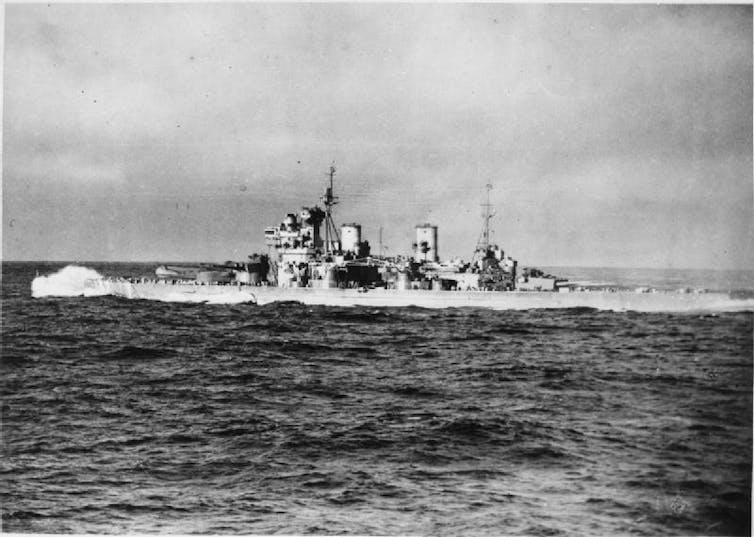
The Duke of York military slow march can often be heard ringing out during the Changing the Guard in London and one of the city’s best-known theatres carries the name. The same is true for pubs in places like London and Belfast, and a second world war battleship and a passenger steamer share the same name too.
Equally, the holders of the title Duke of York have, for over six centuries, held a prominent position in British royalty and society. Customarily conferred on the second son of the reigning monarch, this dukedom has been closely associated with being the “spare to the heir” – the brother born to support the crown rather than inherit it.
Close to the sovereign but destined for a different journey, the story of the dukes of York is one of privilege and dutiful service, with a liberal peppering of scandal and twists of fate.
The current holder of the dukedom, Prince Andrew, has agreed to no longer use the titles and honours conferred upon him – the first time this has happened in the dukedom’s history.
This is a long history of men whose lives were shaped by their unique position within the monarchy. Proximity to power without possession may be the defining factor, but the dukes of York more often than not actively or accidentally flip that rule on its head – almost half of these “spares” found themselves becoming king, one way or another.
There have been 11 men officially styled Duke of York and three holders of the title Duke of York and Albany – a fusion of two titles, one from Scotland and one from England, devised as a demonstration of unity following the 1707 Act of Union.
Edmund of Langley was the first duke, after being granted the title by his father Edward III in 1385. He is the Duke of York who appears in Shakespeare’s Richard II, a play named after the duke’s nephew and son of Edward, the Black Prince.
Following the legal principle of male primogeniture, Edward of Norwich, 2nd Duke of York, inherited the title upon his father’s death in 1402. Edward was killed at the Battle of Agincourt in 1415 and, without children, the title passed to his nephew Richard of York – 3rd Duke of York.
Richard’s death in battle in 1460, during the War of the Roses, then left the title to Edward Plantagenet. When Edward won the Battle of Towton in March 1461, subsequently becoming Edward IV, the Dukedom of York merged with the crown and became extinct, bringing a close to the 76-year existence of this first iteration of the title.
Incredibly, these are the only examples of the title being inherited. In over 560 years since, no Duke of York (or Duke of York and Albany) has ever directly passed the title to a legitimate heir. Of the subsequent ten men bearing either title, four died without heirs, five found themselves as heir to the throne following the death of their elder brother (or his abdication, as happened in 1936) and then king. And in Prince Andrew’s case, without a male heir – having had two daughters.
The duke who disappeared
Edward IV – himself a former Duke of York, recreated the dukedom for his second son, Richard of Shrewsbury, thus starting the long association of this title with the second-born son. Richard was married at the age of four and was one of the Princes in the Tower who disappeared and was presumed dead in 1483 aged 9.
The dukes who became kings
The title was revived in 1494 for Henry Tudor but again died out when Henry Tudor became King Henry VIII (1509). The same happened to Charles Stuart, who was given the dukedom in 1605 but also became king (Charles I, 1625).
James Stuart, the duke who gave his name to New York City. Wikipedia
James Stuart, second son of Charles I, was technically Duke of York from birth, but this was formalised in 1644. In 1660, James was granted the parallel Scottish title of Duke of Albany. New York state, its capital Albany, and New York City derive their names from this duke. James succeeded his childless brother Charles II and became James II of England and James VII of Scotland in 1685, when the title merged with the crown. James was later deposed in the 1688 revolution.
In 1892 Queen Victoria bestowed the title on her grandson, Prince George, the second son of the Prince of Wales and future Edward VII. However, this creation came following the death of George’s older brother. He became George V (1910) and the title merged with the crown.
George made his second son, Prince Albert, Duke of York in 1920. Initially more than comfortable being in the shadows of his elder brother Edward VIII, the abdication crisis of 1936 – the year of three kings – unexpectedly saw Albert become George VI. Because of this duke, the future Queen Elizabeth II was initially styled “Princess Elizabeth of York”.
Three double dukes
Although the dukedoms of York and Albany have been simultaneously held by the same person at times, three men have held the unified “double dukedom” as Duke of York and Albany in the 18th century, yet all died without heirs.
They were Ernest Augustus of Brunswick-Lüneburg, who served in the nine years’ war and the war of the Spanish succession, Prince Edward, who was briefly heir-presumptive, and Prince Frederick Augustus, second son of George III.
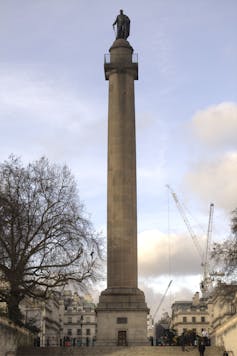
This Duke of York served a lengthy period as commander-in-chief of the British Army, including during the Napoleonic wars. He is perhaps the most likely inspiration for the “Grand Old Duke of York” rhyme. He is also memorialised on the Duke of York Column where Regent Street meets The Mall in London.
The Duke of York Column in London, erected to honour Prince Frederick Augustus, also known as the Grand Old Duke of York. Wikipedia/Prioryman, CC BY-SA
Queen Victoria again separated these titles, creating her fourth son, Prince Leopold, Duke of Albany in 1881, and her eldest grandson Duke of York in 1892.
Andrew became Duke of York in 1986 when he married Sarah Ferguson. While he has agreed to no longer be styled as such, he technically has not been stripped of the title. Nevertheless, with no male heir, the dukedom will become extinct upon his death, regardless.
Although it could be assumed that the title would have been recreated for Prince Harry as the second son of King Charles III, his self-imposed exile and ongoing controversies mean that the future of the Dukedom of York remains uncertain. Perhaps the next revival will take some consideration.
Mark McKinty does not work for, consult, own shares in or receive funding from any company or organisation that would benefit from this article, and has disclosed no relevant affiliations beyond their academic appointment.
The disruption of sleeping and waking patterns from the daylight saving clock change reveals a great deal about our everyday reliance on the interaction of sleep pressure and circadian clocks.
First, you need to understand the intricate changes happening in your body the night the clocks go back an hour. On Saturday evening, assuming we are not in bright light, our bodies will begin the daily chore of secreting melatonin, a key hormone for the timing of sleep. This will accumulate in the blood stream and a few hours later it will reach its peak concentration before declining steadily until morning.
Melatonin does not make most of us sleep, and certainly doesn’t keep up asleep. It is more like a reminder, signalling that sleep should not be far away. Even brief periods of normal electric light delay or even stop this sleep signal, depending on its brightness and wavelength or colour.
In the evening as melatonin rises, the heat generated by our internal organs increases to its highest level of the day, followed by a drop – which is another sleep signal. This is why having a hot bath before bedtime can help us to sleep.
The body’s core temperature continues to drop for the first couple of hours of sleep, which is mostly slow wave sleep. This is when more of the neurons in the brain are firing simultaneously, and when our heartrate slows. It becomes more regular as we have this first episode of deep sleep. Our coldest core body temperature more or less coincides with the highest level of melatonin, showing the synchrony of these two circadian timing signals.
A minute before 02:00 on Sunday 26 October our body’s timing systems and the
clocks will probably be aligned. Our internal core will be approaching its coldest temperature. As the body heats again, and the melatonin signal decreases, another circadian process begins – the slow sustained release of cortisol which will culminate on waking.
If melatonin is a sleep signal, then cortisol is a signal to wake. Unless we are very stressed during the daytime or drink a great deal of caffeine, it will be at its strongest at the time we typically wake. This is why waking up can sometimes seem both energising and stressful, and, why sleep is more difficult when we are stressed.
These three critical bodily timing systems, melatonin, core body temperature and cortisol, are synchronised by a central clock in the suprachiasmatic nucleus of the brain, which co-ordinates the time of the clocks in each cell of the body. The pattern of each signal repeats about every 24 hours, but can be disrupted by different aspects of our environment such as light, vigorous exercise and stress.
These cycles are not fixed at exactly 24 hours. They can be a few minutes shorter or longer than 24 hours. This enables our sleep-wake regimen to gradually change with the seasons.
But the change is slow. Abrupt changes, flying east or west (which extends or shortens sunlight exposure, affecting melatonin), heat waves, cold snaps (raising or lowering core body temperature) or stress (which increases daytime cortisol) cause disruption in this regimen. We just haven’t evolved to cope with sudden changes.
It will take days for the biological and actual clock to realign. Just as flying from London to New York takes more adjustment time than New York to London, the springtime change often feels gentler, because it seems to be easier to move your clock forward than backwards.
We are likely to lose out on sleep in the morning, particularly REM sleep, which kicks in later and is involved in emotion regulation. Our biological clock will still begin the cortisol-induced daily waking process at the same time it did the day before. But you will be awake as it peaks, which may resulted in deflated mood.
This disruption is not the same for all of us. About one in a 100 of the general population have a genetic disorder called delayed phase sleep syndrome, which makes it impossible to sleep until the early hours of the morning. Their melatonin levels increase much later than in other people, which means they will probably benefit from the clocks going back, if only for a short while.
Similarly, about ten to 20 in 100 late-adolescent children – compared to adults – are biologically driven to initiate sleep later. And for them, temporarily, their sleep may align more closely with the rest of the household. But they too will be sleepier in the morning.
Another group in the population, about 1% of those in middle age, feel they need to go to bed far earlier than most, usually in the early evening, and wake very early in the morning. It isn’t clear why advanced-phase sleep syndrome is more frequent in this age group, although the circadian system seems to weaken as we age. This group is more compromised by clocks being put back.
The autumn clock change is also often difficult for menopausal women who experience hot flushes – their body clock appears to be advanced and tend to need to sleep earlier. Clocks going backwards mean they will need to wait longer for sleep than they might wish and wake earlier.
The daylight saving disruption rarely lasts more than a week. But one is left asking why we put our bodily clocks under this abrupt strain. We challenge the synchrony of our bodily clocks, for the sake of fleeting moments of additional light.
John Groeger does not work for, consult, own shares in or receive funding from any company or organisation that would benefit from this article, and has disclosed no relevant affiliations beyond their academic appointment.
The target for the proportion of children passing the phonics screening check – a test of how well children aged five and six in England can “decode” words – has been raised to 90%.
This increase, from 84%, comes as part of the government’s mission to “drive up standards”. It also marks a further commitment to the use of systematic synthetic phonics to teach children to read.
Systematic synthetic phonics has become dominant in education policy and in English primary schools, particularly in the last 15 years. Teachers are now well versed in teaching children how to decode words, which means that they say the right sounds – phonemes – in relation to the letters or groups of letters they see on the page.
Children who don’t pass, meaning they don’t sound out the required number of the 40 words in the test, have to take it again in year two. But results in the phonics screening check have plateaued for nearly a decade. This suggests that however hard schools try, and however good they become at preparing the children for the test, some children will still struggle to master phonic decoding.
It is a well established idea in assessment research that when a high-stakes test is introduced, the proportion of children reaching the benchmark increases initially, as teachers become familiar with how to prepare children for the test. However, there is then a ceiling figure which is reached within a few years.
In line with this, national figures for the phonics screening check show that the proportion of children passing initially increased. Pass rates rose from 58% in 2012 to 81% in 2016, as teachers began to prioritise systematic synthetic phonics teaching and learnt how to prepare children for the test.
But, since then, the pass rate has plateaued at about 80%. The only exception is a post-pandemic dip to 75% in 2022. This suggests that despite the dominance of systematic synthetic phonics as an approach, about 20% of children do not find this system works for them at this age.
Meanwhile, the cumulative figure for children who pass the test in either year one or year two stands at around 89%. This suggests that 10% of children simply need more time to pass the phonics screening check, or more input in order to master the skill of decoding. The remaining 10% who never pass may have additional learning needs – which have likely been identified long before the test – or will need to learn to read in a different way.
What this new target does is effectively require the system as a whole (for the target is a national one, not a school-level one) to ensure that those 10% of children who pass in year two, instead pass the first time around.
The importance of age
So, what can schools do to ensure that all children pass in year one? The figures show that boys are less likely to pass at this point – 76% compared to 84% of girls in 2025. Children born in the summer months are also less likely to pass, as they are younger when they take the test: 73% of August-born children pass, versus 84% of September-borns.
Department for Education data on phonics screening check pass rate by birth month:
Percentage of pupils meeting the expected standard in the phonics screening check by month of birth in English state funded schools. Department for Education
The phonics screening check is so closely related to month of birth that it could be argued that it is a test of age rather than decoding. By the time the test is repeated in year two, the gap between August and September-borns has reduced to 7%, and 85% of August-born children pass by this stage.
The disadvantage gap
Moreover, the disadvantage gap – the difference in achievement between children from disadvantaged backgrounds and their more well-off peers – is significant. For the phonics screening check, it’s 17%, meaning that 67% of disadvantaged pupils pass compared to 84% of their peers. This would suggest that if the government wants more children to pass the test, finding ways to reduce the impact of disadvantage on children’s learning would be a highly effective way of improving the figures overall.
What remains, of course, is a deeper question of why the number who pass the phonics screening check should be such a key focus. Research has found no clear evidence that the phonics screening check improves how well children can read at primary school, or that it reduces the attainment gap.
It has also been critiqued as reducing children’s enjoyment of reading. The international comparison data shows a decline in children’s enjoyment of reading since the early 2000s. The proportion of children who really enjoy reading in England is far below the international average.
In the meantime, this is a target that is going to be very difficult to reach. It may result in an even more intense focus on phonics than we have seen thus far, at the expense of other aspects of learning to read.
Alice Bradbury receives funding from the Helen Hamlyn Trust which funds the Helen Hamlyn Centre for Pedagogy at UCL. She is a member of the Labour Party and the Universities and College Union.
Walk through any supermarket at this time of year and you’ll see shelves stacked with Halloween treats. Halloween and candy go hand in hand but what does all that sugar really mean for children?
The World Health Organization recommends that “free sugars” (sugar that is added to foods, plus sugars naturally present in honey, syrups and fruit juices) make up less than 10% of total energy intake, and ideally under 5%. That’s roughly no more than 10g per day for ages 1–2, 14g for ages 2–3, 19g for ages 4–6, 24g for ages 7–10, and 30g for ages 11+.
To put that in perspective, a small biscuit contains around 4g of sugar, a treat-sized bag of sweets about 13g, and a single lollipop roughly 10g. A successful trick-or-treat haul can easily push a child past their recommended daily limit several times over.
Parents often hear well-meaning advice from friends and relatives about sugar highs, crashes and restless nights. But research shows that the bigger concern isn’t what happens after a one-off binge, it’s what happens when children regularly exceed those limits. So let’s unpack some common beliefs.
1. Sugar makes kids hyper
Despite its persistence, this myth doesn’t hold up scientifically. Research finds little connection between sugar intake and hyperactivity in children. The idea largely stems from expectation bias: when parents expect sugar to cause excitable behaviour, they’re more likely to perceive it.
Children are naturally energetic, and sugar is often consumed at parties, during trick-or-treating, or at other exciting events – so the myth reinforces itself.
For example, in one study, all children received a sugar-free drink, but half the parents were told it contained sugar. Those parents rated their children as significantly more hyperactive, even though no sugar had been consumed.
2. Sugar highs
The “sugar rush” is another myth. Sugar does provide quick energy, but the body tightly regulates blood glucose levels, so there isn’t a genuine “high”.
This one has a little more truth to it. After eating sweets, blood sugar rises quickly, then falls back to normal – and sometimes slightly below normal.
In adults, carbohydrate consumption has been linked to increased fatigue and decreased alertness within an hour after eating, but these effects vary widely and are typically mild.
4. They won’t sleep tonight
The evidence here is mixed. One small study found that 8–12-year-olds had more night wakings after a high-sugar drink before bed, while another in toddlers found no short-term effect. Overall, there’s no strong proof that a one-off sugar binge dramatically affects sleep.
Excitement, later bedtimes, and social stimulation around events like Halloween probably play a bigger role.
The long-term picture, however, is clearer. A meta-analysis found that high sugar intake in children is linked with shorter sleep duration. Another study of two-year-olds found that frequent consumption of soft drinks, snacks, and fast food (often high in sugar) was associated with more night wakings and poorer sleep, while children who ate more vegetables slept better. If only kids found carrots as tempting as candy.
It can also become a vicious cycle: poor sleep increases children’s craving for sugary foods, leading to higher sugar intake, which may further disrupt sleep. Over time, this loop can take a real toll.
5. If you restrict them, they’ll just want it more
There’s some evidence that completely banning sweets can make children desire them more – but that’s about total prohibition, not setting boundaries.
In fact, research shows that children whose parents set consistent limits on sugary foods don’t develop stronger sweet preferences, and actually consume less sugar overall than children with more permissive parents.
Parents have huge influence over eating habits by deciding what foods are available at home. Let’s be honest: kids aren’t thinking about metabolic health. They just know sweets taste good.
One night of Halloween indulgence won’t cause lasting harm. The real concern is habitual overconsumption.
Historical data from people exposed to sugar rationing during the second world war suggests that lower sugar intake in childhood (and even in utero) is linked to reduced risks of diabetes and hypertension later in life.
And, of course, frequent sugar consumption also damages teeth.
High-sugar diets tend to be low in nutrients too, especially worrying for younger children with smaller appetites. When sweets and other energy-dense, nutrient-poor foods replace vegetables, fruits, whole grains, or dairy, children miss out on essential nutrients like vitamins, fibre, and calcium.
This becomes less of an issue in adolescence, when growing appetites can accommodate occasional treats alongside a balanced diet.
Practical tips for parents and guardians
Before heading out to parties or trick-or-treating, serve a balanced meal so children aren’t starting the evening hungry: a full stomach makes it easier to resist overindulging later.
For younger children, it can help to set limits on how many treats they collect, while for older ones, rationing sweets over several days can keep sugar intake in check without making them feel deprived. Above all, remember that healthy eating habits are built gradually. It’s the everyday choices that matter most, not one night of excitement and sweets.
So yes – let them enjoy Halloween. The occasional sugar rush (real or imagined) isn’t the problem. It’s what happens every other day of the year that really counts.
Rachel Woods does not work for, consult, own shares in or receive funding from any company or organisation that would benefit from this article, and has disclosed no relevant affiliations beyond their academic appointment.
Source: The Conversation – UK – By Danny Marks, Assistant Professor in Environmental Policy and Politics, Dublin City University
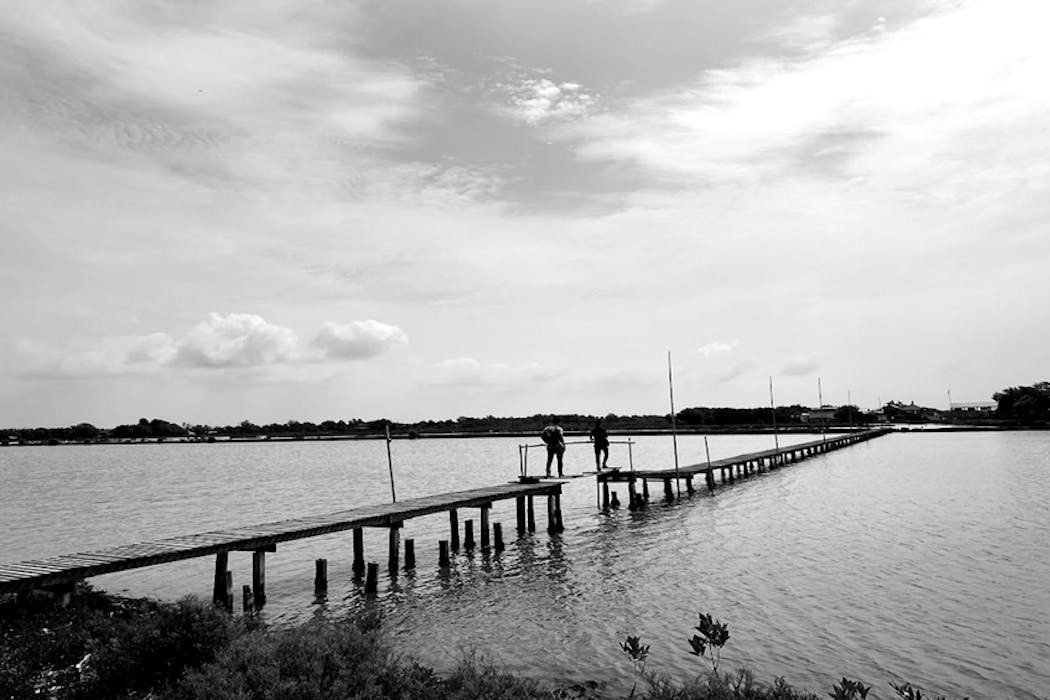
Danny Marks and a researcher walking along a small wooden pathway to the village.Danny Marks
The village of Khun Samut Chin, 50km southwest of Bangkok, Thailand, is a small, rustic fishing village similar to thousands scattered across Asia – except that it is slowly being swallowed by the sea.
Much of the country’s coastline faces severe erosion, with around 830km eroding each year at rates exceeding one metre. But in this village, the situation is far worse. Erosion occurs at three to five metres annually, the land subsides by one to two centimetres each year, and since the 1990s, around 4,000 rai (6.4km²) has already been lost to the sea.
All that remains of the original site is a Buddhist temple, now standing alone on a small patch of land that juts out into the sea so much so that locals call it “the floating temple”.
The severe erosion is partially due to climate change, but has been compounded by other human-driven factors. Upstream dams, built to provide flood control and irrigation to farmers, have reduced sediment flows in the Chao Phraya River delta, where the village is located.
Excessive groundwater extraction by nearby industries has increased land subsidence. Meanwhile, the construction of artificial ponds for commercially farming shrimp has led to widespread clearing of mangrove forests that once served as a buffer against erosion.
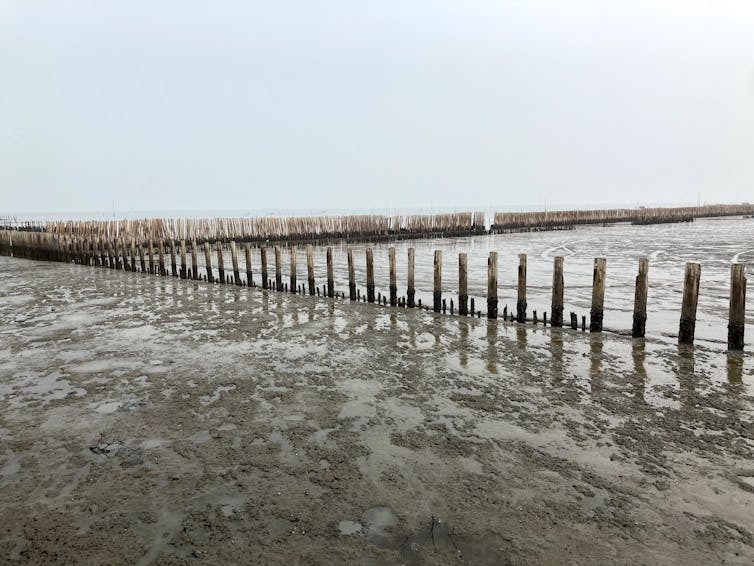
A wall of small concrete and bamboo dykes put in place as part of an attempt to stop coastal erosion. Danny Marks
People move away
My new research has found that villagers have been forced to move away from the sea four times, losing both land and livelihoods in the process. The government has not provided compensation for damaged homes or financial assistance to help them relocate.
Many younger villagers, wearying of constant displacement and finding it increasingly difficult to find fish as sediment makes the sea shallower, have left for jobs in Bangkok on construction sites, in factories and other workplaces. Those who remain are mostly older villagers. Today, the local school has only four pupils, making it the smallest in Thailand.
Khun Samut Chin lies at the forefront of climate change. An estimated 410 million people, 59% in tropical Asia, could face inundation by sea level rise by 2100. Without concerted efforts to change our emission levels, many more coastal communities around the world will face similar struggles in the years to come.
In theory, formal adaptation plans are government-led strategies designed to help communities cope with climate change. The theories assume that the state will decide when, where and how people should move, build protective structures like seawalls, and provide funding to affected communities.
In practice, however, as seen in Khun Samut Chin and many other places across Asia, low-income and relatively powerless coastal communities are often left to abandon their homes through forced displacement or try to stay put, with little or no government support, even when they ask for help.
Not giving up
Wisanu, the villager leader, says that Thai politicians have prioritised urban and industrial centres because they hold more voters and economic power. A government official told me that high land costs and limited budgets make relocation unfeasible. Instead, the state has erected bamboo walls as a temporary fix which have slowed down, but not stopped, the erosion.
Villagers are frustrated that the government has yet to implement any large-scale projects and that they are repeatedly asked to take part in consultations and surveys without any tangible results. Nor has the government provided much support to offset reduced incomes from fishing or improved transportation linkages, which remain sparse.
Coastal erosion in Thailand.
In response, the villagers have taken matters into their own hands. They have initiated a homestay programme. About 10 households, including the leader’s, host tourists who pay 600–700 Baht (£13-£16) per night, with 50 Baht going to a community fund for erosion mitigation efforts, such as purchasing or repairing bamboo dykes.
They market the programme through Facebook and other social media platforms as a place where visitors can experience life at the frontline of climate change, visit the temple, and help by replanting mangroves and buying food from the villagers. Wisanu, whose household manages five homestays, told me that the programme “enables us not to get rich but lets us walk”.
The villagers also believe that the programme helps raise awareness of their plight. They have also lobbied the local government to keep the school open and reconstruct a storm-damaged health centre.
This village offers a glimpse into what many others will likely face in the future. It shows that “managed retreat” is often not managed at all, or at least not by the state. Global frameworks like the Paris agreement and Intergovernmental Panel on Climate Change reports assume that governments have the capacity and political will to plan and fund coastal adaptation efforts.
Khun Samut Chin, however, shows how far reality can diverge from these assumptions: the sea encroaches, the state is absent, and villagers are left to mostly fend for themselves.
Yet they refuse to give up. They continue to stay, host tourists, replant mangroves, repair bamboo dykes and resist the demise of their village. They fight not only against erosion but also political neglect. If governments and global institutions fail to help them, this community will be washed away not by the water alone, but also by our inaction.
Danny Marks receives funding from by a seed grant from Utrecht University’s Water, Climate and Future Deltas Hub (entitled: “Human costs of shrinking deltas: Adaptation pathways of vulnerable groups to sea-level rise in three Asian deltas”).
El Jurado de la Sección Oficial del pasado Festival de Cine de San Sebastián otorgó su gran premio, la Concha de Oro, a Los domingos, de Alauda Ruiz de Azúa. La directora y guionista comentó, al recibir también el Premio Feroz Zinemaldia –que concede la AICE (Asociación de Informadores Cinematográficos de España)– del certamen, que “tenía mucho vértigo de que la propuesta no se entendiera” porque se trataba de algo arriesgado. Pero se entendió. Consiguió su objetivo: no solo que gustara, sino que se hablara de ella.
Los domingos narra la historia de Ainara, una chica de 17 años que debe decidir su futuro. Su familia le pregunta qué carrera elegirá. Pero la noticia de que su verdadera inquietud es ser monja de clausura les pilla por sorpresa, y esto provoca una crisis familiar.
La recepción ha sido buena por parte de personas que toman diferentes posiciones ante la vida, en este caso, creyentes y no creyentes. Y no solo le ha sucedido con Los domingos. La filmografía de Alauda Ruiz de Azúa lo confirma. Interpeló y gustó su ópera prima, Cinco lobitos (que ganó tres Premios Goya), y el año pasado la serie Querer también triunfó en los premios televisivos y entre la audiencia. Sus historias parecen llegar a todo el mundo, independientemente de sus posiciones ideológicas.
Un enfoque diferente
El éxito radica en el modo de hacer cine de Ruiz de Azua, en los temas que selecciona y, sobre todo, la forma en la que los trata, el estilo. La realizadora vasca elige asuntos cotidianos que, por su complejidad, plantean miradas poliédricas, bien sean las sombras y luces de una madre primeriza, las incomprensiones que recibe una víctima de violencia de género por parte de su familia o las diferentes posiciones vitales de la gente ante una adolescente que quiere ser monja.
En el caso que nos ocupa, arriesga un paso más. Los domingos es un espécimen verdaderamente excepcional en el panorama cinematográfico. Y no es que no haya en el cine español actual películas sobre temas religiosos, que las hay. Pero lo inusual es la seriedad, el rigor y la delicadeza del enfoque que da una realizadora que no tiene fe.
Ruiz de Azúa, en una entrevista hecha durante del Festival de Cine de San Sebastián 2025, me comentó que:
“Es una historia que escuché en la juventud, una chica que tenía vocación religiosa. Me llamó mucho la atención. Tenía curiosidad, fascinación. Me era algo muy ajeno. Después de rodar ‘Cinco Lobitos’, vi que lo podría contar desde el prisma de la familia. Y ahí sí encontré esa pregunta más compleja: ¿cómo la acompaña la familia? ¿O no la acompaña? ¿Cómo se posiciona aquí?”
La actriz Blanca Soroa junto a la directora Alauda Ruiz de Azúa en el rodaje de Los domingos. BTEAM Pictures
No se trata solo de dar con la tecla, con el tema adecuado, sino también con el enfoque. A Ruiz de Azúa le atrae comenzar los procesos creativos para explorar escenarios que plantean dilemas difíciles de resolver, a ver qué se encuentra. Y lo hace con mucho respeto. Observa, investiga, pregunta, sopesa. Es meticulosa y cuidadosa con los pequeños detalles:
“Cuando me meto en universos desconocidos, intento ser muy rigurosa y muy analítica… casi como un poco antropóloga; me gusta esa perspectiva. Y luego trabajo con las sensaciones y el imaginario que eso me genera. Pero sí, el rigor me parece importante. En el amor al detalle, a lo meticuloso… sacas muchas cosas que hablan de nosotros”.
Así consigue mostrar la complejidad de las posibles miradas sin caer en el maniqueísmo. En Los domingos se plasman las diferentes posturas ante una vocación religiosa: la de la fe de Ainara contrapuesta a la ausencia de fe de su querida tía Maite. El público se puede identificar con la una o con la otra sin sentirse maltratado o ridiculizado.
“Lo que me ha enganchado del cine desde pequeña era intentar entender a otras personas. Ese era el mecanismo que activaba en mí”.
Las trascendencia del día a día
Ruiz de Azúa es gran admiradora del director de cine japonés Yasujirō Ozu, de quien bebe y con quien se identifica por una mirada austera y sutil:
“Intento que lo cotidiano de alguna manera trascienda (…). Supongo que para mí viene de un cine que me ha gustado siempre, de Ozu, las películas a las que se las denomina trascendentes, no tanto en el sentido religioso sino porque, como caen en lo cotidiano, lo elevan a un sitio un poco más profundo. Y me interesa; me parece muy difícil, pero me interesa. Creo que es una sensación que el cine puede evocar muy bien; combina elementos y de repente construye eso”.
Como Ozu, su tema fetiche es la familia. Y plasma lo de cada día; en el caso de su última película: los rituales, las comidas de los domingos, la asistencia al coro del conservatorio o las reuniones de las monjas para rezar varias veces al día. Lo hace mediante una planificación sobria y centrada en los personajes que juega con paralelismos narrativos y con el sentido del humor y la ironía. Las miradas entre los personajes y las conversaciones que mantienen ayudan a experimentar sentimientos que dan qué pensar al espectador.
Fotograma de Los domingos y de una de sus comidas familiares. BTEAM Pictures
Ruiz de Azúa busca la profundidad y el misterio también a través de la música. Los chicos escuchan temas de Quevedo y Bizarrap, pero cuando están bailando en la discoteca, de modo extradiegético, la audiencia solo oye música sacra. Especialmente relevante se torna el tema “Into my arms”, de Nick Cave, que explora la intersección entre la fe, el amor y la vulnerabilidad humana y que interpreta el coro del colegio. Ainara la canta a ratos, a solas.
En definitiva, el cine de Alauda Ruiz de Azúa respira trascendencia a través de lo cotidiano. Y, al ser tan respetuosa y abierta ante lo que plantea, “no muestra su visión personal. Se abstiene de una interpretación convencional de la realidad”, como diría el crítico y director de cine Paul Schrader.
Este es el secreto de que consiga la conexión con el espectador. Sus historias se quedan en el imaginario y se rumian interiormente; pero también se habla de ellas, se debate sobre lo que cuenta, sin generar combate. Es lo que pretende.
Sofía López Hernández no recibe salario, ni ejerce labores de consultoría, ni posee acciones, ni recibe financiación de ninguna compañía u organización que pueda obtener beneficio de este artículo, y ha declarado carecer de vínculos relevantes más allá del cargo académico citado.













#/media/File:HMS_Duke_of_York_during_an_Arctic_convoy.jpg)

