Bayeux tapestry set to return to the UK – in medieval times it was like an immersive art installation

Source: The Conversation – UK – By Alexandra Makin, Third Century Research Fellow, Manchester Metropolitan University

The Bayeux tapestry is set to return to the UK for the first time in almost 1,000 years. One of the most important cultural artefacts in the world, it is to be displayed at the British Museum from September 2026.

Its significance for history is unquestioned – but you may not think of the Bayeux tapestry as a work of art. Sure, you may recognise it from your history lessons or political campaigns. Maybe you like embroidery and textiles or know about it because of the modern versions it inspired – think the Game of Thrones tapestry or the Great Tapestry of Scotland. Perhaps you are an early medievalist and use it as comparative evidence.

For me, this now famous wall hanging is undoubtedly art, created with great skill. What fascinates me as a textile archaeologist is how early medieval people saw and understood the tapestry.

First, let’s contextualise it a little. The hanging is not a woven tapestry but an embroidery, stitched in wool threads on nine panels of linen fabric that were then sewn together. It was made in around 1070, probably in England. Nobody knows how big it originally was, but it now measures 68.3 metres long by approximately 70cm high.

Starting at the end of Edward the Confessor’s reign (1042-1066), the tapestry’s comic book narrative tells a vivid, very modern story of the struggle for power and the English throne – and the brutal means William of Normandy (1028-1087) used to get it.


This article is part of Rethinking the Classics. The stories in this series offer insightful new ways to think about and interpret classic books and artworks. This is the canon – with a twist.


It follows the highs and lows of Harold Godwinson, Edward the Confessor’s brother-in-law, who became king after Edward’s death in 1066, and his eventual downfall at the Battle of Hastings.

The end of the hanging, and therefore the story, is now missing but it was probably the triumphal coronation of William. It would have provided a mirror in symmetry to the first scene, which depicts an enthroned Edward.

Sensory archaeology of the tapestry

Today, the hanging is famous because it is the only surviving example of its kind. But documentary sources from early medieval England demonstrate that this type of wall hanging was a popular way for families to depict their stories and great deeds.

A good example is the Byrhtnoth wall hanging, which Æthelflæd, the wife of an Anglo-Saxon Ealdorman of Essex Byrhtnoth, gave to the church in Ely after he was killed in 991. We know that the Normans also understood these storytelling wall hangings because Abbot Baudri of Bourgueil (c. 1050-1130) expertly incorporated such a device in a poem he wrote to honour Adela of Blois (c. 1067-1137), the daughter of William the Conqueror and Matilda (c. 1031-1083).

The Bayeux tapestry was, therefore, an obvious way to tell people about the downfall of the English and the rise of the Normans. But this is not all. The early medieval population of Britain loved riddles, multilayered meanings and hidden messages. Evidence survives in pieces like the gold buckle from the 7th-century Sutton Hoo ship burial, the early 8th-century Franks Casket and the 10th-century Book of Exeter. So it is not surprising that people today have argued for hidden messages in the Bayeux tapestry.

While these concepts are interesting, so much emphasis has been placed on them and the role the embroiderers played in creating them, that other ways of early medieval viewing and understanding have been ignored.

Early medieval society viewed its world through the senses. By using sensory archaeology, a theoretical approach that helps researchers understand how past societies interacted with their worlds through sight, touch, taste, smell and sound, we can imagine how people encountering the Bayeux tapestry would have connected with and understood it.

A guide to the story depicted on the Bayeux tapestry.

Art historian Linda Neagley has argued that pre-Renaissance people interacted with art visually, kinaesthetically (sensory perception through bodily movement) and physically. The Bayeux tapestry would have been hung at eye level to enable this. So if we take expert in Anglo-Saxon culture Gale Owen-Crocker’s idea that the tapestry was originally hung in a square with certain scenes facing each other, people would have stood in the centre. That would make it an 11th-century immersive space with scenes corresponding and echoing each other, drawing the viewer’s attention, playing on their senses and understanding of the story they thought they knew.

If we imagine ourselves entering that space, we move from a cooler, stone-hewn room into a warmer, softer area, encased in linen and wool, their smell tickling our noses. Outside sounds would be deadened, the movement of people softened, voices quietened. People would move from one scene to another, through the open doors of the stage-like buildings where the action inside can be seen and watched, boldly or surreptitiously. The view might be partially blocked by others and their reactions and gesticulations as they engaged with and discussed what they saw.

The bright colours of the embroidery would have made a kaleidoscope of colour, a blur that defined itself the closer people got to the work. The boldness and three-dimensionality of the stitching helped to draw them into the action while any movement of the hanging brought the imagery alive.

Here are the main characters in the room with you, telling you their story, inviting you to join them on their journeys of victory or doom.

As onlookers discussed what they saw, or read the inscriptions, they interacted with the embroidered players, giving them voice and enabling them to join the conversation. If the hanging formed part of a banquet then the smell of food, clanking of dishes and movement of the fabric and stitchwork as servants passed would have enhanced the experience. The feasting scenes dotted throughout the hanging would be echoed in the hall.

I believe the Bayeux tapestry was not simply an inanimate art object to be viewed and read from the outside. It was an immersive retelling of the end of an era and the start of something new. When you entered its space you became part of that story, sensorially reliving it, keeping it alive. To me, this is the true power of this now famous embroidery.

Beyond the canon

As part of the Rethinking the Classics series, we’re asking our experts to recommend a book or artwork that tackles similar themes to the canonical work in question, but isn’t (yet) considered a classic itself. Here is Alexandra Makin’s suggestion:

The ITV series Unforgotten, now in its sixth season (with a seventh on the way) gripped me from the start. It follows a team of British police detectives as they track down the killers of people whose bodies have been recently found, but who were murdered years before.

As they do, we, the viewer, are given access to the characters’ often emotional stories. We are brought into their sphere and experience their pain, distress, happiness, horror. We get unrivalled access, eventually, to the motives for their seemingly strange actions. As with the Bayeux tapestry, we are swallowed up in their worlds. This is achieved by Chris Lang’s fabulous writing, the cinematography and the exquisite acting.

Together these elements make a whole, opening a window, immersing you in a world full of powerful sensory engagements. For me, this is classic art in the making.

The Conversation

Alexandra Makin undertakes unpaid consultancy work for the Bayeux Tapestry Museum.

ref. Bayeux tapestry set to return to the UK – in medieval times it was like an immersive art installation – https://theconversation.com/bayeux-tapestry-set-to-return-to-the-uk-in-medieval-times-it-was-like-an-immersive-art-installation-258438

Child hospitalised as bird flu cases climb in Cambodia

Source: The Conversation – UK – By Divya Venkatesh, BBSRC Discovery Fellow, University of Oxford

Tom…foto/Shutterstock.com

Cambodia’s Ministry of Health recently confirmed the country’s twelfth human case of H5N1 avian influenza so far this year. The patient, a five-year-old boy from Kampot province, is currently in intensive care with severe respiratory symptoms.

The announcement, on July 3, came just days after a 19-month-old child in neighbouring Takeo province died from the same virus.

To date, there is no evidence of human-to-human transmission. But the steady increase in cases has renewed attention to the risks posed by H5N1. This highly pathogenic bird flu virus spreads rapidly among poultry and occasionally jumps to humans – often with deadly consequences.

Since 2003, there have been at least 954 reported human infections globally, nearly half of them fatal, according to the World Health Organization (WHO). Experts have long considered H5N1 a serious pandemic threat due to its high mortality rate and potential to evolve.


Get your news from actual experts, straight to your inbox. Sign up to our daily newsletter to receive all The Conversation UK’s latest coverage of news and research, from politics and business to the arts and sciences.


The recent Cambodian cases are linked to the 2.3.2.1e lineage of H5N1 (previously known as 2.3.2.1c), a strain that has circulated for decades in poultry across Cambodia, Laos and Vietnam. From 2005 to 2014, Cambodia saw sporadic but severe human infections – then almost a decade passed without new cases.

That changed in 2023 when six human cases were reported. The numbers have since climbed: ten in 2024, and now 12 in the first half of 2025. Of these recent infections, at least 12 – about 43% – have been fatal. A troubling pattern is also emerging: seven of this year’s cases occurred in June alone, according to the WHO’s latest Disease Outbreak News update.

Animal pandemic

Globally, however, a different H5N1 lineage – 2.3.4.4b – has dominated in recent years. This strain sparked a devastating wave of avian outbreaks starting in 2021, sweeping across continents and decimating wild bird and poultry populations. It also spread to mammals, leading scientists to label it an “animal pandemic”.

Although it no longer causes mass die-offs, 2.3.4.4b remains widespread and dangerous, particularly because of its capacity to infect mammals. It has been linked to about 70 human cases in the US alone, with only one death recorded so far, and is under investigation for suspected mammal-to-mammal transmission in species, including US dairy cattle and seals.

A dairy farm showing cows and farmers.
Bird flu strain 2.3.4.4b is suspected of mammal-to-mammal transmission.
BearFotos/Shutterstock

Influenza viruses are notoriously prone to genetic reassortment – a process by which two or more strains infect the same host and exchange genetic material. These events can sometimes generate new, more transmissible or deadly variants. In April 2024, the UN Food and Agriculture Organization reported the emergence of a reassortant virus in Vietnam. This new strain combines surface proteins from the long-standing 2.3.2.1e virus with internal genes from the globally dominant 2.3.4.4b.

Evidence suggests that this reassortant virus may be driving the rise in Cambodian human infections.

A 2024 study, which has not yet undergone peer review, found that the new virus carries genetic markers that could enhance its ability to infect humans – although it is not yet considered human-adapted. According to the study’s authors, this reassortant form has become the predominant strain found in poultry across the region in recent years.

So far, all confirmed human cases in Cambodia have been linked to direct contact with infected or dead poultry – often in small, rural backyards. This suggests that the country’s “one health” strategy, which aims to integrate human, animal and environmental health responses, is functioning as intended. Although some gaps clearly remain.

Food safety and food security remain serious concerns across much of Cambodia and south-east Asia. Limited veterinary oversight, informal poultry markets, lack of compensation for poultry losses due to disease, and poor biosecurity may offer the virus opportunities to persist and evolve – and potentially reach more people.

Since the COVID pandemic, advances in disease surveillance and reporting have made it easier to detect and confirm human infections, Dr Vijaykrishna Dhanasekaran, head of the Pathogen Evolution Lab at Hong Kong University, told me over email. However, he notes that surveillance remains heavily concentrated in urban areas and the commercial poultry sector, while rural settings and interactions with wild birds are poorly monitored.

Expanding surveillance to these overlooked areas will be vital, he says, if the world hopes to better understand – and prepare for – the next potential influenza pandemic.

The Conversation

Divya Venkatesh receives funding from BBSRC.

ref. Child hospitalised as bird flu cases climb in Cambodia – https://theconversation.com/child-hospitalised-as-bird-flu-cases-climb-in-cambodia-260565

Over 1.6 million children live in families made poorer by the two-child limit on benefits – new data

Source: The Conversation – UK – By Ruth Patrick, Professor in Social Policy, University of Glasgow

New government statistics released today show the reach of the two-child limit. There are 1,665,540 children in England, Scotland and Wales living in households affected by the two-child limit, an increase of over 35,000 from the same time in 2024.

The two-child limit restricts means-tested child benefits to the first two children in a household, subject to some exceptions.

Its sister policy, the benefit cap, affects over 115,000 households, including 300,000 children. It routinely pushes families into deep poverty, far below the standard poverty line of 60% of median income.

The benefit cap places a limit on the total amount a household can receive if no-one in the household earns a minimum amount, again subject to some exceptions linked to receipt of disability benefits.


Get your news from actual experts, straight to your inbox. Sign up to our daily newsletter to receive all The Conversation UK’s latest coverage of news and research, from politics and business to the arts and sciences.


Over the past five years, we have been part of a team of academic researchers investigating the impact of both policies on families with three or more children. We’ve found that these policies drive up poverty, creating deprivation and hardship. This in turn causes sustained and severe harm to children and their families.

The two-child limit and benefit cap leave many families living with extreme financial insecurity. They harm parental mental health, as mothers and fathers struggle to try and make an inadequate income stretch to meet the needs of their children.

Parent with baby in supermarket
Parents are struggling to make their income go far enough.
Odua Images/Shutterstock

In addition, these policies do not fall evenly across the population when looking at ethnicity. Overall, 70% of the families affected by the two-child limit are white, as are 66% affected by the benefit cap. But our new analysis shows that children from an ethnic minority are up to three times as likely as white children to be affected by the two-child limit. They are also up to four times as likely to be affected by the benefit cap.

Alongside administrative statistics, we have analysed household survey data, published today as a policy brief. We find that one in five children from Pakistani families and one in four children from Bangladeshi families are now affected by the two-child limit.

Rising poverty

Our analysis also indicates that these policies are contributing to very high and rising levels of poverty. We estimate that 66% of Bangladeshi children, 60% of Pakistani children, and nearly half (48%) of black children live in poverty. This compares to one in four (24%) white children living below the poverty line – still far too many.

This new analysis provides us with better understanding of where the damage done by both policies is falling. It’s an important reminder of how the two-child limit and benefit cap directly conflict with ambitions not only to act on child poverty, but also to reduce systematic inequalities linked to ethnicity.

Scrapping the two-child limit would give larger families access to benefits they currently miss out on – but it would not have any effect on smaller families living in poverty, so isn’t the only policy solution needed.

Nonetheless, analysis by the Resolution Foundation has shown that getting rid of the two-child limit – which would cost £1.4 billion – is by far the most cost-effective way to reduce the number of children living in poverty. Spending £1.4 billion in other ways – for example by increasing benefits for all families – would make less difference to child poverty than if the two-child limit were ended.

It’s also important to keep in mind the impact on the depth of poverty. Larger families tend to be living further below the poverty line. Scrapping the two-child limit will make a big difference in many households, even if they are not lifted out of poverty as a result.

Labour came into government on a manifesto of “change”, and Keir Starmer has promised to be “laser-focused” in his commitment to drive down poverty.

Labour have already said that they want to get rid of the two-child limit, arguing that they just need to find the money to do so. The government has established a child poverty taskforce, due to report in the autumn, and made a first concrete policy commitment with the extension of free school meals provision for families in England. But there is no alternative to serious action on social security benefits if significant progress is to be made.

The Conversation

Ruth Patrick receives funding from a range of funders including Nuffield Foundation, AFFT, Trust for London, The Robertson Trust and the Centre for Impact on Urban Health. She is a member of The Labour Party.

Kitty Stewart has received funding from the Nuffield Foundation and from LSE for the research reported in this article.

ref. Over 1.6 million children live in families made poorer by the two-child limit on benefits – new data – https://theconversation.com/over-1-6-million-children-live-in-families-made-poorer-by-the-two-child-limit-on-benefits-new-data-260449

L’écologie, un problème de riche ? L’histoire environnementale nous dit plutôt le contraire

Source: The Conversation – France (in French) – By Renaud Bécot, Maitre de conférences en histoire contemporaine, Sciences Po Grenoble

À Warren County, en Caroline du Nord, la mobilisation des habitants contre de la pollution aux polychlorobiphényles en 1982 marque un événement fondateur du mouvement pour la justice environnementale. Ricky Stilley/Henderson Dispatch

L’environnement n’intéresse-t-il que les classes supérieures ? Les travailleurs ont en réalité très vite identifié l’impact de l’industrialisation sur les écosystèmes dont ils dépendent. Mais cette conscience environnementale s’exprime de façon différente en fonction des classes sociales, comme l’explique Renaud Bécot, chercheur en histoire contemporaine et environnementale, dans un chapitre intitulé « Fin du monde, fin du mois, et au-delà ? L’environnementalisme des classes populaires » publié au sein de l’ouvrage collectif La Terre perdue. Une histoire de l’Occident et de la nature XVIIIᵉ-XXIᵉ siècle.


Au milieu des années 1950, Agnès Varda filme une scène ordinaire dans un quartier populaire du littoral méditerranéen. Quelques chats observent le réveil des familles dont les revenus d’existence reposent sur l’extraction des ressources de la mer. Les pêcheurs s’apprêtent à reprendre leur labeur, alors même que les fumées d’une industrie lourde souillent le rivage proche. Ils préparent leurs barques avec discrétion, car les autorités publiques surveillent la capture des poissons potentiellement pollués. Pourtant, « on ne veut pas travailler comme des empoisonneurs ! », s’exclament ces pêcheurs sétois.

Si cette représentation s’inscrit dans une œuvre de fiction (La Pointe courte, 1955), la scène illustre la position singulièrement inconfortable dans laquelle se trouvent les classes populaires contemporaines dans leurs rapports aux environnements. En effet, ces pêcheurs sont bien conscients que leurs revenus, et plus largement leurs conditions de subsistance, dépendent de l’extraction de ressources naturelles (ici halieutiques) – et, par extension, de la nécessité d’assurer la soutenabilité de celles-ci. Leur conscience est d’autant plus nette que l’industrialisation conforte une menace sur ces ressources et sur leur qualité.

Pourtant, malgré cette préoccupation, ces pêcheurs (tout comme les paysans au cours de cette période) sont pris dans l’état de la transition urbaine-industrielle que connaissent les sociétés européennes et américaines depuis le XIXe siècle.

[…]

L’acte d’accusation à l’encontre des classes populaires, supposément indifférentes aux enjeux écologiques, procède du déni des contraintes dans lesquelles se structurent les vies ordinaires au sein des groupes subalternes dans les sociétés occidentales. Face à l’ampleur des transformations urbaines et industrielles depuis le XIXe siècle, les préoccupations populaires pour l’environnement ont pourtant été récurrentes, et bien souvent ancrées dans des enjeux liés à l’organisation de la subsistance et à la protection de la santé.

De l’environnementalisme des pauvres à l’environnementalisme ouvrier

L’économiste catalan Joan Martinez-Alier distinguait trois principaux courants au sein des mouvements écologistes au début du XXIe siècle. Le premier, parfois qualifié de protectionniste, se caractérise par un culte de la nature sauvage. Son histoire se confond souvent avec les actions menées par des membres de classes aisées en faveur de la mise en réserve d’espaces présentés comme emblématiques, à l’instar d’intellectuels tels que John Muir (1838-1914), fondateur du Sierra Club, qui fut longtemps la principale association environnementale étasunienne.

Le deuxième courant renvoie aux promoteurs de l’écoefficacité ou de la modernisation écologique ; les membres de ce courant témoignent d’une conception technicienne et instrumentale du rapport des sociétés à l’environnement. Il vise à organiser les flux d’énergie et de matière de manière plus efficace et il est souvent associé à des figures scientifiques, à commencer par l’ingénieur forestier Gifford Pinchot (1865-1946).


Du lundi au vendredi + le dimanche, recevez gratuitement les analyses et décryptages de nos experts pour un autre regard sur l’actualité. Abonnez-vous dès aujourd’hui !


Enfin, le troisième courant correspond à l’environnementalisme des pauvres, dont Joan Martinez-Alier analyse que « le ressort principal n’est pas le respect sacré de la nature, mais l’intérêt matériel que représente l’environnement, source et condition de la subsistance ».

Cette catégorie d’environnementalisme des pauvres était d’abord pensée pour étudier les conflits dans les pays non occidentaux. Alier constatait que les motifs de protestation soulevaient des enjeux d’accès aux espaces naturels, de partage des ressources, ou de protection des milieux dont l’équilibre était essentiel pour la survie humaine. Plus qu’un culte de la nature ou une volonté de maximiser le rendement des écosystèmes, Alier observait ce qu’il désigne comme des conflits écologico-distributifs. Dans cette approche, il s’agit de penser une « nature ordinaire » correspondant à la protection d’une biodiversité sans valeur économique ou patrimoniale particulière, mais dont le maintien rend possible la protection de la santé humaine et du vivant. Cette nature ordinaire s’oppose aux initiatives de protection exclusive de sites naturels admirables, ou d’espèces animales emblématiques.

[…]

Luttes environnementales, conditions de travail et santé des ouvriers

Au crépuscule du XIXe siècle, dans les manufactures insalubres ou les mines de charbon, des voix s’élèvent pour dénoncer les maux de l’industrialisation. En 1893 puis 1895, ce sont les ouvrières d’usines d’allumettes de Trélazé (Maine-et-Loire), de Pantin et d’Aubervilliers (Seine) qui dénoncent notamment les dégâts sanitaires de leur exposition au phosphore blanc qui provoquent des nécroses maxillaires. Tout comme à Hull (Québec) en 1919, ces grèves d’allumettes rendent visibles les dégâts sanitaires d’une industrialisation à marche forcée. Autour de 1900 encore, l’historienne Judith Rainhorn souligne une convergence entre de rares syndicalistes et des médecins réformateurs, afin de défendre l’interdiction de l’usage de la céruse (ou blanc de plomb) dans la peinture utilisée sur les bâtiments – en France, cette revendication aboutira à l’adoption d’une loi d’interdiction en 1915.

La dénonciation des dommages ouvriers sanitaires et environnementaux de l’industrie se trouve partiellement désamorcée par l’adoption de réglementations encadrant les activités productives dans la plupart des pays industrialisés au début du XXe siècle. En matière de maladies professionnelles, ces lois consacrent le principe de la « réparation forfaitaire des risques du travail ». Ces maux sont présentés comme le revers empoisonné mais inéluctable du progrès. Si les syndicalistes contestèrent initialement cette monétarisation de la santé, la majorité d’entre eux se rallia par défaut à ce qui devint l’un des rares leviers de reconnaissance des maux endurés par les travailleurs.

Pourtant, au cours des années 1960, dans les territoires italiens de la pétrochimie tout comme dans les zones industrielles japonaises, certains groupes ouvriers alimentent une critique de pratiques qu’ils dénoncent comme une manière de « perdre leur vie à la gagner ». Dans une période marquée par une centralité ouvrière (symbolique, politique et sociologique) dans les sociétés occidentales, ces mobilisations réactivent un environnementalisme ouvrier, lequel conjugue un refus de la monétarisation des risques de santé, une volonté de protéger le cadre de vie des classes populaires, tout en énonçant des prescriptions pour une politique du travail plus respectueuse des corps et des environnements.

La justice environnementale, lutte dans un monde abîmé

Dans la typologie proposée par Joan Martinez-Alier, l’environnementalisme des pauvres recouvre également le mouvement se réclamant de la justice environnementale. Celui-ci s’enracine dans l’histoire spécifique des luttes socioécologistes étasuniennes, avant de connaître les résonances dans d’autres aires industrialisées.

Aux États-Unis, deux filiations militantes doivent être soulignées. D’une part, d’anciens militants des droits civiques alimentent une critique des grandes associations environnementales (à commencer par le Sierra Club), accusées de défendre prioritairement une nature « sauvage ». Cette préservation de la wilderness est dénoncée comme un mythe généré par des militants issus de la classe moyenne ou supérieure blanche. D’autre part, une seconde filiation s’inscrit dans la lignée des mobilisations ancrées dans les mondes du travail. Dans les années 1960, de grandes fédérations syndicales étasuniennes exigeaient une réglementation de certaines pollutions industrielles, et parfois une transformation des activités productives, à l’instar du syndicat des travailleurs de l’automobile (l’United Auto Workers). Ce double héritage militant fut à l’origine de grèves intenses, dont celle des éboueurs de Memphis, à laquelle Martin Luther King apporta son soutien lorsqu’il fut assassiné en 1968.

Néanmoins, le mouvement pour la justice environnementale ne s’est désigné comme tel qu’à l’orée des années 1980. Son récit fondateur voudrait qu’il débute lors de la mobilisation des habitants du quartier de Warren County (Caroline du Nord), confrontés au projet d’ouverture d’une décharge de produits toxiques. Ils dénoncent l’inégalité d’exposition aux toxiques dont sont victimes les populations racistes et paupérisées. Leur action se prolonge par l’invention d’un répertoire dans lequel la production de savoirs de santé occupe une fonction toujours plus considérable, comme en témoigne l’enquête d’épidémiologie populaire menée par les habitants de Woburn (en périphérie de Boston), avec le souhait d’éclairer le lien de causalité entre un cluster de leucémies infantiles et leur exposition à des forts taux de plomb, d’arsenic et de chrome. La multiplication des initiatives locales se prolonge dans des coordinations nationales et dans la publication d’études.

En 1987, le chimiste et militant Benjamin Chavis publie un rapport invitant à réfléchir aux processus sociaux de relégation de certaines populations dans des milieux pathogènes comme une forme de « racisme environnemental ». La justice environnementale est peu à peu devenue une grille d’analyse universitaire, consacrée notamment par les travaux du sociologue Robert Bullard au début des années 1990.

Mouvement social, autant que grille d’analyse du social, l’approche par la justice environnementale demeure largement ancrée dans son berceau nord-américain. Des historiens comme Geneviève Massard-Guilbaud et Richard Rodger ont montré la difficulté à transposer en Europe des catégories si liées à l’histoire étasunienne. Pourtant, la plus forte exposition des classes populaires aux toxiques est à l’origine d’une expérience commune de « violence lente » de part et d’autre de l’Atlantique. Proposée par le chercheur Rob Nixon, cette notion vise à désigner le phénomène d’atteintes différées à la santé qui marque les populations vivantes dans les territoires abîmés, ainsi que la difficulté à se mobiliser face aux pollutions dont les effets deviennent perceptibles après plusieurs décennies.

C’est pourtant face à ces violences pernicieuses qui se sont élevées habitants et salariés de nombre d’aires pétrochimiques dans l’Europe, au cours des années 1970. Ces initiatives se prolongent parfois jusqu’à nos jours, comme en témoignent les collectifs militants de Pierre-Bénite, dans le couloir de la chimie (Rhône). Après des conflits particulièrement vifs contre la fabrique d’acroléine entre 1976 et 1978, ce sont aujourd’hui les pollutions rémanentes des perfluorés (ou PFAS) qui sont au cœur des protestations adressées aux industriels de la chimie.

En France, au début du XXIe siècle, un ménage appartenant au décile le plus aisé de la population émet chaque année l’équivalent de 30 à 40 tonnes de dioxyde de carbone, soit au moins deux fois plus qu’un ménage appartenant au décile le plus pauvre (environ 15 tonnes). Pourtant, ce constat n’empêche pas l’éternelle réitération de la stigmatisation des classes populaires.

Couverture de La Terre perdue. Une histoire de l’Occident et de la nature XVIIIᵉ-XXIᵉ siècle, ouvrage dirigé par Steve Hagimont et Charles-François Mathis.
Éditions Tallandier

Contrairement aux parangons de la modernisation écologique, l’ethos des actrices et acteurs d’un environnementalisme populaire se caractérise souvent par une relative modestie dans le récit de leur rapport à une nature ordinaire. Cette attitude est aux antipodes de la mise en spectacle du syndrome du sauveur de la planète. De plus, l’étau de contraintes qui verrouillait le champ des possibles pour les pêcheurs sétois de l’après-guerre dans leur rapport à l’environnement ne s’est pas desserré pour les classes populaires du XXIe siècle. Il n’en reste pas moins que certaines fractions de celles-ci restent porteuses d’un rapport singulier à l’environnement.

The Conversation

Renaud Bécot ne travaille pas, ne conseille pas, ne possède pas de parts, ne reçoit pas de fonds d’une organisation qui pourrait tirer profit de cet article, et n’a déclaré aucune autre affiliation que son organisme de recherche.

ref. L’écologie, un problème de riche ? L’histoire environnementale nous dit plutôt le contraire – https://theconversation.com/lecologie-un-probleme-de-riche-lhistoire-environnementale-nous-dit-plutot-le-contraire-258764

Tour de France 2025 : le peloton à la découverte des bizarreries archéologiques bretonnes

Source: The Conversation – France (in French) – By Patrick de Wever, Professeur, géologie, micropaléontologie, Muséum national d’histoire naturelle (MNHN)

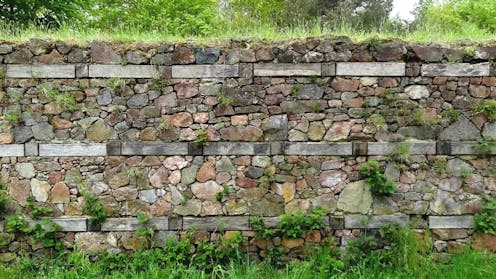
Les murs du Camp de Péran, 2013.
Fourni par l’auteur

Au-delà du sport, le Tour de France donne aussi l’occasion de (re)découvrir nos paysages et parfois leurs bizarreries géologiques. L’itinéraire de la septième étape du Tour de France 2025 débute à Saint-Malo pour rejoindre Murs-de-Bretagne. Juste après Yffiniac, les cyclistes passeront par Pledran, une commune connue pour son camp de Péran, dont les murs sont… vitrifiés. Explications.


Sur les murs en pierre, les roches sont la plupart du temps maintenues entre elles par un mortier : fait pour consolider la construction, ce dernier est un mélange pâteux constitué de boue, de chaux ou de ciment hydraulique avec de l’eau. L’ensemble, qui durcit en séchant, fait alors office de colle. Les types de mortiers et leurs usages ont varié au cours du temps : on retrouve des traces de leur usage depuis le Néolithique (10 000 ans), mais leur composition se diversifie et se spécialise dès -4000 av. E.C. dans l’Égypte ancienne.

Des constructions ont aussi été établies sans l’usage de mortier : c’est le cas chez les Grecs, qui utilisaient la seule force de gravitation verticale, ou chez les Incas, qui avaient recours à des pierres polygonales mais parfaitement ajustées avec les voisines afin de stabiliser la construction.

Plus rares en revanche sont les constructions dans lesquelles les pierres sont bien collées entre elles, mais sans apport d’un matériau externe : elles sont alors directement transformées et soudées sur place. C’est ce que l’on appelle des murs vitrifiés, que l’on retrouve au fort de Péran, en Bretagne, près duquel s’apprêtent à passer les cyclistes.

Le fort le mieux conservé de France

Le camp de Péran, dans la commune de Plédran, est identifiable à son enceinte fortifiée, juchée sur les premières hauteurs (160 mètres) qui dominent la baie d’Yffiniac, à 9 km au sud-ouest de Saint-Brieuc, dans les Côtes-d’Armor. Autrefois connu dans la région sous le nom de Pierres Brûlées, ce site a fourni des pièces archéologiques (cuillers, pièces…) depuis 1820-1825. Mais les premières publications les relatant sont celles de Jules Geslin de Bourgogne, en 1846.

Il était supposé que l’endroit avait été un oppidum gaulois, avant d’être transformé en camp romain. Les campagnes de fouilles ont permis de confirmer et de préciser son intuition : on estime que le camp, désormais classé au titre des monuments historiques, date de la culture de la Tène (env. 450 à 25 av. E.C.), apogée de la culture celtique qui prend fin avec la conquête romaine.


Du lundi au vendredi + le dimanche, recevez gratuitement les analyses et décryptages de nos experts pour un autre regard sur l’actualité. Abonnez-vous dès aujourd’hui !


Après l’époque gauloise, le lieu a été occupé par les Vikings, dont on a identifié des incursions vers les 9e et Xe siècles, ainsi qu’au XIIIe siècle comme en attestent des carreaux de terre cuite.

De forme elliptique, il couvre environ un hectare (160 mètres sur 140) et comporte cinq structures défensives concentriques.

L’énigme des murs vitrifiés

Ce fort, qui est le mieux conservé de France, a pour spécificité le rempart de pierre vitrifié de l’une de ses cinq structures défensives : les pierres du mur sont soudées parce qu’une partie a fondu à la périphérie des blocs, formant un verre qui a cimenté les roches entre elles. De tels murs, souvent associés à des forts, existent dans tout le Vieux Continent, mais particulièrement en Europe du Nord. En France, on en connaît une vingtaine, de la Bretagne à l’Alsace, avec une concentration notable dans le Limousin, la Creuse et la Loire, tous des pays granitiques.

Mur vitrifié. Ce qui fait office de mortier (noir à points blancs), est un verre, résultant d’une fusion partielle des roches Sainte-Suzanne, Mayenne.
JP Morteveille, Fourni par l’auteur
Un verre sombre, bulleux, est inséré entre des fragments de granites.
Gilbert Crevola, Fourni par l’auteur

Ces vitrifications intriguent depuis l’Antiquité. Dès le milieu du XVIIIe siècle un tel mur est signalé dans la cave d’une maison de Sainte-Suzanne, en Mayenne. On s’interroge alors : quel feu fut assez violent pour faire fondre la pierre et ainsi la vitrifier ? Et, ce feu était-il intentionnel ou le fruit d’un accident ? Les seules vitrifications naturelles connues étaient celles liées au volcanisme et, dans une moindre mesure, celles causées par la foudre (les fulgurites) ou les impactites (explosion d’un impacteur dans l’atmosphère, qui n’a pas atteint le sol mais dont l’énergie a fait fondre le sable, tel le célèbre verre libyque utilisé pour confectionner le scarabée du pectoral de Toutankhamon).

Les premiers à proposer une vitrification par combustion sont Auguste Daubrée (1881) puis Alfred Lacroix (1898). En effet, les observations portant sur des granites (riches en silice, donc) révèlent une fusion partielle, plus ou moins avancée à relativement basse température. Si un granite ou un gneiss fondent vers 950 °C en conditions de surface, la présence d’eau permet la fusion à une température moindre (dès 840 °C).

Feu de poutres

Les murs du Camp de Péran, 2013.
Gilbert Crevola, Fourni par l’auteur

On sait aujourd’hui comment cette vitrification a été obtenue : par la combustion de poutres de bois qui armaient les murs gaulois. En effet, les remparts gaulois qui équipaient les oppidums mais aussi certaines villas (les fermes d’aristocrates), étaient des constructions qui associaient des couches entrecroisées de poutres horizontales comblées de terre avec un parement de « pierres sèches » (sans mortier).

L’incendie des poutres dégageant de l’eau a abaissé le point de fusion du granite qui a formé un verre en refroidissant. En conditions de surface de la Terre, un « granite sec » fond vers 950 °C et un « granite hydraté » dès 840 °C. C’est donc la présence d’eau qui aurait permis cette fusion du granité.

Le camp subcirculaire de Péran, à l’ouest de Plédran. À la carte IGN est superposée la photo aérienne.
Fourni par l’auteur

Pour leur très grande majorité, les forts vitrifiés se situent dans des régions granitiques. Il ne s’agit sans doute pas d’un hasard, car la température de fusion des granites est relativement faible en comparaison avec celle des basaltes, qui survient plutôt vers 1450 °C. Le caractère intentionnel, ou accidentel par incendie, reste néanmoins un point débattu.

The Conversation

Patrick de Wever ne travaille pas, ne conseille pas, ne possède pas de parts, ne reçoit pas de fonds d’une organisation qui pourrait tirer profit de cet article, et n’a déclaré aucune autre affiliation que son organisme de recherche.

ref. Tour de France 2025 : le peloton à la découverte des bizarreries archéologiques bretonnes – https://theconversation.com/tour-de-france-2025-le-peloton-a-la-decouverte-des-bizarreries-archeologiques-bretonnes-258129

Économistes et historiens : je t’aime moi non plus

Source: The Conversation – France (in French) – By Alain Trannoy, Enseignant chercheur Ecole d’économie d’Aix Marseille EHESS, Aix-Marseille Université (AMU)

Un chassé-croisé s’observe entre la science économique et historique. Les deux approches, loin d’être opposées, peuvent être complémentaires, comme le montrent les travaux sur la révolution industrielle. Histoire et économie ont tout à gagner à approfondir le dialogue.

Cet article est publié dans le cadre du partenariat les Rencontres économiques d’Aix–The Conversation. L’édition 2025 de cet événement a pour thème « Affronter le choc des réalités ».


Le pivotement des économistes vers l’histoire, en particulier économique, depuis 30 ans, est spectaculaire. En attestent les prix Nobel attribués en 2023 à Claudia Goldin pour son apport à la compréhension de l’évolution du travail des femmes et en 2024 à Daron Acemoglu, Simon Johnson et James Robinson pour leur travail sur le rôle des institutions et leur impact sur la croissance économique.

Au même moment, du moins en France, les historiens pivotaient dans le sens inverse avec un certain désintérêt pour l’histoire économique de la part des générations nées après 1950, alors que la génération précédente avait témoigné d’un intérêt considérable pour le domaine économique comme en témoignent les travaux de Marc Bloch, Fernand Braudel, Christian Labrousse, Emmanuel Le Roy Ladurie et Jean-Claude Perrot pour ne citer que quelques noms liés à l’École des Annales. Ces deux disciplines semblent avoir joué à « je t’aime moi non plus » depuis cent ans. Cette recension est évidemment trop schématique car il faudrait citer l’école de la régulation apparue dans les années 70 (Michel Aglietta, André Orléan, Robert Boyer) qui a toujours donné une place centrale à l’histoire.


À lire aussi :
Ce que Michel Aglietta a apporté à l’économie : une discipline enrichie par les sciences sociales


Quels rapports ces deux disciplines entretiennent-elles aujourd’hui ? Un livre que j’ai coordonné avec l’historienne spécialiste de l’Inde moderne et contemporaine, Arundhati Virmani, offre des aperçus en donnant la parole à parité à des historiens et des économistes en tentant d’établir un dialogue sur les méthodes utilisées par les deux disciplines pour établir des faits scientifiques et les restituer.

Les reines de leurs domaines

L’histoire et l’économie sont les deux disciplines reines des sciences humaines et sociales en France et dans le monde. Il ne s’agit pas d’émettre un jugement de valeur quant au domaine étudié et la qualité des recherches qui y sont menées. Cette affirmation peut être étayée sur deux faits quantitatifs. Le premier provient d’une étude de l’observatoire des sciences et techniques (OST), le second sur l’outil de recherche des articles parus dans le journal Le Monde.

L’OST a procédé dans son étude publiée en décembre 2024 à [la position scientifique de la France dans le monde et en Europe

Analyse de différents corpus de publications et de projets européens

Décembre](https://www.hceres.fr/sites/default/files/media/downloads/ost-position-scientifique-france-2024.pdf). Seuls les articles dans les revues scientifiques sont répertoriés. L’histoire est classée dans les sciences humaines, l’économie dans les sciences sociales. Chacune apparaît en tête de son domaine, quant au nombre de publications aussi bien en France que dans le monde. La France apparaît comme très spécialisée en histoire et un peu plus spécialisée que les autres pays en économie.

Le champ historique semble constituer, par ailleurs, un socle de résistance à la langue anglaise car seul un quart des publications sont en anglais, alors que les publications des économistes français se font d’une manière écrasante dans cette langue (plus de 90 %). Le facteur d’impact des publications des chercheurs français, que cela soit en histoire et en économie, apparaît en retrait de l’ordre de 10 % par rapport à la moyenne mondiale.

Pour les historiens, ce résultat décevant pourrait s’expliquer par la non-prise en compte de la publication d’ouvrages (l’étude se limitant aux articles publiés dans des revues scientifiques) qui sont pourtant un vecteur essentiel de la dissémination des recherches. À noter que pour les économistes français, ne sont pas pris en compte les travaux de nombre d’entre eux en fonction dans des universités étrangères.


Du lundi au vendredi + le dimanche, recevez gratuitement les analyses et décryptages de nos experts pour un autre regard sur l’actualité. Abonnez-vous dès aujourd’hui !


Qui écrit des tribunes ?

En tout cas, les historiens devraient être rassurés en apprenant que lorsqu’on s’amuse à compter le nombre de tribunes, d’interviews ou de notices nécrologiques d’historiens parues dans les pages du journal le Monde pendant les cinq premiers mois de 2025, il dépasse allégrement celui des économistes (167 contre 139). Ils distancent sans aucune discussion possible le nombre d’occurrences des autres sciences sociales. Et les historiens sont loin de s’exprimer uniquement sur des faits passés. Ils sont fréquemment sollicités pour commenter l’actualité.

Comme l’écrit le professeur au Collège de France Patrick Boucheron justement dans un article du même journal.

« Le temps impose parfois à l’historien de rentrer dans la mêlée » !

Mais si l’impartialité de l’historien le met en surplomb s’agissant du passé, peut-il encore l’invoquer lorsque son expertise est convoquée pour commenter par exemple la seconde présidence de Donald Trump ? La solidité du travail sur les sources, la prise en compte de tous les effets de contexte, leur connaissance bibliographique de nature encyclopédique et le fait de raconter un tout sous la forme d’un récit écrit dans une belle langue font l’admiration de tous les autres spécialistes des sciences humaines et sociales. Les historiens sont de vrais littéraires, à l’encontre des économistes qui sont plus tournés vers les chiffres et le langage mathématique et statistique.

En tout cas, depuis une dizaine d’années, les économistes se mettent à copier les historiens sur un point de méthode. Pour rendre compte des résultats d’une analyse économétrique appliquée sur un sujet, il est devenu d’usage de tenter de la raconter d’abord sous la forme d’une histoire.

INA Culture.

De l’impossibilité d’isoler une cause unique

Sur un autre point, les historiens et économistes butent sur la même difficulté, lorsqu’il s’agit d’essayer d’expliquer un phénomène inédit dans l’histoire de l’humanité comme la première révolution industrielle. L’événement s’étend sur plus d’un siècle, met en jeu des forces et des mécanismes économiques, des innovations technologiques et scientifiques, le financement d’activités risquées, des rapports sociaux. Par conséquent, il est par nature presque impossible d’arriver à isoler une ou plusieurs causes d’une façon irréfutable car les boucles de rétroactions entre toutes ces forces sont multiples.

Sur ce sujet, la mêlée est générale car les économistes et historiens sont en quelque sorte à fronts renversés. Alors que les premiers en général défendent des thèses mettant en avant les institutions et la culture, les historiens insistent sur les ressources naturelles et la géographie.

Pour ne donner qu’un exemple, alors que l’économiste Joel Mokyr met en avant la culture du progrès scientifique et technique propre à l’Europe de l’Ouest depuis la Renaissance, l’historien Kenneth Pommeranz choisit de mettre l’accent sur la présence d’abondantes mines de charbon et l’accès aux ressources et au marché du nouveau monde. Ces deux facteurs de chance géographiques battent en brèche la supposition que l’économie s’intéresse à des causes plus matérialistes car plus quantitatives que l’histoire qui serait plus englobante car en capacité d’intégrer des facteurs culturels, sociaux et institutionnels qui sont plus qualitatifs. C’est dire à quel point histoire et économie ont tout intérêt à dialoguer et confronter leurs méthodes de travail.


Cet article est publié dans le cadre d’un partenariat de The Conversation avec les Rencontres économiques organisées par le Cercle des économistes, qui se tiennent du 3 au 5 juillet, à Aix-en-Provence.

The Conversation

Alain Trannoy ne travaille pas, ne conseille pas, ne possède pas de parts, ne reçoit pas de fonds d’une organisation qui pourrait tirer profit de cet article, et n’a déclaré aucune autre affiliation que son organisme de recherche.

ref. Économistes et historiens : je t’aime moi non plus – https://theconversation.com/economistes-et-historiens-je-taime-moi-non-plus-259805

Why recycling solar panels is harder than you might think − an electrical engineer explains

Source: The Conversation – USA (2) – By Anurag Srivastava, Professor of Computer Science and Electrical Engineering, West Virginia University

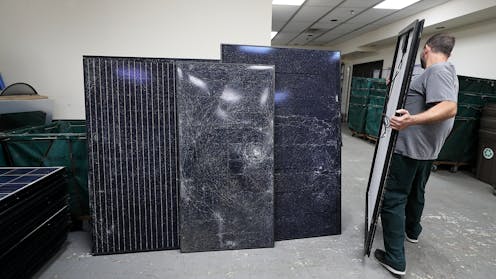
Broken and worn-out solar panels can be recycled, but it’s not easy. Suzanne Kreiter/The Boston Globe via Getty Images

It’s hard work soaking up sunlight to generate clean electricity. After about 25 to 30 years, solar panels wear out. Over the years, heating and cooling cycles stress the materials. Small cracks develop, precipitation corrodes the frame and layers of materials can start to peel apart.

In 2023, about 90% of old or faulty solar panels in the U.S. ended up in landfills. Millions of panels have been installed worldwide over the past few decades – and by about 2030, so many will be ready to retire that they could cover about 3,000 football fields.

As an electrical engineer who has studied many aspects of renewable energy, recycling solar panels seems like a smart idea, but it’s complicated. Built to withstand years of wind and weather, solar panels are designed for strength and are not easy to break down.

A vast field of solar panels.
All of these solar panels will need to be disposed of one day – perhaps by being recycled.
David McNew/Getty Images

The cost conundrum

Sending a solar panel to a landfill costs between US$1 and $5 in the U.S. But recycling it can cost three to four times as much, around $18. And the valuable materials inside solar panels, such as silver and copper, are in small amounts, so they’re worth about $10 to $12 – which makes recycling a money-losing prospect. Improvements in the recycling process may change the economics.

But for now, it’s even hard to reclaim the glass in solar panels. Many layers are glued together and need to be separated before they can be melted down for reuse. And if the separation is not precise enough, the glass that is recovered won’t be of high enough quality to use in making other solar panels or windows. It will be suitable only for lower-quality uses such as fill material in construction projects.

Other panels, usually older ones, may contain small amounts of toxic metals such as lead or cadmium. It can be difficult to tell whether toxic materials are present, though. Even experts have trouble, in part because current tests, such as the toxicity characteristic leaching procedure, can give inaccurate results. Therefore, many companies that own large numbers of solar panels just assume their panels are hazardous waste, which increases costs for both disposal and recycling. Clearer labels would help people know what a solar panel contains and how to handle it.

If someone wants to recycle a solar panel, and is willing to bear the cost, there aren’t many places in the U.S. that are willing to do it and are equipped to be safe about it.

People in reflective vests and protective clothing use tools to take apart a large item.
Recycling solar panels can involve detailed manual labor.
AP Photo/Gregory Bull

Designing for a new life

Despite the Trump administration’s cuts to subsidies for solar projects, millions of solar panels are already in use in the U.S., and millions more are expected to be installed worldwide in the coming years. As a result, the solar industry is working on ways to minimize waste and repeatedly reuse materials.

Some ideas include sending used solar panels that still work at least a bit to developing nations, or even reusing them within the U.S. But there are not clear rules or processes for connecting reused panels to the power grid, so reuse tends to happen in less common, off-grid situations rather than becoming widespread.

Future solar panels could also be designed for easier recycling, using different construction methods and materials, and improved processing systems.

Making panels last longer – perhaps as long as 50 years – using more durable materials, weather-resistant components, real-time monitoring of panel performance and predictive maintenance to replace parts before they wear out would reduce waste significantly.

Building solar panels that are more easily disassembled into separate components made of different materials could also speed recycling. Components that fit together like Lego bricks – instead of using glue – or dissolvable sealants and adhesives could be parts of these designs.

Improved recycling methods could also help. Right now, panels are often simply ground up, mixing all of their components’ materials together and requiring a complicated process to separate them out again for reuse. More advanced approaches can extract individual materials with high purity. For example, a process called salt etching can recover over 99% of silver and 98% of silicon, at purity levels that are appropriate for high-end reuse, potentially even in new solar panels, without using toxic acids. That method can also recover significant quantities of copper and lead for use in new products.

A person uses a shovel to reach into a large bin of crushed material.
Crushing solar panels can make different materials easier to recover from various components.
AP Photo/Gregory Bull

A shared journey

Increasing the practice of recycling solar panels has more than just environmental benefits.

Over the long term, recovering and reusing valuable materials may prove more cost-effective than continually buying new raw materials on the open market. That could lower costs for future solar panel installations. If they are fully reused, the value of these recoverable materials could reach over $15 billion globally by 2050.

In addition, recycling panels and components reduces American reliance on materials imported from overseas, making solar power projects less vulnerable to global disruptions.

Recycling also keeps toxic materials out of landfills. That can help ensure a shift to clean energy doesn’t create new or bigger environmental problems. Also, recycling solar panels emits far less carbon dioxide than manufacturing panels from raw materials.

There are already some efforts underway to boost solar panel recycling. The Solar Energy Industries Association trade group is working to collect and share information about companies that recycle solar panels.

Governments can provide tax breaks or other financial incentives for using recycled materials, or ban disposing of solar panels in landfills. California, Washington, New Jersey and North Carolina have enacted laws or are studying ways to manage solar panel waste, with some even requiring recycling or reuse.

These efforts are important steps toward addressing the growing need for solar panel recycling and promoting a more sustainable solar industry.

The Conversation

Anurag Srivastava receives funding from the US Department of Energy and National Science Foundation to work on renewable energy integration into the grid. He is an IEEE Fellow and member of the IEEE Power and Energy Society and CIGRE working groups.

ref. Why recycling solar panels is harder than you might think − an electrical engineer explains – https://theconversation.com/why-recycling-solar-panels-is-harder-than-you-might-think-an-electrical-engineer-explains-259115

How weather changes cause migraines – a neurologist explains the triggers and what you can do to ease the pain

Source: The Conversation – USA (3) – By Danielle Wilhour, Assistant Professor of Neurology, University of Colorado Anschutz Medical Campus

Migraines can be debilitating – and frustrating when triggered by weather you can’t control. fizkes/iStock/Getty Images Plus

“Is it just me, or is there a storm coming?”

If you are one of the 39 million Americans in the U.S. living with migraines, there’s a good chance an intense headache will begin when the weather shifts.

You aren’t alone. Studies find 30% to 50% of people with migraines identify some type of weather change as a trigger, making it the most commonly reported migraine source.

Yet, it’s also one of the most puzzling.

Some people are more sensitive to weather

As a neurologist and headache specialist practicing in Colorado, a place with frequent weather shifts, patients often tell me that weather is one of their biggest migraine triggers. The results can disrupt work, school and social plans, and create a sense of helplessness.

Doctors still don’t fully understand why some brains are more sensitive to environmental changes.

What we do know is that people with migraines have especially sensitive nervous systems, and that certain environmental changes – like shifts in air pressure, temperature, humidity and air quality – can activate pathways in the brain that lead to pain.

What’s going on in the brain during migraines? TEDx.

Key ways weather can trigger migraines

Weather triggers can vary from person to person, but there are a few common migraine culprits:

Barometric pressure changes, or changes in atmospheric pressure, are among the most commonly cited triggers.

When a storm system moves in, the air pressure drops. Some scientists believe this change may affect the pressure inside your head or how blood vessels in your brain dilate and constrict.

One theory is that changes in barometric pressure may cause a small imbalance in the pressure between the inside of your skull and the outside environment. That might directly stimulate pain-sensitive nerves in the head, triggering inflammation and the start of a migraine.

Others point to inflammation, the way the brain processes sensory input, and changes in serotonin levels – which play a key role in activating migraine.

Temperature extremes, with very hot or very cold days, or sudden changes in temperature, can throw off the body’s internal balance. High humidity or rapid shifts in moisture levels can have a similar effect.

Air pollutants like ozone and nitrogen dioxide can cause inflammation in the nerves that play a role in migraines.

Bright sunlight can also be especially bothersome, likely due to heightened sensitivity to light and an overactive visual processing system in the brain.

Lightning and strong winds may also be linked to migraine attacks in certain individuals.

In short, weather changes can act as stressors on a brain that’s already wired to be more sensitive. The exact triggers and responses vary from person to person, but the research suggests that the interaction between weather and our biology plays a significant role for a subset of patients with migraines.

Steps you can take to reduce the pain

You can’t change the weather, but you can be proactive. Here are a few tips to help weather-proof your migraine routine:

  1. Track your migraines and watch the forecast: Use a migraine diary or app to track when attacks occur, along with weather conditions. Patterns may emerge, such as attacks a day before rain or during temperature changes, that will allow you to adjust your schedule or medication plan.

  2. Develop healthy eating, sleeping and exercise habits: Dehydration, poor sleep and skipped meals can magnify the effects of weather triggers, so keeping your body on an even keel helps reduce vulnerability. Regular exercise and a healthy diet can also help.

  3. Create a migraine-friendly environment: On days when the sun is harsh or the humidity is high, stay inside. Sunglasses, eye masks or even blue-light glasses can be helpful. Some people find that certain earplugs are able to reduce pressure changes felt in the middle ear.

  4. Try meditation, mindfulness techniques or biofeedback, which teaches people to moderate their physiological responses, such as muscle responses and breathing. These strategies can help your nervous system become less reactive over time, which can be especially helpful when dealing with uncontrollable triggers like weather.

  5. Consider pretreatment: If you know a storm is likely to trigger your migraines, you can keep rescue medications close by or even preemptively treat yourself during weather events.

  6. Look into preventive treatment: If weather triggers frequent migraines, talk to your health care provider about preventive treatments – medications, supplements or neuromodulation devices – which can be used on a regular basis to reduce migraine occurrence.

The bigger picture

It’s important to remember that while weather can be a trigger, it’s rarely the only one. Migraine is usually the result of a perfect storm of factors: genetic susceptibility, hormones, stress, sleep, food and, yes, the weather.

That’s why identifying your personal triggers and building a plan, if necessary, with the support of a medical provider, can make a big difference in managing migraines.

Weather-related migraine can be one of the most frustrating triggers because it feels completely out of your hands. However, with knowledge, tracking and the right treatment strategies, you can take back a sense of control.

The Conversation

Danielle Wilhour does not work for, consult, own shares in or receive funding from any company or organization that would benefit from this article, and has disclosed no relevant affiliations beyond their academic appointment.

ref. How weather changes cause migraines – a neurologist explains the triggers and what you can do to ease the pain – https://theconversation.com/how-weather-changes-cause-migraines-a-neurologist-explains-the-triggers-and-what-you-can-do-to-ease-the-pain-258899

The AI therapist will see you now: Can chatbots really improve mental health?

Source: The Conversation – USA (3) – By Pooja Shree Chettiar, Ph.D. Candidate in Medical Sciences, Texas A&M University

Chatbot ‘therapists’ use artificial intelligence to mimic real-life therapeutic conversations. Pooja Shree Chettiar/ChatGPT, CC BY-SA

Recently, I found myself pouring my heart out, not to a human, but to a chatbot named Wysa on my phone. It nodded – virtually – asked me how I was feeling and gently suggested trying breathing exercises.

As a neuroscientist, I couldn’t help but wonder: Was I actually feeling better, or was I just being expertly redirected by a well-trained algorithm? Could a string of code really help calm a storm of emotions?

Artificial intelligence-powered mental health tools are becoming increasingly popular – and increasingly persuasive. But beneath their soothing prompts lie important questions: How effective are these tools? What do we really know about how they work? And what are we giving up in exchange for convenience?

Of course it’s an exciting moment for digital mental health. But understanding the trade-offs and limitations of AI-based care is crucial.

Stand-in meditation and therapy apps and bots

AI-based therapy is a relatively new player in the digital therapy field. But the U.S. mental health app market has been booming for the past few years, from apps with free tools that text you back to premium versions with an added feature that gives prompts for breathing exercises.

Headspace and Calm are two of the most well-known meditation and mindfulness apps, offering guided meditations, bedtime stories and calming soundscapes to help users relax and sleep better. Talkspace and BetterHelp go a step further, offering actual licensed therapists via chat, video or voice. The apps Happify and Moodfit aim to boost mood and challenge negative thinking with game-based exercises.

Somewhere in the middle are chatbot therapists like Wysa and Woebot, using AI to mimic real therapeutic conversations, often rooted in cognitive behavioral therapy. These apps typically offer free basic versions, with paid plans ranging from US$10 to $100 per month for more comprehensive features or access to licensed professionals.

While not designed specifically for therapy, conversational tools like ChatGPT have sparked curiosity about AI’s emotional intelligence.

Some users have turned to ChatGPT for mental health advice, with mixed outcomes, including a widely reported case in Belgium where a man died by suicide after months of conversations with a chatbot. Elsewhere, a father is seeking answers after his son was fatally shot by police, alleging that distressing conversations with an AI chatbot may have influenced his son’s mental state. These cases raise ethical questions about the role of AI in sensitive situations.

Back view of a person using a meditation app on a smartphone.
Guided meditation apps were one of the first forms of digital therapy.
IsiMS/E+ via Getty Images

Where AI comes in

Whether your brain is spiraling, sulking or just needs a nap, there’s a chatbot for that. But can AI really help your brain process complex emotions? Or are people just outsourcing stress to silicon-based support systems that sound empathetic?

And how exactly does AI therapy work inside our brains?

Most AI mental health apps promise some flavor of cognitive behavioral therapy, which is basically structured self-talk for your inner chaos. Think of it as Marie Kondo-ing, the Japanese tidying expert known for helping people keep only what “sparks joy.” You identify unhelpful thought patterns like “I’m a failure,” examine them, and decide whether they serve you or just create anxiety.

But can a chatbot help you rewire your thoughts? Surprisingly, there’s science suggesting it’s possible. Studies have shown that digital forms of talk therapy can reduce symptoms of anxiety and depression, especially for mild to moderate cases. In fact, Woebot has published peer-reviewed research showing reduced depressive symptoms in young adults after just two weeks of chatting.

These apps are designed to simulate therapeutic interaction, offering empathy, asking guided questions and walking you through evidence-based tools. The goal is to help with decision-making and self-control, and to help calm the nervous system.

The neuroscience behind cognitive behavioral therapy is solid: It’s about activating the brain’s executive control centers, helping us shift our attention, challenge automatic thoughts and regulate our emotions.

The question is whether a chatbot can reliably replicate that, and whether our brains actually believe it.

A user’s experience, and what it might mean for the brain

“I had a rough week,” a friend told me recently. I asked her to try out a mental health chatbot for a few days. She told me the bot replied with an encouraging emoji and a prompt generated by its algorithm to try a calming strategy tailored to her mood. Then, to her surprise, it helped her sleep better by week’s end.

As a neuroscientist, I couldn’t help but ask: Which neurons in her brain were kicking in to help her feel calm?

This isn’t a one-off story. A growing number of user surveys and clinical trials suggest that cognitive behavioral therapy-based chatbot interactions can lead to short-term improvements in mood, focus and even sleep. In randomized studies, users of mental health apps have reported reduced symptoms of depression and anxiety – outcomes that closely align with how in-person cognitive behavioral therapy influences the brain.

Several studies show that therapy chatbots can actually help people feel better. In one clinical trial, a chatbot called “Therabot” helped reduce depression and anxiety symptoms by nearly half – similar to what people experience with human therapists. Other research, including a review of over 80 studies, found that AI chatbots are especially helpful for improving mood, reducing stress and even helping people sleep better. In one study, a chatbot outperformed a self-help book in boosting mental health after just two weeks.

While people often report feeling better after using these chatbots, scientists haven’t yet confirmed exactly what’s happening in the brain during those interactions. In other words, we know they work for many people, but we’re still learning how and why.

AI chatbots don’t cost what a human therapist costs – and they’re available 24/7.

Red flags and risks

Apps like Wysa have earned FDA Breakthrough Device designation, a status that fast-tracks promising technologies for serious conditions, suggesting they may offer real clinical benefit. Woebot, similarly, runs randomized clinical trials showing improved depression and anxiety symptoms in new moms and college students.

While many mental health apps boast labels like “clinically validated” or “FDA approved,” those claims are often unverified. A review of top apps found that most made bold claims, but fewer than 22% cited actual scientific studies to back them up.

In addition, chatbots collect sensitive information about your mood metrics, triggers and personal stories. What if that data winds up in third-party hands such as advertisers, employers or hackers, a scenario that has occurred with genetic data? In a 2023 breach, nearly 7 million users of the DNA testing company 23andMe had their DNA and personal details exposed after hackers used previously leaked passwords to break into their accounts. Regulators later fined the company more than $2 million for failing to protect user data.

Unlike clinicians, bots aren’t bound by counseling ethics or privacy laws regarding medical information. You might be getting a form of cognitive behavioral therapy, but you’re also feeding a database.

And sure, bots can guide you through breathing exercises or prompt cognitive reappraisal, but when faced with emotional complexity or crisis, they’re often out of their depth. Human therapists tap into nuance, past trauma, empathy and live feedback loops. Can an algorithm say “I hear you” with genuine understanding? Neuroscience suggests that supportive human connection activates social brain networks that AI can’t reach.

So while in mild to moderate cases bot-delivered cognitive behavioral therapy may offer short-term symptom relief, it’s important to be aware of their limitations. For the time being, pairing bots with human care – rather than replacing it – is the safest move.

The Conversation

Pooja Shree Chettiar does not work for, consult, own shares in or receive funding from any company or organization that would benefit from this article, and has disclosed no relevant affiliations beyond their academic appointment.

ref. The AI therapist will see you now: Can chatbots really improve mental health? – https://theconversation.com/the-ai-therapist-will-see-you-now-can-chatbots-really-improve-mental-health-259360

Wildfire smoke can make your outdoor workout hazardous to your health – an exercise scientist explains how to gauge the risk

Source: The Conversation – USA (3) – By John C. Quindry, Professor of Integrative Physiology and Athletic Training, University of Montana

Air pollution from wildfire smoke can worsen heart and lung disease. helivideo/iStock via Getty Images Plus

As the summer’s sunny days take hold, many people turn to outdoor exercise.

But in parts of North America, pleasant weather often aligns with wildfire season. As summers get drier, both the frequency and the intensity of wildfires have grown, producing more polluting smoke.

A fire’s smoke can spread across several states, leaving people at risk for the health consequences of air pollution.

Exercisers and health experts are asking whether the benefits of outdoor exercise are negated when the skies are hazy with wildfire smoke.

How does air pollution make people sick?

Air pollution’s components depend on its source. For instance, traffic-related air pollution consists largely of vehicle exhaust and brake and tire wear, while industrial pollution contains significant amounts of ozone.

Wildfires produce huge quantities of airborne particles, also called fine particulate matter. These particles are less than 2.5 micrometers in diameter – about a tenth the size of a pollen grain.

Particles of that size, which air quality experts refer to as PM2.5, raise serious health concerns because they are tiny enough to be carried to the air sacs in the deepest parts of the lungs. From there, they can cross into the blood stream, leading to bodywide inflammation – essentially, the immune system’s fight response – which can promote or aggravate multiple chronic illnesses.

Research shows that long-term exposure to wildfire smoke is linked to lung diseases, heart disease and other conditions. Since these illnesses take decades to develop, scientists think that the health problems caused by wildfire smoke inhalation accumulate after years of exposure.

One-time smoke exposures may have cumulative effects

My research team and others are investigating how short-term smoke exposure might also influence long-term health outcomes such as heart and lung diseases.

Particulate matter from wildfire smoke can aggravate chronic illnesses.

To estimate the effects of exposure from a single fire event, environmental scientists can study a variety of factors such as immune system markers of inflammation, signs of physiologic stress and changes in heart, blood vessel and nervous system function. How exactly smoke exposures worsen disease is still poorly understood, but these immediate responses in the body may also be linked to developing chronic disease.

In a study published in June 2025, my colleagues and I examined these outcomes in healthy participants who exercised during a wildfire simulation in our air inhalation lab. The air was filtered to contain high concentrations of PM2.5 particles produced by burning local pine trees – the equivalent to being downwind of a major wildfire.

We asked 20 generally healthy participants in their mid-20s to exercise on a stationary cycle at about half their maximum effort for two hours while breathing the smoke. We found that participants’ blood vessel and nervous system function declined immediately after their smoky exercise session. These stress indicators bounced back to normal within an hour of returning to a clean air environment.

Half of our study participants had a heightened response to physiological stress, which scientists think may signify a heightened risk of chronic diseases. We selected them based on a stress test administered before the experiment: Specifically, their blood pressure spiked when their hands were dipped in ice water for two minutes. The stress-responsive participants experienced significantly stronger declines in blood vessel and nervous system function than people in the typical response group, suggesting that exercise in a very smoky climate may affect some people more than others.

While it isn’t possible to predict who is most at risk, our study underscores the need to think carefully about exposure to wildfire smoke.

How smoky is too smoky for outdoor exercise?

Unfortunately, precise air quality thresholds based on factors such as age and medical condition do not exist. But some simple guidelines and considerations can help.

The first step is to check the air quality where you live at the government website AirNow. It uses a scale called the Air Quality Index, created by the Environmental Protection Agency in 1999 – which ranks air quality regionally on a scale from 0 to 500. The website is searchable by ZIP code. The reading for a given region reflects the contribution of several pollutants, including PM2.5 levels.

Scale for interpreting AirNow air quality readings
The Air Quality Index ranks air quality at six levels.
U.S. Environmental Protection Agency

When the air quality is ranked “good,” the decision is simple – get out there and enjoy the outdoors. And there is little debate that people should generally limit their outdoor exposure when air quality levels cross into the “unhealthy” threshold – or at least be aware that doing so poses health risks.

The risks and benefits of exercising outdoors when air quality is in the “moderate” and “unhealthy for sensitive” ranges are less clear, particularly for people who don’t have chronic health conditions.

Gauging your risk

One major factor in deciding when and whether to exercise outdoors is your health status. AirNow recommends that people with chronic conditions err on the side of caution and remain indoors when smoke levels cause the air quality rating to approach the “unhealthy for sensitive” category.

That advice may be obvious for people with diagnosed lung conditions such as asthma or chronic obstructive pulmonary disease, given that particles from wildfire smoke aggravate the lungs. But studies suggest it’s true for milder disease states, too. For example, a large study of people with elevated but not clinically high blood pressure indicated that those who lived downwind of air pollution were more likely to develop high blood pressure and, ultimately, heart disease.

Another consideration is the time of day. As the afternoon heats up, the column of air we breathe expands, diluting the particulate counts. And afternoon winds frequently blow stagnant air out of the valleys and downtown areas where particulate matter can concentrate during the cooler parts of the day. That means evening workouts may be safer than early-morning ones, though direct confirmation with air quality readings is key.

Also important is the intensity at which you exercise. Higher-intensity exercise means deeper, more frequent breathing, which likely elevates your exposure to harmful air. So you might choose a shorter jog over a longer run when air quality is moderate or poor.

My lab is currently working to quantify how much pollution a person breathes in while exercising in smoky conditions, based on their exercise intensity, exercise duration and local particulate counts. This line of research is still in its infancy, but our early findings and other published research suggest that when wildfire smoke puts air quality into the “moderate” and “unhealthy for sensitive” range, people can dial down the effects of smoke exposure by decreasing their exercise intensity or the time they spend outside.

The Conversation

John C. Quindry received funding from the United States Department of Agriculture Forest Service and the National Institutes of Health – INBRE/RAIN.

ref. Wildfire smoke can make your outdoor workout hazardous to your health – an exercise scientist explains how to gauge the risk – https://theconversation.com/wildfire-smoke-can-make-your-outdoor-workout-hazardous-to-your-health-an-exercise-scientist-explains-how-to-gauge-the-risk-255812