Are there thunderstorms on Mars? A planetary scientist explains the red planet’s dry, dusty storms

Source: The Conversation – USA – By Nilton O. Rennó, Professor of Climate and Space Sciences Engineering, University of Michigan

Mars doesn’t get rain like Earth does, but dust storms are common on the red planet. NASA/JPL-Caltech/Univ. of Arizona

Curious Kids is a series for children of all ages. If you have a question you’d like an expert to answer, send it to CuriousKidsUS@theconversation.com.


Are there thunderstorms on Mars? – Cade, age 7, Houston, Texas

Mars is a very dry planet with very little water in its atmosphere and hardly any clouds, so you might not expect it to have storms. Yet, there is lightning and thunder on Mars – although not with rain, nor with the same gusto as weather on Earth.

More than 10 years ago, my planetary science colleagues and I found the first evidence for lightning strikes on Mars. In the following decade, other researchers have continued to study what lightning might be like on the red planet. In November 2025, a Mars rover first captured the spectacular sounds of lightning sparking on the Martian surface.

A large cone of dust rising out of a desert.
Mars dust storms are many times larger and taller than this large terrestrial dust devil photographed in a valley near Las Vegas.
Fernando Saca, University of Michigan

Lightning on Mars

On Earth, lightning is an electric discharge that begins inside big clouds.

But because Mars is so dry, it doesn’t have clouds of water – instead, it has clouds of dust. With little water to weigh down dirt on Mars, dust clouds can quickly grow into huge, windy dust storms a few times taller than Earth’s tallest thunderstorms.

When smaller dust particles and larger sand particles collide with each other while being whipped around by these storms, they pick up a static charge. Smaller dust particles take on a positive charge, while larger sand particles become negative. The smaller dust particles are lighter and will float higher, while the heavier sand tends to fall closer to the ground.

Because oppositely charged particles don’t like to be apart, eventually the energy building between the negative charges higher up in the dust storm and the positive charges closer to the ground becomes too great and is released as electricity – similar to lightning.

The air around the electricity rapidly warms up and expands – on Earth, this creates the shock waves that you hear as thunder.

Nobody has seen a flash of lightning on Mars, but we suspect it’s more like the glow from a neon light rather than a powerful lightning bolt. The atmosphere near the surface of Mars is about 100 times less dense than on Earth: It’s much more similar to the air inside neon lights.

An overhead photo of a storm moving across the Martian surface, trailing a dark line.
The dust devil shown creates a dark track as it lifts the small and brighter dust particles.
Mars Global Surveyor/NASA/JPL/Malin Space Science Systems

Releasing radio waves

Besides shock waves and visible light, lightning also produces other types of waves that the human eye can’t see: X-ray and radio waves. The ground and the top of the atmosphere both conduct electricity well, so they guide these radio waves and cause them to produce signals with specific radio frequencies. It’s kind of like how you might tune into specific radio channels for news or music, but instead of different channels, scientists can identify the radio waves coming from lightning.

While nobody has ever seen visible light from Martian lightning, we have heard something similar to the radio waves created by lightning on Earth. That’s the noise that the Perseverance rover reported at the end of 2025. They sound like electric sparks do on Earth. The rover recorded these signals on a microphone as small, sandy tornadoes passed by.

a gif of a tall, thin column of dust moving across a rocky landscape.
A dust devil travels across the Martian landscape.
NASA/JPL-Caltech, CC BY

Searching for Martian lightning

When my colleagues and I went hunting for lightning on Mars a decade ago, we knew the red planet emitted more radio waves during dust storm seasons. So, we searched for modest increases in radio signals from Mars using the large radio dishes that NASA uses to talk to its spacecraft. The dishes function like big ears that listen for faint radio signals from spacecraft far from Earth.

We spent from five to eight hours every day listening to Mars for three weeks. Eventually, we found the signals we were looking for: radio bursts with frequencies that matched up with the radio waves that lightning on Earth can create.
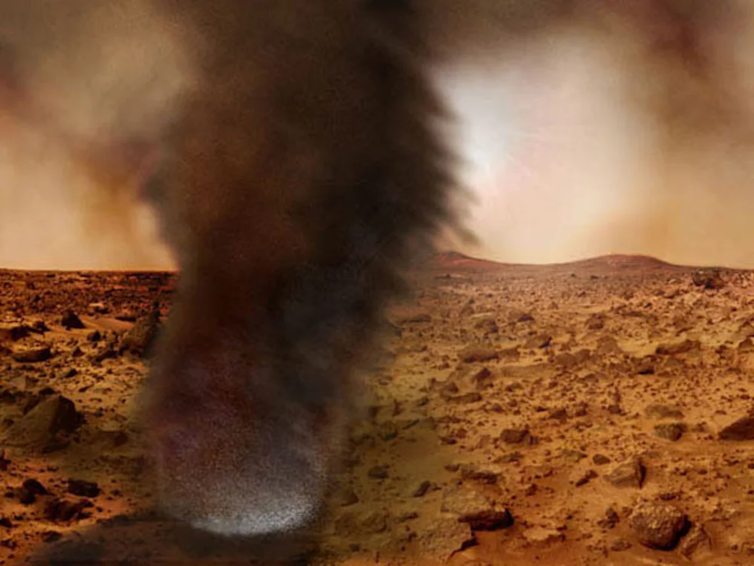
An illustration of a dark cloud crossing a desert.
Artistic impression of a glowing dust devil on Mars. Instead of lightning, electric discharges on Mars dust storms are expected to produce a glow-like discharge like that illustrated in the bottom of this dust devil.
Nilton Renno, University of Michigan

To find the particular source of these lightning-like signals, we searched for dust storms in pictures taken by spacecraft orbiting Mars. We matched a dust storm nearly 25 miles (40 kilometers) tall to the time when we’d heard the radio signals.

Learning about lightning on Mars helps scientists understand whether the planet could have once hosted extraterrestrial life. Lightning may have helped create life on Earth by converting molecules of nitrogen and carbon dioxide in the atmosphere into amino acids. Amino acids make up proteins, tens of thousands of which are found in a human body.

So, Mars does have storms, but they’re far drier and dustier than the thunderstorms on Earth. Scientists are continually studying lightning on Mars to better understand the geology of the red planet and its potential to host living organisms.


Hello, curious kids! Do you have a question you’d like an expert to answer? Ask an adult to send your question to CuriousKidsUS@theconversation.com. Please tell us your name, age and the city where you live.

And since curiosity has no age limit – adults, let us know what you’re wondering, too. We won’t be able to answer every question, but we will do our best.

The Conversation

Nilton O. Rennó receives funding from NASA, JPL, DARPA, and IARPA.

ref. Are there thunderstorms on Mars? A planetary scientist explains the red planet’s dry, dusty storms – https://theconversation.com/are-there-thunderstorms-on-mars-a-planetary-scientist-explains-the-red-planets-dry-dusty-storms-271364

An ultrathin coating for electronics looked like a miracle insulator − but a hidden leak fooled researchers for over a decade

Source: The Conversation – USA – By Mahesh Nepal, Ph.D. Student in Electrical Engineering, Binghamton University, State University of New York

Tiny insulating layers inside electronics help store charge so computers can run smoothly. bee32/iStock via Getty Images

When your winter jacket slows heat escaping your body or the cardboard sleeve on your coffee keeps heat from reaching your hand, you’re seeing insulation in action. In both cases, the idea is the same: keep heat from flowing where you don’t want it. But this physics principle isn’t limited to heat.

Electronics use it too, but with electricity. An electrical insulator stops current from flowing where it shouldn’t. That’s why power cords are wrapped in plastic. The plastic keeps electricity in the wire, not in your hand.

A hand holding a takeaway coffee cup with a cardboard sleeve and a bundle of copper wires covered in plastic coating.
From coffee sleeves to wire coatings, insulators slow unwanted flow. In daily life, that’s heat flow. In electronics, it’s the flow of electricity.
Joe Christensen/iStock via Getty Images; Jose A. Bernat Bacete/Moment via Getty Images

Inside electronics, insulators do more than keep the user safe. They also help devices store charge in a controlled way. In that role, engineers often call them dielectrics. These insulating layers sit at the heart of capacitors and transistors. A capacitor is a charge-storing component – think of it as a tiny battery, albeit one that fills up and empties much faster than a battery. A transistor is a tiny electrical switch. It can turn current on or off, or control how much current flows.

Together, capacitors and transistors make modern electronics work. They help phones store information, and they help computers process it. They help today’s AI hardware move huge amounts of data at high speed.

What surprises most people is how thin these insulating, current-quelling dielectrics are. In modern microchips, key dielectric layers can be only a few nanometers thick. That’s tens of thousands of times thinner than a human hair. A modern phone can contain billions of transistors, so at that scale, slimming them down by even 1 nanometer can make a difference.

As an electrical and material scientist, I work with my adviser, Tara P. Dhakal, at Binghamton University to understand how to make these insulating layers as thin as possible while preserving their reliability.

Thinner dielectrics don’t just shrink devices. They can also help store more charge. But at such scale, electronics get finicky. Sometimes what looks like a breakthrough isn’t quite what it seems. That’s why our focus is not just making dielectrics thin. It’s making them both thin and trustworthy.

What makes one dielectric better than another?

In both capacitors and transistors, the basic structure is simple: They contain two conductors separated by a thin insulator. If you bring the conductors closer, more charge can build up. It’s like two strong magnets with a sheet between them – the thinner the sheet, the stronger the pull.

But thinning has a limit. In transistors, the classic insulator silicon dioxide loses its ability to insulate at about 1.2 nanometers. At that scale, electrons can sneak through a shortcut called quantum tunneling. Enough charge leaks through that the device is no longer practical.

When materials are so thin that they start to leak, engineers have another lever. They can switch to an insulator that stores more charge without being made extremely thin. That ability is described by a metric called the dielectric constant, written as k. Higher-k materials can achieve that storage with a thicker layer, which makes it much harder for electrons to slip through.

For example, silicon dioxide has k of about 3.9, and aluminum oxide has k of about 8, twice as high. If a 1.2-nanometer silicon dioxide layer leaks too much, you can switch to a 2.4-nanometer aluminum oxide layer and get roughly the same charge storage. Because the film is physically thicker, it won’t leak as much.

The breakthrough that wasn’t

In 2010, a team of researchers at Argonne National Laboratory reported something that sounded almost impossible: They’d made an ultrathin coating that apparently had a giant dielectric constant, near 1,000. The material wasn’t a single new compound. It was a nanolaminate – a microscopic layer cake. In nanolaminates, you stack two materials in repeating A-B-A-B layers, hoping their interfaces create properties neither material has on its own.

A diagram showing a microscope shot of alternating thin layers and a photo of a layer cake with alternating layers of cake and frosting.
An electron microscope view shows the repeating layers in a nanolaminate coating. It’s a bit like a cake – thin layers stacked on top of each other.
Mahesh Nepal and Dmytro Hrushchenko/iStock via Getty Images

In that work, the stack alternated aluminum oxide, with a k of about 8, and titanium oxide, with a k of about 40. The researchers built the stack by growing one molecular layer at a time, which is ideal for building and controlling the nanometer-scale layers in a nanolaminate.

When the team made each sublayer less than a nanometer, it found that the entire material was able to hold an incredible amount of charge – thus, the giant k.

The result triggered years of follow-up work and similar reports in other stacks of oxides.

But there’s a twist. In our recent study of the aluminum oxide/titanium oxide nanolaminate system, we found that the apparent giant k value was a measurement error.

In our study, the nanolaminate wasn’t acting like a clean insulator, and it was leaking enough to inflate the k value. Think of a bucket with a hairline crack: You keep pouring, and it seems like the bucket holds a lot, even though the water won’t stay inside.

Once we figured that a leak was behind the giant k result, we set out to solve the larger puzzle. We wanted to know what makes the nanolaminate leak, and what process change could make it truly insulating.

The culprit

We first looked for an obvious culprit: a visible defect. If a film stack leaks, you expect pinholes or cracks. But the nanolaminate looked smooth and continuous under the microscope. So why would a stack that looks solid fail?

The answer wasn’t in the shape, it was in the chemistry. The earliest aluminum oxide sublayers didn’t contain enough aluminum. That meant the film looked continuous, yet was still incomplete at the atomic scale. Electrons could find connected paths and escape through it. It was physically continuous but electrically leaky.

Our process to create these films, called atomic layer deposition, uses tiny, repeatable cycles. You add in two chemicals, one after the other. Each pair is one cycle. For aluminum oxide, the pair is often trimethylaluminium (TMA), which is the aluminum source, and water, which is the oxygen source. Together, they create the aluminum oxide, and one cycle adds roughly a single layer of material – about one-tenth of a nanometer. By repeating the cycles, you can grow the film to the thickness you need: about 10 cycles for 1 nanometer, 25 cycles for 2.5 nanometers, and so on.

But there’s a catch. When you deposit aluminum oxide on top of titanium oxide, the first chemical for aluminum oxide – TMA – can steal oxygen from the titanium oxide layer below. This issue removes some of the sites the aluminum source normally reacts with on the layer’s surface. So, the first aluminum oxide layer doesn’t grow evenly and ends up with less aluminum than it should have.

That problem leaves tiny weak spots where electrons can slip through and cause leakage. Once the aluminum oxide becomes thick enough – around 2 nanometers – it forms a more complete barrier, and those leakage paths are effectively sealed off.

One small change flipped the outcome. We kept the same aluminum source, TMA, but swapped the oxygen source. Instead of water, we used ozone. Ozone is a stronger oxygen source, so it can replace oxygen that gets pulled out during the TMA step. That shut down leakage paths. The aluminum oxide then behaved like a real barrier, even when it was thinner than a nanometer. With the ozone fix, the nanolaminate acted like a true insulator.

The takeaway is simple: When you’re down to a few atomic layers, chemistry can matter as much as thickness. The types of chemical compounds you use can decide whether those early layers become a real barrier or leave behind leakage paths.

The Conversation

Mahesh Nepal does not work for, consult, own shares in or receive funding from any company or organization that would benefit from this article, and has disclosed no relevant affiliations beyond their academic appointment.

ref. An ultrathin coating for electronics looked like a miracle insulator − but a hidden leak fooled researchers for over a decade – https://theconversation.com/an-ultrathin-coating-for-electronics-looked-like-a-miracle-insulator-but-a-hidden-leak-fooled-researchers-for-over-a-decade-272009

For 80 years, the president’s party has almost always lost House seats in midterm elections, a pattern that makes the 2026 congressional outlook clear

Source: The Conversation – USA – By Robert A. Strong, Senior Fellow, Miller Center, University of Virginia

Who will be in the majority in Congress after the midterm elections? Douglas Rissing/iStock/Getty Images Plus

Now that the 2026 midterm elections are less than a year away, public interest in where things stand is on the rise. Of course, in a democracy no one knows the outcome of an election before it takes place, despite what the pollsters may predict.

Nevertheless, it is common for commentators and citizens to revisit old elections to learn what might be coming in the ones that lie ahead.

The historical lessons from modern midterm congressional elections are not favorable for Republicans today.

Most of the students I taught in American government classes for over 40 years knew that the party in control of the White House was likely to encounter setbacks in midterms. They usually did not know just how settled and solid that pattern was.

Since 1946, there have been 20 midterm elections. In 18 of them, the president’s party lost seats in the House of Representatives. That’s 90% of the midterm elections in the past 80 years.

Measured against that pattern, the odds that the Republicans will hold their slim House majority in 2026 are small. Another factor makes them smaller. When the sitting president is “underwater” – below 50% – in job approval polls, the likelihood of a bad midterm election result becomes a certainty. All the presidents since Harry S. Truman whose job approval was below 50% in the month before a midterm election lost seats in the House. All of them.

Even popular presidents – Dwight D. Eisenhower, in both of his terms; John F. Kennedy; Richard Nixon; Gerald Ford; Ronald Reagan in 1986; and George H. W. Bush – lost seats in midterm elections.

The list of unpopular presidents who lost House seats is even longer – Truman in 1946 and 1950, Lyndon B. Johnson in 1966, Jimmy Carter in 1978, Reagan in 1982, Bill Clinton in 1994, George W. Bush in 2006, Barack Obama in both 2010 and 2014, Donald Trump in 2018 and Joe Biden in 2022.

Exceptions are rare

There are only two cases in the past 80 years where the party of a sitting president won midterm seats in the House. Both involved special circumstances.

In 1998, Clinton was in the sixth year of his presidency and had good numbers for economic growth, declining interest rates and low unemployment. His average approval rating, according to Gallup, in his second term was 60.6%, the highest average achieved by any second-term president from Truman to Biden.

Moreover, the 1998 midterm elections took place in the midst of Clinton’s impeachment, when most Americans were simultaneously critical of the president’s personal behavior and convinced that that behavior did not merit removal from office. Good economic metrics and widespread concern that Republican impeachers were going too far led to modest gains for the Democrats in the 1998 midterm elections. The Democrats picked up five House seats.

The other exception to the rule of thumb that presidents suffer midterm losses was George W. Bush in 2002. Bush, narrowly elected in 2000, had a dramatic rise in popularity after the Sept. 11 attacks on the World Trade Center and the Pentagon. The nation rallied around the flag and the president, and Republicans won eight House seats in the 2002 midterm elections.

Those were the rare cases when a popular sitting president got positive House results in a midterm election. And the positive results were small.

An electronic vote tally with a close vote of 217 to 214 to pass a bill.
The final – and close – tally of the House of Representatives’ vote on President Donald Trump’s tax bill on July 3, 2025.
Alex Wroblewski / AFP via Getty Images

Midterms matter

In the 20 midterm elections between 1946 and 2022, small changes in the House – a shift of less than 10 seats – occurred six times. Modest changes – between 11 and 39 seats – took place seven times. Big changes, so-called “wave elections” involving more than 40 seats, have happened seven times.

In every midterm election since 1946, at least five seats flipped from one party to the other. If the net result of the midterm elections in 2026 moved five seats from Republicans to Democrats, that would be enough to make Democrats the majority in the House.

In an era of close elections and narrow margins on Capitol Hill, midterms make a difference. The past five presidents – Clinton, Bush, Obama, Trump and Biden – entered office with their party in control of both houses of Congress. All five lost their party majority in the House or the Senate in their first two years in office.

Will that happen again in 2026?

The obvious prediction would be yes. But nothing in politics is set in stone. Between now and November 2026, redistricting will move the boundaries of a yet-to-be-determined number of congressional districts. That could make it harder to predict the likely results in 2026.

Unexpected events, or good performance in office, could move Trump’s job approval numbers above 50%. Republicans would still be likely to lose House seats in the 2026 midterms, but a popular president would raise the chances that they could hold their narrow majority.

And there are other possibilities. Perhaps 2026 will involve issues like those in recent presidential elections.

Close results could be followed by raucous recounts and court controversies of the kind that made Florida the focal point in the 2000 presidential election. Prominent public challenges to voting tallies and procedures, like those that followed Trump’s unsubstantiated claims of victory in 2020, would make matters worse.

The forthcoming midterms may not be like anything seen in recent congressional election cycles.

Democracy is never easy, and elections matter more than ever. Examining long-established patterns in midterm party performance makes citizens clear-eyed about what is likely to happen in the 2026 congressional elections. Thinking ahead about unusual challenges that might arise in close and consequential contests makes everyone better prepared for the hard work of maintaining a healthy democratic republic.

The Conversation

Robert A. Strong does not work for, consult, own shares in or receive funding from any company or organization that would benefit from this article, and has disclosed no relevant affiliations beyond their academic appointment.

ref. For 80 years, the president’s party has almost always lost House seats in midterm elections, a pattern that makes the 2026 congressional outlook clear – https://theconversation.com/for-80-years-the-presidents-party-has-almost-always-lost-house-seats-in-midterm-elections-a-pattern-that-makes-the-2026-congressional-outlook-clear-271605

Nigeria’s former election umpire has been appointed an ambassador: why this is a red flag

Source: The Conversation – Africa (2) – By Onyedikachi Madueke, Teaching Assistant, University of Aberdeen

The Nigerian Senate confirmed the appointment of the immediate past chairman of the Independent National Electoral Commission (INEC) as an ambassador in December 2025. This has resurfaced concerns about electoral integrity in the country.

Mahmood Yakubu stepped down as head of the electoral commission just three months prior to the ambassadorial appointment.

As a political scientist with published research on the electoral commission and electoral integrity in Nigeria, I argue that even though the president has a right to make the appointment under Section 171 of the constitution, it is still troubling. There are a number of reasons.

Firstly, it raises questions about institutional neutrality and public trust. It looks like a reward for the way elections were administered.

Yakubu’s tenure as chairman included the controversial 2023 general elections. Questions were raised about the commission’s credibility following logistical failures, technological breakdowns and delayed transmission of results. Though the courts ultimately upheld the declared outcomes, the election’s legitimacy remains hotly debated among citizens, civil society and scholars.

The same electoral umpire has been appointed to a prestigious diplomatic role less than three years after conducting an election that returned the appointing authority to power.

Secondly, it undermines public confidence at a time of rising political disengagement. Nigeria’s democracy is facing a legitimacy challenge driven by civic disillusionment, youth disengagement, and declining trust in institutions. Voter turnout in the 2023 presidential election, roughly 26% of registered voters, was one of the lowest in the country’s democratic history.

Thirdly, it reflects a weakening of institutional checks and legislative oversight. Despite widespread objections, the Senate approved the nomination with minimal dissent. A weak or compliant legislature reduces the institutional safeguards that protect elections from political capture.

Nigeria must strengthen electoral governance. This should include cooling off periods for electoral commission officials, stronger Senate oversight, protected institutional autonomy, and sustained civic re-engagement.

Impartiality and the perception of political reward

Electoral commissions thrive on perceived impartiality as much as on legal independence.

In a region where democratic norms are weakening as seen in Mali, Niger, Burkina Faso, Guinea and others, the perception that electoral officials may receive political rewards, especially if they manipulate the electoral institution to favour a candidate, can further erode trust. It sends a signal, intended or not, that electoral umpires can swiftly take on political roles.

This may influence future behaviour within the electoral commission. It becomes harder to preserve the principle of neutrality.

Ebbing trust in elections

Many Nigerians already believe that the electoral umpire is compromised. A 2023 report revealed that some senior electoral officials were politically affiliated with the ruling party.

A 2023 Afrobarometer report showed that 76% of Nigerians expressed a lack of trust in the commission.

In a recent paper, my colleague and I identified constraints on the commission. These included corruption, lack of adherence to its rules, and lack of independence.

Yakubu’s appointment risks deepening cynicism and feeding narratives of elite collusion.

For a democracy already struggling with fractured trust, where young people question whether voting makes a difference, this symbolic gesture may accelerate disengagement. When citizens lose faith in elections, they may turn to protest or apathy. Worse, they might support anti-democratic alternatives such as military intervention. It’s a trend already visible in Mali, Burkina Faso, Guinea and Niger.

Weakening checks and balances

The Senate’s role in the affair raises equally troubling concerns.

Rather than exercising its constitutional role as a check on executive appointments, the Senate appeared to align seamlessly with the president’s preferences. Most of the nominees were only asked by the Senate to bow and go.

This pattern of legislative passivity, common in Nigeria across all tiers of government, mirrors broader regional trends. Parliaments, whether in Togo, Benin or Senegal, have gradually ceded oversight functions to executives.

When political institutions become less independent, electoral oversight becomes more fragile.

A weak or compliant legislature reduces the institutional safeguards that protect elections from political capture.

The confirmation thus symbolises a gradual erosion of institutional balance. It’s a worrying sign in a region where democratic backsliding is accelerating.

What should be done

Reforms are essential.

In the US and Australia, revolving door laws exist to prevent former senior officials who occupied critical positions of trust from using their positions for political gains. They typically observe a cooling-off period before moving into a role that may risk a conflict of interest.

This norm exists to insulate institutional decisions from the prospect of political favour.

Nigeria currently lacks such a safeguard. Introducing a four- to six-year interval before former electoral commission chairs and commissioners could accept political or diplomatic appointments would bring Nigeria in line with international best practice.

Secondly, politically affiliated individuals must not be appointed to any position in the commission. This reform would protect both the individuals and the institution from allegations of political alignment.

Third, the Senate must reassert its constitutional role. It must subject sensitive appointments to genuine debate, ethical screening, and public interest review.

A credible, independent review, focusing on election logistics, technological failures, communication lapses and institutional pressures, would demonstrate a commitment to learning from past shortcomings. Transparency is the antidote to suspicion.

Preserving electoral integrity requires not only laws but also norms, perceptions and trust.

Across west African states, contested electoral processes and the fear that election administrators may align with political incumbents are increasingly widespread.

Nigeria, often viewed as a democratic anchor, cannot afford to reinforce this troubling pattern.

The Conversation

Onyedikachi Madueke does not work for, consult, own shares in or receive funding from any company or organisation that would benefit from this article, and has disclosed no relevant affiliations beyond their academic appointment.

ref. Nigeria’s former election umpire has been appointed an ambassador: why this is a red flag – https://theconversation.com/nigerias-former-election-umpire-has-been-appointed-an-ambassador-why-this-is-a-red-flag-273529

Ethiopian women and safety: why some switch their ethnic identity when they start working

Source: The Conversation – Africa (2) – By Monica Beeder, Lecturer, University of Southampton

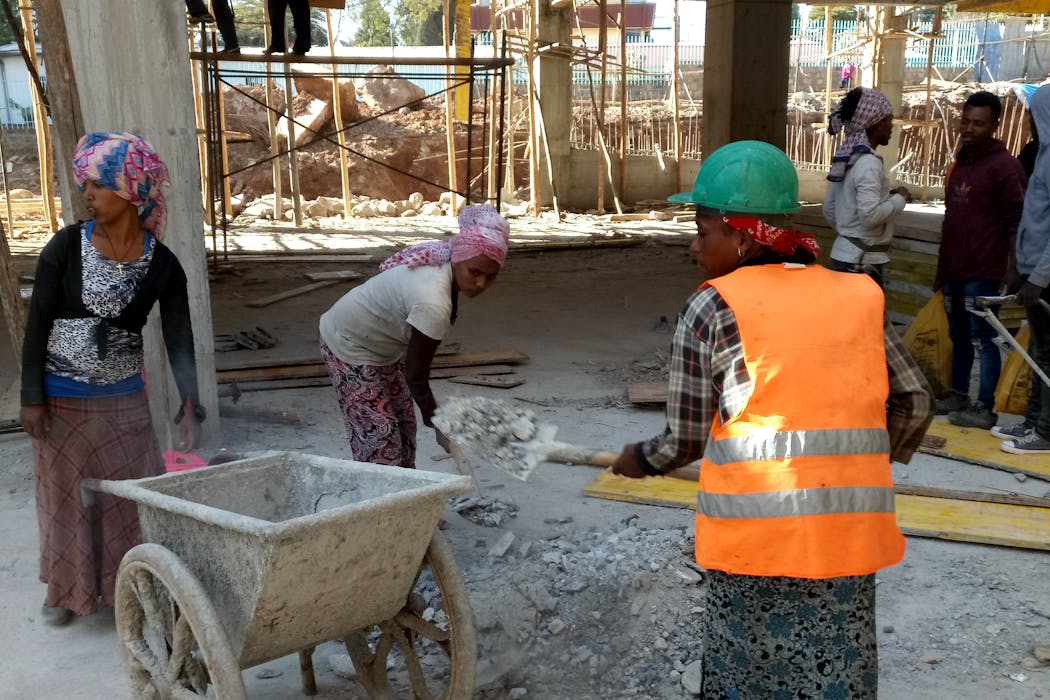
For women entering the formal labour market in Ethiopia, taking a job can expose them to new public spaces and risks. Wikimedia Commons, CC BY

For many women in Ethiopia, getting their first formal job doesn’t just change their income; it can change how they describe who they are in everyday public interactions.

In a country where ethnicity shapes access to opportunities, safety and political rights, this shift is far from small.

That is the provocative finding of our recent study: formal employment can cause women to switch their self-reported ethnicity. We are a team of political scientists and development economists who study labour markets, gender and ethnic identity in Ethiopia. We studied this issue in a recent research project.

We used data from a unique field experiment with 27 firms across five Ethiopian regions, where job offers were randomised among qualified female applicants. This means the firms had more qualified applicants than positions, so eligible women were selected through a lottery system for job offers. We then tracked both women who received a job offer and those who didn’t over multiple survey rounds spanning roughly three years, collecting information on their employment status, earnings, working conditions, daily mobility and commuting patterns, household characteristics, and how they reported their ethnic identity.

What we found was striking. In our full sample of 891 women, around 8% changed their stated ethnicity at some point over the time we followed them. While this may sound like a small share, switching ethnic identity is rare and socially consequential, making this level of change substantial in context.

Women who received a job offer were 4.3 percentage points more likely to switch their stated ethnicity than those who did not. In the comparison group – women who were not offered a job – about 6% changed their stated ethnicity over time. Among women offered a job, this figure rose to around 10%. When we account for who actually took up the job, the effect is even larger.

To some readers, this may sound like a technical result. But in a country where ethnicity shapes politics, social opportunity and daily survival, it is explosive.

Changing one’s ethnic label is not a trivial act. It carries implications for family, community and belonging.

So, why would a job make someone change something so fundamental?

For women entering the formal labour market in Ethiopia, even at low wages, taking a job can reshape their daily routines and expose them to new public spaces and risks. These shifts in mobility and visibility create pressures that women who stay at home may never face.

As they navigate these new environments, some find themselves adjusting not just their schedules, but also how they present and even report their ethnic identity.

By showing that formal employment can lead to ethnic reidentification, our study reveals identity as a living, shifting facet of social life rather than a fixed badge.

As Ethiopia and other African countries pursue industrialisation, labour-market expansion and social mobility, we must pay attention: economic transformation may come with unexpected, and deeply personal, consequences.

Being vulnerable

Our in-depth interviews with women in the two cities with the highest switching in our sample – Dire Dawa in east-central Ethiopia and Hawassa in the southern region – reveal a striking mechanism.

Employment meant commuting through areas where ethnic and, in some cases, ethno-religious tensions were high.

Women told us they felt far more vulnerable on the road than at home, especially if their own ethnicity placed them on the “wrong” side of a local conflict.

As one respondent explained, the decision to switch was driven by practical concerns about personal safety rather than a deeper change in how they saw themselves.

Some women did not adopt the local majority’s identity but switched to a third, more neutral group, one not involved in conflict.

Whether this was possible depended on their appearance, religion and language skills. As several women explained, speaking the correct language allowed them to “pass”, meaning they were perceived as belonging to a safer group while out in public. We cannot say how common this strategy was across all women in our study, but the interviews confirm patterns we also observe in our quantitative data of women switching to a third, neutral ethnicity to navigate local conflicts.

This makes sense in a country experiencing repeated waves of violence. In 2022, more than 40% of all conflict-related deaths worldwide occurred in Ethiopia.

In this kind of context, identity is not static; it becomes a resource.

Our findings challenge common assumptions across economics, the social sciences, and policy. While scholars have long recognised that ethnic identity can be fluid, it is often still treated as something relatively stable in practice, rooted in ancestry or birth.

What our evidence shows is the strategic side of this fluidity. Ethnicity can be consciously adjusted in response to economic conditions, mobility and the risks women face in public spaces.

In other words, identity is not only socially constructed. It can also shift in response to the pressures and incentives created by the work environment.

The protections needed

This raises uncomfortable questions about the global garment industry, which has progressively shifted production from Europe to Asia and is now beginning to extend manufacturing activities to parts of Africa as global value chains are reconfigured in search of lower production costs. Ethiopia has encouraged this growth by developing large industrial parks.

But unlike in long-established manufacturing hubs, there are few safety nets, transport protections or policies designed around local ethnic dynamics.

When women must alter their identity to feel safe on the commute to a low-wage job, something is clearly missing.

Our findings show that when these global industries arrive without adapting to local realities, the burden falls disproportionately on women.

It is not a sign of progress when a woman has to change her identity, even temporarily, to commute safely to a low-paid job. If anything, it calls for a more honest debate about what industrialisation should look like, and what protections are needed for the workers it relies on.

This also raises more profound questions about belonging and dignity. Is changing your ethnic identity an act of personal agency – or a sign of social pressure and insecurity? What does it say about everyday life when your safety depends on how you present yourself while travelling to work?

Imagine having to change the language you speak on the bus – or even the surname you give when introducing yourself – just to avoid trouble on your way to work.

While not all women faced situations this extreme, the very possibility of needing such strategies illustrates the pressures created by moving through tense public spaces.

The Conversation

The research team received funding from the Norwegian Research Council to collect data for this study.

ref. Ethiopian women and safety: why some switch their ethnic identity when they start working – https://theconversation.com/ethiopian-women-and-safety-why-some-switch-their-ethnic-identity-when-they-start-working-271325

Getting into university is only the first hurdle for students from rural South Africa. Here’s what comes next

Source: The Conversation – Africa – By Hellen Agumba, Senior lecturer, University of Johannesburg

As universities in South Africa prepare to admit a new group of students, thousands of young people from rural parts of the country hope for a life-changing opportunity.

In 2023, public universities enrolled 258,778 first-time students. Demand is intense; for example, the University of Johannesburg received 358,992 applications for just 10,500 first-year spaces in 2025.

A substantial proportion of these new students come from economically disadvantaged backgrounds. The National Student Financial Aid Scheme (NSFAS) is often the only key to unlocking post-school education. The scheme supports students from families earning less than R350,000 a year (about US$21,000) and has a target of 850,000 students. It is supposed to cover fees, accommodation, a living allowance, transport and learning materials.

Yet for many rural students, this key fails to turn the lock.

The number of students from rural areas who secure university placements cannot be determined. Neither the Council on Higher Education nor the Department of Higher Education systematically tracks students’ geographic origins. But what research does show is that students from rural areas face challenges beyond financial constraints.


Read more:
How place of birth shapes chances of going to university: evidence from 7 African countries


My research on higher education access and learning experiences, particularly among marginalised students, has explored the reasons and consequences.

The conversation around financial aid rightly focuses on administrative crises: devastating payment delays and operational failures that erode trust. These are human catastrophes. But I’ve found that for rural students, these problems are only the tip of the iceberg. Beneath lies a deeper web of challenges.

Financial aid is crucial but it cannot compensate for systemic disadvantages that begin long before students reach campus and persist throughout their studies.

My research, involving in-depth interviews with rural students, shows the “hidden costs” they bear. Their struggle begins with limited access to information. This constrains their educational choices. Then they may not feel really comfortable to participate in the classroom and make social connections. And their financial situation influences both academic performance and social belonging.

Even when rural students graduate, many describe feeling they have survived higher education rather than thrived in it.

The experiences they shared with me reveal how these challenges interconnect throughout their university journey. Their stories also point to ways of improving rural students’ participation in higher education.

Listening to rural students

My qualitative study consisted of in-depth interviews and focus group discussions with 18 rural students (10 of them female), aged 19-25 at a university in Johannesburg. All participants came from former homeland areas across four provinces – the Eastern Cape, KwaZulu-Natal, Limpopo and Mpumalanga – a pattern reflecting apartheid’s enduring geographic legacy. They were studying fields ranging from education to engineering; 13 of the 18 were first-generation university students, and all were Black African. Their demographic profile was typical of deeply rural students accessing higher education through programmes like NSFAS.

The deliberate selection criteria and consistency of their experiences reveals systemic patterns.

One of the participants, Philip (all names have been changed) from Limpopo, described the sheer physical distance of his home from university:

I pass Polokwane (a city 320km from Johannesburg) and go deep to the rural villages until Giyani (a small town over 150km further on) … then from Giyani I have to catch a taxi to my village … you are far away from universities.

While urban students attend open days to learn about the courses on offer and careers, those in remote villages are left in the dark. As one participant, Terry, observed:

During open day for UJ (University of Johannesburg) … it’s mostly model C schools.“ (These are better resourced high schools which were reserved for white learners during apartheid.) I have never seen someone (there) from rural background.

This isolation limits career awareness to visible rural professions like teaching and nursing.

Sef’s story is telling:

I didn’t know anything about the courses offered … I only know teaching and these professions that you see in the village.

After a costly false start, she found her path to engineering only through a chance family conversation.

In South Africa, many students scrape together a registration fee, gambling that full funding will materialise. And without guidance on accommodation deadlines, they might arrive in the city to find university residences full and be forced into expensive or unsafe private housing.

Jane explained:

We will come and look for accommodation in February … When we get there, we find that the residence is already full.

While universities technically provide accommodation information, it is often buried in lengthy online registration documents that assume students have reliable internet access and familiarity with university processes.


Read more:
South African students still don’t feel safe on campus: how protection can be stepped up


The result is a financial strain from day one. For students like Kate, who was mugged commuting from distant, off-campus housing, the consequences are academic and psychological:

At the end of the year, I didn’t pass that well and as a result I lost my sponsor.

Upon arrival, they face a second battle: cultural and geographic alienation. They enter a space privileging urban, middle-class norms. Participants spoke of being teased for their accents and dress.


Read more:
How class and social capital affect university students


As Ann from the Eastern Cape put it:

Nobody cares … you get to know people from other tribes, people from other races … some of things they do you don’t understand.

Language becomes a profound barrier to participation. Philip shared:

I would want to participate … but eish! English … I’m not confident enough.

The curriculum itself can feel alienating, with examples drawn from unfamiliar urban contexts. Terry, an engineering student, noted:

Sometimes they teach about some events you have never heard of … that’s where they kill us.


Read more:
Universities need to take note of the gap between expectations and experience


It takes more than cash

This brings us back to NSFAS. Its administrative failures hit rural students hardest.

For a student who barely registered, a delayed allowance is a crisis. It means missing lectures, relying on food parcels, and impossible choices between education and supporting families.


Read more:
South Africa’s university students face a crisis: nearly a third go hungry


Ann described the strain:

Since January we’re still waiting … Sometimes I don’t have money to come to school. I have to miss lectures.

The funding, when it comes, doesn’t cover the true cost. It ignores higher travel costs, expensive data to compensate for remoteness, and the burden of unexpected private accommodation.


Read more:
Distance learning changes lives, but comes with its own challenges


The higher education system has focused too long on the narrow goal of access: getting students through the gate. True equity is about ensuring they can thrive as peers inside. The current student financing model is a blunt remedy: it provides cash but leaves the underlying structures of exclusion untouched.

How to change it

My research suggests some steps that could help rural students.

Fix the fundamentals with rural students in mind: Students need a competent, reliable financial aid scheme. Payment timelines must be guaranteed, with emergency support for rural students during delays.


Read more:
South Africa’s student debt trap: two options that could help resolve the problem


Early outreach: Universities and government must take information to deep rural areas through mobile career services and application support long before final high school exams that determine university entrance.

Fund the full experience: Bursary calculations must be nuanced to cover the real, higher costs borne by rural students, including travel, data and safe accommodation.

Create culturally inclusive campuses: Universities must actively combat assumptions that rural students are “underprepared” or “lacking” essential skills. They can do this through staff training, peer mentorship, and curricula that value different kinds of knowledge.


Read more:
We asked university students to tell their own stories in photos: here’s why


The dreams of rural students are stifled by a system blind to their reality. Ensuring timely funding is the bare minimum. They need a system that doesn’t just let them in but truly welcomes them and sets them up for success.

The Conversation

Hellen Agumba received funding from the National Research Fund (NRF). The grant was awarded for her PhD Studies.

ref. Getting into university is only the first hurdle for students from rural South Africa. Here’s what comes next – https://theconversation.com/getting-into-university-is-only-the-first-hurdle-for-students-from-rural-south-africa-heres-what-comes-next-271532

‘We got lazy and complacent’: Swedish pensioners explain how abolishing the wealth tax changed their country

Source: The Conversation – UK – By Miranda Sheild Johansson, Senior Research Fellow in Social Anthropology, UCL

‘A country of rich people’: a superyacht with helicopter on board heads into Stockholm’s harbour. M-Production/Shutterstock

For much of the 20th century, Sweden enjoyed a justifiable reputation as one of Europe’s most egalitarian countries. Yet over the past two decades, it has transformed into what journalist and author Andreas Cervenka calls a “paradise for the super-rich”.

Today, Sweden has one of the world’s highest ratios of dollar billionaires, and is home to numerous “unicorn” startup companies worth at least US$1 billion (£742 million), including the payment platform Klarna and audio streaming service Spotify.

The abolition of the wealth tax (förmögenhetsskatten) 20 years ago is part of this story – along with, in the same year, the introduction of generous tax deductions for housework and home improvement projects. Two decades on, the number of Swedish homes that employ cleaners is one marker of it being an increasingly two-tier country.

As part of my anthropological research into the social relationships that different tax systems produce, I have been working with pensioners in the southern suburbs of Sweden’s capital, Stockholm, to learn how they feel about the decreasing levels of taxation in their later lives.

This trend has been coupled with a gradual shrinking of the welfare state. Many of my interviewees regret that Sweden no longer has a collective project to build a more cohesive society.

“Us pensioners can see the destruction of what we built, what was started when we were small children,” Kjerstin, 74, explained. “I was born after the end of the war and built this society through my life, together with my fellow citizens. [But] with taxes being lowered and the taking away of our social security … we’re not building anything together now.”

Sweden’s gini coefficient, the most common way to measure inequality, has reached 0.3 in recent years (with 0 reflecting total equality and 1 total inequality), up from around 0.2 in the 1980s. The EU as a whole is at 0.29. “There are now 42 billionaires in Sweden – it’s gone up a lot,” Bengt, 70, told me. “Where did they come from? This didn’t used to be a country where people could easily become this rich.”

But like other pensioners I met, Bengt acknowledged his peer group’s role in this shift. “I belong to a generation that remembers how we built Sweden to become a welfare state, but so much has changed. The thing is, we didn’t protest this. We didn’t realise we were becoming this country of rich people.”

Opposite of the American dream

Wealth taxation was introduced in Sweden in 1911, with the amount due based initially on a combination of wealth and income. Around the same time, some of the first moves towards the Swedish welfare state were made – notably, the introduction of the state pension in 1913.

The term used to describe this, folkemmet (“the people’s home”), denoted comfort and security for all in equal measure. It was arguably the ideological opposite of the American dream – its aims not exceptionalism but reasonable living standards and universal services.

After the second world war, the wealth tax – now separated from income – was raised again in several steps up to a historical high of a 4% marginal rate for wealthy individuals in the 1980s, although actual tax burden is is less clear due to complex exemption rules. But total revenues generated from the tax were still relatively low. As a share of Sweden’s annual GDP, it never exceeded 0.4% in the postwar period.

By the end of the 1980s, the political winds were starting to change in Sweden, in line with the shift to privatisation of public services and deregulation of financial markets in several European countries, including the UK under Margaret Thatcher, and the US.

One recurrent criticism of Sweden’s wealth tax was that it was regressive, taxing middle-class wealth (mainly housing and financial assets) while exempting the wealthiest people who owned large firms or held high-up positions in listed companies. Another criticism was that the wealth tax drove tax avoidance, especially in the form of capital flight to offshore tax havens.

While a wealth tax might appear to signal their country’s commitment to socioeconomic equality, my interviewees said it wasn’t something they really thought about much until it was abolished in 2006 by Sweden’s then-rightwing government, following the axing of inheritance tax a year earlier by the previous social democratic government.

“When the wealth tax was abolished,” Marianne, 77, told me, “I wasn’t thinking about millionaires being given a handout, because … we didn’t have lots of rich aristocrats who owned everything. Abolishing the wealth and inheritance tax seemed like a practical thing, not so political.”

Marianne and other pensioners I talked to all told a story of the welfare state having been built through communal effort, as opposed to it being a Robin Hood project – of taking from the rich to give to the poor. This notion of the Swedish welfare state as having been built by equals, by an initial largely rural and poor population, arguably distracted these pensioners from questions of wealth accumulation.

While Sweden still taxes property and various forms of capital income, in hindsight, many of my elderly interviewees now regard the abolition of the wealth tax “on their watch” as a crucial step in reshaping Swedish society away from a social democracy welfare state towards something new – a place of billionaires and increased social disintegration.

“I think about my children, my two daughters who are working and have young families,” Jan, 72, told me. “As children, they were provided for by the welfare state, they went to good schools and had access to football and drama class and the dentist – but now I worry that society is going to get worse for them.”

As with others I spoke to, Jan showed regret at his own role in this change. “I now think that is partly my fault,” he said. “We got lazy and complacent, thought the Swedish welfare state was secure, didn’t worry about abolishing the wealth tax, didn’t think it was going to change anything … but I think it has.”

‘A society that is more humane’

My research suggests the impacts of wealth taxes, or absence of them, are not only about fiscal revenue streams and wealth redistribution. They have wider social ramifications, and can be foundational to people’s vision of society.

Only three European countries currently levy a whole wealth tax: Norway, Spain and Switzerland. In addition, France, Italy, Belgium and the Netherlands impose wealth taxes on selected assets, but not on an person’s overall wealth.

In Sweden at least, the question today isn’t just whether wealth taxes work or not, but about what kind of society they project – one of folkhemmet, or a paradise for the rich.

“Tax was just natural [when] I grew up in the 1950s,” Kjerstin recalled. “I remember thinking when I was in second grade, that I will always be taken care of, that I didn’t ever have to worry.”

Reflecting on how different living in Sweden feels today, she said: “Now people don’t want to pay tax – sometimes even I don’t want to pay tax. Everyone is thinking about what they get back and how to get rich, instead of about building something together.”

“I don’t think you can say: ‘I pay this much in taxes and therefore I should get the same back.’ Instead, you should pay attention to the fact that you live in a society that is more humane, where everyone knows from second grade they’ll be taken care of.”

Names of research participants have been changed.

The Conversation

Miranda Sheild Johansson receives funding from UK Research And Innovation.

ref. ‘We got lazy and complacent’: Swedish pensioners explain how abolishing the wealth tax changed their country – https://theconversation.com/we-got-lazy-and-complacent-swedish-pensioners-explain-how-abolishing-the-wealth-tax-changed-their-country-272041

Why we love literary anniversaries

Source: The Conversation – UK – By Amy Wilcockson, Research Fellow, English Literature, Queen Mary University of London

Last year marked 250 years since the birth of the English novelist Jane Austen. The Conversation celebrated this important literary milestone with a series of articles and a dedicated podcast, Jane Austen’s Paper Trail. This special year saw a variety of high-profile celebratory events across the country, from regency balls and film screenings, to special tours and literary talks.

But literary anniversaries are not just limited to famous and well-loved authors, however significant. Many dates pass us by unmarked, despite the fact that we are in the midst of a golden era of key dates of literary significance.

The 2020s has been a decade of major Romantic-period milestones, including the bicentenaries of the deaths of the poets John Keats (2021), Percy Bysshe Shelley (2022), and Byron (2024). Last year’s Austen anniversary was particularly notable because the writer was so widely and enthusiastically celebrated.

Yet it also was the centenary year of F. Scott Fitzgerald’s jazz-age classic The Great Gatsby, alongside Virginia Woolf’s modernist favourite Mrs Dalloway. Brideshead Revisited by Evelyn Waugh, George Orwell’s Animal Farm and Nancy Mitford’s The Pursuit of Love all turned 80, while children’s classic The Lion, The Witch and the Wardrobe by C.S. Lewis celebrated its 75th birthday.

Celebrating in 2026

In 2026 there is another slew of big anniversaries, marking the tercentenary of Jonathan Swift’s Gulliver’s Travels, and 200 years since the ever-relevant Mary Shelley’s The Last Man (her 1826 novel about the near extinction of humanity after a global plague) was first released.

A.A. Milne’s Winnie-the-Pooh first indulged in his favourite “hunny” in 1926, and it was the start of Agatha Christie’s reign as queen of crime, as the immensely popular The Murder of Roger Ackroyd captured the public imagination.

Fifty years later her last novel, Sleeping Murder, was published posthumously, after her death on January 12 1976. Special re-issues of Christie’s books, new audiobook recordings, lectures, conferences, Netflix adaptations, and even a major British Library exhibition have been organised to celebrate some of these momentous literary milestones.

Anne Rice’s Interview with a Vampire, which reshaped the genre with a more complex, nuanced portrayal of the archetypal character, also celebrates 50 years since its 1976 publication.

But why do we celebrate literary anniversaries? Why do museums, academics and the public rush to commemorate our favourite authors? And why do some authors receive more celebration than others?

First, literary anniversaries are significant as they create a shared sense of heritage and a feeling of unity within communities and cultures. As Shakespeare scholars Monika Smialkowska and Edmund G.C. King observed when considering the Bard’s many anniversary celebrations: “Each event has also been an occasion for the community commemorating him to celebrate itself.”

In 2016, when British and global audiences commemorated the 400th anniversary of Shakespeare’s death, gala concerts, special coins and exhibitions were the tip of the iceberg. Shakespeare represents to many the pinnacle of British culture and many believe his plays are vital as they allow us to examine ourselves and our place in the world.

General historical events don’t seem to capture the public imagination in the same way. And of course, major authors like Shakespeare and Austen become universal. They are not just a symbol of British culture, their fame and embodiment of “Britishness” have gone global. Shakespeare has been recognised by and claimed as a part of American, European, African and wider global contexts.

For instance, the Jane Austen Society of Aotearoa New Zealand celebrated its tenth anniversary last year. Marking anniversaries allow us to build connections not just with the time period or world that the author has built, but with fellow enthusiasts through shared interests in particular genres, texts and authors. We celebrate not just the writers, but our own personal, national and global networks and cultures too.

Nostalgia and literary tourism

Literary anniversaries are also a prime example of nostalgia – of thinking that a place, event or period from the past is preferable to the present. Rituals such as anniversary celebrations are the physical embodiment of this feeling.

This is why enthusiasts dress up in the costumes of the Regency period or in military attire – to transport themselves back to a less complex time, perhaps. By reading an author’s books, visiting their house, and seeing the quills and pens with which they wrote, visitors are similarly invited to step back into the past and into the writer’s world.

It is no surprise then that literary museums put on huge events to mark particularly important author milestones. Literary tourism is growing, with Travel Weekly noting that Austen tourism in particular is – obviously – popular at the moment.

While final visitor figures have not yet been released, a spokesperson for the Jane Austen’s House museum stated that they expected to have surpassed their usual annual 40,000 visitors in 2025.

These anniversaries are of course a global draw, with entire marketing campaigns built around significant dates. For example, 2017 was not only coined by Visit Britain as a Year of Literary Heroes, but an interactive Magical Britain campaign and map were also launched to celebrate 20 years since the the first Harry Potter book.

Anniversaries of popular books and authors boost the local and national economy as visitors flood to visit locations from the author’s writings, as well as their birthplaces, homes and graves.

But why do some authors stick in the public imagination more than others? Author and academic H.J. Jackson notes in her book on Romantic reputations that recognition usually begins with a collected edition of the author’s work, before interest develops into biographies, translations and adaptations. The texts become taught in schools, societies are named in the author’s honour, and then finally anniversary celebrations commence to celebrate their great achievements.

According to Jackson, authors need to win over different audiences to be successful and gain worldwide renown. Given their solid and wide-reaching appeal, I have little doubt we will still be celebrating Keats, Austen, Orwell and Christie in a hundred years’ time.


Looking for something good? Cut through the noise with a carefully curated selection of the latest releases, live events and exhibitions, straight to your inbox every fortnight, on Fridays. Sign up here.


The Conversation

Amy Wilcockson does not work for, consult, own shares in or receive funding from any company or organisation that would benefit from this article, and has disclosed no relevant affiliations beyond their academic appointment.

ref. Why we love literary anniversaries – https://theconversation.com/why-we-love-literary-anniversaries-273375

Humans returned to British Isles earlier than previously thought at the end of the last ice age

Source: The Conversation – UK – By Adrian Palmer, Senior Lecturer, Geography, Royal Holloway, University of London

The return of humans to the British Isles after the end of the last ice sheet, which covered much of the northern hemisphere, happened around 15,200 years ago – nearly 500 years earlier than previous estimates.

This movement of people coincided with a sharp rise in summer temperatures in southern Britain, research by our group shows.

These environmental conditions allowed humans to migrate back up into Britain – then still connected to the European mainland. They were hunting herds of reindeer and horses, which were migrating northwards into ecosystems that supported their preferred food for grazing.

After the end of the last ice age, the climate in north-west Europe shifted from cold to warm conditions on at least two occasions, with changes in temperature thought to have occurred over decades.

Our latest research addresses the first of these transitions in the Late Upper Palaeolithic period (14,000 to 11,000 years ago). In areas such as north-west Europe, including where the British Isles are today, humans successively abandoned and then returned to areas at the abrupt transitions between cold and warm periods.

Broadly, evidence of humans from fossil records showed them migrating to where the environmental conditions supported their survival.

Reasons for repopulation

The repopulation of the British Isles after the last ice age is an excellent period to explore the relationships between climate and environment, and the reappearance of humans in this region.

In previous studies, the evidence has been somewhat difficult to read due to uncertainty of the dating methods and incomplete records of environmental and climate conditions. The traditional view had been that the north-west European climate warmed from ice-age temperatures around 14,700 years ago, and humans reoccupied Britain at that time.

However, revised preparation techniques in the early 2000s for the dating of human remains and associated artefacts showed the earliest appearance of humans occurred prior to the warming of 14,700 years ago.

This finding was difficult to understand, as it coincided with what were then considered cold glacial climates that would have been unlikely to support the resources people needed to survive in Britain.

Summer climate record from Llangorse Lake, Wales

A graphic showing showing summer temperatures in the British Isles after the last Ice Age.
Graph shows the timing of returns to British Isles of reindeer and humans after the last ice age, and related temperatures in Llangrose Lake.
Author’s own illustration

Our study used new calibrations of radiocarbon ages that confirmed the age of those human remains to between 15,200 and 15,000 years ago. So, if humans really were present in the British Isles, could they have survived in cold climates – or was our picture of past environments at this time incorrect?

Clearer insight came from Llangorse Lake (Lake Syffadan) in south Wales, where the lake sediments spanning the last 19,000 years record the abrupt climate change in detail. In addition, the lake’s location lies close to the cave in the Wye Valley where the earliest British evidence for human remains after the ice age were found.

By extracting fossil pollen, chironomids (non-biting midges) and chemical analysis of the lake sediments, an unexpected picture of the climate emerged – one that showed previous climate reconstructions for the region were incorrect.

The chironomids were used to reconstruct summer temperature, and this showed the climate warmed in a different pattern than has been identified in other parts of north-west Europe and Greenland. An abrupt temperature shift from 5–7°C to 10–14°C occurred at 15,200 years in Britain – 500 years earlier than previous evidence had suggested.

Just prior to this climate warming, the presence of human prey, such as reindeer and horses, is more consistently detected in southern Britain around 15,500 years ago. These animals were exploiting the newly available grazing grounds, with people tracking the herds northwards and enduring the moderately warmer summer climatic conditions.

Examining archaeological records along with environmental and climatic archives allows more precise reconstructions of when humans were able to repopulate previously inhospitable regions. This is helped by re-evaluating old radiocarbon dates of human evidence in the landscape, and by generating more precise environmental records from the time – including more precise timings of the transitions from cold to warm periods.

This provided us with a fuller picture of human responses to changes in temperature (and their impact on the environment) in the Late Upper Palaeolithic period. Human survival was the driver of these movements, and following prey into new areas was important. But only a relatively small change in summer temperatures was required to enable this migration.

Our research provides better understanding of human behaviour and resilience to climate change after the last ice age around 15,000 years ago. But understanding these environmental triggers from the past helps create new perspectives on human responses to them even now.

These basic factors have not gone away. The response observed in this study might provide clues on future human behaviour as our polar regions warm and glaciers melt, showing how the potential for human migration could be increased.

The Conversation

Adrian Palmer receives funding from Natural Environment Research Council. He is affiliated with Royal Holloway, University of London and Quaternary Research Association.

ref. Humans returned to British Isles earlier than previously thought at the end of the last ice age – https://theconversation.com/humans-returned-to-british-isles-earlier-than-previously-thought-at-the-end-of-the-last-ice-age-271242

Can you really lose weight by cutting gluten from your diet, as Matt Damon claims?

Source: The Conversation – UK – By Guy Guppy, Lecturer in Performance Nutrition and Exercise Physiology, Kingston University

When Matt Damon recently credited his weight loss to going gluten-free, it reignited a familiar debate about this divisive dietary approach. But while The Odyssey star’s claims have sparked discussion, the science behind weight loss tells a far more nuanced story than simply cutting out a single protein.

Gluten is a naturally occurring protein found in grains such as wheat, barley and rye, which means it’s commonly consumed in everyday foods like bread, pasta and cereal. For most people, gluten doesn’t cause any health problems.

But for those with coeliac disease – which affects about 1% of people – avoiding it is essential. This autoimmune condition triggers an immune response to gluten, damaging the small intestine’s lining, impairing nutrient absorption.

Then there’s gluten intolerance, or non-coeliac gluten sensitivity, a condition associated with symptoms like bloating and reflux. People with this condition also commonly experience problems beyond the digestive system, including headaches and skin rashes.

Despite growing numbers of people reporting such symptoms, gluten intolerance remains hotly debated in terms of its causes and management. Currently, the only recommended approach is to adopt a gluten-free diet.

For everyone else – those without coeliac disease or gluten intolerance – avoiding gluten-rich foods may be unnecessary and potentially problematic.

Foods high in gluten, such as bread, pasta and cereal, don’t just provide carbohydrates, they’re also excellent sources of fibre and B vitamins.

Removing these foods may inadvertently contribute towards nutrient deficiencies. Yet the market for gluten-free products continues to surge, with projections suggesting it will reach US$13.7 billion (£10.2 billion) by 2030.

Given that Damon didn’t disclose any medical condition when discussing his weight loss goals, the likely explanation for his results lies in his overall diet and behaviour rather than gluten itself. Research published in Nutrients found no significant differences between gluten-free and gluten-rich diets in body fat or body weight among healthy adults.

Mechanics, not magic

The weight loss many people experience on gluten-free diets often comes down to mechanics rather than magic. Because gluten is in many energy-dense, carbohydrate-based foods, people eliminating it typically cut out items like pizza, fast food and pasta.

This carbohydrate restriction leads to a reduction in glycogen – the stored form of carbohydrate in the human body. When glycogen is stored, water is stored alongside it.

So when glycogen levels drop, water weight follows, creating the illusion of rapid fat loss. This phenomenon explains why people often see dramatic results in the first week or two of any new diet or exercise programme.

Beyond reduced carbohydrate intake, people following gluten-free diets often shift towards consuming more naturally gluten-free whole foods. This dietary restructuring often results in fewer calories being consumed overall.

A small preliminary study, published in Frontiers of Sports and Active Living, found that adhering to a gluten-free diet for six weeks led to significant reductions in body weight compared to a control diet. But these changes were probably the result of a calorie deficit and fluid loss, rather than any metabolic advantage from removing gluten.

There’s another factor at play. Wheat-based carbohydrates contain fermentable sugars called fructans, which are broken down by bacteria in the large intestine. This fermentation produces gas that can cause bloating, pain and changes in bowel movements. When these foods are removed, symptoms subside and the stomach can appear flatter – an aesthetic change that people may mistake for fat loss.

Gluten may have health benefits

Adopting a gluten-free diet that isn’t medically necessary could actually increase health risks. A large study published in the BMJ found an association between higher gluten intake and reduced heart disease risk.

Similarly, research has revealed a link between low gluten intake and increased type 2 diabetes risk.

The culprit behind these concerning links may well be the gluten-free products lining supermarket shelves. When gluten is removed from a product, it changes the texture and palatability of the food. To compensate, manufacturers add other ingredients to improve taste and consistency.

The result? Gluten-free products have been shown to contain significantly less protein, higher saturated fat, lower fibre and higher sugar than their conventional counterparts. Over time, this nutritional profile may lead to poor diets and hence poor health.

So while people may believe that going gluten-free causes weight loss, the reality is usually different. Subtle changes in diet structure and composition, alongside behavioural modifications, are typically the real reason.

The Conversation

Guy Guppy does not work for, consult, own shares in or receive funding from any company or organisation that would benefit from this article, and has disclosed no relevant affiliations beyond their academic appointment.

ref. Can you really lose weight by cutting gluten from your diet, as Matt Damon claims? – https://theconversation.com/can-you-really-lose-weight-by-cutting-gluten-from-your-diet-as-matt-damon-claims-273392