A chance discovery of a 350 million-year-old fossil reveals a new type of ray-finned fish

Source: The Conversation – Global Perspectives – By Conrad Daniel Mackenzie Wilson, PhD candidate in Earth Sciences, Carleton University

An artist’s rendition of the newly discovered fish, _Sphyragnathus tyche_. (C. Wilson), CC BY

In 2015, two members of the Blue Beach Fossil Museum in Nova Scotia found a long, curved fossil jaw, bristling with teeth. Sonja Wood, the museum’s owner, and Chris Mansky, the museum’s curator, found the fossil in a creek after Wood had a hunch.

The fossil they found belonged to a fish that had died 350 million years ago, its bony husk spanning nearly a metre on the lake bed. The large fish had lived in waters thick with rival fish, including giants several times its size. It had hooked teeth at the tip of its long jaw that it would use to trap elusive prey and fangs at the back to pierce it and break it down to eat.

For the last eight years, I have been part of a team under the lead of paleontologist Jason Anderson, who has spent decades researching the Blue Beach area of Nova Scotia, northwest of Halifax, in collaboration with Mansky and other colleagues. Much of this work has been on the tetrapods — the group that includes the first vertebrates to move to land and all their descendants — but my research focuses on what Blue Beach fossils can tell us about how the modern vertebrate world formed.

a man stands agains a tall cliff
Blue Beach Fossil Museum curator Chris Mansky below the fossil cliffs.
(C. Wilson), CC BY

Birth of the modern vertebrate world

The modern vertebrate world is defined by the dominance of three groups: the cartilaginous fishes or chondrichthyans (including sharks, rays and chimaeras), the lobe-finned fishes or sarcopterygians (including tetrapods and rare lungfishes and coelacanths), and the ray-finned fishes or actinopterygians (including everything from sturgeon to tuna). Only a few jawless fishes round out the picture.

This basic grouping has remained remarkably consistent — at least for the last 350 million years.

Before then, the vertebrate world was a lot more crowded. In the ancient vertebrate world, during the Silurian Period (443.7-419.2 MA) for example, the ancestors of modern vertebrates swam alongside spiny pseudo-sharks (acanthodians), fishy sarcopterygians, placoderms and jawless fishes with bony shells.

Armoured jawless fishes had dwindled by the Late Devonian Period (419.2-358.9 MA), but the rest were still diverse. Actinopterygians were still restricted to a few species with similar body shapes.

By the immediately succeeding early Carboniferous times, everything had changed. The placoderms were gone, the number of species of fishy sarcopterygians and acanthodians had cratered, and actinopterygians and chondrichthyans were flourishing in their place.

The modern vertebrate world was born.

a small fish with a long wispy tail
A shortnose chimaera, belonging to the chondrichthyan group of vertebrates.
(Shutterstock)

A sea change

Blue Beach has helped build our understanding of how this happened. Studies describing its tetrapods and actinopterygians have showed the persistence of Devonian-style forms in the Carboniferous Period.

Whereas the abrupt end-Devonian decline of the placoderms, acanthodians and fishy sarcopterygians can be explained by a mass extinction, it now appears that multiple types of actinopterygians and tetrapods survived to be preserved at Blue Beach. This makes a big difference to the overall story: Devonian-style tetrapods and actinopterygians survive and contribute to the evolution of these groups into the Carboniferous Period.

But significant questions remain for paleontologists. One point of debate revolves around how actinopterygians diversified as the modern vertebrate world was born — whether they explored new ways of feeding or swimming first.

three lower jaw bones on the left, two reconstructions of prehistoric fish on the right
Comparing the jawbones of Sphyragnathus, Austelliscus and Tegeolepis.
(C. Wilson), CC BY

The Blue Beach fossil was actinopterygian, and we wondered what it could tell us about this issue. Comparison was difficult. Two actinopterygians with long jaws and large fangs were known from the preceding Devonian Period (Austelliscus ferox and Tegeolepis clarki), but the newly found jaw had more extreme curvature and the arrangement of its teeth. Its largest fangs are at the back of its jaw, but the largest fangs of Austelliscus and Tegeolepis are at the front.

These differences were significant enough that we created a new genus and species: Sphyragnathus tyche. And, in view of the debate on actinopterygian diversification, we made a prediction: that the differences in anatomy between Sphyragnathus and Devonian actinopterygians represented different adaptations for feeding.

Front fangs

To test this prediction, we compared Sphyragnathus, Austelliscus and Tegeolepis to living actinopterygians. In modern actinopterygians, the difference in anatomy reflects a difference in function: front-fangs capture prey with their front teeth and grip it with their back teeth, but back-fangs use their back teeth.

Since we couldn’t observe the fossil fish in action, we analyzed the stress their teeth would experience if we applied force. The back teeth of Sphyragnathus handled force with low stress, making them suited for a role in piercing prey, but the back teeth of Austelliscus and Tegeolepis turned low forces into significantly higher stress, making them best suited for gripping.

We concluded that Sphyragnathus was the earliest actinopterygian adapted for breaking down prey by piercing, which also matches the broader predictions of the feeding-first hypothesis.

Substantial work remains — only the jaw of Sphyragnathus is preserved, so the “locomotion-first” hypothesis was untested. But this represents the challenge and promise of paleontology: get enough tantalizing glimpses into the past and you can begin to unfold a history.

As for the actinopterygians, current research indicates that they first diversified in the Devonian Period and shifted into new roles when the modern vertebrate world was born.

The Conversation

Conrad Daniel Mackenzie Wilson receives funding from the Natural Sciences and Engineering Research Council of Canada, the Ontario Student Assistance Program, and the Society of Vertebrate Paleontology.

ref. A chance discovery of a 350 million-year-old fossil reveals a new type of ray-finned fish – https://theconversation.com/a-chance-discovery-of-a-350-million-year-old-fossil-reveals-a-new-type-of-ray-finned-fish-254246

Why queer-themed shows evoke a bittersweet nostalgia for missed childhood moments

Source: The Conversation – Global Perspectives – By Rena Bivens, Associate Professor of Communication and Media Studies, Carleton University

A scene from Heartstopper — Charlie (played by Joe Locke), left, is a gay teen boy who falls in love with classmate Nick (played by Kit Connor), right.

Imagine suddenly longing for a past you’ve only seen in a show filmed before you were born. Or, reverse that: Imagine wishing you could re-do your childhood while watching a brand new show like Heartstopper, set in the present day.

Heartstopper is a Netflix hit series, jam-packed with queer and trans teens finding love, accented by cute cartoon leaves fluttering across the screen.

Sounds adorable? Yes, but if you came out later in life, grew up in an unsupportive environment or never had a teen romance, the anemoia you feel may be intense.

If you’ve yet to hear the word anemoia, forgive yourself. Anemoia was only recently defined by The Dictionary of Obscure Sorrows as “nostalgia for a time you never experienced.” The growing obsession with what’s known as Y2K core — fashion, music and culture inspired by the 90s and early 2000s — by Gen Z is an example of this kind of intergenerational envy.

Unlike other forms of nostalgia, neuroscientist Felipe De Brigard tells us that anemoia “doesn’t need real memories.” De Brigard explores the darker side of these complex feelings. He says propaganda can misinform people about the past to elicit a longing for a time that may never have existed.

According to De Brigard, given the right material, we can create simulations of possible scenarios in our minds. We might imagine a different present or an alternative past.

Imagining what could have been

While watching Heartstopper‘s love story unfold in our living rooms, we feel happy for the fictional characters, but anger, grief and a dash of betrayal can creep in as well.

For many Heartstopper viewers, the series blends into memories from our real life. Watching queer and trans teens portrayed as ordinary people can feel like a breath of fresh air, especially if these scenes are inconsistent with our own adolescence. According to media studies professor Frederik Dhaenens, Heartstopper also uses cute esthetics that amplify these positive depictions while “soften[ing] the blow of negative experiences” faced by the characters.

a group of teens stand in a family photo style - they are in front of beach changing cabins
The season 3 cast of Heartstopper.
(Netflix)

Memories from our past start to flood through our minds as we watch. We may find ourselves wishing for the queer childhood we never had. If only I was born later, we might think. Viewers may imagine how their lives could have unfolded differently, if only they had better media representation or were surrounded by more liberal perspectives.

Enter queer anemoia: nostalgia for a do-over of an earlier stage of your life in a different time or place. While commonly expressed by queer and trans folks over 40, anyone who harbours some grief over their coming-out process or the lack of acceptance they had growing up may find themselves riding this emotional rollercoaster.

A moment of recognition

Queer anemoia is a moment of recognition. It is the contrast between our imagined teen love and — for many, but of course not all — the real past — lonely and isolated.

The sight of a thriving trans teen like Heartstopper’s Elle could elicit strong feelings for a viewer who transitioned later in life and missed their own girlhood.

Maybe the word trans wasn’t even accessible to help them make sense of their identity.

Thinking about the past is not unusual for queer and trans folks. With some sarcasm, you could call it a hobby. Hey, want to hang out tonight and subject our adolescence and coming-out stories “to the judgment of hindsight?” Media push this exercise further by helping us visualize what could have been.

‘I Kissed a Girl’

Another show described similarly to Heartstopper is the reality TV show I Kissed A Girl. The Guardian described it as “a celebratory, joyful love letter to queerness” and “the sweetest, most touching” show.

two women snuggle together on a couch, they are looking into each other's eyes
A scene from ‘I Kissed A Girl’ reunion show.
I Kissed A Girl

Among a surplus of straight couples in reality TV, I Kissed A Girl is one of only a handful of shows with queer cast members. But perhaps this is shifting. Sociologist Róisín Ryan-Flood and queer historian Amy Tooth Murphy argue that we are undergoing “one of the most dramatic transformations of gender and sexuality in social life in recent decades.”

By portraying lesbians as ordinary people with ordinary desires, I Kissed A Girl contributes to this transformation. Some viewers’ might find their own ideas about what is possible, desirable and even aspirational beginning to change.

Media can model these possibilities for us, which contributes to our identity formation. Feminist and queer theorists agree, arguing that our gender and sexual identities are collectively created, not self-made.

For example, gender studies professor Amira Lundy-Harris explains how when we encounter others in media — novels, film, television — they can help us recognize something about ourselves.

Therefore these mediated identities — these characters on TV — are not just ours. We co-create our identities with a variety of different forms of media, including social media and memoirs. We also do this with other people, including our families and friends. The cultural and political moment we are living in is also part of this collaborative identity-making process.

Late bloomers may feel more anemoia

Queer anemoia is a politically useful feeling. When we compare different cultural moments we may also recognize that we did not learn about our identity in isolation from the rest of the world. Feminist philosopher Sue Campbell has said our feelings require others to help us interpret and make sense of them. Through their characters and stories, media offer us an interpretive context for our feelings to emerge.

Some late bloomers — especially those left feeling confused or surprised by their sexual or gender identities — may blame themselves for going along with a mainstream, heteronormative or cisnormative cultural script without stopping to ask themselves who they really are. It may be hard, at first, to see that our identities are co-created.

A recently released film, Am I Ok? portrays a late bloomer, Lucy, who is 32 when she finally realizes she’s a lesbian. She’s frustrated and disappointed in herself as she tells her best friend, “I should have figured this out by now.”

Unfortunately, the film does not explore other reasons for her predicament — like compulsory heterosexuality — that are no fault of her own.

Close up of a sad white woman in her 30s with brown hair, tears streaming down her face and eyes closed.
Dakota Johnson stars in a film about discovering your sexuality later in life.
(Rotten Tomatoes)

Naming the ‘nostalgia’

British education professor Catherine Lee, who previously taught secondary school under the homophobic Section 28, wrote in The Conversation about how she was filled with regret as she watched the queer teachers in Heartstopper give their students the supportive environment she never could.

Even Heartstopper director Andy Newbery felt queer anemoia before working on the third season. He said:

“I’ve heard it many, many times since, especially from people sort of my age really, about how they wish they’d had a show like this when they were growing up.”

Naming queer anemoia gives us language for these complex, bittersweet feelings. In today’s political climate, cute portrayals of queer and trans love may not continue to grace our screens, but taking our feelings seriously and asking what they tell us about the role of media in our lives must never stop.

The Conversation

Rena Bivens does not work for, consult, own shares in or receive funding from any company or organisation that would benefit from this article, and has disclosed no relevant affiliations beyond their academic appointment.

ref. Why queer-themed shows evoke a bittersweet nostalgia for missed childhood moments – https://theconversation.com/why-queer-themed-shows-evoke-a-bittersweet-nostalgia-for-missed-childhood-moments-259341


How artificial intelligence controls your health insurance coverage

Source: The Conversation – USA (2) – By Jennifer D. Oliva, Professor of Law, Indiana University

Evidence suggests that insurance companies use AI to delay or limit health care that patients need. FatCameraE+ via Getty Images

Over the past decade, health insurance companies have increasingly embraced the use of artificial intelligence algorithms. Unlike doctors and hospitals, which use AI to help diagnose and treat patients, health insurers use these algorithms to decide whether to pay for health care treatments and services that are recommended by a given patient’s physicians.

One of the most common examples is prior authorization, which is when your doctor needs to
receive payment approval from your insurance company before providing you care. Many insurers use an algorithm to decide whether the requested care is “medically necessary” and should be covered.

These AI systems also help insurers decide how much care a patient is entitled to — for example, how many days of hospital care a patient can receive after surgery.

If an insurer declines to pay for a treatment your doctor recommends, you usually have three options. You can try to appeal the decision, but that process can take a lot of time, money and expert help. Only 1 in 500 claim denials are appealed. You can agree to a different treatment that your insurer will cover. Or you can pay for the recommended treatment yourself, which is often not realistic because of high health care costs.

As a legal scholar who studies health law and policy, I’m concerned about how insurance algorithms affect people’s health. Like with AI algorithms used by doctors and hospitals, these tools can potentially improve care and reduce costs. Insurers say that AI helps them make quick, safe decisions about what care is necessary and avoids wasteful or harmful treatments.

But there’s strong evidence that the opposite can be true. These systems are sometimes used to delay or deny care that should be covered, all in the name of saving money.

A pattern of withholding care

Presumably, companies feed a patient’s health care records and other relevant information into health care coverage algorithms and compare that information with current medical standards of care to decide whether to cover the patient’s claim. However, insurers have refused to disclose how these algorithms work in making such decisions, so it is impossible to say exactly how they operate in practice.

Using AI to review coverage saves insurers time and resources, especially because it means fewer medical professionals are needed to review each case. But the financial benefit to insurers doesn’t stop there. If an AI system quickly denies a valid claim, and the patient appeals, that appeal process can take years. If the patient is seriously ill and expected to die soon, the insurance company might save money simply by dragging out the process in the hope that the patient dies before the case is resolved.

Insurers say that if they decline to cover a medical intervention, patients can pay for it out of pocket.

This creates the disturbing possibility that insurers might use algorithms to withhold care for expensive, long-term or terminal health problems , such as chronic or other debilitating disabilities. One reporter put it bluntly: “Many older adults who spent their lives paying into Medicare now face amputation or cancer and are forced to either pay for care themselves or go without.”

Research supports this concern – patients with chronic illnesses are more likely to be denied coverage and suffer as a result. In addition, Black and Hispanic people and those of other nonwhite ethnicities, as well as people who identify as lesbian, gay, bisexual or transgender, are more likely to experience claims denials. Some evidence also suggests that prior authorization may increase rather than decrease health care system costs.

Insurers argue that patients can always pay for any treatment themselves, so they’re not really being denied care. But this argument ignores reality. These decisions have serious health consequences, especially when people can’t afford the care they need.

Moving toward regulation

Unlike medical algorithms, insurance AI tools are largely unregulated. They don’t have to go through Food and Drug Administration review, and insurance companies often say their algorithms are trade secrets.

That means there’s no public information about how these tools make decisions, and there’s no outside testing to see whether they’re safe, fair or effective. No peer-reviewed studies exist to show how well they actually work in the real world.

There does seem to be some momentum for change. The Centers for Medicare & Medicaid Services, or CMS, which is the federal agency in charge of Medicare and Medicaid, recently announced that insurers in Medicare Advantage plans must base decisions on the needs of individual patients – not just on generic criteria. But these rules still let insurers create their own decision-making standards, and they still don’t require any outside testing to prove their systems work before using them. Plus, federal rules can only regulate federal public health programs like Medicare. They do not apply to private insurers who do not provide federal health program coverage.

Some states, including Colorado, Georgia, Florida, Maine and Texas, have proposed laws to rein in insurance AI. A few have passed new laws, including a 2024 California statute that requires a licensed physician to supervise the use of insurance coverage algorithms.

But most state laws suffer from the same weaknesses as the new CMS rule. They leave too much control in the hands of insurers to decide how to define “medical necessity” and in what contexts to use algorithms for coverage decisions. They also don’t require those algorithms to be reviewed by neutral experts before use. And even strong state laws wouldn’t be enough, because states generally can’t regulate Medicare or insurers that operate outside their borders.

A role for the FDA

In the view of many health law experts, the gap between insurers’ actions and patient needs has become so wide that regulating health care coverage algorithms is now imperative. As I argue in an essay to be published in the Indiana Law Journal, the FDA is well positioned to do so.

The FDA is staffed with medical experts who have the capability to evaluate insurance algorithms before they are used to make coverage decisions. The agency already reviews many medical AI tools for safety and effectiveness. FDA oversight would also provide a uniform, national regulatory scheme instead of a patchwork of rules across the country.

Some people argue that the FDA’s power here is limited. For the purposes of FDA regulation, a medical device is defined as an instrument “intended for use in the diagnosis of disease or other conditions, or in the cure, mitigation, treatment, or prevention of disease.” Because health insurance algorithms are not used to diagnose, treat or prevent disease, Congress may need to amend the definition of a medical device before the FDA can regulate those algorithms.

If the FDA’s current authority isn’t enough to cover insurance algorithms, Congress could change the law to give it that power. Meanwhile, CMS and state governments could require independent testing of these algorithms for safety, accuracy and fairness. That might also push insurers to support a single national standard – like FDA regulation – instead of facing a patchwork of rules across the country.

The move toward regulating how health insurers use AI in determining coverage has clearly begun, but it is still awaiting a robust push. Patients’ lives are literally on the line.

The Conversation

Jennifer D. Oliva currently receives funding from NIDA to research the impact of pharmaceutical industry messaging on the opioid crisis among U.S. Military Veterans. She is affiliated with the UCSF/University of California College of the Law, San Francisco Consortium on Law, Science & Health Policy and Georgetown University Law Center O’Neill Institute for National & Global Health Law.

ref. How artificial intelligence controls your health insurance coverage – https://theconversation.com/how-artificial-intelligence-controls-your-health-insurance-coverage-253602

Neuropathic pain has no immediate cause – research on a brain receptor may help stop this hard-to-treat condition

Source: The Conversation – USA (2) – By Pooja Shree Chettiar, Ph.D. Candidate in Medical Sciences, Texas A&M University

Neuropathic pain is experienced both physically and emotionally. Salim Hanzaz/iStock via Getty Images

Pain is easy to understand until it isn’t. A stubbed toe or sprained ankle hurts, but it makes sense because the cause is clear and the pain fades as you heal.

But what if the pain didn’t go away? What if even a breeze felt like fire, or your leg burned for no reason at all? When pain lingers without a clear cause, that’s neuropathic pain.

We are neuroscientists who study how pain circuits in the brain and spinal cord change over time. Our work focuses on the molecules that quietly reshape how pain is felt and remembered.

We didn’t fully grasp how different neuropathic pain was from injury-related pain until we began working in a lab studying it. Patients spoke of a phantom pain that haunted them daily – unseen, unexplained and life-altering.

These conversations shifted our focus from symptoms to mechanisms. What causes this ghost pain to persist, and how can we intervene at the molecular level to change it?

More than just physical pain

Neuropathic pain stems from damage to or dysfunction in the nervous system itself. The system that was meant to detect pain becomes the source of it, like a fire alarm going off without a fire. Even a soft touch or breeze can feel unbearable.

Neuropathic pain doesn’t just affect the body – it also alters the brain. Chronic pain of this nature often leads to depression, anxiety, social isolation and a deep sense of helplessness. It can make even the most routine tasks feel unbearable.

About 10% of the U.S. population – tens of millions of people – experience neuropathic pain, and cases are rising as the population ages. Complications from diabetes, cancer treatments or spinal cord injuries can lead to this condition. Despite its prevalence, doctors often overlook neuropathic pain because its underlying biology is poorly understood.

Person lying on side in bed, eyes closed, possibly grimacing
Neuropathic pain can be debilitating.
Kate Wieser/Moment via Getty Images

There’s also an economic cost to neuropathic pain. This condition contributes to billions of dollars in health care spending, missed workdays and lost productivity. In the search for relief, many turn to opioids, a path that, as seen from the opioid epidemic, can carry its own devastating consequences through addiction.

GluD1: A quiet but crucial player

Finding treatments for neuropathic pain requires answering several questions. Why does the nervous system misfire in this way? What exactly causes it to rewire in ways that increase pain sensitivity or create phantom sensations? And most urgently: Is there a way to reset the system?

This is where our lab’s work and the story of a receptor called GluD1 comes in. Short for glutamate delta-1 receptor, this protein doesn’t usually make headlines. Scientists have long considered GluD1 a biochemical curiosity, part of the glutamate receptor family, but not known to function like its relatives that typically transmit electrical signals in the brain.

Instead, GluD1 plays a different role. It helps organize synapses, the junctions where neurons connect. Think of it as a construction foreman: It doesn’t send messages itself, but directs where connections form and how strong they become.

This organizing role is critical in shaping the way neural circuits develop and adapt, especially in regions involved in pain and emotion. Our lab’s research suggests that GluD1 acts as a molecular architect of pain circuits, particularly in conditions like neuropathic pain where those circuits misfire or rewire abnormally. In parts of the nervous system crucial for pain processing like the spinal cord and amygdala, GluD1 may shape how people experience pain physically and emotionally.

Fixing the misfire

Across our work, we found that disruptions to GluD1 activity is linked to persistent pain. Restoring GluD1 activity can reduce pain. The question is, how exactly does GluD1 reshape the pain experience?

In our first study, we discovered that GluD1 doesn’t operate solo. It teams up with a protein called cerebellin-1 to form a structure that maintains constant communication between brain cells. This structure, called a trans-synaptic bridge, can be compared to a strong handshake between two neurons. It makes sure that pain signals are appropriately processed and filtered.

But in chronic pain, the bridge between these proteins becomes unstable and starts to fall apart. The result is chaotic. Like a group chat where everyone is talking at once and nobody can be heard clearly, neurons start to misfire and overreact. This synaptic noise turns up the brain’s pain sensitivity, both physically and emotionally. It suggests that GluD1 isn’t just managing pain signals, but also may be shaping how those signals feel.

What if we could restore that broken connection?

Resembling paint splatter, a round glob of green, yellow and red is superimposed on each other and surrounded by flecks of these same colors
This image highlights the presence of GluD1, in green and yellow, in a neuron of the central amygdala, in red.
Pooja Shree Chettiar and Siddhesh Sabnis/Dravid Lab at Texas A&M University, CC BY-SA

In our second study, we injected mice with cerebellin-1 and saw that it reactivated GluD1 activity, easing their chronic pain without producing any side effects. It helped the pain processing system work again without the sedative effects or disruptions to other nerve signals that are common with opioids. Rather than just numbing the body, reactivating GluD1 activity recalibrated how the brain processes pain.

Of course, this research is still in the early stages, far from clinical trials. But the implications are exciting: GluD1 may offer a way to repair the pain processing network itself, with fewer side effects and less risk of addiction than current treatments.

For millions living with chronic pain, this small, peculiar receptor may open the door to a new kind of relief: one that heals the system, not just masks its symptoms.

The Conversation

The authors do not work for, consult, own shares in or receive funding from any company or organization that would benefit from this article, and have disclosed no relevant affiliations beyond their academic appointment.

ref. Neuropathic pain has no immediate cause – research on a brain receptor may help stop this hard-to-treat condition – https://theconversation.com/neuropathic-pain-has-no-immediate-cause-research-on-a-brain-receptor-may-help-stop-this-hard-to-treat-condition-256982

The Vera C. Rubin Observatory will help astronomers investigate dark matter, continuing the legacy of its pioneering namesake

Source: The Conversation – USA (2) – By Samantha Thompson, Astronomy Curator, National Air and Space Museum, Smithsonian Institution

The Rubin Observatory is scheduled to release its first images in 2025. RubinObs/NOIRLab/SLAC/NSF/DOE/AURA/B. Quint

Everything in space – from the Earth and Sun to black holes – accounts for just 15% of all matter in the universe. The rest of the cosmos seems to be made of an invisible material astronomers call dark matter.

Astronomers know dark matter exists because its gravity affects other things, such as light. But understanding what dark matter is remains an active area of research.

With the release of its first images this month, the Vera C. Rubin Observatory has begun a 10-year mission to help unravel the mystery of dark matter. The observatory will continue the legacy of its namesake, a trailblazing astronomer who advanced our understanding of the other 85% of the universe.

As a historian of astronomy, I’ve studied how Vera Rubin’s contributions have shaped astrophysics. The observatory’s name is fitting, given that its data will soon provide scientists with a way to build on her work and shed more light on dark matter.

Wide view of the universe

From its vantage point in the Chilean Andes mountains, the Rubin Observatory will document everything visible in the southern sky. Every three nights, the observatory and its 3,200 megapixel camera will make a record of the sky.

This camera, about the size of a small car, is the largest digital camera ever built. Images will capture an area of the sky roughly 45 times the size of the full Moon. With a big camera with a wide field of view, Rubin will produce about five petabytes of data every year. That’s roughly 5,000 years’ worth of MP3 songs.

After weeks, months and years of observations, astronomers will have a time-lapse record revealing anything that explodes, flashes or moves – such as supernovas, variable stars or asteroids. They’ll also have the largest survey of galaxies ever made. These galactic views are key to investigating dark matter.

Galaxies are the key

Deep field images from the Hubble Space Telescope, the James Webb Space Telescope and others have visually revealed the abundance of galaxies in the universe. These images are taken with a long exposure time to collect the most light, so that even very faint objects show up.

Researchers now know that those galaxies aren’t randomly distributed. Gravity and dark matter pull and guide them into a structure that resembles a spider’s web or a tub of bubbles. The Rubin Observatory will expand upon these previous galactic surveys, increasing the precision of the data and capturing billions more galaxies.

In addition to helping structure galaxies throughout the universe, dark matter also distorts the appearance of galaxies through an effect referred to as gravitational lensing.

Light travels through space in a straight line − unless it gets close to something massive. Gravity bends light’s path, which distorts the way we see it. This gravitational lensing effect provides clues that could help astronomers locate dark matter. The stronger the gravity, the bigger the bend in light’s path.

Many galaxies, represented as bright dots, some blurred, against a dark background.
The white galaxies seen here are bound in a cluster. The gravity from the galaxies and the dark matter bends the light from the more distant galaxies, creating contorted and magnified images of them.
NASA, ESA, CSA and STScI

Discovering dark matter

For centuries, astronomers tracked and measured the motion of planets in the solar system. They found that all the planets followed the path predicted by Newton’s laws of motion, except for Uranus. Astronomers and mathematicians reasoned that if Newton’s laws are true, there must be some missing matter – another massive object – out there tugging on Uranus. From this hypothesis, they discovered Neptune, confirming Newton’s laws.

With the ability to see fainter objects in the 1930s, astronomers began tracking the motions of galaxies.

California Institute of Technology astronomer Fritz Zwicky coined the term dark matter in 1933, after observing galaxies in the Coma Cluster. He calculated the mass of the galaxies based on their speeds, which did not match their mass based on the number of stars he observed.

He suspected that the cluster could contain an invisible, missing matter that kept the galaxies from flying apart. But for several decades he lacked enough observational evidence to support his theory.

A woman adjusting a large piece of equipment.
Vera Rubin operates the Carnegie spectrograph at Kitt Peak National Observatory in Tucson.
Carnegie Institution for Science, CC BY

Enter Vera Rubin

In 1965, Vera Rubin became the first women hired onto the scientific staff at the Carnegie Institution’s Department of Terrestrial Magnetism in Washington, D.C.

She worked with Kent Ford, who had built an extremely sensitive spectrograph and was looking to apply it to a scientific research project. Rubin and Ford used the spectrograph to measure how fast stars orbit around the center of their galaxies.

In the solar system, where most of the mass is within the Sun at the center, the closest planet, Mercury, moves faster than the farthest planet, Neptune.

“We had expected that as stars got farther and farther from the center of their galaxy, they would orbit slower and slower,” Rubin said in 1992.

What they found in galaxies surprised them. Stars far from the galaxy’s center were moving just as fast as stars closer in.

“And that really leads to only two possibilities,” Rubin explained. “Either Newton’s laws don’t hold, and physicists and astronomers are woefully afraid of that … (or) stars are responding to the gravitational field of matter which we don’t see.”

Data piled up as Rubin created plot after plot. Her colleagues didn’t doubt her observations, but the interpretation remained a debate. Many people were reluctant to accept that dark matter was necessary to account for the findings in Rubin’s data.

Rubin continued studying galaxies, measuring how fast stars moved within them. She wasn’t interested in investigating dark matter itself, but she carried on with documenting its effects on the motion of galaxies.

A quarter with a woman looking upwards engraved onto it.
A U.S quarter honors Vera Rubin’s contributions to our understanding of dark matter.
United States Mint, CC BY

Vera Rubin’s legacy

Today, more people are aware of Rubin’s observations and contributions to our understanding of dark matter. In 2019, a congressional bill was introduced to rename the former Large Synoptic Survey Telescope to the Vera C. Rubin Observatory. In June 2025, the U.S. Mint released a quarter featuring Vera Rubin.

Rubin continued to accumulate data about the motions of galaxies throughout her career. Others picked up where she left off and have helped advance dark matter research over the past 50 years.

In the 1970s, physicist James Peebles and astronomers Jeremiah Ostriker and Amos Yahil created computer simulations of individual galaxies. They concluded, similarly to Zwicky, that there was not enough visible matter in galaxies to keep them from flying apart.

They suggested that whatever dark matter is − be it cold stars, black holes or some unknown particle − there could be as much as 10 times the amount of dark matter than ordinary matter in galaxies.

Throughout its 10-year run, the Rubin Observatory should give even more researchers the opportunity to add to our understanding of dark matter.

The Conversation

Samantha Thompson does not work for, consult, own shares in or receive funding from any company or organization that would benefit from this article, and has disclosed no relevant affiliations beyond their academic appointment.

ref. The Vera C. Rubin Observatory will help astronomers investigate dark matter, continuing the legacy of its pioneering namesake – https://theconversation.com/the-vera-c-rubin-observatory-will-help-astronomers-investigate-dark-matter-continuing-the-legacy-of-its-pioneering-namesake-259233

Mitochondria can sense bacteria and trigger your immune system to trap them – revealing new ways to treat infections and autoimmunity 

Source: The Conversation – USA (2) – By Andrew Monteith, Assistant Professor of Microbiology, University of Tennessee

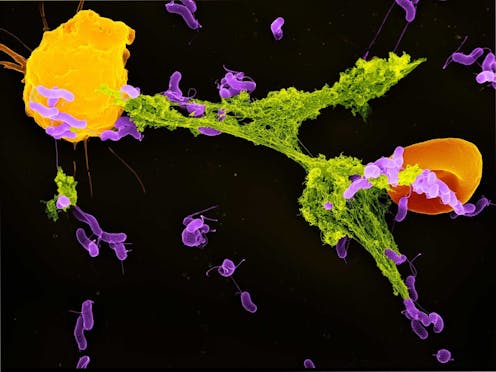
Neutrophils (yellow) eject a NET (green) to ensnare bacteria (purple). Other cells, such as red blood cells (orange), may also get trapped. CHDENK/Wikimedia Commons, CC BY-SA

Mitochondria have primarily been known as the energy-producing components of cells. But scientists are increasingly discovering that these small organelles do much more than just power cells. They are also involved in immune functions such as controlling inflammation, regulating cell death and responding to infections.

Research from my colleagues and I revealed that mitochondria play another key role in your immune response: sensing bacterial activity and helping neutrophils, a type of white blood cell, trap and kill them.

For the past 16 years, my research has focused on understanding the decisions immune cells make during infection and how the breakdown of these decision-making processes cause disease. My lab’s recent findings shed light on why people with autoimmune diseases such as lupus may struggle to fight infections, revealing a potential link between dysfunctional mitochondria and weakened immune defenses.

Side-by-side comparison of labeled illustration of cross-section of mitochondria and its micrograph
Mitochondria do so much more than just produce energy.
OpenStax, CC BY-SA

The immune system’s secret weapons

Neutrophils are the most abundant type of immune cell and serve as the immune system’s first responders. One of their key defense mechanisms is releasing neutrophil extracellular traps, or NETs – weblike structures composed of DNA and antimicrobial proteins. These sticky NETs trap and neutralize invading microbes, preventing their spread in the body.

Until recently, scientists believed that NET formation was primarily triggered by cellular stress and damage. However, our study found that mitochondria can detect a specific bacterial byproduct – lactate – and use that signal to initiate NET formation.

Lactate is commonly associated with muscle fatigue in people. But in the context of bacterial infections, it plays a different role. Many bacteria release lactate as part of their own energy production. My team found that once bacteria are engulfed by a compartment of the cell called the phagosome, neutrophils can sense the presence of this lactate.

Inside the phagosome, this lactate communicates to the neutrophil that bacteria are present and that the antibacterial processes are not sufficient to kill these pathogens. When the mitochondria in neutrophil cells detect this lactate, they start signaling for the cell to get rid of the NETs that have entrapped bacteria. Once the bacteria are released outside the cell, other immune cells can kill them.

Here, a neutrophil engulfs MRSA bacteria (green).

When we blocked the mitochondria’s ability to sense lactate, neutrophils failed to produce NETs effectively. This meant bacteria were more likely to escape capture and proliferate, showing how crucial this mechanism is to immune defense. This process highlights an intricate dialogue between the bacteria’s metabolism and the host cell’s energy machinery.

What makes this finding surprising is that the mitochondria within cells are able to detect bacteria trapped in phagosomes, even though the microbes are enclosed in a separate space. Somehow, mitochondrial sensors can pick up cues from within these compartments – an impressive feat of cellular coordination.

Targeting mitochondria to fight infections

Our study is part of a growing field called immunometabolism, which explores how metabolism and immune function are deeply intertwined. Rather than viewing cellular metabolism as strictly a means to generate energy, researchers are now recognizing it as a central driver of immune decisions.

Mitochondria sit at the heart of this interaction. Their ability to sense, respond to and even shape the metabolic environment of a cell gives them a critical role in determining how and when immune responses are deployed.

For example, our findings provide a key reason why patients with a chronic autoimmune disease called systemic lupus erythematosus often suffer from recurrent infections. Mitochondria in the neutrophils of lupus patients fail to sense bacterial lactate properly. As a result, NET production was significantly reduced. This mitochondrial dysfunction could explain why lupus patients are more vulnerable to bacterial infections – even though their immune systems are constantly activated due to the disease.

This observation points to mitochondria’s central role in balancing immune responses. It connects two seemingly unrelated issues: immune overactivity, as seen in lupus, and immune weakness like increased susceptibility to infection. When mitochondria work correctly, they help neutrophils mount an effective, targeted attack on bacteria. But when mitochondria are impaired, this system breaks down.

Microscopy image of long threads extending from round blobs
Neutrophils unable to effectively produce NETs may contribute to the development of lupus.
Luz Blanco/National Institute of Arthritis and Musculoskeletal and Skin Diseases via Flickr, CC BY-NC-SA

Our discovery that mitochondria can sense bacterial lactate to trigger NET formation opens up new possibilities for treating infections. For instance, drugs that enhance mitochondrial sensing could boost NET production in people with weakened immune systems. On the flip side, for conditions where NETs contribute to tissue damage – such as in severe COVID-19 or autoimmune diseases – it might be beneficial to limit this response.

Additionally, our study raises the question of whether other immune cells use similar mechanisms to sense microbial metabolites, and whether other bacterial byproducts might serve as immune signals. Understanding these pathways in more detail could lead to new treatments that modulate immune responses more precisely, reducing collateral damage while preserving antimicrobial defenses.

Mitochondria are not just the powerhouses of the cell – they are the immune system’s watchtowers, alert to even the faintest metabolic signals of bacterial invaders. As researchers’ understanding of their roles expands, so too does our appreciation for the complexity – and adaptability – of our cellular defenses.

The Conversation

Andrew Monteith receives funding from the National Institute of Health.

ref. Mitochondria can sense bacteria and trigger your immune system to trap them – revealing new ways to treat infections and autoimmunity  – https://theconversation.com/mitochondria-can-sense-bacteria-and-trigger-your-immune-system-to-trap-them-revealing-new-ways-to-treat-infections-and-autoimmunity-255939

Using TikTok could be making you more politically polarized, new study finds

Source: The Conversation – USA (2) – By Zicheng Cheng, Assistant Professor of Mass Communications, University of Arizona

Are you in an echo chamber on TikTok? LeoPatrizi/E+ via Getty Images

People on TikTok tend to follow accounts that align with their own political beliefs, meaning the platform is creating political echo chambers among its users. These findings, from a study my collaborators, Yanlin Li and Homero Gil de Zúñiga, and I published in the academic journal New Media & Society, show that people mostly hear from voices they already agree with.

We analyzed the structure of different political networks on TikTok and found that right-leaning communities are more isolated from other political groups and from mainstream news outlets. Looking at their internal structures, the right-leaning communities are more tightly connected than their left-leaning counterparts. In other words, conservative TikTok users tend to stick together. They rarely follow accounts with opposing views or mainstream media accounts. Liberal users, on the other hand, are more likely to follow a mix of accounts, including those they might disagree with.

Our study is based on a massive dataset of over 16 million TikTok videos from more than 160,000 public accounts between 2019 and 2023. We saw a spike of political TikTok videos during the 2020 U.S. presidential election. More importantly, people aren’t just passively watching political content; they’re actively creating political content themselves.

Some people are more outspoken about politics than others. We found that users with stronger political leanings and those who get more likes and comments on their videos are more motivated to keep posting. This shows the power of partisanship, but also the power of TikTok’s social rewards system. Engagement signals – likes, shares, comments – are like a fuel, encouraging users to create even more.

Why it matters

People are turning to TikTok not just for a good laugh. A recent Pew Research Center survey shows that almost 40% of U.S. adults under 30 regularly get news on TikTok. The question becomes what kind of news are they watching, and what does that mean for how they engage with politics.

The content on TikTok often comes from creators and influencers or digital-native media sources. The quality of this news content remains uncertain. Without access to balanced, fact-based information, people may struggle to make informed political decisions.

TikTok is not unique; social media generally fosters polarization.

Amid the debates over banning TikTok, our study highlights how TikTok can be a double-edged sword in political communication. It’s encouraging to see people participate in politics through TikTok when that’s their medium of choice. However, if a user’s network is closed and homogeneous and their expression serves as in-group validation, it may further solidify the political echo chamber.

When people are exposed to one-sided messages, it can increase hostility toward outgroups. In the long run, relying on TikTok as a source for political information might deepen people’s political views and contribute to greater polarization.

What other research is being done

Echo chambers have been widely studied on platforms like Twitter and Facebook, but similar research on TikTok is in its infancy. TikTok is drawing scrutiny, particularly its role in news production, political messaging and social movements.

TikTok has its unique format, algorithmic curation and entertainment-driven design. I believe that its function as a tool for political communication calls for closer examination.

What’s next

In 2024, the Biden/Harris and Trump campaigns joined TikTok to reach young voters. My research team is now analyzing how these political communication dynamics may have shifted during the 2024 election. Future research could use experiments to explore whether these campaign videos significantly influence voters’ perceptions and behaviors.

The Research Brief is a short take on interesting academic work.

The Conversation

Zicheng Cheng does not work for, consult, own shares in or receive funding from any company or organization that would benefit from this article, and has disclosed no relevant affiliations beyond their academic appointment.

ref. Using TikTok could be making you more politically polarized, new study finds – https://theconversation.com/using-tiktok-could-be-making-you-more-politically-polarized-new-study-finds-258791

How Zohran Mamdani’s win in the New York City mayoral primary could ripple across the country

Source: The Conversation – USA (2) – By Lincoln Mitchell, Lecturer, School of International and Public Affairs, Columbia University

New York mayoral candidate Zohran Mamdani speaks to supporters in Brooklyn on May 4, 2025. Madison Swart/Hans Lucas/AFP via Getty Images

Top Republicans and Democrats alike are talking about the sudden rise of 33-year-old Zohran Mamdani, a state representative who won the Democratic mayoral primary in New York on June 24, 2025, in a surprising victory over more established politicians.

While President Donald Trump quickly came out swinging with personal attacks against Mamdani, some establishment Democratic politicians say they are concerned about how the democratic socialist’s progressive politics could harm the broader Democratic Party and cause it to lose more centrist voters.

New York is a unique American city, with a diverse population and historically liberal politics. So, does a primary mayoral election in New York serve as any kind of harbinger of what could come in the rest of the country?

Amy Lieberman, a politics and society editor at The Conversation U.S., spoke with Lincoln Mitchell, a political strategy and campaign specialist who lectures at Columbia University, to understand what Mamdani’s primary win might indicate about the direction of national politics.

Two men kneel and smile, posing next to a woman and a dog.
New York mayoral candidate Zohran Mamdani, center, greets voters with New York Comptroller Brad Lander, right, on the Upper West Side on June 24, 2025.
Michael M. Santiago/Getty Images

Does Mamdani’s primary win offer any indication of how the Democratic Party might be transforming on a national level?

Mamdani’s win is clearly a rebuke of the more corporate wing of the Democratic Party. I know there are people who say that New York is different from the rest of the country. But from a political perspective, Democrats in New York are less different from Democrats in the rest of country than they used to be.

That’s because the rest of America is so much more diverse than it used to be. But if you look at progressive politicians now in the House of Representatives and state legislatures, they are being elected from all over – not just in big cities like New York anymore.

Andrew Cuomo, the former governor of New York, ran an absolutely terrible mayoral campaign. He tried to build a political coalition that is no longer a winning one, which was made up of majorities of African Americans, outer-borough white New Yorkers and orthodox and conservative Jews. Thirty or 40 years ago, that was a powerful coalition. Today, it could not make up a majority.

Mamdani visualized and created what a 2025 progressive coalition looks like in New York and recognized that it is going to look different than the past. Mamdani’s coalition was based around young, white people – many of them with college degrees who are worried about affordability – ideological lefties and immigrants from parts of the Global South, including the Caribbean and parts of Africa, South Asia and South America.

When you say a new kind of political coalition, what policy priorities bring Mamdani’s supporters together?

Mamdani reframed what I would call redistributive economic policies that have long been central to the progressive agenda. A pillar of his campaign is affordability – a brilliant piece of political marketing because who is against affordability? He came up with some affordability-related policies that got enough buzz, like promising free buses. Free buses are great, but it won’t help most working and poor New Yorkers get to work – they take the subway.

He has been very critical of Israel and has weathered charges of antisemitism.

In the older New York, progressive politicians such as the late Congressman Charlie Rangel were very hawkish on Israel.

What Mamdani understood is that in today’s America, the progressive wing of the Democratic Party does not care if somebody is, sounds like or comes close to being antisemitic. For those people, calling someone antisemitic sounds Trumpy, and they understand it as a right-wing hit, rather than the legitimate expression of concerns from Jewish people. Some liberals think that claims of antisemitism are simply something done just by those on the right to damage or discredit progressive politicians, but antisemitism is real.

Therefore, Mamdani’s record on the Jewish issue did not hurt him in the campaign, but he needs to build bridges to Jewish voters, or he will not be able to govern New York City.

How else did Mamdani appeal to a base of supporters?

He got the support of “limousine liberals” – including rich, high-profile, progressive people. His supporters include Ella Emhoff, a model and the stepdaughter of Kamala Harris, and the actress Cynthia Nixon, but there were many others. Supporting Mamdani became stylish – almost de rigueur – among certain segments of affluent New York.

Mamdani is also a true New Yorker and the voice of a new kind of immigrant. His parents are from Uganda and India. But he is also the child of extreme privilege – his mother, Mira Nair, is a well-known filmmaker, and his father is an accomplished professor. Mamdani went to top schools in New York and knows how to play in elite circles and with white people. He is a Muslim man whose roots are in the Global South, but he is not threatening because he knows how to speak their language.

To people of color and immigrants, Mamdani is also one of them. Because of Mamdani’s interesting background, he brought the limousine liberals together with the aunties from Bangladesh.

Finally, on the charisma scale, Mamdani was so far ahead of other Democratic candidates. Who is going to make better TikTok videos – the good-looking, young man whose mother is a world-famous movie producer, or the older guy who is a loving father and husband but gives off dependable dad, rather than hip young guy, vibes?

Several people are seen moving around white voting booths and holding white folders in a large room.
People arrive to vote in the New York mayoral primary in Brooklyn on June 24, 2025.
Spencer Platt/Getty Images

Is New York City so distinct that you cannot compare politics there to what happens nationwide?

I think that nationwide or at the state level there is a potential for something similar to a Mamdani coalition, but not a Mamdani coalition exactly. But in a place like Oklahoma, there are people who are in bad economic shape and who will also respond positively to an affordability-focused, Democratic political campaign. Mamdani remade a progressive New York coalition for this moment. Other progressives politicians should copy the spirit of that and reimagine a winning coalition in their city, state or district.

When Trump was campaigning, he focused at least on making groceries cheaper. Mamdani is one of the few Democrats who took the affordability issue back from Trump and addressed it head on and in a much more honest and relevant way. Trump has the phrase, “Make America Great Again!” That’s a popular slogan on baseball caps for Trump supporters.

If Mamdani wanted to make a baseball cap, he could just print “Affordability” on it. Boom.

Other Democratic politicians can take that approach of affordability and reframe it in a way that works in Kansas City or elsewhere.

The Conversation

Lincoln Mitchell supported Brad Lander in the primary election.

ref. How Zohran Mamdani’s win in the New York City mayoral primary could ripple across the country – https://theconversation.com/how-zohran-mamdanis-win-in-the-new-york-city-mayoral-primary-could-ripple-across-the-country-259951

What the Supreme Court ruling against ‘universal injunctions’ means for court challenges to presidential actions

Source: The Conversation – USA (2) – By Cassandra Burke Robertson, Professor of Law and Director of the Center for Professional Ethics, Case Western Reserve University

A journalist runs out of the U.S. Supreme Court building carrying a ruling on the last day of the court’s term on June 27, 2025, in Washington, D.C. Chip Somodevilla/Getty Images

When presidents have tried to make big changes through executive orders, they have often hit a roadblock: A single federal judge, whether located in Seattle or Miami or anywhere in between, could stop these policies across the entire country.

But on June 27, 2025, the Supreme Court significantly limited this judicial power. In Trump v. CASA Inc., a 6-3 majority ruled that federal courts likely lack the authority to issue “universal injunctions” that block government policies nationwide. The ruling means that going forward federal judges can generally only block policies from being enforced against the specific plaintiffs who filed the lawsuit, not against everyone in the country.

The ruling emerged from a case challenging President Trump’s executive order attempting to end birthright citizenship. While three federal courts had blocked the policy nationwide, the Supreme Court allowed it to proceed against anyone who isn’t a named plaintiff in the lawsuits. This creates a legal environment where the same government policy can be simultaneously blocked for some people but enforced against others.

Crucially, the court based its decision on interpreting the Judiciary Act of 1789 – not the Constitution – meaning Congress could restore this judicial power simply by passing new legislation.

But what exactly are these injunctions, and why do they matter to everyday Americans?

Immediate, irreparable harm

When the government creates a policy that might violate the Constitution or federal law, affected people can sue in federal court to stop it. While these lawsuits work their way through the courts – a process that often takes years – judges can issue what are called “preliminary injunctions” to temporarily pause the policy if they determine it might cause immediate, irreparable harm.

A “nationwide” injunction – sometimes called a “universal” injunction – goes further by stopping the policy for everyone across the country, not just for the people who filed the lawsuit.

Importantly, these injunctions are designed to be temporary. They merely preserve the status quo until courts can fully examine the case’s merits. But in practice, litigation proceeds so slowly that executive actions blocked by the courts often expire when successor administrations abandon the policies.

Title page of a U.S. Senate bill to ban most nationwide injunctions.
Legislation introduced by GOP Sen. Chuck Grassley would ban judges from issuing most nationwide injunctions.
Sen. Chuck Grassley office

More executive orders, more injunctions

Nationwide injunctions aren’t new, but several things have made them more contentious recently.

First, since a closely divided and polarized Congress rarely passes major legislation anymore, presidents rely more on executive orders to get substantive things done. This creates more opportunities to challenge presidential actions in court.

Second, lawyers who want to challenge these orders got better at “judge shopping” – filing cases in districts where they’re likely to get judges who agree with their client’s views.

Third, with growing political division, both parties used these injunctions more aggressively whenever the other party controls the White House.

Affecting real people

These legal fights have tangible consequences for millions of Americans.

Take DACA, the common name for the program formally called Deferred Action for Childhood Arrivals, which protects about 500,000 young immigrants from deportation. For more than 10 years, these young immigrants, known as “Dreamers,” have faced constant uncertainty.

That’s because, when President Barack Obama created DACA in 2012 and sought to expand it via executive order in 2015, a Texas judge blocked the expansion with a nationwide injunction. When Trump tried to end DACA, judges in California, New York and Washington, D.C. blocked that move. The program, and the legal challenges to it, continued under President Joe Biden. Now, the second Trump administration faces continued legal challenges over the constitutionality of the DACA program.

More recently, judges have used nationwide injunctions to block several Trump policies. Three courts stopped the president’s attempt to deny citizenship to babies born to mothers who lack legal permanent residency in the United States – the cases that led the Supreme Court to limit the reach of injunctions. Judges have also temporarily blocked Trump’s efforts to ban transgender people from serving in the military and to freeze some federal funding for a variety of programs.

Nationwide injunctions have also blocked congressional legislation.

The Corporate Transparency Act, passed in 2021 and originally scheduled to go into effect in 2024, combats financial crimes by requiring businesses to disclose their true owners to the government. A Texas judge blocked this law in 2024 after gun stores challenged it.

In early 2025, the Supreme Court allowed the law to take effect, but the Trump administration announced it simply wouldn’t enforce it – showing how these legal battles can become political power struggles.

A man in a dark suit at a desk holding a folder with white pages in it.
A polarized Congress rarely passes major legislation anymore, so presidents – including Donald Trump – have relied on executive orders to get things done.
Christopher Furlong/Getty Images

A ruling that Congress could change

The Supreme Court’s decision in Trump v. CASA was notably narrow in its legal reasoning. The court explicitly stated that its ruling “rests solely on the statutory authority that federal courts possess under the Judiciary Act of 1789” and that it expressed “no view on the Government’s argument that Article III forecloses universal relief.”

This distinction matters enormously. Because the court based its decision on interpreting a congressional statute rather than the Constitution itself, Congress has the power to overturn the ruling simply by passing new legislation that authorizes federal judges to issue nationwide injunctions.

The Supreme Court’s majority opinion, written by Justice Amy Coney Barrett, emphasized that universal injunctions “likely exceed the equitable authority that Congress has granted to federal courts” under the Judiciary Act of 1789. The court found these injunctions lack sufficient historical precedent in traditional equity practice.

However, the three dissenting justices strongly disagreed. Justice Sonia Sotomayor, joined by Justices Elena Kagan and Ketanji Brown Jackson, focused on the importance of birthright citizenship, explaining that “every court to evaluate the Order has deemed it patently unconstitutional.”

As a result, the dissent argues, “the Government instead tries its hand at a different game. It asks this Court to hold that, no matter how illegal a law or policy, courts can never simply tell the Executive to stop enforcing it against anyone.”

Legislative solutions on the table

Congress was already considering legislation to limit judges’ ability to grant nationwide injunctions.

Another way to address the concerns about a single judge blocking government action would be to require a three-judge panel to hear cases involving nationwide injunctions, requiring at least two of them to agree. This is similar to how courts handled major civil rights cases in the 1950s and 1960s.

My research on this topic suggests that three judges working together would be less likely to make partisan decisions, while still being able to protect constitutional rights when necessary. Today’s technology also makes it easier for judges in different locations to work together than it was decades ago.

What comes next

With the Supreme Court limiting judges’ ability to issue nationwide injunctions based on an old statute, the ball is now in Congress’ court. Lawmakers could choose to restore this judicial power with new legislation, further restrict it, or leave the current limitations in place.

Until Congress acts, the legal landscape has fundamentally shifted.

Future challenges to presidential actions may require either cumbersome class action lawsuits or a patchwork of individual cases – potentially leaving many Americans without immediate protection from policies that courts determine violate the Constitution. But unlike a constitutional ruling, this outcome isn’t permanent: Congress holds the key to change it.

This is an updated and expanded version of a story originally published on April 3, 2025.

The Conversation

Cassandra Burke Robertson does not work for, consult, own shares in or receive funding from any company or organization that would benefit from this article, and has disclosed no relevant affiliations beyond their academic appointment.

ref. What the Supreme Court ruling against ‘universal injunctions’ means for court challenges to presidential actions – https://theconversation.com/what-the-supreme-court-ruling-against-universal-injunctions-means-for-court-challenges-to-presidential-actions-260040

Supreme Court upholds childproofing porn sites

Source: The Conversation – USA (2) – By Meg Leta Jones, Associate Professor of Technology Law & Policy, Georgetown University

The Supreme Court greenlights states’ efforts to block kids from online porn by requiring age verification. AP Photo/J. Scott Applewhite

The U.S. Supreme Court handed down a decision on June 27, 2025, that will reshape how states protect children online. In a case assessing a Texas law requiring age verification to access porn sites, the court created a new legal path that makes it easier for states to craft laws regulating what kids see and do on the internet.

In a 6-3 decision, the court ruled in Free Speech Coalition Inc. v. Paxton that Texas’ law obligating porn sites to block access to underage users is constitutional. The law requires pornographic websites to verify users’ ages – for example by making users scan and upload their driver’s license – before granting access to content that is deemed obscene for minors but not adults.

The majority on the court rejected both the porn industry’s argument for strict scrutiny – the toughest legal test that requires the government to prove a law is absolutely necessary – and Texas’ argument for mere rational basis review, which requires only a rational connection between the law’s legitimate aims and its actions. Instead, Justice Clarence Thomas’ opinion established intermediate scrutiny, a middle ground that requires laws to serve important government interests without being overly burdensome, as the appropriate standard.

The court’s reasoning hinged on characterizing the law as only “incidentally” burdening adults’ First Amendment rights. Since minors have no constitutional right to access pornography, the state can require age verification to prevent that unprotected activity. Any burden on adults is, according to the ruling, merely a side effect of this legitimate regulation.

The court also pointed to dramatic technological changes since earlier similar laws were struck down in the 1990s and early 2000s. Back then, only 2 in 5 households had internet access, mostly through slow dial-up connections on desktop computers. Today, 95% of teens carry smartphones with constant internet access to massive libraries of content. Porn site Pornhub alone published over 150 years of new material in 2019. The court argued that earlier decisions “could not have conceived of these developments,” making age verification more necessary than judges could have imagined decades ago.

More importantly for future legislation, the court embraced an “ordinary and appropriate means” doctrine: When states have authority to govern an area, they may use traditional methods to exercise that power. Since age verification is common for alcohol and tobacco, tattoos and piercings, firearms, driver’s licenses and voting, the court held that it’s similarly appropriate for regulating minors’ access to sexual content.

The key takeaway: When states are trying to keep kids away from certain types of content that kids have no legal right to see anyway, requiring age verification is an ordinary and appropriate way to enforce that boundary.

Implications for other laws

This decision could resolve a fundamental enforcement problem in child privacy laws. Current laws like the Children’s Online Privacy Protection Act protect children only when companies have actual knowledge a user is under 13. But platforms routinely avoid this requirement by not asking users’ ages or letting them enter whatever age they want. Without age verification, there’s no actual knowledge and thus no privacy protections.

The Supreme Court’s reasoning changes this dynamic. Since the court emphasized that children lack the same constitutional rights as adults regarding certain protections, states may now be able to require age verification before data collection. California’s Age-Appropriate Design Code and similar state privacy laws would gain substantially more regulatory power under this framework.

Meanwhile, social media platforms could face more restrictions. Several states have tried to limit how social media platforms interact with minors. Florida recently banned kids under 14 from having social media accounts entirely, while other states have targeted specific features such as endless scrolling or push notifications designed to keep kids hooked.

The Supreme Court’s reasoning could protect laws that require age verification before kids can use certain platform features, such as direct messaging with strangers or livestreaming. However, laws that try to block kids from seeing general social media content would still face tough legal challenges, since that content is typically protected speech for everyone.

The decision also supports state laws regulating how minors interact with app stores and gaming platforms. Minors generally can’t enter binding contracts without parental consent in the physical world, so states could require the same online. Proposed legislation such as the App Store Accountability Act would require parental approval before kids can download apps or agree to terms of service. States have also considered restrictions on “loot boxes” – digital gambling-like features – and surprise in-app purchases that can result in massive charges to parents.

Since states already require an ID to buy lottery tickets or enter casinos, requiring age verification before kids can spend money on digital gambling mechanics follows the court’s logic.

What comes next?

But this decision doesn’t give states free rein to regulate the internet. The court’s reasoning applies to content that children have no legal right to access in the first place, specifically sexually explicit material. For most online content such as news, educational materials, general entertainment and political discussions, both adults and kids have constitutional rights to access.

Laws trying to age-gate this protected content would still likely face the strict scrutiny’s standard and be struck down, but what online content and experiences underage users are constitutionally entitled to is not settled. Many advocates worry that while the “obscene for minors” standard in this case appears legally narrow, states will try to expand it or use similar reasoning to classify LGBTQ+-related educational content, health resources or community support materials as inherently sexual and inappropriate for minors.

The court also emphasized that even under this more permissive standard, laws still have to be reasonable. Age verification requirements that are overly burdensome, sweep too broadly or create serious privacy problems could still be ruled unconstitutional. The court’s decision in this case gives state lawmakers much more room to effectively regulate how online platforms interact with children, but I believe successful laws will need to be carefully written.

For parents worried about their kids’ online safety, this could mean more tools and protections. For tech companies, it likely means more compliance requirements and age verification systems. And for the broader internet, it represents a significant shift toward treating online spaces more like physical ones, where people have long accepted that some doors require showing ID to enter.

The Conversation

Meg Leta Jones does not work for, consult, own shares in or receive funding from any company or organization that would benefit from this article, and has disclosed no relevant affiliations beyond their academic appointment.

ref. Supreme Court upholds childproofing porn sites – https://theconversation.com/supreme-court-upholds-childproofing-porn-sites-260052