A field guide to ‘accelerationism’: White supremacist groups using violence to spur race war and create social chaos

Source: The Conversation – USA (3) – By Art Jipson, Associate Professor of Sociology, University of Dayton

Demonstrators clash with counterdemonstrators at the entrance to Lee Park in Charlottesville, Va., on Aug. 12, 2017. AP Photo/Steve Helber

A man named Regan Prater was charged with arson for the burning of Highlander Center in New Market, Tennessee, on May 7, 2025. The nonprofit has a long history of involvement in the Civil Rights Movement. The FBI stated in a court document that Prater participated in neo-Nazi Telegram group chats online.

Earlier this year, Brandon Clint Russell, founder of Atomwaffen Divison, also known as the National Socialist Resistance Front, a onetime neo-Nazi terrorist organization, according to the Department of Justice, was convicted of conspiracy to damage an energy facility in Baltimore.

In the fall of 2024, a 24-year-old man, Skyler Philippi, targeted the Nashville power grid with an explosive drone. Federal authorities allege that Philippi was motivated by white supremacist ideologies and affiliated with the extremist group the National Alliance.

In my research on right-wing extremism over 30 years, a disturbing pattern has emerged: White supremacists and white nationalists are increasingly willing to use violence targeting critical infrastructure in an effort to destabilize society.

Since the Ku Klux Klan’s resurgence in 1915, white supremacists have pushed for white control of society. In particular, white supremacist and neo-Nazi groups have long advocated violence to establish a white ethnostate, a proposed political entity or nation-state where residency and citizenship are exclusively limited to whites.

In the past several years, extremists have started using the term “accelerationism” to describe their desire to create social chaos and societal collapse that leads to a race war and the destruction of liberal democratic systems, paving the way for a white ethnostate.

What is accelerationism?

The motivating idea behind accelerationism is that social chaos creates an opportunity for extremists to create a racially or ideologically “pure” future.

Scholars who study extremism have used the term “accelerationism” since the 1980s, but it wasn’t widely associated with right-wing extremist violence until the late 2010s. People calling themselves “eco-fascists,” for example, often endorse mass violence as a means to reduce population and spark societal collapse.

Accelerationism is often connected to the white replacement theory, a white nationalist conspiracy theory that falsely asserts that there is a deliberate plot to diminish the influence and power of white people by replacing them with nonwhite populations.

While not all extremists who advocate violent confrontation use the label, the calls for violent disruption strive for the same results. Brenton Harrison Tarrant, the Australian white supremacist who perpetrated the Christchurch mosque shootings on March 15, 2019, in New Zealand, labeled an entire section of his online manifesto Destabilization and Accelerationism: Tactics for Victory.

Men and women standing behind a barricade, holding flags with swastika signs on them.
Members of the neo-Nazi National Socialist Movement salute and shout ‘sieg heil’ during a rally in front of the State House in Trenton, N.J., on April 16, 2011.
AP Photo/Mel Evans

This primer provides an overview of some of the key groups that have embraced accelerationist thinking, posing significant threats to public safety, democratic institutions and social cohesion.

The Order

One of the first American groups to embody this ideology was The Order – also known as Brüder Schweigen, or the Silent Brotherhood – which continues to influence newer generations of extremist organizations, both directly and indirectly.

Robert Jay Mathews, who founded The Order in 1983, was inspired by the apocalyptic vision laid out in the novel “The Turner Diaries.” The 1978 book by William Luther Pierce – under the pseudonym Andrew Macdonald – calls for a violent, apocalyptic race war to overthrow the U.S. government and exterminate Jews, nonwhite people and political enemies. Pierce founded the National Alliance – a neo-Nazi, white supremacist organization advocating for a white ethnostate and violent revolution – in 1974.

The call for violent insurrection and radical societal overhaul has since served as a blueprint for white supremacists and right-wing extremists.

The Order believed the U.S. federal government was under the control of Jews and other minority groups, and it aimed to overthrow it to create a white ethnostate. The Order funded its activities through robberies, including US$3.6 million taken from an armored car near Ukiah, California, on July 19, 1984.

Its criminal and violent actions escalated to murder, most notably the 1984 assassination of Jewish radio host Alan Berg in Denver by Order member Bruce Pierce.

Atomwaffen Division (AWD)

The Atomwaffen Division, one of the most violent neo-Nazi accelerationist groups in the U.S., was officially founded in October 2015 by Brandon Clint Russell, a former Florida National Guardsman.

Russell had been active on a neo-Nazi web forum IronMarch.org since 2014 and announced the group’s formation on the site. He used the handle “Odin” to connect with other far-right extremists.

AWD quickly gained notoriety for its violent, neo-Nazi ideology, advocating for a race war and the collapse of the U.S. government through terrorism. The group drew inspiration from the writings of white supremacist James Mason, particularly his collection of essays titled “Siege.”

AWD’s activities included recruiting members on university campuses and among military personnel, engaging in paramilitary training, and promoting accelerationist violence. The group has been linked to multiple murders and plots in the United States and has inspired offshoots in Europe and other regions.

By 2020, AWD unraveled due to law enforcement pressure, prosecutions and internal splits. Though not fully gone, it effectively stopped operating under its name. Members helped form the National Socialist Order, which continues to promote Mason’s “Siege” and violent accelerationism.

Active Club Network

Active clubs are loosely organized, often regional groups of white supremacists and neofascists who combine fitness, combat training and ideology to promote violence and white nationalist goals. Members protest Pride and multicultual events and recruit members through fighting and combat sports. Active clubs and similar extremist networks use a multipronged recruitment strategy, combining online reach via Telegram and other social media with in-person, fighting-based community-building to attract new members.

Men standing behind a barricade, holding a red flag with a swastika sign on it.
Neo-Nazi counterdemonstrators shout angrily at the marchers from behind police barricades during the Lesbian and Gay Pride March on Fifth Avenue in New York, on June 25, 1995.
AP Photo/Kathy Willens

Emerging in 2017 from the street-fighting “Rise Above Movement” in Southern California and gaining prominence in the 2020s through the rise of The Active Club Network, or ACN, this movement demonstrated a shift from online-only, far-right groups to groups willing to fight.

Beginning in December 2020, The Active Club Network formed as a loosely affiliated, decentralized web of white supremacist, fascist and accelerationist groups that operate under a shared banner promoting physical training, brotherhood and militant white nationalism.

The Base

Founded around 2018, The Base represents one of the most explicit modern expressions of white nationalist accelerationism: as it is known by members, its “Siege Culture.”

Founded by Rinaldo Nazzaro, an American living in Russia who used the name Roman Wolf, the group recruited ex-military and survivalists preparing for collapse through self-sufficiency, aiming to spark a race war. The Base was directly influenced by James Mason’s book “Siege.”

The Base operates as a decentralized network of cells trained in paramilitary tactics, sabotage and guerrilla warfare. Their online propaganda explicitly calls for violent action to destabilize society.

Its members have been involved in plots to murder anti-fascist activists, poison water supplies, derail trains and attack critical infrastructure. In 2020, multiple members were arrested before they could carry out an armed assault at a pro-gun rally in Richmond, Virginia, where they planned to attack police officers and civilians.

Although several members have been arrested and convicted on a variety of crimes, including conspiracy to commit murder, civil disorder, firearm charges, vandalism and other violent crimes, The Base illustrates a fundamental feature of accelerationism: “leaderless resistance,” or a lack of a centralized leadership, which helps it survive and thrive. Its ideology and tactics are spread through online forums dedicated to white supremacist propaganda.

Patriot Front

Founded in 2017 by Thomas Rousseau, Patriot Front is a white supremacist group that emerged from a split with Vanguard America following the Unite the Right rally in Charlottesville, Virginia. Vanguard America was a white supremacist group that opposed multiculturalism and whose members believed America should be an exclusively white nation.

The goals of the organizers of the Unite the Right rally included unifying the American white nationalist movement and opposing the proposed removal of the statue of Robert E. Lee, the general who led the Confederate troops of slave states during the Civil War, from Charlottesville’s former Lee Park. The rally sparked a national debate over Confederate iconography, racial violence and white supremacy.

The Patriot Front defines itself as an organization of “American nationalists.” According to the Anti-Defamation League, since 2019 the Patriot Front has been responsible for a majority of white supremacist propaganda distributed in the United States, using flyers, posters, stickers, banners and the internet to spread its ideology.

The group frequently participates in localized “flash demonstrations” where it marches near city halls. Such demonstrations have also increasingly made it one of the United States’ most visible white supremacist groups. In 2024, Patriot Front held demonstrations on patriotic holidays such as Memorial Day, the Fourth of July and Labor Day.

Although the group claims loyalty to America, the Patriot Front’s ultimate goal is to form a new state that advocates for the “descendants of its creators” – namely, white men.

Understanding the motivations and tactics of accelerationist groups and individuals, I believe, is critical to recognizing and countering the dangers they represent.

The Conversation

Art Jipson does not work for, consult, own shares in or receive funding from any company or organization that would benefit from this article, and has disclosed no relevant affiliations beyond their academic appointment.

ref. A field guide to ‘accelerationism’: White supremacist groups using violence to spur race war and create social chaos – https://theconversation.com/a-field-guide-to-accelerationism-white-supremacist-groups-using-violence-to-spur-race-war-and-create-social-chaos-255699

Video games teach students in this class how religion works in the modern world

Source: The Conversation – USA (3) – By Michael Naparstek, Associate Teaching Professor Religious Studies, University of Tennessee

A man plays the Chinese action role-playing game ‘Black Myth: Wukong’ during its launch day in Hangzhou, in eastern China’s Zhejiang province, on Aug. 20, 2024. STR/AFP via Getty Images

Uncommon Courses is an occasional series from The Conversation U.S. highlighting unconventional approaches to teaching.

Title of the course

Religion and Gameworlds

What prompted the idea for the course?

Most of my research is in Chinese religions, and I find it fascinating that popular video games – like many popular films before them – draw from the mythologies, cosmologies, unseen powers and heroic narratives found across the world’s religious traditions.

Recent examples such as “Black Myth: Wukong” and “Raji: an Ancient Epic” draw explicitly from mythologies and religious narratives of China and India, respectively, putting the player in direct contest against pantheons of gods. Meanwhile, games such as “Sid Meier’s CIV VI,” where players develop an historical civilization from the Stone Age to Space Age in a quest for global domination, explicitly utilize religion as ways to develop and conquer the world.

At the same time, the interactive experience of a video game makes it an especially interesting place to study religion. When your character uses magic, interacts with powerful deities, or even achieves godlike status themselves, the player also shares such experiences on some level as well. Sometimes, viewers’ experiences blur the lines between “real life” and on-screen.

Some churches have even used the game “Second Life” to offer worshippers the option of getting baptized using their digital avatar in the game. This kind of practice raises poignant questions about how we understand religion in our modern world.

Several robot-like figures stand in a circle, some with their hands raised.
A still from the ‘Second Life’ game.
Strawberry/Flickr, CC BY-NC-SA

What does the course explore?

What makes this course different from many others that utilize video games is that the student experience of playing the games influences how we frame our investigation of religion. Students wrestle with questions about how religion helps build the worlds they are experiencing.

We meet in the game lab as a class once a week to observe and analyze each other’s experiences playing different kinds of games.

We start the week with relevant theoretical and historical framing in the traditional classroom. For example, in our investigation of “Black Myth: Wukong,” a game inspired by the 16th-century novel “Journey to the West,” students first read selections from the work as they learn about its protagonist, the trickster monkey god Sun Wukong.

In the novel, Wukong picks fights with all the gods in an attempt to overthrow the cosmic order, only to eventually be violently put in his place by the highest gods of the Chinese pantheon. Our class discussions thus serve as a general introduction to Chinese religions, while we also get to discuss the theoretical basis for culturally defined ideas such as what makes a hero.

Playing as a descendant of Sun Wukong, students explore enchanted landscapes, interact with local spirits and engage in magical combat against the very gods that we learned about in class.

Each week, students note their observations, carefully detailing their experience playing the game, as well as the experience of watching others do the same. Students are also asked to analyze the ways in which religious themes, narratives and practices played a role in the game world they experienced.

We conclude the class with weekly reflections on the overall experience.

What will the course prepare students to do?

In 2024, the video game industry boasted over US$184 billion generated in market value. The global reach of games allows new audiences to experience and learn about religious narratives and practices in new ways.

Popular media has long been a powerful mode of cultural exchange. Video games are just a recent example, but the scale to which gamers around the world connect with each other through playing demands more attention.

The wild popularity following the 2024 release of the game “Black Myth: Wukong,” the first premier produced game out of China for an international audience, suggests that this kind of experience is truly a global phenomenon that will only continue to grow. It only makes sense that video games can serve as powerful pedagogical tools as well.

The goal of the course is to prepare students to better understand the broader contexts in which their shared experience of enjoying video games derives. Learning about the role of religion in shaping that experience allows students to better understand how religion shapes our modern world.

The Conversation

Michael Naparstek does not work for, consult, own shares in or receive funding from any company or organization that would benefit from this article, and has disclosed no relevant affiliations beyond their academic appointment.

ref. Video games teach students in this class how religion works in the modern world – https://theconversation.com/video-games-teach-students-in-this-class-how-religion-works-in-the-modern-world-257511

Southern Baptists’ call for the US Supreme Court to overturn its same-sex marriage decision is part of a long history of opposing women’s and LGBTQ+ people’s rights

Source: The Conversation – USA (3) – By Susan M. Shaw, Professor of Women, Gender, and Sexuality Studies, Oregon State University

A worship session at the 2025 Southern Baptist Convention annual meeting on June 10, 2025, in Dallas. AP Photo/Richard W. Rodriguez

The Southern Baptist Convention has lost 3.6 million members over the past two decades and faces an ongoing sexual abuse crisis. At its June 2025 annual meeting, however, neither of those issues took up as much time as controversial social issues, including the denomination’s stance on same-sex marriage.

The group called for the overturning of Obergefell v. Hodges – the Supreme Court decision that legalized same-sex marriage – and the creation of laws that “affirm marriage between one man and one woman.”

Messengers – Southern Baptists’ word for delegates from local churches – also asked for laws that would “reflect the moral order revealed in Scripture and nature.”

They also decried declining fertility rates, commercial surrogacy, Planned Parenthood, “willful childlessness,” the normalization of “transgender ideology,” and gender-affirming medical care.

This detailed list targeting women’s and LGBTQ+ rights was justified by an appeal to a God-ordained created order, as defined by Southern Baptists’ interpretation of the Bible.

In this created order, sex and gender are synonymous and are irrevocably defined by biology. The heterosexual nuclear family is the foundational institution of this order, with the father dominant over his wife and children – and children are a necessity if husbands and wives are to be faithful to God’s design for the family.

The resolution, On Restoring Moral Clarity through God’s Design for Gender, Marriage, and the Family, passed easily in a denomination that was taken over from more moderate Southern Baptists by fundamentalists in the early 1990s, largely in response to women’s progress in society and in the denomination.

Southern Baptists were always conservative on issues of gender and sexuality. As I was entering a Southern Baptist seminary in the early 1980s, the denomination seemed poised to embrace social progress. I watched the takeover firsthand as a student and then as a professor of women and gender studies who studies Southern Baptists. This new resolution is the latest in a long history of Southern Baptist opposition to the progress of women and LGBTQ+ people.

Opposing LGBTQ+ rights

Throughout the late 1960s and early 1970s, many Southern Baptists began to embrace the women’s movement. Women started to attend Southern Baptist seminaries in record numbers, many claiming a call to serve as pastors. While Southern Baptist acceptance of LGBTQ+ people lagged far behind its nascent embrace of women’s rights, progress did seem possible.

Then in 1979, a group of Southern Baptist fundamentalists organized to wrest control of the denomination from the moderates who had led it for decades.

Any hope for progress on changes regarding LGBTQ+ rights in the denomination quickly died. Across the next two decades, advances made by women, such as being ordained and serving as senior pastors, eroded and disappeared.

The SBC had passed anti-gay resolutions in the 1970s defining homosexuality as “deviant” and a “sin.” But under the new fundamentalist rule, the SBC became even more vehemently anti-gay and anti-trans.

In 1988, the SBC called homosexuality a “perversion of divine standards,” “a violation of nature and natural affections,” “not a normal lifestyle,” and “an abomination in the eyes of God.”

In 1991, they decried government funding for the National Lesbian and Gay Health Conference as a violation of “the proper role and responsibility of government” because of its encouragement of “sexual immorality.”

Predictably, across the years, the convention spoke out against every effort to advance LGBTQ+ rights. This included supporting the Boy Scouts’ ban of gay scouts, opposing military service by LGBTQ+ people, boycotting Disney for its support of LGBTQ+ people, calling on businesses to deny LGBTQ+ people domestic partner benefits and employment nondiscrimination to protect LGBTQ+ people, and supporting the Defense of Marriage Act that limited marriage to a woman and a man.

Targeting same-sex marriage

The gender and sexuality topic, however, that has received the most attention from the convention has been marriage equality. Since 1980, the SBC has passed 22 resolutions that touch on same-sex marriage.

The SBC passed its first resolution against same-sex marriage in 1996 after the Hawaii Supreme Court indicated the possibility it could rule in favor of same-sex marriage. The court never decided the issue because Hawaii’s Legislature passed a bill defining marriage as between a man and a woman.

In 1998, the convention amended its faith statement, the Baptist Faith and Message, to define marriage as “the uniting of one man and one woman in covenant commitment.”

The denomination passed its next resolution in 2003 in response to the Vermont General Assembly’s establishment of civil unions. The resolution opposed any efforts to validate same-sex marriages or partnerships, whether legislative, judicial or religious.

In 2004, after the Massachusetts Supreme Court allowed same-sex marriages in that state, the convention called for a constitutional amendment to define marriage as between a man and a woman. It reiterated this call in 2006.

When the California Supreme Court struck down the state’s ban on same-sex marriage, the SBC passed another resolution in 2008 warning of the dire consequences of allowing lesbians and gay men to marry, as people from other states would marry in California and return home to challenge their states’ marriage bans.

In 2011, the convention offered its support for the Defense of Marriage Act, followed in 2012 by a denunciation of the use of civil rights language to argue for marriage equality.

Close-up of several seated individuals looking ahead while listening to a speaker, with a few seen smiling.
Delegates at a Southern Baptist Convention meeting in 2012 in New Orleans.
AP Photo/Gerald Herbert

The resolution argues that homosexuality “does not qualify as a class meriting special protections, like race and gender.”

When Obergefell was before the Supreme Court, the SBC called on the court to deny marriage equality. After Obergefell was decided in favor of same-sex marriage, the convention asked for Congress to pass the First Amendment Defense Act, which would have prohibited the federal government from discriminating against people based on their opposition to same-sex marriage. That same resolution also offers its support to state attorneys general challenging transgender rights.

Opposing transgender people

A large audience is seated in a darkened hall, listening to a speaker who appears on two large screens at the front, alongside another screen displaying the words 'Dallas Annual Meeting.'
Messengers of the Southern Baptist Convention listen to remarks by its president, Clint Pressley, during the 2025 SBC annual meeting in Dallas.
AP Photo/Richard W. Rodriguez

This was not the first time the SBC had spoken about transgender issues. As early as 2007, the denomination expressed its opposition to allowing transgender people to constitute a protected class in hate crimes legislation.

In 2014, the convention stated its belief that gender is fixed and binary and subsequently that trans people should not be allowed gender-affirming care and that government officials should not validate transgender identity.

In 2016, the denomination opposed access for transgender people to bathrooms matching their gender identities. In 2021, the convention invoked women’s rights – in a denomination famous for its resistance to women’s equality – as a reason to undermine trans rights.

In its resolution opposing the proposed Equality Act, which would have added sexual orientation and gender identity as protected classifications, the SBC argued, “The Equality Act would undermine decades of hard-fought civil rights protections for women and girls by threatening competition in sports and disregarding the privacy concerns women rightly have about sharing sleeping quarters and intimate facilities with members of the opposite sex.”

This most recent resolution from June 2025 returns to the themes of fixed and binary gender, a divinely sanctioned hierarchical ordering of gender, and marriage as an institution limited to one woman and one man. While claiming these beliefs are “universal truths,” the resolution argues that Obergefell is a “legal fiction” because it denies the biological reality of male and female.

Going further, this resolution claims that U.S. law on gender and sexuality should be based on the Bible. The duty of lawmakers, it states, is to “pass laws that reflect the truth of creation and natural law – about marriage, sex, human life, and family – and to oppose any law that denies or undermines what God has made plain through nature and Scripture.”

By taking no action on sexual abuse while focusing its efforts on issues of gender and sexuality, the convention affirmed its decades-long conservative trajectory. It also underlined its willingness to encourage lawmakers to impose these standards on the rest of the nation.

The Conversation

Susan M. Shaw does not work for, consult, own shares in or receive funding from any company or organization that would benefit from this article, and has disclosed no relevant affiliations beyond their academic appointment.

ref. Southern Baptists’ call for the US Supreme Court to overturn its same-sex marriage decision is part of a long history of opposing women’s and LGBTQ+ people’s rights – https://theconversation.com/southern-baptists-call-for-the-us-supreme-court-to-overturn-its-same-sex-marriage-decision-is-part-of-a-long-history-of-opposing-womens-and-lgbtq-peoples-rights-258883

Indonesian social forestry often excludes women from decisions, risking greater inequality

Source: The Conversation – Indonesia – By Tessa Toumbourou, Postdoctoral Research Fellow in Environmental Social Science, The University of Melbourne

Our analysis of Indonesia’s social forestry permits shows that women remain underrepresented in forest management bodies despite efforts to boost their presence, leaving them out of decisions about their forests.

Social forestry redistributes forest management rights to local communities to advance sustainability and local livelihoods. In 2021, the country revised its social forestry regulations to allow one family representative to participate in social forestry management bodies, ‘giving equal opportunity to both men and women.’

However, our analysis of 400 most recent social forestry permit documents, combined with extended, multi-method field research at four sites, shows that women are often excluded from management bodies but are more involved in social forestry business groups (Kelompok Usaha Perhutanan Sosial or KUPS). These groups focus on the processing and sale of forest products.

This low level of participation in management excludes women from decisions about who receives benefits such as land for cultivation, seedlings, equipment, extension training, and technical information provided by the government and NGOs. The absence of women’s presence may deepen local inequalities and hamper effective forest management.

Gender gaps in social forestry

We reviewed the 400 most recent decree letters issued in 2024 that granted forestry management rights. These included 100 permits each for the managements of Village Forests (Hutan Desa) and Community Forests (Hutan Kemasyarakatan) and their respective KUPS (Table 1). Village Forests are rights collectively held and managed by village administrations, while Community Forests are issued to specific farmer or community groups.

Our analysis found that across Indonesia women are often underrepresented in management groups. On average, only 19.54% of members in Village Forest’s management bodies were women, with participation ranging from none to 80%. This number was even lower in Community Forests, averaging 13.95% women, with some groups having no female members and others up to 56.52%.

However, the available data often lacked details about gender in KUPS-related decrees. Only 19 of 100 Village Forests’ KUPS decrees and 23 of 100 Community Forests’ KUPS decrees included this information.

When gender data was included, women were more involved in KUPS of Village Forests, with an average of 46.32% participation. In contrast, their participation in Community Forests’ KUPS was just 13.06%.

These numbers show that progress in gender representation in Indonesia’s social forestry is mixed. While women are more active in economic activities linked to KUPS, they are still sidelined in formal management roles and decision-making.

Understanding uneven participation

Our field research also highlighted how women and men are participating in, and deriving benefits from, social forestry in Indonesia, while exploring factors influencing women’s (and men’s) involvement.

We focused on four social forestry sites — two Village Forests (Sintang; West Kalimantan province, and Muara Enim; South Sumatra province) and two Community Forests (Gunungkidul; Special Region of Yogyakarta, and Enrekang; South Sulawesi province). We selected sites that reflect different levels of women’s participation.

Table 2 highlights a disparity: while women actively engage in forest land use — such as collecting and processing non-timber forest products and cultivating social forestry land — in two sites (Enrekang and Muara Enim) they are not involved in management bodies where decisions about land use, forest resources and benefit distribution are made.

For example, Masna (pseudonym), a farmer and forest user from Enrekang, shared that her involvement in her village’s forest management body (Kelompok Tani Hutan) was limited to preparing snacks while men made decisions.

Why does this happen?

Deeply rooted gender norms significantly limit women’s involvement in social forestry in some sites. These norms often designate unpaid household and care-giving duties to women, positioning men as the primary decision-makers. This affects women’s confidence and participation in village meetings, where forest management decisions are made reduce women’s participation.

Our findings align with earlier studies showing how gender roles, influenced by discourse promoted by the New Order regime, continue to shape these practices of recognising men as breadwinners and landowners, reinforcing their dominance in formal discussions and decision-making bodies.

Although there are no educational requirements for joining social forestry, research shows that those with more education tend to have more influence. In our study, women in social forestry households averaged fewer years of education (6.6 years) compared to men (8.1 years). Lower education levels, socio-economic challenges, and low confidence in public forums, where education often boosts credibility, can further exclude women.

Geographic barriers such as remote forest locations, rough terrain, and poor roads also hinder women’s participation, making travel difficult and limiting their ability to be involved.

Assistance helps, as do local women leaders

In the Sintang and Gunungkidul sites, women have taken on greater roles in forest management bodies.

In Sintang, support from the Indonesian NGO PUPUK (Association for the Improvement of Small Business) significantly boosted women’s participation in the village forest management body. PUPUK facilitated discussions, provided training at convenient times for women, and encouraged male leaders to back greater female involvement. The number of female members increased from just one in 2018 to 12 women and nine men in a newly formed management body in 2022.

The social forestry group in Gunungkidul – initially a male-dominated, government-led reforestation project – evolved into a community-driven initiative with strong female leadership. Support from both government and NGOs enabled women to take more active roles in forestry and agriculture, especially as many men (and some women) left to seek work elsewhere.

A university-educated woman now leads this group and has inspired younger women to join forest management and KUPS activities. These include producing traditional herbal drinks (wedang uwuh) and making snacks from taro, cassava, and arrowroot grown on forest land.

Across the study sites, women involved in KUPS have developed skills in forest management, financial planning, product processing, and marketing, earning modest incomes. These activities have also shifted gender roles. For example, in Sintang, when Mirna (pseudonym) became head of the KUPS, her husband started taking on domestic chores like cooking and childcare to support her work.

What’s next?

Tackling gender disparities in social forestry requires targeted policies to ensure women’s voices, especially from marginalised groups, are heard in decision-making processes that affect their livelihoods and access to resources.

Introducing quotas or affirmative measures for forest management bodies can help close the gender gap and ensure more equitable benefit distribution. Evidence from other Global South regions suggests that at least 30% female representation in forest management bodies is necessary for meaningful participation, enabling women to influence decisions more effectively.

Inclusive governance also depends on fair representation of different ethnic and socio-economic groups, particularly poorer households. When disadvantaged groups are poorly represented, the distribution of benefits suffers, limiting the equitable flow of resources and opportunities.

Partnerships with NGOs and civil society groups skilled in addressing gender differences can empower women and marginalized men with the skills and confidence needed to engage in decision-making bodies.

Creating safe spaces is also vital. This includes holding gender-specific discussions in local languages at times that fit with both women’s and men’s schedules.

The government must also commit to regularly monitoring women’s participation by collecting and publishing accurate gender-disaggregated data, specific to each site and region.

A decree issued by Ministry of Environment and Forestry in August introduces a policy shift that allows individuals — not just groups — to apply for social forestry. This could boost women’s participation, provided targeted support helps them step into leadership roles. Without this backing, the risk remains that social forestry will continue to be dominated by elite men.


Rahpriyanto Alam Surya Putra, the director of The Asia Foundation’s Environmental Governance program in Indonesia, and Ike Sulistiowati, Director of PUPUK Indonesia, contributed to this study.

The Conversation

Tessa Toumbourou received funding from the Australian Department of Foreign Affairs and Trade through KONEKSI (Knowledge Partnership Platform Australia-Indonesia). The views expressed in this publication do not represent the views of the Australian Government.

Andrea received funding from the Australian Department of Foreign Affairs and Trade through KONEKSI (Knowledge Partnership Platform Australia-Indonesia). The views expressed in this publication do not represent the views of the Australian Government.

Gutomo received funding from the Australian Department of Foreign Affairs and Trade through KONEKSI (Knowledge Partnership Platform Australia-Indonesia). The views expressed in this publication do not represent the views of the Australian Government.

Ilmiawan received funding from the Australian Department of Foreign Affairs and Trade through KONEKSI (Knowledge Partnership Platform Australia-Indonesia). The views expressed in this publication do not represent the views of the Australian Government.

Lilis received funding from the Australian Department of Foreign Affairs and Trade through KONEKSI (Knowledge Partnership Platform Australia-Indonesia). The views expressed in this publication do not represent the views of the Australian Government.

Rumayya received funding from the Australian Department of Foreign Affairs and Trade through KONEKSI (Knowledge Partnership Platform Australia-Indonesia). The views expressed in this publication do not represent the views of the Australian Government.

Yulia received funding from the Australian Department of Foreign Affairs and Trade through KONEKSI (Knowledge Partnership Platform Australia-Indonesia). The views expressed in this publication do not represent the views of the Australian Government.

ref. Indonesian social forestry often excludes women from decisions, risking greater inequality – https://theconversation.com/indonesian-social-forestry-often-excludes-women-from-decisions-risking-greater-inequality-238904

Reflecting on 20 years of the Aceh tsunami: From ‘megathrust’ threat to disaster mitigation

Source: The Conversation – Indonesia – By Zulfakriza Z., Associate Professor, Global Geophysics Research Group, Institut Teknologi Bandung

20 years have passed since the Aceh tsunami, which left deep scars on Indonesia, especially for those directly affected. Aceh was also recovering from a three-decade armed conflict between the Free Aceh Movement and the national government

Throughout December 2024, The Conversation Indonesia, in collaboration with academics, is publishing a special edition honouring the 20 years of efforts to rebuild Aceh. We hope this series of articles preserves our collective memory while inspiring reflection on the journey of recovery and peace in the land of ‘Serambi Makkah.’


Sunday, December 26, 2004, 7:58:53 AM (WIB, GMT+7): A 9.1 moment magnitude (Mw) earthquake occurred off the west coast of Aceh. The quake, originating from a depth of 30 kilometers below the sea, triggered a tsunami that devastated the province.

Research in 2021 suggested the earthquake’s magnitude was actually greater than what was previously recorded — 9.2 Mw. Scientists came to this conclusion after recalculating tsunami data using Green’s Function, a mathematical method that analyses how tsunami waves are formed and spread. This gave them a more accurate estimate of how strong the earthquake was.

From December 26, 2004, to February 26, 2005, the United States Geological Survey (USGS) documented about 2,050 aftershocks, a series of aftershock caused by the mainshock.

The effects of the 2004 Aceh earthquake and tsunami extended beyond Indonesia, affecting coastlines in Southeast Asia, South Asia, and possibly Africa. More than 227,000 people were killed, with Aceh alone accounting for approximately 167,000.

The 2004 Aceh Earthquake and Tsunami is known as one of the most devastating natural disasters in history. While it left deep wounds, it also demonstrated the fundamental need for disaster preparedness.

Tectonic map, megathrust zones, and seismic gaps

Indonesia is prone to disasters due to its location in a tectonically active zone where four major plates — Indo-Australian, Eurasian, Pacific, and Philippine — with convergence movement.

Comprising Earth’s rigid outer layer or lithosphere, a tectonic plate is a large, irregularly shaped sheet of solid rock that moves and interacts with other plates to sculpt the surface of the planet over geological time. These plate clashes have the potential to trigger massive earthquakes, particularly in western Sumatra, southern Java, Bali, Nusa Tenggara, the Banda Sea, Maluku, Papua, and Sulawesi.

A shift between two tectonic plates in the Indian Ocean resulted in a thrust fault, causing the 2004 Aceh earthquake. The fault stretched 500 kilometers – roughly the distance between Jakarta and Yogyakarta – with a breadth of about 150 kilometers. Known as a “megathrust earthquake,” the plates shifted by more than 20 meters, releasing enormous energy and causing tsunami waves up to 35 meters high – the height of a 10-story building.

Aside from earthquakes and tsunamis, tectonic movements can also trigger volcanic activity. Indonesia, which is part of the Pacific Ring of Fire, has 127 active volcanoes, making it the world’s most seismically and volcanically active region.

Between 1900 and 2023, Indonesia recorded 14,820 earthquakes with magnitudes greater than 5 Mw. Among these, 15 were more than 8 Mw, including the 2004 Aceh earthquake. Other big earthquakes, like those in Sumba (1977), Biak (1996), Nias (2005), and Bengkulu (2007), also triggered tsunamis, causing substantial casualties and damage.

Indonesia also has several megathrust zones – areas along tectonic plate boundaries prone to generating large earthquakes like the 2004 Aceh event. There are 13 identified megathrust zones near the waters off western Sumatra, southern Java, Bali, Nusa Tenggara, northern Sulawesi, Halmahera, and Papua. These zones are prone to generate quakes of magnitudes ranging from 7.8 to 9.2 Mw, capable of delivering major destruction and tsunamis.

Over the last 30 years, some of Indonesia’s megathrust zones have been releasing seismic energy. These zones were the source of major earthquakes such as 1996 Biak, 1994 Banyuwangi, 2004 Aceh, 2005 Nias, 2006 Pangandaran, and 2007 Bengkulu.

However, data from the past 123 years show that some parts of the megathrust zones rarely experience large earthquakes. This could be because tectonic movements in these locations are stuck, causing stress to build up over time. These “seismic gaps” indicate high-risk zones for future big earthquakes.

A seismic gap, for example, exists between the megathrust zones off the western and eastern coasts of Java. For instance, in western Java’s subduction zone, the slip deficit — or plate movement locked in place — has reached 40-60 mm per year. If this energy is eventually released, it might result in a significant earthquake and possibly a tsunami.

Advances in disaster research

Indonesia’s high disaster risk has attracted scholars from all around the world, particularly following the 2004 Aceh Tsunami. From 2005 to 2024, Google Scholar recorded approximately 1,000 scientific works on Indonesian earthquakes and tsunamis.

These studies have improved our understanding of earthquake causes and trends. For example, research on the 2018 Palu and Sunda Strait tsunamis revealed that neither was directly caused by earthquakes. The Palu tsunami resulted from an undersea landslide triggered by a 7.5 Mw earthquake on September 28, 2018. Meanwhile, the Sunda Strait tsunami was caused by the fall of Mount Anak Krakatau’s volcanic side.

Indonesian academics have also investigated big earthquake origins and aftershocks. Teams from the National Research and Innovation Agency (BRIN), the Meteorology, Climatology, and Geophysics Agency (BMKG), and the Bandung Institute of Technology (ITB) have looked at aftershock patterns to learn more about where earthquakes come from and how they work. Among those closely studied are 2018 Lombok and 2022 Cianjur. This has led to new ideas for reducing risk and damage.

The Indonesian Tsunami Early Warning System (InaTEWS), managed by BMKG, continues to encourage seismic research collaborations. By 2024, the system would have 521 seismic stations spread across Indonesia. This extensive network allows for faster broadcast of earthquake data to the public, notably timely tsunami warnings after major earthquakes.

Mitigation requires collaboration

While scientists continue to investigate tectonic motions, accurately predicting earthquakes and tsunamis remains impossible. Therefore, mitigation and risk reduction are crucial.

Disaster mitigation efforts include public education and the use of earthquake-resistant infrastructure. These require the support of a wide range of stakeholders.

In 2007, three years after the Aceh Tsunami, Indonesia passed a Disaster Management Law, detailing risk reduction activities, including mitigation. This law promotes collaboration among five major elements: government, communities, academics, corporations, and the media — a framework known as the “pentahelix.”

The government acts as a regulator, the media disseminates information, corporations provide financial and technological support, communities serve as field implementers, and academics act as innovators.

Collaboration is essential for successful catastrophe mitigation. However, problems such as sectoral ego frequently impede efforts. For example, a refusal to share data across authorities can jeopardise earthquake research and mitigation efforts.

Finally, disaster risk mitigation is a shared responsibility. Building a more robust and sustainable mitigation system requires improved institutional coordination and communication.

The Conversation

Zulfakriza Z. tidak bekerja, menjadi konsultan, memiliki saham, atau menerima dana dari perusahaan atau organisasi mana pun yang akan mengambil untung dari artikel ini, dan telah mengungkapkan bahwa ia tidak memiliki afiliasi selain yang telah disebut di atas.

ref. Reflecting on 20 years of the Aceh tsunami: From ‘megathrust’ threat to disaster mitigation – https://theconversation.com/reflecting-on-20-years-of-the-aceh-tsunami-from-megathrust-threat-to-disaster-mitigation-245142

Lessons from Aceh: How language unites and segregates in conflicts

Source: The Conversation – Indonesia – By Saiful Akmal, Chair professor, Universitas Islam Negeri Ar-Raniry

20 years have passed since the Aceh tsunami, leaving deep scars on Indonesia, especially for those directly affected. Aceh was also recovering from a three-decade armed conflict between the Free Aceh Movement and the national government

Throughout December 2024, The Conversation Indonesia, in collaboration with academics, is publishing a special edition honouring the 20 years of efforts to rebuild Aceh. We hope this series of articles preserves our collective memory while inspiring reflection on the journey of recovery and peace in the land of ‘Serambi Makkah.’


In December 2022, the Aceh People’s Representative Council (DPR) officially enacted the 2022 Qanun (regional regulation) on the Acehnese language. This regulation mandates that the use of Indonesian, in any form of communications, from scientific works to public services, must be accompanies by Acehnese translations. This move reflects Aceh’s autonomy in preserving local cultures, a key demand of the now-defunct Free Aceh Movement (GAM), which sought independence from Indonesia.

The Aceh conflict that ended with the signing of a peace agreement in August 2005, less than a year after the Aceh devastating tsunami, stemmed from locals’ dissatisfaction with the central government. The separatist movement was triggered by economic inequality and natural resource exploitation.

The Qanun reaffirms the Indonesian government and GAM’s commitment to peace following three-decade armed conflict, as outlined in the 2005 Helsinki Agreement. Language — as an important element in culture — can aid in resolving conflicts. It can reduce psychological barriers and foster trust. Local languages, in particular, can strenthen nationalism by promoting empathy and cultural appreciation.

Language for political mobilisation

The use of language can excarcebate conflicts. It can be used to agitate and mobilise people, create hostile narratives, and be used as a propaganda tool to assert group identity and define friends and foes.

During Soeharto’s dictatorship era, the government’s nationalism policy emphasised the exclusive use of Indonesian as national language, even in regions with strong local cultures and languages like Aceh. Local languages are considered less important than Indonesian. This has led to a decline in the use and teaching of local languages in schools, which in turn can threaten the survival and development of these languages.

During the conflict, using Acehnese could be risky, especially in areas sympathetic to GAM. Speaking local language could lead to accusation of supporting the movement, often resulting in intimidation and arrests by the Indonesian military.

GAM, on the other hand, used Acehnese to raise people’s spirit and gather support during the conflict. Cassettes with songs in local languages played in villages created a sense of solidarity while drawing a stark line between “us” and “them.” This demonstrates how language can be a powerful tool in social and political mobilisation.

Language for conflict resolution

In Aceh, the role of local language in promoting conflict resolution is significant for the following reasons:

1. Reduces psychological barriers

In 2005, Hamid Awaluddin, a Bugis descendant and former Minister of Justice and Human Rights who represented the government in the negotiation of conflict resolution in Aceh, read ‘pantun’, a traditional Malay poem, in Acehnese:

pat ujeun yang hana pirang, pat prang yang hana reuda,” (is there rain that will not stop? Is there a war that cannot be ended?).

Although his Acehnese was not fluent, Hamid’s efforts were warmly received by Wali Nanggroe, Aceh’s cultural leadership, and other people who represented the local communities. His decision to use the local language had created an intimate atmosphere, which then helped reduce tension and increased mutual trust between the two parties.

Language in such contexts becomes a powerful instrument in a peace negotiation process, serving not only as a technical communication tool, but also as a symbol of empathy and respect. It allows the conflicting parties to feel more valued and share emotions, which then can pave the way for a more constructive and inclusive dialogue.

2. Strengthening the sense of nationalism

Case studies show that the recognition of the Acehnese language, identity and culture by the central government can foster Indonesian nationalism among the local communities. According to a research, building something from within, and respecting local conditions contributes to a more permanent peace-building effort.

The government’s move to acknowledge local languages of Aceh and Gayo as intangible heritages has allowed the people to use them in public spaces. As a result, this strengthened the sense of belonging of Acehnese people to the state

By providing space to local languages, the state shows respect for existing cultural diversity–allowing local communities feel more integrated with the national framework.

An inclusive approach

The establishment of the Acehnese Language Qanun is not without risks. While it is true that the Acehnese Language Qanun can increase nationalism because it makes people feel appreciated and recognised, it may negatively impact other ethnic languages.

Aceh is home to 13 other local languages. Enacting Acehnese as an official regional language can make non-Acehnese groups feel isolated, as evidenced by past protests from the Gayo community and other minorities.

For example, protests arose when being fluent in Acehnese became one of the requirements to become a local leader such as a Wali Nanggroe. Additionally, replacing the Gayo hymn with the Acehnese hymn in ceremonial activities has angered the Gayo people as the majority ethnic group in the area.

Without proper mitigation, this policy risks alienating minority groups, potentially leading to feelings of forced assimilation for minority languages. This will harm the efforts to build sustainable peace in Aceh. Therefore, an inclusive approach to language policy is very important.

The efforts to promote the Acehnese language should be accompanied by similar steps to recognise and preserve the languages and cultural expressions of other ethnic groups in Aceh.

This inclusive approach is crucial to building long-term peace and social cohesion in the region. After all, Aceh’s experience teaches us that language has two sides in conflict resolution: as a tool that strengthens peace, or sharpens differences.

The Conversation

Saiful Akmal received funding from the Ministry of Religion of the Republic of Indonesia in 2024 for research entitled “Language, Identity, and Conflict Resolution: The Case of Aceh and Patani.”.

Melly Masni menerima dana dari Kementerian Agama Republik Indonesia tahun 2024 untuk riset berjudul “Language, Identity, and Conflict resolution: The Case of Aceh and Patani”.

ref. Lessons from Aceh: How language unites and segregates in conflicts – https://theconversation.com/lessons-from-aceh-how-language-unites-and-segregates-in-conflicts-245481

Paper mills: the ‘cartel-like’ companies behind fraudulent scientific journals

Source: The Conversation – Indonesia – By Rizqy Amelia Zein, Lecturer in Social Psychology, Universitas Airlangga

Science and Nature, two leading science journals, have revealed a growing problem: an alarming rise in fraudulent research papers produced by shady paper mill companies. This wave of fake studies is creating a major headache for the academic world, putting the integrity of global academic research at risk.

Paper mill companies offer authorship services to researchers, academics, and students who want their names listed as an author of a scientific article published in reputable scientific journals.

By paying around €180 to €5000 (approximately US$197 – $5472), a person can have their name listed as the author of research paper, without having to painstakingly do research and write the results. No doubt, some experts refer to these paper mills as illegal and criminal organizations.

A 2023 research highlights a dramatic increase in fraudulent scientific articles traced back to paper mills. In just five years, the numbers of retractions soared jumped from 10 in 2019 to 2,099 in 2023.

Paper mills have also extremely overwhelmed major scientific journal publishers. Hindawi and Wiley, publishers of open access journals in the UK, for example, retracted around 1,200 paper mill articles in 2023. SAGE, a global publisher of books, journals and academic library resources and Elsevier, a scholarly publisher in the Netherlands also retracted hundreds of paper mill articles in 2022.

Paper mills are found operating in countries whose research policies incentivise researchers to produce as many scientific articles as possible, such as China, Russia, India and Iran.

However, their customer profile is quite diverse, from both developed and developing countries, including Indonesia, Malaysia, Germany, and the United States (US).

Based on research data and investigative journalist reports from the last five years, I summarise how these paper mills operate and how to detect them.

The paper mill playbook: tactics and oddities

1. Problematic articles

Paper mills generally manipulate the process of publishing scientific articles. These articles usually plagiarise other published articles, contain false and stolen data, or include engineered and duplicated images.

They also offer to rewrite scientific articles using generative artificial intelligence tools, such as ChatGPT and Quillbot, or to translate published articles from other languages into English.

2. A promised path to publication

In some cases, paper mills offer authorship slots before an article is accepted for publication.

In other cases, they offer authorship slots after the article is ready to be published by the journal.

Therefore, it is not uncommon for paper mills to sell authorship slots with a guarantee that the article will definitely be published. In fact, according to the conventions generally accepted in the academic community, no well-run journal can give such a guarantee.

Publishing decisions are normally made only after editors have considered the feedback from peer reviewers. This means, there is no possibility for a manuscript to secure acceptance before passing the peer review process.

3. Fake reviews and corrupt deals

Paper mills also offer a wide range of additional services. For example, they offer fake peer review services to convince potential buyers that the offered articles have passed rigorous review.

To smooth the way for their operations, some paper mills even operate like a cartel, bribing rogue journal editors to ensure publication. A 2024 investigation by a Science journalist revealed that some scientific journal editors were offered as much as $20,000 to cooperate with these schemes. This investigation resulted in more than 30 editors of reputable international journals identified as involved in paper mill activities.

4. Unusual collaboration patterns

One of the peculiarities of paper mill articles is its strange mix of authors. An article on the activity of ground beetles attacking crops in Kazakhstan, for example, is written by authors who are neither affiliated with institutions in Kazakhstan nor experts in insects or agriculture. The authors’ backgrounds are suspiciously heterogeneous, ranging from anaesthesia, dentistry, to biomedical engineering.

5. Anonymous co-authors

Prospective customers of paper mill services usually have to agree to the rules of confidentiality. By agreeing to this rule, buyers have no idea which journal their article will target or who their co-authors will be. Often, the authors listed on the same paper don’t even know each other.

Spotting the red flags: how to detect paper mills articles

Detecting scientific articles produced by paper mills often begins with analyzing retraction patterns carried out by journals.

This can be done in two ways: by tracking post-publication peer reviews on platforms like PubPeer, or by checking the Retraction Watch database, a website that documents retractions of problematic scientific articles.

However, journals rarely state outright that a retraction is due to paper mill fraud. Instead, articles are typically pulled for reasons like improper inclusion of the name and order of authors, inclusion of many irrelevant citations or references, plagiarism, or inclusion of manipulated or duplicated images.

The proportion of scientific articles retracted for being associated with paper mills is much smaller than the estimated total number of paper mill articles currently in circulation.

Retraction Watch data, as of May 2024, only recorded 7,275 retractions of articles related to the paper mill out of a total of 44,000 retractions recorded. In fact, it is estimated that up to 400,000 paper mill articles have infiltrated scientific literature over the past two decades.

Despite significant efforts from publishers and the academic community through organizations such as United2Act, a global alliance initiated by Committee on Publication Ethics (COPE) and STM, these attempts are barely enough.

How paper mills hurt the public

The UK Research Integrity Office—an independent UK charity that offers support to the public, researchers and organisations to promote good academic research practice—estimates that the paper mill industry has gained around $10 million globally.

For example, a Russian paper mill could earn $6.5 million if they sold all the authorship of scientific articles it produced from 2019 to 2021.

In Indonesia, this financial loss directly impacts the public. Public universities rely on the state budget, funded largely by taxpayers, and tuition fees from students to cover operational expenses, including research grants and publication incentives.

Though the exact financial toll of these paper mills is hard to pin down, it is clear that the public are footing the bill for fraudulent research practices, siphoning resources away from enuin academic advancements.

The Conversation

Rizqy Amelia Zein tidak bekerja, menjadi konsultan, memiliki saham, atau menerima dana dari perusahaan atau organisasi mana pun yang akan mengambil untung dari artikel ini, dan telah mengungkapkan bahwa ia tidak memiliki afiliasi selain yang telah disebut di atas.

ref. Paper mills: the ‘cartel-like’ companies behind fraudulent scientific journals – https://theconversation.com/paper-mills-the-cartel-like-companies-behind-fraudulent-scientific-journals-230124

High skills, low protection: the legal hurdles for foreign workers in Indonesia

Source: The Conversation – Indonesia – By Wayne Palmer, Senior Research Fellow, Bielefeld University

ilikeyellow/Shutterstock

Developing countries like Indonesia use foreign high-skilled and high-wage workers to drive economic growth and innovation. However, protection of their legal rights is often neglected, affecting these workers’ productivity and well-being and Indonesia’s reputation as a destination country for employment.

My research delves into the flaws of Indonesia’s labour market institutions, such as the national labour dispute settlement system, revealing that current mechanisms are inadequate in protecting the rights of high-skilled foreign workers.

The study

My findings show the national dispute settlement system exhibits significant systemic shortcomings, such as processing cases slowly and siding with employers, which limit its capacity to protect all workers effectively. But disputes involving foreign workers are further complicated by the fact that immigration law allows employers to cancel residence permits, meaning that the government requires the workers to leave the country even though the workers may have been unfairly dismissed.

Foreign workers are mainly from Northeast Asia (China, Japan and Korea), and their use on investment-tied projects coupled with Indonesia’s downstreaming programme will ensure their numbers continue to grow. In 2023, the Indonesian government issued 168,048 permits for foreigners to work in Indonesia with the top three destinations being Central Sulawesi (18,678), Jakarta (13,862) and West Java (10,807). By July 2024, the government had already issued more than 14% more permits than by the same time the previous year.

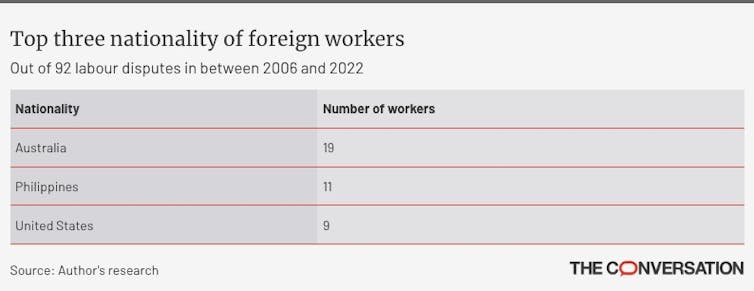
My study examined 92 labour disputes involving foreign workers between 2006 (when the new national dispute settlement system was implemented) and 2022, which were settled by the Industrial Relations Court. One additional dispute was filed in 2023, but the Industrial Relations Court has not yet published the settlement despite a legal requirement to do so.

I complemented these court settlements with 98 qualitative interviews with other stakeholders, including policymakers, labour rights activists, legal professionals, and other foreign workers, such as foreign spouses, remote workers and digital nomads.

As in other countries too, the number of registered labour disputes is only the tip of the iceberg, as workers tend to cut their losses and move on rather than invest time, energy and limited financial resources in challenging their better-resourced employers.

Employers were all Indonesian companies, so no foreign workers who filed a lawsuit worked for a multinational company, and those who did so had at least 20 nationalities.


CC BY

In terms of geographical distribution, the studied disputes were settled in 13 local jurisdictions, and were mostly lodged by workers rather than employers.

The nature of the disputes mostly involved claims that an employment contract had been terminated prematurely (87 cases), while a much smaller number involved resignation (4 cases) or were unknown (1 case). Of the 92 claims, 83 were initiated by workers, and eight by an employer. In one case, the lodging party was not recorded in the final decision.

Hiring a private lawyer

Employers used the Immigration Law to undermine the protective role of the Manpower Law – as it stands foreign workers are only entitled to employment protection if they hold a valid residence permit, which employers can and do shorten. Doing so shows that the Indonesian government prioritizes the flexibility of employers at the expense of employment protection for foreign workers.

In at least 92% cases, foreign workers used paid assistance of a private lawyer to represent themselves at formal meetings and hearings required by the Disputes Settlement Law, the cost of which could be hefty.

As one foreign worker explained:

It’s always in the back of your mind, to do whatever to make employers happy if you want to stay. No matter what the work permit and contract say, they can ask immigration to kick us out within a week!“

A retired government official responsible for designing policy regarding foreign workers was surprised when he heard this, explaining that:

I thought they could look after themselves because they earn such high wages. Well, higher than the average Indonesian worker, that is.

Hiring a private lawyer is the only way to represent themselves throughout the dispute resolution process because they need to leave Indonesia once they are fired. Not having the legal right to remain in Indonesia makes it very difficult – even impossible – to do it without them.

Addressing institutional failures

Engaging a private lawyer served as an ‘institutional fix’ that enabled most foreign workers to engage with Indonesia’s labour dispute settlement system by attending formal meetings and hearings, as well as filling out required paperwork and sending essential letters and replies.

Addressing this institutional failure requires a shift in law and policy. Firstly, legal reforms are essential to ensure that immigration and employment laws are integrated to enable foreign workers to have access to legal processes intended to help protect labour rights. At a minimum, this would involve amending policy to prevent employers from cancelling residence permits so that foreign workers need to leave the country prematurely.

Alternatively, the Directorate-General of Immigration could still permit employers to do so, but then provide the affected foreign workers with a limited-stay visa so that they can remain in Indonesia to engage with the legal process. The Hong Kong Immigration Department does this for Indonesian migrant workers.

Secondly, there is a need for enhanced support systems that provide immediate and effective assistance to foreign workers. Government agencies tasked with settling labour disputes, such as local manpower offices and the Industrial Relations Court, should be equipped with adequate resources and trained personnel to handle migrant labour issues. Doing so would decrease the reliance of foreign workers on private lawyers.

Failure to protect the employment rights of foreign workers has the potential to damage Indonesia’s reputation as a destination country for employment. Such damage could undermine Indonesia’s ambitious plans to build a new capital city (Ibu Kota Nusantara) with the assistance of foreign workers, and undermine the government’s downstreaming programme, which helps Indonesia earn more from the export of raw minerals.

The Conversation

Wayne Palmer has received research funding from the International Labour Organization, the Freedom Fund, and the Australian Research Council.

ref. High skills, low protection: the legal hurdles for foreign workers in Indonesia – https://theconversation.com/high-skills-low-protection-the-legal-hurdles-for-foreign-workers-in-indonesia-230795

Light-powered reactions could make the chemical manufacturing industry more energy-efficient

Source: The Conversation – USA (2) – By Arindam Sau, Ph.D. Candidate in Chemistry, University of Colorado Boulder

Plants use light to make energy – and a team of scientists is using the same principle to power chemical reactions. fhm/Moment via Getty Images

Manufactured chemicals and materials are necessary for practically every aspect of daily life, from life-saving pharmaceuticals to plastics, fuels and fertilizers. Yet manufacturing these important chemicals comes at a steep energy cost.

Many of these industrial chemicals are derived primarily from fossil fuel-based materials. These compounds are typically very stable, making it difficult to transform them into useful products without applying harsh and energy-demanding reaction conditions.

As a result, transforming these stubborn materials contributes significantly to the world’s overall energy use. In 2022, the industrial sector consumed 37% of the world’s total energy, with the chemical industry responsible for approximately 12% of that demand.

Conventional chemical manufacturing processes use heat to generate the energy needed for reactions that take place at high temperatures and pressures. An approach that uses light instead of heat could lower energy demands and allow reactions to be run under gentler conditions — like at room temperature instead of extreme heat.

Sunlight represents one of the most abundant yet underutilized energy sources on Earth. In nature, this energy is captured through photosynthesis, where plants convert light into chemical energy. Inspired by this process, our team of chemists at the Center for Sustainable Photoredox Catalysis, a research center funded by the National Science Foundation, has been working on a system that uses light to power reactions commonly used in the chemical manufacturing industry. We published our results in the journal Science in June 2025.

We hope that this method could provide a more economical route for creating industrial chemicals out of fossil fuels. At the same time, since it doesn’t rely on super-high temperatures or pressures, the process is safer, with fewer chances for accidents.

A diagram showing a flower, where light from the Sun and CO2 go into the flower and water go into its roots, carbohydrates are stored in its leaves, and oxygen leaves.
Plants capture sunlight to convert carbon dioxide from the air into carbohydrates, or sugars.
Wattcle, Nefronus/Wikimedia Commons, CC BY-SA

How does our system work?

The photoredox catalyst system that our team has developed is powered by simple LEDs, and it operates efficiently at room temperature.

At the core of our system is an organic photoredox catalyst: a specialized molecule that we know accelerates chemical reactions when exposed to light, without being consumed in the process.

Much like how plants rely on pigments to harvest sunlight for photosynthesis, our photoredox catalyst absorbs multiple particles of light, called photons, in a sequence.

These photons provide bursts of energy, which the catalyst stores and then uses to kick-start reactions. This “multi-photon” harvesting builds up enough energy to force very stubborn molecules into undergoing reactions that would otherwise need highly reactive metals. Once the reaction is complete, the photocatalyst resets itself, ready to harvest more light and keep the process going without creating extra waste.

Designing molecules that can absorb multiple photons and react with stubborn molecules is tough. One big challenge is that after a molecule absorbs a photon, it only has a tiny window of time before that energy fades away or gets lost. Plus, making sure the molecule uses that energy the right way is not easy. The good news is we’ve found that our catalyst can do this efficiently at room temperature.

A researcher in lab goggles, gloves and a lab coat holds a bright slide over a lab bench.
Center for Sustainable Photoredox Catalysis researcher Amreen Bains performs a light-driven photoredox catalyzed reaction.
John Cline, Colorado State University Photography

Enabling greener chemical manufacturing

Our work points toward a future where chemicals are made using light instead of heat. For example, our catalyst can turn benzene — a simple component of crude oil — into a form called cyclohexadienes. This is a key step in making the building blocks for nylon. Improving this part of the process could reduce the carbon footprint of nylon production.

Imagine manufacturers using LED reactors or even sunlight to power the production of essential chemicals. LEDs still use electricity, but they need far less energy compared with the traditional heating methods used in chemical manufacturing. As we scale things up, we’re also figuring out ways to harness sunlight directly, making the entire process even more sustainable and energy-efficient.

Right now, we’re using our photoredox catalysts successfully in small lab experiments — producing just milligrams at a time. But to move into commercial manufacturing, we’ll need to show that these catalysts can also work efficiently at a much larger scale, making kilograms or even tons of product. Testing them in these bigger reactions will ensure that they’re reliable and cost-effective enough for real-world chemical manufacturing.

Similarly, scaling up this process would require large-scale reactors that use light efficiently. Building those will first require designing new types of reactors that let light reach deeper inside. They’ll need to be more transparent or built differently so the light can easily get to all parts of the reaction.

Our team plans to keep developing new light-driven techniques inspired by nature’s efficiency. Sunlight is a plentiful resource, and by finding better ways to tap into it, we hope to make it easier and cleaner to produce the chemicals and materials that modern life depends on.

The Conversation

The authors do not work for, consult, own shares in or receive funding from any company or organization that would benefit from this article, and have disclosed no relevant affiliations beyond their academic appointment.

ref. Light-powered reactions could make the chemical manufacturing industry more energy-efficient – https://theconversation.com/light-powered-reactions-could-make-the-chemical-manufacturing-industry-more-energy-efficient-257796

How do atoms form? A physicist explains where the atoms that make up everything around come from

Source: The Conversation – USA (2) – By Stephen L. Levy, Associate Professor of Physics and Applied Physics and Astronomy, Binghamton University, State University of New York

Many heavy atoms form from a supernova explosion, the remnants of which are shown in this image. NASA/ESA/Hubble Heritage Team

Curious Kids is a series for children of all ages. If you have a question you’d like an expert to answer, send it to CuriousKidsUS@theconversation.com.


How do atoms form? – Joshua, age 7, Shoreview, Minnesota


Richard Feynman, a famous theoretical physicist who won the Nobel Prize, said that if he could pass on only one piece of scientific information to future generations, it would be that all things are made of atoms.

Understanding how atoms form is a fundamental and important question, since they make up everything with mass.

The question of where atoms come from requires a lot of physics to be answered completely – and even then, physicists like me only have good guesses to explain how some atoms are formed.

What is an atom?

An atom consists of a heavy center, called the nucleus, made of particles called protons and neutrons. An atom has lighter particles called electrons that you can think of as orbiting around the nucleus.

The electrons each carry one unit of negative charge, the protons each carry one unit of positive charge, and the neutrons have no charge. An atom has the same number of protons as electrons, so it is neutral − it has no overall charge.

A diagram of an atom, with protons and neutrons clumped together in the center and ovals representing electron orbits surrounding them.
An atom consists of positively charged protons, neutrally charged neutrons and negatively charged electrons.
AG Caesar/Wikimedia Commons, CC BY-SA

Now, most of the atoms in the universe are the two simplest kinds: hydrogen, which has one proton, zero neutrons and one electron; and helium, which has two protons, two neutrons and two electrons. Of course, on Earth there are lots of atoms besides these that are just as common, such as carbon and oxygen, but I’ll talk about those soon.

An element is what scientists call a group of atoms that are all the same, because they all have the same number of protons.

When did the first atoms form?

Most of the universe’s hydrogen and helium atoms formed around 400,000 years after the Big Bang, which is the name for when scientists think the universe began, about 14 billion years ago.

Why did they form at that time? Astronomers know from observing distant exploding stars that the size of the universe has been getting bigger since the Big Bang. When the hydrogen and helium atoms first formed, the universe was about 1,000 times smaller than it is now.

And based on their understanding of physics, scientists believe that the universe was much hotter when it was smaller.

Before this time, the electrons had too much energy to settle into orbits around the hydrogen and helium nuclei. So, the hydrogen and helium atoms could form only once the universe cooled down to something like 5,000 degrees Fahrenheit (2,760 degrees Celsius). For historical reasons, this process is misleadingly called recombination − combination would be more descriptive.

The helium and deuterium − a heavier form of hydrogen − nuclei formed even earlier, just a few minutes after the Big Bang, when the temperature was above 1 billion F (556 million C). Protons and neutrons can collide and form nuclei like these only at very high temperatures.

Scientists believe that almost all the ordinary matter in the universe is made of about 90% hydrogen atoms and 8% helium atoms.

How do more massive atoms form?

So, the hydrogen and helium atoms formed during recombination, when the cooler temperature allowed electrons to fall into orbits. But you, I and almost everything on Earth is made of many more massive atoms than just hydrogen and helium. How were these atoms made?

The surprising answer is that more massive atoms are made in stars. To make atoms with several protons and neutrons stuck together in the nucleus requires the type of high-energy collisions that occur in very hot places. The energy needed to form a heavier nucleus needs to be large enough to overcome the repulsive electric force that positive charges, like two protons, feel with each other.

A close up of a bright star, which looks like a sphere with some flashes on its surface, against a dark background.
The immense heat and pressure in stars can form atoms through a process called fusion.
NASA/SDO

Protons and neutrons also have another property – kind of like a different type of charge – that is strong enough to bind them together once they are able to get very close together. This property is called the strong force, and the process that sticks these particles together is called fusion.

Scientists believe that most of the elements from carbon up to iron are fused in stars heavier than our Sun, where the temperature can exceed 1 billion F (556 million C) – the same temperature that the universe was when it was just a few minutes old.

The periodic table of elements, color-coded by how each element formed. Lighter elements formed by cosmic ray fission or exploding stars, while larger elements formed by merging neurtron stars or dying low mass stars. Hydrogen and Helium formed through Big Bang fusion.
This periodic table shows which astronomical processes scientists believe are responsible for forming each of the elements.
Cmglee/Wikimedia Commons (image) and Jennifer Johnson/OSU (data), CC BY-SA

But even in hot stars, elements heavier than iron and nickel won’t form. These require extra energy, because the heavier elements can more easily break into pieces.

In a dramatic event called a supernova, the inner core of a heavy star suddenly collapses after it runs out of fuel to burn. During the powerful explosion this collapse triggers, elements that are heavier than iron can form and get ejected out into the universe.

Astronomers are still figuring out the details of other fantastic stellar events that form larger atoms. For example, colliding neutron stars can release enormous amounts of energy – and elements such as gold – on their way to forming black holes.

Understanding how atoms are made just requires learning a little general relativity, plus some nuclear, particle and atomic physics. But to complicate matters, there is other stuff in the universe that doesn’t appear to be made from normal atoms at all, called dark matter. Scientists are investigating what dark matter is and how it might form.


Hello, curious kids! Do you have a question you’d like an expert to answer? Ask an adult to send your question to CuriousKidsUS@theconversation.com. Please tell us your name, age and the city where you live.

And since curiosity has no age limit – adults, let us know what you’re wondering, too. We won’t be able to answer every question, but we will do our best.

The Conversation

Stephen L. Levy receives funding from the National Science Foundation and the National Institutes of Health. He is affiliated with CyteQuest, Inc.

ref. How do atoms form? A physicist explains where the atoms that make up everything around come from – https://theconversation.com/how-do-atoms-form-a-physicist-explains-where-the-atoms-that-make-up-everything-around-come-from-256172