Trust and ethics: the public and politicians no longer even agree on the basics

Source: The Conversation – UK – By Matt T. Clark, Visiting Research Fellow in Philosophy, University of Leeds

Just over 18 months ago, Keir Starmer said the “fight for trust is the battle that defines our age”. Now a scandal surrounding his former ambassador to Washington, Peter Mandelson, could end his political career, precisely because of the damage it could cause to public trust.

At the heart of the story are documents released by the US government showing that Mandelson continued to be friends with Jeffrey Epstein after his conviction for sex offences. The prime minister insists Mandelson lied about the depth of his friendship with Epstein, though he has acknowledged he knew that it continued after Epstein’s conviction.

Some reporting suggests that there was a view in Downing Street that the “risk” of appointing Mandelson as ambassador to the US – his past political career, his then publicly known relationship with Epstein – was less important than the benefit to the national interest. As Peter Kyle, secretary of state for business and trade, put it in September (before further files were released): “Britain needed someone with outstanding and singular talents”.

This implies a specific view of how politicians should behave. When the national interest is at stake, actions are acceptable that would otherwise be morally questionable. Some politicians seem to think political effectiveness can outweigh standards. Philosophers sometimes agree that politics makes “dirty hands” unavoidable. Machiavelli thought politicians should learn not to be good. To achieve important political ends, it can be necessary to act badly.

It’s striking that Downing Street might have thought that this extended to Mandelson’s alleged relationship with Epstein – and that even this could be traded off against improving the UK’s relationship with the White House.

Similar views appear to have been taken when it came to Boris Johnson. He was a man of whom high standards were not expected in office, but who could effectively deliver important political outcomes (an electoral victory, Brexit).

But a large majority the public believes standards should take priority over delivery in politics – according to research from UCL’s Constitution Unit.

This suggests the public and those in politics lack a common understanding of how the latter should behave. And that poses a problem for rebuilding trust. Philosophical perspectives suggest a common understanding of this kind is central if we are to be able to trust well.

What is trust?

When we talk about trust in politics, we often pass over what trust is. And it is frustratingly difficult to set out a clear definition. Researchers significantly disagree about how to conceptualise trust.

Philosophical views vary. Trust may be a demand to be ethically considered by others or to have a deep-rooted psychological need for attachment to others satisfied. It could be to rely on others acting out of goodwill towards you or your desire to do something overlapping with someone’s desire to do something else.

By failing to define what trust is when we aim to restore it, we may act counterproductively or misdiagnose the problems we face.

A growing family of views in philosophy share a central insight. Trust requires more than just expectations about how a person will behave – it also relates to expectations about how a person ought to behave. Philosophers call these “normative expectations”.

Peter Mandelson signing the White House guest book.
Mandelson pictured during his time as Ambassador to Washington.
Flickr/UKinUSA, CC BY-SA

I’m not trusting my partner to make dinner tonight simply because I think that he will. That’s just to rely on him. I trust him only if I think that there is a reason he ought to cook dinner tonight, and I think that he will act in line with this reason. Perhaps, I know he values fairness and that I cooked last night. Maybe he said he’d cook yesterday, and I know that I can take him at his word.

Philosophers debate exactly what these expectations are. Some think trust is concerned with commitments or obligations we should act in line with. Others think it’s that we expect a responsiveness to others counting on us.

All these views suggest a specific environment is required to allow us to trust well. We need some shared understanding of what we should do. If my partner recognises no reasons why he ought to cook me dinner tonight, he most likely won’t. If I come to trust him to do so and he doesn’t, then my normative expectation of him is likely to be wrong. My trust will be broken.

If that discrepancy about how we each think that we should behave grows, trust will be broken more often.

Misaligned politics

If we think about how politicians ought to behave, we can see how there might be a problem of trust.

The same Constitution Unit research shows that the public value standards like honesty and accountability. They think those in public life should behave in line with high standards.

Some politicians look at the same situation and see other reasons that suggest they ought to act differently. Where a relationship essential to Britain’s national security is at stake – or some other element of the national interest – then some politicians think they ought to overlook honesty and integrity.

This mismatch will lead to public trust being repeatedly broken.

Much discussion among politicians focuses on “delivery” as central to establishing trust. Actions will certainly matter. But more work should be done to ensure alignment between what the public expects of politicians and what they actually do. In a volatile world, a public conversation is needed on when – if ever – national need can outweigh these standards. Culture change in government and Downing Street will matter.

This is vital. Falling public trust in politics and distrust in politicians have been linked to voters switching off from politics and turning to protests or populist parties.

We need to align our expectations for high standards in public life. Then we need to require them of everyone, however useful they may be.


Want more politics coverage from academic experts? Every week, we bring you informed analysis of developments in government and fact check the claims being made.

Sign up for our weekly politics newsletter, delivered every Friday.


The Conversation

Matt T. Clark is a member of the Labour Party.

ref. Trust and ethics: the public and politicians no longer even agree on the basics – https://theconversation.com/trust-and-ethics-the-public-and-politicians-no-longer-even-agree-on-the-basics-275533

The US is starving Cuba of fuel – here’s what a deal between them could look like

Source: The Conversation – UK – By Nicolas Forsans, Professor of Management and Co-director of the Centre for Latin American & Caribbean Studies, University of Essex

Cuba has reached a breaking point that even its crisis-hardened leadership cannot ignore. It is running out of fuel amid US pressure, having last received oil on January 9 from Mexico. This has prompted airlines such as Air Canada to cancel all flights to Cuba, hitting the tourism lifeline that accounts for most of the island’s foreign currency.

Massive power outages are now routine, and the UN has warned of a possible “humanitarian collapse” if Cuba’s oil needs go unmet. For the first time in decades, Cuba’s 67-year-old regime faces a crisis where its traditional survival tools – external bailouts, mass emigration and austerity – may no longer be enough.

Hostility between the US and Cuba dates back to 1960, when the newly socialist Cuban state nationalised American assets. Havana’s subsequent cold war alignment with Moscow then prompted an embargo in 1962 that prohibited almost all trade between the US and Cuba. Since then, Washington’s approach has cycled between pressure and limited engagement.

However, Donald Trump’s return to the White House in January 2025 has produced the most aggressive strategy in decades. And following the recent US capture and replacement of Venezuelan leader Nicolás Maduro, which resulted in Cuba losing its main oil patron, Washington has moved to close the island’s remaining energy lifelines. It has done so by threatening tariffs on countries that ship fuel to Cuba.

The Trump administration’s message to Havana is blunt: negotiate a deal on US terms or face an energy collapse that could push Cuba into a new “special period” (a reference to the 1990s when Cuba experienced severe economic crises after the dissolution of the Soviet Union). Havana has few options but to negotiate.

Trump and his secretary of state, Marco Rubio, have framed this operation as the next chapter in their effort to roll back left‑wing regimes in the western hemisphere. But despite this rhetoric, Washington’s goals are more strategic than they are ideological.

This is partly because delivering regime change in Cuba would be difficult. The regime has a strict ideological grip over the population and military that extends far beyond the current Cuban leader, Miguel Díaz-Canel. This makes it unlikely that removing him from office would bring about any real change.

The White House is most likely seeking a Cuba that is less of a security problem, less of a migration pressure valve and more of an economic opportunity – even if it remains formally communist.

What does the US want?

Preventing another mass exodus of Cubans to the US is a central objective. Over the past five years, more than 1 million Cubans have left their country, with hundreds of thousands entering the US. Trump has tightened those channels and has deported some recent arrivals, signalling that the “escape valve” that has helped Havana manage discontent is closing.

Any deal will therefore prioritise the Cuban government’s cooperation in discouraging departures, as well as guaranteeing its acceptance of deportation flights. Washington will also want to secure commitments from Cuba’s leaders to maintain basic social order so a humanitarian emergency does not spill into a migration crisis.

Meanwhile, the US has become alarmed in recent years by Cuba’s role as a listening post and foothold for its rivals. China has invested in intelligence facilities there aimed at intercepting US communications, while Russia signed a new military cooperation pact with Cuba in 2025.

Trump and Rubio may well see the energy chokehold as a chance to force Havana to close specific Chinese and Russian facilities or block future bases. Also likely are demands for some form of monitoring or transparency to reassure Washington that these activities are being rolled back.

At the same time, the Trump administration will see a commercial upside. Cuba’s infrastructure is in tatters and years of mismanagement, US dollar shortages and rules blocking profit repatriation have scared off investors. But the island’s beaches, ports and location still offer long‑term potential.

In any deal, US negotiators would likely push for a significant expansion of the private sector, as well as access for US and allied companies in tourism, energy generation, grids, ports, telecoms and logistics. Crucially, Washington will want some guarantees that foreign investors can repatriate profits.

Many tourism businesses in Cuba are currently controlled by Grupo de Administración Empresarial (Gaesa), a military-run conglomerate that controls about half the economy. So a gradual loosening of Gaesa’s economic control, or at least clearer rules and partnerships that give foreign firms more say, are probable US demands.

This would not mean a wholesale “opening” overnight. The Cuban military would still control much of the commanding heights. But it would create real stakes for US and European businesses in the island’s gradual economic recovery.

Finally, Trump and Rubio need something more immediate they can sell to domestic audiences as proof that pressure has “worked”. Yet they are also wary of triggering uncontrolled regime collapse. That tension points towards symbolic, calibrated steps rather than full democratisation.

This is likely to involve the release of a number of political prisoners, especially those jailed after protests in 2021. It may also see controls on internet access and independent civic activity eased, and possibly some limited experiments with more competitive local elections.

What Washington wants in Cuba is not an immediate transition, but a narrative: that US pressure forced a long‑closed regime to crack the door open, creating space for future change while avoiding a sudden vacuum close to its shores.

For Cuba’s leaders, the priority is regime survival. They will give ground most readily on economic and foreign policy issues, where concessions can be packaged as tactical and reversible. But they are likely to resist anything that looks like real power‑sharing at home.

That makes a deal centred on fuel, finance, migration control and a partial strategic realignment the most likely near‑term outcome. Cuba’s political system will bend at the margins, yet it is unlikely that the US administration will want to break the regime entirely.

The Conversation

Nicolas Forsans does not work for, consult, own shares in or receive funding from any company or organisation that would benefit from this article, and has disclosed no relevant affiliations beyond their academic appointment.

ref. The US is starving Cuba of fuel – here’s what a deal between them could look like – https://theconversation.com/the-us-is-starving-cuba-of-fuel-heres-what-a-deal-between-them-could-look-like-275765

Matt Goodwin’s ‘English ethnicity’ rhetoric: it’s important to ask why politicians want to sort people into categories

Source: The Conversation – UK – By Ros Williams, Senior Lecturer in Digital Media and Society, University of Sheffield

For Reform parliamentary candidate and former academic Matt Goodwin: “Englishness is an ethnicity that is deeply rooted in a people that can trace their roots back over generations.” By contrast, he argues, liberal progressives believe “anybody can be English as long as they sign a piece of paper and identify with Englishness.”

This is not a novel definition, and for some, it may be completely uncontroversial. It’s not surprising that some people living in England can trace their ancestors back many generations.

But attempting to define a particular “ethnicity” is also an attempt to determine who is (and who is not) part of a given group. Policing these boundaries has serious consequences.

The idea of essential groups

To speak of an identity as one that can be traced “back over generations”, is to speak of human reproduction and generational transmission. These are central ideas in how, historically, people have been categorised into racial groups.

The biological sciences have a long history of dividing humans up. Take 18th-century Swedish biologist Carl Linnaeus’s Systema Naturae, the most influential attempt to classify the natural world, and the basis of contemporary zoological nomenclature. Linnaeus subdivided humans into four varieties that many of us would balk at today and has no basis in modern science: white Europeans, reddish Americans, tawny Asians, and blackish Africans.

In the centuries since, the number of groups has changed, as well as the language used to describe them. But the idea that we can inherit some innate qualities via generational inheritance – essentialism – underwrites these influential ideas. Essentialism would have it that you’re born as part of a group and all the “identifying” in the world cannot change that.

These divisions can also generate a sense of entitlement to certain rights or resources for one group over another. They have been used to justify violence, discrimination – some of the most shameful moments in human history. Indeed, racial essentialism became so dangerous that Unesco published a series of statements to flag the dangers of the impulse to divide ourselves like this.

The limits of categories

The world is in a constant state of push and pull. People move or are moved, for all kinds of reasons all the time. They settle and reproduce in different places. This is an empirical truth that limits the utility of essentialist ideas.

Essentialist thinking requires us to say both where, and when, we are from. Some will find it quite straightforward to demonstrate membership of a particular group but others will not. Many of us won’t be able to say that all of our ancestors (as far back as history allows us to trace) were all born in England.

Take Dame Kelly Holmes. She was one of the public figures Spectator editor Michael Gove mentioned when he interviewed Goodwin on this and other subjects. He asked: “Would you say that [she is] not really English?” Holmes is mixed race (a term that also leans on the idea of essential categories that somehow merge). She served in the army, won gold medals for England and Great Britain and received the honorific of Dame. But if only some of her “roots” can be traced “back over generations”, then does she not qualify as English?

Many of us will confound the groups that we are made to squeeze into because, ultimately, our roots long predate contemporary ideas of nation, identity and group.

Why do people invoke these ideas?

For me, what’s important here is not disproving the essential existence of groups, but trying to trace why they are being mobilised. Why do politicians want to define these categories?

Groups, identities and communities are made and remade. We come to feel a part of a collective. And this feeling is generated often in ways that seem somehow naturally occurring. We pray at the same place of worship; we listen to the same kinds of music. But our affiliations to particular groups do not exist in the wild.

Michael Gove interviews Matt Goodwin.

Categories have social power. When you define a collective, it makes it possible to speak to that collective and to mobilise it. Collectives can be delineated in more and less definitive ways. Essentialist thinking is some of the most definitive and inflexible of all. At its worst, those outside a group are denied access to respect and safety.

So, why distinguish between those who belong and those who do not? Why debate whether public figures with ancestors born elsewhere, but born and raised in England, are “actually” English? Why evoke (but not invoke) essentialised ideas of race, using words like ethnicity?

And if we know that cultivating boundaries of belonging can generate a sense of entitlement, then who risks being denied access, and to what? In a period of economic difficulty when public resources are already stretched, what is the next logical step after enough people can be made to agree on a clear definition of who is or is not English?

The essentialist claims we are hearing in the UK are not new, but they are powerful. So when politicians like Goodwin assert a desire to open a public debate on the categories they have selected – and even defined – we have to ask what purpose it serves.

The Conversation

Ros Williams has received funding from the ESRC

ref. Matt Goodwin’s ‘English ethnicity’ rhetoric: it’s important to ask why politicians want to sort people into categories – https://theconversation.com/matt-goodwins-english-ethnicity-rhetoric-its-important-to-ask-why-politicians-want-to-sort-people-into-categories-275200

Snowball Earth wasn’t fully frozen: ice-free oases sheltered early life

Source: The Conversation – UK – By Chloe Griffin, Research Fellow, School of Ocean & Earth Science, University of Southampton, University of Southampton

Pablo Carlos Budassi, CC BY-NC-SA

To an astronaut today, the Earth looks like a vibrant blue marble from space. But 700 million years ago, it would have looked like a blinding white snowball. This seems an unlikely cradle for life, yet new evidence suggests the frozen ocean featured restricted ice-free oases that provided a lifeline for our earliest complex ancestors.

During the Cryogenian period, from 720 million to 635 million years ago, the Earth was buried by massive ice sheets that marched from the poles to the tropics. Surface temperatures were as low as -50°C.

Because the bright, white surface of the planet reflected (rather than absorbed) the Sun’s energy – a phenomenon known as the albedo effect – the Earth remained locked in this extreme climate state, dubbed “Snowball Earth”, for tens of millions of years.

Scientists have long thought that when the ocean is sealed under a kilometre-thick shell of ice, the usual connection between the atmosphere and oceans would be prevented, muting climate variability – short-term variations in temperature, precipitation, or wind patterns.

However, our new research, published in Earth and Planetary Science Letters, challenges this status quo. By forensically decoding ancient rocks, we’ve discovered that the climate became briefly more dynamic than normally expected on Snowball Earth: it even oscillated to a rhythm strikingly like our own today.

Decoding climate cycles

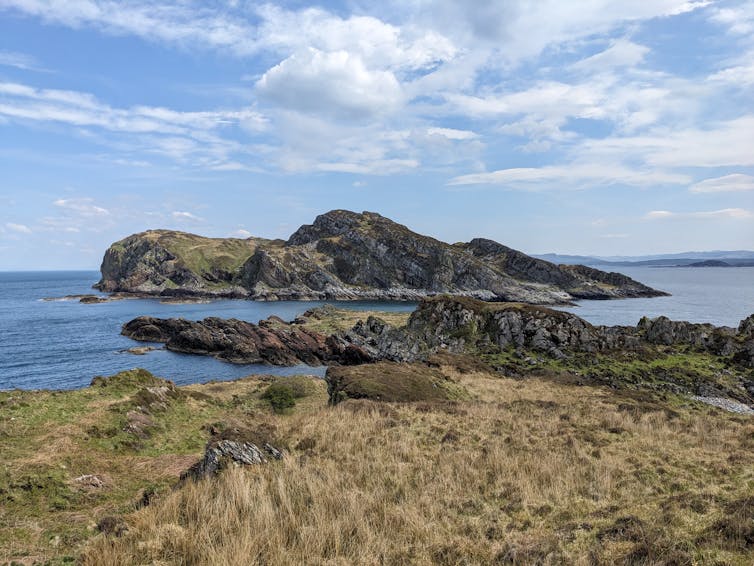
The breakthrough came from the Garvellach Islands off the west coast of Scotland. These rocks formed during the Sturtian glaciation (720–660 million years ago), the first of two Snowball Earth events; the second of which is the Marinoan (650–635 million years ago). The Scottish islands contain a unique exquisitely preserved archive of Snowball Earth, locking in the secrets of this weird ancient world.

Specifically, laminated sedimentary rocks, or varves, act as natural data loggers. Picture a lake today: sediment settles quietly through the water column and on to the lake bed. Over time, these layers of sediment build up at the bottom of the lake. Thousands or millions of years later, geologists can use the physical, chemical and biological information trapped in the now ancient lake sediments to track how environmental conditions – including climatic ones – changed over time.

The remote Garvellach Islands off the west coast of Scotland.
Prof Thomas Gernon, University of Southampton

While modern sediments like this are easy to find, detailed climate archives from deep time are vanishingly rare – leaving us in the dark about how our planet’s climate behaved during Snowball Earth – until now.

We investigated a unique pile of rocks six metres thick, containing around 2,600 such varves, on the Garvellach Islands. What they revealed was, quite frankly, jaw-dropping. Microscopic and statistical analysis showed that these layers weren’t uniform, as you might expect locked in a Snowball state.

Instead, they conform to predictable cycles occurring over timescales of a few years to centuries. Perhaps yet more surprising is that almost the full suite of climate rhythms we know from today are preserved; from annual seasons to modern phenomena like El Niño (a climate pattern marked by warming of sea surface temperatures in parts of the Pacific Ocean), and longer-term cycles linked to solar activity lasting decades to centuries.

We certainly wouldn’t have expected El Niño cycles – a climate phenomenon that happens every two to seven years today – not least since this requires a seamless communication between the atmosphere and oceans, which is hard to envision on an ice-covered world.

A (partially) ice-free ocean?

The cycles in these ancient sediments do raise an intriguing possibility: could parts of the ocean have been ice-free during Snowball Earth? To get to the bottom of this, we used computer climate simulations to test different climate scenarios – put simply, seeing how changing the amount of ice on the oceans changes the patterns of surface temperature across the globe. We found that when the ocean was frozen completely solid, climate oscillations were largely suppressed.

Our simulations also show that vast areas of open water weren’t needed to restart these oscillations; if just a small fraction of the ocean surface was ice free – say, 15% or so – atmosphere ocean interactions could have resumed.

Comparing the simulated climate records to the patterns we decoded in the rock record, we think these sediments most likely document a patch of open water in the tropics, sometimes called an oasis. Such oases are used by many scientists to reconcile the survival of life with the near-global glaciation.

Close-up views of thin, repeating rock layers known as varves, each thought to represent a single year of sedimentation during Snowball Earth.
Prof Thomas Gernon, University of Southampton

Interestingly, several other lines of evidence suggest a partially ice-free ocean at roughly the same time. So, could our rocks provide evidence for temporary warming during Snowball Earth? While they confirm temporary patches of warmth in the surface ocean, these rocks represent a snapshot of around 3,000 years in a multi-million-year glaciation – likely a fleeting “Slushball” state within an otherwise frozen world. Another recent study even argues that liquid water could persist at -15°C, but only if it were extremely salty.

Crucially though, our new analysis shows that the climate system has an inherent tendency to oscillate, even under the most extreme conditions. Could these oases in the sea have been life-rafts for the earliest complex animals?

Perhaps the biggest paradox of Snowball Earth is that this hostile deep-freeze triggered a biological revolution. Around this time, the diversity and abundance of multicellular life exploded – an event fuelled by phosphorus-rich dust ground up by the very glaciers that threatened to extinguish it. Scientists think this happened during the warm interval between the two Snowball glaciations.

But for life to thrive after the ice, it first had to survive the second (Marinoan) glaciation. Our study offers a viable solution to this puzzle: if tropical oceans weren’t entirely frozen over, but held pockets of open water, these oases would have acted as habitable refuges.

Rather than a planet frozen solid, our work paints a picture of an “oscillating” world where thin cracks in the ice or more expansive patches of open water formed habitats that allowed, even encouraged, the colonisation of life.

By maintaining biodiversity during Earth’s most extreme ice age, these oases ensured that when the ice finally melted away, life was ready to bloom into the complex ecosystems we see today – eventually leading to us.

The Conversation

Thomas Gernon receives funding from the WoodNext Foundation, a fund of a donor-advised fund program. He is affiliated with the GFZ Helmholtz Centre for Geosciences, Potsdam, Germany.

Chloe Griffin does not work for, consult, own shares in or receive funding from any company or organisation that would benefit from this article, and has disclosed no relevant affiliations beyond their academic appointment.

ref. Snowball Earth wasn’t fully frozen: ice-free oases sheltered early life – https://theconversation.com/snowball-earth-wasnt-fully-frozen-ice-free-oases-sheltered-early-life-275240

Vinegar Valentines: how cruel Victorians sent insulting cards to their unwanted suitors

Source: The Conversation – UK – By Grace Marks, Graduate Teaching Assistant in History and English Literature, Edge Hill University

Many people imagine the Victorians to be the stern “we are not amused” type, yet they had a pretty cruel sense of humour when it came to Valentine’s Day. While today’s lovers often exchange cute (and cheesy) cards, the Victorians loved to send insulting “vinegar Valentines”.

I first discovered this peculiar practice in 2019, when I designed a small exhibition at The Atkinson arts hub in Southport as part of a larger show about Victorian humour. Researching the cards was eye-opening and a lot of fun, and I think of them every Valentine’s Day when I look at the more sentimental and affectionate fare on sale now.

Posted to unwanted suitors or people one disliked, vinegar Valentines were cheaply produced cards with unflattering images and offensive poems. These anonymous illustrations and verses were intended to represent the unfortunate recipient and point out their flaws, as well as leaving them guessing who sent it.

The last word in bad romance, these mock valentines were particularly popular in Britain and America from the 1840s onwards. They featured many different types of caricatures.

Some cards focused on the recipient’s looks, exaggerating or shrinking facial features to look as unpleasant as possible. The illustration above depicts a women with squashed, unappealing features – and the accompanying verse highlighted these flaws. The rhyme, A Beanery Beauty, states:

Though nothing more homely e’er walked on two feet,

In your own mind you’re everything lovely and sweet,

That you’re not a heart-breaker’s a fact I’d impart –

You may break lots of dishes, but nary a heart.

The card lampoons the recipient’s presumptions that she is attractive and good-tempered. However, the verse cuts through the supposed good opinion the lady has of herself by asserting that she would never be admired enough to be loved. The line describing how she “may break lots of dishes, but nary a heart” is the zinger. Not only is the poor woman deemed unattractive, she’s clumsy too.

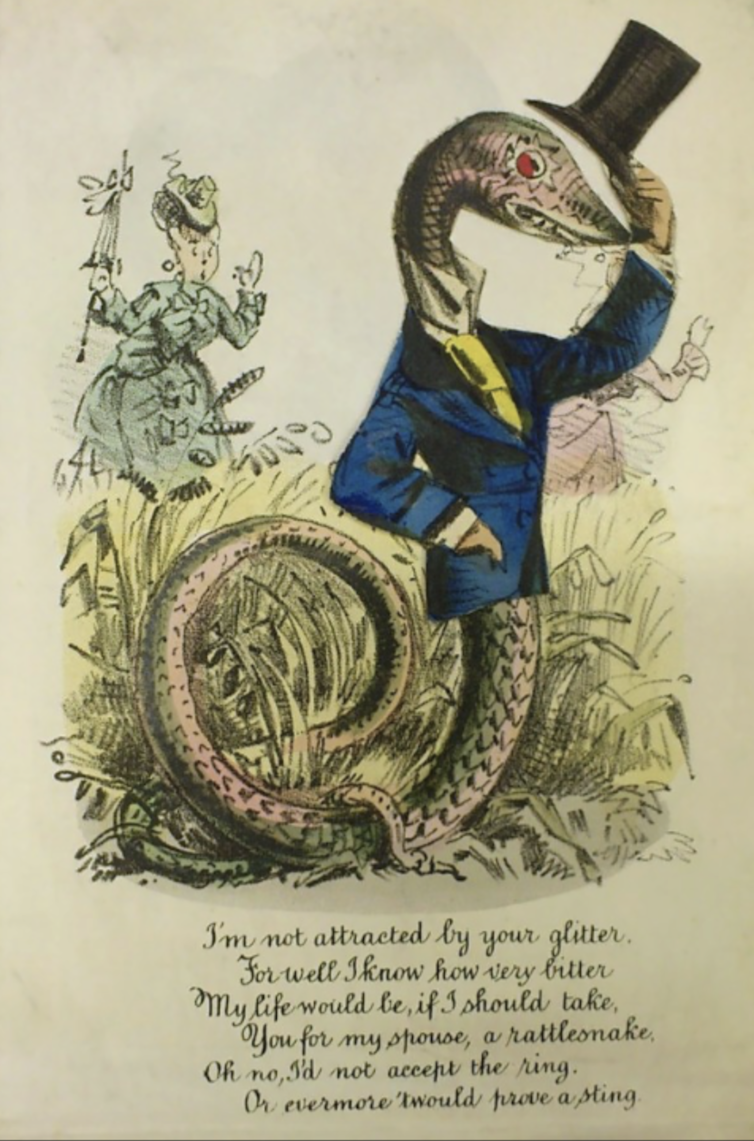
A card showing a snake in a top hat and smoking jacket.
This chap’s bad behaviour has definitely been rumbled.
CC BY

Women were not the only recipient of Valentine’s Day hate mail – men were denigrated if considered to be unappealing flirts. A common feature of vinegar Valentines was to depict the recipient as an animal. My favourite features a snake in a blue smoking jacket with a black top hat, and a horrified lady in the background.

The accompanying poem states the man is a “rattlesnake”, hence the image, and describes the “bitter” life a lady would lead with the recipient as a spouse. It ends with the cautionary line that a lady would “not accept the ring / Or evermore ‘twould prove a sting”.

These cards were phenomenally popular and demonstrate what happens when love goes wrong. But how did Victorians actually meet their potential spouses?

A Victorian version of online dating

A new method of courtship in the Victorian era was placing a matrimonial advert in a newspaper or periodical. These advertisements were much like a modern-day dating profile, where readers would submit their “bio” to the paper and wait for it to be published.

One paper that regularly featured matrimonial adverts was Ally Sloper’s Half-Holiday, an illustrated weekly that focused on the leisure pursuits of the late-19th century.

An early version of the comic strip, the Half-Holiday established an enormous readership, reaching 340,000 people. Most stories followed the fictional exploits of idle schemer Ally Sloper, who skulked and sloped about the alleyways of East London in the late 19th century. The “half-holiday” referred to the half day on a Saturday when people were free to indulge in leisure activities, and which for many coincided with football matches.

The dodgy Sloper was the main recurring character, but the paper also regularly featured his glamorous daughter, a music-hall actress and founder of Tootsie’s Matrimonial Agency. The paper liked to pretend their fictional characters were a genuine family, and offered real services to their readers. As the most romantic character, Tootsie Sloper was the natural figurehead for romance-seeking readers. Hopeful advertisers often described themselves as “fond of fun” and wanted their partners to be “jolly”.

Others played with humour in their ads, like the “Two Young Gentlemen” who described themselves to be “not painfully repulsive, but not precisely dangerously handsome”. Despite fears that dating adverts were full of scammers – much like catfishing today – they provided a novel way for partners to meet, and allowed regular readers the fun of speculating about the advertisers.

Victorians were not the perpetually grim-faced, serious bunch that old photographs often make out. They were fun-loving people who enjoyed playing practical jokes on one another. Matrimonial adverts allowed Victorian lovers to have more control over how they presented themselves to potential partners, and express their humour for all to see.

Vinegar Valentines were one of many ways the Victorians shared their sense of humour, while rejecting any unwanted attention. Insulting in nature, these cards were were intended to make the recipient feel foolish, much like the jokes found in comic papers at the time.

But spare a thought for the poor souls who received one of these cruel cards before the era of prepaid postage. They had to pay to receive their insults!

The Conversation

Grace Marks does not work for, consult, own shares in or receive funding from any company or organisation that would benefit from this article, and has disclosed no relevant affiliations beyond their academic appointment.

ref. Vinegar Valentines: how cruel Victorians sent insulting cards to their unwanted suitors – https://theconversation.com/vinegar-valentines-how-cruel-victorians-sent-insulting-cards-to-their-unwanted-suitors-275714

Fall in love Roman-style by playing boardgames

Source: The Conversation – UK – By Tim Penn, Lecturer in Roman and Late Antique Material Culture, University of Reading

For ancient Romans, many of the gestures now associated with Valentine’s Day would be unfamiliar, if not completely puzzling. Love and desire were not confined to a single day, nor expressed through standardised tokens of romance. There were no cards written (or forgotten), flowers purchased (at inflated prices) or eateries teaming with lovers. Instead, intimacy was negotiated through daily social encounters, leisure activities and moments of shared experience.

Ancient evidence – texts, art, and material remains – show that games were everywhere in the Roman world. We’ve been studying ancient boardgames together since 2018 and our work has found that games brought ancient people together in many different situations, including ones that encouraged closeness, flirtatious competition and prolonged interaction. Often these games, played with simple equipment, could be deeply meaningful and memorable for those who played together.

Roman games included games of strategy played without dice, such as ludus latrunculorum (“the game of the little soldiers”). They also played games which mixed skill and chance by using dice (even though playing dice games was often prohibited by law, like ludus duodecim scriptorum (“the game of 12 lines”), an ancestor of modern backgammon.

There are lessons to be learnt from ancient approaches to these love games. Today, people who are dating report dissatisfying or even dangerous gaps between romantic expectations and reality, as apps and screens compress intimacy into emojis or fleeting swipes.

The 1st-century Roman poet, Ovid, explains the importance of play for attracting and keeping a lover in his poetic manual, The Art of Love. One of his top tips is to play boardgames, and, importantly, to play to lose.

Ovid tells men: “If she is gaming and throwing the ivory dice with her hand, throw amiss and move your throws amiss”. In other words, try and play badly, so that the girl you are trying to charm wins.

Ovid also suggests that a woman in search of a lover should learn how to play, and “should know the throws of the dice, and your powers, O flung counter”, as knowledge of gaming with dice and counters was a key skill for hopeful lovers.

Playing for love, according to Ovid, is never purely about winning: it is about connection, attention, and spending time together.

You can see the ways that people in the ancient world used games to flirt in images too. A bronze mirror from Praenestine (modern Palestrina), an Italian town outside Rome and probably dating to the 2nd or 3rd century BC, shows a young couple sitting close together and wearing rather limited clothing while playing a boardgame. This game is possibly a larger variant of a dice-based one known as pente grammai (five lines), in which players compete to position their pieces on the centre-most line.

To help us understand how much the game is bringing them together, there is a useful dialogue above their heads. She’s saying something like, “I shall beat you,” to which he replies flirtatiously, “I expect you will.” So, the game is less about winning than about what happens around it: the proximity, the banter, and the shared moment of play that brings the couple together.

Returning to the present day, boardgames offer a striking counterpoint to many of today’s expressions of intimacy. Unlike digital forms of interaction, boardgames require presence: players gather around a shared surface, negotiate rules, take turns, and respond to one another spontaneously.

Boardgames structure attention and time, encouraging sustained engagement rather than fleeting exchange, and create opportunities for conversation, competition, and collaboration. In doing so, they bring people together in a shared social experience – one that foregrounds presence, interaction, and mutual awareness.

As is often the case, experience brings the theory to life. For eight years we have been researching ancient boardgames, so in a different way boardgames brought us together. Somewhere along the line, we got married. Perhaps the Romans were on to something, after all.


Looking for something good? Cut through the noise with a carefully curated selection of the latest releases, live events and exhibitions, straight to your inbox every fortnight, on Fridays. Sign up here.


The Conversation

Tim Penn received funding for some of the underlying research in this article from the Society of Antiquaries of London.

He is the co-leader of Working Group 2 ‘Cultural Heritage of Games’ for COST ACTION CA2214: Computational Techniques for Tabletop Games Heritage.

Summer Courts is the Science Communications Coordinator for COST ACTION CA2214: Computational Techniques for Tabletop Games Heritage.

ref. Fall in love Roman-style by playing boardgames – https://theconversation.com/fall-in-love-roman-style-by-playing-boardgames-275506

Using books as discussion prompts can help children with language delay

Source: The Conversation – UK – By Judith Mary Hutchings, Professor of Clinical Psychology, Director Centre for Evidence Based Early Intervention, Bangor University

PeopleImages/Shutterstock

Since the pandemic, more children have been starting school without being “school-ready”.

In 2022-23, 33% of all children starting reception in England did not have the skills needed for success in school, rising to 45% of children receiving free school meals.

Language deficits are a significant part of a lack of school readiness. These include the failure both to understand and produce language, driven by a lack of vocabulary. These skills are important for regulating attention and behaviour. The inability to understand or express themselves makes engagement in school challenging for children.

Early childhood language difficulties have a long term impact. Children with identified vocabulary difficulties at age five are three times more likely to have mental health problems in adulthood, and are twice as likely to be unemployed.

What’s more, 81% of children with behavioural problems have language difficulties, and 60% of young offenders have low language skills. Language skill deficits are a major public health concern.

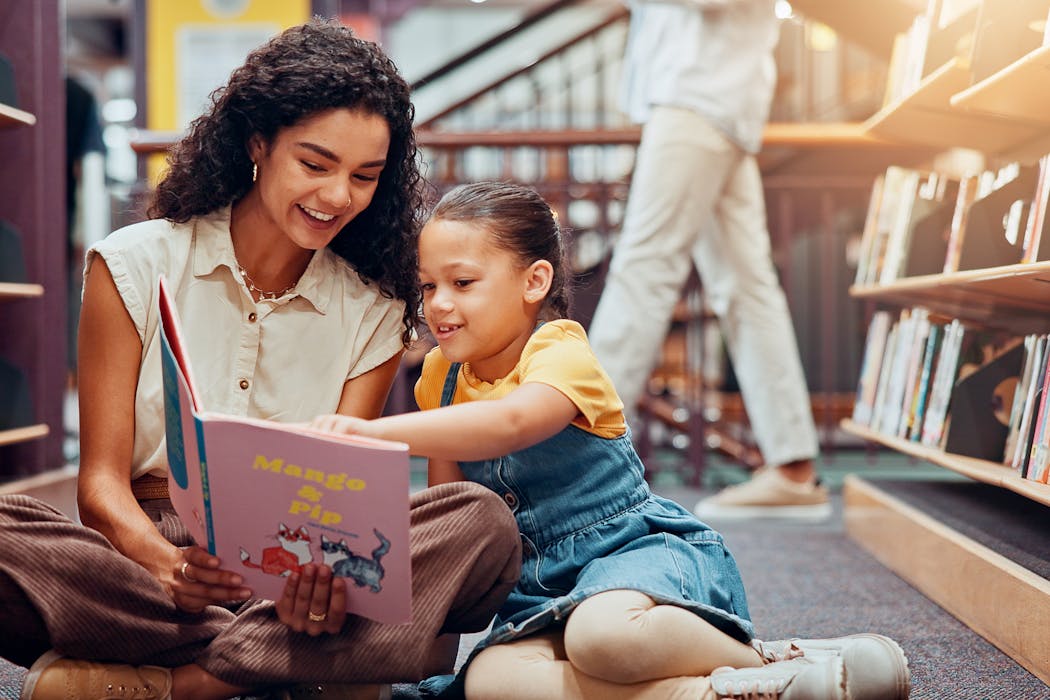
One evidence-based way to improve young children’s language development is through dialogic book sharing. This means that while looking at a book with an adult, children are prompted to speak by being asked questions.

These could be about, for example, what they can see, what they think might happen, how they think people in the pictures are feeling and whether they have had that experience themselves. Adults provide enthusiastic feedback to the child, praising them, as well as repeating what they say and expanding on it.

Using dialogic book sharing, adults become active listeners and encourage children to assume a progressively more active role in storytelling. Adults follow the child’s lead, encouraging them to actively participate in conversations and increasing both the number and complexity of questions asked.

Dialogic book sharing programmes for parents of younger children have shown that giving them the skills to support their children can increase children’s language skills.

Looking at books with adults can give children more frequent exposure to a wider vocabulary of words. Child-directed speech quality – the amount and quality of speech directed at children by their parents or carers – is a strong predictor of children’s vocabulary and language development.

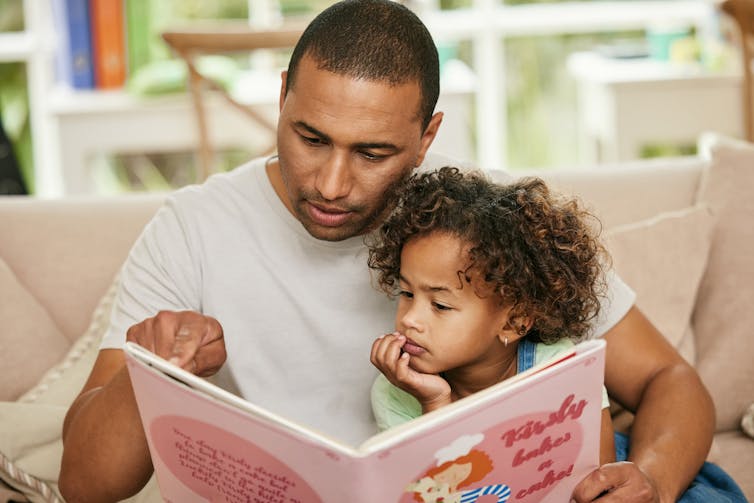
Father and daughter looking at book
Sharing books helps build vocabulary.
PeopleImages/Shutterstock

My research with colleagues adds to this evidence. In one study, parents took part in dialogic book sharing sessions in small groups with their children at school.

It resulted in significant increases in observed positive parenting, such as using praise and encouragement, and child expressive language skills. Parents also reported significantly higher rates of child prosocial behaviour (behaviour that enables children to get on with others) and social and emotional ability – their ability to regulate their emotions and get on with others.

Another study trained school-based teaching assistants to deliver the programme to targeted children in school. The teaching assistants reported positively on the training, and results showed an improvement in the children’s reading skills.

Starting conversations

Most recently, my colleagues and I assessed the effectiveness of a dialogic reading programme, “Books Together”, that we developed based on existing research and pre-existing dialogic book sharing resources, as well as our own research.

The programme is intended to promote children’s school readiness by enhancing their language competence. The programme was delivered online across North Wales to 44 parents of three- to five-year-olds. The parents were identified by schools as having children who would benefit from some support for their language skills.

The underpinning principle is that parents use books to promote conversations with children in which they follow children’s interests. They start with asking children what they see in the pictures and then moving to questions such as: “how do you think that character might be feeling?” “Have you ever felt like that? “What do you think might happen next?”

The results showed increases in children’s school readiness, as well as improvements in their prosocial behaviour and their social and emotional abilities, We also found that the programme had benefits for parents. We found an increase in parents’ wellbeing and in their ability to to understand and predict their children’s needs and respond sensitively. All reported continuing to share books with their children.

It is possible to use any books for dialogic book sharing with young children, but they must not be treated as a story to be read, rather as a prompt to create discussion.

Evidence from these three trials showed benefits to children from supporting both parents and school based support staff to engage in book sharing with children. It’s a proven way to help the growing number of children arriving at school without essential language skills – and who are at risk of exclusion and poor long term outcomes.

The Conversation

Judith Mary Hutchings does not work for, consult, own shares in or receive funding from any company or organisation that would benefit from this article, and has disclosed no relevant affiliations beyond their academic appointment.

ref. Using books as discussion prompts can help children with language delay – https://theconversation.com/using-books-as-discussion-prompts-can-help-children-with-language-delay-255999

I wrote a BBC drama about hope in a ‘left-behind’ town – but Britain changed faster than I could script it

Source: The Conversation – UK – By Steve Waters, Professor of scriptwriting and playwright, University of East Anglia

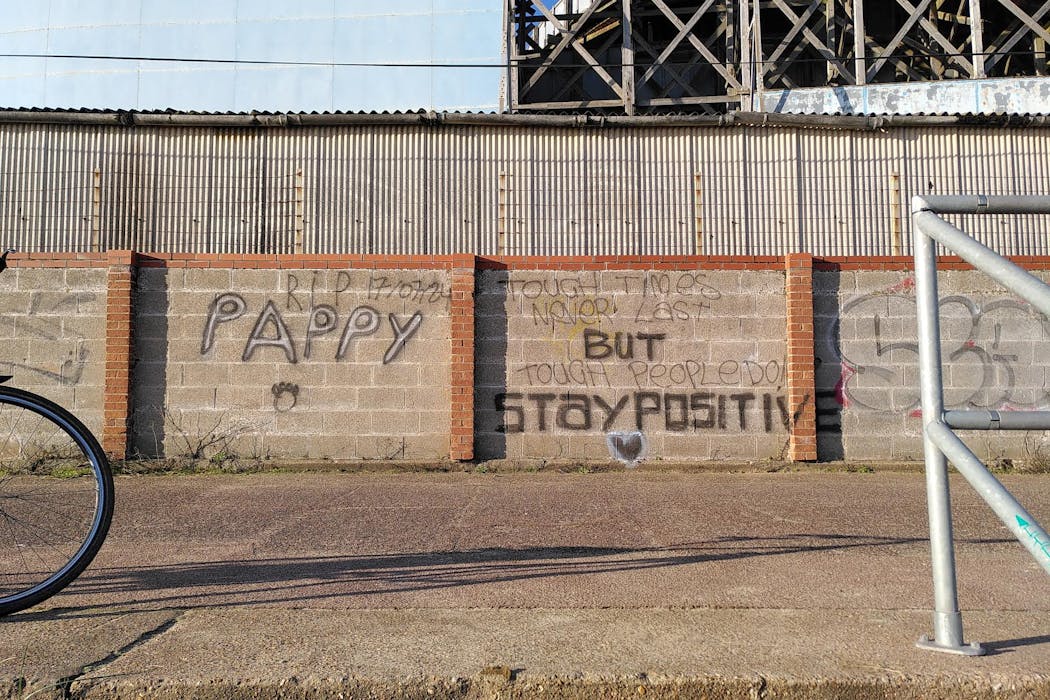
Graffiti seen by the author in Great Yarmouth. Steve Waters, CC BY-NC

The aspiration to write a “state-of-the-nation” drama is the great white whale of political writing. Take the work of legendary German playwright Bertolt Brecht. Exiled by Hitler to Scandinavia in 1933, he attempted to capture life in his homeland from anecdotes and verbatim accounts. The result, his state-of-the-nation play Fear and Misery of the Third Reich (1938) distilled a whole society into the pattern of gestures in a dictatorship.

I won’t place myself in Brecht’s company, but writing my six-part radio drama Good People for the BBC over the last year has felt like the headlong pursuit of a moving target.

My drama tells the tale of four young idealists who fall under the spell of a visionary thinker, Faith Abbott. They create a think-tank, Project Hope, to transform the fortunes of a left-behind town. I track my conflicted characters from the dog-days of the pandemic to an undisclosed near future where mainstream politics has collapsed and a populist revolt is unleashed.

Be careful what you pitch for. I devised the project during the brief honeymoon of Keir Starmer’s new government in summer 2024, as Democrat Kamala Harris seemed to reset the hopes of progressives world-wide and Trump reeled from assassination bids. By the time I got the greenlight, Trump was in, Kamala was history and Starmer’s government was floundering.

In a sense I had a head start, given populism was my theme and the east of England my setting. Even as Labour celebrated its “loveless landslide” in the east, Reform planted their few flags in sea-side towns like the one I took as my focus, Great Yarmouth – reinvented in the series as the fictive Branwich.

Yet even here, events outpaced my imagination. In July 2024 Yarmouth elected Rupert Lowe, a millionaire who’s since trolled the town from afar while picking fights with his former party leader Nigel Farage.

View of the sea with a ship in the distance
Looking out to sea at Great Yarmouth.
Steve Waters, CC BY-NC

Yet beyond the mayhem of the news cycle, Good People maps much slower moving currents of life in the towns lining up behind Reform more out of despair than conviction.

Here I took inspiration from George Eliot’s great novel of provincial life Middlemarch (1871), which mercilessly dissects the ideals of would-be reformer Will Ladislaw as he enters the muddy realm of politics. Eliot’s focus is the era of the Great Reform Act of 1832, decades earlier, and that time lapse enables her to parse the complex weave of power in a locality.

The poverty in places like Yarmouth is not veiled or shy, it is blatant. You simply have to wander from its end-of-the-line station towards the sea to witness desolate social housing and multi-occupancy dwellings – wards where deprivation is baked in.

But equally startling is the hope: the artists making work, the councillors fighting to secure the town’s future, the generous tenor of a community with little to lose. As graffiti I spotted on a sea-wall proclaims: “Tough times never last, but tough people do.”

An audit of power

So yes, the state of the nation here seems critical. Yet following the Brechtian model it’s not sufficient to show and tell, it’s also necessary to analyse. With over five hours to play with, I could offer listeners an audit of how power works in the nation formerly known as the United Kingdom.

My characters’ fates track that; jumping on the AI bandwagon, moving into politics, withdrawing into prepping. They travel through the guts of parliamentary democracy, to the ruins of local government, to find a welfare state severed from its compassionate origins. Taking inspiration from the writings and practice of social thinker Hilary Cottam, in her invaluable book Radical Help (2018), I found myself exploring just how broken our social contract is.

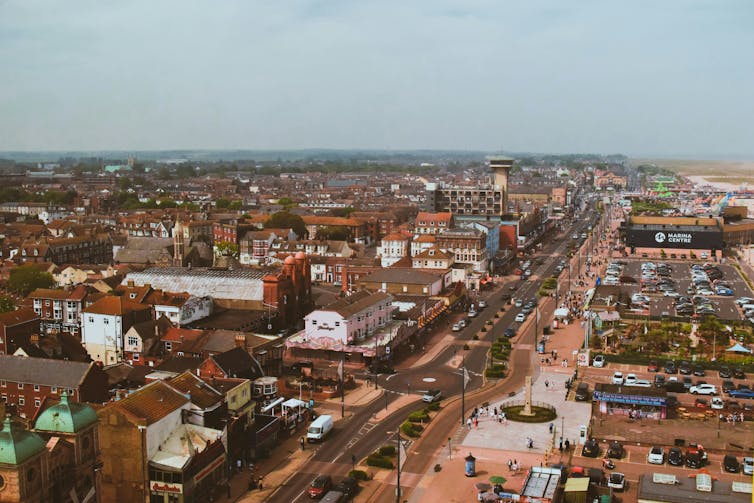
Aerial view of Great Yarmouth
In Good People, Great Yarmouth becomes the fictive Branwich.
Tetiana Zatsarynna/Unsplash

This results in some surprising conclusions for a self-described eco-playwright. If we set aside small boats and social media stoked paranoia, the fires burning under populism seem to be about a democratic deficit as anything else. The feeling of top-down governance as one imperative after another has become conflated with the potential sources of hope itself – the green transition towards a fossil-fuel free economy. It’s certainly hard to miss the phalanxes of offshore wind facing the seafront in Yarmouth, or to note inland the steady roll out of cabling snaking through farmland.

Yet as journalist and novelist James Meek has shown further north in Grimsby or Blyth, this net zero gold rush is experienced as expropriation rather than opportunity. The imported turbines are often installed by multinationals barely denting employment in the town; the ports in which they base their operations are no-go areas beyond the reach of democracy. The vehicles of rapid growth – data centres and freeports – claim land and resource but rarely touch the lives of locals.

My characters find themselves snarled up in these tragic juxtapositions. Yet for all this Good People is not bleak, it’s an attempt to locate hope in dark times. While each episode begins with the endgame, it spools back to explore what might have been.

I once shrank from the notion of state-of-the-nation drama, feeling the presumptuousness of the term: how can a single story speak to a country as complex as our own? Yet right now, it feels like looking this moment in the face is the only way to think our way out of it. Brecht’s play, written in exile, with little hope of realisation, offers one model; Eliot’s novel written in retrospect, another.


Looking for something good? Cut through the noise with a carefully curated selection of the latest releases, live events and exhibitions, straight to your inbox every fortnight, on Fridays. Sign up here.


The Conversation

Steve Waters has received funding from the AHRC

ref. I wrote a BBC drama about hope in a ‘left-behind’ town – but Britain changed faster than I could script it – https://theconversation.com/i-wrote-a-bbc-drama-about-hope-in-a-left-behind-town-but-britain-changed-faster-than-i-could-script-it-275747

Broken legs, skier’s thumb and ‘sled head’: just some of the injuries risked by Winter Olympians

Source: The Conversation – UK – By Adam Taylor, Professor of Anatomy, Lancaster University

The sports featured at the Winter Olympics defy gravity and physics. Many competitors move at breakneck speeds down steep, snowy inclines or careen across icy surfaces in a bid to set world records and earn their place on the podium.

But as exciting as these events are for spectators, they also place competitors at serious risk of injury. This is something we have been reminded of after US alpine ski racer Lindsey Vonn fractured her leg during a horror crash just seconds into her downhill run in the Milan Cortina games.

Of course, this isn’t the first time a Winter Olympian has suffered injury at the Games. Four athletes have died during Winter Olympic events or in preparation for them – most recently, Georgian luge athlete Nodar Kumaritashvili, who died after colliding with a wall during a training run at the 2010 Winter Olympics in Vancouver, Canada.

But of the 15 sports disciplines featured at this year’s Winter Olympics, a few stand out in terms of their riskiness to competitors:

Skiing and snowboarding

Of the snow-based events, skiing and snowboarding appear to be the most risky.

In alpine (downhill) skiing, there’s a 75% risk of professional athletes suffering at least one injury per season. And the majority of these are trauma injuries from a fall or collision. Male alpine skiers are at greater risk of overall injury and upper-body injuries, while women are a greater risk of knee injuries.

Video analysis of alpine skiing injuries shows that almost all occur when the skier is turning or landing from a jump. When you consider Olympic athletes are on the edge of doing what is possible, this is hardly surprising.

Turning and landing also put the knees into a particularly vulnerable position. The forces placed on them can be the equivalent of bearing up to three times a skier’s bodyweight.

This is one of the reasons why knee ligament injuries are common in skiing. Male skiers are at greater risk of medial collateral ligament injuries – a ligament that plays a key role in stabilising the knee. The same study showed that female skiers are almost three times more likely to suffer an anterior cruciate ligament (ACL) injury. This ligament plays a key role in standing and bending the knee.

If you were to look at 100 skiers in a single season, around eight female skiers will experience a severe ACL injury. Vonn had ruptured her ACL just days before competing in these Winter Olympics, illustrating just how harsh the sport can be.

Finger, hand and wrist injuries are common too. These typically happen during falls – either from crashing into an object or while trying to break a fall. Falling with a ski-pole in hand can cause a specific injury known as “skier’s thumb”. This causes damage to the ligament that helps stabilise the thumb.

While finger injuries are an inconvenience, they certainly don’t mean that athletes can’t continue to compete. The Italian skier Sofia Goggia proved this in 2022 when she broke multiple fingers during an event, had surgery overnight, then returned to the slopes the next day.


Read more:
Three common injuries skiers should watch out for this season


Snowboarding also accounts for a large number of injuries – including from falling on outstretched arms, as well as spinal and head injuries. As snowboarding events become more extreme, with athletes performing death-defying tricks and pushing the boundaries of what is possible, this could result in even more injuries per season.

Sledding

Of all the risky winter events performed on ice, bobsleigh, luge and skeleton all rank near the top in terms of injury risk.

“Sled head” is the aptly named condition used to describe the catalogue of symptoms affecting athletes competing in these sports. These include headaches, dizziness and brain fog arising from the multiple small impacts the head receives as athletes rattle down a track.

Approximately 13–15% of athletes in sledding sports also report experiencing concussion at a high-level competition such as the Olympics.

Due to the explosive start needed in sled events, particularly bobsleigh, muscle and tendon tears and ruptures can be common. This creates a problem for bobsledders because the event requires an explosive start, placing the legs’ large hamstring and quadriceps muscles under a lot of pressure. Similar injuries are also seen in sprinters.

Cross-country skiing

Cross-country skiing is far less extreme that its downhill counterparts, but still results in plenty of injuries.

The most common are repetitive strain and overuse injuries, such as shin splints, damaged knee ligaments and stress fractures in the feet. It’s estimated that for every 1,000 hours of cross-country skiing an athlete does, they will sustain an average of around four injuries.

Then there’s also the risk of frostbite, even on the most intimate parts of an athlete’s anatomy – as the Finn Remi Lindholm found out in Beijing in 2022.

Curling

When we think of extreme winter sports, we certainly don’t think of curling. Predictably, curlers suffer far fewer serious injuries than most other winter sport competitors.

But injuries from overuse are common. These are particularly caused by being in the “tuck” position used to deliver the curling stone, since the knee has to flex beyond 90 degrees.

Similar issues arise in the spine and the shoulder from the frantic sweeping of the ice – with team sweepers typically covering over 1km per match. Interestingly, men are more likely to get injured in curling than women, although the reason isn’t clear.

Physical injuries aren’t the only risk to athletes. Over 42% of athletes competing at the Winter Olympics report suffering from a respiratory illness. This can affect their balance, which may increase the risk of falls and sustaining injury.

So, as you watch the athletes doing their thing, it’s worth remembering they may be hiding all sorts of aches and pains – and may be one slip or fall from a season- or career-halting injury.

The Conversation

Adam Taylor does not work for, consult, own shares in or receive funding from any company or organisation that would benefit from this article, and has disclosed no relevant affiliations beyond their academic appointment.

ref. Broken legs, skier’s thumb and ‘sled head’: just some of the injuries risked by Winter Olympians – https://theconversation.com/broken-legs-skiers-thumb-and-sled-head-just-some-of-the-injuries-risked-by-winter-olympians-275166

The science behind the trend for showering in the dark before bed

Source: The Conversation – UK – By Timothy Hearn, Lecturer, University of Cambridge; Anglia Ruskin University

MAYA LAB/Shutterstock

The latest wellness trend and “sleep hack” involves switching off the bathroom light before stepping into the shower. In the dimness, the water feels louder, the day’s visual clutter fades and the hope is that sleep will come more easily. This practice, often called “dark showering”, has spread on social media, with people claiming that washing before bed in near darkness leads to deeper and faster sleep.

There is little research on dark showering as a standalone sleep technique. However, sleep science is clear about two key factors this ritual changes: light and heat. Both can nudge the body toward sleep or keep it alert.

Light is not only for seeing. Bright light in the evening signals to the brain’s internal body clock that it is still daytime. This delays the release of melatonin, a hormone that helps regulate sleep and is often described as the body’s “darkness signal”.

In a laboratory study of 116 adults, typical room lighting between dusk and bedtime reduced early night melatonin levels by about 70% compared with very dim light. Exposure to room light before bed also shortened the total duration of melatonin release by about 90 minutes. Participants reported feeling more alert.


Read more:
Light at night can disrupt circadian rhythms in children – are there long-term risks?


Bathrooms are often the brightest rooms in a home. Overhead lighting and illuminated mirrors are designed for precision tasks that are useful in the morning but less helpful late at night. Turning these lights off, or dimming them, removes a strong signal that it is still daytime.

One experiment exposed volunteers to standard bathroom lighting for just 30 minutes at bedtime. Melatonin levels dropped and self reported alertness increased, even though participants remained in the bathroom.

More recent research supports this. A 2025 crossover trial compared exposure before bed to cool white LED lighting with softer fluorescent lighting at the same brightness. The LED lighting delayed the time it took participants to fall asleep by about ten minutes and left them feeling less sleepy.

Another study of adolescents found that a burst of bright light in the early evening reduced melatonin levels three hours later and delayed the normal rise in sleepiness.

The same pattern appears in studies of screens. A controlled experiment comparing reading on a light emitting e-reader with reading a printed book found that the glowing device delayed the body clock, reduced melatonin and made it take longer to fall asleep.

A 2023 laboratory study that adjusted the “blue weighted” impact of screens, meaning the part of light most likely to affect the body clock, found that reducing this blue component lessened melatonin suppression and shortened the time needed to fall asleep.

If dark showering replaces time spent under bright bathroom lights or scrolling on a phone, it may help simply by reducing evening light exposure. The benefit will be smaller if the shower is followed by time under full lighting to dry hair, choose clothes for the next day and tidy up.

Darkness also works gradually. Melatonin does not switch on instantly when the lights go out, and a brief shower will not reset a body clock that has been running late for weeks.

Shower water may provide a second benefit. Research on passive body heating, which means warming the body without exercise, has shown that a warm shower or bath taken at the right time can help people fall asleep more quickly.

A 2019 meta analysis of 13 trials concluded that about ten minutes in warm water one to two hours before bedtime shortened the time it took to fall asleep by roughly nine minutes and improved sleep efficiency, the proportion of time in bed actually spent asleep. Warm water widens blood vessels in the hands and feet, helping core body temperature drop afterwards, a key signal for drowsiness.


Read more:
Want better sleep? Try a warm bath or shower 1-2 hours before bedtime, study suggests


Dark showering may also help prepare the nervous system for sleep. Low light reduces the brain’s alerting signals and makes it easier to shift from a state of vigilance, often called the “fight or flight” response, into a calmer “rest and digest” state.

One lab study asked volunteers to lie in a bath while sensors monitored their heartbeat. When the water was close to normal body temperature, about 37 to 38 degrees Celsius, the parasympathetic nervous system became more active. This is the part of the nervous system that slows the heart and supports relaxation. Heart rate slowed slightly and heart rate variability increased, a sign the body is adapting and settling.

A simpler experiment found a similar effect using only warm foot baths. Young women who soaked their feet in warm water for ten minutes showed an increase in vagal tone within 15 minutes.

Vagal tone refers to signals carried by the vagus nerve, which helps regulate heart rate, breathing and relaxation. Higher vagal tone is linked to steadier breathing, lower stress hormone levels and an easier transition into sleep.

Darkness supports the same process from another angle. Bright, blue rich LED lighting can raise heart rate and reduce vagal tone within minutes. A 2025 systematic review found that dimmer, warmer lighting allows heart rate variability to increase, signalling a calmer nervous system.


Read more:
LED face masks are popular on social media for glowing skin – but they could disrupt your sleep


Another factor is the sound of running water. A 2024 analysis found that natural sounds such as rainfall or flowing rivers can lower cortisol, a stress hormone, and stabilise heart rate more effectively than silence. Heat, darkness and soft background noise may therefore combine to signal that it is safe to relax.

There are important caveats. No large trial has directly compared dark showers with brightly lit showers while measuring objective sleep outcomes, so the idea is based on combining related findings rather than direct evidence.

People with mobility difficulties may need some light to reduce the risk of slips, and those who experience night-time anxiety may feel uneasy in complete darkness. As with most sleep advice, no single habit is a cure for chronic insomnia. Daytime light exposure, caffeine timing and stress management all play an important role.

The Conversation

Timothy Hearn does not work for, consult, own shares in or receive funding from any company or organisation that would benefit from this article, and has disclosed no relevant affiliations beyond their academic appointment.

ref. The science behind the trend for showering in the dark before bed – https://theconversation.com/the-science-behind-the-trend-for-showering-in-the-dark-before-bed-275592