Why are we so obsessed with bringing back the woolly mammoth?

Source: The Conversation – Canada – By Rebecca Woods, Associate Professor, Institute for the History & Philosophy of Science & Technology, University of Toronto

A photograph of a steppe mammoth on display at the Australian Museum in Sydney. (Unsplash/April Pethybridge), CC BY

In just the last several months, de-extinction — bringing back extinct species by recreating them or organisms that resemble them — has moved closer from science fiction to science fact. Colossal Biosciences — an American for-profit de-extinction startup headed by geneticists George Church and Beth Shapiro — announced two major achievements almost back-to-back.

In the first, scientists spliced part of the woolly mammoth’s genome into mice to create “woolly mice,” incredibly cute pom-pom like rodents sporting coats that express the genes of long-extinct woolly mammoths.

Reuters reports on the woolly mice developed by Colossal Biosciences.

Just a few weeks later, Colossal announced an even bigger achievement, claiming to have brought back the dire wolf, a contemporary of the woolly mammoth who, like their Ice Age proboscidean co-travellers, last roamed the Earth roughly 10,000 years ago.


Read more:
Colossal Bioscience’s attempt to de-extinct the dire wolf is a dangerously deceptive publicity stunt


Mammoth popularity

Woolly mammoths are at the forefront of these controversial de-extinction efforts. Despite a deep bench of more recently extinct species — the dodo, the moa, passenger pigeons, the bucardo, quagga, thylacine, aurochs and a whole host of others — readily available to take centre stage in de-extinction efforts, woolly mammoths figure prominently in de-extinction stories, both scientific and popular.

Woolly mammoths featured prominently in the imagery of Revive & Restore, a “genetic rescue” conglomerate of scientists and futurists headed by tech-guru Steward Brand; in 2021, Colossal “established ownership” over woolly mammoth revival. Colossal’s own logo visualizes CRISP-R, the gene-splicing technology that facilitates de-extinction, and the signature spiralled tusks of Mammuthus primigenius.

In popular culture, woolly mammoths have been a source of fascination for the last several centuries. Thomas Jefferson famously held out hope that live mammoths would be found beyond the frontier of American colonialism in the late-1700s, while early excavations of American mastodons were major events in the early 1800s. American painter Charles Willson Peale captured the first such excavation in oils, and later capitalized on that mastadon’s skeleton in his Philadelphia museum.

More recently, Manny the mammoth featured in the ongoing Ice Age animated film franchise, first launched in 2002.

Climate icons

At the same time, woolly mammoths have also become an emblem of the contemporary climate crisis. During the recent wave of defacing famous artwork in order to draw attention to the climate crisis, environmental activists painted the (fortunately artificial) tusks of the Royal B.C. Museum’s woolly mammoth model bright pink.

In a 2023 publicity stunt, the Australian cultured-meat startup, Vow, unveiled a mammoth meatball produced out of the woolly mammoth’s genome with sheep DNA as filler. Not for sale, the mammoth meatball was scorched before an audience at the Dutch science museum, Nemo.

The stunt was intended to call attention, again, to the plight of the Earth’s climate, the unsustainability of industrialized food systems and the potential for lab-grown meat to square this particular circle.

Model animals

For a creature that no human being has ever seen live and in the flesh, woolly mammoths certainly get a lot of media exposure. How did this long-extinct species become the emblem of contemporary extinction and de-extinction?

People have been interacting with the remains of woolly mammoths for hundreds of years. Dig a hole deep enough almost anywhere in the northern hemisphere, and you are apt to come across the bones or maybe the tusks of extinct mammoths or mastodons.

In early modern Europe, mammoth fossils were famously interpreted as the bones of unicorns and giants before being recognized as belonging to elephant-like creatures around 1700. Only around 1800 were mammoths recognized as a distinct and extinct species of proboscidea.

Elsewhere in Arctic regions, especially Siberia, Indigenous Peoples were familiar with mammoth remains preserved by permafrost. As rivers and their tributaries surged during annual thaws, whole carcasses of mammoths (and woolly rhinos) were sometimes exposed.

Local peoples who came across these remains, apparently recently dead but belonging to creatures they never saw walking the Earth’s surface, surmised that they were great burrowing rodent-like animals that tunnelled through the ground and perished if they accidentally came into contact with atmosphere.


Read more:
Ancient DNA suggests woolly mammoths roamed the Earth more recently than previously thought


Around the Arctic, including in Alaska, permafrost prevented the fossilization of mammoth tusks as well as bodies, and this ice ivory was — and remains — an important element of Arctic economies, carved locally and exchanged into historically regional, and now global, markets.

Continued relevance

Despite their association with the distant past, woolly mammoths have long resonated with modern human cultures as their fossilized or preserved body parts entered economic practices and knowledge systems alike. But as the extinction of once numerous species like the passenger pigeon, the American bison and African elephant began to loom over the late 19th century, woolly mammoths took on new meanings in the context of modern extinction and emergent understandings of human evolution.

a mural of woolly mammoths
A mural by by paleoartist Charles R. Knight depicting wooly mammoths, displayed at the American Museum of Natural History.
(United States Geological Survey)

Revolutions in geology, archeology, paleontology and related disciplines were changing long-held assumptions about the origin of humankind.

Narratives of the rise of “man the hunter” arose in natural history institutions such as the American Museum of Natural History and the Field Museum in Chicago. These origin stories were explicitly connected to the presumed extinction of woolly mammoths and their evolutionary relatives, the mastodons.

These led to some of the most powerful expressions of mammoths in visual form, like the frescoes and paintings produced by renowned paleoartist Charles R. Knight.

At the same time, cave paintings in France, Spain and elsewhere came to light in the early 20th century. For example, the 40,000-year-old frescoes at Rouffignac, France clearly depicting woolly mammoths were interpreted as further evidence of this deep and powerful historical connection.

It is this connection — the association of the rise of modern humankind with the decline and extinction of the woolly mammoth — that feeds today’s continued fascination. Notions of human complicity in extinction stories have long been embedded in modern scientific understandings of woolly mammoths. It is no accident that woolly mammoths are so central to de-extinction projects and climate activism alike.

The Conversation

Rebecca Woods received funding from the Social Sciences and Humanities Research Council of Canada.

ref. Why are we so obsessed with bringing back the woolly mammoth? – https://theconversation.com/why-are-we-so-obsessed-with-bringing-back-the-woolly-mammoth-253432


Lilo & Stitch: With love, a bereaved child feels safe enough to grieve and grow

Source: The Conversation – Canada – By Elena Merenda, Associate Head of Early Childhood Studies, University of Guelph-Humber

Lilo’s story offers a meaningful glimpse into how grief shows up in children through their emotions and actions. (Disney)

This story contains spoilers about Lilo & Stitch.

At first glance, Disney’s Lilo & Stitch, set in Hawaii, seems like a playful, heartwarming film about an alien’s misadventures and a young girl’s search for connection and friendship. But there’s a deeper story — one about childhood grief in the life of the main character, Lilo, and how she navigates the loss of her parents.

Lilo’s story offers a meaningful glimpse into how grief shows up in children through their emotions and actions.

Grief in childhood is often misunderstood and overlooked. A common misconception is that children don’t grieve because they’re too young to understand loss. But just because children don’t express grief the way adults do, it doesn’t mean they aren’t grieving.

As an early child educator who teaches families and post-secondary students about children’s grief, I often say this: anyone who is capable of loving is capable of grieving — and children are deeply capable of love.

Children express grief through behaviours

Lilo’s grief is never directly named in the film, but it’s everywhere — she lashes out, isolates herself and clings tightly to Stitch. These behaviours mirror how many children express grief through actions rather than words.

Research from the National Child Traumatic Stress Network notes that young children often grieve through behaviour — aggression, regression, somatic complaints or withdrawal. This is tied to their stage of cognitive development.

As the theory of cognitive development by renowned psychologist Jean Piaget outlines, children aged two to seven think concretely and egocentrically, making abstract concepts like death hard to understand.

In one scene, Lilo insists on feeding a sandwich to her pet fish Pudge, believing he controls the weather — an imaginative ritual that helps her feel a sense of control in a world that feels uncertain and unstable. In multiple scenes she refuses to listen to her sister Nani, reflecting how grief often shows up through routines, symbolic actions or emotional withdrawal.

Grief can make children feel ‘different’

The Canadian Alliance for Children’s Grief estimates that one in 14 children in Canada will lose a parent or sibling before age 18. Yet despite how common it is, childhood grief is often overlooked — especially in schools, where emotional pain may go unnoticed.

A dog-like character has his tongue out and teeth bared while smiling.
Feeling ‘different’ may go unnoticed in schools.
(Disney)

In Lilo & Stitch, we see this reality through Lilo. She knows she doesn’t fit in and asks her sister why no one likes her. Her classmates tease her for being “weird” and emotionally reactive. In one scene, she tries to share a handmade bracelet during dance class, only to be mocked and excluded. The moment may seem small but it reveals a deeper truth: grief can make children feel isolated, overwhelmed and fundamentally different from their peers.

Research confirms this. Studies in the Journal of School Psychology show that bereaved children often describe themselves as “not normal” or “different,” especially when their peers haven’t experienced a similar loss. Without safe, validating spaces to process their grief, these feelings can lead to loneliness, behavioural struggles and low self-esteem.

Grief grows with us

Grief in childhood isn’t a single moment — it evolves and deepens over time. As children grow, so does their understanding of what they’ve lost. They often revisit their grief at new developmental stages, carrying it in different ways.

Lilo & Stitch reflects this beautifully. Lilo doesn’t talk much about her parents’ death, but we see her grief in the routines she clings to — like listening to Elvis or sharing old family photos. These aren’t just quirks; they’re ways she keeps her parents close.

This reflects what grief researchers call the continuing bonds theory, which emphasizes that maintaining emotional connections to the deceased can support healthy adaptation. Grief isn’t something children “get over.” It’s something they learn to carry — with support, connection and love.

Healing doesn’t mean Lilo returns to who she was before her parents’ deaths. Her grief remains, but she begins to rebuild her world with Stitch, Nani and her new ‘ohana (family).

They don’t replace what was lost, but they become a space where grief and love can coexist.

One of the film’s most memorable lines captures this truth:

“This is my family. I found it, all on my own. It’s little and broken but still good. Yeah… still good.”

Connection is the path to healing

Just as grief is rooted in love, healing is rooted in connection.

Lilo’s healing comes from presence. Despite the chaos he brings, Stitch stays. Nani, overwhelmed and unsure, keeps showing up.

Their love and steady, unconditional presence allow Lilo to begin feeling safe enough to grieve and grow.

‘Lilo & Stitch’ trailer.

This reflects what attachment research tells us: strong, secure relationships are among the most powerful protective factors for children navigating loss. When a child feels emotionally safe with a caregiver, they’re better able to regulate emotions, build resilience and integrate the pain of loss into their development. In bereavement, the presence of a stable, responsive adult can determine whether a child’s grief becomes traumatic — or transformative.

In Lilo & Stitch, connection becomes both the container for Lilo’s grief and the bridge to her healing. The film gently reminds us: love may be the reason we grieve, but it’s also the most powerful way through it.

How caregivers can support a grieving child

1. Maintain routine and consistency.

In times of grief, structure helps children feel safe. Predictable routines — like mealtimes, bedtime rituals and daily rhythms — offer a sense of stability when everything else feels uncertain

2. Normalize and validate emotions.

Help your child name what they’re feeling and let them know it’s OK. Say things like, “It’s OK to feel that way,” or “Whatever you feel is welcome here.” Validation helps reduce shame and gives children permission to process their grief openly.

3. Answer questions honestly.

Children need truthful, age-appropriate information about what has happened. Avoid euphemisms like “went to sleep” or “passed away,” which can cause confusion. Instead, use clear, simple language: “Their body stopped working and they died.” Honesty builds trust and supports children’s cognitive and emotional development as they process the permanence of death.

4. Seek support.

Grief can feel overwhelming — for children and their parents or caregivers. Reach out to school counsellors, grief therapists or local support groups, because support can reduce isolation, support expression and improve coping in grieving families.

The Conversation

Elena Merenda does not work for, consult, own shares in or receive funding from any company or organisation that would benefit from this article, and has disclosed no relevant affiliations beyond their academic appointment.

ref. Lilo & Stitch: With love, a bereaved child feels safe enough to grieve and grow – https://theconversation.com/lilo-and-stitch-with-love-a-bereaved-child-feels-safe-enough-to-grieve-and-grow-259873

Alcohol and colonialism: the curious story of the Bulawayo beer gardens

Source: The Conversation – Africa – By Maurice Hutton, Research Associate, School of Environment, Education and Development, University of Manchester

Kontuthu Ziyathunqa – Smoke Rising – was what they used to call Bulawayo when the city was the industrial powerhouse of Zimbabwe. Now, many of its factories lie dormant or derelict. The daily torrent of workers flowing eastward at dawn, and back out to the high-density western suburbs at dusk, has diminished to a trickle.

But there is an intriguing industrial-era institution that lives on in most of the older western suburbs (formerly called townships). It is the municipal beer hall or beer garden, built in the colonial days for the racially segregated African worker communities. There are dozens of these halls and garden complexes, still serving customers and emitting muffled sounds of merriment to this day.


Read more:
Mbare Art Space: a colonial beer hall in Zimbabwe has become a vibrant arts centre


Like other urban areas in Rhodesia (colonial Zimbabwe), Bulawayo was informally segregated from its inception, and more formally segregated after the second world war. Under British rule (1893-1965) and then independent white minority rule (1965-1980), municipal drinking amenities were built in the townships to maintain control of African drinking and sociality. At the same time, they raised much-needed revenue for township welfare and recreational services.


Read more:
Zimbabwe’s economy crashed – so how do citizens still cling to myths of urban and economic success?


I researched the history of these beer halls and gardens as part of my PhD project on the development of the segregated African townships in late colonial Bulawayo. As my historical account shows, they played a key role in the contested township development process.

From beer halls to beer gardens

Bulawayo’s oldest and most famous beer hall, MaKhumalo, also known as Big Bhawa, was built more than a century ago. It still stands at the heart of the historic Makokoba neighbourhood. It’s enormous, but austere, and in the early days it was oppressively managed. Drinkers would describe feeling like prisoners there.

The more picturesque beer gardens began to emerge in the 1950s, reflecting the developmental idealism of Hugh Ashton. The Lesotho-born anthropologist was educated at the Universities of Oxford, London and Cape Town, and took up the new directorship of African administration in Bulawayo in 1949.

He was tuned into new anthropological ideas about social change, as well as developmental ideas spreading through postwar colonial administrations – about “stabilising” and “detribalising” African workers to create a more passive and productive urban working class. He saw a reformed municipal beer system as a key tool for achieving these goals.

Ashton wanted to make the beer system more legitimate and the venues more community-building. He proposed constructing beer garden complexes with trees, rocks, games facilities, food stalls and events like “traditional dancing”. So the atmosphere would be convivial and respectable, but also controllable, enticing all classes and boosting profits to fund better social services. As we shall see, this strategy was full of contradictions…

Industrial beer brewing

MaKhumalo, MaMkhwananzi, MaNdlovu, MaSilela. These beer garden names, emblazoned on the beer dispensaries that stick up above the ramparts of each garden complex, referenced the role that women traditionally played in beer brewing in southern Africa. This helped authenticate the council’s “home brew”.

But the reality was that the beer was now produced in a massive industrial brewery managed by a Polish man. It was piped down from steel tanks at the tops of the dispensary buildings into the plastic mugs of thirsty punters at small bar windows below. (It was also sold in plastic calabashes and cardboard cartons.)

And the beer garden bureaucracy, which offered a rare opportunity for African men to attain higher-grade public sector jobs, became increasingly complex and strictly audited.

As the townships rapidly expanded, with beer gardens dotted about them, sales of the council’s “traditional” beer – the quality of which Ashton and his staff obsessed over – went up and up.

Extensive beer advertising in the council’s free magazine mixed symbols of tradition (beer as food) with symbols of modern middle-classness.

Beer monopoly system

The system’s success relied on the Bulawayo council having a monopoly on the sale of so-called “native beer”. This traditional brew is typically made by malting, mashing, boiling and then fermenting sorghum, millet or maize grains. Racialised Rhodesian liquor laws restricted African access to “European” beers, wines and spirits.

So, the beer hall or garden was the only public venue where Africans could legally drink (apart from a tiny elite, for whom a few exclusive “cocktail lounges” were built). The council cracked down harshly on “liquor offences” like home brewing.

This beer monopoly system was quite prevalent in southern and eastern Africa, though rarely at the scale to which it grew in Bulawayo. Nearly everywhere, the system caused resentment among African townspeople, and so it became politically charged.

In several colonies, beer halls became sites of protest, or were boycotted (most famously in South Africa). And they usually faced stiff competition from illicit drinking dens known as shebeens.

In Bulawayo, the more the city council “improved” its beer system after the Second World War, the more contradictory the system became. It actively encouraged mass consumption of “traditional” beer, so that funds could be raised for “modern” health, housing and welfare services in the townships. Ashton himself was painfully aware of the contradictions.

In his guest introduction to a 1974 ethnographic monograph on Bulawayo’s beer gardens, he wrote:

The ambivalence of my position is obvious. How can one maintain a healthy community and a healthy profit at one and the same time? I can almost hear the critical reader questioning my morality and even my sanity. And why not? I have often done so myself.

Many citizen groups – both African and European – questioned the system too. They called it illogical, if not immoral; even some government ministers said it had gone too far. And when some beer gardens were constructed close to European residential areas, to cater for African domestic workers, many Europeans reacted with fear and fury.

As Zimbabweans’ struggle for independence took off in the 1960s, African residents increasingly associated the beer halls and gardens with state neglect, repression, or pacification. They periodically boycotted or vandalised them. Nevertheless, with few alternative options, attendance rates remained high: MaKhumalo recorded 50,000 visitors on one Sunday in 1970.

After independence

After Zimbabwe gained independence in 1980, the township beer gardens remained in municipal hands. They continued to be popular, even though racial desegregation had finally given township residents access to other social spaces across the city.

The colonial-era municipal beers continued to be produced, with Ngwebu (“The Royal Brew”) becoming a patriotic beverage for the Ndebele – the city’s majority ethnic group.

But with the deindustrialisation of Bulawayo since the late 1990s, tens of thousands of blue collar workers have moved to greener pastures, mostly South Africa. The old drinking rhythm of the city’s workforce has changed, and for the young, the beer gardens hold little allure. Increasingly, they have been leased out to private individuals to run.


Read more:
Beer, politics and identity – the chequered history behind Namibian brewing success


Nevertheless, there is always a daily trickle of regulars to the beer gardens, where mugs and calabashes are passed around among friends or burial society members. Some punters play darts or pool. And there are always some who sit alone, ruminating – perhaps in the company of ghosts from the past.

The beer gardens of Bulawayo embody the moral and practical contradictions of late colonial development – and the ways in which such systems and infrastructures may live on, but change meaning, in the post-colony.

The Conversation

Maurice Hutton received funding from the Economic and Social Research Council (ESRC) and the University of Edinburgh’s College of Humanities and Social Sciences to conduct the research on which this article is based.

ref. Alcohol and colonialism: the curious story of the Bulawayo beer gardens – https://theconversation.com/alcohol-and-colonialism-the-curious-story-of-the-bulawayo-beer-gardens-256511

Samora Machel’s vision for Mozambique didn’t survive: what has taken its place?

Source: The Conversation – Africa (2) – By Luca Bussotti, Professor at the PhD Course in Peace, Democracy, Social Movements and Human Development, Universidade Técnica de Moçambique (UDM)

Samora Moisés Machel, the first president of independent Mozambique, was born in 1933 in Gaza province, in the south of the country. He died in an unexplained plane crash on 19 October 1986, in Mbuzini, South Africa.

Authoritarian and popular, humble and arrogant, visionary and tactical. All these words have been used to describe Machel. Despite these contradictions, there was one quality that everyone recognised in him: his charisma. At the time this gift wasn’t lacking in many political leaders of emerging countries, especially those of Marxist-Leninist inspiration. Cuba’s revolutionary leader Fidel Castro above all.

Their common faith went beyond any personal or family interest. It was a faith for the progress of humanity, for the liberation of oppressed peoples from the colonial yoke, from the chains of capitalism and from traditional values and practices considered regressive.

Machel’s enlightenment programme was as fascinating as it was difficult to achieve in Mozambique in the mid-1970s. Small farmers, with all their “traditional” beliefs, made up the majority of the population. It was a political battle for social justice as well as a cultural crusade.

Machel’s speech on 25 June 1975, at the Machava Stadium in Maputo, proclaiming Mozambique’s independence from Portugal, highlighted the contradictions. The new head of state addressed the “workers”, who represented a small minority of the Mozambican people. At the same time, he called for freedom from colonial-capitalist oppression and the effective, total independence of the new country, already identifying its possible enemies: the unproductive and exploitative bourgeoisie.

The task of nation-building

Machel’s charisma recalled that of the proto-nationalist hero Gungunhana, who had tried to resist the Portuguese occupation at the end of the 19th century. Machel’s grandfather, Maguivelani, was related to the “terrible” Gungunhana, the last emperor of Gaza, who was defeated in 1895 by Mouzinho de Albuquerque after years of struggle. He was deported to Portugal, where he died in 1906.

Paradoxically, the anti-traditionalist Machel was the descendant of a great traditional chief. This heritage played a role in shaping his personality and political action.

Machel’s main task was to build a nation that only existed because of political unification under the Portuguese. The initial choices, embedded in the Cold War atmosphere, forced the nationalist Machel to opt for a rapprochement with the Soviet Union. Mozambique formally adopted a Marxist-Leninist doctrine at its Third Congress in 1977.

That approach meant political intolerance and the repression of “dissidents”, as well as the marginalisation of certain ethnic groups, above all the Amakhuwa people, who did not sympathise with Machel’s party, Frelimo.

The forces opposed to the Marxist-Leninist solution expected democratic elections to be held after the proclamation of independence from Portugal. But this opportunity never came. Portugal handed over power to Frelimo (Lusaka Accords, 1974), ignoring the existence of other political groups.

The treatment of leaders who opposed Frelimo’s vision was harsh. On their return from abroad, many were imprisoned in concentration camps in the north of the country.

They included the resistance leader Joana Simeão, along with others such as Uria Simango, former vice-president of Frelimo, his wife, Celina Simango, and Lázaro Kavandame, the former Makonde leader who left Frelimo because he didn’t agree with its political line.

They were put on arbitrary trial and executed. The dates and the method of execution are still officially unknown, despite the former president Joaquim Chissano’s public apology, in 2014, for these deaths.

About a year after independence, an armed opposition, Renamo, was formed. It was financed first by Ian Smith’s Southern Rhodesian government, and then by the South African apartheid regime.

Renamo, contrary to Machel’s expectations, had a solid popular base in central and northern Mozambique, especially among peasant populations who had expressed opposition to the policies of collectivisation and cooperation imposed by the Marxist-Leninist government.

And it was war which led Machel to a controversial agreement with the South African apartheid enemy. The Nkomati Accords, signed in 1984, provided for the end of Mozambique’s logistical support to the exiled African National Congress in Mozambique and South Africa’s military and financial support to Renamo.

This agreement did not bring peace. On the contrary, the war intensified, as the South African regime continued to finance Renamo.

Machel died in 1986, with the war still raging, unable to see the end of a conflict that had devastated Mozambique and which defeated the socialist principles.

The General Peace Accords between the Mozambican government, represented by the president, Chissano, and Renamo, represented by its leader, Afonso Dhlakama, were only signed in Rome in 1992.

End of an era

Machel took the first, important steps towards a rapprochement with the west, as demonstrated by his visit to Ronald Reagan in Washington in September 1985.

It can be said that with his death the First Mozambican Republic ended, with all its positive and negative elements. The dream of building a fair Mozambique with an equitable distribution of national wealth came to an end.

Machel had worked hard to ensure that health, education, transport, water and energy were distributed equally among Mozambicans. A poor but fair welfare state was born. But it was quickly dismantled in the years following his death. The Mozambican state had very few resources to devote to the welfare state. The rest was done by the rapid abandonment of an ideology, the socialist ideology, which by then the Frelimo elite no longer believed in.

In addition, international financial institutions entered the country, with the notorious structural adjustment policies, as early as 1987.

Corruption, which Machel sought to combat with various measures, and which he addressed at many of his rallies, spread across the country and all its institutions. The Frelimo political elite soon became the richest slice of the nation.

Several observers began to speak of a kleptocracy. The country suffered from continuous corruption scandals. One of the biggest became known as “hidden debt,” in which the political elite, including one of ex-president Armando Guebuza’s sons and former intelligence chief, Gregório Leão, were convicted of a scheme that cost the public treasury more than US$2 billion.

However, the main defeat was the fall of an inapplicable socialism.

The adoption of a capitalist, liberal and democratic model, at least formally, put an end to the arbitrary violations of human rights as in the age of the socialist state, such as “Operation Production” of 1983. The programme aimed to move “unproductive” people living in cities to the countryside to promote agricultural production.

In reality, it turned into arbitrary detentions and displacement of entire families, increasing the systematic violation of human rights by the state.

At the same time, the end of socialism meant democratic openness. Since the 1990 constitution, Mozambique has had as its fundamental principles respect for civil and political freedoms based on the 1948 Declaration of Human Rights. Still, socio-economic rights have been denied as a result of the dismantling of the welfare state.

How he’s remembered

Today, many people miss Machel’s rule. Those who were close to him, such as José Óscar Monteiro, the former interior minister, recall him as an ethical statesman, intolerant of corruption and abuses against “his” people. So do some of the international media.

Others, since the 1980s, such as Amnesty International, have denounced the serious violations of the most basic human rights by the Mozambican government and its leader.

What remains of Machel today is above all his ethical teaching. He died poor, committed to the cause of his nation, leaving his heirs moral prestige.

It is curious that his figure is associated, even in musical compositions by contemporary rappers from Mozambique, with his historical enemy, Dhlakama, who died in 2018.

This popular tribute is proof of the distance between the country’s current ruling class and a “people” who are looking to the charismatic figure of Venâncio Mondlane, the so-called “people’s president”. But that’s another story that won’t fit here.

The Conversation

Luca Bussotti does not work for, consult, own shares in or receive funding from any company or organisation that would benefit from this article, and has disclosed no relevant affiliations beyond their academic appointment.

ref. Samora Machel’s vision for Mozambique didn’t survive: what has taken its place? – https://theconversation.com/samora-machels-vision-for-mozambique-didnt-survive-what-has-taken-its-place-260110

West Africa terror: why attacks on military bases are rising – and four ways to respond

Source: The Conversation – Africa (2) – By Olayinka Ajala, Associate professor in Politics and International Relations, Leeds Beckett University

More than 40 Malian soldiers were killed and one of the country’s military bases was taken over in early June 2025 in a major attack by an al-Qaeda linked group, Jama’a Nusrat ul-Islam wa al-Muslimin (JNIM), on the town of Boulikessi.

The same group launched an attack on the historic city of Timbuktu. The Malian army claimed it repelled the Timbuktu attack and killed 14 terrorists.

Terrorist groups have attacked Boulikessi in large numbers before. In October 2019, 25 Malian soldiers were killed. The target was a G5 Sahel force military camp.

Timbuktu has been in the sights of terrorist groups since 2012. JNIM laid siege to the city for several months in 2023. Timbuktu has a major airport and a key military base.

In neighbouring Burkina Faso, there have been running battles in recent months between the military and terrorist groups. About 40% of the country is under the control of groups linked to al-Qaeda and Islamic State. Military bases in the country have also been targeted.

Mali and Burkina Faso are under military rule. Insecurity, especially increasing terrorist attacks, were key reasons the military juntas gave for seizing power in both countries.

I have been researching terrorism and the formation of insurgent groups in west Africa and the Sahel for over a decade. What I am observing is that the terrorist groups are becoming more daring and constantly changing tactics, with increased attacks on military camps across the region.

Military camps are attacked to lower the morale of the soldiers and steal ammunition. It also sends a message to locals that military forces are incapable of protecting civilians.

I believe there are four main reasons for an increase in large scale attacks on military bases in the region:

  • the loss of the US drone base in Niger, which has made surveillance difficult

  • an increase in human rights abuses carried out in the name of counter terrorism

  • a lack of a coordinated approach to counter terrorism

  • constant changes of tactics by the terrorists.

Identifying and addressing these issues are important to counter the trend.

Why are the attacks increasing?

First is the loss of the US drone base in Agadez, Republic of Niger, in 2024 after the military seized power in the country.

I was initially sceptical when the drone base was commissioned in 2019. But it has in fact acted as a deterrent to terrorist groups.

Terrorist organisations operating in the Sahel knew they were being watched by drones operating from the base. They were aware surveillance information was shared with member states. The loss of the base has reduced reconnaissance and surveillance activities in the region.

Second, an increase in human rights abuse in the fight against terrorism in the region is dividing communities and increasing recruitment into terrorist groups. A report by Human Rights Watch in May 2025 accused the Burkina Faso military and allied militias of killing more than 130 civilians during counter-terrorism operations.

The report argued that members of the Fulani ethnic group were targeted in the operations because they were perceived to have relationships with terrorist groups. Terrorist groups are known to use such incidents to win the hearts and minds of local populations.

Third, the lack of a coordinated approach to counter terrorism in the region is reversing the gains made in the last decade. Major developments have included the dissolving of the G5 Sahel. This grouping was created in 2014 to enhance security coordination between members. The members were Mauritania, Burkina Faso, Mali, Chad and Niger. The organisation launched joint counter-terrorism missions across member states but was dissolved in December 2023 after Niger and Burkina Faso withdrew.

The weakening of the Multinational Joint Task Force due to the military coup in Niger and the countries’ strategic repositioning is undermining counter-terrorism initiatives. Task force members were Cameroon, Chad, Niger, Nigeria and Benin.

The mandate of the task force is to combat Boko Haram and other terrorist groups operating around the Lake Chad basin. After its establishment in 2015 the task force achieved significant progress. In January 2025, Niger suspended its membership, putting the fight against terrorism in the region in jeopardy.

Fourth, terrorist groups in the region are becoming more sophisticated in their approach. In April 2025, JNIM terrorists were suspected of launching a suicide drone attack on Togolese military positions.

For its part, the military in the Sahelian countries are struggling to adapt to the terrorists’ new tactics. In the last few years, there has been a proliferation of drones in Africa by states and non-state actors.

Halting the trend

To combat the increasing attacks by terrorist groups, especially large-scale attacks on military positions, four immediate steps are necessary.

First, nation states need to invest in surveillance capabilities. The loss of the drone base in Niger means Sahelian states must urgently find new ways of gathering and sharing intelligence. The topography of the region, which is mainly flat, with scattered vegetation, is an advantage as reconnaissance drones can easily detect suspicious movements, terrorist camps and travel routes.

There is also a need to regulate the use of drones in the region to prevent use by non-state actors.

In addition, countries fighting terrorism must find a way to improve the relationship between the military (and allied militias) and people affected by terrorism. My latest publication on the issue shows that vigilante groups engaged by the military forces are sometimes complicit in human rights abuse.

Training on human rights is essential for military forces and allied militias.

Terrorism funding avenues must be identified and blocked. Large scale terrorist attacks involve planning, training and resources. Funding from illegal mining, trafficking and kidnapping must be identified and eradicated. This will also include intelligence sharing between nation states.

Finally, the Sahelian countries must find a mechanism to work with the Economic Community of West African States.

As the numbers and intensity of terrorist activities are increasing across the Sahel, immediate action is necessary to combat this trend.

The Conversation

Olayinka Ajala does not work for, consult, own shares in or receive funding from any company or organisation that would benefit from this article, and has disclosed no relevant affiliations beyond their academic appointment.

ref. West Africa terror: why attacks on military bases are rising – and four ways to respond – https://theconversation.com/west-africa-terror-why-attacks-on-military-bases-are-rising-and-four-ways-to-respond-258622

Here’s a way to save lives, curb traffic jams and make commutes faster and easier − ban left turns at intersections

Source: The Conversation – USA – By Vikash V. Gayah, Associate Professor of Civil Engineering, Penn State

Research shows left turns at intersections are dangerous and slow traffic. Benjamin Rondel/The Image Bank via Getty Images

More than 60% of traffic collisions at intersections involve left turns. Some U.S. cities – including San Francisco, Salt Lake City and Birmingham, Alabama – are restricting left turns.

Dr. Vikash Gayah, a professor of civil engineering at Penn State University and the interim director of the Larson Transportation Institute, discusses how left turns at intersections cause accidents, make traffic worse and use more gas.

Dr. Vikash Gayah discusses why left turns should be banned at some intersections.

The Conversation has collaborated with SciLine to bring you highlights from the discussion, edited for brevity and clarity.

How dangerous are left turns at intersections?

Vikash Gayah: When you make a left turn, you have to cross oncoming traffic. When you have a green light, you need to wait for a gap in the oncoming traffic before turning left. If you misjudge when you decide to turn, you could hit the oncoming traffic, or be hit by it. That’s an angle crash, one of the most dangerous types of crashes.

Also, the driver of the left-turning vehicle is typically looking at oncoming traffic. But pedestrians may be crossing the street they’re turning on to. Often the driver doesn’t see the pedestrians, and that too can cause a serious accident.

On the other hand, right turns require merging into traffic, but they’re not conflicting directly with traffic. So right turns are much, much safer than left turns.

What are the statistics on the unique dangers of left turns?

Gayah: Approximately 40% of all crashes occur at intersections − 50% of those crashes involve a serious injury, and 20% involve a fatality.

About 61% of the crashes at intersections involve a left turn. Left-hand turns are generally the least frequent movement at an intersection, so that 61% is a lot.

Why are left turns inefficient for traffic flow?

Gayah: When left-turning vehicles are waiting for the gap, they can block other lanes from moving, particularly when several vehicles are waiting to turn left.

Instead of the solid green light, many intersections use the green arrow to let left-turning vehicles move. But to do that, all other movements at the intersection have to stop. Stopping all other traffic just to serve a few left turns makes the intersection less efficient.

Also, every time you move to another “phase” of traffic – like the green arrow – the intersection has a brief period of time when all the lights are red. Traffic engineers call that an all-red time, and that’s when the intersection is not serving any vehicles. All-red time is two to three seconds per phase change, and that wasted time adds up quickly to further make the intersection less efficient.

An aerial view of a cars traveling around a roundabout.
Roundabouts reduce the need for left turns, but they don’t work everywhere.
Pete Ark/Moment via Getty Images

What restrictions have been tried in different cities?

Gayah: When a downtown is not very busy – in the off-peak periods – allowing left turns is fine because you don’t need that additional ability to move vehicles at each intersection.

Some cities are implementing signs that say no left turns at intersections from 7 to 9, which is the morning peak period, or 4 to 6, which is the afternoon peak period. In San Francisco, for example, Van Ness Avenue restricts left turns during peak periods.

But cities aren’t implementing these restrictions on a larger scale. Restrictions are more along individual corridors or isolated intersections instead of essentially the entire downtown, where possible. That would make the downtown street network more efficient.

Roundabouts are one approach to avoiding left turns.

Gayah: Roundabouts are safe because there’s no longer a need to cross opposing traffic. Everyone circulates in the same direction. You find where you need to go and then exit.

But restricting left turns, in general, is more efficient. Roundabouts aren’t as efficient when it’s busier. The roundabout gets full, which can cause a gridlock, and no vehicle can move. Traditional intersections are less prone to gridlock.

Roundabouts also take up more space. Installing a roundabout might mean expanding the intersection. In some downtowns, that means tearing down buildings or removing sidewalks. Restricting left turns only requires a sign that says “no left turns” or “no left turns during peak periods.” That’s it.

What are the benefits to banning left turns in urban areas?

Gayah: Any way you cut it, eliminating left turns will result in longer travel distances. I’ll have to travel a longer distance to get to where I need to go. The worst case is having to circle the block. I’m actually traveling four extra block lengths to get to where I need to go.

But not all trips require circling the block. In a typical downtown, each trip will be about one block length longer on average. That’s not a lot of extra distance. And that extra driving is more than offset by the fact that each intersection with banned left turns is now moving more vehicles. Which means every time you’re at an intersection, you wait less time, on average. So you travel a slightly longer distance but get to where you’re going more quickly.

Does avoiding left turns improve fuel efficiency?

Gayah: Our research found that even though vehicles travel longer distances on average with the restricted left turns, they spend less fuel – about 10% to 15% less per trip – because they don’t stop as much at intersections.

This is why UPS and other fleets route their vehicles to avoid left turns. There’s less idling and fewer stops.

Do you think banning left turns could become widely accepted?

Gayah: It’s a new strategy, so it’s uncomfortable for some people. But when they get to their destination faster, I think people will latch onto it.

Watch the full interview to hear more.

SciLine is a free service based at the American Association for the Advancement of Science, a nonprofit that helps journalists include scientific evidence and experts in their news stories.

The Conversation

Vikash V. Gayah’s research has been funded by various State Departments of Transportation (including Pennsylvania, Wisconsin, Washington State, Montana, South Dakota and North Carolina), US Department of Transportation (via the Mineta National Transit Research Consortium, the Mid-Atlantic Universities Transportation Center, and the Center for Integrated Asset Management for Multimodal Transportation Infrastructure Systems), Federal Highway Administration, National Cooperative Highway Research Program, and National Science Foundation..

ref. Here’s a way to save lives, curb traffic jams and make commutes faster and easier − ban left turns at intersections – https://theconversation.com/heres-a-way-to-save-lives-curb-traffic-jams-and-make-commutes-faster-and-easier-ban-left-turns-at-intersections-257877

Nations are increasingly ‘playing the field’ when it comes to US and China – a new book explains explains why ‘active nonalignment’ is on the march

Source: The Conversation – Global Perspectives – By Jorge Heine, Outgoing Interim Director of the Frederick S. Pardee Center for the Study of the Longer-Range Future, Boston University

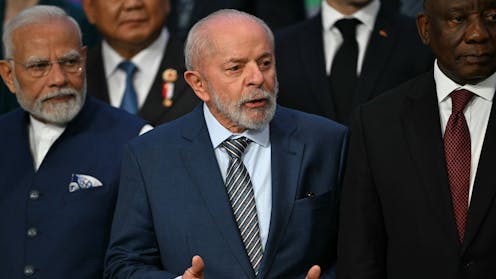
Brazil President Luiz Inacio Lula da Silva, center, flanked by India Prime Minister Narendra Modi, left, and South Africa President Cyril Ramaphosa, speaks at the summit of Group of 20 leading economies in Rio de Janeiro on Nov. 19, 2024. Mauro Pimentel/AFP via Getty Images

In 2020, as Latin American countries were contending with the triple challenges of the COVID-19 pandemic, a global economic shock and U.S. policy under the first Trump administration, Jorge Heine, research professor at Boston University and a former Chilean ambassador, in association with two colleagues, Carlos Fortin and Carlos Ominami, put forward the notion of “active nonalignment.”

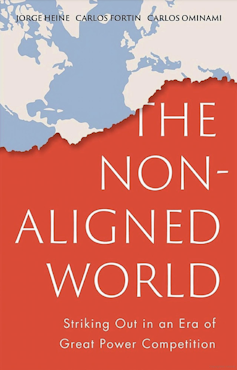
A book cover with the title 'The Non-Aligned World.'

Polity Books

Five years on, the foreign policy approach is more relevant than ever, with trends including the rise of the Global South and the fragmentation of the global order, encouraging countries around the world to reassess their relationships with both the United States and China.

It led Heine, along with Fortin and Ominami, to follow up on their original arguments in a new book, “The Non-Aligned World,” published in June 2025.

The Conversation spoke with Heine on what is behind the push toward active nonalignment, and where it may lead.

For those not familiar, what is active nonalignment?

Active nonalignment is a foreign policy approach in which countries put their own interests front and center and refuse to take sides in the great power rivalry between the U.S. and China.

It takes its cue from the Non-Aligned Movement of the 1950s and 1960s but updates it to the realities of the 21st century. Today’s rising Global South is very different from the “Third World” that made up the Non-Aligned Movement. Countries like India, Turkey, Brazil and Indonesia have greater economic heft and wherewithal. They thus have more options than in the past.

They can pick and choose policies in accordance with what is in their national interests. And because there is competition between Washington and Beijing to win over such countries’ hearts and minds, those looking to promote a nonaligned agenda have greater leverage.

Traditional international relations literature suggests that in relations between nations, you can either “balance,” meaning take a strong position against another power, or “bandwagon” – that is, go along with the wishes of that power. The notion was that weaker states couldn’t balance against the Great Powers because they don’t have the military power to do so, so they had to bandwagon.

What we are saying is that there is an intermediate approach: hedging. Countries can hedge their bets or equivocate by playing one power off the other. So, on some issues you side with the U.S., and others you side with China.

Thus, the grand strategy of active nonalignment is “playing the field,” or in other words, searching for opportunities among what is available in the international environment. This means being constantly on the lookout for potential advantages and available resources – in short, being active, rather than passive or reactive.

So active nonalignment is not so much a movement as it is a doctrine.

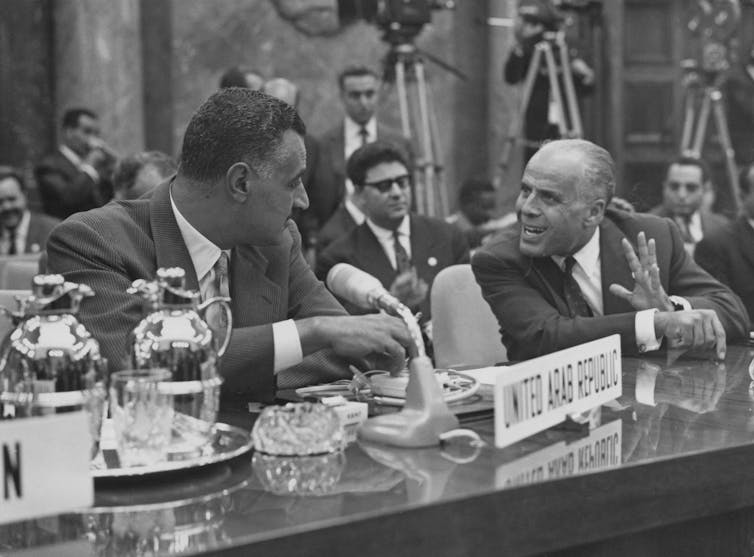
Two men in suits sit behind a desk chatting.
Tunisian President Habib Bourguiba, right, and Egyptian President Gamal Abdel Nasser attend the first Conference of Non-Aligned Countries in Belgrade, Yugoslavia, in September 1961.
Keystone/Hulton Archive/Getty Images

It’s been five years since you first came up with the idea of active nonalignment. Why did you think it was time to revisit it now?

The notion of active nonalignment came up during the first Trump administration and in the context of a Latin America hit by the triple-whammy of U.S. pressure, a pandemic and the ensuing recession – which in Latin America translated into the biggest economic downturn in 120 years, a 6.6% drop of regional gross domestic product in 2020.

ANA was intended as a guide for Latin American countries to navigate those difficult moments, and it led us to the publication of a symposium volume with contributions by six former Latin American foreign ministers in November 2021, in which we elaborated on the concept.

Three months later, with the Russian invasion of Ukraine and the reaction to it by many countries in Asia and Africa, nonalignment was back with a vengeance.

Countries like India, Pakistan, South Africa and Indonesia, among others, took positions that were at odds with the West on Ukraine. Many of them, though not all, condemned Russian aggression but also wanted no part in the West’s sanctions on Moscow. These sanctions were seen as unwarranted and as an expression of Western double standards – no sanctions were applied on the U.S. for invading Iraq, of course.

And then there were the Hamas attacks on Israel on Oct. 7, 2023, and the resulting war in the Gaza Strip. Countries across the Global South strongly condemned the Hamas attacks, but the West’s response to the subsequent deaths of tens of thousands of Palestinians brought home the notion of double standards when it came to international human rights.

Why weren’t Palestinians deserving of the same compassion as Ukrainians? For many in the Global South, that question hit very hard – the idea that “human rights are limited to Europeans and people who looked like them did not go down well.”

Thus, South Africa brought a case against Israel in the International Court of Justice alleging genocide, and Brazil spearheaded ceasefire efforts at the United Nations.

A third development is the expansion of the BRICS bloc of economies from its original five members – Brazil, Russia, India, China and South Africa – to 10 members. Although China and Russia are not members of the Global South, those other founding members are, and the BRICS group has promoted key issues on the Global South’s agenda. The addition of countries such as Egypt and Ethiopia has meant that BRICS has increasingly taken on the guise of the Global South forum. Brazil President Luiz Inácio Lula da Silva, a leading proponent of BRICS, is keen on advancing this Global South agenda.

All three of these developments have made active nonalignment more relevant than ever before.

How are China and the US responding to active nonalignment – or are they?

I’ll give you two examples: Angola and Argentina.

In Angola, the African country that has received most Chinese cooperation to the tune of US$45 billion, you now have the U.S. financing what is known as the Lobito Corridor – a railway line that stretches from the eastern border of the Democratic Republic of the Congo to Angola’s Atlantic coast.

Ten years ago, the notion that the U.S. would be financing railway projects in southern Africa would have been considered unfathomable. Yet it has happened. Why? Because China has built significant railway lines in countries such as Kenya and Ethiopia, and the U.S. realized that it was being left behind.

For the longest time, the U.S. would condemn such Chinese-financed infrastructure projects via the “Belt and Road Initiative” as nothing but “debt-trap diplomacy” designed to saddle developing nations with “white elephants” nobody needed. But a couple of years ago, that tune changed: The U.S. and Europe realized that there is a big infrastructure deficit in Asia, Africa and Latin America that China was stepping in to reduce – and the West was nowhere to be seen in this critical area.

In short, the West changed it approach – and countries like Angola are now able to play the U.S. off against China for its own national interests.

Then take Argentina. In 2023, Javier Milei was elected president on a strong anti-China platform. He said his government would have nothing to do with Beijing. But just two years later, Milei announced in an Economist interview that he is a great admirer of Beijing.

Why? Because Argentina has a very significant foreign debt, and Milei knew that a continued anti-China stance would mean a credit line from Beijing would likely not be renewed. The Argentinian president was under pressure from the International Monetary Fund and Washington to let the credit line with China lapse, but Milei refused to do so and managed to hold his own, playing both sides against the middle.

Milei is a populist conservative; Brazil’s Lula a leftist. So is active nonalignment immune to ideological differences?

Absolutely. When people ask me what the difference is between traditional nonalignment and active nonalignment, one of the most obvious things is that the latter is nonideological – it can be used by people of the right, left and center. It is a guide to action, a compass to navigate the waters of a highly troubled world, and can be used by governments of very different ideological hues.

Two men in suits turn away from each other.
Brazil President Luiz Inacio Lula da Silva and Argentina President Javier Milei at the 66th Summit of leaders of the Mercosur trading bloc in Buenos Aires on July 3, 2025.
Luis Robayo/AFP via Getty Images

The book talks a lot about the fragmentation of the rules-based order. Where do you see this heading?

There is little doubt that the liberal international order that framed world politics from 1945 to 2016 has come to an end. Some of its bedrock principles, like multilateralism, free trade and respect for international law and existing international treaties, have been severely undermined.

We are now in a transitional stage. The notion of the West as a geopolitical entity, as we knew it, has ceased to exist. We now have the extraordinary situation where illiberal forces in Hungary, Germany and Poland, among other places, are being supported by those in power in both Washington and Moscow.

And this decline of the West has not come about because of any economic issue – the U.S. still represents around 25% of global GDP, much as it did in 1970 – but because of the breakdown of the trans-Atlantic alliance.

So we are moving toward a very different type of world order – and one in which the Global South has the opportunity to have much more of a role, especially if it deploys active nonalignment.

How have events since Trump’s inauguration played into your argument?

The notion of active nonalignment was triggered by the first Trump administration’s pressure on Latin American countries. I would argue that the measures undertaken in Trump’s second administration – the tariffs imposed on 90 countries around the world; the U.S. leaving the Paris climate agreement, the World Health Organization and the U.N. Human Rights Council; and other “America First” policies – have only underscored the validity of active nonalignment as a foreign policy approach.

The pressures on countries across the Global South are very strong, and there is a temptation to give in to Trump and align with U.S. Yet, all indications are that simply giving in to Trump’s demands isn’t a recipe for success. Those countries that have gone down the route of giving in to Trump’s demands only see more demands after that. Countries need a different approach – and that can be found in active nonalignment.

The Conversation

Jorge Heine does not work for, consult, own shares in or receive funding from any company or organization that would benefit from this article, and has disclosed no relevant affiliations beyond their academic appointment.

ref. Nations are increasingly ‘playing the field’ when it comes to US and China – a new book explains explains why ‘active nonalignment’ is on the march – https://theconversation.com/nations-are-increasingly-playing-the-field-when-it-comes-to-us-and-china-a-new-book-explains-explains-why-active-nonalignment-is-on-the-march-260234

Thailand’s judiciary is flexing its muscles, but away from PM’s plight, dozens of activists are at the mercy of capricious courts

Source: The Conversation – Global Perspectives – By Tyrell Haberkorn, Professor of Southeast Asian Studies, University of Wisconsin-Madison

Thai Prime Minister Paetongtarn Shinawatra is swarmed by members of the media after a cabinet meeting at Government House on July 1, 2025. Anusak Laowilas/NurPhoto via Getty Images

Thai Prime Minister Paetongtarn Shinawatra is currently feeling the sharp end of the country’s powerful judiciary.

On July 2, 2025, Thailand’s Constitutional Court suspended Paetongtarn from office as a result of a leaked phone conversation in which she was heard disparaging Thailand’s military and showing deference to former the prime minister of Cambodia, Hun Sen, despite an ongoing border dispute between the two countries. Initially set for 14 days, many onlookers believe the court’s suspension is likely to become permanent.

Meanwhile, far from the prime minister’s office is Arnon Nampa, another Thai national whose future is at the mercy of the Thai judiciary – in this case, the Criminal Court.

Arnon, a lawyer and internationally recognized human rights defender, is one of 32 political prisoners imprisoned over “lèse majesté,” or insulting the Thai monarchy. He is currently serving a sentence of nearly 30 years for a speech questioning the monarchy during pro-democracy protests in 2020. Unless he is both acquitted in his remaining cases and his current convictions are overturned on appeal, Arnon will likely spend the rest of his life in prison.

The plights of Paetongtarn and Arnon may seem distant. But as a historian of Thai politics, I see the cases as connected by a judiciary using the law and its power to diminish the prospects for democracy in Thailand and constrain the ability of its citizens to participate freely in society.

Familiar troubles

The Shinawatra family is no stranger to the reach of both the Thai military and the country’s courts.

Paetongtarn is the third of her family to be prime minister – and could become the third to be ousted. Her father, Thaksin Shinawatra, was removed in a 2006 military coup. Her aunt, Yingluck Shinawatra, was ousted prior to the May 22, 2014, coup. In common with past coups, the juntas who fomented them were shielded from the law, with none facing prosecution.

For now, it is unclear whether Paetongtarn’s suspension is the precursor to another coup, the dissolution of parliament and new elections, or a reshuffle of the cabinet. But what is clear is that the Constitutional Court’s intervention is one of several in which the nine appointed judges are playing a critical role in the future of Thai democracy.

Protecting the monarchy

The root of the judiciary’s power can be found in the way the modern Thai nation was set up nearly 100 years ago.

On June 24, 1932, Thailand transitioned from an absolute monarchy to a constitutional monarchy. Since then, the country has experienced 13 coups, as the country has shifted from democracy to dictatorship and back again.

But throughout, the monarchy has remained a constant presence – protected by Article 112 of the Criminal Code, which defines the crime and penalty of lese majesté: “Whoever defames, insults, or threatens the king, queen, heir-apparent or regent shall be subject to three-to-fifteen years imprisonment.”

The law is widely feared among dissidents in Thailand both because it is interpreted broadly to include any speech or action that is not laudatory and innocent verdicts are rare.

Although Article 112 has been law since 1957, it was rarely used until after the 2006 coup.

Since then, cases have risen steadily and reached record levels following a youth-led movement for democracy in 2020. At least 281 people have been, or are currently being, prosecuted for alleged violation of Article 112, according to Thai Lawyers for Human Rights.

Challenging the status quo

The 2020 youth-led movement for democracy was sparked by the Constitutional Court’s dissolution of the progressive Future Forward Party at the beginning of that year, the disappearance of a Thai dissident in exile in Cambodia, and economic problems caused by the COVID-19 pandemic.

In protests in Bangkok and in provinces across the country, they called for a new election, a new constitution and an end to state repression of dissent.

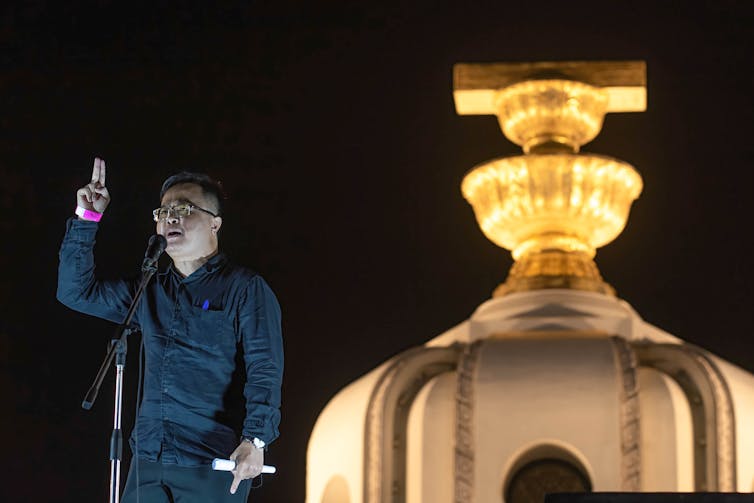
A man next to illuminated building gestures to the crowd
Pro-democracy activist leader Arnon Nampa speaks to protesters.
Peerapon Boonyakiat/SOPA Images/LightRocket via Getty Images

On Aug. 3, 2020, Nampa added another demand: The monarchy must be openly discussed and questioned.

Without addressing such a key, unquestionable institution in the nation, Arnon argued, the struggle for democracy would inevitably fail.

This message resonated with many Thai citizens, and despite the fearsome Article 112, protests grew throughout the last months of 2020.

Students at Thammasat University, the center of student protest since the 1950s, expanded Arnon’s call into a 10-point set of demands for reform of the monarchy.

Making it clear that they did not aim to abolish the monarchy, the students’ proposal aimed to clarify the monarchy’s economic, political and military role and make it truly constitutional.

As the protests began to seem unstoppable, with tens of thousands joining, the police began cracking down on demonstrations. Many were arrested for violating anti-COVID-19 measures and other minor laws. By late November 2020, however, Article 112 charges began to be brought against Arnon and other protest leaders for their peaceful speech.

In September 2023, Arnon was convicted in his first case, and he has been behind bars since. He is joined by other political prisoners, whose numbers grow weekly as their cases move through the judicial process.

Capricious courts

Unlike Arnon, Paetongtarn Shinawatra is not facing prison.

But the Constitutional Court’s decision to suspend her from her position as prime minister because of a leaked recording of an indiscreet telephone conversation is, to many legal minds, a capricious response that has the effect of short-circuiting the democratic process.

So too, I believe, does bringing the weight of the law against Arnon and other political prisoners in Thailand who remain behind bars as the current political turmoil plays out.

The Conversation

Tyrell Haberkorn does not work for, consult, own shares in or receive funding from any company or organization that would benefit from this article, and has disclosed no relevant affiliations beyond their academic appointment.

ref. Thailand’s judiciary is flexing its muscles, but away from PM’s plight, dozens of activists are at the mercy of capricious courts – https://theconversation.com/thailands-judiciary-is-flexing-its-muscles-but-away-from-pms-plight-dozens-of-activists-are-at-the-mercy-of-capricious-courts-260408

How can the James Webb Space Telescope see so far?

Source: The Conversation – USA – By Adi Foord, Assistant Professor of Astronomy and Astrophysics, University of Maryland, Baltimore County

This is a James Webb Space Telescope image of NGC 604, a star-forming region about 2.7 million light-years from Earth. NASA/ESA/CSA/STScI

Curious Kids is a series for children of all ages. If you have a question you’d like an expert to answer, send it to CuriousKidsUS@theconversation.com.


How does the camera on the James Webb Space Telescope work and see so far out? – Kieran G., age 12, Minnesota


Imagine a camera so powerful it can see light from galaxies that formed more than 13 billion years ago. That’s exactly what NASA’s James Webb Space Telescope is built to do.

Since it launched in December 2021, Webb has been orbiting more than a million miles from Earth, capturing breathtaking images of deep space. But how does it actually work? And how can it see so far? The secret lies in its powerful cameras – especially ones that don’t see light the way our eyes do.

I’m an astrophysicist who studies galaxies and supermassive black holes, and the Webb telescope is an incredible tool for observing some of the earliest galaxies and black holes in the universe.

When Webb takes a picture of a distant galaxy, astronomers like me are actually seeing what that galaxy looked like billions of years ago. The light from that galaxy has been traveling across space for the billions of years it takes to reach the telescope’s mirror. It’s like having a time machine that takes snapshots of the early universe.

By using a giant mirror to collect ancient light, Webb has been discovering new secrets about the universe.

A telescope that sees heat

Unlike regular cameras or even the Hubble Space Telescope, which take images of visible light, Webb is designed to see a kind of light that’s invisible to your eyes: infrared light. Infrared light has longer wavelengths than visible light, which is why our eyes can’t detect it. But with the right instruments, Webb can capture infrared light to study some of the earliest and most distant objects in the universe.

A dog, shown normally, then through thermal imaging, with the eyes, mouth and ears brighter than the rest of the dog.
Infrared cameras, like night-vision goggles, allow you to ‘see’ the infrared waves emitting from warm objects such as humans and animals. The temperatures for the images are in degrees Fahrenheit.
NASA/JPL-Caltech

Although the human eye cannot see it, people can detect infrared light as a form of heat using specialized technology, such as infrared cameras or thermal sensors. For example, night-vision goggles use infrared light to detect warm objects in the dark. Webb uses the same idea to study stars, galaxies and planets.

Why infrared? When visible light from faraway galaxies travels across the universe, it stretches out. This is because the universe is expanding. That stretching turns visible light into infrared light. So, the most distant galaxies in space don’t shine in visible light anymore – they glow in faint infrared. That’s the light Webb is built to detect.

A diagram of the electromagnetic spectrum, with radio, micro and infrared waves having a longer wavelength than visible light, while UV, X-ray and gamma rays have shorter wavelengths than visible light.
The rainbow of visible light that you can see is only a small slice of all the kinds of light. Some telescopes can detect light with a longer wavelength, such as infrared light, or light with a shorter wavelength, such as ultraviolet light. Others can detect X-rays or radio waves.
Inductiveload, NASA/Wikimedia Commons, CC BY-SA

A golden mirror to gather the faintest glow

Before the light reaches the cameras, it first has to be collected by the Webb telescope’s enormous golden mirror. This mirror is over 21 feet (6.5 meters) wide and made of 18 smaller mirror pieces that fit together like a honeycomb. It’s coated in a thin layer of real gold – not just to look fancy, but because gold reflects infrared light extremely well.

The mirror gathers light from deep space and reflects it into the telescope’s instruments. The bigger the mirror, the more light it can collect – and the farther it can see. Webb’s mirror is the largest ever launched into space.

The JWST's mirror, which looks like a large, roughly hexagonal shiny surface made up of 18 smaller hexagons put together, sitting in a facility. The mirror is reflecting the NASA meatball logo.
Webb’s 21-foot primary mirror, made of 18 hexagonal mirrors, is coated with a plating of gold.
NASA

Inside the cameras: NIRCam and MIRI

The most important “eyes” of the telescope are two science instruments that act like cameras: NIRCam and MIRI.

NIRCam stands for near-infrared camera. It’s the primary camera on Webb and takes stunning images of galaxies and stars. It also has a coronagraph – a device that blocks out starlight so it can photograph very faint objects near bright sources, such as planets orbiting bright stars.

NIRCam works by imaging near-infrared light, the type closest to what human eyes can almost see, and splitting it into different wavelengths. This helps scientists learn not just what something looks like but what it’s made of. Different materials in space absorb and emit infrared light at specific wavelengths, creating a kind of unique chemical fingerprint. By studying these fingerprints, scientists can uncover the properties of distant stars and galaxies.

MIRI, or the mid-infrared instrument, detects longer infrared wavelengths, which are especially useful for spotting cooler and dustier objects, such as stars that are still forming inside clouds of gas. MIRI can even help find clues about the types of molecules in the atmospheres of planets that might support life.

Both cameras are far more sensitive than the standard cameras used on Earth. NIRCam and MIRI can detect the tiniest amounts of heat from billions of light-years away. If you had Webb’s NIRCam as your eyes, you could see the heat from a bumblebee on the Moon. That’s how sensitive it is.

Two photos of space, with lots of stars and galaxies shown as little dots. The right image shows more, brighter dots than the left.
Webb’s first deep-field image: The MIRI image is on the left and the NIRCam image is on the right.
NASA

Because Webb is trying to detect faint heat from faraway objects, it needs to keep itself as cold as possible. That’s why it carries a giant sun shield about the size of a tennis court. This five-layer sun shield blocks heat from the Sun, Earth and even the Moon, helping Webb stay incredibly cold: around -370 degrees F (-223 degrees C).

MIRI needs to be even colder. It has its own special refrigerator, called a cryocooler, to keep it chilled to nearly -447 degrees F (-266 degrees C). If Webb were even a little warm, its own heat would drown out the distant signals it’s trying to detect.

Turning space light into pictures

Once light reaches the Webb telescope’s cameras, it hits sensors called detectors. These detectors don’t capture regular photos like a phone camera. Instead, they convert the incoming infrared light into digital data. That data is then sent back to Earth, where scientists process it into full-color images.

The colors we see in Webb’s pictures aren’t what the camera “sees” directly. Because infrared light is invisible, scientists assign colors to different wavelengths to help us understand what’s in the image. These processed images help show the structure, age and composition of galaxies, stars and more.

By using a giant mirror to collect invisible infrared light and sending it to super-cold cameras, Webb lets us see galaxies that formed just after the universe began.


Hello, curious kids! Do you have a question you’d like an expert to answer? Ask an adult to send your question to CuriousKidsUS@theconversation.com. Please tell us your name, age and the city where you live.

And since curiosity has no age limit – adults, let us know what you’re wondering, too. We won’t be able to answer every question, but we will do our best.

The Conversation

Adi Foord does not work for, consult, own shares in or receive funding from any company or organization that would benefit from this article, and has disclosed no relevant affiliations beyond their academic appointment.

ref. How can the James Webb Space Telescope see so far? – https://theconversation.com/how-can-the-james-webb-space-telescope-see-so-far-257421

Turbulent research landscape imperils US brain gain − and ultimately American prosperity

Source: The Conversation – USA – By Marc Zimmer, Professor of Chemistry, Connecticut College

International students have been a big part of American STEM. Rick Friedman/AFP via Getty Images

Despite representing only 4% of the world’s population, the United States accounts for over half of science Nobel Prizes awarded since 2000, hosts seven of The Times Higher Education Top 10 science universities, and incubates firms such as Alphabet (Google), Meta and Pfizer that turn federally funded discoveries into billion-dollar markets.

The domestic STEM talent pool alone cannot sustain this research output. The U.S. is reliant on a steady and strong influx of foreign scientists – a brain gain. In 2021, foreign-born people constituted 43% of doctorate-level scientists and engineers in the U.S. They make up a significant share of America’s elite researchers: Since 2000, 37 of the 104 U.S. Nobel laureates in the hard sciences, more than a third, were born outside the country.

China, the U.S.’s largest competitor in science, technology, engineering and math endeavors, has a population that is 4.1 times larger than that of the U.S. and so has a larger pool of homegrown talent. Each year, three times as many Chinese citizens (77,000) are awarded STEM Ph.D.s as American citizens (23,000).

To remain preeminent, the U.S. will need to keep attracting exceptional foreign graduate students, budding entrepreneurs and established scientific leaders.

Funding and visa policies could flip gain to drain

This scientific brain gain is being threatened by the Trump administration, which is using federal research funding, scholarships and fellowships as leverage against universities, freezing billions of dollars in grants and contracts to force compliance with its ideological agenda. Its ad hoc approach has been described by higher education leaders as “unprecedented and deeply disturbing,” and a Reagan-appointed judge ruled that 400 National Institutes of Health grants be reinstated because their terminations were “bereft of reasoning, virtually in their entirety.”

Experts caution that these moves not only risk immediate harm to scientific progress and academic freedom but also erode the public’s trust in science and education, with long-term implications for the nation’s prosperity and security.

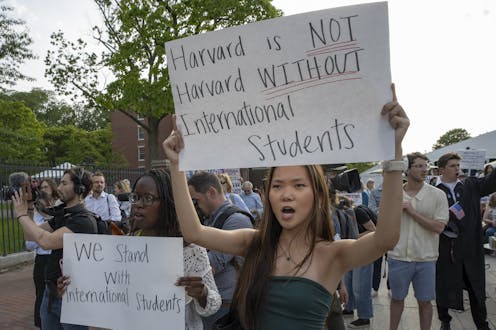
Citing national security concerns, the White House has also targeted visas for Harvard University’s international students and instructed embassies worldwide to halt visa interviews for all international students, citing national security and alleged institutional misconduct. Against a backdrop of court injunctions and legal appeals, the government continues its heightened “national-security” vetting, so thousands of international scholars remain in limbo.

These measures, combined with travel bans, intensified scrutiny and revocations of existing visas, have disrupted research collaborations and threaten the nation’s continued status as a global leader in science and innovation.

What US misses with fewer foreign scientists

The U.S. research brain gain starts with the 281,000 foreign STEM graduate students and 38,000 foreign STEM postdoctoral scholars who annually come to the U.S. I am one of them. After earning my bachelor’s and master’s degrees in South Africa, I left in 1986 to avoid the apartheid‑era military service, completed my chemistry doctorate and postdoc in the U.S., and joined the United States’ brain gain. It’s an opportunity today’s visa climate might have denied me.

poster announcing 'Safe Place For Science'
Some other countries are eager to scoop up STEM talent that is unwelcome or unfunded in the U.S.
Clement Mahoudeau/AFP via Getty Images

Incentives for the best and brightest foreign science students to come to the U.S. are diminishing at the same time its competitors are increasing their efforts to attract the strongest STEM researchers. For instance, the University of Hong Kong is courting stranded Harvard students with dedicated scholarships, housing and credit-transfer help. A French university program, Safe Place for Science, drew so many American job applicants that it had to shut the portal early. And a Portuguese institute reports a tenfold surge in inquiries from U.S.-based junior faculty.

Immigrants import new ways of thinking to their research labs. They come from other cultures and have learned their science in different educational systems, which place different emphases on rote learning, historical understanding and interdisciplinary research. They often bring an alternative perspective that a homogeneous scientific community cannot match.

Immigrants also help move discoveries from the lab to the marketplace. Foreign-born inventors file patents at a higher per‑capita rate than their domestic peers and are 80% more likely to launch a company. Such firms create roughly 50% more jobs than enterprises founded by native-born entrepreneurs and pay wages that are, on average, one percentage point higher.

The economic stakes are high. Growth models suggest that scientific advances now account for a majority of productivity gains in high‑income countries.

L. Rafael Reif, the former president of MIT, called international talent the “oxygen” of U.S. innovation; restricting visas chokes that supply. Ongoing cuts and uncertainties in federal funding and visa policy now jeopardize America’s scientific leadership and with it the nation’s long‑term economic growth.

The Conversation

Marc Zimmer received funding from NIH and NSF.

ref. Turbulent research landscape imperils US brain gain − and ultimately American prosperity – https://theconversation.com/turbulent-research-landscape-imperils-us-brain-gain-and-ultimately-american-prosperity-258537