U.S. and Israeli strikes on Iran could fuel a new wave of nuclear proliferation

Source: The Conversation – Canada – By Saira Bano, Assistant Professor in Political Science, Thompson Rivers University

In the wake of recent strikes by Israel and the United States on Iranian cities, military sites and nuclear facilities, a troubling paradox has emerged: actions intended to prevent Iran from acquiring nuclear weapons may actually be accelerating its pursuit of them and encouraging other countries to follow suit.

On June 13, Israel launched Operation Rising Lion, a military campaign aimed at dismantling Iran’s nuclear program. The operation began with a series of co-ordinated strikes targeting Iran’s top nuclear scientists, senior military officials and key members of the Islamic Revolutionary Guard Corps.

Despite establishing air dominance, Israel did not possess the capability to destroy Iran’s most heavily fortified nuclear facilities — especially the Fordow enrichment site, which is buried deep within a mountain.


Read more:
Why Israel and the U.S. are sure to encounter the limits of air power in Iran


On June 21, the U.S. carried out major airstrikes targeting Iran’s critical nuclear sites at Fordow, Natanz and Isfahan. Using B-2 stealth bombers equipped with bunker-busting bombs, the operation aimed to cripple Iran’s deeply fortified nuclear infrastructure.

Three days later, Iran and Israel agreed to a ceasefire, bringing the 12-day conflict to an end. While both sides declared aspects of the campaign successful, the war marked a dangerous escalation in regional tensions and raised renewed concerns over the future of nuclear nonproliferation and security in the Middle East.

History of nuclear negotiations

The U.S. has consistently asserted that Iran must never be allowed to acquire nuclear weapons. In 2006, Iran was subjected to international sanctions after the International Atomic Energy Agency (IAEA) reported the government was not in compliance with its nuclear energy obligations.

Under former president Barack Obama, the U.S. government pursued a diplomatic path, culminating in the 2015 Joint Comprehensive Plan of Action (JCPOA). Under the deal, Iran agreed to limit uranium enrichment to 3.67 per cent and allow intrusive IAEA inspections. In exchange, it received relief from some international sanctions.

In 2018, U.S. President Donald Trump unilaterally withdrew from the JCPOA, despite IAEA reports confirming Iran’s compliance. This decision undermined diplomatic trust and prompted Iran to scale back its commitments under the deal.

The Biden administration sought to revive the JCPOA, but Iran demanded binding guarantees that future U.S. governments would not again withdraw — an assurance Biden could not provide.

In the aftermath, Iran significantly escalated its nuclear activities. According to IAEA reports, Iran has more than 400 kilograms of enriched uranium to 60 per cent — an amount that, if further refined to 90 per cent, could be sufficient to produce 10 to 12 nuclear weapons.

Iran has long used its nuclear program as a bargaining chip in negotiations with the U.S. While Iranian officials have maintained their program is purely peaceful, the country produces more highly enriched uranium than it needs for domestic power generation. Enriching uranium has been a way for Iran to raise pressure on the U.S. to lift sanctions.

The second Trump administration resumed negotiations for a new nuclear deal aimed at imposing stronger constraints on Iran’s nuclear program.

Although five rounds of negotiations were held, a sixth round scheduled for June 15 was disrupted when Israel conducted a military strike on Iran two days earlier. The attack escalated tensions and derailed the diplomatic process, further complicating the possibility of reaching a renewed agreement.

Strikes could lead to nuclear proliferation

Although Trump claimed the U.S. strikes had “obliterated” Iran’s nuclear program, initial intelligence assessments were more cautious, noting significant damage but not total destruction.

Although it maintains ambiguity about its nuclear program, Israel is seen to be the only country in the Middle East to possess nuclear weapons. It has taken military action to prevent other countries in the region from developing nuclear programs.

In 2007, Israel bombed a suspected nuclear reactor under construction in Syria. In 1981, Israeli fighter jets bombed a nuclear reactor in Iraq.

The Israeli government may have calculated that airstrikes could also effectively work against Iran. However, the difference is that Iran’s nuclear program is far more advanced than Syria or Iraq’s were. While the recent strikes may have set the program back by two years, Iran retains the knowledge and capacity to rebuild.

Ironically, the Israeli and U.S. strikes, which aimed to eliminate Iran’s nuclear capabilities, may instead encourage Iranian officials to accelerate their efforts. Following the war, Iran ended all co-operation with the IAEA, expelling inspectors and cutting off access to its nuclear sites. Without IAEA personnel on the ground, it has become extremely difficult to monitor or verify the scope of Iran’s nuclear activities.

Bombing Iran’s nuclear facilities each time it advances its nuclear program is not a sustainable strategy. Israel had hoped that a decisive military strike would trigger widespread unrest and potentially lead to the Iranian government’s collapse.

Instead, the opposite occurred: the Iranian public rallied around the flag, perceiving the attack as a blatant violation of national sovereignty. As a result, the government strengthened its domestic legitimacy and further suppressed political opposition.

For now, Iranian officials have maintained that they do not intend to develop a nuclear weapon. However, the Iranian parliament is preparing legislation to withdraw from the Nuclear Non-Proliferation Treaty, of which Iran is currently a signatory.

Exiting the treaty would remove a major legal and diplomatic constraint on Iran’s pursuit of nuclear weapons. Should Iran decide to go down that path, it would likely trigger a nuclear arms race in the region.

Saudi Arabia has indicated that if Iran builds a nuclear weapon, it will seek to do the same.

The most effective way to prevent Iran from acquiring nuclear weapons is through sustained diplomacy and a renewed nuclear agreement. A credible deal that includes robust verification mechanisms and IAEA inspections and sanctions relief remains the most viable solution.

Military strikes, by contrast, tend to backfire, and will likely reinforce the belief in Iran — and elsewhere — that only a nuclear deterrent can shield them from external threats.

The Conversation

Saira Bano does not work for, consult, own shares in or receive funding from any company or organisation that would benefit from this article, and has disclosed no relevant affiliations beyond their academic appointment.

ref. U.S. and Israeli strikes on Iran could fuel a new wave of nuclear proliferation – https://theconversation.com/u-s-and-israeli-strikes-on-iran-could-fuel-a-new-wave-of-nuclear-proliferation-260897

A robot stole my internship: How Gen Z’s entry into the workplace is being affected by AI

Source: The Conversation – Canada – By Melise Panetta, Lecturer of Marketing in the Lazaridis School of Business and Economics, Wilfrid Laurier University

For years, the expression “the robot took my job” has brought to mind visions of machines replacing workers on factory floors. But Gen Z is facing a new challenge: the loss of internships and other entry-level positions to AI.

Internships and junior roles have historically provided a predictable ladder into the workforce by providing new workers with the experience and skills needed for long-term career development.

But as artificial intelligence (AI) spreads to every corner of the modern workplace, these roles are susceptible to being replaced by automation.

Entry-level roles traditionally involve low-complexity, high-frequency tasks such as data entry, scheduling or drafting reports — tasks that generative AI can do significantly cheaper and faster than a human. This almost certainly means fewer traditional bottom rungs on the career ladder.

We are already seeing the impact of this: entry-level jobs are becoming scarcer, with candidates competing against a 14 per cent hike in applications per role, according to LinkedIn.


No one’s 20s and 30s look the same. You might be saving for a mortgage or just struggling to pay rent. You could be swiping dating apps, or trying to understand childcare. No matter your current challenges, our Quarter Life series has articles to share in the group chat, or just to remind you that you’re not alone.

Read more from Quarter Life:


AI is changing the workplace

The integration of AI across industries is fundamentally reshaping the job market.

Nearly half of professionals worry AI will replace their jobs. There is good reason for this: by 2030, it’s estimated that nearly 30 per cent of work could be automated by generative AI.

Meanwhile, nearly two-thirds of executives say they are willing to use AI tools to drive up productivity at the expense of losing staff. Conversely, only one in three executives are willing to keep their staff at the expense of higher expected productivity.

It is also projected that declines in traditional entry-level or junior roles in sectors such as food services, customer service, sales and office support work could account for nearly 84 per cent of the occupational shifts expected by 2030.

Talent and entry-level role shortages in the future

Data on AI and the future of work also points to another potential problem: a talent shortage for certain skill sets. A 2024 report from Microsoft and LinkedIn found that leaders are concerned with shortages in areas such as cybersecurity, engineering and creative design.

Though this data might appear contradictory, it signals that in addition to fewer entry level positions being available, changes to job roles and skill sets are also on the horizon.

As a result, competition for entry-level roles is expected to increase, with greater value put on candidates who can use AI tools to improve their productivity and effectiveness.

Rather than simply eliminating jobs, many roles are evolving to require new capabilities. There is also growing demand for specialized talent where AI cannot yet fully augment human abilities.

AI literacy is the new entry requirement

As AI becomes more prevalent in the workforce, “entry-level” roles are no longer just about completing basic tasks, but about knowing how to work effectively with new technologies, including AI.

Employers are beginning to place immense value on AI literacy. Two-thirds of managers say they wouldn’t hire someone without AI skills and 71 per cent say they would prefer a less experienced candidate with AI skills over a more experienced one without them.

With fewer entry-level positions available, young workers will need to figure out how to stand out in a competitive job market. But despite these challenges, Gen Z may also be the best-positioned to adapt to these changes.

As digital natives, many Gen Z are already integrating AI tools into their work. A report from LinkedIn and Microsoft found 85 per cent are bringing AI tools like ChatGPT or Copilot into the workplace, indicating they are both comfortable and eager to make use of this technology.

This trend mirrors broader trends across the workforce. One report found 76 per cent of professionals believe they need AI-related skills to remain competitive. That same Microsoft and LinkedIn report found there has been a 160 per cent surge in learning courses for AI literacy.

This growing emphasis on AI skills is part of a wider shift toward “upskilling” — the process of enhancing skill sets to adapt to the changing conditions of the job market. Today, upskilling means leaning how to use AI to enhance, accelerate and strengthen your performance in the workplace.

A new kind of entry-level job

Since AI literacy is becoming a core career skill, being able to present yourself as a candidate with AI skills is important for standing out in a crowded entry-level job market. This includes knowing how to use AI tools, evaluate their outputs critically and apply them in a workplace context. It also means learning how to present AI skills on a resume and in interviews.

Employers also have a role to play in all this. If they want to attract and retain employees, they need to redesign entry-level roles. Instead of eliminating entry-level roles, they should refocus on higher-value activities that require critical thinking or creativity. These are the areas where humans outperform machines, and where AI can act as a support rather than a replacement.

But to make this work, employers need to re-evaluate their hiring practices to prioritize AI literacy and transferable skills over outdated experience requirements.

The future of work isn’t about humans being replaced by robots, but about learning how to use the technology to enhance skills and creating new entry points into the professional world.

The Conversation

Melise Panetta does not work for, consult, own shares in or receive funding from any company or organisation that would benefit from this article, and has disclosed no relevant affiliations beyond their academic appointment.

ref. A robot stole my internship: How Gen Z’s entry into the workplace is being affected by AI – https://theconversation.com/a-robot-stole-my-internship-how-gen-zs-entry-into-the-workplace-is-being-affected-by-ai-260381

The anatomy of a flash flood: Why the Texas flood was so deadly

Source: The Conversation – Canada – By Hossein Bonakdari, Associate Professor, Civil Engineering, L’Université d’Ottawa/University of Ottawa

Between July 3 and 6, Texas Hill Country experienced catastrophic flash flooding along the Guadalupe River system. The floods claimed at least 130 lives, with over 96 fatalities in Kerr County alone. More than 160 people were missing as of July 12, including children attending camps along the river.

Preliminary economic losses are estimated at US$18–22 billion, reflecting both residential and infrastructure damages.

Understanding the anatomy of this flash flood, and unravelling the complex interplay of meteorological, geomorphological and hydrological forces, forms the foundation for a comprehensive assessment of what happened. This information is vital to help prevent future similar tragedies from occurring.


Read more:
What is a flash flood? A civil engineer explains


Atmospheric conditions

The July 2025 flood event in central Texas was triggered by a rare and potent meteorological configuration.

Atmospheric anomalies are weather conditions that differ from what’s expected. Analysis of the July 2025 atmospheric anomalies reveals exceptional thermodynamic conditions that directly contributed to the flood’s severity.

The total precipitation over the core impact zone in the Hill Country during July 3 to 6 is estimated to have delivered more than 15 billion cubic metres of water — an extraordinary volume.

This deluge was supported by persistent temperature anomalies ranging from 5.4 to 6.9 degrees Celsius above the mean. Such elevated temperatures increased the atmosphere’s capacity to retain moisture.

At these anomaly levels, the air mass could store 35 to 50 per cent more water vapour than normal.

Simultaneously, specific humidity anomalies reflected a 60 to 70 per cent increase over July baselines for central Texas. Specific humidity, which quantifies the actual mass of water vapour per kilogram of air, provides a more direct metric of latent moisture available for precipitation.

The convergence of these extreme thermodynamic variables created an ideal environment for deep, moisture-laden convection, supporting prolonged intense rainfall.
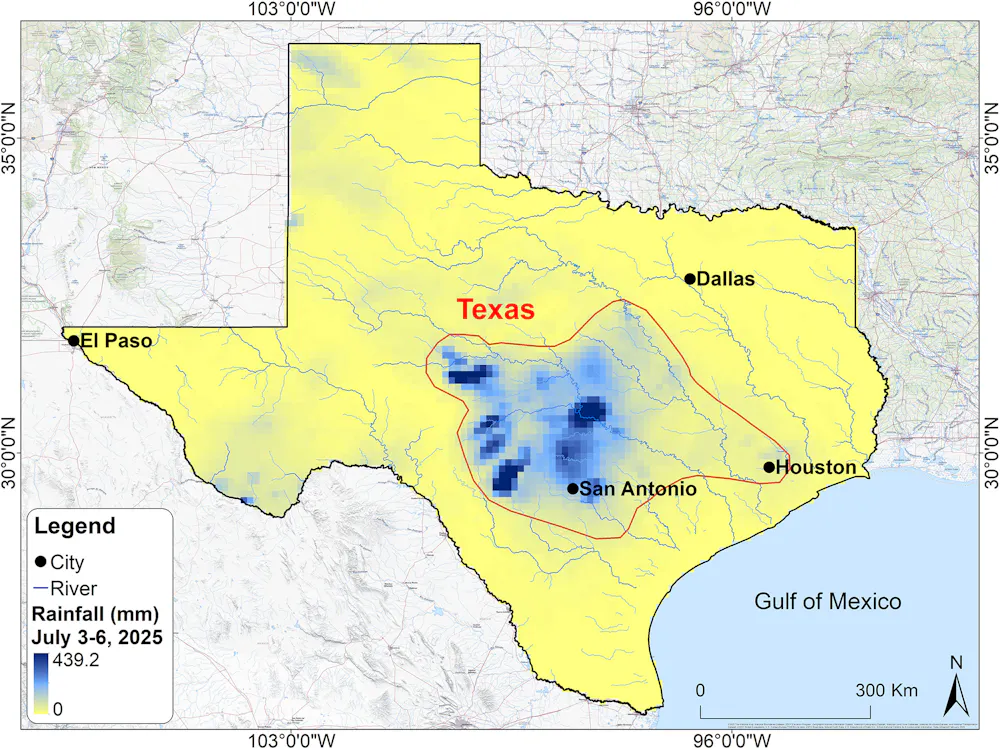
a map of Texas showing cumulative rainfall
This map of Texas highlights the core impact zone in Hill Country, where rainfall totals exceeded 430 millimetres, more than four times the regional July average.
(H. Bonakdari/GSMaP), CC BY

Terrain impacts

While meteorological extremes initiated the July 2025 flood event, the morphology of the Guadalupe River — its shape, behaviour and flows — was pivotal in transforming heavy rainfall into a catastrophic flash flood.

The upper basin’s physical geography, drainage configuration and valley structure contributed to the rapid concentration and propagation of floodwaters.

Known as “Flash Flood Alley,” the terrain of the upper Guadalupe River basin amplified the July 2025 flood through a combination of steep slopes, shallow soils and karstic geology.

These steep slopes limited infiltration and led to rapid soil saturation under intense rainfall. The predominance of karstic limestone — limestone that has been shaped by water creating plains and sinkholes — further reduced storage below the surface, resulting in minimal delay between rainfall and discharge.

Additionally, narrow valley sections created hydraulic bottlenecks, accelerating flow and increasing flood depth, particularly affecting residential areas and campsites.

a map of Texas showing the river's topography
A map showing the relationships between steep headwaters, tributary confluences and vulnerable downstream communities.
(H. Bonakdari/NASA), CC BY

In contrast, broader valleys allowed for the water to spread laterally; there was still destructive momentum due to upstream forcing. These geomorphic traits, compounded by the extreme atmospheric moisture, created an environment where floodwaters accumulated rapidly and struck with devastating force, especially along confluence zones and densely occupied riverfronts.

Excessive runoff

Prior to the July 2025 event, central Texas had already experienced elevated soil moisture conditions due to above-average rainfall during June and early July. Antecedent moisture indices that measure how wet the ground is before rainfall approached 90 to 100 per cent saturation, meaning that the ground was effectively primed for rapid runoff generation.

The region’s karst terrain — characterized by shallow, rocky soils — offered less than five per cent effective porosity, severely limiting absorption into the ground. Simultaneously, regional groundwater tables had risen underground, further reducing the ground’s capacity to absorb water.

This set the stage for an outsized response to the incoming deluge. When intense rainfall arrived, the ground was quickly and completely saturated, resulting in immediate and rapid surface runoff.

The time of concentration is how long it takes rainwater from the farthest part of a watershed to reach its outlet, like a river or stream. In central Texas Hill Country (known for its steep slopes and rocky, shallow soils), that time is just one to two hours. This means that heavy rain can lead to dangerous river rises very quickly.

Water flows fast down the slopes and through underground limestone channels, leaving little time for it to soak into the ground. As a result, rivers such as the Guadalupe can swell rapidly, rising several feet in a short time, which causes fast-moving flood impacts in narrow valleys and low-lying communities.

Multiple forces

The July floods in Texas were devastatingly deadly. A confluence of various meteorological and topographical factors were to blame.

An overheated atmosphere, saturated with water vapour, unleashed record-breaking rainfall. The unique terrain of Texas Hill Country funnelled that rain swiftly into the river system, while the region’s hydrology, already primed by previous storms, converted nearly all of it into runoff.

By understanding how these atmospheric, geographic and hydrological elements combined, we can better anticipate future risks in “Flash Flood Alley” and improve early warning systems to save lives.

The Conversation

Hossein Bonakdari does not work for, consult, own shares in or receive funding from any company or organisation that would benefit from this article, and has disclosed no relevant affiliations beyond their academic appointment.

ref. The anatomy of a flash flood: Why the Texas flood was so deadly – https://theconversation.com/the-anatomy-of-a-flash-flood-why-the-texas-flood-was-so-deadly-260695

Cleaner air in east Asia may have driven recent acceleration in global warming, our new study indicates

Source: The Conversation – Global Perspectives – By Laura Wilcox, Professor, National Centre for Atmospheric Science, University of Reading

A traffic jam in Beijing in China, where air pollution has drastically reduced. Hung Chung Chih/Shutterstock

Global warming has picked up pace since around 2010, leading to the recent string of record warm years. Why this is happening is still unclear, and among the biggest questions in climate science today. Our new study reveals that reductions in air pollution – particularly in China and east Asia – are a key reason for this faster warming.

Cleanup of sulphur emissions from global shipping has been implicated in past research. But that cleanup only began in 2020, so it’s considered too weak to explain the full extent of this acceleration. Nasa researchers have suggested that changes in clouds could play a role, either through reductions in cloud cover in the tropics or over the North Pacific.

One factor that has not been well quantified, however, is the effect of monumental efforts by countries in east Asia, notably China, to combat air pollution and improve public health through strict air quality policies. There has already been a 75% reduction in east Asian sulphur dioxide emissions since around 2013, and that cleanup effort picked up pace just as global warming began accelerating.

Our study addresses the link between east Asian air quality improvements and global temperature, building on the efforts of eight teams of climate modellers across the world.

We have found that polluted air may have been masking the full effects of global warming. Cleaner air could now be revealing more of the human-induced global warming from greenhouse gases.

In addition to causing millions of premature deaths, air pollution shields the Earth from sunlight and therefore cools the surface. There has been so much air pollution that it has held human-induced warming in check by up to 0.5°C over the last century.

With the cleanup of air pollution, something that’s vital for human health, this artificial sunshade is removed. Since greenhouse gas emissions have kept on increasing, the result is that the Earth’s surface is warming faster than ever before.

Modelling the cleanup

Our team used 160 computer simulations from eight global climate models. This enabled us to better quantify the effects that east Asian air pollution has on global temperature and rainfall patterns. We simulated a cleanup of pollution similar to what has happened in the real world since 2010. We found an extra global warming of around 0.07°C.

While this is a small number compared with the full global warming of around 1.3°C since 1850, it is still enough to explain the recent acceleration in global warming when we take away year-to-year swings in temperature from natural cycles such as El Niño, a climate phenomenon in the Pacific that affects weather patterns globally.

yellow smoggy sky, yellow sun and building
Thick smog influences the effect of greenhouse gases.
Shaun Robinson/Shutterstock

Based on long-term trends, we would have expected around 0.23°C of warming since 2010. However, we actually measured around 0.33°C. While the additional 0.1°C can largely be explained by the east Asian air pollution cleanup, other factors include the change in shipping emissions and the recent accelerated increase in methane concentrations in the atmosphere.

Air pollution causes cooling by reflecting sunlight or by changing the properties of clouds so they reflect more sunlight. The cleanup in east Asian air pollution influences global temperatures because it reduces the shading effect of the pollution over east Asia itself. It also means less pollution is blown across the north Pacific, causing clouds in the east Pacific to reflect less sunlight.

The pattern of these changes across the North Pacific simulated in our models matches that seen in satellite observations. Our models and temperature observations also show relatively strong warming over the North Pacific, downwind from east Asia.

The main source of global warming is still greenhouse gas emissions, and a cleanup of air pollution was both necessary and overdue. This did not cause the additional warming but rather, removed an artificial cooling that has for a time helped shield us from some of the extreme weather and other well-established consequences of climate change.

Global warming will continue for decades. Indeed, our past and future emissions of greenhouse gases will affect the climate for centuries. However, air pollution is quickly removed from the atmosphere, and the recent acceleration in global warming from this particular unmasking may therefore be short-lived.


Don’t have time to read about climate change as much as you’d like?

Get a weekly roundup in your inbox instead. Every Wednesday, The Conversation’s environment editor writes Imagine, a short email that goes a little deeper into just one climate issue. Join the 45,000+ readers who’ve subscribed so far.


The Conversation

Laura Wilcox receives funding from the Natural Environment Research Council (NERC), the Research Council of Norway, the Clean Air Fund, and Horizon Europe.

Bjørn H. Samset receives funding from the Research Council of Norway, the Clean Air Fund, and Horizon Europe.

ref. Cleaner air in east Asia may have driven recent acceleration in global warming, our new study indicates – https://theconversation.com/cleaner-air-in-east-asia-may-have-driven-recent-acceleration-in-global-warming-our-new-study-indicates-260601

Trump’s Brazil tariffs point more to his enduring bond with far-right Bolsonaro than economic concerns

Source: The Conversation – Global Perspectives – By Rafael R. Ioris, Professor of Modern Latin America History, University of Denver

U.S. President Donald Trump and then-Brazilian President Jair Bolsonaro attend a joint news conference at the White House on March 19, 2019. Jim Lo Scalzo-Pool/Getty Images

After much back-and-forth over several months, President Donald Trump announced on July 9, 2025, that he planned to levy a 50% tariff on Brazilian exports to the United States. While Brazilian authorities, along with leaders of most other countries, have been expecting new tariffs given their centrality to Trump’s economic agenda, the announcement seemingly caught Brazilian officials off guard, as trade negotiations between the two nations were still ongoing.

Brazil President Lula da Silva was quick in reacting, stating his country could respond in kind, if tariffs indeed come into effect on Aug. 1.

There has been much speculation about the reasons behind Trump’s decision and timing, with some onlookers noting the proximity to the recent meeting of the BRICS nations, a grouping of emerging economies, including Brazil, which had already drawn Trump’s ire. Others argued that this was a protective measure to defend key U.S. industries, such as steel, which have been facing continued difficulties against cheaper products from Brazil.

The clearest answer, however, came from Trump himself.

In a letter to Lula, the U.S. president indicated that his main grievance with Brazil is in fact the trial that former Brazilian President Jair Bolsonaro faces in front of that country’s highest court. The former far-right firebrand is charged for refusing to recognize the result of the last presidential election in October 2022 and for allegedly having led an attempted coup against the democratic institutions and rule of law in January 2023. If convicted, Bolsonaro and some of his closest associates could face long prison sentences.

A history of meddling

The only economic rationale mentioned in Trump’s letter, that of a deficit that his country is said to face with Brazil, is belied by the numbers. The U.S. has sustained consistent surpluses in trade with the South American nation for close to two decades now.

And Steve Bannon, Trump’s former adviser, active cheerleader and primary conduit between the Trump camp and Bolsonaro, was even more blunt than the U.S. president. In an interview with one of Brazil’s main news site, he stated: “Stop the trial and we will reverse the tariffs.”

Two men in suits shake hands.
Bolsonaro meets with Trump during the G20 Summit in Osaka, Japan, on June 28, 2019.
Brendan Smialowski/AFP via Getty Images

As the history of U.S.-Latin American relations ably demonstrates, this is far from the first time Washington has meddled in the region in order to satisfy its own political proclivities. Indeed, particularly during the Cold War, a slew of U.S. decision-makers actively intervened to support friendly right-wing regimes or to otherwise remove from power administrations considered unacceptably independent.

This was nonetheless the first time in recent history that the official U.S. position is that a foreign nation should face harsh economic punishment unless its current government illegally circumvent the judicary’s constitutional role to stop a major investigation against someone accused of high crimes.

Trump-Bolsonaro: Mutual admiration

Of course, Trump’s overt support for Bolsonaro is not surprising, nor new. Their relationship of mutual admiration and ideological affinity hearkens back to the latter’s first presidential campaign in 2018, when he was labeled, to great reciprocal delight, the “Trump of the Tropics.”

During the subsequent two years when their terms coincided (2019-2000), both men pledged to have a mutual special relationship, though to little consequence – no consequential bilateral projects were put in place.

Both leaders also share the experience of having failed to obtain a second consecutive term and having supported the derailment of the peaceful transfer of power.

Now that Trump is back in power, Bolsonaro hopes that the U.S. president will come to his rescue.

Seeking to obtain explicit support, Bolsonaro’s third son, Eduardo, a member of Brazil’s lower house of congress and his family’s most eloquent international voice, took a leave from his legislative duties and moved to the U.S. early this year. He did so to lobby on behalf of his father based on the fallacious argument that Lula is a left-wing dictator, that Bolsonaro faces a politically motivated trial, and that the U.S. government should act against Lula’s administration.

Given Trump’s tariff notice and the explicit reasons he gave for it, it seems safe to assume that Eduardo’s actions paid dividends.

Which direction will Brazil head?

Like the U.S., Brazil is deeply fractured along left and right political lines. So it was no surprise that the local reactions to Trump’s announcement manifested along ideological camps.

Despite their leader’s legal travails, Bolsonaro’s supporters remain very influential in politics, the media and among important economic areas, such as the agribusiness sector. Whether Trump’s decision will serve to help people rally around and in support of Lula and against a case of foreign interference is unclear. Lula’s initial pronouncement that Brazil would respond in kind was seen favorably among his supporters, though the opposition and many in the media pinned the blame on Lula for not being able to forge compromise with the Trump administration.

Key industrialists in the powerful state of Sao Paulo, where Bolsonaro’s powerful ally Tarcisio de Freitas serves as governor, will be the first ones affected by the new tariffs. But the pain will likely spread into other activities, including in the countryside.

And given that the bulk of the country’s agricultural exports go to China rather than to the U.S., the important question is whether these powerful exporters will act pragmatically and work with Lula to enlarge trade with the Asian giant and other countries, or whether they will continue to act ideologically and continue to support Bolsonaro’s enduring partnership with Trump against their own economic interests.

Dialogue has been a hallmark of Brazil’s diplomacy, and even in the middle of these latest heated diplomatic exchanges, Lula reiterated his willingness to negotiate. It is unclear, though, whether the Trump adminstration’s actions in Latin America will be conducted on the basis of rationality and actual numbers, or if they will indeed bring back some old ideologically driven behaviors of picking sides in the internal political disputes of foreign nations. Should one consider at face value Trump’s latest letter, there is reason for concern.

The Conversation

Rafael R. Ioris does not work for, consult, own shares in or receive funding from any company or organization that would benefit from this article, and has disclosed no relevant affiliations beyond their academic appointment.

ref. Trump’s Brazil tariffs point more to his enduring bond with far-right Bolsonaro than economic concerns – https://theconversation.com/trumps-brazil-tariffs-point-more-to-his-enduring-bond-with-far-right-bolsonaro-than-economic-concerns-260993

University graduates in Ghana must serve society for a year – study suggests it’s good for national unity

Source: The Conversation – Africa – By Arnim Langer, Professor, KU Leuven

Almost 70 years after independence was gained across the continent, many African countries continue to face the complex task of managing ethnic diversity and building national cohesion. National cohesion is a broad and often abstract concept. It refers to the extent to which people within a country share a sense of common purpose and belonging. It is often reflected in the strength of national identities and the degree of pride individuals feel in being part of the nation.

The fact that borders in colonial Africa were drawn in the late 19th century to the early 20th century by European powers without regard for ethnic and cultural realities and histories meant that post-colonial African governments had to develop a sense of national consciousness and belonging.

To address this task, many African countries have made efforts to promote a shared national identity which could bridge ethnic and regional divides. Governments have experimented with a diverse range of policies: promoting national languages, establishing civic education, celebrating national holidays, and reforming state institutions. Other measures have included abolishing traditional kingdoms, redistributing land, renaming capital cities, compulsory military service, and national youth service programmes.

Research into the effectiveness of these African initiatives has been limited and inconclusive. In recently published research, researchers at the Centre for Research on Peace and Development at KU Leuven addressed this gap by analysing the impact of Ghana’s National Service Scheme. Our research shows that, under certain conditions, participation in this programme can meaningfully enhance feelings of national belonging.

Ghana’s experience with national service

Established in 1973, Ghana’s National Service Scheme requires university graduates to spend one year serving in diverse roles throughout the country. This sometimes takes them to regions far from their homes.

While Ghana is widely regarded as a model for the peaceful management of ethnic diversity, the establishment of the National Service Scheme in 1973 was necessary. It was partly a response to the deep regional and ethnic divisions that marked the country’s early postcolonial period. Notably, in the years leading up to the scheme’s introduction, political rivalry between Ashanti and Ewe elites played a significant role in the country’s political instability.

Initially designed to counteract such ethnic divisions, the scheme continues to engage very large numbers of graduates each year. Over 100,000 were deployed in 2025. The programme aims not only to strengthen national cohesion, but also to promote manpower development and address key social challenges. These include unemployment, illiteracy and poverty.

Participants are deployed across a range of sectors, including education, healthcare, agriculture and public administration. While the vast majority of participants are assigned to teaching roles in primary or secondary schools or to positions in healthcare institutions, others take on administrative roles within government agencies or the private sector. These deployments are meant to expose them to different communities and foster intergroup contact under conditions that promote social bonding and reduce prejudice.

But can national service also contribute towards fostering stronger feelings of national belonging?

To answer this question, we conducted a large-scale panel survey among almost 3,000 service personnel. They had participated in the scheme between August 2014 and September 2016. The participants were surveyed three times: before their deployment and again within weeks after completing their national service.

The survey was aimed at examining their feelings of national pride before, during, and after their year of national service. Our study provides compelling evidence that national service significantly boosts participants’ feelings of national pride and belonging.

We found that the mechanism behind this impact lies in intergroup contact. This is described as positive, meaningful interactions between individuals from diverse ethnic and regional backgrounds. Participants who reported frequent and meaningful interactions, including developing new friendships and gaining deeper knowledge of other cultural groups, showed the most significant increases in their sense of national pride.

Importantly, the greatest improvements were observed among participants who initially identified less strongly with the nation.

We further found that the positive effects of participation were not short-lived. It persisted well beyond the year of service.

Key takeaways for policymakers

Governments aiming to strengthen national identity through youth service programmes should consider four key lessons from Ghana’s experience.

Mandatory participation is crucial. Voluntary schemes tend to attract individuals who are already inclined towards inter-ethnic harmony. This limits their broader societal impact. Ghana’s mandatory approach ensures that a wide and diverse range of participants are included. This enhances the programme’s reach and effectiveness.

Structured interactions must be actively promoted. Simply placing people from different backgrounds together is not enough. Successful programmes, such as Ghana’s, intentionally create opportunities for meaningful engagement. These structured interactions help participants develop lasting relationships and deepen their understanding of other cultures.

Youth should be engaged during formative years. Recent graduates are at a stage in life when attitudes and identities are still forming. National service programmes that target this age group can have a lasting influence. Especially on how young people perceive national unity and their role within it.

Diverse placements are essential. National service programmes should deploy participants in settings that are diverse. The geographical location is of secondary importance. Exposure to diverse settings will challenge assumptions and broaden perspectives. It will also foster stronger national bonds across ethnic and regional lines.

Why national service pays off in the long run

National youth service programmes, when well-designed and properly managed, are a promising yet underused tool for promoting national unity in Africa’s ethnically diverse societies. These initiatives can create meaningful opportunities for young people to engage across regional and ethnic lines. This helps to build trust, civic responsibility, and a shared sense of national identity.

Yet, in recent decades, many of these programmes have been scaled back or discontinued across the continent. Examples are Botswana, Tanzania, Zimbabwe and Zambia. The main reason? Cost. Governments have often viewed the logistical and financial demands of deploying tens of thousands of graduates each year as unsustainable. But this short-term budget logic misses the bigger picture.

Ghana’s scheme shows what’s possible. In recent years, the scheme’s deployment figures have reached record highs. It is now common for around 100,000 national service personnel to be mobilised in a single service year. The positive outcomes observed in Ghana offer clear, evidence-based lessons for policymakers across the continent. Investing in national service is not just a cost – it’s a commitment to a more united future.

The Conversation

Arnim Langer receives funding from Research Foundation Flanders (FWO).

Bart Meuleman receives funding from Research Foundation Flanders (FWO)

Lucas Leopold receives funding from Research Foundation Flanders (FWO).

ref. University graduates in Ghana must serve society for a year – study suggests it’s good for national unity – https://theconversation.com/university-graduates-in-ghana-must-serve-society-for-a-year-study-suggests-its-good-for-national-unity-258743

Bullying, violence and vandalism in primary school: study explores a growing crisis in South Africa

Source: The Conversation – Africa – By Julie Shantone Rubbi Nunan, Senior Lecturer in the Department of Early Childhood Education and Development, University of South Africa

South African primary schools are facing a crisis. Every day, learners fight, bully, destroy property, and intimidate other learners and teachers, turning what should be safe spaces into places of fear and mistrust.

Research shows that learner behaviour frequently involves violence, bullying and vandalism (damage to school property) that threatens the safety of both learners and staff.

The media usually report only serious cases of violence, but schools and teachers face challenging and dangerous behaviour every day that often goes unreported. This underreporting is not unique to South Africa; it’s a challenge seen in other countries too.

Research shows that this kind of behaviour disrupts teaching and learning, leading to poor learner performance and school dropouts.

Teachers frequently face aggression and intimidation from learners, which undermines their ability to teach effectively. They feel unsafe and frustrated when learners act aggressively, and this problem worsens when parents protect their children’s bad behaviour instead of addressing it.

Violence, bullying, and damage to school property don’t just cause harm to learners and teachers. They also cost schools money to repair the damage and cause emotional trauma and suffering for victims and their families.

Given these realities, it is important to carefully explore the lived experiences of teachers, school leaders and caretakers to fully understand the severity and complexity of challenging learner behaviour. This understanding is essential for developing effective policies and interventions aimed at restoring safety and improving learning environments in South African primary schools.

As part of a wider study of challenging learner behaviour, I interviewed 21 participants from three primary schools in Durban, South Africa. It was a qualitative case study, in which the small sample size was well-suited and provided relevant and credible information on challenging learner behaviour. Thematic analysis was appropriate for identifying patterns and themes for further exploration.

The aim was to probe the participants’ perspectives to understand how learners’ challenging behaviour is experienced in primary schools. I wanted to know more about how behaviour stemming from children’s homes and environments, playing out at school, was affecting teachers and the overall school climate.

The interviews indicated that teachers were unhappy and wanting to quit the profession, learner victims faced constant fear and distress, and caretakers felt degraded. If this is a sign of how teachers, children and caretakers are feeling around South Africa, it points to the need for ways to reduce their stress.

Voices from schools

The schools in my study are located in semi-urban areas within the same district and serve learners from grade R (about age 5) to grade 7 (about age 12). The surrounding communities face high levels of unemployment, domestic violence, and various social challenges.

Fifteen teachers, three governors, and three caretakers shared their experiences through interviews, enabling open discussion and deeper insights. Consistency across school sites supported the trustworthiness of the findings. Ethical guidelines were followed throughout.

Across the three schools, participants described an environment where serious learner misconduct was a common, everyday problem.

Teachers, governors, and caretakers reported daily disruptions that affected teaching, learning and emotional wellbeing. Aggression and violence were constant. Learners engaged in physical fights – punching, kicking, and using sharp objects like pencils and knives. These were not minor scuffles but incidents that caused serious injuries. Teachers were also threatened, shouted at, and occasionally physically harmed.

Bullying was widespread, both verbal and physical. Learners harassed peers through name-calling, exclusion, extortion and intimidation, often in unsupervised spaces like toilets and tuckshops. Victims lived in fear, while teachers struggled to maintain discipline and protect vulnerable learners.

Vandalism and property damage were routine. Learners tore up textbooks, damaged desks and windows, defaced walls with vulgar graffiti, and clogged toilets with rubbish. Caretakers faced degrading tasks like cleaning and scrubbing faeces and graffiti off the walls. The costs of repairing damage strained already limited school budgets.

Adding to the tension, gang-like behaviour emerged. Small groups banded together to provoke fights, intimidate others, and sometimes fuel unrest rooted in xenophobia or local politics, creating fear, uncertainty and division among learners.

Some incidents had gendered and criminal implications, including the reporting of boys violating the privacy and rights of other boys in the school toilets, and girls being inappropriately touched and harassed. This contributed to emotional trauma and, in some cases, learner dropout – especially among girls. The United Nations Children’s Fund posits that school violence contributes to girls dropping out of school. The dropout rate is a concern in South Africa.

Stealing and lying were common. Learners stole from classmates, teachers, and school offices, often without remorse, and frequently lied or blamed others when confronted, further eroding trust and accountability.


Read more:
Dealing with unruly behaviour among schoolchildren in a tumultuous world


Many participants believed learners expressed unspoken pain or mirrored violence and instability seen at home and in their communities. According to social cognitive theory, such behaviours are learned. Children exposed to violence, neglect, or chaos often replicate these actions in school. Without consistent guidance, role models, or consequences, the cycle intensifies.

Moving forward

In short, these schools are no longer safe havens for learning – they are in crisis. Without urgent and effective intervention, the very mission of basic education – and the wellbeing of children – is at risk.

Primary schools depend on governing authorities and communities for their safety and success. Stakeholders must take collective action to reclaim schools as safe learning spaces.

Governing authorities should address the issues raised by reviewing policies and implementing support programmes, including counselling, family-school partnerships, and teacher training to handle challenging behaviour in positive and sustainable ways.

The Conversation

Julie Shantone Rubbi Nunan does not work for, consult, own shares in or receive funding from any company or organisation that would benefit from this article, and has disclosed no relevant affiliations beyond their academic appointment.

ref. Bullying, violence and vandalism in primary school: study explores a growing crisis in South Africa – https://theconversation.com/bullying-violence-and-vandalism-in-primary-school-study-explores-a-growing-crisis-in-south-africa-260111

4 things every peace agreement needs – and how the DRC-Rwanda deal measures up

Source: The Conversation – Africa (2) – By Philipp Kastner, Senior Lecturer in International Law, The University of Western Australia

The governments of the Democratic Republic of the Congo (DRC) and Rwanda concluded a peace treaty in June 2025, aimed at ending a decades-long war in eastern DRC. The United Nations welcomed the agreement as “a significant step towards de-escalation, peace and stability” in the region.

I have analysed several different peace negotiations and agreements. It’s important to distinguish between what’s needed to get warring parties to the table, and what’s eventually agreed on. In this article, I examine whether the DRC-Rwanda deal has got the four essential components that usually signal that an agreement will hold.

Two broad points about peace agreements, first – and one particular complication in the DRC-Rwanda case.

Firstly, one agreement is rarely enough to resolve a complex conflict. Most deals are part of a series of agreements, sometimes between different actors. They often mention previously concluded ones, and will be referred to by subsequent ones.

Secondly, peace is a process, and requires broad and sustained commitment. It is essential that other actors, like armed groups, are brought on board. Importantly, this also includes civil society actors. An agreement will be more legitimate and effective if different voices are heard during negotiations.

One major complication in relation to the DRC-Rwanda deal is that the United States has been the prime broker. But rather than acting as a neutral mediator trying to bring about peace, Washington seems to be pursuing its own economic interests. This does not bode well.

There is no simple recipe for a good peace agreement, but research shows that four elements are important: a serious commitment from the parties, precise wording, clear timelines and strong implementation provisions.

What underpins a good agreement

First, the parties need to be serious about the agreement and able to commit to its terms. It must not be used as a cover to buy time, re-arm or pursue fighting. Moreover, lasting peace cannot be made exclusively at the highest political level. Agreements that are the result of more inclusive processes, with input by and support from the communities concerned, have a higher success rate.

Second, the agreement must address the issues it aims to resolve, and its provisions must be drafted carefully and unambiguously. When agreements are vague or silent on key aspects, they are often short-lived. Previous experiences can guide peace negotiators and mediators in the drafting process. Peace agreement databases established by the United Nations and academic institutions are a useful tool for this.

Third, clear and realistic timelines are essential. These can concern the withdrawal of armed forces from specified territories, the return of refugees and internally displaced persons, and the establishment of mechanisms providing reparations or other forms of transitional justice.

Fourth, an agreement should include provisions on its implementation. External support is usually helpful here. Third states or international organisations, liked the United Nations and the African Union, can be mandated to oversee this phase. They can also provide security guarantees or even deploy a peacekeeping operation. What is crucial is that these actors are committed to the process and don’t pursue their own interests.


Read more:
DRC and Rwanda sign a US-brokered peace deal: what are the chances of its success?


To know what to realistically expect from a specific peace agreement, it’s important to understand that such agreements can take very different forms. These range from pre-negotiation arrangements and ceasefires to comprehensive peace accords and implementation agreements.

A lasting resolution of the conflict should not be expected when only a few conflict parties have concluded a temporary ceasefire.

The DRC-Rwanda agreement: an important step with lots of shortcomings

It’s difficult to tell at this point how serious the DRC and Rwanda are about peace, and if their commitment will be enough.

Their assertion that they will respect each other’s territory and refrain from acts of aggression is certainly important.

But Rwanda has a history of direct military activities in the DRC since the 1990s. And the treaty only includes rather vague references to the “disengagement of forces/lifting of defensive measures by Rwanda”. It doesn’t specifically mention the withdrawal of the reportedly thousands of Rwandan troops deployed to eastern DRC.

The Paul Kagame-led Rwandan government has also supported Tutsi-dominated armed groups in the DRC since the Rwandan genocide in 1994. The Mouvement du 23 Mars (M23) is the current primary military actor in eastern DRC. But the agreement between the governments of DRC and Rwanda didn’t include the M23 or other groups. The two governments only commit themselves to supporting the ongoing negotiations between the DRC and the M23 facilitated by Qatar.

The agreement also foresees the “neutralisation” of another armed group, the Hutu-dominated Forces Démocratiques pour la Libération du Rwanda (FDLR). This group claims to protect Rwandan Hutu refugees in the DRC, but is considered “genocidal” by the Rwandan government. The group has reacted to this plan by calling for a political solution and a more inclusive peace process.

What’s needed

The DRC-Rwanda agreement includes provisions that are vital to the people most affected by the conflict, such as the return of the millions of people displaced because of the fighting in eastern DRC. But it does not address other key issues.

For instance, aside from a general commitment to promote human rights and international humanitarian law, there is no reference to the widespread violations of human rights and war crimes reportedly committed by all sides. These include summary executions, and sexual and gender-based violence, including violence against children.

Some form of justice and reconciliation mechanism to deal with such large-scale violence should be considered in this situation, as for instance in the fairly successful 2016 agreement between the Colombian government and the Revolutionary Armed Forces of Colombia – People’s Army (FARC). This could contribute to preventing further violations as it sends a clear signal that committing crimes will not be rewarded. It also helps the population heal and gives peace a better chance.

There is no single model for this, and so-called transitional justice (defined as the “range of processes and mechanisms associated with a society’s attempts to come to terms with a legacy of large-scale past abuses, in order to ensure accountability, serve justice and achieve reconciliation”) remains highly controversial. For instance, insisting on war crimes trials can be seen as endangering a fragile peace process.

But peace agreements across the world, from Libya to the Central African Republic, have over past decades moved away from blanket amnesties. They have increasingly included provisions to ensure accountability, especially for serious crimes. The DRC-Rwanda deal is silent on these questions.

A twist in the tale

The DRC-Rwanda deal is complicated by Washington’s role and pursuit of economic interests.

The two states agreed to establish a joint oversight committee, with members of the African Union, Qatar and the United States. It foresees a “regional economic integration framework”, which has been criticised as opening the door for foreign influence in the DRC’s rich mineral resources. The country is the world’s largest producer of cobalt, for instance, which is essential for the renewable energy sector.

Such a neocolonial “peace for exploitation bargain” does not send a positive signal. And it will probably not contribute to ending an armed conflict that has been fuelled by the exploitation of natural resources.

The Conversation

Philipp Kastner does not work for, consult, own shares in or receive funding from any company or organisation that would benefit from this article, and has disclosed no relevant affiliations beyond their academic appointment.

ref. 4 things every peace agreement needs – and how the DRC-Rwanda deal measures up – https://theconversation.com/4-things-every-peace-agreement-needs-and-how-the-drc-rwanda-deal-measures-up-260944

Is there any hope for the internet?

Source: The Conversation – USA (2) – By Aarushi Bhandari, Assistant Professor of Sociology, Davidson College

Hate and mental illness fester online because love and healing seem to be incompatible with profits. Ihor Lukianenko/iStock via Getty Images

In 2001, social theorist bell hooks warned about the dangers of a loveless zeitgeist. In “All About Love: New Visions,” she lamented “the lack of an ongoing public discussion … about the practice of love in our culture and in our lives.”

Back then, the internet was at a crossroads. The dot-com crash had bankrupted many early internet companies, and people wondered if the technology was long for this world.

The doubts were unfounded. In only a few decades, the internet has merged with our bodies as smartphones and mined our personalities via algorithms that know us more intimately than some of our closest friends. It has even constructed a secondary social world.

Yet as the internet has become more integrated in our daily lives, few would describe it as a place of love, compassion and cooperation. Study after study describe how social media platforms promote alienation and disconnection – in part because many algorithms reward behaviors like trolling, cyberbullying and outrage.

Is the internet’s place in human history cemented as a harbinger of despair? Or is there still hope for an internet that supports collective flourishing?

Algorithms and alienation

I explore these questions in my new book, “Attention and Alienation.”

In it, I explain how social media companies’ profits depend on users investing their time, creativity and emotions. Whether it’s spending hours filming content for TikTok or a few minutes crafting a thoughtful Reddit comment, participating on these platforms takes work. And it can be exhausting.

Even passive engagement – like scrolling through feeds and “lurking” in forums – consumes time. It might feel like free entertainment – until people recognize they are the product, with their data being harvested and their emotions being manipulated.

Blogger, journalist and science fiction writer Cory Doctorow coined the term “enshittification” to describe how experiences on online platforms gradually deteriorate as companies increasingly exploit users’ data and tweak their algorithms to maximize profits.

For these reasons, much of people’s time spent online involves dealing with toxic interactions or mindlessly doomscrolling, immersed in dopamine-driven feedback loops.

This cycle is neither an accident nor a novel insight. Hate and mental illness fester in this culture because love and healing seem to be incompatible with profits.

Care hiding in plain sight

In his 2009 book “Envisioning Real Utopias,” the late sociologist Erik Olin Wright discusses places in the world that prioritize cooperation, care and egalitarianism.

Wright mainly focused on offline systems like worker-owned cooperatives. But one of his examples lived on the internet: Wikipedia. He argued that Wikipedia demonstrates the ethos “from each according to ability, to each according to need” – a utopian ideal popularized by Karl Marx.

Wikipedia still thrives as a nonprofit, volunteer-ran bureaucracy. The website is a form of media that is deeply social, in the literal sense: People voluntarily curate and share knowledge, collectively and democratically, for free. Unlike social media, the rewards are only collective.

There are no visible likes, comments or rage emojis for participants to hoard and chase. Nobody loses and everyone wins, including the vast majority of people who use Wikipedia without contributing work or money to keep it operational.

Building a new digital world

Wikipedia is evidence of care, cooperation and love hiding in plain sight.

In recent years, there have been more efforts to create nonprofit apps and websites that are committed to protecting user data. Popular examples include Signal, a free and open source instant messaging service, and Proton Mail, an encrypted email service.

These are all laudable developments. But how can the internet actively promote collective flourishing?

An open laptop resting on green grass, surrounded by yellow and pink flowers.
What if Wikipedia were less the exception, and more the norm?
Andriy Onufriyenko/Moment via Getty Images

In “Viral Justice: How We Grow the World We Want,” sociologist Ruha Benjamin points to a way forward. She tells the story of Black TikTok creators who led a successful cultural labor strike in 2021. Many viral TikTok dances had originally been created by Black artists, whose accounts, they claimed, were suppressed by a biased algorithm that favored white influencers.

TikTok responded to the viral #BlackTikTokStrike movement by formally apologizing and making commitments to better represent and compensate the work of Black creators. These creators demonstrated how social media engagement is work – and that workers have the power to demand equitable conditions and fair pay.

This landmark strike showed how anyone who uses social media companies that profit off the work, emotions and personal data of their users – whether it’s TikTok, X, Facebook, Instagram or Reddit – can become organized.

Meanwhile, there are organizations devoted to designing an internet that promotes collective flourishing. Sociologist Firuzeh Shokooh Valle provides examples of worker-owned technology cooperatives in her 2023 book, “In Defense of Solidarity and Pleasure: Feminist Technopolitics in the Global South.” She highlights the Sulá Batsú co-op in Costa Rica, which promotes policies that seek to break the stranglehold that negativity and exploitation have over internet culture.

“Digital spaces are increasingly powered by hate and discrimination,” the group writes, adding that it hopes to create an online world where “women and people of diverse sexualities and genders are able to access and enjoy a free and open internet to exercise agency and autonomy, build collective power, strengthen movements, and transform power relations.”

In Los Angeles, there’s Chani, Inc., a technology company that describes itself as “proudly” not funded by venture capitalists. The Chani app blends mindfulness practices and astrology with the goal of simply helping people. The app is not designed for compulsive user engagement, the company never sells user data, and there are no comments sections.

No comments

What would social media look like if Wikipedia were the norm instead of an exception?

To me, a big problem in internet culture is the way people’s humanity is obscured. People are free to speak their minds in text-based public discussion forums, but the words aren’t always attached to someone’s identity. Real people hide behind the anonymity of user names. It isn’t true human interaction.

In “Attention and Alienation,” I argue that the ability to meet and interact with others online as fully realized, three-dimensional human beings would go a long way toward creating a more empathetic, cooperative internet.

When I was 8 years old, my parents lived abroad for work. Sometimes we talked on the phone. Often I would cry late into the night, praying for the ability to “see them through the phone.” It felt like a miraculous possibility – like magic.

I told this story to my students in a moment of shared vulnerability. This was in 2020 during the COVID-19 pandemic, so the class was taking place over videoconferencing. In these online classes, one person talked at a time. Others listened.

It wasn’t perfect, but I think a better internet would promote this form of discussion – people getting together from across the world to share the fullness of their humanity.

Efforts like Clubhouse have tapped into this vision by creating voice-based discussion forums. The company, however, has been criticized for predatory data privacy policies.

What if the next iteration of public social media platforms could build on Clubhouse? What if they brought people together and showcased not just their voices, but also live video feeds of their faces without harvesting their data or promoting conflict and outrage?

Raised eyebrows. Grins. Frowns. They’re what make humans distinct from increasingly sophisticated large language models and artificial intelligence chatbots like ChatGPT.

After all, is anything you can’t say while looking at another human being in the eye worth saying in the first place?

The Conversation

Aarushi Bhandari does not work for, consult, own shares in or receive funding from any company or organization that would benefit from this article, and has disclosed no relevant affiliations beyond their academic appointment.

ref. Is there any hope for the internet? – https://theconversation.com/is-there-any-hope-for-the-internet-259251

Listening to nonhumans: What music can teach about humanity’s relationships with nature and the divine

Source: The Conversation – USA (3) – By Jeffers Engelhardt, Professor of Music, Amherst College

Members of the Alevi Muslim community perform a ritual semah dance during celebrations for Norooz, or the Persian New Year, in Berlin. Adam Berry/Getty Images

As someone who teaches and researches music and religion, I’ve always been curious about inspiration and how it connects humans to other beings.

Musicians can be inspired by great artists, living and dead; by technologies that expand their experience, like artist Brian House’s macrophones that capture low-frequency infrasound; by plants and animals; and by the unseen, unheard presence of the supernatural. After all, the word inspiration is rooted in the Latin for “breathing in.” Often, it was associated with spiritual or divine influence – inspiration coming from other realms.

In my research and teaching, recognizing non-human beings is ethically important and an act of intellectual humility. It ensures that I honor other people’s religious and musical experiences, and it admits that we cannot know precisely what they know. One person’s reality may not translate to our own understanding.

That’s what led me to design this course: “Music, Sound and Research with Non-Humans.”

What does the course explore?

The “with” in the course title is key: I want students to learn about how human knowledge exists in relationship with non-humans. To do this, we read and listen widely.

In research using Actor-Network Theory, for example, relationships between humans and non-humans are central: musicians, scientists and their instruments; you and your smartphone; humans and gods. In each case, humans and non-humans are both considered actors – beings that make a real difference in the world.

Music scholar Peter McMurray uses a similar lens in his work on Alevi “semah” ritual, which involves music, movement and poetry. Alevism is a mystical tradition of Islam in Turkey that has long faced discrimination. Some of the sung poetry used for semah is inspired by sacred animals, such as cranes. In semah, participants experience cranelike flight through music and dance, which are central to Alevi ritual.

Dance is an important part of Alevi semah.

Or consider traditions of chanting revealed in texts like the Quran, which means “recitation” in Arabic. Spiritually, the purpose is not only to learn the scripture, but to draw closer to its sonic essence. Recitation recalls moments of encounter between humans and the divine, most important being the Prophet Muhammad receiving the Quran through the Angel Gabriel.

We also look beyond music, to everything from medicine and biology to economics, to study relationships between humans and non-humans. One of our favorite readings, for example, is “The Mushroom at the End of the World” by anthropologist Anna Lowenhaupt Tsing. This is a rich ethnographic account of the relationships between humans and matsutake mushrooms, which are highly prized in Japanese cuisine: the piney forests where matsutake grow, the human activities that make them thrive, the foragers who collect them, and the global markets where they are traded.

My students Luana Espinoza and Sofia Ahmed Seid describe our course as exploring a kind of symbiosis: the word biologists use to describe close, often mutually beneficial, relationships between species.

What’s a critical lesson from the course?

This course readies students to confront serious, challenging forms of intellectual diversity, considering how the possibilities of different truths and paradigms might inform their research.

Both students this semester are science majors working on senior theses: Espinoza in chemistry and Seid in neuroscience. By reading and listening to others’ accounts of human and non-human relationships, they say they no longer feel required to leave an essential part of themselves at the classroom door.

Music and sound bridge the physical and metaphysical, the natural and the supernatural. Because of this, they are invaluable for encountering complex truths.

Amherst College students Sofia Ahmed Seid and Luana Espinoza contributed to the preparation of this article.

Uncommon Courses is an occasional series from The Conversation U.S. highlighting unconventional approaches to teaching.

The Conversation

Jeffers Engelhardt does not work for, consult, own shares in or receive funding from any company or organization that would benefit from this article, and has disclosed no relevant affiliations beyond their academic appointment.

ref. Listening to nonhumans: What music can teach about humanity’s relationships with nature and the divine – https://theconversation.com/listening-to-nonhumans-what-music-can-teach-about-humanitys-relationships-with-nature-and-the-divine-256840