Babies born with DNA from three people hailed as breakthrough – but questions remain

Source: The Conversation – UK – By Cathy Herbrand, Professor of Medical and Family Sociology, De Montfort University

Ten years after the UK became the first country to legalise mitochondrial donation, the first results from the use of these high-profile reproductive technologies – designed to prevent passing on genetic disorders – have finally been published.

So far, eight children have been born, all reportedly healthy, thanks to the long-term efforts of scientists and doctors in Newcastle, England. Should this be a cause for excitement, disappointment or concern? Perhaps, I would suggest, it could be a bit of all three.

The New England Journal of Medicine has published two papers on a groundbreaking fertility treatment that could prevent devastating inherited diseases. The technique, called mitochondrial donation, was used to help 22 women who carry faulty genes that would otherwise pass serious genetic disorders – such as Leigh syndrome – to their children. These disorders affect the body’s ability to produce energy at the cellular level and can cause severe disability or death in babies.

The technique, developed by the Newcastle team, involves creating an embryo using DNA from three people: nuclear DNA from the intended mother and father, and healthy mitochondrial DNA from a donor egg. During the parliamentary debates leading up to The Human Fertilisation and Embryology (Mitochondrial Donation) Regulations in 2015, there were concerns about the effectiveness of the procedure and its potential side effects.

The announcement that this technology has led to the birth of eight apparently healthy children therefore marks a major scientific achievement for the UK, which has been widely praised by numerous scientists and patient support groups. However, these results should not detract from some important questions they also raise.

First, why has it taken so long for any updates on the application of this technology, including its outcomes and its limitations, to be made public? Especially given the significant public financial investment made into its development.

In a country positioning itself as a leader in the governance and practice of reproductive and genomic medicine, transparency should be a central principle. Transparency not only supports the progress of other research teams but also keeps the public and patients well informed.

Second, what is the significance of these results? While eight babies were born using this technology, this figure contrasts starkly with the predicted number of 150 babies per year likely to be born using the technique.

The Human Fertilisation and Embryology Authority, the UK regulator in this area, has approved 32 applications since 2017 when the Newcastle team obtained its licence, but the technique was used with only 22 of them, resulting in eight babies. Does this constitute sufficiently robust data to prove the effectiveness of the technology and was it worth the considerable efforts and investments over almost two decades of campaigning, debate and research?

As I wrote when this law was passed, officials should have been more realistic about how many people this treatment could actually help. By overestimating the number of patients who might benefit, they risked giving false hope to families who wouldn’t be eligible for the procedure.

The safety question

Third, is it safe enough? In two of the eight cases, the babies showed higher levels of maternal mitochondrial DNA, meaning the risk of developing a mitochondrial disorder cannot be ruled out. This potential for a “reversal” – where the faulty mitochondria reassert themselves – was also highlighted in a recent study conducted in Greece involving patients who used the technique to treat infertility problems.

As a result, the technology is no longer framed by the Newcastle team as a way to prevent the transmission of mitochondrial disorders, but rather to reduce the risk. But is the risk reduction enough to justify offering the technique to more patients? And what will the risk of reassertion mean for the children born through it and their parents, who may live with the continuing uncertainty that the condition could emerge later in life?

As some experts have suggested, it may be worth testing this technology on women who have fertility problems but don’t carry mitochondrial diseases. This would help doctors better understand the risks of the faulty mitochondria coming back, before using the technique only on women who could pass these serious genetic conditions to their children.

This leads to a fourth question. What has been the patient experience with this technology? It would be valuable to know how many people applied for mitochondrial donation, why some were not approved, and, among those 32 approved cases, why only 22 proceeded with treatment.

It also raises important questions about how patients who were either unable to access the technology, or for whom it was ultimately unsuccessful feel, particularly after investing significant time, effort and hope in the process. How do they come to terms with not having the healthy biological child they had been offered?

This is not to say we shouldn’t celebrate these births and what they represent for the UK in terms of scientific achievement. The birth of eight healthy children represents a genuine scientific breakthrough that families affected by mitochondrial diseases have waited decades to see. However, some important questions remain unanswered, and more evidence is needed and it should be communicated in a timely manner to make conclusions about the long-term use of the technology.

Breakthroughs come with responsibilities. If the UK wants to maintain its position as a leader in reproductive medicine, it must be more transparent about both the successes and limitations of this technology. The families still waiting to have the procedure – and those who may never receive it – deserve nothing less than complete honesty about what this treatment can and cannot deliver.

The Conversation

Cathy Herbrand receives funding from the Economic and Social Research Council.

ref. Babies born with DNA from three people hailed as breakthrough – but questions remain – https://theconversation.com/babies-born-with-dna-from-three-people-hailed-as-breakthrough-but-questions-remain-261385


East African countries and open borders: great strides, but still a long way to go

Source: The Conversation – Africa – By Alan Hirsch, Senior Research Fellow New South Institute, Emeritus Professor at The Nelson Mandela School of Public Governance, University of Cape Town

It’s not uncommon to find a Ugandan taxi driver in Rwanda’s capital, Kigali, just as one regularly meets Zimbabwean Uber drivers in South Africa. But there is a big difference. A Ugandan working in Rwanda most likely has a secure legal right to be there, whereas Zimbabweans working in South Africa are often uncertain of their current or future legality.

East Africa has made greater strides towards the free flow of people crossing borders and seeking work than most of Africa. Only the Economic Community of West African States (Ecowas) is in the same league.

While the African Union’s Free Movement of Persons protocol has faltered at a continental level, some of the regional economic communities have made progress. The Southern African Development Community (SADC) allows visa-free travel across almost all its borders.

Ecowas and the East African Community (EAC) have driven ambitiously towards regional common markets including the freeing up of job-seeking, residential settlement and business development across the borders of member states.

The New South Institute, a think-tank focused on governance reforms in the global south, is nearing the end of a research programme on migration governance reform in Africa. Our new report is on East Africa.

We have found that unlike much of the global north, the African continent is moving towards more open borders for people. In some of the global south the promise of economic growth outweighs political fears. Yet progress is slow, and not coordinated. Mostly migration reform happens in regions and between neighbours.

The progress in the East African Community is particularly notable compared with other African regional communities. We identify a number of reasons for this, including strong leadership and co-operation between state and non-state actors.

The commitment to free movement

The East African Community adopted its Common Market Protocol in 2010. The bloc is made up of Tanzania, Uganda, Kenya, Rwanda, Burundi, South Sudan, the DRC and Somalia.

The regional body’s common market pact includes the movement of goods, services, capital and people. It gives people the right – on paper at least – to find employment across borders, the right to reside and the right to establish a business. There is also a commitment to the harmonisation and mutual recognition of academic and professional qualifications and labour policies to ease mobility.

Even before the common market protocol, the regional bloc began to establish one-stop border posts on many of its internal borders to facilitate the flow of goods and people. Though they don’t all operate the same way or equally well, they have been successful at easing movement.

Uneven outcomes

The common market’s impact on the movement of people has been uneven within the region. Most integrated are Uganda, Kenya and Rwanda, which allow the cross-border movement of citizens with standardised identity documents – they do not need passports.

It is also relatively easy to get jobs across these borders.

Tanzania and Burundi are close to the inner circle but still require passports, though no visas. The three states which joined more recently, South Sudan, the DRC and Somalia, are all fragile states with governance systems that do not always meet the standards needed for acceptance into all the privileges of the regional bloc.

In practice there is differential treatment. Generally, it is more difficult for citizens of the three latecomers to get regular access and jobs in their regional partners.

Another limitation when it comes to the mobility of people is that little progress has been made in the formal harmonisation of education, health and social welfare systems between member states. This inhibits job seeking across borders.

In addition, national labour laws, which tend to require permits for foreigners, still apply to varying degrees in the region. Some countries are more permissive. For example, Kenya, Uganda and Rwanda have a reciprocal no-fee work permit agreement.

Another shortcoming has been that the outcomes of court processes in enforcing the freedom of movement have been disappointing. This is so even though the regional bloc has an active East African Court of Justice. Its legal mandate includes the enforcement of the bloc’s treaty and its protocols.

In some cases the court has found that national actions inhibiting the movement of persons were trumped by the regional protocol. It has instructed the errant governments to comply. But its ability to enforce the decisions is minimal.

Reasons for success

Leadership has been important. The fact that the strongest economy in the region, Kenya, has been part of the leading echelon is significant.

Rwanda and Uganda have led by example too. Rwanda was one of the first countries on the continent to offer visa-free entry to all other African countries. For its part, Uganda is widely admired for its refugee inclusion programmes.

Another factor outlined in our report has been the opportunity for collaboration fostered by relationships between formal institutions, such as governments, and non-state actors such as the International Organisation for Migration. Interactions between these various players have created opportunities for officials and policymakers from states of the region to meet, discuss issues of concern, and develop relationships of trust and understanding.

Another non-state donor-funded actor, TradeMark Africa, which was established in 2010 to support in the implementation of the common market in east Africa, provided considerable support. For example it supported the implementation of the regional One-Stop Border Post programme..

Way forward

Based on our report we identified changes that could make a positive difference.

Firstly, the development of reliable, harmonised systems in the region to collect and manage data on population mobility and employment. This would build confidence that policy was being made on the basis of reliable information.

Secondly, reducing friction in cross-border monetary transactions, including migrants’ remittances. This would make it easier for migrants to send some of their income to their countries of origin.

Thirdly, improvements to population registers, identity documents, passports and cross-border migration management systems. Improvements would build mutual trust in the integrity of systems and pave the way for further commitments to lowering migration barriers.

Fourth, cooperation on cross-border access to social services such as health and education. This is one of the most important intermediate steps towards freeing up mobility for the citizens of the region.

Fifth, reconsidering some of the amendments made to weaken the East African Court of Justice in 2007. This would strengthen the de jure powers of the court, adding considerably to the entrenchment of cross-border rights in the region.

Ultimately, the key constraint in the region is political and security instability, which holds back social and economic development. Nevertheless, incremental progress on mobility is possible despite issues in the fragile states, even though it may result in asymmetric progress within the East African Community.

The Conversation

Alan Hirsch’s work on migration governance is part of his responsibilities while employed as a Senior Research Fellow at the New South Institute.

ref. East African countries and open borders: great strides, but still a long way to go – https://theconversation.com/east-african-countries-and-open-borders-great-strides-but-still-a-long-way-to-go-261021

What will batteries of the future be made of? Four scientists discuss the options – podcast

Source: The Conversation – UK – By Gemma Ware, Host, The Conversation Weekly Podcast, The Conversation

The majority of the world’s rechargeable batteries are now made using lithium-ion. Most rely on a combination of different rare earth metals such as cobalt or nickel for their electrodes. But around the world, teams of researchers are looking for alternative – and more sustainable – materials to build the batteries of the future.

In this episode of The Conversation Weekly podcast, we speak to four scientists  who are testing a variety of potential battery materials about the promises they may offer.

When lithium-ion batteries emerged in the 1990s, they were a huge breakthrough, says Laurence Hardwick, a professor of electrochemistry at the University of Liverpool in the UK. He explains that lithium-ion batteries “ became commercialised at the same time as the mobile electronics industry really took off”. But their subsequent use in electric cars now presents “a challenge of scale”, given the use of rare earth minerals within their components.

Hardwick is director of the Stephenson Institute for Renewable Energy, named after the 19th-century engineer George Stephenson – builder of the world’s first inter-city rail link between Liverpool and Manchester, which passed close by to the University of Liverpool’s campus.

Hardwick’s work focuses on what other materials could be used either in conjunction with lithium, or on their own, to diversify battery manufacturing away from rare earth metals. Part of this includes research on solid-state batteries, which use ceramic plates rather than a solvents to conduct the ions that provide the charge. “ Solid-state batteries offer a lot of potential energy-gaining benefits and safety benefits,” he says.

Sodium-ion is also being touted as a potential alternative to lithium-ion batteries. Robert Armstrong, principal research fellow in chemistry at the University of St Andrews in Scotland, is part of a consortium of UK-based researchers working on questions around sodium-ion batteries, including what type of electrodes and electrolytes work best.

Like potassium-ion, which is also a potential battery candidate, sodium-ion is heavier than lithium-ion, but Armstrong says sodium is  fairly evenly abundant: “So you don’t have the supply issues that might affect lithium-ion, and you’re not like to see the same price volatility.”

Some Chinese manufacturers in China, such as BYD and CATL, are pushing ahead with sodium-ion batteries for cars, despite the fact they’re heavier than lithium-ion batteries. There’s also interest in sodium-based technology in countries in the Arabian Gulf that use desalination plants. “They’ve got all this sodium kicking around. Why not make use of it?” says Armstrong.

Batteries which biodegrade

A version of the soil-fuelled Terracell battery
Terracell on display at the Prototypes for Humanity 2024 showcase in Dubai.
Gemma Ware, CC BY-SA

Other researchers are looking at how to make batteries out of plant-based materials that are biodegradable. Bill Yen, a PhD candidate in electrical engineering at Stanford University, is part of a team who are developing Terracell, a type of battery that generates power using microbes in the soil.

Their inspiration was how to power environmental sensors in damp environments without leaving lots of electronic waste behind at the end of the battery’s life. Terracell won the energy category of the Prototypes for Humanity 2024 event in 2024 in Dubai, a  showcase for sustainable solutions to the world’s problems.

Also in Dubai was Ulugbek Asimov, a professor of mechanical and construction engineering at Northumbria University in the UK, who is developing BioPower Cells, a type of rechargeable battery made from waste products such as coffee which doesn’t contain any rare earth metals. “  And at the end of its lifespan, we drop it into boiling water and it will be turned into liquid ionic fertilizer,” Asimov said.

Listen to The Conversation Weekly to hear the conversations with these four scientists about their work and the batteries of the future.


Applications are now open for early career researchers to submit their projects for the Prototypes for Humanity 2025 awards and showcase in Dubai.

This episode of The Conversation Weekly was written and produced by Gemma Ware with assistance from Mend Mariwany and Katie Flood. Mixing and sound design by Eloise Stevens and theme music by Neeta Sarl.

Listen to The Conversation Weekly via any of the apps listed above, download it directly via our RSS feed or find out how else to listen here. A transcript of this episode is available on Apple Podcasts or Spotify.

The Conversation

Bill Yen has received funding for his work on Terracell from National Science Foundation, the Agricultural and Food Research Initiative and support from the Alfred P. Sloan Foundation,VMware Research, and 3M. Laurence Hardwick has received funding from the Faraday Institution and is a member of the Royal Society of Chemistry. Ulugbek Asimoz has received funding from the Northern Accelerator Proof of Concept to develop certain stages of the BioPower Cells project, which will be a spinout company from Northumbria University in the future. Robert Armstrong has received funding from the Faraday Institution and funding from EPSRC and Leverhulme Trust.

ref. What will batteries of the future be made of? Four scientists discuss the options – podcast – https://theconversation.com/what-will-batteries-of-the-future-be-made-of-four-scientists-discuss-the-options-podcast-261294

New discovery at Cern could hint at why our universe is made up of matter and not antimatter

Source: The Conversation – UK – By William Barter, UKRI Future Leaders Fellow, University of Edinburgh

Why didn’t the universe annihilate itself moments after the big bang? A new finding at Cern on the French-Swiss border brings us closer to answering this fundamental question about why matter dominates over its opposite – antimatter.

Much of what we see in everyday life is made up of matter. But antimatter exists in much smaller quantities. Matter and antimatter are almost direct opposites. Matter particles have an antimatter counterpart that has the same mass, but the opposite electric charge. For example, the matter proton particle is partnered by the antimatter antiproton, while the matter electron is partnered by the antimatter positron.

However, the symmetry in behaviour between matter and antimatter is not perfect. In a paper published this week in Nature, the team working on an experiment at Cern, called LHCb, has reported that it has discovered differences in the rate at which matter particles called baryons decay relative to the rate of their antimatter counterparts. In particle physics, decay refers to the process where unstable subatomic particles transform into two or more lighter, more stable particles.

According to cosmological models, equal amounts of matter and antimatter were made in the big bang. If matter and antimatter particles come in contact, they annihilate one another, leaving behind pure energy. With this in mind, it’s a wonder that the universe doesn’t consist only of leftover energy from this annihilation process.

However, astronomical observations show that there is now a negligible amount of antimatter in the universe compared to the amount of matter. We therefore know that matter and antimatter must behave differently, such that the antimatter has disappeared while the matter has not.

Understanding what causes this difference in behaviour between matter and antimatter is a key unanswered question. While there are differences between matter and antimatter in our best theory of fundamental quantum physics, the standard model, these differences are far too small to explain where all the antimatter has gone.

So we know there must be additional fundamental particles that we haven’t found yet, or effects beyond those described in the standard model. These would give rise to large enough differences in the behaviour of matter and antimatter for our universe to exist in its current form.

Revealing new particles

Highly precise measurements of the differences between matter and antimatter are a key topic of research because they have the potential to be influenced by and reveal these new fundamental particles, helping us discover the physics that led to the universe we live in today.

Differences between matter and antimatter have previously been observed in the behaviour of another type of particle, mesons, which are made of a quark and an antiquark. There are also hints of differences in how the matter and antimatter versions of a further type of particle, the neutrino, behave as they travel.

Big Bang
Equivalent amounts of matter and antimatter were generated by the Big Bang.
Triff / Shutterstock

The new measurement from LHCb has found differences between baryons and antibaryons, which are made of three quarks and three antiquarks respectively. Significantly, baryons make up most of the known matter in our universe, and this is the first time that we have observed differences between matter and antimatter in this group of particles.

The LHCb experiment at the Large Hadron Collider is designed to make highly precise measurements of differences in the behaviour of matter and antimatter. The experiment is operated by an international collaboration of scientists, made up of over 1,800 people based in 24 countries. In order to achieve the new result, the LHCb team studied over 80,000 baryons (“lambda-b” baryons, which are made up of a beauty quark, an up quark and a down quark) and their antimatter counterparts.

Crucially, we found that these baryons decay to specific subatomic particles (a proton, a kaon and two pions) slightly more frequently – 5% more often – than the rate at which the same process happens with antiparticles. While small, this difference is statistically significant enough to be the first observation of differences in behaviour between baryon and antibaryon decays.

To date, all measurements of matter-antimatter differences have been consistent with the small level present in the standard model. While the new measurement from LHCb is also in line with this theory, it is a major step forward. We have now seen differences in the behaviour of matter and antimatter in the group of particles that dominate the known matter of the universe. It’s a potential step in the direction of understanding why that situation came to be after the big bang.

With the current and forthcoming data runs of LHCb we will be able to study these differences forensically, and, we hope, tease out any sign of new fundamental particles that might be present.

The Conversation

William Barter works for the University of Edinburgh. He receives funding from UKRI. He is a member of the LHCb collaboration at Cern.

ref. New discovery at Cern could hint at why our universe is made up of matter and not antimatter – https://theconversation.com/new-discovery-at-cern-could-hint-at-why-our-universe-is-made-up-of-matter-and-not-antimatter-261274

From coal to crops: Dayak women lead a just transition through backyard farming

Source: The Conversation – Indonesia – By Aidy Halimanjaya, Associate lecturer, Universitas Katolik Parahyangan

The global shift toward renewable energy is no longer a choice but a necessity: the climate crisis intensifies, with 2024 confirmed as the warmest year on record.

Yet in Indonesia, coal remains an economic lifeline for several regions. In East Kutai, East Kalimantan, coal mining accounts for nearly 75% of the district’s gross regional domestic product (GRDP).

The end of the coal mining era will come at a cost to local residents, many of whom risk losing their current jobs — especially after their traditional forest-based livelihoods have already been eroded by environmental degradation tied to fossil fuel extraction.

Aulia, 31, a Dayak women from East Kutai, admitted:

We’re heavily dependent on mining—it’s the only thing that gives us a substantial income.

Yet, amid this dilemma, indigenous Dayak women are unfolding a quiet revolution.

By growing food crops in their backyards, these women not only generate income but also demonstrate that sustainable agriculture can align with local traditions. Their initiative is an inspiration, especially for communities near mining sites seeking alternative sources of income.

Mining’s hidden toll on women and indigenous communities

While coal fuels East Kalimantan’s economy, its benefits are unevenly distributed. In 2024, Kutai Kartanegara and East Kutai regencies were ranked first and third among the province’s poorest regions.

Instead of prosperity, many residents face environmental degradation and the loss of traditional livelihoods (land-based livelihood). This is especially true for women, who are often marginalised in decision-making and excluded from the mining sector.

Since the forest was converted into a mining pit, the indigenous Dayak Basap community, which once relied on the forest for its livelihood, has lost its traditional living space and been forced to adapt to survive.

Many men have turned to mining, while women have sought other ways to support their families: some teach, others run small businesses, and many now grow chillies, spinach, and watercress in their backyards.

From backyards to resistance: A community’s fight for survival

With the changing economic landscape, Basap Dayak women are turning to their yards as a source of alternative income. There, they grow food crops that yield quick harvests, are in high demand, and may influence local inflation — such as chillies. Spinach and watercress are also among the popular choices.

This shift is driven by a 2024 pilot project from Just Transition Indonesia and Parahyangan University, supported by Energi Muda, a local NGO focused on energy transition issues.

On a 700-square-metre plot, local residents have learned to blend traditional farming with modern permaculture techniques, including composting and crop rotation. Permaculture is a holistic approach to agriculture and land management that mimics patterns found in surrounding natural ecosystems. Local youth are also engaged as community mobilisers to support the post-coal transition.

The results are promising. With agricultural science and technological support from the startup HARA, Dayak Basap women have overcome challenges such as acidic soil and water pollution caused by mining. Through seed cultivation, their crop yields have even outperformed those of conventional farming methods previously tested.

They’ve also learned to sell their harvests directly to consumers — such as restaurants and cracker producers — cutting out middlemen and increasing their bargaining power. This combination of traditional knowledge and modern innovation is not only enhancing community capacity but also delivering tangible economic benefits.

When innovation meets tradition: Overcoming barriers

However, the journey is far from easy. Formerly mined land takes a long time to recover. Acidic soil and water contaminated with heavy metals pose serious challenges, while limited access to tools and fertilisers remains a significant barrier. In some cases, communities must purchase pre-grown seedlings to speed up the planting process.

This chilli planting program has been very good. It’s just that the condition of the land was inadequate and hard to improve. If there’s a chance, maybe we can try farming that lasts more than just one season—Indigenous Dayak women.

Furthermore, the transition from shifting cropping to a long-term management system requires ongoing training. This kind of adaptation certainly cannot be achieved overnight and requires intensive mentoring.

A just transition must be grassroots-led

Initiatives like these offer valuable lessons.

First, the energy transition must involve local communities—especially women—from the outset.

Second, collective, community-based approaches have proven more sustainable than top-down programmes, which often fail to address real needs on the ground.

Third, policy support must be directed toward grassroots initiatives like this. The focus should not only be on meeting transition targets, but also on ensuring social and ecological justice.

In the global context, Indonesia has expressed its commitment through the Paris Agreement and the Just Energy Transition Partnership (JETP). However, this commitment must be grounded in the lived experiences of communities, particularly indigenous women and those directly impacted by extractive industries.

A just energy transition requires gradual steps, targeted programme support, inclusive partnerships, and genuine commitment from all stakeholders.

The story of the Dayak Basap women is more than one of resilience—it is a roadmap for a just energy transition. Their success proves that economic diversification is possible, even in coal-dependent regions. But that success hinges on the quality of support: whether it truly meets community needs and is led by strong local leadership.

The Conversation

Aidy Halimanjaya terafiliasi sebagai pendiri dan direktur Yayasan Transisi berkeadilan Indonesia. Ia menerima dana dari Bank Indonesia melalui Universitas Parahyangan.

ref. From coal to crops: Dayak women lead a just transition through backyard farming – https://theconversation.com/from-coal-to-crops-dayak-women-lead-a-just-transition-through-backyard-farming-260827

Do women really need more sleep than men? A sleep psychologist explains

Source: The Conversation – Global Perspectives – By Amelia Scott, Honorary Affiliate and Clinical Psychologist at the Woolcock Institute of Medical Research, and Macquarie University Research Fellow, Macquarie University

klebercordeiro/Getty

If you spend any time in the wellness corners of TikTok or Instagram, you’ll see claims women need one to two hours more sleep than men.

But what does the research actually say? And how does this relate to what’s going on in real life?

As we’ll see, who gets to sleep, and for how long, is a complex mix of biology, psychology and societal expectations. It also depends on how you measure sleep.

What does the evidence say?

Researchers usually measure sleep in two ways:

  • by asking people how much they sleep (known as self-reporting). But people are surprisingly inaccurate at estimating how much sleep they get

  • using objective tools, such as research-grade, wearable sleep trackers or the gold-standard polysomnography, which records brain waves, breathing and movement while you sleep during a sleep study in a lab or clinic.

Looking at the objective data, well-conducted studies usually show women sleep about 20 minutes more than men.

One global study of nearly 70,000 people who wore wearable sleep trackers found a consistent, small difference between men and women across age groups. For example, the sleep difference between men and women aged 40–44 was about 23–29 minutes.

Another large study using polysomnography found women slept about 19 minutes longer than men. In this study, women also spent more time in deep sleep: about 23% of the night compared to about 14% for men. The study also found only men’s quality of sleep declined with age.

The key caveat to these findings is that our individual sleep needs vary considerably. Women may sleep slightly more on average, just as they are slightly shorter on average. But there is no one-size-fits-all sleep duration, just as there is no universal height.

Suggesting every woman needs 20 extra minutes (let alone two hours) misses the point. It’s the same as insisting all women should be shorter than all men.

Even though women tend to sleep a little longer and deeper, they consistently report poorer sleep quality. They’re also about 40% more likely to be diagnosed with insomnia.

This mismatch between lab findings and the real world is a well-known puzzle in sleep research, and there are many reasons for it.

For instance, many research studies don’t consider mental health problems, medications, alcohol use and hormonal fluctuations. This filters out the very factors that shape sleep in the real world.

This mismatch between the lab and the bedroom also reminds us sleep doesn’t happen in a vacuum. Women’s sleep is shaped by a complex mix of biological, psychological and social factors, and this complexity is hard to capture in individual studies.

Let’s start with biology

Sleep problems begin to diverge between the sexes around puberty. They spike again during pregnancy, after birth and during perimenopause.

Fluctuating levels of ovarian hormones, particularly oestrogen and progesterone, seem to explain some of these sex differences in sleep.

For example, many girls and women report poorer sleep during the premenstrual phase just before their periods, when oestrogen and progesterone begin to fall.

Perhaps the most well-documented hormonal influence on our sleep is the decline in oestrogen during perimenopause. This is linked to increased sleep disturbances, particularly waking at 3am and struggling to get back to sleep.

Some health conditions also play a part in women’s sleep health. Thyroid disorders and iron deficiency, for instance, are more common in women and are closely linked to fatigue and disrupted sleep.

How about psychology?

Women are at much higher risk of depression, anxiety and trauma-related disorders. These very often accompany sleep problems and fatigue. Cognitive patterns, such as worry and rumination, are also more common in women and known to affect sleep.

Women are also prescribed antidepressants more often than men, and these medications tend to affect sleep.

Society also plays a role

Caregiving and emotional labour still fall disproportionately on women. Government data released this year suggests Australian women perform an average nine more hours of unpaid care and work each week than men.

While many women manage to put enough time aside for sleep, their opportunities for daytime rest are often scarce. This puts a lot of pressure on sleep to deliver all the restoration women need.

In my work with patients, we often untangle the threads woven into their experience of fatigue. While poor sleep is the obvious culprit, fatigue can also signal something deeper, such as underlying health issues, emotional strain, or too-high expectations of themselves. Sleep is certainly part of the picture, but it’s rarely the whole story.

For instance, rates of iron deficiency (which we know is more common in women and linked to sleep problems) are also higher in the reproductive years. This is just as many women are raising children and grappling with the “juggle” and the “mental load”.

Women in perimenopause are often navigating full-time work, teenagers, ageing parents and 3am hot flashes. These women may have adequate or even high-quality sleep (according to objective measures), but that doesn’t mean they wake feeling restored.

Most existing research also ignores gender-diverse populations. This limits our understanding of how sleep is shaped not just by biology, but by things such as identity and social context.

So where does this leave us?

While women sleep longer and better in the lab, they face more barriers to feeling rested in everyday life.

So, do women need more sleep than men? On average, yes, a little. But more importantly, women need more support and opportunity to recharge and recover across the day, and at night.

The Conversation

Amelia Scott is a member of the psychology education subcommittee of the Australasian Sleep Association. She receives funding from Macquarie University.

ref. Do women really need more sleep than men? A sleep psychologist explains – https://theconversation.com/do-women-really-need-more-sleep-than-men-a-sleep-psychologist-explains-259985

Catholic clergy are speaking out on immigration − more than any other political issue except abortion

Source: The Conversation – USA (3) – By Evan Stewart, Assistant Professor of Sociology, UMass Boston

Catholic bishops invited by Mark Seitz, center, the bishop of El Paso, Texas, lead a march in solidarity with migrants on March 24, 2025, in downtown El Paso. AP Photo/Andres Leighton

Catholic priests across the U.S. discuss immigration with their congregations more than leaders in many other faith traditions, according to our new research published in the journal Sociological Focus.

Catholic priests also said they discussed immigration more than nearly all other political issues, including hunger in their communities, capital punishment, health care and the environment. Abortion was the only one priests discussed slightly more often.

Our study, which uses data from the 2022 National Survey of Religious Leaders, found that 71% of Catholic priests surveyed said they spoke about any political issue with their congregations. Among them, just over half talked about immigration.

In white conservative Protestant congregations, Black Protestant congregations and non-Christian congregations, only about a quarter of leaders who discussed political issues said they talked about immigration. Leaders of white liberal Protestant congregations, however, talked about the topic almost as much as Catholic leaders did.

Why it matters

The United States has a long history of religious leaders addressing political matters, on both the left and the right – and today is no different.

With immigration raids on the rise across the country and an unprecedented level of funding approved for deportations, Catholic bishops in the U.S. are speaking out. Many of them have called for compassion and care for migrants and the need to uphold human dignity and due process, regardless of someone’s immigration status – in line with Catholic social teaching.

As sociologists who study politics and religion, we wanted to know what is happening on the ground in congregations. Given the church’s teachings about caring for the vulnerable, we expected that Catholic clergy might be particularly likely to speak out.

However, the percentage of people affiliated with a religious congregation is decreasing, and those who do attend are increasingly politically conservative. Rank and file Catholics are very divided on their support for immigrants, according to a 2024 national survey by the Center for Applied Research in the Apostolate.

In this context, we were curious about whether clergy would discuss a political issue such as immigration with their congregations or say they avoid it altogether.

What still isn’t known

The survey we used is from 2022, before some of today’s immigration enforcement policies took effect. That said, these findings demonstrate that immigration was on the radar for Catholic leaders before the recent changes under the current administration.

Because we focused on survey data, we got a good picture of trends among Catholic leaders nationwide. However, we could look only at whether religious leaders reported discussing immigration; we could not know exactly what they said, or how. There is much more to learn about what kinds of political messages come from the pulpit today and what messages tend to stick with congregants.

We did find that Catholic leaders of congregations where the majority of worshipers are Hispanic were much more likely to talk about immigration, compared with leaders of non-Catholic Hispanic congregations and Catholic leaders of mostly white congregations. Because Hispanic communities in the U.S. are facing the brunt of the immigration crackdown, this finding shows that Catholic leaders have been addressing the needs of their communities.

What’s next

Catholic parishioners may be exposed to different opinions about immigration from religious and political leaders. Diane, one of the authors, is furthering this research by conducting interviews with Catholics in Greater Boston. By asking church members to talk through their attitudes toward immigrants, we can learn more about how people make sense of complicated ethical questions.

The Research Brief is a short take on interesting academic work.

The Conversation

Diane Beckman received funding from Duke University to conduct research using data from the National Survey of Religious Leaders.

Evan Stewart does not work for, consult, own shares in or receive funding from any company or organization that would benefit from this article, and has disclosed no relevant affiliations beyond their academic appointment.

ref. Catholic clergy are speaking out on immigration − more than any other political issue except abortion – https://theconversation.com/catholic-clergy-are-speaking-out-on-immigration-more-than-any-other-political-issue-except-abortion-260485

The government wants local authorities to embrace AI – here’s one way it could work in practice

Source: The Conversation – UK – By Alex Lord, Professor, Lever Chair of Urban Planning, University of Liverpool

Francesco Scatena/Shutterstock

Few issues ignite communities more fiercely than what to do with land. The prospect of releasing small portions of green belt land for housing developments, a windfarm proposal or plans for a new road can transform mild-mannered citizens into passionate advocates overnight.

This visceral connection between people and place perfectly illustrates the famous observation that “all politics is local”. In England, the principle that every citizen should be given the opportunity to “have their say” on planning matters is enshrined in law. Before any planning document is adopted, local authorities must give the public the chance to provide feedback.

The logic for this is based on a common-sense morality: before binding decisions are made about how an area might change, the local people who have to live with those decisions should be given the opportunity to endorse or reject that plan.

In practice this is a hugely cumbersome process. Local authorities have to make sense of thousands of comments. This prompted my colleagues and I at the University of Liverpool to begin thinking about how AI could be used to make this process more efficient.

Once a local authority publishes the relevant local planning document, every citizen, company, public, private or third sector organisation has the right to submit a written response. These may address the entire document or focus on a specific issue.

In all cases, the local authority is obliged to collate, comprehend and concisely summarise all public submissions. They will then decide whether the document requires amendments or if further evidence is needed to justify the proposals.

This creates an overwhelming burden for planning departments up and down the country. In high-development areas, submissions often number in the tens of thousands. And individual submissions range from a few sentences to over 100 pages.

Planners must read, absorb and synthesise all this information into a final report which will be used to make a decision. This report must fairly represent the aggregate views across all submissions.

Beyond the sheer volume of responses, human cognitive limitations and biases further complicate the process. Some submissions may be given greater emphasis than others. Recently read submissions are likely to have a greater influence on the reader than those reviewed earlier.

A digital solution

These challenges prompted us to explore alternatives. We partnered with Greater Cambridge Shared Planning – the planning authority for Cambridge City and South Cambridgeshire District Councils – to develop an AI-powered solution. Our tool, Plan AI, would read and summarise public submissions to the planning process.

In 2025, my colleagues and I conducted a real-world experiment. Three live public consultation exercises were processed in parallel – once by planners and once by Plan AI.

It took a planning officer just over 60 hours in total to download and process 320 submissions. Eighteen hours of this time was used to summarise each submission – a task that took Plan AI only 16 minutes. In that time, the AI tool was also able to create comprehensive reports identifying key themes, referenced sources and geographic analysis of the submissions.

A subsequent qualitative assessment found there to be no discernible difference in the quality of the summaries produced by the human planning officer and those by Plan AI. In fact, the general overview document produced by Plan AI is a significant addition to what would normally be produced. It included a geographic analysis of the origins of submissions – crucial information for planners to understand which communities and demographic groups were participating in the consultation.

Close up of a solar farm
Controversial planning proposals can attract tens of thousands of public comments.
pjhpix/Shutterstock

The future of planning

The UK government has set out a vision for local authorities to embrace AI for reducing administrative burden and improving the efficiency of government. For example, it recently rolled out an AI tool, developed with Google DeepMind, to digitise planning records.

The implications of experiments like these are far reaching. Planners can focus on their core expertise – assessing applications and supporting government priorities for housing, new towns and infrastructure renewal – rather than spending countless hours processing public comments.

AI can process vast amounts of text more consistently and comprehensively than humans. It can also identify connections between submissions that might otherwise be missed.

With the administrative burden drastically reduced, local authorities could potentially consult citizens more frequently across a wider range of planning issues, making planning even more democratic. Planners freed from paperwork could also dedicate more time to meaningful public engagement.

Of course, one danger with AI is that it could be used on the other side of the consultation, to generate a large volume of submissions in an attempt to over-amplify a particular point of view. However, AI tools could be used to defend against this.

PlanAI or similar programmes can generate an immediate summary of a comment submission, an ideal opportunity to insert a verification check that the submitter is indeed human. Putting the human back in the loop in this way reduces the potential for AI to be used to skew consultations.

By building the right tools and systems, we can create planning processes that are both more efficient and more responsive to citizen input – a win for democracy and effective governance alike.

The Conversation

PlanAI was developed under a paid contract with Greater Cambridge Shared Planning. At the time of publication, it is not sold or marketed to other governments or authorities, but may be so in the future. Alex Lord and the other researchers involved received funding from the UK government’s PropTech initiative and Greater Cambridge Shared Planning.

ref. The government wants local authorities to embrace AI – here’s one way it could work in practice – https://theconversation.com/the-government-wants-local-authorities-to-embrace-ai-heres-one-way-it-could-work-in-practice-258449

Why drones and AI can’t quickly find missing flood victims, yet

Source: The Conversation – USA – By Robin R. Murphy, Professor of Computer Science and Engineering, Texas A&M University

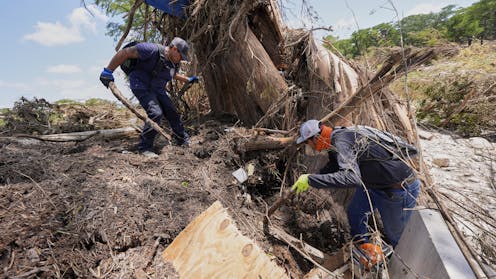
The landscape In the aftermath of a flood makes it challenging to spot victims. AP Photo/Gerald Herbert

For search and rescue, AI is not more accurate than humans, but it is far faster.

Recent successes in applying computer vision and machine learning to drone imagery for rapidly determining building and road damage after hurricanes or shifting wildfire lines suggest that artificial intelligence could be valuable in searching for missing persons after a flood.

Machine learning systems typically take less than one second to scan a high-resolution image from a drone versus one to three minutes for a person. Plus, drones often produce more imagery to view than is humanly possible in the critical first hours of a search when survivors may still be alive.

Unfortunately, today’s AI systems are not up to the task.

We are robotics reseachers who study the use of drones in disasters. Our experiences searching for victims of flooding and numerous other events show that current implementations of AI fall short.

However, the technology can play a role in searching for flood victims. The key is AI-human collaboration.

a large red SUV with a white horizontal stripe and symbols and lettering along the side
Drones have become standard equipment for first responders, but floods pose unique challenges.
Eric Smalley, CC BY-ND

AI’s potential

Searching for flood victims is a type of wilderness search and rescue that presents unique challenges. The goal for machine learning scientists is to rank which images have signs of victims and indicate where in those images search-and-rescue personnel should focus. If the responder sees signs of a victim, they pass the GPS location in the image to search teams in the field to check.

The ranking is done by a classifier, which is an algorithm that learns to identify similar instances of objects – cats, cars, trees – from training data in order to recognize those objects in new images. For example, in a search-and-rescue context, a classifier would spot instances of human activity such as garbage or backpacks to pass to wilderness search-and-rescue teams, or even identify the missing person themselves.

A classifier is needed because of the sheer volume of imagery that drones can produce. For example, a single 20-minute flight can produce over 800 high-resolution images. If there are 10 flights – a small number – there would be over 8,000 images. If a responder spends only 10 seconds looking at each image, it would take over 22 hours of effort. Even if the task is divided among a group of “squinters,” humans tend to miss areas of images and show cognitive fatigue.

The ideal solution is an AI system that scans the entire image, prioritizes images that have the strongest signs of victims, and highlights the area of the image for a responder to inspect. It could also decide whether the location should be flagged for special attention by search-and-rescue crews.

Where AI falls short

While this seems to be a perfect opportunity for computer vision and machine learning, modern systems have a high error rate. If the system is programmed to overestimate the number of candidate locations in hopes of not missing any victims, it will likely produce too many false candidates. That would mean overloading squinters or, worse, the search-and-rescue teams, which would have to navigate through debris and muck to check the candidate locations.

Developing computer vision and machine learning systems for finding flood victims is difficult for three reasons.

One is that while existing computer vision systems are certainly capable of identifying people visible in aerial imagery, the visual indicators of a flood victim are often very different compared with those for a lost hiker or fugitive. Flood victims are often obscured, camouflaged, entangled in debris or submerged in water. These visual challenges increase the possibility that existing classifiers will miss victims.

Second, machine learning requires training data, but there are no datasets of aerial imagery where humans are tangled in debris, covered in mud and not in normal postures. This lack also increases the possibility of errors in classification.

Third, many of the drone images often captured by searchers are oblique views, rather than looking straight down. This means the GPS location of a candidate area is not the same as the GPS location of the drone. It is possible to compute the GPS location if the drone’s altitude and camera angle are known, but unfortunately those attributes rarely are. The imprecise GPS location means teams have to spend extra time searching.

How AI can help

Fortunately, with humans and AI working together, search-and-rescue teams can successfully use existing systems to help narrow down and prioritize imagery for further inspection.

In the case of flooding, human remains may be tangled among vegetation and debris. Therefore, a system could identify clumps of debris big enough to contain remains. A common search strategy is to identify the GPS locations of where flotsam has gathered, because victims may be part of these same deposits.

aerial view of a landscape with green rings superimposed
A machine learning algorithm identified piles of debris large enough to contain bodies in an aerial image of a flood aftermath.
Center for Robot-Assisted Search and Rescue and University of Maryland

An AI classifier could find debris commonly associated with remains, such as artificial colors and construction debris with straight lines or 90-degree corners. Responders find these signs as they systematically walk the riverbanks and flood plains, but a classifier could help prioritize areas in the first few hours and days, when there may be survivors, and later could confirm that teams didn’t miss any areas of interest as they navigated the difficult landscape on foot.

The Conversation

Robin R. Murphy receives funding from the National Science Foundation. She is affiliated with the Center for Robot-Assisted Search and Rescue.

Thomas Manzini is affiliated with the Center for Robot Assisted Search & Rescue (CRASAR), and his work is funded by the National Science Foundation’s AI Institute for Societal Decision Making (AI-SDM).

ref. Why drones and AI can’t quickly find missing flood victims, yet – https://theconversation.com/why-drones-and-ai-cant-quickly-find-missing-flood-victims-yet-261035

Design and Disability at the V&A is a rich, thought-provoking exhibition

Source: The Conversation – UK – By Laudan Nooshin, Professor of Music, School of Communication and Creativity, City St George’s, University of London

One of the first things to greet visitors at the V&A’s new Design and Disability exhibition is a striking blue bench by artist Finnegan Shannon titled, Do You Want Us Here Or Not? This exhibit is a response to the often inadequate seating in museums, which not only acts as a barrier to accessibility for many people, but is more widely symptomatic of ableist approaches to museum and exhibition design.

In this case, the invitation to “Please sit here!” sets the tone for the whole exhibition, which also includes a large sensory map of the layout (located at wheelchair level), a tactile map, and QR codes that link to audio description for blind and partially sighted visitors, and also British Sign Language interpretation.


Looking for something good? Cut through the noise with a carefully curated selection of the latest releases, live events and exhibitions, straight to your inbox every fortnight, on Fridays. Sign up here.


Aiming to showcase the radical contributions of disabled, deaf and neurodivergent people to design history and contemporary culture from the 1940s until the present, the exhibition goes well beyond this, addressing an impressively wide range of issues around access, disability and exclusion. It also reveals how ableism operates across a range of exclusions, such as race, gender, class and more.

As the introductory notes point out: “Disabled people past and present have challenged and confronted the imbalance of design in society. This exhibition highlights disabled individuals at the heart of design history … It is both a celebration and a call to action.”

While the fight for disability justice goes back many decades – also documented in the exhibition – it’s only relatively recently that questions of access and equality have gone beyond the physical. These include a wide range of issues related to neuro-inclusion and sensory access, including calm spaces and sensory maps that indicate noisy areas.

My own interest in sound in museums has come partly out of research focusing on the role of acoustics in creating accessible spaces, and from my own experience of noise sensitivity conditions hyperacusis and misophonia. Inclusive sonic design seeks to address how sound operates as a factor of social inclusion and exclusion in places like museums.

The V&A exhibition comprises three sections: visibility, tools and living. Visibility focuses on design and art as fundamental tools of activism and includes work created as part of disability justice movements over many decades. This section is a stark reminder of the justice and rights that only come about through extensive struggles.

Tools highlight the extraordinary contribution to design innovation made by disabled people. Living explores stories of disabled people claiming space and imagining the worlds that they want to live in.

Sections two and three both advocate for the social model of disability in which people are rendered disabled by their environment, something that calls for design solutions (as opposed to the medical model in which people are required to navigate and find solutions to their “problem”).

The exhibition draws attention to a wide range of physical and sensory exclusions, both in the displays and the design of the space itself. The in-house design team includes staff with personal experience of disability who also worked closely with external partners living with disability.

There are plenty of exhibits that can be experienced through touch. For partially sighted visitors, there are strong visual contrasts in the wall colours and the edges of displays are lit up. And there are raised edgings on all exhibits for people using a cane – all of which help with navigation.

There are also quiet areas and plenty of seating. Some of these features are already being incorporated into gallery and exhibition design, and hopefully will soon become standard.

I particularly liked the way various issues intersect in the exhibition, in which a range of exclusions are set alongside one another: race, hearing impairment, youth exclusion and stammering, for example.

Other favourites included the B1 Blue Flame rattling football used for blind football, which visitors can pick up, feel, smell, shake and listen to. The Deaf Rave set and Woojer Vest are designed for deaf clubbers and performers and use vibrating tactile discs that amplify sound vibrations.

The beautiful blanket and pillow entitled Public S/Pacing by Helen Statford offers an invitation to rest, drawing attention to “crip time”, accepting “a different pace to non-disabled norms, challenging conventions of productivity, and resting in radical ways that would actually benefit society at large”.

The blanket highlights the failures of the design of public spaces to include disabled people, “challenging ableist assumptions with care and visibility”. The reverse of the blanket has a quotation from Rhiannon Armstrong’s Radical Act of Stopping (2016), embroidered by Poppy Nash.

The exhibition includes many examples of “disability gain” by which design aimed at a particular group of people unintentionally benefits others, too. An example is the smartphone touchscreen, based on technology developed by engineers Wayne Westerman and John Elias as an alternative to the standard keyboard, which Westerman was unable to use due to severe hand pain.

Initially marketed to people with hand disabilities, the technology was later sold to Apple where it revolutionised mobile phone technology.

The final panel of the exhibition is titled Label for Missing Objects, an imaginative and fitting way to mark the continuing story of designing a world that works for “every body and every mind”.

Design and Disability is a rich, thought-provoking and landmark exhibition. Kudos to the V&A, although its importance is so obvious, I wonder why it took this long to host a show dedicated to disabled artists and designers and the wider social impact of their work.

I very much hope there are plans for the exhibition to tour the UK and beyond, and to become a permanent gallery at the V&A, so that it can inform curation and design work in other museums.

Design and Disability at the V&A runs until February 15 2026.

The Conversation

Laudan Nooshin received funding from the AHRC for the project Place-making Through Sound: Designing for Inclusivity and Wellbeing (2023-24).

ref. Design and Disability at the V&A is a rich, thought-provoking exhibition – https://theconversation.com/design-and-disability-at-the-vanda-is-a-rich-thought-provoking-exhibition-261135