Four summer hotspots for germs – and why not washing your hands won’t strengthen your immune system

Source: The Conversation – UK – By Manal Mohammed, Senior Lecturer, Medical Microbiology, University of Westminster

MR.ALONGKORN YOOCHAROEN/Shutterstock

Summer is a time for sun-drenched fun. From relaxed days outdoors to packed festival fields and meals under open skies. But with the joy of the season comes an overlooked downside: a heightened risk of infection.

Warmer weather, increased social interaction and more frequent contact with unfamiliar environments all make it easier for germs to spread. That’s why handwashing becomes especially important during the summer months. It might not be glamorous, but clean hands are your first line of defence against the microbes that love to crash summer plans.

Microbes thrive in warmth and moisture, and the activities we enjoy in summer often bring us into closer contact with the surfaces, food and water sources that help them spread.

1. Public restrooms and shared toilets

Outdoor festivals, service stations, beaches and campsites all rely on public toilet facilities. These high-traffic areas can become breeding grounds for bacteria like E coli, salmonella and Staphylococcus aureus. Viruses such as norovirus and flu also spread easily via contaminated surfaces. Even coronavirus can persist in poorly ventilated or inadequately cleaned environments.

Washing your hands thoroughly after using public toilets is essential – and hand sanitiser may not be enough if your hands are visibly dirty.

Worryingly, even in places where hygiene is critical, like hospitals, people often skip this basic step. A 2025 study found that nearly half of hospital visitors failed to wash their hands after using the toilet, despite clear reminders. If so many people skip handwashing in hospitals, where the risks are obvious and facilities readily available, how many more are failing to do so at summer events, where soap and water can be scarce?

2. Outdoor eating and food preparation

Barbecues and picnics are summer staples — but they come with a side of risk. Foodborne pathogens like salmonella, E coli, Bacillus cereus and Staphylococcus aureus thrive in warm temperatures. Undercooked meat, poor hand hygiene and leaving food out in the sun can easily turn a festive gathering into a bout of food poisoning.

Even fungi such as Aspergillus can grow on food and produce mycotoxins: toxic compounds that can cause nausea, organ damage or even long-term harm when ingested.

Wash hands before and after handling food, especially raw meat and after touching shared surfaces like picnic tables, barbecue tools and cool boxes.

3. Swimming and water play

Lakes, rivers, swimming pools and oceans can all harbour harmful germs. Parasites like cryptosporidium and giardia can cause gastrointestinal illness – and they’re often resistant to chlorine. Beach sand and seawater can also carry faecal bacteria.

Whether you’re swimming, paddling or just building sandcastles, make sure to wash or sanitise your hands before eating or touching your face.

4. Camps, playgrounds and festivals

Children are particularly vulnerable to infection in summer thanks to group settings like summer camps, soft play centres and playgrounds.

A US study reported 229 youth camp–associated outbreaks of gastroenteritis over seven years. Common culprits included norovirus, salmonella and Shiga toxin-producing E coli, a particularly dangerous strain of E coli that can cause severe illness and even kidney failure.

In one incident, 20 campers became ill, and three were hospitalised, after eating undercooked beef cooked over a campfire. Shared toilet facilities, communal food preparation and tight sleeping arrangements all increase the importance of hand hygiene.

But isn’t it good to ‘get a bit dirty’?

Some people believe that letting children get dirty helps build their immune system. While early exposure to natural microbes from soil, animals or the environment can support immune development, this is not the same as skipping handwashing after using the toilet or before meals.

Leaving hands unwashed doesn’t strengthen the immune system – it increases the risk of illness. No credible studies show that poor hygiene is good for you. On the contrary, unwashed hands are a leading cause of preventable infections worldwide. This risk is especially serious for young children, older adults and people with weakened immune systems.

Hand hygiene is simple, cheap and effective – and never more important than in summer. As the hospital toilet study shows, we can’t assume that people are washing their hands properly, even in places designed to protect health. Add in the chaos of a campsite or the distractions of a music festival, and it becomes even easier to forget.

So, whether you’re hiking, camping or dancing in a field, you should wash your hands with soap and clean running water for at least 20 seconds and then dry them properly as damp hands spread germs more easily. Use hand sanitiser (at least 60% alcohol) if soap and water aren’t available and ideally keep some in your bag in case you can’t rely on public facilities.

The Conversation

Manal Mohammed does not work for, consult, own shares in or receive funding from any company or organisation that would benefit from this article, and has disclosed no relevant affiliations beyond their academic appointment.

ref. Four summer hotspots for germs – and why not washing your hands won’t strengthen your immune system – https://theconversation.com/four-summer-hotspots-for-germs-and-why-not-washing-your-hands-wont-strengthen-your-immune-system-261635

Two of the best stop smoking medications have been available in the UK since 2024 – so why is no one using them?

Source: The Conversation – UK – By Jonathan Livingstone-Banks, Lecturer & Senior Researcher in Evidence-Based Healthcare, University of Oxford

In 2021, varenicline, the most effective single drug for quitting smoking, was withdrawn from the market in the UK because impurities were found at greater levels than is considered safe.

Rapidly, varenicline (then sold under its brand names, Champix and Chantix) became unavailable. This was a disaster for public health. Research from University College London estimated that varenicline being unavailable resulted in about 1,890 more avoidable deaths each year because fewer people were successfully quitting smoking.

But there was hope. Cytisine (also known as cytisinicline), a naturally occurring plant-based product that had been used for decades in eastern Europe, and more recently to great effect elsewhere in the world, was licensed in the UK and made available from January 2024.

Even so, there was an extended period when neither were available to people trying to quit smoking in the UK (and in other countries, too). But in the UK at least, things were looking up. Based on a limited but growing body of evidence, cytisine probably works as well as varenicline at helping people quit smoking, and it may be better tolerated with fewer side-effects.

It may also appeal to more smokers who may want to use a natural product rather than a drug designed in a lab. So, with varenicline withdrawn and a similarly effective treatment available, we should have seen lives saved as people who would have taken varenicline were encouraged to try cytisine instead.

A doctor examining lung X-rays.
Thousands more deaths could be avoided.
SUPAWADEE3625/Shutterstock.com

Why isn’t anyone prescribing it?

This didn’t happen. Cytisine – despite now being licensed and available in the UK – is still shockingly underused.

Since January 2024, only 0.2% of people trying to quit smoking have used it (the same proportion that used it in 2018, when it wasn’t even officially available in the UK). Official NHS data from people accessing stop-smoking services in England confirm that only 0.7% were prescribed cytisine in 2024.

So why is this? High-profile trials continue to show cytisine’s effectiveness for quitting smoking (and even for quitting vaping).

Maybe cytisine’s relatively complex dosing schedule puts people off. Cytisine starts with six pills a day (one every two hours) and gradually tapers off over a few weeks: more confusing and less convenient than one-a-day varenicline.

Another possibility is that the public’s attention has shifted. With so much focus in recent years on vaping as a smoking cessation aid, prescription drugs for smoking cessation may have fallen off the radar.

It could also be that GPs are reluctant to prescribe cytisine because of its cost and the assumption that local authorities should pay for it, not primary care. While it was once hoped that due to its low-cost availability in eastern Europe, it would become the “aspirin of smoking cessation drugs”, the licensed product in the UK is now as or more expensive than other drugs.

But the simplest explanation is probably the most accurate: not enough people know about cytisine. People who smoke, GPs, pharmacists and even stop-smoking services may not know it’s an option. And if no one is talking about it, no one is prescribing it. And even if they do know about it, there may be a lack of confidence in using or prescribing it because it is a new drug.

That’s a problem. The UK government has made the shift from treating illness to preventing it a central part of its health strategy. Smoking remains the leading cause of preventable death in the country and the world. If we’re serious about prevention, then effective smoking cessation support must be top of the agenda.

Now, varenicline is available again (without its brand names and reformulated to remove the impurities). This is welcome news, but only 1.1% of past-year smokers reported using varenicline. That’s only a quarter of the number from before its withdrawal.

This raises an important question: should we return to prescribing varenicline by default, or is it time to consider cytisine as a first-line treatment? Researchers are continuing to learn more about cytisine, but as the evidence in favour of cytisine grows, maybe it needs a PR campaign for both prescribers and people who smoke.

None of this is to say that cytisine is a miracle cure, or that it will work for everyone. But that’s true of every way to help people quit smoking. Quitting smoking is hard, and people trying to quit need more options, not fewer, and those options need to be visible and accessible.


Get your news from actual experts, straight to your inbox. Sign up to our daily newsletter to receive all The Conversation UK’s latest coverage of news and research, from politics and business to the arts and sciences.

The Conversation

Jonathan Livingstone-Banks has received funding from the US National Institutes of Health (NIH), the National Institute for Health and Care Research (NIHR) and Cancer Research UK (CRUK).

Dimitra Kale receives salary support from Cancer Research UK.

Lion Shahab is a HEFCE funded member of staff at University College London. In the past, he has received honoraria for talks, an unrestricted research grant and travel expenses to attend meetings and workshops from Pfizer and an honorarium to sit on advisory panel from Johnson&Johnson, both pharmaceutical companies that make smoking cessation products. He has acted as paid reviewer for grant awarding bodies and as a paid consultant for health care companies. Other research has been funded by the Department of Health, UKRI, a community-interested company (National Centre for Smoking Cessation) and charitable sources (Cancer Research UK, Yorkshire Cancer Research). He has never received personal fees or research funding of any kind from alcohol, electronic cigarette or tobacco companies.

ref. Two of the best stop smoking medications have been available in the UK since 2024 – so why is no one using them? – https://theconversation.com/two-of-the-best-stop-smoking-medications-have-been-available-in-the-uk-since-2024-so-why-is-no-one-using-them-261393

‘Darkening’ cities is as important for wildlife as greening them

Source: The Conversation – UK – By Nick Dunn, Professor of Urban Design, Lancaster University

Nighttime in Jakarta, Indonesia. Akhnaffauzi/Shutterstock

For billions of years, life has depended on Earth’s rhythm of day and night. DNA codifies body clocks in all animals and plants, which helps their cells act according to this cycle of light and dark.

Humans have disrupted this cycle, though, by producing artificial light at night. A growing body of scientific evidence shows this can have negative effects on many different forms of life.

Essentially, artificial light at night changes the sensory capacities of living things. It can disturb the magnetic orientation of migratory birds and beguile insects, causing them to become easier prey and exhausting them. The same disruption to body clocks we see in wildlife is also linked to health consequences in people.

Moths fluttering around a street lamp in the evening.
Drawn like moths to the flame…
Livio Federspiel/Shutterstock

Apart from some caves, deserts and deep-sea trenches, most of Earth has been invaded by light pollution to some degree, or is under threat of its encroachment. In 2001, astronomer Pierantonio Cinzano and colleagues created the first global atlas of light pollution. It calculated that two-thirds of the world’s population lived in areas where nights were at least 10% brighter than natural darkness.

The scale of the problem was updated in 2016 when the team renewed their atlas. By that time, 83% of people globally were living under a light-polluted sky – and 99% in the UK, Europe and North America.

The situation is not improving: too much light in the wrong place or at the wrong time causes big problems. But restoring darkness can help mitigate some of these issues – and cities are a good place to start.

Alternative urban illumination

Light is widely associated with safety, security and surveillance, but it does not necessarily deter crime. A 2019 study in Melbourne, Australia, for example, showed that more lighting alone did not create safer urban spaces.

Many people are familiar with the idea of greening cities by planting more street trees. If we were to darken cities, we would benefit biodiversity – and the health and wellbeing of humans and nonhumans too. The responsible use of lighting should be decided by an ethical and aesthetic argument for how we want cities after dark to be.


Read more:
Cities need to embrace the darkness of the night sky – here’s why


In my latest book, Dark Futures, I argue that cities should not necessarily seek to create areas of natural darkness with no artificial light – but rather, try to make urban areas navigable at night without harming wildlife. The question is where and when to have illumination, and how it should be deployed and controlled.

Look to the Bahnstadt district of Heidelberg in Germany for an approach that ensures a dark environment for wildlife. Here, infrared sensors have been fitted along a 3.5km cycle path that keeps lights dimmed when not in use.

Likewise, in Lille’s Parc de la Citadelle, France, a nocturnal corridor has been created to preserve biodiversity after dark. Each lighting unit along the path through the park consists of three LEDs with different settings. The brightest lights are only activated when pedestrians, cyclists and cars are detected by sensors.

The brightness of the lighting also mimics natural light patterns throughout the year. This approach, known as biophilic lighting, aligns artificial lighting with seasonal changes.

There have also been efforts to protect particular species at night. Bat-friendly lighting in the Dutch town of Zuidhoek-Nieuwkoop involves streetlamps emitting a red colour and using a wavelength that doesn’t interfere with a bat’s internal compass. The scheme still provides enough illumination for people.

Other forms of lighting, such as bioluminescence, could alter or even replace streetlamps as we know them. Bioluminescence is the emission of light by a chemical reaction in certain organisms.

To date, this type of illumination has only been applied in small experiments, such as those in the town of Rambouillet, France. Here, light is produced by a marine bacterium inside saltwater-filled tubes: a mix of basic nutrients feeds the bacteria, which glow in response. These “lights” are turned off again by stopping airflow into the tubes, putting the bacteria into a dormant state.

Unlike traditional streetlamps, they do not need to be connected to the electricity grid, and their intensity is never sufficient to disturb wildlife. This could open new avenues for the design of urban illumination – which is important, as we need new options.

Cities at night are ideal laboratories to responsibly explore our relationships with light and dark – for the benefit not only of people, but the countless species we share Earth with.


Don’t have time to read about climate change as much as you’d like?

Get a weekly roundup in your inbox instead. Every Wednesday, The Conversation’s environment editor writes Imagine, a short email that goes a little deeper into just one climate issue. Join the 45,000+ readers who’ve subscribed so far.


The Conversation

Nick Dunn is affiliated with the advocacy group DarkSky UK.

ref. ‘Darkening’ cities is as important for wildlife as greening them – https://theconversation.com/darkening-cities-is-as-important-for-wildlife-as-greening-them-252259


Will UK’s 10% discount get more people buying electric cars? The evidence doesn’t look good

Source: The Conversation – UK – By Tom Stacey, Senior Lecturer in Operations and Supply Chain Management, Anglia Ruskin University

RossHelen/Shutterstock

The UK government is offering a 10% taxpayer-funded discount on new plug-in cars that cost less than £37,000. It’s an attempt to re-energise the currently flatlining market for new electric vehicles (EVs) in the UK – but there are reasons for people’s reluctance that a price cut alone won’t solve.

The £37k price limit excludes all new Tesla, BMW and Mercedes-Benz cars – with Tesla still topping EV sales in the UK despite the recent backlash against its owner, Elon Musk. Many Chinese imports are also excluded as they fail to meet the UK’s sustainability criteria, primarily due to high coal use in the generation of electricity that powers Chinese EV factories – although these models will qualify for a smaller discount.

The UK government has framed its subsidy as an effort to make EVs easier and cheaper to own than petrol cars. This is something the car industry has been lobbying hard for, since it will be barred from offering new petrol and diesel cars for sale in the UK after 2030. Meanwhile, carmakers selling in the UK have to meet compulsory yearly sales targets for EVs.

While the UK is obliged by legislation to accelerate its transition to net zero, as a senior researcher of the switch to electric transport, I believe the new EV subsidy is a reactive measure which neglects more fundamental obstacles to wider EV adoption, such as the UK’s inadequate provision of chargers. It also fails to tackle entrenched misconceptions about these vehicles.

Why price cuts fall short

In a study I conducted with 2,000 car drivers in the UK in 2024, 50% claimed cost was their major impediment to buying an EV, even though EVs sometimes undercut similar petrol cars. The latter are universally increasing in price due to the complexity of designing parts that meet emissions targets.

Perceptions often lag reality, however, and the sense that EVs are always the more expensive option is why I found only 4% of drivers were “very likely” to buy an EV next.

The fleet market (vehicles purchased by companies for lease or business use) is where incentives like the one the UK government is offering have worked well. In research I published with colleagues in 2025, we assessed EV fleet adoption by businesses in the east of England.

We found tax incentives that encourage businesses to add EVs to their fleets – particularly if they offer them to company car drivers – are extremely effective, as they offer a joint benefit for both company and driver.

Businesses concerned with the cost of acquiring and maintaining their fleets appreciate that EVs require less maintenance. Company car drivers also prefer driving EVs once they spend some time with them, research suggests.

In our research, 80% of EV sales to company car fleets were attributed to tangible financial advantages such as these tax incentives. The rest were put down to the greener public image they cultivate for businesses. The popularity of EVs as company cars is apparent in market data: only one in ten new EV sales are to private buyers.

Returning to my study of private drivers, 50% of those who opted against buying an EV cited high upfront costs, while 40% highlighted inadequate charging options. This suggests purchase incentives like the 10% discount will not fully address the reluctance of private buyers.

The UK government has promised to invest £63 million by 2030 in building 25,000-50,000 new chargers (some of which are earmarked for local authority and NHS use). But as an EV driver of over 12 years, I think the UK’s public charging network is a mess.

The promised investment will still see the government fall short of its target of 300,000 chargers by 2030. What’s more, because of the 20% VAT rate on public charging, EV owners can pay up to ten times more for charging on the road than at home. This makes EVs, which the public already see as more expensive, actually more expensive to fuel than a small, economical diesel.

Lessons from abroad

The UK has so far failed to comprehensively deal with poor public perceptions of EVs.

Governments can get this right, though. Look at Norway, where 96% of new car sales are electric. This is thanks to consistent policies since the 1990s aimed at changing perceptions – and not merely the use of blunt instruments such as taxpayer-funded discounts.

A 2022 study of Norwegian EV owners highlighted how economic perks such as exemption from the 25% VAT rate on EV sales initially drove uptake. But sustaining this involved tackling public concerns about the limited range of EVs and the availability of public chargers.

You only need to visit Norway to see how: retail parks now have upwards of 30 EV chargers – and increasingly, no petrol pumps – compared with maybe two-to-four chargers in UK retail parks. This has led to 80% of Norwegian EV owners reporting higher satisfaction compared with owners of combustion-engine vehicles.

Cars plugged into public chargers on a city street.
Norway’s public charging network is more advanced than the UK’s.
Baloncici/Shutterstock

My survey results suggest perceptions of cost and practicality will lag reality until policies bridge the gap. This explains the UK’s stubborn 50% cost-barrier fixation, despite competitive pricing and a history of subsidies.

In contrast, Norway has successfully transformed public perceptions of EVs from “expensive novelties” to “smart, cost-effective and practical” by not stopping at price subsidies. By implementing strategic policies such as ensuring charging stations every 50km along major routes and capping charging costs, it avoided the political disagreements that have hindered EV adoption in the UK.

The UK’s efforts, such as discontinuing a purchase grant in 2022 and only partially reinstating it in 2025, have lacked the steady, comprehensive approach that drove Norway’s EV success.

The UK is in a tricky position. Sales mandates and the 2030 petrol and diesel car ban are pushing manufacturers towards selling EVs – but the public is buying only a tiny proportion of the new EVs in showrooms. What’s worse, people are still buying petrol cars in droves: the UK’s best-selling car 4.5 years away from the ban is the Nissan Qashqai – a model not available in electric.

So, while discounts on EVs will help, they will not significantly raise adoption because they treat symptoms, such as perceived upfront costs, rather than causes, such as lack of infrastructure, high charging costs, and a lack of cheaper used EVs that buyers feel they can trust.

To re-energise the EV market, the UK government should also extend the more-generous tax cuts that businesses receive on fleet purchases to private buyers, cap public charging costs to ensure price parity when driving an EV, and also level VAT on charging across the board.


Don’t have time to read about climate change as much as you’d like?

Get a weekly roundup in your inbox instead. Every Wednesday, The Conversation’s environment editor writes Imagine, a short email that goes a little deeper into just one climate issue. Join the 45,000+ readers who’ve subscribed so far.


The Conversation

Tom Stacey receives funding from ERDF for the Eastern New Energy Project.

ref. Will UK’s 10% discount get more people buying electric cars? The evidence doesn’t look good – https://theconversation.com/will-uks-10-discount-get-more-people-buying-electric-cars-the-evidence-doesnt-look-good-261426

Psychedelic drug DMT and near death experiences have long been linked – my study is the first to explore the connection in depth

Source: The Conversation – UK – By Michael Pascal, Lecturer in Psychology , University of Greenwich

BLACKDAY/Shutterstock

Have you ever wondered why people who nearly die often describe speeding toward supernatural light, or seeing their life flash before their eyes? You may have also heard about the powerful psychedelic dimethyltryptamine (DMT), a class A illegal drug in the UK, and how it might generate the so-called near-death experiences. In a recent study I compared both types of experience and found they share fascinating similarities – but also critical differences.

Some studies have suggested there are some basic overlaps between the experiences people have during a near-death experience and taking DMT. But my doctoral research was the first to make an in depth and nuanced qualitative comparison between DMT trips and NDEs. It was also the first field study of its kind, capturing authentic experiences instead of asking participants to take DMT in a laboratory.

Thirty-six participants took vaporised high-dose DMT, typically inhaled from a glass pipe, in familiar settings like their own homes. My colleagues and I used an interviewing technique inspired by micro-phenomenology, a new scientific approach which aims help people discover ordinary but inaccessible dimensions of our lived experience.

This approach helps interviewees recall details of their experience by asking them to articulate it moment by moment in their own words and in chronological order, while expanding out different dimensions such as sensory or emotional experiences.

This allowed us to explore the experiences with greater granularity. For example, in what way the general themes, such as meeting unusual beings or feeling yourself dissolve entirely, specifically expressed itself.

It also allowed us to measure how often each type of these details occurred. We then compared these descriptions to our analysis of another team’s raw data from their 2018 publication studying 34 cardiac arrest-induced NDEs.

My study found both types of experiences also had important differences which researchers have previously overlooked.

People in both groups commonly reported feeling detached from their bodies, encountering beings, travelling through mysterious spaces such as tunnels or voids, and seeing bright lights. These shared experiences hint at similar brain processes at play, like disruptions in the parts of the brain that handle the map of our body, how we simulate other people’s perspectives, sensory perception and spatial processing.

However, DMT trips almost never involved the more classic NDE “life review”, or dramatisations of experiencers’ return to life as in encountering a symbolic threshold of no return. Conversely, NDEs virtually never entailed the visuals of complex geometric patterns iconic to the DMT trip.

The most compelling difference, however, was in the way these features were represented. For example, while people with NDEs frequently reported meeting dead loved ones, DMT users universally described encounters with otherworldly or alien beings.

Suddenly finding yourself transformed into a spirit witnessing your body from above, before being greeted by a guide seemed to be characteristic of NDEs. DMT would simply dissolve people’s bodily awareness, as they rapidly shot into a transcendent world inhabited by mechanical clowns or serpentine scientists.

Hand reaching towards light beams.
Both people who have had DMT trips and those who have had NDEs often see tunnels.
Vlue/Shutterstock

My colleagues and I suggest that a blend of shared brain biology and personal psychology may explain why these experiences are so similar in their generic elements but differ in their content.

Some especially intriguing phenomena in NDEs, such as the “Peak in Darien” experience where the dying see others they did not know were dead, or correctly perceive things in their surroundings when out of body, are not yet fully explained by neuroscience. B

ut the common features mentioned above probably come directly from how DMT or the near-death state affects our brains. Think of these as universal stage props, set by our brain’s biology. But the stories we attach to these props – seeing your dead aunt or a multi-eyed octopoid alien – are influenced by our personal backgrounds, cultural expectations and memories.

DMT and the brain

Early psychedelic researchers suggested that DMT might flood the brain. during near-death conditions. But life isn’t that simple – and nor is death.

Studies have shown, for example, that rats produce DMT not only via their pineal glands, but in their cortical tissue, including at the point of death. But there isn’t yet evidence that this happens in human brains. Even if humans do produce DMT at psychoactive quantities in the throes of dying, our body’s enzymes could break it down before it reaches or has enough impact on the brain. Additionally, serotonin surges dramatically when you’re under extreme stress, which may itself confer psychedelic effects – and also sticks to the serotonin receptor more happily than DMT, possibly eclipsing any DMT activity.

All this said, some scientists argue the measuring methods used to measure rat brain DMT during cardiac arrest might miss short-lived, higher DMT spikes throughout the brain. And some researchers also think damage to certain neural networks and oxygen deprivation near death might amplify DMT’s psychedelic effects.

Interestingly, our study also discovered a subset of near-death experiences that lacked the imagery of a prototypical NDE, and instead presented abstract, cosmic visions more typical of DMT trips. It’s not easy to say where these atypical NDEs could be coming from. But it could be when someone has less preconceptions of NDEs or greater preconceptions of a psychedelic trip. Perhaps their body was synthesising higher levels or DMT than is usual for an NDE. The next frontier of this research would be to track brain activity when general features crop up. We also need more research to explore potential psychological and cultural reasons why these features are expressed in the way that they are.

Many indigenous people around the globe may feel contemporary science is superfluous. Ayahuasca, a shamanic brew that contains DMT, has been used by tribes all over the Amazon to connect to the spirit world and commune with their ancestors.

People who have an NDE almost always feel their fear of death lift afterwards. Since DMT reproduces many aspects of NDEs, it could become a powerful therapeutic tool (alongside psychological support) particularly for people facing existential anxiety or fear of death, whether they are terminally ill or physically healthy. Scientists are already exploring whether ayahuasca may treat prolonged grief disorder.

We’re just starting to demystify what the implications of DMT – this “mystical” substance – may be.

This article features references to books that have been included for editorial reasons, and may contain links to bookshop.org. If you click on one of the links and go on to buy something from bookshop.org The Conversation UK may earn a commission.

The Conversation

Michael Pascal does not work for, consult, own shares in or receive funding from any company or organisation that would benefit from this article, and has disclosed no relevant affiliations beyond their academic appointment.

ref. Psychedelic drug DMT and near death experiences have long been linked – my study is the first to explore the connection in depth – https://theconversation.com/psychedelic-drug-dmt-and-near-death-experiences-have-long-been-linked-my-study-is-the-first-to-explore-the-connection-in-depth-258641

How Disney classics help me teach real-world economics

Source: The Conversation – Canada – By Junaid B. Jahangir, Associate Professor, Economics, MacEwan University

Disney celebrated the 75th anniversary of Cinderella in February this year, with the message that she didn’t just believe in dreams, but did something about them by going to the palace to get Prince Charming.

The message emphasizes individual persistence for a happy ending, and projects popular ideas often entrenched in how undergraduate students learn about economics — that success is based on individual talent and hard work.

The anniversary allowed the Disney store another opportunity to sell its wares, including a US$7,000 diamond engagement ring.

Cinderella’s castle remains a signature feature of the Disney logo. Her story, along with other Disney classics, has been also used by academics and popular commentators alike to teach economics and finance lessons.

I teach economics using Disney and Cinderella. My approach is grounded in scholarly, popular and student critiques of how economics is taught and of the myth of meritocracy — that people get what they deserve.

The focus in my course “Economics for Everyone” aims to critique traditional tenets of economic theory to discuss issues with inequality and also to teach economics in a way that is accessible and interesting to students representing diverse abilities and identities.

Disney celebrates 75 years of Cinderella.

‘Real-world’ economics

The idea of “real world” economics alludes to the push by student groups in the aftermath of the 2008 financial crisis. They were concerned that while they were inundated with mathematical equations, their studies had not prepared them to address the state of the world.

As noted by Geoffrey Hodgson, a specialist in institutional and evolutionary economics, students created organizations and mounted demonstrations for alternative curricula.

In 2016, founding members of the Post-Crash Economics Society at the University of Manchester published The Econocracy: The Perils of Leaving Economics to the Experts. A global network, Rethinking Economics, was formed.

Some economics faculty responded that the discipline ought to focus on issues of inequalities, climate change, concerns about the future of work and financial instability.

Economist John Komlos focuses on the need for diverse or “real-world” issues in economics education while economists Jack Reardon and Maria Alejandra Caporale Madi write about a new “pluralist” economics. Political economist and economic historian Robert Skidelsky discusses why economics should include philosophy, history, sociology and politics.

Economists Sam de Muijnck and Joris Tieleman argue that economics textbooks sideline topics pertaining to power, racism, colonialism, exploitation and unequal life chances.

All these critiques lie at the heart of what I think of as “real-world economics.”

Beginning with situations, not math

Traditionally, in the first year of economics programs, students become deeply familiar with economic theoretical ideas that are posited as scientifically neutral or “value-free” models. However, as scholars like James Kwak and Komlos note, these theories are value-laden and promote neoliberal ideas that rest upon assuming the benefits of privatization, deregulation and small governments.


Read more:
What exactly is neoliberalism?


To teach first-year economics, instead of beginning with mathematical theories, I begin with real-world situations students are familiar with that speak to economic realities. The approach is inspired by Komlos and by a former student, Declan Jensen-Joyce, who asked me to emphasize diverse perspectives and real-world content.

I de-emphasize math at the introductory level, as many first-year students from varied disciplines (like business students majoring in accounting) have to take an introductory economics course. I emphasize a critical evaluation of mathematical models, an approach I sustain in advanced economics classes. Students who advance in economics are critically prepared to consider the limits of mathematical models.

Economics for everyone

The course I designed, “Economics for Everyone,” is offered for undergraduate students and also for senior citizens as part of the Edmonton Lifelong Learners Association. The class centres issues of economic inequality, worker exploitation and systemic discrimination.

I draw on mainstream (neoclassical) economic theory that emphasizes rationality, equilibrium and markets. I also draw on critiques of the field of economics from thinkers both within economics and from disciplines like anthropology, philosophy and history.

Using popular stories to reinforce concepts and ideas when teaching economics isn’t new. Especially since a seminal critique of the “chalk and talk” method — lots of math on a blackboard combined with lecturing — there has been a surge of research involving the use of games, video clips, popular books and other creative media to engage students.

Such methods of instruction are based on the recognition that they make economic content more relatable and increase student interest, break up lectures
and reinforce learning.

Levelling the playing field

The Disney message on Cinderella’s 75th anniversary is just one perspective.

In my class, I show a video clip to discuss the role of both luck and the importance of equality of opportunity in Cinderella’s happy ending. On the one hand, Cinderella’s good looks gave her luck. On the other hand, her opportunities could have been thwarted had it not been for interventions from outsiders.

For example, students learn that a level playing field was created when the Grand Duke allows Cinderella to try the slipper despite the unfair tactics of her stepmother, Lady Tremaine.

Disney Kids: Cinderella tries on the glass slipper.

Selected works of Komlos, as well as by philosopher Michael Sandel and political scientist Tom Malleson, accompany the message I endeavour to highlight to broach topics like democratizing the market system.

Economic freedom

Cinderella also allows us to recognize that people cannot exercise free choice unless they are economically free — as in the case of Cinderella, who must follow orders so she doesn’t end up on the streets.

This is specifically true in the case of racialized people, specifically, as I discuss, Black communities in the United States, who obtained freedom from legal bondage but continued to face economic constraints and hardship reinforced through many forms of white power, both violent and coercive.

Through The Princess and The Frog, a 2009 Disney musical, I consider the characters Tiana and Charlotte as children and as adults. I contrast the wealthy neighbourhood of Charlotte’s (white) family and Tiana’s neighbourhood of working-class Black families in order to teach the economics of racism.

This allows recognition of the systemic impact of neighbourhoods with poor schools and high unemployment on limiting upward social mobility. These themes also support discussing covert racism in the discipline of economics and how communities and systems of governance can mitigate inequalities.


Read more:
Banking co-ops run by Black women have a longtime legacy of helping people


How living standards emerge

Teaching about Pinocchio also helps me critique the economic principle that living standards are based on productivity.

For example, Stromboli enriches himself with gold coins by exploiting Pinocchio’s labour and keeping him in a cage. Examining this story allows an opportunity to broach the mistreatment of poor migrant workers in the Middle East with dismal living conditions.

Overall, various Disney animations allow me to broach real-world economic issues in a manner that captures the interest of students, young and old.

The Conversation

Junaid B. Jahangir does not work for, consult, own shares in or receive funding from any company or organisation that would benefit from this article, and has disclosed no relevant affiliations beyond their academic appointment.

ref. How Disney classics help me teach real-world economics – https://theconversation.com/how-disney-classics-help-me-teach-real-world-economics-259831

UK to recognise Palestinian statehood unless Israel agrees to ceasefire – here’s what that would mean

Source: The Conversation – UK – By Malak Benslama-Dabdoub, Lecturer in law, Royal Holloway University of London

The UK will formally recognise the state of Palestine in September unless Israel acts to end the “appalling situation” in Gaza. After an emergency cabinet meeting, Downing Street released a statement saying the UK would recognise Palestine unless Israel committed to a long-term sustainable peace, allowed the UN to restart humanitarian support, agreed to a ceasefire, and made clear there would be no annexations in the West Bank.

The statement also reiterated the UK’s demand for Hamas to release all remaining Israeli hostages, accept a ceasefire, disarm and play no further part in the government of Gaza.

The UK’s decision follows a pledge by French president Emmanuel Macron on July 24 to formally recognise Palestinian statehood statehood in September. If this is acted upon, France and the UK would be the first G7 members and the first members of the UN security council to recognise the state of Palestine.

Recognition of statehood is not merely symbolic. The Montevideo convention of 1933 established several criteria which must apply before an entity can be recognised as a sovereign state. These are a permanent population, a defined territory, an effective government and the ability to conduct international relations.

The process involves the establishment of formal diplomatic relations, including the opening of embassies, the exchange of ambassadors, and the signing of bilateral treaties. Recognition also grants the recognised state access to certain rights in international organisations. For Palestinians, such recognition will strengthen their claim to sovereignty and facilitate greater international support.

This decision by France and the UK is significant. It signals a departure from the western consensus, long shaped by the US and the EU, that any recognition of Palestinian statehood must be deferred until after final-status negotiations. The move also highlights growing frustration in parts of Europe with the ongoing violence in Gaza and the failure of peace talks over the past two decades.

Yet questions remain: what does this recognition actually entail? Will it change conditions on the ground for Palestinians? Or is it largely symbolic?

So far, the French and British governments have offered no details on whether recognition would be accompanied by concrete measures. There has been no mention of sanctions on Israel, no indication of halting arms exports, no pledges of increased humanitarian aid or support for Palestinian governance institutions. France and the UK remain key military and economic partners of Israel, and the pledges do not appear to alter that relationship.

Nor is this the first time western countries have taken a symbolic stance in support of Palestinian statehood. Sweden recognised the state of Palestine in 2014, becoming the first western European country to do so. It was followed by Spain in 2024.

However, both moves were largely symbolic and did not significantly alter the political or humanitarian situation on the ground. The risk is that recognition, without action, becomes a gesture that changes little.

Macron’s statement also raised eyebrows for another reason: his emphasis on a “demilitarised Palestinian state” living side-by-side with Israel in peace and security. While such language is common in diplomatic discourse, it also reflects a deeper tension.

Palestinians have long argued that their right to self-determination includes the right to defend themselves against occupation. Calls for demilitarisation are often seen by critics as reinforcing the status quo, where security concerns are framed almost exclusively in terms of Israeli needs.

In the absence of a genuine political process, some analysts have warned that recognition of this kind risks formalising a state in name only – a fragmented, non-sovereign entity without control over its borders, resources or defence. Without guarantees of territorial continuity, an end to the expansion of Israeli settlements and freedom of movement, statehood may remain an abstract concept.

What would meaningful support look like?

If the UK and France want to go beyond symbolism, they have options. They could suspend arms exports to Israel or call for an independent international investigation into alleged war crimes. They could use the influence on the world stage to push for greater accountability regarding illegal settlements and the blockade of Gaza. They could also support Palestinian institutions directly and engage with Palestinian civil society.

Without such steps, recognition risks being viewed as a political message more than a policy shift. For Palestinians, the daily realities of occupation, displacement and blockade will not change with diplomatic announcements alone. What is needed, many argue, is not just recognition but support for justice, rights and meaningful sovereignty.

The pledged recognition of Palestine by France and the UK marks a shift in diplomatic tone and reflects broader unease with the status quo in the Middle East. It has stirred debate at home and abroad, and raised expectations among those hoping for more robust international engagement with the conflict.

Whether this recognition leads to meaningful changes in policy or conditions on the ground remains to be seen. Much will depend on the steps the UK and France take next – both at the United Nations and through their actions on trade, security and aid.

This article has been updated to include the UK’s pledge to recognise Palestine as well as France’s.

The Conversation

Malak Benslama-Dabdoub does not work for, consult, own shares in or receive funding from any company or organisation that would benefit from this article, and has disclosed no relevant affiliations beyond their academic appointment.

ref. UK to recognise Palestinian statehood unless Israel agrees to ceasefire – here’s what that would mean – https://theconversation.com/uk-to-recognise-palestinian-statehood-unless-israel-agrees-to-ceasefire-heres-what-that-would-mean-262095

Ontario’s forest management is falling short on key sustainability test

Source: The Conversation – Canada – By Jay R. Malcolm, Professor Emeritus, Forestry, University of Toronto

Forest degradation is increasingly recognized as a major global threat. Such degradation refers to the gradual erosion of a forest’s ability to store carbon, support biodiversity and sustain livelihoods, including those of Indigenous Peoples.

International frameworks such as the United Nations Convention on Biological Diversity and the UN Framework Convention on Climate Change now address degradation alongside deforestation.

While tropical forests have long been the focus, attention is also turning to temperate and boreal forests, where forest management is widespread and the potential for degradation is growing.

Some scientists have argued that if forest management is designed to be “ecologically sustainable,” then there should be little concern about degradation. But is this principle being upheld in practice? Our recent study in Ontario suggests otherwise.

Emulating natural forest disturbances

A widely used strategy to support ecological sustainability is to emulate natural disturbances; that is, to design human-caused disturbances so they fall within the range of variation observed in nature.

The ecological theory behind this approach is that species are adapted to cope with, or even benefit from, natural disturbances. In Canada’s managed boreal forests, for example, harvesting is explicitly designed to mimic natural fires, both in individual cutblocks and across the broader landscape.

In fact, this principle is enshrined in Ontario’s 1994 Crown Forest Sustainability Act that states:

“The long-term health and vigour of Crown forests should be provided for by using forest practice…that emulates natural disturbances and landscape patterns…”

The ecological sustainability of forest management is not a given: it is a hypothesis, and like any hypothesis, it must be tested. Are we actually managing forests in ecologically sustainable ways, or are we witnessing gradual forest degradation?

Our study examined the state of a 7.9 million hectare area of boreal forest in northeastern Ontario from 2012 to 2021 to test whether the provincial management regime was emulating natural disturbances, as required by law, or was instead prioritizing timber harvesting.

We used three indicators:

1) The rate at which forest was disturbed (including harvesting and fire).

2) The amount of relatively old forest (greater than 100 years old).

3) Modelled habitat for two species that have been used as indicators of sustainability: America marten and boreal caribou.

Our research did not find evidence that current practices in northeastern Ontario are emulating natural disturbances across the boreal landscape. Rather, the observed disturbance patterns appear to reflect strategies primarily focused on timber harvesting priorities.

What we found

A particular risk for boreal forests is a focus on timber production and economic returns over ecological goals. Such an approach is fundamentally at odds with the idea of emulating nature.

In particular, forests older than 100 years old have high ecological value in natural systems. They keep large amounts of carbon out of the atmosphere and provide habitat for myriad species. But if one is prioritizing timber, they are viewed as wasteful because they do not produce timber as rapidly as younger forests and are often targeted for removal. In that perspective, they are labelled “decadent.”

We found that the amount of forest disturbed per year was often higher than expected under natural fire regimes and, in some coniferous forest types, even exceeded the rates expected under a strategy that prioritized timber harvesting.

Relatively old forests were also much rarer than in natural landscapes: only 22 per cent of the forest in the study area was more than 100 years old compared to an average of 54 per cent in natural landscapes.

This amount was lower than even the most conservative threshold of natural variability.

Habitats for marten and caribou were similarly degraded and fragmented. Marten habitat covered just 36 per cent of the study landscape, compared to 76 per cent in a reconstructed natural landscape. For boreal caribou, habitat was even more compromised, covering only four per cent of the study area compared to 53 per cent in the natural landscape.

Strikingly, for caribou, levels of habitat disturbance — including disturbances from harvesting, fire and roads — exceeded 70 per cent of the landscape, jeopardizing the sustainability of the two caribou populations.

Surprisingly, the clearest evidence of forest management prioritizing timber occurred within zones meant explicitly to sustain caribou. Our modelling showed that such areas will contain even less caribou habitat in the future than they do today.

A path to an ecologically sustainable future

The Ontario government is currently revisiting its boreal management strategy — a welcome and timely development. But rather than relying solely on a virtual reality model (Boreal Forest Landscape Disturbance Simulator) to define natural landscapes as is currently the case, it is evident that policy must be grounded in empirical data from real, unmanaged forests.

Scientific research over the past several decades has identified forest management approaches that can deliver timber while also sustaining ecological services within natural bounds.

These strategies, however, rely on tools the province has yet to embrace, including longer harvest rotations, increased use of partial harvesting instead of over-relying on clearcutting, expanded areas set aside from logging, and explicit targets for amounts of forest up to 200 years of age or older.

Our findings indicate that forest degradation is already underway in the boreal forests of Ontario. Substantial changes to forest management are required to reverse this trend and safeguard the ecosystem services on which people and wildlife depend.

The Conversation

Jay R. Malcolm has received funding from the Natural Sciences and Engineering Research Council of Canada and Wahkohtowin Development GP Inc. (WDGP). The research also benefited from research on American marten habitat funded by Mitacs
and WDGP. WDGP played a role in defining the study area, but otherwise funders were not involved in the study design; in the collection, analysis, and interpretation of data; in the writing of the manuscript; or in the decision to submit the article for publication.

Justina C. Ray is President and Senior Scientist of Wildlife Conservation Society Canada.

ref. Ontario’s forest management is falling short on key sustainability test – https://theconversation.com/ontarios-forest-management-is-falling-short-on-key-sustainability-test-261054

AI can be responsibly integrated into classrooms by answering the ‘why’ and ‘when’

Source: The Conversation – Canada – By Soroush Sabbaghan, Associate Professor, Werklund School of Education, University of Calgary

Scroll through social media and you’ll find numerous videos such as “How to Use AI to write your essay in 5 minutes” or “How to skip the readings with ChatGPT.”

The discourse surrounding AI in education is deafening and it’s almost entirely consumed by the question: How? How do we write the perfect prompt? How should educators integrate ChatGPT into academic work or detect its use?

This obsession with methods and mechanics is a dangerous distraction. By racing to master the “how,” we have skipped the two far more critical, foundational questions: why should we use these tools in the first place, and when is it appropriate to do so?

Answering the “how” is a technical challenge. Answering the “why” and “when” is a philosophical one. Until educators and educational leaders ground their approaches in a coherent philosophical and theoretical foundation for learning, integrating AI will be aimless, driven by novelty and efficiency rather than human development.

Two frameworks provide the essential lens we need to move beyond the hype and engage with AI responsibly: “virtue epistemology,” which argues that knowledge is not merely a collection of correct facts or a well-assembled product, but the outcome of practising intellectual virtues; and a care-based approach that prioritizes relationships.

Virtue over volume

The current “how-to” culture implicitly defines the goal of learning as the production of a polished output (like a a comprehensive report or a functional piece of code). From this perspective, AI is a miracle of efficiency. But is the output the point of learning?

Virtue epistemology, as championed by philosophers like Linda Zagzebski, suggests the real goal of an assignment is not just writing the essay itself — but the cultivation of curiosity, intellectual perseverance, humility and critical thinking that the process is meant to instil.

This reframes the “why” of using AI. From this perspective, the only justification for integrating AI into a learning process should be to support and sustain intellectual labour.

If a student uses AI to brainstorm counterarguments for a debate, they are practising intellectual flexibility as part of that labour. If another student uses AI to map connections between theoretical frameworks for a research paper, they are deepening conceptual understanding through guided synthesis.

When AI undermines ‘why’

However, when the “how” of AI is used to bypass the very struggle that builds virtue (by exercising intellectual labour, including analysis, deliberation and judgment), it directly undermines the “why” of the assignment. A graduate student who generates a descriptive list of pertinent research about a topic without engaging with the sources skips the valuable process of synthesis and critical engagement.

This stands in direct contrast to philosopher and educator John Dewey’s view of learning as an active, experiential process.

For Dewey, learning happens through doing, questioning and grappling with complexity, not by acquiring information passively. Assignments that reward perfection and correctness over process and growth further incentivize the use of AI as a shortcut, reducing learning to prompting and receiving rather than engaging in the intellectual labour of constructing meaning.

Care over compliance

If the “why” is about supporting human intellectual labour and fostering intellectual virtue, the “when” is about the specific, contextual and human needs of the learner.

This is where an “ethics of care” becomes indispensable. As philosopher Nel Noddings proposed, a care-based approach prioritizes relationships and the needs of the individual over rigid, universal rules. It moves away from a one-size-fits-all policy and toward discretionary judgment.

The question: “When is it appropriate to use AI?” cannot be answered with a simple rubric. For a student with a learning disability or severe anxiety, using AI to help structure their initial thoughts might be a compassionate and enabling act, allowing them to engage with the intellectual labour of the task without being paralyzed by the mechanics of writing. In this context, the “when” is when the tool removes a barrier to deeper learning.

Conversely, for a student who needs to develop foundational writing skills, relying on that same tool for the same task would be irresponsible. Deciding the “when” requires educators to know their learner, understand the learning goal and act with compassion and wisdom. It is a relational act, not a technical one.

Educators must ensure that AI supports rather than displaces the development of core capabilities.

AI as mediator

This is also where we must confront historian and philosopher Michel Foucault’s challenge to the idea of the lone, autonomous author. Foucault argued that the concept of the author functions to make discourse controllable and to have a name that can be held accountable. Our obsession with policing students’ authorship — a “how” problem focused on originality and plagiarism — is rooted in this system of control.

It rests on the convenient fiction of the unmediated creator, ignoring that all creation is an act of synthesis, mediated by language, culture and the texts that came before. AI is simply a new, more powerful mediator that makes this truth impossible to ignore.

This perspective reframes an educator’s task away from policing a fragile notion of originality. The more crucial questions become when and why to use a mediator like AI. Does the tool enable deeper intellectual labour, or does it supplant the struggle that builds virtue? The focus shifts from controlling the student to intentionally shaping the learning experience.

Reorienting AI through values and virtue

The rush to adopt AI tools without a philosophical framework is already leading us toward a more surveilled, less trusting and pedagogically shallow future.

Some educational systems are investing money in AI detection software when what’s needed is investing in redesigning assessment.

Policy is emerging that requires students to declare their use of AI. But it’s essential to understand that disclosure isn’t the same as meaningful conversations about intellectual virtue.

Answering the questions of why and when to use AI requires us to be architects of learning. It demands that we engage with thinking about learning and what it means to produce knowledge through the works of people like Dewey, Noddings, Zagzebski and others as urgently as we do with the latest tech blogs.

For educators, the responsible integration of AI into our learning environments depends on our commitments to cultivating a culture that values intellectual labour and understands it as inseparable from the knowledge and culture it helps generate.

It is time to stop defaulting to “how” and instead lead the conversation about the values that define when and why AI fits within meaningful and effective learning.

The Conversation

Soroush Sabbaghan receives funding from SSHRC.

ref. AI can be responsibly integrated into classrooms by answering the ‘why’ and ‘when’ – https://theconversation.com/ai-can-be-responsibly-integrated-into-classrooms-by-answering-the-why-and-when-261496

Light pollution is encroaching on observatories around the globe – making it harder for astronomers to study the cosmos

Source: The Conversation – USA – By Richard Green, Astronomer Emeritus, Steward Observatory, University of Arizona

Light pollution from human activity can threaten radio astronomy – and people’s view of the night sky. Estellez/iStock via Getty Images

Outdoor lighting for buildings, roads and advertising can help people see in the dark of night, but many astronomers are growing increasingly concerned that these lights could be blinding us to the rest of the universe.

An estimate from 2023 showed that the rate of human-produced light is increasing in the night sky by as much as 10% per year.

I’m an astronomer who has chaired a standing commission on astronomical site protection for the International Astronomical Union-sponsored working groups studying ground-based light pollution.

My work with these groups has centered around the idea that lights from human activities are now affecting astronomical observatories on what used to be distant mountaintops.

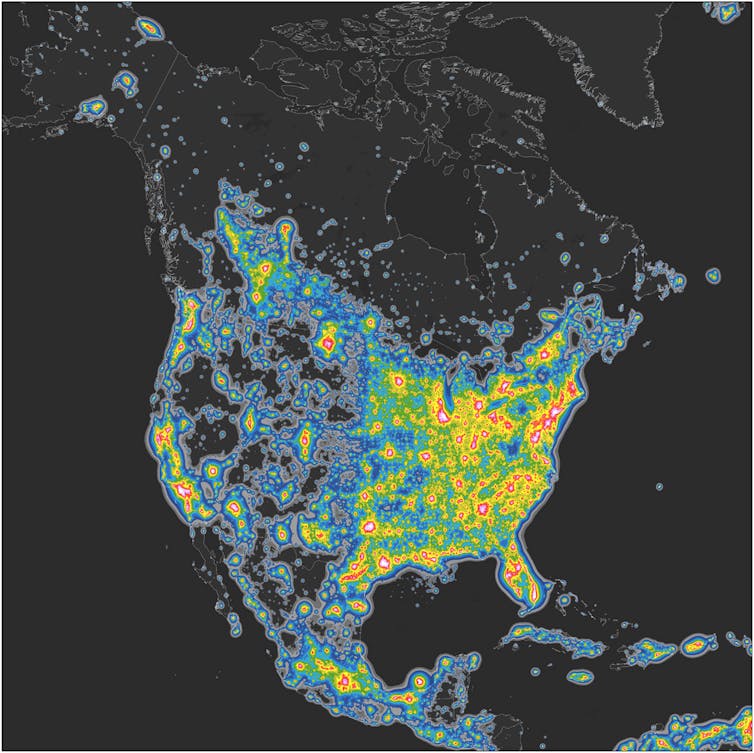
A map of North America showing light pollution, with almost all the eastern part of the U.S. covered from Maine to North Dakota, and hot spots on the West Coast.
Map of North America’s artificial sky brightness, as a ratio to the natural sky brightness.
Falchi et al., Science Advances (2016), CC BY-NC

Hot science in the cold, dark night

While orbiting telescopes like the Hubble Space Telescope or the James Webb Space Telescope give researchers a unique view of the cosmos – particularly because they can see light blocked by the Earth’s atmosphere – ground-based telescopes also continue to drive cutting-edge discovery.

Telescopes on the ground capture light with gigantic and precise focusing mirrors that can be 20 to 35 feet (6 to 10 meters) wide. Moving all astronomical observations to space to escape light pollution would not be possible, because space missions have a much greater cost and so many large ground-based telescopes are already in operation or under construction.

Around the world, there are 17 ground-based telescopes with primary mirrors as big or bigger than Webb’s 20-foot (6-meter) mirror, and three more under construction with mirrors planned to span 80 to 130 feet (24 to 40 meters).

The newest telescope starting its scientific mission right now, the Vera Rubin Observatory in Chile, has a mirror with a 28-foot diameter and a 3-gigapixel camera. One of its missions is to map the distribution of dark matter in the universe.

To do that, it will collect a sample of 2.6 billion galaxies. The typical galaxy in that sample is 100 times fainter than the natural glow in the nighttime air in the Earth’s atmosphere, so this Rubin Observatory program depends on near-total natural darkness.

Two pictures of the constellation Orion, with one showing many times more stars.
The more light pollution there is, the fewer stars a person can see when looking at the same part of the night sky. The image on the left depicts the constellation Orion in a dark sky, while the image on the right is taken near the city of Orem, Utah, a city of about 100,000 people.
jpstanley/Flickr, CC BY

Any light scattered at night – road lighting, building illumination, billboards – would add glare and noise to the scene, greatly reducing the number of galaxies Rubin can reliably measure in the same time, or greatly increasing the total exposure time required to get the same result.

The LED revolution

Astronomers care specifically about artificial light in the blue-green range of the electromagnetic spectrum, as that used to be the darkest part of the night sky. A decade ago, the most common outdoor lighting was from sodium vapor discharge lamps. They produced an orange-pink glow, which meant that they put out very little blue and green light.

Even observatories relatively close to growing urban areas had skies that were naturally dark in the blue and green part of the spectrum, enabling all kinds of new observations.

Then came the solid-state LED lighting revolution. Those lights put out a broad rainbow of color with very high efficiency – meaning they produce lots of light per watt of electricity. The earliest versions of LEDs put out a large fraction of their energy in the blue and green, but advancing technology now gets the same efficiency with “warmer” lights that have much less blue and green.

Nevertheless, the formerly pristine darkness of the night sky now has much more light, particularly in the blue and green, from LEDs in cities and towns, lighting roads, public spaces and advertising.

The broad output of color from LEDs affects the whole spectrum, from ultraviolet through deep red.

The U.S. Department of Energy commissioned a study in 2019 which predicted that the higher energy efficiency of LEDs would mean that the amount of power used for lights at night would go down, with the amount of light emitted staying roughly the same.

But satellites looking down at the Earth reveal that just isn’t the case. The amount of light is going steadily up, meaning that cities and businesses were willing to keep their electricity bills about the same as energy efficiency improved, and just get more light.

Natural darkness in retreat

As human activity spreads out over time, many of the remote areas that host observatories are becoming less remote. Light domes from large urban areas slightly brighten the dark sky at mountaintop observatories up to 200 miles (320 kilometers) away. When these urban areas are adjacent to an observatory, the addition to the skyglow is much stronger, making detection of the faintest galaxies and stars that much harder.

A white-domed building on a hilltop among trees.
The Mt. Wilson Observatory in the Angeles National Forest may look remote, but urban sprawl from Los Angeles means that it is much closer to dense human activity today than it was when it was established in 1904.
USDA/USFS, CC BY

When the Mt. Wilson Observatory was constructed in the Angeles National Forest near Pasadena, California, in the early 1900s, it was a very dark site, considerably far from the 500,000 people living in Greater Los Angeles. Today, 18.6 million people live in the LA area, and urban sprawl has brought civilization much closer to Mt. Wilson.

When Kitt Peak National Observatory was first under construction in the late 1950s, it was far from metro Tucson, Arizona, with its population of 230,000. Today, that area houses 1 million people, and Kitt Peak faces much more light pollution.

Even telescopes in darker, more secluded regions – like northern Chile or western Texas – experience light pollution from industrial activities like open-pit mining or oil and gas facilities.

A set of buildings atop a mountain in the desert.
European Southern Observatory’s Very Large Telescope at the Paranal site in the sparsely populated Atacama Desert in northern Chile.
J.L. Dauvergne & G. Hüdepohl/ESO, CC BY-ND

The case of the European Southern Observatory

An interesting modern challenge is facing the European Southern Observatory, which operates four of the world’s largest optical telescopes. Their site in northern Chile is very remote, and it is nominally covered by strict national regulations protecting the dark sky.

AES Chile, an energy provider with strong U.S. investor backing, announced a plan in December 2024 for the development of a large industrial plant and transport hub close to the observatory. The plant would produce liquid hydrogen and ammonia for green energy.

Even though formally compliant with the national lighting norm, the fully built operation could scatter enough artificial light into the night sky to turn the current observatory’s pristine darkness into a state similar to some of the legacy observatories now near large urban areas.

A map showing two industrial sites, one large, marked on a map of Chile. Just a few miles to the north are three telescope sites.
The location of AES Chile’s planned project in relation to the European Southern Observatory’s telescope sites.
European Southern Observatory, CC BY-ND

This light pollution could mean the facility won’t have the same ability to detect and measure the faintest galaxies and stars.

Light pollution doesn’t only affect observatories. Today, around 80% of the world’s population cannot see the Milky Way at night. Some Asian cities are so bright that the eyes of people walking outdoors cannot become visually dark-adapted.

In 2009, the International Astronomical Union declared that there is a universal right to starlight. The dark night sky belongs to all people – its awe-inspiring beauty is something that you don’t have to be an astronomer to appreciate.

The Conversation

Richard Green is affiliated with the International Astronomical Union and the American Astronomical Society, as well as DarkSky International.

ref. Light pollution is encroaching on observatories around the globe – making it harder for astronomers to study the cosmos – https://theconversation.com/light-pollution-is-encroaching-on-observatories-around-the-globe-making-it-harder-for-astronomers-to-study-the-cosmos-260387