Why Donald Trump has stopped some conflicts but is failing with Ukraine and Gaza

Source: The Conversation – UK – By Stefan Wolff, Professor of International Security, University of Birmingham

In yet another twist in his unpredictable decision making, US president Donald Trump has dramatically shortened his original 50-day ultimatum to Vladimir Putin to call a ceasefire in Ukraine to a mere ten days. It’s an unmistakable sign of Trump’s frustration with the Russian leader who he now appears to view as the main obstacle to ending the war.

Progress has been similarly limited on another of Trump’s flagship foreign policy projects: ending the war in Gaza. As a humanitarian catastrophe engulfs the territory, Trump and some of his Maga base are finally challenging Israel’s denials that, after almost two years of war, many Gazans now face a real risk of starvation.

In neither case have his efforts to mediate and bring an end to the violence borne any fruit. But not all of Trump’s efforts to stop violence in conflicts elsewhere in the world have been similarly futile. The administration brokered a ceasefire between Rwanda and the Democratic Republic of Congo (DRC), which the two countries’ foreign ministers signed in Washington on June 27.

The US president has also claimed to be behind the ceasefire between India and Pakistan in May after the two sides had engaged in several days of fierce combat following a terror attack in Indian-administered Kashmir by a Pakistan-backed rebel group. And, drawing a clear parallel between this conflict and the border clashes between Cambodia and Thailand in July, Trump announced he had pushed both countries’ leaders to negotiate a ceasefire.

All of these ceasefires, so far, have held. By contrast, the ceasefire in the war between Israel and Hamas in Gaza, to which Trump contributed in January, even before he was inaugurated for his second term, broke down in March and fighting has escalated ever since. A short-lived ceasefire in Ukraine in April was barely worth its name given the countless violations.

Mixed record

Three factors can explain Trump’s mixed record of peacemaking to date. First, the US president is more likely to succeed in stopping the fighting where he has leverage and is willing to use it to force foreign leaders to bend to his will. For example, Trump was very clear that there would be no trade negotiations with Thailand or Cambodia “until such time as the fighting STOPS”.

The crucial difference, so far, with the situation in the war against Ukraine is that Trump has, and has used, similar leverage only with the Ukrainian president, Volodymyr Zelensky. This led to a US-Ukraine agreement on a 30-day ceasefire proposal just two weeks after the now-notorious row between Trump and Zelensky in the Oval Office.

The mere threat of sanctions against Russia, by contrast, has done little to persuade Putin to accept whatever deal might Trump offer him. Trump’s threats – which he has never followed through on – did not work in January or May. The Kremlin’s initial reactions to the latest ultimatum from the White House do not indicate a change in Putin’s attitude.

A second factor that may explain why Trump has had peacemaking success in some cases but not others is the level of complexity of US interests involved. When it comes to US relations with Russia and Israel, there is a lot more at stake for Trump.

The US president still appears keen to strike a grand bargain with Russia and China under which Washington, Beijing and Moscow would agree to recognise, and not interfere in, their respective spheres of influence. This could explains his hesitation so far to follow through on his threats to Putin.

Similarly, US interests in the Middle East – whether it’s over Iran’s nuclear programme or relations with America’s Gulf allies – have put strains on the alliance with Israel. Trump also needs to weigh carefully the impact of any move against, or in support of, Israel on his domestic support base.

In the deal Trump brokered between Rwanda and the DRC, the issues at stake were much simpler: access for US investors to the mineral riches of the eastern DRC. Just days into his second term, Trump acknowledged that the conflict was a “very serious problem”. Congo’s president, Felix Tshisekedi, responded by offering the US access to minerals in exchange for pushing Rwanda to a deal to end the invasion and stop supporting proxy forces in the DRC.

This leads to the third factor that has enabled Trump’s peace-making success so far: simpler solutions are easier to achieve. Thailand and Cambodia and India and Pakistan can go back to the situation before their recent fighting. That does not resolve any of the underlying issues in their conflicts, but returns their relations to some form of non-violent stability.

It is ultimately also in the interests of the conflict parties. They have had a chance to make their violent statements and reinforce what they will and won’t tolerate from the other side. The required investment by an external mediator to end battles that have achieved what the warring sides want anyway – to avoid further escalation – is consequently quite limited.

Complex conflicts

Getting to any kind of stability in Ukraine or the Middle East by contrast requires prolonged engagement and attention to detail. These conflicts are at a stage in which a return to how things were before is not in the interests of the parties or their external backers. Nudging warring parties along on the path to agreement under such conditions requires a well-designed process, which is absent in Ukraine and failing in Gaza.

Thanks to funding and personnel cuts, the US secretary of state, Marco Rubio, is now required to perform multiple roles. Trump relies on personal envoys with at best limited foreign policy expertise, while insisting he makes all the decisions. This ultimately suggests that the White House simply may not have the bandwidth for the level of engagement that would be necessary to get to a deal in Ukraine and the Middle East.

This is a self-inflicted opportunity lost, not only for the United States but also for the long-suffering people of Ukraine and the Middle East.

The Conversation

Stefan Wolff is a past recipient of grant funding from the Natural Environment Research Council of the UK, the United States Institute of Peace, the Economic and Social Research Council of the UK, the British Academy, the NATO Science for Peace Programme, the EU Framework Programmes 6 and 7 and Horizon 2020, as well as the EU’s Jean Monnet Programme. He is a Trustee and Honorary Treasurer of the Political Studies Association of the UK and a Senior Research Fellow at the Foreign Policy Centre in London.

ref. Why Donald Trump has stopped some conflicts but is failing with Ukraine and Gaza – https://theconversation.com/why-donald-trump-has-stopped-some-conflicts-but-is-failing-with-ukraine-and-gaza-262241

Flawed notions of objectivity are hampering Canadian newsrooms when it comes to Gaza

Source: The Conversation – Canada – By Gabriela Perdomo, Assistant Professor, Mount Royal University

The response of Canada’s legacy news media to the Israeli government’s military action in Gaza for more than 640 days points to a problem within major Canadian news organizations, according to a new Canadian book, When Genocide Wasn’t News.

In the book, journalists — some writing under pseudonyms — say their newsrooms have been severely hampered by a culture of fear and an adherence to a notion of objectivity that no longer serves the public.

Israel’s relentless military actions in the Gaza Strip following the Oct. 7, 2023 attack and taking of 251 hostages by Hamas should be prominently featured news. The Israeli Defence Forces’ illegal attacks on children, hospitals and aid workers should also be making constant headlines. But news coverage on these attacks is scarce or misleading.

I research and teach media, monitor the news and edit an online publication about journalism in Canada. My PhD thesis focused on Latin America and examined how the mandate to be objective can be confusing in times of war. I also explored questions about how journalists understand and apply objectivity in different contexts.

I found journalists who support peace efforts can easily be accused of being “biased” in favour of those promoting peace.

Not all wars covered equally

Not all wars are covered the same. Noureddine Miladi, a media and communications professor at Qatar University, found Russia’s invasion of Ukraine in 2022 received far greater coverage in mainstream media than the war in Gaza. Part of this difference in coverage lies in the ability to send reporters to cover events first hand, which is impossible in the Gaza Strip, where outside journalists are banned from entry.


Read more:
The chilling effects of trying to report on the Israel-Gaza war


Another major factor affecting coverage is how newsrooms understand and apply their norms, including objectivity. Journalism production is influenced and impacted by the dynamics of place and power that surround it.

As Carleton University journalism professor Duncan McCue argues, an unexamined adherence to objectivity can perpetuate colonial points of view. University of British Columbia journalism professors Candis Callison and Mary Lynn Young, authors of a book about journalism’s racial reckoning in Canada, also make this argument.

Accusations of antisemitism

Accusations of bias can have an outsized impact on reporting and be used to silence journalists.

According to some journalists, there is an atmosphere of fear when it comes to reporting on the Middle East in mainstream newsrooms in Canada. Some have self-censored in response to threats.

Not only do journalists say they are facing threats, they also face a context in which governments, such as the province of Ontario, are adhering to definitions of antisemitism that equate it to criticism of Israel.

In Canada, news organizations and individual journalists attempting to report on the violence in the Gaza Strip are being accused of antisemitism by groups such as Honest Reporting, according to the Canadian Press Freedom Project. This means almost anyone reporting on the Israeli government’s actions in Gaza will receive hundreds of messages claiming the report is antisemitic.

Since many scholars and the United Nations Special Committee to investigate Israeli practices have called the Israeli government’s methods “consistent with genocide, including use of starvation as weapon of war,” urgent reporting is needed — and it’s not antisemitism to call out what experts have labelled global injustices.

Left-wing bias?

The culmination of decades of this type of criticism of news media has included a right-wing narrative that accuses media of a liberal bias. The trope of the liberal media as a threat has had a steady hold of the public imagination across North America since the Cold War.

Reporters who focused on stories about human rights, questioned the tactics and budgets of the military industrial complex or challenged the mistreatment of socialist activists as being unpatriotic were accused of having a liberal, left-wing, even communist, slant.

This isn’t a phemomenon limited to North America. Latin American politicians have a long history of using “left-wing bias” labels as a powerful tool to intimidate journalists.


Read more:
How news coverage influences countries’ emergency aid budgets – new research


What do journalists owe peace?

Research shows that audiences value objective journalism, or reporting that they deem non-partisan and keeps opinions at bay. But consumers also increasingly value journalism that is empathetic and emotionally resonant.

After United States President Donald Trump was first elected in 2016, journalism scholars recognized that a major failure of news coverage during the presidential campaign was not calling things what they were. For example, journalists used euphemisms such as “he misspoke” instead of reporting that Trump was lying, contributing to a crisis of relevance in journalism.

According to the Committee to Protect Journalists, the Israel-Gaza war has killed more journalistsr than in any other conflict it’s documented. But the allegedly deliberate targeting of journalists in Gaza, of whom at least 225 have been killed, has garnered little attention in newsrooms, despite calls by dozens of independent journalists to make the issue more visible.

This is another unprecedented set of events that should be reported on for Canadian audiences.

How will Canadian newsrooms do better? One idea could be that newsrooms join forces to fend off accusations of bias and antisemitism. They could start with reclaiming objectivity as a practice of information-gathering and moving away from objectivity as an ideal of dispassionate reporting.

They could also embrace, instead of fear, journalism’s liberal roots and reclaim journalism from a standpoint of clarity where actions against the rule of law, abuses of power, war profiteering, crimes against humanity — any illiberal acts — clearly fall on the wrong side of the liberal-democratic balance and therefore demand to be denounced. As veteran CBC journalist Carol Off has said, we need to denounce illiberal acts as anti-democratic ideology.

Every inhabitant of Gaza remains in imminent peril today, and the media have a responsibility to inform us about it.

The Conversation

Gabriela Perdomo does not work for, consult, own shares in or receive funding from any company or organisation that would benefit from this article, and has disclosed no relevant affiliations beyond their academic appointment.

ref. Flawed notions of objectivity are hampering Canadian newsrooms when it comes to Gaza – https://theconversation.com/flawed-notions-of-objectivity-are-hampering-canadian-newsrooms-when-it-comes-to-gaza-260552

From ‘God Emperor Trump’ to ‘St. Luigi,’ memes power the politics of feeling

Source: The Conversation – Canada – By Stuart J. Murray, Professor of Rhetoric and Ethics | Professeur titulaire en rhétorique et éthique, Carleton University

Why do images of Donald Trump as a galactic emperor or Luigi Mangione as a Catholic saint resonate so deeply with some people? Memes don’t just entertain — they shape how we identify with power, grievance and justice in the digital age.

A meme is a decontextualized video or image — often captioned — that circulates an idea, behaviour or style, primarily through social media. As they spread, memes are adapted, remixed and transformed, helping to solidify the communities around them.

Trump, the meme pope

Days after Pope Francis’s death in April 2025, Trump posted an AI-generated image of himself in papal regalia on Truth Social. The White House’s official X account then shared it, amplifying its reach.

Trump quickly dismissed it as a joke, but the image lingered.

Two days later, another emerged: Trump as galactic emperor, blending Star Wars aesthetics with the visual rhetoric of Warhammer 40,000, a popular dystopian sci-fi franchise featuring authoritarian rulers, imperial armies and endless war.

Trump memes like these once circulated semi-ironically in social media subcultures like Reddit and 4chan under the banner “God Emperor Trump.”

But what might previously have seemed like absurdist cosplay now carries the symbolic weight of executive power, blending religious and imperial imagery to project Trump as a mythical figure, not just a politician.

In-jokes

As I’ve argued in an article on MAGA and empathy, these memes draw on cultural codes not to parody power but to usurp it as instruments of official political communication.

Fact-checking can’t stop them. We know they are factually untrue, but they feel true and consolidate a shared sentiment among Trump’s base.

The meme is not a joke — it’s an in-joke only the in-group understands.

And that’s the point.

A meme is an accelerant, delivering compressed emotional payloads, short-circuiting debate and reinforcing people’s political identifications. Propelled by algorithms and designed to go viral, memes solicit immediate responses — outrage, loyalty, disgust, amusement.

Memes don’t ask what’s true or what’s just.

Instead, they curate — and encode — emotional alignment, replacing liberalism’s democratic ideal of reasoned public discourse with viral attachment: grievance recoded as identity.

Elon Musk and weaponizing empathy

On Feb. 20, 2025, days after Trump appointed Elon Musk to head his new Department of Government Efficiency (DOGE), the Tesla founder appeared at the Conservative Political Action Conference, an annual gathering of conservative activists and officials from across the U.S.

At the conference, Musk brandished a chainsaw, declaring: “I have become the meme!.” An image of him holding the chainsaw later actually became a meme.

The image projects libertarian efficiency and masculine bravado, but it more than just mocks bureaucracy — it glorifies cutting ties to domestic, global and humanitarian responsibilities.

Far from being merely a meme, it advances a policy of neglect that intentionally lets others die.

Experts estimate that DOGE’s purge of USAID could result in 14 million preventable deaths over the next five years, disproportionately affecting marginalized populations whose historical exploitation helped generate the wealth now wielded as power.

Individuals vs. the collective

But we are not meant to feel empathy. In early 2025, Musk called empathy “the fundamental weakness of western civilization,” claiming it is “weaponized by the left.”

Yet Musk doesn’t reject empathy entirely — only empathy for individuals, which he said risks “civilizational suicide.”


Read more:
MAGA’s ‘war on empathy’ might not be original, but it is dangerous


Instead, Musk believes we must have empathy for “civilization as a whole.” Such rhetoric — sacrificing individuals for the collective — recalls a chilling Nazi-era slogan: Du bist nichts, dein Volk ist alles (“You are nothing, your people are everything”). Musk has also drawn criticism for making public Nazi salutes and ethno-nationalist statements advocating for white people.


Read more:
How Elon Musk’s chatbot Grok could be helping bring about an era of techno-fascism


Mangione, the meme martyr

If Trump and Musk memes stage fantasies of absolute power, Mangione memes reply with fantasies of redemptive rupture.

Accused of killing UnitedHealthcare CEO Brian Thompson, Mangione has been lionized in memes that champion vulnerability and social justice, opposing the billionaire class — figures like Trump and Musk — who put profits over people.

These memes appear to oppose the MAGA meme machine, encoding class struggle as quiet defiance and anti-authoritarianism. Unlike Musk’s chainsaw-wielding bravado, which seems to mask a fragile ego, Mangione memes project a humble, rebellious heartthrob.

Yet, like Trump and Musk, Mangione has become a brand. His face adorns T-shirts and “St. Luigi” prayer candles, capitalizing on the popular meme that emerged soon after his arrest. This commodification mirrors right-wing meme economies, even if the message differs.

Emotional saturation

Mangione memes have helped raise over $1.2 million for his legal defence.

They don’t just reflect feeling — they organize it, channelling it into cultural, political and literal currency, including a Luigi crypto coin ($LUIGI) and a musical.

These memes share MAGA meme tactics: relentless repetition and emotional saturation. Instead of encouraging thoughtful debate, they rally communities around shared grievances, acts of defiance and collective faith.

Feeling our way through the feed

From MAGA to Mangione, meme-mythologies often function as rationalizations of violence — whether framed as righteous, purifying or revolutionary. But what unites Trump’s papal cosplay, Musk’s chainsaw and Mangione’s martyrdom isn’t their message but their form.

Whether cloaked in MAGA nostalgia or social justice sentiments, memes that appear to resist power often reproduce the structures that made that power so intoxicating in the first place.

We’ve seen how official White House and Department of Homeland Security social media memes have become increasingly cruel, sinister, polarizing and even radicalizing.


Read more:
‘Alligator Alcatraz’ showcases Donald Trump’s penchant for visual cruelty


Meanwhile, some liberals on the left continue to promote what is known as the “marketplace of ideas” — the belief that truth will prevail if all ideas are allowed to circulate freely. But reason doesn’t always triumph over power. And memes aren’t just ideas: they’re technologies that bypass deliberation to shape our feelings, identities and ways of communicating.

Consumed by media

We no longer “consume” media: we’re a function of the algorithms and AI powering today’s platforms. Like memes, AI tools like large language models can churn out plausible content that is nonetheless hateful, divisive and patently untrue.

Musk’s “I have become the meme” therefore reveals a paradox: he claims to master the meme, but no one can control its circulation or uptake. Trump and Mangione, too, are less individuals than avatars — produced by a digital culture that pre-shapes our perceptions of them.

The violence, however, is very real. If one violent act doesn’t justify counter-violence, it nonetheless structures and occasions it. Each side claims it is just.

Memes don’t ask: can we intentionally let others die and still be just? Answering this question is nearly impossible in a meme world. The answer will be a meme. And it will be a joke.

The Conversation

Stuart J. Murray receives funding from the Social Sciences and Humanities Research Council of Canada.

ref. From ‘God Emperor Trump’ to ‘St. Luigi,’ memes power the politics of feeling – https://theconversation.com/from-god-emperor-trump-to-st-luigi-memes-power-the-politics-of-feeling-260388

New peace plan increases pressure on Israel and US as momentum grows for Palestinian statehood

Source: The Conversation – UK – By Scott Lucas, Professor of International Politics, Clinton Institute, University College Dublin

A new vision for Middle East peace emerged this week which proposes the withdrawal of Israel from Gaza and the West Bank, the disarming and disbanding of Hamas and the creation of a unified Palestinian state. The plan emerged from a “high-level conference” in New York on July 29, which assembled representatives of 17 states, the European Union and the Arab League.

The resulting proposal is “a comprehensive and actionable framework for the implementation of the two-state solution and the achievement of peace and security for all”.

Signatories include Turkey and the Middle Eastern states of Saudi Arabia, Qatar, Egypt and Jordan. Europe was represented by France, Ireland, Italy, Norway, Spain and the UK. Indonesia was there for Asia, Senegal for Africa, and Brazil, Canada and Mexico for the Americas. Neither the US nor Israel were present.

Significantly, it is the first time the Arab states have called for Hamas to disarm and disband. But, while condemning Hamas’s attack on Israel of October 7 2023 and recalling that the taking of hostages is a violation of international law, the document is unsparing in its connection between a state of Palestine and an end to Israel’s assault on Gaza’s civilians.

It says: “Absent decisive measures toward the two-state solution and robust international guarantees, the conflict will deepen and regional peace will remain elusive.”

A plan for the reconstruction of Gaza will be developed by the Arab states and the Organisation of Islamic Cooperation – a Jeddah-based group which aims to be the collective voice of the Muslim world – supported by an international fund. The details will be hammered out at a Gaza Reconstruction and Recovery Conference, to be held in Cairo.

It is a bold initiative. In theory, it could end the Israeli mass killing in Gaza, remove Hamas from power and begin the implementation of a process for a state of Palestine. The question is whether it has any chance of success.

First, there appears to be growing momentum to press ahead with recognition of the state of Palestine as part of a comprehensive peace plan leading to a two-state solution. France, the UK and, most recently, Canada have announced they would take that step at the UN general assembly in September. The UK stated that it would do so unless Israel agreed to a ceasefire and the commencement of a substantive peace process.


Read more:
UK and France pledges won’t stop Netanyahu bombing Gaza – but Donald Trump or Israel’s military could


These announcements follow those made in May 2024 by Spain, Ireland and Norway, three of the other European signatories. By the end of September at least 150 of the UN’s 193 members will recognise Palestinian statehood. Recognition is largely symbolic without a ceasefire and Israeli withdrawal from both Gaza and the West Bank. But it is essential symbolism.

For years, many European countries, Canada, Australia and the US have said that recognition could not be declared if there was the prospect of Israel-Palestine negotiations. Now the sequence is reversed: recognition is necessary as pressure for a ceasefire and the necessary talks to ensure the security of both Israelis and Palestinians.

Israel accelerated that reversal at the start of March, when it rejected the scheduled move to phase two of the six-week ceasefire negotiated with the help of the US, and imposed a blockade on aid coming into the Strip.

The Netanyahu government continues to hold out against the ceasefire. But its loud blame of Hamas is becoming harder to accept. The images of the starvation in Gaza and warnings by doctors, humanitarian organisations and the UN of an effective famine with the deaths of thousands can no longer be denied.

Saudi Arabia and Qatar, behind the scenes and through their embassies, have been encouraging European countries to make the jump to recognition. Their efforts at the UN conference in New York this week are another front of that campaign.

Israel and the Trump administration

But in the short term, there is little prospect of the Netanyahu government giving way with its mass killing, let alone entering talks for two states. Notably neither Israel nor the US took part in the conference.

Trump has criticised the scenes of starvation in Gaza. But his administration has joined Netanyahu in vitriolic denunciation of France and the UK over their intentions to recognise Palestine. And the US president has warned the Canadian prime minister, Mark Carney, that recognition of Palestinian statehood would threaten Canada’s trade deal with the US.

In response to Trump’s concern over the images of starving children and his exhortation “We’ve got to get the kids fed,” Israel has airdropped a few pallets of aid – less than a truck’s worth. Yet this appears more of a public relations exercise directed at Washington than a genuine attempt to ease the terrible condition on the Strip.

A small number of lorries with supplies from UN and humanitarian organisations have also crossed the border, but only after lengthy delays and with half still held up. There is no security for transport and delivery of the aid inside Gaza.

A sacrifice for a state?

So the conference declaration is not relief for Gaza. Instead, it is yet another marker of Israel’s increasing isolation.

After France’s announcement, the Netanyahu government thundered: “Such a move rewards terror and risks creating another Iranian proxy … A Palestinian state in these conditions would be a launch pad to annihilate Israel.”

But while recognising Hamas’s mass killing of October 7 2023, most governments and their populations do not perceive Israel as attacking Hamas and its fighters. They see the Netanyahu government and Israeli military slaying and starving civilians.

Even in the US, where the Trump administration is trying to crush sympathy for Palestine and Gazans in universities, non-governmental organisations and the public sphere, opinion is shifting.

In a Gallup poll taken in the US and released on July 29, only 32% of respondents supported Israel’s actions in Gaza – an all-time low – and 60% opposed them. Netanyahu was viewed unfavourably by 52% and favourably by only 29%.

Israel has lost its moment of “normalisation” with Arab states. Its economic links are strained and its oft-repeated claim to being the “Middle East’s only democracy” is bloodstained beyond recognition.

This will be of no comfort to the people of Gaza facing death. But in the longer term, there is the prospect that this sacrifice will be the catalyst to recognise Palestine that disappeared in 1948.


Get your news from actual experts, straight to your inbox. Sign up to our daily newsletter to receive all The Conversation UK’s latest coverage of news and research, from politics and business to the arts and sciences.

The Conversation

Scott Lucas does not work for, consult, own shares in or receive funding from any company or organisation that would benefit from this article, and has disclosed no relevant affiliations beyond their academic appointment.

ref. New peace plan increases pressure on Israel and US as momentum grows for Palestinian statehood – https://theconversation.com/new-peace-plan-increases-pressure-on-israel-and-us-as-momentum-grows-for-palestinian-statehood-262259

English universities now have a duty to uphold freedom of speech – here’s how it might affect students’ sense of belonging

Source: The Conversation – UK – By Richard Bale, Director of Academic Development and Research, Associate Professor, The University of Law

Cast Of Thousands/Shutterstock

The Higher Education (Freedom of Speech) Act, which comes into force on August 1 2025, means universities in England now have a new duty to uphold “robust” strategies to ensure freedom of speech on campus.

To support universities in navigating the boundaries of lawful and unlawful speech, universities regulator the Office for Students appointed its first director for freedom of speech and academic freedom in 2023. Arif Ahmed, who is also a professor of philosophy at the University of Cambridge, has reportedly said that coming across views students might find offensive is part of a university education.

It’s possible, though, that feeling offended comes up against the important concept of “belonging” at university. In the context of higher education, belonging is often defined as feeling at home, included and valued. It is linked to more students staying in their courses, having enhanced wellbeing, and being able to learn well at university.

But feeling offended and feeling you belong at university don’t have to be contradictory. Some of our research has found that belonging can also mean being able to challenge the dominant culture at a university, which may exclude students who don’t fit a particular mould.

Students in lecture hall
Being able to challenge opinions is important.
Matej Kastelic/Shutterstock

Some students explained that they proactively resist the prevalent image of the “typical” student. For example, in highly selective universities, students are often extremely competitive and industrious with a tendency to overwork. But this culture may not align with the work-life balance prioritised by some students.

This form of “positive not-belonging” often takes the form of friendship groups and communities that cultivate an alternative kind of belonging. These groups may well enable greater freedom of self-expression, without fear of being judged or feeling pressured to conform to pre-existing academic cultures.

While some students are able to carve out these collective and alternative communities for belonging, many others feel their presence and sense of belonging is conditional – especially minority ethnic students. Clearer advocacy for free speech might help these students feel more comfortable speaking up and building a stronger sense of belonging.

We must not forget that the idea of belonging carries power dynamics, and often has implications for what is perceived as up for debate – and what is not.

Existing free speech

What’s more, the views of students suggest that free speech is already part of their experience at university. In 2023, the Office for Students added a question about freedom of expression to the annual National Student Survey, which gathers final-year undergraduates’ opinions on their higher education experience. The question, added for students at English universities only, asked how “free” students felt to express their ideas, opinions and beliefs.

The results showed that 86% did feel they had this freedom. This has remained stable in the latest survey, with a slight increase to just over 88% in the 2025 results.

The Office for Students also commissioned YouGov to poll research and teaching staff at English universities about their perceptions of free speech in higher education in 2024.

Some positive results mirrored the student data. For example, 89% of academics reported that they are confident they understand what free speech means in higher education. But the polling also found that 21% did not feel free to discuss controversial topics in their teaching.

This lack of perceived freedom of expression does not only have a negative impact on staff. It is widely understood that a key purpose of higher education is to nurture students’ independent thinking and self-awareness. A key step toward this goal is not to be afraid of engaging in difficult conversations, including asking questions.

However, this does not happen automatically. Universities need to provide clear scaffolding, guidance and practical steps to protect freedom of speech. It is also important to normalise and promote conversations about topics such as cultural differences and intercultural competence, which refers to the ability to interact with people from different cultural backgrounds effectively and appropriately.

If addressed, these discussions can help to foster inclusion, and promote diversity of thought and expression.


Get your news from actual experts, straight to your inbox. Sign up to our daily newsletter to receive all The Conversation UK’s latest coverage of news and research, from politics and business to the arts and sciences.

The Conversation

The authors do not work for, consult, own shares in or receive funding from any company or organisation that would benefit from this article, and have disclosed no relevant affiliations beyond their academic appointment.

ref. English universities now have a duty to uphold freedom of speech – here’s how it might affect students’ sense of belonging – https://theconversation.com/english-universities-now-have-a-duty-to-uphold-freedom-of-speech-heres-how-it-might-affect-students-sense-of-belonging-260867

England’s new free speech law comes into force – what it means for universities

Source: The Conversation – UK – By Eric Heinze, Professor of Law and Humanities, Queen Mary University of London

Matej Kastelic/Shutterstock

The Higher Education (Freedom of Speech) Act 2023 comes into force throughout England on August 1 2025. Designed to stop universities from censoring controversial or unpopular ideas, the law gives the Office for Students responsibility for ensuring institutions comply.

This law will mean that many universities will have to change the way they approach free speech.

When it comes to adopting campus speech policies, educational establishments have always had three choices.

One option has been to follow the law, permitting whichever messages the law already allows, while banning whichever messages the law already forbids. UK law prohibits, for example, certain core expressions of racism, anti-LGBTQ+ hatred, Islamophobia, antisemitism, or glorification of terrorism. I’ll call this the “legalist” option.

Another approach is to allow more speech than the law allows. This would, for example, permit guest lecturers to advocate white supremacy or the belief that only heterosexual relationships and behaviour are normal. I’ll call this the “libertarian” option. It treats free speech as sacrosanct.

But this option would never be adopted. Few institutions would welcome the torrent of parental complaints, media publicity, donor withdrawals, police investigations, or full-blown litigation that would follow.

A third option is to permit less speech than the law allows. This would mean, for example, banning sexist speech, which is otherwise still permitted under UK law. We can call this the “communitarian” option. It views educational institutions as more than just places for exchanging ideas: they must also promote civic values, aiming to build an empathic society.

Changing approaches

In the past, British universities could choose option three, cancelling or avoiding events featuring messages that, although legal, risk stoking campus divisions.

Some institutions have stopped controversial speakers through decisions by senior leadership. For example, in 2013 UCL’s senior administrators banned a group that advocated sex segregation. Other times, efforts to cancel events have been made by students or staff. In 2015, the University of York cancelled events for International Men’s Day after complaints from students and staff.

The effect of the Higher Education (Freedom of Speech) Act will be to shift universities from the communitarian to the legalist model. Campus members wishing to stage events will still have to comply with routine guidelines on reserving campus venues, ticketing participants, ensuring security controls, and the like. However, under the act, universities may no longer impede the communication of otherwise legal messages solely on the grounds of their provocative content.

For advocates of free speech, this act may still not go far enough since it keeps an escape hatch. Management can still cancel controversial events if the institution lacks the means to ensure adequate security, and such claims are often difficult to verify.

Yet for others, the act will go too far. Some would argue that existing law in Britain does not adequately protect vulnerable groups, and that universities should stick to the communitarian ideal, creating a refuge that the law often fails to provide.

These anxieties become ever greater in our internet era, when misinformation can proliferate. Some may fear that abandoning the communitarian ethos will turn the campus into a wild west of free speech, disproportionately affecting its most vulnerable members.

Group of talking students
The act aims to preserve free speech on university campuses.
Gorodenkoff/Shutterstock

However, online communications have also proved to be powerful mobilising tools for staff and students, so online power hierarchies may work in more complex ways than meets the eye.

Note also that nothing in the act abolishes student welfare services. Individually targeted acts of bullying, threats, stalking and harassment will remain under the aegis of campus oversight as well as UK law. Staff or students exhibiting racist, sexist, homophobic, or transphobic conduct will remain as subject as they were before to disciplinary proceedings and even dismissal or expulsion.

Finally, it is worth bearing in mind that the act’s most salient ingredients are procedural, placing considerable burdens on institutions to facilitate free speech and deal transparently with accusations of censorship. Yet whether this will lead to an explosion of complaints, and whether ideas exchanged on campus will really differ so much from those we already hear today, remains to be seen.


Get your news from actual experts, straight to your inbox. Sign up to our daily newsletter to receive all The Conversation UK’s latest coverage of news and research, from politics and business to the arts and sciences.

The Conversation

Eric Heinze has received funding for submitting a report to the UK Commission for Countering Extremism.

ref. England’s new free speech law comes into force – what it means for universities – https://theconversation.com/englands-new-free-speech-law-comes-into-force-what-it-means-for-universities-262080

Who is Odysseus, hero of Christopher Nolan’s new epic?

Source: The Conversation – UK – By Stephan Blum, Research associate, Institute for Prehistory and Early History and Medieval Archaeology, University of Tübingen

Somewhere between hero and hustler, family man and philanderer, king and con artist, Odysseus is one of ancient literature’s most complex figures. In the Iliad, he is the mastermind behind the Trojan horse.

In Homer’s Odyssey, he is the protagonist of a ten-year journey home – one that sees him encounter gods, monsters, temptations and profound moral dilemmas. Next year, he will be the hero of a new Christopher Nolan epic, and played by Matt Damon.

Odysseus’s journey from Troy to Ithaca in the Odyssey is anything but a straight line. It’s an epic zigzag through storms, temptations, divine grudges and existential threats. Instead of returning in weeks, he spends a decade adrift.

He is stranded by nymphs, resists sirens and watches his crew perish one by one. Every stop tests not only his wit but his very sense of self.

The Odyssey isn’t a tale of noble perseverance. It’s a study in survival. Odysseus deceives, disguises and entangles himself in morally grey romantic liaisons with a sorceress (Circe), nymph (Calypso) and princess (Nausicaa). He does so often as strategist and sometimes as willing participant.


Looking for something good? Cut through the noise with a carefully curated selection of the latest releases, live events and exhibitions, straight to your inbox every fortnight, on Fridays. Sign up here.


In Homer’s world, infidelity is a tool of survival. Odysseus survives not through moral clarity, but through his moral agility. His loyalty to his wife Penelope (reportedly played by Anne Hathaway in the new adaptation) is longitudinal, not linear. His compass is always aimed at returning to Ithaca, if not always in a straight line.

Would this flexibility pass modern ethical scrutiny? Probably not. But what made him successful wasn’t moral integrity – it was his ability to navigate each situation, even if that meant bending the rules.

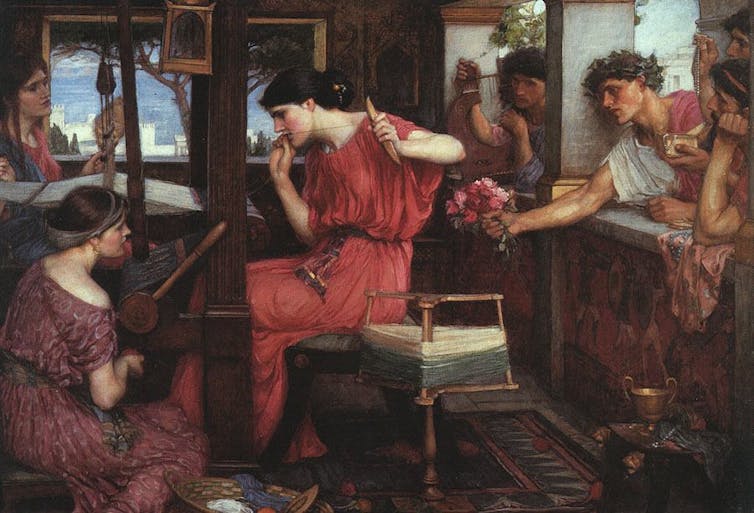
While Odysseus adapts, Penelope endures with strategic resilience. For 20 years, she fends off suitors with deft delay tactics. She avoids them by weaving and unweaving a funeral shroud for her husband’s father, Laertes. It’s a defiant, slow motion resistance campaign, waged with thread and silence.

Painting of Penelope weaving and ignoring suitors
Penelope and the Suitors by John William Waterhouse (1912).
Aberdeen Art Gallery

If Odysseus navigates external monsters, Penelope masters the domestic battlefield. Her fidelity in her husband’s absence is deliberate, political and astute. In a patriarchal world, her power lies in pause. Her story is one of emotional labour and strategic survival.

Narrative loops and non-linear journeys

The Odyssey is an ancient masterpiece of non-linear storytelling. It begins in the middle of the action and uses nested narratives, flashbacks and shifting voices. Odysseus tells much of his own story, reframing events from his point of view and reshaping himself in hindsight. Memory becomes montage. Truth bends to necessity. Fact and fiction bleed into one another.

Homer doesn’t just tell a story – he constructs a labyrinth. The Odyssey anticipates the fractured forms of modernist literature and cinema, where identity is unstable and time itself is malleable.

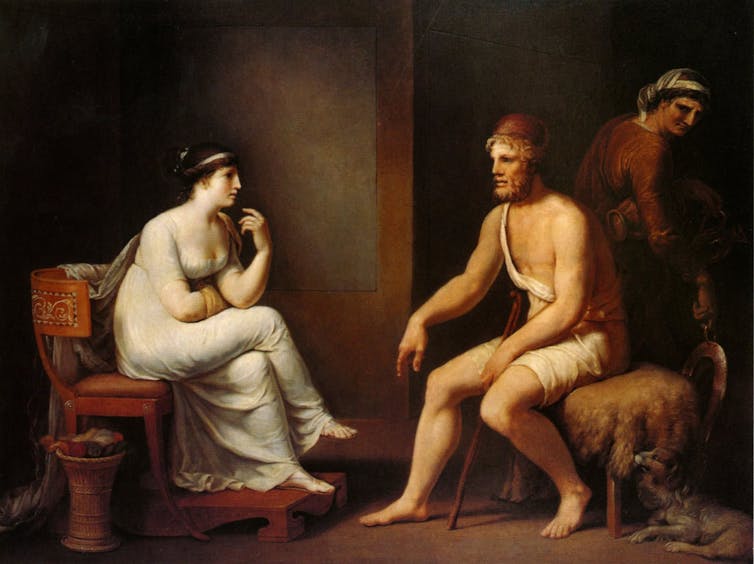
Penelope sitting with Odysseus
Odysseus and Penelope by Johann Heinrich Wilhelm Tischbein (1802).
Wiki Commons

When Odysseus finally returns to Ithaca, disguised as a beggar and quietly assessing his ship’s wreckage, it’s no romantic climax. It’s a calculated risk. Penelope doesn’t swoon; she tests. Only when he passes her intimate knowledge test – he reacts with outrage when she suggests moving their bed, which he built around a living olive tree – does she relent. Their reunion is not a Hollywood embrace but a wary negotiation.

It signals restoration, yes. But also mistrust, trauma and mutual testing. Homecoming, like survival, is complicated.

Odysseus is not a flawless hero. He is a survivor who negotiates with monsters, debates with gods and crawls home disguised as a beggar. A man shaped as much by cunning as by consequence.

Would Odysseus pass a modern ethics exam? Certainly not. Would he charm the professor, flip the question and still walk out with an A? Absolutely. Some stories endure not because they are true, but because they were told by survivors.


This article features references to books that have been included for editorial reasons, and may contain links to bookshop.org. If you click on one of the links and go on to buy something from bookshop.org The Conversation UK may earn a commission.


Get your news from actual experts, straight to your inbox. Sign up to our daily newsletter to receive all The Conversation UK’s latest coverage of news and research, from politics and business to the arts and sciences.

The Conversation

The authors do not work for, consult, own shares in or receive funding from any company or organisation that would benefit from this article, and have disclosed no relevant affiliations beyond their academic appointment.

ref. Who is Odysseus, hero of Christopher Nolan’s new epic? – https://theconversation.com/who-is-odysseus-hero-of-christopher-nolans-new-epic-261781

Vasectomy, pain and regret: what online forum Reddit reveals about men’s experiences

Source: The Conversation – UK – By Kevin Pimbblet, Professor and Director of the Centre of Excellence for Data Science, AI and Modelling, University of Hull

Fabian Montano Hernandez/Shutterstock

Vasectomy has long been regarded as a permanent, safe and effective form of contraception. Its benefits are often summarised as minimally invasive and largely risk-free.

But that may not be the full story.

In recent years, vasectomy rates in the UK have declined significantly. It’s a puzzling trend, given that the procedure’s efficacy hasn’t changed. What has arguably shifted is how men talk about it. Not in doctors’ offices, but online.

As an AI researcher working with large-scale public data, I led a 2025 study using natural language processing (NLP) – a branch of artificial intelligence that analyses patterns in human language – to examine thousands of posts from r/vasectomy and r/postvasectomypain, which are subreddits (topic-specific discussion forums) on Reddit, a social media platform where users share and comment on content in themed communities.

My goal wasn’t to weigh in on urology (I’m not that kind of doctor), but to explore the emotional tone and self-reported outcomes in digital spaces where users speak candidly and in real time.

The findings are revealing and raise important questions about informed consent, online health discourse and the growing influence of social data on healthcare communication.

Fear, regret and pain?

The most common emotional response to vasectomy, whether being considered or already undergone, is fear. To assess this, we used a tool called NRClex, a crowd-trained emotion classifier. This is an AI model trained on thousands of labelled examples to detect emotional tone in text. It found that “fear” dominated more than 70% of user-generated content.

This isn’t surprising. Men on Reddit ask questions like “How bad is the pain?” “How long does it last?” and “Will I regret this?” These are not rare concerns: they’re central to the conversation.

While overall sentiment analysis shows that most users report positive outcomes, a significant minority express deep regret and ongoing pain – sometimes lasting for years after surgery.

This pain is often described as post-vasectomy pain syndrome (PVPS), a relatively little-known condition defined by new or chronic scrotal pain that continues for more than three months after the procedure.

PVPS is poorly understood and may have multiple causes, some anatomical, some neurological and some still unclear. Though some health authorities describe it as “rare,” our Reddit data suggests it could be more common, or at least more disruptive, than currently acknowledged.

We analysed more than 11,000 Reddit posts and found that the word “pain” appeared in over 3,700 of them; roughly one-third. In many cases, the pain described persisted well beyond the expected recovery period. The word “month” appeared in nearly 900 pain-related posts, while “year” appeared in over 600.

This is noteworthy. Post-surgical pain is typically expected to resolve within days or weeks. Yet our dataset suggests that 6%–8% of Reddit users discussing vasectomy report longer-term discomfort – a rate that aligns with the upper estimates in the urological studies. More recent research, including a large-scale postoperative study, argues that the incidence is likely much lower, perhaps under 1%.

Of course, we must emphasise that these are self-reported experiences. Not all mentions of “pain” equate to a formal PVPS diagnosis. It’s also important to acknowledge that people who are dissatisfied with a medical procedure are generally more likely to post about it online – a well-recognised bias in social data. Even so, the volume, consistency and emotional intensity of these posts suggest the issue warrants closer attention from clinicians and researchers alike.

Even more strikingly, around 2% of posts mention both “pain” and “regret”, implying serious, potentially life-altering consequences for a small but significant group of people.

On r/postvasectomypain – a subreddit specifically dedicated to discussing PVPS – the tone is even more sobering. Unsurprisingly, 74% of posts describe persistent, long-term pain. Additionally, 23% mention pain during sex and 27% report changes in sensitivity.

Posts on this forum also frequently reference vasectomy reversal surgery far more often than more specialised interventions such as microsurgical denervation: a complex nerve-removal procedure used in severe cases of chronic testicular pain, typically when other treatments have failed.

From AI to andrology: an ethical crossroads

Why is a professor of AI and physics analysing pain in urology forums?

Because in today’s digital world, people increasingly turn to online platforms like Reddit for health advice, peer support and decision-making – often before speaking to a clinician. As an AI researcher, I believe we have a responsibility to examine how these discussions shape public understanding, and what they can teach us about real-world healthcare challenges.

In this case, it’s possible that the drop in vasectomy uptake is linked, at least in part, to the open and emotional sharing of negative outcomes online. These posts are not scaremongering. They’re detailed, candid and often highly specific. They represent a type of real-world evidence that clinical trials and formal studies don’t always capture.

So, what should we take from all this?

Terms like “rare”, often used in consent forms and clinical conversations, can obscure the complexity and variability of patient outcomes. Pain following vasectomy, whether mild, temporary, chronic or debilitating, appears common enough to warrant more transparent and nuanced communication.

This is not an argument against vasectomy. It remains a safe, effective, and empowering option in reproductive planning. But truly informed consent should reflect both the clinical literature and the experiences of those who undergo the procedure, especially when such experiences are now publicly available in large volumes.

In a world where online forums double as health diaries, support networks and informal research registries, we must take them seriously. Medical language matters. Terms like “rare”, “uncommon” or “low risk” carry real emotional and moral weight. They shape expectations and influence decisions.

If even a small percentage of men experience long-term pain after vasectomy, that risk should be communicated clearly, in plain English – ideally with a range of percentages drawn from published studies.


Get your news from actual experts, straight to your inbox. Sign up to our daily newsletter to receive all The Conversation UK’s latest coverage of news and research, from politics and business to the arts and sciences.

The Conversation

Kevin Pimbblet currently receives funding from STFC, EPSRC, The British Academy, The Royal Astronomical Society, The British Ecological Society, and The Office for Students. None are in direct relation to this work.

ref. Vasectomy, pain and regret: what online forum Reddit reveals about men’s experiences – https://theconversation.com/vasectomy-pain-and-regret-what-online-forum-reddit-reveals-about-mens-experiences-261633

Pacific tsunami: modern early warning systems prevent the catastrophic death tolls of the past

Source: The Conversation – UK – By Ian Main, Professor of Seismology and Rock Physics, University of Edinburgh

The earthquake in Russia’s Kamchatka peninsula on July 30 2025 may have been one of the most severe on record, with a magnitude of 8.8. But innovations in science and technology gave governments vital time to warn and evacuate their people from the resulting tsunami.

Millions of people escaped to higher ground before the tsunami hit.

The 2004 Boxing Day 9.3 magnitude earthquake and tsunami in Sumatra, which caused approximately 230,000 deaths, some as far away as Somalia on the other side of the Indian Ocean, shows how important these warnings are.

Early warning systems were not in place for the Indian Ocean in time for the 2004 disaster. But there is now a system in place, with 27 countries participating in the group effort.

The 2004 tsunami was particularly tragic because tsunami waves travel at a steady speed in the open ocean, about as fast as a jet plane. This means they can take several hours to reach shore across an ocean, with plenty of time for warning.

An early warning system for the Pacific Ocean, based in Hawaii, was created in 1948 following a deadly tsunami two years before. On April 1 1946, the magnitude 8.6 Aleutian Islands earthquake in the northern Pacific Ocean generated a tsunami that devastated parts of Hawaii hours later, leading to 146 fatalities.

The death toll was exacerbated by the leading wave being downwards. This happens in around 50% of tsunamis, and exposes the seashore in a similar way to when the tide goes out, but exposing a larger area than normal. People sometimes investigate out of curiosity, bringing them closer to the danger.

The accuracy and response times of early tsunami warnings have significantly improved since 1948.

How tsunamis happen

To understand the work involved in protecting coastal communities, first you need to understand how tsunamis are generated.

Tsunamis are caused by displacement of mass on the sea floor after an earthquake, landslide or volcanic eruption. This provides an energy source to set off a wave in the deep sea, not just near the surface like in the ocean waves we see whipped up by the wind and storms. Most are small. The Japanese word tsunami translates somewhat innocuously as “harbour wave”.

Detailed global mapping of the sea floor, pioneered by US geologist Marie Tharpe between 1957 and 1978, helped establish the modern theory of plate tectonics. It also improved the physical models for how the tsunami will travel in the ocean.

Wave height increases as it approaches the shore, and the topography of the sea floor can result in a complicated pattern of wave interference and concentration of the energy in stream-like patterns. The establishment of sea-floor observatories led to better data for the pressure at the sea floor (related to wave height) and satellite networks now directly monitor wave height globally using radar signals from space.

One of the factors that has helped scientists predict the range of a tsunami includes the setting up of the worldwide standard station network of seismometers in 1963, which allowed better estimations of earthquake location and magnitude.

These were superseded by the digital broadband global network of seismometers in 1978, which allowed more detail on the source to be calculated quickly. This includes a better estimate of earthquake size, the source rupture area and orientation in three dimensions.

It also tells scientists about the slip, which controls the pattern of displacement on the sea floor. This data is used to forecast the time of landing, the amplitude of the wave on the shoreline, and its height in areas where the wave travels further inland.

The Pacific Ocean warning system now has 46 countries contributing data. It also uses physical and statistical models for estimating tsunami height. The models developed as scientists learnt more about earthquake sources, mapped features on the sea floor and tested model forecasts against outcomes.

Today’s technology

The early warning systems we have today are due to a decades-long commitment to global research collaboration and open data. Scientists have also improved their forecast methods. Recently they started using trained AI algorithms which could improve the timeliness and accuracy.

Pioneered by the US Geological Survey, rapid data sharing is now used routinely to estimate earthquake parameters and make them available to the public soon after the rupture stops. This can be within minutes for an initial estimate then updated over the next few hours as more data comes in.

However, the forecast wave height is inherently uncertain, variable from place to place, and may turn out to be more or less than expected. Similarly, large earthquakes are rare, making it hard to estimate how likely they are on average, and therefore to design appropriate mitigation measures.

The 2011 Tohoku earthquake and tsunami in Japan destroyed or overtopped the eight-metre high protective sea walls that had been put in place based on such hazard estimates. There were over 19,000 fatalities. As a consequence, their height has been increased to 12-15 metres in some areas.

Early warning systems also rely on rapid communication to the public, including mass alerts communicated by mobile phone, coordination by the relevant authorities across borders, clear advice, and advance evacuation plans and occasional alarm tests or drills. Although tsunami waves slow down to the speed of a car as they approach the shore, it is impossible to outrun one, so it is better to act quickly and calmly.

The effectiveness of warnings also means accepting a degree of inconvenience in false alarms where the tsunami height is less than that forecast, because this is inevitable with the uncertainties involved. For good reason, authorities issuing alerts will err on the side of caution.

To give an example, nuclear power plants on Japan’s eastern seaboard were shut down on July 30.

So far it looks like the Pacific early warning system – combined with effective levels of preparedness and action by service providers and decision makers – has worked well in reducing the number of casualties that might have happened without it.

There will always be a level of uncertainty we will have to live with. On balance, it is a small price to pay for avoiding a catastrophe.

The Conversation

Ian Main is professor of Seismology and Rock Physics at the University of Edinburgh. He receives funding from UK Research and Innovation Research Council, a member of the UK Office for Nuclear Regulation Expert panel on external hazards, and acts as an independent reviewer for the Energy Industry-funded SeIsmic hazard and Ground Motion Assessment research program SIGMA3.

ref. Pacific tsunami: modern early warning systems prevent the catastrophic death tolls of the past – https://theconversation.com/pacific-tsunami-modern-early-warning-systems-prevent-the-catastrophic-death-tolls-of-the-past-262283

Yosemite embodies the long war over US national park privatization

Source: The Conversation – USA (2) – By Michael Childers, Associate Professor of History, Colorado State University

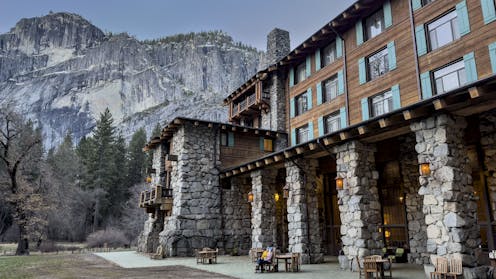
The Ahwahnee is a privately run hotel inside Yosemite National Park. George Rose/Getty Images

The Trump administration’s cuts to the National Park Service’s budget and staffing have raised concerns among park advocates and the public that the administration is aiming to further privatize the national parks.

The nation has a long history of similar efforts, including a wildly unpopular 1980 attempt by Reagan administration Interior Secretary James Watt to promote development and expand private concessions in the parks. But debate over using public national park land for private profit dates back more than a century before that.

As I explain in my forthcoming book, no park has played a more central role in that debate than Yosemite, in California.

Early concerns

In early 1864, Central American Steamship Transit Company representative Israel Ward Raymond wrote a letter to John Conness, a U.S. senator from California, urging the government to move swiftly to preserve the Yosemite Valley and the Mariposa Grove of giant sequoia trees to prevent them from falling into private hands. Five months later, President Abraham Lincoln signed the Yosemite Grant Act, ceding the valley and the grove to the state of California, “upon the express conditions that the premises shall be held for public use, resort, and recreation.” This was years before Yellowstone became the first federal land designated a national park in 1872.

A sepia-toned image of a lake with massive trees and even bigger mountains behind it.
For centuries, the natural beauty of the Yosemite Valley has impressed visitors.
Sepia Times/Universal Images Group via Getty Images

Controversy arose quickly at Yosemite. Two men – James Lamon and James Hutchings – had claimed land in the valley before the federal government gave it to California. Both began commercial operations, Lamon growing cash crops and Hutchings operating a hotel.

California said their businesses threatened the state’s ability to develop roads and trails in Yosemite by competing for tourist dollars. A legal battle ensued and was not resolved until an 1872 U.S. Supreme Court ruling found that the men’s land claims had not been fully validated according to the procedures of the time. The California legislature paid both men compensation for their land, and both left the park.

In 1890, neighboring parts of the Yosemite area became America’s third national park – and in 1906, the federal government again took possession of the Yosemite Valley itself and the Mariposa Grove, specifically to incorporate them into an expansion of the national park.

Development rights

Yet, as my research has found, the role of private interests in the park remained unsolved. Private companies under contract to the National Park Service have long provided needed amenities such as lodging and food within the national parks. But questions over what is acceptable in national parks in the pursuit of profit have shaped Yosemite’s history for generations.

In 1925, I found, the question centered on the right to build the first gas station inside the park, in Yosemite Valley. Two private businesses, the Curry Camping Company and the Yosemite National Park Company, had long competed for tourist dollars within the park. Each wanted to build a gas station to boost profits.

Frustrated over the need to decide, National Park Service Director Horace Albright ordered the rival firms to simplify management of the park’s concessions. The companies merged, and the newly formed Yosemite Park and Curry Company was granted the exclusive rights to run lodges, restaurants and other facilities within the park, including the new gas station.

But as I found in my research, the park service and the concessions company did not always see eye to eye on the purpose of the park. The conflict between profit and preservation is perhaps most clearly illustrated by the construction of a ski area within the park in the early 1930s. The park service initially opposed the development of Badger Pass Ski Area as not conducive to the national park ideal, but the Yosemite Park and Curry Company insisted it was key to boosting winter use of the park.

In 1973, the Music Corporation of America, an entertainment conglomerate, bought the Yosemite Park and Curry Company. The company already had a tourist attraction operating near Hollywood, where visitors could pay to tour movie sets, but had not yet changed its name to Universal Studios or launched major theme parks in Florida and California. Its purchase of the park’s concessions set off a firestorm of controversy over fears of turning Yosemite into a theme park.

That didn’t happen, but annual park visitor numbers climbed from 2.5 million to 3.8 million over the 20 years MCA ran the concessions, which sparked concerns about development and overcrowding in the park. Conservationists argued the park service had allowed the corporate giant to promote and develop the park in ways that threatened the very aspects of the park most people came to enjoy.

With three restaurants, two service stations with a total of 15 gas pumps, two cafeterias, two grocery stores, seven souvenir shops, a delicatessen, a bank, a skating rink, three swimming pools, a golf course, two tennis courts, kennels, a barbershop, a beauty shop, Badger Pass Ski Area and three lodges, the Yosemite Valley was a busy commercial district. Critics argued that such development contradicted the park service’s mandate to leave national parks unimpaired for the enjoyment of future generations.

A few people stand in a large gap within a tree trunk while other people stand nearby.
Crowds gather at some of Yosemite’s most popular sites, such as the California Tunnel Tree.
David McNew/AFP via Getty Images

Who owns the names?

Falling profits and consolidation within the music industry led MCA to sell its concessions rights in Yosemite in 1993. The Delaware North Companies, a global hospitality corporation, took over and ran the park’s concessions until 2016, when it sold the rights to Aramark.

But in that sale, the question of public resources and private profits arose again. Delaware North demanded $51 million in compensation for Aramark continuing to use the names of several historic properties within the park, such as the Ahwahnee, a hotel, and Curry Village, another group of visitor accommodations. The company claimed those names were a part of its assets under its contract with the park service.

The park service rejected the claim, saying the names, which dated back more than a century, belonged to the American people. But to avoid legal problems during the transition, the agency temporarily renamed several sites, including calling the Ahwahnee the Majestic Yosemite Hotel and changing Curry Village to Half Dome Village. Public outrage erupted, denouncing the claim by Delaware North as commercial overreach that threatened to distort Yosemite’s heritage. In 2019, the park service and Aramark agreed to pay Delaware North a total of $12 million to settle the dispute, and the original names were restored.

Protesters unfurl an upside-down U.S. flag from the top of El Capitan in Yosemite National Park in February 2025, protesting Trump administration changes to the National Park Service.

Renewed interest in commercial efforts

In June 2025, Yosemite again took center stage in the dispute over the role of federal funding versus private interests at the start of the second Trump administration when a group of climbers unfurled an American flag upside down off El Capitan in protest of the administration’s cuts in personnel and slashing of the park service’s budget.

Conservationists, including former National Park Service Director Jonathan Jarvis, argued that by defunding the park service and laying off as much as a quarter of its workforce, the Trump administration was “laying the groundwork to privatize” the national parks by allowing corporate interests more access to public lands. Those concerns echo ones raised during the first Trump administration, when the White House argued privatization would better serve the American public by improving visitor experiences and saving federal dollars.

Whichever side prevails in the short term, the debate over the role of private interests within national parks like Yosemite will undoubtedly continue.

The Conversation

Michael Childers does not work for, consult, own shares in or receive funding from any company or organization that would benefit from this article, and has disclosed no relevant affiliations beyond their academic appointment.

ref. Yosemite embodies the long war over US national park privatization – https://theconversation.com/yosemite-embodies-the-long-war-over-us-national-park-privatization-261133